Culture

Culture

Sensei it again

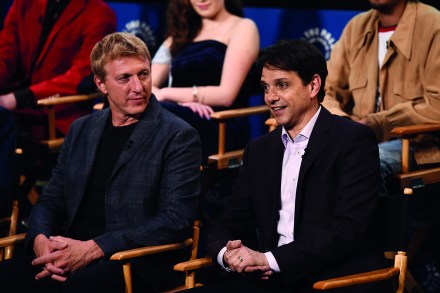
Almost the best thing about Cobra Kai is the response, somewhere between bemused and appalled, it has generated among woke millennials and Gen Z-ers. One reviewer noted with concern that neither of the two featured karate schools is run by someone of Japanese ethnicity. Another squirmed at two middle-aged men’s almost Trump-level inappropriateness, when while discussing the qualities of a mutual old flame they referred to their inamorata’s ‘tightness’. Yes. It’s one of the reasons we Eighties dinosaurs love it so. Cobra Kai is our safe space. It’s our Helm’s Deep of unreconstructed sexism in an otherwise Orcish horde-overrun Middle Earth of gender fluidity, #MeToo and micro-aggressions.
cobra kai

Monumental Mahler

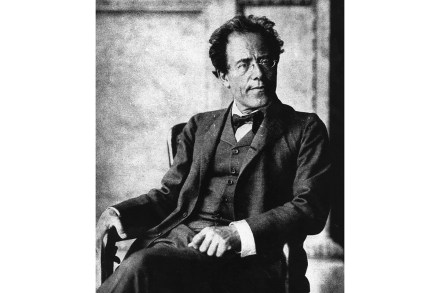
A kind of gigantism took hold of the European mind in the years before World War One. It shaped everything, from empires to poetry. In the confidence of new technology and new ideas, things could be attempted on a larger scale than ever before. The mental power of the age could be measured in the sheer size of the things it produced. This might be ‘Jacky’ Fisher’s Dreadnought of 1906, which set off a European arms race in huge battleships, or a great construction — the Victoria memorial in front of Buckingham Palace is nothing to the one built in Kolkata.

mahler
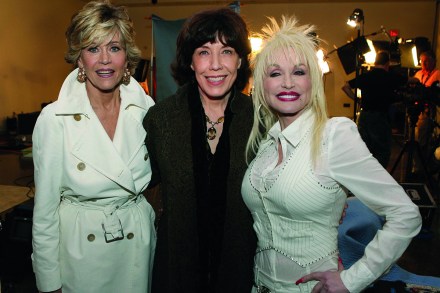
dolly parton

Morals and mortality

There is a moment in the first episode of Dolly Parton’s America when you think the sainted songstress may have made the worst mistake of her career. ‘Do you think of yourself as a feminist?’ asks host Jad Abumrad. ‘No, I do not,’ Dolly says. There is a pause as wide as the gap between those who have four-year degrees and those who don’t. After Dolly says she thinks feminism means hating men, Abumrad cuts to an interview with feminist, Heartland author and Dolly superfan Sarah Smarsh. They grasp for a reason why Dolly would think so non- progressively. The interview starts to feel like a wake.

Still painting after all these years

On March 14, 1847, Eugène Delacroix made a trip to the studio of his colleague and countryman Camille Corot. Later that day, Delacroix recorded in his journal a feeling of newfound appreciation for the painter’s landscapes: ‘Corot is a true artist. One has to see a painter in his own place to get an idea of his worth.’ The Corot paintings that Delacroix had recently viewed at the Paris Salon seemed to hold new meaning after his seeing the site of their creation. As to exactly what had changed, or what he saw that changed it, Delacroix does not — perhaps could not — tell us. Few modern painters can claim as close a kinship to the spirit of Corot as Paul Resika.

resika

The perception of doors

The architectural historian Andrew Alpern has for decades done the dirty work when it comes to pre-war New York apartments. Others have presented glossy coffee-table books full of newly commissioned professional photographs. Alpern has focused on the practical details of apartment design, especially floor plans, which tell us so much about how people actually live in their apartments, or at least were originally meant to. His Apartments for the Affluent (1975), Historic Manhattan Apartment Houses (1996) and New York Apartment Houses of Rosario Candela and James Carpenter (2002) are essential compendia; anyone with an interest in New York residential architecture, especially of the magnificent variety, must have them. The more industrious uptown real estate agents also find them useful.

doors

The art of the presidency

The Obamas loved Hamilton. It was the biggest show to hit Broadway since Cats or Rent, with ticket prices reaching four digits. Michelle, who urgently needs to read Buddenbrooks or visit the Sistine Chapel, called Lin-Manuel Miranda’s musical the ‘best piece of art in any form that I have ever seen in my life’. Hamilton was present at the dawn and eclipse of the Obama years. Miranda first publicly shared material from the musical at the White House’s inaugural Spoken Word evening in 2009. Seven years later, Lin-Manuel joined Barack for a cringe-inducing freestyle rap in the Rose Garden.

art presidency

Out of Nam’s way

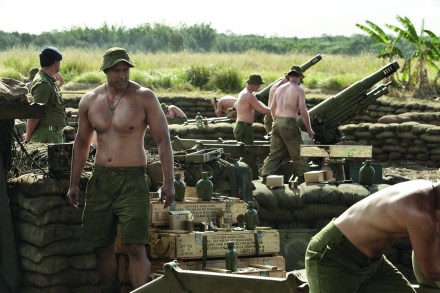
When I was a teenager whiling away the endless hours with VHS video rentals, Vietnam movies were pretty much the only game in town. I must have watched The Deerhunter a dozen times, and the scene in the rat-infested river cage well over a hundred times. Even now, I can’t watch it without being surprised at how De Niro manages to pull off that extraordinary escape stunt. My, how I covet those tiger-stripe Special Forces camouflage fatigues. The problem is, The Deerhunter has loads of boring non-war stuff either side of the good bits. That’s why I much prefer Platoon — controversial choice, Oliver Stone being a pinko — all of which takes place in-country.

nam

The eyes have it

Art historians do not generally become household names, as Kenneth Clark did later in life after embracing television, most famously with Civilisation (1969). They can, however, acquire legendary or semilegendary status within the profession and among amateurs. One such was Leo Steinberg (1920-2011), who taught for many years at the City University of New York and the University of Pennsylvania. Academic art historians are expected to ‘publish or perish’: college texts, monographic studies on individual artists, or down-the-rabbit-hole treatises on arcana that seem to require more pages of footnotes than text. Steinberg mainly wrote for professional journals. He also lectured widely, testing ideas that later might make their way into print.

steinberg

We’re not going to take it — again

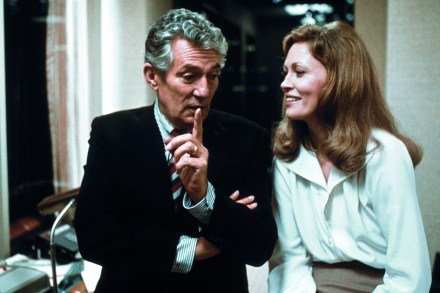
The everyday experience of 2020 includes televised demagogy and a national media making pure spectacle out of domestic terrorism and race riots. The less we believe what we see, the stranger the sights become. These experiences are also the story of Network, the 1976 Paddy Chayefsky/Sidney Lumet hit which won four Oscars out of its 10 nominations. We must ask ourselves why are we living out the 1970s again and, indeed, enacting its satire in deadly earnest. Marx said history repeats itself, first as tragedy, then as farce, but what did he know of Hollywood? A remake is the safest bet. We, however, have reversed Marx’s sequence.

network

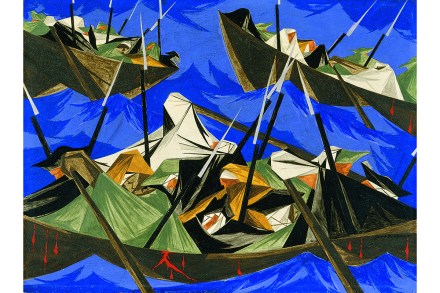
Liberty and death: Jacob Lawrence’s struggle for freedom

Few artworks could be more responsive to the current upheaval than Jacob Lawrence’s 1954-56 series ‘Struggle...From the History of the American People’. Painted during the dawn of the Civil Rights movement, the cycle of 30 panels tells a history of the American Founding through punchy modernist vignettes, engaging with timely and timeless topics such as brutality, race, memory, justice and our shared national heritage. At the Metropolitan Museum of Art, 24 of the original panels have been reunited for the most complete exhibition of the series since its original showing more than six decades ago. The exhibition will travel to Birmingham, Seattle and Washington, DC from New York.

jacob lawrence

Office romance: I’m loving The Bureau

One of the many things I love about the horribly addictive French spy series The Bureau is that it never attempts to improve you with pious little homilies about how foreigners are just the same as us, with values just as worthy as our own, so they should be treated with the same amount of respect, for are we not all children of God? If The Bureau — about the DGSE, France’s equivalent of the CIA — had been made in the US, there would be a specially created nice, upstanding, Americanized Muslim character like the agent in The Looming Tower or the implausible black Muslim character in Jack Ryan.

bureau

Human after all

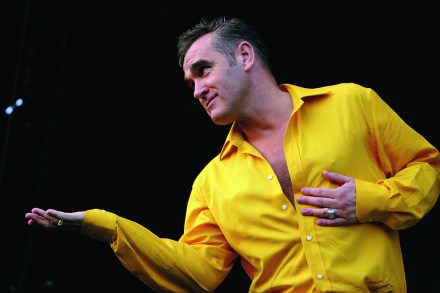
As the weird world of lockdown winds down, we might pause to consider what we’ve learned. I am hardly alone in my heightened hankering to unravel, synthesize, undo and discard. In this mission a voice from the past is helping me piece things together anew as the strange tyranny begins to dissolve. It began when Google started throwing videos of the Smiths in my daily cyberpath, prompting a non-essential trip down Memory Lane. Back in the day, I was, as David Cameron used to boast, a ‘huge fan’ of the Smiths. Precisely, I was a fan of Johnny Marr’s guitar literacy and the persona of Morrissey, the enchanting singer who had jettisoned his given names.

morrissey

Guerra goes to war

Every civilization needs its barbarians. Lazy, filthy, dumb and dangerous, the barbarian, real or imagined, is the eternal grindstone on which the civilized sharpen their prejudices. They are, as the Greek Alexandrian poet Constantine Cavafy wrote, ‘a solution of a sort’ — but to what? In Cavafy’s poem ‘Waiting for the Barbarians’ (1898), an unnamed city is gripped by cultural torpor and political sloth. The gridlocked citizens, weakened by indolence and luxury, dream of a bloody release from their troubles. Disaster, a visit from the barbarians, becomes their last hope for rebirth. You don’t need to be a specialist to see the parallels between the poem and the illicit undercurrents of politics in the 2010s.

barbarians guerra

Meet the Mozarts

It’s 1771, you’re in Milan, and your 14-year-old genius son has just premiered his new opera. How do you reward him? What would be a fun family excursion in an era before multiplexes or theme parks? Leopold Mozart knew just the ticket. ‘I saw four rascals hanged here on the Piazza del Duomo,’ wrote young Wolfgang back to his sister Maria Anna (‘Nannerl’), excitedly. ‘They hang them just as they do in Lyons.’ He was already something of a connoisseur of public executions. The Mozarts had spent four weeks in Lyons in 1766, and, as the music historian Stanley Sadie points out, Leopold had clearly taken his son (10) and daughter (15) along to a hanging ‘for a jolly treat one free afternoon’.

mozart

Purple podcasters

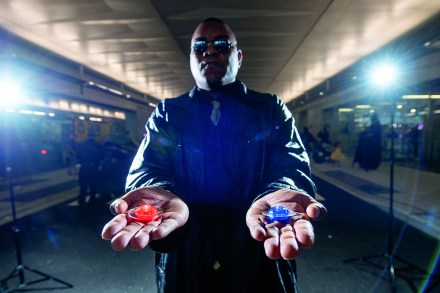
You’re familiar, no doubt, with the term ‘red pill’, the Matrix-inspired metaphor that’s become a catch-all for the type of right-wing thinking that thrives in the dark corners of the internet. Now the journalist Katie Herzog, in an admittedly tongue-in-cheek comment, might well have given us a new term: the purple pill. To take the purple pill, inferring from Herzog’s outlook, is to oppose the dangerous excesses of identity politics, but also the reactionary extremes of the red-pillers. This is, simply, a compromise — or the kind of terminally sensible position that shouldn’t need corny movie metaphors in the first place. But you see her point.

purple pill katie herzog

Statues and limitations

Statues do more than monumentalize individual achievement. They embody the self-image of those who raise, cherish and preserve them. It is this common self-conception that is being upended by the wave of iconoclasm that is sweeping through American cities. The race to raze structures that have stood untouched for decades or centuries disturbs because, instead of reassessing the past, it attacks it to reorder the present. Wherever you stand on this, the ‘debate’ is limited by Western visual traditions and stunted by patchy education. In Wisconsin, the abolitionist Hans Christian Heg was yanked down. In San Francisco, Ulysses S. Grant, a president who set the US Army on the Klan, was deposed. In Washington, DC, Gandhi, once praised by W.E.B.

statues

Perry Mason jars

Unpopular opinion: film noir is dull, self-indulgent and grossly overrated. I recognize it has given us some great performances — Bogart, Peter Lorre and Sydney Greenstreet in The Maltese Falcon, say — as well as chiaroscuro lighting, laconic dialogue, cynical hard-bittenness and cancerously heroic quantities of smoking. But that’s exactly the problem. Film noir is so in love with its look and style, the plotting comes a very poor sixth. What, though, does any of this have to do with Perry Mason, the suave, brilliant, clean-cut lawyer played by Raymond Burr in the long-running Fifties and Sixties courtroom drama series? Well, bizarrely, HBO has decided to revive him for another of those dark and grimy origin stories that Joker made so fashionable.

perry mason

Revolution then: The Patriot stands alone

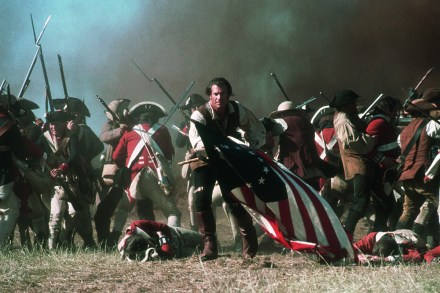
You’re the director of one of the biggest blockbusters in recent memory. Your latest project premiers Fourth of July weekend: an American Revolution epic, headlined by one of Hollywood’s most bankable stars. What could go wrong? In 2000, Roland Emmerich did everything right with The Patriot. Robert Rodat, a veteran of Saving Private Ryan, wrote the script. The Smithsonian Institute consulted on historical accuracy. Mel Gibson, who had led the charge in Braveheart, was the star. He was also People’s ‘Sexiest Man Alive’. ‘The problem I have is people love me so much, they never criticize me,’ Gibson lamented in a cameo on The Simpsons in 1999. ‘It’s hell being Mel.’ Cinematic hell is where The Patriot remains.

patriot

Louis C.K. pulls it off

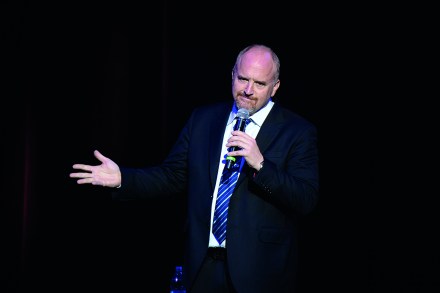
‘You are so lucky that I don’t know your thing. Do you understand how lucky you are?’ comic Louis C.K. tells his comeback show audience. ‘Everybody knows my fucking thing, now. Obama knows my thing. Do you understand how that feels? To know that Obama was like “Good Lord!”’ It’s a good point well made. Everyone who knows anything about the world of comedy does indeed know Louis C.K.’s thing. In 2017, when #MeToo exploded, C.K. was ranked by Rolling Stone number four among the 50 best stand-up comics of all time. His sexual proclivity was publicly exposed, he lost numerous television deals and movie contracts and he suddenly found himself cast into outer darkness. All in all, it cost him an estimated $35 million in lost income.

louis c.k.

Tori rebel

In her new book, the singer-songwriter Tori Amos advises aspiring artists to be wary of those who would lead them astray. ‘Most people cannot raise their hand and say, “Your expression, your piece, your song, your art, is not to my taste; in fact I have an aversion to it, but I think it’s brilliant.” And that means that... some people judge something to be good or not good by what they personally like. Beware of this, I say to all artists.’ The simple sentiment encapsulates why so much creative potential is stifled before it can flourish. An artist whose principal goal is to please an imagined audience, or to adapt his or her work to critical trends, is no kind of artist at all.

tori amos

I hate the Nineties

I’m a Nineties kid. You know what that means: Tamagotchis, Super Mario, Sega, primitive cell phones, slap bracelets, skateboarding, The Simpsons, Seinfeld, David Koresh, scooters, Britney Spears, the Backstreet Boys, the Spice Girls, the first bombing of the World Trade Center, the Nato bombing of Sarajevo, Pokémon!, Blink-182, Bill Clinton, Friends and the friends of Bill Clinton. What a decade! Only Nineties kids will understand it. And as even Nineties kids grow up, Nineties nostalgia is now big business. Everyone from the Spice Girls to Smashing Pumpkins has launched comeback tours on a rising tide of misty-eyed affection. McDonald’s brought back Tamagotchis and Furbys and other veteran Happy Meal toys. Friends is set to make a highly profitable return.

nineties

Count my blessings

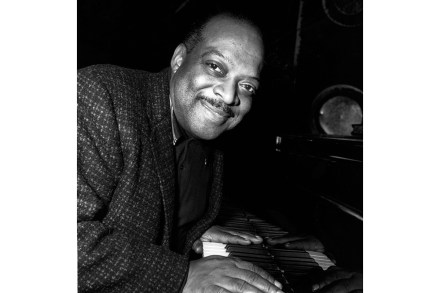
I have to laugh when I read about my Baby Boom cohort’s memories of savoring rock ’n’ roll behind the backs of disapproving elders. I had no such problem. I wasn’t especially taken with the new sounds of the Fifties: I was six years old when Elvis Presley debuted on the Ed Sullivan Show. I thought he was vaguely comical. In any case, my parents had resolutely high-minded middlebrow taste in such things, wavering somewhere between Dvorak, Lawrence Welk and Mozart. Rock ’n’ roll was simply out of the question. Everything else heard in the household — country and folk music, in particular, which my elder siblings’ favored — was tolerated to some degree, but my own secret musical vice was not.

count basie

The shape of things

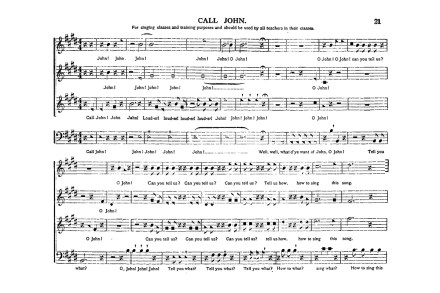
On January 23, Dr Stephen D. O’Leary, a retired professor of communications at the University of Southern California, posted a poem by George Eliot to his Facebook page. It begins: ‘O May I join the choir invisible / Of those immortal dead who live again’. For 25 years Stephen was one of my closest friends in the world. I still can’t believe that I have to use the past tense when talking about him. He pressed ‘send’ on that Facebook post at 4:47 p.m. At one in the morning he joined the choir invisible. Although his heart attack was unexpected, we knew we were going to lose him. He called me the day after he was diagnosed with liver cancer. ‘I’m not afraid of dying. It’s going to be interesting,’ he said.

shape-note singing

The similarity between Charles Dickens and Armando Iannucci

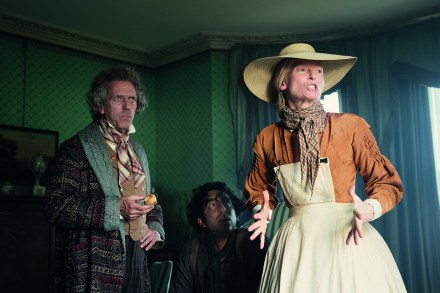
A true adaptation of David Copperfield is neither possible nor even desirable. It would last as long as it takes to read the novel, say, two weeks. The principal cast would number in the dozens, and the extras — the clerks, lawyers, policemen, landlords, cooks, chimney sweeps, pickpockets, sailors, ministers, soldiers, beggars, porters, carters, fishermen, coachmen, pimps, gypsies and whores — in the hundreds of thousands. Replicating the cellars, garrets, galleries, museums, bridges, pubs, factories, shipyards, docks, scaffolds and debtors’ prisons of Victorian London would require construction on a Himalayan scale.

david copperfield

Salvant grace

Jazz has traditionally been a male preserve — all 15 of the Jazz at Lincoln Center Orchestra are men — but jazz singing is the exception. Later this year, Netflix will release Ma Rainey’s Black Bottom, based on the superb play by August Wilson and starring Chadwick Boseman and Viola Davis. If the movie adheres to the spirit of the play and its subject (Rainey, the ‘Mother of the Blues’, sang frankly sexual songs in a moaning style), it is sure to ignite a fresh interest in her tempestuous life and career. The imperious Rainey wasn’t simply a gifted singer, but also an astute talent-spotter.

salvant

What can we learn about coronavirus from classic cinema?

Batavia, New York With the first blizzard of every winter I take John Greenleaf Whittier’s Snow-Bound off the bookshelf, and though I never quite make it through to the end, when the snow is ‘melted in the genial glow’, I feel as if I have hunkered down for the week with the ‘Barefoot Boy’ poet’s besieged shut-ins. So when the Kung Flu — excuse me; I forgot for a moment that mild humor is now as verboten as sweaty raves and square dances — kicked its way into our lives, but before the local library shut down, I, like everyone else — well, like a tiny sliver of the populace — reached for Camus’s...Camus’s...oh, the hell with it: The Plague by Albert Camus.

peckinpah classic cinema

Joe Exotic is an ordinary American

Netflix’s Tiger King has been touted as ‘the only show that’s crazier than the world outside right now’. Besides being weird beyond measure — a seven-part freak show combining meth-heads, involuntary amputees, firearms, sex cults, gay polygamy, cocaine, rednecks, attempted murder and, yes, more tigers than you could shake a flaming torch at — it offers fascinating parallels with the most important debate of our time: the eternal conflict between liberty and authority. As you may have noticed, this coronavirus pandemic has brought out the best and the worst in people and produced two highly polarized visions of the world.

tiger king

The bloody decade: think America’s divided now? Try the 1970s

Late on the afternoon of November 29, 1984, Susan Rosenberg and Timothy Blunk were loading boxes into a blue Oldsmobile Cutlass sedan and a U-Haul trailer parked at a self-storage facility in Cherry Hill, New Jersey, not far from Philadelphia. The boxes were heavy, so despite the autumn chill and the wind, Rosenberg and Blunk were working up a sweat. Both wore glasses as part of their disguises. Blunk had an ill-fitting wig that he barely managed to keep on his head. An FBI wanted poster called Rosenberg armed and extremely dangerous, and the Bureau wasn’t wrong. On the front seat of the Olds, purses held semiautomatic pistols — an Interarms Walther PPK .38 caliber and a Browning Hi-Power 9mm. They were both fully loaded.

susan rosenberg

Conscious coupling

Most of the podcasts that sell relationship advice imply that romance is synonymous with sex. The theory of that equivalency has been a theme in the arts for centuries: Shakespeare, Flaubert, Thackeray and Tolstoy all exposed its follies and truths. Unsurprisingly, the podcast hosts have a less poetic, nuanced note than the classic writers, such as giving the advice: ‘If you’re having a dry spell, listen to us or break up.’ Tony and Alisa DiLorenzo are a Christian couple who have married for 23 years. Perhaps surprisingly, their podcast, ONE Extraordinary Marriage, depicts sex and romance as interchangeable. Tony and Alisa, who couple on the page in their co-authored book 7 Days of Sex Challenge, start each episode with a ‘hug’.

anna faris coupling podcasts