New york times

The left’s great Twitter evacuation

The smell of Musk is in the air, and it’s causing Twitter’s left-wing users to clear the room — or so they say. Their threats to vacate cyberspace started a few weeks ago as free speech absolutist Elon Musk, in short order, became the largest shareholder of the social media firm, was offered a seat on its board, declined that seat, and made an offer to buy the firm outright. They rose to a fever pitch yesterday, as Musk’s $44 billion offer to take the company private was accepted. Twitter’s liberal users buckled under the fear of unmoderated political discussion and even, perhaps, the return of the famously suspended Donald Trump.

Pelosi fights, McCarthy flails

Recently, money was extracted from the taxpayers at gunpoint to create a PBS puff piece about Nancy Pelosi. Called "Pelosi's Power," the documentary is more or less what you'd expect: Pelosi comes off as a strong if sphinxlike figure surrounded by idiot men who can't seem to stop slipping on banana peels and starting riots. Her infamous 2009 lies about waterboarding, her bizarre slandering of her own hair stylist — all of it gets overlooked in favor of the usual "you go, girl!" narrative reductionism. Yet there is one thing about the piece that holds up well: its title. Whatever else can be said about Nancy Pelosi, she knows how to wield power. And little wonder, given that she grew up in Baltimore's Little Italy neighborhood where her father was a political broker.

Standing with J.K. Rowling

When Roland Barthes wrote his 1967 essay “The Death of the Author,” he probably didn’t intend that, fifty-five years later, a major American news outlet would be provocatively suggesting that the world’s bestselling author should be de-personed, de-platformed or de-materialized from history. And yet that is exactly what has happened with the New York Times. They recently ran a series of advertisements on the subway featuring a reader named “Lianna” who is, as much of their subscriber base now are, “breaking the binary,” experiencing “queer love in color” and meditating on “heritage in rich cues.” So far, so predictable. But the ads took a grimmer turn when one suggested that Lianna was “imagining Harry Potter without its creator.

Rowling

Free speech folly at the New York Times

I suppose we should be grateful that the New York Times has finally come out in favor of free speech. After more than four years of hysterical denunciations of anyone who questioned the tactics, rhetoric or punishments employed by #MeToo, Black Lives Matter or transgender activists — some of which were inspired by the Times’s own reporting and editorials — America’s “paper of record” has apparently become woke to the problem of mob intimidation and its deleterious impact on what the mainstream media likes to refer to as “robust” democratic debate.

new york times

Finding the religious right in remote Wisconsin

The New York Times has re-discovered the religious right. In a front-page story, we learn the awful truth that there is a "right-wing political movement powered by divine purpose, whose adherents find spiritual sustenance in political action." They sing hymns; they pray; they burn candles. They import “their worship of God, with all its intensity, emotion and ambitions, to their political life.” Quite a few support Trump and also protest “against Covid restrictions,” among other unspeakable acts. Once, long ago, I ventured into this dark territory, not armored by the shield of New York Times-style contempt for the deplorables, but like Marlowe heading up river into the Heart of Darkness. It was a hard-won lesson.

Democrat gets bitten by fox — and hypes the CDC

Authorities have finally done something about the aggressive, rabid critters that lurk around our nation’s capital and slink from their dens on the Hill to assault honest people for no good reason. Cockburn has encountered all sorts of such creatures on various Capitol Hill pub crawls, but the type the police just decided to address was neither a blundering elephant nor an indignant jackass. Neither was it a Blue Dog, one of those endangered porcupines that rarely appear in the Swamp, nor even a squawking chicken hawk. It was a red fox. A cute little lady fox with a majestically bushy tail, black-tipped ears and feet, white markings on her chest and muzzle, and shining black eyes. People first started posting images of the fox on Monday.

NY Post shames intel officials who flacked for Hunter Biden

Take Cockburn's hand and let him whisk you back to the halcyon days of fall 2020. The presidential campaign was in full swing and the New York Post had just gotten its hands on a scoop: Hunter Biden, the son of Joe Biden, had left his laptop at a repair shop in Delaware. On its hard drive was a treasure trove of damning emails and pictures, including one that appeared to show Hunter passed out in bed with a crack pipe in his mouth. The Post published its story, the Biden campaign yelped, and the establishment duly lost its mind. The Post's Twitter account was suspended. And perhaps most damningly, fifty-one intelligence "experts" signed a letter warning that the laptop story could be Russian disinformation.

walter duranty

The reporter who covered up the Ukrainian famine

Now would seem to be an excellent time for the Pulitzer Committee to withdraw the award it bestowed on Walter Duranty in 1932 for his reporting on events in the Soviet Union. I know I am far from the first to call on the Pulitzer Committee to withdraw the award. I know as well that the Pulitzer Committee responded to one such call in 2003 by declaring that it could find no “clear and convincing evidence of deliberate deception” in Duranty’s 1931 reports from the Soviet Union published in the New York Times in 1931. Those thirteen reports on which the original award was based, admits the Pulitzer statement, amount to work that “measured by today's standards for foreign reporting, falls seriously short.” And time has moved on, etc., etc.

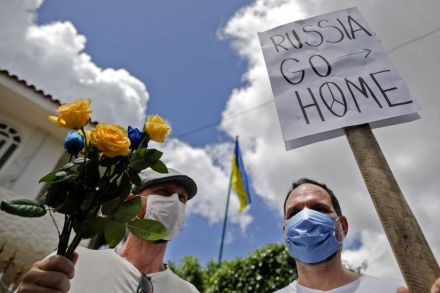
The Ukraine invasion is nothing compared to Iraq

Of the war in Ukraine, New York Times columnist Thomas Friedman writes, “Our world is not going to be the same again because this war has no historical parallel.” In the very next sentence, he describes the Russian invasion of Ukraine as “a raw, eighteenth-century-style land grab by a superpower,” thereby acknowledging that the episode actually has innumerable historical parallels — just not ones that Friedman cares to acknowledge as legitimate. Friedman figures prominently among those claiming to have divined the essential character of the present age. His key finding: tech-driven globalization has rendered old-fashioned power politics obsolete. The rules of the game have changed irrevocably. Practically speaking, nations have no choice but to submit.

invasion iraq

Why the Trump toilet story stinks

While President Trump was in office, White House staff periodically discovered wads of printed paper clogging a toilet and came to believe the president had personally flushed documents. So reports the New York Times' Maggie Haberman, based on anonymous sources. Why should a literate media consumer think the story is garbage? Read it like an intelligence officer. Start by applying some of the same tests intelligence officers do to help them evaluate their own sources. Thinking backwards from the information to who could be the source is a good start when evaluating credibility. For example, is a source in a position to know what they say they know, what intelligence officers call spotting?

blogger

The new unpatriotic conservatives

The die against conservatives opposed to the Iraq war was cast by David Frum in a now-infamous essay for National Review back in 2003. Not only were the right's antiwar sorts unpatriotic, Frum charged, they were defeatist and conspiratorialist appeasers. “They have made common cause with the left-wing and Islamist antiwar movements in this country and in Europe,” he wrote. As one can imagine, this made it quite difficult for this small but active faction of the conservative movement (which included the American Conservative magazine and libertarians like Texas Congressman Ron Paul) to penetrate the mainstream, or build trust with their compatriots across the aisle.

Sarah Palin takes the New York Times to court

Former Alaska governor Sarah Palin is taking the New York Times Company (NYT) to trial in February for alleged defamation. Palin, according to her lawsuit, filed suit in order “to hold…NYT accountable for defaming her by falsely asserting what they knew to be false: that Governor Palin was clearly and directly responsible for inciting a mass shooting at a political event in January 2011.” Palin is alleging that NYT “falsely stated as a matter of fact to millions of people that Gov. Palin incited Jared Loughner’s January 8, 2011, mass shooting at a political event in Tucson, Arizona, during which he shot thirteen people, severely wounding United States congresswoman Gabrielle Giffords, and killing six others.

Inside the Omicron fear factory

In March 2020, a profile of the typical Covid victim emerged from Italy. The average decedent was eighty years old, with approximately three comorbidities such as heart disease, obesity or diabetes. The young had little to worry about; the survival rate for the vast majority of the population was well over 99 percent. That portrait never significantly changed. The early assessments of Covid out of Italy have remained valid through today. And so it will prove with the Omicron variant. The data out of South Africa, after five weeks of Omicron spread, suggest that Omicron should be a cause for celebration, not fear.

omicron fear

Michelle Goldberg and the art of the Big Lie

Lies come in all shapes and sizes, colors, odors, textures and tastes. Some are only little white lies, but more often the accompanying adjective suggests something unpleasant. Damnable lies used to be the most condemned, but today the foulest of all perfidious, incarnadine, silken and sulfurous lies are Big Lies. Thus when New York Times columnist Michelle Goldberg wants to reassure progressive voters that they can ignore the story about a ninth-grade girl who was raped (i.e. forcibly sodomized) in a girl’s restroom in a Loudoun County, Virginia school, she serves up her diversion under the title “The Right’s Big Lie About a Sexual Assault in Virginia.

big lie

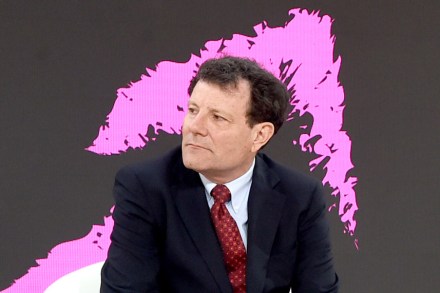
Nick Kristof and a tale of two Oregons

The long-serving New York Times opinion writer Nick Kristof apparently now wants to be governor of Oregon. The 62-year-old media superstar seems to be a rather changeable sort of chap. It might almost seem he’s one of the many New York-area residents to have had their identities stolen. Perhaps it was an old platinum credit card, carelessly tossed in a Midtown trash can, which allowed the criminals to strike, or perhaps the purchase over the phone of a first-class air ticket to one of the exotic locales his business frequently takes him. Whatever it was, it’s difficult to reconcile the superbly cerebral, crusading double Pulitzer Prize-winner and regular CNN contributor with the self-styled ‘Oregon farmboy’ with his finger firmly on the Beaver State’s troubled pulse.

nick kristof

Whipping up a crisis

'It’s a little thing, but a big little thing.’ I’ve been using this not-exactly-eloquent phrase lately to describe a category of observation that could be written off as nitpicking, but which isn’t, really. If you notice enough big little things, you might just be able to explain how the world works. One big little thing I’ve been thinking a lot about lately comes from ‘Another Crisis at the Border’, the September 27 edition of The Daily, the blockbuster New York Times podcast. The episode was hosted by Astead Herndon and was mostly a conversation between him and his fellow Times reporter Michael Shear. They discussed the growing crisis at the US/Mexico border, and the large group of mostly Haitian migrants fleeing political and natural disaster.

border

Setting fire to my house was an act of radical self-love

One of my favorite pastimes is reading those alternate-lifestyle essays that the left-wing media loves to publish unironically. You know the sort: Why I quit my job at a high-powered social media firm to become a minimum-wage pansexual. Or: How my open relationship with three maple trees and a rhinoceros helped me find inner peace. The august New York Times rarely indulges such deviancy, if only because the cardinal rule of that paper's op-ed page is to never let down one's guard lest one accidentally say something interesting. Yet recently the Times did make a modest exception. Last week it ran an essay by Lara Bazelon titled 'Divorce Can Be an Act of Radical Self-Love’.

self-love

The New York Times tips its anti-Semitic hand

After the House of Representatives decided yesterday that it would be, well, a bit much to leave millions of Israeli civilians at risk of being blown up in their own beds, the 'progressive' wing of the Democrat party was devastated. 'Minutes before the vote closed, Ms Ocasio-Cortez tearfully huddled with her allies,' ran a heartrending report in this morning's New York Times, describing the House’s 420-to-9 decision to approve funding for Israel’s Iron Dome missile defense system. 'The tableau underscored how wrenching the vote was for even outspoken progressives, who have been caught between their principles and the still powerful pro-Israel voices in their party, such as influential lobbyists and rabbis.

new york times

Exclusive: the New York Times stole my story

Question: When is a New York Times exclusive not a New York Times exclusive? Answer: On Sunday, when America’s paper of record stole my scoop. It sounds bizarre, but it’s true. Last February, I revealed top-secret details of the killing of the Iranian nuclear scientist Mohsen Fakhrizadeh in the pages of London’s Jewish Chronicle, the world’s oldest Jewish newspaper. Among the revelations — given to me by impeccable sources that I know well — were that the top Tehran official had been killed by Mossad using a remote-controlled gun that weighed one ton and had been smuggled into Iran piece by piece over several months.

new york times

NYT dogged by snarling anti-Trumpers

'Can We Drop a Dog Walker for Her Political Opinions?' asks a letter-writer to this week’s edition of the New York Times’s ethicist column. The writer laments that they have hired a 'reliable, responsible, and kind' person to walk the family dog. The problem? Beneath the visage of humanity, the dog walker is actually a monstrous Trump voter. Rather than stop and ponder the implications of a Trump voter being, in fact, a rather decent human being, the writer gets right to the meat of the matter: Should they fire the dog walker immediately? Kwame Anthony Appiah, the NYT’s ethicist, was relatively measured in his response. 'A manager who penalizes a regular employee for her political views is exercising workplace tyranny,' Kwame writes.

nyt