Food

I’ve come to love the onion

‘Life,’ Carl Sandburg says, ‘is like an onion. You peel it off one layer at a time, and sometimes you weep.’ Carl, being a poet, was the sensitive type. You’d better believe that when Chuck Norris peels an onion, the only crying comes from the onion. But Chuck’s iron-jawed impassivity isn’t a trait I personally seek to emulate (though one is naturally curious about the type; did you know that when Chuck goes to a feminist rally, he leaves with a freshly ironed shirt and a sandwich?) I freely admit that both life and onions have occasionally brought me to tears. Especially onions. Julia Child thought it hard to imagine a civilization without them, but as a seven-year-old I vigorously disagreed.

Onion
Sandwiches

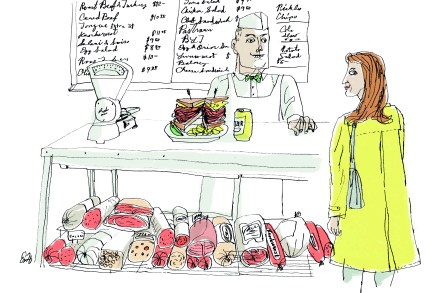
I miss America’s sandwiches

When I was 16 I told my father I wanted to leave America to go to university in Scotland. His only real concern was the food: ‘I don’t think you know what you’re getting into.’ His run-in with British cuisine was in the 1970s, so little wonder. Sure enough, the food in the student halls of St Andrews was worthy of Oliver Twist. If it wasn’t slabs of fatty gammon, already cold in the tray, it was a tepid, oozing excuse for lasagna, harboring hard lumps of ground beef and grainy béchamel sauce. And then there’s haggis. I loved everything about my four years at the tiny university town on the frigid North Sea coast, except for the food. That all changed when I moved to London, and I have to hand it to them — Londoners do know how to eat well. The world’s cuisine is here.

Can the Mayr diet work at home?

About five years ago, just after my 50th birthday, I noticed that I was extremely fat. Not ‘overweight’, not ‘heavy’, not ‘big-boned’, not possessed of a ‘good sense of humor’; fat is what it was. It was down to a long-undiagnosed medical condition and the attendant medication. It was also down to enjoying food a lot. What to do about it? Like a lot of men, I like a solution. I fundamentally believe that if you have a problem, you just need to find the right expert, who will lift the hood, run a few tests, give you a schedule to follow and it’ll be right as rain. ‘Go to the Mayr,’ a friend said. ‘They’ll put you right.’ And so it was. The Mayr Clinic is a celebrated health farm on the shores of the Wörthersee, a lake in eastern Austria.

mayr diet
clam chowder

The chowder crowd

Cape Cod winters are brutal: they are long, freezing cold and windy. Cape Codders don’t know what spring is. The Pilgrims, having first touched terra firma in Chatham after months at sea, headed across Massachusetts Bay for Plymouth to more shelter. Days jump from those when Cape Codders think that Old Man Winter has played a nasty trick on them once again, to days of suddenly delicious warm sun which breaks through feathery skies, filled with what my father Bob called ‘unused air’. One of my dearest memories of spending a winter living in Chatham’s Old Village is of my father, Bob, in mid-May, appearing in his 10-foot skiff putt-putting out of the Mill Pond past our house, wearing his salt-laden floppy hat, heading for Stage Harbor to do some clamming.

The diversity dinner

Growing up in a mixed American household of Indian, Italian and Puerto Rican descent, I never questioned the varying menu each night for dinner. Until I was a teenager, I hadn’t realized my family’s weekly meals were different from those of my friends — until they began begging me to eat at my house on weekends after I told them what was being cooked. For me, dietary normalcy meant chicken curry on Mondays, arroz con habichuelas on Wednesdays and lasagna on Fridays. My Puerto Rican and Italian American mother Loretta had married my father Roop, an Indian immigrant, in 1981. I always admired my mother for her fearlessness in crossing cultural lines during an era when interracial marriage was less common than it is today.

family diversity dinner

Ten Christmas gifts for an adventurous eater

Being a citizen of the world is difficult when you’re not allowed to enter the rest of it, much less travel across state lines without excessive burden. The ‘bad thing’ has made eating adventurously a tad harder. Some of us are meat-and-potato people. Others of us will unflinchingly and unknowingly order gizzard served in the basement of a Nepali restaurant in Queens because, as they say, when in Rome.Although I’ve been unable to travel or eat at restaurants, my enduring love affair with my stomach has not taken a hiatus. With Christmas fast approaching, neither should yours, or that of the citizen-of-the-world you love.These are items I’ve used or eaten, or that are also on my wish list, most of which are under $50. Bon appétit (and joyeux Noël).

christmas adventurous eater

Porgy and best

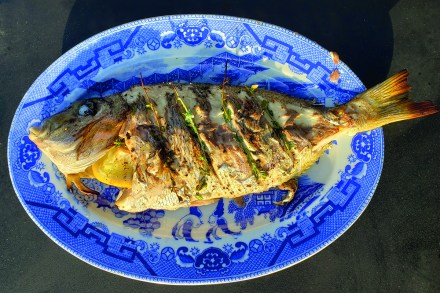
Give a man a fish, and you feed him for a day. Teach a man to fish, and you feed his esteem for a lifetime. There are few miracles greater than what rod and reel will conjure from the deep. So it has been for me as I cast away my cares in this uncertain year. In early spring, I delighted for the first time in the freshwater lake fish of New England. In the cooler months, bluegill, pumpkinseed, yellow perch and largemouth bass all swim close to the Connecticut lakeshore. Fishing from the shore in one such lake in Litchfield County, I found that a simple spinning jig or, better yet, a nightcrawler on a hook and bobber are all that is necessary for a strike. These frisky creatures can be as colorful as their names.

porgy

Game birds

‘Put the hen in a Dutch oven, brown him in butter for 12 minutes. If you have a piano in the kitchen, play the “Minute Waltz” 12 times. Add a little water. Put the lid on and let simmer. When you have finished playing half “The Dance of the Hours”, dragging it slightly, you’re ready to eat like an epicure.’ The Danish-born pianist and comedian Victor Borge is best known for his virtuosity on the keyboard, his wit and his timing. Most Borge fans don’t know that he was also a shrewd gentleman farmer. Julia Ransom Doty, my father’s first cousin, was a food and fashion editor for the Ideal Publishing Corporation, which produced popular, glossy ladies’ magazines back in the Fifties.

cornish game hens

In the soup

Ah, autumn, season of mists and mellow soupfulness, as the poet Keats didn’t quite say. In southern England, where Keats was inspired to write his famous ode to summer’s red-and-golden aftermath, fall mists may stick around all day; but in New England, they burn off with the morning sun, giving way late in the day to heady breezes that blow clean through the soul. It was Geoffrey Chaucer who brought the word autumn into the English language. As sure as ‘Aprill with his shoures soote’ leads ‘folk to goon on pilgrimages’, so October cries out for vigorous outdoor activity followed by autumnal soup.

soup

Eye on the pies: food in the age of ‘cultural appropriation’

I walked into a party with a friend a few years ago and told her I felt uncharacteristically uncomfortable. ‘That’s because you’re not carrying a pie,’ she said. It’s true; I usually have a pie as my calling card. The offering of a homemade pie makes no one unhappy. It’s a nice presentation, sure, but the handoff is magical, a conjuring the baker does when deciding whether the recipient is a pumpkin or cherry pie kind of guy. People think you’re being generous when you show up with pie, but really it’s quite selfish. First, baking carries me away. Second, I love to see people’s faces when handing them pie.

cultural appropriation

A Trumpian feast

This article is in The Spectator’s February 2020 US edition. Subscribe here. Donald Trump serves the best food in Washington. The residents of DC won’t say so, but it’s true. America’s capital has a lively food scene, with many excellent restaurants. None is better than the two that are in the soon-to-be-sold Trump International Hotel on Pennsylvania Avenue: Sushi Nakazawa and BLT Prime by David Burke. Burke’s joint is absolutely my kind of place. It’s in the hotel lobby. The building used to be a post office before the Trump family converted it. The enormous glass-roofed lobby area is a marvel: put politics to one side and admit that it is an extraordinary achievement.

trump dc

French women do get fat

This article is in The Spectator’s January 2020 US edition. Subscribe here.Paris ‘And please meet Alice, who has brought industrial cheese,’ said our Parisian host as she introduced me to the other dinner guests. Imagine my despair! I had failed her, not to mention her guests, on the sacrosanct fromage. A fate worse than death. Food is a national obsession for the French. The couple throwing the party presented us with a three-course meal, all made from scratch using seasonal produce from the local market. To think that I almost brought a six-pack of beer.

french women

Standing up to eat is the new line in dining in DC

This article is in The Spectator’s January 2020 US edition. Subscribe here. Going into Spoken English, you feel a little like Henry Hill taking the back entrance to the Copa in Goodfellas. Wander into the Line Hotel, past the check-in, take a right past the elevators and enter the kitchen. It works best if you’re with someone you need to impress. Unfortunately, this time I’m with a Spectator editor. The Line is one of DC’s newest and hippest boutique hotels. That’s another way of saying it’s slightly less boring than the Hilton about five blocks away.

standing

Bowl food: childhood memories have inspired a new craze for cookie dough

This article is in The Spectator’s December 2019 US edition. Subscribe here. In Greenwich Village, one block south of Washington Square Park, stands the flagship store of DŌ, ‘New York City’s first ever cookie dough scoop shop’. Opened in 2017 by an American designer with fond childhood memories of baking with her mother, DŌ is now so popular that it requires a special line policy, as in: ‘SINGLE FILE so that pedestrians can still use the sidewalk.’ Often, a line of hundreds of customers can be seen snaking around the block, eagerly awaiting tubs and cones of its buttery, sugary (and uncooked) batter.

cookie dough

Pasta, like all good things, should come to an end

Olive Garden’s ‘Never Ending Pasta’ promotion, I’ve come to believe, is an accelerationist ploy. For about $11, you can engorge yourself with your pasta of choice, paired with your selection of a sauce, many of which catch the American eye with the adjective ‘creamy’ or ‘five cheese.’ Authenticity is an afterthought in the fever dream that is ersatz ethnic dining in endless proportions. And with $100 and a bit of luck, you could have purchased a ‘Never Ending Pasta’ pass — the 24,000 winners of this pass can indulge in the creamiest pasta with the crispiest toppings for nine weeks, unlimited. They can eat their weight in pasta without ever having to see the bottom of their ceramic dish staring back at them.

pasta

The strange tale of the Deep Fried BBQ Stuffed Chicken Pizzadilla

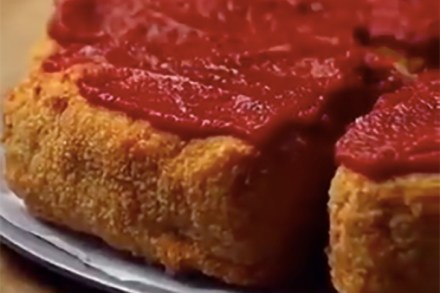
The Greeks had Aesop, whose Fables attempted to teach moral lessons using, for the most part, a cast of animal characters. On the internet, we have a tale of a pizza. But not just any pizza. A deep-fried BBQ chicken quesadilla pizza with a sour cream and mayonnaise dipping sauce. And what unfolded when the video of how to create it went viral this weekend is, when you think about it, the perfect fable for the age we live in. It’s an era where just about everything is fake, and even if it’s fake, it’s profitable. Social media is full of cooking videos – filmed from above, often with time lapses or sped-up video, made popular by the likes of BuzzFeed.

pizzadilla

The Spectator USA guide to eating bugs

Why are journalists so excited about eating bugs? This might sound like a preposterous question – a random assortment of nouns and verbs – but you can't move across the internet without stumbling into articles about the joys of insect eating. ‘Why Aren’t We Eating More Insects?’ asked the New York Times last year. ‘Bugs are the protein of the future,’ added HuffPost. ‘Humans will eat maggot sausages as a meat alternative,’ insists the New York Post. What is going on here? And should the Spectator USA get in on the action? Such articles always point out that people across the world eat bugs. The New York Times piece references the ‘legacy of the late writer and TV host Anthony Bourdain’: ‘...

eating bugs