Drink

The espresso martini is the best cocktail template

Try making up your own cocktail. It's hard. Really hard. Cocktails are balanced chemical concoctions, delicious flavors and fun textures that result from a trick of various dancing ingredients, and usually, when you come up with a cocktail idea and try to make it — even if you’ve read great theory books — it is either too sweet or too nothing, too flat. The best way to come up with one, then, is to play on existing templates. It’s not difficult to make your own sour or spritz, but the best of the best, perhaps the most fun cocktail ever, is the espresso martini. And no cocktail is easier to play with. Many of today’s classic cocktails trace their heritage to the Prohibition Era, but the espresso martini comes from the swinging nightlife of 1980s London.

espresso
wine

The blessing of a good wine shop

There are good wine shops and bad wine shops. Among their various attributes, the good ones have a broad selection of interesting wines from interesting places and — important add-on — a knowledgeable staff whose members can talk intelligently about their wares and can steer you in the right direction. The bad ones — well, you know. Their shelves are full of the stuff the distributors tell them to buy and their staff is not really sure whether Morgon is the name of the boss’s pet or a place in Beaujolais that produces good wine. My office in New York is close to an excellent wine shop called Flatiron Wine & Spirits. It is a big shop on Broadway at 18th Street and it boasts a large, expert and helpful staff.

The classic charm of Exiles

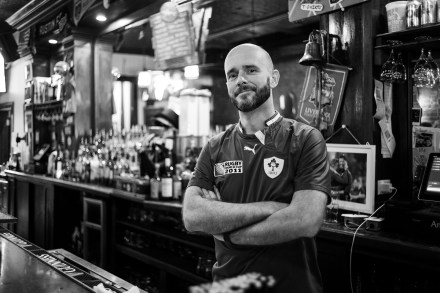
On Washington’s U Street, nestled between a dry-cleaners and the city’s most notorious gay gym, lies Exiles, a modest Irish sports bar marked by a warm blue neon sign and a Bills flag. “It’s a Bills bar and they’ll play a Jets game for me,” boasts Carmen, a local sitting at the long wooden bar. Red Liverpool soccer scarves drape over bottles of whiskey. A large Guinness bell hangs in the middle of the bar. “What can I get for you darling? I almost didn’t recognize you with your glasses on,” says a tender voice with an Irish accent. It’s Donagh. Pronounced “DUN-AHH” according to a sign at the bar. He’s a bartender and one of the owners. “Donagh and Paul will make you feel right at home...

exiles
wine

A French symposium

Just as night watchmen are constrained by duty to make their rounds, so are writers about wine. Sometimes the rounds are seasonal. Beaujolais Nouveau, for example, is released every year on the third Thursday of November at 12:01 a.m., just a few weeks after the September harvest. Gamay, the grape that makes Beaujolais, can be fresh, floral and ruby-like in this nymphet incarnation. Beaujolais Nouveau lacks the depth, succulence and complexity of more mature instances of Gamay — especially in Morgon and Côte du Py — but it is an agreeable, undemanding picnic wine that goes well with your preferred instantiation of déjeuner sur l’herbe.

How to do St. Patrick’s Day like an Irish American

For a country like Ireland, as devoted to its faith as to a good party, the fact that St. Patrick’s Day falls during Lent poses a problem. The saint himself is said to have broken his fast during Lent, eating meat instead of fish, for which he was so apologetic that an angel came to give him comfort. Put your meat into a dish of water, the angel said, and it will turn to fish. This Patrick did and was very pleased to see that the angel was right. The meat had turned to fish, and he could partake of it without guilt. The Irish call this miracle “St. Patrick’s Fish,” and feel no qualms about eating a pork roast to celebrate the day. You can also keep a holy day and drink to excess, if you’re drinking for the right reasons. St.

St. Patrick's
truffle

Truffle shuffle

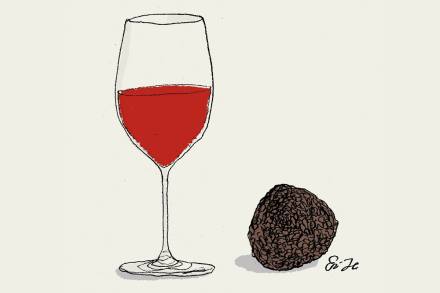
Regular readers may recall the trip we took to St. Émilion on the right bank of the Gironde-Dordogne river system a while back. It being truffle season, some enterprising chaps organized a dinner revolving around that delectable fungus and one of the very best wines from St. Émilion, Château Angélus, a Premier Grand Cru Classé A, and its second label, Carillon d’Angélus. Note the bell motif: a single bell features on the label of Château Angélus, three on that of Carillon d’Angélus, so named because in the vineyards one can hear the bells from three neighboring churches ringing out that prayer to Mary (Angelus Domini nuntiavit Mariæ...) in the morning, noon and around vespers. Those of you who were along for our last foray to St.

The rise of English wine

Sometimes, I pretend that I worked the wine beat thirty or forty years ago. I picture myself in formal wear, kicking back in gilded settings, sipping perfectly aged first growth, trading bons mots with winemakers. We’d spend hours solemnly considering the slow, steady, seemingly eternal rise of wine culture, and how inevitably it would soften the cruder edges of society. It would be so merry, yet cerebral — but also something we could feel good, even morally superior, about participating in. Instead, I’m in 2024 wearing yoga pants and guzzling mineral water (must hydrate!) by myself holding Zooms with winemakers, sweating over the fact that scientists say climate change imperils up to 73 percent of the world’s current wine-growing regions.

wine
Bentwood

New Buffalo’s Bentwood Tavern is an unapologetically tasteful beach town bar

Near the lake in the quaint beach town of New Buffalo, a rotating sign carries the silhouette of a shaggy mutt. A line forms near the door for the boring beachy fare, churned out at factory pace. The souvenir hoodies are out the door as fast as they can print them; the Stray Dog has become a destination in itself. I’ve seen their signature motto — Sit! Stay! — everywhere from Santa Barbara to Brooklyn. You probably have too. And don’t get me wrong, the Stray Dog is great at being what it is: the quintessential beach-town bar. But I prefer it here, half a mile south, in the uncelebrated version of a beach-town bar. There’s no merch store, no zany southwest eggrolls, no Jägermeister dispenser, no television. Just ten velvety bar stools and endless respite.

winter

A Champagne winter

Most readers will come to this column in February. “That’s the dead of winter,” you say (if you are in the Northern hemisphere, anyway). But I write at the absolute nadir of daylight. For some years now, I have kept a daylight diary. I generally start in mid-October and go through the return of daylight-saving time in March. It takes that long to convince me that summer really is on its way back. When I started, I simply noted the time the sun rose, when it set and how much daylight we had that day. I eventually got a little more elaborate, noting the phases of the moon and such, and making very brief annotations about significant events. Every year (so far), it’s been a story with a happy ending.

A craft beer revolution in Grand Cru Country

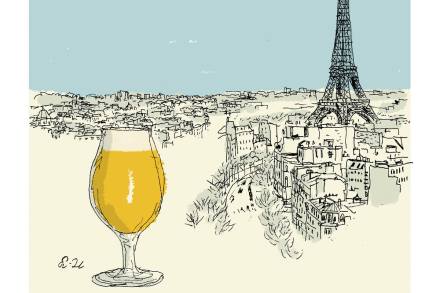
If the dozens of cartoonish stereotypes that flood my mind when I think of France — grand Bordeaux estates, snails and frog legs dripping in garlic butter, elegant women striding down the Champs-Élysées, a glittering Eiffel Tower at night — a stein of hoppy beer is nowhere to be found. France is not known for its pints. And yet, much to the concern of its vineyards and winemakers, that could be changing. “There has been a real explosion of breweries all over France in the past few years,” says Alexandra Berry, a Paris-based beer and hops sales consultant and the author of From Earth to Beer: The Expression of Terroir in a Glass. “General sales in wine have started to decrease in France in part because the industry has started to seem a little dated and overrated.

beer
new year's

How to plan a suitable feast for New Year’s

It is commonplace that the December run-up to the holiday season (aka the Christmas season) is heavy with festivity. The well-lubricated office Christmas parties of yore were legendary, while at home the domestic calendar brimmed with all sorts of communal gaiety. This all occurred during Advent, which in the old Christian dispensation was a penitential season. Except when among the most devout, I was never able to see that this much dampened the fun. As the marketers now see it, the season of getting and spending stretches from somewhere around Halloween right up to Christmas when, all of a shameless sudden, it’s on to Valentine’s. This leaves New Year’s curiously — sometimes on the coldest night of the year — out in the cold.

madeira

Madeira, our onetime national drink

Does America have a national drink? It once did — not officially, quite, but in fact. And what was that national potation? Madeira. The wine, John Hailman writes in Thomas Jefferson on Wine, “symbolized to Americans a common patriotism and spirit of independence.” It was, he continues, the “mother’s milk of the American Revolution,” the “virtual national beverage after the Revolution.” Madeira was used to toast the signing of the Declaration of Independence. Jefferson dispensed it at his inauguration. Washington, Hamilton and Benjamin Franklin all loved the stuff. John Adams remarked that a few glasses of Madeira made anyone feel capable of being president.

Deck the halls at Rolf’s

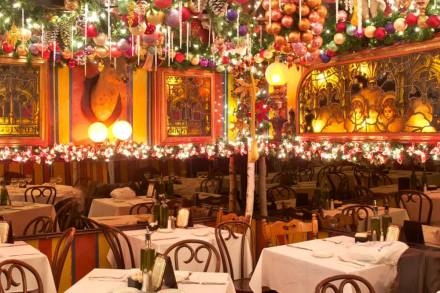
It’s a common lament each year — starting around October, people love to complain that the Christmas season continues to creep further and further into the fall. But for some, that creep is a welcome one. If that’s you, I know a place. At 3rd Avenue and 22nd Street in Manhattan, you can get your Christmas fill for around six months of the year — at least if you wander into the narrow German restaurant on the corner. You might almost miss it if you walk by during daylight hours. At night, it’s hard to miss. In this rather unsexy portion of Manhattan, Rolf’s has been a New York institution since 1968.

rolf's
mortons

Cigars, steak and (alleged) corruption at Morton’s

While Republicans make a symbolic point of permitting smoking in the Capitol complex whenever they’re in power, no one’s lungs really seem to have been in it since John Boehner held the speakership. Back rooms in Washington aren’t what they used to be. So it’s nice that the oddly named Morton’s The Steakhouse — which as a Chicago-based chain is now really Morton’s The 65 Domestic and International Steakhouses — is one place where Washington’s journalists and politicians can still enjoy the complex aromas of cigars, steak and corruption. One person whom it’s almost unavoidable to see at Morton’s is the recently deposed chairman of the Senate Foreign Relations Committee, SenatorBob Menendez.

Sherry

A very Sherry Christmas

Early on in his classic Notes on a Cellar Book, the literary scholar George Saintsbury writes that “no reasonable person should quarrel if we begin with Sherry, even as the truly good and wise usually do at dinner.” That was in 1920. Can you imagine anyone writing that today? The answer is no. But that only tells us how fickle are the revolving fashions of taste. For us, Sherry is an antique taste, quaint if not fusty. By and large it’s something that maiden aunts drink between knitting projects and jumble sales. At its best, Sherry has a fading academic aroma. When I was in graduate school, I had a semester-long tutorial on Plato with the eminent Platonist Robert Brumbaugh.

New wines from Devin Nunes

What’s the next big thing in California wine? Everyone knows about the great Cabernets and Chardonnays of Napa. Most people would say that Sonoma is a close runner-up, with some excellent Cabs and Chards and Pinot Noirs, especially in the Russian River Valley. There are Zinfandels, the original plus-size wine, which is the sort of thing people like who like that sort of thing. But let’s travel south to the Central Coast, between San Francisco and Los Angeles. There is plenty of good (if not great) Cabernet and Chardonnay there as well. But the region is perhaps best known for Rhone-style, Syrah-favoring wines. Get ready for something new: some luscious red wines built largely around Touriga Nacional and Tinta Cão, two of the grapes used to make Port in the Douro region of Portugal.

nunes

The Office Lounge is everything a Texas bar should be

The downtown streets of Georgetown, Texas, are a grid of pastel storefronts and Victorian architecture, centering around the domed and columned Williamson County Courthouse (named after the judge known as “Three-Legged Willie”). America’s fastest-growing city looks like a time capsule from the old Southwest. But thirty miles south, Austin — or “Silicon Hills” — is undergoing a tech boom. Microsoft, Musk’s gigafactory and a host of tech startups have unleashed a flood of yuppie commuters into Austin’s surroundings, rapidly transforming not just Georgetown, but what we think of as quintessentially Texan. Rodeos, the Alamo, cowboys and outlaws — will we one day think instead of smartwatches and Bill Gates? I doubt it.

office lounge
champagne

Champagne and America is a love story without end

From the beginning, Champagne has never been just a drink, or a region: it’s a celebration, an occasion, a trophy, a reward; a symbol of joyful decadence and glamorous debauchery; the overflowing drink of the American Dream. In short, it’s a boozy cheat sheet for the zeitgeist and the anxieties and dreams of the people who sip it. And, for the past seventy-five years or so, that zeitgeist has been driven by the United States. “American culture pervades everything,” says Christian Holthausen, a dual French-American citizen and founder of the Paris-based Champagne consulting firm Westbrook Marketing Partners. “Driving through Paris just now, I saw a Coca-Cola machine on one street, and a billboard for Apple on the next.

Why dry Sauternes are the next big thing

It is my sense that the popularity of sweet wines like Sauternes, Port, Tokaji and all the German Auslese wines is on the upswing. I am here to tell you about the Next Big Thing: dry Sauternes. Yes, that’s right: dry Sauternes. The supersnazzy, superexpensive Château d’Yquem is the only Sauternes to boast the designation “Premier Cru Supérieur” from the 1855 classification of Bordeaux wines. That exclusive label — along with the probably apocryphal but oft-repeated story that Michel de Montaigne, born Michel Eyquem, had something to do with the property — helps account for its astronomical price. But Yquem has been making a blanc sec since 1959.

You seriously expect me to pick one favorite bar?

I was born in Wisconsin and I’ve learned a curious thing traversing it. There appears to be a state law requiring at least one bar at every intersection of its rural roads. I’ve noticed this most often driving at night: there’ll be a neon sign advertising Old Style or Leinenkugel’s hung in the front window of what looks like a farmhouse living room, and several cars nestled up against the house like sucking pigs. There is something homey about a rural bar. The knotty pine, the “first dollar” framed above the cash register, neighbors ironing out local prejudices and asserting the superiority of the Packers despite any evidence — if anyone’s brave enough to produce some.

bar