-
AAPL
213.43 (+0.29%)
-
BARC-LN
1205.7 (-1.46%)
-
NKE
94.05 (+0.39%)
-
CVX
152.67 (-1.00%)
-
CRM
230.27 (-2.34%)
-
INTC
30.5 (-0.87%)
-
DIS
100.16 (-0.67%)
-
DOW
55.79 (-0.82%)
John Swinney’s three worst moments in office
And so we have it: a nationalist coronation, as yet another First Minister resigns. John Swinney, formerly Nicola Sturgeon’s deputy FM and onetime leader of the SNP himself, has been elected – unopposed – as the new leader of the Scottish National party. Thought to have been parachuted in by the party establishment, Swinney’s coronation was almost foiled by ‘flatulence in a trance‘ SNP activist Graeme McCormick who, by some quirk in the SNP’s constitution, had enough nominations to stand against the MSP for the leadership. But, at the eleventh hour, the renegade backed down after having ‘lengthy and fruitful’ talks with Swinney himself.
Branded the ‘unity’ candidate, the new SNP leader is thought to have made a pact with Kate Forbes, who was expected to run against him for the top job. Forbes announced she would not be standing on Thursday, endorsing Swinney instead as offering a vision of ‘competent, candid government earning the trust of the people’. Mr S will believe it when he sees it…
The Scottish parliament is still to vote Swinney in as First Minister – but before it does, Mr S would be keen to take a look at some of the former leader’s worst moments…
Covid WhatsApps
When Humza Yousaf became First Minister in 2023, he promised Scots that he would usher in a new era of ‘openness and transparency’. Then followed three arrests in relation to SNP finances, an £11,000 iPad scandal and, of course, a rather unedifying Covid inquiry that revealed Nats had been routinely deleting their WhatsApp messages – after slamming senior figures in the UK government for doing similar. Awkward…
One of the key SNP figures at the heart of the Covid WhatsApp scandal was, you guessed it, Swinney himself. Once it emerged that Sturgeon hadn’t retained her pandemic messages, it wasn’t long before her former deputy was outed for not holding onto his either. Swinney admitted he had been ‘periodically’ deleting his message exchanges, adding that to his mind, this approach had always been government policy. Since entering Holyrood in 2007, Swinney said that he’d ‘deleted material after I had made sure any relevant information was placed on the official record of the government, and that was the approach I was advised to take’. Golly.
However his former boss and then-first minister Alex Salmond was quick to rebuke the claims:
Honest John, as John Swinney used to be called, said he was doing this manually and that he said he was doing it since 2007. As First Minister between 2007 and 2014 can I assure everyone that no such policy was in existence in these years and John was doing it off his own back.
How curious…
Education record
An accolade that Mr S is rather sure Swinney won’t be putting on his CV is his reputation as one of Scotland’s worst education ministers. When he was education secretary between 2016 and 2021, Swinney’s tenure was far from a smooth success. He faced two confidence votes, had to scrap plans for his own education bill and was responsible for the Scottish exam results scandal during the pandemic.
Sturgeon was adamant she was going to close Scotland’s poverty-related education gap – but the former FM’s right-hand man was of no great help, with the attainment gap even widening in some areas. Not content with the damage he’d already caused Scotland’s schooling, Swinney narrowly faced off a confidence vote in 2020 – after it emerged his Covid scoring system (that graded pupils who were unable to take exams due to restrictions) led to children from poorer areas being penalised.
And Swinney presided over Scotland’s new ‘Curriculum for Excellence’ education strategy that, er, saw a remarkable nosedive in schooling standards and international league tables. As the Times Educational Supplement put it, ‘it highlighted a disconnect between the ambitions of CfE and the qualifications in upper secondary, where the focus is on traditional exams’. Displaying a disconnect between fantasy and reality? Not the SNP, surely…
Named persons law
The Scottish government faced immense backlash after it tried to introduce a radical ‘Named Person’ law in 2016. Its objective was to have a ‘named person’ act as a point of contact between every child under 18 years old and the authorities. But the planned bill was criticised by judges for making ‘perfectly possible’ the chance that a young person’s confidential information could be disclosed to authorities without the child or their parents knowing. Crikey.
Slammed as a ‘snooper’s charter’, the proposals were found to breach human rights laws – namely the right to privacy and a family life – by the Supreme Court. The bill was ditched in 2019 with the clumsy U-turn dubbed a ‘complete humiliation’. Its architect? John Swinney.
Hamas is playing for time
Israeli, international and Hamas officials are currently awaiting the decision of Yahya Sinwar, the terror group’s military leader on a proposed ceasefire deal. Egypt has put forward a phased release of Israeli hostages and a temporary end to the fighting in Gaza. Sinwar is looking at the deal. As the talking and the diplomatic manoeuvring continues, two IDF combat divisions, the 98th Airborne and the 162nd Armoured, are making their final preparations for entry into Rafah. Failure to reach agreement on Egypt’s proposal is likely to set an IDF operation into motion.
Egypt’s proposition would commit Israel to a long and open-ended ceasefire. Over time, Israeli hostages would be swapped for Palestinian prisoners, and the number of Israeli armed forces in Gaza would be reduced. Israeli media has reported that the current stumbling block is whether the ceasefire should be temporary or permanent. The Gazan Hamas leadership wants a permanent conclusion of hostilities, but look a little deeper and it is easy to see why maintaining the current situation might well be preferable to them.
A battle in Rafah would not necessarily represent Sinwar’s last roll of the dice
From their point of view, refusing a deal does not make imminent strategic defeat at the hands of Israel inevitable. Contrary to what Israeli Prime Minister Benjamin Netanyahu might wish, Sinwar, his brother Mohammed, and the Hamas military leader Mohammed Deif are almost certainly not currently besieged in a bunker in Rafah, surrounded and obliged to either agree to the Egyptian proposal or be crushed beneath the treads of the 98th and the 162nd. In fact, it is not even certain if the Hamas leaders and their hostages are even still in the Rafah area, or if through the intricate Gaza tunnel system, they are now already in some other part of the strip.
An IDF incursion into Rafah is meaningful, in that this remains the only major area still containing a major conventional deployment of forces available to Hamas. But a battle in the town would not necessarily represent Sinwar’s last roll of the dice. While a failure to go into Rafah more or less guarantees an Israeli strategic defeat in the war, entry into the town does not make Israeli victory a sure thing. Victory requires the taking of Rafah, but also additional successes.
The situation in Gaza is subjecting Israel to an ongoing erosion in its international standing. It has returned the Palestinian issue to front and centre; it is causing enormous suffering to the people of Gaza (but the Islamist leadership demonstrably doesn’t care about that). The prospect of indictments of Israeli leaders at the International Criminal Court is a realistic one and will become more likely the longer the fighting continues. Sinwar and his cronies are also no doubt observing the steady erosion of national unity within Israel, due to Hamas’s heartless but effective exploitation of the concerns of Israeli hostages’ families over the fate of their loved ones.
Hamas will also be aware of the waves of pro-Hamas protests in European and American campuses and capitals, bringing together supporters of political Islam and those of the radical left. Hamas’s Gazan leadership is doubtless also aware of the strains being placed on relations between the US and Israel, as a result of sharp differences over next military steps. It is in Hamas’s interest to allow all these processes to continue and deepen.
Lastly, no coherent Israeli plan to break the central nervous system of Hamas rule in Gaza appears to have been formulated. Such a plan could take the form of renewed Israeli occupation and military rule of the strip, deploying a couple of divisions for this purpose, until a future arrangement for Gaza’s administration could be formulated. Or, conversely, it could involve the swift implementation of a new political and security system, probably involving some combination of Israeli security presence, local Palestinian self-rule, and participation of Arab forces – probably those of Egypt, Jordan and perhaps the UAE. At present, neither option has been chosen.
Maintaining the current situation involves probable limited cost for the Hamas leadership in Gaza (in terms of things it cares about), and will allow it to continue to maintain the gains that it has made since it carried out the massacres of 7 October. As a result, a full affirmation of the Egyptian proposal on the part of Sinwar and those around him appears unlikely. Rather, they will continue to play for time, confident, not without justification, that it is at present on their side.
Israel is committed to fighting on in Rafah
As last week drew to a close, it seemed that the intense efforts of Egyptian and American mediators might result in a ceasefire deal between Hamas and Israel being reached. Then on Saturday, a ‘high ranking source in the Israeli government’ announced that Israel would invade Rafah whether a deal was reached or not, meaning an agreement would only delay an operation into Hamas’s last stronghold.
In response, Hamas hardened their position. They demanded further guarantees from mediators that the deal would lead to a permanent ceasefire allowing the terrorist organisation to keep control over Gaza and to continue attacking Israel.
Israel cannot allow Hamas to keep control of Gaza and to continue to attack Israelis
Yesterday, negotiations collapsed with both sides blaming each other. It’s entirely possible that Hamas never intended to sign a deal with Israel. They may have been relying on Israeli Prime Minister Benjamin Netanyahu to do what he usually does – self-sabotage – so they could blame him when the negotiations collapsed. He played right into their hands.
Israeli Defence Minister Yoav Gallant issued a statement shortly afterwards that an operation in Rafah will happen ‘in the very near future’. To make matters worse, Hamas launched a barrage of rockets at the Kerem Shalom crossing, where humanitarian aid goes into Gaza, from Rafah, killing 4 Israeli soldiers and injuring 11 others.
Hamas is extremely worried about an operation in Rafah, but is hoping that Israel will refrain from launching one due to international, and particularly American, pressure. President Biden has warned Israel against an operation in Rafah, saying there would be ‘consequences’. It seem that those consequences are already in motion: Biden reportedly delayed an arms shipment to Israel last week, possibly to put pressure on Netanyahu to accept a ceasefire deal.
This should concern Israel. The country has relied heavily on American aid, including continuous shipments of arms. A report by Israel’s finance ministry shows that half of all defence deals associated with the war in the last quarter of 2023 were made with American suppliers. If Biden places restrictions on that aid, it’s unlikely that Israel can make up for the loss of American support from a different source.
The main point of contention in ceasefire negotiations is Hamas’s insistence that a deal has to bring an end to the war. Israel’s position is that it can live with a temporary ceasefire, but that fighting will have to resume in order to defeat Hamas. Israel cannot allow the organisation to keep control of Gaza and to continue to attack Israelis, as it has vowed to do. The 7 October attack made it clear that this is a threat that has to be eliminated, or at the very least reduced to an acceptable level.
To achieve this, Israel has to tackle Hamas in Rafah. Israel has been preparing for the operation by establishing humanitarian quarters for Palestinian civilians to stay in during the fighting. There, they will be able to receive aid, shelter and medical services. Israel is now calling on civilians in Rafah to leave certain areas for their own safety.
Informing Hamas of roughly when and where they will be hit is likely to make things harder for the Israeli Defence forces (IDF). But having a high number of civilian casualties will draw criticism from Israel’s allies and risks isolating Israel even further. Despite its reputation, the IDF doesn’t seek to harm civilians and employs extensive methods to reduce civilian casualties regardless of outside pressure.
So far, it seems that no mediator is capable of placing enough pressure on Hamas to reach a ceasefire agreement, leaving only the military option on the table – for now. The IDF’s call for civilians to evacuate a specific part of Rafah could indicate that the initial operation may be limited – an attempt to pressure Hamas into a deal that’s acceptable for Israel, and to ease American concerns.
On Sunday, Jews marked Holocaust remembrance day. The saying ‘never again’ has received a renewed meaning as Israel fights enemies that wish to annihilate it and Jews suffer an immense rise in worldwide anti-Semitism and threats against their safety. Israel is committed to fight on, and hopes its allies will support, rather than obstruct, its efforts.
Draft dodgers are undermining Ukraine’s plea for help
Emmanuel Macron warned recently that Europe is in ‘mortal danger’. The French president said that Russia cannot be allowed to win its war with Ukraine. He reiterated the idea he first floated in February of sending soldiers to Ukraine, saying: ‘I’m not ruling anything out, because we are facing someone who is not ruling anything out.’ Macron’s comments come amid reports of an upsurge in draft dodgers in Ukraine. They are frightened because their government has launched a crackdown on men avoiding the draft.
In November last year it was reported that as many as 650,000 Ukrainians of military age have left the country since the war began. ‘Some men paid up to $10,000 (£8,000) for a certificate confirming their unfitness for military service,’ explained the BBC, which said the huge numbers of draft dodgers ‘is a serious problem for Ukraine’.
If Ukrainians aren’t willing to defend their country then why should France or any other Nato country?
The New York Times quoted Lt. Vladyslav Tonkoshtan, whose job it is to prevent Ukrainian men skipping the country. ‘We cannot judge these people,’ said Tonkoshtan. ‘But if all men leave, who will defend Ukraine?’
But they are being judged. Mykhailo Podolyak, a senior adviser to Zelenskyy, declared at the start of this year: ‘Everyone must determine for themselves the price they are willing to pay. To either live in a prison camp or in a free country.’
One could understand why young Americans dodged the draft in the 1960s to avoid being sent to Vietnam, a war on the other side of the world in which their country wasn’t threatened. But Ukraine has been invaded. Its survival is at stake.
When Russia invaded Ukraine in February 2022, there were approximately 250,000 men and women in uniform, a figure that rapidly soared to 880,000 and now stands at an estimated one million. The average age of Ukraine’s combat soldier is 43 (in the Second World War it was 26) and so the focus of Zelensky’s team now is on the younger generation.
But there appears to be a general reluctance ‘to do their bit’. One young Ukrainian, Artem, a 28-year-old from Kiev, told Politico: ‘I’m young and want to live my life, and to go there [the front] without knowing when I will return to my normal life is hard.’
When Macron first mooted the idea of sending soldiers to Ukraine in February, he was roundly condemned by his domestic opponents. Olivier Faure, secretary of the Socialist party, accused the president of conveying a ‘worrying lightness’ on a subject of such gravity; Marine Le Pen said Macron was ‘playing the part of the warlord, but it’s our children’s lives he’s talking about so carelessly’.
This point cannot be avoided by Macron. Imagine the reaction in France, or any other Nato country, if their soldiers are sent to fight for a country whose own young men are too feckless to take up arms against their invader.
This may explain why in recent weeks Ukraine has started to address the issue of draft dodging. At the start of April, Zelensky finally signed a bill lowering the mobilisation age from 27 to 25. He had prevaricated over the legislation for nearly a year because he was aware it was a contentious issue. The bill that he did sign into law had been subjected to nearly 4,500 amendments.
Another measure signed into law was the establishment of a digital database of men of military age, a move designed to enable the authorities to track those who have fled the country. The law requires all Ukrainian men of fighting age to present themselves at a draft office to update their papers, remotely or in person within 60 days. The law takes effect on 18 May and until that date Ukraine has suspended all consular services to military age men. Additionally, 27 new recruitment centres will be opened in cities across Ukraine, allowing volunteers to select the unit in which they serve.
Ukraine’s Foreign Minister Dmytro Kuleba posted a message on Twitter saying: ‘Our country is at war… Staying abroad does not relieve a citizen of his or her duties to the homeland.’
Some human rights groups in Ukraine have criticised the new measures. Oleksandr Pavlichenko, executive director of the Ukrainian Helsinki Human Rights Union, described the lowering of the mobilisation age to 25 as a violation of individual rights. ‘It’s just an emotional step, not a legal one,’ he said. ‘It will not bring the results.’
Comments such as those undermine Macron’s declarations that Europe is in mortal danger. If Ukrainians aren’t willing to defend their country then why should France or any other Nato country send their soldiers? ‘I think that many Poles are outraged when they see young Ukrainians in hotels and cafes and then hear about how much we’re doing to help Ukraine,’ said Polish Defence Minister Władysław Kosiniak-Kamysz recently.
There are an estimated 200,000 Ukrainian men in Poland, and the government has said it will cooperate with Ukraine to return them. Lithuania has said it will also repatriate Ukrainians of fighting age.
A recent biography of Zelensky revealed that the president prefers Charlie Chaplin to Winston Churchill. That’s a shame because right now hundreds of thousands of young Ukrainians could do with a Churchillian speech about blood, toil, tears and sweat.
Republicans are embracing the left’s victim culture over antisemitism
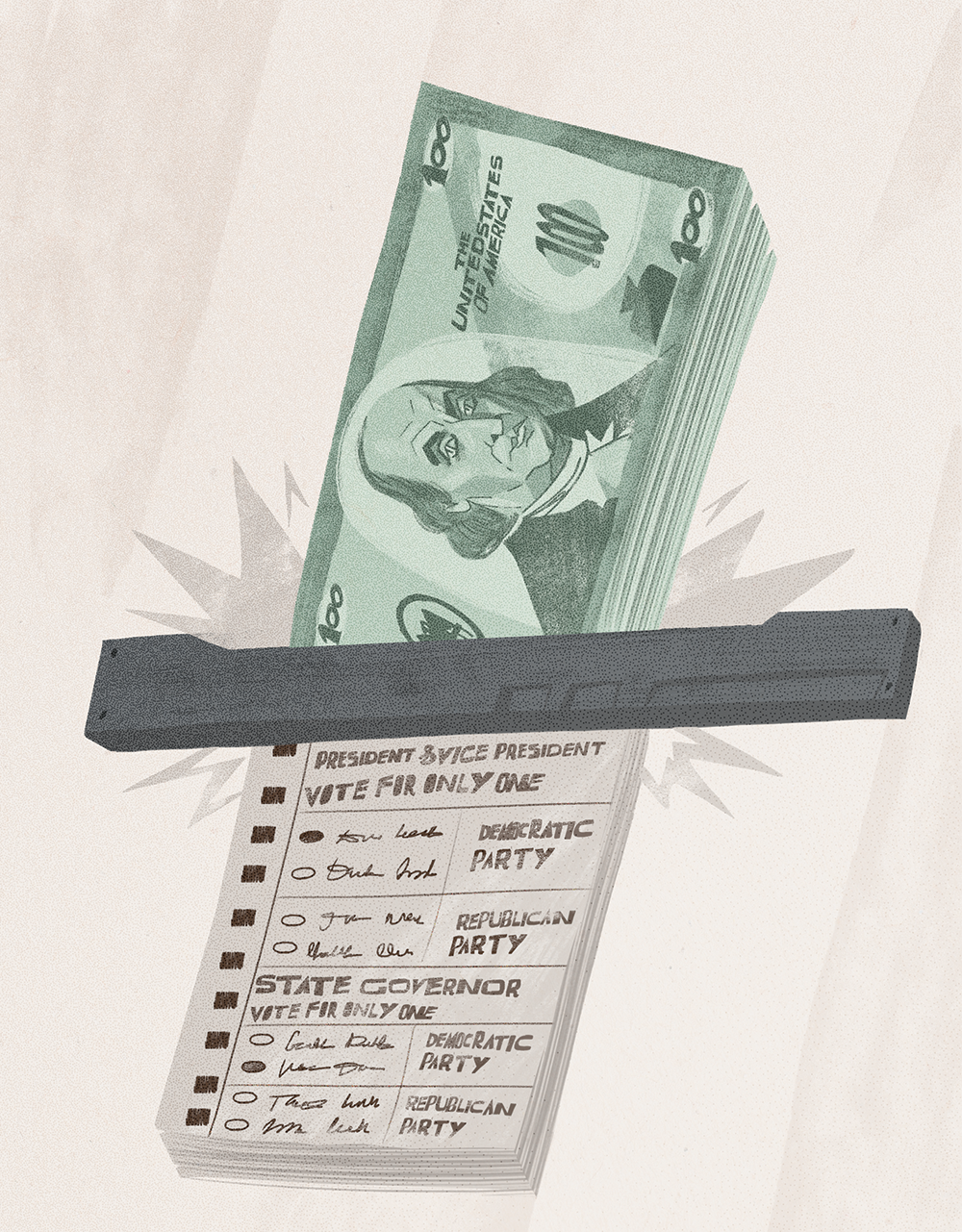
For years, Republicans have claimed that theirs is the party of free speech. They have correctly amplified instances of the intolerant left cracking down on conservative speech, particularly on campuses, often under the bogus guise of combating “hate speech,” racism, sexism, homophobia, transphobia and other scourges they grossly exaggerate. Many of us on the right have mocked safe-space-craving Gen Z and millennial students and their expansive needs to feel “safe” by insulating them from speech that hurts their feelings. But now Republicans are conflating legitimate criticisms of Israel with antisemitism and essentially embracing the left’s victim culture in calling for safe spaces — if not by name — for pro-Israel Jews on college campuses.
Protests have unfolded on dozens, perhaps hundreds of college campuses — and many thousands of people are involved in them. Republicans are making grossly hyperbolic comparisons to 1930s Germany and have portrayed the protesters as antisemites, amplifying video clips featuring the most extreme elements in crowds. Of course, some of the protesters are likely sociopaths, but just as not all the J6 protesters were the violent insurrectionists the left told us they were, not all of the pro-Palestinian protesters are the same.
Are antisemites involved in the protests? As Sarah Palin used to say, “you betcha.” But I don’t buy the notion that many or most of the protesters are Jew-hating antisemites. In fact, there are Jewish groups involved in the protests and Jewish students have been suspended and arrested for their actions. Perhaps the most famous person arrested in the protests so far, Green Party candidate Jill Stein, is Jewish. But Republicans would like us to believe that there’s a sudden explosion of antisemitism on college campuses.
This supposed explosion of antisemitism coincides with Israel’s deadly counteroffensive in Gaza, where tens of thousands of Palestinians have been killed, most of them women and children; 196 aid workers have also been killed in the conflict, according to the US-funded Aid Worker Security Database, along with at least ninety-seven journalists, ninety-two of them Palestinian, according to the Committee to Protect Journalists. Most of the population has been rendered homeless — and the UN says some 577,000 Gazans face imminent famine, largely because the Israeli government hasn’t allowed enough aid in, as documented by the Israeli human rights group B’Tselem and many others.
Republicans aren’t outraged by any of this; in fact, they’ve voted to send even more aid to Israel despite the carnage. But the students are outraged, and they don’t want their tuition dollars going to Israel, even indirectly. CNN published a poll this week indicating that 81 percent of Americans under thirty-five disapprove of Biden’s handling of the conflict in Gaza. And Gallup published a poll a month ago indicating that only 36 percent of Americans approve of Israel’s military actions in Gaza, while 55 percent disapprove. So the students aren’t the only ones concerned about Israel’s war and our support for it.
If you have Gen Z children, you know that calling someone in this generation a racist is about the worst thing you can accuse them of. Say what you will about this cohort — but they are the least racist generation in American history. Yet we’re supposed to believe that they’re more prejudiced against Jews than older Americans? The evidence that antisemitism is exploding on college campuses is mostly anecdotal — look at this sign here, or that chant over there. The left has built a similar case that there’s an epidemic of racism and police brutality, nearly all of it based on anecdotes and social media clips featuring inflammatory incidents. In some cases, they’ve embraced outright hoaxes. Now the right is doing the same to silence or intimidate critics of Israel.
Take, for example, perhaps the most gruesome reported incident of the protests so far, where a Jewish student, Sahar Tartak, was allegedly “stabbed in the eye” with a Palestinian flag at a protest on the campus of Yale University. In denouncing what he claims is a “virus of antisemitism” that is “spreading across college campuses,” this was the key example House Speaker Mike Johnson gave to prove his point in a recent speech. The day after the incident , the Free Press published a piece by Ms. Tartak claiming she was stabbed in the eye “because (she) is a Jew.” She conducted many interviews but didn’t publish her own footage of the incident, though several popular YouTube channels did, including The Jimmy Dore Show, The Majority Report and Breaking Points.
The clip shows a man walking by her waving a small flag on a wooden stick. He may have bumped into her but it’s clear that if the man’s flag contacted her eye, it was clearly accidental, as the man was just walking by her and wasn’t even looking in her direction. So she wasn’t “stabbed because she’s a Jew” any more than Jussie Smollett was beaten up by MAGA bros in Chicago.
It wasn’t the first time Ms. Tartak claimed she was a victim of antisemitism on campus. In December, she made headlines with a claim that the word “Israeli” was removed from a salad in the Yale dining hall. But the Jerusalem Post and other outlets pointed out that the incident had nothing to do with anti-Israel sentiment and the word “Israeli” was quickly restored to the menu. In January of this year she got more media attention with claims that a pro-Israel column she wrote was “censored” (read: edited) by the campus newspaper at Yale.
The Daily Beast reports that a pro-Israel student at Northeastern University tried unsuccessfully to goad the crowd into chanting, “Kill the Jews.” He was booed but ended up getting about 100 other protesters arrested in the process. In another bogus incident, a woman lampooned on social media as a “Karen” walked into a protest encampment at Northwestern University with her dog and called 911, claiming that she was “a Jewish American who needed help” and was being surrounded by protesters, even though video shows she was in no danger whatsoever.
The point of bringing up these incidents is that Republicans purport to oppose victim culture but are happy to promote the claims of dubious “victims” when it suits their needs. Meanwhile, if you listen to what Republicans are saying and how they’re voting on this issue, they don’t sound like a party committed to free speech, or one opposed to cancel and victim culture.
This week, Trump “truth”-ed, “STOP THE PROTESTS NOW!!!” There were no caveats: just shut it all down and to hell with the First Amendment. If only Trump had been so emphatic when J6 protesters were breaching the Capitol.
I believe in the rule of law and there’s no question that some of the protests have gotten out of hand. The First Amendment guarantees their right to protest, but it doesn’t give them the right to take over campuses and prevent other students from attending classes. And some Jewish students have been threatened or harassed — and that’s unacceptable. But again, there’s a difference between ensuring the physical safety of students and creating safe spaces where students don’t have to hear things that upset them. And it’s worth noting that in some protests, like the one at UCLA this week, pro-Israel counter-protesters have also engaged in violent acts. The Jewish Federation of Los Angeles acknowledged this in a statement condemning the violence perpetrated by what they probably correctly call “the abhorrent actions of a few counter protesters.”
Trump’s rhetoric has been matched by others on the right. Senator Marsha Blackburn from Tennessee claimed on X that college protesters were “Hamas sympathizers” who are “promoting terrorism right here in the US.” She said they should be “treated like the terrorists they are supporting.” And in another tweet, threatened to put students on the terrorism watch list and the TSA no-fly list if they “promoted terrorism or engaged in terrorists acts on behalf of Hamas.” What constitutes “promoting terrorism” and which students does she think belong on the lists? She didn’t say.
In the current Republican context, Blackburn is quite mainstream considering what other Republicans have said about Palestinians and their supporters in recent months. Representative Max Miller, a Republican from Ohio, said of Palestinians: “They’re not a state, they’re a territory that’s about to be eviscerated and go away here shortly as we’re going to turn that into a parking lot.” Republican representative Brian Mast of Florida has said that terrorism is “absolutely supported by the Palestinian people from elementary school all the way up into the elderly,” argued that humanitarian aid to Palestinian civilians “should be slowed down,” and compared ordinary Palestinian civilians to Nazi collaborators during the Holocaust.
With that level of animosity toward Palestinians, it shouldn’t be surprising that Republicans want a harsh crackdown on the protests. The House passed a resolution to brand the slogan “From the River to the Sea” antisemitic. Perhaps it is, but Mr. Netanyahu’s Likud Party has a very similar slogan in its party platform — and in any case, Congress has no business policing speech. There’s also currently a bipartisan bill to install antisemitism monitors on college campuses. Imagine if the left wanted to install transphobia monitors or racism monitors at campuses. I bet not a single Republican would agree to it.
The House also just passed a bipartisan “Antisemitism Awareness Act,” that will mandate that when the Department of Education enforces federal anti-discrimination laws it uses a definition of antisemitism endorsed by the International Holocaust Remembrance Alliance. It passed 320-91, with all but twenty-one Republicans voting for it. Representative Jerry Nadler, a Jew, voted against it, arguing that it could have a chilling effect on speech, particularly criticism of Israel. Echoing the ACLU’s concerns, he says that if the bill becomes law, colleges may err on the side of caution in suppressing pro-Palestinian speech to avoid Title VI investigations that could result in the potential loss of federal funding.
I hardly ever agree with Representative Nadler — and politically, I have little in common with the college protesters. But I also don’t believe in simply aligning with the a designated “side” and supporting that side as though it was a sports team regardless of the facts. According to the Gallup poll, 30 percent of Republicans don’t approve of Israel’s war in Gaza, but you’d never know if the way Republicans are acting.
As a conservative, I’m concerned that when it comes to Israel, the GOP tosses aside all of its supposed bedrock principles — fiscal conservatism, commitment to free speech, opposition to cancel culture, victim culture and intellectual safe spaces — in order to shield Israel from (often) legitimate criticism. American taxpayers have funded Israel to the tune of $300 billion since its founding. Legitimate antisemitism must always be condemned, but Americans must always retain the right to protest what their tax dollars are being spent on overseas.
Suella Braverman has made herself look silly
Did Suella Braverman run her latest op-ed by No. 10 for approval? That was the question asked at the end of last year when the then Home Secretary wrote an inflammatory article accusing the Met of being biased towards left-wing protesters. The answer then was that she hadn’t, and she lost her job (for a second time).
This time round, nobody needs to bother to ask the question. She doesn’t have a job. No. 10 will have been dismayed but probably unsurprised to read her article in the Telegraph yesterday in which she blamed the Prime Minister for the catastrophic local election results. She implied he should have been dumped months ago and warned that the general election will be even more of a rout if the party doesn’t immediately do the things Suella Braverman has always wanted it to do.
You don’t need a politician to have fancy prose, but you do want to feel that there’s an intelligent mind at work
Who knows: perhaps she’s right. But she weakens her case by making it in such a wretchedly clumsy piece of writing: so posturing, so silly, so riddled with cliché and so full of implausible and unpersuasive assertions. If she’s to present herself after the election as a plausible candidate to lead the Tory party forward, she’ll need to show a lot more in the way of intellectual and rhetorical quality than that.
She starts, intending to sound tough and no-nonsense, with an unmoored cliché: ‘Let me cut to the chase so no one wastes time overanalysing this: we must not change our leader.’ It gives the reader a little head-wobble. Overanalysing what? The election results, presumably, but it would have been good to say so. And how does cutting to the chase prevent us overanalysing them? It seems a little hubristic to imagine that once Suella has spoken, the matter is settled. Will an ambitious backbencher asserting, ex cathedra, that we shouldn’t change the leader really cause the entire apparatus of the Conservative party to settle down and stop ‘overanalysing’ things? Should it?
She continues: ‘Changing leader now won’t work: the time to do so came and went. The hole to dig us out is the PM’s, and it’s time for him to start shovelling.’ Immediately, the reader’s head wobbles again. Far from being a statement of support, we now realise, this is a statement of regret. She’s saying we shouldn’t change leader, but we should have changed leader – to Suella, presumably. Is this ‘cutting to the chase’? Or is it, to use another cliché, ‘crying over spilt milk’?
Whatever. Now we’ve missed our chance, and ‘the hole to dig us out is the PM’s’? Is there a missing ‘of’ there? Are we in the hole, or is the PM in the hole? Are we all in the hole, but the hole belongs to the PM? Is ‘shovelling’ what you need to do in the bottom of a hole? Proverbial wisdom suggests otherwise.
‘I’ve lost count of the number of election counts I’ve attended over the decade,’ she continues, ‘count’ rhyming with ‘count’ with a terrible clunk. On she goes to claim that she and her supporters cried first ‘tears of sadness’ when they thought they were going to lose and then ‘tears of relief’ when they realised they had, after all, won. Are you buying that scene? I know I’m not.
‘From the south coast to the Midlands or London,’ she declares (bathos: it’s not exactly from sea to shining sea, is it?), ‘wherever I knocked on doors and spoke to our voters, the message was too often: “We’re lifelong Conservatives but you’re not a Conservative party anymore. We can’t vote for you. Show some backbone.”’ That categorical ‘wherever’ is deflated by the limp ‘too often’. The quotation, even as paraphrase, is at once implausible and too specific. Donald Trump’s habit of meeting never-named voters who call him ‘Sir’ and say exactly what he’d like them to say comes to mind. Funny that she didn’t seem to meet the voters many of her colleagues met on the doorstep, who said they won’t vote Conservative because they’re fed up with the childish infighting.
She went on: ‘If we continue like this, we will hand over the keys of power to Labour without much of a fight, either because we have failed in the scramble for the centre ground or because we are destroyed from the right by Reform?’ ‘Keys of power’ is a phrase redolent of a sub-Tolkien fantasy novel – she means ‘keys to No. 10’, maybe, or ‘reins of power’. And the whole sentence is miasmic. Are we handing the keys over on a battlefield? If we’re scrambling for the centre ground is that because we’re in flight from the people destroying us from the right? How do you fail in a scramble? Can you scramble without a fight?
After some mad nonsense about Keir Starmer’s ‘hard left fanatics’ and what she imagines they will do in government (spoiler: it’s quite unconnected to anything they’ve said they’ll do in government), she has a bash at a zeugma. ‘We need to demonstrate strong leadership, not managerialism,’ she wrote. ‘Make a big and bold offer on tax cuts… Place a cap on legal migration… Leave the EHCR…’ That’s all going well enough: each phrase an implied continuation of ‘we need to…’ Then, clunk: ‘Tangible improvement to our NHS’. A random noun phrase where a verb phrase was needed.
And on, hopelessly, it goes. Now she’s claiming that ‘it pains me to say’ that Rishi Sunak’s Tories are a dead loss (when it obviously gives her nearly as much pleasure as it gives me). Then she says ‘instead of paying lip service in guidance on transgender ideology in schools, let’s actually change the law’ (lip service to? And ‘lip service’ denotes a grudging and cursory obeisance, when her complaint is that we’ve given in wholesale to woke). And look out, here comes another electoral ‘earthquake’.
This is not nitpicking, or not just nitpicking. A literary style is the window to a writer’s mind. Orwell, who wrote that ‘the slovenliness of our language makes it easier for us to have foolish thoughts’, was one of many who have pointed out that clarity of writing is connected to clarity of thinking. You don’t need a politician to have a fancy prose style, but you do want to feel that there’s an intelligent mind at work behind the prose: one that seeks to connect with its audience, one that recognises that words mean something and have a relationship to one another. You are entitled, at least, to hope for something that would come back from a GCSE summative assessment marked ‘working at or above the expected level’.
Here, instead, was an argument bolted together from second-order clichés and dead metaphors, which gave us in no more than ten paragraphs ‘cut to the chase’, ‘bucked the trend’, ‘pains me to say it’, ‘deep trouble’, an ‘earthquake’ (that was also ‘a wake-up call’), ‘path to victory’, ‘delivery’, ‘crushing result’, ‘heartlands’, ‘change course’, ‘hard left fanatics’, ‘all is not lost’, ‘we need to be frank’, ‘strong leadership’, ‘bold offer’, ‘stop the boats’, ‘take back control’, ‘our NHS’, ‘lip service’, ‘ploughing on regardless’, ‘troops on the ground’, ‘crying out for’, ‘sparing blushes’, ‘no-one else to blame’.
You get a rough sense of what she’s trying to convey: that the PM has messed this up, and he needs to fix it. But you also get a rough sense of someone typing prompts into ChatGPT while wearing wicket-keeper’s gloves.
Aukus is becoming a potent alliance
Compare and contrast the frenetic, largely unwanted and unnecessary manoeuvres to create a common EU defence union, with the methodical, steadfast construction of Aukus as a formidable Indo-Pacific entente to counter the Chinese threat.
Only this week, South Korea signalled its intent to join the alliance and share advanced military technology with the United States, the United Kingdom and Australia.
Aukus began in September 2021 between Australia, the UK and USA to supply Canberra with a fleet of nuclear-propelled submarines better able to confront Chinese regional expansionism. Building on their near eight-decade ultra-secret intelligence sharing agreement, Five Eyes, the three core members of Aukus now partner strategically and technologically in everything from nuclear to quantum computers and defence.
Moving incrementally and pragmatically, the core three then signalled that others could join them in a second non-nuclear stage, or ‘Pillar 2’, that aims to share sophisticated military technology.
Canada and New Zealand, the remaining two Five Eyes partners, wish to fully join the alliance. Meanwhile South Korea and Japan are moving to join Pillar 2. Both have formidable defence, science and technological capabilities and are on the front-line of Chinese and North Korean aggression.
An Australian and South Korean foreign and defence ministers’ meeting in Melbourne on Wednesday discussed South Korean membership only weeks after the pact considered including Japan. Tokyo in particular is a natural partner of the alliance. It is already working with the UK and Italy on building the sixth-generation fighter aircraft Tempest, and it signed a defence treaty in 2023 with London.
But Aukus is unlikely to stop at seven partners given the anxiety other countries have about Beijing. Conceivably, countries like the Philippines, Vietnam, or even India, could end up signing up to the alliance.
Aukus already intersects with other regional organisations, such as the Quadrilateral Security Dialogue, or Quad, between Australia, India, Japan and the United States. The Quad was established in 2007 to create an ‘Asian Arc of Democracy’ and conducts joint military exercises as a response to Chinese military power. France, a regional actor, with 1.6 million citizens in New Caledonia and the South Pacific, tilted to the Indo-Pacific in 2017 and deployed its navy alongside the Quad in 2021.
Since 2015 Britain has been beefing up its regional presence to signal muscular commitment to its age-old strategic interest in open seas and free trade. It tilted to the Indo-Pacific in 2015 when it displaced one of its Skynet military satellites eastwards to cover east Asia and the western Pacific. The following year it opened up a new Australian ground station because, according to the British High Commissioner in Australia, territorial disputes in the South China Sea risked sparking international confrontation.
Its 2021 defence Integrated Review confirmed the new focus, made good that year by the deployment of an aircraft carrier strike group to the Indo-Pacific to operate with regional allies, with another scheduled to Japan in 2025. It is now a partner in the 11-member Comprehensive and Progressive Agreement for Trans-Pacific Partnership (CPTPP) economic trading bloc (representing 13.4 per cent of global GDP) which already includes all other Aukus members and candidates, except the US who withdrew under Donald Trump.
Foreign policy and defence planners have doubtless been joining the dots between like-minded liberal democracies who want regional stability and have a shared anguish about authoritarian regimes in the region.
An Asia-Pacific Nato is as yet neither necessary nor desired. But were Chinese assertiveness in the South China Sea to become overbearing, or Taiwan to be threatened gravely, or North Korea to overstep the bounds, the filaments of a pragmatic, flexible defence arrangement are in place and able to take more solid form as a Greater Aukus.
The pact is a potent deterrent to regional revisionist hegemons and an exemplar of how to build a functional alliance system.
A principal focus of the alliance will be China’s strategic tilt from the terrestrial to the maritime domain, reflected in her new focus on the navy and her ambition to assert control in the South China Sea. Beijing’s denunciation of Aukus as of a ‘Cold War mentality’ that could turn the Pacific into ‘an ocean of storms’ reflects its anxiety.
As the world returns to geopolitical competition at sea, Aukus is demonstrating how discreet and practical diplomacy can generate the presence and scale needed to deter opponents, dissuade competitors, align allies and partners and uphold British and western values and strategic interests. Long gone is the moment when Prime Minister Boris Johnson felt it necessary to lampoon criticism of the pact as ‘raucous squawkus from the anti-Aukus caucus’.
We know smartphones are harming girls – so why don’t we act?
This week a report by the Policy Exchange think tank found that children at secondary schools with a full phone ban in place achieved GCSE results that are one or two grades higher compared with children at schools with less strict policies. This is despite the fact that the schools with complete bans typically tend to have a higher proportion of pupils eligible for free school meals than schools with less restrictive policies.
We now have dozens and dozens of studies that have proven the correlation between smartphone use and every negative behaviour change possible
This is interesting, but hardly surprising, and I highly doubt it will lead to substantial change. The government’s guidance to schools in February has already made little difference: only 11 per cent of schools in England and Wales physically separate students from their phones for the duration of the school day, even though we know the mere presence of a phone is a distraction in and of itself.
Meanwhile, we continue to argue about where the responsibility lies: Big Tech, government regulation, school policies, parents, the users themselves. Some turn to extremes – for example, one school is extending the school day to 12 hours in order to try and break the students’ digital addictions – all the while overlooking the most important reason behind this rewiring of our children’s brains: social media algorithms.
The easiest way to explain this is by looking at the gendered nature of the mental health epidemic amongst teenagers. One US study found that 57 per cent of teenage girl say they experience sadness or hopelessness (up from 36 per cent in 2011), whilst 30 per cent say they have seriously considered suicide (up from 19 per cent in 2011). Boys’ reported rates of depression and anxiety are nowhere near as high, and their increases since 2011 are also smaller.
Some may argue that girls are just more likely than boys to report suffering with their mental health. But this doesn’t explain suicide data from hospitals. In the US, children and adolescents coming to hospital for suicidal thoughts or attempts almost doubled between 2008 and 2015, with the highest increase for adolescent girls.
It is a similar pattern elsewhere: in Canada, girls aged 15 to 17 are twice as likely to be hospitalised for mental health concerns as boys the same age. In Norway, 29 per cent of teenage girls report having issues with depression or anxiety, compared to only 10 per cent of teenage boys. One Norwegian study found that banning phones in schools significantly improved girls’ mental health and academic progress, and yet had little effect on boys.
Girls do spend more time on their phones: one Swedish study found that 60 per cent of teenage girls reported excessive smartphone use, compared to only 35 per cent of teenage boys. Yet assuming that school policies affect boys and girls in the same way, and assuming that parents police their children’s smartphone use in a similar way irrespective of sex, then these mental health discrepancies must be explained by something else: the kind of content they are consuming.
This is where it seems the algorithm comes in. Algorithms create demand rather than reflect it: this manufactured serendipity makes us think social media is showing us our interests rather than manipulating them. For example, compare mine and my husband’s Instagram ‘Explore’ pages. He is shown videos of high-octane skiing and other sports; I am shown pictures of cosmetic surgery before-and-afters. He is given clips of political interviews and news updates; I get adverts for wedding dresses and baby products. I have never once liked or shared or commented on a single ‘What I eat in a day’ video, and yet I am shown them regularly; he has never come across them.
This rabbit hole of recommended content is the problem. We know, for example, that Instagram’s algorithms push teenage girls who even briefly engage with fitness-related images towards a flood of weight-loss content. We also know that girls are more likely to be shown information related to self-harm, eating disorders and body image.
What worries me though is that even if young girls are not being subjected to extreme content, the stereotyping, self-limiting nature of social media algorithms is narrowing their frames of reference. For example, one study found that 68 per cent of teenage girls said their social media interests were limited to beauty, fashion, and reality television. This might seem more depressing than dangerous, but all of these are far more likely to negatively affect their self-esteem than the boys’ reported interests: sport, technology, politics and business. Of course some girls will be actively seeking out that type of content, but it’s impossible to tell how much is intentional and how much is imposed by an algorithm that is assuming that is ‘what girls like’.
We now have dozens and dozens of studies that have proven the correlation between smartphone use and every negative behaviour change possible: poor sleep, poor concentration, poor mental health, poor social skills. Reports continue to be filed, the data continues to mount, and yet very little is done. Until we do something, teenagers – and in particular teenage girls – will continue to suffer.
Why we should defend Nathan Cofnas’s academic freedom
After a controversial blog post he made earlier this year, the professional career of Dr Nathan Cofnas, a Leverhulme early-career research fellow at Cambridge’s philosophy faculty, is dangling by a thread. The American academic has already been defenestrated from an unpaid research associate position at Emmanuel College, and is now the subject of two investigations, one by Cambridge University and another by the Leverhulme Trust, the foundation funding him.
You don’t have to agree with Cofnas to see that the fact he might be fired for expressing his views violates fundamental principles of academic freedom
Dr Cofnas works in the philosophy of biology, in particular what he calls ‘evolution-informed social science’ and its attendant ethical controversies. This includes the thorny topics of race, genetics and intelligence. He’s currently being hauled over the coals for a February blog post titled ‘A Guide for the Hereditarian Revolution’, where he calls for a wider understanding of population genetics in society, something he calls ‘race realism’. The principally offending passage is about affirmative action and meritocracy in elite American academia. He cites Harvard University data which suggest that were the college to use a colourblind system for academic selection, judging applicants by academic qualifications alone, its proportion of black students would fall dramatically, from around 14 per cent to just 0.7 per cent. When it comes to Harvard faculty, Dr Cofnas added that in a meritocracy they ‘would be recruited from the best of the best students’, meaning ‘the number of black professors would approach 0 per cent’. He adds that black people would ‘disappear from almost all high-profile positions outside of sports and entertainment’ in this society.
Unsurprisingly, his piece prompted outcry on campus after being reported in the student newspaper. A petition denouncing him as ‘bigoted’ and a ‘eugenicist’ and calling for his termination soon gained over 1,000 signatures. Protests were organised and Emmanuel College’s JCR issued a statement condemning his ‘racist views’.
At first, Cambridge authorities nevertheless defended his right to academic freedom. ‘Freedom of speech within the law is a right that sits at the heart of the University of Cambridge,’ said Professor Bhaskar Vira, Pro-Vice-Chancellor for Education. He pointed out that while they may be offensive, the views of one academic do not reflect the views of the university, adding, ‘We encourage our community to challenge ideas they disagree with and engage in rigorous debate.’ Case closed, one might have thought – especially after the embarrassing debacle of disinviting a world-famous professor at the behest of activists and then performing a very public U-turn. Indeed, it was in reaction to the growing problem of campus cancel culture that the government passed its Higher Education (Freedom of Speech) Act last year, which strengthens universities’ legal duties to protect academic freedom.
Yet as protests have continued, with one senior academic denouncing Cofnas’s work as ‘abhorrent racism, masquerading as pseudo-intellect’ at a student ‘town hall’ meeting, it seems Cambridge may be about to cave to the mob again. Prof Vira has since told students Dr Cofnas ‘crossed a line’, and in April Cofnas was informed that Emmanuel College was ending its relationship with him.
The letter makes it abundantly clear that this was because his blog posts ‘amounted to, or could reasonably be construed as amounting to, a rejection of Diversity, Equality, and Inclusion (DEI and EDI) policies’. It maintained that this was ‘inseparable’ from its mission of ‘educational excellence’, and Cofnas’s blog thus ‘represented a challenge to the College’s core values and mission’.
As Peter Singer, the world-famous moral philosopher and Princeton professor of Bioethics, wrote in an op-ed denouncing the move last month, it seems ‘freedom of expression does not include the freedom to challenge [Cambridge’s] DEI policies’. This was an ‘extraordinary’ state of affairs, he said, not least given that Western institutions’ adoption of DEI policies is such a ‘recent phenomenon’.
Thankfully, others are now also weighing in to defend Cofnas’s academic freedom. On Thursday, 14 leading academics and public intellectuals, including Singer, Harvard psychologist Steven Pinker, the ethicist Jonathan Glover and US author Coleman Hughes, jointly signed a letter to the Times urging Emmanuel College to reverse its decision, and for the investigations by the Faculty of Philosophy and the Leverhulme Trust to be called off. They were ‘dismayed’ at how he was being treated, adding that ‘there is nothing to investigate’.
The Free Speech Union is also supporting Cofnas with the two ongoing investigations. ‘Free institutions don’t tell academics how they should reason their way from a premise to a conclusion,’ it has said, ‘nor should they say that certain questions are prohibited from the off.’
You don’t have to agree with what Cofnas wrote to see that the fact he might be fired for expressing his views violates fundamental principles of academic freedom. If people believe he is wrong, then they are perfectly within their rights to say why and how and to explain the flaws in his arguments. Instead, the principal claim levelled against Cofnas has been that some find his ideas ‘offensive’ and ‘distressing’. That may well be so, but if universities are to successfully fulfil their truth-seeking mission, academics’ right to explore offensive or controversial topics must come before considerations of hurt feelings. This vital principle must always be defended – especially when it comes to hard cases. Nathan Cofnas must be free to speak.
How North Korea uses cartoons to evade sanctions
Recently, it was reported that North Korean animators may have been working on cartoon projects for western firms, including Amazon and HBO. Data found on a North Korean computer server suggests they worked on programmes such as Amazon’s Invincible, without western studios knowing.
To those more used to North Korea’s frequent warnings about crushing the West and unleashing nuclear weapons on the world, it might seem surprising that the country also has a sideline in animation.
But despite being one of the world’s most isolated states, North Korea has a long history of producing cartoons. Most of the animations the country makes are meant for a domestic audience. Ninety-eight per cent of North Korean households own a television and broadcasting has been a powerful way of underscoring the Kim regime’s ideology, particularly since television sets, as well as radios, are all pre-tuned to government-controlled broadcasting stations.
The second North Korean leader, Kim Jong Il, was an avid fan of watching and directing films. In 1973, more than two decades before he would succeed his father, Jong Il wrote a book, On the Art of the Cinema, which sought to apply North Korea’s juche ideology of so-called ‘self-reliance’ to film, literature, and art.
From its inception in the late 1950s, North Korea’s state-run animation studio, SEK Studio, has produced notorious cartoons which reinforce the domestic and foreign political narratives of the Kim regime. One popular long-running animation series, Squirrel and Hedgehog, is anything but a cheerful story of animals and birds living in harmony, with episodes entitled ‘Wicked Enemies’ and ‘A Scary Plot’. In the programme, squirrels and hedgehogs represent the North Koreans, while evil wolves and invasive mice represent the Americans and South Koreans. The programme is a way for the regime to push its narrative of being under constant threat of invasion from western imperialists.
Cartoons, however, do more than just offer another way of diffusing nationalistic propaganda. They also provide a source of income to a country that needs to increase its cashflow. In the past, SEK Studio worked on animations for western firms, including the Simpsons Movie and Futurama.
All that came to an end in 2016, when the US Treasury imposed sanctions on SEK Studio. Further sanctions were imposed in 2021 and 2022.
This clearly hasn’t prevented North Korea profiting from the industry though. Much like how the North Korean regime has earned income from foreign labourers working in Russia and China, its animation industry appears to be collaborating with China. Instructions found on the internet server, written in Chinese, suggests that China-based firms were hiring North Korean workers.
It might just be about cartoons, but this kind of collaboration between Pyongyang and Beijing is still concerning. This year marks 75 years of the establishment of relations between China and North Korea. Historically, relations between the two countries haven’t exactly been smooth-sailing. Yet China is still North Korea’s most important ally, not least economically, and also a key partner-in-crime when it comes to evading sanctions.
By assisting in the production of western cartoons, China is violating United Nations as well as US sanctions. These sanctions explicitly forbid countries from conducting business with the hermit kingdom. It is a clear irony that many of these sanctions were supported by China when they were initially passed. In 2017, the United Nations Security Council – of which China is a permanent member – voted unanimously to impose additional sanctions on North Korea, which, amongst other goals, aimed to curtail the revenue that the North Korean regime gained from overseas workers, computer-based or otherwise. Workers were given a maximum of two years to return to the DPRK, but many remained abroad. Nominally they were earning higher incomes than in North Korea, but they had to send much of their income to the Kim regime, which has earned over $500 million per year from its businesspeople based abroad.
So, the next time you watch an HBO cartoon, perhaps you will think twice about who was involved in its production. This is just one way money gets into the hands of the North Korean regime. China, too, is sending a not-so-subtle signal of its continued intention to assist its troublesome neighbour in opposing the West. And that is no laughing matter at all.
Biden’s pause of weapons shipments to Israel is another misstep
President Biden just made a strong move against Israel, ordering the US government to stop shipping weapons supplies to the Israeli Defense Forces. It was his fine strategic mind at work, once again.
Usually the public defers to the president and his advisors on foreign policy, unless the issues become very prominent or the president forfeits their trust. Those are the two problems now facing the Biden administration. The war in Gaza is a major issue — and the public has zero confidence in Joe’s strategic wisdom. He lost the public’s confidence on that score after the disastrous withdrawal from Afghanistan and the failed attempts to appease Iran. Now, they are unlikely to defer to his judgment in distancing himself from Israel, America’s greatest ally in the region.
It’s an exaggeration to say the Biden administration is abandoning Israel outright. It isn’t. Rather, it is Joe’s latest, “on the one hand, on the other hand” policy move, and it is entangled with the riots and encampments on college campuses. A couple of weeks ago, Biden issued a brief condemnation of campus antisemitism, then remained silent as campus after campus erupted — and finally read a brief speech condemning the hatred. It was the least he could do.
Biden’s immediate goal is to put visible American pressure on Israel to stop an invasion of the southern Gaza city of Rafah and to squelch the prospect of resuming major military operations. Biden would like to stop them at least until the November election is over. After that, who cares?
The administration’s moves are dictated less by international strategy than by US politics. Biden fears he cannot win reelection if he loses Michigan and Minnesota, where Arab-American votes are crucial. He is also anxious about disaffected younger votes costing him other battleground states, either by voting for another candidate or not voting at all. For Biden, the “two-state solution” is less about Israel and Palestine and more about Michigan and Minnesota.
The dilemma for Biden and his party is that, when you look beyond voters under thirty and Arab Americans, the rest of the national electorate supports the Jewish state. Overwhelmingly. None of them teach anthropology at Columbia — and they are appalled by students’ open support for terrorism and the spread of vitriolic antisemitism. They are angered by administration efforts to appease students (and professional agitators) who hate Israel, openly support Hamas terrorists and have revived the old cry of defunding the police. (It’s a routine part of student demands.)
Biden already faced serious headwinds with centrist voters because of inflation, an open southern border and weak economic growth. The troubles in the Middle East and on college campuses add to those headwinds.
The dilemma for Biden is winning back those disaffected independent voters without losing those on the left. To solve it, the president has positioned himself squarely in the middle of the road, with cars and trucks whizzing past him in both directions. He ignored Margaret Thatcher’s admonition that standing in the middle of the road is where “you get knocked down by the traffic from both sides.” But that is exactly where Biden now stands.
It is not a happy position to be in, and neither side likes it. That opposition was clearest this weekend on the campus of the University of Alabama, where a pro-Israel, pro-America group faced off against an anti-Israel, anti-American group. In unison, both groups shouted “Fuck Joe Biden.”
He promised to bring the country together — and he has.
Harry and Meghan’s desperate rebrand
Harry and Meghan are at it again – launching themselves into another rebrand – this time embarking on a faux-royal tour to Nigeria, hiring new PR staff in the UK, promoting strawberry jam on Instagram and – good grief! – touting Netflix shows about friendship and polo. There’s a certain sadness about this latest effort, since the Sussexes’s entire past year has been spent branding and rebranding themselves with practically no effect, and the whiff of desperation now hovers over them.
You’d feel sorry for the couple if they responded to their misfortune with some degree of humility
Their annus horribilis of branding mishaps and misfortunes kicked off last April when Meghan signed up with the glitziest of the Hollywood PR giants – William Morris Endeavor. At the time, the Sussex image was in sore need of a turnaround. The consensus had it that they were good at trashing the royal family – via Oprah, Spare and Netflix – but were struggling to prove themselves in any other way. This was unfortunate, as the victimhood narrative was a branding disaster. With the publication of Spare, Harry’s approval ratings in the US dropped an alarming 45 points to minus 7 and Meghan’s fell 36 points to minus 13. And this was before the disdainful South Park episode about their Worldwide Privacy Tour. It was starting to look like Meghan might not be able to run for president after all.
Then, in May, the Sussexes made their historic pronouncement about a ‘near catastrophic car chase’ in New York, invoking the image of the death of Diana and securing the bewilderment of New Yorkers from the mayor down, who wondered how a two-hour high-speed car chase could have happened in a city that is permanently grid-locked. This was another major fail; after all, if it looked as though they were telling fibs about this, what else might not be true? Even those who had believed what was said in the Oprah interview now had their doubts.
A few weeks later, Spotify dropped Meghan’s Archetypes podcast on the grounds that Archewell had failed to meet ‘productivity benchmarks’. That description was evidently a euphemism, as explained by Spotify executive Bill Simmons who said: ‘The Fucking Grifters. That’s the podcast we should have launched with them.’ He was expanding on sentiments he’d expressed before: ‘You live in fucking Montecito and you just sell documentaries and podcasts and nobody cares what you have to say about anything unless you talk about the royal family and you just complain about them.’ Simmons was speaking to a growing majority on both sides of the Atlantic which, having turned against Harry and Meghan, was now hungry for every piece of bad news.
By the summer, the Sussexes’s PR situation was dire. In June it was reported that Meghan was ‘in talks’ to become a brand representative for the French fashion house Dior. Cue a wave of mean but amusing YouTube videos highlighting her many fashion fails. An army of Sussex-watchers sensed that the collaboration was everything that Meghan had ever wanted, and they didn’t think she deserved it. Eventually, Dior denied having spoken to Meghan at all and instead chose Meg Bellamy as its new face. By chance, or not, this was the actress who played Kate Middleton in The Crown.
By the autumn, the phrase ‘they’re smashing plates in Montecito’ was all over the internet and the year ended badly. In the Netherlands, Omid Scobie’s book Endgame named the ‘royal racists’ of Oprah fame as King Charles and Catherine, the Princess of Wales. In PR terms, this was horrendous for the Sussexes – who were desperately trying to disassociate from family drama in order to move on to ‘new projects’. That both Charles and Catherine were afterwards diagnosed with cancer made everything a hundred times worse. In other frightful news, the Archewell Foundation accounts were made public, revealing that the couple put in only an hour’s work a week at their charity – deftly reinforcing the ‘grifters’ moniker.
And so it went on. Harry was caught up in a devastating scandal at the African Parks charity, of which he is a board member – where employees stand accused of violence and rape. Simultaneously, the Duke was having patchy-to-little success with his mind-blowingly expensive legal cases in the UK that made him look petulant. Meghan, meanwhile, was unceremoniously shushed along at a red carpet event, like some B list celebrity, while on another crimson carpet, a former colleague from Suits, when asked about the Duchess, replied in an imperious tone and with great comic timing: ‘We don’t have her number.’ The implication was that Hollywood had no desire to speak to her.
You’d feel sorry for the couple if they responded to their misfortune with some degree of humility. But the past few months have seen several fresh rebrands, all of them imbued with the grandiosity that we’ve come to associate with the couple. A new Sussex.com website was launched. It was massively regal in style and elevated their achievements to delusional heights. Then Meghan launched her new lifestyle brand, American Riviera Orchard, with soft-focus sepia shots of her in a ballgown swanning around her Montecito mansion. In her early days in the monarchy, she was informed that she and Harry could rival the Obamas in their branding ambitions, and it seems like she still believes it.
This week Harry will visit the UK for the tenth anniversary of the Invictus games, although Meghan will not be joining him. Invictus is where Harry needs to concentrate his energy. It’s as down-to-earth and substantial as the majority of the Sussex activity has been pie-in-the-sky and vacuous. The Nigeria trip, with Meghan in tow, is also supposed to focus on Nigeria. So, hurrah for that.
Meanwhile, the rest of the royal family have weathered the Sussex fiascos with admirable silence and a great deal of dignity. There’s no better branding than having your face on a stamp.
How snooker snookered itself
Anyone who flicks through their television channels this Bank Holiday weekend will almost certainly glimpse the final of the World Snooker Championship. Played over Sunday and Monday at Sheffield’s Crucible, the 35-frame marathon is snooker’s answer to Test Cricket. And as one of the few sporting events the Beeb still has the rights to, it still gets blanket coverage – if only on graveyard slots on BBC2.
A glimpse, though, is about as much as many people bother with these days. Snooker is a long way from its mid-1980s heyday, when 18 million Brits tuned in to watch Dennis Taylor beat Steve Davis in the 1985 Crucible showdown.
I am indeed one of those sad middle-aged men you see in live snooker audiences
Indeed, those battling it out this weekend are hardly household names. With Ronnie O’Sullivan and John Higgins already knocked out, the two finalists are Kyren ‘The Warrior’ Wilson and Jak Jones, aka The Silent Assassin. No, me neither. The winner will likely get just the briefest of mentions in the national news – unless some Just Stop Oil loon throws orange powder all over the table again, as happened during last year’s tournament.
Snooker’s fortunes contrast starkly with its pub sports rival darts, which reached cult status after 17-year-old Luke ‘The Nuke’ Littler’s exploits in January’s World Darts Championship. Sure, even the runner-up at the Crucible will still trouser £200,000 prize money – the same amount Littler folded into his tracksuit bottoms at Ally Pally. But the runner up is unlikely to be discussed on Radio 4’s Today programme, or profiled by posh broadsheet feature writers. Let alone be able to sell their sweaty old match shirts for £800 a pop.
The triumph of arrows over cues, though, isn’t just down to the success of one kebab-loving 17-year-old. Way before Littler-mania, darts had already made efforts to remarket itself, turning fixtures at Ally Pally into fancy dress parties, where the crowd is as much part of the entertainment as the players. It has become, quite literally, a spectator sport, where half the fun is dressing up as a Teletubby and getting sloshed (or watching other people doing so).
Snooker, by contrast, remains as buttoned-up as it did in the days of Pot Black. The players still wear evening dress. The commentators are still whispering Ted Lowes rather than hyperbolising Sid Waddells. The refs still tick spectators off for making the slightest notice. And that’s just the telly version. The live version is even worse, I can attest, having attended January’s UK Snooker Masters, which began at Ally Pally just days after Littler’s triumph there.
Yes, you read that right. I am indeed one of those sad middle-aged men you see in live snooker audiences, dressed not in Teletubby costumes but M&S polos and cardies. All I can say my defence is that unlike some of darts’ new fans – and certain football-bore MPs – this is not born of some desire to burnish my faux-proletarian credentials.
For despite its backstreet image, snooker has long had a big middle-class following. Part of its rise in the 1980s was as a respectable, better-dressed alternative to football, then rife with hooliganism. But its heyday also won it a new fan base in suburbia, as a generation of kids seeking to be Alex Higgins bought mini six-foot snooker tables, which could fit in the average semi-detached home. For bookish, wimpy kids like me, who didn’t like the rough-and-tumble of soccer or rugby, it was the perfect softies’ sport. And, courtesy of people like Jimmy White, a passably cool one too.
I’ve remained a snooker fan ever since, not that I talk about it much (present company excepted). Unlike football bores, we snooker fans have enough humility to realise that not everybody shares our chosen passion. But one thing I’d never done was actually attend a match. So it was with much anticipation that my brother, his pal and I finally coughed up £45 each for a round of the UK Masters last January. In one way, we were very lucky. The afternoon session featured Ronnie O’Sullivan, which is a bit like turning up to Wimbledon and seeing Andy Murray. But as a spectator experience, it wasn’t great.
Firstly, for anyone sat in the rearward rows, as we were, the table is too distant to get a decent view of. Instead, there are big overhead screens, showing much the same footage you see at home on BBC telly. Although if you want the commentary too, it’s £12 for a headset. Then, once sat down, you’re there till the mid-session interval. Cough loudly, talk to your mates, or get up to go to the loo, and you’ll get looks as if you’ve just belched during Julius Caesar at the Donmar.
Which is perhaps fair enough from the players’ point of view. But it’s not terribly comfortable – especially given that the bladder capacity of the average middle-aged men is somewhat limited. Personally, I’d rather have been watching at home, where the loo and the beer fridge are always handy, and where I could have opined to my brother loudly about why Ronnie should have gone for that red into the top corner. Indeed, by the end of my session at Ally Pally, I was thinking enviously of the darts crowd who’d been there the week before, with their carefree, bacchanalian ways. Couldn’t snooker do the same?
In fact, it already does, courtesy of a format called The Shoot Out, a sped-up version of the game that is snooker’s answer to Twenty20 cricket. There’s a ten-minute time limit on frames, and a 15-second limit for each shot, deterring tedious safety-play and bringing out each player’s inner Alex Higgins. Crucially, like darts, everyone is allowed to drink beer and cheer, with the players encouraged to show some gladiatorial swagger. It’s like an MMA fight with waistcoats on – and notably, the contestants don’t seem too bothered by the din.
This, I guess, is because the uproar is constant. It’s only when a snooker arena or a theatre is utterly silent that audience noise can be distracting. But while the format has been around for more than a decade, it’s still something of a side-show. Just like some cricket purists disdain Twenty20, there are snooker fans who insist that Crucible remains the only true test. Thus far, Shoot Out is largely confined to the odd-slot on late-night telly. Personally, though, if I ever watch live snooker again – and I’m not sure I’ll bother – the Shoot Out will be my choice. I might even dress up as a Teletubby.
Why are the Japanese so bad at English?
Tokyo, Japan
‘Shhh! Now on face to respectable great eels life’. How’s that for the first line of an article? I spotted this gem written on a sign in the window of a seafood restaurant in the Hibiya Midtown shopping centre in Tokyo recently. I was delighted. I’ve spent 25 years in Japan and have always enjoyed a good bit of mangled Japanese English. I had been dismayed of late by an apparent improvement in the quality of English on signs and noticeboards around Tokyo. But this was the old stuff. This was ‘Engrish’.
Why would a people usually so meticulous about every aspect of life be so seemingly careless about the correct use of a foreign language?
Terrible English on packaging, signs, clothing and shop fronts is hardly a uniquely Japanese phenomenon of course, but it has been elevated into something of an art form here. There are websites devoted to the most amusing examples, where you can find such pearls as a notice in a park telling us to ‘Keep away from smiling grass’; a bollard labelled ‘No porking’, a billboard welcoming us to the ‘Moron Café’ and a property company called ‘Sexy House’.
A particular favourite of mine, not for the degree of error involved, but its brazenness and the ease with which it could have been avoided, was a hotel in the suburb of Monzen Nakacho whose name was writ large on Hollywood Hills size letters on its roof. That the owners of the ‘Day Nice Hotel’ evidently weren’t prepared to spend the five minutes it would have taken to confirm the correct word order before executing what must have been a considerable job is a thing to wonder at. Why would a people usually so meticulous about every aspect of life be so seemingly careless about the correct use of a foreign language?
Someone who has wondered deeply about this is the author and former advertising copyrighter Angus Waycott, who came to Japan in the 1970s and wrote about the succession of dead-end jobs he took on to pay the rent in his delightful memoir Sliding Doors. Japanese English, he wrote:
is not a subdivision of English but a subdivision of Japanese exclusively directed at an uncritical Japanese audience for whom ‘meaning’ has little or no importance. It was the foreignness of the words that made them attractive and gave them power to carry conviction, not their meaning.
Phonology and visual appearance are parts of that attractive foreignness. English is cool and sexy, and has a fresh, modern, occidental sound that appeals particularly to the young. This is most starkly illustrated in Japanese band names, which often feature truly bizarre juxtapositions. Examples include: Bump of Chicken, Marmalade Butcher, Ogre you Asshole (yes, really) and my personal favourite: Flumpool. Admittedly this love of the sound of English did take a hit during lockdown when a theory was postulated that the greater frequency of sibilant sounds increased the risk of catching Covid.
The visual aspect is probably a reaction to the rather heavy overtones of kanji. Douglas Goldstein wrote an academic paper on the subject for which he interviewed copywriters at Japan’s largest the ad agency Dentsu. They told him that kanji can look a bit ‘noisy’ and aggressive, and that it ‘cluttered up the page’. English apparently had a ‘cleaner feel’. Meaning was almost irrelevant and the Mad Men conceded that English, ‘was chosen more for its decorative than its communicative function’.
I shave always suspected a cunning subliminal purpose too. Weird English has a weird kind of power, and confers name recognition on unexceptional products. It sounds a bit mad but there may be method in it. Why on earth would I remember the name of an unremarkable business hotel 20 years after I first noticed it? Indeed, I have a strange nostalgic fondness for the Day Nice Hotel. I might stay there one day, just for old time’s sake, making sure to wish the staff a ‘day nice’ as I leave.
But are we too tolerant? Shouldn’t we feel a sense of proprietorial offence at all this? Is it indeed an example of that egregious modern sin cultural appropriation? English is, after all, the language of Shakespeare, who though he hardly stuck rigidly to the rules of correct grammar and syntax, and wasn’t above inventing words when the need arose, at least always did so beautifully, and with a worthy aim in mind, not just to flog white goods or pot noodles.
I think not. We should rejoice in the endless flexibility and multi-purpose nature of English and take its appropriation as a compliment. After all, Japanese kanji is ritually abused by the tattooed for very similar reasons to those of Japanese signwriters – the look, the exoticness, the cache. How many of those sporting kanji tattoos in the UK have the faintest idea what they mean?
And I have honestly never heard a single Japanese person complain about that. They take it in good part. More of this relaxed, generous, good humoured attitude to culture would be a welcome thing in the world today.
Things look bleak for the Tories
Thursday’s local elections almost inevitably produced a cacophony of information. That presented the parties with plenty of opportunity to cherry pick results that appeared to present their performance in a better light – thereby potentially distracting attention from less convincing performances.
If Reform had fought these local elections more widely, the picture might have looked even bleaker for the Conservatives
As the results gradually flowed in, the Conservatives pursued this strategy with vigour. They trumpeted their successful defence of the Tees Valley mayoralty. And they pointed out that Labour had failed to gain overall control of one of their target councils, Harlow. Unfortunately, that strategy came rather unstuck on Saturday evening when the results of the West Midlands mayoralty came in and the party’s standard bearer, Andy Street, lost out – albeit by the narrowest of margins.
There was, it seems, not so much to cherry pick after all.
In truth, despite the variety of contests and circumstances, the message for the Tories is much the same across the various and varied contests that took place on Thursday. On average, in the BBC’s sample of wards where detailed voting figures were collected, Conservative support was down by just over 11 points when compared with the local elections in 2021. In the mayoral contests outside London the average fall was 10.5 points. And in in the Police and Crime Commissioner elections in England, Conservative support was also down on average by 10.5 points.
Only in London was the fall in support less marked. The party’s vote was down by nearly five points in both the London Assembly votes, while in the mayoral contest the drop was just over two and a half points. Even so, this was still enough to ensure that the party’s share of the London constituency vote fell to a record low.
Meanwhile, the Conservative performance in the parts of the capital where the Ulez scheme was recently extended was only a little better than elsewhere. It seems that the issue may not have had as much resonance as it appeared after the party won last year’s Uxbridge by-election.
Still, it could perhaps have been worse. The fall since 2021 in the party’s support in the national polls, 19 points, is even higher than was recorded in most of the elections this week.
But the polls also reveal that the party is now losing more of its 2019 supporters to Reform than to Labour. In the limited number of council wards where a Reform candidate did appear on the ballot paper, Conservative support did fall on average by 19 points (while Reform themselves averaged 12 per cent). Meanwhile, the damage that Reform could potentially do to the party in a parliamentary election was illustrated in the Blackpool South by-election, in which Reform’s 17 per cent of the vote was a key reason why the Conservatives suffered their third biggest fall in support in post-war by-election history.
In short, if Reform had fought these local elections more widely, the picture might have looked even bleaker for the Conservatives. They have to hope that even if Reform does put up a candidate in every parliamentary constituency, as Richard Tice is determined to do, it will lack the foot soldiers on the ground needed to mount an effective campaign locally.
There are underlying patterns in the geography of the local council results that should cause particular concern in Conservative ranks too.
First, on average the fall in Conservative support since 2021 was higher (14 points) in wards the party was trying to defend than it was elsewhere (ten points).
Second, some voters’ apparent dislike of the party is so great that they are willing to vote tactically for whichever party seems best placed to defeat the local Conservative incumbent.
In wards where Labour started off second to the Conservatives, their support increased on average by nearly nine points, while the Liberal Democrats made hardly any advance at all. In contrast, in wards where the Liberal Democrats were previously in second place their vote was up by nearly six points, while Labour’s advance was a more modest two points.
At the moment, because of the geography of party support, Labour needs to be 14 points ahead of the Conservatives to gain a parliamentary majority of just one. If at the next election it changes in the way it did in these local elections, Sir Keir Starmer will find it easier to secure an overall majority.
Not everything in the garden was rosy for Labour. Rather than suggesting growing enthusiasm for the prospect of a Labour government, support for the party in the local council elections was actually down a point on last year. Outside London at least, the party’s stance on Gaza caused it considerable difficulty in areas with large numbers of Muslim voters. Meanwhile, strong performances by the Greens, who recorded what looks like their best local election performance yet, typically came disproportionately at Labour’s expense.
But the fact that other parties – but not the Conservatives – have found some chinks in Labour’s armour will not be much comfort to Rishi Sunak whenever he eventually decides to call the general election.
Could Andy Street be a future Tory leader?
Andy Street was a political outsider when he was chosen as the Conservative party’s candidate for mayor of the new West Midlands Combined Authority in 2016. He was 53 and had enjoyed a successful career in retail, latterly as managing director of John Lewis and Partners. This weekend, after seven years as mayor, he was narrowly defeated by Labour’s Richard Parker, the margin just 1,508 votes out of a total of 600,000.
Street has become a considerable figure in Conservative politics
Street has become a considerable figure in Conservative politics, seen as straightforward and practical, an effective champion for his region. Partly this has been a result of his status as an outsider, someone who is not in hock to the party machine. Indeed, this time he had campaigned virtually as an independent, eschewing any obvious Conservative branding and highlighting his own achievements as mayor.
When he conceded defeat on Saturday, he did not conceal his disappointment but was characteristically pragmatic. He told voters that he had ‘genuinely believed we were making real progress across the region’ and had ‘put my all into this’. Defeat left him ‘personally devastated’ but he accepted his part in the result.
‘I’m not going to try to push responsibility anywhere else. There’ll be no sloping shoulders from me,’ he said, before wishing his successor ‘all strength and wisdom’.
It was a classy performance, one which will have sharpened the sadness many Conservatives already felt at his loss. Street balanced acceptance with an honest admission of acute disappointment, and that collection of emotions felt real and unfiltered. After a grim few days for the party, and with the memory of Susan Hall’s less gracious concession speech in London still fresh in the mind, some have now wondered if Street should now look to a future at Westminster. Perhaps, one theory goes, he might even be a contender for the Conservative leadership in the wake of an election defeat.
Elected mayors of large authorities are still novel in our constitutional arrangements. The mayor of London took office in 2000, but the next clutch of six elected positions did not come into being until 2017. As a result, we are still in the foothills of understanding how these figures, powerful in their regions and with personal electoral mandates much bigger than any individual Member of Parliament, interact with the centralised Whitehall state.
When Sadiq Khan left the House of Commons to become mayor of London in 2016, it was believed by many that he wanted to distance himself from Jeremy Corbyn’s leadership of the Labour party and create an alternative power base. From here, perhaps, he could return to national politics when, as seemed inevitable, the Corbyn project ran aground. Yet Khan remains mayor now, elected a third time, while Sir Keir Starmer, who sat in Corbyn’s shadow cabinet for four years, is all but measuring the curtains for Downing Street.
Similar motives were ascribed to Andy Burnham. In 2016, while serving as Corbyn’s shadow home secretary, he announced he would seek to be Labour’s candidate for mayor of the new Greater Manchester Combined Authority. Like Khan, he has been re-elected, but, also like Khan, there now seems no obvious way back to Westminster.
Boris Johnson trod this path, of course. Aiming from a young age to be ‘world king’, he had become MP for Henley in 2001 and appointed to and sacked from Michael Howard’s front bench when he left the House of Commons in 2008 to take on Ken Livingstone for the London mayoralty. He beat the incumbent and fended him off again in 2012, and used his eight years as mayor of London to remain a big beast in the Conservative jungle. When he returned to Westminster in 2015 he was obviously waiting for a tilt at the leadership, and after the abortive run of 2016 he beat Jeremy Hunt to the premiership in 2019.
Andy Street would not be deluded to wonder about a similar trajectory. He is only 60 years old and could easily find himself a berth at the next election if the cards fell his way. The Conservative party, after all, has only selected 342 candidates for the 631 seats they will contest. In his own West Midlands, there are still formally vacancies at Solihull West and Shirley, Halesowen and Cannock Chase, for example.
It can be difficult to carry a big reputation into Westminster and expect to skip the novice’s years in the trenches. The House of Commons is an organism and it sometimes rejects transplants. Some outsiders either cannot or will not learn its style and culture. All the same, if Street joined a depleted Conservative party in opposition as it looked to rebuild itself, he would have much to offer. He has a national profile, real-world credentials and experience of executive authority. It would not be a guarantee of success, but it could plausibly be his next chapter.
Watch: Galloway hangs up on LBC
The fall-out from the local elections continue. In the West Midlands, Labour pulled off a shock upset to unseat Andy Street by 1,500 votes. The Starmer army’s triumph there was all the more impressive when one considers that the pro-Palestine independent Akhmed Yakoob finished third on 11 per cent. Yakoob, who won the votes of many traditional Labour voters in the Muslim community, was backed by George Galloway, whose Workers’ Party of Britain is trying to cause Labour headaches across the UK.
Invited on to LBC to speak about the result, Galloway clearly thought he would be on something of a victory lap. But his mood quickly turned sour after host Lewis Goodall asked him about comments he made during the campaign to Novara Media. Galloway told the left-wing news site that he does not want his children to be taught ‘that gay relationships are exactly the same and as normal as a mum, a dad and kids’. When Goodall played the clip, Galloway insisted that ‘This is a clip of a clip, it is an edited clip – you clipped out the point about the 97 genders.’
‘Don’t think I don’t know what I said, I’m not going to have a barney, I came on here to speak about the elections now you’re ambushing me with an edited clip of an edited clip,’ he went on, before concluding:
I’ve got a simple answer, listen to the whole thing tonight and come back, you haven’t given your listeners the whole thing, I’m going to hang up now. Fool me thinking your request to talk about the elections was genuine.
He then duly hung up. Poor old ‘Gorgeous George’ – presumably he doesn’t get this kind of treatment in Russkaya Gazeta or his crackpot YouTube channel…
Akhmed Yakoob’s West Midlands result should worry Labour
While Labour has gained councillors across England, and won bellwether councils such as Nuneaton and Bedworth and Milton Keynes, it has also lost some of its traditional Muslim support to George Galloway’s Workers Party of Britain (WPB) and pro-Palestine Muslim independent candidates. From the industrial Lancastrian town of Blackburn to inner-city Bradford in West Yorkshire, the ‘Palestine’ effect has seen a surge of independent Muslim councillors elected – largely at the expense of Labour.
But arguably the independent pro-Gaza challenger who has landed the fiercest uppercut to Labour’s chin is one who was not even elected: the West Midlands mayoral candidate Akhmed Yakoob. While Labour won the mayoralty from Andy Street, Yakoob managed to gain 69,000 votes across the region.
The criminal defence lawyer received the backing of George Galloway. He was seeking to win over traditionally Labour-voting Muslims who believe Labour has essentially supported Israeli collective punishment of Gazans, and largely overlooked the planned creation of further illegal settlements in the West Bank.
It has been reported that as votes were counted, the reaction of some local councillors in Birmingham was of shock and horror, with traditional Labour heartlands with high Muslim populations showing mass support for Yakoob. Yakoob is also a prospective parliamentary candidate for Birmingham Ladywood, which has been represented by Labour MP and current shadow justice secretary Shabana Mahmood since 2010. It should worry Labour that Yakoob – who received little mainstream media coverage and simply wouldn’t have had the scale of resources available to him that establishment-party candidates usually enjoy – managed to win nearly 43,000 votes in Birmingham (compared to Labour’s 80,000 votes).
The build-up to the West Midlands mayoral election certainly turned nasty in parts. Expressing their frustration over Yakoob’s participation in the contest, thereby potentially thwarting Parker’s chances of winning, a Labour party source commented to the BBC that ‘it’s the Middle East, not West Midlands, that will have won Andy Street the mayoralty. Once again, Hamas are the real villains’. Put aside the fact that you can both support the cause of Palestinian statehood and reject Hamas on the grounds of it being a proscribed terrorist organisation – the source provided a telling insight into the way some in the Labour party believe they are ‘owed’ the votes of British Muslims.
While the likes of Labour national campaign co-ordinator Pat McFadden have said that Labour will work hard to win back voters who have distanced themselves from the party over the conflict in Gaza, there are British Muslims voters who perhaps need to take stock and ask themselves why they supported the party for as long and enthusiastically as they did. Sure, the Conservatives have their fair share of anti-Muslim problems and Labour may be seen as the ‘fair’ and ‘tolerant’ party. But in the modern Labour party, cultural liberals dominate. Few in the party champion family values, the sanctity of life, and the positivity of faith in British civil society.
The Starmer-Reeves axis has seen Labour cosy up to big business, while smaller family-run enterprises in tight-knit, working-class communities are increasingly out of their focus. It is safe to say that the trans radicalism which has emerged from supposedly ‘sensible’ Labour politicians such as Wes Streeting is somewhat incompatible with conventional Abrahamic teachings.
Expect the ‘Gaza effect’ to broaden into a wider conversation in Muslim communities about their fundamental tensions with the Labour party. The question many will ask is if there is space for religious social conservatism in Starmer’s party.
Suella Braverman: we will be lucky to have any Tory MPs soon
So, it didn’t take long for the recriminations to begin. After Rishi Sunak’s Conservatives were subject to a massive drubbing in this week’s council elections, and were hit with the loss of the West Midlands mayoralty last night, the blame game is well underway.
Former Home Secretary Suella Braverman certainly wasted no time in giving Sunak both barrels. Appearing on Sunday with Lura Kuenssberg, the MP laid into the PM for the disastrous results, and predicted that the party was heading for a wipe-out in the next election, saying:
‘The plan is not working … at this rate we will be lucky to have any Conservative MPs at the next election.’
Mr S imagines the Tories won’t be putting that on election leaflets any time soon…
In the interview, Braverman also accused the PM of essentially fiddling while the country burned, pointing out that the government had spent more time legislating on smoking and pedicabs than trying to fix the health service or social care. She added that it was a ‘disgrace’ that her party was trailing Keir Starmer, who has ‘the charisma of a peanut’.
Braverman admitted that she regretted backing Sunak as leader, but in a small consolation for the PM, argued that it was pointless trying to replace him now:
‘I just don’t think that is a feasible prospect right now, we don’t have enough time and it is impossible for anyone new to come and change our fortunes to be honest. There is no superman or superwoman out there who can do it.’
Still, Mr S isn’t sure Sunak will want to follow all of Braverman’s advice. Writing in the Telegraph she suggested that the hole the party is in was Sunak’s responsibility, and he should, err, ‘start shovelling’. It seems it really is only down from here for the party…
Ireland’s border policy is completely incoherent
Earlier this week, Ireland’s newly installed Taoiseach, Simon Harris, made an outrageous proposal to deploy 100 policemen to control immigration along the border with Northern Ireland. Harris is trying to prevent an influx of immigrants crossing the border before Rishi Sunak’s plan to deport immigrants to Rwanda is implemented.
It doesn’t feel like that long ago that his predecessor Leo Varadkar was stressing to European Union leaders how important it was to avoid a hard border. To make his point Varadkar even went as far as highlighting an old news story about an IRA bomb which went off at a customs post in the 70s, killing nine people. Yet for some reason, the moment it became politically inconvenient to defend the open border, Dublin suddenly changed its tune.
As a former customs officer patrolling the border region in Ireland in the early 2000s, I can attest to the fact that life for everyone is far sweeter without a hard border and customs inspections. In the bad old days of the hard border, customs officers were frequently subjected to physical attacks and threats, with their cars being set on fire outside their homes.
By the time I was a customs officer the hard border had been removed but there was still a lucrative smuggling trade, which officials largely turned a blind eye to. When smugglers were caught they were usually given a token fine that did nothing to deter further lawbreaking. I can say with certainty that if a hard border was implemented the IRA would tear it down and threaten or kill any border guard or policeman implementing the government’s policy.
Eventually, the Taoiseach must have realised his border plan was pie in the sky and that setting up a hard border was completely out of the question. Just hours after dropping his announcement bombshell, he reneged on it, saying police officers would not ‘be assigned to physically police the border with Northern Ireland’. But not before he was given a rollicking from British PM Rishi Sunak, who could hardly believe what Harris was proposing.
Harris, 38, is known in Ireland as the ‘Tik Tok Taoiseach’ because of his large social media following. But as a career politician, he’s brought chaos to every department he’s been in charge of in some way.
He is clearly trying to frighten asylum seekers into thinking they will be pushed back into the UK if they enter the Republic, preventing them from making the journey. Doing this in reality would mean Ireland breaking international law, but a robust approach might play well with the electorate, which is very much fed up with the coalition government’s lax approach to legal migration.
During this crisis Ireland was already allowing inward migration from Ukraine. But when large numbers of people began arriving from outside the EU, public opinion began to turn, and violent demonstrations followed. This forced the government to take action to curtail excessive immigration which is threatening to damage the social fabric of Ireland.
There can’t be any happy ending to the immigration crisis, but there is clearly nothing effective 100 police officers can do. Dublin will not go to war with its closest neighbour and trading partner. And it won’t disregard its international treaty obligations either.
With local elections coming up next week, Harris is clearly pandering to the electorate who blame immigrants for the lack of housing and other social amenities. Seventeen per cent of Ireland’s population are foreign born with almost half of those people arriving in the last five years.
Last week, Dublin’s Justice Minister Helen McEntee told the government’s justice committee over 80 per cent of those seeking asylum in Ireland have now come across the border. Rishi Sunak must be rubbing his hands with glee as Ireland appeared to confirm that his plan to send illegal immigrants to Rwanda is actually working. Hilariously, only one immigrant has yet caught a flight to Rwanda but it seems the threat is stronger than the execution.
Meanwhile, Harris’s posturing boils down to political duplicity. He is clearly trying to square the circle of a fundamentally incoherent border policy – with the border remaining open for everything and everyone but migrants. Let this former border guard tell him: it can’t be done.