-
AAPL
213.43 (+0.29%)
-
BARC-LN
1205.7 (-1.46%)
-
NKE
94.05 (+0.39%)
-
CVX
152.67 (-1.00%)
-
CRM
230.27 (-2.34%)
-
INTC
30.5 (-0.87%)
-
DIS
100.16 (-0.67%)
-
DOW
55.79 (-0.82%)
Where is the violence against women and girls strategy?
There was a revealing moment in today’s Liaison Committee session with Keir Starmer where the Prime Minister was asked about violence against women and girls. The government’s VAWG strategy is ‘due’ this week – in fact, it has been ‘due’ since the summer – and Home Secretary Shabana Mahmood did the Sunday morning broadcast round heralding it yesterday. But when Home Affairs Committee chair Karen Bradley asked Starmer about the strategy itself, he still couldn’t say when it would actually be published. All he would say was that it would come out ‘as soon as possible’, adding: ‘I was in Downing Street when we brought together all the various bodies that are helping, working with us on that, the week before last, and so now we are looking at very shortly in the future.’ That ‘very shortly in the future’ sounds more like the kind of thing a journalist behind on their column might tell a comment editor, rather than a prime minister whose home secretary has already given interviews about a major and overdue strategy.
Bradley complained that given Mahmood had been ‘talking about things that would be in the strategy, I expected we would have a statement today on it.’ Liaison Committee chair Meg Hillier then pointed out rather dryly that Starmer had spent some time earlier in the session telling another chair, Alberto Costa, that he agreed that it was important to make statements to parliament first. Bradley continued, telling Starmer that she knew of three rape crisis centres that had closed because they could not commission services while the strategy was delayed. ‘I do want the strategy to be out as soon as possible,’ insisted Starmer again, adding that ‘we just need to finalise it’.
Why hasn’t the government finalised something it was already announcing at the weekend? I understand that things are even more fluid than just some last-minute spellchecking: sources working in the sector tell me that they have been warned to expect more cuts to their services. One says: ‘The sector is deeply concerned that we are being sidelined in the government’s new violence against women and girls strategy. In the same week that they strategy is due to be published, the Home Office has informed us of fresh cuts to funding for vital support services. We’re now worried that more services will be forced to close their doors.’
There seems to be a shift away from the current way of tackling violence against women and girls, and a belief among ministers and advisers that this current way isn’t working, so there needs to be a big shake-up. That’s always difficult for figures in any sector to take, but they have been left a long time wondering what exactly will be expected of them. (I wrote about this back in July.) Bradley pointed to this shift in her next question, telling Starmer that ‘£53 million has been committed to perpetrator programmes for highest risk perpetrators. There hasn’t been a similar amount of money for victims’ services. And there’s a real disquiet in the sector that the victims are being forgotten.’
Starmer disagreed: ‘Certainly the victims are not being forgotten. They are at the centre of the strategy on violence against women and girls.’ Bradley replied: ‘There’s no money that’s been committed for them so far.’
‘Well,’ replied the Prime Minister. ‘I’ll look at the money commitments again and make sure that we’ve got that right. This is a commitment of the government in relation to violence against women and girls. It’s a personal commitment of mine, I’ve been working on this since I’ve became the director of public prosecutions…’
This exchange was the most revealing: Starmer is someone who has a high regard for his own ethics and mission, though the problem with this is that he often forgets to check he’s living up to his opinion of himself. He has determined that the government is doing a good job in tackling violence against women and girls, but hasn’t checked whether that’s really the case. Currently, it isn’t, or at least there is no real evidence either way because a strategy that’s been due for months still doesn’t have a firm publication date, there has been total confusion over funding behind the scenes, and in the meantime, services have been closing. That Starmer doesn’t quite want to say that the strategy will even come out this week should make him question his deeply personal commitment, rather than continue repeating it.
Starmer’s liaison committee grilling revealed three things
Today’s liaison committee meeting was not one for the history books. It was a fairly lacklustre affair, with some of the questions asked being so technical that they bordered on the soporific. The likes of Helen Hayes and Bill Esterson sounded more like attendees at a conference panel than the respective chairs of the Education and Energy Security select committees. ‘In Demark, people grow up to be told that a “good Dane is a green Dane” – do we need something similar here?’ was one such lowlight from Esterson. Yet despite such underarm bowling, today’s session did teach us three things.
The first is the gap between Starmer’s stated and revealed preferences. In one quite remarkable exchange, he was asked by Ruth Cadbury about what he had found ‘most difficult’ in delivering his ‘Plan for Change’. ‘Speed and ability to get things done,’ he replied instantly. ‘We’ve got so many checks and balances and consultations and regulations and arms-length bodies… Every time I go to pull a lever, there are a whole bunch of regulations, consultations, arms-length bodies.’ Yet it is Starmer’s own government that has set up more than two dozen quangos, enhanced red tape across a swathe of areas and established four consultations on welfare alone. Meg Hillier’s wry intervention ought to have told Starmer the implausibility of his answer.
This showed just how much Starmer’s authority has drained away in the past year
It was a habit that the PM demonstrated in other answers too. Alberto Costa, one of the few Tories in attendance, opted to lob a few googlies by grilling Starmer on standards. One such question was about the number of political appointees to the House of Lords – something which Labour pledged to reduce in their manifesto. Starmer brushed it aside. He suggested that his party’s mission to reduce the size of the Lords is ‘ongoing’ by citing the removal of the hereditary peers. However, as the Electoral Reform Society notes, as prime minister, Starmer has already created 96 peers – more than the outgoing 92 hereditaries. It may be right, as Starmer argued, to create more Labour peers to ‘rebalance’ the Upper House – but on his watch, membership numbers have only increased.
A second revelation from Starmer’s appearance was where his attention is actually focused on. His two most enjoyable exchanges were when he was asked about the abolition of jury trials – a debate on which he can claim genuine expertise – and his summary on the situation in Ukraine. But on other matters, he clearly was far less aware of what his government is actually doing. Karen Bradley, the Home Affairs chair, asked about the violence against women and girls (VAWG) strategy, noting that delays were impacting service provision: ‘The government said it would come out before the summer, then it was going to be in September.’ Starmer’s answers here were unconvincing and short of detail – despite this being a long-running and very vocal debate in the sector.
Finally, the liaison committee showed just how much Starmer’s authority has drained away in the past year. In his first appearance before this panel, twelve months ago, the PM was relaxed and unabashed. Yet today there was a sting when Alistair Carmichael grilled him – again – on the family farm tax. The senior Lib Dem MP pointed to the number of Labour MPs against him on this issue. ‘I do listen to party colleagues all the time,’ said Starmer, coldly. It was an uneasy moment which highlighted the uncertainty of the PM’s long-term political fate. Asked about the resident doctors’ strike, Starmer gave himself a ‘ten out of ten’ for how ‘gutted he was’. ‘I’d appeal to the doctors themselves to push back against the BMA,’ he said – a plea which is likely to fall on deaf ears.
Perhaps the most telling reflection of this political weakness came when Starmer was asked by Costa about special advisers briefing about party political matters. ‘Can you confirm that Labour party leadership speculation is a purely party political matter?’ ‘No, I’m not sure I can,’ said Starmer, adding with a laugh, ‘It seems to be pretty rife.’ Uneasy, unsure but forced to make light of it – that question and answer was the moment which summed up Starmer’s position. With the mercy of Christmas recess now looming, he will be forced to hope for new tidings in the new year.
RIP Rob Reiner
The death of the director and actor Rob Reiner in violent and unexplained circumstances is one of the most horrific and surprising stories to have emerged from Hollywood in living memory. One of the reasons why its elites live in areas such as Reiner’s exclusive neighborhood of Brentwood in California is precisely so that they will not be subject to the possibility of random violence in a way that less wealthy Americans face daily. Yet if news reports are to be believed, Reiner and his wife Michele were the victims of intrafamilial strife: a situation that all the gated walls and security cameras in the world could not ameliorate.
It is particularly ironic that Reiner met such a horrible end, stabbed to death in his own home, because the vast majority of the films that he made, especially earlier in his career, were infused with a sense of all-American joyfulness and hope that made him, for a while, a filmmaker talked off in the same breath as Frank Capra and Steven Spielberg. Son of Hollywood royalty Carl Reiner, he began his career as an actor, most notably in the role of Meathead in the Norman Lear sitcom All In The Family. It made him a household name, but also contributed to a sense of Reiner as a dumb, good-natured left-winger: he once remarked that “I could win the Nobel Prize and they’d write ‘Meathead wins the Nobel Prize.’”
It was in part in an attempt to escape from this straitjacket of typecasting that Reiner switched from acting to directing – although he continued to appear onscreen throughout his career, both in his own films and in those of others – and the first picture that he made was a particular triumph, in the form of 1984’s rock mockumentary This Is Spinal Tap. With a script that was co-written by Reiner along with its stars Christopher Guest, Michael McKean and Harry Shearer, it resulted in endless quotable lines – not least the description of an amp that “goes up to eleven” – and Reiner’s own performance as the hapless documentary maker Marty Di Bergi demonstrated his ability to play both warmth and uselessness on screen with great skill.
The film’s modest success led to a new and hugely successful second wind for Reiner, whose first seven films as a director represent one of the most interesting and accomplished runs of form that any 20th-century filmmaker ever managed. He excelled at romantic comedies, which included the John Cusack vehicle The Sure Thing and, of course, the peerless When Harry Met Sally, but his varied repertoire included everything from Stephen King horror (Misery) and swashbuckling meta-comedy (The Princess Bride) to all-American military courtroom drama (A Few Good Men). Another King adaptation, the coming-of-age drama Stand By Me, is commonly regarded as one of the seminal films of the Eighties, and his pictures made huge amounts of money at the box office.
Although Reiner never won an Oscar – he was nominated for producing A Few Good Men – and was probably, ironically enough, too versatile a talent to be seen as a true auteur, it was once a dependable badge of quality to see A Rob Reiner Film. He was also a skillful producer of high-end cinema through his Castle Rock production company, which was responsible for such modern-day classics as In The Line of Fire, The Shawshank Redemption and the loopy Malice, in which the Aaron Sorkin-doctored script allowed Alec Baldwin to declare, histrionically, “You ask me if I have a God complex? Let me tell you something. I AM GOD!”
Any suggestion that Reiner had traded his soul to anyone – be it a deity or a devil – to achieve success came crashing down with his first megaflop, the Bruce Willis family comedy North, which attracted bemused reviews and repulsed audiences. He rebounded with the Sorkin-scripted The American President, a slick, assured piece of entertainment that inadvertently led to The West Wing, but his directorial career never reached the same heights again. Instead, for the next three decades, he either made undemanding comedies or soft-focus issue dramas that played to his status as one of Hollywood’s premier liberal filmmakers.
The major exception was 2015’s Being Charlie, an unusually gritty drama about addiction and familial conflict that was explicitly autobiographical; it was co-written by his son Nick and was based on his life as an addict, as well as dealing with his strained relationship with his successful, distant father. The film was both a commercial and critical flop, and most journalists observed that there was a tension, both on and off-screen, between Reiner’s attempts to bring about reconciliation and a real-life happy ending for his troubled son, and Nick himself, who had clearly undergone experiences that no swell of orchestral music could compensate for. If reports of Reiner’s murder are accurate, then it will be this film – not this year’s lackluster Spinal Tap sequel, or indeed anything else in his great, distinguished career – that will be remembered, for all the wrong reasons. Which is an undeserved end to what was a fine life – right up until its horrific ending.
There are bin liners with more empathy than Keir Starmer
The liaison committee is always a laugh. It’s sort of like a year in review for the government’s litany of failures. Like an advent calendar but behind each door there’s a little puddle of cat sick. The specific aim of this particular roundup was ‘the work of the Prime Minister’, and so as a festive treat our very own pig in a blanket was dragged in for an extra big Christmas helping of his least favourite thing in the world – scrutiny.
First up was Alberto Costa, appropriately the chair of the Standards Committee, which during this parliament must be like being the person whose job it was to keep the deck dry on the Titanic. Mr. Costa made sure to ask him very slowly and deliberately if he understood specific parts of the ministerial code, as if he were asking a toddler whether they were absolutely sure that they could go to the toilet on their own. This was a perfect hoisting of the PM, being exactly the sort of ‘letter not spirit’ legalism which he spent most of his career doing. The PM assented with a sort of worried, constipated nod.
Mr. Costa began with one of the PM’s social media posts about bus fare caps, which appeared to take credit for a Tory policy. It might seem small in the scheme of things, but lest we forget, they got Al Capone for his tax return. It’s also indicative of the PM’s general attitude to the truth: i.e. it’s always dispensable if it serves the purposes of what he believes to be right in the long run. He then moved on from buses to the verisimilitude of Sir Keir’s statements in the House and the sources of leaks and speculation in his government. All of it painted a picture of a generationally dishonest politician; the Pinocchio of Kentish Town.
Nothing matters at all to Starmer other than getting his own way
Cat Smith, one of his own MPs, brought up the family farm raid. She begged him to change his mind in light of reports of elderly farmers planning to kill themselves to avoid the government’s deranged spite tax.
‘You are a prime minister who has been admirably willing to change course,’ she said, which is an understatement, like saying Mr Blobby was ‘admirably willing to confront obstacles in his way’. Starmer declined to do so. In response to whether he knew or cared about the potential for people to kill themselves, he said, ‘I have had discussions with a number of individuals who have drawn all manner of things to my attention.’ Truly, there are bin liners with more obvious human empathy than this man.
Smith was not alone in grilling the PM on this vindictive policy. As is often the case, one of the stars of the show was Alistair Carmichael, that rarest of creatures – a Lib Dem Big Beast. Mr Carmichael brings the Calvinistic candour of Orkney and Shetland to his role as chairman of the Rural Affairs Select Committee. He asked a series of coruscating questions about whether this was actually what it appeared to be – a targeted bit of spite against farmers which will raise no money at all. Starmer did his usual fleshy clucking about ‘sensible reforms’. He looked like an uncooked chipolata as he did so.
Mr. Carmichael reiterated Cat Smith’s question about whether it was a commendable state of affairs that some farmers felt they might be better off dead. ‘No, of course not,’ replied the PM. ‘But governments have to bring about sensible reform.’ There’s the whiff of Robespierre about such psychotic dismissals of human life in favour of ‘progress’. Of course, there are differences between the two. One’s a widely despised lawyer who managed to screw up his country in a couple of years before inevitably being betrayed by his own colleagues, and the other is Maximilien Robespierre.
Mr. Carmichael was angry and not finished. He pointed out that Starmer was unlikely to listen to him or to farmers but asked why, given that several committees with Labour majorities had unanimously asked for reconsiderations of the Bill, ‘do you not listen to your own party colleagues?’
‘I do listen to party colleagues all the time.’ The Prime Minister delivered this line with sullen insistence, as if he was telling people that he did have a girlfriend, but she went to another school. Carmichael snapped back: ‘And then you do what you’re going to do anyway.’
That’s the crux of it: nothing matters at all to Starmer other than getting his own way. For every criticism, you can imagine him making a mental note to push even harder against those who oppose him; whether it’s assisted suicide, the House of Lords, farmers or the Chagos, for every insane or wicked policy he has, the more people try to point out the obvious flaws in them, the more determined he is to ram them down the public’s throat. It might be a delight to watch Starmer getting a roasting but one gets the unpleasant sense that he rather enjoys it.
Why won’t the West defend Jews?
Bondi Beach is not occupied territory. Yet a Jewish celebration there ended in blood. It is not within a military zone, not contested land, not an ‘open air prison’, but still, among civilians, on a day marked for celebration, Jews were once again slaughtered, picked off by a Muslim father and son who were motivated to kill as if it were their God-given right. The images from Bondi are now etched into public memory, but the political reaction now taking shape confirms how little our leaders understand the nature of what they are facing.
The war has not ended. It has migrated. The images coming out of Bondi as the horrors unfolded were a field report from a war already underway. It is a war without formal declarations, which does not depend on tanks or treaties. It spreads through ideology, through grievance networks, through digital propaganda and imported narratives, recruiting from mosques and message boards, from fringe collectives and activist mobs. The enemies of the West no longer require battalions; they need only a few men with weapons, a crowd willing to intimidate, and a state too diffident to respond.
In this war, they aim first at Jews, but we are neither the only victims nor the bigger ‘enemy’ being targeted. In London last week a mob gathered outside a popular Notting Hill restaurant simply because it is owned by the Israeli chef Eyal Shani. The police failed to move them on, leaving the job to a small gathering of upstanding non-Jews who regularly counter such street protests. One of their founding members left with a black eye, after the mob called for ‘backup’ to come and intimidate him. The people who assaulted him were part of a campaign that presents itself as offering ‘solidarity’, and tries to cloak itself in virtue.
Our political leaders are experienced now at expressing sorrow without consequence, mistaking symbolism for statecraft. After the Bondi massacre, Keir Starmer posted a photo of himself and his wife lighting a Hanukkah candle. ‘Light will always win over darkness,’ he wrote, hours after the attack. The delay was telling, the content, worse. Starmer, who permitted months of hate marches through British cities, who has yet to articulate any clear red line on anti-Semitic incitement, who made a point of ‘recognising’ a fantasy Palestinian state, offered candles instead of action. Just a few weeks ago two people were killed in an Islamic terror attack in a Manchester synagogue. Yet nothing much has changed.
No serious political response should rely on metaphors, visual or verbal. Yet we are governed by people who believe that such hollow gestures will suffice in the face of organised ideological aggression. They urge Jews to stay calm, as if a lack of calm is the issue. They light candles while synagogues are barricaded. They mouth solidarity while failing to enforce the law.
Many Jews are drawing the only logical conclusion available: their governments may not ever properly protect them. They are making plans – not out of hysteria, but realism. It is no longer taboo to talk about emigration. About Israel. About America. About alternatives. It is not cowardice to prepare for an exit when one’s position has been abandoned from above. It is memory at work.
The persecution aimed at us and the danger we face is thanks to a convergence of several forces. Islamists provide the theological engine. The far left supplies the ideological cover. Anarchists and foreign regimes exploit the cracks. Mainstream left-wingers might wring their hands when it all goes wrong, but nod along silently regardless. The result is an unholy alliance, diffuse but coordinated, whose shared aim is to destabilise the West from within. Their targets are not only Jews but the norms that sustain western civilisation: public safety, legal equality, freedom of expression, civic trust.
Such bad actors thrive in weak societies. When leaders are weak, when our collective identity is weak, when our defences are weak, they flourish. They test the most vulnerable parts and see what gives. As a tiny minority, Jews are one such pressure point, but we won’t be the last one. This time they came for Hanukkah. Next time they’ll come for Christmas.
Jews represent the freedoms and values of the West, not because we exist freely thanks to them, but because many of those values are actually ours, embraced and adopted by Christianity and wider secular society. That is why these enemies of civilisation hate us so much, and why their attacks on us are actually just one small part of their broader attacks on the entire West.
First they came for Hanukkah, next they’ll come for Christmas
Places once thought neutral, from restaurants to campuses or beaches, are now contested ground. The battlefield has shifted to where people live, gather and believe themselves safe. Security measures once reserved for foreign embassies are now required at primary schools. This is not normal. And yet normalisation is precisely what is happening. This is the modern Jewish experience.
The moral clarity required to confront this has been replaced by moral confusion. The result is paralysis. The state, instead of defending its citizens robustly, now negotiates with those who threaten them. It manages risk rather than removing it. That is how a festival becomes a crime scene. That is how a democratic state begins to lose legitimacy in the eyes of its most loyal citizens.
The tragedy is not only that Jews are being hunted again, but that our societies, once proud to defend us, now don’t. There is still time to reverse this, but it requires a change of posture not just of language. The father and son who attacked Bondi were not sending a message to Jews alone. They were testing the defences of the West. We now know what they found.
The Bondi Beach attack shows diversity is not our strength
In the wake of a tragedy it is only fitting that public figures issue words of condolence. But there’s a vast difference between making a statement that conveys condemnation and anger, sentiments that most ordinary people have felt after the attack on Bondi Beach yesterday, and proffering bland, evasive platitudes that ignore the grave problems that face us – in this case, anti-Semitism and Islamist terror.
With every attack carried out by individuals beholden to an extreme interpretation of Islam, responses of the latter kind arrive with grim predictability. The reaction to the Sydney atrocity has proved no exception. Speaking to GB News last night, Lola McEvoy, Labour MP for Darlington since last year, said that at ‘the core of a lot of the problems that we have’ is ‘this narrative of who we’re against and how much we want to divide each other and how much we want to attack each other.’ She elaborated that ‘we have more in common than divides us’, that we need to ‘celebrate difference’.
If these words sound familiar it’s because we’ve heard this kind of tepid equivocation ever since the destruction of the World Trade Center nearly 25 years ago. The stock response of politicians and commentators such as the MP for Darlington has been to try not to blame the people who have actually committed atrocities in New York, London, Manchester, Paris, Nice, Madrid, Barcelona, Brussels, Istanbul, Tunisia, India and elsewhere.
After the killings at an Ariana Grande concert at the Manchester Arena in 2017 we witnessed a spectacle of vigils, prayers, candles and appeals that we ‘don’t look back an anger’. But there was anger, even if expressing it wasn’t the polite thing to do. Similarly, after the attack on a synagogue in Manchester again this October, we were treated ad nauseam to that abominable cliché, ‘diversity is our strength’, a refrain that grows more unsupportable and mendacious with every year that passes.
After that synagogue attack, the Mayor of Newham reminded us that, ‘Our diversity is our strength, but it needs our active protection and care,’ while the Mayor of Hounslow echoed this insipid sentiment. ‘I am incredibly proud to lead a borough as diverse as Hounslow: our strength lies in the fact that we live, work and grow side by side, with respect, understanding and unity.’
Hoping that people of different beliefs and backgrounds will live in harmony is all very well, but our fractured society won’t be mended by trite, performative utterances. Clinging to the notion that ‘people are good’ may well be a nice ideal, but carrying on with a bien-pensant mindset won’t cut it in a world full of deranged and genuinely awful individuals. Indeed, the French have an even better word to describe a worldview possessed by people like McEvoy, angélisme, meaning ‘naive optimism’ or a delusional belief in the inherent goodness and pure intentions of human beings.
Fear of opprobrium allowed the grooming gangs scandal to continue with impunity for so long
Yet it’s not just naivety that causes such people to respond so vacuously. Their use of euphemism, passive verb construction (‘this tragedy happened’) and their propensity to change the subject in order not to have to mention Islam, points to another universal, eternal human failing: cowardice. They will resort to banalities, or protest that Islam is a ‘religion of peace’, because they don’t want to appear uncaring or lose face by seeming to be racist. Labour MPs in marginal seats have the added incentive of not wanting to alienate Muslim voters.
We in Britain have learnt the hard way the consequences of such cowardice, of what happens when people won’t speak out for fear of being tarnished as racist. It was this fear of opprobrium from colleagues and the public that allowed the grooming gangs scandal to continue with impunity for so long. It’s the same timidity in the face of Islamism and anti-Semitism that has permitted even more heinous crimes to happen, not least in Australia, where three synagogues have been attacked in the past two years, kosher delicatessens have recently been set alight, and the country has experienced a 316 per cent rise in anti-Semitic incidents in the year to October last year.
These were all warnings that sometimes diversity is not our strength. It will never make for an appealing mantra, but it increasingly transpires that diversity has become our undoing.
A trip to Fortnum’s turned me into an expert present-giver
I had only been to Fortnum & Mason once before. The first time I went, I wasn’t sure what I was getting in to. I remember that the distinct, pale eau-de-nil (mint green) exterior – its signature color – was framed by cream trim and Georgian sash windows stacked neatly across several stories. It was charming and slightly whimsical, like a confectioner’s box scaled up to building size.
My maiden voyage was with the British skateboarder and artist Blondey McCoy, who excitedly led my wife around the hallowed halls as an unofficial tour guide during the bustling Christmas season last year, sporting an infectious Cheshire-cat grin. I was jetlagged and generally not festive, but the energy was palpable. I began to turn from a Scrooge into a believer.
I had never heard of the famous hamper, a sturdy, honey-colored wicker basket with leather straps and brass hardware with the F&M monogram stenciled across the front in bold black lettering. I learned that you fill them with biscuits, chutney, crackers, thick-cut marmalade and loose-leaf tea. It lands like a curated picnic from the royal household, equal parts tradition and light performance art, with just enough snobby appeal to make it fun. I left with a small selection of sweets and didn’t think I would ever be back.
That changed when I got invited to return to Fortnum’s by my beloved pal Plum Sykes, a successful author, longtime Vogue contributor, and expert present-giver. Everything about her is effortless, but there’s a sharpness under the surface; she has a reporter’s instinct dressed up with social ease and genuine curiosity. She is an expert at cataloging the rituals and anxieties of upper-crust London and, for some reason, has taken pity on a tattooed American podcaster. She moved her diary around to take me shopping.
America has no equivalent to Fortnum’s; the best we have in New York City is Dean & DeLuca (RIP) and Zabar’s, but neither has the gravity, footprint, or upper-crust excess. Fortnum’s was kind enough to open the doors early for us. Plum and I grabbed our baskets and began to stroll around the store, and I realized our shopping styles were different. I am not a browser; typically, I go into any retail store with an objective in mind. If it is merely to kick the tires and sniff around, I still move swiftly; if it is for a specific purpose, then I go in like a SWAT team: efficient and quick.
Plum was going to leave no stone unturned, stopping at the tea counter and peppering the knowledgeable sales girl with questions before loading up on her favorite blends. We kept it moving, and I was struck by how many things in the store I was unfamiliar with. In all my years I had never heard of a tayberry, much less seen one in preserve form. Did I need pickled walnuts, Stilton in a ceramic crock or gentleman’s relish? Thank God I was with an expert.
With Plum as my translator and tour guide, I began to build a hamper for my parents, who live in Atlanta, Georgia. I wouldn’t call them adventurous eaters. I chose to focus on things they would like: branded tea towels, chocolate pearl biscuits, and cacao-dusted almonds. While Plum was ogling the Christmas ornament selection and trying to resist the tea sets that looked like they belonged in a costume drama, I was focused on finding a high-end, Lorna Doone-style shortbread cookie for my father.
After checking out honey varietals and several different fragrances, we made it upstairs to formally assemble the hamper, with the assistance of a young woman named Dare. She was striking and, if lucky, will be cast and photographed by the fashion photographer Angela Hill before she leaves for university in Dublin. The three of us made small talk until it was time to discuss shipping. My heart sank as my American Express card was returned to me; shipping to the US is only available from the Fortnum & Mason website. A combination of logistics issues and tariffs thwarted our wonderful morning of shopping.
I couldn’t leave empty-handed, so I bought a few tins of biscuits as a consolation prize. Plum made her purchases, and we took the elevator downstairs. The store was busy now, not quite in full swing, but the energy had changed. I love an institution, and Fortnum’s is just that, a special place with a fantastic history that means a lot to people. I will buy two hampers online when I am back in New York City: one for my family and one for Plum. It is Christmas, after all.
This article was originally published in The Spectator’s December 22, 2025 World edition.
How I won over a Scrooge-like New Yorker
Like all men, my dear friend Chris Black is an absolutely terrible person to shop with. He behaves only marginally better than a boy toddler. As we stood on the street outside Fortnum’s, this New Yorker’s greeting to me was, “I’m not really a Christmassy kind of person.”
How anyone could say this when they are about to enter the Father Christmas of department stores is beyond me. Fortnum & Mason, with its crimson carpets and twirling mahogany doors, counters groaning with marzipan and chocolate and its gracious staircases and red-coated butlers transport even the most jaded shopper to a gentler time when Christmas shopping was an “outing,” one that you dressed up for, before people had even imagined scroll-and-click retail.
It’s the kind of place where the salespeople are terribly helpful, gray-haired women with the demeanor of kindly hospital matrons. They do things like give you a joss stick to take home to try before you buy it so you don’t waste money. And a quick shout-out to Pamela in the perfume section who did this, leading me to later buy four boxes of Montroi Oud Monsoon incense sticks, which should be part of every Christmas hamper.
It is the kind of place where you can sit on a pale pink leatherette banquette at a Formica-topped table in the ice cream parlor, and order tea and toasted crumpets mid-morning, while gazing out of the (original, Georgian) sash windows at the bustle of Piccadilly below while a Union Jack flutters in the wind beyond. It’s the kind of place where you can’t help but be cheered by the Britishness of the other clientele – men wearing Husky jackets and holding silver-tipped walking canes, women with lived-in faces as rumpled as their cable-knit sweaters, ladies in fur headbands and velvety capes, provincial types “just up for the day.” It’s not the kind of place for people who “aren’t Christmassy.”
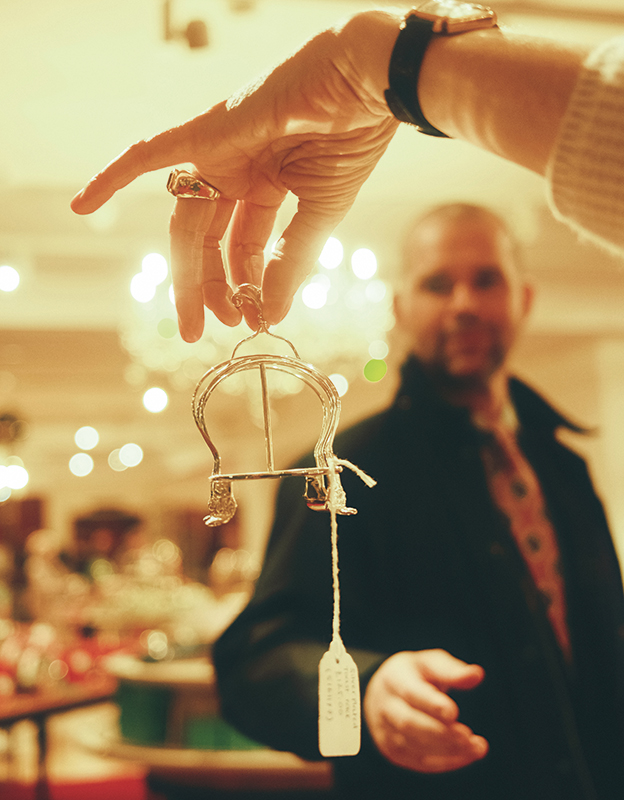
Still, Chris, who is a brilliant podcaster (co-host of How Long Gone) and fashion consultant, had at least leaned into the trad aesthetic for our shopping expedition. He was dressed as a pseudo-Englishman in a striped button-down, pink silk tie, jeans, navy sports jacket and a Barbour. “Wow,” I said as we walked inside, “you look like an unreconstructed 1980s Sloane.” He took this as a compliment and replied, “Yeah, in New York all the finance bros wear Barbours.”
We both grabbed gold shopping baskets with pale blue handles. “Let’s go to the hamper section,” Chris suggested, as he wanted to send one to his mom in Atlanta. I was hamper-focused too but, like most women, I could hardly bypass the other delights of Fortnum’s. “Let’s go to the tea section,” I countered, gesturing at the rows of timeless mahogany shelves with their huge tins, overseen by uniformed staff.
“I don’t drink tea.”
“Well, you should experience the tea counter,” I said. “There’s nothing like it anywhere else in the world.”
“Americans don’t drink tea,” he declared.
Against Chris’s will I made him go to the counter where I spent ages sniffing all the different teas, settling on two large bags of Victoria Grey, and took my time perusing the amazing array of silver strainers. When I put a Fortnum’s portable tea infuser in my basket for my daughter’s main Christmas present, Chris seemed surprised.
“That’s all you’re getting her?” he asked.
“Christmas is not about expensive presents in England,” I explained.
Chris emitted a sigh. “I have to go to the Phoebe Philo store for my wife’s gift.”
Since we were passing the chocolates section, I grabbed a box of the famous Rose and Violet Creams and suggested he get some chocolates for his mother. “She won’t eat them,” he said. “Let’s go to biscuits.”
Chris seemed more comfortable among the ginger nuts and fruitcakes, and chose a tartan-clad tin of shortbread for mom, while I took pots of cognac butter and lemon curd, which he thought was a pudding. When I told him we put it on bread and butter, he looked as though he might gag. “OK, hamper section?” he said hopefully, as I started investigating the honeys.
“Sure, and the Christmas decorations and wrapping paper?” I replied. “And cards?”
Chris looked anguished. “But they’re on the way,” I said, walking ahead.
A little later, as I put a small labrador dog bauble in my basket and added some tartan napkins and cards with bows on them, and showed him the adorable Winnie the Pooh porcelain that I think is an ideal gift for children (“I don’t have any children,” was Chris’s Scrooge-like response), and suggested we nip back downstairs for a jar of the famous Stilton, and perhaps grab a ham too, and why didn’t we pick up the long matches while we were at it, Chris fixed me with a weary gaze and said, “God, Plum, you really do this… properly.”
I was flattered, and before he could say “let’s go to the hamper section” one more time, suggested we stop by the perfumes. There was bound to be something for mom there. “Perfume departments make me feel like I’m in duty free at an airport.”
“This one isn’t like that,” I said. Chris dutifully followed me as I smelled every single candle and scent. He was soon entranced by the L.T. Piver perfumes and when I said, “Right, it’s late, let’s go get our hampers,” I could barely tear the man away.
Up on the fourth floor, Chris took mere seconds to choose a medium-sized square hamper with the famous black F&M monogram printed across the side. “My mom’s gonna love it,” he said excitedly. “Oh, and you know why this is a really good present?” I said. “Once your mom’s eaten everything, she can use it as a picnic basket. I’ve had mine 20 years.”
“Is that something people do here? Go on picnics?” asked Chris. I nodded. “I have never been on a picnic as an adult,” he said. Alas, poor Chris. My Christmas wish for this deprived podcaster is that he may one day go on a picnic in the English countryside, and that, eventually, he may one day become a person who is Christmassy.
This article was originally published in The Spectator’s December 22, 2025 World edition.
Michelle Obama’s new book about style lacks substance
First lady is a strange role. Even when your husband is the first black president, and you’re a Princeton and Harvard-educated former corporate lawyer, America still projects its most regressive ideas about gender onto you. So I understand that Michelle Obama, like Hillary Clinton before her (skipping Laura Bush, a more classical first lady, along with, more recently, Jill Biden and Melania Trump), might have felt constrained, faced with expectations she could never satisfy.
I don’t doubt that being black added enormously to that burden. Yet there is nothing more irritating than the person of Michelle Obama complaining. And she is always complaining. There is always sexism or racism or some other “ism” – even though her life course belies much of her insistence on rampant, endemic race- and gender-based injustice in contemporary America. She was first lady of the US, for crying out loud. She is a global figure of adoration. She wears the finest gowns. She’s a “thought leader,” a power broker and activist – albeit of the yummy-mummy variety – in a way Meghan Markle will only ever be able to dream of.
Obama’s career as first lady was devoted to campaigning on children’s diet, education and veterans’ families – all noble commitments, though certainly pretty gendered. The Look also homes in on another typically feminine interest: her fashion. The book is a “celebration of style” and a tell-all about how she used “the beauty and intrigue of fashion to draw attention to her message,” walking the reader through her sartorial choices from prim cardigans to ball gowns to her edgier choice of designers since she left the White House. One of the key players in this deployment of “the look” is Meredith Koop, her ride-or-die stylist, along with her makeup and hair people and a number of designers. It’s a little strange that this is all parceled up as a political message of “inclusion,” but there you are. The semiotics of appearance know no bounds.
Still, fashion is not actually a substitute for words, actions and thoughts. You can power-dress but be powerless, or you can dress down and wield tremendous say over things. Even as a woman, especially as a black woman – and very much as a first lady.
You’d think, however, based on this book, that fashion is an actual, literal battleground, and that all the prejudices its author continues to complain of find their most pointed outlet in the question of what she ought to wear. And, especially, of how she should do her hair. Having been cruelly ridiculed for my own bushy crop as a Jewish child in an insular WASPy town in 1980s New England, I know that a world of nastiness and mockery can be whipped up about how a girl or woman wears her hair. Even today, I’m often trolled online for my sometimes messy coiffure in TV appearances.
When it comes to black women’s hair, there is obviously a distinctive semiotics of judgment that can be truly vicious and vile. But again, the implication of The Look is that Obama, even as globally lauded first lady in the 2010s, had the same level of vulnerability to overweening prejudice as an elementary school student in the 1980s.
Obsessing over mean comments by bits of the media can point to enduring racist tropes in those quarters, of course. But it can also point to a tendency to ruminate and whine pettily over something on whose significance the jury may well be out, especially in a post-BLM America where women of color are deified in many a workplace, cornrows are seen as a key cultural inheritance and cultural appropriation remains a sin.
But here is Michelle: “What I understood was that at some point I wanted to show up publicly with my hair fully as it comes out of my head,” she said. For her, noted the New York Times in one of many adoring articles, a natural approach to hair “meant braids. It was just a question of when.” And what a question!
Obama goes on to muse on the recent evolution in products for black women’s hair, which is undoubtedly an interesting topic with cultural resonances, but does somewhat smack of sanctimony and rather strikingly traditional female interests for a Democratic ballbuster. “There’s so many lines and products, there’s so much knowledge – heat, the tools that are being used. It’s now a multibillion-dollar industry. That’s just happened in my lifetime,” writes Obama, with dazzling dullness. “I didn’t link to the fact that this is what Black actresses in Hollywood are doing.”
Is this really what feminists from Betty Friedan to bell hooks fought for? Perhaps to ask the question is itself unjust. After all, Obama has been through a lot, such as public “fascination” with her oft-sported bare, muscular arms which, she says, was used to “otherize” her.
But otherizing or not, there’s no excuse for being an advocate for female victims of sexual violence, and yet bailing on those who suffered one of the most heinous sprees of weaponized rape against women in the 21st century. Since October 7, 2023, Obama – a vocal campaigner for the girls kidnapped in Nigeria by Boko Haram in 2014 – has had nothing to say about the Israeli girls and women tortured, sexually abused and held hostage by Hamas.
I’ve always had the feeling that Michelle Obama could be a huge force for progress, but a misplaced preoccupation with being hard done by and discriminated against dramatically limits her both as a symbol and a human being. In the pantheon of first ladies I’d like to meet, I can’t think of one further down the list.
This article was originally published in The Spectator’s December 22, 2025 World edition.
Watch: Starmer grilled on family farm tax
Once, the Liaison Committee was a must-watch in the House of Commons. But the Starmer super-majority means that the thrice-yearly gathering is much more of a snoozefest than it used to be. Two thirds of the 31 members are card-carrying Labour MPs, elected when the PM was at the (short-lived) height of his power in the heady days of summer 2024.
Yet there are a few wise old birds who are ready to give Sir Keir a semi-decent grilling. Today it was the turn of Alistair Carmichael, the longtime Liberal Shetlands survivor, who chairs the Environment, Food and Rural Affairs Select Committee. Picking up the baton from Labour’s Cat Smith, he asked Starmer about why his changes to agricultural property relief were ‘targeted’ at family farmers. The PM – sounding like a Brezhnev-era apparatchik – insisted that the impact was the ‘necessary consequence of the decisions we have taken.’
Carmichael then duly reeled off the panels who have come out against the changes, noting that they are all Labour-dominated. ‘You don’t have to listen to me’, he said. ‘You don’t even have to listen to the farmers out there. You don’t have to listen to the president of the NFU. But what do you not listen to your own party colleagues?’ A grim-faced Starmer insisted: ‘I do listen to party colleagues all the time’. ‘And then do what you’re going to do anyway?’, retorted Carmichael.
Game, set and match to the Lib Dem.
Bondi Beach and the heroism of Ahmed al-Ahmed
As the appalling story of Sunday’s anti-Jewish mass shooting at Sydney’s Bondi Beach continue to unfold, and 16 people are now dead, there have been few glimmers of light in the darkness.
The men identified as the shooters are a father and son, Sajid Akram, 50, and Naveed Akram, 24. The father was shot and killed by police last night, and the son was overpowered and taken into custody. The New South Wales police commissioner says little is yet known about the pair, but Sajid Akram was a licensed gun owner, with six guns in his possession. Old social media posts have also emerged of Naveed Akram being praised for his Islamic studies in 2022.
How these two men became radicalized to commit this atrocity, and how ingrained was their Jew hatred that they came to perpetrate their evil two-man jihad against men, women and children peacefully and joyfully celebrating Hanukkah, will become clear in the coming hours and days. They have, however, destroyed any lingering illusion since Hamas’s October 7 pogrom that Australia is the multicultural haven of peace and tolerance Australians are continually told we are.
But in the sadness, grief and gloom there is one shining example of courage and bravery of a man who risked his life to save others. He was not a policeman or emergency worker. He was just an ordinary bloke in the wrong place at what, for many, turned out to be the right time.
And like the men shooting to end lives, the man who risked his to save many others is a Muslim.
Suburban fruit shop owner, Ahmed al-Ahmed, and his cousin happened to be visiting Bondi Beach as the shootings began. They took shelter behind parked cars as the bullets flew and innocent people were being cut down. Ahmed could have stayed there, keeping his head down, but saw he and his cousin were close enough to one gunman unaware of their proximity.
His cousin Mustafa told Australian media today that Ahmed saw an opportunity to tackle the shooter, and decided to try.
“Ahmed said that he was really upset to see so many people dying in front of him, he said he couldn’t take any more and he had to stop the killings,” Mustafa said.
“He said he just had to do something. He’s a very religious man, he’s Muslim, he doesn’t believe in killings, Muslims don’t.”
“He said he couldn’t take any killings in front of his eyes, and that it was time to stop the killing. He prayed to God, he said ‘give me strength’ and he ran at him from behind.”
The world saw Ahmed’s bravery, captured on video. How he jumped the younger shooter, disarming him after what must have been an adrenalin-charged wrestle, will be long remembered. In the act, he drew the fire of the older Akram and was hit in his shoulder and hand. Nearly a day later, Ahmed is in hospital with his various wounds and expected to undergo surgery later today.
Ahmed al-Ahmed came to Australia from Syria 13 years ago. He has lived a quiet and peaceful life in his new country, runs his small business and is married with two young daughters.
Today, however, he is also a hero, celebrated around the world. President Donald Trump called him “a very, very brave person, actually, who went and attacked frontally one of the shooters, and saved a lot of lives.” A commentator in the Jerusalem Post spoke for many when he wrote, “It is time for Jewish organizations in Australia and worldwide to elevate Ahmed al-Ahmed as a symbol of what courage looks like when it is unscripted and unpolished, when it comes from instinct and decency rather than ideology. He did not have to calculate the risk. He lived it,” and called for Ahmed to be honored as “Righteous Among the Nations.” An American billionaire donated $100,000 to assist him.
But Ahmed’s courage and bravery also serves a nobler purpose, especially today in shocked and horrified Australia. In the aftermath of Bondi, many Australians, in their anger at the perpetrators of this horrible terror act, haven’t hesitated to tar all Muslims with those men’s vile and evil brush. That is as wrong and hateful as those who hate Jews because of their anti-Israel or pro-Palestine ideologies. They should instead be thankful that many Jewish lives were saved by a Muslim man, who could have chosen to keep under cover and save himself. Ahmed’s selfless bravery is a timely and welcome reminder, to all who watched on in horror as the Bondi outrage unfolded, that it is wrong to conflate peaceable, faithful and devout Muslims with radical Islamists.
After a brutal terror attack like Bondi’s, it is understandable that many, in their anger and revulsion, apportion blame indiscriminately. They go past Islamic fanatics and zealots and willingly believe the worst of all Muslims: hate begetting hate. The spontaneous heroism of this mild-mannered, middle-aged Muslim family man reminds us that no faith has a monopoly on goodness – or badness. He’s an antidote to the hatred the perpetrators showed to the Jews they targeted.
In Australia, as we grieve and respond to what happened on Sunday evening, thanks to Ahmed al-Ahmed that’s a salutary lesson about humanity we need to remember just now.
Paul Lumber’s death isn’t funny. Why does that need saying?
Publicly mocking a man who has just died from falling off a ladder. This is what the ‘compassionate’ left has been getting up to on social media in recent days, in between retweeting conspiracy theories about the Bondi terror attack.
‘That knucklehead Paul Lumber who died putting up flags looks exactly like u imagined. The Master Race!!’, spat one person
Paul Lumber, 60, fell to his death while putting up England and Union flags near his home in south Bristol. He was active in the Operation Raise the Colours campaign, which has taken many of Britain’s neglected high streets and dual carriageways by storm.
Lumber suffered multiple injuries, including head injuries, following the tragic incident on 23 November. He was rushed to hospital and placed in an induced coma, from which he never woke up.
First, the tributes poured in from those who knew him. ‘He was widely regarded as one of the area’s most colourful and recognisable characters’, a friend told the media. ‘His family and friends were at the heart of everything he did’, said another. ‘Anyone who knew him will recall the pride, love and warmth with which he spoke about them all. He was a working-class hero.’
Then, the bile came spewing from those who had never met him. ‘Oh dear, how sad, never mind’, tweeted Remoaner influencer Tan Smith (aka @Supertanskiii). ‘Paul Lumber didn’t die in the name of patriotism’, said prize plum Femi Oluwole, another relic of the Brexit wars. ‘He died KNOWINGLY provoking fear and division.’
The no-marks online were even less subtle in their contempt. ‘That knucklehead Paul Lumber who died putting up flags looks exactly like u imagined. The Master Race!!’, spat one. ‘[L]et’s hope he wins a darwin award’, sneered another, referring to the jokey honours conferred on those who take themselves out of the gene pool by their own actions. ‘Remember kids – see a racist up a ladder, give it a little nudge.’
Mocking dead blue-collar men. Wondering out loud if society might be better off now they are prevented from breeding. Welcome to the modern left, a movement of snobs and sociopaths that has long since dropped any pretence to being on the side of those frightful oiks.
Lumber might not have been a choir boy. He was a fixture of Bristol City’s City Service Firm, and went on to write books about the Eighties hooliganism scene. He spent time inside for football-related violence, and is believed to be the first person in the country to receive a football banning order after they were brought in.
But there is still something ghoulish about welcoming the death of a man you did not know, and ascribing views to him from afar. This isn’t about one individual, either. The entire flag-raising movement has been reflexively dismissed as racist, with few on the left stopping to wonder if there might be more going on there. That maybe – just maybe – they’re not all seasoned NF thugs. That there are patriotic people out there who are simply opposed to mass migration, chafing at a divisive, lopsided multiculturalism, and keen to assert a sense of national, shared pride.
The reason the Great and Good casually demonise those raising the colours is that they suspect it is largely white working-class people who are involved – and this is the one group in society it is apparently totally acceptable to despise. Phoney ‘anti-racism’ is how today’s metropolitan middle classes launder their loathing of the lower orders, who they tar as knuckle-dragging fascists. It’s how the new elites express their sense of superiority and sophistication.
Thus, it has become legitimate for supposed left-wingers to think that working-class people are scum, to presume the worst about someone based on what they look like, to share in a giggle when a man they disagreed with falls to his death. They can dress it up however they want, but it’s class hatred all the way down.
Has Donald Trump succumbed to Trump Derangement Syndrome?
The director Rob Reiner and his wife Michelle were found dead in their Los Angeles home yesterday. The couple were discovered with their throats slit open; a knife was found nearby on the premises and their son Nick is being held as a suspect. The nation has been stunned by the brutal circumstances of the Reiners’ deaths – though the requisite level of empathy is apparently yet to reach 1600 Pennsylvania Avenue. This morning, the President issued the following screed on his Truth Social account:
Rob Reiner, a tortured and struggling, but once very talented movie director and comedy star, has passed away, together with his wife, Michele, reportedly due to the anger he caused others through his massive, unyielding, and incurable affliction with a mind crippling disease known as TRUMP DERANGEMENT SYNDROME, sometimes referred to as TDS. He was known to have driven people CRAZY by his raging obsession of President Donald J. Trump…
Even 10 years into Trump’s foray into politics, it is astonishing to think that the President of the United States is the one on the other side of that screen. You might expect a statement of that kind to come from the mouth of a schizophrenic shouting on the street. Trump, who is often accused of being out of touch, is usually quite intentional and tends to draw out certain lines when verbally attacking his enemies. This particular post rings of conspiratorial self-disclosure, the likes of which any PR team would have caught and killed before it saw the light of day.
It is not yet clear why Nick Reiner may have wanted to kill his parents. In 2016, Nick and his father released Being Charlie, a semi-autobiographical film following Nick’s experiences with heroin addiction and homelessness. The story here might be one of a drug-induced breakdown or some other kind of severe mental illness.
Nick Reiner is currently being held at Los Angeles County Jail on a $4 million bail. LA is a city of high-profile homicides. Be it the Charles Manson murders which took place during the summer of 1969, or the deaths of Nicole Brown Simpson in 1994. The fame of those involved, the dark cinematics – car chases, psychedelics – and the uncanny intimacy between the victims and perpetrators tie all of these incidents together.
Trump’s comments prompted Cockburn to think about the conversation still taking place surrounding Charlie Kirk’s murder. The influencer’s death prompted a range of responses, from gloating to appropriate sympathy on the left and righteous outrage to cries for civil war on the right. It goes without saying that no one should be executed for political speech in America. Though at this point, the only person ascribing a political motive to the Reiners’ deaths is President Trump. The last few months have offered Americans a number of opportunities to debase themselves by mocking the deaths of people with whom they disagree. Who knew that the President would come so close to joining their ranks? Or is it now presidential to mock the recently murdered?
Keir Starmer’s Russia problem is here to stay
Keir Starmer will travel to Berlin this afternoon to join European leaders for a ‘mini-summit’ in support of Ukraine following two days of talks between president Volodymyr Zelensky and American officials. Zelensky has been in the German capital since yesterday, locked in talks with US special envoy Steve Witkoff and Donald Trump’s son-in-law Jared Kushner to hammer out the terms of a peace deal on the war in Ukraine that can then be presented to Russia. US representatives have also been invited to this afternoon’s mini-summit – due to kick off shortly after 5.30 p.m. UK time.
Overnight, Witkoff declared that ‘significant progress’ had been made with Zelensky. There has seemingly been a major development: the Ukrainian president reportedly revealed that he was willing to drop Kyiv’s ambition of joining Nato – a key Kremlin demand – in exchange for sufficiently water-tight ‘Article 5-like’ security guarantees from the US and other allies. According to officials briefed on today’s meeting between Zelensky, Witkoff and Kusher, the US is still pressuring Ukraine to give up territory in the Donbass to Russia – another key demand made by Putin. Zelensky has repeatedly stated his refusal to concede territory to Moscow in this way; it is a proposition that is very unpopular in Ukraine itself: according to one poll, up to 75 per cent of Ukrainians oppose it.
It’s not just in Berlin where Russia is the main topic of conversation today
Crammed into the packed schedule in Berlin today is also a joint press conference by Zelensky and German chancellor Friedrich Merz. We will have to wait until that for any potential updates on what progress – if any – has been made with the US on these outstanding issues.
Hosting this round of shuttle diplomacy can be notched up as a triumphant moment for Merz, who is emerging as the figurehead in Europe’s efforts to remain relevant to the discussion around Ukraine’s future and security on the continent. Nonetheless, none of this guarantees that anything discussed over the past days and coming hours will be acceptable to the Kremlin or, in the grand scheme of things, move the conflict any closer to a conclusion.
It’s not just in Berlin where Russia is the main topic of conversation today. Two key speeches by senior defence figures here in Britain will address the direct threat they believe Moscow poses on a domestic front. Blaise Metreweli will use her first speech as MI6’s new chief to warn that the front line against Russia is ‘everywhere’ and that Putin’s ‘export of chaos’ strategy isn’t going anywhere. Meanwhile, Chief of the Defence Staff Richard Knighton has warned that ‘the price of peace is increasing’ and that Russia ‘threatens the whole of Nato, including the UK’. The whole country, he says, should be ‘stepping up’.
Both speeches can be seen as a pitch-rolling exercise, designed to focus the minds of British politicians (and their foot-dragging over defence spending) and public alike on the Russia problem – which, regardless of the outcome of talks in Berlin, shows no signs of going away any time soon.
Will Labour cut ties with Dale Vince?
Good old Dale Vince is at it again. The eccentric eco-millionaire seems to be plagued by a bout of foot-in-mouth-disease – as evidenced by his response to the tragedy at Bondi Beach, in which at least 15 people were killed. The green energy tycoon – who gave Keir Starmer’s party more than £5m last year – said after the attack that Israeli Prime Minister Benjamin Netanyahu ‘wants anti-Semitism to be a thing’ and ‘acts to make it so’. So much for ‘be kind’ eh?
Vince initially made no other comment on the shooting in which a Holocaust survivor was among those killed. But, don’t worry, an hour later, he did find time to express his sympathies about another tragedy. ‘Ten million turkeys are killed every year to celebrate Christmas’, he wrote. ‘It’s a Turkey Holocaust.’ As Clement Attlee – a rather better Labour premier than Starmer – once said, ‘A period of silence on your part would be welcome.’ Words that Vince ought to heed sharpish…
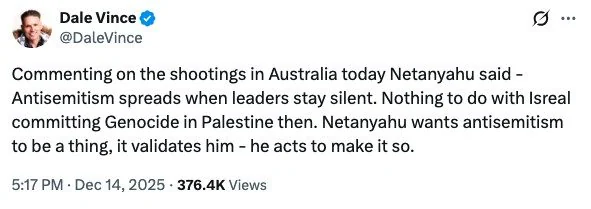
The backlash to his remarks has been swift. Tory politicians have demanded Labour return Vince millions, with Kevin Hollinrake, the party chairman, saying that : ‘This is disgraceful. Any language that excuses or legitimises terrorism gives extremists cover and undermines our values. Labour must return all donations received from Mr Vince, refuse future ones, and make clear that terrorism has no moral ambiguity.’
It was only after the backlash at midday Monday that Vince found the time to write:
My words on this subject were not intended to excuse or legitimise terrorism, or any form of racism – what happened at Bondi beach is an atrocity. My words are aimed at the intervention of Netanyahu who in my opinion overlooks the impacts of his own terrorism. If anti semitism is rising in the world today then surely on any rational analysis, the biggest single cause of that will be the genocide in Palestine. I condemn all acts of violence and all forms of racism.
Bit late mate…
UPDATE: A Labour party spokesperson messages Mr S to say:
We are absolutely clear that the antisemitic terrorist attack against Jewish families at a Chanukah event at Bondi beach is sickening. There can never and should never be any excuses made for barbaric acts of terrorism. The Labour government and the whole Labour movement stands with the Jewish community in Australia, in the UK, and around the world at this awful time. Both before and since we entered government, Keir Starmer’s Labour Party has made tackling antisemitism a key priority and this crucial work will continue so that Jews living at home and abroad can live safely, without fear of violence or prejudice.”
How many more memorial candles must Jews light?
Jews are big on candles. We light two candles every Friday night to welcome the Sabbath and we do the same again on the eve of every Jewish high holy day. Then there is the memorial candle, called a ‘yahrzheit candle’, these are the ones we light when a loved one passes away, and then in memorial every year after. We light them too for those that we didn’t know but mourn nonetheless. Jews around the world light yahrzheit candles annually on Yom H’Shoah (the Jewish Holocaust remembrance day), and since 7 October it feels like we have had to keep on lighting those candles far too frequently.
Hanukkah candles are different, though. Hanukkah candles are smaller, multi-coloured and they burn fast and bright. Hanukkah candles are candles of defiance. They declare: we are still here.
Hanukkah commemorates the Jewish rebellion of 167 BC led by the Maccabees against the Greeks, who had made it impossible for the Jews to practice their faith. The Jewish army was small but mighty and, against the odds, defeated the Greeks. In the Bible story, the Greeks trash the Jewish temple, leaving only enough oil to light the temple menorah (a seven-branch candlestick) for one night, but a miracle occurs and the oil lasts for eight nights. That is why Jews light candles for eight nights of Hanukkah.
I am so sick of seeing yahrzeit candles, of memorials and vigils
It would have been so nice if this year the Jewish community could have had the privilege of lighting only our Hanukkah candles, candles that represent freedom and joy. But no, now we must add Hanukkah to an ever lengthening list of holy days that will be forever marred by murder and barbarism. The 7 October attack happened on the festival of Simchat Torah; then, on Yom Kippur this year in the UK, two British Jews were murdered at a synagogue and now we must mourn the death of 15 Australian Jews, including 10-year-old Matilda Britvan and British-born rabbi and father-of-five, Eli Schlanger, gunned down for the crime of daring to be Jewish in public on Australia’s Bondi Beach.
I am so sick of seeing yahrzeit candles, of memorials and vigils. How many more of them do we have to light before real change happens? Will the Bondi Beach attack finally serve as a wake-up call to leaders in the West? Two gunmen standing on a bridge using Jewish families celebrating Hanukkah as target practice. Is that sickening enough? Does that ring alarm bells for any Western leaders?
Australian prime minister Anthony Albanese is proposing tougher gun laws as his magic solution. Like Keir Starmer after the Heaton Park synagogue attack, who promised increased security of Jewish buildings and communities, he is spinelessly missing the point.
Islamic State (IS) flags were found in the car of the Bondi Beach gunmen suspects Sajid Akram and Naveed Akram. Jihad Al-Shamie, who carried out the Manchester synagogue attack, pledged allegiance to IS before his murderous attack. Meanwhile, the Jewish communities here and in Australia have been pleading for their governments to pay attention to the terrifying rise in anti-Semitism.
Both Albanese and Starmer managed to summon enough courage to actually label the attacks ‘anti-Semitic’. But Heaton Park and Bondi Beach are not random acts of anti-Semitism. They did not occur in a vacuum. These attacks are a combination of a failure to tackle Islamic terrorism across the West and ignoring a toxic climate of anti-Semitism, where relentless anti-Israel propaganda is disingenuously described as political criticism by Palestinian activists. This means anti-Semitic rhetoric and calls to ‘Globalise the Intifada’ flourish on the streets of the UK, Australia and across the West.
It’s a toxic combination and leaders who bury their heads in the sand and refuse to find the necessary courage to deal with it will endanger all of us. Islamists are virulent anti-Semites, of course, but make no mistake, they hate everyone else too. Just this weekend, a plot for a terror attack on a Christmas market in Germany was foiled, alleged to have an ‘Islamist motive’ – what a shock.
There are seven nights left of Hanukkah. Jews and non-Jews alike, all those who believe in the importance of freedom, would do well to search for their own spirit of defiance. Platitudes and lukewarm sentiments of solidarity will not win this battle. Let the coming year be the one when we all find the courage to fight back against the evil in our midst. Only then will light triumph over darkness.
Did the Democrats kill Roomba?
Allow me to add an additional downer note to this grimmest of news days: iRobot, the company that manufactures Roombas, has declared bankruptcy. iRobot said it will continue to update and provide technical support for the devices, so there will be no “bricking.” They will continue to function, just like ghosts continue to haunt the homes in which they once lived. But there’s definitely a brick in the hearts today of the customers who’ve loved their robot vacuums since the 1990s, not to mention the cats who loved to ride them, the dogs that loved to chase them around the house, and the people who loved to watch videos of animals doing those things.
In many ways, the world has passed by the Roomba. We live in an age where driverless cars scoot around American cities, fabric-covered helper robots fold clothes and put away dishes and even the most average person has a quantum generative AI supercomputer in their pocket that can help them generate a work presentation while also telling them they’re the smartest, sexiest human who’s ever lived. In such an environment, how can a little round automated vacuum that hugs the sideboards ever compete? Also, there are cheaper Chinese knockoffs that work better.
About that. The major reason for Roomba’s bankruptcy is that it owes $352 million to a Chinese company called Shenzen PICEA, its primary manufacturer. Picea will now own 100 percent of equity in the Roomba brand. In 2024, Amazon attempted to buy iRobot. US antitrust law would have allowed this acquisition, but it received pushback from typical American corners. “I have serious concerns about the Amazon-iRobot deal,” Senator Elizabeth Warren of Massachusetts said. “Dominant companies like Amazon shouldn’t be allowed to just buy their way out of competing.”
In a letter to the Federal Trade Commission, Warren and several illustrious Congresspeople like Jesus “Chuy” Garcia from Chicago and California’s perpetually peeved Katie Porter, said: “rather than compete in a fair marketplace on its own merits, Amazon is following a familiar anticompetitive playbook: leveraging its massive market share and access to capital to buy or suppress popular products.”
Possibly. But at least it would have been American-owned. Instead, FTC chair Lina Khan, unable to do so legally in her country, asked the European Union to do the dirty work, and the EU’s Commission killed the deal in 2024, admitting at the time that they’d been in “close contact” with the US FTC.
So instead of allowing Roomba to sync up with your Alexa devices, the US has instead turned over control of your dust bunnies to a company based in Shenzhen. And then there are the Roomba competitors, which have admitted that they’re using their devices to create maps of US homes. We all know that Amazon is watching you and tracking your shopping and shipping preferences, but that’s still a far cry from allowing a robotic TikTok vacuum into your house. Your dog may just be chasing around a ticking data time bomb. Pray the Chinese do not alter it further.
Why was this old man fined £250 for spitting out a leaf?
‘I celebrate myself, and sing myself,’ wrote Walt Whitman in his rhapsodic celebration of freedom, Leaves of Grass. ‘And what I assume you shall assume,/ For every atom belonging to me as good belongs to you.// I loafe and invite my soul,/ I lean and loafe at my ease observing a spear of summer grass.’
Dog walkers have complained of being asked to provide evidence of having poo-bags about their person
A century and a half later Roy Marsh, 86, was leaning and loafing at his ease by a boating lake in Skegness when he, too, interacted with a spear of grass. This spear of grass was blown into the poor fellow’s mouth by a gust of wind. Mr Marsh did what everyone would do in the circumstances, which is to say: ‘Ptth’ – not quite a barbaric yawp, but it will have to do until one comes along – and spit it out.
At once, the forces of law and order pounced. A pair of environmental enforcement officers from East Lindsey District Council, in his account of the events, appeared as if from nowhere (they had been skulking, I fancy, in such sedge as had not yet withered from the lake) and said: ‘Can I have a word?’ He was told, some will think a little pompously, that these officers ‘had reason to believe he had been spitting’, and was immediately slapped with a £250 fine.
This raises a host of chewy philosophical questions, and the odd practical one. The main practical one is how well the public purse is served, in these times of financial woe, by having not one but two council contractors patrolling a deserted boating lake in search of ‘environmental crimes’. If they can fine people £250 a pop for spitting out a leaf, and they go about their work with sufficient zeal, there may indeed be a fiscal case for it, but it won’t make the boating lake a very welcoming destination for the blameless ratepayers of East Lindsey.
A lesser practical question is that ‘reason to believe’. What sort of evidence did the enforcement officers have of this environmental crime? Were they wearing bodycams? Will they test the leaf for salival DNA? Assuming neither of those things, we perhaps see that the reason they move around in pairs: eyewitness evidence will require corroboration if it’s not to devolve into a his-word-against-yours situation. It would, obviously, be a tragedy for the rule of law in East Lindsey should such cases collapse when clever barristers, played by David Tennant, start coming up from that London to lodge appeals. There again, quis custodiet? I’ve seen enough episodes of The Sweeney to know that two cops and a perp can lead to some pretty rough justice.
But the philosophical questions are the chewier ones. That leaf, for instance. Had it made its progress to the ground without going via Mr Marsh’s mouth – as presumably it did in countless billion parallel realities – would the world in general, or the Skegness Boating Lake in particular, have been any more hospitable or beautiful as a result? Would anybody have noticed?
And even if that leaf landing on the ground really did constitute an environmental crime, was it Mr Marsh’s crime? Did he become the legal owner of that leaf – did it as good belong to him, in Whitman terms – when it happened to blow into his mouth, so making him guilty of littering when it in turn fell to the ground? Had it bounced off his nose, would the case had been different – spitting it out of his mouth being an active intervention, where owning a nose would qualify him only for bystander status? If nothing else, we must be impressed with the jurisprudential acuity of these two enforcement officers, settling all these questions to their unqualified satisfaction, as they evidently did, before the said leaf had even hit the deck.
Anyway, £250. Two hundred and fifty quid. Mr Marsh claims that he called one of the officers a ‘silly boy’, and it’s hard to demur – though I doubt that speaking his truth will have helped his case much in the moment. Mr Marsh, no doubt rather glumly, paid the fine. But he did lodge an appeal, of which more later.
Since the case was publicised, incidentally, various members of the public have come forward to complain of enforcement officers hanging round the public toilets like hyenas in the hopes of making such a dispiriting collar. Pre-crime even seems to be one of their things. Dog walkers have complained of being asked to provide evidence of having poo-bags about their person; and if they produce only one, of being sent home to get a larger supply. Mr Marsh himself was detained by another enforcement officer who saw him pull a tissue out of his pocket to blow his nose: ‘I saw you take something out of your pocket. Where is it?’ Only on demonstrating that the tissue was, um, in his hand, Mr Marsh was let off.
That appeal, incidentally. When Mr Marsh pointed out in writing to the local council – though he won’t have put it exactly like this – the fatheaded, obtuse, tinpot, jobsworth, money-grabbing effing imbecility of having a pair of plastic parkies fine an old man £250 for spitting out a leaf in a public place, the council relented. They took cognisance, in their Solomonic way, that Mr Marsh has severe asthma, stage three prostate cancer and can only walk with the aid of a rollator, and…reduced the fine to £150. Pretty big of them, eh? I can’t say I carry a torch for Reform, but if their vaunted campaign to cut the costs of local council bureaucracy ends up with the metaphorical machine-gunning of the environmental crimes department of East Lindsey, I’ll be in their corner – and everything they assume I shall assume.
Will bromance bloom between Trump and Jordan Bardella?
Life has never been so good for Jordan Bardella, the 30-year-old president of Marine Le Pen’s National Rally. A recent opinion poll had him as the runaway favorite to win the 2027 presidential election. One man who believes in his credentials is the former president of France, Nicolas Sarkozy. Now out of prison and promoting the book he wrote during his 20-day incarceration, the center-right Sarkozy said that Bardella reminds him of a young Jacques Chirac.
Despite Sarkozy’s conviction for criminal conspiracy, he retains a large and loyal fanbase among the metropolitan boomer bourgeois, a demographic that the National Rally has traditionally struggled to attract.
Bardella has also been broadening his horizons with a visit to London last week where he lunched with Reform party leader Nigel Farage and spoke to the BBC. Among the topics of conversation was Donald Trump, and Bardella said that he agreed “for the most part” with the President’s bleak outlook for Europe.
Bardella had another opportunity to work on his English (he’s been taking intensive lessons this year) when he and Le Pen were invited last Friday to the American embassy in Paris. “I appreciated the chance to learn about the National Rally’s economic and social agenda and their views on what lies ahead for France,” tweeted ambassador Charles Kushner, above a photo of him standing next to Le Pen and Bardella.
The French left weren’t happy. Manon Aubry, a prominent member of Jean-Luc Mélenchon’s La France Insoumise, accused the National Rally of “servilely rushing to destabilize their own country for the benefit of Trump’s doctrine of interference.”
The French edition of the Huff Post articulated the fears of many on the left that the 2027 presidential election “will be subject to foreign interference and pressure.”
The Huff Post wasn’t as vexed about “foreign interference” in 2017 when former president Barack Obama endorsed Emmanuel Macron’s presidential campaign. The same goes for Macron. He said he was “delighted” to receive Obama’s support on the eve of the second round run-off against Marine Le Pen. On the other hand, when Elon Musk took an interest in European politics earlier this year, Macron told him to butt out, saying “this is not the way things should be between democracies and allies.”
Bardella has also undergone a volte-face when it comes to America. His frosty response to Trump’s election victory was to warn that it should be “a wake-up call…to the French and Europeans.”
Éric Zemmour, on the other hand, leader of the right-wing Reconquest Party, couldn’t conceal his glee. “I wish all the best to the Americans who have chosen civilization over wokeism, decline and the deconstruction of their identity,” was how he reacted to Trump’s second term.
That explains why Zemmour was invited to Trump’s inauguration and Bardella was not.
Bardella further blotted his copybook in February when he fled the Conservative Political Action Conference (CPAC) in Washington. Steve Bannon had been accused by the liberal press of making a Nazi salute and Bardella didn’t want to be tainted by association. Bannon accused him of being “a boy, not a man.”
Bardella may have been obeying orders when he flew home from Washington. Le Pen was awaiting the verdict on whether she had misused EU funds and she wanted to avoid the merest hint of scandal. Fat lot of good that it did her. She was found guilty the following month and disqualified for five years.
Since that verdict, Bardella has grown in confidence and influence, emerging from the shadow of Le Pen to become the de facto leader of the National Rally. Even if Le Pen is reinstated when her appeal is heard in February, many within the party regard Bardella as the stronger candidate for the 2027 election.
He is more economically liberal than the statist Le Pen, and in recent months he has been courting France’s business leaders. He is also more attuned to the civilizational issue. Le Pen has always been tepid on this question. In 2016 she angered many of her voters when she said she believed Islam was “compatible” with French values. One of Macron’s ministers, Gerald Darmanin, subsequently mocked her in a debate for her “soft” attitude towards Islamism.
Bardella grew up in Seine-Saint-Denis, the impoverished department north of Paris with the greatest number of Muslims in France. He is acutely aware of how mass immigration is transforming the Republic. In the past he has warned that immigration “poses a threat to our society… it profoundly destabilizes the fundamental balances of our nations.”
Le Pen is also much more of an isolationist than Bardella. She recently reiterated her opposition to the idea of a right-wing union in France, and her attempts to forge any conservative coalitions within Europe have been half-hearted.
Bardella is more open-minded, as he demonstrated during his trip to London to form with Farage what the French press call “a patriotic alliance.”
The mainstream media have also noted Bardella’s overtures towards America. France’s public radio broadcaster ran an editorial on Friday entitled “Bardella and Trump: Same Combat.” It was predictable in its tone, claiming that the pair share “the conspiracy theory fantasy of the ‘great replacement.'”
Le Pen famously went to New York in January 2017 and hung around Trump Tower in the hope of bumping into the president-elect. She didn’t, and the French press made much of her embarrassment.
Bardella may have more luck in meeting the Donald if he heads Stateside between now and the 2027 election.
Bondi Beach and the heroism of Ahmed al Ahmed
As the appalling story of Sunday’s anti-Jewish mass shooting at Sydney’s Bondi Beach continue to unfold, and 16 people are now dead, there have been few glimmers of light in the darkness.
Ahmed’s cousin, Mustafa, said Ahmed saw an opportunity to tackle the shooter
The men identified as the shooters are a father and son, Sajid Akram, 50, and Naveed Akram, 24. The father was shot and killed by police last night, and the son was overpowered and taken into custody. The New South Wales police commissioner says little is yet known about the pair, but Sajid Akram was a licensed gun owner, with six guns in his possession. Old social media posts have also emerged of Naveed Akram being praised for his Islamic studies in 2022.
How these two men became radicalised to commit this atrocity, and how ingrained was their Jew hatred that they came to perpetrate their evil two-man jihad against men, women and children peacefully and joyfully celebrating Hanukkah, will become clear in the coming hours and days. They have, however, destroyed any lingering illusion since Hamas’s 7 October pogrom that Australia is the multicultural haven of peace and tolerance Australians are continually told we are.
But in the sadness, grief and gloom there is one shining example of courage and bravery of a man who risked his life to save others. He was not a policeman or emergency worker. He was just an ordinary bloke in the wrong place at what, for many, turned out to be the right time.
And like the men shooting to end lives, the man who risked his to save many others is a Muslim.
Suburban fruit shop owner, Ahmed al Ahmed, and his cousin happened to be visiting Bondi Beach as the shootings began. They took shelter behind parked cars as the bullets flew and innocent people were being cut down. Ahmed could have stayed there, keeping his head down, but saw he and his cousin were close enough to one gunman unaware of their proximity.
His cousin Mustafa told Australian media today that Ahmed saw an opportunity to tackle the shooter, and decided to try.
‘Ahmed said that he was really upset to see so many people dying in front of him, he said he couldn’t take any more and he had to stop the killings,’ Mustafa said.
‘He said he just had to do something. He’s a very religious man, he’s Muslim, he doesn’t believe in killings, Muslims don’t.’
‘He said he couldn’t take any killings in front of his eyes, and that it was time to stop the killing. He prayed to God, he said ‘give me strength’ and he ran at him from behind.’
The world saw Ahmed’s bravery, captured on video. How he jumped the younger shooter, disarming him after what must have been an adrenalin-charged wrestle, will be long remembered. In the act, he drew the fire of the older Akram and was hit in his shoulder and hand. Nearly a day later, Ahmed is in hospital with his various wounds and expected to undergo surgery later today.
Ahmed al Ahmed came to Australia from Syria 13 years ago. He has lived a quiet and peaceful life in his new country, runs his small business and is married with two young daughters.
Today, however, he is also a hero, celebrated around the world. President Donald Trump called him ‘a very, very brave person, actually, who went and attacked frontally one of the shooters, and saved a lot of lives.’ A commentator in the Jerusalem Post spoke for many when he wrote, ‘It is time for Jewish organisations in Australia and worldwide to elevate Ahmed al Ahmed as a symbol of what courage looks like when it is unscripted and unpolished, when it comes from instinct and decency rather than ideology. He did not have to calculate the risk. He lived it,’ and called for Ahmed to be honoured as ‘Righteous Among the Nations.’ An American billionaire donated $100,000 (£75,000) to assist him.
But Ahmed’s courage and bravery also serves a nobler purpose, especially today in shocked and horrified Australia. In the aftermath of Bondi, many Australians, in their anger at the perpetrators of this horrible terror act, haven’t hesitated to tar all Muslims with those men’s vile and evil brush. That is as wrong and hateful as those who hate Jews because of their anti-Israel or pro-Palestine ideologies. They should instead be thankful that many Jewish lives were saved by a Muslim man, who could have chosen to keep under cover and save himself. Ahmed’s selfless bravery is a timely and welcome reminder, to all who watched on in horror as the Bondi outrage unfolded, that it is wrong to conflate peaceable, faithful and devout Muslims with radical Islamists.
After a brutal terror attack like Bondi’s, it is understandable that many, in their anger and revulsion, apportion blame indiscriminately. They go past Islamic fanatics and zealots and willingly believe the worst of all Muslims: hate begetting hate. The spontaneous heroism of this mild-mannered, middle-aged Muslim family man reminds us that no faith has a monopoly on goodness – or badness. He’s an antidote to the hatred the perpetrators showed to the Jews they targeted.
In Australia, as we grieve and respond to what happened on Sunday evening, thanks to Ahmed al Ahmed that’s a salutary lesson about humanity we need to remember just now.