-
AAPL
213.43 (+0.29%)
-
BARC-LN
1205.7 (-1.46%)
-
NKE
94.05 (+0.39%)
-
CVX
152.67 (-1.00%)
-
CRM
230.27 (-2.34%)
-
INTC
30.5 (-0.87%)
-
DIS
100.16 (-0.67%)
-
DOW
55.79 (-0.82%)
Best events at Labour conference 2024
This weekend Labour ministers, MPs and delegates will arrive in Liverpool for their first conference in office since 2009. Following July’s thumping election victory, the official slogan for this week’s gathering is ‘Change Begins’. But after recent rows on winter fuel and No. 10 squabbles, is everyone in the party agreed on what that change looks like? Below is The Spectator’s guide to some of the highlights at Labour conference over the next four days:
Saturday
19:00 – 22:00 London Labour reception at ACC, Hall 2H
Of the 75 constituencies in Greater London, 59 of them are now represented by a Labour MP. Among their number include ministers like Stephen Timms, Wes Streeting, James Murray and of course Keir Starmer himself. Might we see London Mayor Sadiq Khan popping in too?
19:00 – 22:00 North West Drinks reception at ACC, Hall 2C
Another area where Labour has overwhelming electoral dominance is the North West where they hold 63 of the 73 constituencies, featuring some of the party’s great characters. It was at this event three years ago that Angela Rayner – deputy leader and MP from a Manchester constituency – made her infamous ‘scum’ comments.
21:00 – 22:00 LGBT+ Labour disco at GBar Liverpool
Few events hold more affection in the hearts of hard-clubbing Labour activists than the annual LGBT knees-up, held this year in the colourful surroundings of GBar.
Sunday
11:25 – 11:35 Deputy Leader of the Labour Party’s speech in Conference Hall
This year’s schedule is notable for how few members of the Cabinet will be making a speech in the main hall. But one of them is Angela Rayner, in her capacity as Deputy Leader. Her brief in government though is workers’ rights and levelling up, with businesses likely to pour over her remarks when the spotlight on her.
16:00 – 16:30 ‘The future of the Steel Industry in the UK’ at ACC, Arena Room 7
The UK Steel industry is facing an uncertain future, amid job losses at Port Talbot and competition from overseas. So this could be one of the more punchy panels as Gareth Stace, the head of UK Steel, appears alongside minister Sarah Jones and her fellow MPs Chris McDonald and Stephen Kinnock.
17:00 – 18:30 ‘Change that Lasts’ at ACC, Hall 2D
The relationship between Keir Starmer and Andy Burnham has had its ups and downs over the years. So it is interesting to see the Manchester Mayor appearing at an event hosted by ‘Labour for Electoral Reform’ – despite the current system returning a Labour majority of 174 in July.
18:00 – 19:30 ‘Resetting the UK’s relations with Europe’ at ACC, Arena Room 3
Brexit is one of the thorniest issues for Keir Starmer’s government, given their memories of the 2019 election. So it is striking to see then that Nick Thomas-Symonds – the minister responsible for EU relations – will be appearing at this ‘Labour Movement for Europe’ event alongside fellow Remainers Emily Thornberry and Stella Creasy.
22:00 Dawn Butler’s Jamaica Party at Camp and Furnace
Another firm favourite of conference regulars, this annual shindig is one of the more challenging parties to get into. Run by Brent MP Dawn Butler, it usually features rum punch and guest appearances, with Sadiq Khan sometimes doing a star turn as DJ.
Monday
09:00 – 10:15 ‘Diplomacy, Development and Defence’ at ACC, Arena Room 9
David Lammy has had a busy time in recent months, amid the ongoing wars in Ukraine and Gaza. The Foreign Secretary will give Labour members a chance to hear all about it when he appears alongside the FCDO’s former top mandarin Simon Fraser at this event on Monday morning.
11:00 – 12:00 ‘How will the Labour government deliver a New Deal for Working People?’ at Casa Bar, Revolucion de Cuba
This is an appropriate venue for some of the more militant trade union leaders to give their thoughts on the Labour government. The RMT’s Mick Lynch will join Matt Wrack of the Fire Brigade Union and others to grill Transport Minister Lord Hendy and potentially Justin Madders of the Business Department too.
12:00 – 12:35 Chancellor of the Exchequer’s Speech in Conference Hall
Ahead of next month’s Budget, Rachel Reeves knows that this event is crucial in framing the decisions she will make on tax and spend. The Chancellor faces a difficult tightrope: enthusing activists and boosting business confidence while being candid about the nation’s finances and the difficult decisions ahead.
12:15 – 13:30 ‘Can Labour Transform UK Higher Education?’ at Albert 4 in Hilton
The university sector breathed a sigh of relief in July when the Conservatives were expelled from office. But with some institutes now in a funding crisis, will help be on hand at a time when the purse strings are so tight? Newly ennobled Jacqui Smith will debate this one alongside James Purnell and Margaret Hodge.
16:30 – 17:30 ‘How to fix a broken NHS’ at ACC, Arena Room 11
Isabel Hardman will host this Spectator panel featuring Stephen Kinnock, the Minister for Care, and other experts too. Is Labour ready to do what needs to be done to achieve fundamental reform across the health service?
17:30 – 18:30 ‘Labour to Win Rally’ at ACC, Room 2C
This event will feature some of Labour’s biggest names including the likes of Health Secretary Wes Streeting, Justice Secretary Shabana Mahmood and Liz Kendall, the Work and Pensions Secretary. Expect a triumphant atmosphere at this jamboree of pro-Starmer moderates.
Tuesday
11:00 – 12:00 ‘How Labour Won the Election’ at ACC, Arena Room 2
Few ministers did more media rounds than Pat McFadden did during the election. Here at this event, the Cabinet Office veteran tells journalist Pippa Crerar just how exactly his party made 209 gains in July. Appropriately, it is being hosted by Labour Together – the think tank which backed Starmer’s leadership bid and boasts close ties to his aide Morgan McSweeney.
11:00 – 11:40 ‘Women with Balls Live’ at ACC, Arena Room 1
Katy Balls – The Spectator’s political editor – will interview Education Secretary Bridget Phillipson at this live podcast recording focusing on the big issues of Labour conference.
11:50 – 12:30 ‘Is the net zero target achieveable?’ at ACC, Arena Room 1
Decarbonising power by 2030 is the biggest target of Keir Starmer’s premiership. Can this be achieved? Join Fraser Nelson, the editor of The Spectator, and GMB’s Gary Smith as they discuss what is realistic and what it will mean for Britain.
14:00 – 16:00 The Prime Minister’s Speech in Conference Hall
For the first time in 15 years a sitting Labour Prime Minister will address his party’s conference. Keir Starmer’s speech will be a mix of victory lap and prospectus for government, looking back at the election campaign just gone and explaining what the next 12 months now have in store.
17:15 – 18:30 ‘Securonomics: The Path to Green Growth?’ at ACC, Arena Room 9
The Chancellor is only making a few appearances at this conference and this one looks to be the most eye-catching. Rachel Reeves will appear alongside Heather Boushey – a member of President Biden’s Council of Economic Advisers – as the pair discuss ‘Securonomics’ on both sides of the Atlantic at the IPPR.
18:00 – 19:00 ‘Is Technology the Key to deliver Mission-led Government? at ACC, 1B
Fixing the public services is a pre-requisite if Labour is to secure re-election in five years’ time. To do that, ministers will need to harness the power of technology. Few areas need that more than in the NHS and the Department of Science, amid increased competition from foreign rivals. Wes Streeting and Peter Kyle join Sky’s Liz Bates in conversation at the Tony Blair Institute to discuss.
19:00 – 21:00 ‘Labour First’ Rally at Grace Suite in Hilton
A smorgasbord of Labour MPs are expected to attend this closing-night rally including Luke Akehurst, Pat McFadden, Angela Eagle, Alison McGovern and Calvin Bailey.
Sue Gray’s Labour conference no-show
As well as being paid more than the Prime Minister, it seems Sir Keir Starmer’s chief of staff is getting more press attention these days too. It now transpires that Sue Gray will not be attending Labour’s conference this week, following bad briefings over her pay packet. Rather than attend the Liverpool love-in, Gray will stay away from the party faithful and, instead, apparently prepare for a United Nations conference next week.
The latest round of malicious leaks aimed at Gray revealed Starmer’s top staffer is on a £170,000 salary – £3,000 more than the Prime Minister himself and higher still than the pay packet of her Tory predecessor. The finding led to outrage among party advisers, many of whom were rather disappointed to discover they are now being receiving less money than what they were in opposition. Not quite what they’d expected Sir Keir’s ‘change’ agenda to lead to, Mr S can imagine.
Those in the know about Gray’s wage certainly weren’t pulling any punches over the issue. One source remarked to the Beeb that: ‘It was suggested that she might want to go for a few thousand pound less than the prime minister to avoid this very story. She declined.’ An insider slammed the former civil servant as an ‘increasingly grand Sue’, while another remarked scathingly to the Sunday Times: ‘Sue Gray is the only pensioner better off under Labour.’
So, is Gray’s absence pre-planned or a response to recent events? She attended the annual meet this time last year. ‘It’s probably the sensible thing to do,’ says a Labour aide. ‘If she’d come it would have become a media circus.’ However, Gray’s absence is unlikely to silence her critics – instead she is one of the main topics of conversation at the bash. Out of sight, but not out of mind…
Why JD Vance ‘created’ the pet-eating immigrants
Last week, Republican vice-presidential candidate JD Vance appeared on CNN’s State of the Union where he was interviewed by Dana Bash. During what could best be described as a testy exchange, Vance said he had ‘created’ the story of Haitian immigrants eating pets. Explaining that statement, he said he ‘created’ the story with memes and tweets, not that he created the substance of the story.
Still, no one listened. In America’s media ecosystem, which has little regard for nuance and context, the proverbial die was already cast. Left-leaning media were quick to point to his statement as proof of the story being completely fabricated. Right-leaning media viewed their reactions as another attempt to distort the words of a high-profile conservative. Both views are half-truths. But what interests me about the whole kerfuffle isn’t the truth of the story, but what the reactions to Vance’s statement say about our media, our elected leaders and us as voters.
Part of the blame lies with voters
News as a consumer product has always had a sensationalist element. ‘If it bleeds it leads’. People like spectacle, and they like being told they’re right. American media serves these two desires almost perfectly. Every election is now the most important in history; every member of the opposing party is literally evil; every Republican is Hitler; every Democrat is Stalin or Mao. Our media is always ready to deliver you the most sensational and self-affirming ‘news’ you can handle. I know that no one can really be unbiased, and we all have worldviews shaped by upbringing and genetics and societal pressures and about a million other factors. It’s the attempt to be unbiased, to try to be aware of blind spots, that is sorely missing from American media. Without it, the average voter, trying to make sense of our politics, is in a difficult situation.
Now, I don’t think anybody expects politicians to be saintly. We know politicians – politicians we support – are going to say things that are untrue. That’s why I think it’ll be hard for many Americans to completely admonish Vance for giving an ‘unconfirmed’ story a kick. It’s kept immigration, a subject his ticket polls well on, and a subject many Americans care deeply about, at the top of the headlines all week – or the top of social media trending lists, since that’s how most people get their news nowadays. Without a sensational story, the ‘MSM’ (Mainstream Media) would have continued to give immigration little attention. Is gaining that attention, in an attempt to help fix the issue, worth it? I think most people would say: ‘It’s politics we have’.
Still, I prefer a version of politics where the sensationalism doesn’t come from our politicians, and where our representatives hold themselves to a higher standard than ‘a guy I know told me’. (Especially when it comes to a story such as immigrants eating pets.) The American media does a fine job at sensationalism already. They don’t need the assistance of our elected leaders.
Part of the blame lies with voters. The way in which we expect so little from our leaders and media is a reflection of how little we’ve come to expect from ourselves. People have given in to the base thrill of seeing someone with an opposing idea or ideology get ‘owned’, the buzz from conflict with the ‘other’. If honesty and sober thought are values you don’t care about, then I suppose the current system is working fine for you. American democracy today desperately needs more discerning voters.
Without politicians having to pay a price from their own ‘side’ for being sensationalist and bending the truth, they won’t stop. That puts the onus on voters to extract that price, even if it means having politicians they don’t support in charge for a few years. If Americans want good values to win out, they may have to take a few losses in the short term. There will be another election – despite what you may hear.
Mick Lynch mocks Labour’s outfit freebies
Poor Keir Starmer. One of the first things he did after becoming prime minister was to stuff the unions’ mouths with gold – with his government signing off bumper pay rises for striking train drivers, teachers and junior doctors. Still, as he should probably have known at this Labour conference in Liverpool: money can’t buy you love.
It certainly didn’t stop the RMT’s Mick Lynch from sticking the knife in over the growing controversy over wardrobe-gate this weekend.
On Friday, Starmer, Rachel Reeves and Angela Rayner were all forced to announce that they would no longer accept clothes as gifts, after receiving thousands of pounds worth of freebies from the Labour donor Lord Alli. This weekend, Angela Rayner also had to defend her use of a New York apartment for a holiday stay, again gifted by Alli.
Luckily for the fully kitted-out Labour team, union man Lynch was available to, errr, take the mick out of them this conference.
Lynch began an event on public transport by pointing out there had been lots of public declarations recently and he therefore had his own to make:
There’s lots on the news this morning, and there was a lot of people making declarations about all of their interests… So I’ve got to make a public declaration: all of my clothes are from my wife. And she gives a full consultation with my personal designers: Marks and Spencers. On the table, everything is under £49.99.’
A pointed dig if there ever was one…
Elsewhere in the event, Lynch suggested that his union would inevitably go on strike again in the future, saying:
Under previous Labour governments. NUR and Aslef members took on very heavy periods of industrial action to get what they needed from those governments… That will happen again in the future.
Who could have predicted that Labour paying the union Danegeld would be a bad idea?
Angela Rayner: ‘I don’t believe I broke any rules… in fact I think I was overly transparent’
Angela Rayner: ‘I don’t believe I broke any rules… in fact I think I was overly transparent’
The Labour conference has got off to an awkward start, as senior figures continue to battle controversy around donations, Starmer’s approval rating plummets, and anger persists over the winter fuel allowance. Speaking to Laura Kuenssberg in Liverpool, Deputy Prime Minister Angela Rayner defended her holiday stay in a New York apartment gifted to her by Lord Alli. Rayner argued that ‘MPs have accepted gifts for years… all MPs do it’, and said that the important point was that the government was being ‘open and transparent’ about it. Kuenssberg pointed out that it wasn’t declared that former Labour MP Sam Tarry also stayed in the apartment, and asked Rayner if she wanted to say sorry for any misjudgements. Rayner said she believed she hadn’t broken any rules, and that she had paid for her holiday herself.
Rayner vague on ‘biggest wave’ of social housing
The deputy PM and housing secretary was also asked what proportion of Labour’s promised 1.5 million new homes would be social housing. Rayner repeatedly refused to give a specific number, saying there are ‘so many moving parts’ and that it depended on which building sites became available. Kuenssberg asked Rayner why they wouldn’t remove the right to buy scheme to prevent the loss of social housing stock. Rayner agreed that there should be less of a discount when buying social housing, but guaranteed Labour wouldn’t get rid of the policy completely, saying it had been ‘incredibly important’ to her to be able to buy the council house she had lived in.
Sharon Graham: Labour walking country into ‘austerity mark 2’
Keir Starmer is also facing conflict with unions over the winter fuel allowance. On Sky News, Trevor Phillips asked Unite General Secretary Sharon Graham what she wanted to hear from Starmer in his conference speech. Graham said that the winter fuel allowance decision is ‘a cruel policy’, and she wanted Starmer to admit it was a misstep, and reverse it. Phillips said that party leaders never admit to mistakes, but Graham argued that a good leader would do so, and that it was a mistake that the first thing Labour had done was to take money away from ‘the poorest in our society’.
Chris Philp: Starmer has accepted ‘far more freebies than any other MP’
Shadow House of Commons Leader Chris Philp suggested to Kuenssberg that some of the donations Starmer has received, such as clothes for his wife, are ‘weird’ and ‘inappropriate’. Kuenssberg pointed out that Philp’s own party were in no position to attack Labour on this point, but Philp argued that he himself had not accepted any personal donations, and had resigned from Boris Johnson’s government on issues of ‘ethics and integrity’, so had ‘done [his] bit’. Philp also claimed that people connected with the Labour Party were being given roles in the civil service, and that Lord Alli was ‘apparently advising on appointments’ in Downing Street.
Israeli President Herzog: ‘Lebanon has been hijacked by a terror organisation’
The unprecedented pager and walkie-talkie bomb attacks in Lebanon shocked the world this week, and left Israel on the brink of a full-scale regional conflict. In an interview with Israeli President Isaac Herzog, Trevor Phillips asked if Israel had decided to ‘abandon restraint’. Herzog claimed that the ‘simple message of Israel’ was that they ‘do not want war’. He said the war was started by the Iranian ‘Empire of Evil’, and Israel was fighting for its existence. Phillips asked if Israel was now at war with Lebanon, and Herzog claimed Israel was ‘not interested’ in a war with Lebanon, but was defending itself against Hezbollah, who he suggested have ‘hijacked’ the country.
Richard Burgon fails to draw a crowd at Labour conference
Oh for the days of ‘Oh Jeremy Corbyn’. It only seems like yesterday that the likes of John McDonnell and Richard Burgon were commanding impressive crowds at Labour conference. Even last year, with the Starmerites in the ascendant, Labour left events were standing room only. Now though it seems like the fire has gone out of the revolution…
At a Morning Star event entitled, ‘What’s in it for the workers? Pushing a Labour government left’, it was slim pickings this morning, with stalwart of the barricades John McDonnell sending his solidarity from home after catching Covid.
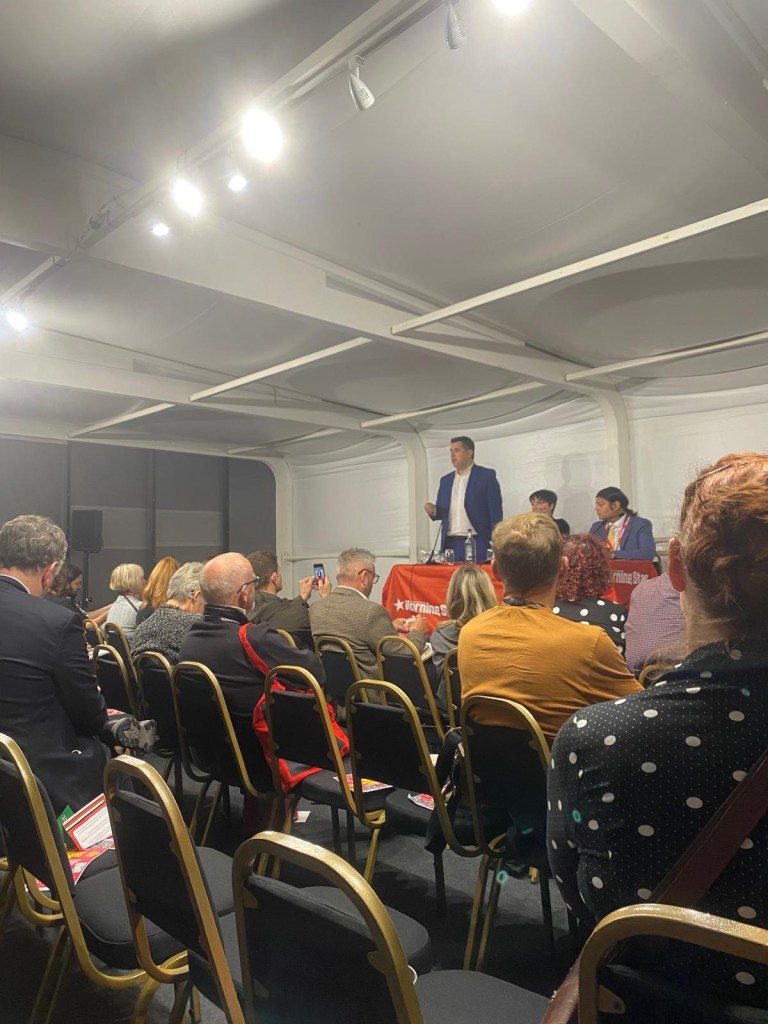
It was therefore left to Richard Burgon to be the red star of the show. But it appears the former shadow justice secretary doesn’t quite have the pulling power he once did, with most of the seats in the small room left empty.
As a result only a miserly group of Labour delegates were able to enjoy Burgon’s rousing call for a wealth tax and equalising capital gains tax with income tax.
How far they fall. In fact, it seems like the only people more miserable than the Starmers’ personal shoppers are the Labour left at this conference…
Starmer approval rating hits record low
Sir Keir Starmer is having a tough time of it, what with his ongoing freebie fiasco, the cronyism row and bad briefings about his chief of staff. Now his fortunes have got even worse — literally. It turns out that the PM’s approval rating is at its lowest level yet, dropping a whopping 45 points since Sir Keir’s lot won the general election. It’s hardly the news Starmer would have hoped for as his Labour conference kicks off today…
New polling by Opinium reveals that the Prime Minister’s approval rating has dropped down to -26 since Sir Keir became the country’s leader. It now makes him — by a point — less popular than former PM Rishi Sunak which, er, after his party’s electoral defeat just three months ago says quite something.
Less than a quarter of those surveyed approve of how Starmer has run the country, while 50 per cent don’t like how the Labour leader is doing things. Nearly two-thirds of people think the Labour government has been unsuccessful while a third of those who voted for Starmer’s army in July don’t think they’ve performed well so far. And, to add insult to injury, almost half of the public now have a more negative view of Sir Keir and Labour since they came into office. Great work, guys!
Things aren’t looking up for Starmer’s cabinet either. Winter fuel payment-cutting Rachel Reeves has seen her approval score plunge 36 points since the election, while Deputy PM Angela Rayner has seen a 23-point drop. Health Secretary Wes Streeting has seen his favourability score drop 18 points — the same as Home Secretary Yvette Cooper — while gaffe-prone Foreign Secretary David Lammy’s rating has fallen by 15. Good heavens. Talk about getting the day off to a bad start, eh?
Keir Starmer’s problems are of his own making
That nobody in Keir Starmer’s inner circle worked out that trashing his personal reputation for a hundred grand’s worth of free stuff was a bad deal tells us a lot. Worse still, nobody seems even to have clocked that accepting so many freebies, especially from the ambitious Labour peer Lord Alli, could prove politically toxic – even though Starmer in opposition had frequently lambasted the likes of Boris Johnson for filling his own boots. On top of that, apparently no one had an issue with giving the right-wing media a free hit on the Prime Minister’s wife for the sake of £5,000 worth of clothes and personal shopping advice.
The Achilles’ heel of modern leftism – a belief that the innate moral superiority of its tenets and personnel is so obvious as to render both above suspicion – is clearly present in abundance in this Labour prime minister and his team. As a result he goes into his party’s annual conference today with a second unwanted nickname rapidly gaining popular purchase: ‘Free Gear Keir’ now sits alongside ‘Two Tier Keir’ as an irresistible moniker.
‘Free Gear Keir’ now sits alongside ‘Two Tier Keir’ as an irresistible moniker
Attending the St Leger race meeting at Doncaster last weekend, Starmer was on the receiving end of prolonged barracking. One heckler loudly labelled him a ‘wanker’ and nobody in the vicinity made any effort to disagree. Again, whoever thought South Yorkshire’s horse-racing fraternity was an appropriate crowd into which to pitch a PM who has alienated the white working class, parents of children at independent schools, smokers and the nation’s pensioners in his first weeks in office merits a mention in despatches for sheer incompetence.
It is not unknown for a prime minister to endure a baptism of fire and yet to come through and turn around public opinion – think of Margaret Thatcher between 1979 and 1983, for instance. But while Starmer may fancy himself as a political Iron Man, his political prospectus seems highly likely to fail. Naked favouritism towards trade unions – as evidenced in the junior doctors’ and train drivers’ no-strings pay deals and the abandoning of Ofsted’s ratings regime for schools – point to a further slump in public sector productivity.
The setting of a threshold for the unexpected withdrawal of winter fuel allowance at around the bottom decile of pensioners by income is another terrible self-inflicted wound. Talking down Britain’s economic prospects during a speech in the Downing Street rose garden was also a curious gambit given the centrality of market expectations when it comes to private investment decisions. Already some commentators claim to be detecting the start of a 1970s-style talent drain overseas as Angela Rayner pioneers new employment red tape, Rachel Reeves prepares for further increases in taxation and Ed Miliband makes energy cripplingly expensive.
Meanwhile, making ‘smashing the gangs’ rather than deterring their human cargo the focus of efforts to control illegal immigration via the English Channel has proved a predictable disaster. So far, more than 10,000 have come on Starmer’s watch.
Calling for swift and exemplary sentences for those connected to anti-immigration riots has contrasted awkwardly with a softly-softly approach to ethnic minority yobbery at Manchester Airport, Rochdale and Harehills in Leeds. Pictures of a previous generation of prisoners popping champagne corks and taking rides in Lamborghinis upon their early release will also live long in the public mind.
Israel has been half-dumped upon as it fights Islamist aggression on multiple fronts. There is little sign that this will be sufficient to assuage British Muslim voters, so ludicrous legislation to outlaw Islamophobia could be next up. Starmer’s obvious worries about his party’s standing in areas with high Muslim populations highlights just how complex his task at the next election will be. As well as facing another wave of independents in the inner cities, sitting Labour MPs with slim majorities will be attempting to fend off Greens in university towns, Reform in the Red Wall, the Tories in bellwether marginals and the SNP in Scotland.
Anyone who can figure out a coherent agenda which can do all that will go down as a presiding genius of British politics. Perhaps healthcare outcomes can be nudged upwards, which would presumably be welcomed by voters from all backgrounds. But aside from that only an economic miracle could cut the mustard.
In his first conference speech after his 1997 landslide win, Tony Blair declared: ‘Ours was not a victory of politicians but of people.’ Keir Starmer’s was just the opposite: a loveless landslide based on a third of the popular vote in a low-turnout contest dominated by the public’s focus on ejecting the ruling party.
No doubt Starmer’s activists will put on a show of enthusiasm for him in Liverpool this coming week. But there is notably little sign of public buy-in to the goals of his ‘mission-driven government’.
The truth about Led By Donkeys
Love them or loathe them, it’s hard not to have noticed Led By Donkeys. The protest group – made up, naturally, of four former Greenpeace workers – has taunted Boris Johnson, Liz Truss and David Cameron with its high-profile stunts. It is best known for projecting its protests – including one branding Boris a ‘liar’ – on to the Houses of Parliament. The group’s members seem mighty pleased with themselves. But what has Led by Donkeys actually achieved? It’s hard to say that the group has won anyone over to the cause.
The group’s members seem mighty pleased with themselves
An exhibition ‘Adventures in Art, Activism and Accountability’ has opened in Bristol to showcase the group’s exploits. It’s an underwhelming display. Led by Donkeys may have started out as a something of an anti-Brexit movement, but the photographs of those billboard capers were relegated to the narrow stairways that connected the rooms at the Midland Road exhibition space. Up front and central was the remote-controlled lettuce banner that disrupted Liz Truss’s speaking tour in August. ‘Returned by the police’, we were told.
The blue plaque that Donkeys erected outside 55 Tufton Street – ‘the UK economy was crashed here’ – was attached to a wall out the back at the exhibition space. While the organisers proudly claimed that ‘all the materials displayed were created at the time of the interventions, then either returned, reclaimed or never deployed’, there was little more to see that justified the long wait to enter the building.
The queue to get in stretched round the block – more than ninety people were standing there patiently on a warm and sunny Saturday afternoon in the Old Market district. Visit Bristol describes the area as ‘bohemian’. Worn out LGBTQ+ flags hung limply from angled flagpoles above our heads, while the occasional stench of cannabis polluted the air. The line was long because the building was small. The hi-vis woman on the door policed a strict one-in, one-out policy.
Wooden staircases connected the four rooms on four different levels. Just beyond the cabbage banner we were led down to the basement in groups of six to watch Donkeys’ film of thousands of items of children’s clothing laid out on Bournemouth beach to protest the conflict in Gaza. The stairs were steep, the lights were dim, and the smell of damp overpowering. Insulation boards hung haphazardly from the low ceiling, sandwiched between wooden beams at head bumping height.
Like the rest of the exhibition and, indeed, Donkeys’ work, the tiny cinema was an appeal to emotion. The movie was slick and professional, featuring 160 seconds of aerial footage. It was political propaganda of the highest order. On YouTube, the description reads, ‘Israel has killed over 11,500 Palestinian children in Gaza and the West Bank since October 7th, when 36 Israeli children were killed’. The tone made it seem like some kind of dismal competition.
However you might feel about Gaza – and it seemed that most of those who had braved the long wait and the plunge into the depth were happy to have their opinions reinforced – this was an effective piece of theatre. The same could not be said for the second film that was shown in the attic, featuring a number of high-profile politicians.
Donkeys were rather pleased with their 2023 sting when they tricked politicians, including Matt Hancock, into speaking to a fake South Korean investment company.
‘In the middle of a cost of living crisis, when people need their MPs more than ever, would a serving Member of Parliament still consider taking a job, furthering the interest of a foreign company?’, the exhibition filmed asked.
Of course some would. But while it might be embarrassing to be caught out, it’s not against the rules for an MP to do a bit of consultancy work as Hancock’s spokesperson pointed out at the time. Nor is it a secret; the Register of Members’ Financial Interests is on public record. So what was Donkeys trying to achieve?
This film was projected onto painted bricks in a room with lots of natural light. It was a pale imitation – quite literally – of Donkeys’ giant projection stunts when the sides of buildings are used as a canvas. But they require tens of thousands of lumens, and they take place after dark. Is this necessary?
This thought, it seemed, didn’t matter to the audience. As I squeezed down two flights of stairs to give up my place in the building to the next in line, the photos on the walls, the empty cans of paint, even a wheelbarrow used in one stunt, pieced together Donkey’s exasperation with the world as they saw it. There was much talk about accountability, but that was for others. The people who had to clear up the mess after Donkeys poured 360 litres of yellow and blue paint onto the road outside the Russian embassy on Bayswater Road were not mentioned in despatches.
A strong sense of self-righteousness permeates Donkeys’ work. I suspect that much of their time is spent preaching to the converted. The queue for the exhibition was long, the building was cramped, and the exhibition was limited, but how many minds were changed is harder to gauge.
The exhibition was a four-day affair – it has already come and gone – but the coffee table book that has been released to coincide with the display remains. You can well predict the type of people who are likely to buy it.
Led By Donkeys: Adventures in Art, Activism and Accountability is published by Thames and Hudson
The Myanmar junta’s desperate campaign of terror
It was about 9:15pm on 5 September when the roaring sound of a warplane began to hum across the hills. Tucked away in a valley in Pekon Township in Myanmar, on the border with Karenni and Shan states, a community of some thousand people were about to go to sleep. Illuminated only by small solar-powered lights and campfires, mothers and fathers were putting their children to bed. But the junta jet fighter didn’t need light. It had already been given direct coordinates, and it was about to drop its payload directly on the camp.
The violence which has plagued Myanmar for over three years had once again come to Pekon. The warplane released two large bombs right into the heart of the settlement where hundreds of displaced families were living. Upon impact, the explosives decimated the bamboo and metal shelters, violently splintering bamboo into the air. Pieces of sheet metal took flight, tearing into everything in its path. Then the military fighter jet returned to machine gun strafe the camp one last time.
The scent of death still lingered among the carnage
The scene was pure hell – chaos and despair. Eight children were killed from the blasts. And one young woman, a local teacher at the community school, was blown away in front of her husband’s eyes. At least 26 others were injured.
The devastation was grim as I walked through the camp just two days after the bombing. Although the bodies had been cleared, the scent of death still lingered among the carnage. Days earlier, dozens of homes were packed tightly together in long rows. But now there was nothing left other than shattered debris lying in the mud. Two large craters could still be plainly seen, one to the far end of the camp, another directly on a house.
This attack was just the latest in a long string of airstrikes to hit the country over the last year. Since Myanmar’s military seized power in a coup in February 2021 coup, at least 5,000 civilians have been killed, and tens of thousands of others have been detained. The junta came to power after overthrowing the elected civilian government of Aung San Suu Kyi and sparking countrywide street demonstrations. The military violently cracked down on the protests, openly killing mostly young people in the streets.
The protests against the new regime then evolved into armed resistance that quickly spread across the country. Within months, thousands of mostly Gen Z and Millennial left urban areas and moved to the borderlands to join either long-held ethnic armed organisations (EAOs), who control large swathes of territory across the country, or People’s Defense Forces, (PDFs), newly formed guerilla groups. The border area where the attack took place is largely under Karenni resistance control. Junta forces have lost around 80 per cent of Karenni State since last year.
Ethnic minority groups, each with their own distinct languages, cultures and histories, have to a large degree started putting their differences aside, choosing to work together to quash the junta. The collective campaign against the Myanmar military presents the greatest challenge to the junta yet. These EAOs have held de facto control over their territories, establishing parallel administrations, judicial systems, and economic activities, often funded by local resources. Despite numerous peace negotiations and ceasefires over the years, the relationship between them and the Myanmar military remains fraught with tension, leading to escalating conflict since 2021 as they seek to protect their autonomy and cultural identity.
The Myanmar military is losing the conflict. What is becoming abundantly clear to anyone involved in the war, or for those simply trying to survive, is that as a result it has become increasingly desperate, resorting to renewed attacks on the civilian population from the sky. The military top brass has no qualms about killing children in their sleep.
In the first four months of 2024, Myanmar junta airstrikes killed over 359 civilians, including 61 children, and injured 756 others according to a study from Nyan Lin Thit Analytica, a research group which monitors regime crimes. An Amnesty International report from July revealed that despite sanctions imposed on parts of the military’s supply chain, shipments of aviation fuel are still arriving in Myanmar. According to the UN, between April 2023 and June 2024, hundreds have been killed by airstrikes and artillery attacks.
‘I saw people were shouting “help me help me!”‘ Father Peaur Than, the local reverend who ran a church just meters away from the blast site, told me. ‘They ran up to me, some were bleeding, others told me there were some people without limbs who were injured during the attack. And so I tried to prepare for the wounded. I ran into the camp to help save anyone I could and also collect the dead bodies and put them in the church.’
The new momentum against the junta is seen clearest in the northern Shan State. On the northern front, the Three Brotherhood Alliance – comprising the Arakan Army (AA), the Myanmar National Democratic Alliance Army (MNDAA), and the Ta’ang National Liberation Army (TNLA) – has made significant gains since October last year. The alliance has captured key townships like Lashio and Mogok.
Across the country the junta is on the back foot
Now there is speculation that the city of Mandalay will soon fall to the resistance too. Across the country the junta is on the back foot, losing hundreds of outposts and numerous townships to the rebels. But it is responding to these sweeping wins with an escalation of airstrikes like the one seen in Pekon. These attacks have left civilians pleading for peace, begging for some kind of international intervention.
Before I left the camp, a young boy walked up to me and told me about how he lost one of his classmates in the attack. He said: ‘We were like brother and sister. But now she’s gone.’ He was holding his friend’s graduation certificate from a summer English program which he recovered from the wreckage. He slowly moved through the site, sometimes staring blankly into the debris. The certificate he was holding was partially torn in half.
‘The military is losing the war so they’re trying to kill innocent civilians,’ a teacher from the school told me. She was one of the first to arrive on the scene of the destruction. ‘The entire community here is devastated. And the junta is trying to use trauma as a weapon. They’re trying to break our spirit.’
The village, which used to have one of the best schools in the area, had already been targeted at least four to five times over the last couple of years. But until then the jets had narrowly missed each time. Residents believe the military is targeting their camp because it has a thriving community, high level education, and a semblance of normality in the face of so much war. The displacement camp was also likely targeted because junta chief Min Aung Hlaing had issued a statement days earlier, vowing a counter offensive throughout rebel controlled territory.
Today, survivors of the attack are grappling to come to terms with a living nightmare, one that the military has deliberately forced them to endure. At the same time, Myanmar is facing one of its worst monsoon seasons on record, where over 200 people have died from flash floods in recent weeks.
‘Don’t stop watching what the military is doing here,’ the teacher told me with tears in her eyes. ‘Don’t look away. Please try to send the military to the International Criminal Court and stop them from being able to buy jet fuel. We just want peace. We want peace.’
Calm down, most cows aren’t ‘killers’
There must be carnage in the countryside. That’s the only explanation for a stampede of anxious headlines about the danger of cows. ‘Are these the UK’s most dangerous animals,’ asked the front page of the Guardian this week alongside a picture of a bemused bovine. The Daily Star was at it too: the paper called cows ‘mooing killers’ and quoted a campaign group which suggested that the true number of cow attacks was being wildly underestimated. You’d be forgiven for thinking twice about going for a walk in the British countryside.
So let’s all take a deep breath before turning to the data: between March 2019 and March 2023, cows were responsible for 22 deaths in England, Scotland and Wales, or an average of around five a year.
It’s not been a great few months for cows
These deaths are obviously a tragedy for those concerned, but is this a trend worthy of front page scare stories? If a truly horrifying death toll is what you’re after, then look at how many cows humans kill in the UK each year: 2.8 million. Every 12 months they kill five of us and we kill 2.8 million of them. Perhaps we’re the dangerous ones?
Cows are my favourite animals and I hang out with them all the time in fields and animal sanctuaries. I’m a keen runner and my weekend route always includes a pause to pet some cows in a local field. I’ve never had the slightest problem, and that’s mainly because I know how to behave around cows.
It’s basic common sense: tread calmly and quietly, don’t walk a dog near cows and don’t go near their babies. The calf tip is particularly important and it also highlights how cruel dairy farming is – dairy farmers typically separate calves from their mothers within hours of birth. So it’s no coincidence that a lot of the people hurt by cows are farmers and that cattle are the most common cause of accidental death in the UK agricultural industry. Mothers tend to get upset if you bother or snatch their young.
Other people who get on the wrong side of cows include those who jump fences into their field. The average weight of a cow is around 1,400 pounds, but some bulls weigh nearly twice that. Not everyone who’s been charged by cows was to blame, of course. But it’s a good idea not to wind up animals of this size. You should keep your distance if you can.
It’s not been a great few months for cows. In June, a police car in Surrey rammed one that had escaped from a nearby farm. In August, the BBC noted a surge in the number of cruel beef and dairy ‘megafarms’ which keep cows indoors for their entire lives. This week, it emerged that workers at dairy farms had attacked cows with poles and kicked them.
We could do without a confected media scare campaign like the dog panic of the 1990s. Back then, headlines about ‘dangerous dogs’ led to the Dangerous Dogs Act. That rushed piece of legislation caused all sorts of ridiculous incidents: a pitbull was impounded because its owner removed its muzzle so it could vomit without gagging, and a boxer-collie cross (named Woofie) was sentenced to death for barking at a postman. Fortunately, he was subsequently reprieved.
The Dangerous Dogs Act has become a byword for the folly of political panic. In the clamour for new laws after the July 7, 2005, bombings in London, one Downing Street official said: ‘We’re not rushing anything. We all remember the Dangerous Dogs Act.’
So hopefully we can nip the cow panic in the bud and not listen to a bizarre campaign group called Cows on Walkers Safety (COWS) with its hysterical website shrieking about ‘killer cows’. Let’s not exaggerate the problem. The truth is that cows are kind and beautiful animals. There’s no real trouble with them. Just act sensibly and be kind to them. If you can’t do that, leave them alone.
Now Rayner’s register of interests is under scrutiny
This weekend Labour hosts its party conference in power for the first time in 15 years. The great and the not-so-good of the labour movement is descending on Liverpool to eat, drink and debate the merits of mission-led government. Bottoms up chaps! Kicking off proceedings is Angela Rayner, tasked with appearing on the BBC’s flagship Laura Kuenssberg show to defend the government after a week of bad headlines.
So it was perhaps unfortunate then that the Deputy Prime Minister has found herself in her own brush with the press, on the eve of conference starting. The Sunday Times reports that she ‘appears’ to have breached parliamentary rules by failing to declare that a friend joined her on a ‘personal holiday’ funded by Lord Alli, the peer at the centre of the ‘passes for glasses’ scandal. Honestly, he’s like Macavity…
Rayner did not report to the authorities that Sam Tarry, the-then Ilford South MP, stayed with her at a $2.5 million apartment in Manhattan over the festive period. Tarry paid for his flights but benefited from Alli and Rayner’s free accommodation. The rules state that MPs must declare foreign trips which they, or anyone connected to them, undertake if a donor pays for ‘part or all’ of it as a result of their ‘parliamentary or political activities’. Rayner declared her own trip but not that Tarry was in attendance too, with her team apparently arguing that it did not need to be reported as ‘Alli did not know that he had been there with her.’ So that’s alright then eh?
The flat in question boasts a three-storey gym with a Jacuzzi, concierge service and panoramic views of Manhattan. Mr S hopes Rayner enjoyed her trip: it seems likely to be the last that any cabinet minister will enjoy at Lord Alli’s expense for the foreseeable future…
Can Keir Starmer reverse his fortunes at Labour conference?
What is Keir Starmer wearing, how much is it worth and who paid for it? That’s normally a question only asked of female politicians, or prime ministers’ wives, but thanks to the Labour leader’s love of a freebie, his own fashion choices are going to be one of the hot topics at Labour Party conference. Unlike the scrutiny of women’s clothes, though, which normally leads Reiss to sell out of whichever dress turned up on the conference stage that week, Starmer’s outfits are causing a rush to judgement, not a rush to the tills.
One of the opening questions from interviewers will surely be ‘where is your suit from and who paid for it?’
Every day of the Labour meeting in Liverpool, one of the opening questions from interviewers will surely be ‘where is your suit from and who paid for it?’ Downing Street’s decision yesterday to say that Starmer and other senior ministers including deputy prime minister Angela Rayner will not accept any more clothing donations won’t draw a line under the matter because it just raises more questions. The key one is if you’re not accepting donations any more, does that mean it was wrong to accept them before? And if it was wrong to accept them before, will you either be handing the (multiple pairs of) glasses and suits back, or paying back their value? And will you keep wearing them, or will they gather dust in your wardrobe?
Katy Balls writes here about the impact of the dysfunction in Downing Street on the wider impression that Starmer is in control. He might be determined to clamp down on the persistent briefing against his Downing Street chief of staff Sue Gray, but that is extremely difficult given she has managed to annoy almost every single Labour special adviser in Whitehall.
Starmer doesn’t help himself, either. His ‘I’m completely in control’ line this week was the sort of thing that no leader who is actually in control needs to state, but what followed it was weaker: the Prime Minister burbled on about creating a ‘national wealth fund’ and putting in place ‘housing frameworks’, neither of which have any real tangible meaning to voters listening. If those are the first two things he can think of when he is reaching for examples of the way the Labour government is getting on with the job of changing lives, no wonder his suits are under such scrutiny.
A lot can happen at conference (just ask Liz Truss), both for good and bad. It is the political equivalent of a cross country race, with top performers slipping over in the mud and unexpected twists and turns. It might be that Labour has a week in Liverpool that does show why it is in government and how full of purpose (one of Starmer’s own favourite words) it is. But it hasn’t started on the right foot – even if on that foot is a very expensive shoe.
How much trouble is Keir Starmer in?
To Liverpool for Labour’s first party conference since Keir Starmer triumphed in the general election. On paper, this ought to be a jubilant affair for all involved. The party has returned to power after 14 years with a large majority, which ought to pave the way for a second term. Yet few in the party are in a celebratory mood. Instead there’s concern that less than 100 days in, Starmer is losing grip on his government.
The past week has been dominated by stories over Labour ‘sleaze’ over donations and ongoing hostile briefings pointing to turmoil amongst Starmer’s top team. ‘It’s all feeling a bit Tories 2019,’ jokes a Labour insider, pointing to how the Conservatives were dogged by stories of staff psychodrama and money rows.
The past week has been dominated by stories over Labour ‘sleaze’
Late on Friday, Downing Street announced that Starmer – along with his Chancellor Rachel Reeves and deputy Angela Rayner – will no longer take free clothes. That means the main Saturday headline going into Labour conference is not the preferred message of ‘change begins’ but a variation on ‘The Prime Minister will no longer accept free clothes’. The u-turn is clearly aimed at putting a lid on the story so it doesn’t drag into conference. But expect Labour politicians to be asked who they are wearing, not so much with regards to the designer but the donor behind the outfit. There is no indication yet that Starmer plans to return the clothes he has accepted.
In a way, the freebies row is the least serious of the current troublesome stories facing Labour. Starmer is particularly vulnerable to it having painted himself as ‘Mr Rules’. But no rules seem to have been broken here, even if the antics are not passing a basic smell test. The wider concern is that it is another sign of a lack of joined up narrative. One Labour figure makes the point that no one seems to have clocked that if the government is making ‘difficult’ decisions, such as cutting the winter fuel payment for most pensioners and warning of potential tax rises, anything that looks as though Labour politicians are having a more luxurious life than the average voter becomes a live issue. It’s telling that Jonathan Ashworth, the former shadow minister and Starmer ally who lost his seat in the election, writes in today’s Sun warning that voters expect Labour to govern in service of working people.
The bigger concern amongst MPs is really on the economy and what further difficult decisions Reeves has planned. She has made the case convincingly to Labour MPs earlier this month that they need to stick on the current path. However, not helping Starmer and Reeves is the fact that Labour is sinking in the polls and approval ratings are low. The risk of all these sleaze stories and the most recent u-turn is that MPs start to think that the operation is not nimble enough to land the narrative for the difficult decisions they plan to take. Persistent briefings about Downing Street Chief of Staff Sue Gray – most notably the disclosure this week that she earns three thousand pounds more than the Prime Minister – are adding to a sense of dysfunction. As one Labour MP puts it: ‘If the government keeps going as it is, voters are going to have lots more reasons to be pissed off and not many reasons for optimism’. Starmer needs to use this conference to put his party at ease on all of the above.
Starmer’s freebies and the truth about Labour’s double-standards
The Labour government’s u-turn on freebies, its disclosure last night that it will no longer accept donations for clothes, is an admission that it has got it wrong. But ‘wrong’ in which sense of the word? Wrong in that they admit that they committed an error, or wrong in that they have behaved immorally? Their language would suggest very much the former.
Nearly two-thirds of all voters say Starmer’s decision to accept freebies for his wife was unacceptable
Keir Starmer’s allies concede that there was a ‘perception’ issue after the Prime Minister accepted clothing worth and spectacles together worth more than £18,000. This has been accompanied by similar gifts accepted by Rachel Reeves, the chancellor, and Angela Rayner, the deputy prime minister. Starmer, Reeves and Rayner all made clear last night that they will stop taking donations for clothes now that they are in office.
On its front page this morning, the Times says this u-turn represents ‘a significant reversal by Starmer’. But is it really? This decision will only apply to clothing and glasses, not to hospitality and other similar donations. This distinction is being made, no doubt, because the clothes donations have generated the greatest outrage, and presumably, the consequent drop in opinion poll ratings. This lies at the heart of this ‘significant reversal’. Labour is undertaking it not because they feel bad over the tawdry affair, but because it looks bad.
This decision exposes the amorality at the heart of the government. Starmer has previously defended the £100,000 he received in donations for clothing, gifts and hospitality by insisting that they were all properly declared. He was playing by the rules, so to speak. That is the defence one would expect from a cold, calculating lawyer. He makes an implicit, clinical distinction between illegality and immorality.
He will presumably still go to his Arsenal games for free and accept similar indecorous munificence, just as long as that doesn’t unfavourably affect his poll ratings or imperil his position: a new YouGov poll has found that one in seven of those who voted for Labour three months ago now regret doing so. Nearly two-thirds of all voters say Starmer’s decision to accept freebies for his wife was unacceptable.
For means of self-preservation, Starmer needs no more diverting chit-chat about free clothes that might arouse accusations of sleaze. As one cabinet minister told the Times: ‘He needs people who will make sure there’s not a distraction around this kind of thing so he can focus on the big issues.’
This u-turn has been prompted not by morality, but by expedience. He and his government show regret, but not remorse. One thinks of a cat caught on the kitchen table, its head in the butter dish. It looks alarmed, scared it has been found out. But it’s not sorry. Cats have no morality. They fear only repercussions. This is how Starmer and his cohorts are behaving.
Some protest that this whole affair is mere tittle-tattle, a distraction from vastly more important matters such the cost of living, the NHS, the growing rate of public borrowing, and so on. And the Labour government is making decisions with far more profound and potentially longer-lasting consequences, they say, such as the inflation-busting pay awards made to doctors and train drivers.
All this is true. But morality matters. It may not be appreciated, being by its nature an invisible force, but morality drives politics. For decades people have voted Labour on the tacit understanding that they are more caring and decent. This is why people, especially celebrities, are keen to boast that they support Labour: to demonstrate that they are more compassionate and virtuous souls. In contrast, to pronounce oneself a Conservative voter is to risk social death. This is the ‘nasty party’ after all, the party of sleaze and ‘back to basics’ hypocrisy.
Until now. And those from the oldish Labour guard, those with some integrity, know it well. Lord Blunkett, the former home secretary, has said that Starmer risked accusations of double-standards after repeatedly attacking the Conservatives over scandals while in opposition. ‘“One rule for them and one law for the rest of us”, which we used in opposition, applies equally to us,’ he said this week. Meanwhile, it has emerged this morning that David Lammy, the foreign secretary, took £10,000 from a Saudi-supporting PR executive months before he became foreign secretary. So much for cleaner-than-clean, holier-thou-than politics.
Other Labour members are as incandescent as Blunkett. As one MP told the Daily Telegraph today: ‘Loads of us are livid. This is what hypocrisy looks like.’ Yet even here the language of amorality shows through here: ‘looks like’. It matters less if a moral wrong has been committed, whether politicians have been behaving in an unbefitting or compromising manner. What matters more are the optics and the consequences. It’s not fear of doing wrong, it’s the fear of being judged as wrong.
Abbott: Starmer is in the ‘pocket of millionaires’
As if Sir Keir Starmer didn’t have enough on his plate what with his freebie scandal, Sue Gray inquiry and his first Labour party conference as PM, his own backbencher has taken aim at him — again. For the third time this week, Diane Abbott has once again very publicly slammed her party leader. Taking to Twitter today, the Hackney North MP posted a classically grainy headshot of her adversary, alongside an acid-tongued attack on Starmer’s freebie fiasco:
Ellie Reeves MP says ‘Labour’s [general election] victory was only possible because under Keir’s leadership we changed the party.’ Changed it into an organisation whose leaders are in the pocket of millionaires?
Ouch. Talk about airing dirty laundry…
It follows two earlier interventions from the Corbynista earlier in the week — with Abbott first confessing to the Beeb she felt Starmer had treated her like a ‘non-person’ over the Frank Hester racism row, before admitting to Elizabeth Day: ‘I’ve never had a nice chat with Keir Starmer.’ Don’t hold back, Diane!
And while Abbott may be one the most openly combative Labour MPs at present, she’s not the only one angry about frockgate. After it emerged that some clothing donations made to Lady Starmer by millionaire donor Lord Alli had not been properly declared, the PM’s gifting situation came under heavy scrutiny this week. It transpires that Sir Keir has accepted over £107,000 worth of gifts since 2019 – the most of any parliamentarian in the same period — with his lefty lot are rather bemused by their leader’s willingness to accept them.
One left-winger told the Telegraph on Friday: ‘I don’t know of anyone who thinks this is a good idea. Friends and colleagues are mortified’, while another struggled to continue their fury at the whole ordeal: ‘This is what hypocrisy looks like – and most of us have been fighting the “they’re all the same” rhetoric for our whole careers, Keir’s double standards just prove it’s entirely accurate.’ Burn…
Despite initial protestations from No. 10 that voters aren’t fussed by frockgate, the PM, his wife, Chancellor Rachel Reeves and Deputy Prime Minister Angela Rayner have now all said they will no longer accept clothing donations in future. But after a week of bad press about the whole palaver, Mr S wonders if it’s just too little, too late…
No, Rich Lowry didn’t say the N-word
Rich Lowry, editor-in-chief of National Review, is being cancelled for calling Haitian immigrants the N-word. One problem: he didn’t. Lowry was on Megyn Kelly’s podcast to talk about the claims, amplified by Donald Trump and JD Vance, that Haitians have been snacking on local cats in Springfield, Ohio. He commented on a combative interview Vance gave to CNN’s Dana Bash and scoffed at Bash’s dismissal of the feline-fressing allegations on the grounds that city records only showed complaints about geese. Lowry observed:
‘I think it was in that interview where Dana Bash says the police have gone through 11 months of recordings of calls and they’ve only found two Springfield residents calling to complain about Haitian migrants taking geese from ponds. Only two calls!’
MAGA lunatic Rich Lowry just dropped the n-word while talking about Haitian migrants. Does anyone need anymore proof that many Republicans are targeting these folks because of their race??? pic.twitter.com/qvIOPF69Ww
— Harry Sisson (@harryjsisson) September 16, 2024
If you’re wondering where the N-word comes in, it is in Lowry’s pronunciation of ‘migrants’. He began by rolling the final syllable of ‘Haitian’, with its concluding ‘uhn’ sound, into the first syllable of ‘migrants’, thus pronouncing it with the short i of ‘immigrants’ before correcting himself to use the long i of ‘migrants’. This produced the garble: ‘migger-uh-uh-migrants’.
Any fair-minded person who watches the video will come to the conclusion that Lowry was not the victim of a Freudian slip which betrayed an internal racist monologue but of a trip of the tongue which revealed him to be a human, and therefore fallible, public speaker. Some, however, aren’t interested in fair-mindedness. They regard Lowry as their ideological enemy and glimpse an opportunity to destroy him.
Black millennial-targeted magazine The Root pronounced that he had ‘obviously used the N-word’ and, though he had denied it, ‘he was literally caught on video’. Madeline Peltz of leftist hit squad Media Matters for America professed herself to be ‘having a hard time coming to any conclusion besides the obvious one about what Rich Lowry catches himself blurting out here’. Under the headline ‘Conservative editor backtracks after seeming to use n word regarding Haitian migrants’, The Advocate began by reporting that Lowry ‘appears to have used a racial slur’ but by the second sentence of its story all doubt had been removed and Lowry had ‘dropped the slur in place of the word “migrants”’. Gen-Z progressive influencer Harry Sisson told his quarter-of-amillion X followers that ‘MAGA lunatic’ Lowry had ‘dropped the n-word while talking about Haitian migrants’ and this was proof that ‘many Republicans are targeting these folks because of their race’.
Rich Lowry didn’t say the N-word. He said the M-word, which isn’t even a word
Addressing the accusations, Lowry writes over at National Review’s The Corner blog about ‘malicious accounts on X the last few days that have insisted that I said a racial slur during an appearance on The Megyn Kelly Show’. He notes that ‘these ridiculously false accusations’ on social media ‘have now resulted in cancellations in the real world’.
Lowry is firmly to my right on most issues but I’m content to know he’s wrong about a lot of things; I don’t need him to be a Grand Wizard too. Others seemingly do, for our thoroughly secular age is more in need of demons than ever before. It is not enough that Lowry has different ideas, wrong ideas, even heretical ideas; he must harbour the gravest malevolence in progressive demonology: racism. Now, if Lowry had said the N-word to insult Haitians, that would be deserving of censure, for racial prejudice is fundamentally at odds with the ideal, if not always the practice, of the American constitutional republic. But Lowry didn’t say that word and we have video of him not saying it, yet he is being treated as though he did say it because enough people want him to have said it. It is commendable that he manages to balance his National Review duties with his new role as the lead character in a Philip Roth novel.
This absurd episode is darkly humorous but only up to a point. Lowry says he has had a speaking gig at Indiana State called off, as well as an address to the Badger Institute, a conservative think tank out of Wisconsin. If either institution did cancel Lowry’s appearance over this fictitious furore, their leadership is a quivering mass of cowardice with a spine made of jelly.
True, in the grand scheme of cancellations, Lowry’s ranks pretty low. He’s a prominent right-wing commentator and not about to find himself on unemployment assistance, but his treatment is not materially different to that meted out to ordinary Americans who say the wrong thing – or, in this case, don’t – on social media or in the workplace. Shorn of Lowry’s advantages, they suffer the full personal, financial and social brunt of cancellation. But Lowry’s experience is another opportunity to say that the mentality that seeks to punish wrongthink is illiberal, if not entirely at odds with the instincts and doctrines of contemporary American liberalism. Then again, perhaps the problem isn’t all that contemporary. It was more than half a century ago that one of Lowry’s predecessors wrote: ‘When a conservative speaks up demandingly, he runs the gravest risk of triggering the liberal mania; and then before you know it, the ideologist of open-mindedness and toleration is hurtling toward you, lance cocked.’
If American liberalism’s pivot away from free expression is to be lamented, so is the closing of the liberal ear to conservatives and conservatism, an intellectual and empathetic pulling up of the drawbridge that leads otherwise rational, level-headed people to believe the worst of their political adversaries, no matter how implausible or demonstrably untrue, because the alternative involves conceding the existence of other ideas. Once you do that, politics is no longer an apocalyptic struggle between the enlightened, inclusive and virtuous and the dumb, racist and evil but a debate between thinking persons who just happen to think differently. Politics is rendered banal, an imperfect instrument for ordering a society rather than a noble crusade to correct the flaws of human nature. Demystify politics and you wound the American liberal more grievously than if you were to debunk every policy position he holds.
Rich Lowry didn’t say the N-word. He said the M-word, which isn’t even a word. He said it because he misspoke, and he misspoke because he is human and prone to error. His detractors should have the good grace to recognise that, to apply intelligence and charity to this episode, and to concede the existence of other viewpoints and the legitimacy of expressing them. Liberalism would be all the better for debating Rich Lowry instead of trying to destroy him.
Why isn’t Gary Oldman playing Smiley again?
Following the huge success of the 2011 film Tinker Tailor Soldier Spy – from the book of the same name by John le Carré – there was much talk of a second movie, based on le Carré’s 1979 novel Smiley’s People. The possibility was floated by Tinker Tailor cast member Gary Oldman in 2012 and then confirmed by him five years later, but then all went silent.
Until last week, when it was reported that any plans Oldman might have to return to the role had seemingly been – bafflingly – blocked by Le Carré’s sons. As the actor’s manager Douglas Urbanski revealed to the Radio Times: ‘We loved Tinker and we started to do prep for Gary to do Smiley’s People and suddenly there was an unexpected rights issue…. We’ve reached out, including again recently, to le Carré’s sons and – the damnedest thing – they have no interest in Gary playing Smiley again. I don’t know why.’
‘Why?’ is a good question. In the 2011 film, Oldman was a triumph. This was particularly remarkable given Alec Guinness’s unforgettable 1979 TV performance in the role, and its part in UK viewing folklore. While Guinness’s performance – a jug-eared, bowler-hatted, irascible cardinal – captured the character for a generation of TV viewers, Oldman’s Smiley – the shy, emotionally inhibited secret serviceman with wife trouble, ‘one of London’s meek who does not inherit the earth’ – was radically different. It was less robust, less openly proactive, and with a silence and stillness that make Guinness’s take look almost garrulous. Seeing the performances side by side, you realise that at this level ‘different’ doesn’t mean worse or better. But as le Carré pointed out, ‘with Oldman you share the pain more. I think you share the danger of life, the danger of being who Smiley is.’
Tomas Alfredson, the Stockholm-based director, captured that pain brilliantly, in a film which, for all its cold war subject matter, is a bit like the Beatles’ ‘Eleanor Rigby’ put onscreen. Alfredson seemed to have spotted the discomfort and despair, the loneliness, implicit in the TV series, and to have run with it. His portrait of the British Secret Service struggling on in a capsizing 1970s London – a dingy netherworld of clashing browns and smudges of desperate, garish orange – is one in which everyone is paranoid, every character seems to be holding in a private shame or grief. Even close colleagues put on an impenetrable front and play each other ruthlessly, trying (like West and East) to find ‘the weaknesses in each other’s systems.’ Betrayal and deception are rampant, conversations cautious and oblique. It’s a world of people who shun the daylight, unwilling to be seen or see too clearly, who can only really be themselves alone, in separate rooms, preferably with the lights turned down or the curtains shut against the world outside.
Sometimes Alfredson scores points the TV series doesn’t – his Secret Service Christmas Party, at which Father Christmas appears in a Lenin mask and the Circus staff, worse for wear, give a soused performance of the Soviet national anthem, is a masterstroke, and there’s a doomed love affair at the heart of the film you believe far more than in the TV equivalent (where Hywel Bennett, as the operative Ricki Tarr, is no match for Tom Hardy in the role). What Alfredson rams home is the perversity: that in its fear, dissembling and surveillance, life at the Circus is uncannily close to the totalitarian world they’re working to defeat.
All these elements come together in Oldman’s performance. As he goes about his search for the mole – identified as one of his close colleagues – he gives us a study of bleak middle age, haunted and chastened by past humiliations. Light on dialogue (it’s a full 16 minutes of screentime before Smiley speaks at all) it’s a performance that reveals, by the merest glance or change of expression, a deep inner life of regret, resignation, bewilderment, thoughtfulness – and compassion, one of this character’s defining features, kept rigidly in check.
The actor may have built a career on playing a series of extrovert and outlandish characters – Sid Vicious, Joe Orton, Beethoven, Lee Harvey Oswald, Winston Churchill – but Smiley, for his fans, was arguably Oldman’s greatest work. The spy’s introverted nature, Oldman admitted in an interview, was ‘closer to me,’ adding that it was ‘a joy to be asked to have an interior life that you express […] just through maybe the smallest gesture, a twitch of the eye.’ It was a pleasure to be asked just to ‘sit in a chair and listen, and to react.’ So understated is his Smiley, so much an ‘economy of energy’ (Oldman’s description of the spy himself) that the actor was frequently forced to ask director Tomas Alfredson if it was registering on the camera at all: ‘It is reading? Is it working?’
He needn’t have worried. Le Carré, speaking for many, said that Oldman, ‘even from the earliest rushes, was a man waiting patiently to explode. He had what painters call the “energy of the object”.’ When the character did combust – raising his voice just once in the movie or, in a flashback, as he witnesses a devastating personal betrayal, collapsing winded and gasping from the shock – it was all the more affecting for its rarity. ‘I love the movie, love your Smiley,’ LeleCarré wrote in an email to Oldman: ‘It’s a beautiful performance.’
Critics seemed to agree. In a five-star review in the Guardian, Peter Bradshaw described the film as a ‘treat’ and an ‘unexpected thrill’, ‘anchored by Gary Oldman’s tragic mandarin.’ The New York Times described Oldman’s Smiley as ‘a fascinatingly gripping performance that doesn’t so much command the screen, dominating it with shouts and displays of obvious technique, as take it over incrementally.’ In a Telegraph review, David Gritten wrote: ‘We’ve never seen Oldman like this before, and he’s simply stunning,’ adding that one soliloquy of his was ‘so engrossing you forget to breathe.’ Oldman, Gritten concluded, was ‘easily [Guinness’s] equal’ in the role.
All of which makes the alleged decision by the late le Carré’s family even harder to believe. To say they are unlikely to find another actor able to inhabit their father’s creation so credibly, compellingly and so abundantly in line with le Carré’s conception of him is, you might say, an understatement of Smileyesque proportions. This much we know: Oldman’s spy isn’t coming in from the cold any time soon. His handlers, it seems, have shot him in the foot.
Is Israel ready for a ‘new phase’ of war?
The toll wreaked from the events of 17 and 18 September has been extensive. According to the best estimates, more than 3,500 people were injured and 37 were killed. The events I’m referring to, of course, were the sudden and surprise explosions of thousands of electronic devices, carried (in the majority) by members of Hezbollah in Lebanon. Among the injured were the Iranian ambassador to Lebanon, who reportedly lost an eye, and allegedly several personnel from the Iranian Revolutionary Guard Corp who sponsor and assist terrorist organisations across the world.
It seems that the Israeli intelligence services managed to pull off a huge coup, interdicting supplies of Taiwanese-made pagers and Japanese-made handheld radios via a Hungarian front company (again, allegedly) and planting in them explosives that could be detonated remotely. Similar methods have reputedly been used before, but not on this scale.
Most Israelis recognise the ‘it’s us or them’ nature of their national existence
The audaciousness of the operation is a reminder that Israeli security is still not to be underestimated. The service has long held a reputation for its fearsome and ruthless efficiency, but that took a significant blow when Hamas invaded across Israel’s southern border almost a year ago, killing some 1,200 people and taking another 240 as hostages, beginning the conflict in Gaza. This failure, compounded by intelligence mistakes in the Israeli incursion, took the sheen off Israel’s reputation of having arguably the best intelligence apparatus in the world. Events of the last week, however, mean that much confidence has been restored, especially as Hezbollah has always been considered a more significant threat to Israel than Hamas.
We are now left with a question: is this operation a one-off or is it the herald for another Israeli invasion of Lebanon? Historically those haven’t worked out so well, but the fact that Israel followed the sabotage attack with heavy air raids on Hezbollah positions on the night of 19 September has caused nervousness across the Middle East. Yesterday, Israel struck targets in Beirut. Netanyahu’s government has declared that it intends to make northern Israel safe enough for the 60,000 people displaced from their homes to return. The implications of this are that Hezbollah must end their attacks. If they don’t, the Israeli’s will have to march in to stop them. Defence Minister Yoav Gallant says that Israel is entering a ‘new phase’ of war.
Whether that happens we shall have to wait and see. One should assume that the Israelis are cautious about wading into another bloody campaign, especially against an enemy which is, despite the recent setbacks, still extremely formidable on its home turf and has spent decades preparing for a full-scale war. No doubt this may also be the point the Israeli’s are wanting to make with their pager attack: we don’t need to come for you, we can reach you anywhere.
The attack has started an international debate about the legality of waging this kind of warfare. Supporters claim that this was a highly-successful and targeted attack – the pagers and radios were in the hands of members of a terrorist organisation. Critics point out that perhaps as many as a dozen children were killed, and the nature of the operation means that proper safeguards on targeting could not possibly be implemented, making this a war crime. The problem with having a debate at all is that outside opinions have practically zero effect on either Israel or Hezbollah. Even the repeated calls to impose arms embargoes on Israel would likely have only a limited effect on their military capabilities. Israel, a nation of only around ten million people, has one of the most advanced arms industries in the world for a reason – it understands that the only guarantor of their security is its own people.
The leadership of Hezbollah have declared that the group will have its revenge. However, they have not, as pointed out by Limor Simhony Philpott in her piece for The Spectator, gone as far as to declare war. Hezbollah’s reluctance to make things official, as it were, or at least promise more than a ‘just punishment’, speaks of caution in their decision making. They have taken a major blow from this attack, with thousands of their operatives and sympathisers injured and, more particularly, compromised. No doubt before initiating the pager attack, the Israeli’s made sure their sources in Lebanon were in position to record those who came to hospital suffering from the explosions. This would have been considerably aided by the slew of videos of the event being put on social media post-detonation and the footage of the victims at hospital. Even the tragic death of a nine-year-old child, killed while bringing her father his pager, gives Israeli intelligence another target. Callous, yes, but I reiterate the reality that Israel really doesn’t care for the hand-wringing from the chattering classes on Twitter – or even the condemnation of allied governments.
Most Israelis recognise the ‘it’s us or them’ nature of their national existence and so, while plenty disagree with Netanyahu and his clique’s expansionist ideas for Israel, they also realise that not taking action leads to the end of their country and likely themselves. Whether this action helps Israel or becomes just another of the myriad of tit-for-tat attacks that has become the norm for international relations in the Levant, we shall just have to wait and see.
Ed Davey’s Lib Dems need to grow up
In a wetsuit and atop a jet ski, Sir Ed Davey hurtled towards the Brighton shore, descending on the Liberal Democrat conference this week with yet another eye-catching stunt. One can only hope it is the final one in what has been months (years?) of such exploits.
No doubt the party and its press officers would point to the coverage this dramatic arrival generated and say it was a job well done. Would you even know there had been a Lib Dem conference if the jet ski moment hadn’t been broadcast on TV screens and splashed across newspaper pages? Unlikely.
The party are all still behaving like attention-seeking social media influencers
The party loyalists would also say similar about the cringe-inducing entrance for the leader’s closing speech, with Sir Ed entering the stage dancing and singing along to Abba as his MPs jiggled and wiggled behind him. Those same people would point to the success the Lib Dems had at the general election when a series of stunts brought in coverage and voters.
‘Having fun, but with a serious focus,’ is how the party leader described the conference in his keynote speech. ‘It reminds me of our election campaign,’ he added.
Indeed. The difference is that, at that point, Sir Ed was the leader of a plucky underdog party in desperate need of attention during a miserable national campaign. Now he is in charge of 72 MPs, the third biggest party in the House of Commons.
Sir Ed is clearly a game, likable chap. He takes on the stunts with gusto. But with the Conservatives essentially leaderless and in tatters, he and his party should be making their mark by holding the new Labour government to account and advocating for liberal policies. Instead, they are all still behaving like attention-seeking social media influencers. The public’s tolerance for such behaviour is likely to run out soon. In short, it’s time for the Lib Dems and their leader to get serious.
That doesn’t mean adopting the dour, miserable approach of Sir Keir Starmer and Rachel Reeves, who hopefully had happier personal honeymoons than the one their government is having. Sir Ed’s personality certainly allows him to do better than that. The Lib Dems can position themselves as a more positive alternative. However, they do have to start acting as a party that is able to be in government if required to do so again. As Sir Ed himself put it:
72 Liberal Democrats in the House of Commons, fighting for the freer, fairer, more open society we all want to build.
A wetsuit is hardly a necessary accessory when trying to build such a society. It would be nice if the Lib Dems remembered that it is now Labour, not the Tories, who are in government. In his closing speech to conference, Sir Ed mentioned the Conservatives 23 times and Labour just six times. Sir Keir Starmer was named twice, just once more than soon to be backbencher Rishi Sunak and the same number of times as Liz Truss, no longer an MP.
Yes, you can come up with plenty of seemingly clever reasons for these tactics. The Lib Dems are continuing to target the marginal seats where they compete with the Conservatives. They did this to great effect at the general election and need to remind voters in those seats why they backed the Lib Dems and prompt them to do so again.
And, yes, the Lib Dems have opposed the cut to winter fuel allowances. That was an easy one. To be a serious, constructive opposition, as Sir Ed repeatedly claims he wants his party to be, they are going to have to go further and push back against the government more and advocate for real liberal policies.
In his four years as leader, Sir Ed has turned around the fortunes of the Lib Dems, from a rump whose leader lost her seat at the last election to having 72 MPs on the green benches. Now is the time to cash in on all that hard work by stopping the stunts, getting serious and having some influence in opposition against a Labour government that seems to want to talk down the country and ban everything.
The reality is that at the general election there was a chunk of people who voted not for the Lib Dems but against the Tories. Those voters will now want to see that their decision has gone towards electing a serious set of politicians, not a circus.