-
AAPL
213.43 (+0.29%)
-
BARC-LN
1205.7 (-1.46%)
-
NKE
94.05 (+0.39%)
-
CVX
152.67 (-1.00%)
-
CRM
230.27 (-2.34%)
-
INTC
30.5 (-0.87%)
-
DIS
100.16 (-0.67%)
-
DOW
55.79 (-0.82%)
Giorgia Meloni is going to war with Italy’s judges
Italian Prime Minister Giorgia Meloni has declared war on Italy’s judges who are trying to kybosh at birth her much vaunted scheme to offshore illegal migrants to Albania.
Last Friday, a court in Rome dealt Meloni’s Albania scheme a potentially fatal blow by ruling that the first migrants sent to Albania cannot be detained and must be freed because their countries of origin – Bangladesh and Egypt – are unsafe.
The Toghe Rosse have Meloni in their sights
She has now issued an emergency decree to change the law and her ministers are confident that it will stop the judges making similar rulings in the future.
Meloni’s Albania scheme launched last week and is seen across Europe as a potential game changer in the battle to stop illegal migrants. The aim is to ferry up to 3,000 migrants a month picked up in the central Mediterranean straight to Albania 750 miles away to process and repatriate them in record time. It is much easier to achieve this in Albania than Italy.
Only adult male migrants from safe countries, by definition not refugees, will be sent to two purpose-built migrant centres in Albania which are under Italian jurisdiction. Failed asylum seekers will be detained pending deportation. This year the top country of origin for migrants arriving by sea in Italy is Bangladesh. Egypt, Tunisia and Pakistan are in the top ten, as are Guinea and Gambia. None of these countries is at war.
Sixteen migrants were ferried by the Italian naval vessel Libra to Albania last week as the scheme launched. Four were immediately sent back to Italy because they claim to be minors, or else were deemed vulnerable. A court in Rome then rejected the asylum applications of the other 12 on the grounds that they were from safe countries, namely Bangladesh and Egypt, thus not refugees.
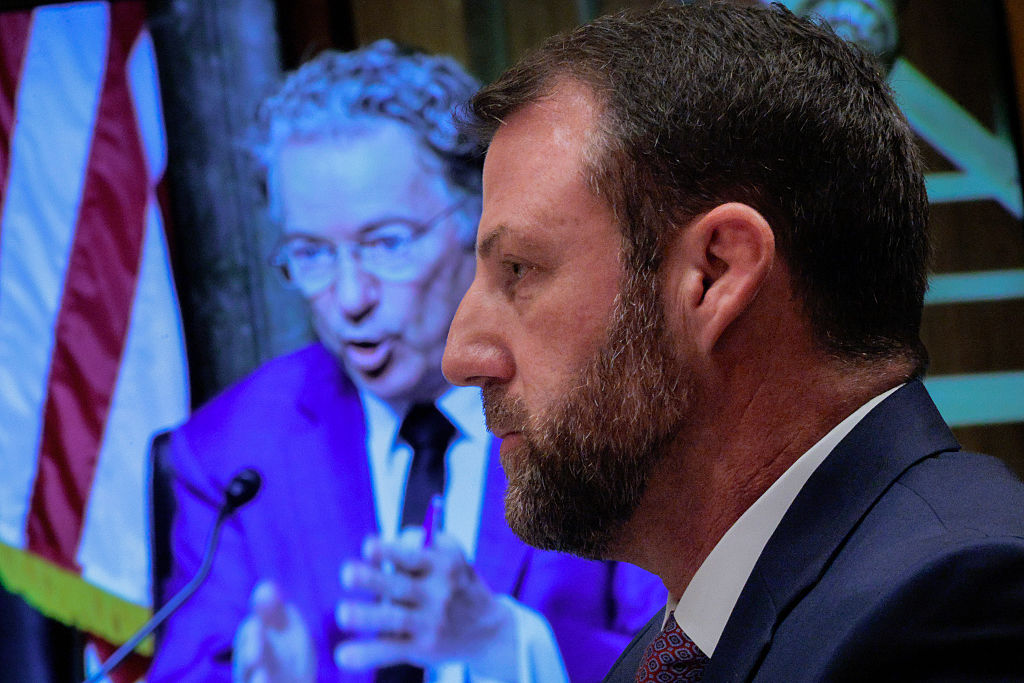
Then, on Friday, a second court in Rome – called to validate their detention pending deportation – ruled that Bangladesh and Egypt, though not at war and on Italy’s list of safe countries, are not safe.
So the migrants – the court ruled – cannot be detained. They were therefore brought by a coastguard vessel to Bari in south east Italy where they are now housed in an open migrant centre pending their appeals which will be decided within 14 days. They will probably just disappear as so many illegal migrants do.
It has been estimated that the cost of ferrying these 12 migrants from the Sicilian Channel to Albania and from Albania to Puglia is €20,000 per migrant. That’s a quarter of a million in total. This is a perfect example of what the migrant crisis is doing to Europe.
If allowed to stand, the Rome court ruling in the case of these 12 migrants will mean that no migrants can ever be taken to Albania. But Meloni is absolutely determined to overturn it. On Monday evening, her cabinet issued an emergencydecree which turns the government’s safe country list from secondary to primary law. She and her ministers say this cannot be overruled by the judges.
The clash between her government and the judiciary signals the start of what many are calling the third civil war between Italy’s elected governments and unelected judges in the past three decades.
In the first, during the early 1990s, Italy’s judges put on trial hundreds of businessmen and politicians for paying and accepting bribes in a judicial crusade known as Mani Pulite (Clean Hands) which caused the collapse of the so-called first Republic. The Italians, by and large, backed them.
The only political party left untouched was the Italian Communist party which as a result stood on the verge of power. To its fury, and that of the judges, the media tycoon Silvio Berlusconi threw his hat into the ring and won the 1994 general election.
So began the second civil war. Italy’s judges proceeded to subject the four times prime minister to dozens of criminal trials. But the Italians did not back the judges and kept voting for Berlusconi though in the end he was forced to resign in 2011.
This time, in the case of Meloni, the Italians absolutely do not back the judges.
Italy’s first female Prime Minister – after two years in office – is riding higher than ever in the opinion polls. One reason is that the Italians voted for her to stop illegal migration. She is also – incredibly – backed in her crusade to stop the boats by many in Brussels. The majority of EU leaders now want to set up a similar EU-run scheme to offshore migrants. The EU Commission President, Ursula von der Leyen, has praised it as ‘out of the box thinking’ and ‘in line with obligations under EU and international law.’
Obviously, Meloni’s opponents are cock-a-hoop at the refusal by the judges in Rome to validate the detention of the 12 migrants from Bangladesh and Egypt and say the ruling kills her Albania scheme dead at birth.
But as she told journalists:
‘I think the decision of the judges in Rome was a decision that was politically biased… Apart from that, the real question is far wider because in essence what these judges are saying is that safe countries do not exist. So I communicate officially here that the problem is not in Albania. The problem is that no one can ever be repatriated. The problem is that you can’t ever send people back. The problem is that you can’t implement any programme to defend your borders.’
In Italy, judges, also known as magistrates, are a separate profession from lawyers. They investigate, prosecute and adjudicate. Many make little effort to hide their left-wing sympathies and are nick-named Toghe Rosse (Red Gowns).
Now the Toghe Rosse have Meloni in their sights.
The newspaper Il Tempo has just published an email sent last week by a top judge to colleagues in which he implies that Meloni is more dangerous than Berlusconi and they must find a remedy. The judge and his colleagues who received his email are all members of the left-wing professional body Magistratura Democratica.
‘Meloni is not the subject of any judicial inquiries and so is not motivated by personal interest but by political vision and this renders her much stronger, and her actions also much more dangerous,’ he says in the email.
The idea of politicised judges will probably strike a British audience as absurd and impossible – although perhaps less so after Brexit and Rwanda.
But in Italy – though invariably denied by the judges themselves and their left-wing supporters – it is more or less a given.
Even with the best will in the world a close look at the Rome court ruling on the 12 Albania migrants makes it difficult to conclude that it was anything other than a political decision.
The court based its decision on a recent ruling by the European Court of Justice (ECJ) in Luxembourg on 4 October.
In 2022, a Moldovian was refused asylum by the Czech Republic on the grounds that Moldova is on its list of designated safe countries, with the exception of Transnistria. The ECJ ruled – if I have understood its tortuously written judgement published in French – that because the Czech Republic had designated Moldova as only partially safe cannot be a safe country. As a result, the Moldovan – ruled the ECJ – cannot be sent back to Moldova.
But what does this have to do with migrants from Bangladesh and Egypt in Albania who want to come to Italy? Italy has designated both countries as safe countries, not just partially safe, as the Czech Republic had done in the case of Moldova.
Carlo Nordio, Italy’s Justice Minister and himself a former judge, said at a press conference on Monday that the ECJ ruling was ‘written in French and probably not properly understood or properly read’ by the Rome judges. The government has appealed their ruling. On Wednesday, at question time in parliament Nordio said that the Rome court had not bothered to explain, in relation to each migrant, why it reached its decision, as required by law.
Regardless, Meloni has now changed the law on Italy’s safe country list to make it a primary law anyway. This, according to her ministers, means the judges cannot reject it. They can only appeal it if they feel it contravenes the Italian constitution or EU law.
Asked at the same press conference if Italy’s judges from now on could still send migrants in Albania to Italy Interior Minister Matteo Piantedosi said: ‘No, because it’s controlled by a primary law.’
We shall soon find out if he is correct.
Taxing the gambling industry just won’t work
Ahead of the Budget on 30 October, Rachel Reeves is being bombarded by lobbyists urging her to loot their enemies. The New Economics Foundation wants a ‘jet-setter tax’ on frequent fliers of €100 per flight. Action on Smoking and Health wants a levy on tobacco companies. Greenpeace reckons it can raise at least £26 billion a year by levying a wealth tax on the ‘super-rich’. An assortment of think tanks and pressure groups linked to the Labour donor Derek Webb think they can squeeze another £3 billion out of the gambling industry by doubling gaming and betting duties. Meanwhile in Scotland, the neo-temperance lobby are demanding a ‘levy’ on alcohol retailers who, they claim, are getting rich off the back of minimum pricing (a policy that only exists because they lobbied for it).
The appeal of these taxes lies in the old adage ‘Don’t tax you, don’t tax me, tax that fellow behind the tree’. They will, supposedly, only affect faceless corporations and ‘those with the broadest shoulders’, and who cares about them? Alas, it is more complicated than that and the Labour party is starting to realise that if there were billions of pounds lying on the pavement, the last government would have picked them up. Putting VAT on school fees and taxing non-doms were the closest thing Labour had to a magic money tree before the election, but it is now widely recognised that they will raise little if any revenue and the overall impact on the public finances could well be negative.
It is a reminder that before you hike up taxes, you should give a little thought to the unintended consequences, and yet the wider economic consequences of windfall taxes on industries that have not been the beneficiary of any obvious windfall are rarely considered. It is probably fair to say that the New Economics Foundation does not have the best interests of either the airline industry or business travellers at heart. For anti-alcohol, anti-gambling and anti-smoking groups, creating unemployment in the industries they attack is not so much an unintended consequence as the whole point.
The idea of doubling machine games duty, doubling general betting duty and hiking remote gaming duty from 21 to 50 per cent comes from a report by the IPPR, a centre-left think tank. It contains no modelling of the impact on the wide range of companies that will be affected and the entire analysis runs to just four paragraphs. It might as well have been written down the pub on the back of a beer mat. Insofar as it is possible to discern the IPPR’s logic, it is that if you double the tax rate, you make twice as much money.
This is naive in the extreme. Take general betting duty, for instance. This is the tax that bookmakers pay. The IPPR wants to increase it from 15 to 30 per cent. It is not clear whether the IPPR understands this, but general betting duty is paid on Gross Gambling Yield (GGY), which is the amount of money an operator has taken in stakes after it has paid out winnings. It does not include operating costs, rents, wages and other overheads. Although GGY is sometimes misleadingly referred to as ‘profits’, it is much closer to ‘revenue’. The IPPR is proposing that the government snaffle an extra 15 per cent of what a bookmaker earns before he has covered any of his expenses. In other words, any bookie who makes a margin of less than 15 per cent will – all things being equal – be put out of business.
The same applies to other parts of the gambling sector. Take casinos, for example. Last year, Grosvenor casinos made £23.7 million profit from £331 million revenue, a margin of 7 per cent. Mecca casinos made £3.9 million profit from £139 million revenue, a margin of 3 per cent. Even these modest figures flatter the industry. When the impact of club closures is taken into account, Grosvenor’s profits fell to £16.5 million and Mecca made a loss of £1.7 million. Much of a casino’s revenue comes from machine gaming, taxes on which the IPPR wants to double from 5-20 per cent to 10-40 per cent (depending on the machine). Again, this is a tax on revenue, not profit. Combined with a hike in gaming duty, which casinos also pay, it would make virtually every casino in the country unviable. And while the IPPR spares bingo clubs from a rise in bingo duty on the basis that bingo is ‘lower harm’, they make a lot of their money from gaming machines and would also be under threat.
Even many online gambling companies, which tend to be more profitable, would find it hard to survive if remote gaming duty was hiked from 21 to 50 per cent. In crude terms, they would need to have a profit margin of at least 30 per cent to stay in business, but few of them do. Rank’s online gaming business, for example, yields a margin of 10 per cent while Evoke, which owns William Hill and 888, has a margin of 13 per cent.
It would be too simplistic to say that all these businesses will go bust if Rachel Reeves capitulates to the anti-gambling lobby on taxation, but many of them will. Some of the others could survive, but only by making redundancies and giving customers a worse deal by, for example, offering shorter odds. They might do less advertising and few people would complain about that, but advertising agencies employ people too.
What is certain is that there is not £3 billion – or anything close to it – swishing around the gambling industry that can be painlessly creamed off by the government. The same is true of the wider economy. Contrary to left-wing orthodoxy, the Conservatives have milked it dry. There is no easy money.
Leyte Gulf is the greatest naval battle you’ve never heard of
When you think of great naval engagements, the Battle of Leyte Gulf does not immediately spring to mind, despite it being the largest naval battle in modern history. Leyte Gulf, which celebrates its 80th anniversary today, took place in the Philippines in 1944. Even my well-educated American friends, the CEO of a major publishing company included, fail the vox pop test of knowledge of this epic battle.
The sea battles that we remember tend to be engagements that define the outcome of struggles between empires and civilisations. At the Battle of Salamis, Athenian triremes thwarted Persia’s conquest of Greece. Similarly at the Battle of Lepanto, Pope Pius V’s Holy League navy defeated the Ottomans who threatened Europe. Britain’s greatest sea battles of course – Trafalgar, Jutland and the Battle of the Atlantic – were instrumental in the defeat of the hegemonic ambitions of Napoleon, Kaiser Wilhelm II and Hitler. But the Battle of Leyte Gulf does not belong in this canon of civilisation defining engagements. Why?
Tactically, the Japanese plan in the summer of 1944 was spot on
First a little background. Although it is sometimes thought that the Japanese navy was irrecoverably handicapped before the Battle of Leyte Gulf, this is not the whole truth. Yes, Japan did lose four of its frontline fleet carriers at the Battle of Midway in 1942. But before this fluky American victory, at the earlier Battle of the Coral Sea, the first carrier-on-carrier battle in history, it was Japan that won. In terms of training and technology, the Japanese fleet at the start of the Pacific War was significantly superior to that of the US.
There were many battles during the subsequent Guadalcanal campaign in the Solomon Islands and Japan won its fair share. Indeed, Pearl Harbor apart, the Battle of Savo Island and the Battle of Tassfaronga are considered the worst defeats in US naval history. In the two carrier-on-carrier battles at Guadalcanal, the Battle of the East Solomon Islands and the Battle of the Santa Cruz Islands, victory honours were even.
Thus, 20 months later, in June 1944, as Japan sought out America’s Pacific fleet while it was protecting the US Marines’ landing on Saipan (the island from which the US would begin the carpet-bombing of Japan), Japan’s naval commanders had every reason to think that they had a fair chance of victory.
Throughout the Pacific War, the Japanese navy had sought to draw America into battle to replicate the stunning victory Admiral Togo had inflicted on the Russian navy at the Battle of Tsushima in 1905. This engagement, a Japanese Battle of Trafalgar, had brought the complete destruction of the Russian fleet, which had sailed halfway round the world from the Baltic Sea to the Sea of Japan. The Battle of Tsushima effectively ended the Russo-Japanese War and with it Tsar Nicholas II’s attempt to conquer northern China and Korea. Thus, Tsushima became the Japanese template on how to defeat a great world power like the United States.
Contrary to received opinion, the surprise Japanese attack on Pearl Harbor (otherwise known as Operation Z) on 7 December 1941 was not aimed as a war-winning knockout blow. The fact that America’s carriers were not in port may have been bad luck from a Japanese point of view, but that did not significantly affect Admiral Isoroku Yamamoto’s strategic plan. Like at Tsushima, the plan was to draw the US navy into a decisive action in Asian waters, thousands of miles from America’s home bases. As navy Chief of Staff, Admiral Osami Nagano informed Emperor Hirohito, ‘at the appropriate time, we will endeavour by various means to lure the main fleet of the United States (toward Japan) and destroy it’.
In the interwar period, the naval limitation treaties at Washington (1922) and London (1930) were aimed at reducing the battleship arms race. The agreed ratio of warships disadvantaged Japan. The Japanese navy set out to nullify the treaties’ effects. It invested heavily in new technologies such as submarines, aircraft carriers and torpedoes – weapons that were not treaty-limited.
In 1927, an eight-man team of Japanese naval engineers visited the Whitehead Torpedo Works in Weymouth. Instead of buying British, they returned to the Kure Naval Yard, along the coast from Hiroshima, to build a compressed pure-oxygen-powered torpedo. They succeeded where the British gave up. The resulting Type-93 became known as the ‘Long Lance’; it could travel at 53 mph and had a range of nearly 23 miles – seven times the distance of American torpedoes.
By contrast, for the first two years of the war, American torpedoes did not work because of a faulty design. It did not help that the US navy’s torpedo plant was monopolistic and based in Delaware, a state famous for public corruption and racketeering. The naval factory engineers even ignored the advice of a visiting Albert Einstein who warned that their torpedoes, designed to strike below an enemy ship’s plimsoll line, would not work because of the Bernoulli Principle of fluid dynamics that explains pressure and velocity.
Range extension was also implicit in the design of enormous Japanese submarines. Their C-3 B-1 submarine was built as a global underwater cargo ship that picked up strategic Nazi supplies from the port of Lorient on France’s Atlantic Coast. Bigger still, at the suggestion of legendary commander Admiral Yamamoto, Japan built the Sentoku (literally ‘three uses’) I-400, double the size of any allied submarine; it was designed as an underwater aircraft carrier that could launch three Aichi M6A Seiran torpedo bombers.
Neither did Japan abandon the battleship. Again, the design concept emphasised range. After the expiry of the naval limitation treaties, the Japanese Navy built the two largest battleships in history, IJN Yamato and IJN Musashi; their 18-inch guns could fire a 1.5-ton shell 26 miles. By comparison, the largest American battleships had 16-inch guns which could fire a 1.35-ton shell for 20 miles – giving Japan a more than useful 6-mile advantage in the epic future naval encounter envisaged by Yamamoto.
Given these technological advances it has to be asked why the Japanese navy performed so badly at the Battle of the Philippine Sea some 20 months after their successes in the naval engagements at the Coral Sea and in the Solomons?
Tactically, the Japanese plan in the summer of 1944 was spot on. Admiral Toyoda, who had become Commander-in-Chief of the navy after the assassination of Yamato, aimed to attack the US fleet as it supported the US marine landings on Saipan. Here Toyoda could use land-based aircraft on Saipan to supplement its by now outnumbered carrier fleet air arm. The US navy had 15 fleet and light carriers compared to the nine that Japan could muster. The ensuing Battle of the Philippine Sea would be the largest carrier-on-carrier battle in history.
In the event, the Battle of the Philippine Sea was a crushing defeat for the Japanese navy. It lost three of its carriers with three more damaged. By comparison, just one US battleship sustained some damage. The real damage however was to Japanese navy’s aerial assets; some 650 of its 750 planes were shot down. Such was the aerial massacre that the battle is more often referred to as ‘The Great Marianas Turkey Shoot’. Almost all the Japanese pilots along with thousands of carrier technicians, both scarce resources, were killed. Toyoda’s ‘decisive battle with full strength’ turned into a catastrophic defeat.
The Battle of Leyte Gulf was an overwhelming victory for the United States
Why did the Japanese navy, that had such a technical advantage at the start of war, perform so poorly? The answer is that the US navy had not stood still. Apart from bringing new Essex class aircraft carriers on stream, the US had raced ahead of Japan in areas such as carrier-to-air communication, radar and analogue computer anti-aircraft guns.
By the summer of 1944, the US navy had replaced its pre-war Grumman F4F Wildcat fighter with the F6F Hellcat which had upgraded armament, speed and range. Captain David McCampbell, the US navy’s top Second World War ace, who scored all of his 34 victories in a Hellcat, described it as ‘easy to fly, and was a stable gun platform, but what I really remember most was that it was rugged and easy to maintain’. Similarly, the Douglas Devastator torpedo plane, a deathtrap at the Battle of Midway, had been replaced by the faster Grumman Avenger.
At the beginning of the Pacific War, Japan’s outstandingly manoeuvrable Mitsubishi Zero fighter, enjoyed a 12 to one kill ratio. By 1944, those statistics had reversed to one to nine. But there was another factor at play – one that was not technological. Japan was running out of pilots. In anticipation of a single overwhelming victory like Tsushima, Japan had only a shallow pool of carrier pilots. They were brilliantly trained and far from the feeble, pebble-spectacled pilots so arrogantly imagined by the British and Americans. The problem for the Japanese navy was that by 1944 their elite prewar carrier pilots were nearly all dead – as were their supporting technicians. They could not be replaced. The Japanese navy had neither the time nor the aviation fuel to train new recruits.
So, after the ‘Marianas Turkey Shoot’ what were the Japanese navy’s options? They still had a lot of capital warships and some aircraft carriers, but not enough pilots. In these straitened circumstances, the they devised an all-in high-risk strategy aimed at destroying the armada that was bringing General MacArthur’s sixth army to a landing at Leyte Gulf in the Philippines. Despite the intricacy of the plan concocted by Admiral Soemu Toyoda, his naval attack at Leyte Gulf had more than a touch of ‘suicide mission’ about it. As Admiral Takeo Kurita noted before the battle, ‘Would it not be a shame to have the fleet remain intact while our nation perishes?’
In chess, a queen sacrifice (sometimes known as the ‘Aleppo gambit’) is a high risk and rarely successful ploy. Admiral Toyoda’s strategy at the Battle of Leyte Gulf was the naval equivalent. At Leyte Gulf, Toyoda planned a complex three-pronged naval engagement in which he would offer four prized aircraft carriers as a sacrificial decoy; without carrier pilots they were in any case a worthless asset.
Japan’s intel had convinced its naval hierarchy that the US Fleet Commander Admiral William ‘Bull’ Halsey was an inspirational leader but also a monomaniacal hothead who bridled at the thought that he had, through illness, missed out on command at the Battle of Midway. His heart’s desire was to sink a Japanese flat-top. As Admiral Jisaburo Ozawa recalled after the war, ‘we always tried the operation plan according to the characteristics of the United States commander’.
Toyoda guessed right. Halsey, who was meant to be protecting General Douglas MacArther’s landing on Leyte Island, took the bait and chased the empty carriers to the northeast of the Philippines. Halsey bagged the four Japanese decoy flattops, but it was a hollow victory. Meanwhile to the south of the Philippines, another Japanese decoy squadron was ambushed and annihilated in the Surigao Strait that separates Leyte Island from the Philippines’ southernmost major island, Mindanao.
This was the start of the Japanese navy’s use of kamikaze as a weapon of war
With the San Bernardino Strait above Leyte Island unguarded, the route to annihilating the landing of General MacArthur’s 6th army on the island was now open to a force led by Admiral Kurita aboard the behemoth battleship IJN Musashi. However, before it could slip through the San Bernardino Strait, a US carrier aircraft found Musashi in the Sibuyan Sea. The 72,000-ton battleship was hit with 19 torpedoes and 17 bombs before it turned turtle and sank. Its captain and 1,022 men, almost half Musashi’s crew, went down with their ship. Kurita switched flagships.
With his remaining squadron, Kurita transited the San Bernardino Strait and fell on the unprotected escort carriers and destroyers which had been abandoned by Halsey in his pursuit of the empty Japanese carriers. MacArthur’s 6th army, in the process of invading Leyte Island, was at Kurita’s mercy. At this moment, with victory in sight, Kurita inexplicably turned back and slipped back through the San Bernardino Strait, before Admiral John McCain Sr., (grandfather of the Republican party presidential candidate for 2000) scurrying back from Halsey’s forces, could bring his carriers to bear on the battle. After the war Kurita confessed, not altogether convincingly, that he ‘did not realise how close I was to victory’.
Fake news filtered back to Tokyo: it was reported that 16 American carriers had been sunk. Hirohito ordered victory celebrations. General Suzuki declared ‘we must demand the capitulation of MacArthur’s entire forces’.
In fact, the Battle of Leyte Gulf was an overwhelming victory for the United States – in terms of matériel destruction, by far the greatest ever in US naval victory. The Japanese navy lost 12,500 men, a fleet carrier, three light carriers, three battleships, ten cruisers and 11 destroyers – 28 ships out of Japan’s 80 serviceable warships. Meanwhile, the US suffered 2,800 casualties and lost six ships. 265 American planes were downed compared to an estimated 550 or more Japanese planes; the difference was that most of the downed US pilots were rescued before they were captured or attacked by sharks.
Despite the unique scale of the victory, it has to be judged that the Battle of Leyte Gulf was not a war-defining engagement. Even if the US navy had been defeated and MacArthur’s landing disrupted by the end of 1944, the US could have replaced its losses within months.
The American industrial juggernaut was in full flow. By mid-1945, America had 28 fleet and light carriers, as well as more than 71 escort carriers, 23 battleships, 73 cruisers, 377 destroyers, and 232 submarines. If auxiliaries are included, the US navy comprised more than 7,500 ships. Often forgotten is that to sustain supply chains supporting 1.5 million US personnel in Asia, America had built 2,751 Liberty cargo ships. By contrast, after Leyte Gulf, the Japanese navy consisted of just 72 ships of all types, while their merchant fleet had already been decimated.
If the Battle of Leyte Gulf left an immediate legacy, it was the start of the Japanese navy’s use of kamikaze (‘divine wind’) as a weapon of war – the tactic that came to define the death cult that imbued Japanese forces during the Pacific War as they fought for their godhead, Emperor Hirohito. Nevertheless, there was a perverted logic to this tactic of mass suicide. As Japan’s fighter ace, Saburo Sakai, explained after the war:
Putting a kid with only about 20 hours flight time into a plane and telling him to take on US pilots in Hellcats and Corsairs is just as much a suicidal tactic as being a kamikaze. We figured that if they’re going to die anyway, the kamikaze attack will probably cause more damage to the enemy for the same price in lives.
The Battle of Leyte Gulf deserves a larger place in history than it is usually accorded. It was the largest naval battle in history in terms of the number of ships involved – 375 (not including auxiliaries such as troop ships, supply boats, launches, landing craft patrol boats etc.). In geographical scale, the battle was similarly unique. Leaving aside the Battle of the Atlantic, more a war-long campaign than a battle, the engagement at Leyte Gulf took place across four days over the largest naval battlefield in history; it covered the entire 115,000 square mile Philippine Archipelago, an area 20 per cent larger than the United Kingdom. The Battle of Leyte Gulf was the sixth and last of the carrier-on-carrier naval battles in history. It is very unlikely that there will ever be another.
WR Masters
Two of England’s brightest prospects received a golden opportunity to play at the WR Chess Masters Cup, an elite knockout tournament held at the Langham Hotel in London last week. WR is Wadim Rosenstein, a keen chess player and CEO of the German WR logistics group, which last year partnered with Fide to organise the World Rapid and Blitz Team Championships in Düsseldorf.
Shreyas Royal recently broke the record to become the UK’s youngest grandmaster at the age of 15 years and seven months. In the first round of the knockout, he faced former world champion Viswanathan Anand. With two extra pawns in the diagram below, one would expect Anand to comfortably notch up the win. But his next move 44 Rc7, aiming to capture on g7 and deliver mate, was based upon flawed reasoning.
Viswanathan Anand-Shreyas Royal
WR Chess Masters Cup, October 2024
44 Rc7! Rxh3 45 b4? This throws away the win. I am convinced that Anand intended to play the winning move 45 Rg6, intending a thematic double-rook checkmate after 45…Rbxb3 46 Rbxg7+ Kh8 47 Rg8+ Kh7 48 R6g7 mate. But then he would have spotted a fiendish defensive idea: 45…Kh8!, intending 46 Rbxg7 Rh5+! 47 gxh5 Rg2+. Black’s idea is to jettison the second rook, thereby achieving a draw by stalemate or perpetual check. For example, after 48 Kh4 Rg4+, Black gives check up and down the g-file. There is one way to defuse this idea, with a tightrope walk along the sixth rank: in the variation above, instead of 48 Kh4, 48 Kf6! wins. If 48…Rxg6+ 49 Rxg6 lifts the stalemate, or if 48…Rf2+ 49 Ke6 Re2+ 50 Kd6 Rd2+ 51 Kc6 Rc2+ 52 Kb6 (using the b-pawn as a shield) Rc6+ 53 Rxc6! with a trivial win after 53…Kxg7. Rd3 46 Rh6+ 46 Rbb7 is no better: 46…Rd5+ 47 Kh4 Kh8 48 Rxg7 Rxb4 and the single extra pawn is not enough to win. Kg8 47 Rg6 Rd5+ 48 Kh4 Rxb4 49 Rcxg7+ Kh8 50 Ra7 Rb1 51 Rh6+ Kg8 52 Rc6 Rh1+ 53 Kg3 Rd8 Exchanging a pair of rooks leads to an easy draw, while further checks lead nowhere. Draw agreed but Anand won the next game.
India’s Arjun Erigaisi, currently rated fourth in the world, was the event’s overall winner. But he needed a little good fortune in the semifinal.
Rameshbabu Praggnanandhaa-Arjun Erigaisi
WR Chess Masters Cup, October 2024
Praggnanandhaa must have underestimated his chances, since he chose 36 Qg5+ and proposed peace. That won the match for Erigaisi, so it was draw agreed. Instead, 36 f5! would begin a decisive attack. For example, 36…Nd3 37 f6 Rb1+ 38 Kh2 Qe5+ 39 g3 wins, or 36…Rf8 37 Qe6+ Qxe6 38 dxe6 and the pawns decide.
No. 824
White to play and mate in two moves. Composed by Hermann Feodor Lehner, Deutsche Schachzeitung, 1873. Email answers to chess@spectator.co.uk by Monday 28 October. There is a prize of £20 for the first correct answer out of a hat. Please include a postal address and allow six weeks for prize delivery.
Last week’s solution 1…f6! wins, e.g. 2 Rxf6+ Qxf6. Shankland chose 1…Kh7? missing 2 Qg8+!! Kxg8 3 d8=Q+ Kh7 4 Qh4 with perpetual. 1…Kh5 2 Rc5+ is no better.
Last week’s winner Kevin Kiernan, London EC2
The Spectator’s Jilly Cooper Competition
For Competition 3372 you were invited to submit a prose-style mash-up of Jilly Cooper and another famous writer. The entries were very amusing, though a handful were a little too pornographic for publication. Some of you seemed regrettably unfamiliar with the works of Cooper while others seemed to err in the other direction. I anticipated a fair few Austen–Coopers and there were indeed several excellent examples – shout-outs to Janine Beacham and D.A. Prince for theirs. Also deserving of a mention: a couple of versions of Chandler-meets-Jilly (Mike Morrison and Basil Ransome-Davies), Brian Murdoch for his Cooper/Tolkien, and David Silverman, who brilliantly yet unprintably infused Jane Eyre with some essence of Cooper (‘Reader, I shagged him’). The following win £25.
Rupert Campbell-Black in jodhpurs. Rupert Campbell-Black out of jodhpurs. Jodhpurs. Bestriding the moist clefts of Cotswold valleys. Bestriding unattended wives. Caressing the warm, plump swell of Cotswold hills. Caressing pliant mistresses. A ‘sport’ of multiple entendres: naked on private tennis courts, private upon naked horseflesh, resplendent at Hunt Balls. Hobnobbing Conservative ministers, captains of industry, the regal, the rival. In pursuit, always, of beauties. Adjacent, always, to beauties. Atop, always, of beauties. Atop, should circumstances necessitate or fancy tickle, the still beautiful mothers of beauties. Throughout, insouciantly engorged by half–blushing, half-lusting gorgeousness. Veins throbbing as one Helen swoons. As another Beatrice yields. As a chorus of exotically named au pair girls pass between his muscular thighs. As a brace of illegitimate children germinate, unwanted. His stubble rough, his chuckle gravelled, his breath five-star-brandied. Virile as a stallion. Rupert Campbell-Black in jodhpurs. Rupert Campbell-Black out of jodhpurs. Jodhpurs.
Adrian Fry (Jilly Cooper and Gertrude Stein)
With nothing to recommend her apart from a voluptuous figure and a soft pillowy bosom, Fanny Jolly-Sort, drenched in Diorissimo, presented herself at the Rumpy-Pumpy room in Bath, seeking a well-endowed suitor. She was approached by a handsome gentleman, broad-shouldered with narrow hips and magnificently muscled thighs. He thrust something pink and tautly skinned at her: ‘Cocktail sausage,’ he said in throaty suggestive tones. ‘Oh how super,’ breathed Fanny, her nipples stiffening. He introduced himself as Captain Hardman of the Bonkshire regiment and they proceeded to engage in lively intercourse. However, on discovering that the captain was penniless, Fanny transferred her affections seamlessly to Mr Fitztightly-Wrightley, an erect personage who looked as if a large root vegetable had been shoved up his rectum. He was however in possession of a vast fortune and it is a truth universally acknowledged that romantic fiction isn’t about love. It’s about sex and money.
Sue Pickard (Jane Austen/Jilly Cooper)
In Millicent’s eyes, Fr Dominic had everything. At 22, he was tall, broad-shouldered and heart-stoppingly handsome. He was also curate at the third most important Anglo-Catholic parish in north London. A tea invitation had seemed daring, but as her sister Winifred entered the room with a tray bearing bread and butter, jam and a cake, Millicent felt relaxed, catlike. She had worn the new floral dress bought from Sloane St the week before. Were the short sleeves a little too obvious? Fr Dominic, if he had noticed, had not indicated anything to that effect, so she was unsure whether to feel vindicated or disappointed.
Either way, Winifred’s departure to do the washing up provided the chance she wanted. Millicent moved smoothly to the sofa, sat next to Dominic, lean-hipped and loose-limbed as a lurcher puppy, before placing her hand on his thigh.
‘I adored your sermon on Sunday,’ she whispered, breathily.
David Harris (Barbara Pym with a touch of Jilly)
OCTOBER 25. My dear Carrie startled me this evening, by reading to me from Horse and Hound. She said: ‘It says here that, once you know the trick, it is comparatively easy to extricate a gentleman from jodhpurs.’ In answer, I made an amusing remark, which by-the-by, had Carrie in stitches: ‘Shall we have a saddle of lamb this evening, or would you bridle at my tenderloin?’ How we roared, and removing our garments (in Carrie’s case, a bell-shaped skirt, and a most elegant straight-front corset), we repaired to the bedroom in The Laurels. Incidentally, she has filled our boudoir, as she calls it, with greenery. As Carrie, with an assiduity our maid Sarah would be wise to cultivate, removed my woollen trousers, I gazed at her array of plants, and essayed a further pleasantry: ‘Before we begin the first chukka, may I inspect your monstera deliciosa bush?’
Bill Greenwell (George and Weedon Grossmith with J.C.)
My kind master grew increasingly distraught, and one morning came dolefully with Belinda, his daughter, to explain that, being bankrupt, he must perforce sell Merrylegs and myself to Rupert, the local glamorous cad. With heavy hearts we accompanied a weeping Belinda to meet our new owner, a well-built, swaggering man. I felt unsure of him initially, yet he inspected me expertly and, sensing my nervousness, calmed my flank with a hand of notable gentleness.
I think that he must have sensed Belinda’s nerves also, for he began to soothe her likewise, and before long the two of them repaired to a corner of the stable. From what next occurred I gained a sense of how he might ride me in competition, going calmly in the first stretch, accelerating when I showed confidence, adjusting smoothly to new positions, and finally thundering home to an immense finish. ‘Golly!’ said Belinda, ‘That was super!’
George Simmers (J.C. and Anna Sewell – an extra chapter for Black Beauty)
No. 3375: Plum assignment
Since they went to the same school (Dulwich College), you are invited to submit an extract in which P.G. Wodehouse has a go at writing Raymond Chandler-esque noir (150 words maximum). Please email entries to competition@spectator.co.uk by 6 November.
2677: What’s in a name?
Unchecked and mutually cross-checking letters in 14 unclued lights spell out PEEP – THE SPECTATOR CHARACTERS RECREATE REST. One such light is hyphened and another comprises two words.
Across
1 Bundle of stuff needing time (7)
5 Dubious party assumes American power (7)
9 Church, with Old English exterior, from which arrows are launched (4)
13 Impressive collection of maths and physics constants (4)
14 Long-lost beast is such, or a fake (7)
16 Letters delivered for Badger (5)
17 Cold bottle of milk overturned – it’s irresistible to kitty (6)
20 Mediterranean restaurant worker sent back outside state (7)
21 Least cautious female interrupts returning emperor (7)
25 Fight animals from the rear, having run away (3-2)
26 Sage Henry also known as Mike (5)
31 Knows Shakespearean wife too much, the rogue (7)
34 Poets regularly greeting tragic hero (7)
37 In haste, I cooked fish (6)
38 Top score from captain almost netting record (5)
39 Omit wet slips for 2D (3-4)
40 Mark’s unlimited awards (4)
42 Low blow, primarily by fool (4)
43 Idyllic valley before extremely short storm (7)
44 Male tutees playing old bagpipes (7)
Down
3 Expert bags prize individually (6)
4 Raise small advance payment for vessels (5)
6 Struggles right inside Cornish resort (7)
7 Poirot intermittently absent after key date (6)
10 Alone, catch wriggling creature thought to be extinct (10)
12 Familiarise new scout in cycling coat (8)
18 Mad scientist injected with heroin laughing uncontrollably (2,8)
22 Painter overseen for review (8)
27 Singaporeans maybe mentioned depression (7)
30 Silent mum upset dispute (6)
32 Diplomacy originally shown about bottom in nether regions (6)
35 Spell in section of Church Army (5)
Download a printable version here.
A first prize of £30 and two runners-up prizes of £20 for the first correct solutions opened on 11 November. Please scan or photograph entries and email them (including the crossword number in the subject field) to crosswords@spectator.co.uk, or post to: Crossword 2677, The Spectator, 22 Old Queen Street, London SW1H 9HP. Please allow six weeks for prize delivery. The dictionary prize is not available at present.
2674: New crop – solution
7D sung by 40A suggested other unclued lights, all anagrams of fruits: 12A mango; 17A apple; 18A apricot; 24A damson; 9D tangerine. MELON, an anagram of LEMON, was to be highlighted.
First prize Kathleen Durber, Stoke-on-Trent
Runners-up Clare Reynolds, London SE24; Sid Field, Stockton on Tees
Is Wes Streeting the Hamlet of the health service?
Is Wes Streeting the Hamlet of the Health Service? Is this undoubtedly talented and thoughtful young Labour prince fatally irresolute when it comes to doing what he knows must be done?
Few politicians have articulated so clearly the need for reform of our healthcare system. Streeting’s insistence that the NHS should be a service not a shrine angered all the right people, which is to say the BMA. It marked a welcome departure from the treacly displays of affection which have hitherto characterised ‘debate’ about the health service. More recently, the Health Secretary has frankly admitted that the NHS is letting patients down and acknowledged its manifold inefficiencies. The need for change has been recognised. The case for reform is urgent. The sickly patient lies before us, the vital signs deteriorating. But instead of action, this week we have been offered a National Conversation; in place of reform, procrastination. The native hue of resolution has been sicklied o’er by the pale cast of an internet suggestions book.
There are no alibis for this inaction. Streeting shadowed his current role for more than two years
What does Wes need to know that the cold facts cannot already tell him? British citizens have the worst rate of life expectancy in western Europe. We have higher avoidable mortality rates than our neighbours. Survival rates for breast, cervical, rectal, lung, stomach and colon cancer are lower in the UK than in comparable jurisdictions. NHS patients who suffer heart attacks or strokes are more likely to die than in France, Spain, the Netherlands, Canada, Italy and New Zealand.
More than seven million people are on waiting lists for NHS treatment. Every month tens of thousands wait for more than 12 hours for treatment after being admitted to accident and emergency wards. It is then no surprise that the number of (wealthier) patients opting to pay to be treated privately is at a record level – more than 800,000 every year.
So we have a two-tier health system in this country in which the rich secure the best care, those in pain wait in agony and those with life-threatening conditions know their treatment would be better in Marseille or Madrid than Manchester or Middlesbrough. What more warrant for action is required?
And yet the launch of Labour’s ‘Ten Year Plan’ for the NHS this week amounted to no more than a declaration of three principles to guide the future which make motherhood and apple pie seem novel and contentious.
The government’s ‘new’ commitment to move the NHS from hospital to community, analogue to digital and sickness to prevention is no more than a recital of the bleedin’ obvious masquerading as a roll-call of revolutionary changes. Did any Tory health secretaries argue we should have more inpatients and fewer outpatients, more bedblockers and less efficiency, refuse to embrace new technology and display wanton indifference to the spread of disease?
There are no alibis for this inaction. Streeting shadowed his current role for more than two years, during which the doors of every thinktank were open, the testimony of every professional was at his disposal and he had generous room and time to reflect and plan. He had the experience of previous Labour reformers such as Simon Stevens and Alan Milburn to draw on. They will have told him that the Blair government wasted its early years ducking reform and embarked upon necessary change only after political capital had been depleted and public trust eroded.
The nature of the reform required is clear, though certainly not easy. In running any health service, politicians must arbitrate between the interests of patients, the tax-payer and those who work within the system. A reforming government should be putting patients first, watching expenditure carefully and requiring greater accountability from professionals. Unfortunately, the revealed preference of this government so far is to privilege producer interests by pumping in taxpayers’ money to inflate salaries without securing improved patient outcomes. Acceding to union demands may have ended strike action but it has not been accompanied by any measures to improve productivity.
The number of GPs working full time has fallen from around a third in 2017 to just a fifth today. Nurse recruitment is impeded by the trade union insistence on degree-level entry. Consultant management of waiting lists and operating theatres reflects professional incentives rather than the highest Hippocratic ideals. The mission to heal and the vocation to care are noble ideals but, as the New Labour thinker Julian Le Grand has pointed out, one cannot run an efficient public service on the idealistic premise that everyone working within it is without a shred of self-interest. Or on the assumption that the BMA, RCN and other health unions exist only to advance medical knowledge and regard talk of terms and conditions as unpardonable vulgarity.
Reform of the NHS requires ministers to challenge poor performance, demand accountability for actions, provide incentives for improvement and, inevitably, introduce greater choice and contestability. Until we see weak NHS managers sacked, recruitment reformed, GP contracts overhauled and new providers brought in, the change needed will not happen. And Streeting’s NHS reform plan will be Much Ado About Nothing.
Portrait of the week: Budget leaks, prisoners released and Israel kills Hamas leader
Home
Rachel Reeves, the Chancellor of the Exchequer, was expected to freeze tax thresholds in the Budget on 30 October, to swell government income as more working people were brought into higher tax bands. Before Labour formed a government, she had said that the Conservatives, by freezing tax thresholds, were ‘picking the pockets of working people’. Weeks of speculation on the Budget were encouraged by leaks and by constant questioning of ministers about how Labour would keep to its manifesto undertaking not to raise taxes on ‘working people’ by increasing income tax, national insurance or VAT. The International Monetary Fund raised its growth forecast for the United Kingdom to 1.1 per cent this year, compared with the 0.7 per cent it forecast three months ago. Government borrowing rose last month to £16.6 billion, against the £15.1 billion it had predicted. HSBC is dividing its operations into eastern and western markets.
The government released 1,100 more prisoners early, in a scheme to ease overcrowding in jails in England and Wales. Shabana Mahmood, the Justice Secretary, announced a sentencing review led by the Conservatives’ former justice secretary David Gauke. It was disclosed that Chris Kaba, the man shot dead by a police firearms officer in Streatham, south London, on 5 September 2022, had shot a man in both legs at the Oval Space nightclub in Hackney six days earlier. Sgt Martyn Blake was acquitted of murder this week after a trial in which the jury knew nothing of Kaba’s criminal career. The Serious Fraud Office investigated the building of a hotel and conference centre in Birmingham by the Unite union, using £112 million of its members’ money; the complex has since been valued at £29 million.
The most effective drug for Alzheimer’s disease, donanemab, will not be issued by the National Health Service because of its cost. Wes Streeting, the Health Secretary, will vote against legalising assisted suicide because of worries about the state of palliative care. A man died when the Shrewsbury to Aberystwyth train ran into the stationary Machynlleth to Shrewsbury train. In the seven days to 21 October, 695 migrants in small boats arrived in England. A baby died when a boat carrying 66 people capsized off Wissant in the Pas-de-Calais region. An 11-year-old from Cardiff was unable to take part in lessons as she had no smartphone to use in class.
Abroad
Israel killed Yahya Sinwar, the leader of Hamas who had been the architect of the attacks against Israel on 7 October 2023. Israel intensified its strikes against Hamas in north Gaza, and attacked sites associated with Hezbollah in Lebanon. Israel said that beneath Al Sahel Hospital in Beirut millions of dollars in cash and gold were kept in a hidden Hezbollah bunker. Amos Hochstein, the special envoy to the Middle East of President Joe Biden of America, flew to Beirut seeking a negotiated end to the war in Lebanon ‘as soon as possible’. Classified documents were spread around showing an assessment by the United States of plans by Israel to attack Iran.
The first 1,500 North Korean soldiers had arrived in Russia to fight against Ukraine, according to South Korea. In a referendum, Moldova approved changes to its constitution committing it to join the EU by 50.46 per cent; on the same day Maia Sandu, the incumbent pro-EU president won the first round of presidential elections by 41 per cent to 26 per cent for her closest rival. EU membership also figured in campaigning for the elections in Georgia due on 26 October. President Alexander Van der Bellen of Austria invited the incumbent Chancellor, Karl Nehammer, and the leader of the conservative People’s party to form a government, even though the biggest vote, at 29 per cent, had gone to the right-wing Freedom party.
Donald Trump’s campaign for the US presidency complained to the Federal Election Commission about ‘blatant foreign interference’ by British Labour party activists campaigning for Kamala Harris in America. Cubans suffered days of power cuts. During a ceremony at the Parliament House in Canberra, Lidia Thorpe, an Aboriginal Australian senator, shouted at the King: ‘This is not your land, you are not my King.’ Thousands in Sydney turned to greet the royal visitors. Mike Jeffries, 80, the former chief executive of Abercrombie & Fitch, and his British partner, Matthew Smith, 61, were arrested and charged with sex trafficking of men. CSH
The OnlyFans model, the milkshake and me
What better start to a Monday than to attend Westminster Magistrates’ Court? I was there for the trial of the young OnlyFans model Victoria Thomas Bowen who threw a banana milkshake at my face on the day that I launched my campaign in Clacton. Unbelievably, she planned to plead not guilty despite the fact that the whole thing was caught on camera. Rumours that her reason for doing all of this was because I had unsubscribed from her page are untrue. There was the usual circus of media outside as I arrived, but Victoria still insists she didn’t throw the milkshake just to get publicity for her website. It was a spur-of-the-moment decision, she says. Then at the last minute she pleaded guilty. The judge was not impressed. A huge amount of time and public money has been wasted on this charade. The sentencing date is set for 16 December, when she’ll get even more publicity. So it goes. As I left I noticed that Victoria was one of the very few British people to face justice that day. Most of the people on the list were Romanian criminals facing extradition. Funny that!
It was a fun-packed day. Later in the afternoon I gave a witness statement to the Metropolitan Police over a recent threat to kill me. I had covered on my social media channels the journey of a man called Mada Pasa as he made his way from Stockholm to Calais. He is, we believe, from Syria and would not therefore be deported when he gets into our country, as Syria is on the government’s ‘unsafe’ list. Pasa has a Kalashnikov tattooed on his cheek and in one TikTok post his colleague waves a handgun about. I made all this public to highlight the fact that we have some very dangerous people arriving on our shores. In response, Pasa made threatening posts, including one in which he insists that he will shoot me. Such are the joys of public life in 2024. I must need my bumps felt for getting back into politics.
It isn’t just the mega-rich who are quitting the UK. At a family wedding in Hong Kong, I met lots of young British expats who’d fled the country, and all of them seemed to be enjoying life outside the UK, especially with top rates of tax at 17 per cent. The brain drain last seen in 1978 is in full swing, and it’s always the brightest and most ambitious young people – the ones this country needs the most – who head off first. They go to the likes of Lisbon and Dubai. All of this started under the last Tory government and I have no doubt the problem will escalate after the doom Budget in a few days. It’s sad to see.
I have to confess that the ways of parliament are still a complete mystery to me. Though clearly not a fan of the European Parliament, at least I knew, on the Monday morning of a sitting week, what the times of the various votes and debates would be for the next few days. Not so in Westminster. This means that instead of tending to their constituents, MPs have to spend their time waiting around pointlessly. Trying to do the job to which I was elected and run and help organise a rapidly growing political party (more than 90,000 members now) is proving something of a challenge. I also still regularly get lost as I go from building to building.
A shocking 25,000 constituents in Clacton will lose their winter fuel allowance. There is pension credit available for the brave pensioners who dare tackle the application form, but the form itself is 243 questions long, and by definition the people who need it most are old and often short-sighted or confused. We are setting up a series of local surgeries across the constituency to help those who ought to qualify for pension credit, and I am very grateful to the local volunteers who are prepared to spend time helping.
The real highlight of this week for me is of course Americano Live: the US election special with The Spectator in London, chaired by Freddy Gray, The Spectator’s deputy editor. I’ve been very much looking forward to it. The betting markets are saying Trump will win, and the betting markets are right (and the editor of this magazine is wrong). People are beginning to see a side of Donald Trump that I’ve known for many years: he is just the most tremendous fun. He has a great sense of humour, unlike Kamala, who laughs but only as a nervous tic. This makes her seem less human, not more. The image of the next President of the United States at a McDonald’s drive-through in a McDonald’s apron putting salt on the chips is one that will live long in the memory. If he does it again, I’ll volunteer to stand beside him and serve the milkshakes.
Join Nigel Farage and Freddy Gray, The Spectator’s deputy editor, at Americano Live: US election special on 24th October. Book your tickets here. And, to never miss future Spectator events, sign up to our newsletter here.
The resurgence of Angela Rayner
On Monday evening, the Strangers’ Bar at Westminster was treated to a rare sight: Angela Rayner looking happy, smiling and holding court. As the newspapers went on the offensive over a new analysis of the Employment Rights Bill, which found it will cost business nearly £5 billion a year, the Deputy Prime Minister went to the Commons watering hole for a wine to celebrate the bill’s second reading.
It’s not just Rayner’s new deal for workers (now titled ‘make work pay’, following intense focus-grouping) that is giving her cause for fresh optimism. She is also enjoying a resurgence inside government after a tricky start. As Boris Johnson once said, ‘There are no disasters, only opportunities. And, indeed, opportunities for fresh disasters.’ While Keir Starmer navigates a route out of a difficult first 100 days and faces personal poll ratings of minus 30, there is a chance for his deputy to benefit.
Since Labour’s election victory, Rayner’s position has often been the subject of negative briefing. Pre-election talk of an office for the deputy proved premature: the gov.uk website states that ‘the current administration does not have a Deputy Prime Minister’s Office’. A Rayner ally points out that she actually has five: a departmental office for Housing and Local Government, one in the Cabinet Office complete with staff, her parliamentary office, her constituency office and one she occasionally uses in a Manchester government building.
Many of Rayner’s colleagues think she has the charisma the Prime Minister lacks
There is another point of view. ‘The office is dead because Pat [McFadden] is the real deputy prime minister,’ says one Labour figure. The power of McFadden – the veteran Blairite who leads the Cabinet Office – is felt across government. ‘He is the person Keir speaks to the most on a day-to-day basis,’ says a Downing Street aide. McFadden is seen to take on the unglamorous and serious work of government.
Meanwhile, Dorneywood, the grace-and-favour home that Blair once offered to John Prescott, has gone to the Chancellor. That’s not the only land grab by Rachel Reeves, which has created confusion among MPs about who exactly controls the planning brief. ‘I keep on asking, “Is Angela being kept in a cupboard?”’ says a party figure.
When Prescott was Blair’s deputy, he would busy himself of his own accord, knowing his political career had peaked. Rayner is a different beast. Her relationship with Starmer has had its ups and downs. One of Starmer’s first crises in opposition came when he tried to demote Rayner in a reshuffle – only for her to hold firm, delay the whole thing and come back stronger with three job titles.
Unlike Prescott, Rayner wants to be involved in making big decisions. Many of her colleagues think she has the charisma the Prime Minister lacks, as was apparent this week when she stood in for Starmer at PMQs. ‘When it comes to Starmer successors, Angela doesn’t come up the most in conversation, but it’s not impossible,’ says one MP.
Starmer and his new-look No. 10 are trying to build bridges with Rayner following the departure of Sue Gray. Gray was credited with initially smoothing relations between Rayner and Starmer (one cabinet minister says Gray adopted a ‘broken bird syndrome’, taking on under-appreciated ministers as personal projects). However, by the end of Gray’s brief time in government, the dysfunction in Downing Street was causing problems even for Rayner.
One of Morgan McSweeney’s first acts as Starmer’s new chief of staff was to make Rayner an official member of the national security council. She had been attending regularly anyway, but was missed off the list. ‘It meant it became a story,’ says one who was privy to the conversations. McSweeney’s decision comes as part of wider efforts to create ties across the party, such as moving the so-called ‘Spad school’ on Tuesdays from a dingy Westminster basement to 10 Downing Street. Last week Starmer addressed the Spads, this week it was Lucy Powell – leader of the house – discussing the government’s legislative agenda.
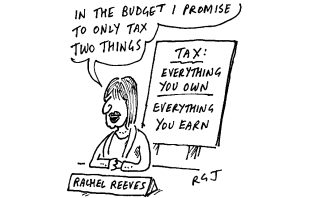
Ahead of next week’s Budget, Starmer needs friends across the party. ‘Keir knows he can’t afford to piss off the left right now,’ says an MP. ‘That means hugging Angela close.’ Following reports that Rayner had sent a letter to Starmer arguing against proposed cuts by Reeves, there is a heightened sense that the Prime Minister needs to work with the one member of his cabinet it would be hardest to sack – given that Rayner, like him, was elected by the party membership.
It has this week been agreed that Rayner will be allocated £1 billion in council house funding in the Budget. ‘In reality, it’s peanuts,’ says a senior Labour politician. Yet the funding boost can be presented as a win and it is popular with Labour voters. To cement her status as an important figure in the government, Rayner needs to go further and make her mark on policy. She hopes to do this with the planning brief (which is primarily with her department, despite briefings to the contrary) in the coming months.
Rayner retains strong ties to the trade unions and there are those on the party’s left who look to her as the government has to make trade-offs. She has a loyal band of new MPs who believe her support helped them secure their candidacy in safe seats. These include Paula Barker for Liverpool Wavertree (majority: 16,304), Anneliese Midgley in Knowsley (18,319), who crushed her rival Ryan Wain of the Tony Blair Institute, and Mark Ferguson in Gateshead (9,644).
The prospect of a left-wing revolt is weighing heavily on the right of the party. This week, a new parliamentary grouping called Labour First has emerged with the purpose of being ready to spring into action if the right needs to protect or influence the government. The Labour peer John Spellar and Luke Akehurst, a new MP and NEC old-timer, are among the figures leading the counter-revolution. ‘We know the left will try to make a comeback,’ says a figure involved. ‘They will accuse the government of betrayal whether it is the Budget or foreign policy. We need to be prepared.’
Ahead of what No. 10 aides expect to be a turbulent few weeks, Starmer will find it much easier to keep his party together if his deputy is in his corner.
Trump makes America laugh again
‘Tradition holds that I’m supposed to tell a few self-deprecating jokes this evening,’ said Donald Trump in his speech at the Al Smith Dinner in New York on Friday night. ‘So here it goes.’ He paused. ‘Nope. I’ve got nothing… There’s nothing to say. I guess I just don’t see the point at taking shots at myself when other people have been shooting at me.’ The crowd roared.
Many of the jokes were close to the bone: ‘We have someone in the White House who can barely talk, barely put together two coherent sentences, who seems to have mental faculties of a child. It’s a person that has nothing going, no intelligence whatsoever. But enough about Kamala Harris.’
We can’t know whether Harris herself would have laughed. She was the first presidential candidate in 40 years to miss the dinner, which has become famous for its speeches in which the two opponents make jibes at each other’s expense. Instead, she appeared only in a prerecorded video. Some Democratic operatives feared that her absence might upset the Catholic vote: this is a charity fundraiser organised by the Arch-diocese of New York. What would voters make of the Vice President’s priorities, especially in the swing state of Pennsylvania where a quarter of voters are Catholic?
What followed was a hybrid between a MAGA-fest and a comedy show
In the end, however, her team needn’t have worried about a perceived snub. They should have worried that, unopposed and in the spotlight, Trump confirmed Democrats’ fears: he is still funny.
When Trump is down on his luck, his angry, vengeful reflexes kick in – and the former president has been in a slump for years. He lost the 2020 election. He failed to produce a ‘red wave’ in the 2022 midterms. He faces multiple indictments which have so far resulted in one conviction. Whether he’s fighting legitimate battles for the presidency or illegitimate battles to overturn election results, he becomes frustrated and bitter when things aren’t going his way.
But when he is on the up, his humour returns. During the Republican primaries, Democrats were rooting for Trump to win the nomination, expecting they would be running against an angry, revenge-obsessed candidate. For months, that’s who they got. But in the past few weeks, something has restored Trump’s humour. Perhaps it’s positive internal polls, or Harris’s recent word salads. Regardless, in his speeches, rallies and other events, he’s going back to the style of performance that helped him clinch the presidency in 2016. Can he keep people laughing until polling day?
I witnessed firsthand the return of Trump the stand-up comic at a Town Hall event at Lancaster, Pennsylvania, on Sunday night. The show began long before attendees arrived. Once I registered for a ticket, my inbox was bombarded. ‘From Trump: I’LL NEVER STOP LOVING YOU’, followed by a fund-raising plea. ‘From Trump: I JUST LEFT MCDONALD’S’, reads another message. ‘That was fun!’ Trump’s shift at McDonald’s was part of his weekend tour of Pennsylvania. Another message: ‘I have a McGift for you. It’s President Trump!’
The Convention Centre in Lancaster holds roughly 6,000 people, but many more turned up for the event, driving for hours, even across state lines. Not everyone got in, but everyone in the queue still got to witness the fun. Trump impersonators walked up and down the block imitating his speeches. A group of first-generation immigrants held up a flag depicting Trump as a samurai, dancing to rap music and the national anthem. For many attendees it was a family day out. ‘It’s like standing in line for a Disney ride,’ remarked one dad, ‘but even more surreal.’
Most attendees wore their MAGA finest. The most popular T-shirt was one emblazoned with the photo taken of Trump in the seconds after the first assassination attempt: bleeding, fist-pumping, and shouting ‘Fight’. Every few paces was a vendor with a cart of gear, including hats that read ‘I’m voting for the convicted felon’ and politically incorrect placards of the Vice President, the ‘border tsar’, in a sombrero and with a moustache. ‘I know Biden screwed up the economy, but you can still buy a hat,’ shouted one seller. ‘Put it on your credit card and pay it off when Trump is president!’
In 2020 Lancaster county voted for Trump by a 16-point margin, but among the red-brick homes decorated with pumpkins and fallen leaves, there were plenty of Harris-Walz signs. Despite all the Trump supporters walking by them, none appeared to be defiled. ‘If the situation were reversed, Trump signs would be kicked in,’ asserted one young woman. I asked her which way she thinks the state will vote. ‘It’s really 50/50. If the media stopped taking his jokes out of context, his polling would be better.’
Pennsylvania’s 19 electoral college votes are expected to determine the outcome of the election, which is why Trump and his vice-presidential candidate J.D. Vance have been ramping up their appearances in the state this month. This makes Trump an expert on the place: ‘I know this area very well, maybe better, some of the greatest people,’ he told the crowd after he took the stage to Lee Greenwood’s ‘God Bless the USA’.
What followed for over an hour was a hybrid between a MAGA-fest and stand-up comedy. Trump answered the audience’s questions, moderated by Sage Steele, a former ESPN commentator who has rebranded herself as a critic of the mainstream media. Most of the time was spent on illegal immigration and fracking, with occasional nods to the economy. (Trump said ‘tariffs’ was his ‘favourite word in the dictionary, outside of “love” and “religion”.’) Whatever the topic, he made them laugh.
He pulled up his ‘favourite’ immigration chart, which he says saved his life in the first assassination attempt, as turning towards the graph caused the bullet to clip his ear, not his skull. ‘I wouldn’t be here without that chart. I sleep with it, I kiss it when I go to bed.’
He repeatedly talked about migrants ‘taking over’ America and rolled it into an insinuation about crime: ‘They’re in the real estate business all of a sudden.’ The reference was to dubious reports that Venezuelan gangs have taken over vacant apartment buildings in Colorado. The audience was laughing. Facts matter less in comedy routines.
It’s sometimes unclear whether a comment is meant to be funny, and then Trump has to clarify. ‘I can’t use the word “Harris”,’ he said with disgust, before flipping immediately. ‘And by the way it’s her 60th birthday, so I want to wish her a happy 60th birthday. And many more.’ The audience burst into mock boos and laughter. ‘And I mean it. You know, I do mean it, actually,’ he insisted.
Trump’s most loyal supporters gave as much as they got. One woman was noticed by Trump and Sage Steele at the start of the rally, crying what were dubbed ‘happy tears’. ‘Oh no she’s crying again,’ Trump said halfway through the Town Hall. ‘Stand up, show everybody.’ The camera panned to her sobbing face. ‘Thank you, darling,’ Trump said after her devotion had been witnessed by the crowd. ‘Appreciate it.’ Another woman, selected to ask a question, reminded Trump that they had met before. ‘Uh oh,’ he replied, before recalling her description of his face tattooed on her leg.
Among the jokes and chants and meeting the faithful, he made time for fear-mongering. ‘If they get chosen, our country is finished,’ he reminded the audience towards the end. Still, the audience walked out elated. ‘That was better than Netflix,’ one man said to his family. They nodded.
On the highway home, I was confronted with billboard after billboard of election ads for both Trump and Harris. Littered between them were ads for cannabis shops in neighbouring states and local strip clubs. That’s America: sex and drugs and Trump on a roll.
Listen to Kate Andrews on The Edition podcast:
America’s last undecided voter
This is the last column I’ll file before the American presidential election, and I’ve dreaded writing it for months. (The next one, filed on election day itself, may prove impossible. Perhaps that’s when I’ll choose to share my recipe for parsley as a side vegetable.) Meanwhile, I’ve watched fellow ‘double haters’ squirm in print. There are two models for wrestling with this dilemma, one exemplified by Andrew Sullivan. The conservative commentator ‘came out’ in a September Substack newsletter – no, not in that dated sense: everyone knows he’s gay – in support of Kamala Harris, only to lavish the overwhelming majority of that column on what a ghastly candidate she is.
I find it impossible to determine which victorious candidate could turn out to be worse
The second model for facing down two flagrantly unacceptable electoral choices has been embodied by my friend Bret Stephens, a long-standing Never Trumper whose 2016 opposition to the Donald alienated him from his colleagues at the Wall Street Journal but inspired a job offer from the New York Times. While as committed as ever to opposing his Republican bête noir, Bret announced in an NYT column weeks ago that he couldn’t vote for Kamala Harris. She still hadn’t furnished substantive answers to a range of crucial policy questions. This puristic fence-sitting has driven the Democratic readership insane. It’s provided a running theme for Bret’s weekly public dialogue with the more liberal columnist Gail Collins, who’s never stopped nagging him to man up and back the only halfway level-headed, law-abiding candidate who has a chance of becoming president of the United States.
Academically, I profoundly sympathise with Andrew’s contention that any former president who has hindered the peaceful transfer of power, and any candidate who refuses to commit to accepting the results of the election, has invalidated himself for high office. But I am so blindingly bored by countless hysterical screeds decrying the character of Donald Trump and deploring the guy as a ‘threat to democracy’ that I’m loath to subject you to more of the same. For what gets less play is the ‘Democratic’ party’s threat to democracy.
Granted, our friend Kamala is an empty pantsuit, insecure and at least subconsciously aware that she’s in this thing way over her head. So if she wins, her presidency will likely be titular. She will do as she’s told by the same handlers who controlled her senile predecessor, and her administration will pursue four more years of roughly the same progressive policies. That makes her sound like the safer bet. But continuing the same policies is only safe if those policies were ever safe, and there’s nothing safe about four more years of wilful self-destruction.
More of this: an effectively open border letting in millions of low-skilled foreigners who will be a net loss to the taxpayer over their lifetimes and are already burdening major American cities such as Chicago and New York with bankrupting bills for free food, healthcare, schooling and accommodation. Whatever Harris claims now to get elected, she will continue to placate the climate change lobby, subsidising costly green energy while denying licences for oil and gas exploration and pipelines, thereby hobbling what had previously constituted an economic miracle and freed the US from Middle Eastern blackmail. Expect more gratuitous net-zero suicide.
Harris supports divisive, unaffordable and arbitrary reparations for slavery. In 2019, she committed to ‘equity’ – Marxist equality of outcome, not opportunity. Elements of her current platform pandering to black male voters reflect the heavy-handed racial preferences that ‘equity’ demands. They include a promise to provide black entrepreneurs with $20,000 ‘fully forgivable’ loans – which sound awfully like presents to me and which, being race-based, would be unconstitutional.
But since when did Democrats care about the constitution? Supreme Court packing, Senate packing with new, Democratically controlled states (DC and Puerto Rico) and backhandedly abolishing the Electoral College all happily rattle in their bag of prospective tricks. The party has shamelessly weaponised the judicial system to keep Trump off the ballot or throw him in jail, which is creepy even to people like me who despise the guy. Democratic refusal to prosecute shoplifting abandons the state’s protection of private property. The Biden administration has systematically pressured social media companies to censor or suppress commentary unfriendly to government policy; Harris has never distanced herself from such violations of the First Amendment.
Last week, Andrew Sullivan admitted that he’s reconsidering voting for Harris, because he’s horrified by her administration’s relentless promotion of chemical and surgical sex ‘reassignment’ for children – though he hasn’t quite formally rescinded his endorsement. By contrast, on Monday my friend Bret finally capitulated to the inevitable for any Never Trumper, conceding in his dialogue with Gail Collins that he’d vote for Harris.
I may not have embraced the label, but I’m close to being a Never Trumper myself. That makes me a Harris supporter, right? Besides, while as a voter I’ve the right to a secret ballot (in Democratic New York, it doesn’t matter for whom I vote anyway; relaxing, innit?), surely as a pundit I’m obligated to take a side? At last I’ve decided the answer is no. I don’t recall ‘will make emphatic presidential endorsements’ in my Spectator contract.
I detest Kamala Harris. Empty, incapable and dim, she’d make for a piss-poor specimen to break the ultimate glass ceiling. To the degree that she has any real convictions, I share few of them. With thanks to Holden Caulfield, I simply can’t bring myself to publicly plump for such a phony. I also can’t bring myself to publicly back Donald Trump. I vowed long ago to never, ever burden myself reputationally with supporting that clown on the record.
I’ve been in a state of paralysis this whole campaign season. I find it impossible to determine which victorious candidate could turn out to be worse. I accept that neutrality amounts to cowardice. Still, at the risk of appearing pathetic, for now I’m sitting this one out. I at least share Gerard Baker’s certainty in the Wall Street Journal this week that my country will survive either terrible president, a fragile confidence which these days has to pass for optimism.
Albania has long lived in Italy’s shadow

Ian Thomson has narrated this article for you to listen to.
Albanians are descended from the most ancient of European peoples, the Illyrians. The country came into existence only after 1912 with the demise of Ottoman power in Europe. Its first ruler, the glorified Muslim chieftain King Zog, was hounded out by Mussolini when fascist Italy invaded in 1939. (Zog was put up in London for a while at the Ritz.) Five years later the Nazi Germans were expelled by the Albanian resistance fighter Enver Hoxha. Outwardly a Stalinist, the artful Hoxha was a Muslim-born Ottoman dandy figure who terrorised his Balkan fiefdom through retaliatory murders, purges and the trap-door disappearance of class enemies. Albania has long lived in Italy’s shadow. Last week, the Italian Prime Minister, Giorgia Meloni, was reportedly furious when her plan to send asylum seekers to Albania was blocked by the European Court of Justice, and the immigrants were sent back to Italy from an offshore detention facility. She is unlikely to give up.
I first visited the troubled Balkan outpost in 1988 when Hoxha’s anointed successor, Ramiz Alia, was in charge. The dictator’s widow, Nexhmije Hoxha (the ‘Lady Macbeth of the Balkans’), was the hidden hand behind the feared Sigurimi secret police. As individual tourists were not allowed in, I went in a group of 20 Friends of the Royal Scottish Academy. Among them was Lady Rosebery (‘A countess!’ gasped our Albanian guide). At a customs shed on the Yugoslav border one of our party had his beard shaved off, as beards were synonymous with Greek Orthodoxy and banned.
I returned to Albania recently with my wife on a hiking holiday through the Accursed Mountains that border on to Kosovo and Montenegro. The night before we left, at the Café Oto in London, we saw the composer Dave Smith perform his Albanian Summer fantasia with Jan Steele on saxophone and his wife Janet Sherbourne on piano. The music, hypnotically good, was inflected with the Ottoman folk rhythms that Smith had gathered on visits to the Albanian highlands during Hoxha’s 40-year regime. Our idea was to follow in the footsteps of the Edwardian ethnographer Edith Durham, who in the early 1900s tramped across the highlands in a waterproof Burberry skirt and plaid golf-cap, recording tribal customs. The Albanians were so taken with her and her book High Albania that they crowned her ‘Queen of the Mountain People’.
From our hotel on Edith Durham Street in the northern Albanian city of Shkoder, we set out for Bajram Curri some 30 miles west of the Serbian border. The countryside was a wild jumble of chestnut forests and moorland tarns. We climbed on up through alpine meadowlands towards Valbona, with the irregular fangs of Mount Shkelzen hazy in the distance. The uplands were busy with excursionists: Albania is the fastest-growing tourist destination in Europe. In the mountain hamlet of Theth we came across a partially ruined refuge tower or kulla. Hardly any of these towers survive in Albania. In pre-communist times they served as sanctuary for Albanians caught up in blood feuds. The Ottoman-era revenge cult of giak per giak – blood for blood – is sanctioned by Albania’s ancient tribal constitution known as the Kanun which the Illyrians codified. Enver Hoxha made a show of outlawing the Kanun as backward Balkan tribalism but it resurfaced briefly after communism collapsed.
On a visit to Theth 30 years ago, I met an old woman who had been betrothed by her father in utero, in accordance with the Kanun. ‘And now look who I’m stuck with!’ she gestured to a sleazy-looking pasha lying in bed with a white skullcap. ‘Ah, shut up, my dear old thing,’ he countered. The great engine of vengeance – the old idea of purification by blood – was the subject of the late Albanian writer Ismail Kadare’s novel Broken April. Blood will always be quick on the knife in Albania – and in east London, too. The Albanian gangs who have captured the cocaine market in the UK abide by the Kanun code of besa, the necessity of keeping a promise. Giak per giak ensures gang loyalty.
Albania’s capital, Tirana, is a buzzy place today with a surfeit of bars. Opposite the Hoxhas’ huge empty villa is a KFC takeaway. Hoxha’s children threatened legal action when plans were announced to turn the villa into a Museum of Oppression. Enver and Nexhmije are believed to have owned 25 refrigerators, 28 colour television sets and 19 telephone lines. Enver was known for his love of Norman Wisdom films, which cock a snook at factory owners. Not one of his Sigurimi was ever put on trial for torture or other cruelties.
Nexhmije died in 2020 at the age of 99. I interviewed her when she was under house arrest on corruption charges in Party Villa No. 6 off Tirana’s Boulevard of National Martyrs. Enver’s bronze statue had just been toppled. ‘That was more painful to me than his actual death,’ she said. Nexhmije and her husband executed more than 6,000 Albanian political opponents, jailed around 34,000 (1,000 of whom died) and sent 59,000 into internal exile. Albania under the Hoxhas was a self-immolated model of Stalinist planning.
On our last night in Tirana we dined out on Lake Shkoder carp fish, milk curds and maize bread. The waiter had a beard.
Which were the closest US elections?
Back to the White House
If Donald Trump wins on 6 November, he will be the first US President to serve two separated terms since Grover Cleveland, who was president between 1885-89 and 1893-97. Cleveland actually won a higher share of the popular vote in the 1888 election, but lost to Benjamin Harrison in the electoral college after an election fought on the issue of trade tariffs. Cleveland’s wife Frances was confident she would return to the White House, reputedly telling her staff to keep things in good order for when they return four years to the day. So it proved – Cleveland won the 1892 election easily.
Close calls
The closest US elections in terms of margins in the electoral college:
1876 Rutherford Hayes 185, Samuel Tilden 184
1796 John Adams 71, Thomas Jefferson 68
2000 George W. Bush 271, Al Gore 266
1800 Thomas Jefferson 73, John Adams 65
1824 John Quincy Adams 84,
Andrew Jackson 99 (Quincy Adams became president because no candidate had an absolute majority and so the House of Representatives decided the issue.)
The right to buy
Angela Rayner is to constrict the right to buy by lowering discounts and increasing the period in which tenants must live in a property before they qualify.
– Between 1980 and 2023 there were 2,017,590 council property sales under the right to buy in England. In 2022-23 there were 10,896 sales, raising £1.108bn: an average £101,713 per property. However, the receipts only funded the construction or purchase of 3,447 replacement units. In spite of high house prices, authorities in London did manage to replace more than half the units sold in London – there were 1,858 sales and 1,131 replacements. The East and South West were the only other regions to replace more than half the units sold.
– The region with the lowest rate of replacement was the North East, where 731 properties were sold under right to buy in 2022-23, with only 9 replacements.
Source: Department for Levelling Up, Housing and Communities
On the take
Years when tax revenues as a share of GDP rose the most (as a percentage point):
1974 +2.7
1961, 1981 +2.0
1996, 1997, 2021 +1.5
1969 +1.3
1967 +1.2
They were highest in 1948, at 37.2%, and lowest in 1960, at 27.9%.
Source: IFS
Halloween is the time for fairies
Francis Young has narrated this article for you to listen to.
Among the many options available for Halloween costumes and decorations these days, from witches to zombies, from mummies to serial killers, there is one traditional Halloween character you are unlikely to see: fairies. But in Irish and Scottish folklore, which provides the basis for modern Halloween traditions, fairies were central to this festival. In Scotland, it was on Halloween night that the ‘fairy rade’ (procession) was said to be seen going through the countryside, bearing the souls of the unbaptised dead or those who were snatched away in life by the fairies. In the ballad of Tam Lin, Janet has to wait until the fairies ride at Halloween to rescue her otherworldly lover from the clutches of the Fairy Queen. In Ireland, it was at Samhain (Halloween) that the fairies emerged from the ancient burial mounds (sídhe) in which they dwelt, and heroes such as Fionn mac Cumhaill did battle with them by throwing his spear into the mounds as they opened.
So why do we seem to have forgotten the association between Halloween and the fairies? One reason is that the Halloween now celebrated in England with ‘trick-or-treating’, pumpkins and ghoulish costumes is primarily a transatlantic borrowing from America. The intimate association between fairies and the land meant they did not always travel well, despite the deep Irish influence on American folk culture. Another reason is that fairies themselves have undergone a transformation in folklore. Most people today think of small and benevolent winged beings, not of the terrifying Fairy Queen who declares her wish to tear out Tam Lin’s heart and replace it with a heart of stone.
The fact that fairies were once part of our celebration of Halloween might tell us something about the origins of this festival. Some folklorists have speculated that the association between fairies and ancient burial mounds, and the fact that they emerge at Halloween, reveals that the fairies are, in fact, the deified ancestral dead. They are the exalted prehistoric ancestors whose bones were carefully defleshed and arranged on shelves in long barrows, and moved about for centuries in acts of ritual remembrance, until their human identities were entirely forgotten and they became immortals who feast beneath the earth. Perhaps the neolithic or Bronze Age cups found in barrows gave rise to the idea of the fairy feast and the accompanying warning to mortals never to join it by accepting food or drink.
As the ancestral dead, the fairies received all those dead the church could not – the souls of the unbaptised and of suicides, who were buried in unconsecrated ground and therefore in the unhallowed earth that still belonged to the ancestors. And so it was that people sometimes claimed to glimpse familiar faces among the fairy host as they made their way silently across the autumn landscape. We have kept the association between Halloween and the dead, as every plastic skeleton bears witness; but the stranger link between Halloween, the earth, and the deified ancestors who became the shining court of the fairies is harder to recover. Halloween’s ancient association with the fairies reminds us of the unnumbered dead who have returned to the bosom of the earth – and feast there yet, perhaps, with the mighty ancestors of old.
A British First Amendment wouldn’t save free speech
Does the United Kingdom need a First Amendment? That’s a question I’ve been thinking about a lot recently, given the government’s unrelenting assault on free speech. If Britons enjoyed the same constitutional protections as Americans, it would have been more difficult to prosecute anyone over the summer for social media posts ‘intending to stir up racial hatred’, the crime for which Lucy Connolly, the wife of a Conservative councillor, received two-and-a-half years last week.
The solution is not to pass a new law, but to repeal those laws that limit our freedom of expression
But I remain sceptical. For one thing, there’s no mechanism in our constitution for creating a law that couldn’t be repealed by the next parliament. True, certain laws passed in the Blair and Brown years have proved hard to reverse, such as the Human Rights Act 1998, the Constitutional Reform Act 2005 and the Equality Act 2010, but that’s because they enjoy cross-party support, as well as the overwhelming support of the professional managerial class. I’m not sure a British version of the First Amendment would command such enthusiasm. There might at some future point be a referendum on replacing the Human Rights Act with a British Bill of Rights, one clause of which could resemble the First Amendment, and if the ‘Yes’ side won, it would be difficult for a future government to overturn it. But would it offer more robust speech protections than Article 10 of the European Convention on Human Rights?
Here we get to the heart of the matter, which is whether the Supreme Court of the United Kingdom could be trusted to prioritise freedom of expression over other countervailing rights, such as the right to privacy or – God forbid – a right not to be offended. Free speech will always have to be weighed in the balance against other considerations, which means we would be at the mercy of the Justices on the Supreme Court, which to a great extent we already are.
Our Supreme Court has a mixed report card when it comes to defending freedom of expression, but it’s bound to get worse as the current Justices are replaced over time, given the gradual capture of our judiciary by radical progressive ideology. In America, the fact that Supreme Court Justices are appointed by different presidents (and enjoy life tenure) is a safeguard against ideological capture, but we have no such guarantee given that our Justices are appointed by unelected officials.
Could a British First Amendment be worded in such a way that it gives judges no wiggle room when it comes to prioritising free speech? Doubtful. After all, we couldn’t hope for anything more robustly worded than the actual First Amendment and even that wasn’t sufficient to protect freedom of expression in America for the first 140 years or so of its history. Plenty of censorial laws were passed after the constitution was amended, such as the Alien and Sedition Acts of 1798 which made it a crime to ‘print, utter, or publish… any false, scandalous, and malicious writing’ about the government. Absent the appointment of Oliver Wendell Holmes to the Supreme Court in 1902, the First Amendment would not be the bulwark against censorship that it is today.
But if this isn’t the solution to the erosion of freedom of speech in Britain, what is? It’s worth bearing in mind that the first ten amendments to the American Constitution were inspired by English Common Law, including the right to free speech. As interpreted by a famous Supreme Court decision in 1919, the First Amendment protects speech, including speech advocating insurrection, unless it will lead to ‘a clear and present danger’. That’s American for ‘breach of the peace’ and echoes the Common Law principle that speech should be permitted unless it will stir up public disorder. We have departed from this principle several times, most recently in 1965 when the Race Relations Act substituted ‘stirring up public disorder’ with ‘stirring up racial hatred’, a much more nebulous standard which has since been expanded to include stirring up religious hatred and hatred based on sexual orientation.
The solution, then, is not to pass a new law, but to repeal those laws that limit our freedom of expression. We should think of ourselves not as legislators, but as gardeners, pulling up all the weeds obscuring English Common Law. Admittedly, those weeds could be replanted by a Labour government, but it would have to restore them one by one, which would take up more parliamentary time than simply repealing a British First Amendment. We don’t have to copy our American cousins. All we need do is resuscitate the Common Law breach of the peace principle that they copied from us.
The Battle for Britain | 26 October 2024
Why the young are fleeing to Portugal
Rory Sutherland has narrated this article for you to listen to.
The legendary music producer Rick Rubin once asked me why I had never moved to the United States. The answer, I think, comes down to an important trade-off: quantity of earnings vs quality of consumption.
Historically, once you had a job, there was a limit to the lifestyle choices you could make
Whereas the United States is certainly a better place to earn and accumulate money, Europe is, on balance, still a better place to spend it. (Which may explain why Rick asked me that question at his summer home in Italy.)
This imbalance partly arises from a fundamental asymmetry in the transmission of ideas. Whenever anything good or interesting arises in the New World – freedom of religion, Breaking Bad, drive-through KFCs, nachos, Amazon, stem-cell therapy or cupholders – these things rapidly make their way eastwards across the Atlantic.
Yet the same process does not happen in reverse. If you want great Indian restaurants, medieval cathedrals, M&S food, free healthcare, border castles, sausage rolls, country pubs, four weeks’ holiday, tea made with boiling water and drinking outdoors, then you’re stuck living here. Standard economics does not understand this distinction at all, since it assumes that quantity of money translates directly into quality of life.
Until recently, freshman economics students were sometimes asked whether they would prefer to earn $60,000 a year in a world where everyone else averages $40,000, or to earn $80,000 a year in a world where everyone else averages $120,000. When a sizeable majority picked the former, they were told they were ‘wrong’ to do so. This kind of nonsensical assertion suggests that modern economics should be considered as little more than a mathematicised religion, rather than a serious attempt to model human reality.
People are now increasingly discovering that, beyond a certain threshold, you can improve your life far more easily by optimising your consumption than by maximising your earnings. The reason this is a recent discovery is that, historically, once you had a job, there was a limit to the lifestyle changes you could make. Not least because you couldn’t move anywhere else. If you earned money in London you lived in London, spent money in London and paid tax in the UK. (If you were under 40, the worst part was probably not the tax but the ruinous cost of accommodation.)
Government has always pandered to the super-wealthy because it was accepted that such people could leave the country in pursuit of lower taxes and sunshine. The rest of us, it was assumed, couldn’t move anywhere else. But that is no longer true of the talented young, for whom the opportunity to work from anywhere may soon be the single most important factor in their career decisions.
A banking salary in London is inarguably better than a publishing salary in London. But what happens when the choice is between £120,000 in London and £80,000 in Portugal? Not quite so easy now, is it? After all, whose social media feed do you really envy? The talented coder hanging out with tanned kite-surfers, or the person in a suit in a Canary Wharf All Bar One drinking with the Fixed-Income Trading Desk before heading home to Muswell Hill in the dark?
There have always been cities which have cunningly exploited the super-rich and their mobility. The Riviera and now Dubai are purpose-built for this. But what the Portuguese are doing is ingenious. They are trying to attract the talented and mobile young. Not only with visas, but with proposals to dramatically cut tax rates for people under 35. It is inevitable that a few other countries will follow this route. We need to consider the risk that Britain will soon face a new kind of migration crisis – this time in the opposite direction.