-
AAPL
213.43 (+0.29%)
-
BARC-LN
1205.7 (-1.46%)
-
NKE
94.05 (+0.39%)
-
CVX
152.67 (-1.00%)
-
CRM
230.27 (-2.34%)
-
INTC
30.5 (-0.87%)
-
DIS
100.16 (-0.67%)
-
DOW
55.79 (-0.82%)
These won’t be the last casualties Israel sustains in Lebanon
Israel has sustained its first casualties since the launch of its cross-border incursion into southern Lebanon. Eight soldiers have been killed in battles with Hezbollah and, tragically, they are unlikely to be the last casualties of this conflict.
Captain Eitan Itzhak Oster, 22, a squad commander in the ‘Egoz’, an elite commando unit specialising in guerrilla warfare, was killed in what was reported to be an ambush by Hezbollah fighters in a village in southern Lebanon. Other Israeli Defence Forces (IDF) personnel killed in clashes with Hezbollah on Wednesday include four members of a commando unit, two soldiers serving with a reconnaissance squad, and another who was part of the engineering corps. The IDF has named the soldiers as Captain Harel Ettinger, Captain Itai Ariel Giat, Major Noam Barzilai, Major Or Mansour, Major Nezer Itkin, Sergeant Alamkan Tarfa, and Sergeant Ido Breuer.
As one former senior British army officer told me in Afghanistan in 2006 – the enemy always has a vote
These soldiers were killed in a battle with Hezbollah operatives in a southern Lebanon village, according to a report in the Times of Israel. Five other soldiers were seriously wounded. One survivor of a Hezbollah ambush said everyone in his unit had been injured but they had managed to withdraw.
Even for Israel, a country so used to war and sacrifice, losses so early on in a campaign will come as a shock. The eight deaths also demonstrate that fighting in the coming weeks and months will be costly and difficult. Hezbollah will want to make the IDF pay in blood for every inch of their soil they are forced to surrender in the hope that Prime Minister Netanyahu may decide that the sacrifice being asked is too much.
Southern Lebanon represents a different strategic problem to Gaza, where the IDF was able to target Hamas strongholds with air, drone and artillery strikes before Israeli troops moved in on foot in a series of clearing up operations. Even then, with all of the military hardware the IDF has at disposal, the war in Gaza has dragged on and the casualty rate increases daily for both the civilian population and the Israeli army.
Geographically, southern Lebanon poses a different threat. It is a hilly area, dotted with abandoned villages and criss-crossed with a vast network of tunnels – all of which make it the perfect ground for snipers, ambushes and the use of improvised explosive devices, designed to maim and not kill.
Israel possesses one of the world’s most effective and highly capable fighting forces and the country’s intelligence network is second to none – exactly what you would expect from a country which has more or less been fighting for its survival for the past 70 years.
But as one former senior British Army officer told me in Afghanistan in 2006 – the enemy always has a vote. By this he meant that no matter how well trained and equipped a fighting force, the enemy will always play a role in how a plan unfolds.
The Taliban were poorly trained and ill equipped – their weapon of choice was an ageing AK-47 assault rifle taken from a dead Russian soldier. They had no artillery, air power or tanks. While British troops fought in increasingly heavy and restrictive body armour and helmet, the Taliban wore traditional dress and sandals but were able to hold both the British and US forces at bay for more than ten years and inflicted thousands of casualties in doing so.
Hezbollah are infinitely better equipped, trained and possibly more motivated than the Taliban and they are fighting for what they perceive as their land. Like the Taliban, Hezbollah will also have a vote and it’s likely to be a big one.
Netanyahu’s plan in Lebanon, we are told, is a limited one – degrade Hezbollah and push it away from the border, north of the Litani river. It is anyone’s guess how long this will take and at what the cost will be in blood and treasure. But in all likelihood it will not be small.
Israel is fighting for its very survival and the West needs to ensure that it doesn’t fail, in exactly the same way that the West needs to ensure that President Vladimir Putin is not victorious in Ukraine.
We should ensure that Israel has the military hardware it needs to achieve its limited aims. If the IDF can hit Hezbollah hard and fast before withdrawing it will, hopefully, limit the number of casualties it sustains.
Don’t blame Ukraine for not giving up
Two years ago, Volodymyr Zelensky was hailed as a hero in America. He was the man who stood up to Putin, who saw off the pillar of Russian tanks advancing on Kyiv – the man who’d fight the revanchist autocracy so the West didn’t have to. How times have changed. To a great many in Washington he is now a liability, a hustler, someone trying to pour American money and his countrymen’s lives into an unwinnable war. An increasing number of Republicans are making him the scapegoat for a war that only the Kremlin can end.
The outcome of next month’s US presidential election will be watched more closely in Ukraine than perhaps even in America. Kamala Harris has pledged to do ‘everything’ to help Ukraine win the war. Donald Trump has slammed Zelensky for refusing to ‘make a deal’ with Russia and promised to end the conflict ‘immediately’ by making a good deal for ‘both sides’. Just what that means in the context of an invaded country is hard to tell.
No alternative can offer Kyiv the level of security that Nato membership would provide
China has also been busy, teaming up with Brazil to launch the ‘Friends of Peace’ platform proposing to freeze the fighting. Hungary, Switzerland, Turkey, Mexico, Egypt, and Saudi Arabia are already backing it. Zelensky sees this is a euphemism for giving Putin his conquests – then time to rearm and return. ‘Maybe somebody wants a Nobel Prize for a frozen truce instead of real peace’, he said last week. ‘The only prizes Putin will give you in return are more suffering and disasters’.
Zelensky’s own ‘victory plan’ aims to strengthen Ukraine’s negotiating position. He went to Washington last week seeking permission to strike Russian military bases using British Storm Shadow and American ATACMS missiles. Boosting Ukraine’s military capabilities will disrupt Russian advances on the front line, with the hope of creating a deadlock that could compel Putin to seek diplomatic solutions. The word is that Biden administration officials are unpersuaded. Kyiv’s dream of fast-track Nato membership was shattered last week by Turkey’s President Recep Erdogan who said that the US and other Nato members ‘don’t want Ukraine to be a member state’.
Ukrainians know the difference between genuine peace and delayed, but certain, war. Zelensky had his first and only meeting with Putin in Paris five years ago where he asked him to withdraw Russian troops from Donbas. A ceasefire was agreed upon – the third after the failures of Minsk-1 and Minsk-2. This one didn’t work either. Still, Ukraine kept asking for talks right up until the point when hundreds of Ukrainian civilians were massacred in Bucha in March 2022. Asking for peace had a radicalising effect on Moscow: Putin saw Zelensky as a weak leader and Ukraine as an easy prey.
When the Kremlin sees weakness, it escalates. Over 3,200 civilians were injured in Ukraine this summer with almost 600 killed. Last month was the first when the country was under drone attacks every single day. This is Putin’s strategy: to cause unbearable suffering to the civilian population to force them to give up. He’s upping Russia’s defence budget by 25 per cent next year and plans to draft over 130,000 recruits over the autumn. Freshly-supplied Iranian missiles are being saved for winter attacks.
Last week, Zelensky told the United Nations general assembly that Russia intends to attack three nuclear power plants ahead of winter. In recent weeks, Russian drones have been flying low over nuclear facilities, exploring them, a pattern similar to attacks on thermal power plants, all of which have now been destroyed. Zaporizhzhia nuclear plant is already on the verge of blackout after a Russian attack cut off a power line to the facility this week. When temperatures drop below zero soon, Ukrainians will have to endure hours without electricity, heat, or water.
The threat to Ukrainian nuclear facilities is seen by Kyiv’s allies as less escalatory than Zelensky seeking permission to strike deep into Russia with western missiles. Washington continues to set ‘red lines’ for Ukraine while avoiding any clear stance on the West’s own red lines with Moscow. This leaves uncertainty about when Russia’s actions will be considered serious enough for allies to increase their support for Ukraine. The missile attack on the children’s cancer hospital in Kyiv in July once again proved that the Kremlin is allowed to commit all kinds of atrocities with no consequences.
In a video message this week, addressing his people to ‘celebrate the day of reunification with Russia’ of Ukraine’s four partially-occupied regions, Putin said that ‘all the intended goals will be achieved’ in the country. His terms remain the same: that Ukraine gives up some 20 per cent of its territory, shrinks its army and declares neutrality. Ukrainians see acceptance of these conditions as suicide. Some 91 per cent of Ukrainians polled in June believe that Russia would simply bide its time to prepare for a new offensive, while 86 per cent think Russia is likely to attack again even if a peace treaty is signed.
The greatest challenge to securing lasting peace in Europe lies in preventing Russia from continually invading Ukraine in the years and decades to come. The reality is that no alternative can offer Kyiv the level of security that Nato membership would provide. However, Hungary’s Viktor Orban could single-handedly block any effort to secure Ukraine’s accession, even if just the unoccupied territories were to join. The allies would also need to keep supplying Ukraine with weapons, strengthening its air defences, and delivering Nato-level military training. A powerful, well-equipped military is Ukraine’s best deterrent against future aggression. Like Israel and Taiwan, Ukraine must maintain a fully prepared army at all times.
Ukrainians would be far more open to dialogue if a concrete security package were on the table. The public debate won’t begin while the country is offered pinky promises and vague assurances. At home, Zelensky also needs to be more honest. The dream of complete victory has sustained high morale for a very long time, but it’s crucial to confront reality and adjust expectations on time. Four out of five Ukrainians have now lost a family member or friend due to hostilities. It is hard to say how much more grief and suffering the nation will be able to endure.
There is no quick way out of this war, and rushed agreements will bring temporary solutions. Ukraine may never have a better opportunity to fight off Putin than it does now – until Russia replenishes its losses. While allies decide which path to take, the country is bracing for a long, dark season: the upcoming winter will be the hardest in almost three years of full-scale war. Last week, Zelensky tried to reassure the nation that it is almost over, that ‘we are closer to peace than we think’. ‘We just have to be very, very strong’, he said. But as things stand, few at home believed him.
Could Iran target Jews outside Israel?
After the massive direct Iranian attack on Israel, many breathed a sigh of relief that Israel’s defences were mostly well prepared and highly effective. The one death reported was that of a Gazan Palestinian man killed by shrapnel near Jericho. So much for Iranian solidarity with the Palestinians. Yet tensions remain high as further Iranian aggression may follow. This time, it could the Jews of Europe, the UK or America who are the targets.
Iran has a history of responding to setbacks with global terrorism
Israel’s impressive strategic operational activities in Lebanon and Syria have not only severely limited Hezbollah’s abilities, but also restored Israel’s intelligence and military deterrence in the region. By thrashing Hezbollah so severely, Israel badly humiliated the terror group’s puppet-master, Iran. Iran’s ability to damage Israel directly has so far proved to be lacking, but at the start of the Jewish New Year, many Jews around the world have a pronounced sense of unease.
Among some Iran analysts, there is a rising fear that the regime could continue its retaliation in a way more aligned with its traditional strategic playbook: through asymmetric warfare. Iran has a history of responding to setbacks with global terrorism, and the infrastructure for such attacks is already in place, including here in the UK and across much of the West. Our weakness in the face of their extremism and manipulation has put all of us at risk, particularly Jews and Iranian dissidents.
Iran’s embarrassment over its proxy Hezbollah’s failures cannot be overstated. For decades, Hezbollah has been Tehran’s primary asset, a formidable force against Israel and a key component of Iran’s regional power projection. However, in recent months, Israel’s unprecedented intelligence-led strategic planning and precision strikes have severely weakened Hezbollah, exposing the limitations of the group that was once considered nearly untouchable.
When Iran cannot strike a powerful military blow, it frequently turns to asymmetric warfare, often targeting Jewish and Israeli civilians far from the Middle East. We have seen this pattern before, most notably in the 1994 bombing of the AMIA Jewish community centre in Buenos Aires, orchestrated by Hezbollah under Iranian direction. The terror attack killed 85 people as part of a broader strategy to exert pressure on Israel by hitting Jewish targets globally.
Today, the threat is particularly acute. Iran’s Revolutionary Guard Corps (IRGC) has been busy mapping Jewish institutions across Europe, preparing for precisely this type of retaliation. Several foiled terror and murder plots, especially in the UK, have shown how far Iran’s reach extends. Tehran’s global terror networks, cultivated over decades, make Jewish communities in the diaspora easier targets than the well-protected state of Israel.
Iran has long been recruiting foreign nationals to carry out attacks on its enemies. A recent case illustrates the lengths to which the regime is willing to go: Iranian agents attempted to recruit Russians and Americans to assassinate Iranian dissidents in Europe and the U.S. during discussions with an Israeli man they had also allegedly recruited for assassination plots. The Islamic Republic’s determination to operate across borders, targeting not just its immediate enemies but anyone standing in its way, is undeniable. It could well apply this strategy to Jewish civilians outside Israel, who are more vulnerable than ever amid the current geopolitical tensions.
Jewish communities in Europe are particularly exposed, especially around significant holidays like Rosh Hashanah, when they gather in large numbers. Islamic terrorists have a history of choosing symbolic moments to strike, knowing the psychological and political impact such attacks can have. While Israel remains on high alert for further retaliation, Jewish communities outside Israel do not enjoy the same level of protection, making them tempting targets for Iran’s proxies.
This danger is compounded by the deep networks the IRGC has established across Europe. Over the years, Iranian influence has taken root in mosques, cultural centres, and radicalised Shia Islamist communities, providing Tehran with ready-made infrastructure to carry out attacks far beyond its borders. In the UK, for instance, IRGC-linked centres have been known to host events glorifying terrorism and spreading antisemitism, further radicalising local populations and creating fertile ground for recruitment.
Despite the clear and present danger, the West’s response has been inadequate. One of the most glaring failures is the refusal to proscribe the IRGC as a terrorist organisation. Without this designation, law enforcement agencies lack the legal tools to crack down on Iran’s networks and disrupt its operations. Proscribing the IRGC would not only hinder its ability to carry out attacks but would also send a strong signal that Iranian-backed extremism will no longer be tolerated.
This reluctance to act, however, has emboldened Iran. Civil servants and politicians, particularly in Europe, often fear being labeled Islamophobic, which creates a paralysis in addressing the very real threat posed by the IRGC. This leaves Jewish communities, as well as Iranian dissidents, dangerously exposed.
The time for inaction is over. As Israel continues to dismantle Hezbollah’s infrastructure in Lebanon, Jewish communities across the globe could find themselves in the crosshairs of Iran’s rage. Rosh Hashanah, traditionally a time of renewal and reflection, is more than ever also a moment of heightened risk. The West cannot afford to wait for another tragedy to unfold, and should learn from Israel’s bold efforts to face down the Islamic Republic’s threats. Let there be no doubt: Iran’s dark strategy of terror must be met with firm resistance, and its time of impunity must soon come to an end.
What our prisons get wrong
‘Purposeful activity’ is a phrase often heard in discussions about our prisons. It describes work, training, therapeutic courses and other meaningful activities which improve prisoners’ mental health and make them less likely to behave antisocially in prison or offend after release. In theory our prisons should make sure that most prisoners are spending a significant amount of time out of their cells participating in this purposeful activity. Unfortunately, a report published last Friday by His Majesty’s Inspector of Prisons reveals that the reality falls far short of that. Of 32 closed prisons inspected in 2023-24, 30 of them were rated ‘poor or not sufficiently good’. In practice this means that ‘more than two thirds of prisoners were spending most of their days in their cells with little to occupy them’. In men’s ‘reception prisons’ the picture is even worse. These are the local jails which most remand and newly-sentenced prisoners are sent to before being distributed to ‘training’ or ‘resettlement’ prisons across the country. They are often particularly crowded, and have a highly varied population. While in theory prisoners should not spend very long in reception prisons, in reality many are jailed in them for months or years. In these jails ‘50% of prisoners reported spending more than 22 hours in their cells on a typical weekday’, while 72 per cent report this at weekends.
I spent the second half of my sentence at Hollesley Bay, an open jail on the Suffolk coast
So what? You may think that prison should be tough, and that locking people up all day is an effective punishment. In my experience though, it does no good and a great deal of harm. During the spring and summer of 2020, while imprisoned at HMP Wandsworth, we were under lockdown because of Covid. As a result, almost every prisoner spent 23 or more hours a day behind his cell door. Cells at Wandsworth, like those in most prisons, are about the size of a car parking space. In that tight, cramped tomb is squeezed a bunk bed, a loo, a basin, a narrow table and a stand for the television. Two men eat, sleep, crap, talk and stare at the TV. In an environment which is simultaneously empty of sensory variety, and surrounded by clanging, banging, shouting and jangling, it is no wonder that many prisoners turn to drugs or drink, or succumb to depression and despair. As Charlie Taylor, chief inspector of prisons told me: ‘Prisoners locked in their cells for long periods of time become bored and demotivated and the temptation to take drugs to pass the time becomes stronger.’ Charlie’s right. Staring at daytime television doesn’t make people more likely to find work after release, improve mental health, or reduce dependency on substances.
Further, frustrated prisoners who spend all day locked up are more likely to become violent, either with their cellmates, or with other prisoners and staff on the wing. I remember the night my neighbour assaulted his cellmate. After 15 minutes his victim screamed and pleaded before staff finally opened the cell door and brought the assault to an end. According to the most recently available data, covering the twelve months to March 2024, there were 28,292 assaults on prisoners (327 per 1,000 prisoners), representing a rise of 19 per cent over the previous year. Meanwhile, there were 9,847 assaults on staff, an increase of 24 per cent over the previous year. Given this high level of risk and danger, it is no wonder that prisons struggle to retain officers, putting ever greater pressure on those who remain, and making it even more difficult to offer productive time out of cells.
Building more prisons and restoring staff numbers will take time which the government doesn’t have. They need to pursue radical action. One solution which would significantly reduce pressure on the reception jails is to change what happens when prisoners are sentenced. Instead of sending the vast majority of prisoners to reception prisons, we could look to assess risk as a part of sentencing. Courts already have on-site probation staff who produce pre-sentencing reports for people convicted of crimes and awaiting sentencing. They, in conjunction with judges and lawyers, could identify those people who represent the lowest risk, and who could be sent immediately to open prisons.
Our open jails are environments where serious, meaningful purposeful activity happens, often outside the prison, with inmates allowed out each day under ‘release on temporary licence’. I spent the second half of my sentence at Hollesley Bay, an open jail on the Suffolk coast. There I saw the ways in which a good open prison can transform lives for the better. Men attended college, university or work, and built the habits of pro-social, law-abiding and positive behaviour which mean they are much less likely to offend again and be returned to prison. A bold government would change how sentencing operates, take pressure off the most crowded jails, and reduce reoffending. I hope the Lord Chancellor and Prisons Minister are feeling bold.
Watch more on SpectatorTV:
In defence of Rosie Duffield
Rosie Duffield’s magnificently rancorous resignation of the Labour whip has reduced the number of MPs on the government side who are able accurately to identify what a ‘woman’ is by about 30 per cent. This is, then, a grave loss to Sir Keir Starmer, who could have wheeled Rosie out every time he was asked the tricky question and told his interlocutors: ‘Ask her, she seems to know. I haven’t a clue. I have been shown diagrams, of course, many of them in full colour. But a proper definition still eludes me because, for me and the vast majority of my colleagues on the left, such things as diagrams and scientific facts are easily trumped by the post-truth wish–fulfilment pleading of shrill lunatics.’
The more a bloke professes his status as a feminist, the tighter the chicks should grab their canisters of mace
I cannot remember a newly elected government losing one of its MPs so quickly and with such an expression of contempt and disgust, nor one which has so speedily won the scorn of the people who voted for it. Duffield, a wholly admirable MP for whom I once voted, never seemed to me to be on the hard left of the party – rather, she is idiosyncratic soft left and, crucially, not terribly concerned about her own career. In her letter to her erstwhile leader, Duffield described in full Starmer’s political ineptitude and lack of principle. Later she expanded upon the theme, suggesting that the government was in the hands of a group of ‘lads’: ‘They have now got their Downing Street passes. They are the same lads who were briefing against me in the papers and other prominent female MPs and I was really hoping for better, but it wasn’t to be.’
This is what happens when you let them vote, these women-people. They start getting really arsey. Perhaps we should have let them throw themselves in front of horses and simply put it down to the time of the month, rather than caving in and letting them march towards the polling booths. What interests me however, is the apparent problem which left-wing men have with women – which may well stem from an inability to identify a woman in the first place. After all, if there is no essential difference between the two sexes then we may as well forget about feminism, because it cannot by definition exist.
Or perhaps it is a little more complex than that. Those who are on the left believe not simply that they are correct about stuff, but also that they are morally good and that those who oppose them are immoral scum. The left has always been swathed in self-righteousness, of course – a consequence of believing in historical inevitability, I suppose: we are ordained to triumph. It also seems to be the case that on those vexed identity issues, the left believes it can do no wrong because it is signed up to the whole shebang. How can a liberal man be ‘sexist’ when he is so obviously on the ‘right side of history’? And so they behave however the hell they like, inoculated from opprobrium by the simple fact that when it comes to issues such as abortion, glass ceilings, gender pay gaps etc, they always vote in the right way. Therefore they cannot possibly be sexist.
And yet if you look at the complaints of Rosie Duffield and then turn your eyes to the gentlemen who provoked the whole #MeToo movement, notice that the transgressors, in almost every case, are liberal–lefties. Harvey Weinstein, Jeffrey Epstein, the even more odious Bill Cosby – all lefties whose respect for women was, of course, beyond doubt, despite those assaults and stuff. The truth is that the more a bloke professes his status as a feminist, the tighter the chicks should grab their canisters of mace. Convinced of their own inviolable rectitude, they believe themselves beyond the realms of accusation and indeed often seem very surprised when the accusations arise. This is not to say that the behaviour of conservative men towards women is always exemplary – but in many cases a certain old-fashioned chivalry does pertain. A chivalry which may well anger a feminist, but tends to act nonetheless as a means of self-restraint. The modern left has not found a suitable replacement for chivalry.
The left’s approach to race issues is very similar. Compare the Labour front bench with the Conservative front bench, and remember what party it was that first had a person of colour as foreign secretary, chancellor of the Exchequer and prime minister. Labour patronises black and Asian people, telling them they will never get anywhere without the party’s help in this corrosively racist country. The right, meanwhile, empowers them, much as it has done simply and effectively with women. I suppose it might also be the case that people of colour who join the Labour party are rather less talented than people of colour who join the Tories (or the SDP, or Reform).
But we are getting ourselves into difficult waters here. All I would add is that if your country were in a desperate crisis, who would you prefer to help us all out of it? David Lammy and Clive Lewis? Or Rishi Sunak, Kemi Badenoch and Priti Patel?
Almost all of the holes Labour has dug for itself stem directly from the misapprehension of those in the party that they have a monopoly on morality, that they cannot do wrong because they mean well. It is there in the fatal failure when designing policies to put more faith in hope than in examining potential outcomes, though outcomes are really what matters. It is there in the blitheness with which they dismiss all those accusations of freeloading and greed while kicking the pensioners in the teeth. ‘How can you think this of us?’ they ask, plaintively, not understanding that buying into the left-liberal worldview leads directly to such a consequence. As we shall see time and again over the next five years.
Israel’s Iron Prime Minister
At home, the left sees him as cynical, conniving and corrupt; while the right sees him as tired, weak and unambitious. Abroad, he is almost universally loathed and distrusted. And yet no one can deny his Machiavellian mastery of the dirty game of politics, domestic and international.
Modern history has produced only two figures who fit this description. The first is Germany’s Iron Chancellor, Otto von Bismarck. The second is Israel’s Prime Minister, Benjamin Netanyahu. For Bibi – his nickname and the title of his recent autobiography – read Bibismarck.
Netanyahu has been Prime Minister for almost 14 of the past 15 years, not quite the 19 years Bismarck served as German chancellor. For nearly a decade, whether Bibi should stay or go was the central question of Israeli politics. Between 2018 and 2022, Israel held five elections in which one of the rallying cries of the opposition was ‘Just not Bibi’. In August last year, Israel was racked by anti-Netanyahu protests that drew hundreds of thousands to the streets, including almost every member of the country’s cultural and even military elite. The surprise attack of 7 October was seemingly the final nail in Netanyahu’s political coffin.
Like Bismarck, Bibi has combined devious foreign policy with devious domestic politics
Yet there Bibi still sits in his office in Jerusalem: still Prime Minister. As the anniversary of 7 October approaches, he is again ahead in the polls.
And no wonder. Hamas has largely been vanquished in Gaza, its remaining fighters confined to tunnels under a heap of rubble. More impressively, Israel has conducted arguably the most successful clandestine operation of the 21st century, maiming around 3,000 Hezbollah operatives with explosive pagers. And it is waging a war in all but name in Lebanon, attacking more than 5,000 targets in the past month and eliminating 16 of Hezbollah’s most senior operatives.
Last week, Bibi was at the UN General Assembly, defiantly quoting the Prophet Samuel: ‘The eternity of Israel will not falter.’ Half an hour after he stepped down from the podium, from his hotel on Manhattan’s Upper East Side, he ordered the killing of Hassan Nasrallah, the seemingly invincible secretary-general of Hezbollah. On Monday, Netanyahu went even further. In a video addressing the Iranian people, he hinted that Iran ‘will be free sooner than people think’.
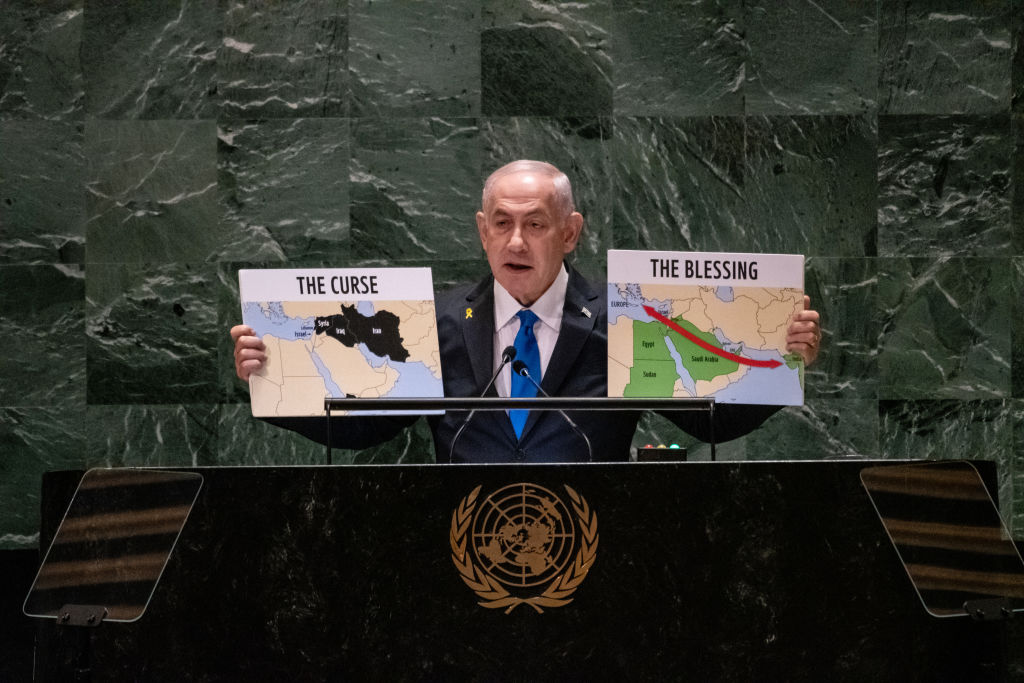
At the time of writing, Iran has launched more than 180 ballistic missiles at Israel. Judging by his recent performance, Netanyahu may seize the opportunity to hit the Iranian ‘octopus’ over the head, seeking to topple the theocracy in Tehran, or at least to strike a blow against its nuclear weapons programme.
When we met with Netanyahu in Jerusalem in February, we were struck by his Bismarckian demeanour. Throughout our conversation, he kept glancing sideways to a map of the Middle East that hangs on his office wall, as if to remind himself of his country’s predicament. Bismarck famously said that his map of Africa was a map of Europe. Bibi’s map of the world is a map of Israel, tiny and surrounded by foes.
Asked what a future historian in 20 or 30 years’ time might think about him, he replied: ‘The United States was declining. But Israel was able to resist the regional ambitions of Iran by defeating or containing the tentacles of the octopus.’ He added that in pursuing this objective, he always took care to avoid antagonising ‘superpowers’, meaning Russia and China. The future historian may add that, by focusing relentlessly on the Iranian threat, Netanyahu succeeded in building bridges to the Arab states, including those in the Gulf, while at the same time marginalising the Palestinians. The Abraham Accords were the result not of idealism but of vintage Realpolitik. In pursuit of his goals, Netanyahu has worked with Russia in Syria, enabled Hamas in Gaza, and defied first Barack Obama and then Joe Biden in Washington.
Moreover, like Bismarck, Bibi has combined devious foreign policy with devious domestic politics. He took the soft-left Yair Lapid as his finance minister, the hard-right Itamar Ben-Gvir as his national security minister and rallied the conservative masses against the liberal bourgeoisie with the lightning rod of judicial reform, repeatedly dividing the nation to secure his own political position.
Bismarck instrumentalised German unification to defend the Prussian monarchy and aristocracy against the threat posed to them by bourgeois liberalism. He built the German Reich with a series of short, sharp wars: against Denmark, against Austria and against France. Having founded the Reich, he never lost sight of Germany’s vulnerable position between France and Russia. He devised the intricate diplomatic instrument of the Secret Reinsurance Treaty to avoid being dragged into a fight with Russia on Austria-Hungary’s behalf. All this could be sustained domestically only with a series of artful measures to divide the liberals, exploiting their anti-Catholicism and anti-socialism, as well as the susceptibility of the industrialists to the temptation of tariffs.
Yet, for all the resemblances, Netanyahu seems to be reliving Bismarck’s career in reverse. In 1874, 16 years before being forced out of office, Bismarck complained: ‘I am bored. The great things are done.’ After close to the same amount of time in office, Netanyahu has never been less bored, for he now has the chance to do the great things. The decapitation of Hezbollah may be his Königgrätz, the battle in 1866 which confirmed Prussian primacy over Austria. Destroying the Iranian nuclear programme – or the regime itself – would be his Sedan, the battle that doomed the Second French Empire of Napoleon III.
In Krav Maga, Israel’s national martial art, breaking out of a headlock requires striking the opponent in the head with a free hand, disorienting them, then going on the offensive. This metaphor describes many episodes in Israeli military history. In 1955, Operation Elkayam killed 72 Egyptian soldiers in retaliation for the Fedayeen insurgency, humiliating Egypt into a ceasefire. In 1967, Israel launched the Six-Day War as a response to Egypt’s closure of the Straits of Tiran. In 1978, Israel launched Operation Litani to end PLO raids in northern Israel. Israel’s headlock, before and after 7 October, was obvious. Iranian proxies – Hamas, Hezbollah, the Houthis, Palestinian Islamic Jihad – threatened it from multiple sides. We now have a sense of how Netanyahu seeks to emerge from it.
Launching a new war in Lebanon gave Israel three options. The first was to trigger an Iranian response, which would yield an opportunity to strike either the Iranian nuclear programme or the stability of the regime itself. The second, had that not materialised, was to hit Hezbollah so hard that Iran weighed in to try to push Hamas into a ceasefire on Israel’s terms. The third was to pre-empt a harsh reaction by a weakened Hezbollah, which would have given Israel the opportunity to effect lasting strategic change north of its border.
As with all Bismarckian stratagems, there were many risks involved. It seems unlikely that the Hamas chief, Yahya Sinwar, if he is still alive, will be more likely to agree a ceasefire now, as Hamas does not depend on Iranian supplies, and a larger war might even save it from perdition. And an all-out Lebanon War would absorb Israel’s capabilities, giving Iran a window to sprint to a bomb.
Bismarck saw five fronts in his famous ‘combinations’ (Austria, Britain, France, Russia, Italy). Netanyahu has to think about more than seven (Gaza, the West Bank, Syria, Lebanon, Iraq, Yemen and Iran – to say nothing of Turkey, Egypt and the Gulf states). The coming days, more than any other period in his career, will determine Netanyahu’s place in history. As the son of an historian – his father Ben-Zion wrote The Origins of the Inquisition in Fifteenth Century Spain – Bibi is no doubt aware of that.
Netanyahu, unlike his settler allies, can all too easily imagine a world in which Israel no longer exists
Perhaps the most profound similarity between the Iron Chancellor and the Iron Prime Minister is the way they look at history. Survival is more important than ideology, a principle that extends as much to one’s own political career as to the life of the state. Bismarck was born in 1815. His political career tracks the rise and fall of the great powers’ Congress System. Netanyahu was born in 1949. His political career tracks the rise and fall of the Pax Americana.
After living through the revolutions of 1848, Bismarck concluded that the advance of modernity was unstoppable. Netanyahu’s father taught him that Jewish history is a ‘history of Holocausts’. The conservativism of the two men is perhaps rooted in this essential pessimism. Netanyahu, unlike his settler allies, can all too easily imagine a world in which Israel no longer exists. Unlike his opponents on the left, he cannot imagine a utopian end of history. Like Bismarck’s, then, his is a vision of perpetual struggle.
The key question for Israel is what follows Netanyahu. Henry Kissinger’s critique of Bismarck was that it is impossible to institutionalise a multi-year tour de force. The same may be said of Bibi. He has no obvious successor, and that is by design. The Israeli political landscape is littered with protégés turned enemies: former prime minister Naftali Bennett, former defence minister Avigdor Lieberman, former defence minister Moshe Yaalon and former justice minister Gideon Sa’ar (though Netanyahu managed to coax him back into the cabinet last week).
Netanyahu’s view that there is no one up to the task may be true. But after Bismarck came Caprivi. And eventually came Bethmann-Hollweg, the chancellor whose miscalculations plunged Europe into war in 1914. Netanyahu’s most likely successors in the Likud party are avowed populists without his historical sensibility or facility with the English language. He thus bequeaths his country as uncertain a future as Bismarck left to his. Bismarck unified Germany but failed to unite the Germans. His successors embarked on a road that led to war and the dissolution of the Reich.
To be the Israeli Bismarck is no mean feat. But there may be a sting in Bibi’s tale.
Will Rachel Reeves’s Iron Age morph into a Golden Age?
Rachel Reeves seems to be promising us an initial Iron Age of misery which will mutate into a glorious Golden Age. How very classical of her.
It is true that some ancient Greeks saw it the other way round. They argued that it was early civilisation that was the Golden Age, inhabited by men who lived ageless and free from hardship, while Nature poured forth its fruits, harvested by men at leisure (comic poets greatly enjoyed imagining a world in which it rained wine and pease porridge, hot sausage slices rolled down rivers and inanimate objects jumped to obey orders: ‘Table, come here! Cup, go wash yourself! Fish, turn over and baste yourself with oil and salt!’). But, the story went, this Golden Age deteriorated over five stages into the violent Iron Age of the contemporary world, when men held ‘the law in their fists’, honoured criminals and scorned oaths, ‘exulting in misfortune with a face full of hate’, until Decency and Moral Disapproval, veiling their faces, abandoned mankind to join the immortals.
But Ms Reeves clearly could not associate the Tory party with a Golden Age and has decided to opt for the alternative classical model. In that account, Greeks like Herodotus, travelling about the known world exploring different cultures, came across what seemed to them savage, uncultured ways of life which they came to believe must have represented a primitive stage of civilisation before their own enlightened version emerged. Poets picked up the theme, talking of the time when mortals lived like lawless beasts in sunless caves on the mountains, without farming skills and living off human flesh, until sheer necessity – or, in this case, the Labour party – revealed to men the way to escape Tory barbarity into a polished, civilised existence.
All we have to do, then, is to hunker down under the time-honoured insecure, cold, poverty-stricken Iron Age of Labour as (almost) foreseen by Thomas Hobbes (1651) – ‘no industry, no culture… no arts, no letters… and the life of man, solitary, poor, nasty, British, and short’ – for the miracle to occur.
How Ed Miliband plans to conjure electricity out of nothing
Electricity is magical stuff. From a couple of tiny holes in a wall comes an apparently endless supply of invisible, weightless, silent ether that turns instantly into light, heat, motion or information at your command. It is a metaphor for the modern economy: we use pure energy to create useful outcomes in the real world.
We found out last week that Britain has now for the first time achieved top spot, among 25 nations, in terms of the price we pay for this supernatural ichor, for both domestic and industrial use.
This is a disaster. Electricity prices have doubled in Britain since 2019. They are 46 per cent above the International Energy Agency’s median for industrial and 80 per cent above the median for domestic electricity. As the independent energy analyst David Turver points out, British business pays almost four times as much as American business for each unit of power and British consumers pay almost three times as much as Americans. And that is last year’s data, before Ed Miliband has even started on his policies to accelerate decarbonisation: all the technologies he champions are more expensive than gas.
It’s a system of beauty as faras producers are concerned, but a thing of horror for consumers
High electricity prices make companies based here less competitive, so some will leave or die; and consumers less well off, so some will freeze and all will buy less of other things: a drag on both production and consumption. Consumers pay for high electricity prices both when we use it and again when we buy things that have been manufactured or refrigerated with it. Given that the plan is for us all to use a lot more electricity in the future, for cars and home heating, this is alarming news.
How was the double triumph of chart-topping electricity prices for both business and homes achieved? Green lobbyists say that it is because we have not built enough wind farms and are too reliant on gas. But this is belied by the facts. Last month, the results of an auction of contract bids for generating electricity were announced. You will recall that because of inflation, the subsidy junkies in the ‘unreliables’ industry boycotted the previous auction for offshore wind, demanding and getting more generous terms.
Sure enough, last month’s bids by onshore wind, offshore wind and solar power are at average ‘strike prices’ higher than the recent going rate, which is set by the price of gas. The way contracts for difference work, the suppliers pay us if market prices are higher than the strike price; we pay them if they are lower. Only very briefly, when gas prices spiked during the early phase of the Ukraine war, did we get a little money back under the scheme.
In August, contract-for-difference subsidies were £237 million, the third highest ever and a record for August. That includes a £72 million rise in offshore wind subsidies, caused by a windy month, new wind farms coming online and falling gas prices. The more the wind blows and the lower the gas prices fall, the bigger the subsidies we pay wind farms. It’s a system of beauty as far as producers are concerned, but a thing of horror for consumers. ‘For the generators it’s heads they win, tails the consumer loses,’ says Turver.
Yet the strike price is only a small part of the cost of relying on unreliable wind and solar. National Grid plans to spend around £11 billion a year upgrading the transmission grid by 2035 to connect distant wind farms to where people actually live.
Add the extra cost of balancing the grid when supply varies, and backing it up with just-in-time gas power when the wind does not blow and the sun does not shine. And the cost of storing electricity in batteries, for which Mr Miliband just announced new subsidies: forecast by Edinburgh University’s Professor Gordon Hughes to hit £5 billion a year by 2030.
Had we stuck with coal, like China and Germany have partly done, storing energy in heaps would be all but free and our electricity would be far cheaper (I can say this now I no longer have an interest in coal). We closed the last coal-fired power station this week. Had we gone for shale gas, like America did, it would also have been much cheaper: imported gas is always much more expensive than home-grown (unlike coal and oil, where there are world market prices). Mr Miliband is intent on shutting down the North Sea gas industry, ensuring we pay more still. The slogan that unreliables are now cheap remains a lie however often the subsidy junkies repeat it.
When things cost more, people buy less. Because of these high prices Britain is using less electricity every year. Final electricity consumption is down by about 23 per cent since 2005 – in spite of a rising population. Dr John Constable, of the Renewable Energy Foundation, adds: ‘And no, it’s not efficiency. This is price rationing pure and simple.’ We are de-industrialising.
It is not just old industries like steel that are driven away by high electricity prices. Data storage and bitcoin mining are getting more energy hungry. A query with ChatGPT costs ten times as much as a Google search.
Despair not. Ed ‘Baldrick’ Miliband has a cunning plan. As a tweet from his department revealed last week, the government plans to repeal a couple of laws, making electricity cheaper at a stroke. Which laws? Why, the first and second laws of thermodynamics of course. The tweet read: ‘Did you know a heat pump is 3x more efficient than a gas boiler? Meaning it generates 3 times more energy than it consumes.’
Apart from the fact that the second sentence definitely does not mean the same as the first, it implies that you can conjure energy out of nothing, breaking the first law of thermodynamics, and that entropy-eating perpetual-motion machines are possible, breaking the second. Hooray!
Watch more on SpectatorTV:
‘No win, no fee’ has no place in war zones
The guilty plea of the former human rights lawyer Phil Shiner this week to charges of fraud is a story that deserves considerable attention. Shiner had tried to claim £200,000 in legal aid without disclosing that – in the breach of the rules – he had employed an agent to cold-call potential ‘victims’ of mistreatment at the hands of British service personnel in Iraq.
An inquiry held by the UK government in 2014 found that the allegations of abuse or violence which Shiner brought forward had little basis in fact: one fighter who was said to have been killed in custody by a British soldier was established to have died in battle, never captured alive. Yet the conclusion of the long case against Shiner – who was struck off as a solicitor seven years ago after his actions came to light – does little to solve an underlying problem: that laws established for civilian life are being inappropriately applied in war zones.
When the bullets are flying in a war zone, concepts of civilian law are suspended
Soldiers should not, of course, murder captives in cold blood, nor torture or mistreat them. Where these crimes are committed, the perpetrators deserve to be punished. At the same time, armed forces operating in a war zone cannot be expected to observe the niceties afforded to citizens in peacetime.
For many years, enemy combatants were considered to be protected by international humanitarian law, derived from the Geneva Convention, which sought to minimise human suffering without compromising the ability of a nation to use lethal force to defend itself and others against aggression.
International humanitarian law demands, for example, that captives are fed, clothed and protected against acts of vengeance. Yet it also accepts that war involves violence and killing. In such an environment, the right to life – not to mention the right to a fair trial, to work, freedom of association and collective bargaining and so on – has little relevance.
But in recent years there have been growing attempts to apply full human rights law to wartime situations. Following the Iraq war, lawyers such as Shiner saw the opportunities presented by an unpopular conflict and seized their moment. Warfare has in effect been opened up to the no win, no fee culture which had already taken hold in civilian life. UK soldiers facing daily snipers, booby traps and suicide bombs in what had become a vipers’ nest of guerilla warfare suddenly found themselves treated as if they were police officers handling suspects in a London police station.
The role of legal aid in this shift was instrumental. UK citizens even of modest means find it hard to obtain legal aid, since the rules demand that they dip into their savings before calling on the taxpayer. Yet when it came to Iraq, copious sums of legal aid were offered to foreign nationals to take cases out against British service personnel.
Those claiming to have been maltreated risked almost nothing: win, and they would earn a large payout from the UK taxpayer; lose, and their legal bills would also be met by British taxpayers. This produced a fundamental asymmetry, since British soldiers had little or no recourse to claim compensation from the guerillas and militias who had attacked them in combat.
The Conservative leadership candidate Robert Jenrick has touched on the issue of human rights in wartime. He claims that British special forces are killing terrorists rather than taking them captive, for fear they would end up having to be released under human rights laws. This, in Jenrick’s eyes, adds to the argument that Britain should leave the jurisdiction of the European Court of Human Rights.
Jenrick has been criticised for his comments by, among others, his leadership rival Tom Tugendhat, and has so far been unable to present evidence for his claims. But if former ministers are arguing over such a point, it rather shows up the legal muddle when it comes to war zones. To fight effectively, our armed forces deserve to know the rules under which they are operating. There should be no doubt, either, as to which authority they are answerable if they should break those rules.
We have court martials for a reason: to separate military justice from civilian courts, in recognition that different rules ought to apply. Such a distinction is absolutely necessary for the functioning of military forces – we can’t have soldiers having to assert their right to self-defence every time they shoot an enemy combatant when they are just doing their job. That is not to say that an off-duty soldier who starts a fight in a pub should be excused from civilian justice, but it does mean that when the bullets are flying in a war zone, concepts of civilian law are suspended. There should be no legal aid, and no human rights lawyers touting for business.
The incorporation of the European Convention on Human Rights into UK law has introduced all kinds of grey areas, as its critics warned it would. We no longer have clearly written laws so much as general principles that must be balanced against each other. The uncertainties have helped to transfer power from our elected politicians to judges. That is a serious enough problem in everyday civilian matters. But when it comes to the people defending our country’s interests with their lives, it is vital that they know where they stand – and that the real army is not undermined by a metaphorical army of ambulance-chasing lawyers.
Did Michael Gove mean what he said?

Toby Young has narrated this article for you to listen to.
I thought the Spectator dinner for Michael Gove hosted by Fraser Nelson would be cancelled. To be clear, this wasn’t a dinner where the Ming vase would be passed from one custodian to another, witnessed by the magazine’s general staff. Rather, this was a dinner to celebrate Michael’s legacy as education secretary organised weeks earlier by Rachel Wolf, founder of the New Schools Network, and which Fraser had kindly agreed to host. But – talk about bad timing! – at 1.30 p.m. on the day it was due to take place it was announced that Michael would be succeeding Fraser as editor. That was a bit like Theresa May having agreed to host a dinner for Boris in Downing Street to celebrate his legacy as Spectator editor, only to discover that in the interim he’d ousted her as prime minister. Would it go ahead?
Of course the Pinteresque subtext of the evening was the editorial succession
The answer is yes, obviously. As Fraser said, he could have asked Rachel to hold the dinner at a nearby restaurant, claiming he was exhausted after a difficult day. But that would have made it look like he was unhappy about the appointment, which he wasn’t. So the dinner went ahead.
Apart from Fraser, I was the only journalist, having played a part in making the free schools policy a reality. Every-one else was an ex-minister, a former civil servant or a retired policy wonk: essentially, the brains trust behind Michael’s education reforms.
So that was supposed to be the topic for the evening. But, of course, the Pinteresque subtext was the editorial succession. Could Fraser resist bringing up his and Michael’s disagreement over lockdown? Would the new broom reassure him that Ross Clark wouldn’t be fired, given that Michael is completely captured when it comes to the ‘climate emergency’? Bear in mind that the two hadn’t met since Sir Paul Marshall’s £100 million bid for the magazine. This was their first opportunity to talk – and they’d have to do it in front of an audience!
I arrived early and Fraser showed me into his office – or, as he put it, ‘Michael’s office’. He confessed to having at the last minute ordered some vintage Margaux, knowing that Michael would be presented with the bill at the end of the month. I had thought that we were about to learn Sir Paul had acquired the Telegraph Media Group along with The Spectator and Fraser was to be appointed editor of the Telegraph. Indeed, I had a pitch prepared about making me the movie critic. But Fraser’s body language suggested otherwise. He had the air of a man contemplating a future in which 14-hour days would not be the norm.
After we were seated, Fraser stood up and took the bull by the horns. He welcomed Michael, repeating what he’d been telling his staff all day: the great thing about Gove as an editor is that he knows where all the bodies are buried because he buried half of them himself. Michael, he said, had shown government at its best (free schools) and worst (lockdown), but either way was always inspiring Spectator covers. He also said he was reassured by Michael’s reputation as a boss, inspiring loyalty and affection among those who’d worked for him in different government departments, as was apparent from the presence of so many former colleagues in the room.
Michael then reciprocated, telling Fraser he felt a bit like David Moyes succeeding Alex Ferguson. During his predecessor’s 15 years at the helm, the magazine had put on readers, enhanced its reputation and increased in value from £20 million to £100 million. How could he follow that?
The conversation moved on to school reform, with the general theme being that trying to get anything done in government is incredibly hard. The reason Michael had succeeded is because he and the people in the room spent two years planning everything beforehand; the Lib Dem education minister, David Laws, was surprisingly sensible; and the policy was supported by ‘the Centre’, i.e. Downing Street. I asked how people like me, still involved with schools we’d set up 14 years ago, could protect them from an interfering Labour government and they told me not to worry. ‘This lot are so incompetent they won’t be able to do any serious damage,’ said one former No. 10 policy chief.
Towards the end of the evening, Michael told the assembled company they could ask him anything – he was no longer in politics so he could answer truthfully. When it was my turn, I said the best thing about working for Fraser from a columnist’s point of view is that he never told me what to write or censored anything I’d written. Would Michael be equally hands-off? ‘Write about anything you like,’ he assured me. ‘You have a free hand.’
‘In that case,’ I said, ‘I’ll write about this dinner.’
I hope he’s as good as his word.
The Battle for Britain | 5 October 2024
Sorry, but you’ve got to love the Springboks
There may still be some poor benighted souls who regard the Springboks as the bane of rugby union. If you meet one, get ready to dispense a proper mauling. South Africa, for so long the Millwall of rugby, are playing an all-round game that is so breathtakingly attractive you have to love them. It may be hard for you, but tough.
It would take a brave man to bet against them for the 2027 World Cup in Australia
The scrum has always been irresistible, of course; relays of vast men who can shred opponents to bits: here’s hooker Malcolm Marx, accumulator of tries and the size of a terraced house but with added mobility; there’s Ox Nché, all 19.5st of him and the best prop in the world right now. On the flank is Pieter-Steph du Toit, relentlessly fast and on track to be world player of the year again; at lock the extraordinary Eben Etzebeth, as imposing as the Statue of Liberty, who has just become the most capped Bok of all time. At the weekend, after pulverising Argentina 48-7 in Nelspruit, a weeping Etzebeth talked about rugby being a religion in his country. Maybe that’s it. South African rugby and the country itself were reborn at the same time, in the World Cup final of 1995 when Nelson Mandela wore skipper Francois Pienaar’s shirt. The Boks beat the All Blacks 15-12 in that match and have since won the World Cup three more times. It would take a brave man to bet against them for the next World Cup in Australia in 2027.
On top of their crushing forward power, coach Rassie Erasmus has added some of the best backs in the world: Cheslin Kolbe on the wing, whose mesmerising footwork for his try against the Pumas was almost impossible to follow with the naked eye; the outstanding Aphelele Fassi at fullback; and at fly-half the dazzling 22-year-old Sacha Feinberg-Mngomezulu. In just the past few years these Boks have become double World Cup winners, beaten the Lions and are now winners of the Rugby Championship. It is deeply impressive. Many of the players – the captain Siya Kolisi for instance – have powerful life stories about overcoming adversity. For anyone who cares about the rainbow nation, we should wish the best for these Springboks.
Cricket’s next Test series (please don’t yawn at the back) starts next week in Pakistan. The game has become an endless cycle in which players have little time to prepare and the whole thing gets increasingly meaningless. What was the most memorable moment of the cricketing summer? Probably Somerset beating Surrey (for whom their England stars Ollie Pope, Jamie Smith and Gus Atkinson hardly ever play). Not everything was better way back when, but cricket arguably was. Counties mattered, one-day finals were must-watch TV (rather than a 20-over thrash in the drizzle as this year), and not every Test match was to prepare for the Ashes, which is pretty insulting to anyone who’s not Australian.
Meanwhile, Hampshire have been taken over by the people who own the Indian Premier League franchise, the Delhi Capitals, though largely it seems so they can use the county’s superb Southampton venue as a multi-purpose entertainment centre. And Lord’s have put their prices up, so only those who can attend the Royal Opera House or Glyndebourne can afford to see Test cricket in NW8.
That great polymath Kris Kristofferson has bowed out at 88. Decades ago I was at my parents’ house in Oxford with my latest Kristofferson album. He was then one of the best-known artists on the planet. My father, a cricket-loving don closely involved with the Rhodes Scholarship committee, took one look at the cover and said with great warmth: ‘Ah, Kristofferson, a very fine left-arm bowler as I recall.’ Who knew? He won a boxing blue as well, by the way.
Dear Mary: How can I handle boredom during a play?
Q. I am at a dinner and the man on my right won’t turn and I am staring ahead feeling ultra self-conscious and victimy. The table is too wide for the people opposite to help out. What to do?
– L.P., London W11
A. Twenty years ago the answer to this question would have been: ‘Place your hand on to the offender’s thigh.’ Today you will need to get the attention of your host at the head of the table and give a subtle signal that a disruption is called for. An experienced host will break the spell by clinking a glass and making a pleasant announcement of some kind and adding that he/she hopes everyone has turned.
Q. What is the etiquette when sitting next to someone on a plane? It seems odd to sit closer than you would to your own partner without some sort of acknowledgment. Recently I turned to my fellow passenger and said ‘Hello, I’m John’ brightly. He gave me a look of alarm. Is it more polite to simply ignore one’s neighbour?
– J.W., Frome, Somerset
A. Many seasoned air travellers are cautious about being friendly to their adjacent fellow passenger for fear of unleashing a flight-long monologue from a potential bore who has spotted a captive audience. The correct etiquette is to indicate goodwill as you first take your seat, by making eye contact and smiling broadly, before then inserting AirPods, whether or not they are turned on. While you are unlikely to meet a soulmate on a flight from Luton to Las Palmas, it may be a different matter on a flight between Luton and Sibiu if, for example, you are heading for the Transylvania book festival. If you sense compatibility (judging by the neighbour’s reading matter or general demeanour during the flight), wait until about 25 minutes before landing to make your friendly overture.
Q. A dear elderly friend is a keen theatre-goer who kindly invites me to accompany him on a regular basis. He takes me to dinner afterwards and I love talking to him but my problem is that I often find myself bored beyond measure during the play and don’t know how to put up with this ordeal, which often lasts for as long as two hours. Any suggestions, Mary?
– Name and address withheld
A. You might take a tip from ex-Queen Margrethe of Denmark. Gyles Brandreth reveals in his recent book Seven Secrets of Happiness how she coped with the tedium of public life. ‘If you listen carefully the speech is very rarely as boring as you thought it was going to be. Don’t switch off. Somehow listen. It is much better that way.’
An inedible catastrophe: Julie’s Restaurant reviewed
At Julie’s at the fag end of Saturday lunchtime, Notting Hill beauties are defiantly not eating, and the table is covered with crumbs. Restaurant Ozymandias, I think to myself. This is no longer a district for the perennially wracked, or unrich. The Black Cross – Martin Amis’s ideal pub in London Fields – is now a sushi joint. Of course it is.
The omelette is bright yellow and tough, like a hi-viz croissant
Julie’s, which is named for its first owner, the interior designer Julie Hodgess, mattered in the 1980s. I don’t trust restaurant myth-making – let longevity be the judge, and this is the third Julie’s on the site – but it was for a while the sort of place that glossy magazine people wrote about when glossy magazines mattered: like Langan’s, the Grill Room at the Connaught and Le Caprice. Julie’s was an idea really: that by occupying a space Mick Jagger had occupied, you were somehow, if not Mick Jagger himself, then close enough.
This third Julie’s has been kindly reviewed. Possibly it is nostalgia – the first Julie’s was good, it sold sausages and mash – but, as you know, the nostalgic is not yearning for place but for himself when he was there. He is reviewing himself, when young. Because this is ashes: the worst meal I’ve had since Langan’s, and it is no coincidence. You can’t eat myths, and left to themselves myths get lazy.
The interior is flouncy florals – pretty enough, like Notting Hill is pretty enough: with its own distinctive culture, invented by Richard Curtis in his film Notting Hill, it is now less place than aesthetic. When Americans who watch European rom-coms think of London, they think of Notting Hill and Mary Poppins and Paddington. Unreal places don’t need real people or real food. All this, though subconsciously, Julie’s manifests. I should have taken a marmalade sandwich and hidden it in my hair. They treat me like I have.
My companion orders duck liver schnitzel with shallot marmalade, and I choose a mushroom omelette. Perhaps I shouldn’t have: chefs say that brunch is cursed. But it is Saturday afternoon in autumn, so why not? The duck liver schnitzel is small, and it sits in a reservoir of fat like a thing, and my companion cannot eat it. If schnitzels could cower, this would. The mushroom omelette is bright yellow and tough, like a hi-viz croissant. Inside, too-large girolles sit in a havoc of unmelted Gruyère. It looks and tastes vile, it is £19, and I can’t eat it.
We can’t eat this, we tell the waiter when he comes, gesturing at the plates. This is how we always cook it, he replies of the catastrophe omelette: do I want another one? I think the insinuation is: I am insane, and he will humour me to a point. I don’t, I say. We don’t discuss the schnitzel, and its testimony floats away. I think of this duck, which deserved better.
We go to the front desk for the bill. Our food was inedible, I say, we couldn’t eat it. The woman hands me the bill with angry eyes, as if I have failed Julie’s because I do not understand it, and, in doing so, am unworthy of it.
This is restaurant as cult, and cults can’t hear. When I booked, I gave my credit card details – I understand why restaurants insist on it, because people are selfish and cruel – and then I moved my booking because I had Covid. If I moved the booking again, I was told, I would be charged. There’s a carelessness here, as if Julie’s exists for a fictional Mick Jagger, and everyone else is dust. Does he know?
What does Yvette Cooper mean by ‘hubs’?
‘Did she mean youth clubs?’ asked my husband when I said how annoying I found the promise made by Yvette Cooper, the Home Secretary, to provide ‘new youth hubs to steer young people away from violence’.
No, she definitely said ‘hubs’. Everyone has to have a hub now. Sophy Ridge has one on television at seven o’clock every evening. A hub was an almost magical thing when Gordon Brown as prime minister introduced one to Downing Street. It was credited with being inspired by one at the Daily Telegraph.
‘Mr Brown has decided to spend some of his time working in Downing Street surrounded by his closest aides,’ reported Rosa Prince in 2008. ‘The Telegraph operates a unique “hub-and-spoke” office at its headquarters. The key section heads meet centrally and their team each have a spoke stretching away from the “hub”’.
But the next year, she wrote that ‘the very openness which the layout was intended to foster now threatens to widen the fallout from the emails scandal’. Damian McBride had sent emails to Derek Draper proposing the posting of rumours about the private lives of prominent Conservatives.
When Gordon Brown dropped in to the hub he would find Liam Byrne, Tom Watson, Sue Nye (now a peeress; in 2010 the diary secretary blamed accidentally on air by Brown for getting him to meet Gillian Duffy in Rochdale), along with Jeremy Heywood, his principal private secretary. On a spoke clung Damian McBride weaving webs.
Such dangerous hubcraft sounded new, but the Doctor Who spin-off Torchwood got there first. From 2006, viewers learnt of a Hub occupied by the mysterious Torchwood Institute, situated below ground in Cardiff Bay. In 2009, the Torchwood Hub was destroyed. Now, through what the Doctor would call a ‘controlled temporal implosion’, Yvette Cooper wants hubs brought back.
Imminent disaster
Mistakes in chess come in pairs. Last month, and not for the first time, that nugget of wisdom thumped me on the nose. Representing England at the Olympiad in Budapest, my game against Luca Moroni was proceeding rather pleasantly. It was clear the Italian grandmaster had underestimated my sacrifice of rook for bishop in the middlegame, and I was about to recover my material investment with interest. Alas, my return was diminished by an elementary tactical oversight, missing the move 25 Na4xb6 (see first diagram). No matter – I was still a pawn to the good. I moved my rook which was under attack, and he responded in the obvious way. One minor hiccup need not derail an otherwise agreeable game. Oblivious to any danger, my crude blunder on the very next move allowed 27 Nb3xa5. Another pawn gone, and what was worse, the frenzied cavalry were about to sack the remains of my position.
Sensing imminent disaster, I abandoned any ideas about winning the game smoothly. After long thought, I ditched my remaining rook to tame the horses and regain the initiative. My opponent, perhaps perplexed by the juddering tempo of the game, misplayed his advantage and went down in the time scramble.
Luca Moroni–Luke McShane
Fide Olympiad, Budapest 2024
1 d4 Nf6 2 c4 e6 3 Nc3 Bb4 4 Nf3 b6 5 e3 Bb7 6 Bd3 O-O 7 O-O c5 8 Na4 cxd4 9 exd4 Re8 10 a3 Bf8 11 b4 a5 12 b5 d6 13 Be3 Nbd7 14 Nd2 e5 15 dxe5 Rxe5 16 Nb3 g6 17 Rc1 Rxe3! A strong exchange sacrifice. The black minor pieces are perfectly poised to exploit the weaknesses in White’s kingside. 18 fxe3 Bh6 19 Kh1 The e3 pawn is not worth defending, e.g. 19 Qe2 Ne5 20 Nd4 Nfg4 21 Nc2 Qh4 22 h3 Qg3 is crushing Ne5 20 Be2 Ne4 21 Bf3 21 Qd4 Qg5! prepares Ne4-d2, with a discovered attack against g2. Bxe3 22 Bxe4 Bxe4 23 Qe2 Bxc1? Based on a dreadful oversight. 23…Qg5! was far stronger. After 24 Rc3 Ng4 25 h3 f5! the Ng4 cannot be captured on due to mate on the h-file, so White is almost paralysed. 24 Qxe4 Bxa3 When I grabbed the Rc1, I counted two extra pawns here and naively thought ‘what’s not to like?’ 25 Nxb6! Simple and good. Capturing the knight leaves the Ra8 hanging. Rb8 26 Nd5 Rc8? Hoping to provoke a retreat Nb3-d2, but inviting the opposite. 27 Nxa5! Qxa5 My instinct was to cut my losses with 27…Kg7, but 28 Nc6! Nxc6 29 bxc6 Rxc6 30 Qd4+ is catastrophic. Murky complications offer better chances. 28 Ne7+ Kg7 29 Nxc8 Qc7 30 Ra1 The knight is saved, but remains in a clumsy position. Instead, 30 b6! Qxc8 31 b7 would retain better chances to win. Bc5 31 Ra8 Qd8 32 h3 Qf6 33 Qe2 Ng4 A neat shot, e.g. 34 Qxg4 Qf1+ 35 Kh2 Bg1+ 36 Kh1 Bf2+ 37 Kh1 Qg1# 34 Ne7 Nf2+ 35 Kh2 Qf4+ 36 g3 Qc1 37 Qf3 Nd3 38 Qg2 Ne1 39 Qe2 The final error. 39 Rg8+ Kh6 40 Qe4! leads to a draw by repetition, e.g. Nf3+ 41 Kg2 Qg1+ 42 Kxf3 Qf1+ 43 Kg4 Qd1+ 44 Kf4 Qf1+ etc. Nf3+ 40 Kg2 Ne1+ 41 Kh2 Nf3+ 42 Kg2 Ng5 White resigns After 43 Rg8+ Kh6 there is nothing to be done about Qc1-g1 mate.
This turbulent win helped us to a 3-1 victory against Italy. We were later knocked back by narrow losses against close rivals Armenia and France, though our 20th place in the final table remained respectable. The women’s team finished in 27th place, with an outstanding individual performance from Jovanka Houska who scored 8/10.
No. 821
White to play. Ciolacu-Khotenashvili, Fide Women’s Olympiad, Budapest, September 2024. How did White crown her kingside attack? Email answers to chess@spectator.co.uk by Monday 7 October. There is a prize of £20 for the first correct answer out of a hat. Please include a postal address and allow six weeks for prize delivery.
Last week’s solution 1 Rxe7! Rxe7 2 Qd5+! Qxd5 3 Nxe7+ Kf7 4 Nxd5 wins
Last week’s winner Chris McSheehy, Mattingley, Hampshire
Spectator Competition: Smalls miracle
In Comp 3369 you were invited to write about the recent underwear storm of Chongqing, or some other freak event, as if it had happened centuries ago and become legend. The entries were wonderfully imaginative, though they dangled some grim visions of the future. It pains me not to squeeze in David Silverman’s poem, so here is his second verse:
Sing of that legendary dawn:
Of Chongqing’s briefs and panties, borne
Aloft o’er realms of Genghis Khan;
Of knickers measureless to man,
Of boxer, Y-front, bra and thong,
Dry clean and machine washable.
Recall the words of Mao Zedong:
That miracles are possible!
The winners below receive £25.
In days long since, an ancient man came to Chongqing. He knocked on the first house, saying: ‘I am old, hungry and thirsty. Spare me some bread and water.’ He was chased away. It was the same at the next house and the one after. In time he had called at every house with the same result. He hobbled away to a nearby hill and sat on a rock. With a wave of his hand the man transformed himself back into Sun Wukong, the Monkey King. He looked down at Chongqing, saying: ‘You would not support an old man in his need, so you shall have no support where you need it most.’ He waved his hand again and a great whirlwind sprang up. It raced through the town ripping undergarments from lines and sucking them into the sky. Wails rose up from the folk of Chongqing. Sun Wukong laughed.
Joseph Houlihan
Time back, beyond the recall even of granite, China’s Emperor Xi determined all: his eyes were in every room, his Thought in every mind. All went smoothly and to his monomaniacal purpose until, one day, amongst the drying underthings of his unfortunate underlings, a freakish tornado suddenly blew up. Bras entwined themselves about the Emperor’s surveillant eyes, flying underpants diverted into helpless hilarity minds hitherto preoccupied adhering to his edicts, suddenly animate nighties enjoyed freedoms of movement unknown to their owners. The Emperor, chillingly furious, ordered the underthings apprehended, the wind extinguished, the underlings into permanent forgetting. But some of the underthings could not be found, having flown into the ocean. The wind could not be identified from census or intelligence file, having never been named or registered. And though the underlings said they had forgotten, every household in China, famished another joyous ascent, hung its washing high.
Adrian Fry
Many aeons ago, the people of Chongqing worshipped the Laundry Gods. They hung their most intimate, freshly washed clothing on balcony altars as tributes, hoping to be honoured on the Great Day of Drying. The high priests of Laundry even sent messages into the clouds, begging the gods to accept their sacrifice. At last, the gods sent a windstorm that blew the underwear skywards on a spin cycle of epic proportions, into the great Tumble Drier of the Heavens. However, the Laundry Gods preferred natural fibres, and rejected certain tired nylons, saggy elastic, torn lace, snapped underwires and faded polyester-cotton blend. And so the people were showered with inferior bras, knickers, slips and jockey shorts. All unworthy lingerie, whether cheap, loose or saggy, was collected at the Temple of Brief Adoration, as a hallowed reminder of what was sacred to the laundry gods, and what was holey.
Janine Beacham
Many centuries ago, an election in Chongqing was won by the Integrity and Decency Party. But when its smartly dressed and moralistic leader came out to address the jubilant crowd, a rude heckler interrupted him, asking why he and his friends had accepted bribes of beautiful gowns from a dubious grandee. The leader beamed gently at him through expensive spectacles, and explained patiently: ‘We are a mighty province, and our leaders must look elegant when representing us to the world. And fine robes do not fall from the skies, you know.’ At which point a large pair of ladies’ bloomers descended from above, covering his head entirely with gusseted pink cotton. Other items of intimate wear fell upon his colleagues. The crowd, previously so admiring, became loud in their mockery, and the next election was won as usual by the Chumocracy and Sleaze Party. You knew where you were with them.
George Simmers
Long ago in a land far to the east it is said that there was once a great underwear storm. End user and storage devices known at that time as bras and pants, now made redundant by advanced cybernetics, were plucked into the air by mighty winds. Some of these devices fell to earth in relentless downpours and Greta, the self-styled climate maven of that time, a humanoid with the tendency of those life forms to exhibit irrational emotional responses, predicted prolonged and catastrophic pants precipitation. The phenomenon was short-lived but legend has it that one item of underwear was swept up into the Xosphere, named for a guru of that age, and travelled beyond into space where it remains to this day, lending its title to what we now know as star base Venus Blue Origin but which is still referred to by its old designation, the Evening Bra.
Sue Pickard
In the second Thrumpian dynasty, under Vancisco, the suzerain of Hiyo, it happened that all the dogs and cats of Springsteen, in that territory, were put to the sword by marauders who sacked the city. Hard men wept and harder women wailed. But the outlaws, who were from Voodoo, did not stop with the execution of the many family pets. Their culture demanded maximum indignity, and, setting a fire in the central piazza, they grilled, broiled, roasted and ate the corpses before the horrified eyes of their owners. The process took weeks. And when the Voodoo barbecues ran out of animal, the invaders seized all local children who had just been born, who were a day old only, and made fresh feasts. At this point Vancisco, known as Hillbilly, enlisted the Down Bad Cat Ladies from the Taylors Wiff-T international army, and she ruled over them all a thousand years.
Bill Greenwell
No. 3372: super duper
It’s Jilly Cooper season. You are invited to submit a mash-up of her writing style with another famous novelist’s (150 words maximum). Please email entries to competition@spectator.co.uk by 16 October.
2674: New crop
7D (two words), performed by 40A (two words), suggests the other unclued lights, which are all similarly amended forms of words of a kind. A final ‘7D’, itself a thematically appropriate word, must be highlighted in the final grid.
Across
1 Actor, you said, departed with a hook (8)
8 Young bird from e.g. Spain returning (4)
11 Pet perhaps I put on rocky shingle (7,6)
15 Son, rugged and skinny (7)
16 Mythic work almost included from the east (4)
23 Cricket side permits decorative items (7)
25 Parisian to go with soldier caught reacting badly? (8)
26 Deviation from course, meaning to get on (8)
27 What crooks do with wrong conclusion (6)
29 Make good choice between relaxation and drug (7)
33 Tiny organisms in northern station (7)
34 Asian plant in undergrowth I risked turning (5)
35 Old uncles seem dubious (4)
38 Leave one’s home, wanting good ruler’s territory (7)
39 Figure husband’s boarded plane? (5)
41 Sporting champ remains, having energy (4)
42 New map with facts for health facilities (3,5)
Down
1 Idiot cycling around getting skittle (7)
2 Article by doctor for massage (2,2)
3 Neural changes in part of arm (6)
4 A school’s maintaining soft features (7)
5 Loud noise, day after day (4)
6 Suited worker, say, crossing river (6)
8 Electronic record in storehouse (5)
10 Needle compilers following fashion, mostly (6)
13 Pick current film for positive person (8)
14 Gradually stop holding a tart out (5,2,1,4)
20 Old actor close to Nathan Lane at first (6)
21 Father in empty garage with superior clothing (8)
22 Members warning politicians about money (9)
27 Working with earl, attempt’s not repeated (3-4)
28 Dull covers European put on special boats (7)
29 Green nuts seared (6)
30 Tip-top spree around Roman province (6)
31 Is American protecting life-force and bones? (6)
32 The Spanish guy, about to carouse (5)
36 Measure heap in disarray (4)
Download a printable version here.
A first prize of £30 and two runners-up prizes of £20 for the first correct solutions opened on 21 October. Please scan or photograph entries and email them (including the crossword number in the subject field) to crosswords@spectator.co.uk, or post to: crossword 2674, The Spectator, 22 Old Queen Street, London SW1H 9HP.
2671: Canned madras – solution
Nine unclued lights have been seen on STAGE (35): THE RIVALS (4A), ELECTRA (27), THE BIRDS (29), ALL MY SONS (39), LYSISTRATA (1D), BECKET (3), NO MAN’S LAND (19), ORESTES (26) and ST JOAN (30) (‘Saint Joan’ in short form). RHINO (33) (‘Rhinoceros’ in short form) is to be shaded.
First prize Mydrim Jones, London WC1
Runners-up Trevor Evans, Drulingen, France; Gail Petrie, Brean, Somerset