-
AAPL
213.43 (+0.29%)
-
BARC-LN
1205.7 (-1.46%)
-
NKE
94.05 (+0.39%)
-
CVX
152.67 (-1.00%)
-
CRM
230.27 (-2.34%)
-
INTC
30.5 (-0.87%)
-
DIS
100.16 (-0.67%)
-
DOW
55.79 (-0.82%)
A shaky truce in Beirut
There was an Israeli drone buzzing over Beirut at 8 a.m. on November 27, four hours after a ceasefire was signed and the shooting stopped. It soon disappeared and a feeling of elation set in. It was the best day we had in months.
The Christmas spirit was palpable in Gemmayzeh, a Christian neighborhood in central Beirut. Christmas decorations were going up and the bars were packed that night. Lebanese in the diaspora who’d canceled their holiday trips to Beirut rebooked that day. But the Lebanese also know how to manage their expectations — they always hedge good news with dread.
The agreement lays out an initial sixty-day truce, during which Hezbollah is required to withdraw its forces north of the Litani river, and the Lebanese Army is to take its place. Israel meanwhile is required to gradually withdraw from occupied Lebanese territory. After the initial truce, the parties will work to establish a more permanent peace.
In the week after the deal was signed, Israel attacked Lebanon several dozen times and Hezbollah fired rockets into northern Israel once, in what the group called a “defensive warning.” The agreement allows Israel to strike Hezbollah if it violates the agreement by reconstituting its forces in the south or not withdrawing.
“With the same power we used to secure the agreement, we will now enforce it,” Lieutenant General Herzi Halevi, the Israeli military’s chief of staff, said in a video statement the night before the agreement was signed.
Conflicts often reach their peak intensity just before a ceasefire, as warring factions attempt to secure strategic advantages or force concessions. In 2021, the fighting in Afghanistan escalated dramatically in the weeks leading up to the American withdrawal. During the final stages of the Bosnian War in 1995, combat intensified as Bosnian, Croat and Serb forces engaged in fierce battles before the Dayton Accords were signed. This pre-ceasefire escalation is often fueled by the perception that the end of active combat may limit future opportunities for strategic gains.
One week before the ceasefire came into effect in Lebanon, the fighting here reached a similar climax. Virtually everyone in central Beirut heard, and felt, the four Israeli air strikes in quick succession at 4 a.m. on November 23. They were described by many as the most powerful explosions felt since Hezbollah chief Hassan Nasrallah was assassinated almost a month before in the southern suburbs.
According to several security analysts, that morning the Israelis used bunker-buster munitions designed to penetrate deep underground before detonating, the same type used to kill Nasrallah. The target of the strikes still isn’t clear, but they killed at least twenty-nine people and injured sixty-six, with another thirty people still “missing.” Hezbollah Member of Parliament Amin Chirri denied that any of the group’s personnel were in the building. But Israeli public broadcaster Kan reported the strikes as an attempt to assassinate Hezbollah leader Muhammad Haydar. Others have speculated the target was senior commander Talal Hamiyah. The fate of both men remains unclear.
The majority of strikes in the greater Beirut area have been in Dahieh, the southern suburbs of Beirut, where Hezbollah has a strong base of support. This particular strike was in Basta, a neighborhood as close to the center of Beirut as it gets. Rescue crews, members of the Lebanese Army and masked men with an unclear affiliation were at the strike site that morning, while the press was kept a hundred yards away. One mangled body after another was pulled from the rubble.
The following evening, Hezbollah launched more than 250 missiles and drones into central Israel, some of which landed in Tel Aviv. “A blow in the heart of Beirut equals a blow in Tel Aviv,” the group said. Israel responded in turn with a series of very heavy air strikes in Dahieh. This may sound unlikely, but until this point, both sides had been exercising a degree of restraint. Hezbollah was using its precision-guided missiles sparingly, and Israeli strikes in Dahieh usually came with preliminary evacuation orders. There was lots of room to escalate, and the fighting was spinning out of control.
On the morning of November 26, I was back at the air strike site in Basta. A rescue worker said they were still pulling out body parts. Omar Kabalan and his family barely survived the strike. His building is riddled with damage, and the building adjacent was demolished. He took his family outside and waited on the curb until they could see the full devastation at sunrise.
This is the second home Omar has lost in a year of war. His family home in Mais al-Jabal, a village near the Israeli border, was destroyed earlier in the year. “Yet all of this is not important compared to the sacrifices that our fighters are making on the front lines. Al-Sayyed Hassan [Nasrallah], this man was incomparable, no one can replace him. He is the type of person who comes around once every thousand years. After his loss, we have nothing to regret,” he said.
Omar is right — Nasrallah was irreplaceable to Hezbollah.
Over the last several decades, few world leaders have gained a cult of personality as strong as his. Nasrallah’s speeches were legendary — he had an authoritative charisma that made everyone in Lebanon, even Hezbollah’s staunchest enemies, pay attention. For Hezbollah’s supporters, he had the aura of a demigod.
More than two months after Nasrallah was assassinated, he is still Hezbollah’s leader in spirit. Part of this is a coping mechanism for the supporters, who feel like his death is the death of the organization. They are still in the early stages of grief. The acting secretary-general, Naim Qassem, attracts significantly less adoration. There are few portraits of Qassem plastered around the Shiite areas, possibly because they’re scared he too could be killed. Qassem was never supposed to be secretary-general anyway. It should have been Nasrallah’s cousin, Hashem Safieddine, head of the Hezbollah executive council, who was widely seen as second in command. He too was assassinated in October.
Virtually every day for two months, dozens of journalists and morbidly curious civilians would converge on a hilltop overlooking Dahieh to watch the airstrikes land after evacuation orders were issued. There were tents and lawn chairs and shisha-smoking and packed lunches — people were literally tailgating at the air strikes.
On the afternoon of November 26, Israel issued a flurry of evacuation orders — twenty buildings in total were about to be struck. The Israelis either strike without warning, like they did in Basta, when the purpose is to assassinate, or they issue evacuation orders, in which the purpose is to destroy infrastructure.
We headed quickly for the tailgate, but the city was crammed with traffic as panicked residents fled in every direction. As we sat bumper to bumper in central Beirut, the Israelis struck again without warning, just around the corner from the last strike in Basta. The sound of sirens was non-stop. Then we got news of another air strike in central Beirut. It was pandemonium.
There was no way we were going to make it to the hilltop at this pace. My driver checked the evacuation orders again, as he crafted a very dangerous scheme. He made a U-turn and suddenly we were in that part of the city adorned with portraits of Nasrallah and piled with air strike rubble. He had taken us down El Imam Musa al-Sadr Street — directly along the edge of Dahieh, the heart of Hezbollah territory. We rolled down the windows in anticipation of a strike and sped down the empty street at almost 60mph.
The air strikes started landing to our right, one only a hundred yards from the car. We rejoiced after passing a Lebanese Army checkpoint on the other side of Dahieh. By the time we made it to the hilltop, we found out that the strikes had already happened — all twenty of them. The Israeli air force struck twenty targets in 120 seconds, and we’d driven right past it all.
There were several dozen air strikes in the greater Beirut area that day and throughout the evening. I spent most of it waiting with some colleagues next to a building that was scheduled for an air strike, burning a trash fire to stay warm. We were expecting the whole tower to come down, but the strike only destroyed part of the building, where the Hezbollah-linked financial institution al-Qard al-Hasan is located.
Hezbollah did what it could to respond with missile and drone strikes that day, causing significantly less damage in Israel. The disproportionately higher casualties on the Lebanese side in this conflict are staggering: between September 1 and November 27, at least 3,100 people were killed in Lebanon, compared to only twenty-nine in Israel, according to data from the Lebanese Ministry of Health and the conflict-data aggregator ACLED.
And yet, when the ceasefire came into effect the next day, Hezbollah surrogates and Shiite society at large declared victory. But they were acting far more relieved than triumphant.
On the morning of November 27, thousands of people started pouring back into the southern suburbs, many of them heading home for the first time in months. They paraded through the streets with Hezbollah flags and other Shiite iconography, chanting, “At your service, Nasrallah!”
There was lots of celebratory gunfire, a once-in-a-decade opportunity to see Hezbollah members out in the open with their weapons. In the center of a public square, a woman brandishing a pistol stood in the sunroof of an SUV, accompanied by a gargantuan Nasrallah portrait.
“This is not Dahieh, the southern suburbs of Beirut. This is the Dahieh of al-Sayed Hassan [Nasrallah]!” she declared.
An older man named Ali Hassan Mansour loitered nearby, pensively watching the shebab — the young guys— wildly shooting at the sky. To absolutely no one’s surprise, eventually someone was shot in the stomach by accident.
“This is a bill that we’ve needed to pay for forty years, and we knew it would cost us a lot,” Mansour said.
“From the very beginning, we have been crawling toward al-Quds [Jerusalem]. The destruction you’re seeing — that is honor and pride for us. Who is a person who loses his family and everything he owns, and yet comes here to celebrate victory? That is a righteous person,” he said.
Hezbollah’s culture of martyrdom is unparalleled in its strength and social penetration, even among other Islamist movements, which is why its members were so willing to go along with this suicidal war. But everything changed after Nasrallah was killed and the inner sanctum of Hezbollah territory in Dahieh started getting destroyed. Survival was paramount, so the group signed a deal that heavily favors Israel. Some Lebanese Shiites are delusionally embracing mere survival as a victory.
On December 3, Israeli prime minister Benjamin Netanyahu made a grave clarification. “We are currently in a ceasefire. I point out: a ceasefire, not the end of the war… We are enforcing this ceasefire with an iron fist, acting against any violation, minor or serious,” he said.
If a larger war resumes, Hezbollah will have significantly drawn down its forces in southern Lebanon and be even weaker against the ultra-modern Israeli military. As Iran has its focus pulled to Syria, it will have less ability to rebuild Hezbollah. And without their dear leader to console and inspire, Hezbollah’s Shiite society may lose the will to keep fighting.
How Norman Mailer changed the face of biography
Many labels leap to mind in association with the prolific and controversial Norman Mailer, who died in 2007, but “biographer” is not typically one of them. He was not considered a serious practitioner of the genre in the same sense as Edmund Morris, Ron Chernow or his friend Doris Kearns Goodwin. And yet, as his own official biographer J. Michael Lennon asserts to me, “Mailer became a major biographer in the last half of his career.”
Thirty years ago, two intriguing books by Mailer appeared just a few months apart: Oswald’s Tale: An American Mystery and Portrait of Picasso as a Young Man. Both were eclipsed at the time by competing treatments of their subjects, but Mailer’s volumes are the highpoint of his idiosyncratic contribution to biography and are well worth a reappraisal.
In addition to his three official entries in the field, including his 1973 Marilyn, Mailer wrote several other books that leaned heavily into biography, among them The Fight, The Executioner’s Song and the biographical novels The Gospel According to the Son and The Castle in the Forest, along with scores of magazine profiles stretching at least as far back as the John F. Kennedy-themed “Superman Comes to the Supermarket” from 1960. If we expand our definition to include these genre-bending portraits, it could be argued that Norman Mailer wrote little besides biography in the second half of his career.
Yet the formal mapping of a life, birth to death (or, in the case of Picasso, birth to age twenty-five) was something Mailer stumbled into by accident. The project that became Marilyn began its life as the preface to a coffee-table volume of Marilyn Monroe photographs. Very quickly, the author got carried away with his assignment, sending the designers of the book scrambling to accommodate its new shape.
There were critical headwinds from the outset, but Mailer brought innovation to his new field. He uses the first-person plural frequently, suggesting that “we” — author and reader — are in collaboration, attempting to piece together a puzzle. This enables him to speculate openly on the inner lives and motivations of his subjects, exploring and discarding theories ranging from the sensible to the far-fetched. It’s a fascinating view into a process that many biographers engage in privately.
Mailer attempted to inhabit historical lives via what we might call “method biography,” which he explained in a letter to Henry Miller after profiling him in a 1976 literary study titled Genius and Lust. As Lennon relates in Norman Mailer: A Double Life:
Mailer told Miller that he expected to be attacked by Miller’s supporters and rightly so for “putting much of myself into you. It is the technique by which I work and I’ve never pretended to hide it. When I wrote about Marilyn Monroe I tried to understand her with that part of her I felt was similar to myself. I’ve made the same attempt with you.”
Marilyn, despite its rushed nature, is a lyrical treatment of Monroe’s willful ascent to Hollywood stardom, chock-full of asides on reincarnation, the occult and, most jarringly, Richard Nixon. It is a gloriously weird and compulsively readable book, though whether the author captured the essence of his subject is open to debate. Susan Mailer, a staunch though not uncritical defender of her father’s work, tells me, “I think it’s a book that men love. I haven’t heard many women talk about Marilyn… When I was reading it, I thought, these are Norman’s fantasies about Marilyn. Who knows if she was really like this? It was a free-association kind of biography, and he took liberties.” Arthur Miller, Monroe’s third husband, was less measured in his response, opining that the book amounted to the writer’s imagining himself into it, what Miller called Mailer “in drag.”
Marilyn has its advocates. Carl Rollyson, author of well-regarded biographies of both Monroe and Mailer, has said that reading Marilyn was his impetus for becoming a biographer. “What I liked about it was his musing on biography,” Rollyson tells me. “And obviously he felt he understood certain things about Marilyn Monroe, but he acknowledged that certain things were opaque, that they were hard to get at. I think he got a lot of it right. Norman Mailer revolutionized the biography of Marilyn Monroe, and he did it with one word, and the word was ‘Napoleonic.’ Up until then, by and large, the narrative was of a woman who had a lot of psychological hang-ups and was suicidal and — poor Marilyn, she’s pathetic. Well, you don’t call a pathetic woman Napoleonic.”
Susan Mailer has a warmer take on Portrait of Picasso as a Young man, where she feels that the “method” approach hit its mark. “I loved it,” she says:
I thought it was a great biography because it touched on the human quality of Picasso. Picasso was loved by his mother and was loved by women, as was Norman. He was a little guy just like Norman. He was tough and barrel-shaped like Dad, and he had this unbounded energy. So I think my father saw a lot of points of comparison. As a matter of fact, I remember telling him that I understood him more now. I understood why he was so driven. I understood what he would go through when he had this idea and he was writing, you could never interrupt him or be in his way or anything…. That book really helped me understand him psychologically.
“Mailer was interested in Picasso and Monroe because they were artists,” Lennon notes, “and shaped to a great extent as much by their immense fame as by their art.” From that perspective, their overlap with Mailer’s status as one of the last “celebrity authors” who dominated the cultural conversation of the 1960s in a way that is difficult to conceive of in the 2020s, is considerable. But the insular Lee Harvey Oswald must have presented a greater challenge, and it is fortunate that 1995’s Oswald’s Tale, which functions as both a biography and a true-crime narrative, appeared after 1979’s The Executioner’s Song, Mailer’s immersive, factually scrupulous, Pulitzer-winning account of the final months of murderer Gary Gilmore.
Oswald’s Tale represents a skillful blending of the speculative approach of Marilyn with The Executioner’s Song’s relentless grounding in the known facts. Few would argue that Mailer did not get as deep into Oswald’s psyche as was conceivably possible. Initially, Oswald — whom we first glimpse as an inarticulate would-be defector to the Soviet Union — is defined by his negative spaces: his avoidances, his unexplained acts (and resources), and the trace impressions he leaves on those around him, all of which provide the author a glimpse through an open door that can be nudged wider as details accumulate. As with Marilyn, Mailer invites the reader to join him in considering various possibilities concerning Oswald. But unlike with Marilyn and the later Picasso book, the speculation is grounded in extensive on-the-ground research conducted by Mailer and his research collaborator Lawrence Schiller in Russia, along with a careful parsing of the Warren Report and the other established American sources.
The book ranges across the entirety of Oswald’s life. And it carries some weight that Mailer, not unfriendly to conspiracy theories, ultimately concludes that Oswald acted alone in killing John F. Kennedy. It is also significant that the Kennedy-admiring author locates a point of empathy with Oswald as the unseen needing to be seen — a man seemingly fated for historical insignificance violently wresting the wheel away from fate.
Oswald’s Tale received some of Mailer’s strongest reviews since The Executioner’s Song, though its lukewarm sales must have disappointed. Gerald Posner’s nearly contemporaneous Case Closed: Lee Harvey Oswald and the Assassination of JFK undoubtedly stole some of its thunder. Perhaps too, as Lennon speculates, readers recoiled at Mailer’s “Tolstoyan compassion” toward the purported assassin. “Oswald’s Tale… is another of Mailer’s books for readers a century hence,” Lennon writes in A Double Life, “readers removed from the pain of one of the greatest tragedies of twentieth-century American life.” Still, Mailer’s deeply felt consideration of Oswald’s psyche is of value to the literary-minded student of American history. And there was at least one reader of Lennon’s generation who was able to mine the book’s riches: Stephen King relied on Oswald’s Tale (along with Case Closed and works by Edward Jay Epstein and Thomas Mallon) as source material for his acclaimed Kennedy assassination thriller 11/22/63, calling Mailer’s book “remarkable” in the afterword.
There are obstacles to any contention that Mailer’s biographies are lost classics. The faults of Marilyn and Portrait of Picasso (which received a critical drubbing on its release) are apparent, and the books occupy an eccentric position even within Mailer’s own canon. It is regrettable that Mailer, who had a large family to support and was often in need of quick money, did not have the time to do more original research (Oswald’s Tale excepted). He quotes far too much — pages-long passages — from other authors, which, whether done for expediency or, as he insists in Portrait of Picasso, to capture “each separate vision” of the other authorities, makes the cut-and-paste accusations of some critics difficult to challenge.
But I would argue that Mailer’s efforts go to the heart of why we write, and read, biographies in the first place. We wish not only to learn of the lives of the movers of history, but also, to locate ourselves within their experiences. Norman Mailer was one of the few contemporary biographers to openly lean into this impulse. The doors are still open in these occasionally frustrating, haphazard, yet ultimately alive books, beckoning us on to further exploration.
This article was originally published in The Spectator’s January 2025 World edition.
One hundred years of Theodore Dreiser’s An American Tragedy
The high-water mark of the American naturalist novel lasted for about forty years — the period bookended by Frank Norris’s 1899 McTeague and John Steinbeck’s 1939 The Grapes of Wrath, taking in along the way such highlights of the form as Upton Sinclair’s 1906 The Jungle, Sinclair Lewis’s 1920 Main Street and James T. Farrell’s Studs Lonigan trilogy of 1932-35. But these are all subsidiary crags on the path to Mount Olympus, for the novel that towers above them all and draws each of them — to mix the metaphor a little — into its remorseless slipstream is Theodore Dreiser’s 1925 An American Tragedy.
George Orwell once confessed that as a young man he “wanted to write enormous naturalistic novels with unhappy endings, full of detailed descriptions and arresting similes, and also full of purple passages in which words were used partly for the sake of their sound.” It is not quite certain when Orwell came across Dreiser’s masterpiece — he refers to it in a newspaper article of 1945 and it turns up in a reading list compiled at the very end of his life — but An American Tragedy might have been expressly written with him in mind; at any rate, the terrific sense of fatalism that sends Dreiser’s young anti-hero to the chair would, you imagine, have been very much to Orwell’s taste.
Determinism hangs over most naturalist novels — here defined as “subject to the working out of vast, impersonal, natural forces” — like a whiff of ammonia, but there is something particularly dreadful about Dreiser’s attitude to “fate.” Like Jack London, in whose stories the rescue boat bent on saving the starving mariners always arrives five minutes after the cabin boy’s throat has been cut, he specializes in grotesque accidents and spectacular pieces of misfortune that leave his characters lying helpless in the dirt with no chance of being redeemed — runs of bad luck that are all the harder to swallow because of the well-nigh incidental way in which they come about.
This casual attitude to his characters’ destinies is an important part of Dreiser’s appeal, for it separates him from most of the other novelists who at one time or another have been filed as “naturalists.” Tess in Hardy’s Tess of the D’Urbervilles is a cosmic pawn toyed with by the President of the Immortals; the Joads in The Grapes of Wrath are scurrying ants, urged on by almost biological impulses as they head to destitution in the California orange groves; the figures in Anthony Powell’s A Dance to the Music of Time are fragments of a complicated mosaic they cannot yet understand, and perhaps never do. Dreiser’s characters, on the other hand, are both less figurative and more ordinary, pieces of human flotsam perilously adrift on the tides of machine-age America, ever more likely to be blown away once the wind gets up.
The urban setting in which the characteristic Dreiser novel takes place — 1900’s Sister Carrie, his first book, is set half in Chicago and half in New York — is intimately connected to the kind of effects he manages to bring off. Dreiser wrote at a time when the consequences of US industrialization were first becoming apparent to its citizenry, when robber-baron capitalists were making fortunes out of cotton and textiles, when the big eastern megalopolises were growing so rapidly that it was sometimes impossible for municipal planners to keep track of their dimensions, and when the small-scale, familiar life of the town was being replaced by the bustling, impersonal existence of the city.
All this meant that the world through which the average Dreiser character tries to make headway engages him in a savage Darwinian struggle — the resourceful rise to the top and the feeble are left sprawling by the wayside. The difficulties faced by An American Tragedy’s anti-hero Clyde Griffiths are several degrees worse. Clyde has ambition without the personal resonance to make it count or the single-mindedness to avoid the snares and pitfalls that lie in wait. Sensitive and self-pitying, well-meaning but weak-minded, absorbed by tantalizing vistas of the good life glimpsed on movie screens and through the swing-doors of expensive hotels, Clyde is heading for a fall from the moment we first encounter him on a Kansas City street corner.
The Griffiths are a family of itinerant missionaries, pious and ground-down, living in cheap accommodation and permanently hard-up, although there is talk of a wealthy uncle who owns a collar-manufacturing concern in Upstate New York. Seeking to better himself, Clyde secures a job as a hotel bellhop, only to find his plans for advancement thrown into jeopardy when, coming back from a pleasure trip with his fellow-workers, the car in which they are traveling kills a child in a hit-and-run accident. Several anonymous years of re-establishing himself end when the famous uncle appears in the Chicago gentleman’s club where Clyde has come to rest. Introducing himself, and making a favorable impression, Clyde is invited to head out east.
In an ideal world, Clyde would live modestly, behave decently, apply himself to the factory supervisor’s job which he is eventually offered and marry someone from his own humble station. But this is Planet Dreiser, and Uncle Samuel, while making it clear to his nephew that no favors will be done, has shown him a taste of the dazzling upper-class life of Lycurgus, New York, which is impossible to resist. Clyde, having first illicitly involved himself with his meek-mannered colleague Roberta, is taken up by a glamorous society girl. All of which would be just fine, did it not coincide with news of Roberta’s pregnancy.
To say that you can guess the rest is to ignore the extraordinary psychological resources that Dreiser brings to bear on the hapless Clyde over the next few hundred pages as he tries to find a way out of his jam. This is all the more impressive because Dreiser’s literary skills are fairly negligible, not much more in the end than a talent for saturation. Orwell remarked of An American Tragedy that it actually gains something from the clumsy, long-winded manner in which it is written, and the most convincing passages are the long stretches of prose in which Clyde sits and broods about his society honey, the promise of marriage extracted from him by Roberta and the boat trip on the lonely lake which may be the answer to his problems.
Once again that typical Dreiser moment takes center stage — the terrible mischance that scythes down a would-be villain who has finally determined to make amends. Just as Hurstwood, the doomed hotel manager in Sister Carrie, decides to return the money he has stolen only to watch the safe click shut with the notes still in his hand, so Clyde, overcome with remorse, resolves not to consign Roberta to the deep only for her to stumble forward, bang her head and capsize the boat. The passages that follow — Clyde’s owl-haunted late-night journey through the backwoods; his hike to the lakeside camp where his beloved is ensconced, his desperate struggle to keep up appearances and the eventual arrival of the police — are extraordinary pieces of writing which occasionally veer off into a kind of tortured blank verse.
Justice, inevitably, is done in a series of lavishly extended court scenes, rife with class-conscious reportage, but the modern reader will probably be struck by the sheer arbitrariness of the novel’s conception. After all, Clyde is not a deep-dyed villain from Gothic romance but a horribly ordinary homme moyen sensuel caught up in an impasse he can see no way of resolving. There are people in Dreiser’s fiction who succeed: Sister Carrie’s heroine winds up as a Broadway actress while the man who abducted her to New York gasses himself in a Bowery flophouse. Similarly, Dreiser gave great offense in 1911’s Jenny Gerhardt by offering a portrait of a “fallen woman” who defies the fictional convention of her time by contriving to lead a successful and prosperous life. But if his fall-guys are irrevocably flawed, their demise is merely a matter of chance. On Planet Dreiser, it could have happened to anyone.
There are moments when the inquisitorial eye on display in the novel seems to hint at a grounding in real life, and it is no surprise to discover that Dreiser’s gargantuan tale of guilt, anomie and violent death draws on a real murder that took place in very similar circumstances in 1906. The real Big Moose Lake in the Adirondacks is reimagined as the “Big Bittern” and Clyde shares the initials of Chester Gillette, executed for killing his girlfriend Grace Brown. Like many other American novels from the same period — Farrell’s Studs Lonigan is an obvious comparison — An American Tragedy is as much a historical artifact as a work of fiction, a grim souvenir from the world of big city loneliness and blighted dreams, that couldn’t possibly be written by a novelist born into a world of moral free-for-all and social security checks.
This article was originally published in The Spectator’s January 2025 World edition.
Lisa Marie Presley’s posthumous book exposes the horrors of celebrity
The title of this book may offer a clue to its prevailing tone. There’s a certain amount of showbiz gossip involved, but it is essentially a protracted rumination of the “What’s it all about, Alfie?” variety, with plenty of unflinching discourse on matters such as spirituality, depression, addiction and the precariousness of the human condition. “I wondered how many times a heart can break,” the authors write near the end of their tale of untold material privilege and wrenching emotional grief. All too often, is the inescapable answer.
The book is freighted with a certain amount of woe from the start, because its principal author, Elvis Presley’s only child, herself tragically died in January 2023, aged fifty-four, due to weight-loss surgery complications. She left behind three daughters, one of whom, the actress Riley Keough, completed the project from tapes her mother bequeathed her. Lisa Marie’s son Benjamin, known to the family as Big Ben, had predeceased his mother, committing suicide in 2020 at the age of twenty-seven. He bore a striking resemblance to his famous grandfather and, like him, wanted to be a singing star. It’s somehow in keeping with the general tenor of the book to learn that Lisa Marie elected to keep Benjamin’s body on ice in the spare bedroom of her Los Angeles home for two months following his death.
“There’s no law in the state of California that you have to bury someone immediately,” she writes, before adding in characteristically blunt terms: “It would scare the living fucking piss out of anybody else to have their son there like that. But not me. The normal process of death is: the person dies, they have an autopsy, viewing, funeral, buried, boom,” she continues. “It’s all over in a four- or five-day period, maybe a week if you’re lucky. But you don’t really have a chance to process it. I felt so fortunate that there was a way that I could still parent him, delay it a bit longer so that I could become okay with laying him to rest.”
From Here to the Great Unknown is rather that sort of book.
Lisa Marie herself was born to be tabloid fodder, from the first photos of her proud parents Elvis and Priscilla carrying her home amid a gaggle of reporters following her birth in Memphis in February 1968. She seems to have loved and feared her iconic father in roughly equal measure. “He was a god to me, a chosen human being,” she writes, although by the same token, “you didn’t want him to get ~angry with you. If I ever upset him or if he was mad at me at all, it felt like everything was ending. I couldn’t deal with that.” Matters were even more complicated with Priscilla. “She was so upset that she was pregnant with me that she’d only eat apples and eggs and never gained much weight. I was a pain in her ass immediately, and I always felt she didn’t want me.”
“I believe in energy in utero, so maybe I already felt her vibe of trying to get rid of me,” Lisa Marie posits. “She didn’t have great maternal instincts. That might be what’s wrong with me.”
The author spent her early years at Elvis’s mansion Graceland, which she describes as “like its own city, with its own jurisdiction… My dad was the chief of police, and everybody was ranked. There were a few laws and rules, but mostly not.” Activities for the Presley family and its large live-in entourage included discharging an impressive variety of firearms, setting off fireworks, throwing billiard balls at one another in darkened rooms, drinking, taking drugs and eating copious quantities of fried food. Elvis himself was a night owl, and not at his best before about four in the afternoon. Sometimes an aide had to lift him off his bed and pump his arms up and down to jump-start him.
In this distorted funhouse of a home, Lisa Marie slept in a giant, hamburger-shaped bed and roamed about the place in a customized Harley-Davidson golf cart her father bought her. The staff rarely told the little girl what to do, and she had the retaliatory equivalent of a nuclear bomb at her disposal when they did. “One day I was tearing up the backyard with the cart and someone told me to stop doing it, and I said, ‘I’ll tell my father on you when he wakes up’… I was wild,” we learn.
Lisa Marie’s life changed for the worse in 1973, when her parents divorced and she moved with her mother to Los Angeles. She missed the looking-glass world of Graceland, and her snooty school in Beverly Hills was a “fucking drag,” although set against this there was the moment when Elvis himself appeared for a parent-teacher conference. In a departure from the standard protocol on these occasions, “he was wearing black pants and some kind of blouse, as well as a big, majestic belt with buckles and jewels and chains, along with sunglasses, and he was smoking a cigar.”
From time to time, father and daughter would fly back to Memphis together, “and he would land the fucking plane, too,” Lisa Marie notes. “At the end of the trip he would get in the copilot seat, which made everybody nervous, and announce, ‘Ladies and gentlemen, please fasten your seatbelts, Elvis is going to land the plane.’” The nine-year-old was visiting Graceland in August 1977 when her father succumbed to a fatal heart attack, precipitated by an extensive drug habit, an event she recalls movingly here.”
Somehow it is no great surprise to learn that Lisa Marie’s adolescence and early adulthood were a merry-go-round of opioids and sex, from which she periodically alighted only for her latest stay at a rehab facility. In 1994, she went to the Dominican Republic to obtain a quickie divorce from her first husband, the father of this book’s co-author, and as an alternative married Michael Jackson. “I fell in love with him because he was normal, just fucking normal,” she writes, although this judgment may only be true from the perspective of one who had spent her early years at Graceland. Before long, however, “Michael started going to the doctor’s office a lot. I’d pick him up and he would be really out of it… One of his family told me that it was a pill thing.”
When accusations emerged of child abuse at Jackson’s estate Neverland, Lisa Marie loyally stood by him. Even so, she admits, after that “things started to go downhill,” largely because of her husband’s burgeoning drug habit. They divorced in 1996. In 2002, she married the actor Nicolas Cage, a union that lasted for 108 days. At some point, Lisa Marie’s $65,000 diamond engagement ring went flying over the side of a boat while the couple were sailing off the coast of California. Professional scuba-divers were summoned but failed to retrieve it. Lisa Marie later said that the Elvis-obsessed Cage had considered her just another souvenir.
A fourth marriage ensued, to a hirsute young guitarist, but it, too, was to add to an affinity for divorce hearings that practically amounted to a collector’s mania. At some stage, Lisa Marie forsook the spangled palisades of Beverly Hills for the more bucolic charms of a village in the southern English countryside, apparently chosen for its proximity to the headquarters of the Scientology Church, a religion she first patronized but later renounced.
Her involvement with Scientology began in unusual fashion. Lisa Marie writes of her fourteen-year-old self, “My mom made me live with her, but I was miserable. It was clear she didn’t want me there. She tried to make me go to a boarding school, but it never worked out, so in the middle of the night she made me pack my bags and she took me to the Scientology Celebrity Center and dropped me off.”
Amid the subsequent litany of drink, drugs and ill-advised relationships, Lisa Marie somehow found time to release three well-received pop albums, as well as several duets with her late father patched together using archival recordings. Like Elvis, she was also notably generous to charities, despite filing papers in one of her divorce hearings in which she claimed to be $16 million in debt.
It’s not often that you feel the tectonic plates of received pop-culture wisdom moving beneath your feet, but something like a seismic shift in any feelings of envy you may have toward the entertainment industry’s rich and famous may well take place after reading this book, which by rights should come equipped with a public health warning. It’s a story built on grief, and at the heart of it are its late author’s fractured relationships with her parents. There was the sun-god father she adored and feared, and whose body she watched being carried out of his bedroom the day he died: “I saw his head, I saw his body, I saw his pajamas, and I saw his socks at the bottom of the gurney,” she writes. And there was the neglectful, flighty mother. As Lisa Marie concludes in a striking moment of self-analysis: “People think I’m a bitch, because unfortunately I have my mom’s chilly thing.”
Between them the authors have produced a book that’s unsparingly blunt, breathless, when not given over to its numerous philosophical longueurs, and spiced with sexual and chemical shenanigans. The inescapable conclusion is that, for all Lisa Marie’s relentless globetrotting in search of a stable home, her most fixed abode was that mournful hotel her father sang of down at the end of Lonely Street. It’s a tale about the sometimes intoxicating highs of the entertainment business, and a grim reminder, too, of its abysmal lows.
This article was originally published in The Spectator’s January 2025 World edition.
William Boyd’s latest novel is a smoothly gripping read
Gabriel’s Moon is William Boyd’s eighteenth novel, swiftly following last year’s The Romantic, which delightfully described the adventures of a man living through the nineteenth century in Europe. Though Boyd relates a smaller section of his new hero’s life here, many of his characteristic themes are fully at play: surveillance, deception, honor, love, art, fraud, real historical characters jostling with fictional ones, and relationships between mothers and sons. Essentially, this new book is a spy story, well within the lineage of John le Carré (complete with liberal ambivalence about duty to one’s country), and with skillfully handled layers of double-dealing. “The world was full of charlatans,” muses a character at one point; and indeed this cynical view is what Boyd’s protagonist Gabriel Dax comes to realize, as he progresses from ingenu to fully-fledged operator.
Gabriel — the angelic name is significant, as initially he’s very much an innocent — is a typical Boyd hero: educated at a minor British independent school and afflicted with wanderlust, he is a successful travel writer, as well as something of a layabout. He’s conducting an affair with a (slightly generically drawn) fast-food restaurant waitress (breaking down those class barriers, you see: it is the 1960s, after all), and mopes about from country to country as it suits him.
Boyd enjoys poking fun at Gabriel’s overly lush writing: “The broad valley lay before me, swart and dry, baking silently in the gold radiance of the dying day,” very much at odds with his own clipped and precise style. This, perhaps, is a non-plashy nod to Boyd’s great hero Evelyn Waugh and the similar parodies of overblown style in Scoop. Still, Gabriel’s readers don’t seem to mind — his books are bestsellers. (Is Boyd teasing the reading public too?) His older brother, Sefton, is a typical upright, pipe-smoking Foreign Office civil servant, living in a large house in North London with his wife and two children, providing an image of the successful home life Gabriel is avoiding. Though he visits his brother regularly for Sunday lunch, the two are emotionally distant, a result of the tragedy that begins the novel: their family’s farmhouse burned down when Gabriel was six, killing his mother and almost killing him; Sefton was away at boarding school. Their father was already dead, so the fire left them orphans. Despite this, they both appear to be leading normal middle-class lives, with Sefton as the “sensible” older sibling, and Gabriel the charming prodigal.
Gabriel’s journalistic job allows Boyd to bung his hero into various beautifully evoked places, from the Congo to a dusty Spain and a grim Cold-War era Poland, as well as the dirty London streets and the Suffolk countryside. Gabriel is relatively famous, and thus is often recognized, which provides a handy set-up for the plot: is Faith Green, a woman he meets on a plane, holding Gabriel’s book because she really likes it? Or was it all planned? Boyd keeps us guessing as Gabriel is swiftly drawn into the shadowy world of the secret services. If any- thing, in the early parts of the novel Gabriel is a little too passive, simply letting events happen to him.
But there are two main strands of investigation which provide impetus for the reader. In the first, Gabriel slowly works out exactly what he’s got himself into; in the second he excavates the past, trying to understand the causes of the fire. This process of digging is key: Gabriel also visits a psychoanalyst, who helps him understand that he needs to establish facts in order to confront the past. With these tools, as well as his journalistic skills, he can delve deeper into the world of espionage.
Many things are buried, literally and metaphorically. Among the first are some tapes on which Gabriel recorded an interview with Patrice Lumumba (the communist prime minister of Congo), just before he was killed in 1960, and on which are the names of his assassins, who are linked to some seriously important people. The tapes are hot property, and as Gabriel is the only person who knows where they are (beneath a bush in his garden), he becomes a marked man. Among the metaphorically buried things are the truth about the farm’s conflagration and the reality of the secret services’ motives. The act of recording is also significant to the novel: Gabriel’s sessions with his psychoanalyst are taped, helping to create an uneasy atmosphere of paranoia, where everything is noted down and potentially dangerous.
Another crucial metaphor is the moon of the title: it refers to Gabriel’s nightlight, a candle that burned in a moon-shaped globe by his bed. Gabriel is told it’s what caused the fire at the family farm, and his guilt manifests in insomnia and dreams of conflagration. But Gabriel also moons about after women, seeking the mother-love that he never had, and even taking on the attributes of a stalker as he obsessively begins to follow Faith Green. The moon’s rays, of course, illuminate deeds done in darkness, and provide a cold counterpoint to the flames that engulfed Gabriel’s early life. Not all the metaphors are quite so elegant: Gabriel’s London flat is beset by mice, and he tries to trap them as he himself is being tricked and manipulated. Mr. Boyd, we get the point.
The idea of manipulation, though, is an interesting one. Gabriel quickly understands that he is little more than a puppet. As Boyd manipulates his characters throughout their troubles, so Green manipulates Gabriel. It’s his attempts to break out of this and attain his own agency that, at last, endow him with a bit of backbone, which propel him throughout the latter parts of the book.
The plot seems at first straightforward: Green asks Gabriel to pose as an art dealer — his flamboyant uncle Aldous conveniently happens to be one, so he’s got good cover — and buy a drawing from Blanco, a gay Spanish painter, before delivering it to a contact, Caldwell. He’s never quite told the full picture (excuse the pun), but he does his job well and is asked to do more. But things get complicated, and the pace picks up after this assignment, as we enter into comfortingly familiar spy story territory.
Although, post-Slow Horses, some of this may seem tame, the joys of reading a new Boyd are in the consummately evoked details. The sections set in Spain are particularly well-handled, with the dusty roads and poverty of General Franco’s country springing to life. The seedy half-world of spies is brilliantly recreated: the heroin addicts picked up by agents to perform minor tasks, the impenetrable codes and signals, the briefings and counter-briefings, the mind-bendingly complicated ruses worked out to the tiniest point. Boyd cleverly works on us readers, performing many sleights of hand, which force us to question whether we agree with Gabriel’s actions or not. Our sympathies with him are thrown into question at least twice.
Not only are various people looking for the tapes which reveal Lumumba’s assassins, but there’s also a “termite” in the British service passing information to the Russians. Green tries to work out who is undermining them, as Gabriel equips himself with spycraft, taking to the job with (almost suspicious) ease. The trail brings him uncomfortably close to home. Meanwhile, the Cold War hangs heavily in the background, with nuclear missiles going missing: there’s a very effective section during the Cuban missile crisis, where Gabriel notes down what he hears people saying on the streets about possible nuclear disaster. It’s chilling.
The female characters are ciphers. When Gabriel isn’t enjoying wild sex with the waitress, he’s fantasizing about (and stalking) the icy Faith Green, whose name, too, resonates, as it’s always unclear whether Gabriel can trust her or not. Faith does have a little more depth than some, but is still essentially a dream of a woman. Most of the other male characters, too, are little more than cut-outs, fulfilling their functions briskly enough: a sinister American spy bearing the pseudonym Raymond Queneau, a posh publisher called Inigo.
Gabriel is a tad more fully developed; he has serious qualms about the more dangerous aspects of his job, and he does display honorable behavior of a sort. Nevertheless, he likes a lady in a fur coat, a fast car and a good bottle of wine; and he likes the extra money that his secret work brings in. Many ominous signs warn him to leave the world of espionage. However, unlike the mouse he sets free from its trap, he’s stuck in it.
What’s interesting is the choice of Gabriel as protagonist. Both Caldwell and Green have fascinating and complicated back stories, economically conveyed in a few paragraphs: the homosexual Caldwell is a globe-trotting agent, charismatic and potentially dodgy, who’s led a life of intrigue; Green, who lives a double life, with a “respectable” quantity surveyor fiancé, has also sustained serious trauma through wartime torture. Both lives would potentially have provided more interest- ing material. So why did Boyd plump for Gabriel?
The reason, I think, is that his metamorphosis from cheery man-about-town to ruthless killer provides a springboard for further adventures. Could we be look- ing at a sequel? I should think so, as Gabriel plunges into even more dangerous territory, and one or two loose ends come back to haunt him. (Boyd has hinted that he has two further novels planned.) Gabriel’s Moon isn’t Boyd at full steam: his hero isn’t quite Smiley, and nor is he quite Bond (with whom Boyd has form, as he penned a 007 volume called Solo, intentionally more realistic than the Fleming novels). Even so, he’s a pleasant enough companion, and his many surprises and setbacks make up a smoothly gripping read.
This article was originally published in The Spectator’s January 2025 World edition.
Guiding young minds through the National Gallery of Art
“Are there any more questions?” I asked loudly.
I was struggling to make myself heard above about thirty seventh-graders, whom I was leading on a tour of the National Gallery of Art. There had already been many questions that morning, even before we began looking at objects in the museum’s permanent collection. We had just finished an analysis and discussion of techniques and symbolism in a seventeenth-century sculpture from Seville, so I took advantage of the momentary lull in the hand-raising and was walking toward the next work on our itinerary when I heard an unexpected sound. Thud.
Turning, I saw that one of the students had fainted, practically at my feet.
Teacher and chaperones rushed in, and after a few moments the student was fine. She had not breakfasted properly before she traveled with her class for some considerable distance on a bus, and then got “museum legs,” which are a lot like “military inspection legs” — one’s blood pressure can dive after a period of standing still. The teacher reminded the students not to lock their knees, and to take it easy rather than dashing about all over the place.
“Well,” I commented to one of the chaperones. “I’ve never had that reaction to a lecture before.”
The incident seemed an inauspicious start to our tour.
Over the years, I’ve led many art tours at home and abroad. I’ve also spoken to all kinds of audiences: art connoisseurs, professional associations, university students. However, I had never before spoken to members of the thirteen- to fourteen-year-old demographic, let alone shown them around a museum, and was not quite sure what to expect. Surliness, shyness, shoe-gazing, perhaps, thinking of myself around 1987, and how I never quite fit in with my own classmates.
To my pleased surprise, when I met with my tour group I was confronted with very alert and engaged young minds, all armed with copious questions and clipboards on which to write down their impressions of what they saw and heard. Thus, whether I was lecturing or answering a question, I could see dozens of heads bent down and scribbling furiously.
The questions began to rain down before we’d even left the reception room off the rotunda.
“Will we be seeing any Picassos?” asked one student. “Will we be seeing any studio copies of paintings?” asked another. “Is the ‘Mona Lisa’ here?” asked a third.
No, I explained, we wouldn’t be seeing any Picassos, but we would be seeing an original and a studio copy of an Old Master painting. And I noted that while the “Mona Lisa” lives in Paris, the only Leonardo in the Americas resides at the National Gallery. And it’s not far from the entrance — as we headed into the museum proper we paused to look at Leonardo’s portrait of Ginevra de’ Benci, only a few years older than these students, with her russet hair and solemn expression. Even the presence of a stern security guard didn’t discourage the chorus of ooohs and aaahs.
“That’s Bacchus!” exclaimed a student, pointing out a large bronze as we walked down the gallery. The statue of the god of wine, accompanied by a faun, was cast in Milan, probably in the late 1500s. “Are you interested in art history?” I asked. She nodded vigorously. Clearly, I would have to be on my toes. Or, like the little faun, my hooves.
The next gallery I’d planned to visit was disappointingly roped off — I’d checked a couple of days before, but ongoing renovations at the NGA, coming to a close after several years of work, mean unpredictable closures and rearrangements.
The student who’d asked about copies of paintings was in luck, though — we found ourselves examining the famous El Greco of St. Martin sharing his cloak with the beggar (1600/14) and near it, a studio copy. In the days before photography and color printing, I explained, someone who wanted a copy of a favorite painting could go to an artist’s studio and request one, in various sizes or even with different details. Sometimes such copies were produced by the original painter’s workshop; at others local painters did them. Several studio copies of the St. Martin are known to exist, in addition to the one hanging before us in the National Gallery. One copy was mysteriously stolen from the Royal Palace in Bucharest after World War Two — perhaps one day one of the group might find it? This notion seemed to particularly interest the boys.
We talked about the patronage system, and how during the Middle Ages and the Renaissance people sometimes commissioned art as a way of trying to make amends for something that they had done wrong, or as a way of distracting the people around them from their misdeeds.
“But how could they get away with that?” asked one student, incredulously. I pointed out that even now, people who do something shady and suddenly become wealthy often donate works of art or public buildings to try to distract people or to repair their reputations.
You never know what fruits will come from this sort of observation. A seed planted in a young mind may take many years to grow. But had I just planted a seed of indifference, skepticism, or something worse?
Our tour eventually came to Salvador Dalí’s enigmatic “Sacrament of the Last Supper,” once the most popular painting in the museum, although it is currently banished to a basement hallway near the restrooms past the gift shop. (Sic transit gloria mundi.) The students gazed at the picture and the questions soon came thick and fast. They weren’t all very sophisticated, but they were excellent questions.
“Is this a real place?”
“Why is that man dressed in blue, and that man dressed in yellow, when all the other men are dressed in white?”
“What’s that body with no head doing floating up there?”
As we finished our tour, I asked one last time for questions, wondering whether anything I’d shared that morning had really sunk in. Perhaps I was just another boring adult, droning on about boring things. I certainly didn’t anticipate being asked to give such a tour again in future. Just then, one of the students approached me with his clipboard.
“You said that Saint Martin was a Roman soldier who originally came from Hungary,” he said. “But what was Hungary called during the Roman Empire?” My brain froze for a moment. I knew the name began with a “P,” but had to look it up online. “Pannonia,” I said, showing the student my screen for spelling purposes. Maybe it’s true that men, even young ones, think about the Roman Empire pretty often.
As the students headed off to lunch, chattering loudly and ignoring the sidelong looks of the security guard, their teacher pulled me aside.
“This was so wonderful,” she said. “Do you think you’d be willing to do this for us again next year?”
This article was originally published in The Spectator’s January 2025 World edition.
The joy of Boxing Day football
Whether it’s food, music or movies, this time of the year is all about traditions. To my mind, there are few better than Boxing Day football. Across the country, fans like me partake in the ritual of watching our team play a match, the result of which can make or break our Christmas.
Teams in other top European leagues get a two-week break over Christmas. But while our neighbours on the continent might enjoy their football-free festivities, over here we have a packed schedule. The number of games being played in just a few days means Boxing Day marks the start of a crucial period of the season. Lose a couple of these Christmas clashes and your side’s hopes for the campaign can be dashed. Win them, and you can go into the new year full of hope. It all puts extra importance on that first game.
It is lovely to step out into the fresh air and head to a game after the over-indulgence of Christmas Day
If nothing else, should your team be playing at home on Boxing Day it’s a few hours where you can get away from the family bickering and terrible cracker jokes, before returning just in time for leftovers.
When the fixtures come out, fans always look to see who and where their teams are playing on Boxing Day. I am always disappointed if my team – Tottenham – is not at home. It is lovely to step out into the fresh air and head to a game after the over-indulgence of Christmas Day. Going to a game with my Dad always feels even more special during the festive period too. It is not just a regular match, but an occasion.
The atmosphere at the ground for these fixtures is also somewhat different to that during the rest of the year. There is a bit more of a buzz from fans who have not had to rush to the ground after work and are likely looking forward to a few days off. The football is the centrepiece of their – our –Boxing Day.

That said, the crowd can sometimes be a bit sleepy to begin with, but a bit of action on the pitch tends to liven thing up quickly. This includes the use of chants that are only appropriate at this time of year, not least the evergreen variation on Jingle Bells: ‘Oh what fun it is to see [insert visiting team] win away’. Other seasonal chants are not printable in a family publication such as this, but all help to give the Boxing Day matches their distinct feel.
Some things have, of course, changed over the years. There is, in fact, a history of football matches being played on Christmas Day. Indeed, these games usually took place between local rivals and the same teams used to play each other on both Christmas Day and Boxing Day, once at each club’s ground. No longer. The last Christmas Day match in England was Blackpool vs Blackburn Rovers in 1965. The end of Christmas Day football is probably for the best.
Things have modernised in other ways too, including on the media front. Amazon’s streaming service, Prime Video, now has the rights to show matches today. It’s a hugely prestigious slot for a non-traditional outlet to have bagged. It shows how football broadcasting, and sports broadcasting in general, is changing whilst still trying to maintain some of its heritage.
Today, the games will begin with Man City vs Everton at 12.30 p.m. and end with Brighton vs Brentford, which kicks-off at 7.30 p.m. By the time the final whistle blows in that match, there will have been around nine hours of almost unbroken live football to watch. That’s the true meaning of Christmas!
The good thing about all the games being streamed like this is that you do not have to move to catch the action. The bad thing about it is that if you’re not going to a match, you might get roped into doing some washing-up or, worse, playing games with the family instead of being able to take it all in.
Boxing Day football is not some British anachronism. We’re not the only country in which sport plays a big part in our Christmas. In the United States, basketball is an integral part of Christmas Day. The NFL has moved onto that turf too, and Netflix will now show two live games on 25 December.
From about mid-November, barely an interview with a football manager or player goes by without them moaning about how many matches there are over Christmas. I understand. They cannot take the time off to relax with their families. The risk of injury due to the heavy fixture load is real. However, there are far more nonsensical bits of the football calendar – the expanded Club World Cup, for instance – that should be done away with before fans are deprived of the ritualistic joy of Boxing Day football.
This month in culture: January 2025
Wallace and Gromit: Vengeance Most Fowl
January 3, Netflix
The panic that gripped the McMorris household in November 2023 was rivaled by that of the great toilet paper shortage of 2020. Greater even, for this crisis could not be solved with a credit card and the willingness to fight hand-to-hand against fellow Costco members. Aardman Animations, the last bearable producer of children’s entertainment, was running out of clay. The sole remaining British factory that produced the stuff behind Wallace and Gromit and Shaun the Sheep had shuttered. Only a pitchfork would suffice. The advent of CGI has fried parental eyeballs with neon ever since Toy Story and only Aardman has resisted the trend, delivering us stop-motion Stan and Ollie routines. The company reassured parents it had enough clay in its stable for one more feature, which hits Netflix nearly twenty years after the last feature film starring that brilliant, idiotic inventor and his silent, put-upon canine partner. The pitchfork remains in the shed for future supply-chain crises.
-Billy McMorris
They Call It Late Night with Jason Kelce
January 4, ESPN
In American iconography, it makes no sense that Jason Kelce would be a famous person. He played the most ignominious position in football at center on the offensive line. He is the son of a steel salesman and a regional manager at a local bank in Cuyahoga County, Ohio. Yet somehow, against all odds, this bearded millennial who resembles a portrait of Paul Bunyan became an icon of American masculinity. He and his brother Travis, another football player who we’re told has a famous girlfriend with aspirations of being in the music industry, were named the sexiest podcast hosts by People magazine. The fame sometimes seems to overwhelm the flannel-donning Jason, unlike his more celebrity-affiliated brother. But now he has the opportunity not just to put his capacity for entertainment on display, but to show up the so-called professionals at their own job: They Call It Late Night with Jason Kelce is the Worldwide Leader’s attempt to find a late-night equivalent of their smash hit with Pat McAfee’s midday program. On the surface, it looks like must-watch television. Why settle for the thinning facial hair and even thinner “comedy” of ABC’s hackish, tired Jimmy Kimmel when you can go for a beer-can-smashing mountain man in Jason Kelce? Let the better JK win.
-Ben Domenech
American Primeval
January 9, Netflix
Thanks to Taylor Sheridan, western dramas and thrillers seem to be having a moment. Add another one to the list, though this seems miles away from the soapy fare found on the latest Paramount+ series. Written by Mark L. Smith, who brought us The Revenant and The Boys in the Boat, among others, and directed by the great Peter Berg, American Primeval is a six-part miniseries about the sometimes-violent settling of the West and the competing clash of interests — from Mormons to Indians to adventuring pioneers. The trailer looks like the best of Berg, known for bringing us great action and drama from projects as varied as Friday Night Lights and Lone Survivor. Count me in.
-Zack Christenson
Presence
In theaters January 10
These days, almost everything about a film gets leaked before it comes out. The trailers show too much, on-set shots leak crucial moments, and Twitter gets flooded with spoilers. And yet, Presence releases this month, and there’s little out about it other than that critics love it. Directed by the brilliant and experimental filmmaker Steven Soderbergh, it’s a horror film about a family who move into a haunted house, shot from the perspective of the titular “presence.” In A Violent Nature pulled a similar trick last year for the slasher genre, and it was just incredible, so I can’t wait to see this.
-Ross Anderson
Wolf Man
In theaters January 17
Universal’s big-budget series of monster films took a big hit when the Tom Cruise Mummy picture flopped, but 2020’s Invisible Man, which reworked the idea as a parable about gaslighting, was a massive success. The studio will be hoping for similar rewards from this Julia Garner-starring creature feature, which will boast lycanthropic transformation effects with state-of-the-art nastiness (check out the breaking bones) and, hopefully, a typically thoughtful and affecting performance from Garner. But, let’s face it, at the end of the day you’re watching this for a guy turning into a wolf, nastily.
-Alexander Larman
Better Man
In theaters January 17
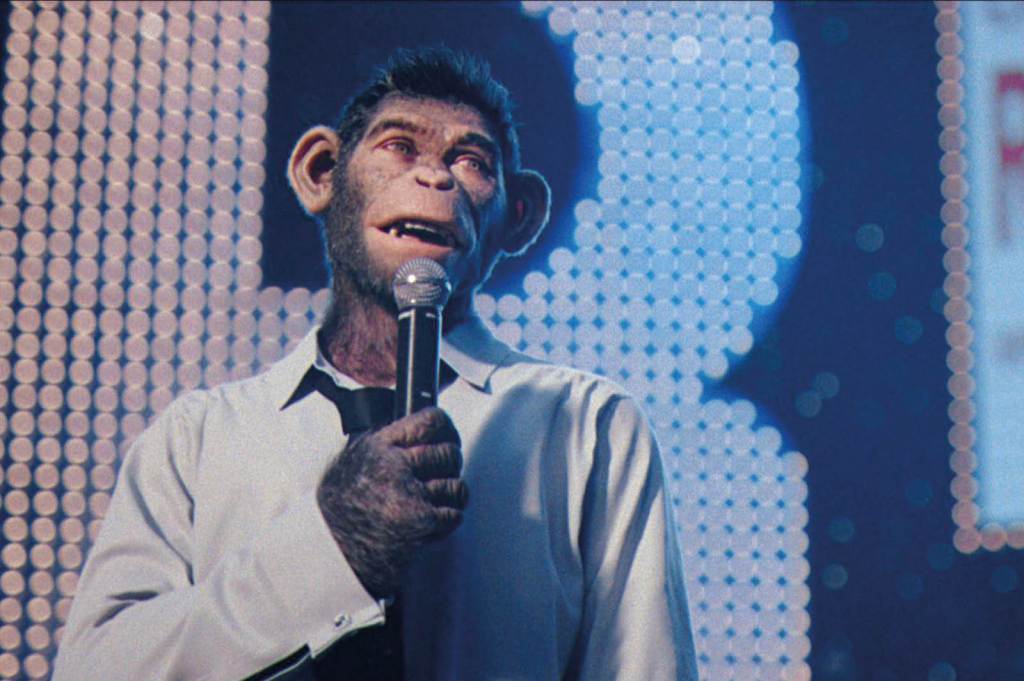
The pop star Robbie Williams is a strange phenomenon. In his native Britain, he’s the biggest male solo act of the past thirty years, someone who sells out stadiums without blinking. But in the United States, the man can’t get arrested. This warts-and-all biopic of Williams comes with a unique gimmick: the man is played by a photorealistic CGI chimpanzee. Sound bizarre? It almost certainly will be, but early word has been rapturously strong on Michael “The Greatest Showman” Gracey’s all-singing, all-dancing, all-snorting extravaganza.
-AL
Prime Target
January 22, Apple TV+
You may know him as the chav rent boy from season two of The White Lotus; now Leo Woodall zags in the opposite direction to play a mathematician whose work with prime numbers may unlock every computer in the world. Of course, we know there are corporate and government forces that won’t allow that to happen, so here comes another great-looking Apple TV+ thriller that reveals a deep-state conspiracy. We appear to be in a spy thriller renaissance with new series announced almost monthly — we hope the momentum continues, but more importantly, the quality.
FKA twigs, Eusexua
January 24
Brat summer is over; now, Eusexua winter is upon us. Returning for her third album, her first in over five years, British singer-songwriter FKA twigs is still pushing the envelope. She launched her first offering from this record, a combination of “Drums of Death” and the title track, with a deranged seven-minute-long music video in which a drab office is defiled — and then twigs turns into a tropical fish. It’s an aural cocktail of Massive Attack, Grimes, Kate Bush and Sonique — yet simultaneously it is entirely, wholly FKA twigs. The follow-up “Perfect Stranger” is a bit more accessible, but its video nonetheless feels like being sexually tormented in art school. “EUSEXUA has been my practice for the years that it has been in creation. it is my opus and truly feels like a pin at the center of the core of my artist,” she wrote on Instagram. OK!
-Matt McDonald
Flight Risk
In theaters January 24
When someone mentions Mel Gibson, your first thought isn’t, “Ahh yes, the brilliant auteur director.” And yet Apocalypto is one of the most mad, ambitious action movies I’ve ever seen; The Passion of the Christ is a French-New-Extreme-inspired torture-porn flick; and Hacksaw Ridge is one of the great modern war movies, deftly moving between being inspirational, comedic and horrifying. Any new Mel Gibson movie is a must-see moment, and hopefully Flight Risk is no different. Starring Michelle Dockery, Topher Grace and Mark Wahlberg, it’s about a US marshal escorting a government witness to trial on a small plane, and how things start unraveling as people try to take them down. The script was on the Hollywood “Black List” — of well-liked but unproduced screenplays — so hopefully Gibson can knock it out of the park again.
-RA
Mythic Quest, season four
January 29, Apple TV+
Anything that keeps Rob McElhenney away from Ryan Reynolds is a worthwhile exercise, so welcome the return of his Apple TV+ series Mythic Quest, a sitcom set in a video-game studio. McElhenney’s egomaniacal game creator Ian Grimm is set to return to the company he founded, along with his sparring partner Poppy, played by Charlotte Nicdao. Game on.
-MM
You’re Cordially Invited
January 30, Amazon Prime
Everyone knows the feeling of having your wedding venue double-booked, right? That’s why this one will really hit home for most folks. If you haven’t had this happen, this movie will fill you in. Its version, though, includes Will Ferrell and Reese Witherspoon to help with the hilarity, with Ferrell as the father of one bride and Witherspoon as the sister of the other, complete with a script written and directed by Nicholas Stoller of Forgetting Sarah Marshall and The Five-Year Engagement fame.
-ZC
This article was originally published in The Spectator’s January 2025 World edition.
Road-tripping with Wittgenstein
North Carolina
The ancients used the sun and moon to measure time, but modern man has a more exact instrument at his disposal: the odometer. It has ticked up a thousand-plus miles, a sure sign the 2024 holiday season has just ended. The children are all struggling in the backseat — against one another, their own bladders and the nylon straps the Car Seat Cartel has foisted upon them — and are thus unable to see the dash’s mileage ticker, as well as the incriminating orange “service reminder” messages your wife is pretending to ignore. When you read aloud the “Welcome to North Carolina” sign, your most intelligent child says, “Are we still in the United States?”You make a mental note to increase the 401(k) contribution for you will be on your own for retirement; then you read the odometer and remember that you eschewed a 401(k) to pay for the roof rack.
In his Philosophy of Psychology, Wittgenstein introduces the concept of “aspect blindness,” in which a person fails to understand the deeper meaning behind what is right in front of them. “Could there be human beings lacking the ability to see something as something — and what would that be like?” he asks. The most brilliant philosopher of the twentieth century then spends several pages imagining what that would be like. You need only to turn to the backseat and contemplate those seven words: “Are we still in the United States?”
Of course we are. This is I-95, the most American of roadways. Look there, you tell your child, a blue sign for fried chicken delivered quickly. And over there a billboard for a motorcycle accident attorney looking formidable and genuine in his leather jacket. This is a far cry from Virginia where the motorcycle accident attorney looks formidable and genuine in his leather vest, and the fried chicken logo is red.
And it dawns on you that Wittgenstein, childless though he was, would be sympathetic to the plight of the twenty-first century father trying to help children navigate a world that is impatient with the aspect blind, yet insistent on erasing all demarcations that would help them learn to see something as something.
Prior generations of children grew up with definitive signs of when they had entered an adult space. Their senses told them so. They could look around the restaurant and see white tablecloths and formal dress. They could smell the aroma of tobacco coming from the den and know that boring discussions of tax rates and lawn care were taking place. They could feel the weight of their mother’s hand on their backside and know they should retreat outside to the other children.
Children today lack such tell-tale signs. The dress and décor of patrons at a TGI Fridays are no different than that of a Zagat-rated restaurant; my daughters are the only people in either establishment not wearing yoga pants or glorified pajamas. We should forgive a child for spying a dog and giant Jenga blocks in the eatery and discerning that it is not a serious place or recognize that a public green is a place where children may do cartwheels, even if a grown man sees it as an ideal reading spot. The only way to discern an adult-space from that of freedom is the hissing that arises after the kids have run afoul of etiquette.
Our egalitarian age eliminated the high-low distinction to free adults from neckties and social obligations that did not jibe with their self-conceit. The result is a mushy middle culture that has grown more childish and yet childfree. Manners may have been relaxed, but etiquette will always be with us, and the burden for instilling in our children ever more nebulous rules of our cultural language falls upon parents. It is a language game that Wittgenstein would recognize as rigged.
The infantilization of America is not unlike I-95, where the only sign anything has changed is the odometer that is not visible to the backseat. There is an easy fix, one that a startling number of parents opt for out of social pressure. The adults who have commandeered public spaces want to see your child become an iPad drone, seen but too distracted to be heard. They are no doubt aware of the brain rot that accompanies the screen. They do not care, for it is not their child. It is your job as a father to opt out of a game designed to sacrifice your child’s wellbeing so Anastacia and her girlfriends can gab about the latest developments on the reality show they’ve been binge-watching on their own devices.
iPads have their place — on the back of the passenger headrest during interstate Christmas travel — but they should never be mistaken for tools of socialization. If modern etiquette dictates that children must become automata, then damn etiquette. Ignore the hissing. The best tool you can provide your child is exposure to adult spaces with clear forewarnings about how to behave. The best tool you can provide an entitled man-child is to help him resolve his own aspect blindness, in which he sees children as non-humans, dogs as children, oversized Jenga as a worthy adult activity, and nothing as something.
This article was originally published in The Spectator’s January 2025 World edition.
On embracing the winter years
Batavia, New York
I sit in hospice at the bedside of my beloved Aunt Jane — who never let us use the honorific, as “Aunt” made the perennially youthful Jane feel old — and the jukebox in my mind plays its saddest song: “Who Knows Where the Time Goes?” by Fairport Convention.
Jane, who is eighty-nine and till a few weeks ago looked twenty-five years younger, was my hip and happening aunt of the 1960s who lived in Buffalo and dated pro athletes and bopped along to WKBW’s Top 40. She taught my brother and me to write letters, which is why I still have an autographed photo of Minnesota Vikings kicker Fred Cox, and my brother has his signed picture of Rams quarterback Roman Gabriel.
I remind her of these things, but the part of Jane that forms words can no longer respond. I don’t know where the time has gone.
What a week. The other night, three buddies and I went to see Dave Alvin and Jimmie Dale Gilmore blow the roof off the Sportsmens Tavern in Buffalo. I saw Alvin in Santa Barbara back in 1986, when the guitar virtuoso of the Blasters played with members of X in the punk-folk supergroup the Knitters.
Rock and roll never forgets?
I dunno. Gray and white hairs outnumbered hairs of color by 10-1 at the Sportsmens. As seventy-nine-year-old Jimmie Dale Gilmore said, looking out over the crowd, “There’s a lot of old people here who are younger than me.”
I thought back to when in my thirties I took a young friend to a Social Distortion concert as a high-school graduation present. I’d seen Social D a decade or so earlier. They had moved on, thematically, from their early sonic mayhem, but at the later show they dropped in a few chestnuts like “Mommy’s Little Monster” for the enjoyment of the older set, rather as a wedding band will dutifully churn out Kool & the Gang for the parents and grandparents while the kids smile indulgently.
That young friend is now fifty.
Dave and Jimmie Dale still echoed in my ears the following night, when Lucine and I hosted the twenty-eighth-annual October evening of readings from my town’s most famous (I didn’t say “best”) writer, John Gardner. For ninety minutes a couple dozen of us read and listened to excepts from Gardner’s mammoth corpus, and then into the wee hours we drank and laughed and basked in the warmth of the wonderful friendships that have developed over the years.
Only two of us are under sixty. No one is under forty.
I can’t help noticing that the local talks and shows I attend or help organize are populated almost exclusively by those who are, shall we say, shuffling into their Buddy Ebsen years.
This isn’t necessarily a recent phenomenon: upon our repatriation thirty-plus years ago, Lucine and I joined the historical society and were about the only non-AARP members at the monthly dinners.
We used to laugh at the delighted reaction of the old-timers to our presence: “Ooh, young people!”
Now we have become them.
So I wonder: where are all the kids, and why don’t they like to do the things I like to do?
I feel silly typing that — like some doddering dotard in the 1970s scanning the audience for vernal shoots at a show by the Count Basie Orchestra.
A friend, an Eastern poet and comrade given to melancholy turns, wrote me recently: “The problem with being a rural localist is that we are terribly isolated. Speaking now just for myself, I think we invested a lot in the thought that our small examples of things going right would spawn others.”
It really doesn’t pay to think too much on such things.
When I was a kid I assumed there must be a Batavia underground consisting of Main Street bohemians who met in secret to watch early Seventies cult movies (Payday, The Hired Hand, Scarecrow) and discuss the sort of authors — Kurt Vonnegut, Richard Bratigan, Hunter S. Thompson — that appealed to fifteen-year-old me. (I don’t mean to dismiss these writers in retrospect; I still esteem Slaughterhouse-Five and Fear and Loathing: On the Campaign Trail ’72.)
Then I grew up. My wife and I moved back here and I realized no, there is not and probably never was such a thing, but that doesn’t matter. “Build soil,” as Robert Frost said. Something may come of it.
God willing, there will be a twenty-ninth-annual Gardner Reading, and by then, God willing, Jane will be young again, all ears and with her up-for-anything smile.
This article was originally published in The Spectator’s January 2025 World edition.
Beware the middle of Lidl
If you’re a regular, or even an occasional, customer at Lidl, you’ll know what to expect. Own-brand foodstuffs that shamelessly imitate better-known manufacturers and, by doing so, flirt with copyright infringement right up to the edge of legality; a selection of wines, spirits and beers that alternate between excellent value for the money and frankly undrinkable; and, most famously of all, the middle aisle.
Slowly, step away from the Middle of Lidl. Your dignity will thank you later
For the uninitiated, the middle aisle at Lidl has a unique attraction, mainly for men. It seems to have been based on the sketch from The Fast Show in which a man is sent out to buy groceries and, asked if he’s bought what he was asked to reply, invariably replies: “Even better than that!” before giving an account of the useless tat he has come home with.
In every branch of Lidl, there is an opportunity to buy truly bizarre items that defy belief. On one Reddit thread, users vie with one another in their accounts of what their other halves have returned with from their shopping expeditions. One man came home with a flamethrower, “for getting rid of weeds”, and another returned with a two-man canoe. The latter, unsurprisingly, did not live anywhere near water, but who cares about such things when you have your very own canoe?
The preponderance of this inexpensive, diverting but largely pointless junk, which has engaged usually bored and usually male shoppers in a way that little else has managed to, has helped Lidl make a pre-tax profit of £41 million, after it lost £76 million last year. That represents, undeniably, a huge number of canoes and flamethrowers being sold. But as the company’s UK CEO Ryan McDonnell chortled, “we have a big male following…we often get partners at odds with each other because men have disappeared up the aisle and are buying things they maybe already have.” While their poor, put-upon spouses are busy searching out bargain mince pies and Christmas cake, useless husbands are eyeing up the possibility of buying a chainsaw, crampons or a cement mixer. If they’re lucky, all at the same time.
Their wives cannot say that they haven’t been warned. Lidl suggest on their website that customers should “cruise along our Middle of Lidl aisle for household kit that you never knew you needed…from gardening essentials and outdoor furniture to nifty additions for your kitchen and bathroom.”
Wickedly, they conclude by asking: “What will you take home on your next Lidl shop?” The answer, in many cases, would appear to be “notification of impending divorce”. As McDonnell observes, “I would say there are a lot of men in trouble when they come in here.”
There may be a certain cult following to the sheer weirdness of everything that is sold in the middle aisle, not least because there genuinely seems no end to the tat that appears in every store on a daily basis. (For some reason, gazebos are popular all year round, not only in summer.) But just because something appears to be offered at a bargain price doesn’t mean it’s going to be of any better quality than everything else for sale. Just as much of the food and drink in the shop must be carefully checked, so it is more than likely that that tempting-looking ski gear might fall apart as soon as you take to the slopes.
Lidl has announced that, despite the recent Budget and the apparently never-ending price rises for food even in its stores, that it remains in confident mood for its trading. Little wonder, when the preponderance of cult rubbish in the middle aisle continues to lure in the unwary and curious alike, gawping at what’s on offer. But before you, too, find yourself wondering whether that all-granite pestle and mortar is going to take pride of place in your shed, look at where you’re buying it from and, slowly, step away from the Middle of Lidl. Your dignity will thank you later.
The new political era
It seems likely that on Election Day the country entered fully upon the new political era that commenced with the fateful presidential election of 2016. Donald Trump spent the last four years in the howling political wilderness, savagely set upon by every species of Big Beast — legal, financial and political — but from which he emerged as a survivor — physically, mentally and morally intact to achieve what is acknowledged to be the greatest political comeback in American history. Donald J. Trump is, without a doubt, the most remarkable American politician to hold office since 1945. Whether or not he is a genuinely great man as well is a question that only the next four years can answer.
The gradual but steady drift of American culture and politics since the 1990s toward the realization of an ideologically oriented and authoritarian society could have gone in the direction of Orwell’s brutally repressive Soviet-type dystopia, or of Huxley’s soft and therapeutic one, or a combination. Over the past four decades the great question for the United States and the social democratic West as a whole has been whether a political party, movement or coalition would — or could — resist what Jean-François Revel in the late 1970s called the “totalitarian temptation.” Trump’s election in 2016 appeared to show that such a thing was possible, while defeat in his bid for a second term in office, followed by four years of the highly ideological Biden-Harris administration, suggested otherwise. So did the political transformation of the Conservative Party in Great Britain, its defeat by Labour last July and the subsequent implementation of Sir Keir Starmer’s and his colleagues’ socialist policies.
Beginning with Barack Obama’s first presidential administration, the Democratic Party has progressively taken on the character of America’s first revolutionary mainstream party. The Biden-Harris Directorate has been attacking, frankly and unapologetically, some of the most fundamental institutions and arrangements established by the Constitution, most notably the Supreme Court as the third branch of the federal government, the reservation to the states of the right to establish voting procedures in federal elections, long-agreed-upon procedural rules governing the conduct of business in the Senate and the legal obligation of the chief executive and the commander-in-chief of the armed forces to secure the nation’s borders against foreign invasion. Now, Trump’s and the Republicans’ — not just the MAGA ones — stunning rout of Vice President Harris points toward a different and opposite future.
This is not to conclude, it goes without saying, that the revolutionary-minded “progressive” element of the Democratic Party that Biden-Harris have indulged, aided and abetted for the past four years has been defeated for all time. As the late French political philosopher Claude Polin argued, the socialist temptation — the socialist dream — has been endemic to Western societies since the late eighteenth century and will remain so for as long as Western civilization lasts. Moreover, every political victory is fleeting; as T.S. Eliot said, no cause, good or evil, is ever finally won, just as it is never permanently lost.
Nevertheless, this most recent presidential election is an angry and emphatic repudiation of the most egregious policies of the modern progressive-Democratic Leviathan that, far from being restricted to the professional political establishment, includes the corporate, legal, educational, cultural, scientific, medical and military-defense ones along with every other organized interest one might point to, among them the NGOs (nearly all of them liberal) and the powerful pro-abortion and pro-immigration lobbies, many of the latter supported — financially, politically and morally — by the churches. It was a rejection of Representative Alexandria Ocasio-Cortez’s Green New Deal, of the government-mandated production and purchase of electric vehicles, of federal restrictions on drilling, mining and other types of fossil fuel production, of open borders and the defunding of police forces, of “Diversity, Equity and Inclusion” policies, of the legally enforceable inclusion of males on women’s sports teams and all the rest of the progressive insanity that promises slavery in the guise of freedom (or “fweedom,” as the late Kamala Harris would say).
The comprehensiveness of MAGA’s repudiation of the Democratic-progressive agenda explains by itself the Republicans’ achievement in forging a comprehensive and diverse coalition — a counter to the Rainbow Alliance — that could prove as enduring as the 1930s one created by Franklin Roosevelt that persisted into the first decade of the twenty-first century, slightly weakened by the rise of neoliberalism in the 1990s. Just how long it can last, and maintain its present influence and power, will be the test of how great Donald Trump’s achievement really is.
Meanwhile, it is at once an example and an inspiration for anti-liberal and anti-socialist parties in other Western countries, most notably Great Britain, seeking to free themselves from what the British call the Blob — the same “woke” political, business, managerial, educational and cultural elite that has just received a humiliating kick in its over-ample backside from Donald Trump and his newly expanded MAGA alliance — the kick, it may be, that will be felt around the world.
This article was originally published in The Spectator’s January 2025 World edition.
A week at the World Backgammon Championship
Most people will know that there are no rivers in Monaco.
The one I found there is the metaphorical waterway used by poker player and professional pollster Nate Silver to describe an ecosystem of people and ideas focused on probabilistic thinking and calculated risk-taking. The term is derived from poker, where the last community card to be revealed in a game of “Texas Hold ’Em” is known as the River.
Poker players paddle about in the river, but so do stock-market traders, venture capitalists and anyone else consistently taking calculated risks. A politician deciding how to respond to Covid or a foreign invasion is “in the river.” In the broadest sense, we all live in it as we make risky decisions in an uncertain world, tipping our hats to Heraclitus from time to time.
This brings me to backgammon, which is one of the oldest board games known to man, with a five-thousand-year history dating back to ancient Mesopotamia.
Backgammon, a board game that combines strategy and luck, is what brought me to Monaco in the first place. It’s the quintessential river game; you don’t know from moment to moment whether you’ll be ankle-deep or treading water. Backgammon may be a game of perfect information — players can see all the pieces — with no real scope for bluffing, but chance isn’t entirely eliminated.
The aim of the game is to move your fifteen checkers around the board and bear them off (remove them from the board), before your opponent does. The skill comes in choosing the optimal moves based on the potential results of the rolls of your dice and anticipating your opponent’s moves. Players have the option to double the stakes when they have an advantage, which requires further skill in evaluating their positions.
Backgammon is extremely complex (there are thousands of potential positions even after two rolls of the dice); even the top grandmasters are far from perfect. But human players have improved drastically over time: an expert player today is a better player than the top grandmaster from the 1980s.
Still, the game was “solved” in the early 1990s — a computer can play at a level that human players can’t beat. This has an important implication — there is no market to play backgammon online for money; anyone who uses a computer to cheat would eventually win. This is quite different from poker, which has not been “solved” in the same sense. Poker strategy has evolved because of computers, and though they can help, they cannot guarantee winning, so online play remains a huge market for poker.
This factor is probably the most important in explaining diverging trends in the games’ popularity. Poker’s popularity exploded in 2003 after Chris Moneymaker won $2.5 million in the Poker World Series after qualifying for an online event for $40. The number of players in the main event trebled from 800 to 2,600 the following year and stands at over 10,000 in 2024.
Backgammon’s popularity, on the other hand, peaked in the 1980s. Only 300 players entered the World Championship in 2024 — and I was one of them.
The World Backgammon Championship started in Las Vegas, moved to the Bahamas and has been held in Monaco since 1979. The tournament lasts six days and is unusual for the considerable length of its matches (which average about two and a half hours with breaks) and the prestige which comes with its title, which in turn means that it attracts most of the game’s top players.
I entered the fifty-fifth World Championship with my eyes wide open. As a merely competent player, I knew I was at a disadvantage against the professionals and veterans. The entry fee is €1,250, but the total cost ends up being much higher because staying in Monaco isn’t cheap.
The tournament is held at the Fairmont, a dated hotel best-known as the site of the Formula One track’s famous hairpin, and just below the Monte Carlo Casino, the oldest casino in the world. Players are offered a discount to stay in the hotel, with its unassuming bar where a beer costs €17.
Staking €1,250 at odds of about +20000, as an underdog, is not obviously an everyday bet. But I viewed it as an investment: if, say, I improved over time and played the tournament for another thirty years, my chances of eventually being world champion would be about 14 percent (0.5 percent chance of winning over thirty attempts = 14 percent winning chances). That is a better shot than in any other field I can think of. The player population was about 90 percent male but diverse in nationality and appearance. Some chose to dress formally (one American was wearing black tie) but the vast majority were wearing shorts and flip-flops, in part due to the 95-degree heat. A top young Czech player by the name of “Zizi” played in swimming trunks, brightly colored basketball shoes and a bucket hat. It’s common to find out that a man in flip-flops was an ex-world champion or grandmaster and watch him roll out a bundle of notes for a high-stakes cash game. And you can’t miss players like Antoinette-Marie Williams, of New York — “Lady Fabulous” — who zooms around the floor in her “Ferrari,” a crimson mobility scooter. Antoinette-Marie has played in the championship more than thirty-eight times and is an advocate for teaching the game in public schools and community centers.
When I began to play, my heart rate was elevated because of the general excitement, and it was hard to concentrate because of the noise — 100 tables-worth of players shaking and rolling dice at the same time felt like being in the nest of a giant rattlesnake.
I won my first two matches against German and Danish opponents in games that took close to four hours. In my third, I lost to a quiet but aggressive player who said he was from San Francisco even though he had dice with “Moscow Backgammon Federation” stamped on them.
In my fourth game, I faced an Israeli player in what turned out to be a tense and gripping match. So tense, in fact, that my opponent resorted to sucking animatedly on an unlit cigarette. I had led for most of the match but found myself 8-10 down in a match to 11.
In that game, I fell into a weak position where I was down to only a 15 percent chance of winning despite feeling like I had played well. In a remarkable turn, my opponent threw his worst number (6-5), a 6 percent probability exposing two checkers and giving me a 67 percent chance to win. I missed both shots and one after, losing the game.
That rollercoaster experience is typical in backgammon. I had been very lucky to get the shot and then unlucky to miss it. Importantly, I had played the position correctly (I checked later using a computer) and so I could walk away knowing that it was probably a fair outcome. This is why I am drawn to backgammon — and wouldn’t be surprised if it had its own “moneymaker” moment in coming years.
Applying machine-learning analysis to backgammon has enabled players to distinguish between the roles of luck and skill in determining match outcomes. In Monaco it was common to see matches being recorded with a GoPro. This lets players analyze their matches later to learn from their mistakes. Who wins is important, but how a game is won is a paramount consideration in determining how a player will do in the long term.
In that sense, playing backgammon today repeatedly teaches that you cannot judge an in-game decision based on its outcome and that you shouldn’t rue misfortune or celebrate good luck, but recognize each for what it is.
I find that constant reinforcement very useful in approaching life — another game of skill and luck, yet one where it is very difficult to distinguish between the two, even in retrospect.
So I don’t think my bet was so irrational after all. After reeling in the lessons of this expedition, I’ll be back to the river in Monaco again, maybe with a bucket hat and GoPro next time.
This article was originally published in The Spectator’s January 2025 World edition.
Skiing Hokkaido’s powder triangle
“Insane, isn’t it?!” Kyle yelled from thirty feet below, leaning back on his snowboard to watch me struggle.
I summoned every ounce of strength in my jet-lagged body to prize my legs, still attached to skis, from several feet of fresh snow. Wedged sideways, I pulled myself up by a tree root, alternating between hysterical laughter and acute panic as little progress was made in five minutes. I’d come to Japan for the powder — and I’d sure found it on my first morning in Furano, Hokkaidō. Fighting to stand up, I steeled myself to tackle the impossibly light powder reaching my armpits, on the widest skis I’d ever clipped into. It really did feel different to snow in the US or Europe. This would take some getting used to.
“You said you wanted ‘Japow’!”
I couldn’t argue with my new friend, who I’d bumped into at the top of the Kitanomine Gondola, just an hour after he fitted my rentals at a Rhythm shop. I’d shared big plans to explore what locals call the “powder triangle,” flying 4,100 miles in search of the fluffy snow Japan is so famous for. After he gave up his lunch break to direct me to his favorite run, I could hardly tell him I’d need a minute to find my ski legs.
Freezing Siberian winds pick up moisture over the Sea of Japan and famously dump top-quality snow across Hokkaidō, the northernmost island in the Japanese archipelago. While European ski conditions become increasingly unpredictable, Japan retains some of the highest snowfall rates in the world — and its hospitality game is strong, too. Invited to explore three resorts and three hotels by the Luxe Nomad, I’d finally made it after years of wanderlust. Just getting there was a bucket-list moment, the Japanese transport system requiring patience I also had to dig deep for. A flight from Mumbai, followed by a train ride across Tokyo from Narita airport to Haneda, then a flight to New Chitose and a two-hour car transfer to the Fenix Furano proved to be worth the struggle. My super-modern apartment was so close to the line of riders for first lift, I had time for a lie-in, and had to take care not to flash anyone as I got up and pulled on my ski pants.
Perfectly embodying Japanese “wa” (best described as people living together, in harmony) sixty-two full-service studios and apartments overlook Daisetsuzan National Park and Mount Tokachi, brilliantly convenient for a tired adventurer. The basin-shaped valley has hosted the FIS Downhill World Cup twelve times — and after two days of rag-dolling down its famous tree-lined slopes, I understood why. Pistes conquered, I called on the reception staff to help me plan a train ride to Rusutsu resort just over 100 miles away, where I’d meet a friend. We’d planned to link up in Furano and hire a car for the onward journey, but my International License-holding comrade had been delayed flying in from Palisades Tahoe, itself buried under eight feet of the white stuff (the irony).
Arriving at the Vale Rusutsu felt like a fever dream, though my friend Marcus touched down in time to pick me up en route, back at New Chitose. Within hours we found ourselves on a closed road — signposted in Japanese — thick snow rendering us so stuck, two chefs spent their cigarette break pushing us out. A flying start to his trip; I didn’t have the heart to tell him when I later discovered we could have reached our desired ramen joint on foot. A huge indoor walkway connects the Vale to an uncannily kitsch shopping center laid out like a town from a deranged Disney movie, full of restaurants, cafés and hotels built during the Eighties “ski boom.” We hadn’t come for the ten-foot robotic talking tree, nor the full-sized fairground carousel filled with demonic-looking pigs, but they were certainly an amusing add-on.
Flinging open the curtains of our beautiful, condominium-style digs, we could see the beginnings of forty-two kilometers of slopes that span two distinct peaks — more than enough to keep us busy for two days, despite hitting quicker speeds than I’d managed in Furano. We found uncrowded wide-open spaces and tons of natural features among the trees, though relatively flat slopes warranted some sweaty hikes back to pistes that would get us home. Another charming idiosyncrasy: the lifts are old, and downright dubious-looking in places, adding a thrilling layer of amusement or peril depending on your nerves and experience. Snow cover was lighter than you might expect in peak season, but whizzing down the Giant course from the summit of West Mountain and past roller coasters at Rusutsu Amusement Park is a memory that more than makes up for it. With Marcus battling a fifteen-hour time difference, our evenings were lowkey, punctuated by leisurely visits to the Vale’s luxurious Kotobuki onsen, where naturally hot water trickles through two springs and guests unwind in saunas and cave baths, Jacuzzi bubbles tickling their feet. It’s a truly iconic place to lean into Japan’s ancient tradition of public bathing, where gendered outdoor baths give sweeping views of the national park. I hoped the waters rich with sodium bicarbonate would soothe my skin, dry from air travel and launching myself down mountains.
Ravenous, but keen to avoid any more car trouble, we raided the fridge at Seed Bagel and Coffee Company back at the hotel, finding ingredients to cook up in our suite’s Italian-style kitchen. Dairy products are particularly good in Hokkaidō — a cool climate and fresh air makes for happy cows — so we made sure to feature cheese heavily, for research purposes.
Our next meal was no lighter, and equally excellent. Making the twenty-minute drive to Niseko, the final stop on our tour, we stopped at a typically modest, typically sensational small business, abruptly pulling up in a snowy forest.
“No photos please!” Boulangerie Jin’s owner entreated me, as I pulled out my phone. Her selection of homemade pastries and breads looked casually world-class, and like most of Japan’s foodstuffs, preposterously well-priced. We left with armfuls of raisin bread, flaky cheese twists and thick almond croissants, which we toasted, reheated and squabbled over throughout our last three mornings, washed down with hot tea from vending machines.
“The party is by the traffic lights,” the receptionist at Niseko Kyo smiled as we wheeled our bags through. Our slopeside studio room boasted a kitchen, but it’d go unused, the buzzy town of Hirafu beckoning. There I discovered one of my favorite restaurants of all time (“top secret,” staff warned me not to reveal) and a throng of drinking dens long conquered by skiers before us. We hit Half Note for live music, Tamashii for snacks, an outdoor kiosk for natural wine, Bar Gyu+ to show off that we’d managed to get a table and Freddies, where we watched a barman set his face on fire after lighting a shot of high-proof rum.
As for skiing? Even challenged by hangovers, I could begin to understand why Niseko’s so often called Japan’s best. Four resorts operate under the Niseko United umbrella, and you can ski between them if you time it right, using the same pass. Hanazono, Grand Hirafu, Niseko Village and Annupuri offer unique experiences, our base of Grand Hirafu the largest. Within minutes of pulling on our boots, King Lift #4 took us to Gate 3, the Hirafu Peak Gate at 1,180 meters. On a crisp bluebird, we joined the slow trickle of people making the additional 128-meter vertical climb to the summit of Mount Annupuri, the only place you want to sink a beer when the sun is shining. The Niseko Volcanic range spanning Lake Toya, Kutchan, the Sea of Japan and the Pacific are clearly visible from the magnificent vantage point, watched over by majestic Mount Yotei.
Our ride down to Annupuri’s base played out like a video game, a natural halfpipe handily leading to the Annupuri Gondola. Or it would have been handy, if we hadn’t got carried away ordering up karaage, katsu curry and beers from Yotei Brewing during a celebratory late lunch, missing the last lift entirely. All’s well that ends well — a Korean instructor who’d just finished night-skiing offered us a ride home. Plus, some news.
“Big storm, on the way! Snow!” he yelled, slapping our backs as we loaded our skis into his trunk.
“No! I leave tomorrow!” I complained, my return flight to Tokyo fast approaching. Back at Niseko Kyo, Marcus and I parted to soak in the hotel onsens. We each emerged with the same conclusion: we’d change our flights. Japow was what we’d come for, after all.
Amy was a guest of the Luxe Nomad. Please find the winter rates below
FenixFurano: from $277
The Vale Rusutsu: from $271
Niseko Kyo: from $503
This article was originally published in The Spectator’s January 2025 World edition.
What Spectator writers read in 2024
Rod Liddle
The angels in Jim Crace’s Eden are tetchy and petty authoritarians, apart from one who can’t fly properly. This dissertation on freedom and mortality is rather wonderful – published two years ago but I caught up with it only this year. The best non-fiction book of the year is David Goodhart’s The Care Dilemma: Caring Enough in the Age of Sex Equality, which has the temerity to suggest that divorce rates and broken families might just have something to do with our epidemic of mental illness. How dare he?
Lionel Shriver
I’d recommend the novel Havoc by Christopher Bollen, set in an Egyptian hotel to which westerners have fled to avoid the tyrannies of Covid regulations. I loved the concept of a character who’s a compulsive meddler, priding herself on fixing people and their faulty relationships – only for the older woman to meet her match in an eight-year-old boy. It’s refreshing to read prose that is so well crafted. Bollen has style, and he’s a natural storyteller.
Matthew Parris
‘Sometimes, as the car passed a scarlet thicket of cactus and geraniums, a nightingale scattered a few daylight notes through the window.’ A Quiet Evening: The Travels of Norman Lewis is John Hatt’s anthology of this superb travel writer’s best articles. What observation! What majesty of style! What laconic humour! For me, Lewis has been the discovery of the year.
Melissa Kite
I only just discovered H.E. Bates and read The Darling Buds of May, which, it turns out, really is perfick. I laughed until the tears ran down my face as Ma Larkin piled impossible amounts of food on the table and Pop Larkin persuaded Miss Pilchester to get on a stampeding donkey. All the eccentric earthy charm of long lost England and the ideal antidote to woke if you’re feeling jaded. Generous, life-affirming and joyous.
Rory Sutherland
The comedian Max Miller was in the habit of attending football matches and shouting at the players: ‘Use your own judgment!’ He was right in a way. It is situational awareness, not intelligence, which makes for good decision-making. Unfortunately we now live in a world so codified and controlled by weird unaccountable entities such as HR or compliance that we are often powerless to act independently, even in the face of utter stupidity. If you want to understand a large part of what has gone wrong with modern life, I can recommend no better book in 2024 than Dan Davies’s The Unaccountability Machine: Why Big Systems Make Terrible Decisions – and How the World Lost its Mind. Complexity theory, cybernetics and squirrels all in one book. Who could ask for more?
Kate Andrews
There were lots of caveats that came with this year’s release of Gabriel García Márquez’s ‘lost’ book Until August. It was imperfect, unfinished and ultimately a work that the author – who wrote it while struggling with dementia – decided he did not want released. However, a decade on from García Márquez’s death, his children decided it should be rescued from the archives. Unsurprisingly, it’s fantastic: short, raw and heartbreaking. It’s a study for all readers on the tensions between independence and betrayal – and for García Márquez’s fans it is such a treat to return to his work and experience it new.
I also can’t resist nominating a book that was not published this year, or in this decade. Yet somehow, I found myself reading Nora Ephron’s Heartburn for the first time this spring. Now I will be forever smiling, forever crying, and forever laughing to myself as I remember passages from this perfect autobiographical novel. I could not recommend a book more highly.
Martin Vander Weyer
Heavyweight biographies (and worse, autobiographies) of over-achievers in the business world come at me like juggernauts in motorway fog. So it was a joy to discover a literary celebration of under-achievers: Doing Nothing by Tom Lutz, subtitled ‘A history of loafers, loungers, slackers and bums in America’, is a thoroughly researched (no slacking here) chronicle of several generations of laid-back leisure-seekers in fiction and fact, from the cast of The Great Gatsby to the young George W. Bush. In a highly entertaining way it illuminates the cultural heritage of today’s workshy Generation X – but they’re almost certainly too idle to read it.
Toby Young
My book of the year is Mania by Lionel Shriver. The Great Awokening is an excellent subject for a dystopian satire and there have been a few attempts, but Lionel absolutely nails it. The conceit of the book is that it suddenly becomes unacceptable to discriminate against people on the basis of intelligence and, of course, the world immediately goes to pot – nothing works, planes start falling out of the sky and if you go to see a doctor, you’re taking your life in your hands. All frighteningly plausible, until the ending, in which common sense and sanity return. That will never happen.
Peter Jones
Easily the most interesting book about the ancient world which I read this year was E.E. Cohen’s Roman Inequality: Affluent Slaves, Businesswomen, Legal Fictions. It explains how the evidence from legal fictions described by Roman legal advisers (‘jurists’) demonstrates that slaves could make big money out of business transactions on behalf of their wealthy masters, who were not allowed to engage in trade, and that women too could set up their own businesses, running banks, offering loans, owning and renting out property and so on. It would take 1,000 years before women in Europe had such power again.
Realising that the sea monster of the brain had, many aeons ago, purged any memory of Jane Austen, I also picked up Persuasion. I was transfixed: it was as thrilling a literary experience as any I have ever had.
Mary Killen
The Quality of Love: Twin Sisters at the Heart of the Century tells the story of the identical Paget twins, Celia and Mamaine, who were born in 1916, orphaned at 12 and taken in by a stuffy uncle who tried to turn them into debs. But they escaped society for bohemia where their soulmates lived. The beautiful brainboxes were fit to win the hearts of leading 20th-century thinkers – among them George Orwell, Albert Camus and Arthur Koestler. Pivotally, the twins wrote letters and kept diaries. When editor/narrator Ariane Bankes finally brought herself to look at these after her mother Celia’s death, she learned that the twins had had ringside seats for the 20th century’s intellectual developments – and what love was like in the days of proper romance and when driving passions consumed each waking hour.
Christopher Howse
In 1939, residents of Pinner, Middlesex, petitioned for their new Metropolitan line station to be built in ‘medieval’ style. The champion architect of ‘new old’ timbered houses was Blunden Shadbolt, who laid roof tiles on wobbly chicken wire for an effect of weathered age. Such popular byways of British architecture of the time, alongside unpopular abstractions like Berthold Lubetkin’s (London Zoo penguin pool and Highpoint flats, Highgate) are explored in the eye-opening Interwar: British Architecture 1919-39 by the incomparable Gavin Stamp, who died in 2017 leaving a manuscript now edited by his widow Rosemary Hill.
Jonathan Ray
The martini is the most elegant and stylish of drinks and Alice Lascelles the most elegant and stylish of writers. I read The Martini: The Ultimate Guide to a Cocktail Icon at a sitting and have been dipping in and out ever since. I learn something new every time – a witty quotation, a new twist, a surprising fact, the ideal accompaniment – and Laura Edwards’s gorgeous photos always have me drooling with desire. Barman, a Gibson on the rocks please!
Olivia Potts
Always with my finger on the pulse, I finally discovered Muriel Spark this year. I’d read her before – once, I think – but over the summer I almost accidentally began reading The Girls of Slender Means – which is so short that if you do accidentally start reading it, you may also end up accidentally finishing it. It’s brimming with what makes Spark so timeless – perfect prose, biting social observations – and is very, very funny. In slightly more recent publications, I ate up Paul Murray’s The Bee Sting, a brilliantly crafted tragicomedy family saga that was published last year, and I will be thinking about Patrick Radden Keefe’s Say Nothing, a forensic and compelling reporting of a murder in Northern Ireland during the Troubles, for years to come.
Roger Alton
Some terrific sports books this year, notably Sir Chris Hoy’s heartbreaking but uplifting memoir (have some tissues with you) and fast-bowling legend Jimmy Anderson settling some scores off his long run. But it is always good to turn to top-class fiction. And you won’t find much better than Henry Porter’s latest superlative thriller, The Enigma Girl. His new heroine, Alice ‘Slim’ Parsons, is a tough, resourceful undercover MI5 spook and as ballsy, hard-nosed and, er, sexy as you could wish for. Much of the highly twisty plot evolves around events near the wartime code-breaking centre at Bletchley Park, hence the title. Thrilling and gripping, it’s a big book too. Not to be missed.
Bruce Anderson
Rory Stewart is a master of prose. It may not be a recent release, but The Places in Between is one of the best books published in English so far this century. Mr Stewart also has a fascinating political intellect. Last year’s Politics on the Edge is full of controversy but will not be the last word on any of the subjects. On David Cameron, our author is unfair to the point of silliness. But Stewart opera omnia always guarantees a good read.
Robert and Isabelle Tombs’s That Sweet Enemy, an account of Anglo-French relations, and the two nations’ history, is not a good book. It is a great book. There is stimulus and delight on every page. Everyone interested in politics should devour this seminal work. It is scandalous that I had taken so long to get round to doing so.
Tokyo drift: Japan’s once-pricey capital is now cost-effective… for Americans
I spent my last afternoon in Tokyo stocking up on snacks and feasting on cheap and delicious conveyor belt sushi, in anticipation of characteristically criminal airport concession prices. But when I made my way past Haneda Airport’s Rodeo Drive-esque esplanade of luxury shops — does anyone really buy a $10,000 Omega watch on their way to their gate? — I was in for a surprise.
Bottles of water, iced tea and other soft drinks were less than $1 in airport vending machines, just like everywhere else in the country. I wasn’t hungry, but when I realized that I could buy a plate of yakisoba with shrimp, pork and squid for the yen equivalent of $6 and six takoyaki (essentially balls of fried octopus) for $4.75, I ordered both. Like everywhere else in Japan, I wasn’t asked to tip, and if I’d left one, it would have been considered an insult. The airport food court even had cups of free ice water. Boarding a flight home was never so difficult.
I’m a self-described pathological traveler who has been traveling the world for three decades. But I’d purposely avoided Japan because of its reputation for high prices until I finally pulled the trigger this year, as the yen has fallen to historic lows against the dollar. Traveling with my wife and teenage sons in June, we spent eight nights in Tokyo and nearly three additional weeks riding the rails to other destinations around Honshu, Japan’s largest island. I expected to love the snowcapped Japanese Alps in Kamikochi and the UNESCO World Heritage sites we visited in Kyoto, Nara and Koyasan, and they didn’t disappoint. But what surprised me was how addictive Tokyo is and how well we ate for so little there and everywhere else in Japan.
I rarely prioritize spending time in big cities, and megacities have never been my thing, so my Tokyo expectations were modest. With a metro-area population of 37 million, it’s the world’s largest city, and planning a visit there can be intimidating given the dizzying array of attractions and the distances between them. We tackled Tokyo’s geography problem by spending the first four nights of our trip in Ueno at the family-friendly Mimaru hotel chain, near the city’s best museums and the historic Asakusa neighborhood, and the last four nights in buzzing Shibuya, in West Tokyo, where we enjoyed some of the best people-watching and aimless wandering we’ve experienced anywhere.
Tokyo’s subway, with its startlingly punctual, air-conditioned trains, is arguably the best in the world. Thanks to the weak yen, a seventy-two-hour subway pass currently costs less than $10 and, with a little help from Google Maps, we were able to get nearly anywhere we wanted to go. Even better, the trains are spotlessly clean, quiet (the Japanese, bless them, don’t yak on their mobile phones or converse loudly in public), and I never once encountered a panhandler, a busker or any other public nuisances. There are comparatively few homeless people in Tokyo, and those who do sleep on the streets aren’t allowed to run amuck as they are in some US cities. We wouldn’t let our kids ride the subway in New York or other big American cities alone, but we did so in Tokyo several times because the city seemed very safe.
I’m lukewarm on sushi in the States, but I couldn’t get enough of it in Japan. I fell in love with three sushi chains in Tokyo — Sushizanmai, Kura and Sushiro. At the latter two, we could feast on a dizzying array of nigiri for less than $10 a head, all ordered via iPad and whizzed out to us on conveyor belts at about twenty to thirty mph. One night, I walked by a Kura branch at around 11 p.m., and when I noticed it was open, ate a second dinner alone, consisting of seven plates of sushi, a beer and a dessert. It cost the equivalent of $12 and took about fifteen minutes: I was in and out before my family suspected a thing! Plates of katsu, soba, udon, ramen and other mouthwatering Japanese treats rarely cost us more than $10 per person anywhere we went.
Tokyo was once reckoned to be one of the world’s most expensive cities but not now — if you have US dollars. Hotels still aren’t cheap, though if you only need one double bed or two twin beds, you’ll likely find the prices a bit cheaper than in comparable hotels in New York or LA. Even better, there were no expensive attractions in Tokyo or anywhere else in Japan. For example, I visited Tokyo’s outstanding National Museum of Western Art one morning for 500 yen, or just over $3. Almost every temple, shrine, palace, museum and castle in the country is similarly priced.
My wife took the boys to Universal Studios, near Osaka, one day while I went to Nara, the ancient capital, and she reported that the tickets and concessions are about half the price that they are at Universal Studios in Orlando. Aimless wandering in Tokyo, particularly after dark, was even more fun than sightseeing. I never got tired of people-watching on the bustling, neon-clad pedestrian boulevards and the smoke-filled alleyways of Shinjuku and Shibuya. There’s an infectious energy on Tokyo’s streets after dark that’s unlike anything else I’ve experienced elsewhere. I’m usually claustrophobic in crowds, but in Tokyo, the city is orderly enough that it all somehow works without ever feeling chaotic. And while Kyoto’s most popular attractions can feel overwhelmed by tourists, the Japanese always seem to outnumber tourists in Tokyo.
The highlight of our trip wasn’t just stuffing our faces and sopping up bargains though; it was the many remarkably kind Japanese people we met. The Japanese are famous for their manners, but the people don’t always get the credit they deserve in the West. After all, there is no legal gay marriage in Japan, and immigration levels are kept comparatively low (though rising at about 200,000 this year) for an affluent country.
I’ve often read that Japan’s immigration policy is indicative of a kind of national xenophobia. Every country has its share of xenophobes, but to paint the Japanese with that brush is unfair. Almost every Japanese city has volunteer guide clubs that match foreigners with free local guides. We took advantage of these free guides, who offer their time and knowledge because they enjoy meeting foreigners, in several cities, including Tokyo. Meeting local guides Michiko Kitaguchi in Kanazawa, Tommy Otsuka in Nikko, Yayoi Uchikata in Kyoto and Mitsuo Hattori and Yuko Hikimoto in Tokyo gave us an opportunity to get to know local people, see their favorite haunts and experience cities through their eyes.
The American media is currently pushing an “overtourism in Japan” line, particularly Kyoto, obsessing over the backlash to rising tourism numbers. But almost everyone we met in Japan was exceedingly helpful and welcoming. It’s true that Kyoto’s most popular attractions are jammed with tourists, but the city has 1,600 temples and 98 percent of them are virtually empty, so resourceful travelers can always find unspoiled treasures.
I was particularly impressed with Tokyoites because so often they didn’t just point us in the right direction when we were lost in places like Shinjuku Station, the world’s largest train station —they took the time to walk us right to the correct platform or the restaurant we were searching for. Even though waiters and waitresses had no hopes of garnering tips, we got better service than we typically do in Florida. Sometimes staff thanked us so profusely that we almost wondered if they were on some sort of happy pills.
I asked my wife after one such experience how staff are trained in Japan, and she said, “It’s not training, it’s their culture. They’re taught to be kind, work hard and do a good job from the time they’re born.” And she was right. You can’t teach nice, but the Japanese do it better than almost anyone else.
Tokyo bills itself as the place where old meets new. Most tourism slogans are as empty as the Aral Sea but Tokyo’s is apt in many ways. It’s a futuristic place where tech is revered — you may need help just figuring out how to use Japan’s complicated toilets — but traditions are strictly preserved, even by the young. Nowhere was this more apparent to us than in the world of Japanese sumo, which has adapted to allow in foreign rikishi (wrestlers) but has otherwise remained largely unchanged for hundreds of years.
We attended a sumo retirement ceremony in Tokyo’s national arena, which involved plenty of pageantry along with a host of matches and a slow-motion haircut. Rikishi don’t cut their hair during their careers. They live and train in stables where there are strict, seniority-based rules governing their conduct. At their last match, dignitaries cut their hair — one strand at a time. In our case, we watched all the match- es and then watched one notable after another cut the hair of the retiring wrestler, Ishiura Shikanosuke. I have no idea how long this haircut took, because we lost patience with it after an hour.
A day later, we visited the Ajigawa stable and met two of their top rikishi, Anosho Yamato and Danylo Yavhusishyn, a twenty-year-old Ukrainian who wrestles using the Japanese name Aonishiki and speaks fluent Japanese. They live and work in the same building on the east side of Tokyo and the smell of sweat overwhelmed us when we entered their training studio. They trained to the brink of collapse — it was almost uncomfortable to watch — and later told us that the hardest thing about their jobs was gaining weight. Go figure.
We attended two baseball games, one at the Hanshin Tigers stadium near Kobe, and another, a Giants game, at the Tokyo Dome. Both experiences were infinitely more fun than attending baseball games stateside. The fans chant and sing songs, there are bands and cheerleaders and adorable vendors who bow to their sections as they make their way up the aisles selling draft beer for about $5. I feasted on sushi, kalbi beef and yakisoba in both stadiums for about the price of a lunch at McDonald’s in the US.
If you’re already packing your bags for Tokyo by the time you finish reading this, understand that Japan is no place for anarchist and libertarian types. I had several cashiers critique me for not standing exactly where I was supposed to while lining up. We had to revamp our itinerary, adding time in Tokyo and cutting a few small towns, because the only two companies who offer one-way car rentals wouldn’t accept my American driver’s license or a copy of my international driver’s license (originals only!). Rules are enforced strictly. You may have to carry garbage around, even dirty diapers, for hours or perhaps all day. Tokyo is spotless, but there are very few public trash cans. And children are charged as adults at age twelve. It’s no wonder the country has a low birth rate.
After my low-cost feast at Haneda airport, we spent eleven and a half hours on a Delta flight back to Atlanta, where we were welcomed back to the United States by hectoring TSA officials who found fault with everyone. I was berated for not taking my camera out of my carry-on before going through security. Then we paid $16 for terrible airport fast food and were prompted to tip the employees for essentially nothing. Cups of ice water were $3.50, the same price as soda. At our gate, one woman was enjoying a loud program of some sort with no headphones while a man nearby made a series of phone calls we were forced to overhear. It was all enough to make me want to get right back on a plane to Tokyo, the world’s biggest and best-run city where good manners and meals are never hard to find.
This article was originally published in The Spectator’s January 2025 World edition.
Is Paris the world’s most bookish city?
After I ventured to New York in May 2024, bound for a discerning literary journey round the city’s bookshops, libraries and hotels, I received some lively and constructive feedback from Spectator readers. Many, thankfully, agreed with my arguments about its bookish charms, but a consistent theme in the comments I received was, “How can you claim that New York is the quintessential literary city? Have you forgotten Paris?” To which my reply was reasonably simple: “What about Oxford, London, Rome, Edinburgh, Dublin, Santiago or San Francisco?” All of them hugely distinguished citadels of the written word, both present and historic alike.
Yet I felt uneasy at my response. Paris, after all, isn’t just the place where many of France’s greatest writers lived, worked and loved, but an expatriate literary hangout par excellence. Without Paris, it’s doubtful that Hemingway, Scott Fitzgerald or James Joyce would have achieved anything like as much as they did. The so-called “Lost Generation” of American writers who all but colonized the city in the Twenties didn’t just prop up the bar of the Paris Ritz until they ran out of change or credit, they created a valuable conduit between the Old World and the New. A century after the Lost Generation were at their peak, it felt incumbent upon me to hop onto the Eurostar from London and soak up a couple of days of literary and artistic bonhomie in search of the city’s timeless joys.
My choice of hotel, naturally, had to be in keeping with my mission, and so I was especially pleased to discover that the recently opened Hôtel Balzac, a few steps away from the Champs-Élysées, was located upon none other than the spot where Honoré de Balzac himself lived. It’s not the best-known Balzac residence — that would be the Maison de Balzac in the 16ème — but the story of how the great author spent his final months in the former Avenue Fortunée, before dying in the arms of his new wife Eveline Hańska at the age of fifty-one, is a stirring and quintessentially Parisian one. It is rumored that one of the reasons for his early demise was his habit of drinking up to fifty cups of coffee a day. We can only speculate whether such classics of French literature as Germinal and La comédie humaine were written in a hypercaffeinated state.
In any case, Balzac would be hard-pressed to recognize the establishment that bears his name today. It is an exceptionally discreet and well-appointed place, expensively and painstakingly renovated after its acquisition by the group Les Maisons Bertrand. An expensive and comprehensive redesign by the Festen architecture group has allowed for sumptuously furnished suites, some of them with a direct view of the Eiffel Tower, and a beautifully designed spa, the Ikoi, which has been constructed on Japanese lines and sits comfortably in the basement of the hotel, ready to receive its weary visitors and give them the relaxing experience of their dreams. But it’s the bedrooms that will make anyone gratefully sink into the enormous and tender embrace of soft mattresses and softer pillows: they are enough to inspire well-rested writers to their finest work.
The hotel has a casual dining space, where you can take breakfast while reading the New York Times or The Spectator, but if you’re after a more comprehensive experience you might wish to stroll past the Arc de Triomphe and head for lunch at the Balzac’s sister establishment, the Saint
James Paris, where you might enjoy a lavish repast at the Michelin-starred Bellefeuille. It’s a wholly different experience, a château sitting in grandeur in the cent- er of the French capital, and the food is exemplary, as you would expect. A soup of tomato and goat’s cheese actually tasted of tomato, rather than the usual flavorless nonsense, and a main course of duck, accompanied by a very fine glass of Burgundy, was as good as anything that I’ve eaten this year. Chef Grégory Garimbay is a hugely talented man who deserves at least a sonnet written to his skills, if not a great deal more.
Thus replete, it was time to wander round the city’s greatest literary haunts. It would not be a visit to Paris without popping into the famous English-language bookshop, Shakespeare and Company, which has adorned the Left Bank since 1951 after being opened by the eccentric bookseller George Whitman. Some of its more unusual traditions have been toned down — the so-called “tumbleweeds,” aspirant writers who would sleep in the bookshop in exchange for helping out behind the cash desk, now have to make formal applications for a residency period, whereas once they would simply have turned up, knapsack in hand — but there is still a great sense of satisfaction in buying a copy of a book and having it stamped with the Shakespeare & Co insignia: a recognition that a great literary tradition has been maintained to the present day.
Paris is a proudly bookish city, although this has not been without controversy and upset. The Seine’s second-hand booksellers, the bouquinistes, may enjoy elevated and historic status, but it took President Macron’s intervention to prevent their riverside book stalls being closed or dismantled during the Olympics, on the perhaps ridiculous grounds that lurking within their Simone de Beauvoir first editions might be some deadly explosive or weapon. (Those who have read their books will be aware that they’re devastating enough on their own terms.) Many would argue that the most damaging item in these booksellers’ arsenal would be their impeccably timed literary quips, made to any browser who’s taking too long and not looking as if they will buy enough books, and few would dare fail to make a purchase before moving onto their next destination.
There are many other spots that any self-regarding book lover will wish to visit, whether it’s Les Deux Magots, the literary café where Sartre and Beauvoir held their performatively public assignations, Oscar Wilde’s much-kissed grave at the Père Lachaise cemetery, or the Maison de Victor Hugo, where, as the name might suggest, the author of Les Misérables worked and lived. Yet I would seek to direct the curious bibliophile to two other places, one legendary and one aspiring to become so.
A stone’s throw from the Hotel Balzac lurks one of the city’s best-known and most beloved restaurants, Fouquet’s. It opened in 1899 and has subsequently played host to virtually every single well-heeled writer in Paris, whether they were on their own dime or being hosted by an unusually generous publisher or fellow author. It has managed to stay both authentic and popular for the last century and a quarter by updating its menu subtly but keenly, courtesy of three-Michelin-starred superchef Pierre Gagnaire: those in the know suggest that you will not get better frogs’ legs or lamb anywhere in the city, so settle into a red banquette, order yourself a glass of Sancerre and sit back in the happy knowledge that you’re dining in the company of the great.
And if you’re in the mood for something altogether more contemporary, a writer friend pointed me towards the aptly named Public House, lurking in the Opéra district. It’s the perfect combination of English-language and French influences, with British chef Calum Franklin — the so-called “pie king” — overseeing the menu, which, as you might expect, goes appropriately heavy on pies. (Try the braised beef with bone marrow, and you can thank me later.) This is not a light and refined restaurant, like many nearby, but a hearty, vibrant place, full of literary and cultural discussions conducted at top volume. It’s too dark to read, so the best thing the solo diner can do is to gulp down one of the excellent cocktails (the French Whisky Sour and Basil Smash are particularly highly recommended), smile warmly at those around you and try to discuss the finer points of the Lost Generation’s writing. With any luck, you’ll have made life-long friends before you’ve even uttered the words “Gertrude Stein.”
Paris is one of the world’s greatest cities for indulging both the body and mind in conjunction with one another: no Cartesian dualism here. My perfect day here would consist of spending my morning reading Balzac or Hemingway in a café, my afternoon walking around bookshops and literary monuments and my evening eating escargots and steak frites and drinking wine, and then waking up, thoroughly refreshed, before repeating the same process all over again. After enough days of doing so, I can only imagine that it’ll lead to me being able to create another timeless masterpiece of my own. Alternatively, I could develop gout, but such things are a necessary risk of any couple of days spent in this most intoxicating and literary of places. Sorry, New York: you’ve got serious competition.
This article was originally published in The Spectator’s January 2025 World edition.
How Eastern Europe is leaving Western Europe behind
I’m in the tiny riverside town of Virpazar, in the little Balkan country of Montenegro; and under the white geisha face of a late summer moon I am warily ordering the celebrated local delicacy. It is carp — caught from the nearby, slivovitz-clear waters of Lake Skadar (biggest lake in the Balkans!). But what makes me wary is the preparation. The carp is apparently marinated, and served cold, with boiled potatoes and greens.
Cold slimy fish with hot spuds and spinach? It sounds like some nightmare culinary “specialty” from the old communist bloc (of which Montenegro was once a part, within Yugoslavia). I’m veteran enough to remember a few of these. “Famous” flatbreads that came with rancid lard. “Tasty” chicken necks which turned out to be way more neck, gristle and bone than chicken.
My meal arrives, it smells good, the anticipation rises. And then I take a bite and immediately I know. It is ace. And as I wash down the succulent carp with quite good homemade red wine, I realize that it is, in fact, tastier that any single meal I had during multiple visits to France earlier this year.
Not only that, this is just one of many brilliant dishes I’ve enjoyed across Eastern Europe in recent months — from Poland (pierogi) to Moldova (zama) to Transnistria (borscht), even Ukraine during a war (Odessan cuisine is wondrous). All of them have given me better food than I nowadays generally get in the west. In bomb-sheltering Kyiv I had Italian food better than anything I ate on a recent three-week trip to Italy.
Does this matter? That Eastern European food is now often better — fresher, smarter, tastier, cheaper — than Western European equivalents? Yes, I think it does, because I believe Eastern Europe is now superior in various ways to the West, and the overtaking gastronomy is merely another symptom of this wider evolution. And all my life the opposite has been true; indeed “West is best” has been axiomatic for centuries, so this is the cultural equivalent of the earth’s magnetic poles flipping around.
Another way Eastern Europe is superior to Western Europe is its low crime. The difference when you shift into the east is invisible but palpable. It is like that moment when you drive down France and the north imperceptibly gives way to the south around Valence and the weather becomes reliably good; similarly, as you head east, all at once you no longer have to worry so much about personal crime. In many Polish, Slovak, Slovenian, Hungarian cities your chances of being mugged or robbed or molested are way less than in Berlin, London, Paris, Barcelona, or hundreds of smaller Western cities.
The difference in attitude can make for some remarkable spectacles, for a Westerner. A week ago, here in Montenegro, I watched as an entire table of teenagers, in a large, crowded seaside bistro, abruptly decided to jump in the waves thirty feet away, leaving behind a lunch-table bedecked with all their bags, phones, wallets, handbags. The kids knew they would be there when they got back. Yesterday my hotelier here in Virpazar loaned me a bike without a lock and when I expressed surprise he shrugged and said: “no one steals bikes here.” Imagine that in the UK, Germany or Spain.
Why is Eastern Europe so devoid of the crime that now besets the West? One answer is surely high levels of immigration, which is a Western phenomenon.
This is not to say that immigrants are more likely to be criminal (some stats point the opposite way). The point is that if you have lots of immigrants, lots of coming and going, a country begins to resemble a hotel rather than a home. And if people do not know who is in the next room, they do not feel able to trust the unknown neighbor, and opportunist criminals find it easier to commit crime, without fear of being recognized. That’s why low-trust societies nearly always suffer higher crime than high-trust societies. And that’s not to mention the type of immigration which really does bring crime. There have been no Bataclans in Bratislava.
The list of Eastern superiorities goes on. Thanks to their traumatic history, they are cautious about socialism and resistant to communism, which is handy if you don’t want your nation to go broke. The idea of a Corbyn arising in Croatia is laughable. Equally, because Eastern Europeans have so often seen their identities repressed or even erased, now that they’re finally and proudly free they are not about to yield to cultural cringe, vitiating guilt, or corrosive theories of “white privilege” (compare that with the polls showing a plunge in pride in the UK’s history). Eastern Europeans are basically patriotic in a way we have foolishly forsaken.
Even on the literal street level, Eastern Europeans evince more pride than Westerners: their cities, despite relative poverty, are often cleaner, with less graffiti, less trash, less of a sense of “Meh, whatever.” Krakow in Poland, for instance, is probably better kept than any city in Britain. Central Lviv, in western Ukraine, is possibly more spick and span than any town in Italy.
It is important not to overdo this point. Eastern Europe faces terrific problems. Depopulation and low birthrates haunt nations as diverse as Hungary, Poland and the Baltics (though as natives realize East is possibly best, those human flows might reverse). Crime may be relatively absent from the pavements, but corruption is rife in higher echelons. And then there’s Putin, stalking the frontier like some sociopathic Vlad Dracul with nukes. But Putin also knows he faces countries grimly determined to defend themselves, unlike the flabby, declining westerners.
My supper here in Virpazar is done. I cycle to my hotel and sleep like a Slavic baby and next morning I go on a tour of Lake Skadar with a smart young guide named Miloš. It was he that recommended I try the carp. As we eat yummy fresh Balkan breakfast donuts — priganice — and look at the terns and kingfishers, we move on to politics and I tell him my thoughts. He listens, and says, “You know for many years, we Montenegrins have been desperate to join the EU, but now we look at you… And, for the first time, we are maybe not so sure. By the way, have you tried the priganice with honey and cheese?”
This article was originally published in The Spectator’s January 2025 World edition.
Off-season fun in Montauk
At the very end of Long Island you’ll find Montauk, the end of the line on the Long Island Rail Road; the train station might be familiar if you’re a fan of Eternal Sunshine of the Spotless Mind. In recent years, Montauk’s popularity has boomed, becoming an extension of the Hamptons in the summer. But in the off-season, it remains a secluded and mysterious town.
I have come here every year for the last five years — Montauk is famed for its incredible striped bass and largely untouched natural beauty. It’s affectionately known as a drinking town with a fishing problem, and that’s what we found: we planned to fish Monday to Saturday, but with bad weather setting in, the fishing was over by Tuesday and with the rest of the week looking impossible for getting out on the water, we had our fishing problem.
In the mornings we would leave at 6 a.m., stop at a deli for a bacon, egg and cheese bagel, a two-pint vat of coffee blended exquisitely with Cinnabon creamer, and a variety of colorful isotonic sports beverages to fortify us for a day on the water. Even when there was no fishing to be done, I found myself walking down the highway in the morning to embrace this fine breakfast tradition so hard to find outside America.
The walk into town from my motel was about three miles down a maze of avenues surrounded by thick woodland. Transportation here is almost entirely by car, and it’s both exciting and perhaps unwise to walk — but Citi Bike has yet to expand to this neighborhood and I was stuck.
Rows of immaculate gated mansions (the landscaping business here must be booming) sit alongside smaller, sometimes completely dilapidated cottages. The odd house is adorned with MAGA flags, turning the tranquility of this quaint setting into a sudden unease that I could just disappear and no one would ever find me.
The town itself is situated around a large roundabout, or “Carl Fisher Plaza.” Fisher was a brilliant entrepreneur who developed Miami Beach and the Indianapolis Speedway, then tried to repeat his success by building the “Miami of the North” here in Montauk. But the project collapsed during the 1929 financial crash, leaving the town largely a fishing destination until the 1960s, when the likes of Andy Warhol, the Rolling Stones and a small surfing community exploded. Now Montauk has many tourist shops selling all manner of beach equipment, a bespoke vape shop, naturally, and several nice coffee houses.
Thinking I might get a book or some sort of weekly British political and cultural news to fill my day, I went to the town bookstore and to my surprise, next to Matthew McConaughey’s Greenlights, was Tom Baldwin’s recent Keir Starmer biography. I suppose I got my hopes up a bit too high on the strength of this: when I rang local bars to find out about seeing the Anthony Joshua-Daniel Dubois fight, none of the proprietors had a clue what I was talking about.
Historically, most Montauk restaurants — with or without pay-per-view boxing — close up after Labor Day, marking the end of the busy summer season when Montauk’s population goes from about 4,000 year-round residents to roughly 30,000.
Luckily for us late-September visitors, despite our fishing problem it was still a drinking town. There were still a great number of places to drink, and eventually eat at, like the Dock, with its dark wooden interior, its walls and ceilings covered in Americana. Phones were once firmly banned here, and you would be berated via megaphone for using one. Now it seems they are merely frowned upon, as I watched the next table over making sure to capture the entirety of their dining experience. I had — but respectfully did not photograph — the Clams Casino, grilled clams covered with breadcrumbs, bacon and tabasco.
Marlena’s Pack Out is another great bar, a single-room bar on the edge of a marina — the kind of place where you open the door, everyone turns around, realizes they do not know you and you’re an out-of-towner, and immediately turns back around. The excellent yacht rock hits I put on the jukebox were politely turned down from behind the bar; I had clearly misjudged the appetite for Steely Dan.
A great place to watch a sunset and sign off on another day of excellent work was the Montauket. Not only does it have a very fine beer garden, here there seemed to be a unanimous appreciation of the musical stylings of Steely Dan and Tom Petty. Sunsets in Montauk are really so spectacular that almost everything looks great, including the parking lots.
Another excellent local attraction is the Montauk Brewing Company, which has grown to enormous success from its origins as a small beer garden. It offers several delicious and deceptively strong IPAs in plastic cups; the Montauk Wave Chaser is as delicious as it sounds.
When locals can be coaxed into actually speaking to you, you get incredible stories about the area. Along with a story about a wedding his family had been to in Newcastle, I was told by a fishing guide that I might enjoy reading about the abandoned Camp Hero radar tower. This led me to the “Montauk Project conspiracy,” a local legend involving parapsychology, repressed memories and alien abduction, which formed a large part of the premise of the Netflix show Stranger Things. When I looked it up Reddit took me straight to missing people, UFOs, time travel and experiments in psychological warfare, but it turns out you can just go and have a look at the Radar Tower.
Near the iconic lighthouse, whose museum I bypassed on my pressing quest, I followed a few winding dirt roads, occasionally passing ominous signs of military activity. Eventually I was led on tarmac paths to an enormous concrete structure surrounded by a large chain-link fence, which suddenly seemed like exactly the sort of place clandestine government operations would have occurred.
The legend of Frank Mundus is somewhat more historically verifiable: a local shark hunter, Mundus became the basis for the Quint character in Jaws. Mundus, who was said to paint his big toenails red and green to be sure of port and starboard, was a charter captain who found that there were more sharks than bluefish in the area, and adjusted his plans accordingly. A nearby marina displays a replica of one of his whoppers, a 3,427-pound Great White shark, which he caught with rod and reel for a world record that still stands.
Montauk has changed during the summer months, but in the off-season, it’s still the same special, strange and beautiful place it’s always been. I hope it stays that way — a great place to not go fishing.
This article was originally published in The Spectator’s January 2025 World edition.
My thoughts on Malört
It was January in Chicago and the forecast was for heavy snow followed by bitter cold — high time, I thought, for a shot of malört, the most undrinkable beverage on earth. Or so I’d always heard — and therein lies a tale I didn’t expect to tell.
Chances are you’ve never heard of malört, formally known as Jeppson’s Malört, Carl Jeppson being the Swedish immigrant who invented the liqueur a century ago. However, it’s legendary in Chicago, where it’s commonly described as a rite of passage. That tells you a lot right there.
Lest there be any doubt, readers are invited to search for #malortface on X, formerly known as Twitter, or Instagram or Flickr. There, thanks to the miracle of the smartphone, you may study the many classic expressions a swig of malört inspires, running the gamut from WTF to grossed out of existence. (Serving malört to unsuspecting newcomers is a common prank in Chicago.)
To the literary mind, the charm of malört lies in attempts to describe it. A sampling from the internet:
- Grandma’s house boiled in flat root beer (Reddit)
- (Like) licking the rim of a gas tank with a stick of black licorice in your mouth (Reddit again)
- Saffron and yellow fruit characteristics are secondary to notes of fusel oil and burning lanolin (New York sommelier, as reported in Eater)
- Like pencil shavings and heartbreak (John Hodgman, best known to me as ‘Judge’ John Hodgman, contributor to the New York Times magazine’s ‘Ethicist’ section)
- Like swallowing a burnt condom full of gas (Jason Sudeikis, star and co-creator of Ted Lasso, as Gene in Drinking Buddies)
- Tastes like the day dad left (ubiquitous)
You get the picture.
But here’s the thing. (Well, the first thing. There’s also a second thing, which we’ll get to anon.) Although I’d been hearing about malört for years, I’d never actually tried it. I was busy. Besides, I’m a journalist. Just because you write about capital punishment doesn’t mean you need to experience it. Still, the breadth and ingenuity of the commentary about malört had made me curious, and the risk of permanent injury seemed low. How bad could it be?
I called my buddy Charlie, who I rely on for support in such matters. We decided to find out.
We went to Ten Cat tavern because a) it was two blocks from my house and b) I knew they served a concoction called a Chicago Handshake, consisting of a shot of malört plus an Old Style, a popular beer in Chicago, to serve as flame retardant.
It wasn’t until we’d settled in at the bar that we realized what we’d walked into. Jess, the bartender, wore a sweatshirt with the Jeppson’s Malört logo on the front and, on the back, a montage of the Jeppson’s bottle, a slice of thick-crust pizza, a Chicago-style hot dog and the Chicago flag. On the bar in front of her was a Jeppson’s-branded spill mat, behind her a figurine of a kitten cuddling a liter of Jeppson’s infamous product. In short, this wasn’t just a place that sold malört. It was a malört shrine.
We announced our mission. The regulars had been there. “Like driving through Gary, Indiana, with your mouth open,” one said.
A pair of Chicago Handshakes were produced. We were advised to toss back the shot in one gulp, to limit collateral damage.
I did so, expecting my eyeballs to melt. That brings us to the second thing: they didn’t.
Not saying the stuff was mother’s milk.
Drinking it required a certain steadfastness of purpose, about which more in a moment. On the whole, though, I had to say: malört wasn’t bad.
I was astonished. I thought I’d be spitting up blood. I glanced at Charlie, who also seemed unfazed, then at Jess, who’d been watching for adverse reactions. “Like grapefruit and dandelions,” she said.
Imagine my predicament. I’d been expecting to write another crazy-stuff-they-do-in-Chicago story. Now I faced the prospect of having to tell a baffled world that an obscure beverage even locals consider revolting actually has its points.
Well, so be it. In this era of fake news, one need to call ’em like one sees ’em. We ordered another round. I started a fresh page in my notebook.
The initial sensation is deceptive — honeylike, some say, owing to the coating of the tongue, but you can make the case for an oil slick. This erupts into an interval of alcohol-fueled turbulence, like sex during July when the AC is out, and over just as quickly, leaving behind a lingering acrid taste, blotted only partially by the beer.
This last phase figures prominently in descriptions of malört. Grapefruit? I’ll buy that. (My limited dandelion consumption didn’t permit judgment.) What you’re looking at experientially, though, is an extended period of melancholy contemplation. Once that passes — and all things pass — you’re left with a modest glow, fortifying you to step out into a cold night.
Not a priority in Miami Beach, maybe. But — acknowledging that even in Chicago some will argue the point — I can say it works here.