-
AAPL
213.43 (+0.29%)
-
BARC-LN
1205.7 (-1.46%)
-
NKE
94.05 (+0.39%)
-
CVX
152.67 (-1.00%)
-
CRM
230.27 (-2.34%)
-
INTC
30.5 (-0.87%)
-
DIS
100.16 (-0.67%)
-
DOW
55.79 (-0.82%)
The Sandown meeting that’s a good predictor of next year’s prospects
I never enter a Cheltenham Festival week without thinking of the Irish punter who won enough on champion hurdler Istabraq to pay off the mortgage on his house. He then lost the lot when Ireland’s hope Danoli failed to win the Gold Cup. ‘To be sure,’ he declared, ‘it was only a small house anyway.’ Alas, publication dates mean that this column must be penned before this year’s Festival starts, and I began my week with feelings so mixed about the fortunes of Istabraq’s owner J.P. McManus that they should have been rattled in a cocktail shaker.
As racing’s biggest benefactor and a man with an impeccable record in looking after his ex-racers, J.P. has deserved every one of the 78 Cheltenham Festival winners he has amassed over 40 years. If by the time you read this he has added any of a Champion Chase, an Arkle, a Plate and the two mares’ hurdles to his list of Festival targets not yet achieved I will be delighted.
Where it gets mixed is over the Gold Cup which he last won with Synchronised 13 years ago. Back in the autumn I suggested to Spectator readers that J.P.’s Inothewayurthinkin, trained in Ireland by Gavin Cromwell, would have a good chance in next month’s Grand National. He is a spring horse who impressed winning the Ultima at Cheltenham last year. Before he ran an intriguing fourth in the Irish Gold Cup won by Galopin des Champs I backed him for the National at 33-1 and have been looking insufferably smug as he was then backed down to 7-1 favourite.
Then, lo and behold, J.P. decided last week to spend £25,000 supplementing Inowthewayurthinkin to run in the Gold Cup. Clearly he would be unlikely to run in both big races and if he did go on to contest the National a hard tussle against the two-times Gold Cup winner Galopin would hardly be the best preparation. My best hope of salvaging a few pence from the situation was to back Inothewayurthinkin each way for the Gold Cup in which 99 per cent of pundits reckoned Galopin unbeatable.
At least I will have spent Cheltenham week for once playing with bookies’ money. Having failed to note M25 closures it took me three hours-plus to complete my normal 80-minute journey to Sandown on Saturday. Even then my journey was more fun than that of Lambourn trainer Jamie Snowden, who had to do the dirty work after a rear tyre blowout in his Discovery en route. But he had consolation. Dust-covered and sweat-stained he arrived at Sandown just in time for the awards ceremony after his Laurens Bay had won the EBF Betfair Novices Hurdle in the hands of Gavin Sheehan.
Good news for me too because I always attend Sandown’s Imperial Cup meeting hoping to find a decent winner or two to help fund my excesses at Cheltenham the next week. Along with a win bet on the disappointing favourite Belliano I had invested each way on the 33-1 Laurens Bay (a good bumper winner listed by his jockey as one to follow for the season) and the 28-1 Off The Jury ridden by the ever-cheery 46-year-old amateur David Maxwell.

I never worry if I see a Sheehan-ridden horse at the back for much of the race. He has become an expert judge of pace as well as being a strong finisher, qualities displayed when he scored a shock success on Hewick in the 2023 King George. This time though it wasn’t deliberate. Gavin had wanted to be up front on Laurens Bay but his mount couldn’t cope. Members of the owning Happy Valley syndicate, a group of friends from Hong Kong days, feared, as did the rider, that he would have to be pulled up.
Meanwhile although it may have taken David Maxwell 18 years to ride the 71 winners required to lose his allowance, the amateur pilot was riding an impeccably canny race. He improved after three out, got a good leap at the last and led smartly on the run-in. Then just as I was cheering him home Laurens Bay, who had stayed on brilliantly up the hill, came with a wet sail under Sheehan to deny him in the last few strides. It was cruel. Don’t think for a minute it was because it was amateur vs professional. If David had held on to win it would have been his fourth success in his last four rides and he is confident that in races with a strong pace which concentrate his mind Off The Jury still has better to come. Either way, helped by two later exactas, I had my Cheltenham punting money.
The Sandown meeting is a good predictor of next year’s prospects. Note down also Charisma Cat, a Nathaniel mare trained like Off The Jury by Alan King and the winner of the Listed bumper. ‘I wish I had a yard full of Nathaniel,’ said her trainer, who hopes to run her at Aintree too.
Bridge | 15 March 2025
Everyone has good days and bad days; no one more than me. I like to think my A game is pretty good but my B game is such a car crash that sometimes I feel like giving up. Great players also have A and B days, the difference being smaller the better the player. Towards the end of last year I was thrilled with my game: defences seemed to go swimmingly, ditto bidding and even my declarer play was unusually successful. Sadly it went crashing down to B with no explanation.
Today’s hand came up towards the end of my A streak.
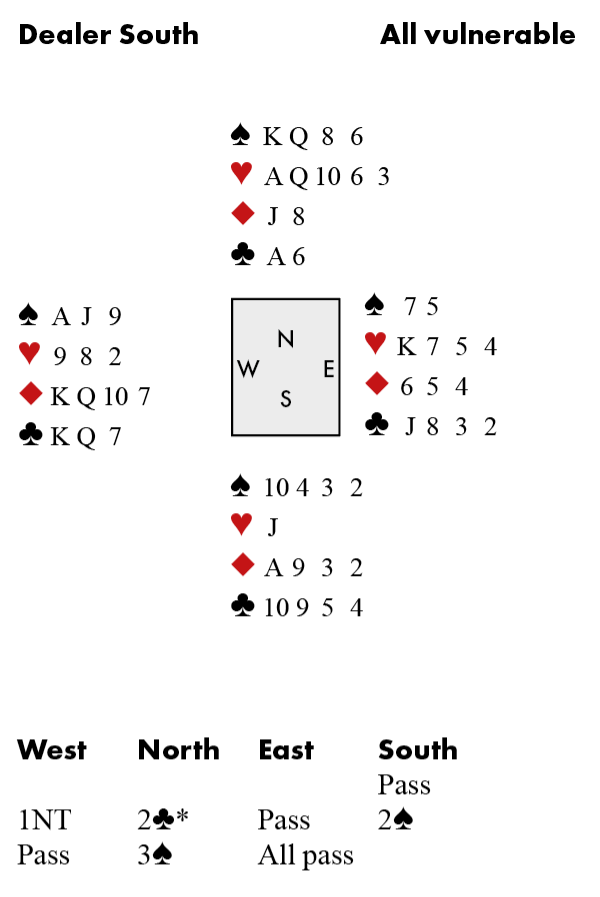
North’s 2♣️ was Landy showing both majors. I was West and started with the ♦️K. South won and ran his singleton Jack of Hearts. When it lost, he looked so disappointed I nearly apologised. My partner returned a Diamond to me and I played the K♣️, won in the dummy. It all seemed rather mundane; if declarer could get back to hand a couple of times, surely all I would score was the Ace of trumps? Just making?
Declarer trumped a Heart to get back to hand, and played a Spade up, ducked. Then he took another Heart ruff and played a second Spade up. I won the Ace – why not? – and was ready to cash my club and concede the rest, when I spotted that if I could put partner in with a Club, he could promote my ♠️J with a fourth Heart. It was worth trying and it worked a treat. Good by us or poor by declarer? As so often, a bit of both. He could easily just duck my King of Clubs, and we would have had no communication.
How to reform Reform
In early June last year I had a reasonably agreeable meal with a bunch of Reform UK activists at a restaurant in Guisborough – the main town in the seat which I would be contesting for the Social Democratic party, Middlesbrough South and East Cleveland. There were four of them, united primarily by one thing – a visceral loathing of the Conservative party.
Beyond that they were basically anti-woke and economically dry, as we used to call it. But all that took second place to the animus against the Tories. I have met pink-haired, nose-ringed, utterly vacuous LGBTQI sociology students who were more kindly disposed to the Conservatives than this lot.
They were, then, the perfect expression of what Rupert Lowe last week called a ‘protest party’, except that back then they didn’t yet have a messiah. He came along later, transforming what might have been a very lacklustre Reform campaign ending, most likely, in no seats whatsoever, as Rishi Sunak had intended by calling an early election. When the messiah did turn up, they managed only five, even if their national vote should – under a decent system – have given them somewhere in the region of 50.
So both Lowe and Nigel Farage are right, in a sense. Reform UK is indeed a protest party led by the messiah. And Farage is absolutely right to insist that if he hadn’t upset the apple cart by announcing his leadership and candidacy, Rupert Lowe wouldn’t have come close to winning Great Yarmouth. There, you see – I have come to heal, to pour oil on troubled waters.
There are other disagreements, of course, and yet they seem footling. Lowe is marginally more in favour of Tommy Robinson than is Farage, although even Lowe contends that he is ‘not right for Reform’. Farage’s blanket dismissal of Robinson is, I suspect, more pragmatic than deeply felt, and he was unfortunate that it drew the ire of Elon Musk. It may be, too, that Musk’s favourable comments directed towards Lowe – despite confessing he hadn’t the slightest clue who the hell he was – may have embedded within Lowe’s brain intimations of greatness, of leadership.
It is also true that Farage runs Reform UK like a personal fiefdom, in an autocratic manner, as Lowe has averred. My suspicion is that Farage thinks he is perfectly well within his rights to do this, being the only member of his party who is recognised by the public and the only one who has had what we might call success, politically.
You cannot simultaneously be a nationalist and an internationalist
Reform was ticking over nicely when led by Richard Tice but, as I’ve said, would have come nowhere near any electoral success last July. The Guardian, meanwhile, has suggested that Lowe is well to the right of Farage – and cited Lowe’s enthusiasm for repatriation, as the old NF used to call it. Farage is against, but once again largely for pragmatic reasons.
Otherwise there does not seem to be a great difference between them politically. Both are fervent disciples of the blessed Margaret and on social issues would have been perfectly at home in the old Monday Club. On economic issues they are both anti-taxers at heart, if not libertarians.
And so it is interesting that the first major schism in this nascent party has come between two people who basically agree with each other about a small state and reduced tax burden, given that Reform UK is currently trying to woo those Red Wall voters by promising to nationalise the railways and so on. If there were to be an ideological split in Reform, that is surely where it would come.
And in that you have Reform’s problem: it is still a protest party and does not have any ideology, as such. Even on the subject of migration, the party’s biggest vote-winner, there is among many at the top of Reform no small affection for the notion of free trade and free movement of labour. They are, as I have said, pro-business libertarians.
I have argued for a long while that the party will find it very hard to rise above about 25 per cent in the polls, and indeed that is roughly where they have been stuck for the past few months, despite a deeply unpopular government and an almost nonexistent opposition. This, I think, is a consequence of the party being in essence, as Lowe says, a protest party and also being seen as ‘far right’, no matter how stupid a term that may be. But it is also because there is a contradiction at Reform’s heart: you cannot be a free trader and in favour of free movement of labour and protect the jobs and incomes of your indigenous workforce. In other words, you cannot simultaneously be a nationalist and an internationalist. And in making commerce king, you become internationalist.
If you look at the parties in Europe which have been called by the media ‘far right’, none has clawed its way above about 25 per cent in the polls while pursuing a right-wing economic agenda. Look, for example, at the AfD in Germany. The populist parties in Europe that have succeeded in gaining power have tended to be protectionist and redistributivist, mixing a sometimes splenetic anti-liberalism with what we might call Old Labour concern for the working class. This is true of the Social Democrats in Slovakia, the National Rally in France and, to an only slightly lesser extent, Fidesz in Hungary.
More strikingly, it is also true of Donald Trump. We may not be accustomed to thinking of him as being ‘left-wing’, but trade tariffs which protect the jobs of domestic workers are precisely that. There is a Blue Labour side to the Trump administration – which is perhaps why the architect of Blue Labour, Lord Glasman, was the only Labour figure invited to the inauguration.
The current spat in Reform is personal and a little petty. What lies beneath, though, is potentially far more destructive.
Why does the beheading of Christians not make headlines?

Colin Freeman has narrated this article for you to listen to.
The Congolese chapter of Islamic State has a ruthless way of stopping outsiders reporting their presence to the authorities. Under the edicts of their founder, Jamil Mukulu, who once lived as a cleric in London, anyone who strays across them in their forest hideouts should be killed on sight. ‘Slaughter him or her, behead them immediately,’ Mukulu once commanded. ‘Never give it a second thought, do not hesitate.’
His acolytes take him at his word, even when it’s not just one hapless villager who runs into them, but dozens. Last month, they beheaded 70 Christians in Mayba in the eastern Congo, according to the Catholic charity Aid to the Church in Need, which campaigns on behalf of persecuted Christians worldwide. The charity said the corpses of the victims, including women, children and elderly, were dumped in a nearby evangelical church.
Even in a world accustomed to IS horrors, such atrocities would normally make headlines, as they used to in IS’s old killing fields in Syria and Iraq. Not so when they happen in the Congo, where violence has long been the norm. There are so many different armed groups that even the most diligent foreign editor struggles to make sense of it. A three-sided civil war is hard enough to explain. A 120-sided one? Forget it.
The only attention the murdered Christians have had in Britain is via the Catholic peer Lord Alton of Liverpool. ‘What are we doing to confirm those reports?’ he asked the Upper House. ‘Have we raised this with the International Criminal Court and the African Union to ensure that those responsible for this terrible atrocity are brought to justice?’
His questions are unlikely to get satisfactory answers. While another Christian charity, Open Doors UK, is ‘100 per cent confident’ that the incident occurred, Monusco, the Congo’s UN peacekeeping force, is still trying to confirm it a month later. The alleged culprits, who act under the banner of Islamic State’s Central Africa Province, have vanished into the bush. And even if Monusco knew where they were, it has bigger threats to worry about. In January, the Rwandan-backed M23 rebel group launched a brazen offensive in the eastern DRC, capturing the regional capital, Goma, and sparking fighting that has killed 3,000 civilians and 13 UN peacekeepers, and forced nearly half
a million to flee their homes.
The black IS flag flutters over troublespots across the region, from Somalia and Mozambique to Mali and Niger
It is in such anarchy that groups such as IS, which have failed to regain their strongholds in the Middle East, now see a future. A decade ago, the group’s only significant presence in sub-Saharan Africa was in Nigeria, where Boko Haram pledged fealty. Now the black IS flag flutters over trouble spots across the region, from Somalia and gas-rich northern Mozambique to the coup-ridden Sahel nations of Mali, Burkina Faso and Niger.
Ever since the beginning of the War on Terror, security officials have warned that Africa’s impoverished central belt – home to nearly a dozen failed states and much of the ‘bottom billion’ of the world’s population, many of them Muslim – could become jihadism’s last redoubt. With Donald Trump abandoning America’s role as world policeman, and Europe pre-occupied with its own security challenges, that seems more probable than ever.
Congo’s jihadists started life as a militant Islamist sect in neighbouring Uganda in the 1990s, operating under the innocuous name of Allied Democratic Forces (ADF). They were funded by the Congolese dictator Mobutu Sese Seko and Sudan’s Omar al-Bashir, to be pawns in regional mischief-making. Clashes with Ugandan troops then forced the ADF over the border into eastern Congo, where it embraced full-blown jihadism and is now – despite stiff competition – the most violent of the region’s armed groups.
Its founder, Mukulu, was born a Christian, David Steven, but converted to radical Islam and travelled to Sudan, where he is thought to have met Osama bin Laden. In 2010, the Foreign Office launched an investigation into UN claims that he was raising funds for the group while working in London. Since 2015, he has been in jail in Uganda, awaiting trial on terrorism charges, but his group has gone from strength to strength, with up to 2,000 followers. Like Boko Haram, it recruits and kidnaps child soldiers, and sees schools as targets for headline-grabbing atrocities.
Despite the hopes of Lord Alton, it is unlikely that the ADF’s henchmen will ever face justice. In Nigeria and Somalia, Islamist militants are chased – with limited effectiveness – by western-backed government forces. In the Sahel, they have to contend with Russian-backed Wagner mercenaries. But in the eastern Congo, UN and Congolese government forces have their hands full dealing with the chaos caused by the M23 incursion. The M23 – widely seen as a proxy force for Rwandan leader Paul Kagame – claims to be chasing Hutu genocidaires who fled into eastern Congo after slaughtering half a million Tutsis in 1994. Most analysts, though, think that Kagame is using this as cover for a landgrab on the eastern Congo’s mineral assets, which include rare earth deposits.
Will Brown, a senior policy fellow at the European Council on Foreign Relations, likens M23 to Vladimir Putin’s ‘Little Green Men’ who took Crimea in 2014. There, though, the comparison ends. For much as the West disapproves of M23, there is a limit to how much they want to alienate Kagame. While activists criticise his human rights record, Rwanda has prospered under his rule. In contrast to many of its neighbours, aid has been spent well, corruption tamed and governance improved. Rwanda’s battle-hardened army is also highly capable, and has been helping with counter-insurgency operations in the Central African Republic, Benin and Mozambique, to name but a few. Kagame is increasingly seen as the region’s policeman, for better or worse.
All of this means the West has little leverage over Rwanda as it stirs chaos in the eastern DRC, beyond a few threats of sanctions – most of which will seem even weaker given America’s growing rift with Europe. A new war in the Congo may be just the first of many across Africa – and for every strongman like Kagame flexing his muscles, there will be an IS franchise wielding their machetes.
Save Syria’s Christians
David Lammy, the Foreign Secretary, and Marco Rubio, US Secretary of State, had rather tellingly different responses to the latest wave of violence in Syria. Lammy deplored the ‘horrific violence’ but failed to address where that violence was coming from. Rubio, by contrast, stated clearly that ‘radical Islamist terrorists’ were targeting minorities in Syria, including Alawites, Christians and Druze.
Rubio is right. While precise numbers are difficult to ascertain, it appears that, according to a source verified by the Hungarian government’s State Secretariat for the Aid of Persecuted Christians – the only one in the world – up to 3,000 people may have been killed, the majority of them innocent Alawite civilians. A number of Christians have also been killed. While clearly a pogrom against the Alawites, Christians in Syria are deeply concerned because, as the old Syrian phrase has it, ‘first the Alawites, then the Christians’. Since the accession of the Islamist government at the end of last year, Christians have been the subject of murder, kidnappings, intimidation and vandalism. The situation is very tense.
It may not be acceptable to say so, but, under the undeniably brutal dictatorship of the Assad family there was no inter-religious strife and all religious minorities were protected. On a visit to Iraq in 2017, my interpreter, a resident of Raqqa and a former supporter of the rebels, told me he was committed to Assad because he had seen the alternative.
The alternative, even if they put on western suits and enjoy obsequious chats with the Davos crowd, are all committed Islamists. The new leader, Ahmed al-Sharaa, otherwise known as Abu Mohammed al-Jolani, started his terrorist career in Iraq with Abu Musab al-Zarqawi, before moving the franchise to his own version of al Qaeda. Can it be that an Islamist leopard has changed his spots?
The PR war, at least in the West, is being skilfully handled: the new regime has yet to appoint a diversity minister, but its supporters are trimming their Islamist beards and talking to journalists about education for women. However, discussions on the constitution include sharia law and, more worryingly, the demand the president be a Muslim, thus relegating all minorities to second-class status.
Does it matter, apart from the obvious humanitarian question, that Christianity survives in Syria? Hearing Syriac Aramaic, the closest language to that used by Jesus, being spoken not just in the liturgy but on a mobile phone in the ancient town of Maaloula is a reminder of the roots of Christianity in Syria. This part of the world is one of the very few places where Aramaic is still spoken, including parts of the Nineveh Plains of Iraq, and that is not just a cultural linguistic curio. Christianity was born in this region. According to the historian Philip Jenkins, between the years 640 to 740 there were no fewer than six popes from Syria and, in 668, Pope Vitalian sent Theodore of Tarsus to Canterbury to be archbishop. There was a time when the Church was truly catholic – and the contribution of the Churches of the Middle East, particularly Syria, was vital.
Pope John Paul II once spoke of the Church ‘[breathing] with two lungs – of the East and the West’, and if one of the lungs is either damaged, destroyed or ignored, the body as a whole will suffer. Not only have Middle Eastern Christians felt ignored and forgotten by the Church in the West, as Islamic persecution has destroyed their churches, but western Christianity, with its increasingly empty churches and dwindling congregations, has lost a vibrant and revitalising connection with the roots of the religion.
A tree cut off from its roots will not survive. The very fact that most western Christians are unaware of the extent of persecution directed against the Church, helped by an uninterested or hostile media, is an ignorance for which much of the leadership in the Church is culpable. The Church in the West focuses on climate change and ‘green audits’ for parishes. Yet those who are having their heads cut off for their profession of the Christian faith do not worry too much about the harmful effects of air conditioning.
This year, the Church commemorates the 1,700th anniversary of the Council of Nicaea, which produced the Nicene creed, still said on Sundays by orthodox Christians. At that council, which was critical to the life and teaching of the early Church, the majority of the bishops attending were from the East. It would be illogical to celebrate that crucial moment in history without considering the contribution of the ‘eastern lung’ of the Church. We must not forget that lung, as it fights for breath today.
What music did our monarchs like?
Royal warrant
The King revealed that among his favourite pieces of music were the 1980s hits ‘Upside Down’ by Diana Ross and ‘The Loco-motion’ by Kylie Minogue. What music did other monarchs like?
– Elizabeth II was reported to have been partial to ‘Cheek to Cheek’ by Fred Astaire, ‘The White Cliffs of Dover’ by Vera Lynn and ‘Sing’ by Gary Barlow and Andrew Lloyd Webber, written to celebrate her Diamond Jubilee.
– George V attended a command performance by Louis Armstrong in 1932, hinting at a fondness for jazz.
– Edward VII knighted Sir Edward Elgar.
Avocado blight
Alan Titchmarsh implored people to eat cornflakes for breakfast rather than avocado on toast, on account of the ecological damage wrought. Global production of avocados soared from 716,000 tons in 1961 to 10.4 million tons in 2023. The largest producers (in tons) in 2023 were:
Mexico 2.97m
Colombia 1.09m
Dominican Republic 1.02m
Peru 983,000
Indonesia 874,000
Kenya 542,000
Europe’s largest producer is Spain, with 86,800 tons.
Source: UN Food and Agriculture Organisation
Home rules
How many people pay full council tax? Of the 25.7 million dwellings in England:
– 16m (62.5% pay the full rate).
– 8.8m (34.1%) qualify for a discount, mostly because of single occupancy.
– 120,000 (0.5%) pay a premium, in most cases because they have been empty for more than a year.
– 280,000 (1%) are second homes, many of which will become liable for a 100% council tax premium from April.
– 748,000 (3%) are exempt, occupied entirely by students, disabled or mentally impaired people, or are being renovated.
Slave drivers
Who gets referred on suspicion of being a victim of modern slavery?
– In 2024 there were 19,125 referrals, a 13% increase on the previous year.
– The most common nationalities of the suspected victims were UK (23%), Albanian (13%) and Vietnamese (11%).
– The biggest increase was among Vietnamese, from 988 to 2,153.
Source: Home Office
The ‘physician associate’ will see you now…
There is a war being waged in NHS hospitals. On one side are overstretched junior doctors in understaffed wards. On the other: physician associates (PAs) or, to use the more disparaging term, ‘noctors’.
Since 2003, non-medical graduates have been able to gain entry to hospital wards and GP practices if they complete a two-year clinical course that leaves them a ‘physician associate’ or ‘anaesthesia associate’. At first, PAs were rare – ten years ago there were fewer than 150 in England. Since the pandemic, however, the numbers have exploded. There are now approximately 4,000 PAs working in England and Wales.
PAs are supposed to help doctors with the time-consuming administrative work. Instead, many medics argue that they are stealing training opportunities from medical practitioners. Junior doctors complain about low pay, with foundation-year medics until recently beginning on a base salary of around £28,000 – while physician associates now start on £46,000. Graduates who have completed at least five years of medical school are expected, in some hospitals, to answer to non-doctors who have completed something akin to a clinical crash course. And medics keen to pick up training opportunities for speciality training applications have been pushed out of procedures while PAs benefit.
The already troubled relationship between doctors and PAs reached a nadir this month when pro-euthanasia politicians rejected an amendment to the assisted suicide bill that would have insisted only fully qualified doctors sign off applications. MPs fear that non-medics could be the ones deciding who lives and who dies.
It’s not just doctors who should worry about the influx of PAs in hospitals. Cases of medical mismanagement at the hands of physician associates are stacking up. In 2023, 30-year-old Emily Chesterton died of a blood clot after being misdiagnosed by a PA whom she assumed was a GP. Chesterton exhibited ‘red flag’ symptoms of shortness of breath and calf pain, but the physician associate examining her didn’t spot the seriousness of her presentation. More alarmingly, the PA did not make it clear that they were not, in fact, a medical practitioner.
Last month, a coroner issued a warning about PAs after a woman with severe abdominal problems was wrongly diagnosed as having a nosebleed. She died four days later. In another case, Ben Peters, 25, died after suffering an acute aortic dissection – a tear in the biggest artery in the body – the day after he saw a PA in November 2022. While the hospital trust concluded that the physician associate had ordered all the correct tests, Peters’ case illustrated yet another example of a patient being discharged without seeing a doctor.
Employing PAs is a cheap and easy way to tackle the NHS staffing crisis, but it comes at a cost: patient care
There have been reports of PAs using the title ‘Dr’ despite having no right to do so. There are even cases where physician associates have been drafted into GP surgeries that had struggled to recruit clinicians. In fact, in a 2017 census by the Faculty of PAs, almost two-thirds of physician associates admitted they had been asked to cover trainee doctor rota gaps at hospitals. Tellingly, the question was ditched from subsequent surveys.
It’s the blurring of lines between PAs and doctors that worries medics. Some take issue with the job title, since in surveys patients say they think ‘physician associate’ sounds ‘grander’ than junior doctor. Lady Finlay, a palliative care doctor and fellow of the Royal College of GPs, suggested the role should be renamed ‘physician assistants’. (To make matters more confusing, there is already a doctor role titled ‘associate specialist’.)
Adding to the ambiguity, the General Medical Council – the body that polices doctors – became the statutory regulatory body for PAs last year. This move has caused much consternation in medical circles: the British Medical Association, the Doctors’ Association UK and the EveryDoctor group all opposed the decision.
‘What’s become increasingly clear is that by trying to refer to everyone as “medical professionals”, there is enormous confusion as to who is doing what,’ says Professor Philip Banfield, the BMA chair. He points out that the only legally protected title for a doctor is ‘medical practitioner’ – which sounds awfully similar to the umbrella term PAs now fall under.
‘The GMC has also declined to set the standard for what a non-doctor can and can’t do,’ adds Banfield, whose union is taking the GMC to court over the issue. ‘As you find more evidence of something being wrong in medicine, you don’t keep treating the patient when it’s not working. This is a patient safety issue. There’s a clear distinction between the amount of training, skills and expertise a doctor has compared with a physician associate. The associate professions should be supervised directly by a senior doctor – but that isn’t happening. What we’re seeing is doctors being substituted by PAs.’
The GMC is facing a separate legal challenge from Anaesthetists United, which has accused the medical regulator of ‘simply ignoring the law on professional regulation’. The Association of Anaesthetists, another organisation that has flagged concerns, has called for the GMC to ‘present doctors and PAs on separate registers’ and ‘protect every-one from accidental or deliberate misrepresentation’.
Doctors are disappointed by the actions of their regulatory body. ‘For some time now, doctors have lost confidence in the GMC as their regulator,’ says Banfield. ‘It doesn’t come as a surprise for the GMC to defend an indefensible position.’
There has been some relief at Health Secretary Wes Streeting’s decision in November to commission a review to examine whether the non-medics are working within their limitations. ‘The difficulty is that the only point at which we know what physician and anaesthesia associates can do is at the point of qualification,’ says Banfield. ‘After that, it’s entirely down to what an employer lets them do. So there’s no national scope of practice that puts the ceiling on what they can and can’t do. There is nothing stopping an employer training a physician associate to do a caesarean section, for example, and then two years later calling them a “consultant” – without any understanding of the underlying anatomy, physiology, pathology and things that can go wrong.’ The PA course skips the scientific foundations of medical degrees and its finals are more straightforward than first-year medical exams.
All major political parties are in favour of training PAs as a quick solution to staffing shortages. Under the last Conservative government, NHS England aimed to expand numbers to 10,000 by 2036, while the Scottish government says it is keen to ‘gradually’ increase numbers. More PAs on the wards mean staffing quotas can be met while weakening the bargaining power of doctors campaigning for better pay and conditions. Although PAs often start on higher salaries than junior doctors, there is less opportunity for career – and therefore pay – progression. As the exodus of medical trainees to countries such as Australia and New Zealand continues, employing PAs is a cheap and easy way to tackle the NHS staffing crisis. All this does come at a cost, however: patient care.
Flooding the system with less qualified medical staff makes incidences such as the death of Emily Chesterton more likely. ‘It symbolises the start of a greater sort of creep, of less qualified medical professionals doing things outside of their competencies,’ one practising doctor tells me. Even if these cases don’t end fatally, misdiagnosis further clogs the system with patients who need to return to their GPs or hospital.
There is also a worry that a ‘two tier’ system could evolve, with more rural, deprived areas being left under the care of non–medical graduates while the dwindling population of doctors are moved to big city hospitals. Dr Alison George, a GP from Newcastle, has warned of the evolution of a ‘doctor-lite’ service. ‘It’s a down-skilling, downgrading of healthcare which will affect people on lower incomes,’ she says.
While there are areas where overworked doctors would be desperate for extra help – from history-taking to administrative tasks – there is no future for a health service that sees physician associates acting like doctors. The insidious creep towards PA-led care must be tackled and the scope of PA practice must be clearly defined and regulated – or patients will be the ones losing out.
Losing Kursk is a big blow to Zelensky
After eight months of fighting on Russian soil, Ukrainian troops are pulling back from the Kursk region. This morning, Russian forces raised their flag over Sudzha and are now closing in on the last 50 square miles of Ukrainian holdouts. The retreat couldn’t come at a worse time for Kyiv – just as a ceasefire and potential peace deal are on the table. Zelensky had hoped to trade the Kursk salient for Ukrainian land in negotiations. Now, that leverage is almost gone.
Russian troops, reinforced by North Koreans, have been steadily clawing back the 500 square miles of Russian territory seized by Ukraine last August. But the real breakthrough came in the past two weeks, as Russian forces gained fire control over the only paved road linking Sudzha to Ukraine’s Sumy region, choking off Ukrainian logistics and burning down supply convoys with drone strikes.
While Russians pressed the flanks, storming Ukrainian positions on motorcycles, quad bikes and even golf carts – driving straight over minefields – about a hundred soldiers spent two days crawling through an empty gas pipeline to slip behind Ukrainian lines near Sudzha. Ukraine’s military insisted they weren’t caught off guard, posting videos where they bombed the Russians as they emerged. But the advances from all sides still left Ukrainian troops at risk of encirclement. One by one, brigades were ordered to pull back, with some soldiers forced to march dozens of miles on foot.
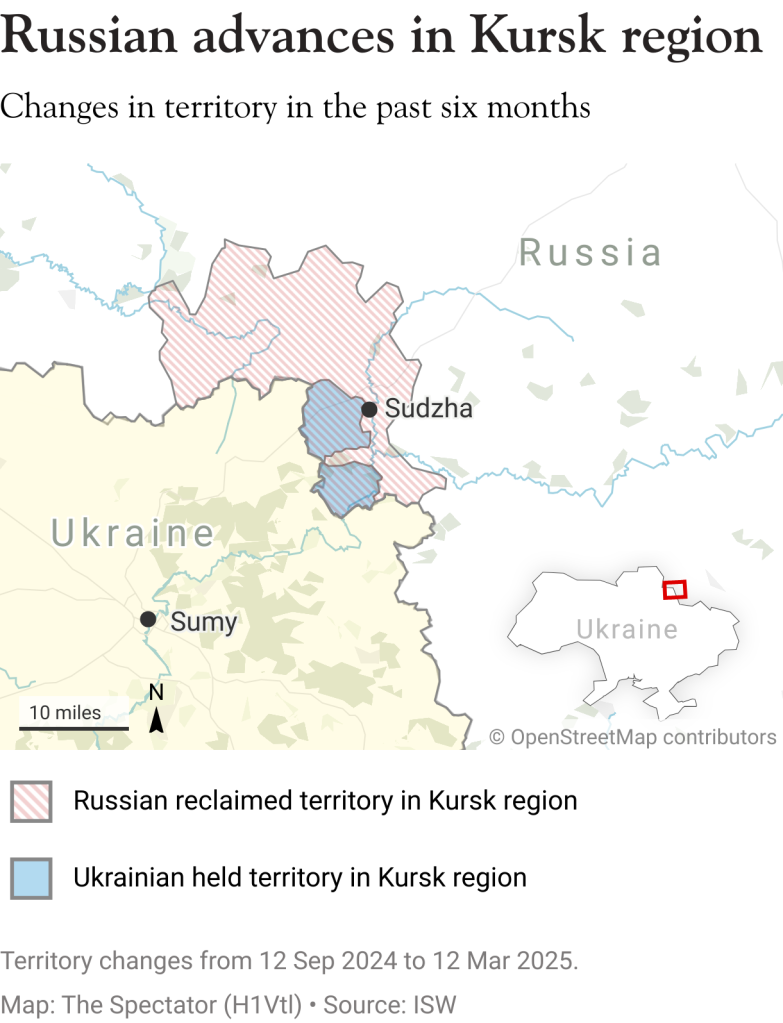
Was the operation worth it? That depends on how you look at it. The Kursk offensive marked the first incursion on Russian soil since the second world war and successfully drew 60,000 Russian troops into bombing their own territory instead of Ukraine. It exposed poor Russian defences and humiliated Vladimir Putin, who had to seek help from North Korea to reclaim Russian land. It also gave Ukraine a much-needed morale boost after more than a year of bloody defence. But the cost was high: Volodymyr Zelensky pulled elite units from the Donetsk region to reinforce the push across the border, weakening Ukraine’s eastern front and paving the way for Russia to seize territory three times the size of Kyiv last year.
Now, the fall of the Kursk salient will play straight into Donald Trump’s narrative that Ukraine ‘doesn’t have any cards’ at the negotiating table. Three years of full-scale war have drained any realistic hope of expelling Russian troops from all Ukrainian lands, and Zelensky’s gamble – that Putin would have to make concessions to restore the pre-Kursk boundaries – has failed. The issue of land will be central to the negotiations with Russia, with Putin insisting that Ukraine surrender four regions and Zelensky refusing to cede an inch. With Kursk lost, Zelensky’s standing now looks much weaker.
Man Utd fans – and Gary Neville – should stop moaning
What exactly is it that the Glazer family has done that makes Manchester United fans whine so endlessly? I ask only because I’ve just finished watching Gary Neville’s frequently ludicrous interview with British billionaire Jim Ratcliffe – who since purchasing a 27.7 per cent stake in the club in 2023 has overseen its football operations – and am none the wiser.
After hearing Ratcliffe, very patiently, it must be said, appraise Neville of the truly parlous state of the club’s finances – it seems obvious if the Glazers are guilty of anything, it is of being too trusting. For the last 12 years, the family on the other side of the Atlantic has apparently obligingly signed every cheque they’ve been asked to in order for the club to go on attracting the world’s best players and managers. Over that same period, however, very obviously the Reds have been run with same regard for value as is the NHS.
‘They’ve given management a lot of rope – too much rope, obviously,’ Ratcliffe says. ‘The previous two teams of management have to take a lot of the blame.’
Manchester United fans never tire of talking about how the Glazer family, by enacting a leveraged buy-out of the club, has saddled it with debt, but what difference in itself has this debt made to the end product – namely the football the first team produces? The answer is none. The funds have always kept flowing – more plentifully, in fact, than ever before.
Since the departure of Sir Alex Ferguson in 2013, Ratcliffe points out United ‘have spent a billion pounds on players, which is pretty much the same as Manchester City… but we haven’t spent it that well.’ As a result – given the laws of, err, capitalism, repeated failure to qualify for the lucrative Champions League tournament and the inability to draw on infinite reserves of oil money a la their Abu Dhabi-owned neighbours – the club not surprisingly now finds itself in queer street.
‘Manchester United would have run out of money by the end of the year… in the last four years it has lost £330 million,’ Ratcliffe says, adding 1,100 people are now employed by the club and that since 2018 annual costs have increased by £100 million. ‘It’s a bloated organisation and has made mistakes.’
It’s at this point in the conversation multimillionaire Neville, who despite educating his children privately is never shy of burnishing his left-wing working class hero credentials, attempts to take Britain’s second richest man to task for his efforts to reduce expenditure at United by ending the practice of providing free lunch for all staff.
He says: ‘I think when it comes to food and Manchester United’s staff being fed, the idea of me eating differently than my compatriots in the office, the groundsmen, the kit men… I find that difficult from an equality perspective.’
Politely – ‘I get that, Gary’ – Ratcliffe doesn’t in return ask the former defender if he ever had, from an equality perspective, any problem when playing with being remunerated rather differently to his groundsmen compatriots, but instead points out the money that finances free lunches is ultimately ‘the fans’ money’, adding he would rather see it spent on players that might help the football club win matches.
‘Can we not do both?’ Neville asks, sounding for all the world like a child with no concept of what money is, and seemingly having not listened to a word Ratcliffe has said.
While I’m reluctant to draw too much wider significance from the story of a private business – in this case a very famous football club – in decline, it is hard to ignore the reality that what its fans fear is happening at Manchester United is obviously to a greater or lesser extent also afflicting every part of life in the UK.
Our high streets, our infrastructure, our cultural institutions, even our ability to make things – all of it seems long ago to have been first sold to the highest bidder and then badly managed or hollowed out with a rapacity that once terrified but now seems entirely routine. This week it’s Thames Water in the headlines, but before that it was Debenhams, and before that Cadbury, and before that P&O Ferries and British Steel and so on and so on. Great generators of long-term wealth, each gutted and stripped for short-term profit.
One hopes eventually something will be done about it – a similar political force, perhaps, that has taken hold in the US will replicate itself here – but until that day comes Manchester United fans should remember that the club they love chose all by itself in 1991 to list itself on the UK stock market for the sole purpose of raising a quick buck, and by doing so made itself vulnerable to precisely the kind of economic forces that have led it to where it finds itself today.
They should then count themselves lucky that their American benefactor continues – despite their near constant ingratitude – to send the cheques, and that in Ratcliffe they have a mini Elon Musk, come to turn the ship around by first eradicating waste.
But please, in the meantime, enough with the whining.
Is £250 a year enough for you to have a pylon ruining your view?
As part of its plans to streamline the planning process for much-needed infrastructure, the government has confirmed that it intends to give people a discount on their energy costs if they have new power pylons or other energy infrastructure built near their property. Outlining the plan, the housing and planning minister, Alex Norris, said that the discount could amount to £250 a year – around 12 per cent of the average household’s energy bill – for those living within 500 metres of new or upgraded structures.
‘If you’re making that sacrifice of having some of the infrastructure in your community, you should get some of the money back,’ he said. Insisting that communities ‘need to share the benefits’ of the country’s move towards clean energy, he went on: ‘We think that’s a fair balance… people who are making that commitment to the country themselves, well, they should be rewarded for that.’
Well, yes, but let’s have a think about it. At the risk of being selfishly Nimbyist, I have to say that £250 a year – or £2,500 over ten years, as it was presented – would not do much to sweeten the pill if the house I had chosen for its unobstructed rural views suddenly acquired a line of 150-foot-high pylons marching across the near horizon. I grant that there are some infrastructure projects – a very few – that could be said to enhance the landscape. Some of the Eiffel bridges come to mind, and my out-and-out favourite, Sir Norman Foster’s Millau Viaduct in central southern France. But let’s say that the £250 is the government’s opening bargaining position and that a few in-person protests blocking access to the chosen site might edge up the rebate a bit.
A natural question might rather be – why stop there? How long might it be before payment for proximity, as we could call it, becomes a wider political issue? What is it, after all, that makes pylons and other power infrastructure such a problem that it requires restive locals to be bought off, while a host of other – to some equally or still more needed – investments carry no such premium?
Let’s start with the third runway for Heathrow Airport. Living in south west London, I am already under what seem a myriad of Heathrow flight paths, which only seem to multiply and extend their hours at the very times that you want your windows open, and the late evenings and early mornings are light. If the government is prepared to pay a price for ‘communities’ who welcome new power pylons, how about a price for the increased noise nuisance of even more flights taking off and landing at Heathrow?
Come on, ministers – if you don’t want to splash the cash, how about an annual allowance in kind – a couple of free return air tickets for those whose quiet evenings are polluted by the aircraft that will be using the third runway? There could even be a special category for us, say, Flyover Club Class, with preferential boarding. Come to think of it, once the principle has been granted, how about some back pay for all the years of ever-more-frequent flying? Surely, if female shop-floor workers at Asda can make a case for equal pay with mostly male warehouse workers going back decades, there is a historic case for those bothered by the nearby airport?
What else do people not like having built near them? How about those euphemistically named ‘recycling facilities’, otherwise known as ‘the tip’? I am quite a fan of the one at Battersea, with its multiple pits for different sorts of rubbish and the delightful gents – no ladies for some reason – who guide you to a parking slot and advise you on what goes where. You leave with the satisfaction of having both got rid of surplus stuff and done your bit for the environment. But I wouldn’t choose to live near one.
Nor do a lot of other people. Indeed, some of the early ‘green’ protests in Russia were about the siting of new rubbish tips, and they can hardly be called popular in any country. So why not try a backhander? Sorry, I should have said a ‘reward’ for accepting the pain for a shared gain. A new recycling facility is surely as necessary to the common weal as new clean power infrastructure. If local councils, which usually commission such facilities, do not want to give an actual cash discount on our council tax, how about a consideration equivalent to ten free rubbish collections a year? Or how about a free Christmas tree, delivered and collected at that time of year?
A new prison, a new bail hostel, a new migrant hotel, the Bibby Stockholm barge (remember that?). What sort of amenity is there where the principle, set out by the minister, ‘If you’re making the sacrifice of having some of the infrastructure in your community, you should get some of the money back,’ would not apply?
Which makes me wonder whether the government ever really considered the implications of what it was proposing – essentially paying people to put up with some nuisances and not others. Because surely, if you get paid even a pittance for not protesting about a particular sort of unwelcome but needed development – in this case, pylons or, presumably, power plants – it is hard to see why other similarly unwelcome but needed developments are not compensated too.
It is equally hard to see how this disparity, with its perceived unfairness to those facing no less hateful developments within a 500-metre radius of their homes, will not end up in court. I look forward to all the new class-action lawsuits that are going to clog up the judicial system in the near future, as barristers argue to-and-fro about whether pylons, say, are unique in the strength of opposition they inspire versus the communal benefit they confer, or whether this is a characteristic that many other new developments share.
Why Russia should agree to a ceasefire – and five reasons Putin might not
The main achievement of the US-Ukrainian talks in Jeddah was to produce a ceasefire document that Russia might actually want to sign. A long list of Ukrainian red lines – such as a partial ceasefire in the air and sea only, and security guarantees before any ceasefire was implemented – were swept aside. What’s on the table is essentially an unconditional ceasefire on all fronts, initially limited to thirty days. Putin now needs to decide whether it’s in Russia’s interests to accept. There are six reasons why he should sign the Jeddah deal – and five reasons he may not:
Why Putin should agree to the deal:
Relations with Washington are more important than military gains on the ground in Ukraine
As Russian National Guard chief Viktor Zolotov put it, “Ukraine is where the border between the US and Russia runs.” Putin has always maintained that the Maidan revolution of 2014 was a Western-orchestrated coup and that the Kyiv regime are puppets of Washington. Therefore, by his own logic, the only way to prevent Ukraine from joining Nato and becoming a strategic threat to Russia is to do a deal with the puppet-masters in Washington.
Trump is unpredictable and could turn against Putin as suddenly as he has turned towards him
It’s easy to forget that Trump was much harder on Putin in his first term than Obama had ever been, sanctioning Gazprom’s Nord Stream-2 pipeline and stepping up military aid to Kyiv. Senator Lyndsey Graham yesterday threatened that if Putin does not take the deal then the US will sanction countries that imported Russian oil and gas – principally India, but also Europe which still gets 13 per cent of its energy from Russia and growing. Those would be the kind of hard sanctions that could truly cripple the Russian economy.
The war is slowly strangling Russia’s economy
Despite surviving sanctions far better than expected, Russia is suffering from high inflation and interest rates. A GDP bump fuelled by military spending is going flat and there is a crippling shortage of skilled workers and investment. War spending consumes 40 per cent of Putin’s state budget.
Russian elites want to get rich and travel again
A key fallacy behind Western sanctions since 2014 has been that Russia’s ‘oligarchs’ will see Putin as bad for business and rein in his geopolitical adventuring. In the end, Putin ignored the business class and wiped billions off their wealth by ploughing on with his self-appointed world-historical mission to ‘liberate’ the Russians of East Ukraine to secure his nation’s borders in depth. But after three years of war, members of the elite are starting to chafe at travel restrictions, personal sanctions and frozen bank accounts.
Thirty days is a short time
The short time limit on the ceasefire gives Putin plenty of room for demanding concessions from Kyiv – principally over the formula for Ukraine’s future neutrality, and the size of its military. If he gets nowhere, Putin can always resume the offensive. A month will not give the Ukrainians time to significantly strengthen or regroup.
Putin has a better chance at controlling Ukraine through the ballot box than by violence
Ever since Ukraine’s independence in 1991, Moscow has tried to control Kyiv’s elites though an endlessly shifting mix of macroeconomic bribery, personal corruption, funding of pro-Russian opposition parties and propaganda. The full-scale invasion of 2022 was driven in part by the failure of those mechanisms to change Ukraine’s pro-Western course. But having spent trillions of rubles and 700,000 casualties on taking just 19 per cent of Ukrainian territory, Putin may now calculate that the time has again come to revert to the old pattern and try to influence Kyiv from within.
Five reasons Putin may not agree to the deal:
Putin believes he is a grand master of geopolitics
Putin famously lives in an information bubble and is surrounded by sycophants trained, like himself, in the 1970s KGB. Trump’s sudden fit of apparent sympathy for Putin and anger at Ukraine is, in truth, driven partly by Trump’s personal grudges against Zelensky and partly by impatience to finish the war. Trump sees no vital US interests in either Russia or Ukraine. But the people around Putin may hubristically decide that the world is suddenly going their way and push for more concessions. Putin’s foreign policy has always been opportunistic; he’ll take what he can get. The biggest danger to peace in Ukraine is Putin’s arrogance and his tendency to over-reach.
Once the war is paused, it may be hard to remobilise Putin’s motley force
Putin hates to lose
The Kremlin’s continued stranglehold on Russia’s information space will allow Putin’s propagandists to spin any outcome of the war into a victory. But questions will be asked – especially by right-wing ultranationalist Russian self-described ‘patriots’ – over what the titanic sacrifice was all for. If Ukraine continues its pro-Western course and remains democratic and free, it will be clear that the invasion achieved nothing. That could seriously undermine Putin’s image as an infallible protector of his people.
War is hard to resume once stopped
It’s hard to get an objective picture of morale inside the Russian army. But servicemen bloggers on Telegram and Signal offer plenty of tales of commanders’ sadism, execution of their own men, massive corruption and cynicism across the Russian military. Most Russian soldiers are serving only in order to collect huge bounties, or to get out of jail. Once the war is paused, it may be hard to remobilise this motley force.
Putin’s regime needs an outside enemy to survive
At the beginning of the war, Putin’s propagandists attempted to cosplay the invasion of Ukraine into a version of the USSR’s fightback against the Nazis. Paramilitary youth groups were formed and schoolchildren paraded. As the war wore on – especially after the Wagner mutiny of summer 2023 – the tendency has been to play down the ‘special military operation,’ which often doesn’t even enter the top three items on national TV evening news. Unlike the battling states of Orwell’s 1984, the regime does not rest solely on constant warfare for its legitimacy. Indeed, in his last state-of-the-nation speech in November, Putin spent four times longer speaking of prosperity and social programmes as on the war. Nonetheless, Putin poses as the protector of his people from a belligerent West. If he suddenly makes a deal with Washington, what will his narrative be then?
Demobilising the army will be dangerous
There is a major political and social liability inherent in demobilising hundreds of thousands of battle-traumatised, ultra-violent men. As Yevgeny Prigozhin’s mutiny showed, there was a groundswell of support among ultranationalists that Wagner had been stabbed in the back and the war could have been won were it not for ‘parquet generals’ and corrupt politicians. The greatest threat to Putin’s power comes not from pro-Western liberals like the late Alexei Navalny, but from the nationalist right who could easily develop a betrayal narrative against the thieving Kremlin.
Is Kemi Badenoch getting better at PMQs?
If Kemi Badenoch has a plan, she’s keeping it hidden. At PMQs she used her scattergun approach to complain about unemployment, farming, winter fuel payments, council tax, increases in NI, business closures, food-aid for underfed kids and the murder of David Amess. Eventually, she reached the chancellor’s awkward ‘spring statement’ which would have made a much better starting point. There was no shape to her performance, no dramatic climax, no electrifying revelation to dominate the afternoon news. And she’s low on energy. Does she even need six questions? She should sell half of them to the SNP who are adept at concealing illicit financial deals from the auditors.
Her best moment came when she mentioned the stinking dunes of refuse gathering in Labour-run Birmingham.
‘People vote Labour and all they get is trash – just like he’s saying over the despatch box.’
This looked like an improvised quip. And she derided Sir Keir’s policy of placing ‘breakfast clubs’ in schools to feed pupils who arrive in the classroom with empty bellies. Labour has cannily opened two of these soup-kitchens in Kemi’s constituency to create an atmosphere of poverty and failure. She was quick to decry the gimmick as ‘60p breakfast clubs.’ A fair point. Treating north Essex as a famine zone is unlikely to boost children’s confidence in Britain’s future. But Sir Keir slapped her down for daring to criticise his saintly programme.
Without any leadership from Kemi, Sir Keir was allowed to dominate. He was briefly cornered by a Tory backbencher, Andrew Snowden, who raised a worrying issue that Kemi had overlooked. Snowden complained about new sentencing guidelines that promise harsher punishments for defendants belonging to a religious or ethnic majority. He urged Sir Keir to ‘stop this guidance in its tracks … and prove he hasn’t been Two-Tier Keir all along.’
Sir Keir blandly replied that the guidelines were cooked up by the Tories.
‘The proposal was drafted in 2024 and the last government was consulted. They said they “welcomed the proposals.”’
Given an easy ride by the opposition, Sir Keir had more trouble from his own party. The hard left is staging a comeback.
Zarah Sultana, who always sounds as if she’s calling an ambulance, accused Sir Keir of failing to unblock Israeli deliveries of aid to Gaza. Blithely accusing Israel of the worst crimes imaginable, she called these temporary delays, ‘further evidence of genocide.’ Sir Keir slyly agreed while disagreeing. He said that Israel ‘risks breaking humanitarian law’ but he went no further.
He was then attacked by Richard Burgon who looks like a badly-drawn superhero. Burgon always poses as the champion of the poor, the distressed and the physically broken. But today he scared the living daylights out of them. Labour’s spin-machine has warned that ‘tough choices’ are being considered over disability benefits. Burgon translated this into plain English.
‘Tough choices mean easy choices. Making the poor and vulnerable pay,’ he warned. Scary stuff! Sir Keir rushed to reassure everyone that Burgon was indulging in empty sloganeering. He gave his word that Labour would ‘support those who want to be supported’ into work. Burgon had offered the house a specific solution to the soaring benefits bill. He wants to seize more assets from ‘the very wealthiest.’
Sir Keir rebuffed Burgon by claiming to have implemented this policy already. He boasted that his government began by clobbering the non-doms and went on to hike taxes on private jets. His next challenge is to ‘kick-start growth’ he said. He forgot to mention that most of the private jets are full of billionaires heading into permanent exile.
Putin can still defeat Ukraine
After Ukraine accepted America’s 30-day ceasefire proposal, all eyes are on Russia’s reaction. Will Vladimir Putin – who, as President Trump has incredulously claimed, has all the cards, and at the same time no cards at all – go along with the US proposal, or choose to snub it?
To answer this question, it is important to understand what Putin is trying to do. On the one hand, he did not spend hundreds of billions of dollars on this war, sacrifice hundreds of thousands of lives, and put Russia’s entire economy on a war footing in order to claim a devastated strip of territory in eastern Donbas. Putin wants to reassert effective control over Ukraine, something he can claim as his life’s work and his legacy for Russia.
On the other hand, Putin values the promise of a better Russian-American relationship. He wants the United States to lift its extensive economic sanctions on Russia, and hopes to exploit the emerging rift between Washington and its European allies and partners to weaken, roll back, or altogether cripple Nato.
These two priorities appear to be contradictory. Turning down the ceasefire deal could anger and humiliate Trump, and so potentially recommit him to Ukraine’s cause. This would not be in Russia’s interest. It would almost certainly torpedo the shiny promise of a Russian-American entente, and possibly trigger new sanctions on Russia at a time when the country is already facing dire economic challenges.
But agreeing to a ceasefire when the Russians are making steady gains is risky too. Putin highlighted this risk when he claimed last December that a simple ceasefire would allow the Ukrainians breathing space just as they are nearing ‘exhaustion.’ The Ukrainians would be able to dig in, resupply their positions and secure more external support. They could then more effectively resist Russia’s aggression, and even claw back some of the territories they have lost.
Putin will have a few days before he has to commit one way or another. He will use this time to intensify pressure on Ukrainian troops in the Russian region of Kursk, routing the Ukrainians who are already in retreat. A victory in Kursk will strengthen Putin’s hand in possible future negotiations with the Ukrainians, depriving Zelensky of the one questionable card that he had hoped to play to secure reciprocal Russian withdrawals from Ukrainian territory.
Still, Putin will probably accept the ceasefire proposal as a goodwill gesture – after all, has he not repeatedly claimed that Russia is prepared to negotiate? – and then press his demands. We have a fair idea of what these are likely to be from the ill-fated Istanbul negotiations: Ukraine’s neutrality (backed by ineffective guarantees), its demilitarisation (which would leave Kyiv at Russia’s mercy), the acceptance of ‘realities’ (i.e. the loss of territory), and the repeal of laws that constrain Russia’s propaganda and political influence in Ukraine.
The Russian president will want Trump to arm-twist President Zelensky to agree to these humiliating conditions. And if Zelensky stands firm, Putin could then pin the failure of the peace talks on the recalcitrant Ukrainians and restart the fighting, hoping that by then Kyiv’s morale would have been sufficiently undermined to allow a swift collapse of the frontline.
In this scenario, Putin could have his cake and eat it too. President Trump, who is already inclined to see Zelensky as an obstacle to peace, could well buy into Putin’s point of view, and pull the plug on Ukraine, this time finally and irrevocably.
Putin is a skillful strategist. He surely appreciates Carl von Clausewitz’s famous dictum that war is but politics by another means. And so, he will press on until he feels that he has met his objectives, especially if the other side – frustrated, anxious, inconsistent, and all too eager for quick solutions to intractable problems – gives Putin an opening to win through negotiations what he has failed to take by military force.
Steve Bannon blames Gavin Newsom for creating Elon Musk
Critics say California governor Gavin Newsom’s new podcast, This Is Gavin Newsom, is an attempt to appeal to the center ahead of a possible 2028 presidential bid. But the governor claims his goal is to begin an open dialogue with people who don’t agree with him. So who would be better to speak to than the right-wing populist nationalist, host of War Room — and intellectual godfather of the MAGA movement — Steve Bannon?
During their conversation, Newsom wanted to address Bannon’s issues with Musk.
“Do I have any issues?” Bannon joked before quoting himself in calling Elon Musk “a parasitic illegal immigrant.”
The governor wanted to tease out the contradictions in how Bannon feels about the oligarch. The War Room host has been a staunch supporter of the work that DoGE and Musk have been doing to cut back on waste, fraud and abuse. He even went as far as to tell Newsom, “Elon ought to take a California DoGE and sit down with you.” But Newsom asked Bannon how he balances this admiration for Musk’s work with the disdain he has for him as a person.
Bannon responded with pragmatism. “I’ve got a lot of problems with Elon, and you know that. Elon knows it. But what I do admire is that he is trying to get this situation to get the waste, fraud and abuse out. I hope it gets to a trillion dollars. I’m his biggest supporter of that.”
Bannon said Musk joined the MAGA coalition after “he saw the math of what we were doing as grassroots of this precinct strategy — canvassing, he backed the play.” Bannon said Musk’s engineer brain kicked in when he saw the winning strategy of Trump’s 2024 election. And although he takes some of the credit for flipping Elon, he blames Newsom for creating him.
Newsom agreed. “It was our regulatory process and our subsidies to create this market. You’re 100 percent right.”
Bannon said that this extended to other tycoons, including Mark Zuckerberg. “You guys loved all the oligarchs, in particular Elon, until they flipped. And remember, all the rest of these oligarchs were all progressive Democrats until 11 p.m.”
To Bannon, leaders like Newsom are participating in a Frankenstein-esque process — creating a monster, getting upset when it breaks free from their control and starts a rampage and then trying to chase down the monster they created in the first place.
Rodrigo Duterte’s war on drugs is catching up with him
I saw my first murder scene in Manila. On the evening of the 22 January 2018, a pair of assassins on motorbikes rode up to the scrap metal dealer Manny ‘Buddy’ Wagan and blasted him twice in the head. I didn’t witness the killing itself but arrived with my fixer just in time to see a passerby lighting a candle in honour of the deceased, the flickering flame reflected in the pool of blood, brain and skull spread across the pavement.
Manny’s death was one of up to 30,000 such slayings over the course of President Rodrigo Duterte’s six-year rule of the Philippines between 2016 and 2022. Duterte had declared a war against drugs by pledging to eliminate every last pusher and addict. ‘If someone’s child is an addict, kill them yourselves,’ he said in one speech, ‘so it won’t be so painful to their parents.’
The war on drugs fought by Duterte closely follows the stages of a genocide
It’s not clear from the public record whether Manny’s name was on a police kill list of drug suspects, but his execution fit the pattern. There was even a term for this sort of drive-by by murderous motorcyclists: ‘riding in tandem’.
Duterte was arrested in Manila on Tuesday on a warrant issued by the International Criminal Court for crimes against humanity, and has now been flown to the Hague.
Father Flavie Villanueva, a Catholic priest who helps the families of victims of extrajudicial killings (EJKs, as they’re known here), read a poem to me addresse to Duterte that was written by a member of his flock. ‘You’re lucky your father was read his Miranda rights, while ours were read their funeral rites,’ he said. ‘Your father had a jet plane, we had a hearse.’
One of Duterte’s colourful quotes is slo telling. ‘Hitler massacred three million [sic] Jews,’ he declared in 2016. ‘Now there are three million drug addicts. I’d be happy to slaughter them.’
Both the president and his spokesman soon walked back his comments as a clumsy analogy and apologised, but the parallels between the Filipino Terminator and a certain moustached megalomaniac are quite strong. As I argued in my book Dopeworld, the war on drugs fought by Duterte closely follows the stages of a genocide as outlined by Holocaust scholar Raul Hilberg.
First is identification, in which a portion of humanity is identified as the scourge of society. For Duterte, this was the consumers and purveyors of illicit substances (specifically crystal meth, or shabu), who he claimed had shrunken brains and accused of raping babies. However, most Filipinos who took meth were not mentally-incapacitated child molesters but rather blue-collar workers such as builders or truckers who used it to stay awake during long shifts.
Of course, druggies are not an ethno-religious group, but the question of whether genocide should only apply to this category of victims is an academic and legalistic one: Argentina’s dirty war, which saw the ruling military junta enforce state terrorism between the 1970s and 80s, and the Khmer Rouge’s reign in Cambodia in the 1970s are often described as genocides; in both cases the ruling regime was largely slaughtering its own people. The original definition of genocide included social and political groups, but this was left out of the UN’s final definition in 1948 after lobbying from Stalin’s USSR, which slaughtered millions in pursuit of a communist utopia.
Then comes confiscation and concentration: taking away the vilified group’s property, and then extracting the group itself from society. Around 70 per cent of inmates in Filipino jails are being held over minor, non-violent drug charges, leaving the Philippines with one of the most overcrowded prison systems on Earth. Many are yet to even be convicted. Yet research shows imprisoning small-time drug offenders has little to no effect on reoffending.
The final stage is extermination. In the Philippines, this was carried out by police officers, who in some cases have been accused of allegedly deliberately shooting suspects, then planting evidence to make it look as though they were facing armed resistance. This was known as nanlaban, or ‘fighting back’. One particularly trigger-happy unit known as the ‘Davao Boys’, named after Duterte’s hometown, gunned down over a hundred suspects in the first year following his election.
Then there were so-called ‘vigilante-style’ killings such as Manny’s, perpetrated by killers unknown. In September 2016, British-Filipino citizen Maria Moynihan, daughter of the third Lord Moynihan (an aristocratic conman, and associate of Welsh hash smuggler and bestselling author Howard Marks, aka ‘Mr Nice’), was found shot dead while on bail from a drug charge. A cardboard sign left next to her lifeless body read ‘drug pusher to the celebrities’.
Journalistic investigations, including my own, have found that these hitmen were on the payroll of men in uniform: either the police or military. Officially the killings were pinned on the narco underworld, but far from being capos in powerful drug mafia clans, the overwhelming majority of victims were poor or working-class Filipinos, many of them only buyers, not sellers, of shabu. Last year, Duterte admitted to leading a similar death squad while serving as mayor of Davao prior to his presidential bid.
But even after all this bloodshed, the Filipino government agency tasked with assessing the crackdown’s effectiveness revealed that drug consumption had only been reduced by a pitiful 4.5 per cent. Duterte’s trial should hopefully prompt some soul-searching across the globe. What will it take for such a prohibitionist ideology to be dismantled?
Nicola Sturgeon wasted eight years in power
As Nicola Sturgeon announces that she is standing down from the Scottish parliament, it is worth reflecting on what a gilded political life she led – and how she managed to fritter it all away and leave frontline politics with no legacy, or at least none she’d care to be remembered by.
The former Glasgow solicitor became Scotland’s deputy first minister at 36 after Alex Salmond invited her to stand as his deputy in the 2004 SNP leadership election. From there, she was handed the health portfolio, then put in charge of infrastructure, and became a household name during the independence referendum. When Salmond quit in the wake of that defeat, she was handed the leadership without a single member’s vote cast. She inherited Salmond’s unprecedented parliamentary majority, a post-referendum membership surge, and a country in which 45 per cent had just voted for the SNP’s number one policy. She won all but three Scottish seats in the 2015 general election, effectively wiping out the once-invincible Labour party.
From there, she was gifted Brexit, which 62 per cent voted against in Scotland, and then a UK Tory government falling apart in real time over its failure to deliver it, as parliament itself descended into dysfunction. At the same time, the Labour party made Jeremy Corbyn its leader and spent four years in a state of civil war. Then came Boris Johnson, an acutely unpopular politician north of the border, and with him Partygate and the return of Tory sleaze. The Covid-19 pandemic put her on TV every day, running Scotland’s containment effort from her podium, the exposure benefiting the SNP’s already healthy poll numbers. Topping it all off, the Tories gave us three prime ministers in two months amid a cost-of-living crisis that undercut all the 2014 messaging about the Union offering economic stability and prosperity in contrast to the uncertainty of independence.
Seldom has a political leader benefited from such good fortune and failed to do very much of substance with it. She was the first woman to serve as Scotland’s first minister and remains the longest serving thus far. She won the Scottish element of general elections in 2015 (gained 50 seats), 2017 (lost 21), and 2019 (gained 13). She won the 2016 Holyrood election, but failed to regain the government’s majority, and the 2021 poll, increasing the SNP’s seat toll by one. But these electoral achievements belied an unfocused policy and legislative agenda, which darted from one priority to another, generating a great deal of noise but little in the way of substantive change.
As health secretary, Sturgeon legislated a ‘legally binding’ NHS waiting time target of 12 weeks between referral and treatment for all patients. In the final quarter before she left office as first minister, January to March 2023, there were 118,402 cases of patients waiting longer than 12 weeks.
As first minister, Sturgeon pledged to make closing the attainment gap in education her number one priority, even saying: ‘I want to be judged on this.’ Between 2018 and 2022, performance fell 7 points in science, 11 in reading, and 18 in mathematics, while the attainment gap continues to grow.
In 2021, Sturgeon boasted of Scotland’s ‘legally binding’ target to achieve net zero by 2045 and ‘world-leading’ interim target of reducing emissions by 75 per cent by 2030. In fact, the Scottish Government has missed its climate targets eight times in 12 years, was told they were ‘in danger of being meaningless’ by the Climate Change Committee, and eventually scrapped them one year after Sturgeon’s departure.
Every policy area she ever touched was cursed thereafter
It was on Sturgeon’s watch that Scotland became the drugs deaths capital of Europe, ministers so badly botched the procurement of two ferries they ended up nationalising the shipyard, and the UK government was forced to block a radical gender self-identification law, a move upheld by the courts.
She might have weaved a spell with her gift for positioning and framing, but every policy area she ever touched was cursed thereafter. This included, of course, the cause for which the SNP exists. Sturgeon’s leadership was a time of speeches, plans, strategies, briefings and white papers on Scottish independence, but she made no progress whatsoever on restoring Scotland’s national sovereignty. In fact, she might well have set it back, for it was her Supreme Court gambit that confirmed that the only lawful route to another independence referendum is through Westminster. Election after election, the SNP’s true believers turned out in heaving numbers but no matter how many seats they gave her in one parliament or another, they got nothing in return from Sturgeon. The hallmark of her leadership was that victories for Scottish Nationalists did not translate into victories for Scottish nationalism.
It’s considered poor form to intrude on private grief, so we’ll leave nationalists to reflect on her break from Alex Salmond, the fracturing of the Yes movement, and the police investigation into SNP funds (Sturgeon is not accused of any wrongdoing). Yet even those of us outside the tribe can see that Nicola Sturgeon’s time in politics was a waste of her own talents, a frittering of the efforts of others, and a squandering of considerable quantities of political good fortune.
Still, at least she got a book deal out of it.
Will Streeting’s shake-up save the NHS?
Not for the first time, the NHS is facing a major overhaul under a Labour government. A series of announcements in recent weeks – relating to job cuts and changes at the top of the health service – constitute a complete resetting of healthcare governance in England. But will it work? And can this shake-up fix our broken healthcare system?
One of the biggest reforms relates to NHS England (NHSE) and the Department of Health and Social Care (DHSC), where a cut of around 50 per cent in central staffing (currently numbering 19,000 workers) is planned. This would represent a headcount reduction far greater in percentage terms than that proposed (and delivered) by Steve Barclay as Health Secretary from 2022-2023.
Streeting’s intention is clear: to show this is a health service ‘under new management’
Addressing this central bureaucracy is necessary if the NHS is to get a grip on a colossal £7 billion deficit. If it fails, the health service is at risk – according to one of Health Secretary Wes Streeting’s adviser’s last week – of ‘collapse’.
Come July, exactly twelve months after the general election which swept Labour to power, there will be new names in almost all the most important roles in health policy, regulation and governance. There will be a new Permanent Secretary at DHSC, with interviews taking place this month. Amanda Pritchard will stand down as Chief Executive of NHSE, with Sir Jim Mackey, former chief financial officer of NHS Improvement announced as ‘interim’ chief. He has already suggested there will be a ‘big clearout’ of senior leadership.
Indeed, this has already begun. We have news of the imminent retirement of Sir Stephen Powis, medical director (the service’s ‘top doctor’). Julian Kelly, the chief financial officer will step down ‘in a matter of weeks’. So will Emily Lawson, chief operating officer. We will shortly have a new chair of the board in the form of Dr Penny Dash, current Chair of the NHS North West London Integrated Care Board.
Some of these changes have been the result of serendipity, rather than a shove, stealth or sacking, but the cumulative effect is a comprehensive clear-out.
Streeting clearly intends not just to reset personnel, so the health service is ‘under new management’, but to reform the centre and its functions quite fundamentally.
Dr Dash (the incoming chair of NHSE), is finalising a review of patient safety organisations (ordered by Streeting in the Autumn). This is likely to propose some radical changes which may see fewer bodies overall or mergers given we have – what Dash has herself calls – “a busy landscape”.
But it will be changes at NHSE and DHSC which will have the greatest significance in the short term. The new NHSE CEO must become Streeting’s “chief policy adviser”, a former chief executive of the service has suggested, to create a far closer relationship.
This is a recognition that it is the Health Secretary, ultimately, who is responsible for the performance of the NHS; that this is a fundamentally political system after all.
A ‘change programme board’ will be established between NHSE and DHSC (with a lead yet to be appointed). A new ‘delivery unit’ is being set up at DHSC which will be tasked with “tracking and challenging” the delivery of the Health Secretary’s priorities (including delivery on manifesto commitments.)
These developments are significant from a government which had as recently as the Autumn proposed ‘no top-down reorganisation’. Indeed, the Health Secretary seems to be pursuing the closest possible merging of functions, short of a merger via legislation.
But a far closer relationship between the organisations has long been needed. In 2022, the Policy Exchange reports Devolve to Evolve and Balancing the Books stressed the urgency of reducing friction between DHSC and NHSE – and that upwards of £1 billion could be saved from doing so. Last year, in Just about Managing, we called for more far-reaching reform and for an NHS Management Board to be reinstated within the DHSC itself.
With these recent developments, Streeting is making a fine start at addressing these issues.
The aim of these measures will be to make the “ship shipshape” – to rekindle a memorable phrase used by the Health Secretary from last July’s election night.
What is clear is that these changes will necessitate a tightening of focus. A trimmed down ‘Mandate’ (effectively the NHS’s ‘marching orders’ from the Health Secretary) made this clear last month with a focus on just four key operational priorities: cutting waiting times; improving primary care access; improving emergency care and sorting out the ‘operating model’.
But will these personnel and structural changes just be a case of shuffling the deckchairs on the Titanic? And how will he take the health service with him?
After all, Streeting’s own theory of change and plan to fix the health service is yet to fully emerge. Will this be driven by ‘choice’? He has talked about putting ‘patients in control’, but detail remains limited on what this will mean in practice. Will it be ‘competition’ which has ebbed and flowed over recent decades, but used to great effect to tackle waiting times under Alan Milburn’s leadership in the early 2000s? What of ‘collaboration’, the theory of change which underpinned the development of integrated care boards from the 2010s?
Perhaps Streeting will attempt to bring these approaches together through the forthcoming Ten Year Health Plan – or proceed in a new direction entirely. To deliver change through such a complex organisation, it is essential that the new leadership he is bringing in both fully understand and are able to communicate his priorities.
There is much still to do, but recent weeks demonstrate Streeting’s clear intention: to show this is a health service ‘under new management’.
Labour MP U-turns on benefit cuts letter
There’s drama in Labourland today as one backbencher appears to have had second thoughts about her stance on benefits payments – after the Get Britain Working group’s open letter went out with her name on it. The letter, which has called upon Work and Pensions Secretary Liz Kendall to introduce a ‘new social contract’ to get disability benefit claimants back to work, has ruffled feathers both with left-wing MPs and, er, one of its own signatories. Allison Gardner has taken to social media today to fume that her name ‘shouldn’t have been added’ to the petition and assure her constituents she has requested its removal. Talk about a reverse ferret, eh?
Slamming the note, Gardner raged:
My name shouldn’t have been added to that letter. When I was asked to sign, I made it clear that the wording and focus would have needed to change to better reflect the needs of those with severe disabilities and chronic illnesses who simply can’t work. I felt strongly that the struggles many face with work capability assessments, PIP applications, refusals, appeals and tribunals needed to be highlight and vocalised this. This was erroneously taken as consent to include my name on the letter.
I’m really sorry for any confusion or distress this has caused. Please rest assured that I will always stand up for those who are disabled, ill and unable to work. I’ve already asked for my name to be removed from the letter.
The irate backbencher joins the growing crowd of sceptics gearing up for a battle with the government over Rachel Reeves’ proposed welfare cuts – which could push over 2 million claimants currently off sick back to work. While the plans are supported by the letter’s now 35 signatories, dozens of left-wingers are planning to stage a rebellion. In a last-ditch attempt to convince the unconvinced, Sir Keir Starmer has invited all 404 Labour MPs to Downing Street for meetings on Wednesday and Thursday to discuss the upcoming cuts. Will the PM manage to win over his doubters? If Gardner’s reaction is anything to go by, Mr S isn’t so sure…
A response from me on the Getting Britain Working letter pic.twitter.com/eCPGcMGc4U
— Dr Allison Gardner MP (@AllisonCGardner) March 12, 2025
Is Kemi Badenoch finally getting the hang of PMQs?
Kemi Badenoch made some changes to her strategy at Prime Minister’s Questions today and had a much better time of it. She stuck to one topic, rather than performing handbrake turns from one matter to another, and she didn’t accuse Keir Starmer of not answering the question.
Instead, she claimed the Prime Minister was ‘out of touch’ and had no idea ‘what is happening out there’.
The Tory leader’s focus was on the national insurance increase, which comes into effect next month. She asked first about job losses caused by the rise in employers’ contributions, and responded curtly that Starmer ‘needs to get out more’ when he argued that Labour had created thousands of new jobs and more investment since coming to office. She argued that the tax rises ‘are hurting every sector of the economy, and used rising nursery fees as an example of that. Can he explain how more expensive childcare is good for the economy or for working families struggling to make ends meet?’ she asked.
Starmer replied that the government was setting up breakfast clubs – which is obviously a separate issue given they are for school age children rather than early years. He then argued that Badenoch was ‘forgetting the £22 billion black hole that they left us to deal with’ and that she ‘wants all the benefits of our budget in terms of investment but she doesn’t want to pay for it’ because she was offering no details of how she would fund an alternative approach.
In response, Badenoch pointed out that he was ‘talking about 60p breakfast clubs’ while she was talking about nurseries charging over £2,000 for full-time care. ‘He has no idea what people out there are experiencing’. On the exchanges went, through council tax increases, winter fuel payments and rising food prices. Badenoch also accused Starmer and Rachel Reeves of ‘killing farming in this country’ and making ‘life so much harder for everyone else’, before claiming that the Chancellor would be presenting an ‘emergency budget’ in two weeks which had been necessitated because ‘they trashed the economy with their bad choices’. Her payoff was that this is a ‘high tax, low growth, job-killing government’, and that Starmer should ‘use the emergency budget to fix the mess he’s made’.
Starmer was clearly more concerned about Labour MPs’ response to the welfare cuts planned in that forthcoming budget. The first question after Badenoch sat down came from a loyal Labour MP welcoming the plan to ‘give everyone who is able to work the support they need’ and ‘fix the broken welfare system left behind by, you guessed it, the Conservatives’. It gave Starmer the chance to repeat the argument he made to his parliamentary party earlier in the week, which was that we ‘inherited a system which is broken’ and which is ‘indefensible, economically and morally, and we must and we will reform’. He added that the government had ‘clear principles’ and would ‘protect those who need protecting’. But ‘Labour is the party of work,’ he added.
Ed Davey followed this with his own question about cuts to disability benefits in particular. He wanted Starmer to ‘calm anxiety for many’ people who were worried that those who ‘simply cannot work’ will not lose their entitlement. Davey also wanted to know about the UK’s response to the ‘damaging metal tariffs already hitting British industry’, and whether Starmer would fly out to Canada to show support to its Commonwealth ally, as well as being more robust with President Trump’. Starmer replied that Canada was ‘an ally and a very important ally too’. He added that: ‘I am disappointed to see global tariffs in relation to steel and aluminium, but we will take a pragmatic approach. We are, as he knows, negotiating an economic deal with coverts and will include tariffs if we succeed. But we will keep all options on the table.’ That presumably includes retaliatory tariffs.
Team Trump’s incoherent plan to change GDP measurements
If there is anything that all governments watch carefully, it is GDP growth. Without substantive and ongoing increases in what GDP measures — the total monetary value of all final goods and services produced in the economy over a specific time period — societies are in big trouble. That’s one reason why recessions usually result in electoral death for whoever holds office at the time.
To accurately estimate total growth in an economy, everything that contributes to GDP must be measured. That presently includes consumer spending, private domestic investment, net exports, and, lastly, government consumption and spending.
Now, however, Trump officials ranging from Elon Musk to Howard Lutnick are stating that we should consider excluding the latter category. Both argue that true GDP is really about private sector-driven growth — not the wasteful inefficient spending that characterizes the public sector.
That public sector spending is highly inefficient and tends to crowd out private sector investment is, to my mind, not in dispute. Markets are far more proficient at allocating capital and labor in more productive ways. All other things being equal, we want the public sector to be a small component of the total economy if we want economic growth to be more than merely mediocre.
These, however, are not reasonable grounds for subtracting government spending from the GDP calculation. Inefficient as it may be, public sector spending does add to economic growth, and the whole point of calculating GDP is to know the economy’s total growth over a set time-period.
When the state spends money on what economists call “public goods” (national defense, infrastructure needs, a legal system, etc.), it generates some economic activity. Granted, what truly counts as a public good is debated. Governments of all parties also have a bad habit of labelling their pet endeavors as public goods. Nor is there doubting how wasteful the process of raising and spending money on public goods can be. Governments routinely build new infrastructure that is years behind schedule and widely exceeds allocated budgets.
But what is not in doubt is that some level of economic value is being created by such public spending. It is likely less valuable than what might otherwise be generated by the private sector. But we do want to know what it is as a proportion of total GDP. Hence, we need to include it in that calculus. Taking it out of the calculation would suggest that government spending somehow doesn’t count as part of the economy, which, whether we like it or not, it unquestionably does.
Another reason we want to include state spending in the GDP calculation is that it helps us holds governments accountable. Let’s say that government spending during peace time as a proportion of GDP is steadily increasing over a given business cycle. This tells us that more and more wealth is consumed and invested by the public sector in ways that are, generally speaking, far less efficient than markets.
But it also suggests that the private sector isn’t performing as well as it should, and that the government is seeking to make up the difference. This, however, will cause some people to start asking questions about why the private sector is tanking, and which government policies — like excessive regulation, mistaken monetary policy, punitive tax-rates, etc — are contributing to that poor private sector performance.
I’m all in favor of reducing government spending as a proportion of total GDP and focusing state spending on that small number of things that actually count as true public goods. Cleaning out the waste that characterizes the public sector, feeds government vanity projects, and facilitates cronyism is always a good thing. More people also need to grasp the effects of crowding out private sector investment.
None of this, however, requires us to rethink how we calculate GDP. Fixing real economic problems is what’s important. Fiddling with measurements is a serious distraction from that.