-
AAPL
213.43 (+0.29%)
-
BARC-LN
1205.7 (-1.46%)
-
NKE
94.05 (+0.39%)
-
CVX
152.67 (-1.00%)
-
CRM
230.27 (-2.34%)
-
INTC
30.5 (-0.87%)
-
DIS
100.16 (-0.67%)
-
DOW
55.79 (-0.82%)
What the next phase of Trump’s trade war with China looks like
For clues as to where US policy towards Beijing goes next, look beyond Donald Trump’s chaotic and erratic tariffs and focus instead on the small print of the US-UK draft trade deal. It has a clear message: that if you want to do business with Washington, keep China at bay.
The agreement itself doesn’t quite put it that way. It doesn’t need to. Instead, there are broad pledges to cooperate and coordinate on ‘the effective use of investment and security measures, export controls, and ICT [information and communications technology] vendor security’, and ‘to address non-market policies of third countries’ – all tailor-made for China, even if the country is not mentioned by name. It is even more significant because the UK agreement is being touted as a template for those the US is seeking to strike with others.
Xi Jinping has sought to capitalise on Trump’s tariff chaos by presenting himself as a champion of free trade
That explains why Beijing is so rattled, its foreign ministry telling the Financial Times it was a ‘basic principle’ that agreements between countries should not target other nations, and that ‘co-operation between states should not be conducted against or to the detriment of the interests of third parties’. Earlier, before the weekend tariff war truce between China and the US, China’s commerce ministry warned any country striking trade deals at its expense that it ‘will take countermeasures in a resolute and reciprocal manner’.
That is, of course, rank hypocrisy. Beijing routinely strong-arms countries and companies over trade, investment and market access. For instance, when Lithuania allowed Taiwan to open a diplomatic presence in Vilnius using its own name, Beijing launched a trade embargo against the Baltic state that also included threatening multinational companies that sourced their components from Lithuania. More recently, Beijing has urged Chinese companies to purge foreign-made goods from their own supply chains.
Beijing’s reaction to the US-UK deal is a measure of its concern that despite the 90-day suspension of crippling tariffs, Washington remains not only intent on shaking up international high-tech supply chains, locking China out from the most sensitive areas, but is seeking to bring allies and trading partners into line via trade deals.
President Xi Jinping has sought to capitalise on Trump’s tariff chaos by presenting himself as a champion of free trade and globalisation in the face of the Trump wrecking ball. He has called for ‘unity’ against Washington. The problem Xi faces is that while Trump is undoubtedly haemorrhaging trust, China never enjoyed much trust in the first place, especially among the large ranks of countries who have long experience of Beijing’s coercion.
Britain is in an especially difficult position because Keir Starmer’s government has publicly committed to re-engaging with China. Chancellor Rachel Reeves and Energy Secretary Ed Miliband are among those who have travelled cap in hand to Beijing in search of investment. They have been accused of recklessly ignoring the security risks inherent in blindly embracing investment from an increasingly hostile China, such as those in renewable technologies. And the recent British Steel debacle, when the company’s opaque Chinese owner was accused of trying to shut down the Scunthorpe plant by sabotaging its blast furnaces, also brought the dangers sharply into focus.
The speed at which the US-UK trade pact was negotiated has been credited to Starmer bringing in diplomatic heavy-hitters, such as Peter Mandelson as ambassador in Washington and Jonathan Powell as national security adviser. Intriguingly, both had China links during their periods out of government. Global Counsel, a lobbying firm founded by Mandelson was the go-to destination for Chinese firms seeking to navigate Britain’s political and economic landscape. Both men are fellows of the 48 Group Club, whose stated mission is to ‘connect China to the world’ and which enjoys close relations with the Chinese communist party, lobbying energetically on China’s behalf.
With their experience in and out of government, they cannot have been unaware of the significance of the security provisions in the US-UK trade pact and how these conflict with Starmer’s China policy. Perhaps they are gambling that, like the sky-high tariffs themselves, they will be put to one side. That seems unlikely. It should be remembered that when Britain locked Huawei, China’s national tech champion, out of Britain’s 5G network on security grounds, it was not because then prime minister Boris Johnson realised the danger the company posed, but because of pressure from America, which warned that leaving Huawei in place would endanger security cooperation.
The policy of shaking up supply chains, keeping China out of the most sensitive, and curtailing its access to cutting-edge Western technology is a more deep-seated American policy than the drama over tariffs. It enjoys strong partisan support in Washington. It is also common sense, and it should not take American pressure – and a new trade pact – for the Starmer government to see the dangers in cosying up to China.
How Donald Trump will be impeached
From the election in November to the presidential inauguration in January, media commentators took turns to pronounce the Trump “Resistance” dead. I know I did. The line was too tempting. As Trump stormed back into the White House, his power looked irresistible. His enemies seemed so broken and defeated.
We all spoke too soon. “NeverTrumpism” is a reaction to Trumpism, as natural as magnetic repulsion and the urge to defy and destroy his presidency hasn’t vanished. In fact, look closely and you can see a “Resistance 2.0” gathering momentum in response to the second Trump administration.
The arguments for the next impeachment of Donald Trump are being tested ahead of the 2026 midterms and they will center, once again, on the possible corruption of the Trump family and its associates through vast sums of Middle Eastern cash. Trump is going to Abu Dhabi today and he seems cock-a-hoop at all the trillions of dollars in Arab investment deals that are coming his way. “I want to thank the media,” he said yesterday, magnanimously, at a meeting in Qatar. “The media, I have to say, has been very fair. They’re having a hard time saying bad because this is a record tour that will raise… it could be a total of $3.5-4 trillion.” Everybody loves big numbers.
But Trump is deluding himself if he can’t see the negative publicity spinning out of his golden grand tour of the Levant. There’s the Qatar Force One story – the news that Trump has accepted a $400 million luxury jet as a gift from the government in Doha. The aircraft is meant to replace the aging Air Force One aircraft and Trump professed himself incredulous as to the outrage over the present. “Only a FOOL would not accept this gift on behalf of our Country,” he said.
But the Israel hawks surrounding Trump are displeased with his new friendship with the Qataris, who are, according to the official line from Tel Aviv, state sponsors of terrorism, the evil Robin to the badman Batman that is Iran. If Trump continues to fall out with Benjamin Netanyahu – and dares to strike some kind of nuclear deal with Tehran – the jet gift story will be pushed as evidence of a sinister “quid pro quo” with the Muslim Brotherhood. Remember it was allegations of a “quid pro quo” offer to Volodymyr Zelensky that caused Trump’s first impeachment in 2019.
But the jet story will be just one arrow in the Resistance 2.0’s quiver. The bigger looming scandal is World Liberty Financial, the crypto business which the Trump sons launched at Mar-a-Lago last September. It hasn’t gone unnoticed that, this month, an Abu Dhabi investment firm used a WLF “stablecoin” to invest $2 billion in Binance, the online crypto platform. WLF’s co-founder is Zach Witkoff, son of Steve, Trump’s Middle East envoy, and the whole enterprise has more than a whiff of Hunter Bidenish depravity about it. Crypto is still the wild west of the digital future and riddled with nefarious operators, some alarmingly close to the First Family. And the WLF story is already being connected to the $Trump coin scandal – the obviously bogus crypto currency that the president helped launch in the week of his inauguration. A number of Trump associates made a lot of very fast money out of that.
Democrats claim to be shocked by the sheer brazenness of the Trump family’s double-dealing. “It’s hard not to be simultaneously terrified at the thought of the damage he can cause with such power and awed by his willingness to brazenly shatter so many harmful taboos,” Rob Malley, who helped broker Barack Obama’s deal with Iran in 2015, tells Axios. But without a congressional majority, Trump’s opponents remain impotent.
The question then turns towards the mid-terms: if Trump loses his slender advantage in the House of Representatives, as he did in 2018, the Democrats will make White House “kleptocracy” their number-one issue and move to impeach him once more. That is unlikely to remove him from office, as the Democrats surely won’t have a sufficiently large Senate vote to terminate the presidency. Still, as Trump continues his pharaonic world diplomacy, the corruption stories are piling up against him. And if most Americans don’t start feeling richer as a result of these petro-trillions flooding into the tech-dominated American economy, the stench will start to overpower.
The above is taken from Freddy Gray’s weekly Americano newsletter. To subscribe click here.
How Labour ended up taking on the Boriswave
Sir Keir Starmer, remarkably, has launched an immigration crackdown. Britain risks becoming an ‘island of strangers’ after the Tory ‘one-nation experiment in open borders’, he said on Monday. A Home Office white paper has introduced several measures which will supposedly bring the sky-high numbers down.
Most interestingly, the government will extend the required qualification period for Indefinite Leave to Remain (ILR) – which grants migrants access to the welfare state and the ability to bring dependents – from five years residency in the UK to ten. On Wednesday it confirmed that this would apply retroactively. Which means that should this go through – there will be a public consultation – it can be expected to prevent the post-2021 migration surge known as the ‘Boriswave’ from automatically being granted permanent settlement in the next few years.
With the prime minister seemingly inaugurating a paradigm shift on immigration, the only question now is where the debate will be pushed to next
This is a hugely welcome and sensible move: if the Boriswave was a mistake, as it is widely agreed to be, there is no reason we should let it become permanent.
Still, such far-sighted restrictionism is hardly the typical brainchild of a Labour Spad or civil service wonk wedded to Whitehall immigration orthodoxy. So many will be wondering: how and when did this come to be the policy of this government of robotic lefties?
The answer reflects the quickened tempo of today’s political-media environment in the age of social media – and the increased organisation of the British right. On X, numerous pseudonymous accounts had been posting about the Boriswave and the need to extend ILR throughout 2024. In late November, when the ONS net migration figures for 2023 were revised to almost one million – 170,000 more than previously thought – online alarm about what this would mean reached fever pitch. Before long the calls to limit ILR had jumped the barrier to the legacy media. Guy Dampier of the Prosperity Institute was warning in the Telegraph that ‘time is running out’ to prevent an ‘immigration disaster’. Sam Bidwell, senior fellow at the Adam Smith Institute, soon followed this up with a policy blog, ‘Britain’s ILR Emergency’.
Enter Kemi Badenoch, who had received a savaging from Keir Starmer on immigration at PMQs soon after the figures came out, and the following week attempted to go on the attack but failed dismally. I then wrote here that if Badenoch wanted to improve her immigration game, she might consider campaigning on ILR. Around that time, rightly concerned about this greatest of Badenoch’s vulnerabilities, CCHQ is understood to have taken soundings on the idea of campaigning on reforming ILR. By February, it was Conservative party policy, a key plank of Badenoch’s first major policy announcement as leader.
Somewhat cruelly, Kemi Badenoch is unlikely ever to get much credit for the Tories taking the lead on this, even if she probably should. After all, it’s doubtful that Labour would have come to this idea on its own without the fear that the Tories might use it to repair their reputation on immigration, while presenting Labour as unserious. Now, however, Starmer will likely fold this into his narrative of Labour cleaning up the Tories’ migration ‘mess’.
Even so, Labour did have to be pushed to get there. Asked about the ILR extension on Monday by the Conservatives’ Nick Timothy, Home Secretary Yvette Cooper refused to say that it would apply retroactively i.e. to the Boriswave. Only on Wednesday did a government source tell the BBC that Cooper has ‘for some time been concerned’ about the coming ‘significant increase in settlement and citizenship applications’ owing to the recent migration surge.
What does this say about our politics today? On the one hand, of course, Labour’s unlikely migration-sceptic turn, even if purely cynical, shows it views public anger about immigration as a major threat. Reform’s recent triumph in the local council elections has of course been a sharp reminder of the deep trouble they’re in.
It takes a crisis to produce a change, Milton Friedman once said, and that when one occurs, ‘the actions that are taken depend on the ideas that are lying around’. The fact that ILR reform is what Labour has turned to reflects the persistence and influence of a new generation of British conservatives.
With the prime minister seemingly inaugurating a paradigm shift on immigration, the only question now is where the debate will be pushed to next. Perhaps before long the government may close the bizarre loophole by which some 1.8 billion Commonwealth citizens are presently eligible to vote in British elections as soon as they move to the UK; maybe it will even look at the extraordinary numbers of foreign-born people in London’s social housing. In the present political climate, who would bet against either? Today, what was once an X post is UK government policy. Tomorrow, anything seems possible.
This article has been amended to clarify that Commonwealth citizens are eligible to vote only when legally resident in the UK.
In Andor, Tony Gilroy showed us the emotional power of Star Wars
Tony Gilroy’s Andor, having concluded its second season on Disney+ this week, stands as a monumental achievement given the pressures of Disney-era Star Wars leadership and its Kathleen Kennedy authoritarian “The Force is Female” complex.
The excellence seems almost accidental, a trick of timing and opportunity. With Gilroy exercising the authority of an auteur director from outside the world of science fiction, equipped with sensibilities derived from corporate thrillers and conflicts that pit differing clans of elites against one another, the series is the standout of an otherwise unmemorable or eagerly forgotten era of Star Wars creations. If The Acolyte is Kennedy’s vision for DEI-laden Star Wars, written and directed via the behind-the-scenes machinations of Harvey Weinstein’s secretary and starring her wife, then Andor is what happens when you wrest a galaxy away from the compelled corporate matriarchy to just tell a great story.
Even more surprising is that such a story could be told in the context of a known ending. Without a retcon available, Andor accelerates toward an end that makes certain moments more haunting and portentous, the viewer armed with knowledge the characters do not yet have. In the hands of a lesser filmmaker, this would be squandered – but Gilroy makes the most of it, with scenes and character conclusions that always feel earned by what leads up to inevitable death and destruction – or, surprisingly, rebirth.
None of the previous Star Wars entries have worked in this fashion. There are no Jedi. There is no Skywalker family drama. The Force is only present on the edges, as a ludicrous old fable of a lost religion, not an abiding faith. This is a story about rebels becoming soldiers becoming a revolution, not a plucky fantasy where all the Stormtroopers miss and no one ever gets just straight-up murdered. The casting, particularly of Imperials Denise Gough and Kyle Soller, injects a resonance into the series for understanding the true nature of evil and how it overtakes its human cogs and collapses their misgivings. And Gilroy’s choice to use as many physical settings as possible – casting aside the Unreal Engine Volume for Britain as the cold emotionless Coruscant and Spain as the gorgeous but decaying Republic – makes the whole series feel more grounded, a human drama where otherworldly things exist, but are not the focus of the plot.
There’s always an inclination to assign current politics to Star Wars, whether in the context of the George W. Bush years or the current anti-Trump moment. But what Gilroy manages in this series is to show this clash instead as one between elites. This is no Occupy Wall Street rebellion. Instead, it is an authoritarian empire which creates nothing that must lie, steal and disrupt peaceful people in order to grasp the wealth and political freedom of a capitalist class of traders and merchants. It is a militarist state that takes from those who grow, build and create by force of arms, because that is all they have. Yes, they are stronger – but their hubris leaves the villains vulnerable to the machinations of those who actually know how to build, how to create, and how to hide the key to the Empire’s destruction in plain sight.
Whatever comes next for this saga, if the cost of three increasingly ridiculous sequel movies was getting the Gilroy vision of Star Wars, it was absolutely worth it.
Who judges the judges?
I started out as a reporter covering the criminal and civil courts in Ohio. I got to read every piece of paper filed with the clerk’s office, a bottomless source of stories. These were the days when people still trusted reporters and talked to us. I hung out with the prosecutors and cops, and wandered in and out of the judges’ chambers.
It horrifies English lawyers when I suggest there is merit in electing judges rather than allowing them to be appointed by the diversity-obsessed Judicial Appointments Commission
After the closing gavel, judges, prosecutors, defence lawyers and we reporters would assemble in chief judge Kessler’s chambers for a whiskey. He kept a spittoon by his desk, a cigar in his jaws and hens at his farm. They produced green eggs, which he would gift to his cronies.
In 39 American states, voters got to know the measure of those putting themselves forward for judicial office. Because we, the reporters, told them. And they rendered their decision at the ballot box. In my corner of Ohio, it worked pretty well.
It horrifies English lawyers when I suggest there is merit in electing judges rather than allowing them to be appointed by the diversity-obsessed Judicial Appointments Commission, a gift from Tony Blair. The idea that the courts should be transparent is anathema. British reporters don’t hang around with judges, can’t rummage through the dockets and the judges carry on judging with no accountability to voters or anyone else.
I reflect on this trying to understand how the British legal system, once touted as the envy of the world, has been able to produce a miscarriage of justice as grotesque as the Lucy Connolly case in Birmingham. I have been especially curious about the judge who sentenced Lucy Connolly, who celebrated her 42nd birthday in prison in January, for her social media posting during the disturbances following the murder of three girls at a dance class.
Mrs Connolly was sentenced to 31 months in prison for publishing a post that supposedly stirred up racial hatred, but it was ambiguous, seen by few and quickly taken down by Connolly herself. The sentence was handed down at Birmingham Crown Court on October 17, 2024, following her guilty plea, which seems to have been extorted when she was warned that she could remain on remand for months, if the case was to go to trial.
The sentence was imposed by Melbourne Inman KC, apparently aged 68, the Recorder of Birmingham, apparently a bigwig at a provincial chambers before his elevation to the bench. Details are scarce. I have consulted 24 sources for this article and can find nothing substantial whatsoever about this judge, his legal scholarship, not even where he was born.
As Laurie Wastell reported here, three days into the disorder, ‘the Prime Minister told the country that the unrest we were seeing was the work of ‘gang[s] of thugs’ who had travelled to ‘a community that is not their own’ to smash it up; ‘far-right thugs’ would become his mantra. He also said the violence was “clearly whipped up online”, prompting a fierce crackdown on online speech.’ Keir Starmer was whipping up the police, Crown Prosecution Service and courts to hysteria, demanding convictions. And none of it was true.
Here, perhaps, is where one might expect the exercise of judicial temperament from a senior circuit judge. Judge Inman disappointed. He parroted the prime minister’s talking points. And the judicial hierarchy above him also disappoints. Lucy Connolly is appealing her sentence today, but as of today, she remains in prison.
Is this the two-tier justice that our politicians deny? Judge for yourself. In an earlier case I have discovered, Judge Inman sentenced one Antonio Boparan, who pleaded guilty to causing death by dangerous driving after killing a young girl. Boparan received an 18-month sentence and served fewer than nine months. Less than Connolly.
The judge told Lucy Connolly, who had repented for her mistake, and who is a woman with no criminal record and a challenging family life: ‘Sentences for those who incite racial hatred and disharmony in our society are intended to both punish and deter.’
Not, so, apparently for those who kill children.
Perhaps in Birmingham, Judge Inman might nevertheless be elected, were there to be elections. He certainly played to the gallery, coming down like a ton of bricks on a white working class woman who remains incarcerated, to the shame of British justice.
Who is this judge? At least we might know more about him, and would do, if he were forced to account for himself before voters. He’s a man who seems to have risen without trace.
The Judicial Appointments Commission which examines all candidatures in secret was introduced by Tony Blair’s government in 2005, replacing an equally obscure but perhaps more effective system of appointments by the Lord Chancellor, after ‘soundings’. It was one of the great constitutional reforms, credited to the influence of Blair’s barrister wife, Cherie.
We know a lot about the long march on such institutions as schools, universities, the police, civil service. Rather less about the transformation of the judiciary, or the machinations of legal process, where we are allowed to know virtually nothing at all. The reporters are kept out. Transcripts are unavailable. The qualifications of judges secret.
It’s time for some order in the court.
Is Britain’s strong growth really because of Rachel Reeves?
The UK economy grew faster than expected in the first three months of the year. According to figures just released by the Office for National Statistics, GDP rose by 0.7 per cent in the first quarter – ahead of economists’ forecasts. If this pace were maintained across the rest of the year, Britain would far outperform its G7 peers
Growth was broad-based: the services sector expanded by 0.7 per cent, while production surged by 1.1 per cent – a notable bounce after a period of decline. Even on a per capita basis, GDP rose by 0.5 per cent after falling for two consecutive quarters.
So, is this a vindication of Chancellor Rachel Reeves, or just a fluke? Reeves was quick to take credit, hailing the results as evidence of ‘the strength and potential of the UK economy’. As she pointed out, Britain outpaced the US, Canada, France, Italy and Germany in Q1. But it’s worth looking more closely at what might be driving these figures and whether they’ll last.
This growth came in the run up to Trump’s ‘liberation day’. In March, the Purchasing Managers’ Index (PMI) – a gauge of business activity – hit a five-month high, as companies rushed to stockpile ahead of anticipated trade barriers. Exports also surged for the same reason. In short, some of this growth may simply be activity brought forward that would have otherwise happened later in the year.
And there’s historical context to consider: in the same period last year, the economy grew even faster at 0.9 per cent. The labour market is also showing signs of strain, with the £25 billion national insurance raid beginning to bite. More recent PMI figures paint a far gloomier picture. As businesses reckon with higher costs – from both the tariff turmoil and from growth-hampering employment policies – reinvestment in productivity is likely to suffer. The remaining quarters of the year could look very different.
Still, this unexpected growth spurt will likely prompt forecasters to revise up their estimates for 2025. Crucially, that includes the Office for Budget Responsibility, whose projections determine whether the Chancellor can meet her self-imposed ‘ironclad’ fiscal rules. Any upward revision from the OBR will make it marginally easier for Reeves to stay within those rules – and delay the conversation about the fiscal crisis that ever looms because of the sheer size of Britain’s state.
Plus as I write in The Spectator’s cover story out today, some of Britain’s most important taxpayers have fled – taking their capital, investment and jobs with them. Economic growth driven by temporary trade distortions and government incentivised spending is one thing. Sustained, high-quality growth is unlikely to come until the country’s fiscal position goes through a serious reset.
Three in four voters say Labour’s priorities are wrong
They say that politics is all about priorities. But what happens when the public says you’ve got it wrong? Mr S has got his hands on some polling – and it doesn’t make for happy reading for No. 10. Some 76 per cent of UK adults say the government has the wrong priorities, with low support for policies like football regulation and the smoking ban. It seems like the public have taken a leaf out of Jacob Rees-Mogg’s book: ‘Boo to nanny…’
When asked which areas the government is spending too much or too little time on, the proposed football regulator and the generational smoking ban policies ranked lowest. Just 22 per cent said the government isn’t spending enough time on vaping, and only 14 per cent felt the same about football regulation. Still, there is some good news for Labour: the public overwhelmingly back the PM’s war on visas.
The polling also revealed that Nigel Farage is the only political leader with a positive net approval rating
When asked to rank key policy areas addressed by this parliament, ‘establishing a Border Security Command with counter-terror-style powers to target illegal immigration gangs’ was selected as the number one priority, chosen by twice as many respondents as any other option. Thumbs for the ‘island of strangers’ shtick…
The second most popular measure was ‘making the bosses of private water companies personally liable for company lawbreaking,’ followed by the creation of GB Energy and plans to increase defence spending to 2.5 per cent of GDP. The poll by JL Partners for JTI was a nationally representative sample of 2,086 adults, between 8 to 12 April, including an oversample of 200 Labour to Reform switchers.
The polling also revealed that Nigel Farage is the only political leader with a positive net approval rating. However, Keir Starmer still narrowly holds a lead in public preference for prime minister, with 33 per cent backing him compared to 30 per cent for Farage. Kemi Badenoch, the Conservative leader, was a distant third on 16 per cent. Sub-optimal for the Tories…
Poll: Reform support surges to record high
Well, well, well. Sir Keir Starmer’s big immigration speech on Monday prompted accusations the Prime Minister was trying to ‘out-Reform Reform’ – but if this is the case, it doesn’t seem to be working. A new survey by political advisory firm True North has recorded the highest vote share to date for Farage’s party in a Westminster opinion poll, with 30 per cent of Brits backing Reform. Will the surge ever stop?
The UK-wide poll, carried out between 2-5 May, put Labour five points behind Farage’s crowd on 25 per cent, while Kemi Badenoch’s boys in blue are lagging on 18 per cent. The Lib Dems are on 13 per cent while 7 per cent of Brits backed the Greens. The figures suggest the Reform would end up with 334 MPs while Labour would fall to 150 – while the Tories would manage just 23. Good heavens…
The data was collected in the aftermath of the local elections and Reform’s victory in the Runcorn and Helsby by-election, where the party picked up another MP – and their first female parliamentarian. Farage’s party swept to victory at the start of the month, seeing their candidates elected in the new mayoralties and winning over 670 council seats. To add insult to injury for Labour, analysis by Electoral Calculus of the May elections suggests that Nigel Farage’s party could elect 81 MPs across the areas that voted in the recent council polls – and even oust current Net Zero Secretary and veteran politician Ed Miliband. Oo er.
In a look ahead to next year, recent polling has suggested that Reform could become the biggest opposition party in both the Welsh and Scottish parliaments by splitting the unionist vote. Ex-Reform MP Rupert Lowe may have branded Farage a 'viper' and warned voters not to let his become the party of government, but whether this will dent support is another matter. 'The only saving grace for Farage's opponents is that the next general election,' True North's Calum Ross remarked, 'is likely to be several years away. However unless something changes the rise and rise of Reform looks set to shape the debate every day until then.' Indeed.
Putin only wants to talk to one man
A week of diplomatic manoeuvring, ultimatums and psychological gambits has ended with a sadly predictable result: Vladimir Putin will not be coming to the negotiating table in Istanbul. Nor will he be sending a single cabinet-level negotiator. Instead the Russian delegation will be headed by former culture minister Vladimir Medinsky – the same low-level minion that Putin sent to the last round of talks in Istanbul in March-April 2022. Instead of a breakthrough, the great diplomatic effort led by Zelensky and the combined leaders of Europe have elicited nothing beyond a calculated insult from a defiant Kremlin.
This latest cycle of hope and failure in the endgame to the Ukraine war began last week with a joint visit by Sir Keir Starmer, France’s Emmanuel Macron and Germany’s brand-new chancellor Friedrich Merz to Kyiv. Amid emotional atmospherics, man-hugging and a presidential walkabout through downtown Kyiv Europe’s leaders issued an ultimatum to Putin. A 30-day truce proposed by Zelensky would start on 12 May, or else devastating sanctions would follow. Roundly ignoring the Monday deadline, the Kremlin responded with a surprising late-night broadcast by Putin proposing direct peace talks with the Ukrainians in Istanbul on Thursday 16 May. According to veteran Kremlin reporter Andrei Kolesnikov, Putin penned his speech himself with no consultation with his advisers. Zelensky’s counter proposal was to propose not just officials’ talks in Istanbul but a face-to-face meeting with Putin himself. If Putin failed to show, Zelensky threatened, ‘the world will know who is the true obstacle to peace.’
The world held its breath. Kremlin spokesman Dmitry Peskov, rarely a man at a loss for answers, deflected questions about whether Putin would fly to Istanbul by admitting to reporters that he had no news for them – he was awaiting orders from the boss. But instead of girding his loins for a mano-a-mano showdown with his arch-enemy Zelensky, Putin and his team were instead busy formulating the precise composition of the high-stacked dung sandwich they were going to serve the Ukrainians.
In addition to Medinsky, a notoriously dim-bulb 54-year-old Putin toady whose years of sycophancy have not even landed him so much as a senate seat or governorship, the delegation heading to Istanbul also co-stars deputy defence minister Colonel-General Alexander Fomin. No Sergei Lavrov, Russia’s long-serving foreign minister. No Yuri Ushakov, a former Russian ambassador to the US who has been a key interlocutor in recent talks with Trump envoy Steve Witkoff. Even Kirill Dmitriev, the Russian-born banker who spent much of his career in the US and who was brought into talks to offer the Trump administration a financial upside, will stay at home.
The choice of Medinsky and Fomin is no coincidence. These two apparatchiks led the abortive previous round of talks between Russia and Ukraine in Istanbul in March-April 2022. ‘We listened to them, and we realised that these are not people sent for talks, but for our capitulation,’ Zelensky’s adviser Mykhailo Podolyak recalled. ‘They had no understanding of the country that they had invaded, and of our resources. They had no idea how to negotiate.’
Among the lowlights of the 2022 talks was an open threat from Fomin. ‘We will keep killing and slaughtering you,’ the general told Podolyak, according to Yaroslav Trofimov’s book Our Enemies Will Vanish. Medinsky, for his part, demanded that Ukraine hand over all its tanks and artillery to Russian forces, accept a reduction of the Ukrainian Army to 50,000 men. Moscow also wanted a different, Russian-friendly government installed in Kyiv, the arrest and trial of ‘Nazis,’ the restoration of Russian as Ukraine’s official language, and a Russian veto over Ukraine’s joining any international organisations – including Nato and the EU. To top things off, Medinsky also demanded that city streets named after Ukrainian national heroes be returned to their old, Soviet names.
‘In those days, we were willing to do almost anything to avoid more bloodshed,’ Podolyak told me in Kyiv last year. ‘But we could not negotiate away our country’s right to a foreign policy. We could not give away our right to defend ourselves.’ Yet in sending Medinsky and Fomin, Putin has confirmed that he intends to pick up precisely where his negotiators left off. And to add insult to injury, the delegation will also include General Igor Kostyukov, the head of Russia’s GRU military intelligence service. Kostyukov is under US, EU, and UK sanctions for involvement in US election interference in 2016, the Skripal poisoning in 2018, cyberattacks on critical European and US infrastructure as well as for his role in planning the 2014 annexation of Crimea.
Zelensky is reportedly, and understandably, appalled at the prospect of negotiating with the grotesque passengers of history’s most evil clown car. Indeed, according to the Washington Post, he had to be talked down from sending no-one at all to Istanbul as a protest. While a satisfying gesture, such a refusal would defeat Zelensky’s chief purpose over the last days and weeks, which is to prove to the US that Putin who is sabotaging talks, not Ukraine.
Zelensky is reportedly appalled at the prospect of negotiating with the grotesque passengers of history’s most evil clown car.
So Putin’s low-level delegation will meet with Ukrainian officials, probably led by Zelensky’s chief of staff Andriy Yermak. Both sides will know that they are wasting their breath. Meanwhile, reports are coming in that Russian troops are gathering on vulnerable sectors of the Ukrainian lines around the Donbas town of Pokrovsk and have pushed Kyiv’s forces out of the village of Malinovka. It seems that a fresh assault, not diplomacy, will be Putin’s more concrete response.
But what of Starmer, Macron and Merz, the brave bunch whose ultimatum to Putin was the wind beneath the wings of this latest attempt to bring a war to and end? On their sortie to Kyiv they spoke loudly. But the stick they carried is, sadly for the Ukrainians, apparently non-existent. Indeed the EU and UK are actually just a few weeks out from their previous supposedly draconian package of sanctions, which in practice were noticed by nobody. The next package, Merz rather feebly announced, would be agreed only in July.
That puts all eyes on Donald Trump, the only western leader who commands the economic clout to actually hurt Putin. Senator Lyndsey Graham, a leading Trump supporter and – unlike his boss – a firm and consistent critic of Putin’s, has prepared a bill of swingeing secondary tariffs that could, if implemented, crush Putin’s ability to export oil and gas to key customers. These include India, China and Europe, which actually increased its imports of Russian liquefied natural gas by 25 per cent in 2024 and has paid far more to the Kremlin in exchange for energy imports than it has given to Ukraine in aid. What remains to be seem is if Trump will back it – and accept the high cost of enforcing those sanctions.
Trump’s irritation at Putin’s reluctance to come to the negotiating table is becoming more and more evident. Last night he told reporters that meeting Putin personally could be ‘a possibility’. There has been unconfirmed speculation that Xi Jinping, guest of honour at Moscow’s Victory Day celebrations last week, called on Putin to wrap up his military adventure in Ukraine, as it complicates his more important and more high-stakes trade diplomacy with the Trump White House. Putin’s refusal to seriously engage in Istanbul seems a high-stakes gamble that could alienate both Washington and Beijing – with no immediately obvious upside.
Zelensky has made a brave attempt to take control of the peace process. But it is sadly clear that for Putin the endgame of this war lies in striking a grand bargain not with the puppets, as he dismissively describes the Ukrainians, but with Washington.
Which European country has the largest nanny state?
Across Europe, Nanny’s influence is growing: there has been a steady erosion of liberty for those of us who like to eat, drink, vape or smoke. Leading the pack in the 2025 Nanny State Index is Turkey where the state’s penchant for control borders on fetishistic, banning vapes outright and taxing alcohol off the scale. Its only saving grace is that so many of its little prohibitions are poorly enforced.
Hot on its heels is Lithuania, where the war on fun is fought with puritanical zeal. Alcohol is a particular target, with the drinking age raised to 20 a few years ago and all advertising banned. E-cigarettes are not outlawed entirely but are saddled with such a ludicrously high tax – €6.30 (£5.30) per bottle – that they might as well be.
Finland, Hungary and Ireland make up the rest of the top five. In Ireland, cigarettes are priced as if they were Fabergé eggs and the state deems its citizens too feeble-minded to navigate a supermarket without state-issued blinkers. ‘Booze curtains’ were introduced in 2020 to shield shoppers’ eyes from bottles of plonk and minimum pricing for alcohol came into force in 2022. Paternalistic Finland has seen slivers of liberalisation in recent years, repealing its tax on sweets and weakening its state monopoly on alcohol. But it still has high scores across the board. Hungary has gone after vaping with the fervour of a medieval inquisitor and has Europe’s most extensive array of food and soft drink taxes.
In seventh place, the United Kingdom registers its highest ranking since 2019. It is bound to go higher once it has introduced its food advertising restrictions and generational tobacco ban later this year, both of which break new ground for nanny state interference. With a sugar tax, plain packaging, a draconian smoking ban and punitive taxes on both alcohol and tobacco, it would already be firmly in the top three, were it not for its relatively liberal treatment of vaping. Sadly, this, too, is in jeopardy.
At the bottom, freer end of the table are Germany and Luxembourg where a vestige of adult autonomy endures. Italy also keeps things relatively sane, with wine and chocolate unmolested by the health police. These countries are a reminder that you don’t need to treat adults like toddlers to keep society ticking over. Things are steadily getting worse for consumers in nearly every country in the Index, but there is an appreciable gulf between the best and the worst.
Yet for all of Nanny’s meddling, there is no difference when you look at health outcomes. The countries with the toughest anti-alcohol policies do not necessarily have lower rates of alcohol consumption; the countries with the most extreme anti-smoking policies do not have fewer smokers. Overall, a higher score in the Nanny State Index does not correlate with longer life expectancy.
So what is the point of all this a creeping despotism cloaked in the rhetoric of ‘public health’? For governments, it is often about money. By far the most popular nanny state policies, as far as politicians are concerned, are sin taxes. It is easier to squeeze money out of people if they believe that it is for their own good. You can always be sure too of the support of the majority if you are taxing a minority.
Unsurprisingly, tobacco duty has been rising across Europe for years and is at eye-watering levels in France, Ireland and the UK. Once vaping emerged on the scene, it did not take long for governments to spot a new source of tax revenue. Twenty of the countries in the Index now have a tax on e-cigarettes, up from eight in 2017. Both the UK and Ireland will soon be following them. Sugar taxes are also on the rise, with eleven countries now taxing soft drinks, including six who tax them regardless of whether they contain sugar.
The costs of such taxes are palpable. The costs of the other policies are not so much financial as existential. Each regulation and each prohibition erodes the individual’s capacity to choose and makes his or her life a bit more miserable. The Nanny State Index shows that this kind of coercive paternalism is a political choice and that the public have nothing to gain from having their lifestyles restricted and stigmatised. So let us raise a defiant glass – while we still can – to the nations that trust their people to pursue happiness in their own way.
Can the India-Pakistan ceasefire hold?
The cold-blooded killing of unarmed tourists by terrorists in Indian administered Kashmir has horrified not only Indians but people all over the world. The conviction in India that Pakistan was somehow or the other behind this attack, led it to strike at nine sites in Pakistan which it regarded as ‘terrorist camps’. Pakistan, in turn, attacked the military bases from where it believed the attacks on its territory had come and, given that these are two nuclear powers, the whole situation seemed to be escalating alarmingly.
Pakistan will have to take some responsibility for dismantling Islamist extremist organisations
The ceasefire, therefore, that both the USA and Pakistan agree was brokered by the former (India has a different spin on it), and which seems to be holding, has come as huge relief to residents on both sides of the border. The question now is what is to happen after the guns have stopped firing? Will this be just another standing away from arms for the time being or will it be followed, as President Donald Trump wishes, by talks on substantive issues dividing the two countries?
One of the first matters to be agreed will have to do with the withdrawal of troops from borders and other kinds of disengagement from a ‘war footing’ of the armed forces of both sides. This is important to do so that conflict cannot flare up again. From Pakistan’s point of view, the reactivation of the Indus Basin Water Treaty of 1960, which divides up the waters of the Indus and its tributaries between the two nations, is an existential issue. Agreed under the aegis of the World Bank, it has been an international model for water sharing, even for countries where there has been a history of conflict. Its unilateral suspension by India at the beginning of the recent action, has come as an unpleasant surprise to the government and people of Pakistan and was seen by them as an ‘act of war’ in itself. It must be a priority for the World Bank and the United Nations to secure its reactivation.
Whatever the rights and wrongs of the present situation, Pakistan will have to take some responsibility for dismantling Islamist extremist organisations which have taken root in its soil. Many of them arose when western and gulf powers were looking for ways to confront and destabilise the Soviet presence in Afghanistan. The creation of these bodies (including what later on became the Taliban) certainly brought down the Soviet-supported socialist government in that country but it also brought about a network of extremist organisations within Pakistan itself and, indeed, in the region as a whole.
These organisations are not only a threat to India but to the national fabric of Pakistan itself, not least to groups like the Shi’a and the Ahmadiyya, as well as to non-Muslim minorities such as the Christians and Hindus. Both India and Pakistan will need to provide cast iron and internationally verifiable guarantees that they will not foment religious or nationalist terrorism in the territories of the other. Such an agreement is vital as a confidence building measure and also to prevent a similar flare up in the future.
The casus belli for conflict between the two nations has most often been the dispute over Jammu and Kashmir. The background to this is that, at the time of partition, the Hindu Maharaja acceded to India, while the largely Muslim population wanted the territory to go to Pakistan. The resulting war between the two nascent states was halted by a UN-backed ceasefire, with the territory divided between the two along a ‘Line of Control’. All parties promised the people of Kashmir a referendum under UN supervision to determine their future. This has never taken place. There has been some change in the demographics of Kashmir but the Muslim population, as a whole, still wishes either integration with Pakistan or independence.
If President Trump is serious about the US using its good offices to bring the two countries around a negotiating table, some realities on the ground will have to be taken into consideration. The first one is that hitherto India has always refused international mediation in resolving the dispute. All the signals are that it will do so again. It has to be asked, however, whether facilitation is the same thing as mediation. After the 1965 war between the two, the Soviet Union was able to bring the two together at Tashkent. This resulted in a breaking down of barriers and an agreement to resolve the Kashmir dispute peacefully. Will India agree to a similar role for the USA? The claim that all issues between India and Pakistan can be resolved bilaterally is not borne out by nearly 80 years of history.
The temptation for the international community is to urge a solution such that the ‘Line of Control’ becomes a border between Pakistani administered and Indian administered Kashmir. From the Pakistan point of view, this would release enormous resources for much needed education, health and social welfare programmes which are, at present, being spent on defence. It does not, however, take account of the wishes of the Kashmiri people. India is unwilling to yield on this matter, because many there feel a spiritual link with Kashmir and because of the fear of encouraging other separatist movements in East Punjab, North East India and even the South. If negotiations are to succeed, however, there will have to be some ‘give’ on either side. The Line of Control may have to be adjusted and there may need to be some population movement to take account of where people want to be. No one can predict the outcome of such talks but experience has shown that ‘jaw-jaw’ is surely better than ‘war-war’!
One other matter, which should be of some concern to the international community, and which should be discussed, is that of the use of nuclear weapons, whether conventional or tactical. It should be possible to achieve an agreement on ‘no first use’ of either kind by either of the parties. This would be a security boon for the region as a whole and may provide a model which can be used elsewhere.
The recent armed conflict has certainly caused suffering for ordinary people on both sides of the border, but the situation can also be seen as an opportunity to resolve long standing differences and disputes, preferably with international facilitation but, if not, then bilaterally. Let us hope and pray, for the sake of ordinary people in both countries, that the opportunity will not be wasted but seized with both hands by all sides to the conflict.
The rise of the liberal Caesars
The triumph of Mark Carney in the Canadian election has turned what seemed like a series of local flukes into a global trend. The political mainstream has begun to despair of its own leaders, and now feels compelled to parachute in stately ex-mandarins of a slick, personalist style – figures who seem to stand above the factions. Call them “liberal Caesars.”
Carney is only the latest example. He joins the former banker and technocrat outside hire Emmanuel Macron, the ex-NATO chief Jens Stoltenberg installed as Norway’s finance minister, the statesman emeritus and top eurocrat Donald Tusk in Poland, the former spy-chief Dick Schoof of the Netherlands, the dour ex-chief prosecutor Keir Starmer – each are, in their own way, a sign of an essential loss of faith in civilian politics.
There is now a standard procedure for floating these kinds of figures. One or both of the mainstream parties collapses. Popular challengers begin to circle. Just when all seems lost, an unassuming ex-bureaucrat appears – often with unnerving speed – as a candidate of national unity. Policies, talking points, slogans, placards – all seem to have been prepped well in advance; and our candidate turns out to be not so unassuming as previously thought, now carrying themselves with a new swagger. There then comes a brief, seemingly mandatory burlesque about hidden sexual powers – from the Times of London alone: “Keir Starmer has turbocharged my arousal levels. I feel fruity” and “Mark Carney’s back! Let’s hear it for the (sexy) older man.”
These figures are chosen precisely because they are “above politics.” The act needs to be kept up, even in office. Keir Starmer, for example, has always been baffled by the internal lore of Britain’s Labour party and seems to think it’s somewhat below him to get up to speed; the current French President, meanwhile, has been keeping up an exasperated Mr. Smith Goes to Washington routine for about eight years. Puffed up beyond all reason, there’s a baroque self-seriousness that you don’t get with ordinary politicians. This is a strident, though not particularly ideological, style that aims to get a handle on an uncertain age through strength of résumé alone.
They have a tendency towards grandiosity that you don’t see with populists – who, in office, are on some level aware that they’re still in an insurgent position. It didn’t take long for Macron to start to compare himself to the thunder god Jupiter; and Keir Starmer has pictures of himself taken of a kind that, ten years ago, would have gotten any politician laughed out the room. People like Nigel Farage and Donald Trump make oppositional jibes at their foes; but with these figures it’s not entirely clear what they think the theoretical basis for dissent even is. Opponents are a “rot” that have reduced the nation to “rubble and ruin,” and are guilty of fomenting civil war. Mainstream politics becomes synonymous with themselves alone – Canada’s Liberals had all but collapsed before Carney’s arrival, and when Macron’s term runs out all bets are off.
Liberal Caesarism is now seen as the default fix to any problem. Time and again the first recourse has not been to new policies, but to new personalities – oddly grave ones. Of the major western countries not currently under populist governance, only Spain, Germany and the Antipodes are not making use of some neophyte ex-spy or financier.
Next to these figures, the current generation of populists can look startlingly normal. Giorgia Meloni, Viktor Orbán and Marine Le Pen all came to power as civilian politicians, doing the hard yards on the stump and in the debating chamber.
How to explain this new imperial style? The status quo has been running on emergency powers for over half a decade. Russia, Covid, supposed mass malfeasance in high office – anything that can bring about some general rallying to established institutions and a suspension of ordinary politics. It’s not a surprise that we now find it leaning more and more, not on the old parliamentary processes, but on transient charismatic authority.
Charismatic authority – but to what end? No one quite knows. There’s a cosmic pointlessness to these kinds of figures. The whole advantage of the personalist style lies in its reforming potential, its ability to cut some Gordian Knots. That was certainly the case with, say, FDR. But the new liberal Caesars are incapable of doing so. It’s just not who they are. These people – after all – came to power to defend a system under which courts and NGOs get the final say over how we live. Their role is grandiose but by the same token ceremonial: even if they don’t know it, their purpose is to win an election, look stately and distinguished, and let the unreformed system trundle on beneath them.
Every year or so there’s a hubbub in the British press about Macron’s latest big speech. At last, it’s said, the President is about to make good on the Jupiterian stagecraft by slashing the bureaucracy, or reforming the state pension, or uniting the Eurozone as a federal state. Nothing ever comes of it – much to Macron’s chagrin – because these figures are meant to be gilded bollards, not executives.
In this regard Starmer seems to know his role better than most. He has few if any settled beliefs, but he does very much believe in Prime Minister Keir Starmer. According to recent reports, he spent much of his first few weeks in Downing Street watching soccer on TV. Unlike his restless cousin Macron, Starmer knows what he’s there for: to be an imposing equestrian statue, and little else. What the Carney, Keir and Macron style seems to add up to is personalism and leader-worship with few actual policies, sustained largely by bluster and hot air. Now, doesn’t that criticism sound familiar?
Leo XIV’s papacy is off to a surprisingly promising start
Rome
In the days before the conclave that elected Pope Leo XIV, traditionalist Catholics were so worried about interference from evil spirits that, according to reliable sources, they arranged for a priest to conduct what’s known as a ‘minor exorcism’ outside the walls of the Vatican.
Such ceremonies, which typically involve the sprinkling of holy water mixed with blessed salt, aren’t such a big deal as the major exorcisms of a demon from a person; they are blessings intended to remove Satan’s influence from places where it may occur. But the fact that some clergy in Rome thought the Sistine Chapel might be one of those places reveals the depth of the wounds inflicted on the Church during the turbulent reign of Pope Francis.
Even hard-bitten traditionalists are expressing puzzled delight at his gestures in their direction
Can the new Pope, an American elected after just four ballots, heal those wounds? It’s hard to say because, compared with other cardinals, Robert Francis Prevost kept such a low profile – ‘not exactly a household name, even in the Vatican,’ as one Roman source puts it.
Raised in Chicago, he spent most of his career as an Augustinian missionary and bishop in Peru before being catapulted by Francis into one of the top jobs in the Curia: Prefect of the Dicastery for Bishops, the Pope’s chief adviser on episcopal appointments. That was as recently as 2023, so he didn’t have much time to establish his profile – and he didn’t seem to want to.
Rumour had it that two other candidates had already turned down the post, not wanting to be chewed out by the irascible Francis for putting forward the wrong names and then being ignored. And, indeed, this seems to have been what happened to Bob Prevost, who was frozen out of major decisions such as the appointment to Washington of Cardinal Robert McElroy, a hardline liberal favourite of disgraced ex-cardinal Theodore McCarrick.
There was surprise, therefore, when a few months ago an unlikely duo of cardinals started lobbying for the mild-mannered Prevost to become the next pope. They were the retired Oscar Maradiaga of Honduras, a leftist confidant of Francis with a reputation for corruption and anti-Semitism, and Christophe Pierre, the doctrinally orthodox nuncio to the United States. The two men didn’t have much in common apart from being well-connected. People who had written off Prevost as a risk-averse bureaucrat began asking what was so special about him.
The investigative Catholic website The Pillar said Prevost was a cardinal ‘in the mould of Francis’ but with the bonus of a ‘now-desired western approach to management and governance’. Yet he was also facing allegations of mishandling two sex abuse scandals. Three sisters in his former diocese of Chiclayo, Peru, accused him of failing to take action against two priests accused of abuse. Also, back in 2000, when Prevost was Augustinian provincial superior in Chicago, he allowed a priest suspected of sexually abusing children to live in a house half a block from a parish elementary school.
Campaigners for abuse victims – angered by Prevost’s claim to have followed correct procedures in the Peruvian case and his refusal to comment on the Chicago allegations – declared him unsuitable to be pope. The consensus was that, like the ‘Asian Francis’ Cardinal Luis Antonio Tagle, hit by reports that he had run up gambling debts in Manila, Prevost had just seen his chances go up in smoke.
But then we heard the words ‘Habemus papam. Eminentissimum ac reverendissimum Dominum Robertum Franciscum Sanctae Romane Ecclesiae Cardinalem…’ Vatican-watchers didn’t have to wait for the surname, because only one cardinal was called Robert Francis. But why on earth had the 133 electors rushed to elect a colourless American fighting off claims that he mishandled sex scandals?
Reactions from different factions varied widely. Liberals professed relief that Francis’s reforming legacy would be preserved, though most of them had preferred other candidates. Clerical careerists who had been promised advancement by the shamelessly ambitious Cardinal Pietro Parolin, the Vatican’s Secretary of State, tried to hide their disappointment. Many traditionalists were in despair and drew little comfort from the fact that the new Vicar of Christ appeared on the loggia of St Peter’s dressed in the traditional garments ditched by Francis and had chosen the name Leo, associated with illiberal popes. Within minutes, tweets surfaced in which Prevost had attacked the immigration policies of the Donald Trump administration. Surely this was really Francis II?
A week later, however, moods have changed. The liberals are feeling queasy, having discovered that Leo opposes ‘the homosexual lifestyle’, the adoption of children by same-sex couples and the trans lobby’s creation of ‘genders that don’t exist’. Meanwhile, even hard-bitten traditionalists are expressing puzzled delight at his gestures in their direction.
For one thing, the new Pope clearly loves Latin. On Sunday he led a crowd of 100,000 in St Peter’s Square in the Regina Caeli, a 12th-century antiphon to the Blessed Virgin. In fact he sang it, which takes some balls when you consider that it’s full of perilously high notes and he was basically singing solo because the audience didn’t know it.
Two days before, at a Mass for cardinals in the Sistine Chapel, the Pope read the Eucharistic Prayer in fluent and elegant Latin. But it was his homily that stunned traditionalists and other orthodox Catholics with its uncompromising focus on Jesus Christ and its assertion of papal authority.
‘Now that God, through your vote, has called me to succeed the first of the Apostles, He entrusts this treasure to me so that, with his help, I may be a faithful steward of it for the good of the entire Mystical Body of the Church; so that she may become ever more a city set on a hill, an ark of salvation sailing through the waves of history.’ Protestants winced. Perhaps it occurred to them that Pope Leo XIII, whose social teaching inspired Prevost’s choice of name, was also the pope who declared Anglican orders ‘utterly null and void’.
The new Leo was careful to pay tribute to Pope Francis, who ‘taught us so often’ to bear joyful witness to the Christian faith. But, judging by his homily, he does not share his predecessor’s view that ‘all religions are paths to God… like different languages that express the divine’.
Francis said that last September, in a shockingly banal address to young people in Singapore. It was 1,000 words long, and not one of those words was ‘Jesus’ or ‘Christ’. Never before had a pope flirted so carelessly with indifferentism, the belief that all religions are equal. It’s an idea particularly abhorrent to African and Asian bishops – and here, perhaps, we have a clue as to why, according to a credible report, there was a ‘stampede’ of voters from the developing world towards Prevost after it became clear that the frontrunners Parolin and the Hungarian conservative Peter Erdo could not achieve a two-thirds majority.
In that crucial homily last Friday, Leo described Christ as ‘the only Saviour’ of mankind and accused some Christians of adopting a ‘practical atheism’ that reduces Jesus to ‘a kind of charismatic leader or superman’. If, as seems likely, Cardinal Prevost had expressed this sort of passion in the pre-conclave meetings, and in a rumoured meeting with the strictly orthodox Cardinal Raymond Burke, then – taking into account his long years of working with the poor in Latin America – it’s less surprising that the conclave voted for him not only decisively but quickly.
And there is another factor too. Pope Leo holds a doctorate in canon law from the Pontifical University of St Thomas Aquinas in Rome. This is very significant, because one of the worst features of Francis’s 12-year reign was his willingness to disregard the laws of the Church, sometimes in order to protect his friends who had been accused or convicted of sexual assaults of the utmost depravity. Admittedly, Leo has himself been accused of failure in this area. But – and this is a difficult point to make – there is a difference between isolated instances of negligence of the sort that many bishops, including Pope John Paul II, have been guilty of, and Francis’s unprecedented harbouring of sex criminals.
Pope Leo is too intelligent not to realise that the expressions of joy at his election now echoing round the Vatican are motivated in part by relief at the end of the unpredictable, disorientating and sometimes sinister reign of his predecessor.
There are aspects of Francis’s pontificate, such as its emphasis on the agony of displaced migrants, that he can legitimately embrace. There are others that he must repudiate, in actions if not words – beginning with swiftly laicising Fr Marko Rupnik, who has been accused of the sexual assault of many young women, including nuns. His influence at the court of Pope Francis was little short of diabolical.
The omens are encouraging. During his Mass for the cardinals, Leo XIV produced the outline of an unambiguously Catholic manifesto in language of startling clarity. And he did so in the Sistine Chapel. Is it too much to hope that, at least on a metaphorical level, the exorcism was successful?
Abolishing the care worker visa is a mistake
For years I worked as an NHS manager, seeing first-hand the consequences of Britain’s broken social care system spill over into hospitals. Elderly patients, who no longer required medical care, were frequently marooned on wards because there was no one to support them at home. Behind every delayed operation or jammed A&E corridor was the same bottleneck: a care sector too understaffed to function.
The government’s decision this week to abolish the care worker visa may please Labour strategists wary of Reform, but it’s incomplete. Ministers are killing off a flawed solution without putting anything in its place. The plan, set out in a white paper, is to move the UK away from dependency on overseas care workers by establishing Fair Pay Agreements – a form of collective bargaining intended to improve pay and conditions for British carers. It is meant to attract domestic workers back into the sector.
To keep costs sustainable, many care homes will undoubtedly turn to the black market for labour to stay afloat
However, local councils will have to bear the financial burden. Many have already been pushed to the point of bankruptcy by social care costs. To keep costs sustainable, following the change, many care homes will undoubtedly now turn to the black market for labour to stay afloat.
The government has not got a serious plan to build a domestic workforce. There’s been no reckoning with how unattractive Brits find care work and no appetite for radical change, such as cutting university places or reshaping the labour market, that would make their plan feasible.
Yes, the care visa process was flawed. In the two years to December 2024, 470 care companies had their licences to sponsor workers revoked for serious compliance breaches. Migrant workers were recruited under false pretences and charged illegal fees. In some cases, they were dumped without work on arrival. But the majority of overseas care workers have been able to work in reasonable, if somewhat difficult, conditions. What replaces it will be worse, as the system becomes even more reliant on the black market.
The Home Office’s independent investigation from last year has already identified rising levels of labour exploitation within the care sector. The abolition of the legal visa route, which for all its faults vetted, documented and theoretically protected workers, will worsen this situation. Illegal workers are less likely to complain, more likely to accept abuse and are harder to trace. The whole enterprise becomes more precarious and more dangerous. In trying to clamp down on exploitation, we may be about to engineer more of it.
It’s one thing to close a failing scheme. It’s quite another to do so without replacing it. If you’re going to take away the flawed mechanism propping up the sector, you need a plan for what comes next. That’s the real scandal: not that the care visa is going, but that no alternative is being created.
Care providers will be left with rising demand, unfillable vacancies and no legal way to recruit. The end result won’t be a care system that’s cleaner or more ethical, but one that’s harder to regulate.
The UK doesn’t have enough people willing to work in social care. The latest Skills for Care figures show that there are more than 130,000 vacancies in England (about 8.3 per cent of the sector). This is a modest improvement on the vacancy rate at the height of the crisis – which reached 10.7 per cent in 2021/22 – and the change was brought about almost entirely by international recruitment. In 2023 more than 58,000 foreign care workers were hired under the now-doomed visa route. Now they’re gone, who fills the gap?
The government insists British workers will. But that confidence is misplaced. Wages in care remain low, often lower than supermarket work. Conditions are poor, with limited training and career progression. The job itself is demanding and thankless.
Creating a domestic care workforce requires far more than tinkering around the edges. It would mean reshaping the UK’s entire approach to education and labour-market participation. These are difficult, politically toxic choices. If the government wanted to build a large, stable labour pool to staff care homes and deliver personal care, it would need to begin by drastically reducing the number of people going to university.
Every year, hundreds of thousands of school leavers go into debt to take up degree courses that offer little wage premium or vocational value. They do so because successive governments, Labour and Conservative alike, have insisted that higher education is the route to personal advancement.
Sectors like care, meanwhile, have been left to pick from a shrinking pool of domestic workers and an expanding pool of reluctant international conscripts.
If the university intake were halved and young people were channelled into vocational routes such as care, we might begin to see a viable alternative to mass immigration in low-wage sectors. Yet that would require a great deal of political will and ideological clarity. It would mean taking on the university sector, which has become as bloated and protected as the NHS.
The government has chosen the worst of all worlds: it is ending the compromise without adopting the alternative. It’s curing a limp by cutting off a leg. This approach may satisfy headline writers for a week or two, but the consequences will last far longer. And they will not be felt by ministers in Westminster, but by patients waiting to be discharged, families trying to arrange care for their parents, and the invisible, overworked staff who prop the system up.
Man and machine
The other day, a top computer chess engine demolished the world no. 2 Hikaru Nakamura in a series of online blitz games by a 14-2 margin. Nothing unusual in that; computers have played at superhuman levels for decades now, to the point where scoring two points out of 16 counts as an achievement. But those games were also played with knight odds for Nakamura! His opponent, an online chess-playing bot named ‘LeelaKnightOdds’, has been specially tuned to play with a knight missing from the start position. It was adapted from ‘Leela Chess Zero’ (aka LCZero), an open source project based on the ideas behind the AlphaZero engine described in papers by Google DeepMind in 2017.
Despite this chasm between man and machine, there remains scope for machines to improve, as shown by the following game. Stockfish, another top engine, evaluated the position below as essentially a certain win for White. And why not? Kingside attack, rook for bishop and pawn, and the h6 pawn is about to fall. Leela was more phlegmatic, so to speak, since it foresaw a beautiful resource. (Stockfish ultimately won this match, so evidently it also has strengths which Leela lacks).
Stockfish–Leela Chess Zero
Classical Cup 4, Match 11, Game 15, April 2025
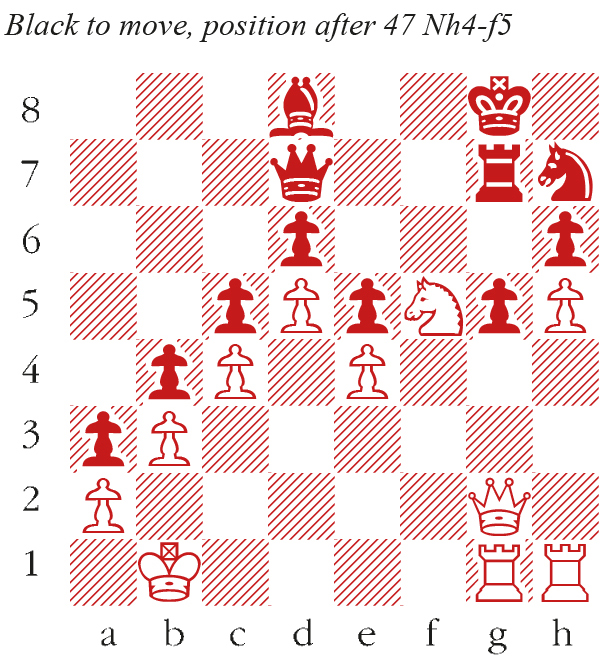
47…Qxf5!! 48 exf5 Bf6 49 Kc1 Kf8 50 Kd1 Re7 Humans can readily perceive what Stockfish could not. Black has a fortress, as there are no entry points for White’s major pieces. In the next 32 moves, the rooks came to e1 and e4, and the queen came to f3. Leela moves its king to d8 and knight to f8. (Moves omitted.) 83 Rxe5 Rxe5 84 Rxe5 Bxe5 85 f6 Kc7 86 Qf5 Kb7 87 f7 Bg7 88 Qe4 Be5 The rook sacrifice was the only try, but the fortress holds, as all the queen’s entry squares are covered. Draw agreed after 132 moves.
Below is a classic example from human play. Hazai’s last move, 45…Qa7-b6, sacrifices his queen for a knight to erect a fortress.
Arshak Petrosian–Laszlo Hazai
6th International Jnr Tournament, Schilde, 1970

46 Nxb6+? Analysis shows that White could win by delaying this. cxb6 47 h4 Or h5-h4 seals the kingside shut for ever. 47…gxh4 48 Qd2 If this queen could emerge on h3, White would easily win, but Hazai has it covered. 48…h3! 49 gxh3 Else Black advances h3-h3 49…h4 Now the fortress is watertight. 50 Kb3 Kb7 51 Ka4 Ka7 52 Qg2 Kb7 53 Qb2 Ka7 54 Qc2 Kb7 55 Qc3 Ka7 White cannot try to win with 56 Qxa5+ with the bishop still alive on g3. So draw agreed.
No. 850
White to play and draw. The conclusion of an endgame study composed by Frédéric Lazard in 1946. Which move allows White to salvage a draw from this position? Email answers to chess@spectator.co.uk by Monday 19 May. There is a prize of a £20 John Lewis voucher for the first correct answer out of a hat. Please include a postal address and allow six weeks for prize delivery.
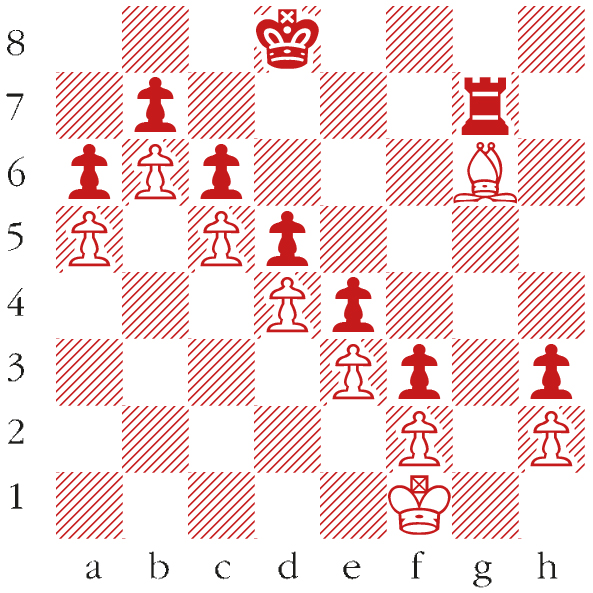
Last week’s solution 1 Qxc8+! and Tal resigned because 1…Bxc8 2 Re8 is mate
Last week’s winner Robert Fortune, Barnet, London N12
Spectator Competition: That’s your cue
Competition 3399 called for a traditional bedtime story updated for the 21st century.We’re tight on space, so I’ll pause just to give a special mention to Ross Haggart before awarding the £25 vouchers to those below.
‘The sky is falling!’ cried Chicken-Licken. Ducky-Lucky, thinking this might be fake news, waddled off to do some fact-checking. But Henny-Penny had reliable information from Humpy-Trumpy and Q-Anonny on ticky-tocky that Crooked Hillary-Clillary, helped by five gee-gees all the way from China, was planning to bring down the sky, in order to distract from her other naughty conspiracies. Goosey-Loosey was very kind. She felt that Chicken-Licken needed help. ‘How are you really?’ she asked him a hundred times. She thought he was ‘catastrophising’ due to unresolved emotional issues and suggested to him a course of mindfulness and Ceeby-Teeby. Turkey-Lurkey blamed climate change (which Henny-Penny told him was a big porky pie). The King blamed the previous king for leaving them with a huge 22 million miles wide black hole, into which the sky was falling. Clever Holey-Moley said nothing but ran and dug for cover – just in time.
David Silverman
Once upon a time there were three little property developers, whose mother sent them out into the world to seek their fortune. The first little developer built his house with straw – but the Big Bad Council huffed, and it puffed, and it said that straw failed the fire safety regulations, so he went bust. The second little developer built his house from sticks – but the Big Bad Council huffed, and it puffed, and it prosecuted him for destroying a woodland habitat, so he went to prison. The third little developer built his house from nasty cheap bricks. While the Big Bad Council was huffing and puffing away, up rode the brave knight Sir Keir and said ‘No one votes Labour here – build what you like!’ So the third little developer built 100,000 brick houses in the greenbelt, became a millionaire Labour donor and lived very happily ever after.
Tom Adam
The Duckling flapped their grey feathers and looked round their playground. You’re Ugly! one of their playmates shouted and the others joined in: Ugly! Ugly!
No, said Duckling, That’s body-shaming, that is. I’m calling you out. They felt hurt but they were a Duckling who knew wrong from right and that the Playleader would help.
When the others had it explained to them that body-shaming was a hate crime, the Duckling felt empowered. Yes! they squawked. But inside, although they had tried to be forgiving and process what had happened, they knew that for the sake of their mental health their future would be elsewhere.
So Duckling set out on their journey in life mindful that they might be called ugly again. But when they came to a swan’s nest they were welcomed warmly and told they were beautiful. Thank you, Duckling said, Being kind makes it a better world.
D.A. Prince
The hare was making fun of the tortoise for being slow and lazy. ‘You were doing WFH before anyone even thought of it,’ he said. ‘And as for quiet quitting, where you’re concerned who could even tell?’ Offended, the tortoise challenged the hare to a race. The hare won by a mile, but the adjudicators felt it was the taking part that counted and awarded both animals a ‘participation medal’.
The hare, finding this intolerable, took the adjudicators to an employment tribunal and eventually received substantial compensation.
The tortoise reacted to this setback by self-identifying as a cheetah and challenging the hare to a rematch. Sadly, this plan also failed. The hare, it emerged, had applied for a Motability grant on the grounds of neurodiversity (‘I’m a March hare, after all,’ he’d explained). He used the grant to acquire a nippy VW Golf and this time won by two miles.
Joseph Houlihan
Generative AI, I’ve this bedtime story idea: please finesse it for success. Elements of story comprise: trio of porcine real estate developers. Their modish ideas about environmentally friendly building materials. A Wolf of above average size and capacity for presenting moral challenge. His incantatory threat and actuation protocol focusing in particular on lupine lung capacity and designed for multiple strands of appetite satiation. Initial success of approach when deployed against straw house and occupant. Subsequent success upon deployment against house of sticks and occupant. Natural anticipation of success prior to engagement with brick house and porcine occupant. Confounding of expectation when bricks prove permeable on account of having been designed to allow ingress and habitation by swifts. Completed story to be delivered to my offspring in vocabulary appropriate to whatever their ages and genders currently are using voice sample from this instruction. Notify responses, if any, to my inbox.
Adrian Fry
Once upon a neurodivergent-affirming time Princess Gwyneth – cursed by a wicked fairy wielding a rogue spindle (violating H&S protocols) – fell into a non-consensual sleep. A century later, Prince Charming (he/they), a TEDx-famous gerontophile with a Level 2 Consent Certificate, smitten with the 116-year-old princess, kissed them awake. Gwyneth sued for boundary violations while the Prince cited their resting ‘yes face’ as implied consent. The case ignited media debates and cancel culture erupted. The Palace, freshly woke, pledged allegiance to Sleep Justice. After restorative co-counselling, and a viral TED-talk (‘Love in the Time of Coma’), Gwyneth launched a podcast (Woke and Woken), sponsored by ethical vaginal-sourced collagen serum. The couple curated an intentional love space, monetised their trauma, and partnered sustainably, but soon after, citing irreconcilable differences, the Princess distanced theirself from the Prince, who was deplatformed. They stated: ‘We’ve consciously uncoupled, with ever-after implications, and I’m developing a mindfulness app.’
Ralph Goldswain
No. 3402: Quirk related
Recently we ran a poem about someone who liked to cook a meal, then drop it on the floor. You’re invited to submit a poem or passage about an unusual predilection (150 words/16 lines max, printable). Please send entries to competition@spectator.co.uk by 28 May.
2703: Eeeesy does it
The unclued lights share a common feature, while two trios from among the clued Down solutions do so to a lesser extent. Ignore an acute accent.
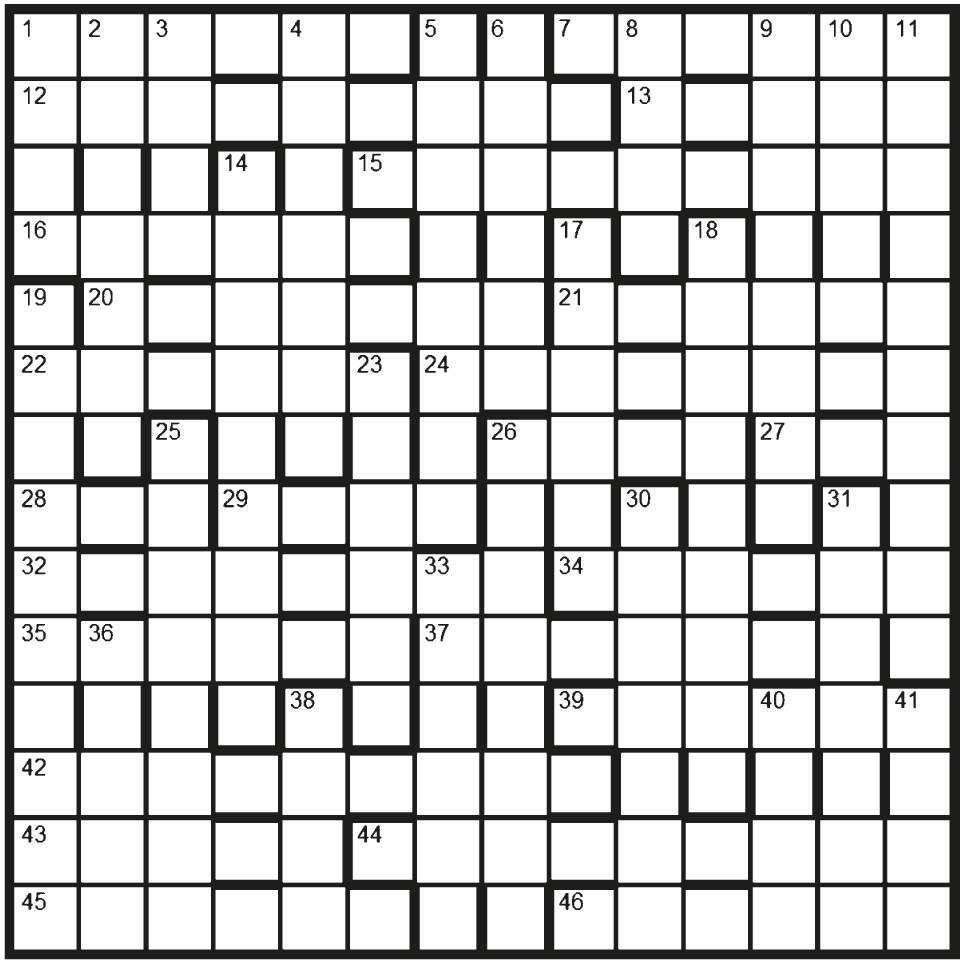
Across
1 Give confidence when not at sea, reportedly (6)
7 Tolerated, having cut through undergrowth and fouled (6)
13 River horse, so to speak (5)
16 County not right accepting vice inspection (6)
21 This girl lost her head during nuclear power plant disaster (6)
22 Variety of sandstone produces vintage Merlot, say (3,3)
24 Tinted visor certainly owned during middle of week (8)
26 High point is getting married in a church (4)
27 Ballpoint brand with blue ink cap, for starters (3)
28 Grass turned over in the Chinese way (3)
29 Rowdy Aussie party at arbour, now and again on time (4)
35 French forces Doc into 8 (6)
37 I go nuts arranging day trips (7)
39 Are sections of bone found here in Italy? (6)
43 Salvo possible but not rounds (5)
46 Take in Sartre novel (6)
Down
1 Fliers at the very heart of the parody (4)
2 Developments as the briny calms down, we hear (7)
3 Insinuation that Sri Lanka upset Richards, for starters (4)
4 Fails to keep a promise – at bridge? (7)
5 32 spilt drinks here at county show (4)
6 Some pray elsewhere, upsetting church founder (6)
8 Barriers regularly holding Olympian (4)
9 Two chancellors take to one vegetable (8)
10 You grab people, turning up hostile (5)
17 One that’s cold to walk over (3,3)
19 Left large hound at site of steelworks (4,6)
23 Difficult times in nameless township in NW Sutherland (6)
25 Mathematical principles for dealing with fumarole (8)
26 Use paper crumpled in France to a certain extent (1,3,4)
30 Mac’s salmon spear removed half the dace from county town (7)
31 Abbey’s wild geese oddly missing, as well (7)
33 Why one may have had a dry old Christmas (6)
36 Female bird in here, eventually (5)
38 Opening of motet points to lyre’s middle string (4)
40 Pipe carrying water to sides of hothouse (4)
41 It borders this little land and former ferry point across the Severn (4)
Download a printable version here.
A first prize of a £30 John Lewis voucher and two runners-up prizes of £20 vouchers for the first correct solutions opened on 2 June. Please scan or photograph entries and email them (including the crossword number in the subject field) to crosswords@spectator.co.uk, or post to: Crossword 2703, The Spectator, 22 Old Queen Street, London SW1H 9HP.
2700: Tracking far north – solution
The unclued lights are stations on the Far North railway line from Inverness to Thurso and Wick.
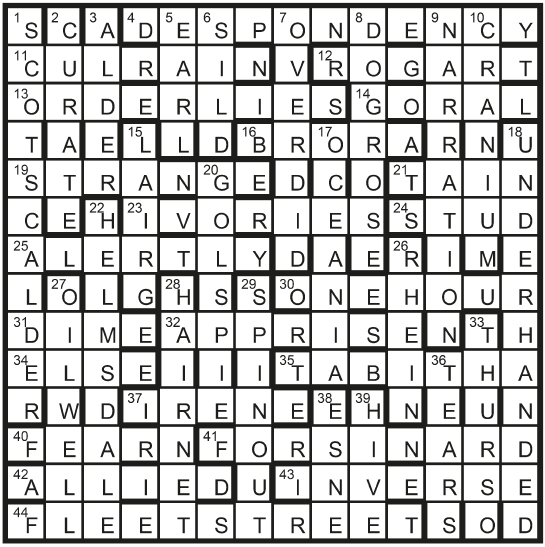
First prize Lesley Gibbons, Twickenham
Runners-up Peter Dean, London W8; David Carpenter, Sutton Coldfield
The left is finally accepting immigration control
When it comes to immigration, Keir Starmer has been ‘on a journey’. As a young barrister, he authored a review in which he argued that all immigration law was ‘racist’. As a new Labour backbencher, he called legislation to make renting to illegal immigrants a criminal offence ‘everyday racism’. While running for his party’s leadership, he demanded an ‘immigration system based on compassion and dignity’, pledged to ‘defend free movement’ and backed a letter objecting to the deportation of 50 Jamaican criminals, including burglars and rapists.
The white paper explicitly rejects the reigning Whitehall orthodoxy that immigration brings growth
Unveiling the government’s immigration white paper this week, however, Starmer announced that not only is ‘the idea that immigration should be controlled’ a ‘core value’ of the Labour party, but that it’s also something he’s long believed in. If Britain doesn’t reduce immigration, he said, we’re on track to become an ‘island of strangers’ – language robust enough for one former Labour MP to compare him to Enoch Powell.
The invocation of Powell’s name has long been used to police the borders of the immigration debate. But 57 years on from his inflammatory intervention, it is high time to consider migration as coolly and rationally as other public policy questions without attributing wicked prejudice to those who express concern.
Labour’s white paper has been in the works for a while. But its launch came less than a fortnight after Reform UK’s triumph at the local elections and the Runcorn and Helsby by-election – Labour’s 16th safest seat. Starmer’s proposals to (among other things) restrict settlement rights for some new migrants, pause the recruitment of overseas care workers and improve English tests for would-be citizens must be seen in the light of Reform’s advance. The views of those who voted Reform deserve as much respect as anybody else’s. When democratic discontent is dismissed as the ill-bred atavism of the uneducated and unscrupulous, public anger only grows.
The public has repeatedly voted for lower immigration. That was what they were promised in 2010, 2015, 2016, 2017 and 2019. Yet numbers have surged to new highs. Astonishingly, 3.8 per cent of the UK population have arrived since 2021. Successive governments have also failed to stop the tens of thousands crossing the Channel in small boats. Voters have had enough. This week, 50 per cent told YouGov that immigration is one of the country’s major issues – the highest level since June 2016.
Parties on the right understand nations can’t survive without borders and any change, whether demographic or cultural, needs to be managed with care. But parties on the left have good reason to want to control migration too. Labour figures such as the trade unionist Paul Embery, the philosopher Lord Glasman and the new MP for Pendle and Clitheroe, Jonathan Hinder, all understand that migration disproportionately affects the poorest in society by depressing wages, increasing pressure on public services, driving up rents and straining social solidarity.
For these ‘Blue Labour’ politicians, migration control is a precondition of rebuilding an economy centred on higher wages, stable communities and reindustrialisation. That vision stands in opposition to the whims of international capital and its demand for cheap labour. Starmer’s white paper, by explicitly rejecting the reigning Whitehall orthodoxy that immigration brings growth, is an endorsement of the Blue Labour analysis. And all the better for it.
Critics of Starmer from the left have deployed highly emotional language to imply his motives are impure or that he’s denying Britain’s history as a nation of immigrants. We cannot make a window of Keir Starmer’s soul, but responding to public concern can hardly be an immoral act for a prime minister. And Britain’s island story is much more one of population stability than huge churn. Indeed, Britain was historically a country of emigration, not immigration. In the 25 years before New Labour’s election, net migration was 68,000; in the 25 years afterwards, it was 5.9 million.
The real test for the Prime Minister is not one of motive or morality but effectiveness. Since Starmer entered No. 10, record numbers are crossing the Channel in small boats: 12,699 people have made the journey so far this year – up 33 per cent on 2024 – bringing the total to almost 36,000 since the election. Having scrapped the previous government’s Rwanda deterrent, the PM’s quest to ‘smash the gangs’ has so far proved fruitless. While he pledges to reform the use of Article 8 of the European Convention on Human Rights to block deportations on the grounds of the right to a family life, few doubt that activist lawyers will find exciting new ways to stop removals.
That is why the Tories are right to demand that proposed legislation be strengthened to oust human-rights provisions which frustrate effective migration control. The borders we need to police are those around our island, not those around a vital debate.