-
AAPL
213.43 (+0.29%)
-
BARC-LN
1205.7 (-1.46%)
-
NKE
94.05 (+0.39%)
-
CVX
152.67 (-1.00%)
-
CRM
230.27 (-2.34%)
-
INTC
30.5 (-0.87%)
-
DIS
100.16 (-0.67%)
-
DOW
55.79 (-0.82%)
NHS Fife refuse to reveal costs of trans tribunal
To NHS Fife, which is once again making headlines for all the wrong reasons. The Scottish health board has been slammed by the country’s information tsar for failing to publish its spend on an ongoing employment tribunal brought against it by nurse Sandie Peggie. Whatever happened to transparency, eh?
After nurse Peggie questioned a transgender doctor for using the female changing rooms, she was suspended by the Scottish health board. The move pushed her to bring a landmark tribunal against NHS Fife and Dr Beth Upton for harassment and discrimination and prompting heated discussion about what the Equality Act says about the provision of single-sex spaces. But when investigators approached the health board about the money spent on the tribunal, NHS Fife refused to be drawn – as the Spectator noted at the time. Instead, the Scottish health board said it had ‘no indication of costs’.
This hasn’t satisfied Scottish Information Commissioner David Hamilton, however, who has ruled that NHS Fife has failed to comply with the law. Hamilton states that the health board had only approached Central Legal Office – that provides legal advice to Scotland’s NHS – for the costings. In addition, he says, the health board should have conducted ‘proportionate searches’ itself for the relevant information. The information tsar has since ordered NHS Fife to carry out a further review – and to get back with a response by 14 July. Tick tock…
It’s another blow for the Scottish health board, after the Supreme Court ruled last month that the terms ‘woman’ and ‘sex’ in the Equality Act refer to biological sex, prompting the EHRC to issue new guidance about single-sex space provision. In the aftermath of the judgment, the health board issued a non-committal statement, remarking: ‘NHS Fife notes the clarity provided by today’s Supreme Court ruling regarding the legal definition of a woman. We will now take time to carefully consider the judgment and its implications.’ Will it now U-turn on its stance on the matter? Stay tuned…
National Liberal Club distances itself from Farage
Egad! Uproar in clubland. The reason? Nigel Farage. Yes, it seems that the veteran Brexiteer is still capable of causing a fuss among t’great and t’good – even when he is pledging to, er, lift the two child benefit cap. The Reform UK leader gave a big speech on Tuesday in Whitehall, talking about his party’s plans for welfare reform. His choice of venue was the Royal Horseguards Hotel – the construction of which, in the 1880s, involved an elaborate pyramid scheme of fraud. Insert your own jokes here….
Unfortunately, the hotel’s site also encompasses the National Liberal Club, the haunt of choice for that rarest of all breeds: senior Liberal Democrats. The likes of Nick Clegg and Tim Farron have made speeches here while Charles Kennedy’s infamous Newsnight interview was filmed in the club smoking room. At least 25 MPs have snaffled free memberships since the last election too. And it seems that the right-on Lib Dems are not too happy at lengthy journalistic reports linking Farage to their beloved watering hole.
Such is the level of anger that NLC bosses have been forced to write to puce-faced Orange bookers, assuring them that the Farage press conference did not actually take place within the club. In an email sent to members in the aftermath of the event, the club says that:
The Reform UK political party held a press conference on 27 May 2025 at the Horse Guards Hotel, which we were fully aware of in advance and we implemented plans that ensured participants attending did not have access to any of the National Liberal Club areas. We wish to clarify for Members that the press conference was not held within the National Liberal Club. The space used was fully under the control of the Horse Guards Hotel, and there is no connection between the National Liberal Club and the Reform UK press conference or its content. As Members will be aware, while the National Libera Club and the Horse Guards Hotel share certain areas within the building, guests and press attending the Reform UK event did not have access to the Club’s private facilities.
Liberalism at its finest…
Reeves is right to slash funds for wealthy landowners
It is beginning to feel a bit like 1998 all over again. That was the year of the first countryside march when it – supposedly – rose up in anger at the Blair government over its plan to abolish hunting, introduce the right to roam and build some houses for people to live in. Landowning interests, already reeling from Rachel Reeves’ decision to partially remove the inheritance tax exemption on agricultural land, are now gearing up to bleat about a proposal to slash the £2.5 billion a year budget for Environmental Land Management (ELM) – the scheme which replaced the Common Agricultural Policy (CAP) after Brexit.
It is reported that the scheme will be designed to be less generous, with payments being retained only for small farms. The landowning interest will be expecting to whip up mass public anger again, just as it did for the countryside march. But what exactly are taxpayers getting in return for ELM payments?
We should not be doling out billions to wealthy landowners without any public benefit in return
The idea behind ELM was to come up with a more sensible scheme than CAP, which for the last two decades has been little more than welfare for landowners – it doles out billions to them simply for owning land and keeping it in the vague definition of ‘agricultural condition’. Across the EU there have been plenty of fraudulent claims whereby people have been claiming payments for land which doesn’t actually exist, or which they do not own. But the whole thing is a scam, a bung for rural voters.
ELM was supposed to change that by rewarding farmers instead for looking after nature. They were to receive payments for farming land in particular ways which were supposed to encourage the wild flowers and hedgehogs. All very nice, of course, and designed to earn public support, because everyone likes nature. However, as with CAP in its later years, ELM is not linked with food production and so does nothing to promote national food security.

On the contrary, ELM money comes with all kinds of pernickety and bureaucratic conditions which make it harder to produce food. In many cases it encourages land to be taken out of production; some of the money is going to rewilding schemes dreamed up as part of the government’s net zero agenda. It is aiding the offshore companies who are buying up productive farmland in order to plant it with trees to claim carbon credits.
Nor is there any requirement under ELM to increase public access, which has been seriously lacking in some parts of the countryside since the Enclosure Acts – passed by a Parliament made up rather heavily of landowners – extinguished many rights of rural people. Indeed, I know of many places where ELM has made it even more difficult to access the countryside, as newly-planted hedgerows crowd in on country lanes, eliminating grassy verges and making it harder for people to walk about without being mown down by cars and tractors. What ELM is principally doing is helping wealthy landowners to create private nature reserves.
I fear we might be hearing a lot in the coming weeks about Reeves killing off the bunnies and foxes by watering down ELM. Sorry, but I am not going to fall for the propaganda. We have a £150 billion a year deficit which is driving the country to fiscal ruin. We should not be doling out billions to wealthy landowners without any public benefit in return. Landed interests were showered with public money throughout our years in the EU. There was no need to replicate one of the worst aspects of the bloc when we left.
We still need Jane Austen’s icy wisdom
I managed to sit through most of Jane Austen: Rise of a Genius the other night. I endured luvvies and minor academics and even Cherie Blair, all wide-eyed at the brilliance of their heroine. She was inevitably presented as edgy and funny and brave and ground-breaking and mould-breaking and ball-breaking and oozing girl power.
One of Austen’s prime targets is clumsy groupthink, which makes her pretty relevant to the age of social media
Equally predictably, no one mentioned the key to her writing’s power, to her authorial authority: her moral intensity. It’s the truth about her that’s universally unacknowledged. It is hard to talk about – we don’t like moralists nowadays, do we? We don’t like the idea that the creation of literature might have a moral or even a religious dimension – yuk! But it must be talked about. For her comedy and acuity of observation is not random, scattergun, unfocused. It has a logic. People deserve to be mocked without mercy for their selfishness and vanity, which must be analysed with a scalpel.
Austen does not draw attention to her moral agenda. For example, Emma Woodhouse is described on page one as ‘clever, handsome and rich’. The phrase has an air of completeness, as if that’s obviously all one could aspire to be, but it’s ironic. For Austen is testing the reader: have we noticed that we have not been told whether she is good? This is the whole point of the novel: to expand on that unstated question.
One of Austen’s prime targets is clumsy groupthink, which makes her pretty relevant to the age of social media. Another is the charming but morally toxic media performer – ditto. I was reminded of this last year, when I taught Pride and Prejudice to some fifteen-year-olds, who were a bit more Lydia than Lizzie.
At the first ball, groupthink decides that the rich newcomer, Mr Bingley, is utterly charming, and showers him with ‘likes’. And it decides the opposite of Mr Darcy. Everyone wants to signal his or her virtue by condemning him, making him a symbol of the heartless stuck-up aristocrat.
Our heroine Elizabeth fails to notice that she’s joining the groupthink. She sees herself as an especially acute critic of Darcy. This is repeated when Mr Wickham turns up. He is charming in a touchy-feely, cool-guy way. His frank, chatty charisma makes Elizabeth feel that any topic ‘might be rendered interesting by the skill of the speaker’. When he is finally exposed as a sexual predator, the town quickly redacts its recent adulation:
All Meryton seemed striving to blacken the man, who, but three months before, had been almost an angel of light…Everybody declared that he was the wickedest young man in the world and everybody began to find out, that they had always distrusted the appearance of his goodness.
The novel’s famous opening phrase, ‘It is a truth universally acknowledged…’ turns out to be a half-veiled warning about the power of groupthink, especially when fused with the self-righteousness of youthful intelligence, so sure that it is thinking for itself. Suspect all orthodoxies, she says, and also the edgy critics of such orthodoxies. It seems that we still need her icy wisdom.
Labour has launched a galling attack on nature
During the last Conservative government, it was common to hear the refrain that the prime minister of the day was waging a ‘war on nature’. As someone who played a role in advising a string of environment ministers, I always thought that to be somewhat hyperbolic. I always admire the passion of campaigners, and I share with them a longing for our government to go further and do more for nature; but, at least until the last couple of years of Conservative government, I didn’t think many of the criticisms were fair.
I’m starting to worry now, though, that we’re living in an altogether different world. The new Labour government was elected on a promise to protect and restore nature. And yet here we are a year later wistfully contemplating those halcyon days when No. 10 was criticised for ‘lacking ambition’ on nature recovery. Seemingly every environmental protection in the statute book is under threat.
Every promise Labour has made to protect the natural world has been placed in doubt
Nature is not voiceless in today’s government. Defra Secretary Steve Reed cares and is certainly doing what he can to stand up for nature. Ed Miliband, while much more concerned with the drive for net zero, is also an ally in the struggle for more nature in Britain. But no matter which way you cut it, it’s clear that siren voices in the Ministry for Housing, Communities and Local Government, and more so in the Treasury, are leading the charge and calling for the sidelining or scrapping of protections for nature, as well as the defunding of incentives aimed at nature recovery.
The government’s efforts to diminish protections are starting to seem relentless. Part three of the Planning and Infrastructure Bill, currently working its way through parliament, appears explicitly designed to rip apart decades of legal protections for our green spaces. Pledges to create new nesting sites for swifts by mandating the inclusion of ‘swift bricks’ in new developments have been ditched; the chalk streams action plan, for restoring the health of these waterways, shelved; the chemicals strategy for safe chemicals production has vanished; the list goes on.
There are also credible reports that the government’s nature-friendly farming fund, known as the Environmental Land Management scheme (ELM), which replaced the EU’s common agricultural policy with the aim of paying farmers to look after nature, is set to be cut drastically. This would catastrophically undo efforts to meet legally binding targets to reverse the decline of nature in Britain.
Quite why Treasury officials are contemplating such cuts is beyond me. Nature-friendly farming incentives represent a drop in the ocean in the context of overall government spending, but deliver huge bang for our buck. The benefits of ELM are already beginning to be felt across tens of millions of acres of our world-renowned countryside. Without it, farmers are unlikely to continue their individual efforts to piece back together the natural fabric of our country. They’ll be too busy just trying to stay afloat.
Now, in the newest assault, the government is turning its crosshairs on the ‘biodiversity net gain’ (BNG) policy, the key legal requirement that all developers must ensure their projects add to nature, rather than just build over it. In other words, when you build a house over meadows, you must seek to restore other meadows near your development. Now, I declare a partial interest here, as I helped with the formation of this policy. It’s a world-leading initiative which, introduced last year, has the potential to create huge reserves of nature. I’m such a believer that I’ve even invested in Nattergal, a new venture that aims to use BNG and other market mechanisms to restore nature at scale, first in England and eventually elsewhere too.
Already, hundreds of millions of pounds of investment have been poured into efforts to create nature gains in the country. But, in an instant, the government has threatened to undermine the whole basis of the policy. By specifically stating that it intends to exempt ‘small sites’, which account for well over 80 per cent of all planning applications and a massive proportion of all land use change in England, the government is launching a missile at the very heart of this world-leading policy. Scrap small sites, scrap BNG.
What’s particularly galling about this is that the government promised, just a few weeks ago, that BNG was safe under their watch. In response to repeated requests for reassurance that this world-leading policy would be protected, the government promised that they wouldn’t touch it.
Pushing for the dismantling of BNG are the same ministers who claimed to be consulting with green groups and campaigners on part three of the Planning and Infrastructure Bill, but then refused to accept a single amendment to it. They have exploited the goodwill of many, including me, who have entered into talks in good faith, only to find that nothing changes and the systemic dismantling of nature’s protections has continued unabated.
For evidence of this, consider how the government announced its intention to wreck BNG yesterday: the housing minister Matthew Pennycook went on the radio to announce that a consultation would be held, only to declare that the result would be the scrapping of BNG for the majority of sites. In other words, there is to be no ‘consultation’. The conclusions have already been drafted.
Anyone who believes that nature matters deeply, which according to polls is most of us, should now be worried about where this government stands. Every promise they have made to protect the natural world has been placed in doubt. Every pledge they have made to talk to campaigners has so far come to nothing.
This week’s announcements on ELM and BNG leave me stunned and wondering whether this government is the one now waging an actual war on nature. We badly need people from all walks of life to make their voice heard – now.
The problem with Trump’s Golden Dome project
Donald Trump did not get to where he is today by taking no for an answer. Mark Carney, the Prime Minister of Canada, could scarcely have been clearer when he visited the White House earlier this month that the President’s notion of Canada becoming America’s 51st state was not even being entertained. ‘Canada is not for sale,’ he said bluntly. When Trump chided him that he should never say never, he mouthed silently, ‘Never, never.’
Undaunted, President Trump has tried a new tack: the proposed Golden Dome, a missile defence system covering the United States which Trump initiated by executive order in January. He announced on his Truth Social platform that Canada was keen to be part of Golden Dome, and he had an offer.
President Trump is preoccupied with grand schemes of perhaps-impossible complexity
It will cost $61 Billion Dollars if they remain a separate, but unequal, Nation, but will cost ZERO DOLLARS if they become our cherished 51st State.
There is something very revealing about the President choosing to invoke the Golden Dome. It is inspired by Israel’s Iron Dome, which has been in service since 2011 and which is astonishingly effective, intercepting between 75 and 90 per cent of targets. But it comes at a fearsome cost, with each of the 10-15 batteries across Israel costing $50 million (£37 million).
President Trump has been impressed by the Iron Dome, and struck by the vulnerability of the United States to missile attack. We saw a glimpse of this at last year’s Republican National Convention when he asked, rhetorically and petulantly, ‘Why should other countries have this and we don’t?’ So, characteristically, he also wants a scaled-up US equivalent and has called it the ‘Golden Dome’.
He is right to be worried. Annie Jacobsen’s brilliant but terrifying book Nuclear War: A Scenario suggests that existing systems controlled by America’s Missile Defense Agency have a success rate of around 55 per cent. Letting half the enemy’s missiles through is not a sustainable option.
Trump’s executive order deals with something far vaster and more complicated than a magnified Iron Dome, which protects against short-range ballistic missiles. The President has demanded ‘defence of the United States against ballistic, hypersonic, advanced cruise missiles, and other next-generation aerial attacks from peer, near-peer, and rogue adversaries’. It would involve space-based, orbiting ‘interceptors’ as well as batteries on the ground.
The President has announced that the Golden Dome will cost $175 billion (£130 billion) and will be operational before his term ends in January 2029. To say this is ambitious is like accusing Joe McCarthy of mild anxiety about Communist infiltration. The Congressional Budget Office has estimated a cost of between $542 billion (£403 billion) and $831 billion (£619 billion) for a relatively limited system. Some doubt that such an ambitious scheme is possible at all.
While President Trump contemplates his money-no-object Wunderwaffe, Europe, for once, is taking practical and pragmatic steps to rearm. Earlier this month, Britain and Germany announced they would cooperate on a new precision deep-strike capability with a range of more than 1,200 miles; Germany has signed a letter of intent with Ukraine to work together and manufacture long-range weapons in Ukraine and, it implied, procure them for the Bundeswehr. Rolls-Royce, meanwhile, has been chosen to supply MT30 gas turbine engines to Canada’s new River-class destroyers and the South Korean navy’s Ulsan-class frigates.
It even seems that the UK/Italy/Japan global combat air programme to deliver sixth-generation stealth fighters by 2035 has survived the UK’s Strategic Defence Review. Sweden, Saudi Arabia and Australia have shown interest in also joining the consortium.
Rearmament across Europe will be hard: it will cost more money than politicians are yet willing to admit. It must be accompanied by radically faster and more efficient procurement processes and the European defence industry will need to expand and think flexibly and innovatively. Suddenly, however, projects are beginning to move that focus on the capabilities we need. Meanwhile, President Trump, his Department of Defense in disarray and headed by a Secretary of Defense who is simply not up to the job, is preoccupied with grand schemes of perhaps-impossible complexity, costing hundreds of billions of dollars, inured as ever to voices of reality.
Perhaps it was Trumpian shock therapy which changed Europe’s attitude. But the President has always been better at giving than receiving advice. Some things never change.
Anne Hidalgo has ruined Paris – now she wants to be UN refugee chief
Anne Hidalgo, the mayor of Paris, is being lined up for one of the world’s most powerful humanitarian jobs: United Nations High Commissioner for Refugees. With Emmanuel Macron’s backing, she hopes to swap the Hôtel de Ville in Paris for Geneva, taking charge of a $10 billion global operation that defines who counts as stateless, who deserves protection, and indirectly who gets to enter countries like Britain.
Now the very policies that have fuelled Paris’s dysfunction could be about to be exported globally
Anne Hidalgo ruined Paris. She has destroyed its ancient heritage, dug it into a giant financial black hole, and left the city choking on traffic, crime, and ideological nonsense. She brags about planting trees and engages in green posturing while pavements crumble. Her possible leap to the United Nations is an insult to the city she’s broken. Hidalgo’s aggressive immigration policies, which prioritise newcomers at the expense of long-time Parisians, have fuelled the decline. Now she wants to export this vision worldwide.
Hidalgo made headlines last year when she jumped into the river Seine in a wetsuit, part of a stunt to show the river was clean enough for Olympic swimmers. Several athletes who followed her into the water during Olympic events fell violently ill. It was vintage Hidalgo – costly, performative, and nauseating.
Her likely ascent to the UN post is a bitter irony. She has reshaped Paris with her aggressive, ideologically driven immigration policy. Newcomers have been prioritised for housing, benefits, and support. Now the very policies that have fuelled Paris’s dysfunction could be about to be exported globally, under the banner of humanitarianism. The role of High Commissioner is no figurehead position. With responsibility for 139 million displaced people, UNHCR shapes refugee and asylum policy worldwide. The decisions taken in Geneva ripple across Europe, including in Britain, where UNHCR recommendations can influence resettlement schemes, border management and the immigration debate.
If appointed UN High Commissioner for Refugees, Hidalgo would wield enormous soft power on one of the most important political issues of our time. It’s a perfect symbol of our age: failure at home rewarded with promotion abroad. If we’re to believe the French press, Hidalgo may not finish her stint as mayor. She will flee to the UN before her term is even up.
Back when Jean Tiberi, the last right-wing mayor of Paris, was in power the city still worked. Conservative stewardship kept Paris affordable, ordered, and pragmatic. It was still the ‘City of Light’, a place of order and elegance. Since the left’s takeover, Paris has become a cautionary tale.
You can still find the picture postcard Paris: the Marais, the 6th and 7th, are manicured and curated for tourists and elites. But step outside the bubble, and the bins are overflowing, there are rats in playgrounds and concrete blocks where fountains used to be. This is the city Hidalgo is to leave behind.
During the right-wing era, Paris enjoyed fiscal discipline. Property taxes on modest flats remained stable for years. City debt was cut to record lows, with spending carefully controlled. For families in central Paris, life was expensive but manageable.
No longer. The left ballooned Paris’s city debt to €3.36 billion by 2014 under Socialist Bertrand Delanoë, and Hidalgo’s spending spree sent it soaring to €8 billion by 2022. In 2016, she mortgaged 60 years of social housing revenue. In 2022, she hiked property taxes by 52 per cent. At the same time, local business taxes, already among the highest in France, were raised again, hitting independent shops and family-run cafés the hardest. For many, staying open became a losing battle. Not content with exploding the tax burden, the left has continued to spend with abandon, signing off projects with no clear path to repayment. The city is now, by most measures, effectively bankrupt. There’s talk that a state bailout will soon be unavoidable. Residents foot the bill while Hidalgo brags about her Olympic tree-planting programme.
Paris was built for cars. Motorists could drive along the Seine, cross Rivoli, and commute across town in under 30 minutes. Infrastructure investment kept traffic flowing, even if pollution remained a concern. Then came the crackdown. Delanoë launched bike sharing with Vélib in 2007, and Hidalgo turbocharged the war on cars. Hidalgo brought 1,300 kilometres of bike lanes, a pedestrianised Seine, a car-free Rue de Rivoli, and a 30 km/h speed limit. An effective ban on SUVs now hangs over motorists. Pollution may be down, but so is mobility. Commuters crawl through gridlock. Cars are no longer allowed to drive at all down the rue de Rivoli, which has become a four-line bike path.
Public backlash against Hidalgo crystallised a couple of years ago around the hashtag #SaccageParis (‘Trash Paris’), a protest movement on social media. Users posted photos of overflowing bins, broken pavements, concrete slabs dumped in public squares, and unexplainable urban installations on which she’d spent a fortune. The hashtag captured the dismay of residents forced to live with a city more focused on performative green projects than basic upkeep.
Hidalgo’s Paris is a city redesigned to impress outsiders, planners, tourists, and green lobbyists, while making daily life harder for many who call it home. Hidalgo’s city prioritises immigrant families for housing, displacing native Parisians who’ve spent years on waiting lists.
Tiberi’s Paris felt safe. In 2000, there were 70,000 reported crimes, mostly petty. You could walk through Paris after midnight. Metro rides were uneventful. By 2024, reported crime rose to 100,000, with violent incidents up 20 per cent since 2014. Muggings on the grimy, urine-stained metro are now common. Hidalgo created a municipal police force in 2021, but it is understaffed and largely invisible, except when issuing parking tickets, which it does with remarkable efficiency in the nicer neighbourhoods. Paris feels on edge. Security, like affordability, has become a luxury.
The old liveable Paris is gone. In its place stands a model city for progressives: €8 billion in debt, uninhabitable for motorists, haunted by rising crime, and governed by abstraction. Delanoë and Hidalgo have built a utopia for a self-satisfied elite that forgets the people who live here. The comparison to London is instructive. Sadiq Khan, like Hidalgo, has turned a once-great capital into a city of performative politics, stifling regulations, and collapsing public services. Both have made war on motorists. Both have presided over spiralling crime and rising taxes. Both wrap their failures in progressive slogans while everyday life deteriorates. The rot is visible, and it’s spreading. Like Khan, Hidalgo has become a byword for municipal failure, an emblem of a new political class that leaves chaos in their wake.
And so, as Mayor Anne Hidalgo prepares to leave the Hôtel de Ville, Parisians are left not with pride but with ruins. Her ambition is global, her record local. And the old Paris is gone. Hidalgo’s exit from city hall is no retirement, it’s a promotion. Macron is positioning her to shape international refugee policy, despite the damage she’s inflicted on Paris.
The war on normality
Exciting news. To ‘showcase the vibrant diversity of both marine life and the LGBTQ+ community’, the visionary Bristol Aquarium has just announced a one-off tour of non-binary fish. On 28 June, its Sunset Seas exhibit will ‘celebrate love, life and the beauty of being yourself’ by illuminating with brightly coloured lights a collection of creatures that ‘defy the binary, change sex and mirror the spectrum of identities found in the human world’. Adults-only tickets are a mere £18.50, so rush to reserve your place now.
We’re presumably to conclude from this racy reveal that because some fish can change sex and hermaphroditic undersea organisms are commonplace, for humans sex is a phantasmagorical multiple choice and we can change sex, too. Thus the aquarium’s attendees can enjoy ‘a safe, inclusive and joyful space for people to connect and be themselves’. Or be other than themselves, which is more the point.
Claiming to inhabit an exotic in-between is no different from claiming to be a tree… or fish
Now, I’m fractionally sympathetic with the yearning of marine biologists to appear with-it and right-on as the hallowed month of ‘Pride’ looms ever closer, when their field must present few opportunities to, if you will, get in the swim of things. There’s just one little problem: people are not fish.
Nature, which many progressives feign to revere, may display an exhilarating variety – or what those ineluctably drawn to the now most overused noun in the English language would choose to call ‘diversity’. But nature can also be infuriatingly rigid. She may seem bossy and unfair, but Gaia determined many years ago that humans are mammals, which reproduce through the mating of male and female. I hate to break it to the scads of young people desperate to distinguish themselves from dreary flat-out men and women and dumpy old heterosexuals, but for people there is no such thing as being ‘non-binary’. You’re stuck in a binary organism, and claiming to inhabit an exotic in-between is no different from claiming to be a chair, or a tree or… a fish.
Granted, humans are very rarely born with confused reproductive organs. But in our species, mix and match genitals are always a mistake. To use a word I’d bet serious money is now a gasp-inducing no-no, the few babies born with discombobulated sex characteristics suffer from deformity. Verifying this whoops! quality? Unlike fish, human hermaphrodites cannot mate with themselves and make more babies. Further, unlike fish, humans cannot change sex. We can wear dresses not trousers, play with toy trucks instead of dolls and even get gruesome plastic surgery, but we are immutably male or female in every cell. If you dislike that setup, don’t complain to me. I didn’t make the rules.
For years, we’ve been subject to a sustained war on the whole concept of normality. This campaign has been so culturally successful that at some American universities, over half the student body has joined the alphabet people. Yet one thing hasn’t changed: nature is still and always will be heteronormative. We may have concocted some expensive workarounds, but absent a tremendous amount of medical bother, only the boring old in-and-out will produce another little Olivia or Jayson. Cruelly, nature has ensured that, unless they possess the considerable resources required for surrogacy or IVF, most of the alphabet people whose inventive practices we celebrate next month will die out, taking their inventive practices with them.
Evolutionarily, this makes perfect sense. We may have socially embraced tolerance. Yet without elaborate medical help, gays, lesbians, infertile or castrated trans people, asexuals, ‘self-sexuals’ and the delusionally ‘non-binary’ don’t perpetuate the species. (Bis get a pass only if they do overtime with the opposite sex.) Given the West’s threateningly low birth rates, it is therefore biologically perverse to dedicate an entire month to promoting behaviour that in the main truncates the genetic line.
Personally, I can’t see why any sexual proclivity should engender ‘pride’. Various methods of amusing ourselves in the bedroom might sensibly inspire satisfaction, affection, embarrassment or humour in retrospect; OK, ideally not shame. But fitting together a limited number of body parts entails pretty primitive puzzle-solving; it hardly qualifies as an accomplishment one might vaunt. Still, if we’re to laud any erotic entertainment as deservedly fostering pride, that would have to be bog-standard shagging – which alone as a default convention has the capacity to sustain the human race. Heterosexual Pride Month might have something going for it.
Bristol Aquarium might therefore do the world an enormous favour by emphasising to the viewers of Sunset Seas that all the kinky fish in this exhibit pursue practices that make lots more kinky fish. If some fish can change sex, that’s because this ability is to their Darwinian advantage. Most importantly, please explain that, while carving up human genitals reliably results in infertility and sterility, this fascinating flexibility in fish in no way inhibits their capacity to reproduce – because if it did, natural selection would guarantee that marine transgenderism would disappear. The curators could be of enormous therapeutic help were they to stress that hermaphroditism in their tanks is not a supremely rare and unfortunate birth defect (oh, I bet we’re not supposed to use that expression, either) but is by evolutionary design – a design that again, most importantly, allows the fish to reproduce.
Marine biologists might counsel the aquatically curious, then, that, however supportive of sexual ‘diversity’ corporations draping their headquarters in rainbow flags have grown, nature solely rewards humans for the so-called vanilla kind. So if younger visitors can possibly stand it, they might keep a hand in straight-up fornication.
As a footnote, behold a little-observed casualty of the war on normalcy. I was a slightly strange kid – socially incompetent, given to peculiar passions, prone to writing 30-page short stories that bored my classmates stiff. I was an oddball; I now make a living as a professional oddball. Nowadays, though, young people seem to latch on to aberration – anything to escape the disgraceful classification of ‘normie’. No normal, no abnormal. By eliminating the mainstream from which to depart, we’ve inadvertently endangered an underappreciated species: the weirdo.
The lost art of getting lost

Sean Thomas has narrated this article for you to listen to.
One of the quietly profound pleasures of travel is renting cars in ‘unusual’ locations. I’ve done it in Azerbaijan, Colombia, Syria and Peru (of which more later). I’ve done it in Yerevan airport, Armenia, where the car-rental guy was so amazed that someone wanted to hire a car to ‘drive around Armenia’ that he apparently thought I was insane. Later, having endured the roads of Armenia, I saw his point – though the road trip itself was a blast.
Recently I rented a motor in Almaty, Kazakhstan, where they were slightly less surprised than the Armenian had been, but nonetheless gave me lots of warnings and instructions, chief of which was: ‘Don’t rely on Google Maps, it doesn’t work out here.’ As soon as I was told that I felt my heart lift, because it meant there was a fair chance of getting lost – and if I like renting cars in remote spots, I love getting lost, anywhere. And yet sadly, as technology gets ever more efficient, it becomes harder to end up completely clueless as to where you are. We are losing the fine art of getting lost.
Before the advent of Google Maps, GPS, Starlink and the rest, getting lost was a doddle. I’ve done it everywhere. Africa, Asia, the Americas, Surrey, the Antarctic peninsula (in a storm), Dartmoor. I’ve been really lost in south London without an A to Z (remember the A to Z?).
Amid this lexicon of lostness, some adventures still stand out. In Peru, while researching a thriller in the grey, weird, eerie Sechura desert north of Lima, I went looking for an ongoing archaeological dig, the excavations of which have revealed the unsettling sacrificial rites of the 2nd- to 9th-century Moche people, known for their incestuous sexual practices, culminating, it is thought, in the strangling of their own teenage children.
So it was that I got completely lost in the dusty scrub, failed to find the dig, panicked for an hour, then, as I finally worked out where I’d parked, I felt a scrunch underfoot. I was walking over an eroded adobe Moche pyramid and many pieces of Moche pottery, depicting their fanged Tarantula God. If I hadn’t got lost, I wouldn’t have those haunting shards on a shelf in my flat today.
Sometimes getting lost can be good because it revives your faith in human nature. On a later trip to upland Peru I got lost in a forest, took several wrong turnings in my car, went entirely off-road and ended up stuck in knee-high sand, wheels spinning uselessly. Running out of ideas, I looked in my guidebook. All it said was that the forest in which I was marooned was ‘known to be dangerous, and several tourists have been murdered here’.
A few minutes later a local passed me on a moped. He didn’t murder me. Instead, he went to his village, where he recruited half a dozen laughing friends who helped me get my car unstuck and refused the money I offered. They did it because most people around the world are really nice, given the chance. Getting lost teaches you that.
On some of my misadventures, the thrill comes from the sheer danger of being alone somewhere remote. That was the case when I drove the Fish River Canyon in Namibia. The baboons were fun and the birdlife was vibrant but then I realised I had no idea where I was, and I might be the only human for 30 miles. But then I thought, heck, it’s a canyon: all you can do is drive to the end, and I did, and it was fine – and a buzz I won’t ever forget. Yes, breaking down would have been a nightmare, but that didn’t happen.
Other times, lostness is aesthetically pleasing. One of the best things you can do in Venice is go there in winter (and dump your phone), then start aimlessly wandering away from St Mark’s Square at night. Soon you will be, yes, lost in a maze of damp calli and silent piazzette and chilly black canals, with an invisible gondolier plashing in the mist and the noise of a bar always just around the corner, and you swear you can see the ghost of Byron, or wicked little ladies in scarlet coats. Spellbinding.
Naturally, getting lost is not always good. I don’t recommend getting lost in Alphabet City, New York, in the mid-1980s. Try not to get lost any time in Ciudad Juárez, Mexico. Or, indeed, Mexico. Nonetheless, getting lost is a vital part of the human experience; if we forsake it, we will, ironically, lose something precious. So here’s my advice – and the final lines of a memoir I’ve just written about my absurdly wandering life. Wherever you are in life, get lost. It’s the only way to know if you truly want to be found.
Why did the ancient Greeks have so many gods?
Writing in a lesser organ, Matthew Parris wondered whether most ancient Greeks ‘really, sincerely, did believe in their bizarre pantheon of gods’.
Belief in a single god was at that time limited to two peoples: Jews and Zoroastrians (and Egyptians once, briefly). To everyone else, perhaps the sheer variety of the world, the extraordinary generative power of nature and the impossibility of making secure predictions about anything suggested a multitude of powers at work. Since it was obvious that earth and sky combined to control nature – man’s only resource – it was not unreasonable for the ancient Greeks to see those features as the first two gods and then, constructing them as a human couple (the family being such a central Greek concern), to assume they generated not only other gods but the whole physical world too. The farmer-poet Hesiod (c. 680 bc) named more than 300 such gods, from Zeus and the Olympian gods at the top to Night, Day, Sleep, Oceans, Mountains, Rivers, Winds, Hades and so on, all with different functions. Result: you name a feature of human life, there was probably a god for it, all the way down to gods of weeding, muck-spreading, reaping and mildew.
But what did those gods require? Obviously, what humans required, that is, respect, in the shape of acknowledgement. That could consist of a prayer, an offering left on an altar, or (at the communal level) a hecatomb (100 oxen sacrifice). And what did humans hope for in return? Primarily, the means of life, especially ‘the blessings of the gods visited on them, for ploughing and for harvest, each in its season, with unbroken regularity’ (Isocrates). That was achieved as long as the rituals were properly carried out – the sole function of priests, male and female. But if, say, Athenians felt that the gods could help their political ambitions, that was something for the democratic assembly to discuss.
However, for myth-makers, dramatists and poets, this plethora of deities was absolute gold dust. Homeric epic set the scene, showcasing both the gods’ grandeur and human failings. Comic poetry made endless fun of them (but not of Athena). Philosophers like Plato were shocked, or cynical. The medium was the message.
Resigning in error
Anyone who plays chess will know the feeling of reaching a winning position, only to screw it up and to lose the game instead. So far so normal, and the cliché about ‘snatching defeat from the jaws of victory’ can apply to any sport. But chess offers a far more piquant anguish, unavailable in most other endeavours. Even among chess players, only a tiny minority will experience it. Directly resigning in a winning position – that is the stuff of nightmares. It sounds ridiculous – why would you ever do that? All it takes is to overlook one crucial resource, and it happened last week to one of the best in the world.
The diagram position below is taken from an online game played in the Champions Chess Tour. Nakamura, rook for bishop ahead, has just offered an exchange of rooks on the g-file.
Hikaru Nakamura-Magnus Carlsen
Champions Chess Tour Knockout, May 2025
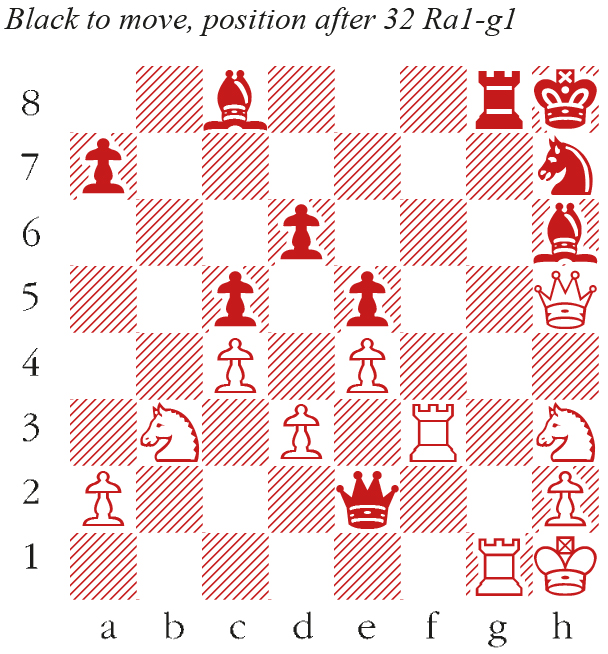
Carlsen plays his trump card, clearly planned a few moves earlier: 32…Bg4! From the video stream, it is evident that Nakamura has not seen that coming, and 33 Rxg4 Qxf3+ is catastrophic. He holds his head, gestures in despair and resigns 25 seconds later. Just after the game finishes, Nakamura checks the game with his computer, only to be confronted with the brutal truth that his position was actually winning. The cold-blooded 33 Rfg3!! wins, since 33…Bxh5 34 Rxg8 is mate. 33…Rg5 is a better try, but 34 Qe8+ Rg8 35 Qf7 should win. Nakamura has to smile, no doubt sensing the absurdity of his error.
That lucky break handed Carlsen a 3-1 victory over Nakamura, and he went on to dominate the final match against Maxime Vachier-Lagrave, winning 2.5-0.5. The first game was particularly elegant.
Magnus Carlsen-Maxime Vachier-Lagrave
Champions Chess Tour Knockout, May 2025
1 e4 c5 2 Nf3 d6 3 Nc3 Nf6 4 h3 Nc6 5 d4 cxd4 6 Nxd4 e5 7 Nf3 h6 8 Bc4 Be6 9 Bb3 Be7 10 O-O O-O 11 Re1 Rc8 12 Nd5 Bxd5 13 exd5 In principle, White would prefer to play 13 Bxd5 Nxd5 14 Qxd5 to retain the d5 square as an outpost for a piece, but 14…Nb4! is a refutation. 13…Na5 14 Ba4 Nd7 15 c3 f5 16 Bc2 Qb6 17 Rb1 Rf7 18 a4 Qc7
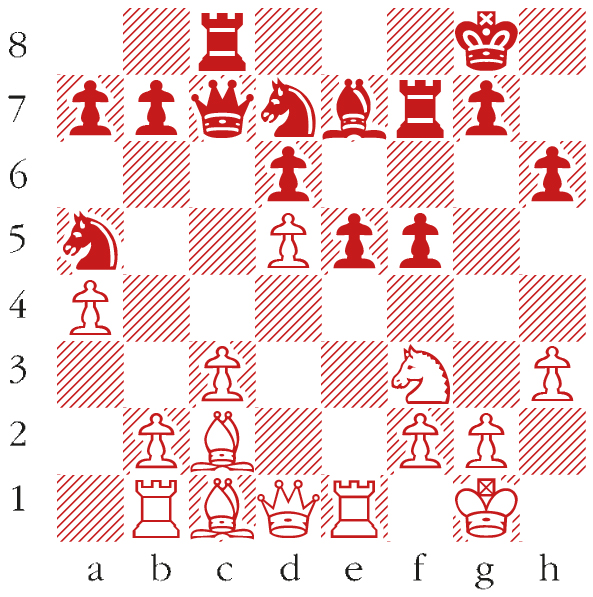
19 g4!! Magnificent judgment. At first sight, exposing the kingside like this looks reckless, especially with the rook bearing down from f7. But Carlsen has foreseen that the light squares in Black’s kingside will be critically weakened, bearing in mind the unopposed Bc2. fxg4 20 hxg4 Rcf8 20…Nf8 was safer, to guard h7 and g6, but Carlsen would retain the better chances. 21 Qd3 Rxf3? A strange blunder, allowing mate. 21…g5 was unpalatable, but necessary. 22 Qh7+ Kf7 23 Bg6+ Kf6 24 Bh5 Black resigns, since 24…Bd8 25 Qg6+ Ke7 26 Qe6 is mate.
No. 852
White to play. Torre-Parker, New York Simultaneous exhibition, 1916. White resigned, seeing no defence to the threat of Rc5-c1+. Which move would have led to the opposite result? Email answers to chess@spectator.co.uk by Monday 2 June. There is a prize of a £20 John Lewis voucher for the first correct answer out of a hat. Please include a postal address and allow six weeks for prize delivery.
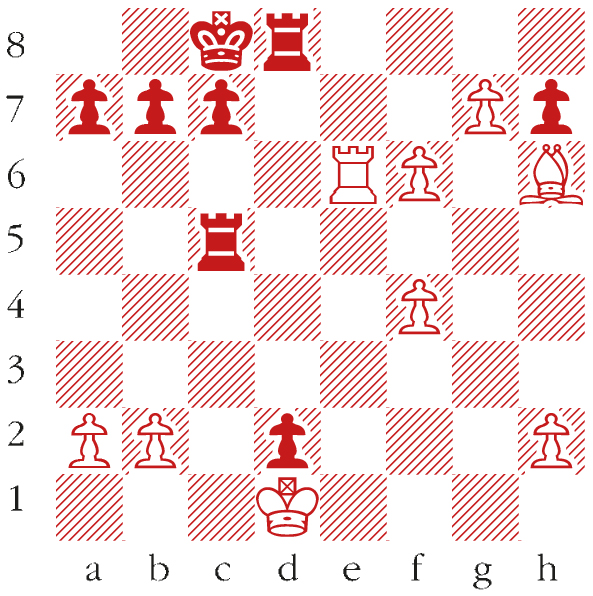
Last week’s solution 1…Qf4+! 2 Rxf4 (or 2 g3 Qd2+ wins) g3 mate.
Last week’s winner Michael Low, Weston-super-Mare, Somerset
Spectator Competition: Marvelling
For Comp. 3401 you were invited to submit a poem that included the line ‘My vegetable love should grow’ from Marvell’s ‘To His Coy Mistress’. There were lots of entries, some of them quite fruity (sorry). There are too many worthy runners-up to name names, but the£25 vouchers go to the winners below.
My vegetable, love, should grow,
not end up on your plate,
at least until it’s won first prize
at the village fète.
I’ve never nurtured one so vast,
nor hosed a hue so green –
how can you think of eating it
like some mere runner bean?
But at my back I hear you mutter
It’s just a courgette, after all…
Hands off! – such plants once rooted in
Eden, before the Fall.
I could bang on an age or two
extolling its perfection,
though it and I of course would need
cryopreservation.
Tom Vaughan
Had we but world enough and time,
This coyness, Lady, were no crime,
I’d woo you in a bed of foam
And plant my seedlings in your loam.
You’d fondle figs and stroke courgettes,
Slide fingers under insect nets.
My vegetable love should grow,
And swell until the world should know
Of well-hung cucumbers and leeks,
And bloated yams in sunlit streaks.
But always at my back I hear
That old man, Winter, hurrying near:
Your brassicas begin to droop,
My tubers wilt in autumn’s swoop;
So let us plough this fertile bed –
And trade our juices, ripe and red.
Ralph Goldswain
To His Coy Onion
My vegetable! Love should grow – let’s not
To photosynthesis of leafy heart
Admit impediments, remote shallot!
From coy indifference, lady, now depart,
For amor inter allia, onion love
Is sure to bring a tear to any eye,
Our love’s as strong as any garlic clove:
The Posh and Becks of allioideae!
Be not remote, shallot, and be not coy,
Nor hearken to the speciesist naysayers
But onion girl, in front of onion boy,
Remove those shy resistances in layers.
For some, vegetal passion, so humungous,
Takes over like a knotweed or a fungus,
Or moss or bindweed, but with me and you,
It just was planted quietly – and grew.
David Silverman
‘Mon petit chou,’ I cooed. ‘My sweet
Neat vegan, good enough to eat,
My cabbage, let our fates enmesh…’
But she’d no yearning for my flesh.
Though tasty as a teatime, she
Felt no affinity for me.
I pleaded ‘Get to know me. Oh,
My vegetable, love might grow…’
Cajoled by plaintive words I said,
At last she ventured to my bed,
But then, in terms that I thought caddish,
Compared my manhood to a radish.
I said: ‘While you express such scorn,
No wonder that it shrinks forlorn.
Oh, did you but encourage, though,
My vegetable, love, should grow.’
George Simmers
My lady, you know that I adore you
But do this for me, I implore you
Open up yourself to the possibility
That raising our crops organically
Will not suppress the pests that plague us –
Grub worms assault your rutabagas
While the blight of white rust ravishes
The swollen red globes of my radishes.
But lady, you cast my proposal aside
When I suggest we use inorganic pesticide –
I do not wish to see you compromised,
But my galangals are woefully undersized.
With glyphosate, my vegetable love should grow
And we could win first prize in the village show
In the root and tuber category –
Just think how marvellous that would be!
Sue Pickard
Depleted supermarket shelves, each rack
emptied of salads, cabbage, lemons, lime
caused by (again) a fresh computer hack –
the only ‘fresh’ thing here – so now it’s time
(again) to get down dirty, clear the weeds
and head-high thistles, double-dig the plot,
manure and water it and plant the seeds
of future self-sufficiency: the lot.
My vegetable love should grow – it should
produce imagined glories. Alas, snails
plus slugs, droughts, pigeons, carrot fly (again)
doom this back-breaking enterprise. It fails,
reminding me I never learn: that soil
won’t feed our fantasies, just the regrets.
I blame foul weather, pests, the thankless toil
and feeble germination of courgettes.
D.A. Prince
Marvell writes, ‘My vegetable love should grow’:
though Heaven only knows what Marvell means.
But it could be something different, very much so,
to my own love for a tin of Heinz Baked Beans.
Did Marvell, maybe, spend long hours
in lovers’ trysts with cauliflowers
or use his wily charm to coax
sweet kisses from young artichokes,
then wildly and improperly
deflower stems of purple sprouting broccoli?
Then when old and tired and ravaged
was his choice between limp cabbage
or some wrinkled old tomatoes
as his last inamoratos?
Or did he manage, even yet,
to woo a coy cucumber or courgette?
Martin Parker
No. 3404: Wild time
You are invited to design your own midsummer ritual (16 lines/150 words maximum). Please email entries to competition@spectator.co.uk by midday on 11 June.
2705: Thirty sevens
The unclued lights have an award-winning feature in common.
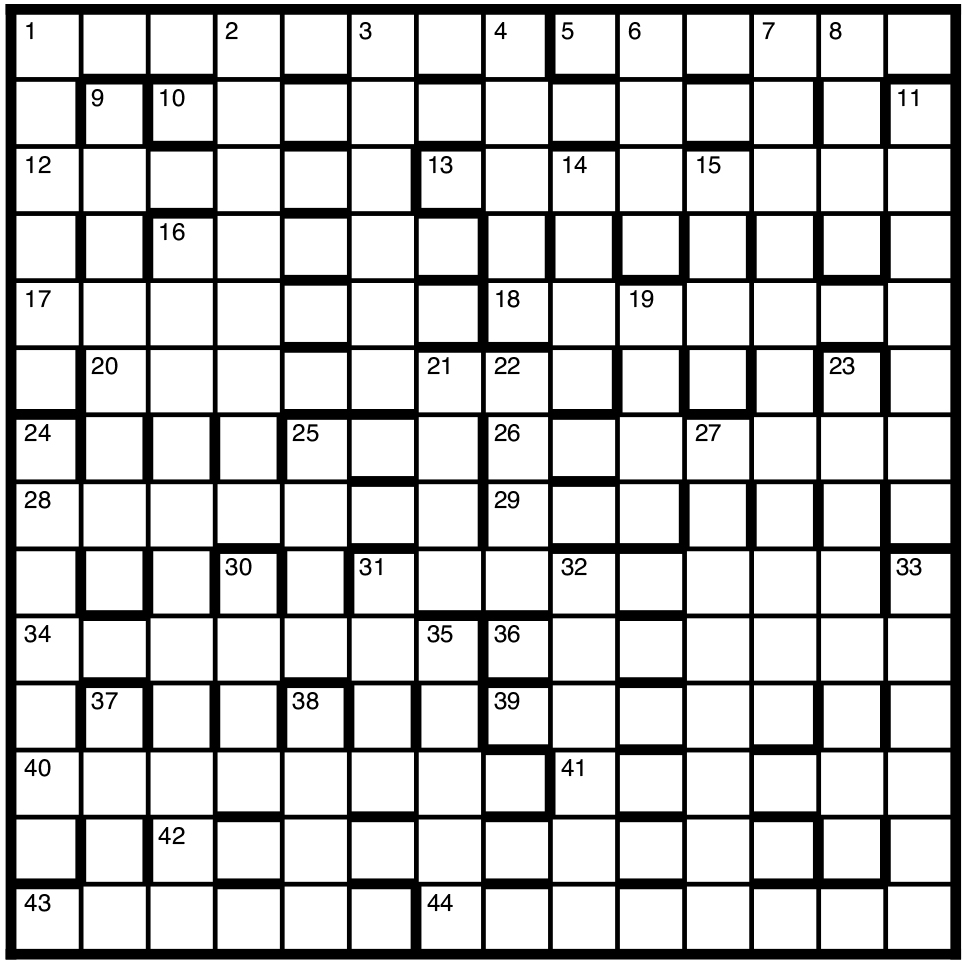
Across
5 Webcam perhaps covering temporary accommodation (6)
10 With Head absent, our teachers brewed liqueur (10)
12 Start to grumble and show contempt, returning cabbage and sprouts (6)
16 Virginia starts to gripe about loss of nerve (5)
17 French film-maker returns in time to shake things up (7)
20 Views wild rhinos surrounding empty zoo (8)
25 Women’s popular victory (3)
26 Hero sat awkwardly in proximity (7)
28 Can start to see city in outline (7)
29 Hail one empty vehicle (3)
31 Run profit-making facility for outside users (8)
34 Distinctive qualities of musical about revolutionary (7)
36 Stretched out and gently massaged around top of hamstrings (7)
39 I make a claim over small matter (5)
40 Hey! Start to lower yearly interest – it’s necessary for some artists (3,5)
41 Film a story with new section (6)
42 Use old slang in New York area (4,6)
Down
1 Show surprising gains on left (6)
2 Sunbathe at resort hosting Noel Coward and Harold Pinter? (8)
3 Tumbled quartzes, without question fake (6)
4 Endless to-do over small whisky measures (5)
6 Car starts to accelerate up to Oldham (4)
7 Mixes palette, then joins in a few events (11)
8 Changed gear, covering up hem (4)
11 Fool moved in, getting approvals (7)
14 Puts in stitches, we hear (4)
15 It’s reported I have a place in Scotland (4)
16 Victor and I look over eccentric colonel’s instrument (11)
19 Virginia creeper covers particular area (4)
21 Stone axes in use formerly (4)
22 Ordered and can, at last, tuck in (4)
25 Are living in the past? (4)
27 Confident genius creatively absorbing article (8)
30 Angel Delight, perhaps with fruit (4)
31 First pieces of embroidery tidied up in sewing case (4)
32 Teresa leaves sandwiches for marketing again (6)
33 Goodness! Nothing wrong in protein (6)
35 Could be a boom in martinis on ice! (5)
37 Look to the audience for support (4)
38 Weather reporter is self-important sounding (4)
Download a printable version here.
A first prize of a £30 John Lewis voucher and two runners-up prizes of £20 vouchers for the first correct solutions opened on 16 June. Please scan or photograph entries and email them (including the crossword number in the subject field) to crosswords@spectator.co.uk, or post to: Crossword 2705, The Spectator, 22 Old Queen Street, London SW1H 9HP.
2702: Some beef – solution
Triplets related to 38 WELLINGTON were 4A,
13 and 26 (WW2 bombers): 11, 27 and 32 (boots) and 1D,
12 and 31 (New Zealand cities).
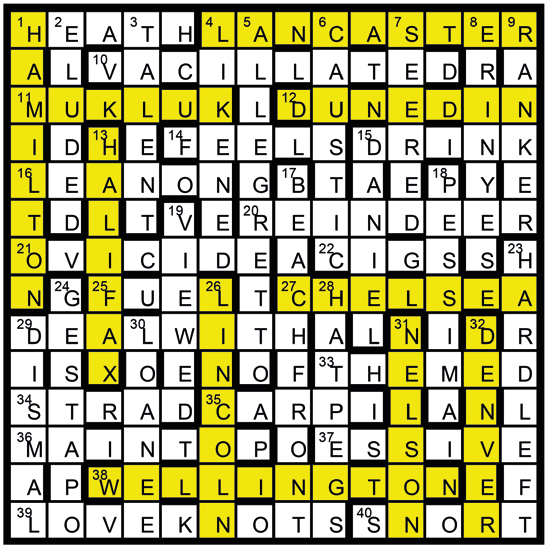
First prize Jude Wilson, Surbiton, Surrey
Runners-up Sarah Darlington, Acton Trussell, Stafford; Sharon Harris, Hadlow, Tonbridge, Kent
Will Labour’s rail replacement service leave travellers stranded?
By spooky coincidence, on Saturday night I watched an old episode of Slow Horses in which a passenger died mysteriously on a replacement bus between High Wycombe and Oxford Parkway – and on Sunday I woke to reports that the first service of the new era of rail renationalisation, the 5.36 from Woking to Waterloo, had also featured a replacement bus. Nobody died, but it wasn’t a good omen.
Nor was it quite the ‘turning point for the future of our railways’ that Transport Secretary Heidi Alexander declared. South Western Railway’s return to state hands this week was in fact the fifth major passenger franchise to go that way – four having already failed under the previous government. Nine more will transition as their contracts expire between now and 2028, by which time Labour’s Great British Railways (GBR) will have seized control of the whole contraption, including tracks and stations.
So this is a work in progress – which in theory should lead to economies of scale, co-ordinated timetables and simpler ticketing. In practice, it’s also likely to be hobbled by incompatible IT, endless track and signal troubles, and workforce intransigence. But in fairness, all this reflects the fact that the Major government’s 1996 blueprint for privatisation, which broke British Rail into 70 companies, was a Treasury-driven dog’s breakfast that enriched undeserving players, bankrupted worthy ones and left commuters deeply disgruntled.
On the other hand, GBR is also a nakedly leftist move to return to state ownership the only privatised industry in which (as its time-limited franchises expire) the transfer can happen without confiscation or compensation. Behind it are unions whose resurgence was marked by a 15 per cent unconditional pay rise for train drivers shortly after Labour came to power.
Tories blamed for rail chaos in the first place won’t rush to reprivatise; nor is that likely to feature in Reform’s manifesto. So the GBR replacement service is leaving the station and by the end of the decade we’ll have some sense of whether it can deliver better travel at lower taxpayer cost. As a reversion to the Attlee government’s monolithic 1948 blueprint, I hope it doesn’t leave travellers stranded like the cast of another, much older screen mystery, The Ghost Train.
Save Grand Central
I also hope unions and ministers won’t conspire to abolish the passenger-friendly ‘open access’ system which has hitherto allowed freelance operators such as Hull Trains, Grand Central from Sunderland and Lumo from Newcastle, under licence from the regulator, to compete against franchisees – bringing welcome choice and entrepreneurial eagerness to please.
Well-spun reports say ministers fear that a rash of open-access bids from former franchisees could have the effect of siphoning revenue from GBR and increasing the need for taxpayer subsidy. A forthcoming Railways Bill, on which consultation recently closed, is likely to include a sneaky clause in which the power to grant open-access licences would pass to GBR itself, with the regulator acting only as a court of appeal. I think we can see where that’s going. I write as a satisfied weekly Grand Central customer on the East Coast mainline: my campaign to save the service starts here.
Self-defeat devices
Justice is slow but it usually gets there in the end. A German court has convicted four former Volkswagen executives on charges of fraud in the ‘Dieselgate’ scandal, in which the automotive giant was discovered a decade ago to have fitted ‘defeat devices’ in its cars to produce understated results in emissions tests. The trial took four years, and even before that VW had incurred €30 billion in fines and settlements for the greatest embarrassment in its history, mitigated only by allegations that numerous other major European and Japanese carmakers had been up to very similar tricks.
The motivation behind these frauds was to enable manufacturers to keep producing diesel vehicles on existing platforms for as long as possible. The impact of being caught red-handed was to hasten a face-saving pivot towards electric vehicles, which in its first flush looked welcome news for the planet and the eco-minded motorist. But it has gradually turned into a disaster for the industry.
A multiplicity of new models were rushed out before battery technology and charging networks had advanced to solve range problems. Electric car prices were high, depreciation was precipitous, non-urban drivers weren’t interested – and some pointed out that their carbon footprint was possibly heavier than that of new-generation ‘clean diesel’ competitors.
VW’s own electric conversion, to quote Top Gear magazine, ‘has very much had its ups and downs, and the downs have been painful and self-inflicted’; but hope is now pinned on the launch in 2027 of the €20,000 ID1 as a mass-market successor to the Golf and the Beetle. It all amounts to a cautionary tale of a great company brought low by a self-defeating conspiracy of cheaters.
Nanny-state dashboard
To Oxford – on an overcrowded, slow-running GWR train – for lunch at the Ashmolean Rooftop restaurant, with its breezy panoramic vista. I can’t fault the food, the service or the ambience, but I’m disconcerted by the menu, which not only tells me ‘breastfeeding welcome’ and ‘adults need around 2,000 calories a day’ but provides a QR code link to a carbon-footprint counter for every dish. My gnocchi scores a relatively virtuous 387kcal and 0.7kg of CO2, but my companion’s sea bream weighs in shamefully at 532kcal and 3kg. And what’s missing from this nanny-state dashboard is a live tracker of food price inflation, which has risen for four months in a row to hit 2.8 per cent. Let dons looking out over dreaming spires worry about carbon in their cream tea; the rest of us have more earthly concerns these days.
Letters: Britain sold its fishing industry down the river
Hard reset
Sir: Once again we must debate Brexit (‘Starmer vs the workers’, 24 May). The ‘reset’ agreement does give more control over UK domestic policy to the EU, if the points outlined in it are followed through. I assume they will be, as that’s what Labour’s front bench wants. (The prospect of us rushing through EU passport control, as Michael Gove and others suggest, is still unlikely, though – the document states only that there will be the ‘potential use of e-gates where appropriate’.)
Britain must pay for many of the extra ‘benefits’. Apparently the boost to the UK amounts to £9 billion by 2040, but I’m unable to identify any government research that supports this – only an assertion in a press release. According to the release, in the absence of agreement on the EU’s carbon trading system, UK exporters will contribute £800 million to the EU from 2026. My own simplistic calculation is that if this is repeated for 15 years, it would cost us £12 billion. If this is treated as a benefit by our government, then there are no other benefits – but only costs – to reach a total of £9 billion.
And Richard Johnson (‘Left alone’, 24 May) wants government loans with union and workers’ conditions attached to the fishing industry. Socialism never dies! Simply giving tax credits for such investment would be 100 per cent better.
Trevor Pitman
Beckenham, Kent
Hook, line and sinker
Sir: Matthew Parris is right: the French have always looked after their coastal communities better than we have (‘Flogging a dead fish’, 24 May). In contrast, Britain missed a clear opportunity. Had we been tougher on fishing rights – linking them to the return of Channel migrants – we might have curtailed a widely disliked trade from the start. Yes, fishing is only 0.03 per cent of GDP, but that statistic ignores the real story: it was the EU that paid British fishermen to decommission, dismantle and ultimately destroy their ability to fish. We didn’t lose the industry by accident – we were paid to scrap it.
Alan Pedder
Bury, Greater Manchester
Pipe dreams
Sir: Lord Moore’s Notes (24 May) are as entertaining as ever. One imagines that riding through remote Kyrgyzstan countryside is not for the fainthearted, but presumably his hunting experience came in handy. The rendezvous with a bagpipe-equipped student from St Andrews seemed almost surreal, until I recalled a parallel encounter in the Sahara desert several years ago. During a geological survey in the south of Algeria, we had bivouacked for the night around a warming fire (cold nights in February) when one of our camp guardians, a Tuareg tribesman with a Kalashnikov over his shoulder, produced a set of bagpipes and skirled for a while. Apparently, the pipes are not unknown in those desert areas, although whether there is a Scottish connection, I never found out. As a postscript I would like to report that we heard cuckoos in Biddenden and Sissinghurst this spring, so maybe they will return to Sussex next year.
Peter Cutts
Biddenden, Kent
Falling short
Sir: On first reading Alice Loxton’s paean to the plethora of ‘short histories’, I thought her intentions were satirical (‘Short and sweet’, 24 May). However, her omission of the one truly worthwhile short history, 1066 and All That by W. C. Sellar and R.J. Yeatman – which is a parody of the type of defective knowledge and understanding encouraged by short history – leads to the thought that she is serious. If so, she hasn’t been paying attention: the study of history and the democratic culture that depends on it are menaced by crude and simplistic versions of the past that short histories serve up. She might reflect that Clio, the muse of history, like any self-respecting goddess, needs to be wooed slowly and respectfully; or that cricket, so closely associated with respect for the English past, is being destroyed by the ‘short form’ of the game. To paraphrase Kingsley Amis, more short histories will mean worse history.
Professor Lawrence Goldman
History Reclaimed
St Peter’s College, Oxford
Holy disorder
Sir: Christopher Howse’s reference to the 1631 edition of the Authorised Version of the Bible commanding ‘Thou shalt commit adultery (‘Notes on typos’, 24 May) reminded me both of the so-called ‘Unrighteous Bible’, published in 1655 by the Cambridge Press, where Corinthians 6:9 read ‘Know ye not that the unrighteous shall inherit the Kingdom of God?’, and a Bible printed in Ireland in 1716 which, in John 8:11, commanded ‘Go and sin on more’. Bibles do seem particularly prone to typos, but I’d like to think it was a mischievous typesetter who once had David in Psalm 119 complain not that ‘princes have persecuted me without a cause’ but ‘printers have persecuted me…’.
Peter Saunders
Salisbury, Wiltshire
You name it
Sir: John Power’s article on the vulnerability of the UK’s electrical grid (‘Volt farce’, 10 May) was very timely and extremely thought-provoking. Mr Power demonstrates a natural grasp of electricity infrastructure, as well he might. Looking through the ranks of Spectator contributors, it is impossible not to consider who else might have an affinity for subjects closer to home: does Tanya Gold have a view on the vertiginous rise in the price of precious metals, for example? The outstanding Yorkshire Sculpture Park might easily appeal to Mary Wakefield, and as we drift into the mayfly season I can already see a fishing column co-authored by Francis Pike and Rod Liddle.
Tom Nelson
Oban, Argyll
The derangement of Harvard
It is 60 years since William F. Buckley said that he would ‘rather be governed by the first 2,000 people in the Boston telephone directory than by the 2,000 people on the faculty of Harvard University’. Yet even the godfather of American conservatism would be surprised at how much more attractive the folks in the phone directory appear today.
Harvard is currently having a major row with Donald Trump’s administration. It results from the way in which the university responded to the 7 October attacks in Israel. While the Hamas massacres were still on-going, more than 30 Harvard University student organisations signed a letter which claimed to hold the ‘Israeli regime entirely responsible for all unfolding violence’.
You might wonder why students at Harvard have such an inflated sense of their own importance that they imagine any ‘regime’ or government would be waiting for their take on things. Stranger still was the students’ apparent belief that Harvard was somehow central to the Israeli war effort. ‘Harvard out of Occupied Palestine’ was one of their demands. You would be hard-pushed to find anyone in the Middle East who believes that their lands are occupied by Harvard University, whoever else they think culpable.
Since then, events on campus have become increasingly insane. Jewish students were subjected to assaults, insults and intimidation – all while the university authorities defended all this as a ‘speech’ issue. In a set of notorious hearings in front of a Congressional committee, the then president of Harvard, Claudine Gay, insisted that calls for ‘genocide’ against Jews would have to be judged based on their ‘context’.
Many observers noted that if it had been black students being chased across the Harvard campus with calls for lynchings then things might have been regarded differently. If foreign students were shown to have participated in such activities, then withdrawing their visas would have been the least of the demands. Yet students at Harvard who were part of a group that attacked their Jewish peers were not only given free rein to do so, but only the other day a number of them were honoured by the university and given further scholarships.
The university knows what it could do to clean up the mess, yet it presents itself as the victim
The latest Trump administration has made Harvard one of the focuses of its attempts to de-radicalise the American university system. It has threatened to freeze tens of millions of dollars of federal subsidies to the university and warned that the Internal Revenue Service would be taking away the institution’s tax-exempt status. Last week the Department of Homeland Security said that it was revoking Harvard’s certification for participating in the Student and Exchange Visitor Program – effectively cutting billions of dollars of further financing.
Many Americans will have been surprised to learn that billions of dollars of their taxes have been going to educate foreign students at Harvard – including the sort of foreign students who use their time to foment revolution in the United States. Harvard started legal proceedings against the government within the day, once again reminding us that the only people who always benefit from this sort of dust-up are members of the legal profession.
This week the Homeland Security Secretary Kristi Noem said the Trump administration is ‘holding Harvard accountable for fostering violence, anti-Semitism and co-ordinating with the Chinese Communist party on its campus’. She went on: ‘It is a privilege, not a right, for universities to enrol foreign students and benefit from their higher tuition payments to help pad their multibillion-dollar endowments. Harvard had plenty of opportunity to do the right thing. It refused.’

Harvard and its supporters have done what any university would do, insisting that the cuts threatened by the Trump administration have already affected research into cancer and other diseases. This is a pretty cunning move. Harvard knows what it could do to clean up the mess made by its students and faculty, yet it presents itself as the victim of brutal and inexplicable cuts that threaten the very things that everybody agrees a research university should focus on. It is the playbook that the left always uses whenever financial cuts occur, here or in the US – portraying them as falling hardest on ‘the most vulnerable’. Campaigners are one step away from proclaiming: ‘It is such a shame that since the government’s slashing of funding to our egregious and politicised campaigns all the puppy sanctuaries will have to close.’
Harvard is betting that it can win the war with Trump. His administration is clearly enjoying the opportunity to sock it to an institution that has become increasingly partisan and political. Yet all the time the obvious correction remains in plain sight.
The trouble lies in the fact that Harvard is no longer Harvard, just as so many other institutions in the West are not what outsiders imagine them to be. Harvard’s best line of defence would be to return to what it is meant to be – a genuinely world-class university which prioritises the cultivation of excellence. It is many years since it or most other higher education institutions in the US have been any such thing. It is one reason why students are desperate to enrol in new establishments such as the University of Austin and Ralston College in Savannah. These places aim to provide a true, classical education, because it is so hard for Americans to find it where they once did.
One left-wing author claimed this week that through its attacks on Harvard, the Trump administration ‘has launched a comprehensive attack on knowledge itself’ which ‘if successful will undermine Americans’ ability to comprehend the world around us’. We shall see. But for that line of argument to work, the people in what used to be the phone directory would have to be persuaded that Harvard has been an enlightening presence in American life of late, rather than an utterly deranging one.
Germany’s Bundeswehr bears no resemblance to an actual army
Confusion abounded this week when the new German Chancellor Friedrich Merz said that Ukraine could use western missiles to hit targets deep within Russia. ‘There are no more range limitations for weapons delivered to Ukraine. Neither from the Brits, nor the French, nor from us. Not from the Americans either,’ he said. The problem was twofold. Firstly, that is not the official policy of western allies. Secondly, Germany has not provided Ukraine with any long-range missiles.
Partly that is a political choice by Germany, but there is also the fact of the inherent weakness of the Bundeswehr itself. Merz’s new government has recognised the limited nature of his military, vowing to build ‘the strongest conventional army in Europe’. For that to happen, the Bundeswehr will need more than money. It needs to know what it is and what it’s fighting for. Is Germany – still deeply scarred by its Nazi past – ready to build a military ethos fit for the 21st century?
Independent thinking has never been a priority for the Bundeswehr general staff. Rock-solid trust in US leadership was part of its very foundations. With those foundations eroding, Merz is trying to build his own as quickly as possible. He has promised to spend 5 per cent of GDP on the military and related infrastructure; this amounts to some €200 billion, four times what Britain spends on defence in any given year.
There is an irony in this promised military expansion: it’s the result of Donald Trump’s demands that Nato allies meet their obligations under the treaty. Even when it comes to greater German self-reliance, it seems that Washington is still calling the shots.
This historic reliance on American strategic direction is combined with a relaxed approach to the chain of command. The Bundeswehr is wary of discipline and blind obedience, which are seen as characteristics of previous German militaries, especially the Nazi Wehrmacht. So its self-declared ‘company ethos’ is that of a ‘citizen in uniform’ acting on his or her own ‘inner guidance’. In other words, soldiers are explicitly encouraged to question every order. ‘The Bundeswehr knows no absolute obedience,’ recruits are told. ‘The ultimate decision-making body is the conscience of the individual.’
Germany’s military was a publicly funded employer whose focus was subsidised educational opportunities
This was a conscious break with the Prussian military tradition. Members of the Prussian aristocracy, or Junkers, had previously made up a sizeable proportion of the officer class. Their obedience to the monarchy came with a long-established ethos of strict military discipline. This allowed for the development of a more flexible command structure compared with European neighbours. Called Auftragstaktik or mission command, it involved the commander issuing an objective rather than a direct order on how to achieve it. His subordinates would then have a large degree of freedom as to how to achieve the objective. The Prussian military was highly trained and ideologically consistent, meaning that commanders could trust their underlings to follow military doctrine.
The Bundeswehr still largely relies on the Auftragstaktik model, but now minus the element of absolute structural obedience. It’s easy to see why. Wehrmacht soldiers committed terrible crimes on behalf of Hitler in a war that was explicitly genocidal. Commanders later claimed they were only following orders. The idea of an army of ‘citizens in uniform’ was that every soldier should have the capacity to stop such atrocities. Individual morality must exist, even within military command structures.
Perhaps that independence of mind is what led to a series of scandals within Germany’s elite Kommando Spezialkräfte. In 2020, the KSK was partially disbanded when members of the unit were found with Nazi memorabilia and evidence emerged of soldiers singing fascist songs. The then-defence minister said the unit had ‘become partially independent’ of the chain of command.
KSK members were found to have discussed the potential of a migration-induced civil war, while another was implicated in a 2022 attempted monarchist coup. Investigators found that some NCOs had compared the unit to a modern-day Waffen SS.
Those accused of these right-wing plots came from historically conservative parts of the country like Saxony and Thuringia. The KSK’s base is in a remote part of the Black Forest, which investigators said contributed to their insular mindset. As of 2021, no woman had passed the KSK commando soldiers’ entrance tests.
Fear of such scandals is what fuels the Bundeswehr’s many diversity initiatives. Women only gained access to all military roles in 2001, yet are now seen as ‘naturally equal’ and their presence as ‘a normality’. Accordingly, there has been a massive drive to push the proportion of female personnel from 13 per cent to above 20 per cent. The Bundeswehr holds annual ‘Girls’ Days’ in an attempt to recruit women into the military.
There has been a similar focus on changing the demographics of recruits. In a recent study entitled ‘Colourful in the Bundeswehr?’, the Ministry of Defence declared that ‘as a matter of principle, the way towards conditions of equal opportunities in any organisation goes through the furthering of a diverse and “colourful” body of staff’. The ministry is at pains to point out that it understands ‘diversity’ as a ‘holistic’ concept involving not just ethnicity but also other characteristics such as gender, age, disability, religion and sexual identity. Notably, for a country that reunified only 30 years ago, there’s no mention of regional or class diversity. Germans from poorer eastern states are excluded from such diversity drives.
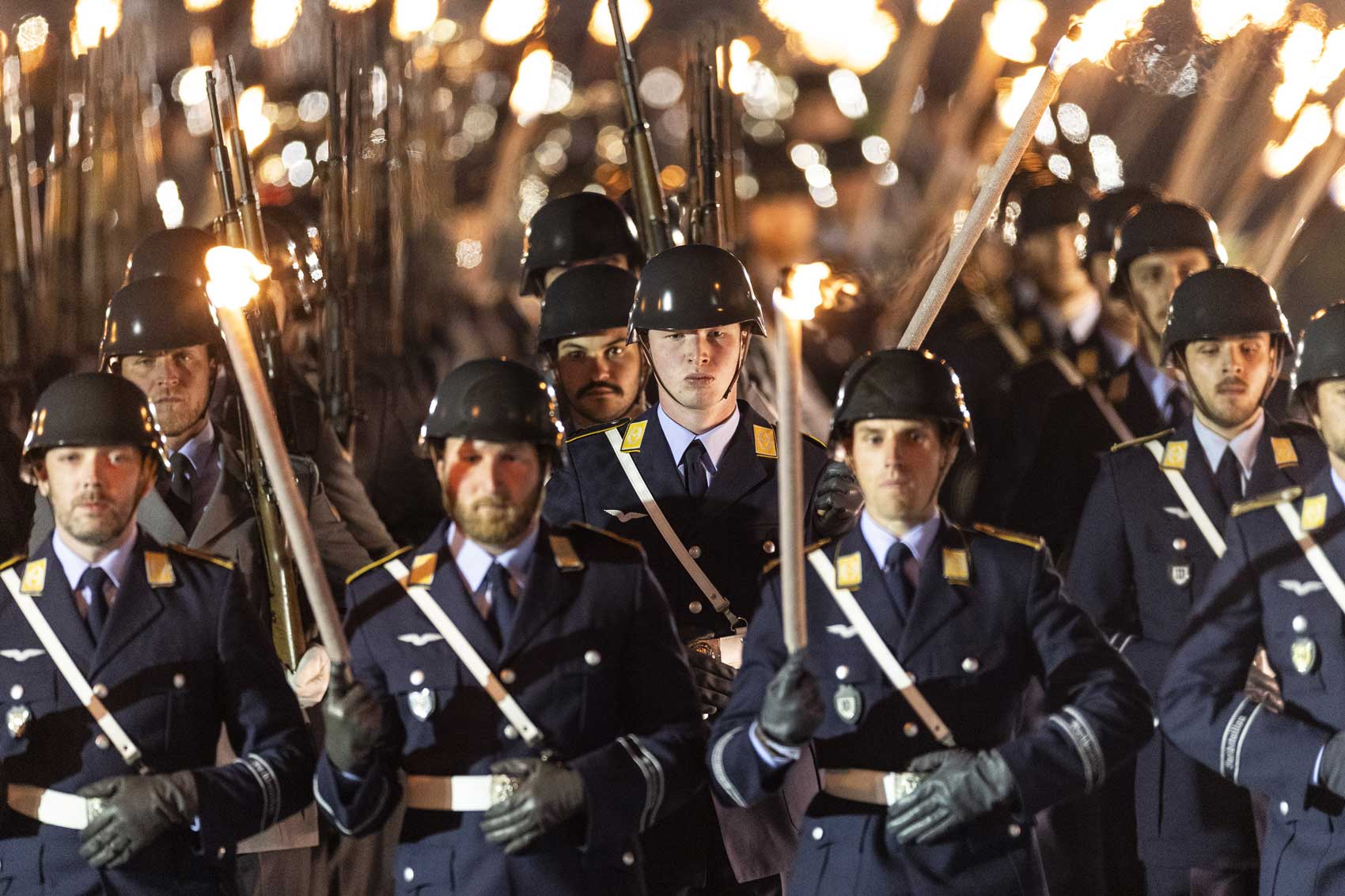
The Bundeswehr presents itself as a regular civilian employer whose main concern isn’t operational effectiveness but the recruitment and retention of a civilian-like workforce. The ideal is an army that reflects society, but the downside is that it makes institutional loyalty an afterthought. If the Bundeswehr presents itself as a regular employer, recruits will treat it accordingly. They will come and go as they please and show reluctance to do jobs that are difficult, dangerous or less well-paid.
The recent report of the Parliamentary Commissioner for the Armed Forces of Germany revealed serious problems. It points out that since 2019, the average age of Bundeswehr members has risen from 32.4 years to 34 years. Efforts to increase the size of the military from 180,000 active soldiers to the target of 203,000 by 2031 have so far been unsuccessful. There has been an increase in the number of recruits but more than a quarter of them leave the Bundeswehr within six months. A survey of those who left concluded that most had done so because they found ‘a different alternative’; others said the job was ‘too far from home’.
The focus on personal work conditions has also led to a rather ‘top-heavy’ structure. A recent study of Bundeswehr applicants showed that despite the increase in absolute numbers, there is an acute shortage of those who want to join the rank and file rather than via the officer routes. The chief of the German army, Lieutenant General Alfons Mais, has complained that of the 180,000 members of the Bundeswehr, around 100,000 occupy officer staff or leadership roles. ‘They are watching from the stands while 80,000 are trying to win the war,’ Mais said.
These are long-standing structural problems of the Bundeswehr, issues that for decades no one thought needed fixing. If anything, politicians were happy for Germany’s military to be a publicly funded employer whose focus was subsidised educational and employment opportunities. One of my (female) German school friends signed up as an officer recruit because she wanted her university degree funded. She is no longer in the Bundeswehr.
It was deemed a success that the postwar officer class was no longer dominated by heel-clicking Prussian Protestants all recruited from the same aristocratic families. Today’s Bundeswehr leadership is instead distinctively middle-class. According to the recruitment study, applicants who considered themselves ‘middle-class’ or ‘upper-middle-class’ were vastly overrepresented.
It’s a demographic particularly interested in employment opportunities: the Bundeswehr runs two universities, in Hamburg and Munich, offering courses that have little to do with military tasks, including psychology and sports science. My former officer friend graduated with a degree in education after a few years in the Bundeswehr.
The somewhat transactional nature of recruitment never seemed a problem; the Bundeswehr was mostly a tolerated but unloved part of Germany’s restructured postwar order. There was enough funding to keep its uniformed citizens occupied and a firm conviction that they would never have to fight in costly, large-scale campaigns. This led to a neglect of the actual machinery of war: depleted ammunition, infrastructure, equipment and supplies. Under Angela Merkel, defence expenditure dropped to barely above 1 per cent of GDP.
Since the second world war, the German armed forces have rarely been deployed and when they were, it was always amid acrimonious public debate. In total, the Bundeswehr has lost 119 people on foreign missions since 1955 – which, while tragic, is extremely low compared with the losses of many of Germany’s partners. The UK has lost 7,193 since the end of the second world war.
In 2022, the then-foreign minister Annalena Baerbock argued that Germany was more reluctant to get involved in Nato campaigns ‘because we are not all the same – even though we are standing side by side, we have different roles and we have different history’. On the eve of Russia’s invasion of Ukraine she still insisted: ‘This is not the moment to change our course by 180 degrees.’
Merz says that moment has now come. But with the weight of German history on his shoulders, he too will find it difficult to reform the Bundeswehr. No educational offer or recruitment campaign is a replacement for the ethos and traditions that bind soldiers to one another. Money alone will not make it a force for which the country’s young are willing to fight and potentially die. Only a sense of purpose, identity and comradeship can do that – the kind of military culture Germany’s postwar elite has always quietly feared.
My sitcom-worthy walking holiday
I’ve just returned from a walking holiday in Northumberland with Caroline and my mother-in-law. I say ‘walking’ but that makes it sound more physically demanding than it was. Billed as ‘gentle guided walking’, it was more like an ambling holiday, and the distances weren’t very great. On the second day, I was anxious to make it to the pub to watch the League One play-off final, so raced ahead and completed the walk – the entire walk – in less than an hour.
It was a packaged tour organised by HF Holidays, a co-operative set up as the Holiday Fellowship in 1913 by Thomas Arthur Leonard, a non-conformist social reformer. He wanted to save factory workers from the fleshpots of Blackpool by encouraging them to take walking holidays instead. A great believer in the improving effects of the great outdoors, he was a strong supporter of the National Trust and was also involved in setting up the Youth Hostel Association and the Ramblers’ Association – a bit like Robert Baden-Powell, except without the links to African colonialism or Hitler Youth. Leonard was also a supporter of the Independent Labour party, a staunch pacifist and, towards the end of his life, a member of the Society of Friends.
Not my cup of tea, then, but HF Holidays is now a broad enough church to accommodate sybaritic non-believers. Well, up to a point. I asked my mother-in-law if I could bring some wine, but was told this wouldn’t be in keeping with the slightly frugal, ascetic atmosphere. We were staying in an hotel in Alnmouth owned by the company, and meals were communal, with the 60 or so guests sharing tables and expected to chat to each other while selecting from a limited menu. The food wasn’t as bad as I’d feared, but breaking out a bottle of the good stuff – indeed, doing anything remotely flashy – would have been infra dig.
To underline the air of self-denial, each dish listed its calorie count, although the numbers may have been plucked out of the air. For instance, on the breakfast menu, a boiled egg had 52 calories, but a poached egg had 105. Surely poaching an egg doesn’t double the calories? On the other hand, if you added smoked haddock to your poached egg, it only brought the total up to 127, which must have been an underestimate. Not surprisingly, this latter combination proved very popular with the calorie-counting outdoorsmen.
Every evening before dinner, the guests were given a run-down of the walks on offer the following day, with ascending levels of difficulty. We chose number two on the first day – six-and-a-half miles, with some gentle hills – and number one on the second – four miles along a coastal path. The choices were accompanied by much speculation as to whether the person who’d calculated the distances was the same person who’d totted up the calories. Would six-and-a-half miles turn out to be ten? This wasn’t just a chance to poke gentle fun at the holiday company. The average age of the guests was about 75 and they didn’t want to risk keeling over. Happily, the guides explained that they would only move as quickly as the slowest person in the party, with plenty of loo breaks and coffee stops.
We went back to when the distinguishing characteristic of the British was fondness for taking the mickey
It turned out to be an enjoyable way to spend the bank holiday weekend. Not only is the scenery along the Northumberland coast spectacular – a bit like Cornwall without the crowds – but the other ramblers were excellent company. Most of them were quintessentially British, which is to say constantly making jokes about every-thing. We quickly formed little friendship groups and assigned each other stock roles from the back catalogue of classic English sitcoms. So, because I’d been anxious to make it to the play-off final, I was the football obsessive, a bit like Terry Collier in The Likely Lads. An old boy who was anxious about the loo breaks became Godfrey from Dad’s Army, while a bluestocking with a jolly-hockey-sticks air was Margo from The Good Life. I don’t mean we literally referred to each other by these names. Rather, we turned everyone into comic caricatures from the great pantomime that is our shared social history and then teased each other accordingly. It was like going back in time 25 years to when the distinguishing characteristic of the British was our fondness for taking the mickey. Now, of course, it’s our propensity to take offence.
I’m not sure I’ll be rushing to go on another HF Holiday in the next ten years, but when I hit my seventies and start worrying about staying active, I can think of worse ways to spend a long weekend. I’ll just have to work out a method of smuggling in some Gevrey-Chambertin, disguised as cold-pressed beetroot juice.