-
AAPL
213.43 (+0.29%)
-
BARC-LN
1205.7 (-1.46%)
-
NKE
94.05 (+0.39%)
-
CVX
152.67 (-1.00%)
-
CRM
230.27 (-2.34%)
-
INTC
30.5 (-0.87%)
-
DIS
100.16 (-0.67%)
-
DOW
55.79 (-0.82%)
How do you exhibit living deities?
The most-watched TV programme in human history isn’t the Moon landings, and it isn’t M*A*S*H; chances are it’s Ramayan, a magnificently cheesy 1980s adaptation of India’s national epic. The show has a status in India that’s hard to overstate. Something like 80 per cent of the entire population watched its original run; in rural areas entire villages would crowd around a single television hooked up to a car battery. When the show ended, omitting the ‘Uttara Kanda’, the fairly controversial last book of the original poem, street sweepers across the country went on strike, demanding the government fund more episodes. The government caved.
But while every country has its pieces of cult media, in India the cult is literal. Some viewers would take a ritual bath before tuning in. Others would decorate their TV sets with garlands of flowers, or light oil lamps in front of the screen and perform aarti, a devotional rite in which a flame is waved in circles in front of an image of a god. And why not? There was an image of a god on the screen. He might have been played by an actor in a plastic crown, but Ramayan was a representation of Lord Ram.

Abrahamic faiths can be quite iffy about this kind of thing. At my maniacally Orthodox Jewish primary school, I was told in no uncertain terms about all the terrible punishments God periodically imposed on those of his followers who tried to make images of Him. At one point, in an art lesson, we were told to draw a picture of Moses receiving the Ten Commandments; one boy who made the mistake of depicting Yahweh as an enormous stick figure had to watch his effort being ripped up in front of the entire class.
Christianity has traditionally been more relaxed, but it has its own long history of recurring iconoclasms: Byzantine monks burning images of Christ; black-clad Puritans bursting into English churches to smash all the stained glass. In America, Catholic churches might have deposited heaving busloads of their parishioners outside suburban cineplexes to see The Passion of the Christ, but nobody got on their knees and started worshipping the screen. You could venerate an image of the crucifixion in a church, but Raphael’s version in the National Gallery is only a work of art.
As it happens, Indian religions used to be fairly similar. The earliest form of Hinduism was the Vedic religion that existed from around 1500 to 300 BC, and which was, as far as we know, firmly aniconic. If they did make any images of their gods, we haven’t found them. What we do know, from the writings they left behind, is that their worship was focused around a sacrificial fire. The oldest collection of Hindu texts, the Rig Veda (c.1500-1000 BC), consist of hymns to be sung in front of these fires and extremely detailed descriptions of the sacrifices to be thrown into the flames. From there, the fire-god Agni would share out the sacrifice with the rest of the pantheon. Mostly, Agni was given gifts of ghee, grains and soma. Sometimes there were animal sacrifices. It might have never been actually carried out, but there’s one more, the Purushamedha sacrifice, in which you offer the gods human flesh.
It’s likely that the Hindu tradition of devotional images came about in response to Buddhism, but Buddhism was also, originally, very strict about images. This makes sense, given early Buddhism’s focus on nothingness and impermanence. During his life, the Buddha didn’t call himself ‘me’ or ‘I’, since the self doesn’t exist, but Tathagata, which means something like ‘the one who has thus gone’. For the first few centuries of the religion, there was a strong taboo on any direct representation of the Buddha as a man. The preferred way to show him in stone carvings was as an absence. You could symbolise the Buddha with the image of an empty crown, or a riderless horse. The most popular image was the Buddhapada, a pair of footprints: the hollow left by something that no longer exists. The familiar smiling, seated figure didn’t emerge until more than 500 years after Siddhartha Gautama achieved enlightenment. It’s as if we had started depicting Henry VIII in 2025.
The preferred way to show the Buddha in stone carvings was as an absence
The situation is very different today. Hinduism still has room for interesting abstract forms, like the phallic lingam that represents the god Shiva, but most Indian religions are intensely visual religions. When Hindus visit a temple, they won’t usually say they’re going for puja (prayer), but for darshan, which means ‘vision’. The most important element in worship is to look at the image of the god. But it goes both ways: there’s darshan dena and darshan lena, giving and receiving sight. You look at the god, the god looks at you. The murti or idols in Hindu temples often have large, brightly painted eyes. The representation does not have to be exact, but the idea is that any image of a deity will be inhabited by that deity. Sometimes small street-corner shrines in India will consist of a small, roughly carved disc, or even just a corn husk, watching you with painted eyes as you pass.
This makes exhibiting some of these objects difficult: how are you supposed to display a historical artefact that is also a living deity? At the British Museum, Ancient India: living traditions tries hard to accommodate their dual status. There’s a room dedicated to each of three major Indian religions, Hinduism, Jainism, and Buddhism, and along with some of the treasures of the British Museum’s archives there’s also a short video in which a modern-day British practitioner explains their worship. Some of these treasures really are extraordinary. A tiny gold reliquary that contains the first-ever figurative representation of the Buddha (c.AD 1st century). There’s a magnificently fluid Ganesh, carved out of volcanic stone a thousand years ago (see below). Stranger are the fierce, grimacing yakshas, teeming nature-spirits that might have evolved into the more stately Hindu gods. But there’s also a plasticky Ganesh statue from 2007 owned by an events company called Om Creatives Ltd, and a photo of the god being paraded on the banks of the Mersey in 2014. Many of the figures of gods and sages are displayed on wide plinths, giving visitors space to leave an offering in front of the murti if they want. When I went, none of the visitors had done so. The museum is its own kind of religion, with its own rituals.

But if we’re considering these works as part of a living religion, and not just objects from the past, it’s striking that India’s second-largest religion doesn’t appear anywhere in the exhibition. Islam has been an Indian faith for more than a thousand years, and in that time plenty of uniquely Indian traditions have emerged. There are Sufi shrines, dargahs, that are also sacred to Hindu deities, where strange new forms of syncretic worship have taken shape over the centuries. Islam tends to be strongly aniconic, but then so does Sikhism, another autochthonous Indian faith that doesn’t get a look-in here. Part of the problem is that the curators are a little too eager to make a clear identification between the religions of two millennia ago and their practitioners today. There is no straight line between them; religions, like everything else in the world, constantly change. These objects might have meaning for modern-day Hindus, Buddhists, and Jains, but the people who actually made them are gone.
Maybe my favourite object in the exhibit was a tiny first-century copper statuette of a four-armed goddess found in the Deccan, central India. She has flowers in her hair and a girdle around her hips, but we no longer know her name. Whatever cult worshipped her is now extinct. But maybe her presence is still in there, looking out at the new kind of devotee that shuffles around the museum, seeing and being seen.
Darkly comic samurai spaghetti western: Tornado reviewed
Tornado is a samurai spaghetti western starring Tim Roth, Jack Lowden and Takehiro Hira (among others). Samurai spaghetti westerns aren’t anything new. In fact, we wouldn’t have spaghetti westerns if it weren’t for the samurai genre – Sergio Leone’s Fistful of Dollars (1964) was, as Clint Eastwood conceded, an ‘obvious rip-off’* of Akira Kurosawa’s Yojimbo (1961) – yet this may be the first one set in 1790 and filmed in Scotland. It may also be the first one to feature thick woollens and tweed. That makes it sound twee which it isn’t. It’s a super-bloody revenge story filmed in just 25 days with a running time of 90 minutes. We love a 90-minute film, so I feel bad saying this, but it does feel as if it needed more time to cook.
It comes flying out the gate flying, opening mid-chase with an adolescent girl (played by Koki, a famous Japanese singer-songwriter and model) running from the gang of outlaws who are on her trail. The outlaws are led by Sugarman (Roth) who would slit your throat at the drop of a hat. (The endless violence is darkly comic; expect chopped off limbs and geysers of spurting blood.) He has a resentful son, Little Sugar (Lowden), while the other woollen- and tweed-clad gang members have Guy Ritchie-esque names like Kitten (Rory McCann) or Squid Lips (Jack Morris). This is the sort of film Tom Hardy should be in but isn’t. The gang pursue the girl through the forest into a mansion where she hides. What has she done? Questions are answered with a jump back in time to events earlier that day. (It turns out the opening 20 minutes come from the middle section of the story. We’re doing middle, back, then forwards. I think chronological storytelling may well be over. I blame Christopher Nolan).
The Japanese girl is not the Japanese girl with no name. She is called Tornado, and she and her father (Hira) are travelling puppeteers with a marionette act that stages samurai combat. It’s an impoverished existence, not to her liking. She is bored and resists her father’s attempt to teach her Japanese culture, honour and sword skills. Teenagers: when have they ever realised how boring they are? She wants a way out so when she crosses paths with Sugarman’s gang she steals their bag of gold. She is not given to making good decisions, this wee lassie.
She runs; they chase, and if you are awaiting a big twist, it doesn’t come. It is light on story as well as dialogue. Thankfully, characters arrive fully formed in the hands of actors like Roth. Joanne Whalley pops up at one point and even though she only has two or three lines max, her character is fully formed. Koki, meanwhile, delivers a strong performance but Tornado may well be underwritten. Why is she so oblivious to the rising body count caused by her actions? Come the final act, which effectively turns into a superhero origins story, it turns out that she was listening to her father all along. We are meant to be rooting for her but I’m not sure I ever was. I wanted a lot more Kitten, as well as a conflict that wasn’t solved by lopping someone’s arm off.
That said, the film is assured. It has a terrific soundtrack by Jed Kurzel, which is all pounding percussion and jagged strings with hints of Morricone, while the cinematography by Robbie Ryan delivers a beautiful yet bleak landscape beset by shimmering lochs.
* When Fistful of Dollars was released Kurosawa wrote to Leone: ‘It is a very fine film but it is my film… you must pay me.’ He was awarded 15 per cent of all revenue.
The charm of Robbie Williams
What could it possibly feel like to be a sportsperson who gets the yips? To wake up one morning and be unable to replicate the technical skills that define you. To suddenly find the thing you do well absolutely impossible. Golfers who lose their swing, cricketers whose bowling deserts them, snooker players who can’t sink a pot.
Stage fright – something both Robbie Williams and Cat Power have suffered from – is much the same. Williams took seven years off touring last decade because of it, which must have been devastating for someone whose need for validation is so intense that he has made it his brand. Chan Marshall, the American singer who performs as Cat Power, toured through hers, resulting in shows performed on stages in near-darkness, or that ended early or were undermined by alcohol and the other things that terror forced on her.
Both are now in their fifties, both still performing, both very consciously revisiting the past in their own ways, and you couldn’t have got two more different performances. Williams, early in proceedings, announced his intention to be recognised globally as the King of Entertainment – Michael Jackson having already taken the title of King of Pop (‘And you don’t even have to come for a sleepover at my house!’). And truly, we were entertained.
Even the boring bits – and there were boring bits, usually played out on the video screens – were entertaining by the standard of the boring video bits at stadium shows. The only part that was truly misjudged was a singalong medley of covers – he’d just done ‘Let Me Entertain You’ and been joined on the chorus by 60,000 people, so he didn’t need to get the crowd loose.
Better Man, the ape-as-Robbie biopic, has plainly resurrected him as an item of public interest after a period in which his appeal was becoming, Spinal Tap-style, a little more selective. ‘Robbie fucking Williams. Back in stadiums,’ he noted, and one wouldn’t have predicted it even a couple of years ago. At heart it was a variety show: rock songs, singalong ballads, a load of jokes, a couple of set pieces and a pair of standards. Performing ‘My Way’ and ‘(Theme From) New York, New York’ absolutely straight and with complete sincerity, gave away the lineage in which he places himself – and it’s not next to Oasis. Obviously, he sees himself as an old-fashioned song-and-dance man, and he’s a very, very good one – whether in end-of-the-pier or big-stadium mode.
At a press conference in San Francisco in December 1965, Bob Dylan was asked whether he thought of himself as a singer or a poet: ‘Oh, I think of myself more as a song-and-dance man, y’know.’ That is the sole point of connection between Williams and Cat Power; for while he ran into the spotlight, she stayed in the shadows: her songs at the Barbican had no hint of dance about them.
Her set, based on Dylan’s 1966 tour with the Band (with an acoustic first half, then an electric second), has had writers asking why? Let’s assume she just likes the songs, and if Bob Dylan is going to play them like this, why shouldn’t she? But watching her expert band recreate what Dylan called ‘that thin, wild, mercury sound’ was a reminder that she could never hope to recreate the cultural force of Dylan going electric; that music loses its power shorn of context.
The trio of records that unveiled Dylan’s sound – Bringing It All Back Home, Highway 61 Revisited, Blonde on Blonde – are one of the rare points in pop history where you can hear a style of music being invented as it is recorded: if it were made now, you’d call it Americana, a thrilling amalgam of country, folk and R&B played by kids who’d grown up on rock’n’roll. It is thrilling because you can still hear history being made. But repeating it 59 years later? This was the rock equivalent of watching a BBC2 documentary where Lucy Worsley stands in front of someone pretending to be Richard III and enquiring about a horse.
The songs with Robbie Williams’s name attached to them are not as profound as those with Dylan’s name attached to them. ‘You think that I’m strong/ You’re wrong/ You’re wrong/ I sing my song/ My song/ My song,’ will never win the nobel prize for literature. But the nakedness of Williams’s neediness, and his complete awareness of his own limitations, is winning. Where Power has all but removed herself from her own performance, Williams’s show is about one thing: him and only him. Not even the music. Just him.
Why disaffected actors often make excellent playwrights
Actors are easily bored on long runs. Phoebe Waller-Bridge once revealed that she staged distractions in the wings to amuse her colleagues. On the last night of Hay Fever, egged on by another actor, she bent over ‘and showed [her] arsehole’ to the on-stage actors.
Nabokov’s plays are seldom performed. But he was alive to middling, mediocre dramatic clichés, fashions long-forgotten, but invaluably preserved in his 1941 lecture ‘The Tragedy of Tragedy’: ‘The next trick, to take the most obvious ones, is the promise of somebody’s arrival. So-and-so is expected. We know that so-and-so will unavoidably come…’ This is the lost convention, the stand-by that Beckett was frustrating in Waiting for Godot – with its tedious announcements and its adamantine disappointment.
John Osborne was a jobbing actor and therefore intimately irritated by the conventions of repertory drama. In Epitaph for George Dillon, co-written with another actor, Anthony Creighton, Osborne super-sizes the Act One curtain line. It is announced that George Dillon will be arriving as a temporary lodger. He arrives. It is intimated that he will replace Raymond, a son who has been killed in the war. He is exceedingly polite. But his curtain line, as he contemplates a framed photograph of Raymond, is ‘You stupid-looking bastard’.
As David Baron (his stage name), Harold Pinter was another disaffected thesp. Hence his brusque impatience with dramatic convention. The Caretaker begins by violating convention:
MICK is alone in the room, sitting on the bed. He wears a leather jacket.
Silence.
He slowly looks about the room, looking at each object in turn. He looks up at the ceiling, and stares at the bucket. Ceasing, he sits quite still, expressionless, looking out front.
Silence for thirty seconds.
Thirty seconds of silence in the theatre is an eternity. And this second silence follows on the initial silence. Then Mick exits. Without saying a word. An unusual, irregular opening. When Act One ends, we expect the act-division to cover an omitted passage of time. But Act Two begins ‘A few seconds later’.
The Room begins as a two-hander – a bizarre one-handed two-hander, in which the wife drivels on, unstoppably. The husband, Bert, says nothing until the very end of the play – an extreme version perhaps of the radio comedy Take it from Here, where the young couple, Ron and Ethel, displayed the same imbalance, Ron’s dialogue being restricted to ‘Yes, Eth’. Ron being short for Moron.
The Homecoming has an important stage direction describing the set. The wall between the sitting room and the staircase isn’t there. The audience assumes this is an exploded view, a stage convention, so we can see what would otherwise be hidden. However, as Lenny tells us later, the wall has actually been knocked through. The imaginary and the real are confused, as they are for most of the play, until it becomes clear that the men in the play are acting out a communal fantasy – a sexual fantasy trailed by Max, the patriarch, when he is guying his homosexual brother, Sam: ‘When you find the right girl, Sam, let your family know, don’t forget, we’ll give you a number one send-off, I promise you. You can bring her to live here, she can keep us all happy. We’d take it in turns to give her a walk round the park.’ This prolepsis is long before the arrival of Ruth and Teddy, long enough for the audience to forget it. Ruth is a prostitute. But for most of the play we aren’t certain. The confusion over the wall is emblematic of this overall instability.
The Dumb Waiter – two killers waiting for their victim – derives from Hemingway’s story ‘The Killers’. The hyper-banal is invested with menace. Hemingway’s title makes even the diner menu toxic: ‘chicken croquettes with green peas and cream sauce and mashed potatoes.’ Banal, except that the men eat with their gloves on. ‘In their tight overcoats and derby hats they looked like a vaudeville team’ – if they didn’t look so much like gangsters, George Raft or Jimmy Cagney. Food and fear, a telling zeugma.
In Pinter, orders for scampi, for soup of the day, liver and onions, jam tart, arrive via the dumb waiter, defunct but still active – like a moribund stage convention. Here we have the classical convention of the deus ex machina, the god lowered in some sort of box who intervenes at a play’s end to resolve all difficulties and provide solutions. But instead of instructions, there are customer ‘orders’. It is significant that the stage directions refer to the ‘box’: ‘The box descends with a clatter and bang.’ Not ‘compartment’ or ‘shelf’.
Pinter’s play knows it is a play. Just before the dénouement, Gus and Ben rehearse:
BEN: When we get the call, you go over and stand behind the door.
GUS: Stand behind the door.
BEN: If there’s a knock on the door you don’t answer it…
What transpires, however, is nothing like the rehearsal. Gus stumbles in looking more like a victim than an executioner: ‘He is stripped of his jacket, waistcoat, tie, holster and revolver.’ A reversal of the rehearsal. Nothing is resolved. Anyone for menace?
Summer opera festivals have gone Wagner mad
Another week, another Wagner production at a summer opera festival. This never used to happen. When John Christie launched Glyndebourne in the 1930s, he hoped to stage the Ring. So he gathered a team of refugee musicians from Germany, who quickly assured him that it was impossible and he should stick to Mozart. The man who changed all that was Martin Graham, the plimsoll-wearing founder of Longborough Festival Opera, who died in April at the age of 83. Graham was irrepressible; a self-taught enthusiast. With no one around to tell him it couldn’t be done, he pushed ahead regardless, staging the Ring cycle twice in as many decades.
And now look. We’ve got Parsifal at Glyndebourne (its third Wagner staging), a chamber-sized Tristan coming up at Grimeborn and a full Ring cycle starting next year at Grange Park Opera – which, having built its own back-garden theatre, has followed the Martin Graham playbook still further by importing Longborough’s music director Anthony Negus. Meanwhile in Notting Hill, Opera Holland Park has taken a first step into the Bayreuth club with The Flying Dutchman, Wagner’s shortest opera, and the least Wagnerian that actually sounds Wagnerian, if that makes any sense.
It certainly makes sense for OHP, which is still operating on a Covid-era stage that places the orchestra in the middle of the performance space. That’s not invariably a bad thing: the orchestra is the sea on which this drama sails, and with Peter Selwyn conducting, the City of London Sinfonia went at Wagner’s (moderately reduced) score with suitably salty vigour. The apron stage thrust the singers towards the audience, the roof of OHP’s tent was configured to suggest sails, and out among the shrubs and the five-a-side pitches, the peacocks gave their best impression of seagulls.
There was plenty to admire in Julia Burbach’s production, too, plus a few things that weren’t so great. Senta (Eleanor Dennis, bright and austere) was on stage almost throughout and her rusty skeleton of a house is tilted like a shipwreck. When Daland (a bluff Robert Winslade Anderson) brings the Dutchman (Paul Carey Jones) home to meet her, gravity propels her towards him – a neat visual metaphor. Neal Cooper as Erik, and Angharad Lyddon, as Mary, found more (both musically and dramatically) than you’d have thought possible in these thankless roles, while the masked ghost crew stalked the action in silence. The Holland Park set-up gives the big choral scenes a real physicality.
The negatives? OHP performs the opera in its three-act form, which is unusual these days but valid enough. A pity, though, to lose the orchestral postlude that Wagner added in a later revision, and there was some curious textual jiggery-pokery at the end of Act One, introducing a female chorus into an act where Wagner’s sonic palette is built around the darkness of male voices. Possibly it’s authentic – Wagner tinkered with The Flying Dutchman a lot, and it’d take a musicologist to unpick all the variants – but it rang false, even if the score as presented was a better fit for Burbach’s vision, which was more concerned with obsession and social isolation than transcendence.
The City of London Sinfonia went at Wagner’s score with suitably salty vigour
Again, that’s a valid approach, but it meant that the ending of the opera was confusing. Senta simply wandered off stage. And it was a bumper night for 21st-century-opera-director mannerisms (chilly, distant lovers; domestic violence; silent doppelgangers populating the overture) though if you’re a regular operagoer, you price that in. Overall, though, the energy and atmosphere won through, crowned by Carey Jones’s weatherbeaten Dutchman: rough in all the right places and positively sulphurous in the depths. Carey Jones was a formidable Wotan at Longborough. Clearly, a rising tide lifts all boats – even ghost ships.
It’s not every year, moreover, that the UK sees two different but comparably fine productions of Verdi’s Simon Boccanegra. Close on the heels of Opera North’s touring production, Grange Park Opera has opened its season with what turns out to be a revival of David Pountney’s 1997 staging for Welsh National Opera; complete with costumes in the colours of renaissance frescos and shifting, sea-dappled abstract sets by the great Ralph Koltai.
Insert your own bitter aside about how a national company has been defunded by the Arts Council (Welsh and English: both are culpable) to the point that only private festivals can now afford to revive classic productions that were once public property. What matters here is that Grange Park has done it proud, with excellent singing in every role. Otar Jorjikia, as a purposeful Gabriele, made a particularly strong pairing with Elin Pritchard’s Amelia: a performance in which pathos burned as bright as passion. Gianluca Marciano conducted vividly, and Simon Keenlyside was a noble Boccanegra – by turns expansive, belligerent and vulnerable in one of Verdi’s most Shakespearean title roles.
Ingenious: the Globe’s Romeo & Juliet reviewed
Cul-de-Sac feels like an ersatz sitcom of a kind that’s increasingly common on the fringe. Audiences are eager to see an unpretentious domestic comedy set in a kitchen or a sitting-room where the characters gossip, argue, fall in love, break up and so on. TV broadcasters can’t produce this sort of vernacular entertainment and they treat audiences as atomised members of racial ghettos or social tribes. And they assume that every viewer is an irascible brat who can’t bear to hear uncensored language without having a tantrum. The result is that TV comedy often feels like appeasement rather than entertainment.
Theatre producers are keen to fill the gap, and the latest effort by writer-director David Shopland declares its ambitions in its title. Cul-de-Sac is set on a housing estate where Frank and Ruth are busy destroying their marriage. Ruth lounges on the sofa all day drinking sherry and mourning the loss of her career as a therapist. Frank is a depressed salaryman who rants and raves obsessively about a mysterious Mercedes parked by his kerb. The couple make friends with a timid bisexual neighbour, Simon, whose wife has just run off with his brother. More characters arrive. Marie is a beautiful, nerdy evangelical who recruits worshippers for her husband’s church by knocking on strangers’ doors. Her latest disciple, Hamza, is a Kurdish businessman who owns the Mercedes that blocks Frank’s drive. Thus the messy social circle is complete.
The characters are quirky, likeable and easy to relate to. And the show is full of awkward comic moments and latent sexual conflict. The best character, Simon, is perhaps too obviously based on Alan Bennett. He has a squashed blond hairdo and geeky black-rimmed glasses, and he speaks in a lugubrious, wheedling Yorkshire accent.
The show is good fun for 90 minutes but after the interval, disaster strikes. The script morphs into an anguished memory play and the characters become self-pitying bores. They take it in turns to describe the most grisly moment of their lives. Ruth explains the crisis that terminated her therapy career. Marie reveals the difficult truth about her missionary work. The men recount tales of loss and bereavement caused by lethal explosions and murderous terrorist attacks. These distressing back-stories have no shape or dramatic direction and the show becomes an interminable group-therapy session.
At the climax, a suitcase is opened to reveal a blood-stained item of clothing, and the script delivers ‘messages’ about the virtues of tolerance. We’re warned not to indulge in xenophobia or to lay blame on a particular faith for the crimes of a few extremists. In other words, it feels like a TV show. Perhaps Netflix will pick it up.
At the Globe, Sean Holmes offers an ingenious new take on Romeo and Juliet. His inspiration? Set the show in the Wild West. It makes sense, just about, to plonk the story into a frontier town where two murderous families are locked in a deadly feud. The Victorian age was a time of stylish and dignified fashions so the show looks terrific. The women swish around in sumptuous full-length gowns while the men sport frockcoats, hip-hugging trousers and chic leather boots. The cowboy hats are a bit of a problem. Thesps hate wearing headgear that conceals their faces, and in this production the actors wear their hats shoved well back on their heads so that their handsome mugs can be seen at all times. Perhaps the hats could be ditched altogether.
This feels like a TV show. Perhaps Netflix will pick it up
Most of the cast are pretty good, some are exceptional. Michael Elcock’s Mercutio is a mischievous, charming street hustler who turns the tricky Queen Mab monologue into a tour de force by pretending that it’s the most hilarious joke he’s ever heard. (On the page, the speech reads like a bad dream about a spider improvised by a stoned poet.) Elcock’s playful, fleet-footed Mercutio makes Romeo seem like an angry dullard by comparison, but that’s always a risk with this play. At least Rawaed Asde (Romeo) has the dreamy good looks of a movie star. His Juliet (Lola Shalam) plays the part as a cheery Essex blonde with a heart of steel. When her father threatens to force her out of the house, he looks more scared than she does. Jamie Rose-Monk’s Nurse is too young to perform the role as a venerable lady’s maid and she plays it like Juliet’s best mate from school. Dharmesh Patel works wonders with the small role of Peter by adding balletic little hand gestures and other physical absurdities. None of his play-acting is in the script but it comes across beautifully in the festive, carefree atmosphere of the Globe.
This is an object lesson in how to reconceptualise Shakespeare. The idea of the Wild West is lightly handled and it offers witty suggestions rather than imposing ugly restrictions.
Channel 4’s Beth is a sad glimpse into the future of terrestrial TV
On the face of it, Beth seemed that most old-fashioned of TV genres: the single play. In fact, Monday’s programme was the complete version of a three-parter made for YouTube and excitedly announced as Channel 4’s first-ever digital commission. A less excited interpretation, however, might be that it was Channel 4’s first sign of surrender to the hostile forces of streaming now threatening all of Britain’s terrestrial networks. Either way, it was a peculiar watch that, over the course of its 36 minutes, felt less like a fully fledged drama than notes towards one.
In a nervous bid to ensure YouTube viewers were gripped before they could search for something else, it began with a good-looking couple having sex. But not for long. Within 50 seconds, the man, Joe, noticed blood on the sheets and the woman, Molly, realised she’d had the latest in a series of miscarriages. Seconds after that, the pair were visiting their hunky private doctor who advised them to knock off the IVF, in favour of ‘lots of sex’: advice he bestowed with a distinct leer in Molly’s direction.
Following the consultation, Joe and Molly (Nicholas Pinnock and Abbey Lee) wondered about adoption or fostering, but as an interracial couple, decided they wanted ‘our kid to look like both of us’. In one of these ‘notes towards’ moments, it also appeared that Joe himself had been unhappily fostered. But of course there wasn’t time to get into that and instead the first 12-minute section ended with Molly suddenly pregnant.
Once she was, there were some more hints at a theme the show would clearly have liked to explore in more depth, in this case Joe’s class unease about having a much posher partner. Yet, no sooner was this suggested than we cut to the delivery room, where Molly gave birth to a white baby – moments later, a white primary-school girl whom Joe, now separated from Molly, was picking up from a party.
Despite his (and our) suspicions, the reason for the child’s colour wasn’t the pervy doctor, but something wholly unguessable which relied on a lurch into the supernatural that I’d better not spoil, but that, once again, the show didn’t have time either to prepare us for or to reflect on, and so simply plonked in front of us.
Beth was by no means a disaster. The two leads did their considerable best with what they had to work on – as did the script, which often managed to be intriguing before the time constraints rendered it merely frustrating. Nonetheless, you couldn’t help thinking how much more could have been done with the material in a mini-series that wasn’t quite so mini. If this was a glimpse of the terrestrial-TV future, the best you can say is that its programmes certainly won’t overstay their welcome; the worst is that they’ll be badly lacking in the swagger and storytelling confidence of the pre-streaming era.
Still, if it’s old-fashioned you want, there’s always Not Going Out – the longest-running sitcom now on British television and by some distance the most traditional.
There remains something almost heroic about Mack’s determination to keep the British-sitcom faith
Defending his chosen form, its creator Lee Mack said recently: ‘The thing you always hear people say about studio sitcoms is: “They’re so 1970s.” But then you ask people to name their favourite British sitcoms and they’re all from the 1970s: Fawlty Towers, Dad’s Army, Steptoe and Son.’
Sadly, I’m not convinced that many of these ‘people’ would be under 50. But there remains something almost heroic about Mack’s determination to keep the British-sitcom faith, especially as he can get at least as many laughs from his lightning ad-libs on Would I Lie to You? without any of the hard writing yards required here.
Even so, it’s not quite true, despite those references, that the show’s influences are all British – because it’s too full of wisecracks for that. Captain Mainwaring, Basil Fawlty and the Steptoes would be wildly indignant if they knew we were laughing at them, whereas the characters in Not Going Out (like those in say Cheers and Frasier) constantly make remarks that are intended to be funny.
So it was that the 14th series started with the fictional Lee and his wife Lucy (Sally Bretton) being shown round a property by a seller who doubled as a straight man setting up Lee and Lucy’s stream of one-liners – which carried on just as relentlessly once the episode developed into a full-blown, well-plotted farce based, naturally, on implausible lies, implausibly believed.
I can’t claim that Not Going Out is among my weekly unmissables (unlike Would I Lie to You?). But I’m definitely delighted that Mack continues to fly the flag for a sitcom that has no desire to throw in some dark drama to provide an edifying moral lesson – or indeed to do anything much beyond making us laugh.
The Sizewell delusion
The Chancellor’s promise of £14 billion for the Sizewell C nuclear power station in Suffolk is hardly news. The project has been talked about for 15 years while the existing UK nuclear estate has gradually been shut down and the only other new station, Hinkley Point in Somerset, has stumbled to a decade-long delay and £28 billion of budget overruns. Quite some optimism – verging on Milibandian delusion – is required to embrace the idea that Sizewell will come quicker and cheaper because it will replicate Hinkley Point while avoiding its mistakes. And since Chinese money has been ruled out, it’s still a mystery as to who else will pay for the project beside HMG and the French utility company EDF.
Unarguably, we need a constant baseload of nuclear power to stop the lights going out in mid-century: commitment to Sizewell can’t be all wrong, despite local objections. But what’s intriguing about this week’s news is that it coincides with the naming of Rolls-Royce as ‘preferred bidder’ to deliver the UK’s first small modular reactors, in theory much easier to bring to fruition. If SMRs can really deliver nuclear power one town at a time by the mid-2030s, as planned, Hinkley Point and unfinished Sizewell will begin to look like dinosaurs.
The simple truth is that both should have been done and dusted a generation ago. But nuclear decision-ducking has been a shame on successive governments for as long as most of us can remember.
Defensive stocks
My recent suggestion of a ‘Rearmament Isa’ that would incentivise savers to buy shares in UK manufacturers of military kit brought a positive response from one former defence minister but not from the current Chancellor who, let’s face it, may not be among my most devoted readers. Nevertheless, I’m hoping the idea might feature in an Isa overhaul this autumn, because last week’s £68 billion defence review wish-list of everything from ammo factories to autonomous weaponry was a reminder of how vital it is to sustain an innovative, well-capitalised, British-owned defence industry, rather than one that is picked off piece by piece by US and other foreign predators. And it’s fair to say that the review’s call for ‘warfighting readiness’ makes the sector a strong bet for investors anyway, with or without Isa tax benefits.
Blue-chip defence stocks have already soared since the beginning of the year – BAE Systems up 68 per cent, Rolls-Royce 55 per cent – but may pause as the market discovers how much of the wish list the government actually commits to buying and to what extent UK firms are impeded (as President Emmanuel Macron of France has signalled) from supplying EU rearmament demand. In the meantime, smart stock-pickers will hunt for defence-related businesses that have yet to catch the upswing.
Naturally on this theme I consult this column’s veteran investor Robin Andrews, who suggests taking a look at ‘engineering and electronics companies that are vital in the supply chain and whose customers are major defence companies and in some cases governments directly’. Here’s his promising half-dozen: Melrose Industries in aerospace; Hunting in precision engineering; Filtronic, already a hot stock in telecom systems; and in various aspects of IT, Concurrent Technologies, EnSilica and the curiously named Raspberry Pi. As ever, we urge you to do your own research.
City stampede
Here we go again: three more tech companies abandoning London. Spectris, a listed precision instrument maker that descends from the Fairey seaplane company and might have featured in our roll call of defence-adjacent stocks above, is selling itself to the US private equity giant Advent for £3.7 billion. Alphawave, an Anglo-Canadian designer of ‘high-speed connectivity solutions’ that listed in London in 2021, has fallen to US microchip maker Qualcomm for £1.8 billion. Both deals are at huge premiums over the companies’ last quoted share prices, reflecting the pattern of chronic undervaluation that has driven the decline of the London Stock Exchange and provoked a stampede of takeovers.
Third to go this week is Wise, a money-transfer fintech founded in London by Estonian emigrés and now worth £11 billion, but moving its primary listing to New York. Time and again we’re told City authorities, Treasury ministers and the Exchange itself are urgently pursuing reforms to make London’s capital markets slicker and sexier; but so far, as the exodus accelerates, to no effect whatever.
Top shopkeeper
Last week, to some readers’ irritation, I applauded a €100 million bonus for Michael O’Leary in his 31st year as the presiding genius of Ryanair. So if I’m in favour of high pay for high performance, logic might dictate that I should also favour the £7 million award to Stuart Machin for his third year’s work as chief executive of Marks & Spencer. But I’m not so sure.
The high street chain has certainly revived under Machin’s leadership: profits are up, stores look fresher, the food offer outpaces rivals and the shares have risen 150 per cent since he took the helm in May 2022. And he’s clearly not to blame for the cyber-attack that crippled M&S’s website and cost the business £300 million.
But nor is he a creator of the M&S brand: he’s a hired hand (having previously worked for Sainsbury’s, Tesco, Asda and in Australia) whose efforts have been closely mentored by his powerful chairman, Archie Norman. In that case, is it really fair to pay him 140 times the average store manager’s salary?
Then again, I hear you mutter, what’s fairness got to do with it if £7 million is the going rate for global boardroom talent? Maybe, but it’s a big number for running a shop and it puts Machin in a merciless media spotlight. Having said which, I’ll pop out to buy my M&S picnic lunch.
Letters: How ‘Nick’ could save the Tories
Dying wish
Sir: As a 99-year-old with, presently, no intention of requesting assistance to die, I am struck by the articles of Dan Hitchens and Tom Tugendhat (‘Bitter end’ and ‘Killing me softly’, 7 June), which base their strong opposition on the opinions of everyone other than the person supposed to be requesting such assistance. He or she, poor soul, is expected to just lie there and listen to whether they are to be allowed to have any opinion at all on the matter. It’s my life they are writing about. At present I have the ability to end it whenever I might wish. What Messers Hitchens and Tugendhat are arguing is that, if I change my mind, no one is to be allowed to help me at a moment of my choosing. That’s wrong.
Alan Hall
Westerham, Kent
Life lessons
Sir: In response to Tom Tugendhat, having seen a friend suffering with severe agitation because of uncontrolled pain, my concern is that there is a strong disincentive for medical practitioners to provide adequate pain control, as adequate doses can exceed the upper limit of the ‘normal’ recommended range, leaving the doctor liable to litigation.
My proposal is to introduce a form of advance instruction from patients: Pain-relief Over Prolongation Of Life (POPOL). Similar to the Do Not Resuscitate (DNR) for life-threatening medical emergency advance instructions at the front of the medical record, this would make it clear that the patient and relatives stipulate giving enough analgesia to control pain, despite the likelihood of it shortening life. It would have similar status to the DNR.
This could be relatively easily adopted and would provide a much less controversial way than ‘assisted dying’ of achieving what many people want – a pain-free death. Having advanced cancer myself, I can strongly empathise with a wish for this path to be followed, which indeed it often was when I first qualified 45 years ago.
Dr Ros Furlong MBBS
FRCPsych scientific adviser to SANE
London N6
Saving Nick
Sir: Your recent leading article rightly identifies Nick, the archetypal 30-year-old, as at the thin end of the wedge (31 May). Traditionally the Conservatives stood for him, empowering Nick to acquire capital, a home and a family. Shifting to side with those who already have something, and against those striving to acquire it, is what made the party lose its compass. I founded the group Next Gen Tories (NGT) to put Nick back on the radar. Tackling Nick’s challenges is the key to reversing both the UK’s economic decline and the party’s. We must return to the popular capitalist vision which has been a hallmark of every other postwar Conservative government. If Nick wants to save himself and arrest the country’s decline, he should join the Conservatives to force this change of pace.
James Cowling
London SE10
Brought to book
Sir: Having taught A-level English literature for nearly 30 years, I can’t agree with Philip Womack’s assertion (‘Literal disaster’, 31 May) that some students’ difficulty in interpreting older texts is a sign that ‘the foundations of western culture are teetering into collapse’. Part of the joy of teaching literature is to guide students sensitively through the social and historical contexts of a text and build a bank of cultural capital for their future reading. I still blush when I recall my inability to ‘elicit a scintilla of sense’ from ‘The Convergence of the Twain’, Hardy’s poem about the sinking of the Titanic. ‘How could it be an august night,’ I asked my teacher, ‘when the ship sank in April?’
Andy Simpson
Sandbach, Cheshire
Fleet of foot
Sir: Christian Wolmar’s advice on Chinese banquets (Notes on, 31 May) is sound but incomplete. While it is important to pace yourself and to avoid the host, who is duty bound to press every dish upon you, there are other factors to remember. A refusal always offends, as does slow, reluctant consumption. My friend, a notoriously picky eater, recognised he must take part in the banquet for the good of his business, and managed to conceal a shudder as he accepted the proffered entire chicken foot. He coped by eating it quickly. His speed was taken as enthusiasm and his delighted host immediately offered him another.
Joanne Aston
Norby, Thirsk
Period pains
Sir: Madeline Grant is quite right to decry the distortion of history in recent shows (‘The sad decline of period dramas’, 7 June). The worst offender in this respect, of course, is one William Shakespeare (1564–1616). How much does his Richard III owe to the historical king? Not a lot, but he owes a mountain to Holinshed or, worse, to Thomas More. So much for character but, as for gender, don’t get me started. His Joan of Arc was played by a boy, as was his Ophelia. For convenience naturally, and misrepresentation if you will. In the eyes of our national Bard, so it would appear, history is not in the past. It is in the present, and so are we.
Robert Fraser
Emeritus Professor, English and Creative Writing, Open University
Tapioca heaven
Sir: Olivia Potts rightly celebrates tapioca (The Vintage Chef, 31 May) but fails to mention the sublime payasam served in Tamil Nadu. This milky sweet cardamom-scented tapioca pudding has only one drawback: it is very difficult to eat with your fingers. But delicious nevertheless.
Caroline Walker
Beaminster, Dorset
Write to us
letters@spectator.co.uk
Is Xi Jinping’s time up?
Stories about Xi Jinping’s father, Xi Zhongxun, are blowing up on social media. He died in 2002, so why the interest in him now? The weird fact is that Xi Zhongxun is being talked about in the West because he is not being talked about in China. Omission is the perverse way that one learns about what is really going on in the opaque world of Chinese Communist party (CCP) politics. China-watchers live on scraps.
Xi Zhongxun was a big cheese in his own right. Born in the north-west’s Shaanxi province, he was an early member of the youth league of the CCP. After meeting Mao Zedong at the conclusion of the Long March, which ended up in his home province, he quickly rose through the party ranks. After making a success of his governorship of Guangdong Province, where he set up one of the first of Deng Xiaoping’s ‘Special Economic Zones’, Xi Zhongxun was promoted to the politburo in 1982. His official obituary describes him as ‘an outstanding proletarian revolutionary’, who was ‘one of the main founders and leaders of the revolutionary base areas in the Shanxi-Gansu border region’.
In short, Xi Zhongxun was an early hero and ‘big beast’ of the CCP. He passed his ‘red genes’ on to Xi Jinping, the primus inter pares of the ‘princelings’ who have come to dominate China’s politics over the past decade. As such, it was no surprise that at the recent inauguration of the Revolutionary Memorial Hall in Shaanxi, it was planned to name it after Xi Zhongxun. But it didn’t happen. At the last minute, in a low-key ceremony, his name was not only expunged from the title but omitted entirely from the memorial.
A similarly strange story attaches to the 40-episode drama series Time in the Northwest, which followed Xi Zhongxun’s life story. This unashamed glorification of President Xi’s family, slated to be shown in primetime on CCTV, China’s main state broadcaster, was dropped after two episodes.
Is it a coincidence that the expunging of Xi Zhongxun has come to light while Xi himself seemingly disappeared from public view in the last two weeks of May? Chinese institutions are always alert to changes in the political wind – no more so than the state media. Recently China-watchers have detected subtle changes. Xi, usually on every front page of the People’s Liberation Army Daily, has been much less prominent. Shen Ming-Shih, a director of the Institute for National Defence and Security Research in Taiwan, has observed ‘a noticeable decline in the official references to Xi’.
In the past, Xi has been described as the ‘eternal core of the party’. As recently as December, the People’s Liberation Army Daily wrote that decisions should ‘rely on a single voice of authority’. Now it praises the virtues of ‘collective leadership’. In addition, Shen has pointed out that academics at Peking University and South China University of Technology have not been punished for writing essays critical of Xi’s policies.
Remarkably, Hu Jintao, Xi’s predecessor and faction opponent, who, in front of the world’s press, was humiliatingly manhandled out of the CCP’s 20th National Congress in October 2022 by Xi’s bodyguards, seems to be making a comeback. On 19 May, the People’s Daily and Xinhua News both published articles using Hu catchphrases that reference ‘scientific, democratic and law-based decision-making’. Wen Jiabao, the supposedly billionaire former Chinese premier, is another elder who is reportedly on manoeuvres.
In May, the usual monthly politburo meeting did not take place. Furthermore, Xi has not been present at high-level meetings of the Central Military Commission (CMC) of which he is chairman. His place has been taken by General Zhang, who is not a Xi faction member. CMC chairmanship is central to the power of a CCP General Secretary.
CCP elders are disillusioned by a leader who has assumed dictatorial powers but is deemed to have failed
Uncertainty about the direction of the People’s Liberation Army has contributed to the rumours of change in China’s leadership. Hei Weidong, vice-chairman of the CMC and a member of Xi’s Fujian faction, was suddenly arrested in April. Xi was governor of Fujian Province in the late 1990s. In November last year, another of Xi’s Fujian clique, Admiral Miao Hua, who was head of the CMC’s Political Work Department, was put under investigation for ‘serious violations of discipline’ – the usual newspeak for corruption. On 30 April, he was dismissed. Other Xi generals have reportedly been removed from their posts.
In the realm of economic management there are also signs of discontent. It is widely recognised that Xi’s repressive handling of the Covid pandemic was catastrophic. In the end it was public protest that forced him to end lockdown. By Chinese standards, post-Covid recovery has been anaemic. A property crash has destroyed consumer confidence and has also landed provincial governments with unsustainable levels of debt. Graduate unemployment has risen sharply. Many are fleeing to the West to find employment.
A sense of malaise has cast a pall over China’s younger generations. As a recent émigré Chinese dissident, who, like her friends, disparagingly refers to Xi as ‘the village headman’, confided to me: ‘I realise that I was fortunate to live in a golden age of freedom and prosperity. Now it is over.’
A sign of Xi’s diminishing power is the increasing redundancy of the economic posts he held. The Central Financial and Economic Affairs Commission, which he chairs, has been meeting only sporadically.
Foreign direct investment (FDI), which was a main contributor to the explosive economic growth of China after Deng’s liberalisation of the economy in the 1980s, has collapsed. Beijing’s State Administration of Foreign Exchange reported that FDI in 2023 was the lowest for 30 years. Inevitably a high proportion of blame for capital flight is being put on Xi’s ‘wolf-warrior’ approach to diplomacy, itself an abandonment of Deng’s ‘softly, softly’ approach to the expansion of China’s global power.

Who has been moving against Xi? Apart from elements within the army, who are thought to oppose military action against Taiwan, the ‘princelings’, many of whose offspring now reside overseas with the billions that their families have squirrelled away, are thought to be conspiring against the President. Most importantly, the party elders are disillusioned by a leader who has assumed dictatorial powers but is deemed to have failed. In China the elders act like an informal Areopagus, which in extremis checks the power of the executive.
Willy Wo-Lap Lam, a Hong Kong-based scholar, has concluded that Xi’s ‘ability to shape policy in the financial, foreign affairs and other arenas has been truncated’. Lam speculates that ‘Xi might be driven out of office this year’. Similarly, Cai Shenkun, a long-standing China-watcher, has reported that CCP leaders have already decided that Xi must step down: ‘It’s almost certain that an arrangement will be made to allow Xi and his inner circle to withdraw gracefully from the political stage. Once new leadership takes over, a new approach to governance will follow.’
In a similar vein, Yao Cheng, a former officer in the CCP navy who deserted and fled to America in 2016, has speculated that Xi will retain ‘only the ceremonial title of China’s Chairman, before fully retiring at the 21st National Congress [in 2027]’.
Xi’s two-week disappearance in May seemed to support the theory that he has already been frozen out. So, did his reappearance on 4 June when he met Belarus leader Alexander Lukashenko lay to rest the rumours of his political demise? Quite the opposite. The meeting, which was abnormally held in Xi’s house, was strangely subfusc and devoid of normal protocols. Reporting was delayed and brief and did not feature any quotations from the President. The press photographs were lifted from Belarusian media as though Chinese reporters and photographers were not allowed to be present.
If the rumours of Xi’s defenestration are true, why the delay and subterfuge? The answer may lie in the fact that there is no obvious successor. No surprise here, seeing as, during his 12 years in power, Xi has put his clique in most senior positions. Zhang Lei, a well-connected, US-based YouTuber, has speculated that the CCP elders are casting around for a successor. Her sources suggest that Wang Yang, a liberal ‘non-princeling’ member of the Politburo Standing Committee of the CCP from 2017 to 2022, has been sounded out.
The demise of Xi has been predicted before and there can be no certainty that the recent waves of rumours are accurate. Even if they are true, it remains possible that Xi could stage a comeback and put his enemies to flight. However, given the dire problems facing China and the indifferent performance of its leader, it seems quite plausible that forces within the CCP have had enough of the dictatorial Xi, who, just two years ago, had presumptuously declared his intention to rule until 2032. If Xi falls, or indeed has already fallen, the consequences for Taiwan and US-China relations could be dramatic – and possibly beneficial to both.
Elon Musk and the art of flattery
Flattery will get you everywhere, as the sycophants that surround Donald Trump, Kim Jong-un, Vladimir Putin and Xi Jinping know. Which makes Elon Musk’s defection rather interesting. Trump’s policies meant that Musk simply could not flatter him any more just to satisfy his inexhaustible self-love, which, says the Greek essayist, biographer and diplomat Plutarch (d. c. ad 120), is what gives the kolax (‘flatterer’) his foothold: the person he wishes to flatter, his victim, will be only too happy for the kolax to endlessly proclaim his qualities and abilities.
Naturally, the kolax does not pay attention to poor, obscure or unimportant persons – where is the gain in that? – but only to those with power, engaged in great affairs. Since friendship is cemented by a likeness of pursuits and habits, and since delight in the same things brings people together in the first place, the kolax adjusts and shapes himself, as though he were so much inert matter, to adapt to the character of his victim. Like a cuttlefish which changes its colour, texture and shape at will, the kolax identifies his victim’s interests and, abandoning his own feelings, captures like a mirror the image of his victim. People (it is said, for example) used to copy Plato’s stoop, Aristotle’s lisp and Alexander the Great’s twisted neck.
Observe also the kolax taking a good seat at the theatre in order to give it up to his victim; or falling silent at a debate to allow his victim to speak and to agree with him; or proclaiming his victim not just wealthy and blessed but also supreme in intelligence, technical skill and every excellence. Watch the kolax disapprove of the actions of those whom his victim dislikes, while commending everything that pleases him. The kolax will show that his victim’s tastes are excellent by imitating them, and that his prowess is unrivalled by letting himself be outdone. Like water that is poured into one receptacle after another, the kolax is constantly on the move, changing from shape to shape in tune with his victim.
But at least Musk knows he will live to fight another day, unlike the terrified flatterers of the others in the list above.
A love letter to lonely hearts ads
Published in Britain for at least 330 years, lonely hearts ads are now a rare sight – driven to the brink of extinction by the rise of dating apps.
This is a pity. ‘The personals’ were a voyeuristic delight. Even if you weren’t looking for love, you still read them. They could be tragic, comic, or both – like this one placed in an 1832 edition of the Dorset County Chronicle: ‘My wife has been dead 12 months ago, last Shroton Fair. I want a good steady woman for a wife. I do not want a second family. I want a woman to look after the pigs while I am out at work.’
His was a straightforward request, clearly stated. But quite often the ads were keyholes through which whole melodramas might be glimpsed. In 1788, the Hibernian Telegraph carried an ad placed by an elderly man who wished to marry ‘a healthy pregnant widow’ in order, he went on to explain, to disinherit a nephew who had behaved ‘in a manner unpardonable’.
But whatever an individual’s situation, the goal was the same: to find the right person. Today’s apps do this by means of filters via which you can choose age, height, income, etc. No doubt this is effective in its way.
Anyone, though, can fill in an online form and let the algorithm do its work. The harder task for the writer of a printed ad was to distil their hopes and dreams into just a few lines. Some of the most entertaining lonely hearts are those which, instead of merely claiming a ‘GSOH’, actually have a go at displaying one, as in: ‘Good looking, athletic, movie star millionaire seeks gullible stunner.’
Publications naturally attracted ads formed in their own image, so the ‘Eye Love’ column in Private Eye, for example, tended to specialise in the pithy: ‘Have penis – will travel.’ (That was the whole ad.) Another ended: ‘No vicious spinsters!’ There was a whole sub-genre of humorous personals that riffed on the idea that, if you needed to place an ad at all, you must be a hopeless loser: ‘Tell me I’m pretty, then watch me cling,’ warned one woman in the London Review of Books.
As Francesca Beauman points out in her history of the lonely heart, Shapely Ankle Preferr’d, publishers were well aware of how entertaining lonely hearts could be. She suggests that the man who, in 1786, advertised in the Times for a female companion to help him with ‘an incurable weakness in the knees occasioned by the kick of an Ostrich’ may have been made up by editors to keep the readership entertained. The fact that personal ads sold papers was also not lost on the lady who later asked in hers: ‘Why are we writing magazine copy for them?’
While many lonely hearts amused, others reflected the desperate times in which they were written. This 1915 ad still has the power to shock: ‘Lady, fiancé killed, will gladly marry officer totally blinded or otherwise incapacitated by the War.’
Discussing this ad in a letter to her fiancé, Vera Brittain speculated that the woman did ‘not want to face the dreariness of an unattached old-maidenhood’. But then, the ad was not meant for her. Suitable gentlemen might have discerned other motives at play, including a noble sense of Christian or patriotic duty, sympathy, or simple niceness.
Brittain wondered if the lady received any replies. My guess is she got a sackful.
I’ve lost control of the kitchen
Looking back, I can pinpoint my fatal blunder. It was lunch. It was like the West allowing Vladimir Putin to help himself to the Crimean peninsula without a peep, basically. This is how it happened.
My husband had invited two families to stay over the May bank holiday which bled into half term. For four days. ‘Don’t worry,’ he said, in light tones, ahead of their arrival. ‘I’ve told them they’re bringing all the food and doing all the cooking.’ As if I’d welcome this wonderful idea, when in fact what he’d suggested was the domestic equivalent of handing over the nuclear football and the codes behind my back.
The guests are delightful and I couldn’t wait to have them all (five adults and five children), but guests handling the catering was never going to happen under my roof, as my husband ought to have known.
One, I am a fast and capable cook. I came second to Ed Balls in the final of the BBC’s Celebrity Best Home Cook series (and maintain that he won because he made a pirate cake with full sails out of chocolate and he blubbed). Two, if an Englishman’s home is his castle, the female equivalent of the White House Situation Room is a woman’s kitchen.
The last thing I needed, in other words, was several other bossy middle-class parents occupying my catering HQ on Exmoor. Plus, I’d already ordered a van-busting home delivery from Sainsbury’s. On the Art of War principle that ‘supreme excellence consists of breaking the enemies’ resistance without fighting’, I replied: ‘Oh no, don’t worry! But maybe they can do lunches?’
Category error on my part. Perhaps I’m late to the party here but, as it turned out, the families didn’t really have a concept of ‘lunch’ as a separate meal, after breakfast and before supper. They simply prepared and ate fare whenever they or their children were hungry, which was, of course, all the time.
In more civilised places than the Johnson compound, i.e. Provence or Tuscany, when you have 12 people for four days it’s understood that one of the ‘main’ meals will be ‘out’, i.e. at a restaurant to spare mine hosts, and the convention is that the guests stump for this. But the farm is two miles from Tarmac. It’s an hour round trip for a pint of milk. A two-hour round trip to a pub. All meals are eaten in and none are ‘opt’.
The last thing I needed was several other bossy middle-class parents occupying my catering HQ on Exmoor
On day one, everyone arrived at teatime after extended drives on the M4 and M5. We had tea and cake, and a late-ish supper. So far, so good. Two meals down!
Day two was different. When provisioning, I’d texted my husband’s nephew to ask what his three heavenly girls ate for breakfast. ‘Bacon eggs toast juice fruit yoghurts porridge etc,’ came the detailed reply. I therefore rose at 8 a.m. to slam the first tray of bacon in, yet there were people refilling the coffee jug and boiling eggs and stirring porridge at elevenses. Still, the guests did a fine clear-up and cleared off with the kids to a local beauty spot while I made scones for tea.
Everyone returned from Tarr Steps at 1 p.m., making noises about their lunch duty, and invaded the kitchen. For hours. With what I felt was superhuman restraint – I can make an apple crumble in five minutes flat, and on Best Home Cook I made crab ravioli on a bed of fennel with a citrus jus from scratch starting with flour and water for the homemade pasta in 35 minutes – I only said ‘But how long does it actually take to boil rice?’ loudly around three times.
At 3 p.m. (!) there was a simple lunch of delicious dahl (brought from London in Tupperware) and the rice on the table. As I shovelled it in, I worked out that at this rate, there would be half an hour until tea; tea would run straight into children’s supper; and then adult supper. I had an awful vision of us all mealing non-stop till bedtime. I therefore put my fork and foot down and made an announcement. First, there would be a ‘breakfast window’ of an hour. As it was already past 3.30, I went on, we would have the scones for pudding. This went down well.
So I went to the kitchen to fetch the scones. It was then that I discovered a full tray of chicken pieces in the Aga bubbling in their juices. Genuinely panicked, I returned laden with the scones, Rodda’s and jams.
‘And what meal is all the chicken in the Aga for?’ I queried, brokenly. The table fell silent. ‘Oh I put them in, just in case the children were hungry… later,’ one perfect guest replied as a dozen arms shot out to grab the scones as if they’d been deliberately starved by colonial aggressors for months.
I sank to my chair and applied golden, crusted Rodda’s thickly to my scone. It was clear there’d still be a whole other meal ‘later’, i.e. between now and children’s supper and, after that, two more days of culinary occupation. On day three the dishwasher flooded. On day four, the Aga went out as if in protest and could not be relit.
Looking back, yes – it was lunch. Lose lunch, and you’ll be out-generalled in your own kitchen by a chicken traybake.
The guest who robbed me of my five-star rating
Bolting down the back hallway, I realised I was running away from the guests. I shut the door marked private and collapsed on to the dirty old dog sofa in the boot room.
‘You’ll never guess what I’ve done,’ I texted the builder boyfriend who was in London. ‘Left the yard hose on,’ he texted back, for I often risk emptying the well when I’m on my own by forgetting to turn off the stable yard tap after topping up the horses’ water at night.
‘No. Worse. The French people arrived and I hadn’t heated the water. You’ve got to get it on a timer,’ I said, attempting to blame him. ‘I’ll do it when I’m back,’ said the BB. Then: ‘Have you turned the yard hose off?’
Had I? I ran outside to check, vaguely aware there were guests calling me from the other side of the private door to ask for something unreasonable.
Like my hero Basil Fawlty, I find myself either running away or being horribly sarcastic. For example, as no one eats normally any more, when people start questioning the bread in the morning, and when even the gluten-free option doesn’t end the debate, I mutter: ‘There’s some nice grass outside…’
Luckily, they are too busy rejecting everything on allergy, environmental and/or humanitarian grounds to hear me. All the English want to talk about is their food ethics and intolerances. All the Americans want to talk about is whether you’re going to install a geothermal heat pump. After 20 minutes of either you’re praying for death. The French, German and Dutch travellers are the best. They don’t want to talk about anything. They just want you to leave them alone, if possible, by disappearing in your own house.
When he is here, I push the BB out in front of me. But he is often working in London, the lucky sod.
A man from Hawaii arrived, after telling me on the booking system I was not where I said I was because Google Maps disagreed.
After checking in, he tried to plan a journey to the nearest harbour town that was a 15-minute drive from the gates of the house – but by a Google route, which was sending him a convoluted way that would take an hour yet which looked direct when viewed by a satellite in space. He argued for an hour until I told him his way looked better, and he set off. He came back later, happy to have got lost.
The West Cork clientele mostly come to see something they call nature, mistaking cultivation and industrial farming for accidental greenery. This makes them largely lefty, eccentric to say the least.
‘Your dog has told me he needs healing – I’m a shaman,’ said a ditzy Canadian girl. She came down from breakfast on a cold morning in a pair of skimpy shorts and declared she was looking for an Irish farmer to marry her. ‘Can you cook?’ I asked.
‘It’s his liver,’ she said, feeling up the spaniel. ‘Is it? Is it really?’ I said, as she knelt beside him groping his chest. ‘And his liver has moved all the way up there?’ She made a face and kept feeling.
‘He’s got a blocked tear duct, as I’m sure you know, so if you could sort that it would save me the vet bill,’ I mumbled. ‘There, he is healed!’ she declared, as Dave wandered off.
She said she wanted to keep a pet cow and commune with it. I said I didn’t think her new Irish farmer husband would agree, but she wasn’t listening.
Now and then a reader comes and we have a brief respite. It’s like meeting old friends. But mostly, Basil was right. You realise you’re trying to no avail, so you may as well indulge yourself.
A young couple from Mumbai arrived with a lot of suitcases. He was something big in cashew nuts and said it would have been better if our house was an hour closer to Killarney. ‘I’ll see if we can get someone to move it,’ I said, and he laughed, but I wasn’t joking.
He had ignored instructions to input my Eire code into his satnav, and tried to import the Airbnb dropped pin locator to Google, which was showing a rough idea of the location as a dot in the village half a mile away. Naturally, he ended up at the supermarket.
‘You really need to get this sorted,’ he said, as his girlfriend petted the dogs. ‘Well we did sort it but you unsorted it,’ I murmured.
The man from Hawaii also rejected my Eire code and informed me that, according to Google, I lived in a different place in Galway. I told him to follow the Eire code nonetheless and come to this house, as he might enjoy it.
They sometimes try to arrive by bus and order Ubers that don’t exist. I offer to pick them up from the bus stop. ‘No, I’m a walker. I want to walk,’ said a Swedish girl in her twenties. On the day, her message read: ‘Please help me! I can’t walk any further!’
She had made it 100 metres up the first vertical West Cork hill and was sitting sweating on the steps of the church with a large wheelie case when I found her.
They were all giving us five-star reviews for a while, until the lad from the Midlands who arrived looking miserable, left looking miserable, and decided to rate us four stars, which instantly downgraded us to 4.92.
I nearly cried when I saw the gold laurels removed from the listing for our best room. No amount of newer reviews giving it five stars seems to budge the rating far enough to get our gold laurels back. I’m stuck at 4.94 because of one depressed Brummie. As Basil would say, this… is… typical.
In praise of camels
Laikipia, Kenya
For decades now I have kept only cattle, goats and sheep on the farm, but for the first time this week, we have a herd of dromedaries browsing in the valley. To see these beautiful creatures moving through the acacia woodland is a pleasure – and I reckon a shrewd move on my part. Camels nibble back the thick bush, which allows the pasture to sprout in the sunshine, which is good for my cows. Camels bellow yet smell sweet. They have rabbit lips with which they lovingly nibble your collar, big giraffe eyes and long, tarty eyelashes. Camels let down their milk long after cattle udders have shrivelled up in a drought. Goats are hardy but nibble bushes to the stump, whereas sheep tear grass out by the root and seek any excuse to die. A camel tends to browse only the higher branches, its soft-padded feet do not scour the ground and erode the soil like a cattle track, and it can survive for three weeks without going to water. ‘A camel man is a man,’ the Somali nomads say, ‘but a goat man is half a man – and a cow man is no man at all.’
Cyclical droughts in East Africa have been killing ever more cattle, leaving pastoralists destitute and forcing them to the margins of towns to find work as night guards, corner boys and hustlers. These youngsters are often out of sorts and, being from the poorest communities, few have the chance of an education that will help them in life. They are disinclined to take up hoe or spade and they can become angry at the modern world. Yet they are the sons of Africa’s best stockmen, who for centuries bred the finest humped Boran cattle, fat-tailed Blackhead Persian sheep worthy of an Old Testament sacrifice and the superb, snow-white Galla goat.
Some of the camel herds on the farm now are Somalis, and the Somalis are the greatest of camel men, whose poetry focuses on about three things – love, war and camels. The Somalis joke that the camel was the last animal created by Allah, who in his fatigue stuck the head of a giraffe on to a body with a lion’s skin and then, as it shuffled away, he threw the organ of a man at the camel’s rear so that it stuck on backwards. There are more camels in Somalia than anywhere on Earth and many have spilled over into Kenya, providing a diet of meat, very healthy milk and an excellent method of transport. Even their hair can be used for weaving – as anybody knows after sleeping under a Bactrian blanket from Mongolia.
Having camels on the farm awakens happy memories. My father was obsessed by camels. He made many journeys on them across Africa and Arabia’s bone-strewn deserts. In the second world war, he led a band of camel scouts on the coast of the Bab el-Mandeb Strait and spotted a surfacing Italian submarine, the Galileo Galilei, which was then captured by the Royal Navy. At my childhood home, the place was piled with camel bells, stirrups and saddles, Afar knives, the smell of sand, rancid butter, commiphora resins and tribal leather. When he was off to the Sahel he insisted on interrupting French lessons with my astonished tutor. ‘Les hommes soufflent dans le vagin du chameau pour voir si elle est enceinte!’
The Somalis are the greatest of camel men, whose poetry focuses on about three things – love, war and camels
In his eighties Dad teamed up with my elder brother Kim to persuade Maasai pastoralists in the borderlands between Kenya and Tanzania to begin raising camels, since there was none there. Decades later as one drives through that country, the place teems with them. Kim and Dad had a camp near a dry riverbed, and after a day out herding with the pastoralists we would build a fire, slaughter a goat, eat together and sleep in a circle around the dying embers. Sometimes there was little food and we lived on tea and chapatis – and, when we ran out of flour, just a bag of dried onions. On a long walk when our camels bolted with the baggage after they got spooked by a lion or a puff adder, we relied on water from puddles soupy with filth. We improvised tea by brewing up a concoction made from a local Maasai shrub and we treated the water with wood ash to flocculate the muck and offset the tang of cow dung. Tasting it with a loud smacking of his lips, Dad said contentedly: ‘Ah, well. As the Arabs say, life is like a cucumber. One day it’s in your hand, the next it’s up your arse.’

Life in 2025 is like a cucumber in all ways, I think, as I listen to the camels bellowing at nightfall a little distance from where I am writing this.
Bridge | 14 June 2025
Gunnar Hallberg is a tall, big-boned Viking of a player, who, three decades ago, decided to cross the North Sea to raid the high-stake bridge clubs of England. He’s lived here ever since, and Sweden’s loss, it turns out, has been our gain. He’s gone on to represent England numerous times in European and world championships (twice winning gold in the Seniors), and is a popular figure who’s always willing to lend his time and expertise to lesser players.
Now aged 80 (you’d never guess it), he’s still going strong, still playing for the England seniors and still a fearsome opponent at the rubber bridge table. You can find him at TGRs in London most weeks, and the game is always more fun when he’s in it. This deal cropped up recently; the stakes were £30 (per 100 points):
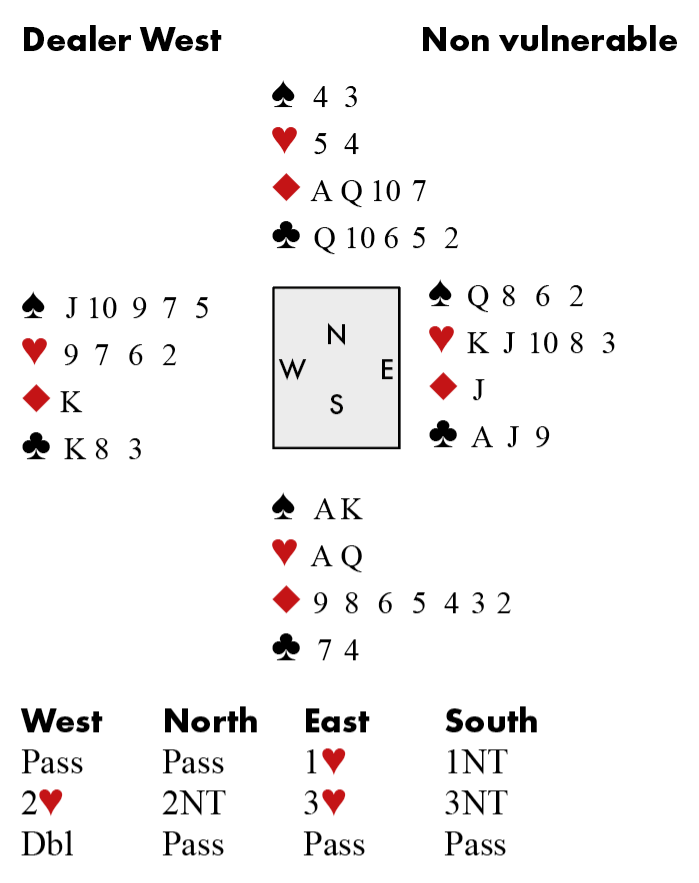
Gunnar’s 1NT overcall was a classic psyche: after seeing his partner pass, he pretended to have a strong balanced hand, intending to run to 2♦️ if doubled. It was what happened next that was so unusual: not many players would bid on to 3NT and then pass a double! When his partner bid 2NT over West’s 2♥️, however, Gunnar knew he must have seven or eight points. Those points were most likely in the minors. And he surely had length in the minors too, as he hadn’t overcalled 2♠️. So over East’s 3♥️, he bid 3NT.
West, as it happens, was the former England international Robert Sheehan, a superb and solid rubber-bridge player. But Gunnar didn’t panic-run. 3NT, he worked out, had as good a chance as 4♦️. And when Robert led the ♠️J, he was soon claiming 11 tricks and +750. Fortune favours the brave, as every Viking knows.
How to ruin a city
Why would you choose to make a city crappy? Plenty of cities don’t have much going for them. But when they do, it takes a certain amount of skill to actively wreck them.
Take London, for instance. Anyone in charge of our capital needed only to maintain it, if not improve it. Yet in almost a decade as mayor, Sadiq Khan has overseen a decline which is obvious to any resident or visitor.
That first sign of rot – the tolerance of minor crime – is everywhere. It might be graffiti on the Tube. Or it might be the fact that it is risky to hold a mobile phone in the street or park a bicycle. Khan’s police aren’t interested in minor crimes such as phone and bicycle theft. And they’re not much interested in major crimes either, such as stabbings.
Yet somehow, it doesn’t matter. Khan was re-elected mayor last year, and this week he went off to Buckingham Palace to become Sir Sadiq.
It’s a similar story with Gavin Newsom in California. He has been governor of America’s most beautiful and prosperous state since 2019, and won re-election in 2022. Before that he was mayor of San Francisco, which should be one of the world’s most beautiful cities. But Newsom has a skill for wrecking everything he touches.
During his mayoralty, San Francisco became ever more dystopian. The rich would descend from unaffordable apartment complexes on to once-desirable streets where the ‘unhoused’ roamed around on crack and exposed themselves furiously. It became perfectly normal to walk down any road and think you must have been transported into a zombie movie, with the undead pushing around trolleys of their possessions. Under Harvey Milk in the 1970s, San Francisco famously cracked down on dog littering. By Newsom’s time as mayor the one thing you could say with confidence was that whenever you saw faeces on the streets, it didn’t come from a dog.
Yet from the time of his election as governor, Newsom tried to roll out his San Francisco model across the state. The policies that had done for San Francisco and then did for Los Angeles include (in no particular order) incentivising illegal migrants to come into the state, ensuring that homelessness is encouraged and home-ownership punished, legalising just about every mind-altering substance known to man and presenting law enforcement as the enemy of the people.
If you encourage lawlessness you can be seen to be doing it for all the right reasons
Of course Newsom did all these things under the same glorious cover that Khan wears – that great cloak of left-wing ‘compassion’. Law enforcement is easy to present as lacking in compassion. Making a city a ‘sanctuary’ allows politicians to present themselves as ‘kind’ and filled with ‘empathy’. Saying that illegality cannot be allowed is ‘mean’ and ‘unkind’. Promote mass illegal migration? ‘Healing.’ Try to stop it? ‘Divisive.’
Most of the problems in America, as in Britain and Europe, can be chased down to this asymmetry. If you encourage lawlessness you can be seen to be doing it for all the right reasons. If you encourage following the law you will be portrayed as doing it for all the wrong reasons. Allow people to break the law on a grand scale and there is no punishment. Try to mop up that mess and you will be the bad guy.
So it is with the stand-off between Newsom and Donald Trump. Conservative estimates suggest that between ten and 12 million people entered the US illegally in the four years of Joe Biden’s presidency – almost doubling the number of illegals in the country. Trump has already fulfilled his campaign promise of sealing the southern border, so that the number still breaking into the country via that route is effectively zero. But he is also intent on fulfilling his campaign promise of removing the people already in the country who shouldn’t be. He and his border tsar, Tom Homan, have made it clear that they are prioritising the removal of the more than half a million illegal migrants who are thought to have criminal records.
On a good day the Trump administration has managed to deport around 800 illegals. But you can do the math yourself on how long it would take to complete the task. At the current speed, assuming there are no more legal or physical challenges, Trump and Homan might be able to deport all the illegal migrants with a criminal record by 2027 or 2028. If they want to deport the millions who came in between 2020 and 2024 alone, President Trump would have to remain in office for years, if not decades. Which is not actually a proposal.

The unrest that broke out in Los Angeles this week was not even the result of Homan’s team simply detaining illegal migrants. They were seeking people who were engaged in criminal activity. But the unwiser parts of the American left decided to assume their normal position. They blamed law enforcement for causing the problem and pretended that the resulting violence was peaceful. All this as the public could see footage of masked left-wing activists spitting in the faces of policemen and throwing stones at them.
Now Trump has sent in the National Guard and Marines and told ‘insurrectionists’ that ‘if they spit, we will hit’. Newsom, Hillary Clinton and other Democrat bigwigs are pretending that it is Homan, Trump and law enforcement who are the bad guys, while the people burning cars on the streets and looting the local Apple store are merely reacting to the provocation.
Which brings me back to that central imbalance of our time – in the US as here. Why is the person who caused the mess allowed to be presented in the kindliest light, while the people trying to clean up after them must be portrayed in the crappiest?
My plan for Prevent
In the autumn of 1940, British cities were being bombed every night by large aeroplanes whose provenance was apparently of some considerable doubt. While the public almost unanimously believed the conflagrations to have been caused by the Luftwaffe, the authorities – right up to the government – refused to speculate. Indeed, when certain members of the public raised their voices and said ‘This is all down to Hitler and Goering and the bloody Germans!’, they received visits from the police who either prosecuted them for disturbing the peace or put their names on a list of possible extremists.
The nights grew darker. The number of towns and cities subjected to these nightly bombardments widened. Very soon everybody in the country knew somebody whose home had been destroyed or who had themselves been killed. The government was forced to take action, and so in November 1940 it came up with what it called its ‘Prevent’ strategy, which aimed to protect British cities from further destruction.
In the introduction to this new policy, civil servants listed possible vectors for these bombing raids and top of the list, by some margin, were the Slovaks. A senior intelligence officer told the public: ‘The greatest threat to our nation today is from the Slovaks. We must train our people in how to spot Slovaks and report them to the police whenever they can.’ The Germans were also mentioned, further down the list of possible perps, but the wording here was heavily caveated. Yes, some Germans may have been involved, but over all the German population was utterly devoted to peace and regretted the nightly infernos every bit as much as did the people who suffered under them. Our own air force was directed to drop its bombs on Bratislava, Kosice, Poprad and (the consequence of an understandable confusion over the names of the two countries) Maribor. And yet for some mystifying reason, the raids on Britain did not lessen.
This seems to me exactly the response of our government(s) and most importantly of Prevent to the threat from Islamic terrorism. Let me be clear: I am not remotely comparing Muslims with Germans or Islam with National Socialism – I am simply saying that, in effect, this is what our government would have done in 1940 if it had been gripped by the same cringing witlessness and outright lying that possesses seemingly all of our authorities today when it comes to terrorist attacks upon the British people.
You may be aware of the manifestly stupid quote from the Prevent halfwits that people who believe that ‘western culture is under threat from mass migration and a lack of integration by certain ethnic and cultural groups’ are cultural nationalists at risk of becoming the kind of extremists who end up murdering people. People who believe the above probably consist of 70 per cent of the British population and, if his latest speeches are anything to go by, include the Prime Minister. And yet this stuff pervades everything Prevent puts out, while at the same time exonerating Islam and in some cases even those Muslims who do become terrorists (because they have suffered, you see).
If people who support Brexit or worry about immigration are extremists, you’re going to get pretty high figures
So, for example, Bolton council’s useful ‘Prevent’ handbook singles out ‘right-wing extremists’ as being at the forefront of terror attacks in the UK, and these extremists include people who are cultural nationalists: ‘Cultural nationalism is ideology characterised by anti-immigration, anti-Islam, anti-Muslim, anti-establishment narratives, often emphasising British/English “victimhood” and identity under attack from a perceived “other”.’ Islamic terrorism is also mentioned – but, again, heavily caveated. Then there’s Prevent’s own list of people who were picked up under its guidelines: 45 per cent were related to extreme right-wing radicalisation (230); 23 per cent were linked to Islamist radicalisation (118); the rest were related to other radicalisation concerns, including incels and those at risk of carrying out school shootings.
But then I suppose if people who proclaim their support for Brexit or worry a bit about immigration are extremists, you are going to get pretty high arrest figures. If you add into the mix the fact that simply to associate Islam with terrorism you are guilty of Islamophobia, then you can see why we’re in the state we’re in. Incidentally, when she was Prime Minister, Theresa May, to her credit, drafted a new introduction to the Prevent guidelines which made it clear that the biggest threat to British security was al Qaeda, not Tommy Robinson et al. But that message does not seem to have sunk in with those in Prevent.
It seems almost pointless to run through the facts. The truth is that almost every fatal terrorist attack in Britain since 2001 has been perpetrated by Islamists. All bar three. Have these people got a twisted or perverted understanding of Islam, as Prevent insists? I haven’t a clue. I am no Quranic expert. I’m just, y’know, taking their word for it. Further, 80 per cent of the Counter Terrorism Policing network’s investigations are related to Islamism (2023). Some 75 per cent of MI5’s surveillance cases are Islamists. There are around 40,000 potential jihadis being monitored by our security services. There is not the remotest doubt as to the provenance of the gravest terror threats to our country. It’s not the shaven-headed nutters with swastika armbands. It is Islamists.
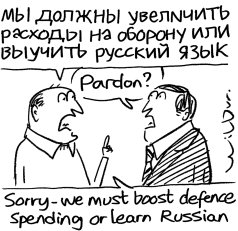
Nigel Farage’s answer is to sack everyone working in Prevent. That seems a perfectly reasonable suggestion. But I may have a better one. Scrap Prevent entirely and initiate a new network of monitoring and reporting which focuses solely on Islamic terrorism. Junk the sixth-form philosophising over what is meant by the term ‘extremist’ and locate the problem precisely where it is: somewhere within our Muslim communities, even if we accept that our Muslim communities may not want them there. In short, get real and tell the truth. This kind of approach worked pretty well 85 years ago.
How to game the social housing system

John Power has narrated this article for you to listen to.
Westminster council has announced that every single social housing tenant in the borough will receive lifetime tenancies. No test of need. No review of income. No incentive to move on. Once you’ve been awarded a property, you can stay as long as you like. When you die, your adult children may be eligible to inherit the lifetime tenancy too.
Social housing tenants in Westminster pay around a fifth of what renters on the open market spend. They also have access to more than one in four properties in the borough, from flats in postwar estates to £1 million terraced houses. The council says it’s bringing stability to people’s lives but for many young professionals dreaming of their own home, it looks like something else: a bribe.
Angela Rayner has secured £39 billion more for social and affordable housing this week. Local councils will use this money not only to build houses, but to buy them from private landlords. It’s a form of class warfare which targets the most politically invisible demographic – young, propertyless professionals – whom the state exploits mercilessly.
One woman told me that she and her partner rent privately on a joint income of more than £100,000, yet still cannot afford to buy in Westminster. ‘We walk past people every day who are being subsidised to live in the middle of London, while we can barely get by,’ she said.
You may scoff at the plight of high-earning professionals, but do the maths: a couple in London on £100,000 loses around £27,000 to tax, £30,000 on rent and 9 per cent of income over £28,000 to student loans before travel and bills. For many professionals, working hard simply doesn’t add up.
They are not alone in feeling this way. Another woman I spoke to recently bought a flat in a converted west London maisonette, only to find Japanese knotweed growing into her garden from a neighbouring property. ‘If I had normal neighbours, this would have been fixed years ago. But because the flat happens to be owned by a housing association, they’re not dealing with it.’ She could lose tens of thousands on the value of her home, while her neighbours don’t face any consequences.
This sense of imbalance is not new, but it’s becoming harder to ignore. One woman found herself living above a man who is fresh out of prison. He was placed there by the local authority and uses the property to deal drugs, smoke weed and house his illegal XL bullies. When she complained, he threatened her with his dogs. When she spoke to the council, she was told the placement was intentional, to keep him away from ‘negative influences’ in a nearby estate.
Voters, paying ever more in housing costs, want a system that also rewards those playing by the rules
Middle-income earners are paying for a model that rewards dysfunction. In the course of reporting this piece, I spoke to a senior housing officer with more than three decades’ experience, a social worker in one of London’s most ethnically segregated boroughs and a former official who has witnessed profound changes in social housing. All spoke of claimants who game the system.
‘People know what to say,’ explained one officer. ‘They’ll allow mould to grow in their temporary accommodation to get on the council flat track. Or say their partner’s become abusive. That gets them priority.’ I was told that some families encourage their daughters to declare themselves homeless while pregnant. ‘Everyone knows how it works,’ one official said. ‘You get her on the list and she’ll get a flat in a couple of years. They’ll take her back in the meantime, then she moves out when a property is offered.’
Once housed, few ever leave. ‘There’s no incentive to move,’ said the social worker. ‘If you start earning, you don’t lose the flat. If you stop, you get help again. People treat it like an inheritance.’ In boroughs such as Tower Hamlets, entire communities have been built around this model. ‘There’s halal butchers, Islamic schools, mosques. The infrastructure is there.’
The patterns are impossible to ignore. In Tower Hamlets, 67 per cent of Muslim households are in social housing. The reasons are complex: economic clustering, migration history, support networks, but the result is visible.
Often newcomers are helped by others who know how the system works. ‘You ask around, someone tells you what to do,’ the former officer said. ‘It’s ingrained.’ Fraud happens too, sometimes spectacularly. In Greenwich, Labour councillor Tonia Ashikodi was convicted of applying for council housing while owning multiple properties. In Tower Hamlets, another Labour councillor and solicitor Muhammad Harun pleaded guilty to housing fraud. Staff across multiple boroughs have been caught taking bribes. But most manipulation is quiet, legal and invisible.
While middle-income Londoners compete with one another in the housing market, the government buys up more properties, removing them from the private rental pool. Westminster council has just spent another £235 million buying hundreds more properties. Those are now off-limits for those looking to rent or buy, pushing up the price of remaining homes. Here, too, are the hidden costs of the groaning social housing system.
‘If you earn £100,000, you lose your child benefit, your tax allowance, your eligibility for support,’ one young professional told me. ‘But the person in the flat next door could be on full housing benefit and you’re paying for them to live there.’ For many, that’s the injustice. The problem isn’t that people are housed, but that they are housed indefinitely, unconditionally and often with more security than those footing the bill.
If we’re serious about fairness, long-term benefit claimants should be rehoused in cheaper areas. This isn’t about punishing those people. In fact, it’s the kinder thing to do: it would free up homes for teachers, nurses, civil servants, people who make cities function and who are priced out.
A new politics may be emerging from this tension. Not one of ideology but of exasperation. Last month, shadow justice secretary Robert Jenrick published a video in which he confronted fare-dodgers on the Tube, asking why they felt they could get for free what everyone else had to pay for. It went viral for a reason. Voters, paying ever more in taxes and housing costs, want a system that also rewards people who play by the rules.
OnlyFans is giving the taxman what he wants
Fenix International occupies the ninth floor of an innocuous office block on London’s Cheapside. The street’s name comes from the Old English for marketplace, and once upon a time Cheapside was just that: London’s biggest meat market with butcher shops lining either side of the road. Today, the street houses financial institutions and corporate HQs.
But Fenix still runs a marketplace. Some may even call it a meat market, albeit one that operates on the phones of hundreds of millions of users worldwide. Its name: OnlyFans.
OnlyFans is best understood not just as a porn site, but as a social media platform with a paywall. Creators – mostly women – post photos, videos and voice notes behind monthly subscriptions. Users pay extra to tip the women, customise content and have one-to-one chats with their favourite models. Not everything on OnlyFans is X-rated, but that’s the content that makes the money.
An entire ecosystem has grown around OnlyFans since it was founded nine years ago by two British brothers, Tim and Thomas Stokely. One ‘e-pimp’ explained that successful models outsource much of their work to offshore call centres to give the illusion of intimacy with customers. Low-paid workers in Venezuela or the Philippines are hired to impersonate creators over text chats, maintaining dozens, even hundreds, of relationships with lonely men.
OnlyFans’ profits are enormous. In 2023, it generated nearly £5 billion in sales – up more than 2,000 per cent in four years. The company paid £127 million in tax last year, £110 million of that in corporation tax. Because Fenix is based in London, the bulk of that cash is flowing straight into the Treasury. For comparison: Britain’s fishing industry – supposedly a red-line issue in Brexit – brings in just £876 million and pays next to nothing in corporation tax, while also receiving £180 million a year in tax concessions.
We don’t think of OnlyFans as a media company (if we think of it at all) and so we ignore what it is in business terms: a staggering success. With more than four million ‘content creators’ and 305 million subscribers, it would easily rank in the top three British publishing companies. It is perhaps the most successful creator-based subscription service ever. Traditional platforms can’t compete – OnlyFans’ revenues are twice that of North America’s Aylo, which operates the world’s biggest porn websites.
Britain’s sex industry brings in far more to the economy than politicians are comfortable admitting
Britain’s sex industry brings in far more to the economy than politicians are comfortable admitting. The Office for National Statistics estimates Britons spend in excess of £6 billion annually on it. It is one of the few British industries which remains a net (digital) exporter.
Indeed, OnlyFans is perhaps the strongest unicorn (a privately held start-up worth more than $1 billion) in the country. It’s more profitable than any other British tech start-up. And it’s doing something our other digital start-ups can’t: exporting to America while keeping tax revenues onshore. Two-thirds of its revenue now comes from the US, proving that even in a global tech economy dominated by Silicon Valley, British firms can still compete.
OnlyFans’ success makes it all the more striking that, according to Reuters, Fenix is in talks to sell. Los Angeles-based Forest Road Company is leading a group of investors in negotiations to buy the business for £6 billion. It’s rumoured that other suitors are vying for attention and that shares may be sold on the stock market. Either way, one of Britain’s few successful exports could soon be gone.
It’s awkward to defend pornography, and so politicians don’t try. Parliament hosts thousands of lobbying events every year – payday lenders, bookies, vape companies, even arms dealers turn up for drinks and canapés. There is no ‘sex tech reception’.
Ministers fall over themselves to visit impressive-looking factories that are in fact barely relevant. For example, Glass Futures, a research and production plant for the glass industry based in St Helens, was recently picked by Keir Starmer as the perfect location for his speech decrying ‘Farage’s fantasy economics’. The plant is a not-for-profit that makes £7 million in annual sales. OnlyFans pays more in tax in a month than Glass Futures earns in a year. But no MP would be caught dead at OnlyFans’ Cheapside HQ, despite, I’m told, many invitations to visit.
Neither has any politician ever defended the porn industry in a debate on innovation, exports or growth. The most recent House of Lords research note on ‘the impact of pornography on society’ contains no mention of the words ‘economy’, ‘tax’ or ‘finance’.
Of course, money isn’t everything. The harms of porn – to women, to relationships, to the minds of teenage boys – are real and considerable. We might well be better off banning the whole thing. But if we are going to wage a moral war on porn, we should at least be honest about what we’re sacrificing. The money is real – and it’s already in the bank of HMRC.