-
AAPL
213.43 (+0.29%)
-
BARC-LN
1205.7 (-1.46%)
-
NKE
94.05 (+0.39%)
-
CVX
152.67 (-1.00%)
-
CRM
230.27 (-2.34%)
-
INTC
30.5 (-0.87%)
-
DIS
100.16 (-0.67%)
-
DOW
55.79 (-0.82%)
Bannon on LA riots: ‘We’re in World War Three’
It’s all war all the time inside Steve Bannon’s War Room in Capitol Hill. “We’re in the Third World War,” he tells me. “And it’s a battlefield that’s everywhere, including in downtown Los Angeles.” The weekend’s riots in LA, he insists, are part of an orchestrated push by nefarious forces in America to stoke civil unrest in America.
The Democrats, he says, “allowed in 10 to 13 million illegal alien invaders into this country. They all must go home. All. Not some. All must go home. They must be deported. They must go home or we don’t have a country, OK?”
We’re in for another of summer of riots, says Bannon. “They just kicked it off,” he says.
It’s Black Lives Matter, the pro-immigration version, five years on and as the nation’s capital prepares to celebrate the 250th anniversary of the Army this weekend.
Yet whereas the Trump administration let the BLM riots swell in the summer of 2020, Bannon says this time Team Trump should ignore all the cries against “authoritarianism” and start locking up the political enemies who are stoking the unrest.
“They’re calling for [unrest] nationwide,” he says. ‘And it’s already expanded to San Francisco. The question here is, who told the police to step down? I think there’s only ten arrests. The LAPD allowed that thing to metastasize. Who gave the order? Whoever. Whoever was the government official that gave that order should be arrested this morning.”
“We need to start arresting government officials, including the Mayor of Los Angeles, Karen Bass, who’s stirring this pot up.” If that means suspending habeas corpus, so be it.
Bannon calls Governor Gavin Newsom, who is defying the Trump administration over the riots, “a neo-confederate” and compares him to John C. Calhoun, the pro-slavery vice president under Andrew Jackson. “Andrew Jackson said, ‘hey, if this guy goes against me, I’m assembling the US Army, and I’m going to hang him from the first lamppost.’”
Bannon stops short of saying Newsom should be strung up, but he thinks he should probably be arrested too. “If Gavin Newsom is saying, ‘hey, come on, arrest me.’ Hey, well, if he gets in the way of federal officials trying to sort this mess out, he should be arrested.”
Bannon is on something of a roll at the moment, having just, in his words “taken out” Elon Musk from the Trump administration. He calls Musk a “dangerous narcissist” and repeats his claim that Musk is controlled by the Chinese Communist party. He feels “the tech bros” are running scared: Bannon claims the All-In podcast – cohosted by Trump crypto czar David Sacks – didn’t air last week after he unleashed a torrent of criticism of them on War Room “because they’re pussies.”
The Trump administration, he says, will use its legal powers to bust up the monopolistic power of Big Tech. “We’re going to break up Facebook,” he says. “We’re going to break up Google. We’re going to break up Amazon. We’re going to break… I think hopefully we get to eventually break up Walmart. You’ve got too much concentration of private power. It’s obvious it’s anti-populist. It’s anti-economic nationalist.’
What, I wonder, does Bannon think of Javier Milei, the man who presented Elon Musk with a chainsaw on stage at CPAC in February?
“I think he’s more of a libertarian right? More to the libertarian side.”
You don’t think he’s like controlled by Big Tech, I ask.
“When I say ‘libertarian type,’ that’s a code for being controlled by Big Tech.”
But how does Bannon expect the movement he speaks for, the Make America Great Again movement, to take on the might of America’s technological giants and win?
“The tech bros at their core are soft,” he says. “It’s like the elites in England. It’s like the elites know England went from a country that ran the world. You know why? Because it generated people that had character values and were tough. You’re not tough anymore. You’re a bunch of fucking pussies. Just like the tech bros. They lived a soft life. They’ve never had to make hard decisions. They’ve never had any kind of real challenges in their life, hard challenges. And that’s where they’re soft. And the soft will never beat the hard.”
In Steve Bannon’s War Room, in other words, the revolution is just getting started.
Will America and China call a truce in their trade war?
High-level talks have started in London today between American and Chinese officials aimed at dialling down the trade tensions between the two largest economies in the world. If they result in a breakthrough, perhaps it will be known as the ‘London accord’. But can President Trump strike a ‘grand bargain’ with China? There is every chance that he might – which would give a huge boost to the global economy.
The talks in London follow on from a friendly chat on the phone between President Trump and his counterpart in Beijing, President Xi. Both sides have already stepped back from an all-out trade blockade, with the United States reducing the tariffs it imposes on Chinese goods from an extraordinary 145 per cent to a more manageable 30 per cent, while on the Chinese side, tariffs have come down from 125 per cent to just 10 per cent. The most important single trading relationship in the global economy is starting to get back on track.
For the moment, President Trump has only suspended the tariffs until August
Even so, the trade war has hit both sides very hard. American companies had started to warn that profits would collapse as components ran out, or as the stocks of Chinese-made goods dwindled. At the same time, China’s export machine stalled, with figures out this week showing that shipments across the Pacific fell by 34 per cent year on year over May, following on from a 21 per cent fall in April.
There is just one catch. For the moment, President Trump has only suspended the tariffs until August. The two sides will need to reach a broader agreement before then.
What could a deal between the two sides look like? China would almost certainly have to make some big concessions. It would have to allow the American tech giants such as Meta and Netflix full access to the domestic Chinese market. You can’t expect to trade peacefully with another country if you effectively block its most successful businesses from yours. It would have to do more to boost domestic consumption so that it could import more from the United States and start reducing its trade surplus. And perhaps most importantly, it would need to start integrating the renminbi into the American-led global financial system, accepting that the dollar would remain the world’s dominant currency for another generation or even longer. Those would all be genuine wins for President Trump.
In return, US tariffs could be permanently lowered, allowing China to maintain the export-led growth model that has transformed its economy over the last thirty years. And it would be allowed to keep expanding into industries such as aerospace, automobiles, computer chips and pharmaceuticals, where it is moving into the technology-based markets that were traditionally dominated by the West.
A deal such as that would be win-win for both sides. It won’t necessarily happen. But it would give the global economy a huge boost if it did – and stock markets are already rallying in anticipation of an agreement.
Are vegetarians really hungry for power?
The secret is out: vegetarians are ‘tougher’ and more ‘power-hungry’ than meat eaters, according to a study in the Times this morning. Well, as a vegan I suppose I must be even tougher and more megalomaniacal. I’m surprised, then, to not find myself doing a whole lot of street brawling or holding any subterranean meetings to discuss how I’ll overthrow Keir Starmer with my bare hands.
I was actually as surprised as anyone by the findings. Not because I subscribe to the caricature of veggies as gentle, pathetic creatures, but because my experience of vegetarians and vegans is that we are a bit less impressed with clout and power than most people. We’ve seen the horrors that mankind’s dominion over animals has led to in factory farms, slaughterhouses, laboratories and on racing tracks, and we’ve understood viscerally that might is often not right.
Ironically, the meat eaters who lash out at vegans and vegetarians might be the most similar to us
But one of the study’s findings today did ring true. Professor John Nezlek of SWPS University in Warsaw, who led the research, said he suspects the conclusions reflect how vegetarians in western societies have historically felt like a ‘besieged minority’. Noting other studies which show that vegetarians and vegans get much more negative feedback about their lifestyle choices than meat eaters, he said that:
If you look at it through that lens, it starts to make sense: to maintain a vegetarian diet, a certain psychological toughness might be required.
It’s true that when you stop eating meat, you can face a breathtaking avalanche of defence mechanisms, weird questions, pseudoscience and outright antagonism from some meat eaters. Yes, some vegans can be annoying too, but I’ve lost count of the number of times that I’ve sat at a dinner table with meat eaters and they’ve been rattled by the fact I don’t eat meat – even if I’ve said not a word about my lifestyle as I quietly tuck into my bean burger.
Everyone says they’re against cruelty to animals but meat eaters pay people to be cruel to animals. So I think the mere presence of someone who’s thought sincerely about animal cruelty makes others want to talk about their own take and try to justify their own actions, even if nothing has been asked of them.
Vegans and veggies generally understand that the root of this is guilt. People at ease with their choice to eat meat aren’t even momentarily bothered by veganism. Why would they be? But those less at peace will be triggered and lash out, just like people who are insecure with their own sexuality can’t help but be nasty to gay people.
So ironically, the meat eaters who lash out at vegans and vegetarians might be the most similar to us. Except that where we deal with our horror at animal slaughter by giving up meat, they deal with theirs by shrieking at us for reminding them that they haven’t quite resolved how they feel about eating animals.
Well may they shriek. More than 92 billion land animals are killed each year for their meat, usually at a minuscule fraction of their natural lifespan. Around 85 per cent of the UK’s farmed animals endure their short lives in industrial factory farms.
It has become increasingly fashionable to pretend that all opinions and positions are equal, but I’d argue that the obvious, if inconvenient, truth is that paying people to enslave, mutilate and kill animals is a less moral lifestyle than not paying people to enslave, mutilate and kill animals.
I suppose that putting up with people’s defence mechanisms about all this does give vegans and veggies a certain strength, but I’m still not quite buying the study’s conclusions. There’s no more systematic wielding of power on the planet than chaining animals up in factory farms and then dragging them to a slaughterhouse to put a bolt in their head or a knife across their throat as they tremble and cry out. Vegans and vegetarians are the only ones who reject that power.
Having said that, overthrowing Keir Starmer sounds like a very good idea to me, as I’m sure it will to many readers of this magazine. So perhaps if enough of us give up meat, we’ll be able to have him out by Christmas?
Gavin Newsom blew his chance to stand for law and order
Gavin Newsom had a golden opportunity this week to prove that he’s learned something in the time since the summer of George Floyd. He had an opportunity to set himself up as a Democrat willing to take on the factions of his own coalition when their methods go from peaceful protest to setting fires in the streets, destroying property and all-out anti-cop violence. He could have taken a stand for law and order, taking flak from his own side for standing up for the law-abiding citizens of California.
Instead, he blew it. He called the decision by President Trump to deploy the National Guard “an illegal act, an immoral act, an unconstitutional act,” and announced a lawsuit against the government over the issue. He laid the problem entirely at the feet of President Trump: “He’s exacerbated the conditions. He’s lit the proverbial match. He’s putting fuel on this fire,” Newsom told NBC. “Donald Trump needs to pull back. He needs to stand down. Donald Trump is inflaming these conditions. This is Donald Trump’s problem right now, and if he can’t solve it, we will.”
Newsom’s response is laughably out of touch. His regrets in the NBC interview weren’t for people whose property was destroyed, or for cops and ICE agents being targeted just for doing their jobs, but for the meta-narrative the violence played into. “They’re just playing right into Donald Trump’s hand,” Newsom mourned. Even if we could have guessed that’s what really matters to the slick politician from San Francisco, he didn’t need to just go out and say it.
Democratic unwillingness to take on the sacred cows of their party in big blue cities and states across the country has become an obvious anchor on their hopes for political comeback. They are unwilling to take on their pro-Hamas faction, their trans men in girls’ sports faction and their pro-illegal migrant faction in any serious way. Newsom can pay lip service to these ideas – but that’s all it is.
Until this changes – until someone prominent within the party is willing to set out on a different path – Democrats are going to continue to find their most extreme wing giving President Trump one chaotic gift after another, casting him as the champion of law, order, and normalcy. Whatever that approach is, it is not the path to political victory.
Figures emerge like ghosts from Antonia Showering’s canvases
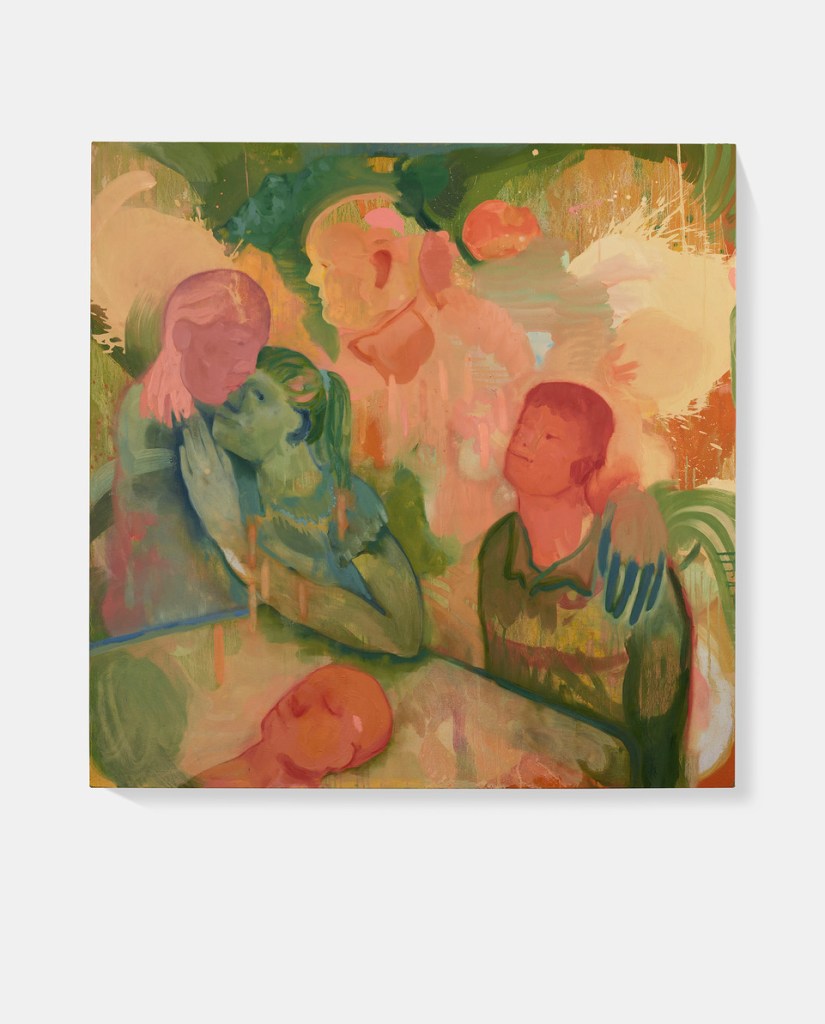
Figures emerge like ghosts from Antonia Showering’s canvases, their sketchy lines and expressionistic color palette relaying an atmosphere of deeply personal narrative as much as an emotional message, wordless but with universal resonance. Take 2025’s “The Waiting Room” (2025), from her current show, titled In Line, at Timothy Taylor: A woman, resting on a bed in a pool of maroon, has just given birth; her belly appears aglow in a warm yellow as her newborn, outlined in pale purple, rests next to her, umbilical cord still attached. “I wanted to talk about the vulnerability about someone postpartum,” says the artist. The hues she’s employed are bodily, those of flesh, fat, and veins, yet here transcend into a surreal haze of life’s first moments.
Courtesy the artist and Timothy
Taylor © Antonia Showering
Across the 13 oil paintings on view, motherhood imagery abounds, spanning contexts from pregnancy and labor to a child’s loving embrace. Indeed, Showering’s own recent journey into first-time motherhood weighed heavily on the driving vision behind the work. Still, it’s only one component of a broader existential meditation the British artist hopes to convey. “It’s general life cycles, this unrelenting march that just continues,” she says. The exhibition’s title, “In Line,” gets at this notion, especially in terms of lineage. “It’s about beginnings and endings of life and things that happen in between the two – relationships and intimate moments and family.”
The central painting, 2024-25’s “Secret Language,” is a mother holding her toddler-aged child as she stands at her easel, painting. Given the clear autobiographical themes at hand, you could be forgiven for misinterpreting the scene as one right out of Showering’s weekly schedule. Not so: It was rather inspired by her own offhand comment to a friend on the phone: “’Oh, well you try painting a picture with a baby on your hip.’ Not that I ever do do that! Just the image of if in my head felt so powerful,” explains Showering. The subject matter is the fruit of Showering’s imagination, but it’s fiction, not fantasy. Certainly, variations of the scenario have played out before, across place and time. And when it comes to multitasking between mothering and professional endeavors, the specifics multiply to infinity.

Courtesy the artist and Timothy Taylor
© Antonia Showering
Another recurring motif takes the more immutable form of a mountain range. This landscape, appearing across several compositions, nods to the artist’s childhood memories of traveling to Switzerland to visit her Swiss grandmother and Chinese grandfather, an art historian and architect respectfully who had a “massive influence” on Showering. “Every time I return to Switzerland, I feel like everything is changing. People have joined us, people have left us,” she says. “These mountains seem to be the only thing that remain a constant.” One such panorama, in 2024’s “After Life,” pays homage to a curious series of events she witnessed shortly after the death of her grandmother, with a depiction of two foxes nestled in the foothills. “We had about four days where this fox followed us wherever we went,” Showering recalls. “It was bizarre. It would walk down the road beside us. It would be in the garden for hours. Even my younger brother, who’s the least superstitious person, started finding it strange. When we looked it up, in Chinese [culture], it signifies the passing on to the afterlife.” Rendered with dreamlike orange-pink and green-blue swathes of color that create a disorienting, blurred-dimensional surface effect, the piece imagines her grandparents reuniting, as foxes, in the spirit world.
The rendition of this story, with its mystic and mythic undertones, also evinces what Showering describes as the “magical quality” that oil pigments, layered slowly and through intuitive mark-making, can impart. “Sometimes the meaning unfolds in weeks or months after the painting is finished,” she says. In a parallel reveal, what further comes into focus are “desires and hopes and regrets and pain and joy – what makes us human.”
SNP ferry fiasco worsens. Again
Back to Scotland, where yet another ferry is facing further delays. The MV Glen Rosa, which is being built at the Ferguson Marine shipyard in Port Glasgow, has been hit by another setback – despite already being six years behind schedule and more than £100 million over budget. Talk about incompetent, eh?
This isn’t the first fiasco that has hit Scotland’s ferry projects in recent years
It has emerged that when the ship’s funnels were removed for internal work, gaps weren’t sealed and as a result the ferry, er, flooded during heavy rain two weeks ago. More than that, it transpires that the funnels themselves were only initially fitted for cosmetic purposes for Glen Rosa’s late launch last year in order to make it look like the vessel was nearer completion than was actually the case. Parts then had to be subsequently removed to allow other integral components to be fitted. You couldn’t make it up…
This isn’t the first fiasco that has hit Scotland’s ferry projects in recent years. As reported by the Scottish Express, MV Glen Rosa’s sister vessel Glen Sannox was found to have a rusted propellor after having been left sitting still in Greenock for such a length of time. Last year, it transpired that parts were being removed from Glen Rosa to replace those on Glen Sannox – which had reportedly worn out, despite neither ship being in use. The latter vessel eventually entered service in 2025, seven years behind schedule. But now Glen Rosa, which was supposed to be ready for use in 2019, will have its service date further delayed to next year at the earliest.
It’s yet another palaver for the Scottish Government-owned Ferguson Marine shipyard, as taxpayer costs have ballooned over the years. The Scottish Tories have slammed today’s development as one that ‘should have been easily avoided’ while Labour fumed: ‘This is yet another embarrassing mishap in the SNP’s seemingly endless ferry fiasco.’ Quite.
Gary Lineker blocked from addressing Jewish writer’s memorial
Gary Lineker may have been finally forced out of the Beeb, but the ex-footballer is still managing to make headlines. Now it transpires that the son of the late award-winning football journalist Brian Glanville – who was made football correspondent for the Sunday Times in 1958 and covered every World Cup for the next 44 years – has forbidden Lineker from speaking at his Jewish father’s memorial ceremony after the pundit shared a controversial post about Zionism on social media. Mark Glanville hit out at the former Match of the Day presenter after his sister Jo suggested Lineker speak at their father’s service due to the journalistic duo’s close acquaintance – and blasted the ex-pundit’s post as ‘crossing a line’.
Despite his father’s friendship with Lineker, Glanville has insisted his late father – who died last month aged 93 – would not have wanted the ex-pundit to speak at the ceremony. As reported by the Mail on Sunday, the highly-acclaimed sports writer’s son noted:
I can’t have somebody coming to speak at my dad’s memorial service who, though not antisemitic, is someone who is giving ammunition to people who are antisemites. Once you share a picture of a rat which is associated with Nazis, you really are crossing a line.
It comes after Lineker shared a video titled ‘Zionism explained in less than two minutes’, with text written across it: ‘Why does this still have to be explained? Why?’ Next to the title sits a cartoon rat, which stayed on the screen throughout the film – in which lawyer Diana Buddu blasted Israel’s attacks on Gaza. While the ex-England captain has never shied away from criticising of Israel, his opponents were quick to hit out at this particular reel and lambasted the addition of the rat image – which is seen as being reminiscent of Nazi symbols used to depict Jewish people – for going too far. Soon after, Gary – the corporation’s highest-paid ‘star’ – quit.
Glanville added that his father had been deeply affected by the Holocaust and had received antisemitic bullying at school. For his part, Lineker has apologised for sharing the post, saying that he was not antisemitic and would ‘never, ever have shared’ the clip if he had realised its ‘awful connotations’. Too little, too late…
The battle of the Channel has been fought – and lost
Kemi Badenoch says the Conservative party will take a look at withdrawing from the European Convention on Human Rights (ECHR), freeing us at a leap and a bound from the tyranny of human rights lawyers. The Tory leader would give Britain the power to deter the cross-Channel influx of asylum seekers, by withdrawing protections from those arriving in Britain without papers.
The government might as well install a gargantuan flashing neon sign on the White Cliffs of Dover: Refugees welcome here
As there is unlikely to be a Conservative government in the foreseeable future, this announcement is going to have no effect now, or any time soon, on the actual boats. And read the fine print: Badenoch hasn’t really even made up her mind; she is going to set up a committee to look into it.
In the real world, the boats aren’t being stopped, the gangs aren’t being smashed and the French judges and police are shrugging.
It was already a shambles. And now the Mail on Sunday reports that the courts in France have effectively started giving the actual people smugglers a free pass. An Afghan couple, resident in Germany, who were caught transporting a large inflatable, an outboard motor and 50 lifejackets, received a suspended sentence. Family members laughed in court.
The gangs have been given a green light. Anchors aweigh for the boats.
Photographs last week showed four Gendarmes standing on the beach, hard-looking men from the elite French paramilitary police. They have SIG-Sauer pistols slung low on their hips, jaunty calot field caps. But their hands are not on their guns but their phones.
Because before them in the shallow water is a massive inflatable boat – and scrambling to get in it, scores of fit men of African, Middle Eastern and indeterminate origin. Destination: England. And are the police stopping them? No, the police are taking pictures.
The police look like they don’t care about stopping the boat, and to be blunt, they don’t. Their presence is largely ceremonial on the lawless beaches of northern France.
I have a gendarme friend who was up near Calais on the comically-named Operation Poseidon, the ballyhooed £480 million Anglo-French deal signed two years ago, in which the French agreed to stop the boats, and the British to pay them them for doing it. For the French police, this mission really amounted to nothing more than hanging out on the beach, with binoculars.
Stop the boats? ‘Hein!’ she snorted. Officers have been pelted with stones and threatened with knives. Can’t she shoot them if they do? She rolled her eyes. The police know they will be betrayed by the politicians, if things get out of hand. So an ad hoc deal has been struck. The police are allowed to watch, but not stop the boats.
This capitulation of the French judiciary is the final stake through the heart of Operation Poseidon. Yet the French have just asked to extend the pact, and the British government has agreed.
Never have the politicians on both sides of the Channel been caught so blatantly skinny dipping, their phony announcements so nakedly exposed. The pretend policy of stopping the boats is just pish tosh. The Poseidon deal between Emmanuel Macron and Rishi Sunak is a farce, entirely useless, a dead fish, with the British taxpayer the patsy. The joke is on the rosbifs. My neighbours here in France are happy to see migrants leave France, I note in passing.
Daily X postings from the Prime Minister Keir Starmer boast of his great leaps forward on all fronts, including smashing at least one gang, supposedly, but not actually stopping the boats, because they keep coming. At Home Secretary Yvette Cooper’s recent meeting with her French counterpart Bruno Retailleau, the ministers agreed to extend the useless Sandhurst Treaty underpinning the comedy Operation Poseidon.
The government might as well install a gargantuan flashing neon sign on the White Cliffs of Dover: Refugees welcome here.
There has never been any credibility in this ‘stop the boats/smash the gangs’ soap opera, which has so far seen Britain receive nothing other than tens of thousands more men (and a much smaller number of women and children) claiming asylum.
French interior minister Retailleau, an up-and-coming right-wing politician with presidential ambitions, last week promised to change the law to make it possible for the police to stop boats in the water. It is another meaningless announcement, like Badenoch’s. Never jam today, jam promised tomorrow.
Those wanting to stop the boats have been outsmarted, mostly by human rights lawyers. Even if by some extraordinary happenstance, Badenoch succeeded in withdrawing Britain from the ECHR, it wouldn’t cut any mustard in France.
The scandal on the Channel is a symptom of institutional collapse, on both sides of it. British and French ministers push buttons, post declarations on X, and nothing happens. In real life, hard-left NGOs deploy flotillas of lawyers. The police are neutered. Northern France has become a lawless world. And British taxpayers pick up the bill.
Moderate winds are likely to create favourable conditions for migrant crossings this week. So, as we say in France, plus ça change, plus c’est la même chose. The uncomfortable truth is that the battle of the Channel has been fought, and lost.
Britain must learn from France’s e-scooter mistake
An e-scooter revolution is coming to Britain whether the country likes it or not. “The revolution will hurt a little, but it’s necessary,” declared the vice-president of one of Europe’s leading e-scooter rental companies. Christina Moe Gjerde of Sweden’s Voi Technology has said her ambition was to have 50,000 more e-bikes and scooters on the streets of Britain. “You [Britain] are sitting on a gold mine,” said Moe Gjerde. “Get it right and there’s so much potential.”
France was an early advocate of the e-scooter craze but also one of the first to fall out of love with it
Private e-scooters are illegal on English roads but rental companies have been operating rolling trial schemes for a number of years in many towns and cities. The government wants more e-scooters and e-bikes and is encouraging local authorities to initiate more pilots. This roll-out would be regulated with restrictions on parking and speed. Moe Gjerde acknowledged that these two issues are a “problem” and reasons why e-scooters are so divisive.
In March, Nottingham City Council agreed a three-year trial with Dott, a French company, for the introduction of 1,300 rentable e-scooters. Each machine has a unique number that the Council says will make it easier to identity irresponsible users, such those who ride the scooters dangerously or take them outside the city limits.
In contrast, Basildon Council in Essex last week announced they were withdrawing their e-scooters from public use because, in the words of one Labour councillor, they were “causing carnage”. “While e-scooters may offer a green transport alternative, our experience has raised significant safety concerns,” Aidan McGurran explained.
It certainly hasn’t been a good weekend for those in the e-scooter industry. In Australia, a 24-year-old British woman has been charged with causing death by dangerous driving while under the influence. After leaving a bar with a friend, the backpacker collided with a 51-year-old man in Perth last month at around 15 mph. The man died two days later and the friend, who was thrown from the e-scooter, and suffered a fractured skull.
It’s not just on the roads and pavements where e-scooters can be lethal. Last Friday, in the French city of Reims four people were killed when a blaze ripped through a block of flats. On Saturday Reims prosecutor François Schneider revealed that the fire had been started by the battery of an e-scooter.
“Fires caused by this type of battery…are extremely difficult to extinguish, since the cells tend to self-sustain when they burn,” said Schneider. “Which explains the violence and rapid spread of the fire.”
The blaze began in a flat occupied by two teenage boys and their stepfather. The man survived, though with serious burns, while the teenagers died.
France was an early advocate of the e-scooter craze but also one of the first to fall out of love with it. In April 2023, Parisians voted in a referendum to ban rental scooters from the streets five years after their introduction.
I was living in Paris during this period and can confirm that e-scooters, or more precisely the people driving them, were a menace. If they weren’t jumping red lights, they were weaving in and out of pedestrians on the pavements at speeds of up to 15 mph, frequently causing accidents.
The rental scheme had been backed by Paris’s Socialist mayor Anne Hidalgo, but as the numbers of e-scooters soared (there were 20,000 in 2019) so did the accidents. Hidalgo told users to “limit the speed to 20 km/h (12 mph) around the city and to 8 km/h in pedestrianised streets” but few listened. In June 2021, an Italian woman was killed in a hit and run accident, one of 371 incidents involving e-scooters or hoverboards in Paris that year. The three main causes of accidents were refusing to give way, inattention and travelling in the wrong direction.
These incidents continued to rise in 2022, as did the number of deaths – three (among a total of 34 nationwide) – prompting Hidalgo to hold an e-scooter referendum in 2023. Among those who celebrated their demise in Paris was Philippe Juvin, head of the A&E department at the Georges-Pompidou European Hospital.
“The end of self-service scooters is a good thing,” he said, fed up with the number of casualties he and his staff had to treat. “When you fall off a scooter, your face is usually smashed into the pavement, unlike on a bicycle, where you lie on your side.”
Madrid and Melbourne followed the example of Paris last September and banned rental e-scooters from their streets having also concluded that while the machines may be environmentally friendly they’re not very human friendly.
Some revolutions just aren’t worth the hurt.
Greta Thunberg should thank Israel for intercepting her Gaza selfie ship
Once again, the Mediterranean has hosted a familiar theatre of self-satisfied spectacle. This time, however, the curtain has come down swiftly. The latest vessel to set sail in defiance of Israel’s naval blockade of Gaza – the Madleen, a boat bloated with virtue signalling and the vanity of performative compassion – has been intercepted by the Israeli Navy.
The Madleen, a boat bloated with virtue signalling and the vanity of performative compassion, has been intercepted by the Israeli Navy
The operation was executed peacefully and without casualties by fighters from Fleet 13, Israel’s naval commando forces. The ship is now making its way safely to the port of Ashdod, its dozen passengers – including Greta Thunberg, the climate whinger turned omni-cause moral voice – healthy, unharmed, and provided with sandwiches (individually wrapped in plastic, sorry Greta) and water.
The Israeli Foreign Ministry left no doubt about the farcical nature of this voyage: “There are ways to provide aid to the Gaza Strip – they don’t involve Instagram selfies.”
The Madleen’s cargo, amounting to less than one aid truck, will be transferred to Gaza through genuine humanitarian channels. Meanwhile, more than 1,200 aid trucks have entered Gaza from Israel in the past fortnight alone, and nearly 11 million meals have been distributed directly to civilians through the Gaza Humanitarian Fund.
During their virtue-signalling sailing jolly, one can only hope that Greta and her companions brought something worthwhile to read. They might reflect on the cautionary tale of Vittorio Arrigoni – a story that should linger as a sombre whisper against hubris. In August 2008, Arrigoni arrived in Gaza by boat with the Free Gaza Movement flotilla. During Operation Cast Lead, he became one of the best-known Western voices in Gaza, writing prolifically and immersing himself in the territory’s brutal complexities.
Yet in his zeal to “stay human”, Arrigoni drifted dangerously close to factions linked to Hamas and other Islamist groups – remaining ideologically blind to the jihadist forces brewing in parallel. His was a worldview intoxicated by its own moral purity, one that refused to see the brutal realities of the actors around him. The consequences were fatal. In April 2011, Arrigoni was abducted by the Salafist group Tawhid wal-Jihad, and hanged by those he thought he understood.
Yet even in the aftermath, some refused to confront the truth. His family’s decision to repatriate his body via Egypt – avoiding any cooperation with Israel – betrayed a continued ideological obstinacy. Critics such as Fiamma Nirenstein denounced him as “a fan of political Islamism” and “an enemy of the Jews”. Others labelled him a “terror tourist” and an “ideological tourist” who failed to grasp the lethal indoctrination coursing through the territory he romanticised.
Arrigoni’s death became a grim parable of Western moralism divorced from realism. Thunberg’s voyage risked repeating this same grievous error – albeit on a larger stage. Now it has ended in anti-climax, its intended media provocation neutralised.
Israel’s Defence Minister Israel Katz rightly congratulated the IDF for its swift and safe action to uphold the naval blockade. He has ordered that the flotilla passengers be shown video evidence of the atrocities committed by Hamas on 7 October.
By attempting to breach the blockade, the Madleen’s activists sought not to relieve the suffering of Gazans, but to stage a photogenic tableau for Western media. A few boxes of rice, tampons, and crutches would not change conditions in Gaza. The flotilla’s purpose was theatrical – and dangerous theatre at that.
Israel’s right to enforce its naval blockade, as upheld in the 2011 Palmer Report, remains firmly grounded in international law. Humanitarian aid does and must continue to flow through controlled channels. What the Madleen attempted was not responsible aid, but irresponsible grandstanding.
The vanity of it all is appalling. It makes a mockery both of Israel’s legitimate security concerns and of the Palestinians themselves, whose plight cannot be alleviated by the conspicuous virtue of foreign celebrities. The Palestinians become a passive backdrop, their suffering instrumentalised for a Western morality play, starring the world’s most famous contemporary white saviour.
Had the Madleen succeeded in docking, the activists would have faced a chaotic and volatile landscape in which not all factions share their idealism – nor even basic tolerance for foreign interference. They would have been in everybody’s way, but in nobody’s service.
Arrigoni sailed under the banner of Restiamo umani – “Stay human” – and it remains a noble injunction. But staying human also requires staying wise. Gaza’s tragedy is not ameliorated by empty gestures. It is deepened by them, when they obscure the harsh realities and genuine complexities of war, blockade, and diplomacy.
The Madleen has been stopped. The activists are safe. But the lesson stands: moralism without realism is not virtue, but vanity – and, at times, mortal folly.
Will Donald Trump’s defenders finally admit the truth?
So, there we have it. The President of the United States wants to bypass state governors and deploy the National Guard and the US Marine Corps against his own citizens. This comes after Donald Trump’s administration, apparently impatient with the existing legal immigration process, started bundling black and brown people into vans with a view to summary deportation.
Trump wants to be king. He doesn’t even slightly attempt to conceal it
Is there some point at which those who like to sneer at the “orange man bad” school of thought will swallow their pride and come round to the realisation that the orange man is, in fact, bad? Come on, my chickadees. We can call bygones on all the warning signs that were so easy to miss: the criminal record, the sucking up to tyrants, and the pardoning of the insurrectionists. We should now, surely, be on the same page. It would be nice to think that what happens in the US is their own affair, on which outsiders should reserve judgment, but like it or not, what happens in the US is the world’s affair.
Look, I get it. Mr Trump, at least for a bit, seemed attractive because he “owned the libs”. He was lively. He drove dreary centre-left technocrats and blue-haired progressives alike into conniptions of rage and despair. This struck folk who despise both those categories of person as a result to be savoured. On a my-enemy’s-enemy-is-my-friend basis, a callow and frivolous, or at least a short-sighted, faction of the British right gave him a welcome. He was sticking it to the “smug liberal establishment” and he was “shaking things up” and he was speaking for the left-behind.
But it is now as plain as any pikestaff that the only “establishment” the Trump administration is seeking to destroy is the established constitution of the United States, its rule of law and its norms and decencies. In doing so, he goes to war on the whole American idea – which, however imperfectly it has been instantiated through that country’s history, remains one of most compelling and beautiful ideas in politics: government of the people, by the people, for the people.
Everything about the US constitution is geared to the rejection of the arbitrary power of a monarchical state. Its separation of powers, its checks and balances, its emphasis on states’ rights, its two-term limit on the top job, its unequivocal assertion of the inalienable rights of citizens to free speech, freedom of assembly, and due process; even the roots of the much-contested right to bear arms are in the service of an idea that can be summed up as “no more kings”.
Trump wants to be king. He doesn’t even slightly attempt to conceal it. Underlying the soap-opera melodrama of his exchange of insults with Elon Musk was a shared worldview. Musk insisted that Trump owed him for swinging the election in his favour. Trump threatened to unilaterally remove government contracts for Musk’s companies. Musk threatened to unilaterally cancel a keystone of the US space programme. Trump threatened that there would be “consequences” if Musk switched his support to the Democrats. The framing presumption in both cases was that power is arbitrary and personal, and that clientilism is the natural order of things.
So the divide in our politics should not be one between right and left when it comes to Trumpism. I hope that I can find myself in common cause in this respect with colleagues such as Douglas Murray or Rod Liddle or Toby Young with many of whose views on more or less everything I’ll tend to respectfully disagree. That couldn’t matter less. This isn’t about the content of political disagreement: it’s about the forms and structures that make political disagreement possible in the first place. Even our fiercest culture-war spats in the UK are still, thank goodness, about such issues as how the law should be applied and how democracy should represent public opinion rather than about whether the law should be applied and whether democracy should continue to exist.
Whether you’re a command-and-control socialist or an Ayn Rand libertarian, a United Colours of Benetton multiculturalist or an enthusiast for an autarkic ethnostate, if you believe in some version of democracy or the rule of law – rather than the absolute personal power of a tyrant – Trump and Trumpism are your enemy.
What’s happening in the US should terrify us all – not least because it shows how fragile liberal democracy is even in the country that has been its global torchbearer since the middle of the last century.
I repeat: it’s a matter of form rather than of content. It doesn’t matter if Trump, or any leader, gives perfect voice to the desires of his country’s silent majority: the important thing is that his authority proceeds, temporarily and as it were on loan, from his being in tune with his countrymen; rather than his views being an accident of his disposition and his authority being the defining fact. It’s a dangerous fool who thinks the form of politics doesn’t matter as long as the content seems agreeable to them. Democracy, as has been said, is less valuable for what it enables than for what it prevents.
The line from Robert Bolt’s A Man For All Seasons also comes to mind. When one character declares that he’d gladly “cut down every law in England” to get at the Devil, Thomas More retorts: “This country is planted thick with laws, from coast to coast, Man’s laws, not God’s! And if you cut them down, and you’re just the man to do it, do you really think you could stand upright in the winds that would blow then?”
There is no dignity in dyeing
Growing up, like a lot of English girls, I was what was known as a ‘dirty blonde’. (An evocative phrase, the Dirty Blondes are now variously a theatre troupe, a pop group and a restaurant.) In the summer, I would put lemon juice on my hair and watch in wonder as it bleached in the sun; I mainly did it to irritate my mother, who found overly blonde hair ‘tarty’. When I grew my impressive rack and shot up to 5ft 8in at 13, what I thought of as ‘The Bothering’ started – grown men attempting quite openly to pick me up, especially when I was wearing my school uniform. Blonde hair was the last thing I needed.
Like many a dreamy teenager of the time – I’m not sure it still happens – I was drawn to the mythical beings of Hollywood. I remember a poster I owned, jostling with pin-ups of the very contemporary David Bowie and Bryan Ferry (both themselves Hollywood obsessives), which was a drawing of James Dean and Marilyn Monroe bearing the legend WHERE HAVE ALL THE GOOD TIMES GONE? This could be seen as somewhat insensitive in our touchier times, considering that they’d both been unhappy people who died young.
But though I adored Marilyn – as one would adore a wounded animal crossed with a goddess – it was the swashbuckling brunettes of Hollywood I saw as role models: the Liz Taylors and Ava Gardners. I was probably one of the few teenage girls ever to watch Gentlemen Prefer Blondes and want to be the Jane Russell character, with her tough good humour and straightforward lust. When I got the news that I’d bagged my first job in journalism and could scarper from the family home, I dyed my mousy hair jet black and never looked back.
I’ve identified as a brunette all my life, and when my roots started coming through white a decade ago, in my fifties, there was no question that I’d be trooping off every three weeks to the hairdresser to have them covered up, and damn the expense. I viewed women in the public eye who let their grey/white hair grow out with something approaching moral panic; from Angela Carter to Mary Beard, I saw them – ludicrously – as in some way negligent of their personal care. I had no such feelings about famous men going grey, though I’ve never bought the ‘Silver Fox’ nonsense. To be fair, I viewed my own reflection with its three inches of pure white roots with a similar horror during lockdown, and when the hairdressers were allowed to open, I was straight round there.
Which makes my current attitude to having increasingly grey – white, really – hair all the more surprising. I haven’t had my hair dyed since November 2024; after emergency spinal surgery in December I spent five months in hospital, emerging a cripple, in a wheelchair. I’ve lost my legs, my front teeth, my splendid rack – and my lovely thick, glossy, tossable brunette mane. Due to medication and stress (I always swore I’d never use that word, but I reckon it’s allowable when you lose the ability to walk) my hair is much diminished in every way, wig-fulls coming out with every brush-stroke. It’s real sparse, scalp-showing old-lady hair of the kind I arrogantly believed I’d never have.
I’m aware that it would be easy to correct – there are lots of home-visiting hairdressers, especially in my senior-friendly ’hood of Hove. But I appear to have had something of a satori. Doing everything in my power to appear youthful and robust, once highly important to me, now seems rather silly and self-defeating. I’m a disabled 65-year-old, soon to be an actual OAP; what’s the point in pretending to be anything else?
Last summer a cross ex-friend wrote me an angry message about this very issue, apparently perturbed by my upbeat, Pollyanna-ish nature and my pleasure-seeking sociability. Knowing her as well as I did, I knew that much of the impetus came from her fathomless dissatisfaction with her own life, but I wonder if there wasn’t something in it when she accused me of ‘making a fool of yourself prancing around like a teenager when you’re almost a pensioner’. Perhaps she had a point; maybe it wouldn’t kill me to be more age-appropriate? Indeed, if I hadn’t been intent on acting like someone much younger and tougher, I’d have gone to the doctor when my health problem started rather than leave it till it was too late.
Doing everything in my power to appear youthful and robust, once highly important to me, now seems rather silly and self-defeating. I’m a disabled 65-year-old, soon to be an actual OAP
Letting my hair grow out white could be the way I force myself to accept that my gallivanting days are over. It helps that in the bed opposite me at the rehabilitation unit was Sue, a gorgeous woman of a certain age with pure white hair and a look of Helen Mirren. But I know myself – and my hair – well enough to comprehend that if I carry on down the au naturel route, I won’t be a Sue – I’ll be a Struwwelpeter.
Is letting one’s hair grow out as Nature intended a white flag or a gesture of defiance? I veer between the two schools of thought. The publication of Victoria Smith’s excellent book Hags: The Demonisation of Middle-Aged Women in 2023 clarified thoughts which had occurred to me since I passed the first flush of youth, and which became amplified during the height of the trans debate, when my side had the word ‘old’ flung at it as though it was a word on a par with child-killer. Reviewing the book in the Guardian, Rachel Cooke wrote:
The surprise is that I find myself on the receiving end of as much sexism and misogyny now as I did when my bum was pert and my breasts very bouncy – and nearly all of it comes from those far younger than me. Was the harassment I experienced when I was young better or worse than the dismissive contempt that’s aimed at me today? I’m not sure.
Why are so many men angry at women, past the first flush of youth, who let themselves go? I think it may have something to do with the drastically different levels of sex available to heterosexual men and heterosexual women. Women find sex very easy to come by; by the time a woman reaches the menopause, she will have had all the sex she wanted – and perhaps quite a lot she didn’t. Unless a man is very good-looking, or rich, or famous, the same certainly won’t be true of him, unless he has a very low sex drive. Giving up seeking male attention is an acknowledgement of this; letting one’s hair whiten the most obvious aspect. Whatever the reason, the rude invitations from strangers in the street that started when I was 13 and lasted until I was into my sixties are well and truly over; now men smile pityingly at me as they hold the door for my husband to push me through in my wheelchair. I wouldn’t have chosen to be a balding, white-haired ‘halfling’ – but I’m damn well going to make the best of it. And only in a slightly age-inappropriate way, I hope.
Are you in #ChronicPain?
The pinned post at the top of the r/ChronicPain subreddit is ‘how to get doctors to take you seriously’. The subreddit has 131,000 subscribers, and is a tricky community for outsiders to understand. People talk in acronyms (chronic lower back pain – CLBP, myalgic encephalomyelitis – ME, acceptance and commitment therapy – ACT) and have their own vocabulary (‘spoonies’ and ‘zebras’). There are flippant memes about muscle relaxants next to horrific stories of medical negligence. People report their condition being so bad that they’ve dropped out of school or are even unable to care for their children.
We can imagine the feelings of grief – and, of course, the sheer physical suffering – that come with chronic pain conditions. Or at least, we can try to. But anger at not being taken seriously seems to be the predominant emotion on these forums. It’s one thing to grieve for the life you thought you might live, and another to feel that people somehow see you as complicit in your own agony – whether due to compassion fatigue from friends, or dismissal by doctors. Medical institutions and quacks alike offer a carrot-on-a-stick approach to various treatments – many of them expensive – which often fail to improve quality of life. The resulting emotions are all different shades of anger: frustration, exhaustion, righteous indignation, pure outrage.
Luigi Mangione posted on a variety of Reddit chronic pain communities (part of what is called the #cripfam) in the months leading up to his alleged shooting of United Healthcare CEO Brian Thompson. He advised someone with a back condition to ‘fake a foot drop or piss yourself. This is the absolute nuclear option, but there comes a point where it’s just ridiculous that people won’t operate on your broken spine.’
What specifically about pain leads to radicalisation? Pain is clearer than hunger, quicker than exhaustion, more potent than even desire. In his book What The Body Commands, the philosopher Colin Klein outlines a theory of pain based entirely on the idea that pain is inherently motivational. It is not only an unpleasant sensation, but an unpleasant sensation with a statement: do something. Listening to pain is useful because pain is not just a symptom. It is part of the cure: you are told not to continue putting pressure on a twisted ankle, or to keep agitating a scab on a scraped elbow.
But chronic pain is tricksier. Patients are told by doctors to find a variety of ways to ignore the body. This seems counter-intuitive when your whole being is screaming: do something! So some people take opioids. Others cocoon themselves in online support groups. Motivation without direction can be dangerous. Many people with chronic pain have lost their work and been dismissed as histrionic by those they trusted. They have nothing left to lose.
Patients are told by doctors to find a variety of ways to ignore the body. This seems counter-intuitive when your whole being is screaming: do something!
Pain also brings cognitive distortions: it can make someone more susceptible to black-and-white thinking. Small studies show that people suffering from chronic pain are more prone to impulsivity. There have been medically motivated attacks in the past: psychiatrists working on chronic fatigue in the UK received death threats in 2011, and in 2022 a doctor in Tulsa was shot by a patient with back pain.
People in pain have always been isolated and angry – often rightly so – but now they are very, very online. To ignore this is to ignore fertile ground for radicalisation, especially as a nascent ideology begins to emerge from the rants and commiserations of these forums. There used to be too many things to blame and too few heroes. But in the wake of Luigi, the mentality of ‘us vs them’ has narrowed. They have found a martyr in him, and an enemy in those institutions that seem determined to write them off. In America, this means insurance companies. In the UK, it may be politicians and NHS bureaucrats.
Chronic pain persists for a variety of reasons, and there is no magic pill. Long-term opioid use is correlated with worse pain and is no longer recommended. Sufferers find it difficult to accept help in the form of cognitive behavioural therapy and antidepressants, as these are often seen as attempts to write them off as ‘headcases’. This sort of help, despite being the most supported by data, is often seen as a full-on affront to the validity of their suffering.
Chronic pain is affecting more and more people in the UK, with increasing numbers of NHS referrals. Meanwhile, doctors have less time to make them feel heard. In many ways, we are protected from the violent consequences of its radicalisation because pain is physically inhibiting – but I expect to see more Luigis. In Bethnal Green, there is a graffitied portrait of the American. The portrait is half Eastern Orthodox icon, half Rolling Stone magazine cover. Luigi has become a sainted rockstar of pain.
America’s new stealth jets don’t need pilots
Donald Trump is presiding over an unprecedented boom in stealth jet production. He announced the F-47 in March and the F-55 in May – alongside upgrades to the F-22 Raptor. He inherited the B-21 Raider project and will make a decision about the Navy’s F/A-XX program. It promises to be a deadly stable of airborne thoroughbreds.
But before the President and the rest of the national security apparatus commits future generations to paying for these programs, they should pause and consider a basic reality: in most cases, the military doesn’t need manned aircraft to fly over enemy territory anymore. Most of the functions of the four new, exquisite and very expensive, manned aircraft under development can already be performed by other, far less expensive systems.
Manned bombers lost their relevance even before the US Air Force announced the start of the B-21 a decade ago. The B-21 will complete the airborne leg of the nuclear triad (together with land-based intercontinental ballistic missiles and submarine-launched ballistic missiles), capable of striking strategic targets deep inside enemy territory.
But in 2025, there are plenty of ways to deliver a munition to a distant target. The services can employ cruise, ballistic and hypersonic missiles. They have armed unmanned aerial vehicles like the MQ-9 Predator that can spot and engage targets. The Army and Marine Corps both have long-range artillery to deliver munitions. The Air Force has long-range weapons such as the AGM-158 Joint Air-to-Surface Standoff Missile that has a range of 500 miles and costs $1.5 million.
With those alternatives in mind, the idea of sending two human beings flying a $700 million B-21 into the heart of the enemy’s heavily defended airspace to drop a $25,000 bomb makes little sense.
Unlike a manned bomber, fighter jets do still retain some military utility. But many of their capabilities can also be performed by unmanned systems. For instance, drones can be used for reconnaissance and localized air superiority can be achieved through ground-based air defense systems. In the 21st century, there is no need for fleets of bombers to be escorted by swarms of fighters over the enemy’s capital.
This isn’t to suggest that manned fighter aircraft aren’t necessary anymore. Soldiers need highly effective attack aircraft, which need equally effective fighters to protect them. Fighter jets are vital to defend the homeland – but because they would be flying over friendly territory, they don’t need to be as sophisticated and stealthy as those designed to penetrate deep into enemy territory.
The President announced that the F-55 would be a twin engine variant of the F-35 Lightning. But the F-35 program has been a boondoggle from the beginning: costs for the program have more than doubled, the jets can still not perform many of the missions assigned to them, they are highly unreliable and the full mission capable rates for all three variants of the F-35 remain far below even the minimum standards. The new F-55 may have improved performance in some areas, but there is no reason to think cost control will be improved.
Trump also greenlit an upgrade package for the F-22 fleet, including improved infrared sensors, new weapons, and advanced threat warning receiver which is expected to cost $4.3 billion. Each jet cost on average $350 million – far more than anticipated – after the number ordered was cut from 648 to 187. Today the jets today have a very low readiness rate of 40 per cent.
The F-47 is intended to be the successor to the F-22. Pentagon officials have been reluctant to reveal anything about the program other than that it will have a longer range, be stealthier, and more reliable than the F-22 and F-35. Former Secretary of the Air Force Frank Kendall testified before Congress that he expected the jets to cost “multiple hundreds of millions” each.
And Navy leaders are planning a sixth-generation fighter jet known as the F/A-XX program. A contract award decision between Boeing and Northrop Grumman is expected this year. Until that happens, about the only thing anyone can be certain about is that it will be expensive.
One telling feature of these new aircraft programs is that they are intended to operate with fleets of drones called Collaborative Combat Aircraft. These drone swarms will compliment the manned aircraft by increasing the number of vehicles in the air, confounding the enemy and creating new methods of attack. But their entire concept invites the question: how much longer will a human pilot need to sit in the cockpit when there are such advanced autonomous systems – that are smaller and cheaper?
It is becoming increasingly clear that the need for manned aircraft has diminished significantly over the past 25 years. That’s not to suggest that all aircraft should be unmanned. There are still plenty of roles like close air support, combat search and rescue and even basic transportation missions where a thinking and immediately responsive pilot is still necessary.
Just because the US military has traditionally employed large fleets of bombers and fighters doesn’t mean that’s what is needed in the future. Success in future wars depends on implementing the right policies now, to safeguard the security of the United States and the lives of the men and women on the front lines.
I’m a Strava addict
If a man runs through a forest but doesn’t post it on Strava, it didn’t happen. I won’t believe it, anyway: the athletic tracker app is my new addiction. The name is borrowed from the Swedish word meaning ‘to strive’. Users document their sporting activities – walking, kayaking, surfing, skiing – and share their adventures with their followers.
Founded in 2009 by two Harvard graduates who met on the rowing team, the app has 150 million users. That’s small fry compared to Facebook’s three billion or TikTok’s 1.3 billion. But Strava is on the up, acquiring Runna, another fitness app, in mid-April. Strava syncs to your smartwatch, if you have one. As well as mapping your distance and tracking your time, it lets you add photos and captions to your posts. Users are sure to feature their exercise equipment (why yes, these are the new On Cloudrunner 2s – thanks for asking).
I mostly use the app for running. I like to share smug, not-that-tired-looking selfies to rack up my ‘kudos’ (the equivalent of ‘likes’) and expose my followers to the niche British rock bands that make up my running playlists. A friend from school has taken to ‘shitposting’ memes on Strava to accompany his runs to and from work. His captions include ‘running away from that bullshit’ and ‘running toward that bullshit’.
Of course, there is still a hierarchy of annoying users. Cyclists are the worst. I’m competitive at the best of times (I am particularly motivated by my boss, who runs a mile a minute faster than my average). But few updates remind me of my inadequacies more than seeing my friend’s fiancée has ridden the equivalent of New York to Philadelphia in an afternoon.
I like to share smug, not-that-tired-looking selfies to rack up my ‘kudos’
It may be a less problematic form of social media – but that doesn’t make it healthy. Fitness has simply become the new fix. We’re all striving for ‘Local Legend’ status, which is awarded to frequent users in a particular area. Everyone is tracking your progress and workout regularity. This means there are no breaks: the mapping function encourages you to stick with your runs and workouts. I might go for a breezy 10k around Washington D.C.’s National Mall – but that won’t top my friend’s jog along an exotic beach. It’s a higher level of bragging than even Instagram can offer: you’re not just seeing the world, you’re living it.
‘What we’re building with all of you is bigger than any sport or type of activity,’ the founders said in a corporate statement last year. ‘It’s about the human condition: to move, to connect.’ I’ve swallowed this jargon whole. The initial idea behind social media was to connect people. Today, Facebook is for your wacky cousin’s viral chainmail. X is for teasing OnlyFans content and seeing Elon Musk’s posts. TikTok is to prop up the Chinese Communist party.
Defeated Democratic vice-presidential nominee Tim Walz may have taught his daughter that ‘running is a privilege’ – but he’s been wrong before. Strava has retained most of the innocence of early social media. It tells your audience where you are, where you ran and how long it took you. When you live on a different continent from most of your friends and family, as I do, that’s all you need. That and working out how to outrun your boss without doping.
A version of this article first appeared in the Spectator World edition.
The NHS Fife case raises questions for the Scottish press
Journalists are prone to a bouts of tiresome nostalgia. Stick a handful of us round a table, add a couple of bottles, and the war stories will flow. Having once been one of the new generation (I’m 55, now, and started this nonsense 37 years ago) I know how exhausting encounters with aged hacks can be. Fortunately, it is possible to resist becoming that old know-it-all.
The truth as I see it is that young journalists today work under levels of pressure that those of my generation never did. Newsrooms have been hollowed out, piling additional stress on an ever-decreasing number of reporters, many of whom are lucky to have time to get out of the office to follow up a lead. While I’m generalising, let me add that I detect, among younger hacks, more thoughtfulness about the subjects and the people they write about than was ever displayed when I started out.
In the media wild west of the past, there was far too little thought given about the consequences of the stories we wrote. It was a case of get the tale then get to the pub and if anyone suffered collateral damage from appearing in our pages, well, that was the price of a free press.
These days, as I watch an increasing number of stories about the damage to women’s rights caused by gender ideology, I can’t help feel we could do with a return to the old days. Next month, the tribunal brought by nurse Sandie Peggie – suing both NHS Fife and trans-identifying doctor Beth Upton for harassment and discrimination over single-sex spaces – will restart.
During the first evidence sessions in February, we heard extraordinary details about the way Peggie was treated when she declared biological sex both real and important. We heard of a health board captured by gender ideologues, where women were expected to indulge the beliefs of biological men like Upton and the law on single-sex spaces was ignored.
What the tribunal has not yet uncovered is how a health board could have got itself into this appalling, not to mention hugely costly, mess. It struck me during those first hearings that something was missing from the coverage. Where were all the members of the board – the people legally responsible for the NHS trust’s actions – in all of this?
As the first week of Peggie’s tribunal drew to a close, I messaged an old chum. Murray Foote is now the former chief executive of the SNP but, a quarter of a century ago, he was the news editor of the Daily Record and I was one of the many reporters he managed. In our day, I told him, you’d have had one of us on the doorstep of every member of the board, terrifying them with questions along the lines of: ‘What are you playing at?’ He agreed and we exchange rueful messages of the sort old gits send.
Don’t get me wrong, the classic journalistic ‘doorstep’ still takes place but it is less common than it was and our media and democracy is the poorer for it. NHS Fife has handled every step of Sandie Peggie’s case, appallingly. Even now, the trust evades scrutiny, even launching an unsuccessful attempt to exclude some reporters from joining the live feed of the coming tribunal sessions. This would not have happened, I believe, if members of the board had endured the terrifying experience of opening the door to find a hack and a snapper in the garden.
A reduction in staffing levels is only part of the reason that the ‘doorstep’ is going out of fashion. The phone-hacking scandal which closed the News of the World in 2011 sent a wave of fear across the newspaper industry. Not because everyone was at it but because that dreadful mess made a strong case for stricter regulation of the media. In a bid to see off stricter controls, editors argued that they would get their own houses in order. Part of this process has been a new era of caution which, while it might please the legal departments of newspapers across the country, has changed the game for the worst. A more cautious press is not a more effective one. How could it be?
The Sandie Peggie case – along with countless others – has exposed a modern corporate culture where faceless and lavishly rewarded executives ignore the reality of the law and apply work regulations based on vibes. If we want to restore sanity to these organisations as quickly as possible, it is time for a return to the combative days when reporters would turn up unannounced at someone’s home, where the questions asked were less important than the message sent. And that message was ‘we’re on to you, mate’.
I make no defence of the worst excesses committed by some in my trade in the past, but I can’t help feeling an overcorrection has taken place. How I yearn for more serious decision-makers and a less grown-up press.
In Essex, the only way is Reform
The country is slipping away. The whole place, slowly, but London suddenly, blinding glass slabs becoming East End blocks, ‘SPLENDID NEW APARTMENTS!’ turning to marshland, to golf clubs, to small towns and a train station, Laindon, Essex, which has a nice 4×4 Porsche parked outside. Decline is the mood of Britain, and I was going to Essex to talk to people about it. Any political energy left in this country is behind Reform, and lately Nigel Farage has been using a new label for his people. ‘We are the party of workers, but also the party of entrepreneurs,’ he said recently. Did he mean the two simultaneously? The appeal to rich and poor and the people done good… Something in that mix sounded like an evocation of Essex.
At a car boot sale in Dunton, near Laindon, Barry has just sold a piece of Hitler-themed merchandise, a piggy bank where the coins go in the Führer’s mouth. The market has been open since 5:30 a.m., and by midday it is emptying and only the bad stuff is left. A mad wind is running about the place. A guy near Barry is having no luck selling a selection of car doors and headlights, and others are trying to shift muddy power tools and disposable vapes.
A sign at Dunton’s entrance:
NO COUNTERFEIT GOODS. NO DISPOSABLE VAPES. NO ALCOHOL. NO POWER TOOLS.
‘Do you want a bag?’ Barry says to the young buyer of the Hitler head. ‘I wouldn’t walk around with it. The ol’ Jewish people aren’t that keen on him!’
Barry wears an England football cap and a white shirt, mostly unbuttoned. Big silver cross on a chain around his neck.
‘I ain’t done this all my life,’ he tells me. ‘I worked for British Gas. A high-powered job. People always ringing me. “Do this, do that. Get this, get that.” They moved to Leeds, British Gas, and I didn’t want to go to Leeds, so I took the money and retired. And you get bored at home, don’t you, so I got this stall down in Romford and I loved it. I done that for 25 years but it got too much. I had to employ people and get up at three in the morning and got home at seven at night. You make money. But money’s not everything, is it?’
Barry retired again, got bored again, and started selling old coins, war medals, canvas prints of Winston Churchill and Hilter piggy banks at Dunton. Memories of England old. He used to live in Barking, in east London, but now he’s in Leigh-on-Sea, west of Southend. He is also a Labour voter. Keir Starmer is doing – and he said this sincerely – ‘an absolutely fantastic job’.
Barry tells me you can’t beat life in Southend. ‘You’ve got two lovely theatres. You’ve got Cliffs Pavilion and this other one. And every three or four weeks we go and we see the bootleg Beatles, Elvis and all that sort of thing. It’s great, you know? Miles better than where I used to live in Barking. I mean, I’m not racist at all, but in Barking there is more… How can I put it? Foreigners. Let’s say that. More foreigners than English people. It’s turning into a ghetto. I mean, I love foreigners myself.’
In moving from Barking to Leigh-on-Sea, Barry had made the same journey as those Londoners who left the East End around a hundred years before him, some after their city industrialised and many after the two world wars, who pushed their lives along the north bank of the River Thames and through rejected marshlands, at once frontiersmen and invaders, to settle on England’s coast.
Business at Dunton isn’t what it used to be, and one woman manning a stall with her husband says it’s because immigrants don’t buy the same things as British people. ‘Even the Poles would spend money,’ she says. (She would rather I didn’t use her name.) ‘But this lot only want old trainers or frying pans. The whole country now, no one is spending anymore. We were doing alright a few years ago.’
‘We feel like we’re being discriminated against. Especially when you see a lady put in prison for what she put online. Then you see other people being let out.’
She is a reluctant Reform voter. ‘We don’t know if they’ll be any different, but they’re all we’ve got. Our last chance.’ No one wants to know what follows the last chance. John is selling DVDs at another stall and worries about violence. ‘If this were happening in France there would be riots,’ he says, a load of feeling and pain behind the word ‘this’.
It is a short drive from the car boot sale to Ingatestone Hall, where local collectors of classic MG cars in boat shoes and polos and blouses and pink three-quarter-length trousers have driven their vehicles to a meadow for a lovely picnic and a raffle. There must be around 50 cars parked up. Lots of perfectly kept Roadsters and Minis.
Ingatestone Hall is in the constituency of Brentwood and Ongar. Thirty per cent of homes have four bedrooms or more, and the Conservatives won the seat with a 6,000 majority last year. Today, Electoral Calculus gives Reform a 79 per cent chance of winning the seat at the next election.
I meet Jim, who started his career as an engineer and ended it in facilities management. He’s done well for himself and is spending his day – as is every 66-year-old man’s right – hidden from his family. He sits in a camping chair in sunglasses and a cap. A happy man next to his red 1972 MGB GT.
Business at Dunton isn’t what it used to be
‘I don’t think Reform are going to be any different to anyone else,’ Jim says. ’But my son is inclined to believe Farage’s promises. He believes he should have more for his money than he’s getting.’
‘It does strike me as strange that you come back off your holidays and you queue at Gatwick for half an hour, and someone can just get on a rubber boat and just come over. I do agree with people’s human rights. I just think you’ve got to speed it all up. I spoke to someone recently, and they said in the second world war we prevented the Germans, who were a force to be reckoned with, from entering the country. But a few people on rubber boats? I mean, that’s frustrating.’
I speak to a lady with a tote bag from L’association Automobile et Patrimoine du Pays de Fougères, a classic car association which holds an annual rally down western France. She says she might vote Reform.
At the Chelmsford City Racecourse, a 30-minute drive from the MG rally, I meet Peter. Today is supposed to be a ‘family fun day’ at the track, but he has left the wife and kids at home and brought the Racing Post. We sit on a picnic bench and watch the event. A horse owned by Sir Alex Ferguson wins. Kids in suits and dresses play. People down Pimm’s. Peter tells me he is on gardening leave from the Co-op.
He says he lives not far away, in Shalford. ‘It’s really nice,’ he says. ‘We go into Finchingfield and Saffron Walden, which are nice. Braintree is not too bad. It’s okay.’
‘You look here today. I worked in London. This is nothing like London. This is nothing like London. This is… This is… This is what the people of Essex want.’ Everything to change, and nothing.
Worrying about migration doesn’t make you an extremist
This country still has a problem with a radical ideology. News that the government’s anti-radicalisation programme, Prevent, now classifies concerns about mass migration, or ‘cultural nationalism’, as a potential ‘terrorist ideology’ reveals the magnitude of this problem. And the problem in question is hyper-liberalism, a radical ideology that remains endemic in Prevent and elsewhere in the arms of the state.
Far from dying out, this ideology, otherwise known as wokery or radical progressivism, has become normalised and embedded, especially in areas of government. The ideology has literally graduated from the academy and into the state sector.
Charges of racism are never far behind
According to the reports, an online training course hosted on the government’s website for Prevent identifies ‘cultural nationalism’ as one belief that could trigger someone being referred to the deradicalisation scheme. This term encompasses a conviction that ‘Western culture is under threat from mass migration and a lack of integration by certain ethnic and cultural groups’.
Critics of this wording have pointed out that such a sweeping definition, covering an arc of perfectly respectable opinions, could lead even Sir Keir Starmer and Robert Jenrick, the shadow home secretary, to be theoretically included in such an ‘extremist’ category, on account of their recent comments. Yet this is not the first time Prevent has widened its definition of ‘extremism’ to alarming levels of risibility.
In February, Michael Portillo told GB News viewers how back in 2023 his BBC television series, Great British Railway Journeys, was singled out by Prevent for being capable of ‘encouraging far-right sympathies’ (other programmes also named by Prevent included House of Cards, Tinker Tailor Soldier Spy and Yes, Minister). Portillo’s disclosure came the same week a leaked internal Home Office review on extremism suggested that claims of ‘two-tier policing’ were a ‘right-wing extremist narrative’.
Radical progressivism remains endemic – or ‘systemic’, as its purveyors might say – in the halls of power and in the apparatus of the state. The language used by Prevent merely mirrors the real-life actions by the police and the judiciary of late. Last month The Sunday Telegraph uncovered the case of the wrongful arrest of a Kent pensioner for a supposedly anti-Semitic remark on Twitter. This week a man was given a criminal sentence for burning the Quran.
What unites all these instances is a suspicion the British state now has for free speech and freedom of conscience. In the field of counter-terrorism it used to be the norm for agencies to monitor high-risk people with dangerous intent – as is still the remit of M15 – rather than keep an eye on those with awkward opinions. But this has changed.
In this we see an obvious influence of hyper-liberalism and one of its key tenets: the idea that words are dangerous and must be policed – in our case today, literally. This is why woke activists have for years harped on about ‘offensive’ words, ‘microaggressions’ and even obsessed in a seemingly trivial way about pronouns. Hyper-liberals believe words can cause damage, especially when employed by those not sufficiently educated to use them.
That invariably entails supervising the language of ordinary people with unfashionable viewpoints. That’s why targets tend to be pensioners with ‘Brexity opinions’, or unsophisticated white people who aren’t overly keen on the state of Britain after decades of state multiculturalism and recent accelerated rates of immigration. The over-educated classes who sneered at the hoi polloi for not understanding their jargon are the same overclass who deride them now for their ‘cultural nationalism’.
Charges of racism are never far behind, levelled at those who might speak the language of ‘indigenous’ Britons or a ‘native’ culture. But assuming there is a reflexive love of this country’s past among cultural nationalists, there is indisputably a corresponding and eternal mentality among members of the British intelligentsia: a knee-jerk embarrassment and hatred of their own country, often accompanied by an indulgent attitude towards cultures of the exotic or the ‘other’. Romantic primitivism goes back to Rousseau, but it became endemic in academia in the 1960s, reaching epidemic proportions in the 1990s, and thenceforth seeping out into the real world.
It is a motor of top-down politics today. Asymmetrical multiculturalism informs Prevent’s lopsided approach to terrorism, one that overplays the threat posed by the far right and underplays the one posed by Islamists. It was behind the ‘double standard’ that the damning Shawcross Review on Prevent spoked of in 2023, with the programme’s ‘expansive’ definition of right-wing extremism that included ‘mildly controversial or provocative forms of mainstream, right-wing leaning commentary that have no meaningful connection to terrorism or radicalisation’.
Little has changed in the intervening two years. That’s because ingrained attitudes can’t be altered by legislation. Culture cannot be changed by fiat. But understanding the mentality of those who issue diktats of their own is a good place to start.
Is Reform a right-wing party?
If the problem with Labour is that it believes in nothing, the problem with Reform is that it believes in everything. The dispute over the burqa is only the latest example.
Few things unite supporters of Reform like opposition to benefits for anyone other than themselves
In pushing Keir Starmer to ban the burqa ‘in the interests of public safety’, new MP Sarah Pochin undoubtedly spoke for a significant section of the party’s supporters. For that matter, polling has previously indicated the British public’s backing for a ban.
For some, it is indeed a safety issue: presented with a stranger, covered head-to-foot, identifiable only by their eyes, how can we know who that person is, whether they ought to be there, and what their intentions are?
For others, it’s a symbol of the cultural separatism that sees entire communities of Muslims live parallel lives in Britain, indifferent or hostile to our inherited customs and conventions. Then there are the feminists — not liberal feminists, actual feminists — who say the garment is misogynistic and echoes Islam’s broader contempt for women.
But in calling Pochin’s question ‘dumb’ and subsequently quitting as chairman, Zia Yusuf will also have spoken for some Reform voters and many more in the electorate.
For these people, the issue isn’t safety but liberty: what business is it of the state how a person dresses provided they are wearing clothes and acquired them lawfully? The sovereignty of the individual is intrinsic to the British tradition of freedom.
For others, this is specifically a question of religious liberty. This is no longer a country in which a person must display or refrain from displaying their religious loyalties. Muslim women should no more be prevented from veiling their faces than traditionalist Catholic women should be from donning a mantilla. Besides, even if the burqa is a device of modesty and repression, what’s wrong with either of those? Nationalists and assimilationists might see burqa bans as a means of creating a hostile environment for Muslims, but post-liberals and virtue ethicists would say that self-denial, piety, and humility are moral goods and their practice contributes to the living of a righteous and well-ordered life.
This goes to a question that no one — not Nigel Farage, nor his voters, nor his opponents, nor the political scientists — seems able to answer: Is Reform a right-wing party and, if so, what kind of right-wing is it? Is it just a zombie-Thatcherite party (‘Must… cut… more… taxes…’) or does it break with market liberalism in favour of the common good and the moral order?
Another illustration of this tension between boomer Toryism and zoomer futurism is the question of family benefits, and in particular the two-child cap. This time Farage is on the zoomer side: last month he called for an end to the cap, which has been identified as one of the causes of an increase in child poverty. It was a brave call for a populist considering that 60 per cent of voters back the cap, but especially for Farage since that figure rises to 84 per cent among Reform voters.
Few things unite supporters of Reform like opposition to benefits for anyone other than themselves. While the removal of the Winter Fuel Allowance was cruel and callous penny-pinching, the two-child cap is, if anything, far too generous. Lazy, feckless people should stop expecting others to pay for their children or just stop having children altogether.
It is no coincidence that the age group most in favour of the cap is the over-65s and the least in favour those aged 18 to 24. The post-war baby boom came about in part because an expansive state created circumstances favourable to procreation. Then the baby boomers voted to shrink the state for subsequent generations and, for good measure, to hoard property and oppose development, making it all the harder for their children and grandchildren to start a family. Even as the depressive effects of these decisions on natality shift the burden of state pensions and social care onto a dwindling supply of young workers, boomers insist on denying additional social security to families who have above-replacement levels of children.
The young workers who find themselves shouldering the financial and societal consequences created by an entitled generation are, unsurprisingly, more sympathetic to loosening the Treasury’s miserly grip on the public finances. They think the state should be subsidising larger families, and while this might be because they are generally prone to welfarist attitudes or consider the two-child cap unfair on more fecund ethnic minorities, it is amusing to watch the children of the Sixties turn sour on free love while their grandchildren long for nothing more than settling down, buying a house and starting a family. Every revolution is the midwife of a counter-revolution.
Reform relies heavily on boomer votes and so Farage’s stand against the two-child cap is another test of what kind of right-wing the party represents. Pro-family or pro asset-hoarding? For wealth creation and innovation, or the orderly management of Britain’s decline?
I said at the outset that believing in everything was the problem with Reform, but is it necessarily a problem for Reform? A big-tent party (think New Labour or the current SNP) can contain competing and even contradictory ideologies and policy platforms. We might call this Kang and Kodos centrism, after the alien duo from The Simpsons who plot to take over the United States by impersonating Bob Dole and running on a broad-based platform of ‘abortions for some, miniature American flags for others’. Can Reform adopt a similar strategy – ‘child benefits for some, burqa bans for others’ – that is capable of taking them into Number 10? And, if they can, will they be able to maintain it in government, or will fiscal and policy dilemmas force them to choose?
Leo Varadkar and the real story of the Imane Khelif gender scandal
Remember when Leo Varadkar egged on someone with male strength who was punching women in the face? It sounds made up, I know. Varadkar, the former Taoiseach of Ireland, is painfully PC. He might have started his political career as a small-c conservative. But he ended up guffawing with Justin Trudeau over their shared penchant for virtue-signalling socks, slamming Israel like a Trinity brat in a keffiyeh, and getting so lost in the weeds of transgenderism that he once said his government had ‘no official position’ on how many genders there are. (Leo, bro: it’s two.)
‘Truth is dying!’, they wailed for years, and yet now they kill biological truth with their own bare hands
Surely a man like that would never whoop as someone with male strength smacked a lady? Not so fast. It was August 2024. The Paris Olympics had just ended. And the Algerian boxer Imane Khelif had caused a global stink by competing in the women’s boxing there, even though many suspected this was a person with male chromosomes. Varadkar was in Khelif’s corner. He took to Instagram and wrote a three-word message of love. ‘Get em girl!!’, it said.
Have you ever heard anything so cringe? The former leader of a European nation issuing an Americanised, teenage-style cry for clicks and likes from the self-righteous of social media. Worse, he wrote his fawning note in bright pink. Maybe he was keen to drive home his point that Khelif is a woman. Women like pink, right?
This was after Khelif had pounded the Italian boxer Angela Carini with such ferocity that Carini threw in the towel after 46 seconds to ‘preserve her life’. It was after Khelif won gold, to the fury of many feminists who believed that a biological male was nabbing medals from actual women. And it was after Khelif had threatened legal action against JK Rowling for having the uppity-woman gall to question whether this person of questionable sex should be boxing women. Varadkar saw all that and still said ‘Get em girl!!’. Not to the wounded Carini, not to the plain-speaking Rowling — to Khelif.
Indeed, his ‘Get em girl’ was primarily said about Khelif’s legal rather than boxing antics. He said he hoped Khelif would get ‘financial support’ for the lawsuit. ‘I’d be happy to make a donation’, he said. Get em boy!
Fast forward a year and there is now more controversy about Khelif. A leaked medical report claims Khelif is male. Or in the scientific lingo: ‘Chromosome analysis reveals male karyotype.’ Khelif has always insisted that she is a female and it remains unclear whether the report is legitimate. But if it turns out to be accurate, then it’s possible Varadkar was offering to help fund a lawsuit brought by a biological male who was seeking to legally reprimand a woman for daring to criticise the inclusion of blokes in women’s boxing. You do wonder if the right-on ever imagined they would find themselves standing against females like this.
If it’s true, Varadkar might say he didn’t know Khelif had ‘male karyotype’. Okay, but he could have tried listening to women – a big ask for some fellas, I know.
I don’t mean to single out Varadkar. It’s just that his hot takes on this hot mess of a scandal brilliantly sum up today’s tyranny of credulity. The 21st-century ruling classes are shockingly gullible. They’ll believe any old crap if it sounds warm and fuzzy and wins them brownie points on the social-media circuit. Even truths humankind has known since we first came down from the trees can be cavalierly dispensed with in the name of accruing ever greater moral glory.
These people claim to belong to the expert classes. When Varadkar was Taoiseach, he frequently bemoaned the scourge of misinformation. He lamented our ‘post-truth’ era. Yet his policies on transgenderism suggest he bowed obsequiously to the greatest post-truth of them all: namely, that a male can be female. That men can become women. That lesbians can have penises. That there are so many genders his government could not possibly come to an ‘official position’ on how many. He cosplayed as a paragon of rationalism yet drank from the cup of lunacy.
Varadkar was not alone. Virtually every liberal, every Rest Is Politics bro, every New Atheist and every ‘Listen to the Science’ greenie now bows and prays at the altar of trans. People who looked down their noses at the religious are now religious fanatics for genderfluidity. ‘Truth is dying!’, they wailed for years, and yet now they kill biological truth with their own bare hands.