-
AAPL
213.43 (+0.29%)
-
BARC-LN
1205.7 (-1.46%)
-
NKE
94.05 (+0.39%)
-
CVX
152.67 (-1.00%)
-
CRM
230.27 (-2.34%)
-
INTC
30.5 (-0.87%)
-
DIS
100.16 (-0.67%)
-
DOW
55.79 (-0.82%)
How did the Enola Gay’s crew live with bombing Hiroshima?
Eighty years on, the atomic bombing of Hiroshima continues to provoke fierce debate, reflection, and deep moral inquiry. How did the thirteen men aboard the Enola Gay – the US aircraft that delivered the bomb that killed at least 150,000 people – live with the knowledge of what they had done?
The morning of 6 August 1945 began like any other on the Pacific island of Tinian. That was until the Boeing B-29 Superfortress lifted into the sky. Its destination: Japan. Its payload: ‘Little Boy’, the first atomic bomb ever used in warfare. Piloted by Colonel Paul W. Tibbets Jnr. and manned by a crew of twelve, the mission forever altered the course of history. The explosion over Hiroshima ushered in the atomic age, marked the beginning of the end of the Second World War, and created a moral legacy that haunted and defined the lives of those aboard.
Some defended their actions unapologetically; others expressed private doubts or lingering sorrow
The men of the Enola Gay were highly trained and mission-focused, yet none could fully comprehend the historic and human weight of the operation they had executed. After the war, these men returned to civilian life or continued military careers, each navigating the public scrutiny and personal reckoning that came with their roles in the atomic bombing. Some defended their actions unapologetically; others expressed private doubts or lingering sorrow. But all of them lived in the long shadow of that moment.
Colonel Tibbets Jnr., the aircraft’s commander and pilot, remained the most visible and vocal member of the crew throughout his life. As the man who had selected the Enola Gay, named it after his mother, and led the 509th Composite Group, Tibbets carried the weight of command. Unapologetic to the end, you can only admire his message discipline, consistently defending the mission as necessary. In a 2002 interview, he reflected:
I viewed my mission as one to save lives. I didn’t bomb Pearl Harbor. I didn’t start the war. But I was going to finish it.
Tibbets served in the US Air Force until his retirement as a brigadier general in 1966. He never expressed remorse and, anticipating potential protests, requested no headstone after his death in 2007. His ashes were scattered over the English Channel by his French-born widow, Andrea.
Major Thomas Ferebee, the bombardier who released the bomb, shared Tibbets’ view. A seasoned airman who had seen combat in Europe, Ferebee also showed little inclination toward public reflection or regret. He returned to service after the war and retired as a colonel, keeping a low profile for much of his life. Like Tibbets, he believed the bombing had ultimately saved more lives than it had taken.
Navigator Captain Theodore ‘Dutch’ Van Kirk was responsible for guiding the aircraft to its target. His recollections offered a blend of historical realism and quiet resignation. In a 2005 interview, Van Kirk said:
War is war. And in war, you do what you have to do to win. It was a different time and a different place.
After leaving the military, Van Kirk worked in private industry, remaining relatively quiet until his later years, when he began to speak more openly about the mission. He maintained that the bombing, tragic though it was, had likely prevented an even greater catastrophe. He passed away in 2014, the last surviving member of the Enola Gay crew.
Co-pilot Captain Robert Lewis, in contrast, expressed deep emotional conflict shortly after the mission. In his logbook, written during the return flight, he famously recorded:
My God, what have we done?
This single line became one of the most quoted responses from the mission, often contrasted with the stoic tone of Tibbets and others. But his crew members have called into question the veracity of that account. According to Van Kirk, who was sitting behind the co-pilot, as they gazed at the giant mushroom cloud enveloping the heart of Hiroshima, Lewis exclaimed: ‘Look at that son of a bitch go!’.
Lewis, a civilian airline pilot before and after the war, wrestled with the event privately. Though he never publicly condemned the mission, his writings and interviews reflected a more complicated emotional legacy. He died in 1983.
Sergeant George ‘Bob’ Caron, the tail gunner, was the only crew member to witness the blast directly through a rear-facing window. He captured the famous photographs of the mushroom cloud that have since become emblematic of the bombing. In his 1995 memoir Fire of a Thousand Suns, Caron defended the mission as a necessary military action and expressed pride in his crew’s professionalism. After the war, he lived a relatively quiet life and worked in sales.
Lieutenant Jacob Beser, the radar specialist, played a role not only in Hiroshima but also in the second bombing mission over Nagasaki. A physicist by training, Beser was deeply involved in the technical side of the weapon’s delivery. In later interviews, he was frank about his participation, stating that he had no regrets, though he did express concern over the uncontrolled spread of nuclear weapons in the postwar world. Beser passed away in 1992.
Several crew members chose to step away from public life entirely. Staff Sergeant Wyatt Duzenbury, Sergeant Robert Shumard, and Technical Sergeant Joseph Stiborik all returned to civilian life without engaging in public commentary. These men had played crucial roles in maintaining the aircraft and monitoring its systems, yet their postwar narratives were largely defined by silence. Their private reflections, if any, were not widely recorded.
Captain William ‘Deak’ Parsons, the mission’s weaponeer, had the grave responsibility of arming the bomb during flight. A naval officer and ordnance expert, Parsons ensured that the weapon was live before it reached the drop zone. He continued to work in nuclear weapons development and held high-level roles in the Navy and at Los Alamos. Parsons died in 1953, before the larger public reckoning with the bomb’s legacy fully unfolded.
Ensign Morris Jeppson, Parsons’ assistant, was the man who removed the bomb’s safety plugs mid-flight, allowing it to arm. After the war, Jeppson became an electrical engineer and worked in private industry. In later life, he occasionally gave interviews in which he offered a calm, pragmatic defence of the mission. He expressed neither regret nor triumph, focusing instead on the technical precision and professionalism required for such a complex operation.
Their reflections were often grounded in the logic of the time: a brutal war, a feared invasion
As the Cold War intensified and nuclear weapons proliferated, public sentiment around Hiroshima became increasingly divided. The 50th anniversary of the bombing in 1995 brought renewed scrutiny to the crew of the Enola Gay, particularly when the Smithsonian Institution’s planned exhibit on the aircraft was met with controversy. Veterans’ groups clashed with peace activists and historians over how the bombing should be remembered. Tibbets and other surviving crew members criticised what they saw as a politically skewed narrative that cast them as villains rather than soldiers following orders during wartime. The exhibit was eventually revised, displaying the aircraft without a strong interpretive stance.
While many of the men maintained personal pride in their military professionalism, few glorified the destruction itself. Their reflections were often grounded in the logic of the time: a brutal war, a feared invasion, and the perceived necessity of demonstrating overwhelming force to end the conflict swiftly. These were not bloodthirsty men; they were professionals who had been tasked with delivering an incomprehensibly powerful weapon, under orders and in service to a broader strategic objective.
As the years passed, the crew of the Enola Gay aged into a world that changed dramatically from the one in which they had taken flight. They watched as the power they had unleashed became the centrepiece of global geopolitics. Some lived long enough to see the fall of the Soviet Union, the debates over arms control, and the shifting global consensus about the use of nuclear weapons.
Yet through it all, the men remained tethered to that day in 1945. Whether in silence or speech, pride or doubt, they carried the memory of Hiroshima with them. Their mission was history’s turning point, but also their personal burden. They did not ask to become symbols of victory, destruction, or moral ambiguity, but that is what history made them.
Their story is not one of monsters or saints, but of men caught in the furnace of global conflict, making choices within the brutal logic of war. They dropped the bomb. And then, for the rest of their lives, they lived with it.
‘The Hiroshima Men: The Quest to Build the Atomic Bomb, and the Fateful Decision to Use It’ by Iain MacGregor is out now
I flew to Florence to find my father’s shoes
Just before my father died, he visited Mannina in Florence to have his feet measured for a pair of shoes. I’d found the handwritten receipt in his desk on thin yellow paper, stapled with samples of leather. Online pictures of Mannina showed a glass-fronted shop of lacquered wood and brass, the name in beveled gold across the door. So after months without a holiday, I booked a cheap short haul flight from London to Italy, determined to track down these missing shoes.
My father had been a tailor for much of his life, the third man in Pakeman Catto & Carter, an established men’s clothing shop in the Gloucestershire town of Cirencester. ‘At one point he’d dressed half the gentlemen of England,’ my uncle said at his funeral, which is probably not far from the truth. I remember when I was at school seeing the emerald flash of a teacher’s coat (green linings were Pakemans house style) and another parent’s dotted navy handkerchief, stitched with their belt and dragon insignia.
About a decade ago, Pakemans was bought out by Cordings. But my father always adored old-fashioned family-run establishments. When I was a teenager, he took me to get a pair of shoes at Ducker & Sons in Oxford, which shod J.R.R. Tolkien, Evelyn Waugh and Herbert Asquith. I remember him laughing and laughing with the man who ran the shop. Buying from such people was almost a civic duty. Duckers closed in 2016.
But Mannina is still going after more than 70 years. It’s on the southern side of Florence’s Ponte Vecchio, the famous bridge that’s lined with small shops overlooking the River Arno, on the main street leading to the Pitti Palace. I explained to the kind woman at Mannina why I had come and she led me through the back corridors and into the workshop. As we entered, I had a rush of nostalgia. Low lamps hung from the ceiling, people sat at vice benches covered by newspaper, the workshop filled with the smell of glue and leather. I have foggy memories of being a child and taken to the room above Pakemans where tailors with tape measures around their necks cut lengths of cloth.
‘Mr Carter,’ a man in a frayed leather apron said, ‘I’m very sorry to hear about your father.’ He brought out a sketch of the shoes they had designed together and a pair of lasts. What a strange thing to see the shape of his feet – identical to the wooden shoe trees still in his bedroom in Gloucestershire. I didn’t really know what to say. ‘He had paid for the shoes but we never finished the measurements. We can either make a new pair for you or you can pick two pairs off the shelf.’ It would be bad luck if I chose the custom pair then also popped my clogs.
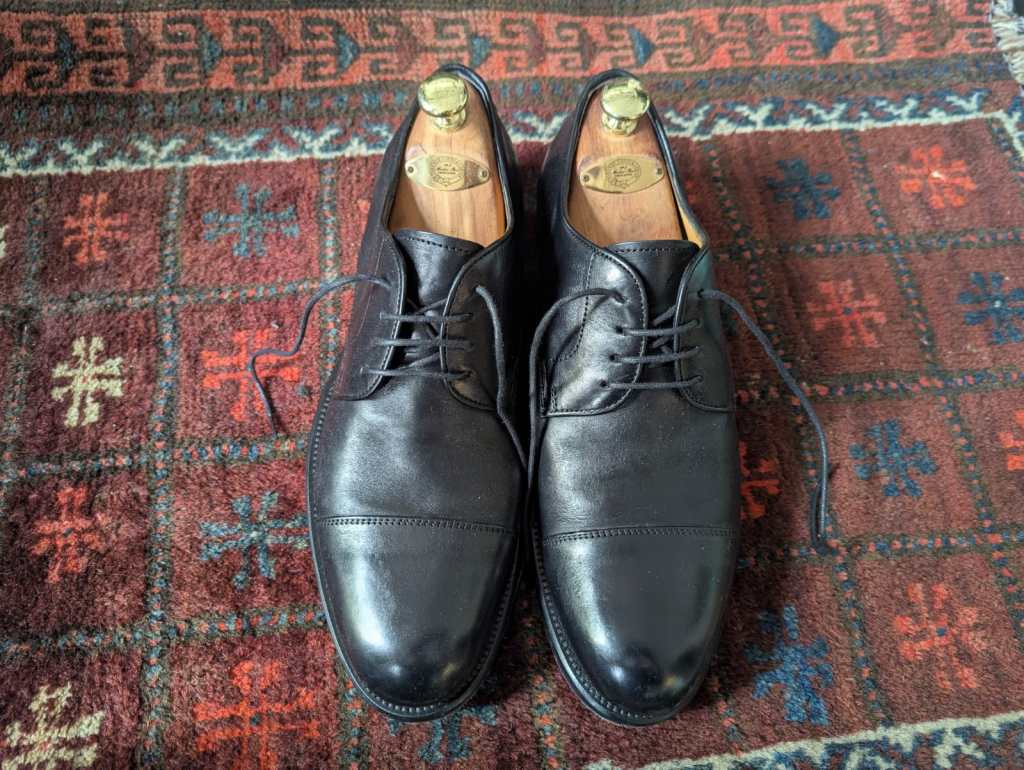
So we returned to the front of the building and I found myself hopping about the shop, trying on tasselled deerskin numbers and ornate perforated brogues. The owner, Antonio, was as Italian as you could imagine – floppy greying hair, immaculate cream chinos, a shirt collar that burst out from his lapels. ‘From London, eh? You’ll need something with a strong sole for all the rain!’
Low lamps hung from the ceiling, people sat at vice benches covered by newspaper, the workshop filled with the smell of glue and leather
He smiled as he brought out boxes and told me that his father had died recently too. I realised who it was in the photographs hung between the shelves – the same floppy hair, but greyer, the kindly face of Signor Mannina Snr. As Antonio encouraged me to try on yet more shoes, I imagined what my father’s advice would be: get one sober pair for work, the second can be more relaxed.
The first pair I chose were dark brown suede boots, all clean lines and perfect leather soles. The kind you could wear for a relaxed stroll up to the Pitti Palace for a Campari spritz. For the serious pair, I asked if Antonio had something in a slightly more English style, perhaps with rounded toes and without too much patterning (I have not inherited the same sense of sprezzatura as my Florentine friend). So we settled on simple Derbys with immaculately polished black toecaps and semi-rubber soles for that grim London weather. Antonio took the Derbys and bent them backwards, twisting the vamp to show me just how soft the leather was. They are, without a doubt, the most comfortable things I have ever put on my feet.
Two and a half years after my dad’s death and 900 miles from Gloucestershire, I was handed a bag containing what are surely the finest shoes in all of Italy. As I was leaving, Antonio turned to me, put his hand on my shoulder and said ‘thank you’ – as though I had just done him some great favour rather than the other way round. There is nothing in this world more decent than a family-run business.
Could the Scottish Tories do a deal with Reform?
Senior Tories are floating the idea of an electoral pact with Nigel Farage’s Scottish outfit
It’s not a good time to be a Scottish Conservative. While the SNP has seen a bounce in the polls – despite the infighting that followed Nicola Sturgeon’s resignation and the Operation Branchform police probe – the Tories and Labour have both suffered from a surge in support for Reform UK north of the border. Scottish Labour is projected to lose Members of the Scottish Parliament (MSPs) but ultimately it is the Tories who look to be hit the hardest.
It is the fear of an electoral wipeout next year – and projections that suggest Reform will pick up around 15 seats from a standing start – that has prompted senior Tories to float the idea of an electoral pact with Nigel Farage’s Scottish outfit. As reported in the Telegraph, party figures have suggested a deal could help avoid splitting the vote on the right and oust the SNP from government.
The idea at present would involve the Tories avoiding standing candidates in areas where Reform is projected to do well and vice versa. It comes after 14 Tory councillors defected to the Farage‑run group ahead of next year’s Holyrood election, and both the Conservatives and Reform UK expect that a sitting Tory MSP could switch sides. Some Scottish Tories have dismissed switchers as being ambitious and seeing an easy way into Holyrood via Reform, while Farage’s Scottish organisers have suggested that the party could introduce a deadline for defectors to stop opportunistic politicos taking advantage of Reform’s surge.
Scottish Conservative leader Russell Findlay is against the idea of a pact – and so is Nigel Farage. The Reform leader told the Telegraph: ‘No chance. The Tories are dying in Scotland and I’ve got no desire to do a deal with them whatsoever.’ His Scottish team echoed the sentiment, with a senior party source telling me: ‘Why would we stand down in areas we’ll win?’ They added that no Scottish Tories have approached Reform with the strategy and reiterated that the party will stand candidates in all 73 constituencies as well as on the regional list. They concluded: ‘There’s absolutely nothing in it. They’re at it.’
The SNP is the only party to have published its candidate list for the 2026 election – featuring a mix of former MPs, current MSPs and a number of younger councillors. Scottish Labour and the Conservatives have not finalised their lists yet, while Reform UK is vetting candidates and conducting parliamentary assessment meetings with the help of its London team. After this, a committee will approve applicants before branches select candidates for 2026. A full finalised list is expected early next year. The Scottish Conservatives will be hoping no more councillors – or MSPs – defect before then.
Is David Williams the MoD’s fall guy?
Yesterday the Ministry of Defence (MoD) confirmed that its permanent secretary, David Williams, will be stepping down in a matter of weeks. He has served for just over four years, almost exactly the average tenure of his predecessors since the department was created in 1964, but it is difficult to regard the timing as a coincidence. It is still not yet three weeks since the catastrophic loss of data on Afghan nationals and others, and the MoD’s use of a super-injunction, were disclosed to parliament by defence secretary John Healey.
This is not a failing individual. This is an ingrained, systemic, cultural malaise. And it has to be fixed.
Williams is not explicitly being sacked: permanent secretaries very rarely are. The Ministry of Defence is being very careful and measured in its language to refer to his impending departure: according to the BBC, Healey had a ‘conversation’ with Williams before the Afghan data loss story became public knowledge, and ‘made clear that this was the right time to make a change’.
There is a plausible argument that we should not draw a line directly from the data loss to Williams’s departure. The MoD has also briefed that this is ‘an appropriate time for a transition’ of leadership; under Healey’s Defence Reform programme, the senior levels of the Ministry of Defence have been rearranged and streamlined into a ‘leadership quad’ which will supervise all aspects of defence policy and the armed forces.
This is the biggest reorganisation of the MoD for half a century, and it need not be any reflection on Williams that he chooses to step down before implementing the reforms in full, or that the defence secretary would prefer a fresh approach and a new top civil servant. Air Chief Marshal Sir Richard Knighton will be taking over as Chief of the Defence Staff next month, while the recruitment for a permanent national armaments director is taking longer than expected. While Madelaine McTernan, Chief of Defence Nuclear, has been in post since 2022, replacing Williams at this stage could make sense.
Equally, Williams’s departure could be seen as part of a wave of changes at permanent secretary level which often happen in the first year or so of a new government. Simon Case (Cabinet Secretary), Sir Matthew Rycroft (Home Office), Dame Tamara Finkelstein (Defra), Sir Philip Barton (FCDO), Dame Bernadette Kelly (Transport), Sarah Munby (DSIT) and Sir Jim Harra (HMRC) have all left the civil service within the past 12 months.
And yet… while the MoD is making no explicit connection between Williams’s departure and the data loss, it is hard to escape the feeling that we are being invited to join the dots, and that the permanent secretary is an expiatory offering to the political gods. The whole scandal did, after all, take place on his watch, and he was in charge of the overall management and leadership of the Ministry of Defence, as well as formally being principal accounting officer responsible to parliament.
The MoD should under no circumstances be allowed to wipe the slate clean with Williams’s departure. There is still a great deal we do not know about the Afghan data loss scandal, though the Intelligence and Security Committee, the House of Commons Defence Committee and the Public Accounts Committee will all be inquiring into the issue. But Williams – whatever his individual culpability – cannot be the fall guy.
Even based on what we currently know, the MoD has a shameful inability to prevent the loss of secret data, and data breaches have increased threefold over the past five years. There is also a systemic lack of accountability, particularly in relation to a number of disastrous equipment procurement projects. The readiness with which the department accepted the comfort blanket of a super-injunction for nearly two years speaks to a deeply ingrained culture of secrecy and dislike of scrutiny.
The Ministry of Defence is secretive, inefficient, unaccountable and almost pathologically unable to learn from its mistakes. That has been common currency in defence circles for decades, but the Afghan data loss cut through to the consciousness of the wider public. There is now a major issue of public trust, already a rare, valuable but rapidly disappearing commodity.
If ministers try to usher Williams off stage, bring in a new permanent secretary and assume that previous disasters can then be written off, they must have their feet held to the fire. This is not a failing individual. This is an ingrained, systemic, cultural malaise. And it has to be fixed.
The rise of rugby’s Nepo Babies
Julie Burchill may not have coined the phrase ‘Nepo Baby’, but my Coffee House colleague certainly has established a reputation as a deliciously mordant chronicler of the phenomenon.
The babies are everywhere, although as Burchill points out, ‘there are some professions in which the far reach of the dead hand of nepotism strikes me as worse than others’. Modelling and the media appear to be jobs where nepotism is more important than talent. (Incidentally, before you ask, I am not related to John, Bob or even Dennis Mortimer, the former Aston Villa midfielder.)
Professional rugby is a cut-throat business with a surfeit of talented youngsters all vying for a contract with a small number of top-flight clubs
But there is another profession where having the right surname seems to be increasingly handy, and that’s top-level rugby. These days the sport isn’t just about power and pace, but apparently who you are related to.
The British and Irish Lions play their third and final Test against Australia today and among the 23 players selected by coach Andy Farrell is Owen, his son.
In his heyday Owen Farrell was a very fine player. He made his England debut in 2012 and won the last of 112 caps at the 2023 World Cup. The following year he signed a lucrative deal with a French club, Racing 92 of Paris, but it wasn’t a success.
Farrell quit the club halfway through his two-year deal and returned to England in June with the jeers of the French ringing his ears. ‘Un flop’, as one rugby website remarked. In fairness to the 33-year-old Farrell, his season was disrupted by injury – no surprise given his age – and since January he managed to start only six matches.
This didn’t bother his dad when he needed a replacement for the injured Elliot Daly, who broke his arm in the Lions’ second match of their Australian tour. He drafted Owen into the squad despite his lack of form this season, and the fact he hadn’t played international rugby for nearly two years. There were plenty of alternatives – Scots, Irish and Englishmen at the top of their game – but Andy selected his son. He justified it on the grounds of his ‘experience’, but Lions should be selected on form and fitness. Dan Biggar, the former Wales and Lions fly-half turned pundit, said he was ‘struggling to get to grips’ with the sense of it.
Owen Farrell isn’t the first player to seem to benefit from having his old man as head coach. There’s Dan Lancaster, who, like Farrell, signed for Racing 92 last summer.
Racing 92 are one of rugby’s heavyweights – European Cup runners-up in 2018 and 2020 – yet Dan Lancaster arrived from Ealing Trailfinders, who play in the second division of English rugby. The French press were surprised. Did Dan’s arrival at Racing have anything to do with the fact his dad, Stuart, is head coach? When the question was put to Jacky Lorenzetti, Racing’s owner, he replied: ‘Nepotism, why not, but let’s not get too carried away’ Stuart Lancaster (who coached England a decade ago) was sacked midway through the season and in June Dan left Racing.
One of rugby’s first apparent nepo babies was the Welshman Thomas Young, handed a professional contract in 2014 by his dad, Dai, when he coached London Wasps in England’s Premiership. ‘When things didn’t work out at Cardiff Blues… my dad gave me an opportunity to come here,’ said Thomas. Dai made his son club captain in 2019, a few months before he left Wasps by mutual consent. Thomas subsequently flew the Wasps’ nest to rejoin his dad who was then coaching Cardiff.
There also seem to be rugby Nepos in Australia and South Africa. Robert du Preez was accused of ‘nepotism’ in 2019 when he coached the Sharks in Durban. Du Preez dismissed his critics as ‘cockroaches’, although he never came up with a good reason why he kept selecting his son Robert junior at fly-half instead of the clearly superior Curwin Bosch.
There are also players whose dads aren’t coaches but who seem to still benefit from having a famous father. Among them are Adam Hastings, son of Scotland legend Gavin; Tom de Glanville, whose dad Phil captained England in the 1990s; Jack Bracken, son of Kyran, a World Cup winner with England in 2003, and Reuben Logan, whose dad, Kenny, played for Scotland and whose mum is Gabby, the BBC sports presenter who represented Wales in gymnastics.
Premiership club Sale Sharks recently signed the 20-year-old Reuben and the club’s director of rugby, Alex Sanderson, said: ‘He has got two ex-professional sporting parents. That stands for a lot for me in terms of when you are that young.’
Rugby’s Nepos are different from their media and modelling peers in that they have given blood, toil, tears and sweat in pursuit of their goal. They are all talented, disciplined and admirable young men.
But professional rugby is a cut-throat business with a surfeit of talented youngsters all vying for a contract with a small number of top-flight clubs. A report in 2020 in the Guardian about the competition for contracts in the English Premiership stated: ‘One experienced Premiership academy manager has said he believes up to 20 per cent of the country’s most talented teenage players each year are being overlooked or blithely ignored’.
It apparently helps to get noticed if you have a famous dad or, even better, if he picks the team.
Confessions of a juror
When the jury service summons landed on my doormat, I cursed my luck. The nag of civic responsibility was just strong enough to stop me trying to wriggle out. Down to the Crown Court I trudged, praying that I wouldn’t be lumbered with – and impoverished by – a six-month trial. Mercifully, the case was done in seven days. But it should have been over long before.
In court, the lunch hour lives up to its name – and then some
Why did it take as much time as it did? It turns out that a day in court is no such thing. Sometimes it’s not even half a day. Three of our seven days began at 10am, two at 10.30am. One day didn’t get going till 11am. Only once were we told to be in court for 9am – on the first day, before the trial had started. When it did, there were more breaks than at the cricket. Barely an hour into each day, the judge let us out for a 15-minute breather. Didn’t the custom of the morning interval end when we left school?
The phrase ‘lunch hour’ lies to us. Most people wolf down a sandwich in ten minutes then get back to work. Not in court, where the lunch hour lives up to its name – and then some. Most days we stopped well before 1pm and didn’t resume till 2pm. On Thursday, the judge rewarded our two-hour morning sitting with an equivalent lunch break. We returned refuelled for a long afternoon in court. Fat chance. Only once did the day stretch to 4.30pm. Otherwise we clocked off before 4pm. The standard working day in Britain is seven-to-eight hours. For many it’s over ten. In court, if you’re a juror at least, you’re unlucky if it’s three or four.
Technical glitches added a flavour of farce. One day the microphone in the witness box broke. ‘Can the jury step out while we fix it?’ Another 20 minutes lost. ‘We’re now going to watch some video evidence on the screen,’ announced the defence barrister. Not so fast, big man. The telly didn’t work. Of course it didn’t. That was the excuse the judge needed to grant us another early lunch. When we returned an hour and-a-half later, he told us not to get too comfortable: the TV was still kaput, so he was sending us home for the day.
What’s the difference between eloquence and concision? A barrister. ‘I apologise for repeating this…’ was uttered in court so often, I couldn’t help but think: are you sorry, or do you just like to go on a bit? There’s a point of justice here too: long and slow proceedings are harder for juries to follow. Nowhere was repetition more soporific than with written character statements. Fourteen mini-essays, all saying the same thing as the character witnesses we’d just heard in the stand. Yet every word from every statement was read aloud. Even a barrister fond of his own voice struggled with this recital, losing his place and mispronouncing his words. In 12 Angry Men, Henry Fonda’s character asks, ‘It’s possible for a lawyer to be just plain stupid, isn’t it?’ In the middle of 14 back-to-back statements, it’s a certainty. A summary would’ve saved us an hour and the barrister’s blushes.
This exhibition in inefficiency was by now comic, a source of eye-rolling and piss-taking among the jurors. The biggest laugh of all came on the third day. After yet another delay, the judge told us not to worry: ‘We’re running ahead of schedule.’ Wow. What does behind schedule look like?
Sir Brian Leveson, the retired High Court judge, suggested last month that one way to save the justice system from collapsing would be to cut the number of trials involving juries. I’m no judge, but I do have a more mundane solution: an eight-hour day in court. By doubling the time for cases each day, the growing backlog would rapidly start to shrink.
My argument isn’t a swipe at the state. If you work in the private sector, you’ll know that time-wasting isn’t the preserve of the public one. But given the crisis in our courts, it’s hardly unreasonable to ask for a little more from them. Trial by jury in Britain has lasted for 800 years. Us jurors can give eight hours to help preserve it.
The horror of ‘cutting season’
Yesterday as I went through boarding at Gatwick Airport I smiled as I watched all the excited children going off on their holidays with their families. Everyone had on their new holiday clothes, and despite the crowded check-ins, people were in a good mood. I boarded my flight to Addis Ababa, the capital of Ethiopia. Addis is a busy hub with connections across Africa.
As we began to cruise, I noticed that many of the women on my flight were wearing full black abayas with hijabs, as were the girls they were with, who were aged between eight and 12. I soon realised that these groups consisted only of women: little girls with their mothers and grannies. There were no men. I remembered that this was the start of the long summer holiday, and that these children did not know what was going to happen to them.
It is the start of the ‘cutting season’. Every year, African women living across the world will take their pre-pubescent daughters back to their place of origin to suffer female genital mutilation – or FGM, for those who are in the trade of trying to stop it.
In Somalia, FGM consists of adult women holding the girls down whilst a ‘cutter’ uses a razor blade to remove the girls’ genitals. Their clitoris, their labia minora and majora. They are then sewn up with just a small hole left for urination and menstruation. They don’t get any anaesthetics. The cutter is paid perhaps a pound or two per girl.
When the girls marry, the man opens them up with a knife for intercourse.
Why is FGM done in the school holidays? The families know that FGM is a criminal offence in the UK, so, to avoid being caught, they take their girls in July, knowing that any infection and immediate pain will have eased by the start of school in September.
It is not just Somalis, but Sierra Leonians, Ethiopians, some Nigerians and Sudanese who put their girls through FGM. Even the Masai of Tanzania and Kenya do it to their children. Indeed, so do some Kurds, Indonesian, Malaysian and Egyptian families.
I am in the business of trying to stop this violence. With 40 years working in policing, either in the UK or advising on it in trouble spots, protecting the vulnerable is in my blood.
I have a message for Home Secretary Yvette Cooper
As one of the first police and crime commissioners, I elevated this issue into public conscience more than ten years ago. I embarrassed the police chiefs into trying to do more, and it worked for a while. I remember being delighted to see plain clothes officers approaching people at the departure gates at Heathrow and Gatwick. Once, I was impressed by the diligence of two detectives from the Sussex Police at Gatwick, who had worked out that the mothers were avoiding detection by routing to Africa by indirect routes: via Istanbul, for example. I watched them as they ‘pulled’ likely groups and warned them that they might be checked on their return.
Over the years, however, these interventions appear to me to have stopped. I imagine it is another case of police, social services and educationalists fearing being called racist. I remember Border Force once produced a training video to inform staff about FGM, but neutered it by using white characters.
I have a message for Home Secretary Yvette Cooper. Instead of grandstanding to your union paymasters and wasting tens of millions we do not have on an Orgreave enquiry, put your money where your mouth is and do something effective to stop violence against women and girls. Save these innocent little girls from horrific torture and a life of pain. Stop this abomination.
Was Eat Out to Help Out really such a bad idea?
Eat Out to Help Out, the government scheme aimed at encouraging people to return to restaurants during the pandemic, launched five years ago this week. From the outset, it came in for plenty of criticism. It was costly, controversial and possibly premature, its critics say. Bereaved families claim people died because of the scheme. These criticisms might be valid, but they’ve also obscured something else: the fact that, for many – especially young people – this policy didn’t just bring food onto tables. It marked a return to normal life after weeks of lockdown.
It was one of the few bright spots in 2020, a year defined by fear, isolation and loss
We queued. We booked. We ordered that second starter. For a few wonderful weeks, tables were full, pub gardens were loud, and weekday evenings took on the glow of Friday nights. It wasn’t just about food. It was about re-entering the world. I didn’t realise it at the time – no one did – but Eat Out to Help Out became, for many people, one of the few bright spots in 2020, a year defined by fear, isolation and loss.
At the time, I was head of behavioural insight at HMRC and fed advice into the scheme’s design. I don’t know how influential it was, but I found it unusually exciting – not just because it was bold, but because it set out to change how people felt, not just their bank balance. It was a rare moment when policy engaged with perceptions, not just price points. And it worked — in ways we hadn’t fully anticipated.
What I noticed in that month wasn’t just economic activity – it was emotional reanimation. People weren’t just eating out. They were getting dressed again. Choosing where to sit. Seeing people across a table, not through a screen. It sounds small. But after months of lockdown, rules and rationed pleasure, it felt like momentum.
We often talk about the long tail of the pandemic’s effects on young people: the stalled careers, the missed milestones, the mental health struggles. It’s worth remembering that, in a year of cancellations and constraints, this was the rare moment when they were told: go out. Be with friends. Rejoin the world.
And they did. In just one month, over 160 million discounted meals were claimed – more than two per person across the UK. It wasn’t just a treat. It was structure. Something to look forward to. Restaurants filled. So did diaries. We started planning again.
Sales in hair styling products rose 17 per cent, hair removal products 11 per cent. People weren’t just leaving the house – they were preparing to be seen. For many who worked in hospitality – also disproportionately young – EOHO didn’t just bring them joy as customers, but employment as staff. They were needed again.
The scheme, as I’ve said, had its critics. There are serious concerns about its role in the second wave of Covid. Some saw it as wasteful – a subsidy for those who would have eaten out anyway. Both perspectives deserve reflection. But let’s not ignore the fact that this scheme gave people something more than economic support. It gave them a reason to leave the house, to put on proper shoes again.
None of this means government should subsidise people’s meals out during normal times. But it does mean we should pay attention to the emotional reverberations of policy — not just economic outcomes. For a moment, Eat Out to Help Out made people feel like things were turning a corner. As we reflect on the long tail of youth disaffection today, it’s worth asking: what if more policies aimed not just to recover — but to rekindle? August 2020 opened up a tantalising possibility.
How Cowes found the secret of a successful seaside resort
These days, most English seaside towns are sites of national mourning. You pay your respects by walking up some deathtrap pier, dropping two pence in an arcade coin pusher and whispering, your flower now on the grave: ‘Ashes to ashes, dust to dust.’ But Cowes, on the Isle of Wight, has managed to stave off this sorry end. Its secret is Cowes Week.
Cowes Week, which starts today, is an annual sailing regatta. It has earned its place as a respected event in Britain’s sporting calendar – always in August, between Glorious Goodwood and the Glorious Twelfth – but its beginnings were unambitious. On 10 August 1826, following an advertisement in the Southampton Town and Country Herald a fortnight before, ships raced from Cowes to Southsea Castle near Portsmouth and back, eight nautical miles each way, for a prize of £100. Cowes’s genius – and what has secured its survival – has been turning this local lark into a money-spinner: ‘Cowes Week, The Oldest Sailing Regatta In The World.’
While Poole and Bournemouth are still flogging sticks of rock to the same diminishing group of day-trippers, Cowes has rebranded as a ‘sailing town’. To get technical, it has mastered what The Spectator’s Wiki Man Rory Sutherland calls ‘reverse benchmarking’. Rather than trying to compete with other seaside towns on the usual terms – best fish and chips, nicest beach – Cowes has gone its own way. It has a Henri Lloyd, some lovely bakeries, a big M&S and a nice restaurant that sells expensive seafood platters. The beach is not great, but no one cares.
Before Cowes Week, Cowes was a dull administrative centre for the British Empire. Rice from the American colonies was brought to the town, which is at the northernmost point of the Isle of Wight, to clear customs before being distributed across Europe. Tourists only really started coming to Cowes when Queen Victoria built a palace in Italian renaissance style on a cliff on its eastern outskirts. Prince Albert said that the vista, overlooking the grey and murky Solent, reminded him of the Bay of Naples.
While Poole and Bournemouth are still flogging sticks of rock to the same diminishing group of day-trippers, Cowes has rebranded as a ‘sailing town’
Perhaps Albert was getting ahead of himself, but the Isle of Wight does have a foreign allure. This makes the rebrand to ‘international sailing town’ believable. Friedrich Engels, who visited the island often, said it was a ‘little paradise’, and oddly also compared it with Naples. Engels was apparently drawn to the Isle of Wight after reading a book by James Clark, a physician, who wrote in 1829 that the Isle of Wight’s air had miraculous medicinal properties. ‘[The island] possesses several peculiarities of climate and situation,’ said Clark, ‘which render it a very favourable and commodious residence throughout the year for a large class of invalids.’
There are still some wrong ’uns around the Isle of Wight, and around Cowes. Last year, a criminal who was on the run registered himself as living at my parents’ address for the purpose of acquiring a driving licence, and I have also become friendly with a former convict who likes to pick magic mushrooms from a field near the town. HMP Isle of Wight, a high security ‘super prison’, is a ten-minute drive from Cowes. It was once home to the Kray twins and the Yorkshire Ripper. David Icke also lives on the Isle of Wight. Criminals, conspiracists and cosmopolitan sailors share Cowes happily.
The judiciary picks another fight with Trump
The second coming of President Trump has brought an invigorated commander-in-chief asserting broad authority over the executive branch, reigniting debate over how much power the president has over his own subordinates, including US Attorneys.
At present, the battle has focused on one US Attorney in particular. On March 24, 2025, the President named Alina Habba, his former personal attorney, the Interim US Attorney for the District of New Jersey. There’s a catch: Interim US Attorneys may serve only 120 days. On July 1, the President nominated Habba for Senate confirmation as New Jersey’s US Attorney; if confirmed, Habba could have served permanently at the pleasure of the President. Neither of her home state’s senators (both Democrats) supported Habba.
In the meantime, the clock ran out on Habba’s interim appointment, and under an obscure law found at 28 U.S.C. 546(d), federal judges in New Jersey named her deputy, Desiree Grace, the Acting US Attorney. Acting US Attorneys, who are career prosecutors named for temporary promotions, expect to return to their line jobs at some point. Grace accepted the appointment. But Trump still wants Habba, so his Justice Department, as one would expect, took up the boss’s famous charge to “fight, fight, fight” back. Attorney General Pam Bondi fired Grace, rehired Habba as a deputy, and then promoted Habba to Acting US Attorney while the President’s team pulled her nomination paperwork.
Skeptics on the left have questioned Habba’s qualifications for the job. Ultimately, if President Trump resubmits her nomination for confirmation, that will be a matter for the Senate to determine. In the meantime, at least one criminal defendant has challenged his indictment in court, claiming Habba lacks the authority to serve as Acting US Attorney.
If all this sounds incredibly complex – it is, even for lawyers. The kerfuffle over who has the power to appoint US Attorneys, however, is a question of constitutional importance. The Habba scenario may play out across the country as President Trump’s interim US Attorney appointments, including those in Washington, DC, New York and California, are reviewed by the judiciary. This is important because US Attorneys are the chief law-enforcement officers for the districts in which they serve; Habba is essentially President Trump’s top cop when it comes to federal cases in New Jersey in which the US is a party.
A US Attorney has tremendous authority vested by the Justice Department. She has the power to determine prosecution priorities; direct high-profile cases; manage relationships with other law-enforcement leaders; lead personnel by hiring, firing, and promoting staff; and serve as the public face of the office, including with the press and community. In turn, the Justice Department is a cabinet agency of the executive branch. The department will naturally pursue the priorities of the president, whether that be illegal-alien entry, human trafficking, or white-collar crime. That is, unless a rogue prosecutor turns rebel. So the president has a deep interest in who leads each of the 94 US Attorney Offices across the US and its territories. Promises made to voters about border control, protection from sexual predators, and safeguarding American markets from foreign bad actors, for example, must be promises kept.
All of this brings us back to the question of who should appoint US Attorneys. Should top federal prosecutors be appointed by the president, acting through the Justice Department, which they serve, or should US Attorneys be named by federal judges, who belong to an entirely separate branch of government?
As a matter of policy, the answer seems clear. The president must have control over the people executing policies under the authority of departments for which he holds responsibility. Every cabinet agency, including the Department of Justice, answers to the president and should execute his policymaking vision. President Trump and his team have identified a fight worth fighting, and they deserve to win.
Federal judges have no more business appointing US Attorneys than they do US Marshals, Assistant Attorneys General, or any other members of the executive branch. There is no other comparable context in which the bench has the power to appoint anyone to a separate branch of government. Judges are umpires, not players.
The law, however, is unsettled at this point. Until the recent New Jersey complaint, no litigant had challenged the ability of the president to appoint temporary US Attorneys. Unless Congress revisits the thicket of legislation that created this chaos, Alina Habba’s fate as US Attorney someday may be decided by the Supreme Court.
Green party leadership contest heats up as ballot opens
Today, Green party members can begin voting for their next party leader – or leaders – as ballots in the leadership contest have now opened. Voting will take place across the month before ballots close on 30 August with the result to be announced on 2 September, just a month before the party heads to Bournemouth for a three-day conference. The choice is between current co-leader Adrian Ramsay who is running on a joint ticket with North Herefordshire MP Ellie Chowns (after Bristol Central MP Carla Denyer announced she wouldn’t be running again) and the party’s current deputy leader Zack Polanski. Yet despite the competitors having worked closely together for years, the race has got off to a pretty disagreeable start.
Ramsay and Polanski were pitted against each other on Iain Dale’s LBC show last week. Over the course of 90 minutes, each made their case for the leadership and quizzed the other on their diverging proposals. Things got frosty when Dale asked Ramsay if he liked his deputy – at which point the co-leader became strangely tongue-tied. In a later hustings, Ramsay went on to compare Polanski to, er, Liz Truss. The Green co-leader worries that Polanski’s proposals will break from a strategy that has in recent years seen the Greens quadruple their seats in Westminster (albeit from one to four), ousting a shadow cabinet member in the process.
Polanski is less bothered about persuading soft Conservative voters to back the environmentalists, and instead has pushed a more radical ‘eco-populism’ campaign using social media platforms and prominent voices on them to help draw people to his cause. While not quite at Nigel Farage levels of TikTok followers, he has 45 times more followers than Ramsay. Left-wing media outlet Novara Media has suggested that the Green party membership has grown by ‘at least 8 per cent’ since Polanski launched his campaign – while the deputy leader himself recently boasted he had secured the backing of election campaign organisers and managers. Yet recent YouGov polling suggests that the Green leadership team remains relatively unknown not just among the wider population, but their own voters – with more than 84 per cent unaware of Ramsay, Chowns or Polanski.
The creation of the as-yet-nameless Jeremy Corbyn and Zarah Sultana party also poses identity problems for the environmentalists. Polling has shown that those stuck on whether they should back Corbyn’s group or the Greens have expressed a desire to see the latter outfit become more left-wing than environment-focused. This is where Polanski may win out over Ramsay and Chowns: he is widely seen as being more progressive on culture war issues and has shared social media clips of Corbyn and left-wing commentator Owen Jones heaping praise on him. Where Polanski is open to an electoral pact with the new left-wing party, Ramsay has warned against the Greens becoming a ‘Jeremy Corbyn support act’.
For his part, Jezza has this week ruled out an alliance with the Greens – saying that the group is ‘not a socialist organisation’ – but admitted his new party wouldn’t rule out working with them ‘on social justice issues’. The matter is already dividing those on the left, with some taking aim at James Schneider, the former director of communications for Corbyn’s Labour party, over his support for a left-wing pact with the Greens on the background he is married to Keir Starmer’s press secretary. If there’s one thing on which the left is unrivalled, it’s fighting amongst itself. It certainly seems unlikely that the Green party will emerge from this leadership contest unscathed.
Why the Valuation Office Agency isn’t value for money
Another day, another dispiriting quangocracy revelation. This time the spotlight is on the Valuation Office Agency, whose performance has been rapidly declining year on year – while complaints about the organisation have skyrocketed. Freedom of Information data received by the TaxPayers’ Alliance shows that call wait times have more than doubled over the last three years, targets have been increasingly missed and complaints about the organisation have shot up by 200 per cent. Dear oh dear…
Over the last three years, targets have been increasingly missed and complaints have shot up by 200 per cent
In the 2024/25 financial year, average call wait times for the VOA – which works to provide property valuations and advice to support the administration of taxes and benefits – were almost 10 minutes on average, compared with just over 4 minutes in 2021/22. In 2023/24, two-thirds of calls were answered by an advisor within the organisation’s target time, with this figure slumping to 59 per cent the following year. Meanwhile the organisation’s performance review admits that it was ‘below target’ when it came to dealing with council tax and business rates reports in 2022/23. It continued to underperform in following years, steadily getting worse.
As readers will expect, complaints rose accordingly in this time. In 2021/22, 762 complaints were made – and of the 771 that were resolved, 40 per cent were at least partially upheld. Instead of learning from this, the VOA appeared to fall further into decline. Complaints rose by 40 per cent the following year, which the organisation attributes to the then-government’s energy rebate announcement (which, it says, led to increased demand and therefore more delays). The next year, however, complaints shot up again by almost a third and in the most recent financial year they surged by 70 per cent – with the VOA receiving 2,300 reports of dissatisfaction in 2024/25. Crikey!
The Chancellor of the Duchy of Lancaster Pat McFadden announced there would be a review of ‘arm’s length bodies across government’, issuing a warning that if departments cannot justify the existence of quangos, they’ll be merged or closed. Mr S isn’t at all surprised that the VOA has been deemed inefficient, with the organisation set to become part of HMRC under these changes. But, as the TPA’s investigations campaign manager Joanna Marchong notes, this ‘must be more than a box-ticking exercise’. She added about the rather, er, unflattering figures:
Taxpayers were being left on hold while performance at the Valuation Office Agency continued to worsen. Waiting times were climbing year after year, and fewer calls are not being answered on time: it’s simply not good enough.
Ministers need to ensure this absorption delivers real improvements – not just another layer of Whitehall bureaucracy that is further removed from the taxpayers footing the bill.
Quite!
Kamala: ‘Democracy is dead. Buy my book’
Kamala Harris reappeared last night, making a 30-minute guest appearance on the now-canceled Late Show with Stephen Colbert, to deliver this message of hope to the American people: The country is irretrievably broken and there’s nothing anyone can do to fix it. Hilarious!
Momala said that everything terrible that was going to happen if she lost to Donald Trump has now happened (relatively strong economy, world peace) but the worst thing is that her fellow Democrats have “capitulated” to Trump’s fascist program of trade protectionism and renaming everything after himself.
Harris, who recently announced that she’s not running for California governor, said she probably won’t run for President in 2028 either. “I just, for now, I don’t want to go back into the system,” Harris said. “I think it’s broken.” (Cockburn reads “broken” as “I simply can’t win.”)
“I always believed that as fragile as our democracy is, our systems would be strong enough to defend our most fundamental principles,” she continued. “And I think right now that they’re not as strong as they need to be, and I just don’t want to for now. I don’t want to go back in the system. I want to travel the country. I want to listen to people, and I don’t want it to be transactional, where I’m asking for their vote.”
However, she does want people to listen to her long enough to buy her new book “107 Days,” which is exactly how long she and her supporters maintained the illusion that she might become President. Colbert said her statement was “harrowing,” while a copy of the book sat on the desk between them. “I am always going to be part of the fight,” said Harris, who had just said she was no longer going to be part of the fight.
Democracy is dead. Buy my book.
A Trump-Hawley tiff
When he’s not busy claiming the greatest economy in American history, bringing peace to the planet or threatening drug companies to bring down prices (or else), President Trump is still finding time to shitpost Senators from his own party. This week he called 91-year-old Iowa Senator Chuck Grassley a “RINO” and “sneaky,” for expressing mild concern about last month’s tax bill. According to The Hill, other Republicans found this “irritating”.
Then Trump went to town on Truth Social over Missouri’s Josh Hawley helping to vote a Congressional insider trading bill out of committee. The President sounded very defensive even though Hawley said he “still loves” Trump, that the bill has nothing to do with Trump and would only affect future Presidents, and Hawley, too, wants Nancy Pelosi’s investigated for her family’s stock trading.
Later, the “second-tier” Senator said he had a “good chat” with Trump, who apparently no longer thinks that Hawley is a “pawn” of the DEMOCRATS who are jealous of “our tremendous ACHIEVEMENTS and SUCCESS.” Cockburn continues to advise Republicans to not make Trump angry. You won’t like him when he’s angry.
On our radar
EPSTEIN UPDATE Virginia Giuffre’s family released a statement urging the DoJ to keep Ghislaine Maxwell in prison, after Trump said his friendship with Epstein ended after the sex trafficker “stole” her from Mar-a-Lago while she was working there as a spa attendant.
RUN FAST President Trump is bringing back the Presidential Fitness Test for all public school children in an attempt to “restore urgency in improving the health of all Americans.”
MEXICAN TARIFFS📈📈 After Trump pressured President Sheinbaum to allow US troops in Mexico to fight cartels, two Mexican officials were charged with leading a drug trafficking group.
2, 4, 6, 8, what can we deregulate?
The Environmental Protection Agency has been hard at work undoing decades of government-sponsored greening. Secretary of Energy Chris Wright joined EPA Administrator Lee Zeldin to rescind a 2009 EPA “Endangerment Finding” and announced a recent DOE Report that’s contents are going to cause a five-alarm emergency among climate-change activists.
Zeldin’s team is re-studying and re-evaluating many things Americans thought they knew, including the social cost of carbon. Wright said the 2009 regulations were made by people who “didn’t look at the data,” adding, “they didn’t understand climate change, they didn’t appreciate how energy works.”
To avoid the same alleged mistakes as the 2009 crew, Wright reached out to five scientists with differing opinions and backgrounds to get a comprehensive review of what regulations actually benefit the Earth and its inhabitants. And from his brief remarks, Thursday, it appears there will no longer be government incentives to buy electric vehicles, as they offer “roughly zero reduction in greenhouse gas emissions.” Wright said, “Electric vehicles are not climate tools, but they’re politically popular because rich people like them, so they’ve been deemed to be climate solutions. We want to get back to science and data and facts.”
Wright encouraged the public to read the 150-page report and “engage in a thoughtful dialogue about what is climate change.” Cockburn, who’s no climate alarmist, has survived smog, acid rain and several unusual winter storms in his life. But he also fancies electric cars somewhat, so he looks forward to the chat.
Strictly ballroom
The White House is just not big and beautiful enough, apparently. The Trump administration announced construction plans Thursday morning for a “much-needed and exquisite addition” of a 90,000 square foot, 650-person capacity ball room, and the operation will begin next month. (Trump, of course, discussed his plans for a White House ballroom in his first magazine interview with The Spectator‘s Ben Domenech. The President printed out pictures of Mar-a-Lago’s ballroom to show Ben what he had in mind.)
After gawking at the gold and white neoclassical teaser photos, Cockburn was relieved to find the construction cost will not come from his own meager tax contributions; it will be paid for by his billionaire president and others who “generously committed to donating” funds for the $200 million addition.
In the press pool on Thursday, Trump explained why there hasn’t been a ballroom in the White House before now: “We’ve been planning it a long time… but there’s never been a president who was good at ballrooms.” That changes now.
A global MAGA crusade against web regulation?
“Censorship is not how we do things in Western civilization”. So said Congressman Scott Fitzgerald (R-WI) of the United Kingdom’s new Online Safety Act (OSA). Its effects on free expression are “dangerous and needs to be addressed,” possibly by means of an international “united front”.
The Congressman was fresh from meetings with British and Irish lawmakers and US tech firms, held as part of a House Judiciary Committee fact-finding mission to investigate the impact of the OSA and the European Union’s new Digital Marketing Act on American businesses. The main event was a one-on-one between Committee chair Jim Jordan (R-OH) and Peter Kyle, the United Kingdom’s Secretary of State for Science, Innovation and Technology.
The OSA, which came into force last week, requires internet platforms to put new measures in place to prevent under-18s from accessing violent or pornographic content. Supporters of the Act say this is essential to protect children; opponents that the regulations are at best ham-handed, at worst part of an attempt to quash online discussion of issues like illegal immigration.
The rollout has not reassured critics. When the Act came into effect, British X users logged onto the website to find that its new filter had blocked footage of a protest in Epping, England against illegal migrants being housed in a nearby hotel. Also hidden was a speech made by a member of the British House of Commons on the Rotherham rape gangs scandal. Footage of the wars in Gaza and Ukraine fell foul of the filter as well.
Significantly, the OSA applies to any site operating in the UK. American companies that fail to meet its provisions could face fines of 10% of “qualified worldwide revenue”. This has caused consternation in Silicon Valley, and not just among its MAGA-aligned faction. Congressman Kevin Kiley (R-CA), another member of the delegation, says that tech giants like Apple and Meta are “all very frustrated” at the Act, and claim that they’re being “overregulated”.
It speaks to a perennial complaint, by no means confined to the Trumpist right, that European governments use regulations like these as a means to cream off some of the proceeds of Silicon Valley for themselves. These laws represent a “direct transfer of wealth” from Americans to Europeans, said Rep. Fitzgerald. “America innovates; Europe regulates.”
This isn’t just a commercial spat, though. We’re often told that MAGA is a politics of expediency and self-interest: “America First”. What tends to be missed is how prominently a general concern for the fate of the West often features. That was certainly the tenor of Rep. Kiley’s criticism of the OSA, who was “very concerned” by its impact on free expression in the UK. “Free speech is a hallmark on Western civilization”. The USA should be “aligned with European allies” on free expression, Rep. Fitzgerald added – Europe was “a little off track” in this regard.
It’s not the first intervention of this kind. Earlier this year at the Munich Conference, Vice President Vance criticized European governments over limits placed on speech. During the Obama years – and before – criticisms of the “human rights abuses” of various regimes were a routine event. A MAGA equivalent may now be taking shape.
Nor would they be without local allies. The Democratic lawmakers on the delegation, including Eric Swalwell, recently tilted with Nigel Farage, leader of the populist Reform UK party, in a meeting held on Tuesday to discuss the OSA. Farage took umbrage with Congressman Jamie Raskin’s (D-MD) criticisms of Trump, calling him “pig-headed”.
Where does the President fit into all this? So far he has been fairly sanguine about the OSA (“I cannot imagine him [British Prime Minister Keir Starmer] censoring Truth Social … I only say good things about him and his country”) and is less inclined to comment on the internal affairs of other Western countries. That might be changing, though: after his meeting with Keir Starmer in Scotland on Monday, the President beseeched the Prime Minister to lift the ban on oil and gas exploration in the North Sea. Would Fitzgerald and Kiley be bringing their concerns to the White House? “Yes”.
J.D. Vance is right about Germany’s civilisational suicide
This week, US Vice President J.D. Vance levelled a blistering critique at Europe, accusing it of ‘committing civilisational suicide’, and Germany in particular of bringing about its own demise, saying:
‘If you have a country like Germany, where you have another few million immigrants come in from countries that are totally culturally incompatible with Germany, then it doesn’t matter what I think about Europe… Germany will have killed itself, and I hope they don’t do that, because I love Germany and I want Germany to thrive.’
While some dismissed his remarks as yet another post-Munich Security Conference jab, Vance insisted his concerns for Germany were sincere. And he seems to have a point.
Painful, necessary reforms to the welfare state, pensions, and immigration policy are endlessly postponed or ignored
While the US watches these developments from afar, the German mainstream media continues to push the narrative that the country needs 400,000 ‘skilled workers’ annually. This is despite the fact that nearly four million able-bodied people of working age already receive benefits, almost half of whom are non-German citizens. When you include those with German passports who were born overseas, the number rises to around 64 per cent. So, where did it all go wrong for Germany on migration and refugee policy?
It began with the Gastarbeiter (‘guest workers’) invited during the post-war economic boom under Chancellor Konrad Adenauer and his minister for economic affairs (and future Chancellor) Ludwig Erhard. Starting in 1955, Germany recruited labour from Greece, Italy, Spain, and Turkey. What began with 300,000 workers in the 1960s ballooned to 2.6 million by 1973. The introduction of family reunification turned these guests into permanent residents. Although there were efforts to curb immigration and encourage return migration as late as the 1990s, they met with little success. Germany is simply a nicer place to live than Turkey, even if Germans of Turkish origin set off fireworks to celebrate Erdogan’s election victories.
The floodgates were fully thrown open in 2015 by then-Chancellor Angela Merkel, when she allowed Syrian migrants to enter Europe. Millions of asylum seekers and economic migrantsmade their way across Europe with little to no vetting. Even though the Syrian civil war has come to an end, almost none want to return home, and a combination of family reunion and lax borders means that asylum seekers keep coming in large numbers.
In contrast to the Netherlands and Denmark, Germany has not produced a comprehensive recent cost-benefit analysis of migration. No official lifetime cost estimates exist. Yet the consequences are increasingly visible: rising violent crime, public schools where students of migrant backgrounds make up 42 per cent of the pupils (with some schools reaching 90 per cent), cultural fragmentation, and an overburdened welfare and healthcare system. Even Germany’s once-abundant tax revenues are no longer enough. A €172 billion budget shortfall looms, worsened by promises such as a special pension for mothers. Meanwhile, the government is floating the idea of a ‘Boomer-Soli’, a new tax on ‘big pensions’ above €1,000 per month.
The warning lights are flashing, but the government continues to kick the can down the road. Painful, necessary reforms to the welfare state, pensions, and immigration policy are endlessly postponed or even ignored.
Instead, policymakers debate introducing migrant quotas in public schools, some of which already serve only halal food and have reportedly abandoned Christmas celebrations in favour of mandatory Ramadan events.
Meanwhile, thousands of individuals in Germany have faced lawsuits for sharing memes, voicing criticism, or insulting politicians. Most of these cases were brought by politicians from the left: the Green party, the Free democrats (FDP) and the Social Democratic party (SPD). In one case, a pensioner was subjected to a police search and later sentenced simply for sharing a meme. A journalist from a right-wing populist publication received a suspended prison sentence and a fine for posting an image of former Interior Minister Nancy Faeser edited so that she was holding a sign that read: ‘I hate freedom of speech’.
Economically, things look equally bleak. After a disastrous trade deal between the EU and the Trump administration, Germany’s once-mighty automotive industry faces another blow amid already collapsing revenues. Even the unions seem more focused on climate activism and class struggle than job security. Well-paid industrial jobs, they hope, will be preserved by the ‘green economy’. Some hope.
After five years without significant economic growth, any rational politician should be deeply alarmed. Instead, Chancellor Friedrich Merz touts vague promises that 61 companies are ready to invest €631 billion in Germany. He seems to hold the misguided view that subsidies alone can salvage what remains of Germany’s crumbling economic model.
It is a sobering reality when the Vice President of a foreign country appears more concerned with Germany’s future and problems than its own political class.
Why Starmer is courting TikTok influencers
Some of my oldest and dearest school friends absolutely hate reading the news. One called me up nearly a week after Rishi Sunak called last year’s election to ask if I fancied a weekend in the countryside. ‘That sounds great,’ I said ‘but you know I’m working on the election?’ ‘Oh my gosh, there’s an election?! Totally missed that!’ she squealed.
Sometimes, ignorance really is bliss. Her bliss, however, has been somewhat disrupted by TikTok. I nearly fell off my chair when she asked if I’d seen Keir Starmer’s Labour party conference speech last year. Starmer’s demand for the release of the sausages (instead of hostages), had understandably, gone viral, reaching even my staunchly anti-media friends.
While recruiting influencers shows No. 10 is getting better at finding their messengers, the question remains: what is Starmer’s message?
Social media’s deep reach into the wider population is why Starmer’s decision to host up to 90 influencers in No. 10 yesterday is smart. Ofcom found that over half of adults now get their news from social media. In the US, that’s more than consume media from TV networks or news websites. The outsized impact of podcasters in elections demonstrates which way the wind is blowing. No wonder White House Press Secretary Karoline Leavitt now holds exclusive press briefings for influencers: ‘Millions of Americans are now turning to social media and independent media outlets to consume their news, and we are embracing that change, not ignoring it,’ she said during the first influencer briefing earlier this year.
This shift isn’t limited to politics and the media. Social media has become the world’s largest advertising channel, driven in part by influencer marketing. Platforms like MasterClass – featuring courses from the likes of Gordon Ramsey and Serena Williams – demonstrate the public’s preference for learning from individuals perceived as authentic, rather than traditional institutions.
Despite the sneering, Starmer’s turn to influencers is hardly revolutionary. In 2018, Theresa May’s team drew up lists of key Twitter influencers to help sell her Chequers deal. Rishi Sunak made videos with everyone from ‘Budgeting Mum’ Beth Turbutt-Rogers to endurance athlete, Hardest Geezer. Across the political spectrum, digital communications teams increasingly focus on the general public, while traditional press operations, such as those who handle the papers, are seen as a conduit to Britain’s institutional elite.
That’s not to say that Starmer’s strategy is not without its pitfalls. There’s the irony of No. 10 courting TikTokers while the app is banned on government devices. But the more fundamental problem for Starmer is that government communications is a two-sided coin. It’s about both what you’re saying and how you’re saying it. While recruiting influencers shows No. 10 is getting better at finding their messengers, the question remains: what is Starmer’s message?
Starmer’s lack of narrative has already been covered extensively, but it is worth reiterating that his failure to communicate effectively has significant consequences beyond the polls. Without a compelling narrative on winter fuel and welfare reform, the government has been forced into costly concessions, diverting billions that Reeves will now have to borrow or raise in tax.
Some see this week’s other communications shake up, the appointment of former Sun editor and News UK Chief Operating Officer David Dinsmore to the new role of a civil service comms chief, as a sign that No. 10 are getting serious about fixing this. Dinsmore is a seasoned operator with tabloid instincts, a skillset often missing in government communications teams. While his appointment has ruffled the feathers of the Labour left and those who praised Starmer for his pledge to boycott the Sun over Hillsborough, it signals yet another attempt from Starmer to get to grips with governing.
Unfortunately for Labour, Dinsmore is only starting in November. If Starmer’s influencers don’t start performing soon, they’ll leave the field open to perhaps the most impactful influencer of them all: Nigel and his iPhone.
Rachel Reeves has crushed confidence in Britain
It doesn’t look like the Chancellor will hit her target for turning the UK into the fastest-growing economy in the G7. Nor has ‘stability’ unlocked a wave of foreign investment. Instead, it has plunged. As for Rachel Reeves’s fiscal rules, they have been missed almost every month since they were announced. Now there is more bad news for the Chancellor. Business confidence has collapsed to an all-time low.
It is not hard to work out why the mood is so bad
Leaving the EU’s single market was tough for Britain; so was the financial crash of 2008 and 2009. The pandemic, too, was never going to make business owners feel good about life. But still, 2025 is looking like our country’s economic nadir. According to a survey by the Institute of Directors released today, business sentiment dropped to minus 72 in July, a steep drop from an already very gloomy minus 53 a month earlier. It is the lowest reading on the survey since it started in 2016, and even worse than during the Covid crisis. Almost 85 per cent of the 900 business leaders surveyed said they ‘lack confidence in the government to jump-start the economy’. More than two-thirds said they believed the government’s policies on the economy have been ‘very unsuccessful’ to date. There may be one or two entrepreneurs out there feeling good about their prospects – perhaps a guy selling spare parts for windmills in Sunderland – but everyone else is suicidal.
It is not hard to work out why the mood is so bad. Companies have already been hammered with one round of tax and more and higher levies are almost certainly on the way in the autumn. Entrepreneurs face higher capital gains taxes and possibly a wealth tax as well. Expanding has become not just more expensive, but more difficult too. Employers must adhere to a whole raft of new employment rights.
Rachel Reeves has never seemed to understand that a good chancellor is a good storyteller. He or she needs to inspire, and to persuade people that even if times are tough, they will get better soon. Relentlessly talking down the economy has been a huge mistake – and Reeves is about to pay a high price for it.
Labour accused of ‘social engineering’ over working class internships
Well, well, well. It transpires that in plans to make Whitehall more working class, civil service internships will only be offered to, er, students from low income families. The Cabinet Office has said that only those from ‘lower socio-economic backgrounds’ will be able to apply to Whitehall’s internship scheme – with eligibility based on, um, what jobs their parents did when they were 14. Good heavens…
Currently the summer scheme is up to two months long, and open to undergraduate students in the last two years of their degree, allowing them to shadow civil servants, write briefings and take part in policy research. Those deemed successful will then be put forward for the Civil Service Fast Stream graduate programme. From next summer, however, only those from poorer backgrounds – with parents who are receptionists, plumbers or van drivers – will be accepted.
Speaking to the Beeb, Cabinet Office minister Pat McFadden insisted:
We need to get more working-class young people into the Civil Service so it harnesses the broadest range of talent and truly reflects the country. Government makes better decisions when it represents and understands the people we serve.
The Tories have hit out at the move, criticising Sir Keir Starmer’s Labour lot of ‘leftist social engineering’. Shadow cabinet office minister Mike Wood added: ‘We believe in opportunity based on what you can do, not where you come from. We all want to see greater opportunity for working-class young people. But this scheme sends the message that unless you fit a particular social profile, you’re no longer welcome.’
Quite. Perhaps the government should have taken a leaf out of The Spectator’s CV-blind internship scheme instead…
Can AI prevent prison violence?
The government desperately needs to save the justice system, and it believes that technology might be part of the solution. The Ministry of Justice has announced that it will be using AI to ‘stop prison violence before it happens’. The need is urgent. There were over 30,000 assaults in prisons during the 12 months to the end of March 2025, a 9 per cent increase on the previous year.
The reality is that this will all rely on the data provided by prison staff, which is often of very low quality
This is now Labour’s problem. As Andrew Neilson, Director of Campaigns at the Howard League said yesterday, ‘these statistics cover most of the government’s first year in power. While action is being taken to reduce pressure on the prison population and stabilise regimes, far more must be done, and urgently, to save lives and ensure prisons work to cut crime, rather than create it.’
So how will AI help? Describing a system more like that seen in Minority Report than our crumbling Victorian jails, the government says AI will ‘identify dangerous prisoners and bring them under tight supervision’. AI will analyse data on individual prisoners, including their offending history and behaviour in custody in order to allow staff to prevent violence before it happens.
Technology has already been deployed to rapidly scan prisoners’ seized mobile phones to produce intelligence on crime within jails, including the drugs trade. This is very timely, as this week the government has announced that drone incidents over our prisons are up by 43 per cent.
That’s the idea anyway. The reality of course is that this will all rely on the data provided by prison staff, which is often of very low quality. This week I attended the ongoing inquest into the death of Rajwinder Singh, a man who died at Wandsworth in 2023. During testimony I heard on Wednesday, it became apparent that the contact logs were not reflective of the visits to Rajwinder’s cell shown by the prison’s CCTV.
This is an extreme example, but anyone who has spent much time in prisons knows that they are often chaotic, badly-organised environments which rely on a huge amount of paperwork. If AI is fed garbage, it will be worse than useless.
The government has great hopes for technology in prisons, something which I know is driven by Lord Timpson’s personal enthusiasm for it. There are already some excellent examples of Large language models (LLMs) being deployed across the justice system. Probation have been piloting three different systems which take audio recordings of meetings between offenders and probation officers and produce transcripts, saving many hours of work.
Even within the probation profession there are doubts about this. Tania Bassett, National Official of NAPO, the probation union, told me that there were concerns about whether LLMs could cope with some regional accents (with Geordie identified as being particularly challenging), and that they are ‘approaching it with caution because of the MoJ’s history of being bad with technology, and we are concerned that this doesn’t become an excuse to replace people and relationships.’
All this investment in technology will come at a high price, something NAPO are also concerned about, particularly as they are currently balloting for industrial action. Bassett said ‘they’re spending all this money on technology but we’re in a strike ballot for pay – we’re concerned that this £700 million for probation will end up being squandered on technology which doesn’t solve the underlying problems’
Broadly, this kind of investment in technology is a good thing. The justice system in general, and our prison system in particular, are incredibly backward, with a huge amount of staff time spent manually completing forms and documents. If technology can free staff up to spend time working with inmates, engaging in purposeful activity and making prison actually work, then it could be a huge benefit.
There are likely to be challenges though. In particular, if there are perceived racial inequalities in who the systems identify as being likely to commit violence in jail, it is possible that legal challenges may be forthcoming.
In the end, a safer prison system will benefit staff, inmates and the public. Jails which are awash with violence can do almost nothing to help people reform. Most prisoners do not want violence on their ‘landings’. It might not quite be Minority Report, but if this halts the rising tide of violence in our prisons it will absolutely be worth it.
Trump hasn’t won the trade war
Maybe Trump doesn’t always chicken out after all. Rapid trade deals with the UK, Japan, the EU and others in recent weeks may have given the impression that the trade war was essentially over. Today, though, comes Trump’s Ardennes offensive, with immediate tariffs of 35 per cent announced for Canada. Other countries have been given a week to prepare for steep increases: India will be subject to 25 per cent tariffs, Taiwan 20 per cent and Switzerland – far from neutral in this particular conflict – 39 per cent.
Those who insist Trump has a very clever strategy and is winning tend also to be people who, in any other context, are in favour of low taxes
According to Trump, Canada has been singled out for harsh treatment because it has failed to cooperate on the flow of fentanyl across the border – which doesn’t make a lot of sense because, according to the International Narcotics Control Board, the US was the world’s second largest producer of the drug in 2023, accounting for 30.7 per cent of it, after Germany (42.5 per cent). Canada produced less than 3 per cent.. Trump also hinted that he was punishing Canada for recognising Palestine, but then he has just done a trade deal with the EU in spite of France taking the same action, and didn’t make any trade threats to Britain in spite of Keir Starmer saying this week that the UK will recognise Palestine in September if Israel does not meet certain conditions.
It seems rather more likely that Trump is saying: look, other countries have yielded and agreed to one-sided trade deals with the US – I’m going to carry on beating you about the head until you agree to do the same. But will they? So far, the countries which have agreed to Trump’s rather rough and ready trade deals have acted as if the benefits of a trading relationship with the US are one-way – they have more to lose than the US if a deal cannot be struck. But of course that is not always true. Taiwan, for example, produces over 90 per cent of the world’s high-end microchips, which are implanted in just about every device manufactured in the US. What benefit does it bring America if those chips are in future taxed at 20 per cent?
There is a strange dislocation in attitudes towards Trump’s tariffs. Those who insist he has a very clever strategy and is winning tend also to be people who, in any other context, are in favour of low taxes. But a tariff is just a tax like any other – it adds costs to business and so suppresses economic activity. If tariffs are set at modest levels, it may be worth putting up with tariffs’ depressing effect in return for the revenue they raise. Raise them above a certain level, however, and revenue will start to decline as business activity is discouraged – the classic Laffer effect. US growth may have proved more resilient than many feared it would be after Liberation Day, but it is certain that tariffs on raw materials and components are a negative influence on US manufacturing industry.
A country does not ‘win’ by taxing its imports more than other countries tax its exports – if it did, the US would be one of the poorest countries in the world while many African countries would be startlingly rich. The US has done brilliantly well out of a regime of low import tariffs – as has Singapore, one of the few countries which, prior to Liberation Day, imposed even lower tariffs than did the US.
But even if you do think that imposing higher tariffs than your trading partners amounts to ‘victory’, it is far from clear that Trump will emerge the eventual winner. Some countries may have yielded to him, but others are clearly holding out, and may well make the calculation that the US has more to lose from a trade war than they do. This war has a long way to run yet.