-
AAPL
213.43 (+0.29%)
-
BARC-LN
1205.7 (-1.46%)
-
NKE
94.05 (+0.39%)
-
CVX
152.67 (-1.00%)
-
CRM
230.27 (-2.34%)
-
INTC
30.5 (-0.87%)
-
DIS
100.16 (-0.67%)
-
DOW
55.79 (-0.82%)
Labour’s deputy leadership race could tear Starmer’s party apart
The rules have been fixed and the timetable agreed. So, who will be the key players in the race to be Labour’s next deputy leader? That is the question all Westminster is asking this lunchtime, following Angela Rayner’s resignation last Friday. The party’s National Executive Committee (NEC) met this morning and confirmed that nominations will open this Saturday and close on 27 September. Candidates need to be nominated by at least 20 per cent of MPs (80) and either five per cent of local parties or three affiliates including two trade unions; they are then put to members in a preferential ballot. Voting will open on 8 October and run until 23 October, with the result announced two days later.
The number of potential Starmer foes has only grown
That tees up an intriguing Labour conference at the end of this month, when the contest will be in full swing. It means that the party’s splits could potentially be exposed in full public glare when members assemble in Liverpool. Those at the top of the party are all-too-aware of the potential for this race to disrupt the workings of government as Keir Starmer desperately tries to get his administration back on track. But given the legal constraints of the Labour rulebook and likely union opposition to any abolition of Rayner’s role, there is no other way but to proceed with a seven-week-long contest. The last time a deputy contest happened without a concurrent leadership race was 1981 – the year when Denis Healey, for the party right, narrowly saw off Tony Benn, the tribune of the Labour left.
This contest could be similarly divisive – although, personalities, not issues, in Benn’s famous phrase, are likely to form a major role. Loyalty to the current Labour leadership is likely to be a key dividing line. Shabana Mahmood, the new Home Secretary, has ruled herself out this morning. Other names being bandied about as helpful to Starmer include David Lammy and Alison McGovern. The list of less-helpful names is likely to be longer. As the lifetime of this government has progressed, the number of potential Starmer foes has only grown. Lucy Powell, unceremoniously dismissed last week is now viewed as a likely contender; Emily Thornberry, sacked last summer, is almost certain to stand. Louise Haigh, a third woman axed by Starmer, has used a piece in the New Statesman today to effectively call for Labour’s ‘fiscal straitjacket’ to be ‘broken.’
Rayner was a somewhat mercurial deputy, who often caused Starmer’s close aides no air of despair. But her worth was evident in the welfare rebellion when she sought to alleviate tensions between No. 10 and the Labour left. Her successor is likely to articulate, not alleviate, such grievances in the future, as the ructions from last week’s reshuffle continue to ripple through the party.
More disruption for Starmer as strategist quits after two weeks
It’s all change in Sir Keir Starmer’s government. After his former deputy Angela Rayner resigned from both her government and party positions on Friday following an ethics probe into her tax affairs, the Prime Minister reshuffled his cabinet and his junior ministers. Those weren’t the only changes Starmer made, however – new appointments to the PM’s team at the start of last week saw Darren Jones MP move from the Treasury to No. 10. And even before that, the Prime Minister recruited another strategist in a bid to turn his government’s fortunes around after an, um, difficult first year in office.
But it wasn’t a match made in heaven, with new recruit Tom Kibasi (who helped Starmer win his 2020 leadership campaign) quitting the job after just two weeks in post. As reported by Bloomberg, eyebrows were raised when the former think tank chief was brought into the Downing Street team. Kibasi, who was formerly director of the Institute for Public Policy Research, has been heavily criticised in an internal report by the organisation over his management style. He was accused of having an ‘often aggressive communication style’ as well as being ‘physically angry’ on one occasion – and coming under fire from the IPPR management team and the staff union over his role in a company cash crisis. Dear oh dear…
Despite his move to No. 10 expected to last a few months, Kibasi will instead return to NHS England where he had been working since May. A Downing Street official told Bloomberg that Kibasi was working on a short-term project at No. 10 which has now finished, while the former think tanker told the publication that his time at IPPR had been subject to unfair allegations which he said he had reported to the police. Oo er.
The ex-IPPR director had been brought in to work on a strategy project with Starmer’s chief of staff Morgan McSweeney in a move seen as part of a wider government reset to help the PM tackle plummeting polling figures. More appointments were made to the communications and policy teams in Downing Street last week as part of this effort, while Yvette Cooper aide Amy Richards has replaced Claire Reynolds as No. 10’s political director.
While a number of new MPs have been promoted in the various reshuffles that have taken place over the last few days, there are concerns about the elevation of a tight knit group of Starmer allies. As James Heale wrote on Sunday, McSweeney’s fingerprints are all over the changes – and the fact that the chief of staff’s wife, as well as both the husband and brother of Downing Street’s new political director, are in the whips office won’t reassure sceptical backbenchers. A week is a long time in politics…
Four years on the run: New Zealand’s fugitive dad shot dead by police
A fugitive father who vanished into the rugged bushlands of the Waikato region of New Zealand with his three children has been shot and killed by police. Tom Phillips’s death marks the end of a case that has gripped the country for nearly four years.
Phillips first disappeared from his small Marokopa community with his homeschooled kids, Jayda, now aged twelve, Maverick, ten, and Ember, nine, in September 2021, but was nabbed by police shortly afterwards and charged with their abduction, apparently stemming from a custody dispute. A member of Phillips’ family later said the episode had to do with the father needing to ‘clear his head’.

Before the case could be heard in court, however, he vanished again with the children, this time managing to elude investigators until this week’s dramatic shootout.
Phillips died on a remote back road after police received a tip-off he may have been on a motorbike travelling on the same highway and laid spikes across it. One officer was ‘confronted by gunfire’ at the scene, according to police, reportedly sustaining severe eye injuries before another officer arrived and shot Phillips dead.
Paying tribute to the injured officer, prime minister Christopher Luxon said the incident marked a ‘sombre day’ for the country.
The case was as puzzling as it was dramatic. Aggrieved parents disappearing with their wards are hardly unknown in New Zealand, whose gloomy hinterlands offer good opportunities for people not wishing to be found – but hardly with three youngsters in tow. The country’s dark and often dangerous rural expanses are hardly the bucolic English countryside.
No convincing explanation was ever given as to why Phillips’ absconded in the first place. Interviews with the mother of the children, identified simply as Cat, failed to shed much light.
‘My babies deserve better,’ she told the public broadcaster RNZ, ‘it’s beyond time that they come home and supporting Thomas is essentially supporting child abuse because that’s what it is. There’s no beating around the bush.’
Investigators appeared to beat around the bush, however, in a nation where international visitors lost on hiking trails are routinely found within days.
Helicopter searches, apparently with heat-sensor equipment able to spot human heat in the freezing dark, weren’t any help. A £40,000 reward for Phillips’ capture went unclaimed.
As the saga dragged on, the suspicion grew that he was receiving local support in the tight-knit rural community of Piopio, located 130 miles south of Auckland. ‘He’s not a bad bugger,’ a local farmer told reporters early on in the manhunt. ‘He won’t be getting dobbed in from me.’
Members of the same community, however, also supplied police with hundreds of pieces of information over the years, including the tip-off leading to this week’s denouement.
Until today, Phillips successfully managed to play cat and mouse with those investigators, intermittently getting spotted on remote farmland or else in heavy disguise on CCTV wandering the aisles of supermarkets. Yet always he managed to put the slip on his shadow. He was periodically suspected of being involved in other property crimes, including a bank robbery at the nearby town of Te Kuiti.
One of Phillips’ children was with him at the scene of Monday’s shootout. She was not hurt during the confrontation. With only a few hours until nightfall and teeth-chattering winter conditions cloaked the region again, searchers fanned out to find the other two siblings, who were quickly spotted at a nearby campsite a mile or so away. The speed of the discovery, and the earlier violence of the day, only underscored the mystery of why investigators failed to unriddle the case a long time ago.
Why Anthropic AI is finally paying me
Word came down last week of a court judgment that means, for once, that authors of books are going to get paid, including, most importantly, me. A federal judge ruled in Bartz v. Anthropic PBC, a class action lawsuit under the Copyright Act, that the AI company Anthropic had taken books from pirate websites, including one called Library Genesis (LibGen), without authorization. Anthropic, which has more money, apparently, than all the gods put together, will have to pay at minimum hundreds of millions of dollars to all the authors who it robbed.
When I saw news of the judgment, my first thought was, well, I’ve written some books. What’s in it for my bottom line? I emailed my agent, Murray, who sent me to a LibGen search engine published by the Atlantic. Generally I don’t like to read the Atlantic unless I’m hate-scrolling Covidian propaganda. But I went to the search, and, magically, more than a dozen titles with my byline popped up. Three of them appear to be repeat uses of my book Never Mind the Pollacks, which is a great American rock and roll novel, but we also published it under several different titles during a period where my career was swerving all over the place like a drunk who’s stolen a sportscar. A few of them are book reviews that I don’t even remember writing. But most of them are novels or memoirs that I actually do remember writing, for the most part.
The news is all good. Once the dust settles from the settlement, I’m set to receive $3,000 per book. Cha-ching! Daddy’s getting paid and going to Sandals. The irony in all this is that I’m not one of those writers who huffs and puffs about AI. I don’t believe that I’m some sort of irreplaceable, magical being. People still ride bicycles in the age of the automobile. As long as writers accept the fact that we’re potential roadkill at any moment, we can still go about our business.
I would have happily agreed for Anthropic to use my books to train their lit-robot of the future. But they needed to ask, which, I guess, is the entire point of the lawsuit. If they had asked, I would have said, how about using only my books to train the robot? Then I’d have a friend to talk to who would get all my jokes and would understand why people were mean to me when I was a sensitive young man. Instead I’m all virtually gummed up with Clive Cussler and Jonathan Safran Foer and Jesmyn Ward and whoever else Anthropic stole from the pirates.
Besides, I didn’t get into the writing racket for the money. I did it for the glory, the fame, the freedom, and, for many years, the drugs. With the Anthropic lawsuit, I now stand to make more off my books than the advances for my last five novels combined. My yearly royalties for three decades of prodigious literary output total about $100. A five-figure outlay just because an AI company got greedy means I can finally buy the Japanese toilet of my dreams.
OK, now, let’s run a test. Grok, write a couple of sentences in the voice of Neal Pollack celebrating his financial return from the Anthropic lawsuit:
“Hot damn, the Anthropic lawsuit paid off big time, and I’m grinning ear to ear with this sweet financial win! Time to pop some champagne and keep writing – those AI pirates just funded my next masterpiece!”
That doesn’t sound like me at all. That’s the Impossible Burger version of me. My AI search engine says I don’t have to pay taxes on class-action settlements that cause me “emotional distress.” And those above sentences are quite distressing. I’m going to fight the IRS on this one. I’m a writer. Do they think I’m made of money?
Bring on the driverless Tube
London’s entire underground tube system – apart from the Elizabeth Line – is being paralysed for almost a week by a rolling series of strikes called by the RMT union to which the Tube drivers belong. The Tube is not due to return to ‘normal’ until 8 a.m. on Friday. The disruption is the first all-out strike on the Underground since March 2023.
There is a solution to the stress and strain that Tube drivers suffer which would remove the need for such massively disruptive stoppages permanently: the driverless train
The union has called the strikes despite only 57 per cent of its 10,400 London members having bothered to vote in a postal ballot for strike action. Tube train drivers take home an average annual salary of between £65,000 and £75,000, but RMT say that the real value of their pay has been eroded by inflation, and are demanding a reduction in their working week from 35 to 32 hours to compensate. TfL management say that this is ‘neither practical nor affordable’ and have offered a 3.4 per cent pay rise instead.
Drivers work 35 hours a week in three shifts and say the stress of shift work to keep trains running for 24 hours a day takes a toll of their physical and mental health. The union has accused TfL of not taking this ‘fatigue management’ seriously.
There is, however, a solution to the stress and strain that Tube drivers suffer which would remove the need for such massively disruptive stoppages permanently: the driverless train.
The Docklands Light Railway (DLR) in east London, which links the City airport and Canary Wharf to other parts of the capital, is a driverless metro train service which first opened almost 40 years ago in 1987 and has been extended several times since. It runs trains along 24 miles of track and has operated continuously without major adverse incidents or disasters ever since.
Despite this success story, London’s mayor Sadiq Khan announced last year that there were no plans to convert the underground system to a driverless service, even though the technology to do so is clearly achievable. The RMT oppose the driverless trains, ostensibly on safety grounds, but though drivers would disappear, there is no reason why they couldn’t be retrained to act as guards and inspectors.
What is preventing such progress is the stubborn Luddite refusal of the unions to accept and adapt to such an inevitable change. Their reactionary attitudes reminds me of the futile resistance of the printing unions to change which did so much to speed the decline of the national newspaper industry.
I worked in Fleet Street, the traditional heart of the newspaper industry, in the 1980s when newspaper management lived in fear of the tyrannical power of the three printing unions the NGA, NATSOPA and SOGAT. The crooked ‘Spanish practices’ and constant strikes of the unions made the smooth production of national newspapers increasingly difficult, and yet the unions adamantly refused to accept the introduction of new computer technology which threatened to make them redundant.
Rupert Murdoch finally broke free of the union blackmail when in January 1986 he moved production of his papers out to Wapping, defying the bullying and intimidation of the Luddites, causing a revolution that would soon be followed by the rest of the press barons.
So long as Sadiq Khan and his administration running (and ruining) London remain in hock to the RMT and their short-sighted greed, millions of Londoners will continue to suffer the misery of such unnecessary and anti-social action.
Scott Bessent, future UFC fighter?
Plans have begun on constructing the Octagon on the White House lawn for a UFC fight to commemorate what President Trump is now calling the “Super Centennial,” the US’s 250th birthday next year. And it looks like we might have an undercard ready to go involving the Treasury Secretary.
Last week, according to Politico, Scott Bessent got into it with top housing finance official Bill Pulte at a private dinner at Executive Branch, an “ultra-exclusive created by and for Trump world’s uberrich.” Cockburn didn’t receive an invite to this birthday party for podcaster Chamath Palihapitiya, even though he and Chamath go way back.
In any case, Bessent had apparently heard that Pulte was badmouthing him to Trump behind his back, and said, “Why the fuck are you talking to the President about me? Fuck you. I’m gonna punch you in your fucking face.”
Whoa whoa whoa, said club owner Omeed Malik, but Bessent insisted that Malik throw out Pulte on his rear.
“It’s either me or him,” Bessent said to Malik. “You tell me who’s getting the fuck out of here.”
“Or,” he added, “we could go outside.”
“To do what?” asked Pulte. “To talk?”
“No,” Bessent replied. “I’m going to fucking beat your ass.”
As it turned out, no billionaire or millionaire beat anyone else’s ass that night, and the “bonkers” and “unhinged” incident ended “without further incident.”
Cockburn has long been a consumer of American political history and enjoys most of all the stories of people beating each other with canes on the floor of the Senate. However, this takes Team of Rivals to a new level. Bessent has been pugilistic with his words in other recent moments as well, getting into it with Elon Musk in the White House over who should be the acting IRS commissioner.
The Treasury Secretary has clear alpha-male anger issues, which is why he belongs in the Octagon. Before Brock Lesnar or whoever takes to the canvas, let’s have Bessent fight a deputy undersecretary of something or other. He can get it out of his system and then get back to his regularly scheduled program of cryptocurrency shilling and tariff apologia.
Then again, maybe violence isn’t the solution to all our problems. President Trump made a big show today about rooting out “anti-religious propaganda” in schools and donating his family Bible to a Bible Museum. But the Bible doesn’t teach you to threaten to “fucking beat the ass” of political rivals. A Biblical ass is something for a pregnant virgin to ride on to the manger.
Does the Trump family Bible say anything about turning the other cheek or loving thy neighbor? “If possible, so far as it depends on you, live peaceably with all,” the Good Book says. Unless some bastard is talking about you behind your back to the President. Them’s fighting words.
Will Rayner take her £17k handout?
On Friday, Angela Rayner resigned as Deputy Prime Minister after a probe into her tax affairs by Sir Laurie Magnus, the Prime Minister’s ethics adviser. In a rather extraordinary scandal, Rayner was investigated after it emerged she had underpaid stamp duty when purchasing a seaside apartment in Hove, East Sussex. Sir Keir Starmer hinted on Thursday that he would move to sack Rayner pending the results of the investigation, but Rayner jumped before she was pushed. Her departure triggered a cabinet reshuffle, while Labour’s NEC will meet at noon today to discuss the timeframe for a deputy leadership election. But as Rayner moves to the backbenches, one big question about the ex-DPM remains: will she take her £17,000 golden goodbye?
The former Labour deputy is due a severance payment of £16,876 – which might sweeten the blow of Sir Laurie Magnus’s ethics probe into her tax affairs. But given Rayner has already been accused of hypocrisy over her underpayment of stamp duty, she might want to avoid further charges over this. After all, Mr S would remind readers, in February 2024 Rayner voted in favour of ministerial severance pay reform that would stop ministers who were found to have breached the ministerial code from receiving a payout. How very interesting…
So will the Red Queen stay true to her principles – or will it be a case of rules for thee, but not for me? Watch this space…
Who cares if there’s a blunder in Ian McEwan’s latest book?
Ian McEwan’s new novel What We Can Know isn’t even out yet, and already someone has spotted a goof. In response to an early review in a Sunday paper – which reports that McEwan’s novel is set in a world where a Russian hydrogen bomb has missed its target in the United States, exploded in the Atlantic and “flooded three continents” – the science fiction writer Charles Stross pointed out drily on social media that “if you can flood three continents with a single H-bomb in the Atlantic, that bomb is rather more powerful than all the nuclear weapons we, as a species, ever manufactured, multiplied by some factor with too many zeroes appended”.
When you write “big boom, giant tsunami”, most readers will buy it and go along for the ride
This is a good and rather a funny point – assuming the review quoted is a fair representation of the novel. I expect, for a novelist as ostentatiously science-curious as McEwan, that it will sting a bit. (Likewise a corollary, that McEwan’s book has humans “living off protein extracted from carbon dioxide”, which describes the already-existing technology of photosynthesis.) But I’d like to add a little Anthisan to that sting. If McEwan has got the physics of nuclear bombs even wildly wrong, it is highly unlikely to matter a toss to whether his novel works. The point is to create a mise en scene: a world in which sea-levels have risen dramatically, and in which McEwan wants to set his story. JG Ballard started from such a premise in The Drowned World, as did Will Self in The Book of Dave. Can we remember – and does it matter – how plausible the mechanisms for creating such a world were in those other books? Richard Matheson’s I Am Legend – vampires, but it’s some sort of disease – is still best assessed by readers and critics rather than epidemiologists.
Of course, the willing suspension of disbelief is harder to maintain if one of your McGuffins defies common sense or creates an internal inconsistency in the rules of your fictional universe. But there is very wide latitude.
When you write “big boom, giant tsunami”, most readers will buy it and go along for the ride rather than falling to their logarithm tables in dismay. Arthur C Clarke’s famous nostrum that any technology sufficiently advanced is indistinguishable from magic is a boon to the storyteller. Technology in science fiction has the role magic does in fantasy and in its ancestor the folktale, where stories of a world we don’t recognise cast light on the ones we do. Baba Yaga’s chicken-legged hut has always been immune to the scepticism of the structural engineer.
I make out in Stross’s reaction a shade of the righteous irkedness that writers who make their home in a genre sometimes feel at incomers; particularly the so-called “literary writers” presumed to look down on genre fiction. As he went on to say, “Sounds to me like McEwan *badly* needed to hire a competent SF writer as a ghost-world-builder, at least…Literary writers who paddle in the genre waters all unaware of the shark infestation.”
Well, maybe. I should say that as a multiple award-winning sf writer, Stross has a great deal of authority in this matter. But I nevertheless respectfully submit a counter point: it’s the job of science fiction to sound sciency, not to tell us about science. We have scientists for the latter job. When William Gibson was writing his breakthrough novel Neuromancer – an acknowledged classic of the genre – he spent his time eavesdropping on computer guys at tech conferences, not because he needed to understand how tech works, but to get a linguistic flavour of the future. He said a few years ago, of that novel: “When the going gets really tough in cyberspace, what does [the protagonist] do? He sends out for a modem. He does! He says: ‘Get me a modem! I’m in deep shit!’ I didn’t know what one was, but I had just heard the word. And I thought: man, it’s sexy.”
Of course there’s a huge amount to be enjoyed, if that’s your thing, in so-called “hard SF”, where the author really wants to get the science right – or appear to. Fiction is (among many other things) a fantastic engine for dramatising ideas. My own teenage years were bewitched by Larry Niven’s Known Space novels, with their disquisitions on what near-light travel would mean for the physics of spaceships, or on hoop-shaped artificial planets, neutron stars and helium-based lifeforms. But hard SF is a vibe thing too. It doesn’t make the stories less compelling if subsequent experimental data dings one of their premises.
If by common consensus the laws of thermodynamics – not to mention a bunch of thought experiments involving butterflies and Hitler’s dear old mum – make time-travel an impossibility, that doesn’t mean the entire SF subgenre of time-travel stories needs to disappear. You take the premise, and you run with it. Gatekeeping seems to me a bit futile whether you’re gatekeeping science fiction or fantasy against snobby literary writers or gatekeeping literary fiction against incomers with suspiciously populist credentials.
And yet, it’s one of our favourite things to do. Ursula K LeGuin was, at least initially, pretty salty when Kazuo Ishiguro strayed onto her turf with The Buried Giant. When Garrison Keillor had the temerity to publish an anthology of verse, the poet August Kleinzhaler declared that Keillor had “wandered into the realm of fire, and for his trespass must be burned”. Jinkies, as Velma on Scooby Doo might say, can’t we all get along?
I think this is a bit unfair on McEwan, too. He may be, in publishing terms – i.e. they put his new stuff in hardback on the front tables at Waterstones and people feel a bit clever for reading him – a “literary novelist”. But he’s a novelist who has always taken a fierce and as I read it non-condescending interest in so-called genre fiction. Sweet Tooth and The Innocent are spy novels; Solar is a farce; Machines like Me is SF; Atonement has strong romance elements and there’s a ton of gothic in his back-catalogue.
Nevertheless, just for laughs perhaps he should be encouraged by his publisher to take on a “science fiction sensitivity reader”. I nominate Charles Stross. And an extra treat would be to see transcripts of their conversations turned into a play by Alan Bennett and filmed by Alex Garland.
The case for MAGA imperialism
Empire has always been part of the American tradition. We are a sequel state to the greatest empire in world history. Our period of colonial tutelage under that empire taught the lessons of legitimate territorial expansion against French and Spanish rivals. Our continental aggrandizement after independence was necessary. Later overseas expansion, including periods of imperial apprenticeship in places such as Liberia, the Philippines and Panama, was further evidence of our colonial métier. Like it or not, imperialism and colonialism are congenital to the American experiment. This has been the case since 1779, when the Continental Congress branded a proposal to limit westward expansion an “intolerable despotism.” Since then, our imperial project has experienced constant cycles of confidence and self-doubt. Fair-weather friends – such as Niall Ferguson and Max Boot – scamper for the exit when times are tough. But history shows the need to stay the course. Making America great again will require the United States to take up its old vocation.
The Trump administration inherits two of the most critical imperial roles that we currently undertake: the defense of Taiwan and the defense of Israel, two countries that are, properly speaking, imperial dependents: without American support they would not exist. So far, the US has borne those responsibilities admirably. But the past six months have shown that a more avowedly imperial policy represents the best means of advancing the national interest. Donald Trump’s highlighting of the misgovernance of Greenland and the Panama Canal region has been energizing through its cold-blooded pragmatism. The US has had interests in these jurisdictions for decades, but it was only the credible threat of imperial annexation that could extract the concessions made by Panama and the Danish Crown.
Similarly, the revival of the very old idea of a North American union with Canada has been a jolt in the arm to our listless northern neighbor. It has elected a conservative in all but name as prime minister, is boosting defense spending to bear its fair share of the NATO burden, and is reinforcing the porous border that it long ignored. Mass immigration is being checked and fiscal balance taken seriously. We could not suffer our northern border becoming some semi-failed European welfare state with colorful socks, and it was only our threat to revise the verdict of 1812 that has forestalled this.
Still outstanding on the overseas front is how to reconstruct Gaza into a stable and humane enclave which has been fumigated of terrorists. Trump (and Israel) recognize that there is no going back to Palestinian self-governance. Much as 60,000 Lebanese demanded a restoration of French rule after a port explosion leveled Beirut in 2020, there is a case for a restored western mandate in Gaza led by the US. Making America great again requires the US to take up these new loads of the “enlightened man’s burden” (which is apparently what Rudyard Kipling meant when he spoke of “the white man’s burden”) lest we fail in our historic mission as provider of ordered rule to places of strategic significance. The US military has been quietly building up its ranks and training civil affairs officers since being caught with its domestic governance pants down in Iraq and Afghanistan. The sooner the Trump administration initiates the project, the better. Lessons learned from the successful colonial occupation of Iraq and the failed one in Afghanistan can be applied. In time, a self-governing enclave could emerge.
The other outstanding overseas imperial calling is in Yemen. The country has been a failed state since the British fled from their shrinking perimeter in Aden in 1967. The United Arab Emirates set up a de facto colonial regime in Aden in 2017, the Southern Transitional Council. It is now part of a larger, Saudi-orchestrated governing body for the non-Houthi areas of Yemen, the Presidential Leadership Council. Both are supported by the UN as well as the EU. Now that Iran’s ability to support the chaos in the rest of the country has been weakened, there is an opportunity for the US to form a governing coalition for the country as a whole with Abraham Accords partners. This would secure the maritime route through the Suez Canal and bring further security to both Saudi Arabia and Israel. That would be an imperial mission to applaud.
Finally, there is the pressing question of restoring American rule in the US itself. The US-Mexico border that was delineated in 1848 never acted as a barrier to illegal immigration. Since then, tens of millions of people from around the world have used the southern border to colonize themselves as US subjects. But colonialism must be in the gift of the colonizer, not the colonized. Aside from a stronger border and an end to birthright citizenship, our growing imperial capacities must play a role here. The imperial waystation in South Sudan that the Supreme Court declared legal in early July, as well as our use of El Salvador for the same purpose, are examples of how our imperial network abroad can be used to protect our imperial gains at home.
A more robust defense of our imperial story is also the best way to fight the “decolonizing” impulse at home. The great decolonizer Barack Obama represented a break with the long tradition of black patriotism since the American founding. The “return to Africa” neo-segregation of black communities that this encouraged could only be a farce since black people have no actual interest in decolonizing themselves from white communities.
More serious was Obama’s encouragement of Native American separation and its entailed obliteration of American imperial history on the continent. Under the Obama and then Biden administrations, the entire Department of the Interior gave itself over to “decolonizing” American land management in favor of “Native American” groups. What is required now is to develop a robust legal strategy to combat this steady erosion of the republic.
The US became an empire because most actual Indians, as with most California and Texas Mexicans, most Spanish Floridians and, later, most Filipinos and South Vietnamese and South Koreans, preferred American rule to the available “indigenous” alternatives. The Taiwanese prefer US suzerainty to rule by China and Israel certainly prefers it to erasure. The American experiment has been an imperial one from the very first; the sooner we affirm this – at home as well as abroad – the better.
For the good of France, Macron must go
This evening Emmanuel Macron will almost certainly be searching for his fifth prime minister since January last year. Francois Bayrou’s decision to call a vote of confidence in his government looks like a calamitous misjudgement, one that will plunge France into another period of grave instability. Comparisons are being drawn with the tumult of the Fourth Republic when, between 1946 and 1958, France went through more than twenty governments.
The French are fed up with their political class
Bayrou’s coalition government has limped along this year, achieving little other than creating more disenchantment and contempt among the long-suffering electorate. The French are fed up with their political class.
Above all, they’re sick to the back teeth of their president. It was Emmanuel Macron’s decision to call a snap election in June 2024 that kickstarted the chaos. And to think he did it for ‘clarification’.
An opinion poll last week reported that Macron’s approval rating has hit a record low: just 15 per cent of the country think he is doing a good job. Who are these 15 percenters? How can any voter cast an eye over their crumbling country and conclude that France is in a better state economically and socially than it was in 2017?
Across the political spectrum calls are growing for Macron to resign. From Marine Le Pen on the right to Jean-Luc Mélenchon on the left, and including veteran centrists such as Jean-François Copé, a minister in the government of Jacques Chirac. They believe the only way France can begin to rebuild is with a new president. So do the majority of the people; a weekend opinion poll reported that 58 per cent believe Macron should resign in the event Bayrou loses his vote.
Were Macron a man of his word he would step down. In an exchange in 2019 with a group of intellectuals, he criticised previous presidents who stayed in their posts despite losing the confidence of voters in legislative elections.
‘The president of the Republic should not be able to stay (in office) if he had a real disavowal in terms of a majority,’ said Macron.
The president’s parliamentary majority was slashed in the 2022 election when his party lost 105 seats. In last year’s snap election, they haemorrhaged a further 95.
The president still struts around the international stage, exchanging hugs and handshakes with other equally inept European leaders. But outside Western Europe no one takes Macron seriously. Not Trump, not Xi, not Putin, not even Tunisia.
Last week a Tunisian with a history of drug abuse and violence rampaged through Marseille, stabbing several people with a knife as he screamed ‘Allahu Akbar’. Police shot him dead. The Tunisian government is outraged, calling it ‘an unjustified killing’ and demanding an investigation into the actions of the policemen.
Authoritarian regimes issue such provocative statements because they know Macron won’t respond. Tunisia, like Algeria – which in the last 12 months have thrown a French journalist and a Franco-Algerian writer in jail – have no respect for the president of the Republic.
With every day that Macron stays in office, France’s international standing drops another notch. But he insists that he won’t resign.
In that case, what are the alternatives to France’s political impasse, assuming Bayrou does lose his vote of confidence this evening? Macron could dissolve parliament and call fresh elections, which is what Marine Le Pen wants. But then she would, knowing that the opinion polls put her National Rally party way in front of its rivals.
Last week, former president Nicolas Sarkozy said that legislative elections were the ‘only solution’. He also legitimatised Le Pen, declaring that the ‘National Rally is a party that has the right to stand in elections…in my view, they belong to the Republican spectrum’.
It’s going to be a week of extreme turbulence in France
Last month Macron declared that fresh elections aren’t the answer. His preference is to cobble together a third coalition government. Having tried a centre-right Premier (Michel Barnier) and a centrist in Bayrou, he’s said to be considering a prime minister from the left.
The name on commentators lips is Olivier Faure, the leader of the Socialist Party. He and Macron know each other well, to the point of using the informal ‘tu’ when addressing each other.
One might consider it odd that Macron would turn to a Socialist. This is the party whose representation in parliament has nosedived from 331 seats in 2012 to 66 last year. Their presidential candidate in the 2022 election, Anne Hidalgo, polled 616,478 votes (1.7 per cent), 200,000 fewer than the Communist candidate.
Then again perhaps it isn’t surprising. Macron may have sold himself to the public as a centrist when he launched his En Marche! party a decade ago, but he is at heart a Socialist. He admitted it to a summit of business leaders in 2014, when as the Economy Minister in Francois Hollande’s government, he told his audience: ‘I am a Socialist…I stand by that.’
In effect, France has been governed by a Socialist since 2012. Between them Hollande and Macron have led the Republic to rack and ruin. Now there is the prospect of a Socialist prime minister.
Among the measures Faure has announced in the event he becomes PM are a reduction of the retirement age from 64 to 62 and the creation of a 2 per cent tax on assets worth more than €100 million (£87 million).
A Socialist government would also have ramifications for Britain. When France and Britain agreed their recent ‘One in One out’ migrant deal, it was dismissed by Oliver Faure as ‘repressive’. Among his proposals to deal with the Channel crisis are the establishment of ‘legal mechanisms enabling unaccompanied minors with family members in the United Kingdom to join them’. He also proposes integrating Britain into the Schengen area.
It’s going to be a week of extreme turbulence in France. There is the vote today in parliament and then on Wednesday the people will take to the streets in a protest movement called ‘Block Everything’.
Do they really need to bother? France is already blocked, thanks to Emmanuel Macron.
Prince Harry returns, but does Britain want him back?
“Success”, Winston Churchill was once reputed to have said, “is the ability to go from failure to failure without loss of enthusiasm.” By this metric, Prince Harry must be about the most successful figure in public life today. Despite a series of myriad embarrassments and humiliations, which have included his Sentebale charity descending into chaos, his well-publicised legal shenanigans (which, apparently, cost him over a million pounds, for little reward) and a consistent ranking as Britain’s third most unpopular royal (ahead only of his disgraced uncle and perennially disliked wife), he is returning to Britain this week, for his first significant visit to 2022.
Harry is “determined to press the reset button”
Harry is “determined to press the reset button,” according to press reports. Although Harry’s popularity has been in the gutter in his home country over the past few years, he has decided that he is going to go on what amounts to a public relations offensive to change this. Ominously, according to a well-sourced report in the Sunday Times, the Duke of Sussex has decided that “he is going to have some fun” on his return to Britain. Given that the younger Harry’s definition of ‘fun’ included everything from dressing up in a Nazi uniform to being surreptitiously photographed playing poker naked in Las Vegas, one might fear the worst. In fact, the itinerary that has been briefed to the media is impeccably wholesome. There are the WellChild awards on Monday, plenty of receptions with charities that he supports, including the Invictus Foundation, and he will be attending a meeting in Nottingham for young people affected by violence. This is, those around Harry hope, the best of him: his mother’s compassion and sincere interest in others channelled through to a new generation.
At least, this is the hope. Yet during his four-day visit, which is, perhaps wisely, “jam-packed with hardly any downtime”, there are two rather significant elephants in the room.
The first, of course, is Harry’s family. He is not believed to have any direct contact with his father in recent months, since they last met in February 2024, and his ill-judged remarks about the King’s health in his equally ill-judged BBC interview in May – after failing to succeed in taking legal action against his government – are understood to have caused deep offence that will make any reconciliation hard.
As for relations between Harry and William, there is more chance of Meghan Markle making her West End debut in a one-woman production of Mother Courage than there is of the two estranged brothers speaking any time soon. The tawdry revelations in Spare set the kibosh on another very frosty relationship. Notably, he will be staying in expensive hotels, rather than at Buckingham Palace.
The other problem is that Harry is incapable of keeping his mouth shut. He is an impetuous, emotional man who is all too keen to use the media to get his message across, but as his lack of popularity shows, he could often do with removing his foot from his mouth. It has been briefed that Harry would someday like to bring his young children back to the country of his birth – where they have not visited since June 2022 – and that: “He wants to be able to show his children where he grew up. He wants them to know their family here. He really would like to come back to the UK much more.” Yet the myriad difficulties with the practicalities of this may well make such a thing impossible. For the Duke to be accepted once more into the bosom of his family, one can imagine that various conditions might be made – which may or may not include leaving his fragrant wife in Montecito, where she would certainly rather remain – and a proud and headstrong figure like Harry might be unwilling to debase himself in so public and humiliating a fashion.
The Duke’s visit this week will inevitably attract headlines and much attention, and he is hoping, as one well-sourced friend has briefed the papers, that it will go well. “He is excited to be on the ground, helping his organisations where he can. He’s pumped for the visit, he’s happy.”
Should it proceed according to plan – in other words, uneventfully – then it might be the beginning of a rapprochement with his home country. But should anything go amiss, or the coverage of his visit be less rhapsodic than he might wish, then it will be hard to imagine that this return will be as regular an occurrence as Harry might be hoping for. How heartbroken his former subjects would be by this remains to be seen.
Why A Dance to the Music of Time has stood the test of time
Fifty years ago today, a literary masterwork of the 20th century reached its conclusion with the publication of Hearing Secret Harmonies, the final volume in Anthony Powell’s 12-novel sequence A Dance to the Music of Time.
Inspired by the painting of the same name by the 17th-century French artist Nicolas Poussin (which you, like Powell, can see at the Wallace Collection), the series began with A Question of Upbringing, published a quarter of a century earlier in 1951. This introduced us to the English narrator of the whole endeavour, Nicholas Jenkins (uncoincidentally he shares the Christian name of the painter, albeit with an Anglicised aitch), who attends a boarding school – unnamed but modelled on Powell’s time at Eton. It begins with a memorable image of a lad in a cap ‘at least a size too small’ running – or rather ‘hobbling unevenly’ – through the dusk. It’s December 1921 and the reader is at the start of a journey that encompasses nigh-on a million words and the next 50 years.
As you turn the pages you are introduced to a changing cast of characters who move in and out of the authorial frame as Jenkins gives us a ring-side seat to witness their humanity, failings, vanities, marriages, careers and triumphs. Characters come and go… and before you know it they are back again, reimagined, transformed or simply still grubbing along as before – just older, greyer and usually no wiser. Much like in life.
The thing about Dance (as Powell himself referred to it in his memoirs) is that you don’t remember the plots – or at least I don’t. What stays with you is a handful of the characters, whether that’s Uncle Giles or Books Bagshaw, X. Trapnel or the ghastly Kenneth Widmerpool (of whom I can think of at least two or three real-life versions). And what you remember most of all is simply being there – occupying the world concocted by Powell over 25 gloriously fecund years. It’s a mellifluous merry-go-round of life as you pass through the middle 50 years of the 20th century. Dance is a testament to an era, one long gone and scarcely understood today but one that is therefore increasingly valuable.
In her important 2017 biography of Powell, Hilary Spurling notes that when Kingsley Amis finished reading the last book in the series he said it felt ‘like the sadness that descends when the last chord of a great symphony fades into silence’. Spurling also quotes Michael Frayn: ‘The world remembered by Nicholas Jenkins is in many ways better established, more publicly accessible, more objectively there, than the worlds we ourselves remember.’
Try it today and it’s likely that the Dance literary project wouldn’t fly. It would surely be castigated as not so much a Dance to the Music of Time but a jaunt through the corridors of privilege. (The irony is that those who would cancel it most vociferously would probably have no problem with Gatsby, say, even though that is a testament to US privilege – and conspicuously more so than the sober, rather bourgeois outlook of Nick Jenkins.) Fortunately, ‘privilege’ was not a consideration for the publisher nor the sequence’s avid readers in the 1950s through to the 1970s. And even now, for all that it details the lives of an Old Etonian at school and then his and his circle’s exploits as they embrace London society and adulthood in the 1920s and 1930s, before the upset of war then the onset of middle age in 1940s, 1950s and 1960s – the books’ appeal is far reaching.
‘The world remembered by Nicholas Jenkins is in many ways better established, more publicly accessible, more objectively there, than the worlds we ourselves remember’
The series is still in print, and you can find some eminent Dance fans in unexpected places. When I interviewed Ian Rankin for Spear’s a week before the pandemic struck in March 2020, he told me he hoped his Rebus detective series – itself stretching across more than 30 years – could be a sort of Dance to the Music of Time, set against Edinburgh and covering the late 20th and early 21st century – albeit with a rather difference milieu of characters. In 2006, when he was Sue Lawley’s guest on Desert Island Discs, he had chosen Powell’s work to have with him in his sandy isolation. He wasn’t the first: Jilly Cooper, she of Rivals and Riders fame, also had it as her choice when she was interviewed by Roy Plomley in 1975 – and John Peel picked it in 1990. On the face of it it’s hard to see Peel and Powell in the same sentence but, then, that’s the transcendent appeal of the book. (Interestingly, Powell’s own choice on Desert Island Discs in 1976 was Mikhail Lermontov’s A Hero of Our Time and his luxury was a bottle of red wine a day.)
Its vast cast of characters – the cranks, dons, struggling painters, impecunious uncles, composers, men on the make, politicians and denizens of Grub Street like X. Trapnel – and their endless interactions and deliciously observed foibles speak to us. In its way Dance is a literary soap-opera, albeit on an unparalleled scale. And where Powell’s genius lies most is in his fluidic and seamless ability to blend the past – through memory and exposition – with the present action of each book, so that before you know it you’ve travelled through a span of time and space, crossing perhaps decades or generations before you arrive where you started or maybe somewhere else altogether, into a new episode. Spurling says that Powell, who died in 2000 aged 94, was in a ‘hypnotic dreamlike state’ when he wrote it. In his own words he said that he was ‘conscious of an external force taking over the job, something beyond the process of thought, conscious planning, or invention’.
I can still remember the doomy feeling of heartbreak that accompanied reaching the final page of Hearing Secret Harmonies. How better, then, than to mark this important literary anniversary than by reading or re-reading this enormous sequence of books? And, perhaps, if you haven’t already, it’s time to treat a son or daughter or niece or nephew or grandchild to a copy of their own? After all, we want to make sure that the dance goes on.
Peter Sellers and the comic tragedy of The Producers
It’s October 1994 and I’m rooting around in a garage in a non-descript LA neighbourhood, a few blocks from 20th Century Fox. The garage is piled high with clothes, cameras, audio tapes, reels of film and, in pride of place, a Nazi storm trooper helmet.
This was the last resting place for a mountain of paraphernalia belonging to comedy legend Peter Sellers, who was born 100 years ago today. The house was owned by Sellers’s widow, Lynne Frederick, who had been found dead there just six months earlier. Now her mother lived there alone and was the keeper of the trove. After several G&Ts together, she agreed to allow me access.
I was in LA filming a series of interviews for The Peter Sellers Story, a documentary for the BBC’s Arena. The garage was a side trip, but as I stood there surrounded by the remains of his messy life, I realised I’d stumbled across a fresh seam of Sellers gold.
One particular item caught my eye, an audio tape labelled ‘Interview with Mel Brooks’. Brooks was among the people I was due to interview in the coming days. He and Sellers had never worked together, but I knew they’d met and I wanted to talk to him about Sellers’s peculiar obsession with his first film, The Producers.
In 1967, the year The Producers was released, Sellers was in Hollywood making I Love You, Alice B. Toklas! He killed time in the evenings watching films in a private screening room with screenwriter Paul Mazursky. One night the projectionist offered up the as yet unreleased The Producers. The movie tells how third-rate Broadway producer Max Bialystock (Zero Mostel) teams up with an emotionally stunted accountant, Leo Bloom (Gene Wilder), to stage the musical Springtime for Hitler, written by a shell-shocked Nazi pigeon fancier. They intend it to be a surefire bomb. Only it isn’t.
Sellers fell head over heels in love with the film but was concerned that it would be overlooked, so he took out a laudatory full-page advert in Variety, calling it one of the greatest comedies ever made. Regardless, the critics hated it and audiences stayed away.
Undaunted, Sellers got himself his own print and made it his mission to show it to anyone who came into his orbit. As Sellers’s career imploded towards the end of the 1960s, his devotion to The Producers remained undimmed – a fact echoed by almost everyone I interviewed, including Michael and Sarah, his first two children. I took them back to the Surrey house where Sellers lived with Britt Ekland in his heyday. They sat in the still intact cinema built over the garage and remembered having to suffer through their dad’s favourite movie again and again. Sarah said Sellers took the print with him everywhere, even on holiday. In 1972 he went on Parkinson dressed as Franz the Nazi songwriter in greatcoat and storm trooper helmet (now consigned to that LA garage), reciting whole chunks of the character’s lines.
When I sat down with Brooks two days later, he claimed he’d never met Sellers. I took out a photo of them together on the set of a Sellers film shot in New York in 1963 and handed it to him
Watching The Producers again through Sellers’s eyes, the appeal became clearer. It contained all the elements of his background from childhood, through the war to The Goon Show. Beneath the late-1960s veneer of amorality, the film is essentially an old-fashioned Jewish showbiz story. Women are objects of derision or lust in this sealed male world: the only other significant female is the Swedish secretary (Lee Meredith) who Max and Leo both salivate over. Such a male cartoon of desirability would have appealed to Sellers, whose own relationships with women were disastrous, including his marriage to Britt, his very own Swedish object of desire.
Sellers had been born into a Jewish music hall troupe and had spent his childhood around the variety halls, where he would have witnessed an English version of this same New York Jewish showbiz world. The Goons, another sealed male world, revelled in the sounds and imagery of the second world war, trading on the wartime experiences of its stars Sellers, Spike Milligan and Harry Secombe. Like The Goon Show, The Producers was about men mucking around, hatching dastardly plans to make themselves rich and often ending with everyone being blown up.
When I sat down with Brooks two days later, he claimed he’d never met Sellers. I took out a photo of them together on the set of a Sellers film shot in New York in 1963 and handed it to him. He stared at it and went quiet. The cogs turned as he struggled to retrieve a lost memory.
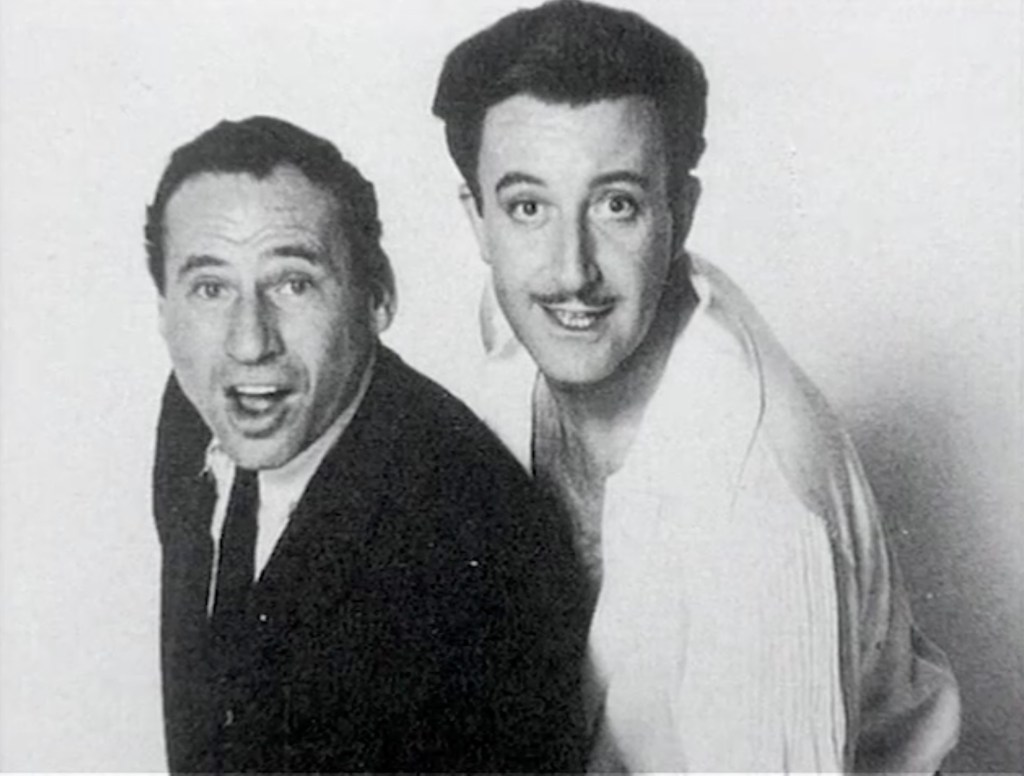
Then something clicked as he recalled meeting Sellers and handing him a script. It was called Springtime for Hitler, the original title of The Producers. Brooks was a successful comedy writer then but not yet a director. He wanted Sellers to play Bloom and he remembers Sellers dragging him shopping while he tried to pitch the script. But Sellers was more interested getting Brooks’s opinion on clothes, jewellery and gadgets. Did Sellers ever read this small black comedy by this first-time director? Brooks thinks not, as Sellers was a huge star with a crazy schedule. That year alone he completed The Pink Panther, A Shot in The Dark, Dr Strangelove and The World of Henry Orient. One wonders when he finally saw the film in 1967 whether he remembered being offered it? If he did, it would explain a lot about his reaction.
On my last day in LA, I went back to the garage and was able finally to listen to the mystery tape. It seemed to have been recorded in England, on Sellers’s own equipment. It featured Sellers and Brooks fooling around, first as two Americans, then Sellers as himself interviews Brooks in Brooks’s popular guise as the 2,000-Year-Old Man – a character that could have come from The Goon Show.
There is an appropriate comic tragedy to Sellers being obsessed by a film that it turns out he could have starred in, made by a man whose work, as the audio tape shows, he was already a fan of but who had forgotten that they met. Sellers was always looking for ways of translating The Goon Show’s essence to the big screen. He’d ruined several films and driven certain directors to the edge of madness in pursuit of it. Now here was a film that seems to have captured it all, and to see it gloriously completed at a point when his own career and private life were in crisis must have been deeply frustrating. Yet rather than trying to ignore it and risk letting it gnaw at him, he became almost its sole industry champion.
Its failure at the box office may almost have suited him, allowing him to continue to evangelise about a forgotten film that the power-that-be had dismissed. He adopted it, then went further. By repeated viewing, by dressing up as one of its characters, by wholesale appropriation of parts of the script into his patter, he managed retrospectively to ‘star’ in The Producers through a kind of osmosis.
Why do so many Brits hate Jews?
If you’re a Brit who doesn’t hate Jews – a smaller number than you might think – then you may be surprised by a poll published over the weekend by the Campaign Against Antisemitism, to coincide with its protest march through London. The CAA’s YouGov poll found that the number of people who admitted – perhaps a better word is boasted – they hate Jews has doubled since 2021.
The reaction to the Holocaust did not destroy Jew hate. It merely buried it
They didn’t put it like that, of course, but it’s what they meant. Respondents were shown a dozen different statements, as prescribed in the ‘Generalised Antisemitism Scale’, half of which were straightforward examples of “Judeophobic antisemitism” and half “anti-Zionist antisemitism”. Statements such as “Jewish people can be trusted just as much as other British people in business; Jewish people are just as loyal to Britain as other British people; Compared to other groups, Jewish people have too much power in the media; Israel can get away with anything because its supporters control the media; Israel treats the Palestinians like the Nazis treated the Jews.”
A fifth agreed with at least four of the 12 statements. Proper Jew haters, in other words, not just people who occasionally come out with lines like, ‘Some of my best friends are Jews, but..’
That estimable Judeophile Julia Hartley-Brewer responded to the poll with a sentiment that is doubtless shared by many: “Congratulations to the BBC, Sky, Channel 4 and other media who’ve helped stirred up this ancient hatred by deliberately perpetrating the lie that Israel is committing a genocide on Gaza. You know better. Shame on you all.” She’s right, of course.
But she’s also wrong, because in reality the BBC, Sky, Channel 4 and other media haven’t made anyone decide to hate Jews. Rather, what they’ve done though the drip, drip, drip of their reporting is to help remove the stigma against admitting to hating Jews. That difference matters.
The received wisdom is that antisemitism has risen exponentially in the past few years. It certainly has. The figures show it is now higher than at any point since the Community Security Trust first started recording antisemitic incidents four decades ago, a trend of rising incidents that started during the years of Jeremy Corbyn’s leadership of the Labour Party.
But to understand the real meaning of any graph, what matters is when you start plotting it – what the index you are measuring covers.
If you plot a graph from, say, 2010 to today, you see a startling rise. But that tells us only one story – that things are bad today, as if what we are now experiencing is some sort of aberration. To grasp the deeper meaning of today’s level of antisemitism and its context, however, it needs to be placed in a longer index going back to 1945.
Do that and you see not just the sudden spike in recent years, but that the real aberration was the decades after 1945 when levels were so low. The unique circumstances of the decades after the Holocaust made expressions of antisemitism socially unacceptable. But we are now discovering something which should have been obvious: the reaction to the Holocaust did not destroy Jew hate. It merely buried it.
It is deeply ahistorical to have considered, as we tended to do until relatively recently, that we had somehow passed beyond antisemitism. It is not called the longest hatred for nothing. What is happening now is that we are now reverting to the mean, when Jew hate is openly expressed. It is a fact of history that a lot of people hate Jews – and act on that hate.
Here in the UK we are relatively fortunate that, so far, we have not had significant outbreaks of violent attacks on Jews. That is not so elsewhere. In France, Australia, Canada and the United States, for example, openly antisemitic attacks are becoming ever more frequent. I do not expect us to be outliers for much longer, especially given the ferocity of the verbal attacks seen on the regular hate marches, as they were accurately labelled by the former Home Secretary, Suella Braverman. As Jews have learned over 2,000 years, words have consequences.
One of the most disturbing but historically unsurprising findings of the poll is that Jew hate is significantly worse among the young: 42 per cent of 18-24 year olds believe that Israel can “get away with anything” because its supporters “control the media”; 58 per cent of young people believe that Israel and its supporters are a bad influence on our democracy; 19 per cent of young people believe that the Hamas attack on Israel on 7 October 2023 was justified. Antisemitism is a virus that not only spreads its net widely, it deepens itself when it is caught. I am sorry to be the voice of doom, but today’s rising antisemitism is nothing new. It is not even the new norm. It is the old norm, returning.
It’s easier than ever to get into university
In the next couple of weeks, hundreds of thousands of young people will be heading off to university. They’ll be bracing themselves for the wholesale regret that freshers’ week will undoubtedly precipitate, and possibly contemplating attending a lecture or two.
But among their number there will be some who got nothing like the requisite grades advertised on university websites, because clearing has radically changed the application landscape. Clearing shares certain features with the Grand National: tensions run high and chaos reigns as the starting gun sounds, and competitors jostle for position; a frenzied race ensues, and invariably there are a few casualties along the way. But increasingly, these casualties are few and far between, as clearing seems to mop up pretty much any leftover students, often with surprising placements.
For anyone unfamiliar with clearing, it’s the process whereby universities and other further education providers fill any places they have remaining before the courses begin. It opens officially in early July, but this is really only relevant for students who already have their results (such as those who took the International Baccalaureate), or who for whatever reason didn’t submit an application by the deadline at the end of January. The real clearing scramble kicks off at 8 a.m. on that fateful Thursday in mid-August when A-level students discover whether they’ve achieved the grades they need to meet their offers for classics at the University of Cambridge or football business at the University of Bedfordshire.
Until relatively recently, the academic opportunities afforded by clearing were distinctly limited, and students would really need to compromise often quite radically on their course or university, and often both. But the academic landscape has been changing. Universities are confronting increasing student numbers and serious financial challenges. The proportion of 18-year-olds going to university has essentially tripled in the past 50 years, and grown by nearly a million this century alone.
Cash flow is problematic for various reasons. There has been a sustained erosion in tuition fees as the cap has meant these have failed to keep pace with the costs of education. So the money universities get for each student is worth less year on year. Alongside this development, the lucrative international student market seems to be contracting a little. These students are particularly attractive to British universities as they pay up to four times the amount British students do. EU student numbers have been falling since Brexit, and 2023/24 saw an overall decline in the number of international students studying at British universities.
So these universities are pretty keen to get bums on seats. While some are still not in clearing (essentially, Oxbridge, Imperial, St Andrews and the LSE), most Russell Group universities are, and they increasingly have a significant number of places available across a broad range of courses. In 2023, there were 3,500 courses available at Russell Group universities – a year-on-year increase of just over 25 per cent. And there is even more choice for foreign students. Last year it was reported that Russell Group universities had 4,504 courses available to foreign students, compared with 3,883 for British students.
This year, places were available at King’s College London, Durham University, and the universities of Manchester, Leeds, Nottingham, Exeter and Bristol. And while aspirant medicine, law and dentistry students will find their options in clearing very limited indeed, there was a startling number of vacancies for subjects which would normally require top grades.
So clearing has become more than just a safety net for students who fail to make their grades. It has become an opportunity for students to switch courses or find a place at a more prestigious university than the one which had made them an offer through their original Ucas application. Indeed, these two categories accounted for a third of clearing users in 2024. This would seem to be an extremely positive development, allowing students the flexibility to change their minds and to stretch themselves academically.
But questions remain as to the academic competence of some of the students being placed through clearing at top universities. Over the past couple of years, I have seen some extraordinary placements, including many which make a mockery of the A-level exam system, as well as the Ucas university application process.
Students have swiftly worked out how to play clearing to their own advantage
One student I know is off to read history and politics at a Russell Group university which sits comfortably within the top 20 of the Times league table for 2025; he was asked for AAA and he got AAC. Another exchanged a place at a ‘plate-glass’ university where she had a place to read a social science degree with a BBB offer; she got BCD and not only did the original university agree to take her, but she actually traded up for a place at a top 30 Russell Group institution.
Students have swiftly worked out how to play clearing to their own advantage – and more power to them. The current cohort still bear the emotional and educational scars of Covid, so I am delighted that they are able to leverage the system in their own favour. One of the ways they can try to ensure a place at one of the more desirable universities is to sign up to a combined honours vacancy in clearing. One boy is off to a hugely popular Russell Group university to study economics. He was originally asked for AAA, got BBC, and was rejected. But he then spotted a vacancy in clearing for the same university’s combined honours degree which means he’ll combine economics with one other subject of his choosing from a list of over 20.
Modern foreign languages (MFL) often seem to be an easy route into a top university in clearing – possibly because fewer than 3 per cent of A-levels taken last year were in an MFL, and now more students take PE than take French, German, Latin and Greek combined. This year, a student found a place to read Spanish at a Russell Group university with a C in Spanish. The university in question would normally require ABB.
Another student had set his heart on studying at one of the University of London’s most sought-after component colleges. The degree he applied for usually requires A*AA, and he ended up with ABC. Yet he was accepted if he agreed to combine it with an MFL; he hadn’t taken languages at A-level and his result in his GCSE MFL was hardly indicative of any real linguistic competence.
Then there’s the student who had long dreamed of studying politics at a particularly popular Russell Group university. Having underperformed the first time, and got BCD, she re-took and was predicted AAA, and was duly offered a place at this particular university. She got the same overall grades but this time got a B in the subject in which she’d got a C previously. Using a combination of her original grades which meant she had BBC, the university agreed to take her to study politics if she agreed to combine it with any MFL.
Another compromise can be to sign up for a foundation year. This means that a degree will take an extra year, but upon successful completion of the foundation course, students automatically progress to the degree. A neurodiverse student I know is going to a University of London college to study computer science with UUU this autumn, and another student will read pharmacy at a Russell Group university with two pass grades.
We don’t yet know how these students will fare at university, and whether this relaxing of entry requirements for clearing applications will be sustainable. Universities will find themselves plummeting down the league tables if their graduates emerge with poor degrees and lacklustre employment prospects. AI will transform the job market for all but the most successful graduates from the very top universities, and a good many of the students who get lucky in clearing may simply be postponing disappointment.
As Trump wooed Kim Jong-un, he secretly unleashed Navy SEALs
Think of the first Trump administration’s North Korea policy, and the bright lights, photo ops and eventual lack of deals in Singapore and Hanoi come to mind. The first two years of Trump 1.0 saw the then-new US president fluctuate between threatening “fire and fury” on the hermit kingdom to calling Kim Jong-un a “great leader”. Yet, the recent and as-of-yet unconfirmed revelations of an abortive US mission in early 2019 – wherein US Navy SEALs sought to intercept communications of Kim Jong-un – may seem to contradict the unusual bromance between Trump and Kim at the time. But in fact, they only emphasize Trump’s desperation for a deal with North Korea at the time.
Neither Washington nor Pyongyang has ever commented on the elaborate operation, allegedly approved by Trump, which seems closer to a James Bond movie than reality. Navy SEAL Team 6 was given the task of sneaking into waters off North Korea on a nuclear-powered submarine, after which a small team of SEALs would be dispatched in smaller submarines near the shore. They would then swim to shore, plant the listening device and return unseen having evaded the gaze of North Korean surveillance. Yet as with all military operations, things are easier said than done. As the special operations forces made their way to shore, North Korean fishermen in a trawler, allegedly fishing for shellfish in the area, moved towards the stationed submarines. The SEALs – by then on land – shot all two or three North Korean civilians and abandoned their mission.
Questions abound as to whether North Korea knew about the incident and how Pyongyang might have reacted at a time when Trump and Kim were exchanging frequent “love letters” after their first summit in Singapore on June 12, 2018. Kim Jong-un wanted benefits from the United States, including the removal of sanctions but also status and legitimacy, all the while he continued to expand his nuclear and missile programs. With a second summit with Trump set for February 2019, any North Korean escalation in brinkmanship in response to the incident could have led to the cancellation of talks at the bare minimum. After all, North Korea had already witnessed Trump’s volatility when, in May 2018, he abruptly cancelled – before re-instating – the Singapore Summit.
The period from 2018 to 2019 marked a bizarre juncture in US-North Korean ties. After his election in November 2016, not even North Korea knew what to expect from the man who, in his pre-election campaign, offered to “eat a hamburger over a conference table” with Kim Jong-un. But Pyongyang was glad to see the end of the Obama administration, whose policy of “strategic patience” – waiting for North Korea to take the first step towards denuclearization before offering the North any concessions – had brought Pyongyang few benefits bar the time to develop its nuclear and missile technology.
As US-North Korean summitry gained momentum, the war of words that characterized relations between Trump and Kim after Trump took office in January 2017 would undergo a hiatus, but not after North Korea launched its first intercontinental ballistic missile on 4 July and, on September 3, conducted its sixth nuclear test, which the North Koreans would deem to be a hydrogen bomb. Had the Navy SEALs’ operation succeeded in early 2019, then Washington would certainly have gained information about how the secretive North Korean regime thinks and works, which would have been in line with Trump’s simultaneous ambitions to engage in dialog with Kim Jong-un whilst also transform North Korea in the longer term. Who can forget when, at the first summit between Kim and Trump in Singapore on June 12, 018, Trump showed Kim Jong-un a video of how a non-nuclear North Korea could become a site of prime real estate with “investment from around the world”?
For all his idiosyncrasies, the Kim regime saw in Trump an opportunity to continue its then-byungjin policy of parallel nuclear and economic development and gain recognition of North Korea as a de facto nuclear state, the latter which has going grown stronger to this day. Soon after the failed Navy SEAL mission, the much-anticipated second summit between Trump and Kim in Hanoi, from February 27-28, 2019, would take place, and be anything but a success, particularly for Kim Jong-un. Kim’s desire for sanctions relief in exchange for the Yongbyon Nuclear Facility was rightly refused, and expectedly, Washington and Pyongyang could not agree on how to define North Korea’s denuclearization.
As more details of the 2019 mission look to emerge, could Trump 2.0 engage in a similar operation? Kim Jong-un is now hardly a novelty for Trump, with the two leaders having met three times across 2018 and 2019. What is more, the costs of any such operations have only heightened. North Korea in 2025 is not the same as in 2019. As Pyongyang seeks to ensure it benefits from its relations with its authoritarian comrades of Beijing and Moscow, Trump has already targeted Vladimir Putin, Xi Jinping and Kim Jong Un for “conspir[ing] against the United States of America”. And with Washington focused primarily on deterring China, gaining information on North Korea from the Supreme Leader himself – whilst valuable – may not be a priority.
Is Jacinda Ardern hiding from Covid scrutiny?
During the five years Jacinda Ardern led New Zealand, much was made of her ‘transparent’ style of touchy-feely leadership and willingness to deal with thorny questions. Yet on the biggest issue of her record – her zero Covid policies – the former Prime Minister has gone missing.
A planned week-long public hearing at an inquiry in New Zealand into the nation’s Covid response was abandoned last month, after Jacinda Ardern and other senior figures from her government unexpectedly refused to testify.
Ardern’s no-show came as a surprise to many, including the country’s prime minister, Christopher Luxon, who said his predecessor’s decision was ‘not right’.
Summarising her decision not to speak publicly about her handling of the pandemic, the commission said Ardern and her former allies – her health minister, Ayesha Verrall, the minister in charge of the Covid response, Chris Hipkins, and her high-spending finance minister Grant Robertson – believed that the exercise would merely be ‘performative’ rather than ‘informative’.
The erstwhile ministers had also been concerned that the livestreaming or publication of their evidence could become fodder for epic online trolling.
A spokesman for Ardern said she had already provided ‘extensive evidence, including a recent interview that lasted three hours’ for the commission, which is currently in its second phase of evaluating the country’s response to Covid – homing in on the later period when much of the gloss came off the Ardern juggernaut.
A touch wearily, Hipkins, who has led Labour since Ardern stepped down in early 2023, said he had already spent years talking about the subject.
As Ardern’s minister in charge of the Covid response, Hipkins oversaw the implementation of a raft of policies that saw cities locked down for months at a time, all but the luckiest expatriate Kiwis denied entry back into their country and, most controversially, Ardern’s ‘no jab, no job’ policy for public servants in education and health who refused the vaccines.
The last measure led to a month-long occupation outside parliament that ended with running street battles between police and hundreds of protesters.
In the wake of the chaos, the telegenic leader’s hitherto unassailable poll numbers began to crash, and within a year she decided to call it a political day – even as her reputation abroad remained as high as ever in social democratic circles.
Her latest decision to stay mum about the central event of her life seems awkwardly timed. With political life now behind her, Ardern has been promoting a bestselling new book about the ‘different’ kind of leadership she brought to world politics.
Billed as an ‘inspiring story of how a Mormon girl plagued by self-doubt changed our assumptions of what a leader can be’, Ardern’s new work has also been criticised in Britain as a 350-page transcript of a less-than-enthralling therapy session.
Surprisingly little space is devoted in the book to lingering questions over her handling of the pandemic. The period is mainly recounted in the context of a factual retelling of landmark moments without much reflection on the kinds of pratfalls that almost certainly would have been raised at any public hearing in New Zealand.
It could be that she has simply moved on to brighter things. Since leaving politics, Ardern has nabbed a number of plum stateside academic roles, including dual fellowships at Harvard Kennedy School – the university’s school of public policy and government – and a recent commencement speech at Yale.
This year she became a visiting fellow at Oxford University’s Blavatnik School of Government, where she offers what the school describes as her insights into ‘leadership in times of crisis, commitment to public service, and deep understanding of governance’. Presumably not to be repeated beyond closed doors.
Starmer’s reshuffle has Morgan McSweeney’s fingerprints all over it
After 48 hours, the final appointments have been made to complete the government’s reshuffle. A raft of rising stars from the 2024 intake like Josh McAlister, Josh Simons and Kate Dearden have all been handed junior ministerial posts. Kanishka Narayan, a tech enthusiast and Labour’s only Old Etonian, has gone to the Department for Science. Blair McDougall, who ran the Better Together campaign in 2014, is now in Business and Trade. These have been balanced with appointments for more long-serving colleagues too. Chris Elmore joins Yvette Cooper in the new-look Foreign Office team, while Anna McMorrin has replaced Nia Griffith in the Welsh Office.
It is instructive to look at which departments have had the most ministerial change. As my colleague Lucy Dunn observed yesterday, the Home Office team has been completely replaced. At Education, there are now three new faces: McAlister, Olivia Bailey and Georgia Gould. Bridget Phillipson retains her post as Secretary of State but the shake-up suggests that Starmer hopes to get more out of a department that has recently featured in numerous bad headlines. The Cabinet Office has been overhauled too. Simons will work with fellow new MPs Satvir Kaur and Chris Ward to build the new delivery command centre under Darren Jones there. Clearly, this is a major No. 10 priority.
What to make of the reshuffle overall? At the top, there has been something of a game of musical chairs. Only three ministers actually left the cabinet: Ian Murray, Lucy Powell and Angela Rayner. The survivors largely swapped jobs, prompting the Times‘ Chris Smyth to dub it the ‘Morecambe and Wise reshuffle’: all the right people, just not in the right order. Yet while Starmer declined to enact a Macmillan-esque ‘Night of the Long Knives’, he has clearly decided to double down on his existing political strategy. Within Labour, there is a cleavage of opinion. Some on the so-called ‘soft left’ want Starmer to talk less about migration, believing that a progressive, pro-worker agenda will shift attention onto more favourable Labour-coded issues like the NHS.
Labour’s fiscal straightjacket looks set to remain tightly-closed
Starmer appears to have ignored these voices. Rayner and Jonny Reynolds – perhaps the two closest figures in government to the trade unions – no longer hold departmental briefs. Peter Kyle, an arch moderniser on the right of the party, has now taken over at Business and Trade. It represents a potential shift in the centre of gravity of this government. One source suggests it will be ‘devastating for the employment rights’ agenda.’ With Rachel Reeves still at the Treasury and James Murray promoted to be Chief Secretary, Labour’s fiscal straightjacket looks set to remain tightly-closed. The trade unions will need to find new champions at the top of the party too.
The reshuffle would appear to confirm the power of Morgan McSweeney, Keir Starmer’s chief of staff. The two men drew up the reshuffle together from Starmer’s Downing Street study on Friday, enacting it over the next 48 hours with ruthless precision. McSweeney’s brand of politics are shared by key members of the new-look cabinet. Steve Reed, a close friend, gets Rayner’s brief at Housing and Local Government. Shabana Mahmood at the Home Office and Pat McFadden at Work and Pensions are both respected allies. In the lower ranks, McSweeney worked with Ward in Opposition; Simons succeeded him as Director of the Labour Together think tank. Imogen Walker, McSweeney’s wife, is among a raft of new appointments to the Whips’ Office too.
But with every winner, comes an inevitable loser. Discarded Labour veterans are piling up on the backbenches. It has been a bad week to be a Greater Manchester MP – Powell and Rayner are out from the cabinet while Jeff Smith and Mike Cabinet are leaving the Whips’ Office too. One estimate suggests that at least eight North West MPs are victims of this week’s reshuffle, potentially storing up regional trouble in the future. Others leaving government are Griffith, Kerry McCarthy, Gareth Thomas, Fleur Anderson and Justin Madders. All five were reasonably competent and bore the scars of Labour’s long march back from the electoral low point of 2019.
One factor in Boris Johnson’s fall was the number of older MPs of the 2010 and 2015 intake who feared that their time had passed. It was striking that at least ten of the welfare rebels this summer were former shadow ministers passed over for office in July 2024. The danger for Starmer is that the discontent of the dispossessed festers into open rebellion if the new arrivals cannot start delivering quickly.
Starmer clears out Home Office in reshuffle
On Friday, former Deputy Prime Minister and housing minister Angela Rayner resigned after an ethics probe into her tax affairs was published. The move prompted Prime Minister Keir Starmer to begin a mass reshuffle of his government, with his new cabinet appointments here. Starmer’s timing made it a rather coincidental coup, with the news overshadowing the first day of Nigel Farage’s Reform UK conference in Birmingham. And if Farage thought day two of his conference would pass uninterrupted, he was mistaken. Today the PM is reshuffling his junior ministers and the first set of appointments have just been published.
The most significant changes are in the Home Office which is experiencing something of a clear out – with immigration minister Dame Angela Eagle and policing minister Rt Hon Diana Johnson moved to DEFRA and DWP respectively. Scottish Labour’s Michael Shanks has been promoted to become a minister in the Department for Business and Trade on top of his current role as minister in the Energy Department. Shanks has had something of a meteoric rise after winning the Rutherglen by-election in 2023 – becoming shadow Scotland minister ahead of the general election before being made energy minister last July. And businessman Jason Stockwood – who lost the mayoral race for Greater Lincolnshire to Reform’s Andrea Jenkyns earlier this year – will be made a life peer and become a minister in both the Department for Business and Trade and the Treasury.
The reshuffle remains ongoing, and there are a number of the 2024 intake hopeful they will get promoted into government. There are expectations that some of the new Starmerites – many of whom have worked in the Morgan McSweeney-founded Labour Together – may get government roles. Former Labour Together director Josh Simons is now Cabinet Office minister, providing maternity cover. As more names get announced, Starmer gets closer to his headcount limit (as there is a maximum number of ministers he can have on the payroll) and the end of the reshuffle.
The full list is here:
- Jason Stockwood is minister for investment jointly in the Department for Business and Trade and the Treasury. He will also be made a peer.
- Dan Jarvis is a Cabinet Office minister, and remains a Home Office minister.
- Baroness Smith of Malvern is skills minister in the Department for Work and Pensions, and remains minister for skills and minister for women and equalities in the Department for Education.
- Lord Vallance is energy minister, and remains science minister.
- Michael Shanks is minister in both the Department for Business and Trade and Department for Energy Security and Net Zero.
- Alison McGovern is housing minister.
- Dame Angela Eagle is rural affairs minister.
- Rt Hon Dame Diana Johnson is work and pensions minister.
- Sarah Jones is Home Office minister.
- Anna Turley is minister without portfolio in the Cabinet Office, and will attend Cabinet.
- Alex Norris is Home Office minister.
- Sir Chris Bryant is business and trade minister.
- Luke Pollard is defence minister.
- Georgia Gould is education minister.
- Rt Hon Ellie Reeves is Solicitor General.
- Lucy Rigby is economic secretary to the treasury.
- Ian Murray is minister in both the Department for Culture, Media and Sport and the Department for Science, Innovation and Technology.
- Chris Ward is Cabinet Office minister.
- Seema Malhotra is foreign office minister.
- Mike Tapp is Home Office minister.
- Louise Jones is defence minister.
- Baroness Levitt KC is justice minister.
- Miatta Fahnbulleh is housing minister.
- Samantha Dixon is housing minister.
- Dr Zubir Ahmed is health minister.
- Chris Elmore is foreign office minister.
- Satvir Kaur is Cabinet Office minister.
- Josh Simons is Cabinet Office minister.
- Josh McAlister OBE is education minister.
- Olivia Bailey is education minister.
- Blair McDougall is business and trade minister.
- Kate Dearden is business and trade minister.
- Kanishka Narayan is science minister.
- Anna McMorrin is Wales minister.
- Matthew Patrick is Northern Ireland minister.
- Katie White is energy minister.
Baroness Gustafsson CBE, Jim McMahon MP, Daniel Zeichner, Maria Eagle, Catherine McKinnell, Abena Oppong-Asare, Catherine West, Lord Ponsonby of Shulbrede, Lord Khan of Burnley, Janet Daby, Baroness Jones of Whitchurch, Justin Madders, Gareth Thomas, Feryal Clark, Fleur Anderson and Dame Mia Griffith have left the government.
More to follow…
Will Emily Thornberry be Starmer’s new deputy?
It is a plot line worthy of a Sopranos episode. A newly-elected Prime Minister, flushed with electoral success, triumphantly sacks his onetime rival – only to discover, a year later, that she is now in pole position to become his new deputy. That’s right folks, Emily Thornberry – the gin-loving, flag-bashing Islington Dame – has returned to haunt Keir Starmer once more. Trebles all round!
With Angela Rayner gone, the question of who succeeds her as deputy leader is exercising much of the Labour party. Early opinion is that it has to be a woman and preferably one who can provide a bit of a foil to Starmer. Luckily, there is no shortage of disgruntled, displaced and dissatisfied wimmin who fit the bill. Louise Haigh and Lucy Powell are two names being floated by Andy Burnham, the ever-unhelpful Mayor of Manchester: both of course were sacked by Starmer.
But there can surely be no more delicious potential candidacy than that of Emily Thornberry. She was the only re-elected member of the shadow cabinet who did not make the transition into government on 4 July 2024. Instead, Starmer opted to ditch her, preferring to ennoble his old mate Richard Hermer. To quote Tyler Durden of Fight Club, ‘How’s that working out for ya?’
Speaking on Laura Kuenssberg this morning, Thornberry played the part of a helpful-but-wounded Labour supporter to perfection. In her lyrical tones, she praised the ‘fantastic’ work of her colleagues in government but noted, alas, that ‘nobody seems to be hearing about that.’ ‘Why are we making these mistakes?’ she mused aloud. One might wonder indeed, Emily.
Asked by Kuenssberg directly if she would stand, Thornberry replied:
I’m thinking about it and it’s really a question of what can I bring to this. I hear what is said about the deputy leader should come from Manchester, and I’m sure that the mayor of Manchester would say that, I’m sure that people would say that they should come from Wales or Scotland. What’s important is what you bring. Do you have the strength, do you have the experience, can you actually make a difference?
Cometh the hour, cometh the Thornberry. Mr S waits with relish for the contest to kick off properly…