-
AAPL
213.43 (+0.29%)
-
BARC-LN
1205.7 (-1.46%)
-
NKE
94.05 (+0.39%)
-
CVX
152.67 (-1.00%)
-
CRM
230.27 (-2.34%)
-
INTC
30.5 (-0.87%)
-
DIS
100.16 (-0.67%)
-
DOW
55.79 (-0.82%)
Moldova has been saved from Russian influence, but at what cost?
The European Union, guardian and champion of democracy, rightly takes a dim view when ruling parties ban their opponents, refuse to open polling stations in areas likely to vote against them, censor opposition news channels and allow a large staff of foreign election monitors to police social media in the run-up. If Serbia, say, or Georgia tried systematic election rigging of this kind, Brussels would be the first to call foul and disregard the result as illegitimate. But when it’s the EU that’s running the interference, as in Moldova this week, the rules are apparently quite different.
This week the pro-EU party of Maia Sandu, Moldova’s President and a former World Bank official, won a slim majority in a general election. Her main opponent was Igor Dodon, who led a coalition of pro-Russian parties which were heavily backed by the Kremlin (lest anyone doubt their ideological bent, the opposition’s election symbol was a hammer and sickle inside a heart inside a Soviet five-pointed star). The race was seen as a showdown between Europe and Moscow over control of a poor but strategically important ex-Soviet state – a category that also includes Georgia and Ukraine.
‘Not only did you save democracy and kept the European course, but you have also stopped Russia in its attempts to take control over the whole region,’ the Polish Prime Minister Donald Tusk wrote in his public congratulations to Sandu. ‘Moldova, no attempt to sow fear or division could break your resolve,’ wrote the European Commission president Ursula von der Leyen. ‘You made your choice clear: Europe. Democracy. Freedom. Our door is open. And we will stand with you every step of the way.’
There is little doubt that Moscow opened its wallet wide – as well as its usual bag of electoral dirty tricks – in its attempt to influence Moldova’s elections. Telegram, a news and messaging app, openly hosted channels offering cash for votes. There were well-documented stories of Orthodox priests receiving bribes in order to influence their flocks. Several main opposition parties were not just pro-Moscow but provably funded by Moscow too. Pro-government Moldovan media estimate – without much proof – that the Kremlin dropped some $400 million, or 1.5 per cent of Moldova’s GDP, on its failed influence operation.
To counter the Kremlin’s campaign, the EU deployed what the foreign policy commissioner Kaja Kallas described as ‘a specialist team on the ground [to help] Moldova address illicit financing around the elections’ as well as ‘a group of experts, a hybrid rapid response team, to support Moldova against the foreign interference’. Among the tasks of the EU’s team of electoral experts was to monitor online news and social media, and to use Europe’s investigative firepower to track campaign finance violations in the form of Russian money. The European Commission also dangled an irresistible €1.8 billion support package to underpin Moldova’s economic growth plan on its path to the EU.
According to Telegram’s founder, the Russian billionaire Pavel Durov, Europe had some dirty tricks of its own to play. The day of the election, Durov announced that France’s secret services had approached him last year with a covert deal while he was detained in Paris on charges of failing to police criminal activity on Telegram. According to Durov, French spooks ‘reached out to… ask me to help the Moldovan government censor certain Telegram channels ahead of the presidential elections’. In exchange, the security services allegedly offered to help Durov with his legal problems – apparently a crude good cop, bad cop shakedown.
At first, Durov claims, Telegram ‘identified a few [channels] that clearly violated our rules and we removed them’. But when a second list was produced that for the most part included channels that were ‘legitimate and fully compliant with our rules’ but were simply critical of the Moldovan government, Durov refused to comply. ‘Telegram is committed to freedom of speech and will not remove content for political reasons,’ he wrote. ‘I will continue to expose every attempt to pressure Telegram into censoring our platform.’ France’s security services have not commented.
The question remains whether Maia Sandu’s victory makes Europe look strong or weak
Just two days before the vote, Moldova’s electoral commission banned two opposition parties – both believed to be funded by Moscow – though their names remained on the ballots, meaning that the votes of anyone who mistakenly voted for them were lost or went to other parties. President Maia Sandu had called for the large numbers of Moldovans working abroad to take an active part in elections. But just two polling stations were set up in Russia to serve the estimated 78,000-150,000 electors who live there vs more than 70 in Italy, home to some 100,000 Moldovans. In the neighbouring Russian-controlled statelet of Transdnistr, which lies between Moldova and Ukraine, several polling stations were moved at the last moment and two of the bridges linking the territory to Moldova were under repair, hindering people’s ability to vote.
Do such measures amount to anti-democratic censorship and electoral interference – or are they legitimate acts of self-defence? The story of Moldova’s elections is reminiscent of Cold War Europe, when Moscow poured cash and resources into Euro-communist parties while Washington bankrolled right-wing parties such as Italy’s Christian Democrats – explaining why many Europeans are still so prone to political conspiracy theories and to seeing the secret hand of America everywhere. Moscow, for its part, has long maintained that democracy movements in the former Soviet Union, from Kyiv to Tbilisi, Minsk to Bishkek, have all been orchestrated, financed and directed by the West as a covert means of extending power through the former Soviet Empire.
On balance it’s probably Europe, with its huge trading bloc, track record of fighting corruption in its newest member states and deep (at least by Moldovan standards) pockets that offers a brighter future for the country than Russia. Today’s Kremlin, unlike its Soviet predecessor, offers no inspiring ideological vision and can’t spare much cash to fund its overseas clients. But at the same time Russia remains a major trading partner of Moldova, and many citizens feel close cultural ties to Moscow. Forcing Russia’s neighbours to make a binary decision between East and West has proved not just divisive but has also, in the case of Ukraine and Georgia, led to bloodshed. In Georgia, recent elections have rejected former president Mikheil Saakashvili’s radical pro-EU, pro-Nato course in favour of friendship with Russia – with the result that Georgia’s economy grew a staggering 9.4 per cent last year.
Many Europeans are congratulating not just Moldova but themselves on saving the country from Russian influence. But the question remains whether Sandu’s victory makes Europe look strong or weak. On the one hand, Brussels won. On the other, just as with Boris Yeltsin’s gerrymandered election victory in 1996, democracy had to be strangled in order to save it.

Event
Americano Live: Is America Great Again?
What are the risks of first cousins having children?
Park life
Locals were angered by the closing off of 1,500 acres of Windsor Great Park to create a secure area around Forest Lodge, the new home of the Prince and Princess of Wales. Medieval residents of Berkshire would have been in sympathy, as William I had the entire park closed off to the public under his Forest Laws. Large parts of the park were eventually opened to the public by William IV in the 1830s, though it wasn’t good enough for some. In 1972 anti-monarchists set up what they called the People’s Free Festival trying to reclaim the park for the public, claiming it had been illegally enclosed by George III. The festival was repeated for the following two years before being broken up by the police. The following year the government offered a nearby airfield for the event instead.
Idle hands
Rachel Reeves says she wants to ‘abolish long-term youth unemployment’. How many young people are not in employment, education or training (Neet)?
– In the second quarter of this year there were 948,000 young people classified as Neet, up from 923,000 in the first quarter.
– The former figure amounted to 12.8% of 16- to 24-year-olds.
– Prior to the pandemic, more women than men were Neet, but this has now turned around, with 13.1% of males and 12.4% of females Neet.
– Over the past decade the highest proportion of Neets was in the fourth quarter of 2024, when 13.2% of 16- to 24-year-olds were Neet.
– The lowest was between April and June 2021, when it was 9.7%.
Kissing cousins
The NHS was attacked for publishing guidance which claimed that first cousin marriages can promote ‘stronger extended family support systems and economic advantages’. What are the risks of first cousins conceiving children?
– A 2013 study involving 13,776 pregnancies in Bradford found that the risk of congenital abnormalities was 6.1% in the case of first cousins conceiving children together and 2.4% in the case of non-consanguineous conceptions.
– A Norwegian study of children born between 1967 and 1995 found that birth defects were 36 per 1,000 in the case of first cousin matings and 15 per 1,000 in the case of non-consanguineous ones.
– A study of 131,760 children in north-eastern France found that 1.08% of cases of congenital abnormalities involved consanguineous conceptions. The latter made up 0.28% of all births.
Transgenderism proves people will believe anything
For years, the World Professional Association for Transgender Health (WPATH) has wrapped itself in a guise of medical expertise, advising doctors, schools and corporations in America about how best to treat the hundreds of thousands of people who have mysteriously become confused about which sex they are (personally, I’d recommend a quick dart to the loo to pull down their pants). In truth, WPATH is an advocacy organisation whose storm troopers comprise manic men in dresses who hate women but also think they are women. Get your head round that.
Last year, a trove of intra-organisational emails exposed the recklessness of its indiscriminate promotion of ‘gender-affirming care’ (neither affirmative nor care) for ostensibly transgender minors. These susceptible children suffer disproportionately from other mental health problems and do not, as WPATH members freely admitted among themselves, possess the competence to give informed consent to life-altering medical treatments. The ignominious emails were published and analysed in a report entitled ‘The WPATH Files’, written by Mia Hughes and widely publicised by the distinguished American journalist Michael Schellenberger.
WPATH stages big, rowdy annual conferences celebrating self-poisoning and genital mutilation all around the world. In recent years, a doughty counter-organisation called Genspect has staged conferences in the same city as WPATH’s, but to call attention to the copious harms that the last 15 years of cultural intoxication with transgenderism have wrought among families, children and adults who’ve fallen under the sway of gender ideology, and ‘detransitioners’ who’ve woken up to the reality that changing sex is neither possible nor desirable but who are often left permanently mangled and emotionally scarred. Last weekend in Albuquerque, New Mexico, I was one of Genspect’s speakers. Of necessity, security precautions were ferocious.
After two days of presentations by young people brutalised by this generational fetish, physicians horrified by its medical consequences, therapists appalled by the complicity of their colleagues and journalists decrying the purposeful bewilderment of schoolchildren, it’s a tough call whether the cumulative effect was depressing or encouraging. Obviously, this ludicrous fashion for pretending to change sex having ever taken such hold is depressing; as fads go, this one is far more destructive than the crazes for pet rocks or razor scooters. Yet the hundreds of determinedly dissenting attendees, including many desolate parents who had lost children to the trans cult, and the dozens of professionals who are risking their reputations to resist the capitulation to gender ideology in their fields, were collectively encouraging.
The audience and presenters both roughly concurred that, slowly and agonisingly, the tide is turning on this vast medical scandal. Especially thanks to a handful of courageous women such as the Brits Helen Joyce, Maya Forstater and J.K. Rowling and American investigative reporter Abigail Shrier, it’s now possible to speak aloud what five years ago would have been career-ending heresies.
As I’m neither a medical expert nor a parent of a trans child, my utility was primarily hortatory. Set in a fictional near past in which the notion has seized the western world that people are all equally intelligent and that discrimination against dumb people is ‘the last great civil rights fight’, my most recent novel, Mania, aims to illustrate human vulnerability to ideological contagion. Of the social hysterias that have swept the West since about 2012 – #MeToo, Black Lives Matter, Covid lockdowns, climate catastrophism, rabid vituperation against Israel – my ‘Mental Parity Movement’ most resembles the West’s abrupt infatuation with transgenderism.
In a crowd, our species naturally manifests a hive mind
Such as there is one, the lesson the novel imparts is the disheartening truism that people will believe anything. Specifically, most people will believe whatever everyone else appears to believe, if only because everyone else appears to believe it. Fortunately, exceptions abound. Mania’s disgusted protagonist represents the minority: sceptics almost genetically immune to psychic pandemics. Yet in a crowd, our species naturally manifests a hive mind whose irrational or even deranged conceits now buzz through the globe’s fibre-optic cables in seconds.
Thus the thrust of my event last weekend ran: Never relinquish your incredulity. While we sceptics may be constitutionally resistant to deranged popular dogma, we’re still adaptive. We may not believe just anything, but we can get used to anything. So it’s vital to refresh our astonishment at the widespread adoption of a practice that 20 years ago would have been exclusively pursued by a few lost, misguided mental patients.
The fad for transgenderism is unbelievable and should stay that way. This movement gleefully defies biological reality. Sex is not in the mind but is written in our every cell. ‘Some people are born in the wrong body’ is an absurd, medieval fiction. Because it’s impossible to change sex, transgenderism is merely a psychically, socially and financially expensive form of playacting. We’ve allowed a wicked but highly profitable industry to burgeon. Cynical, fanatical or criminally naive, its doctors impede and corrupt adolescents’ natural development into adulthood, butcher and amputate perfectly healthy body parts, destroy erotic function and systematically sterilise young people. Yet for at least a solid decade anyone objecting to this modern-day voodoo has courted infamy, ostracism and unemployment.
A Genspect montage: one mother asked me to write about her son, who detransitioned, was shunned by the trans ‘community’ and took his own life. Self-described as effeminate from childhood, another detransitioner testified on stage to having been duped by doctors who convinced him he’d have an easier time as a gay man if he lived as a woman. His trans medication halted his growth in adolescence. After emerging from this nightmare, the 22-year-old, originally informed that without pharmaceutical intervention he’d likely grow to between 6ft and 6ft 2in, is now permanently stunted at 5ft 8in. An endocrinologist detailed the many dire medical conditions that result from blocking puberty, including significantly reduced intelligence. A surgeon explained how genital cosmetic surgery can cause fistulas that continually leak urine, or bowel injuries through which faeces oozes into the patients’ fake vaginas. All this tragedy is both utterly unnecessary and deliberate. Never relinquish your incredulity.
Emerging prodigy
The boy they call the ‘Messi of Chess’ achieved a milestone result at the ‘Legends and Prodigies’ tournament, held in Madrid last month. Eleven-year-old Faustino Oro, from Argentina, won the tournament with 7.5/9, thereby achieving his first grandmaster-level performance. The requirement is for three such results before the title is awarded. But in Madrid he cleared the bar with room to spare, and becomes the youngest player ever to achieve an international rating above the symbolic 2500 level, approximately grandmaster standard. Since 2021, the youngest player to qualify was Abhimanyu Mishra, at 12 years and four months.
Energetic middlegame play against a young Spanish master set the scene for an elegant finish.
Faustino Oro–Diego Macias Pino
Legends & Prodigies, September 2025
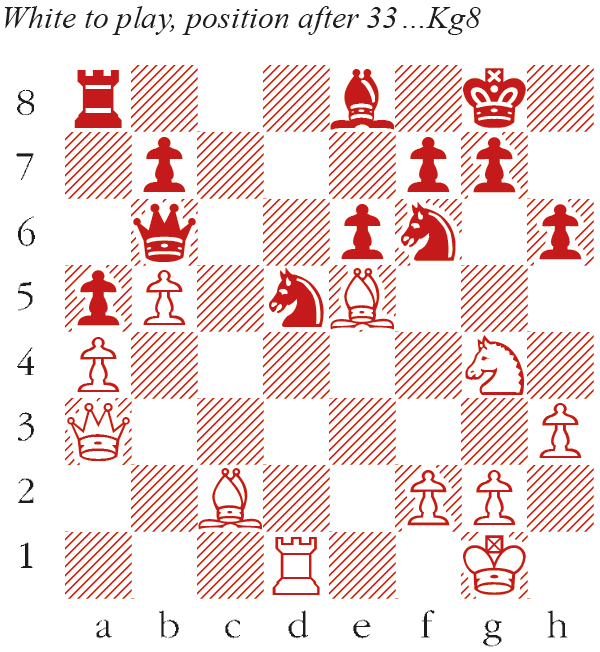
1 e4 c5 2 c3 Nf6 3 e5 Nd5 4 Bc4 Nb6 5 Bb3 d6 6 exd6 e6 7 Nf3 Bxd6 8 O-O Nc6 9 d4 O-O 10 dxc5 Bxc5 11 Qe2 Nd5 12 Rd1 Qb6 13 Bc2 h6 14 a3 Natural, but missing a quirky tactic: 14 b4! wins knight and bishop for rook: Be7 15 b5 Na5 16 Rxd5 exd5 17 Qxe7. Rd8 15 b4 Be7 16 c4 Nf6 17 Rxd8+ Qxd8 18 Bb2 a5 19 b5 Nb8 20 Nbd2 Nbd7 21 Rd1 Qc7 22 Ne4 Kf8 23 c5! A far-sighted pawn sacrifice. Bxc5 Black will miss this dark squared bishop, but 23…Nxc5 was no better, e.g. 24 Be5 Qb6 25 Rd6 is one good option, and then 25…Qa7 26 Nxf6 Bxf6 27 b6 Qa6 28 Qd2 with decisive threats. 24 Nxc5 Qxc5 25 Rc1 Qd6 26 h3 Nd5 27 Qd3 N7f6 28 Ne5 Bd7 29 Rd1 Be8 30 a4! This pawn push, which introduces the threat of Bb2-a3 (since the Nd5 is pinned), also turns out to be useful for the combination which ends the game. Qe7 30…Qc5! was more stubborn, intending counterplay with Nd5-b4. 31 Ng4 Qc7 32 Be5 Qb6 33 Qa3+ Kg8 (see diagram) 34 Nxh6+! gxh6 35 Qg3+ Kf8 If 35…Kh8 36 Rd4 (preparing Rd4-h4) Qc5 37 Rxd5 is the simplest win. 36 Bd6+ Ne7 37 Bxe7+ Black resigns in view of 37…Kxe7 38 Qa3+ with mate to follow.
Two rounds later, Oro showed his sharp tactical eye against an experienced Argentinian grandmaster who now represents Spain. Pichot made a mistake in playing 29…Rc2-a2.
Faustino Oro–Alan Pichot
Legends & Prodigies, September 2025
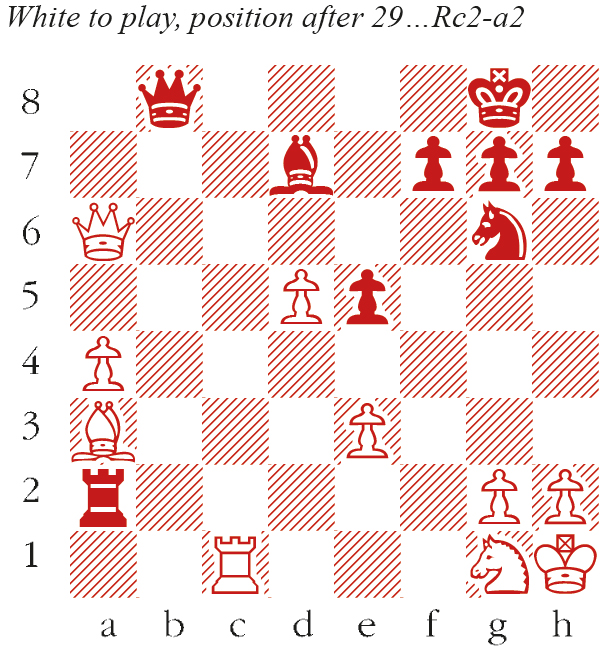
30 Rb1! Qe8 If 30…Qxb1 31 Qa8+ leads to mate along the back rank. 31 Qd6 The direct threat is 32 Qxd7, using the back rank mate idea again. But the queen also supports a future Rb1-b8. Even with time to prepare, Black cannot avoid losing material. Rc2 32 Bc5 h5 33 Rb8 Bc8 34 Qc7 Qxa4 35 Qxc8+ Kh7 36 Qf5 Kh6 37 Be7 A neat finish, threatening mate starting with Qg5+. Or 37… Nxe7 38 Rh8 is also mate, so Black resigns
No. 870
White to play and mate in two moves. Composed by Franz Dittrich, Ceske Listy Sachove, 1897. Email answers to chess@spectator.co.uk by Monday 6 October. There is a prize of a £20 John Lewis voucher for the first correct answer out of a hat. Please include a postal address and allow six weeks for prize delivery.
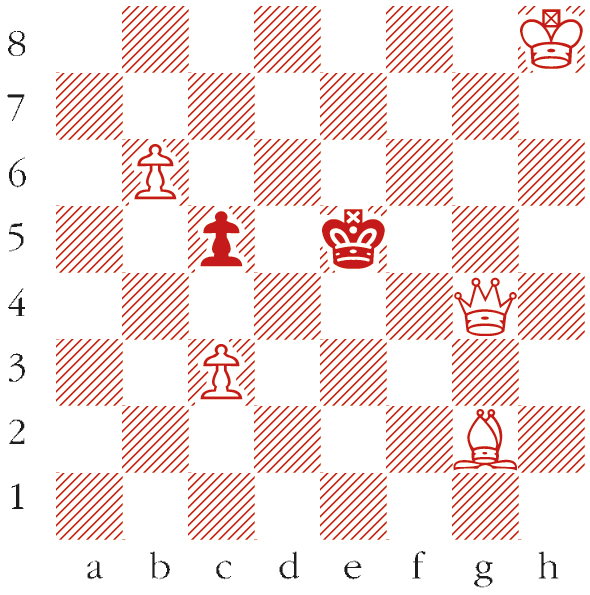
Last week’s solution 1 Qc5! threatens Nh6#, and 1…Bg7 2 Bxg7 wins easily
Last week’s winner Jeremy Forgan, Middlesbrough
Spectator Competition: what day is it?
For Comp 3419 you were invited to write a poem to mark National Vodka Day (4 October) or another spurious designated day, actual or invented. There were several good vodka poems, by Adrian Pascu-Tulbure, D.A. Prince, Tanya Dixon–Clegg, and Helen Baty – I was sorry not to be able to fit them in. Ditto David Silverman’s celebration of National Crisp Day (the ‘Feast of Crispian’), John O’Byrne’s Baked Beans Day, Alan Millard’s Gobbledegook Day, Bill Greenwell’s National Plagiarism Day, Andy Myers’s Breakfast Wine Day, Jayne Osborn’s No Talking About Your Ailments Day, Frank Roots’s Self-ID Day, George Simmers’s Lemon Meringue Pie Day (15 August), and others besides.
The £25 vouchers go to the following.
Raise spicy Bloody Marys high
to National Vodka Day,
Serve shaken, stirred martinis, chilled,
It’s spud juice all the way,
This neutral, tasteless, odourless
Chameleon of booze,
Makes Moscow Mules and Wallbangers,
Boosts all bucolic brews.
Without it, Bond is on the rocks,
His franchise frail and straggly,
No Bond girl would look twice at him,
The Spy Who Didn’t Shag Me.
Let Slavic, slaking spirits shine
With olive, ice or twist,
The hippest hip-flask hooch in town,
Be chic, be suave, get pissed.
Janine Beacham
We chaps of Savile Row now fund a flag day for the cummerbund,
Which isn’t worn as often as of yore,
For we know gentlemen of taste require a band about the waist,
And press our silken garments to the fore.
Upon this Day of Cummerbunds, which Savile Row discreetly runs,
What more than wear one ought a fellow do?
Well, read our latest Press Release upon the purpose of the pleats
And you’ll be coming for a new ’bund, too.
Encummerbunded, surf the trend and swank about from dawn to end
Of one Day designated for the task.
In our accessory absurd, your midriff looks the final word
While for their own swish sash your friends will ask.
Quickly encumbered by demand from every chap across the land,
On Savile Row we’ll take no pause to smile:
We’ll have financial recompense of gratefully engirdled gents
Though we are simple servitors of style.
Adrian Fry
Welcome to Scotland’s National Porridge Day,
anyone can join us to exalt
its charms – that is, if made the Scottish way
with three parts water, oats, a pinch of salt.
Our hero, Rabbie Burns, enjoyed his oats,
what’s more he sowed some wild ones for good measure,
but every morning, read it in his notes,
’twas porridge fortified our national treasure.
The Sassenachs contaminate the dish
by adding fruit and nuts and raisins, too
then honey, sugar, anything they wish
to mask the real taste, the perfect brew.
It’s rich and creamy, flavoursome and hot,
the fibre keeps cholesterol at bay,
we stir it with a spurtle in the pot –
Yes, every day should be a Porridge Day!
Sylvia Fairley
It’s National Nothing’s Happening Day,
A day for everyone,
Make sure you do not get involved,
Do not join in the fun!
Of all the days throughout the year,
I think this is the best,
There’s nothing going on at all,
So you can have a rest.
The day will not be marked
By celebrations in the town,
They won’t be starting at midday,
Make sure you don’t come down.
There won’t be anything to do,
Or anywhere to go,
It’s National Nothing’s Happening Day,
Will something happen? No!
John Dredge
To celebrate National Poetry Day coinciding with both Fungus Day and National Back Pain Day
This morning on the lawn, a fairy ring of villanelles.
In clusters under hedges sprout great fleshy white rondels.
For breakfast, supermarket odes (of even size) on toast.
Radio 4 has ‘Fungus Please!’ A special long edition
Begins with Shakespeare’s famous lichen number ninety-four.
An enigmatic sequence of shiitake sets me musing…
Serenely a mycelium loiters till the time is ripe,
Then patient threads it looses to the surface smoothly swell
To sonnets big as dinner plates that take over the meadow.
But beware! The French bref double, which they’re easily confused with,
Is sometimes anapaestic to the young, or old and frail.
We’d learn to spot the toadstools and pick poems we could stomach
If it were more than once a year, but as it is, for many,
Such poetic puffball mornings aggravate the old lumbago.
Bob Newman
No. 3422: Timeshift
You are invited to submit a poem or passage on the theme of ‘daylight saving’ (16 lines or 150 words maximum). Please email entries to competition@spectator.co.uk by 15 October.
2723: Not like us
Five pairs of unclued lights are similarly linked.
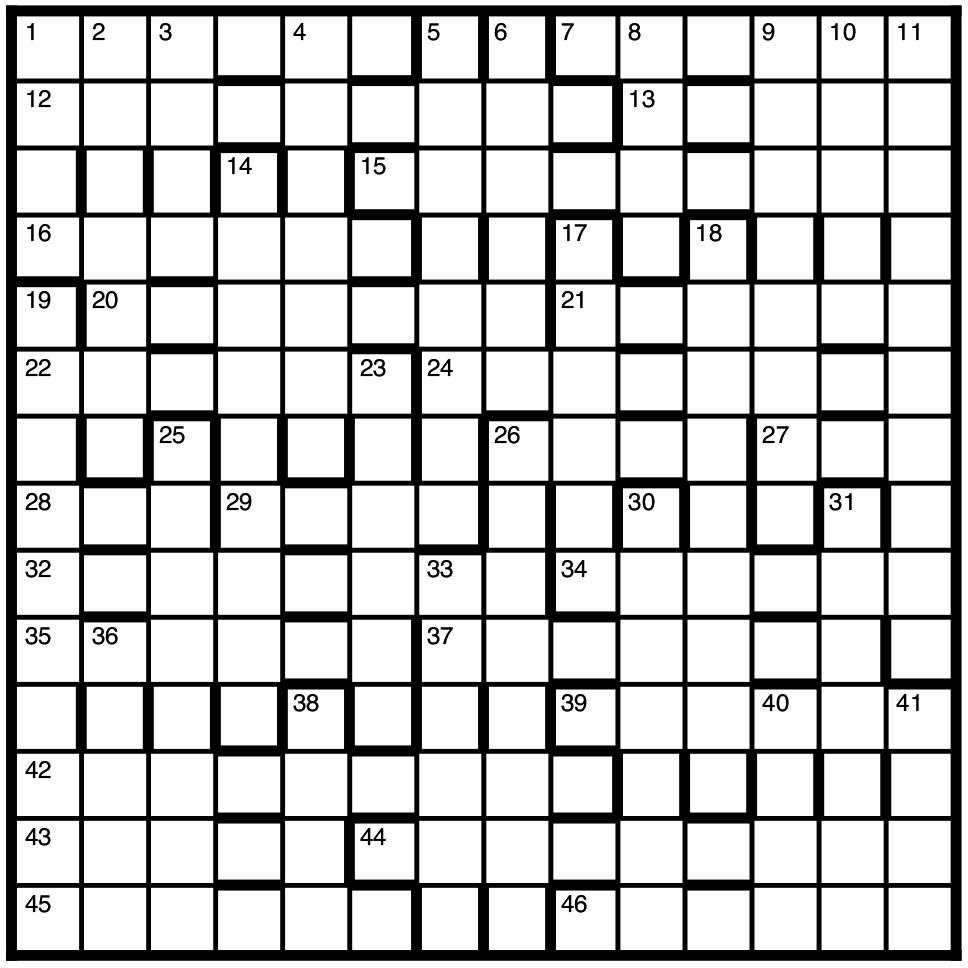
Across
12 Finally, favourite coastal town gets special treatment (3,6)
13 Seafront apartment housing readily available (2,3)
15 Conductor is in Costa in confusion (9)
16 Get comfortable in finest Levis! (6)
20 Shell-like gold relic smashed (7)
21 Could be made in reverse? (6)
22 Passionate time following Forest (6)
26 Openings of the best satirical poetry in little volume (4)
27 Pull to the left in Winnebago (3)
29 One of these? (4)
32 Dominic’s ending former right to work (8)
34 Aim in German for distinction in grammar (6)
35 Canoes sunk here? (6)
37 Looking for moving trains – not Southern! (7)
39 Plant against illuminated fences (6)
42 Fabulous Riviera’s holding large contests (9)
43 Time of enchantment (5)
44 A lot of cider and some beer is on the side (5,4)
45 Some blokes say silly things in writing (6)
46 ‘Steer with feet’ occasionally advisory for cyclist! (6)
Down
1 Make endless cereal (4)
2 Swot up again on Shakespearean king and knight (7)
3 Likelihood of ten in the end? (4)
4 Charlie exhausted by golf career (7)
5 ‘Perfect’ pickle not so great (8)
6 Ship returning without Zoe? (6)
8 Way travelled by boat I hear? (4)
9 Argument about drunk returning shoe (8)
11 Plant weird arrangement in display (10)
17 In case of emergency, get something to reduce swelling (3,3)
18 Wipe nose with a broken arm (9)
19 Dull series of lectures in building protection (4,6)
23 Romeo overwhelmed by this tense desire (6)
25 Running nuns veer into cows (8)
30 Atop Etna, memorial bears term of endearment (3,4)
31 Easy to read, like outrageous libel cases (7)
33 ‘Their’ mis-spelt over one hundred and three times (6)
38 Supporter of Arsenal, extremely, extremely lucky (4)
Download a printable version here.
A first prize of a £30 John Lewis voucher and two runners-up prizes of £20 vouchers for the first correct solutions opened on 20 October. Please scan or photograph entries and email them (including the crossword number in the subject field) to crosswords@spectator.co.uk, or post to: Crossword 2723, The Spectator, 22 Old Queen Street, London SW1H 9HP. Please allow six weeks for prize delivery.
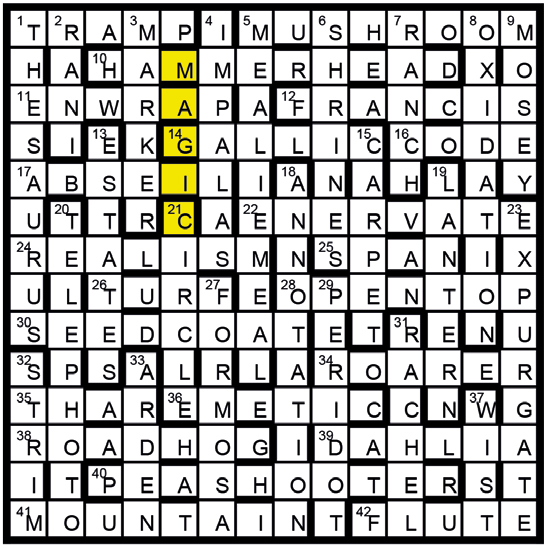
2720: Black and white – solution
Unclued lights all follow MAGIC. (41A MOUNTAIN and 42A FLUTE should be preceded by ‘The’).
First prize Ronnie Hind, Llandygwydd, Cardigan
Runners-up Deirdre Hartz, Medstead, Hampshire; Stephen Rice, London SW1
ID cards are Labour’s alibi for its failure
Questions of identity permeate our politics. What is it to be English, to be British? The Prime Minister sought to reclaim patriotism for the left in his conference speech, but his invocation of football stadium flag-waving and Oasis swagger was a remix of Britpop themes which were tinnily jarring two decades ago and beyond tired today. It was karaoke Cool Britannia.
A much more thoughtful consideration of what modern patriotism requires, and where the dangers in an exclusively ethnic approach to national loyalty lie, came from the Home Secretary, Shabana Mahmood. In both her conference speech and her comments at a fringe meeting with The Spectator, Mahmood navigated questions of faith and flag with a candour and willingness to challenge the simplicities of both simple-minded left and hard-hearted right which was refreshing.
It also stood in stark contrast to the ugly questioning of her right to call herself English, which emanated from ethno-nationalists online after her speech. Mahmood demonstrates a commitment to open debate, empirical reasoning and civility towards her opponents which is much more quintessentially English than the exclusionary identitarianism of her detractors. But what is not quintessentially English, or British, let alone justified by any appeal to empiricism, civility or openness, is Labour’s proposal to make our individual identity a commodity controlled by government.
The PM’s plan to impose digital ID is illiberal, incoherent and undoubtedly counter-productive
The Prime Minister’s plan to impose a digital ID system on Britons is illiberal, unworkable, incoherent, unnecessary, ideologically wayward and undoubtedly counter-productive. The argument from first principles against any form of identity card system goes to the essence of what it is to be a British citizen.
Liberty lies at the heart of our identity. To be British is to be free to act, speak, associate and enter contracts without requiring the state’s permission, oversight or consent. That is at the root of our Common Law traditions. We are sovereign over our own actions, save for those which the state explicitly prohibits for the common welfare.
Other jurisdictions operate differently. Napoleonic principles and statist assumptions govern how other countries regulate common life. There, actions require state permission or licensing. The presumption is that liberty is so precious it must be rationed by the authorities. Raison d’état trumps live free or die. Hegel and Rousseau, the primacy of the state and the supremacy of the common good, are the tutelary influences in other countries. For Britons, it is Edward Coke and John Locke, John Milton and George Orwell – the defenders of the cussed independence of the individual from executive overreach.
The establishment and maintenance of a national database which will register – and regulate – movement and employment treats humans like cattle to be branded or commodities to be imprinted with a barcode. To be British is to find the idea itself alien.
It is not even as though the state itself can make an argument from efficiency. There are already multiple personal identifiers the government generates and then fails to manage adequately. We already have passport numbers, national insurance codes, driving licences – and yet the government still cannot police our borders robustly, collect taxes fairly or get the DVLA to operate with minimal efficiency. Past efforts to create a single – voluntary – identifying code for users of government services have run aground against resistance from departments jealous of their data and technical incompetence from the state’s officials.
The one state body that should be trusted above all to use data rigorously, the Office for National Statistics, is facing a crisis of credibility over its failure to produce reliable information. Why should any of us submit to another government data programme when the existing programmes don’t work effectively, government departments themselves don’t trust them, and the state cannot guarantee their efficiency, transparency or honesty?
Advocates of the new digital ID system protest that we already share our data with tech companies daily. What greater infringement of privacy does an itty-bitty government programme really involve?
Big Tech may know more about each of us than we’d like. But it doesn’t possess the state’s clunking fist. And the chilling effect on liberty this government has generated is real. The recent armed arrest of the comedy writer Graham Linehan for a provocative tweet was merely the highest-profile recent example of the police taking action against citizens for speaking too freely. More than 12,000 people a year – more than 30 a day – are arrested for causing online offence.
Britain appears gripped by a state of ‘anarcho-tyranny’, with social media posts zealously policed while shoplifting surges and burglaries go without investigation. Why should the law-abiding majority be forced to carry a digital ID when the state seems incapable of tackling the crime gangs whose e-bike couriers deal drugs on our streets, whose black economy labour is laundered in fake barber shops, and whose people-smuggling activities escalate every day?
The Prime Minister’s argument that we need digital ID to tackle illegal immigration is industrial-scale gaslighting. Employers must already check the immigration status of any hire. If they are set on employing an illegal worker, a lack of a digital ID won’t dissuade them. The black economy has not shrivelled in other countries with ID cards, such as France, Germany and Italy.
Meekly accepting the imposition of digital ID would be to accept the government’s alibi for its failure on migration. But worse, it would be to acquiesce in an erosion of the liberties which define these islands. The Conservatives are right to oppose this folly. It must be resisted à outrance.
Death and glory: the politics of the World Cup
World Cup fever is a strange affliction. It’s more contagious and unavoidable than Covid, and more widespread too: each new World Cup, as Simon Kuper writes, ‘becomes the biggest media event in history’, which ‘occupies the thoughts of billions of people’. It also produces a cluster of sometimes contradictory symptoms, physical as well as mental. Kuper quotes a study that found an increase of 25 per cent in hospital admissions for heart attacks in England on 30 June 1998, when England played Argentina (David Beckham, Michael Owen and all that). Later, he describes the moment when the American journalist Grant Wahl died of an aortic aneurysm in the media stand during the Netherlands vs Argentina match at the Qatar World Cup in 2022.
That might have been an unrelated misfortune, but it was not just professional diligence that kept Kuper sitting yards away, mostly focused on the game. Growing up in the Netherlands, he had followed their football team ever since (he is of South African descent). He just couldn’t help himself:
So there, to my left, was someone I knew and admired, possibly dying. But in front of me was Oranje, my team, playing a thriller. I’m not proud to say this, but I spent half an hour swivelling my head between Grant and the match.
With that admission of latent fandom, and the title he has chosen for his book, you might expect Kuper to be suffering from the full-blown version of World Cup fever – a blinkered obsessive who has been lucky enough to parlay his passion into his profession. Starting as a fan, he has attended every World Cup since 1990 (Italy), as a journalist from 1994 (USA) and specifically as a Financial Times correspondent since 1998 (France). But it all seems to have produced a chronic dose of Weltschmerz, the melancholy world-weariness we usually associate with the gloomier poets.
For the reader, this has its advantages. There could be little doubt about the cynicism that lies at the heart of Fifa – the governing body which assigns the World Cup in a system seemingly designed for venal interference – after the selection of Russia, Qatar and Saudi Arabia as hosts. Kuper is an excellent guide to this apparent favour-auctioning and its consequences – including the deaths of thousands of construction workers building eight mega stadiums in ‘tiny, boiling Qatar’.
In his chapter on the bidding process that led to the selection of the two Arab hosts, he interviews the disgraced former head of Fifa:
Sepp Blatter is an eternal Swiss type: the hotel concierge, der Portier in German… friendly, multilingual and unideological. He always remembers guests’ names. Above all, living in a country that money flows through, der Portier knows which of them can afford the hotel bills.
In the 21st century, that means ‘Russians and Gulf Arabs’. But even Blatter regretted the choice of Qatar as host, while his successor, the even more egregious Gianni Infantino, embraced it.
To his credit, Kuper doesn’t excuse himself from guilt by association with all this wickedness. In Qatar, having pointed out how little the pre-tournament outrage did to dent attendance, participation or coverage, he offers another confession:
I know this sounds like a cop-out, but I flew to Doha to report on football while my Financial Times colleagues covered the serious stuff. The idea was to hold two thoughts in our heads simultaneously: to fight sportswashing while enjoying the sport.
Thousands of construction workers died building eight mega stadiums in ‘tiny, boiling Qatar’
It does sound like a cop-out, but millions of football supporters were engaging in the same act of wilful cognitive dissonance. Fans are used to it, from the chants that you wouldn’t want to explain to your mother to the on- and off-pitch violence that are ‘part of the game’. As they say on the news: ‘Look away now.’
Naturally, the World Cup’s magic isn’t always black. Kuper doesn’t try to persuade us that every match was a classic. He thinks, anyway, that ‘there’s nothing deader for a writer than a dead football match’ – but his book is filled nevertheless with memorable vignettes. The two best chapters are on the South African World Cup (2010), in which he takes a personal interest as the child of parents who emigrated from apartheid South Africa in the 1960s. His grandmother was still in Johannesburg at the time of the tournament, while one of the books he consulted for historical background, An African Bourgeoisie, was written by Leo Kuper, his great-uncle. In the lobby of his hotel, Kuper meets his aunt Ruth, ‘possibly the most old-fashioned woman in South Africa’, who ‘quietly disapproved of black rule’. A group of cleaners, dressed in the South African strip, are dancing and singing ‘Nkosi Sikelel’ iAfrika’, the anthem ‘despised by conservative whites’. But his aunt sings along. ‘The World Cup was turning Ruth into a new South African.’

Event
Speaker Series: An evening with Bernard Cornwell
An unheroic hero: Ginster, by Siegfried Kracauer, reviewed
Siegfried Kracauer (1889-1966) made his name as a film theorist. His critical writings have long been available in English, and now his fiction is finally getting its due. The first of his two novels – published in Germany in 1928, five years before Kracauer fled the rise of Nazism – uses as its title his journalistic pseudonym. The protagonist inherits other autobiographical details, too, starting from the opening sentence: ‘When the war broke out, Ginster, a young man of 25, found himself in the provincial capital of M.’
Germany’s descent into the Great War is sketched in vividly cubist images. One character ‘consisted of three spheres stacked on top of one another to form the outline of a bowling pin’; another’s ‘figure possessed the amiability of a rectangle’. The military are reduced to empty shells: ‘The dress uniform in the silver train’ next to ‘a double-breasted tunic.’ There is no shortage of metal; even ‘workers… looked like spare change, with mustaches, heavy and made of nickel’.
An architect, Ginster dreams of designing ‘a large kaleidoscope in the ceiling over the pool that will be set in motion with a mechanism and constantly project shifting shapes in ravishing colours’. What’s required instead are cemeteries for soldiers and factories producing army supplies. Following Ginster’s pencil as it traces ‘paths [running] in obedience to strict rules’ and ‘trees clipped into cubes’, the translator Carl Skoggard executes these drawings with a similar precision.
Ginster is unfit for military service, but his friend Otto has enlisted. Their meeting is awkward: ‘They’ve forced him into a perfect rectangle, thought Ginster, an automaton.’ Others have also changed, for ‘ever since war was declared, no one talked any longer about important things’. Many believe it’ll be over soon, and that life must go on. When Ginster learns of Otto’s death on the front line, he is doubly ashamed: of feeling happy to be alive and of hating ‘the emotions, the patriotism, the huzzahs, the banners’. But the ‘empty space’ left by Otto is soon ‘sealing itself up’, and life goes on, filled with work and romance. When Ginster is eventually conscripted, he starves himself to ‘general physical debility’ and is sent ‘to peel potatoes against the foe’.
Ginster has been compared to Erich Maria Remarque’s All Quiet on the Western Front and other contemporary novels exposing the insanity of war. Kracauer does it in his own way, treating modernity itself, with its ‘spoiled’ machines and ‘perfectly angular’ lines, as a blueprint for catastrophe. Having survived it, his unheroic hero can only weep ‘for himself, for countries and human beings’.
The vanished glamour of New York nightlife
Mark Ronson has one of the finest heads of hair in all showbusiness. The music producer’s coiffure is a dark, whipped and quiffed thing that makes it look as though he naturally belongs on a Vespa in Capri, being ogled by the belle ragazze as he scoots on by. As a cultural object, it certainly surpasses the Oscar he won for the songs in that Lady Gaga remake of A Star is Born; it probably equals his Barbie soundtrack; and maybe even approaches the hits he made with and for Amy Winehouse.
But it wasn’t always like that. Back in the 1990s, Ronson’s hair was a standard-issue crop, while he was a gawky young club DJ looking to make it in New York. It’s this scene that he writes about in his memoir Night People, not the fame and accolades that would follow. He calls it ‘the Mark Ronson book nobody asked for’ in the acknowledgements at the back, adding: ‘What, no Amy?!’
Honestly, I turned to those acknowledgements after just a few sentences. My suspicions had been aroused, you see. The book’s first paragraph was an evocative description of a house party at 2 a.m., where ‘the diehards are smoking cigarettes like it’s still 1999, ashing into a cereal bowl that’s been sacrificed for the occasion’ – and I wanted to check whether Ronson had used a ghostwriter, as celebrities so often do. Sometimes you can divine the truth from the nods and thanks in the back matter.
But, no, I don’t think he did; at least not beyond a bit of polishing, perhaps. Night People appears to be Ronson’s text – and it’s really good. Nobody asked for it, but plenty of people should buy it, whether they’re interested in DJing or not.
If that sounds patronising, it’s not meant to – it’s actually just raw envy on my part. Judging from this book, Ronson had a blast in the 1990s. From hanging out with his childhood friend Sean, John Lennon’s son, to rooting around record shops for obscure hip-hop, disco and funk releases. From hustling as a ‘gigging bar DJ’ to presiding over dancefloors occupied by ‘Mike Tyson, Wesley Snipes and Leonardo DiCaprio, a young rap fanatic’. Booze. Coke. Models. Parties. Night People is no cautionary tale; it’s a celebration. It reads like a Bret Easton Ellis book in which almost everyone is nice and balanced.
Not that Ronson is blind to the preposterousness of much of his old life, nor to its rougher edges. He just doesn’t make a big deal of it. Potentially tricky subjects such as class and race are dealt with – ‘Jewish DJs played for black promoters, DJs played for Jewish promoters, and we all hung tough’ – and then moved on from; not, you feel, out of evasiveness, but because Ronson and his book are more interested in the cultural scene than in causing a scene. It’s the music that motivates him.
There are times, however, when this approach does leave you wanting more. After all, Ronson wasn’t the only person chrysalising in New York at the time. Night People contains a couple of tantalising references to Donald Trump and, separately, his daughter Ivanka (‘an underage blonde with exceptionally well-ironed hair’) showing up at parties – but neglects to go into details.
Elsewhere, Ronson recalls performing at events hosted by the since-disgraced Puff Daddy where he’d see ‘people like Muhammad Ali, Martha Stewart, Denzel and the Duchess of York all mingling’. He adds nothing else about Her Royal Ferginess, but perhaps this reflects the DJ’s lot: always overlooking the crowd, never actually joining it.
Otherwise, the only problem with Night People is that you may end up believing – tragically – that its swagger and cool has somehow rubbed off on you. I realised too late, while nerdily constructing an online playlist of every song mentioned in the book, that I was only proving the point of its final chapter. That whole scene no longer exists.
It used to take years of accumulated expertise and hours of crate-digging to discover tracks such as Weldon Irvine’s ‘We Gettin’ Down’ or Tom Scott’s ‘The Honeysuckle Breeze’, whereas now any old tourist can dial them up within seconds on their phone. Even in the best cases – and the nightlife in 1990s New York really does sound like one of the best cases – subcultures can only ever hope to explode into the wider culture before burning out.
Which is why it’s astounding that Ronson himself shows no signs of burnout, despite what he put his brain and body through all those years ago. Amy Winehouse’s best songs, the Barbie soundtrack, an Oscar, Grammies, a great wardrobe, exquisite hair… and now, we discover, he’s a fine writer and cultural tour guide too? As some kid once said of Charlie Brown, how I hate him.

Event
Speaker Series: An evening with Charles Moore
Welcome to the age of de-extinction
Colossal, a $10 billion biotech firm with a knack of grabbing headlines, has announced it is on the way to de-extinguishing the dodo, the very icon of extinction. Like most of Colossal’s announcements, this one included a hefty helping of hype. All the firm’s scientists have actually done on this occasion is prove they can grow primordial germ cells of pigeons, one of many necessary steps – and not the hardest one – in reviving the fat and flightless bird of the pigeon family of Mauritius that was the dodo.
In a couple of years, Ben Lamm, who runs the company, will probably present us with a fat and flightless pigeon with a funny beak and say: ‘Look, a dodo!’ That’s roughly what he did last year when he made a big white wolf with just 20 genetic edits, which looked a bit like the dire wolf, an extinct species – and claimed that’s what it was. Hmm.
I have no connection with Colossal but I am an adviser to Revive & Restore, the non-profit organisation that started the de–extinction movement. Some in the organisation are dismayed by the way Colossal raises expectations unrealistically.
Other extinct birds are even closer to coming back. The passenger pigeon genome has been sequenced. Ten years ago, I convened a meeting in Newcastle to discuss the possible de-extinction of the great auk, which is – remarkably – the only European-breeding bird species to have gone globally extinct in 500 years. The size of a penguin, it was a flightless cousin of the razorbill, driven to extinction by the 1840s as a result of its feathers being used to stuff pillows.
As we planned our meeting, we thought we would need to begin by debating how to find a way to read the great auk genome, but Tom Gilbert, director of the University of Copenhagen’s Center for Evolutionary Hologenomics, arrived to tell us he had already more or less done that, from cells in great auk guts preserved in alcohol in a Danish museum. Later he began work on a well-preserved dodo that was brought alive to Holland in the 1600s, preserved at Gottorf Castle in Germany and captured by Danish forces in 1702. This specimen was then passed to Colossal, and the deciphering of its genome sequence began.
We also thought we would need to find a way to foster great auk primordial germ cells inside the ovaries and testes of a surrogate species of bird – but Mike McGrew, a group leader at the Roslin Institute, arrived from Edinburgh to tell us he had developed a way to replace embryonic duck germ cells with chicken germ cells, so ducks could father chickens. In short, two of the hardest jobs were already nearly solved.
Many ecologists hate the idea of de-extinction and grasp at any argument to denounce it
That left two more hurdles: how to edit a razorbill genome into a great auk genome; and how to raise great auk chicks and release them into the Atlantic Ocean without parents to guide them. The first problem requires maybe up to a million precise spelling edits to a billion-letter genome. Gene-editing technology has made rapid advances in accuracy and volume since then but it’s a long way off achieving something on that scale. Still, you would not bet against it getting there in the next decade, perhaps through a series of semi-great auks.
As for the second problem, we find ways to raise and release red kites, white storks and sea eagles, so why not great auks? There are plenty of mackerel to feed them, and islands off Britain, Iceland and Newfoundland on which to release them into holding pens and then the open sea. I think there is every chance it will be doable in the next 20 years.
But that does not mean it will happen. There is a fifth hurdle that will have to be cleared: human negativity. Many ecologists hate the idea of de-extinction and grasp at any argument to denounce it – one reason Colossal’s hype is unhelpful. There is a reason the great auk went extinct, they say fatalistically: it probably could not survive in the North Atlantic now. But the reason was that we killed them to stuff pillows; if we choose not to do that, they should thrive as other auks – puffins, guillemots and razorbills – do today.
The critics also say that if we de-extinguish extinct species, people will stop trying to save endangered ones. Really? Think it through: those of us battling to keep curlews on the Pennine moors because we like their song are hardly likely to shrug and say let’s let them go extinct and then spend a few million pounds struggling to bring them back later.
The dodo announcement brought this sniffy response from an Oxford University biologist, Richard Grenyer: ‘It’s a huge moral hazard; a massive enabler for the activities that cause species to go extinct in the first place – habitat destruction, mass killing and anthropogenic climate change.’ But climate change opens up feeding grounds slightly further north than where great auks lived in the 1800s. Anyway, says Andrew Torrance of the University of Kansas, reviving an extinct species is like mending something you broke – a moral imperative.
This is when the penny dropped. I suddenly realised what we are dealing with here: a philosophy that is all too common in the environmental movement, namely that being pessimistic about a problem is so lucrative that they hate solutions, or what they call technical fixes. I recently interviewed a brilliant Dutch entrepreneur of Croatian descent, Boyan Slat. Shocked at the plastic he met with when scuba diving, he set out to solve the problem – rather than just wail about it.
He founded Ocean Cleanup, a non-profit that has developed ways to catch and dispose of vast quantities of plastic in rivers and the sea. It is proving spectacularly successful, but he is baffled by the resistance he meets in the environmental movement. It is as if plastic in the ocean is not something they want to remove; it’s something they want to use to raise money. ‘Technology is the most potent agent of change,’ he wrote a few years ago. ‘It is an amplifier of our human capabilities.’ Yet for many greens, technology is the enemy.
I also met Michael Stephen, a British entrepreneur who developed a simple ingredient to add to plastic during its manufacture that turns it into a biodegradable substance. Exposed to heat or sunlight, this ‘oxobiodegradable’ plastic decomposes and turns into food for bacteria. But Stephen finds himself stuck between a plastic industry that does not want to change and an environmental movement that wants to ban plastic: neither likes the idea of continuing to use and manage plastic but have it rot naturally if it is littered.
Once you see this mentality of preferring the problem to the solution, you notice it is everywhere. Nuclear power might solve climate change. Can’t have that – emoting about it is far too lucrative! Fertilising the ocean might reduce carbon dioxide levels – therefore don’t let’s even try it.
Bringing back the dodo, great auk or passenger pigeon would be the ultimate technical fix and will therefore meet opposition. And it’s not just about birds. As for mammals, Andrew Pask at Melbourne University has sequenced the genome of the thylacine, an extinct marsupial predator known as the Tasmanian tiger. Then there’s mammoths and woolly rhinoceroses.
How to create an educational elite
University term has started, and even more students are being taught in even larger classes. But to what end?
Education was a subject that thinkers like Aristotle who argued that the aim of a state was ‘the sharing by households and families in the good life, i.e. a complete and self-sufficient life’. This being of supreme importance: ‘It is evident that there must be one and the same education for everyone, and the superintendence of this should be public and not private… Public matters should be publicly managed.’ But what was meant by ‘the good life’? Here Aristotle wavered: ‘There are no generally accepted assumptions about what the young should learn, either for virtue or the best life, nor is it clear whether education ought to be conducted with more concern for the intellect than for the character of the soul… for things useful in life, or those conducive to virtue or directed at exceptional achievements.’
Plato took a quite different view. For him, philosophy was the true education and depended on the interaction of minds: dialogue was at the centre of it, which would result in ‘truth flashing on the soul like a flame kindled by a leaping spark’. As a result, he began by alerting the potential young student to ‘the nature of the subject as a whole, and all the stages that must be gone through, and how much labour it requires’. Only fully committed students were accepted. As for the rest, Plato came up with the brilliant image of those for whom the purpose of education was to gain a ‘superficial veneer of learning like someone lying in the sun to get a tan’, presumably turning over now and again until lightly educated on both sides.
If, then, the UK wants an educational elite – why seek any other sort? – give every student a year to prove their worth, then ruthlessly cull the sun-tanners. But Aristotle was also right: there is far more to life than ‘philosophy’ (or, in our terms, study for a degree). Sun-tanners must be encouraged to consider opportunities to develop their own ‘exceptional achievements’ in whatever areas suit their skills.
The luxury of French prisons

David Shipley has narrated this article for you to listen to.
Nicolas Sarkozy, former president of the French Republic, has been convicted and sentenced to five years for a ‘criminal conspiracy tied to alleged Libyan funding of his successful 2007 presidential campaign’. For those of us more familiar with Anglo-Saxon criminal law, there’s much to be confused by. France, like many ‘Napoleonic’ legal systems, draws no distinction between determining guilt and sentencing. Both are, of course, determined by the same magistrates or judges. As a result, French courts often hear defendants’ lawyers insist upon their client’s innocence with one breath, before saying that ‘should the judges find them guilty, their sentence should be light because…’.
This is all very bizarre to British ears. In our courts, sentencing is not discussed or considered at all until after a defendant has either pleaded or been found guilty. We would also expect a sentence to commence immediately on being handed down. Sarkozy walked free from court after his sentencing. This isn’t because he received any special treatment. Under the French system the judges who issue the sentence don’t actually decide how it will be served. So, on 13 October, Sarkozy will stand before a Juge d’application des peines, or JAP, who will decide where and when his sentence will be served.
Given Sarkozy’s sentence, prison is a certainty. What experience can he expect in French jails? I turned to ‘Bill’, a man I met when I was in prison. He’d also served a short sentence in a French jail. What he described to me was a crowded, tough environment, like ‘something from Napoleon’s time’, in which he shared a cell with three or more other men. Surely, even in an egalitarian republic, a former head of state would not suffer similar conditions?
It seems not. Bill was held in a maison d’arrêt, a local ‘remand centre’ for those serving short sentences. As the former president is high profile and potentially vulnerable, the JAP will work with prison officials to find an appropriate jail, something which does not happen in England, where even celebrity prisoners are sent to the same ‘reception’ jails as every other prisoner. The consensus in France is that Sarkozy will be sent to Prison de la Santé, a 158-year-old jail in Paris’s 14th arrondissement. Here he will almost certainly not be held alongside the general population of prisoners, but rather in le quartier vulnérable (QPV), which an English jail would call the ‘vulnerable prisoners wing’. At la Santé this is a small unit, housing just 19 prisoners, all in individual cells.
Cells are roughly twice the size of a similar cell in a British prison. Each has an individual shower as well
Compared with the typical British prison, these sound almost luxurious. At 10-12 square metres the cells are roughly twice the size of a similar cell in a UK jail. Each has an individual shower as well. No communal washing for Sarkozy. Other than being on the QPV, he will be treated like any other prisoner. Much of the ‘regime’ sounds similar to that I experienced in HMP Wandsworth. Three meals a day, special dietary requirements catered for, a canteen to order extras from and some opportunities to work or study. There is one, terribly French difference, though. Prisoners there are still allowed to smoke, a far cry from most British jails, where tobacco is valuable contraband and vaping is widespread.
During his sentence, Sarkozy will have much more chance of early release than under the English system. Nicola Padfield, emeritus professor of criminal and penal justice at the University of Cambridge, has the sense that the French ‘are keener to get people out the other end’, and that there is less of the risk-aversion we see around early release in this country.
Perhaps part of this is because of the continuity found in the French system. In France, a prisoner will be represented throughout their sentence by the same lawyer who represented them at their trial, and the JAPs are involved in release decisions too. When the professionals have known an inmate for years they may find it easier to decide whether or not they deserve release.
Padfield notes that when French parole judges come into a prison it’s a great event, and the whole parole system is ‘more respected as a process’. The system also offers ‘time off for good behaviour’, something which English jails haven’t offered for decades and which the forthcoming Sentencing Bill will move only very slightly towards.
In contrast, in France, even those serving life sentences can earn time off their minimum sentence by as much as six months for every year of good behaviour, according to Padfield. This offers young men serving lengthy sentences for murder the chance to earn their way out with some of their life left. There’s similar mercy available for older inmates like Sarkozy. At the age of 70 he will be an old prisoner, and is expected to apply immediately for early release based on his age. With luck, or a sympathetic Paris appeal court, Sarkozy might find he’s free next year. Failing that, he’ll have to hope the winner of the 2027 French presidential election exercises another Gallic judicial tradition and releases him under an amnesty.
What we can learn from Singapore
I was in Australia last week, having been invited to give the annual oration by the Robert Menzies Institute, and stopped off in Singapore on the way home. I’ve always been curious about this Southeast Asian city state, having read so much about Lee Kuan Yew, its Cambridge–educated founding father, who holds the record of being the world’s longest-serving prime minister.
When he assumed office in 1959, Singapore was a fading outpost of the British Empire, seemingly destined to be swallowed up by one of its larger neighbours. The population was impoverished, illiterate and riven with racial conflict. It had no natural resources and most of its 224 square miles was swampland. Yet by the time Lee stepped down 31 years later, it had been transformed into an Asian tiger with the second-highest GDP per capita in the region. Today, it is arguably the most successful, best–governed country in the world.
For someone like me, who believes western liberal democracy is the best system of government, Singapore poses a challenge. Lee ruled with an iron fist, exiling political opponents, muzzling the press and introducing severe penalties for low-level anti-social behaviour such as spitting, littering and – famously – chewing gum. Like many post-colonial countries, only one party has been in power since independence and Singapore is dominated by a dynastic ruling family: the previous prime minister, Lee Hsien Loong is Lee’s son. The model has been described as ‘enlightened authoritarianism’ but it’s not that enlightened. Caning is a regular occurrence, drug traffickers are executed, and homosexuality was only decriminalised in 2023.
Yet you only have to set foot in the place to realise just how well run it is. It took all of 20 minutes to get to my hotel from the airport, not because it was close but because traffic jams are virtually unheard of. If you look at the quickest way to get from A to B on Google Maps, buses are often a better option than the subway, although the metro is remarkably clean and reliable. The carriages are decorated with posters featuring smiling cartoon characters telling you how to behave – cute authoritarianism – and among the verboten activities are feet on seats, loud music and consuming food or drink. Hard to argue with that.
Singapore is a low-crime, high-trust society, which is remarkable given that it’s largely made up of different immigrant populations. Lee Kuan Yew put various measures in place to end the racial tension that threatened to boil over in the 1950s and 1960s, the most important of which was to desegregate neighbourhoods. He recognised the dangers of multi-culturalism, insisting that the schools teach children to be proud of their country and introducing national service. It helps that annual growth has averaged about 7 per cent since 1965. Widespread home ownership was made possible by the Housing and Development Board, a state agency responsible for swamp clearance, land reclamation and building tower blocks.
Lee Kuan Yew boasted of being unburdened by ideology and was ruthlessly pragmatic
Lee boasted of being unburdened by ideology and he was ruthlessly pragmatic, with a suck-it-and-see attitude to public policy. If something worked, great, but if it didn’t he’d abandon it. Everything was subordinate to transforming Singapore into a modern economic powerhouse. That inevitably meant he was drawn to conservative measures, even though he originally described himself as a socialist. The highest rate of income tax is 24 per cent, there’s no capital gains tax and inheritance tax was scrapped in 2008. He was an admirer of the British society he observed as a student in the 1940s, but disapproved of our over–generous welfare system. He ensured that education and health, while heavily subsidised, are not 100 per cent free. Social security works differently, too, with employees able to keep track of their payments in different pots and even use some of the money to put down a deposit on a flat.
I could go on. Singapore is a powerful argument not just for one–party rule, but for centralised planning – every technocrat’s dream. Yet I’m not convinced we should abandon democracy quite yet. The 20th century is littered with less successful examples of this model, from Stalin’s Russia to Mao’s China. It works in Singapore because it’s a city state and Lee Kuan Yew was a political genius. The test will come when one of his less gifted successors comes to power, which could turn out to be the current PM. As Aristotle pointed out, the problem with the best kind of rule – a virtuous and wise monarch – is it can devolve into the worst: tyranny. Democracy is more limited, but also less risky.
The Battle for Britain | 4 October 2025
To win, the Tories should be the party of motorists
The path to electoral success at the next election is straightforward. Just follow what I call the Channel 5 strategy. Channel 5 is a rare success story in the world of free-to-air broadcasting, a feat attained by following a simple playbook: making programmes the public likes to watch, but which people working in television are mostly too precious to make.
Channel 4 got there first. By broadcasting American football, it found a sport which was far more popular with the public than most ‘people in television’ realised. Every NFL game played in London since 2007 saw sold-out crowds at Twickenham or Wembley; when the Pittsburgh Steelers made an appearance in Regent Street, more than 250,000 people turned up. I suspect any political party which promised the UK its own NFL franchise would gain half a million votes.
Why does nobody do this? Mostly because, among the reputationally paranoid educated middle class you would lose peer-group respect by doing so. There is a lesson here from another American sport, basketball. As of today, Rick Barry still holds the all-time NBA record for the highest free-throw percentage in the history of the sport; all the more remarkable since Rick (who is 81) retired in 1980. He achieved this by throwing underhand, an approach almost every subsequent player has disdained to copy. As Shaquille O’Neal explained: ‘I told Rick Barry I’d rather shoot 0 per cent than shoot underhand. I’m too cool for that.’
John Maynard Keynes made the same point when he observed (of investing, not basketball): ‘Worldly wisdom teaches that it is better for reputation to fail conventionally than to succeed unconventionally.’ In any sphere, people are more eager to avoid peer-group opprobrium than to achieve box-office success. (It always amused me how it pained the BBC to broadcast Top Gear, even though it was its biggest export.)
In the old days of capitalism, the way to make money was to do something your competitors were physically or technologically incapable of copying. Now you can simply find an emotional territory your competitors are culturally or ideologically incapable of occupying. What in politics is called a ‘popularist’ is called an entrepreneur in business: someone who spots a misalignment between what incumbent businesses think is important and what customers care about. In business, the mantra is ‘You are not your customer’; in politics it’s ‘You are not your voter.’ Nigel Farage and Donald Trump know this; both say the things their rivals can’t bring themselves to mention. They are popular because they are resolutely unfashionable: the Mrs Brown’s Boys of politics.
In any sphere, people are more eager to avoid peer-group opprobrium than to achieve box-office success
Dominic Cummings is a master of this psychological jujutsu. In the run-up to the 2016 vote, he proposed creating a movement called ‘Vapers for Brexit’, because a million more people (including me) were more likely to get riled over losing their blueberry–flavoured vapes than the technocratic guff Remainers bored us with.
My latest suggestion is for the Conservatives to rebrand as the Conservative and Motorist party. More than migration, the attitude to the car is perhaps the biggest gulf between received and popular opinion. Most people love their cars, yet it is an article of faith among our political class (i.e. tragic bus-riding Londoners) never to miss an opportunity to tax or otherwise inconvenience drivers. I have two policies pretty much oven-ready. First, get rid of speed bumps. It is ridiculous in 2025 to limit car speed by making roads unpleasant. Second, it’s time to make speed cameras properly Bayesian: every time you drive past a camera at a legal speed, you should earn points which you can redeem against future offences. When you think about this a little, it’s not quite as mad as it first sounds.
Dear Mary: do my AirPods make me look like an imbecile?
Q. My printer is broken, so I asked my neighbour to print off a letter for me. It was from my doctor. I wanted to show it to my husband, who hates reading things on a computer. I hadn’t realised it had two attachments on the bottom with information of a very personal matter. Our neighbour kindly came round with the print-offs, including the attachments. We used to walk our dogs together but now I am so embarrassed I can’t look him in the face. What can I do?
– Name and address withheld
A. Contact the neighbour to arrange a dog walk as per normal. When you meet up, burst into gales of laughter and claim that you cannot believe that he fell for your practical joke: ‘We went to so much trouble to fake that letter and attachments. I suppose it was a bit childish but we couldn’t resist it. Ha ha ha!’
Q. I have trouble hearing at parties with all the background noise. I’ve recently bought some Apple AirPods that reduce background noise and increase the sound of voices near me – it means that in restaurants, dinners etc, I can hear much more clearly. The problem is that the white AirPods are very distinctive and many people assume I’m listening to music or have forgotten to remove them. They solve my hearing problem, but I perhaps look like an imbecile… Help!
– D.J., Whydown, East Sussex
A. Another partygoer with a similar preference has made the mistake of cloaking his AirPods with strips of Elastoplast in a bid to ‘make them look more like conventional hearing aids’. This is a wrong move for both aesthetic and technical reasons. Instead source a ‘fun-sized’ (i.e. large) ‘Hearing Impaired’ lapel badge (widely available online) and wear this to parties along with the AirPods. The badge will be the most immediate thing people notice about you and, since you are signalling, it will embolden them to comment on your AirPods. You can nod in an encouraging manner and suggest that they try using AirPods themselves for noise control and see what a difference they make. Then swiftly change the subject.
Q. I have been going to a lot of weddings and for some reason, maybe because I am very tall, strangers – usually family of the bride and groom – gravitate towards me. I don’t know how to get away from these perfectly nice people without being rude, but I also want to talk to my own friends, some of whom I may not have the opportunity to see again for a while. What should I do?
– C.L., London W11
A. Carry a disposable camera in your pocket and say: ‘Oh, it’s been lovely talking to you, but I have to move on because I’m in charge of taking funny pictures.’
Drink early, drink often
As readers will be aware, and without sounding too immodest, this column is absolutely committed to diversity. In an earlier era, that might have seemed unnecessary. A British oenophile did not need to search out bottles from great distances. He could merely take his pleasure from the first growths of Bordeaux and the grands crus of Burgundy, with perhaps a little dalliance on the Rhine or the Rhône.
Nor was this only a British modus operandi. I covered the French election of 1981 from Burgundy (there were good political reasons for doing so, as well as other ones). The Burgundians knew that wine was made on the banks of the Gironde, but when I assured them the best of it was excellent, there was polite scepticism. As a result, bargains were to be had in the claret sections of wine lists. A bottle of Mouton-Rothschild ’61 was a mere 450 francs: £45. I had never tasted a subtler wine. Was it ready? I couldn’t decide, even after the second bottle. Alas, the experiment was unable to continue. They apologised profusely: there had only been two bottles left. I consoled myself that after the exile from their terroir, the wines had found a good home.
These days, everything is different. Given the rises in price, a British oenophile who restricted himself to the hauts-lieux of Burgundy and Bordeaux must be seriously rich, and all the younger wine makers seem to have travelled extensively to enhance their professional competence, usually far beyond the limits of France. Apprentice French vignerons have studied in Australia and California, and their hosts have benefited from cross-pollination, not to mention investment. The Rothschild/Mondavi partnership to create Opus One is the most spectacular example.
But better wine is being made in larger quantities throughout the world: just as well. That sweet enemy, France, still deserves most of the gold medals, but left to themselves, the Grenouilles would also trouser all the gold. Competition restrains cupidity.
There is one underappreciated region which has collaborated with France for well over a century. In 1880 a grand Chilean, Don Domingo Fernandez Concha, identified a suitable site for a winery on the banks of the Maipo river. He called it Santa Rita and imported French experts with grape varietals: Cabernet Sauvignon, Chardonnay and Carmenère. A century and a half later, everything is flourishing. Surrounded by mountains, with a view over the vines down to the river, its fine buildings endowed with pre-Columbian antiquities, the charm of Santa Rita is prelapsarian.
Apprentice French vignerons have studied in Australia and California, and their hosts have benefited
A few British connoisseurs had found their way to Santa Rita, but not on the scale of my friend Ranald Macdonald, of Boisdale fame. Ranald has one regret about his native land: no one has yet worked out how to grow grapes there. So he has become an oenophile missionary, especial reference to Latin America.
Recently, he was kind enough to invite me to a Santa Rita tasting. We started with the Chardonnays. The first was a sound aperitif: the second, a Floresta Limari 2020, although in a different style, was comparable to a Burgundy premier cru. Then the Carmenère, a Floresta Apalta 2021: the best Carmenère I have ever tasted.
Finally, the Cabernet Sauvignons, the star being a Casa Real 2015, which has won gold medals. Ranald ran it against a Mount Brave from California and a Pontet-Canet 2014, either of which would be twice as expensive.
So which deserved the gold? The two guests could not decide, and changed their minds every five minutes. But on one point there was certitude. The house of Santa Rita makes exceptional wine in magnificent surroundings. Drink early, drink often.