-
AAPL
213.43 (+0.29%)
-
BARC-LN
1205.7 (-1.46%)
-
NKE
94.05 (+0.39%)
-
CVX
152.67 (-1.00%)
-
CRM
230.27 (-2.34%)
-
INTC
30.5 (-0.87%)
-
DIS
100.16 (-0.67%)
-
DOW
55.79 (-0.82%)
Is Shabana Mahmood Labour’s Iron Lady?
Has the Labour party finally found its answer to Margaret Thatcher? Shabana Mahmood’s withering response to Lib Dem MP Max Wilkinson’s po-faced complaint about her language in the asylum debate this week must rank as the most devastating, and justified, playing of the race card in recent parliamentary history. Opposition to using every legal means to stop the boats, she implied, is a kind of luxury belief enjoyed only by those who aren’t at risk of being called a ‘F***ing P***’ in the street.
Has the Labour party finally found its answer to Margaret Thatcher?
Turning the tables on the racial justice panjandrums on her own side by citing her personal experience of racial abuse felt very Thatcher vs the wets. So, too, did Mahmood’s combination of personal conviction and plain, jargon-free, language.
Like Thatcher, Mahmood comes from a religiously devout political family. Indeed, Mahmood (like several of her Labour colleagues) is rather more of a nepo-baby than Thatcher: her father was chairman of the Birmingham Labour party, which surely trumps being alderman of Grantham.
Thatcher in her time was more of an outsider in the Westminster club as a woman than Mahmood is now as a British Pakistani. Nevertheless the latter’s religiosity and conservatism on many matters, including illegal immigration, sets her apart from most people in the modern Labour party which has been partly defined by openness to immigration.
As the country’s centre of gravity has shifted from metropolitan openness in the heyday of New Labour to provincial insecurity in more recent years, Labour leaders have struggled to authentically embody the new mood, despite wrapping themselves in rhetorical union flags. The public can sense it. In case there was any doubt about it, Keir Starmer reminded them with his ridiculous apology for using the term ‘island of strangers’ when introducing Labour’s new hardline policies on legal immigration back in May.

By contrast, Mahmood feels no white liberal squeamishness about a hardline approach to boatloads of black and brown people landing illegally on English beaches. Her inner Birmingham constituency of Ladywood is more than three-quarters ethnic minority and around half South Asian, mainly Pakistani. Like many of her constituents, who are the children and grandchildren of legal migrants, she resents the queue jumping of the illegals.
Many of them also fear, as Mahmood said, that they will suffer if frustration with dysfunctional borders curdles into anti-minority resentment. It doesn’t take many angry nativists to make life unpleasant for a lot of people.
To adapt the famous David Frum quote, ‘If white liberals won’t enforce borders, their ethnic minority colleagues will.’ The British political class has recently got into the habit of handing its most difficult jobs to second generation immigrants. Think of poor Rishi Sunak (one year above Mahmood at Lincoln College, Oxford), who was handed the Tory party at the point of no return in government; then Kemi Badenoch picking up the poisoned chalice after the historic election defeat in 2024; and now Mahmood, who is expected to solve the wickedest problem of all in contemporary politics.
Yet despite the outrage she has provoked on the Labour left, and support she has received from Tommy Robinson and Nigel Farage, the new measures are highly unlikely to succeed in driving down numbers significantly.
Mahmood wants to stay within the current international legal frameworks and ‘Labour values’ and make the current asylum system work. The key proposals include: making refugee status temporary (reviewed every 30 months), removing automatic access to welfare and housing, and granting settlement only after 20 years; streamlining appeals against rejection of asylum claims, making it easier to return families, and narrowing the use of European Convention Article 8 protecting family life; imposing visa penalties on (small, weak) countries that refuse to take back failed asylum seekers; and improving financial incentives to leave.
Mahmood feels no white liberal squeamishness about a hardline approach
Some of her proposals have echoes of earlier Tory failures and fall some way short of the ‘full Danish’ approach. Mahmood should have no difficulty getting the measures through Parliament (those that need legislation). But the courts and the bureaucracy are another matter. As one former Home Office official said yesterday: ‘There is a staggering amount of policy and operational work to be done to get anywhere near implementing the proposals. The Home Office is being set up for another fall.’ Meanwhile, Mahmood will have raised expectations of quick results as the boats will keep rolling in.
The big question is, does she have another shot in her locker? If these measures don’t produce a significant decline in asylum seekers – 110,000 last year on a rising trend, while falling in the rest of Europe – will she move to off-shoring asylum seekers, as the Tories and Reform and some European governments are embracing, or even detaining them in camps? Both would require setting aside the ECHR and the Human Rights Act.
As the next few months are likely to confirm, the only way of stopping the boats, or illegal entry more generally, is to ensure that nobody who arrives illegally gets to stay. They can be given protection and safety but on Ascension Island, or in a camp on Dartmoor. As soon as such a rule is rigorously implemented, people stop coming, so you only need capacity to detain a few thousand at most. Indeed, we need to change the rule on having to claim asylum inside the country to having to claim it outside the country in a UNHCR camp or an asylum hub. We then choose who most needs to come here in the numbers we think are reasonable.
That is for the future. In the meantime, Mahmood needs to hope that her measures will bring at least some downward pressure on the asylum numbers, possibly helped by tougher border controls elsewhere in Europe. Politically, she needs to attract back enough potential Reform/Conservative voters to make up for those driven into the arms of the Greens or Jeremy Corbyn by the new restrictions.
Mahmood would not be the first Ladywood MP to lead her party or the country
But there is another, somewhat overlooked, element to the story that might yield swifter practical and political results for Mahmood: reducing the enormous cost of housing and looking after asylum seekers. The visibility of the Channel crossings is currently compounded by the visibility of housing so many refugees in the local hotels where not long ago people were holding their wedding receptions and golden wedding anniversaries. Ordinary low income British people deeply resent the high cost of this free riding.
As I wrote in a Policy Exchange report in 2023, The Future is Safe and Legal, we should be calling on diaspora groups and people of goodwill to share the burden and open their doors to asylum seekers. The Homes for Ukraine scheme attracted more than 200,000 people willing to house Ukrainians. The number would not be so high for asylum seekers from more culturally distant parts of the world but I expect several tens of thousands of people would step up.
There are now more than 30 ethnic minority groups in the UK with communities of more than 100,000. This is enough to have national and local associations, media and so on, for each. Why is the Society of British Afghans or the Iranian Association not being asked to step up to house and support their co-nationals? Obviously not all asylum seekers can be housed in this way, and the system would need proper oversight, but it could radically speed up the closure of asylum hotels, currently not scheduled until 2029.
Mahmood has picked up these same ideas and could quickly set up new community or individual sponsorship schemes. This is potentially a big win that might one day even help propel Mahmood to the Labour leadership, after some ostentatious left-wing noises on subjects other than immigration.
She would not be the first Ladywood MP to lead her party or the country. Neville Chamberlain won the seat in 1924. In second place, only 100 votes behind, was one Oswald Mosley, still a member of the Labour party and with a burning conviction that only he could lead his party and country to salvation. I suspect the current would-be saviour of party and country would prefer comparison with the Iron Lady.
Can ‘Bazball’ help England finally triumph Down Under in the Ashes?
‘Bazball’ – England’s exhilarating and exasperating style of playing cricket – has reached its denouement. Starting tomorrow, England face Australia in five Ashes tests that will define the legacy of this controversial philosophy and the four-year tenure of coach Brendon ‘Baz’ McCullum.
Bazball is a spirit of freedom. McCullum – who was a brilliant, daredevil captain for New Zealand – has rewired England to play cricket aggressively, and without ‘fear of failure’. Bold, and often brash, Bazball is a revolt against English cricketing orthodoxy – a stand for the cavaliers against the roundheads.
It can be argued that this approach is needed most in Australia. Winning a series Down Under is tough. Very tough. England haven’t won a single away Ashes test in their last fifteen attempts. Australia are bullish but ruthlessly pragmatic, and England are not going to beat them without playing extraordinary cricket. The swagger of Bazball (which many Australians dismiss as pomposity) might – just might – be the answer.
This Ashes, Bazball’s aggressive batting will face its toughest challenge
This series is England’s best shot at winning in Australia since the 2013–14 series. Joe Root is England’s finest batsman since the second world war, and Harry Brook is ranked number two in the world. The fast bowlers, Jofra Archer and Mark Wood, are potential destroyers. Ben Stokes is Ben Stokes.
The supporting cast is, on the whole, stronger than it has been for a decade. McCullum and Captain Stokes are uncannily good at spotting players with potential and nurturing them to succeed. They recalled Ben Duckett, a fast-scoring batsman with an irregular technique, after six years out of the team. He scored a century in his first innings under Bazball and has become one of the best openers in the world.
Even more remarkable is the case of off-spinner Shoaib Bashir, who Stokes brought into the squad after watching one clip on Twitter. Bashir, who is only 22, can hardly get a game in the county championship but has four five-wicket hauls in just 19 tests. That’s more than England’s 2005 Ashes hero Andrew Flintoff managed during his entire career.
McCullum and Stokes have clearly provided a mental (and social) environment where players can flourish. Under Bazball, England have won matches – such as against Pakistan in Rawalpindi and against India at Headingley – from positions where victory would have hitherto been unthinkable.
The trouble is, Bazball has also produced implausible defeats. In the Edgbaston test of the last Ashes, England were over 50 runs ahead and needed to take just two wickets from Australia’s worst three batsmen. They opted for a high-risk bouncer tactic that removed the possibility of Australia securing a draw. The outcome? Australia won without losing another wicket. Even worse, against New Zealand in Wellington in 2023, England became only the fourth team in test history to lose after enforcing the follow-on.
Ahead of last summer’s series against India, England promised a refined approach. When they made good on that promise, they won. When they didn’t, they lost. The most infuriating thing about Bazball is that the team doesn’t seem able, or willing, to learn from its mistakes. That explains why, in the biggest series – home and away against India and at home to Australia – Bazball has produced two draws, one defeat and no victories.
It comes down to the central tenet of Bazball: freedom. An attitude of freedom may be a great strength but, as England’s regular batting collapses have shown, it’s also a tragic flaw. A more sophisticated philosophy of liberty would recognise that, just as freedom of speech has limits, the licence to bat aggressively does not authorise recklessness. You shouldn’t need to be Adam Smith or Isaiah Berlin to understand that freedom comes with responsibilities.
This Ashes, Bazball’s aggressive batting will face its toughest challenge. Of the top nine bowlers in the world rankings, six are Australian. What’s more, the Aussie pitches (and even the ball) are the most bowler-friendly they’ve been in living memory.
The hosts are also, by a distance, the top-ranked team in the world. Amid all the hype, it’s worth remembering that visitors Down Under usually get spanked. This applies even to good teams. Ahead of the 2013-14 series, when England had taken the past three Ashes, many commentators expected them to win. They lost 5-0.
A similar result isn’t likely this time. Bazball will probably pull off at least one stunning victory (most plausibly in the first test, when Australia will miss their injured fast bowlers, Pat Cummins and Josh Hazlewood) but without self-control, it won’t prevail three times out of five.
But, if England can recognise that some of the old ways are still the best ways, and that the freedom to attack should not be absolute, they stand a chance. The next six weeks will define whether Bazball has been a glorious revolution or a hubristic flop.
Are we finally about to crack fusion energy?
Imagine dropping a pea-sized capsule through a spherical chamber and hitting it with a colossal bolt of laser energy as it falls. If the capsule contains a mixture of deuterium and tritium, two heavy versions (isotopes) of hydrogen, then the atoms may fuse, turning into helium and emitting fast neutrons as they do so. Those neutrons and their accompanying radiation can heat molten salts around the walls of the chamber and that heat can be used to power industrial processes – or to boil water and generate electricity through a steam turbine.
That’s the dream of a firm called Xcimer, one of the more ingenious fusion energy startups, based in Colorado. Three years ago, on 5 December 2022, at the Lawrence Livermore National Laboratory in California, this technique was used to reach a significant milestone in the search for near-limitless energy from fusion, the process that fuels stars (and hydrogen bombs). The experiment generated an ‘ignition’ event in which more energy came out than went in: 3.15 megajoules out from 2.05 megajoules in.
Whether it can be made cheap will depend on the physics but even more on the regulation
In the words of those who did that experiment, 192 laser beams were fired into a cylinder called a ‘hohlraum’, generating a ‘bath’ of ‘soft’ X-rays that blew off the surface of a ‘peppercorn-sized capsule’, resulting in a ‘rocket-like implosion’ creating pressure and temperature ‘found only in the cores of stars and giant planets and in exploding nuclear weapons’.
Fusion energy holds enormous, if distant, promise. We know it works in stars. Its fuel is all but limitless, being made from water (some of which contains deuterium) and lithium (which can be made into tritium by bombarding it with neutrons). The energy released from fusing small atoms is at least four times greater per event than from splitting large ones (nuclear fission). Fusion does not generate long-lived radioactive waste like fission does (tritium is beta-radioactive with a half-life of just 12 years). A fusion reactor cannot have a chain reaction and will not be able to explode or melt down. In theory a small facility with no more environmental risk attached than in a typical industrial process could power a whole town. But that’s in theory; making it work in practice is far harder.
Until 2022 – a year that is looking increasingly like a possible hinge of history given that it was also in November that year that the launch of ChatGPT sparked the artificial intelligence craze – the best bet for achieving fusion looked as if it would come from a different technology, the torus or tokamak. This is where a gaseous plasma of deuterium and tritium is suspended by massive electromagnets inside a chamber the shape of a doughnut or cored apple and heated to over 100 million degrees centigrade to initiate fusion.
Tokamak-based fusion projects have been inching towards net energy production for decades, generating less energy than cynicism about whether they would ever get there. To some, public-funded fusion has begun to seem more like a leisurely scheme for employing physicists than an urgent push to solve the world’s energy needs.
For example, the Joint European Torus machine in Oxfordshire set the record for energy generation in a controlled fusion reaction as long ago as 1997 (16 megawatts out, but from 24 megawatts in). Still more slowly, the $25 billion ITER project in southern France, a collaboration of 33 governments, began in 1985, broke ground in 2007, started assembling its machine in 2020, plans to commence research operation in 2036 and hopes to fuse deuterium with tritium generating net energy in 2039.
Thus the suspicion occurs that taking decades is less a necessity and more a plan. Around ten years ago a few impatient physicists began to leave for the private sector to speed things up. Such a goal looked newly plausible, thanks to compact magnets made possible by the invention of high-temperature superconductors – ceramic alloys of rare metals that lose almost all electrical resistance at temperatures well above the boiling point of liquid nitrogen, minus 210 degrees centigrade. In 2022 (again!) Tokamak Energy in Britain became the first private company to achieve the threshold temperature for fusion of 100 million degrees in a plasma, though not for more than an instant.
There are now around a dozen firms worldwide racing to be the first to generate fusion energy. Commonwealth Fusion Systems in Massachusetts has raised nearly $3 billion and is expecting to get net energy from a compact tokamak in 2027. Others are abandoning tokamaks: Helion in Washington state and TAE Technologies in California plan to use ‘field-reversed configuration’ to fire two balls of plasma into each other. Xcimer’s approach of firing lasers at a series of falling capsules of fuel would in effect turn the reactor into a batch process rather than a continuous one. These startups are beginning to look like a hare compared to the tortoise of the public sector projects – but remember what happened to the hare.
A challenge faced by all fusion technologies is how to cope with the high-energy neutrons released during the reaction. These would deliver the energy you are after but they would also cause havoc with almost any solid material, turning the steel of the reactor itself into a corroded mess. The solution to this that some firms are planning is to line the reactor with lithium, which would absorb the neutrons, preventing them reaching the steel, and better still turning some of the lithium ions into tritium by radioactive decay – thus generating the fuel needed for the reaction. Neat, but easier said than done.
Others think a better bet is to abandon deuterium-tritium altogether and instead go for proton-boron fusion, which produces heat but no neutrons. The boron turns into carbon, releasing alpha particles that decay to helium. What’s the catch? That you would need to reach more than a billion degrees centigrade rather than 100 million. Still, that’s not going to deter ambitious entrepreneurs.
In 2023 TAE Technologies teamed up with scientists at Japan’s National Institute for Fusion Science and managed to achieve proton-boron fusion in a magnetically confined plasma for the first time. More energy in than out, of course, but TAE thinks a commercial reactor in the 2030s may be possible.
Fusion power could prove eternally out of reach or be only ten years away. It is unlikely to be providing electricity in a significant way before 2050. Whether it can be made cheap will depend on the physics but even more on the regulation. It was the rules and regulations, standards and certifications that caused nuclear to stall, despite its excellent safety record. Going back to the regulator for permission to change every weld and nut destroyed the nuclear industry’s ability to learn how to bring down costs. This stifled innovation and added nothing to safety. Please don’t let’s do that to fusion.

Event
The Spectator presents The Year in Review
Was the BBC’s Trump edit outrageously wrong?
I should begin by making something clear. Splicing together two parts of a speech to give the impression they were one unbroken excerpt is a grave professional error, and would be viewed as such by any broadcaster in the business. The error would be egregious even if there were no suggestion it reinforced the accusation that Donald Trump was inciting riotous behavior, simply because what viewers thought they witnessed did not occur. There is no excusing what the BBC did to Donald Trump’s January 6, 2021 speech.
Nobody in the senior ranks of the BBC is to blame for not knowing about this at the time; but once it did become known, an immediate and unconditional apology should have been made. Crisply and severely dealt with, the story could have been contained, and it’s for their failure to get on the front foot after a bad mistake that the Corporation has deserved censure. Please, therefore, do not think me an apologist either for misconduct in the making of the Panorama program, or for the BBC’s handling of the scandal.
But about the effect in practice of this splicing, I’m less sure. I’ve read verbatim the entire speech. It’s peppered with the imagery of battle. “Fight,” “fighting” etc occur throughout, and though the combative language may have been used metaphorically, the effect of the repetition is undoubtedly to stiffen the sinews and summon up the blood. Though Trump did once (and only once) tell the crowd they were going “to peacefully and patriotically” protest, the violence of his language all through the speech, and his repeated suggestion that America itself was under attack and his and the crowd’s mission was to “save” the country – along with sentences like “We fight like hell! And if you don’t fight like hell you’re not going to have a country any more!” – can plausibly be interpreted as being calculated (in the legal sense of the word) to inflame the marchers. His later urging of his supporters to “remain peaceful” could equally be interpreted as implicit recognition that he had started a riot.
I do not myself believe that Trump had a plan to provoke violence, but I do suspect he was careless whether he had that effect. I think too that, on the evidence, the accusation that he did know what he was doing would be fair comment on a matter of intense public interest.
That, presumably, was the argument Panorama were rehearsing, and entitled to rehearse. And in doing so by splicing, they fell into a type of self-justification that does not infect the BBC alone but can be encountered everywhere in the media – though notably less in newspapers than the audiovisual media.
Are you familiar with the word “truthiness?” The expression (I read) was invented by Stephen Colbert in The Colbert Report 20 years ago. He was making fun of media professionals who justify the purveying of untruths by explaining that if the purpose of journalism is to reveal a greater truth, then we may deploy a degree of artifice in our methods. If it feels true, if it conveys a truth without being itself literally true, then never mind the absolute truth: it has truthiness.
Despicable? Do not imagine that the pursuit of truth through truthiness always feels outrageously wrong. Let me give you the most anodyne of examples, employed by the closest we have in Britain to a television saint: David Attenborough. Sir David once told me that, in a TV sequence showing reindeer migrating across snowfields in Lapland, long-lens cameras were used to zoom in on the herd from a considerable distance. Viewers would be able to see the reindeer close up. No problem with that. But if they were to be seen close up, viewers would expect to hear them close up too. For this, Sir David confided, dry custard powder and a pestle and mortar did the trick wonderfully. The sound, being almost indistinguishable from the real thing, had truthiness.
I find it hard to get indignant about that. But this is a slippery slope. Attenborough had been criticized for taking us, his viewers, into a snow tunnel to see a baby polar bear nurtured by its mother. Well, mother polar bears do nurture baby bears in tunnels in the snow. But in the arctic, how would you get a camera in to capture the scene? So the program used a constructed maternal scene, viewed through a glass panel in a Dutch zoo, while Attenborough talked about the wild, which viewers thought they were seeing. I feel uncomfortable about this, but I reckon (and TV professionals reckon) most viewers would be fairly relaxed about not being told. The bear nursery we saw had truthiness.
During the last century, in the depth of John Major’s troubles as Britain’s prime minister, the news media started using a photograph of him, head sunk in his hands. Sir John has told me he was in fact bored, and shielding his eyes from the lights while attempting a limerick on a notepad beneath the desktop. So the image’s implication was false. But it had truthiness.
Down the slippery slope we go, until we reach Trump in that Save America speech. Its effect was incendiary: to inflame his roaring crowd of supporters (“We love you! We love you!”) they kept chanting. I’d submit that there was nothing dishonest about a documentary arguing that Trump was whipping his supporters into a riotous mood. That is believed by many. And he did shout: “We’re gonna walk down to the Capitol… and I’ll be there with you.” And then at another point in his speech he did shout: “And we fight! We fight like hell!” And if run together, you do get the impression he was at the very least careless about what he was starting. And if that is what the program–makers were arguing in good faith, then to them the splicing had truthiness. I too find the possibility truthy. But beware of that innocent-looking little y.
My teenage brush with a micropenis
Like Adolf Hitler, I have been involved in a Channel 4 documentary about penises. I also share a love for watercolours and a partiality for Wagner but that, I promise, is where the similarities end.
But back to penises. The Führer’s genitalia – or lack thereof – is a feature of a new documentary, Hitler’s DNA: Blueprint of a Dictator. The documentary makers have examined a scrap of the bloodied fabric from the bunker sofa upon which Hitler blew his brains out and the long – but mostly the short – of the findings are that history’s most evil man likely had underdeveloped sexual organs, including a micropenis and an undescended testicle. So now we know that the popular wartime ditty ‘Hitler Has Only Got One Ball’, was rather closer to the mark than we previously assumed.
I’d always been a tad shy. If I could spend two weeks chatting to strangers about their penises, I might be cured
This news reminded me of my own brush with todger television. Back in 2019, I was kicking my heels during the long university summer holiday. Flicking through various Facebook groups, I stumbled across an internship for a documentary about ‘masculinity in the 21st century’. I’m a bloke, I thought, I have two weeks free and a CV that needs some padding. How hard could it be? I applied, survived a brief interview, and was told to report to a Tottenham Court Road office the following Monday.
Splendid: I had assuaged parental concerns that I was going to spend the summer moping about at home, and my nana was impressed enough to tell all the ladies in her retirement home that her grandson was destined for a television career. I was chuffed. Alas, I should have done a little more research.
On my first day the office manager sat me down to outline my exact role. Earlier that year, she told me, the company had put out a documentary entitled 100 Vaginas. The premise of the show – I explained that sadly I had been out that evening – was this: women of all shapes and sizes had their vaginas photographed and were then interviewed about what their vagina meant to them. I must admit to feeling both rather underqualified and a little nonplussed. What had this got to do with masculinity?
When I was told I would be working on a sequel, the reality started to dawn. For the next two weeks, my job would be to find participants for a potential follow-up, 100 Penises. I would need to find men willing to come on national television to have theirs photographed. A variety of gentleman sausages would be needed – from the substantial baloney of the unusually well-endowed to the cocktail counterparts of those with similar genes to old Adolf. A small mercy was that, unlike Hitler’s, my own manhood wouldn’t be the centrepiece.
This was not what I had been expecting. I felt shafted by the vagueness of the advert. When I returned home, I was evasive, disconsolately prodding my bangers and mash as the family tried to find out exactly what it was that I was doing. What 19-year-old self-respecting boy could look his grandmother in the eye and tell her that he was working on a cock doc?
As I headed in for my second day, I had an epiphany. I’d always been a tad shy. If I could successfully spend two weeks chatting to strangers about their penises, I might be cured. If I could ask David from Durham about what it’s like living with only two inches in your trousers, or Mark from Maidenhead about the exact ins and outs of his penis enlargement surgery, I could do anything. And so, with one eye on what it was doing to my browser history, I threw myself into the work.
I turned out to be a dab hand. Given a target list of particular penises each morning – ‘We’d like a post-op trans man, William, and a circumcised Muslim’ – I would trawl the internet to find suitable candidates. Some parts of the role were easier than one might expect. Ask a penis enlargement clinic if anyone on their books is willing, pre- or post-surgery, to have their manhood on camera, and you get a very positive response. People really are that desperate for their 15 seconds of fame.
Two weeks of investigating the nation’s penises gives quite a good insight into the state of play. Whatever its size, the phallus is usually a source of anxiety. Demands for enlargement are common, even for those with middling ones. Having one testicle is surprisingly frequent. For most, it just means a reduced libido, without an accompanying desire to plunge Europe into a genocidal Götterdämmerung.
Perhaps surprisingly, older gentlemen tended to be more comfortable than younger men when it came to talking about their old chap. Years of familiarity breeds an acceptance of one’s constant downstairs companion. Above all, I learnt it is impossible to say the word ‘micropenis’ down the phone without giggling.
Adding to the surrealness, the office was frequented by the crème de la crème of British documentary-making. I would get off a chat with a potential contributor, then turn around and see Louis Theroux or Lucy Worsley standing behind me. I switched straight from a call about a micropenis to asking Joanna Lumley if I could squeeze past her to make a cup of tea.
I ended up enjoying those two weeks immensely. While I don’t think any employer has ever taken any notice of the CV entry, it succeeded in building up my confidence, and for reasons beyond discovering that I had far fewer problems in the trouser department than a lot of my fellow Englishmen.
I must admit that I have yet to see the final documentary. I don’t think I’m brave enough. But I did eventually admit to the family what the focus of my two weeks had been (sorry, Nana). This prompted my dad to watch the programme’s credits to see if I got a mention. He reappeared a couple of minutes later, looking as white as a sheet. ‘Rathera lot of penises,’ he said. I don’t think he meant the production staff.
Fide World Cup
The biennial Fide World Cup underway in Goa is a feast for chess fans. Lasting nearly a month, more than 200 participants are whittled down to a single winner through a series of knockout matches, starting with two games of classical chess, followed by rapid and blitz tiebreaks if necessary. Stakes are high, with a $2 million prize fund, and the top three finishers qualifying for the prestigious Candidates tournament (to be held in Cyprus in the spring), whose winner will challenge for the world championship.
The game below was an early highlight. The queen sacrifice is not new, and Harikrishna was probably aware that computer evaluations slightly favour the queen, but rightly trusted his own judgment. Faced with the dominant knight on d6, Nesterov struggled to develop his forces.
Pentala Harikrishna-Arseniy Nesterov
Fide World Cup, Round 2, Goa 2025
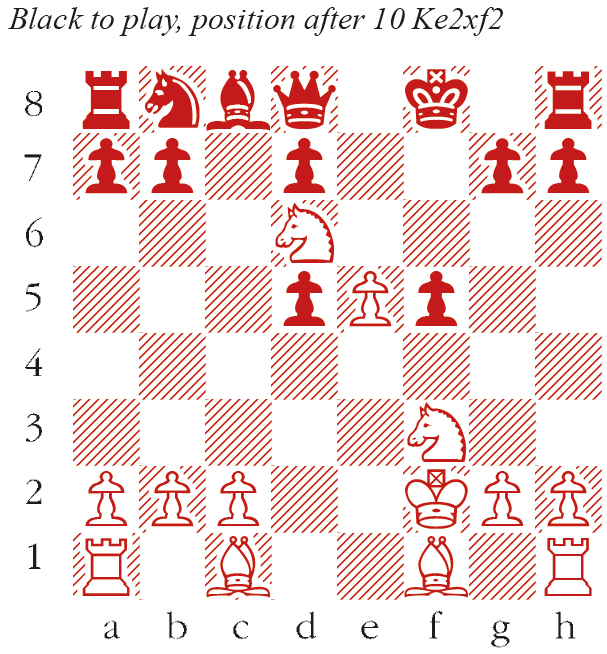
1 e4 e5 2 Nf3 Nf6 3 d4 Nxe4 4 dxe5 Bc5 4…d5 is more popular and far safer. 5 Qd5 Bxf2+ 6 Ke2 f5 7 Nc3 c6 8 Nxe4 cxd5 9 Nd6+ Kf8 10 Kxf2 (see diagram) Nc6 11 Be3 d4 11…Qc7 is a clever defensive idea, threatening Nc6xe5. Then 12 Nb5 Qa5 13 Bd3 d6! returns a pawn to activate the miserable Bc8, which proves so ineffectual in the game. 12 Bf4 Qb6 13 Bd3 Ne7 13…Qxb2 can be ignored: 14 Rhf1 and Kf2-g1 prepares an attack along the f-file. 14 Bd2 Nd5 15 Bxf5 Ne3 16 Bd3 Ke7 17 Rhe1 Rf8 Losing by force. 17…h6 was essential, to rule out a future check with Bg5. 18 Rxe3! dxe3+ 19 Bxe3 Rxf3+ 19…Qxb2 20 Bg5+ Ke6 21 Bc4 mate displays perfect minor piece coordination. 20 Kxf3 Qxb2 21 Bg5+ Ke6 22 Re1 b5 Stopping Bd3-c4 mate, but dropping a rook. 23 Bf5+ Kd5 24 Be4+ Ke6 25 Bxa8 Qc3+ 26 Re3 Qxc2 27 Be4 Qd1+ 28 Kg3 Qh5 29 h4 Black resigns
At the time of writing, India’s Arjun Erigaisi is the top seed remaining. In the ‘last 16’ round, he dispatched Levon Aronian in style:
Levon Aronian-Arjun Erigaisi
Fide World Cup, Round 5, Goa 2025
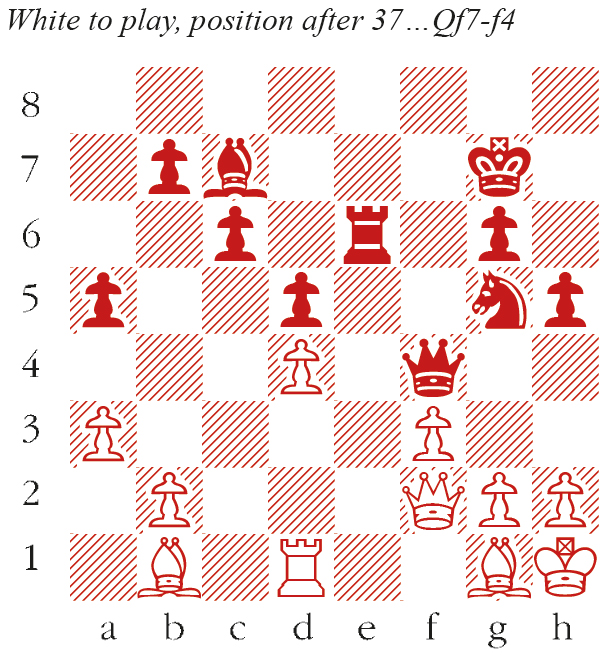
38 Re1? Nh3!! White resigns due to 39 gxh3 Rxe1 40 Qxe1 Qxf3 mate, or 39 Qf1 Nxg1 40 Qxg1 Rxe1 41 Qxe1 Qxh2 mate.
Two English contenders, Nikita Vitiugov and Michael Adams, were knocked out in early rounds. They, along with Gawain Maroroa Jones and me, are the England squad regulars competing in the elite all-play-all tournament at the XTX Markets London Chess Classic. We will face a powerful lineup of six foreign guests, including Nodirbek Abdusattorov from Uzbekistan and Alireza Firouzja from France. The festival includes an array of events alongside. Tickets are available: www.londonchessclassic.com/spectator-tickets.
No. 877
Donchenko-Liem, Fide World Cup, Goa 2025. Donchenko’s next move forced a decisive material gain. What did he play? Email answers to chess@spectator.co.uk by Monday 24 November. There is a prize of a £20 John Lewis voucher for the first correct answer out of a hat. Please include a postal address and allow six weeks for prize delivery.
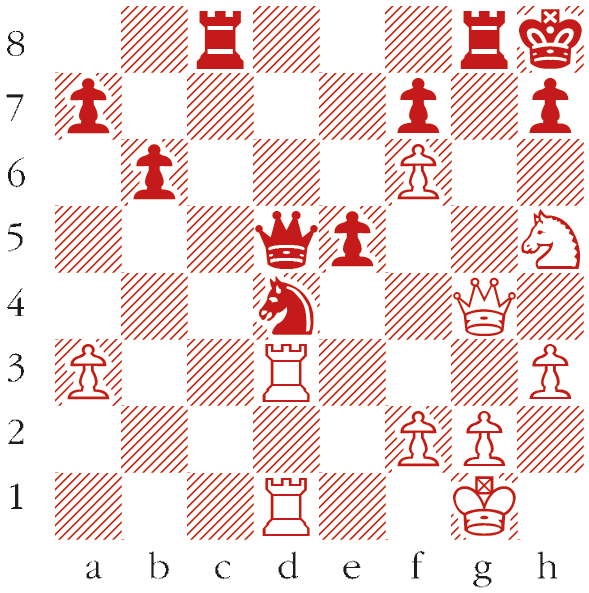
Last week’s solution 1 Bf7+!! After 1… Kxf7 2 fxe3 the queen was lost and White won. No better is 1…Qxf7 2 Qxe5+ or 1…Ke7 2 fxe3 Qd6 3 Rad1 etc.
Last week’s winner Tim Nixon, Heptonstall, West Yorkshire
Spectator Competition: Here and there
Comp. 3426 was inspired by Stephen Vincent Benét’s 1927 poem ‘American Names’ (see Charles Moore’s Notes, 1 November):
I have fallen in love with American names,
The sharp names that never get fat,
The snakeskin-titles of mining-claims,
The plumed war-bonnet of Medicine Hat,
Tucson and Deadwood and Lost Mule Flat.
You were invited to submit poems to do with place names. It was hard to whittle down the very good entries (too many runners-up to single any out) though certain places kept cropping up so I tried to avoid too much repetition. The £25 vouchers go to the following.
Morning! After downing booze,
Have a fryup, come the dawn –
Chopwell, chipping. You’ll enthuse:
Ham and eigg, or even quorn –
Rustle up another bangor,
Greet the brand new, sober day-o!
A burgar hill, you want a treat –
Smother all in salt and mayo.
Baconsthorpe is what you need:
Sit beside the river – Chew.
Foodie crackpot! Fill with greed –
Breakfast’s greasby, just for you.
Hungerford? Of course, my dear!
Topography’s a living language –
After breakfast, have a beer,
Or butterton a second sandwich.
Bill Greenwell
I will arise and go now, and go to Pity Me
Until I find somewhere to outquirk that –
Wheelbarrow Town, perhaps (pop. 23)
Or maybe Buckler’s Hard or Symonds Yat.
I shall hie me hence to Once Brewed
And live on moonshine hooch,
Or seek a Gallic mode and mood
In Ashby-de-la-Zouch.
Surely in Kingston Bagpuize
I could live in some decorum,
While sheer charisma must suffuse
Whitchurch Canonicorum.
Or I’ll leave Waverley Station,
To another novel go,
With its mark of exclamation:
I am coming, Westward Ho!!
David Shields
Place names found in Somerset
Paint pictures in the mind
Suggesting, should you visit them,
The kind of place you’d find:
Grey, gruesome names like Gurney Slade
And pithy names like Pylle,
Noble names like Wellington
Or Keinton Mandeville.
Weird, wicked names like Wookey Hole
And watery names like Wells,
Or names like Charlton Mackrell
With its hint of fishy smells.
But best you never visit
Since it would be such a shame
If what you pictured in your mind
Was nothing like its name.
Alan Millard
If I should die, think only this of me:
I want nothing interred at Wounded Knee;
Chop me up and do your worst;
But please respect my wishes first.
Dispatch my parts across the land:
To Fingringhoe, perhaps a hand;
Great Snoring seems a fitting site
For a nose that foghorned through the night.
Brain to Crackpot; paunch to Beer
(Not Droop – I’d like to make that clear);
Forgive me Lord, for I have sinned:
So bury my buttocks at Brokenwind.
Then speed, bonny boat, across the sea
With everything else I used to be;
Farewell cruel world, goodbye to all that:
And bury what’s left in Orkney’s Twatt.
Richard Warren
For thirty thousand years of man
It flowed with quiet aplomb.
Quite happily unknown to most.
Not now. It’s called The Somme.
A lot of quiet backwaters
Were happy to remain
Obscure. Columbine, Sandy Hook.
Aberfan or Dunblane.
The magic mystic orient
Has damaged placenames, too.
Hiroshima, of course. My Lai,
Or Dien-Bien-Phu.
Dylan Thomas got the point
And wisely chose to call
His story-town Llareggub:
Famous for bugger all.
Brian Murdoch
We can’t remember Adlestrop,
We lost the plot in Splatt,
Our GPS won’t work down south,
So there’s no hope of Twatt.
We passed a painful Crapstone,
Peeved in Peebles, soaked in Bath,
Dissed Diss, went nuts in Knutsford,
Battled Battle’s beaten path.
We had a ball in Rugby,
Cheesed off Cheddar, savoured Rye,
Saw Nantwich, Prestwich, Sandwich,
But we couldn’t fathom Wye.
We made haste touring Hastings,
Squeezed ourselves through Butthole Lane,
Don’t sing of happy highways, please,
We’re sodding lost again.
Janine Beacham
No. 3429: Write christmas
You’re invited to tell the story of the nativity in the style of a well-known writer (150 words max). Please email entries to competition@spectator.co.uk by 1 December. The early deadline is for the Christmas schedule.
2730: Herrlines
The unclued lights, (when taken as an individual, three pairs and one trio), are of a kind, verifiable in Chambers (13th edition).
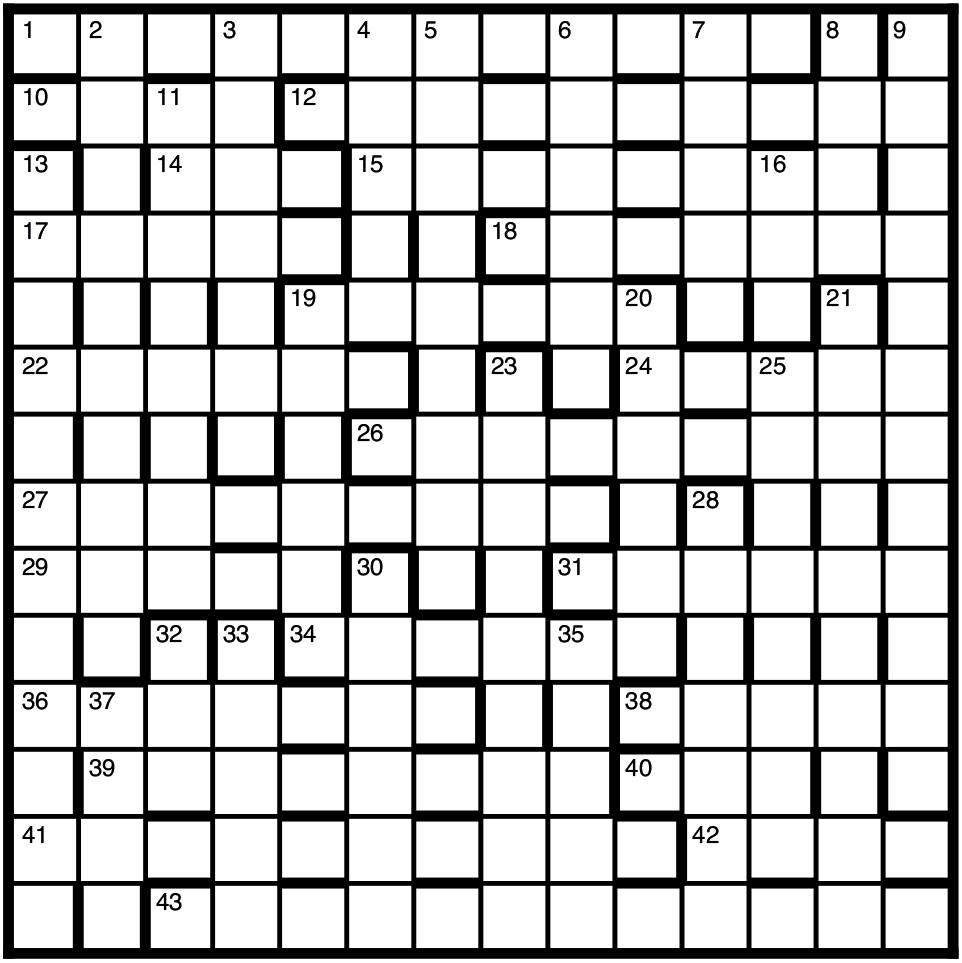
Across
10 Father Gold froze thematically (4)
12 Awkward bra stealer can be nicked (10)
14 An indefinitely large number of alcaics – not odd! (3)
15 OK turning west, pulled along and grovelled (8)
19 Two journalists admitting half the article has been blue-pencilled (6)
22 Anger cut short in pursuit of peace (6)
24 Australia’s Khawaja is chap from the States (5)
26 Metal ring for Jamaican musicians (5,4)
27 Cutting grass and tidying up after start of summer (9)
29 In France it is a basket used when playing jai alai (5)
34 Continue to exist and have a specific diet (4,2)
36 ‘I first’ is for such a person (7)
39 Clearly heading towards studying at university? (2,6)
40 Rod’s letter is spoken of (3)
41 Feat of chaps in disgrace (10)
42 Pity it has only four chapters (4)
Down
2 Rebuilt gantries or frames in fireplaces (4,6)
3 Removing all traces of time to celebrate (7)
4 In the kirk, edgy and annoyed (5)
5 Wild Picts riot, having such involuntary reflex reactions (9)
6 Consider end of Close Encounters upset (6)
7 Spoke of area of Argyll and Bute’s grasslands (5)
8 M*A*S*H star appearing during formal dances (4)
9 Without doubt, you and I will turn round with lady (4,3,5)
11 Sweet spinsters and lords and ladies ignored island at sea (3,5)
13 Most of the month with one American salad – a tragedy (6,6)
16 End of problems on German river (3)
21 Like some leaves moving all at once, absorbing energy (10)
23 State notes Rector has left diocese (9)
25 Hate Tim out with posh French boy (8)
28 Match the sink, say (7)
32 Hundredweight! (3)
33 Parish priest and little girl by vehicle (5)
35 Signs round loo (5)
Download a printable version here.
A first prize of a £30 John Lewis voucher and two runners-up prizes of £20 vouchers for the first correct solutions opened on 3 December. Please scan or photograph entries and email them (including the crossword number in the subject field) to crosswords@spectator.co.uk, or post to: Crossword 2730, The Spectator, 22 Old Queen Street, London SW1H 9HP. Please note the deadline is earlier than usual – this is because of the Christmas printing schedule.
2727: On track – solution
The unclued lights are F1 RACE TRACKS which include the pairs at 15 & 16 and 36 & 26.
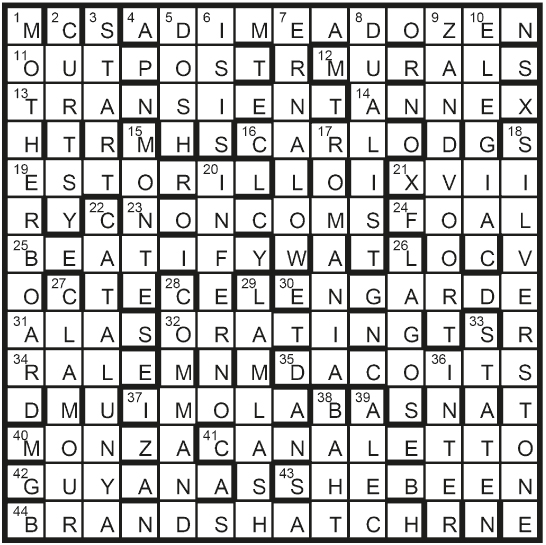
First prize Christine Rees, Cowlinge, Suffolk
Runners-up Dorothy Mulvenna, Bay Horse, Lancaster; Richard Lawn, Coventry
It’s not science if you can’t question it
Follow the Science. The Science is settled. Two phrases which invoke the power of open inquiry to close down open inquiry. Science is not a body of unalterable doctrine, a chapter of revealed truths. Science is a method. It is a means of arriving at the best possible explanation of phenomena through thesis, testing, observation and revision.
Science depends on a culture of doubt, as one of the greatest scientists of the last century, Richard Feynman, continually argued. Its conclusions, by definition, are provisional models which are subject to future revision as new data and better explanations arrive. The story of science is a chronicle of old models being superseded and new theories seeking to make sense of our world.
The claims of certainty about future consequences of global warming deserve particular scrutiny
Throughout its history, science has been misunderstood, sometimes deliberately, often to serve political purposes. Genetics and evolutionary biology are areas where a specific and partial understanding of scientific findings has repeatedly been annexed by ideology. Climate change is another.
The best available evidence we have strongly indicates that man’s economic activity contributes to the warming of the planet. That is undoubtedly the prevailing scientific consensus. But it is not unscientific to question how conclusions have been drawn from that theory to dictate human action. It is not, as Ed Miliband, the Energy Secretary, would have it, ‘denial’. It is the scientific method at work.
A properly scientific approach to global warming must consider not just the impact of man’s activities, including carbon emissions from fossil fuels, but other factors that bear on the hugely complex system which is the Earth’s climate. The theoretical work behind the warming effect of emissions is robust, yet the claims of certainty about future consequences deserve particular scrutiny.
Campaigners and politicians have predicted terrifying consequences with a level of pessimism that sounds more like the utterings of a millenarian cult than the scientifically literate offering a judgment on likely probabilities. Those same people have weaponised the precautionary principle, taking what is a possible future risk and elevating it to a certain apocalypse that justifies the most drastic action. Nations have been asked to arrest economic development, desist from the use of efficient sources of energy, distort market signals and throw the pace of growth into reverse in order to slow global warming.
A series of international conferences – the latest of which is COP30, taking place in Brazil this week – require participants to commit to energy policies that depend on state direction, legal compulsion, taxpayer subsidy and thermodynamic legerdemain. Britain’s Labour government is leading the crusade, which is why we have the highest energy prices in the developed world. Other countries affirm the importance of these policies but take, at best, a more Augustinian approach: make me net zero but not yet. Brazil is driving ahead with the exploitation of its fossil fuel resources – planning to invest $100 billion in oil and gas production over the next five years, increasing production by 20 per cent – and China is manufacturing solar panels for us while building new coal power stations for itself.
It is not in any way immoral or illegitimate, let alone unscientific, to ask if the commitments we are making are justified. That is precisely the question Bill Gates is now asking. Britain is set on a course that requires us to leave efficient energy sources in the ground, which countries like Norway are happy to exploit. We rely on our neighbours for our energy supplies. We subsidise wind and solar power which, because of their intermittency, still require us to have fossil fuel infrastructure as a back-up. We are giving up productive farmland and risking environmental damage to install yet more renewable energy infrastructure. And we are accepting de-industrialisation and the weakening of our sovereign defence capacity along the way. As the former MI6 chief Sir Richard Dearlove explains, we are giving the Chinese Communist party effective control over more and more of our economy, further compromising our national security in the process.
These costs are certain. They are rising too, unlike the sea levels that climate alarmists predicted would have submerged several island nations by now. It is still true that future climate change is likely to bring significant challenges for poorer societies – but we are unlikely to be in a position to help those nations adapt if we ourselves are weaker and poorer.
It is because debate is needed on energy and climate policy – all the more so because of the vehemence with which some try to shut it down – that The Spectator is committed to publishing a series of articles in the coming weeks that will examine the costs of our current approach and the assumptions underlying it. The first essays in this series are Sir Richard’s analysis of the security risks of energy policy and Matt Ridley’s exploration of the possible benefits from investment in fusion research. We welcome as wide a range of views as possible in reviewing these questions. Science is not served by the hunting down of heretics but by the opening up of inquiry.
Portrait of the week: an immigration overhaul, Budget chaos and doctors’ strikes
Home
Shabana Mahmood, the Home Secretary, proposed that refugees would only be granted a temporary right to stay and would be sent home if officials deemed their country safe to return to. They would not qualify for British citizenship for 20 years. To avoid drawn-out appeals, a new appeals body would be created. Article 8 of the European Convention on Human Rights, which protects migrants’ ‘right to family life’, would somehow be weakened. Digital ID was invoked for the enforcement of checks on status. Opponents seized upon the possibility that, to pay for accommodation, migrants’ jewellery would be confiscated. Kemi Badenoch, the Conservative leader, offered her party’s support if the government encountered a backbench rebellion against the plans, outlined in a government policy statement, Restoring Order and Control. According to the Office for National Statistics, the number of British nationals leaving the country last year was three times the previous estimate: 257,000, not 77,000. Luke Littler, 18, became the Professional Darts Corporation world number one.
Rachel Reeves, the Chancellor of the Exchequer, let it be known that she had dropped her plan to raise income tax at the Budget on 26 November, having spent weeks persuading voters and the markets that she had no alternative. Jaguar Land Rover reported a loss of £485 million, against a profit of £398 million a year ago, before it suffered a cyber attack. Resident doctors in England downed stethoscopes for five days, their 13th strike since March 2023. Lilliput Church of England Infant School in Poole, Dorset, asked parents to encourage their children not to sing songs at school from the film KPop Demon Hunters.
The US private equity firm RedBird dropped its £500 million bid to buy the Telegraph. Sir Lindsay Hoyle, the Speaker, circulated an MI5 warning of the risk to parliament from Chinese spies. Britain lacks a plan to defend itself from a military attack, a report by the Commons defence committee found. Monmouth was badly flooded. Agency workers brought in to cover for dustmen on strike in Birmingham since March themselves voted to strike.
Abroad
President Donald Trump of the United States said he would sue the BBC for between ‘$1 billion and $5 billion’; it had apologised over misleadingly editing footage to make it seem that he had encouraged the storming of the Capitol in 2021, but it paid no compensation. Trump turned against Marjorie Taylor Greene, the Republican Congresswoman who had called for the release of files on Jeffrey Epstein; he called her wacky, a lunatic and a traitor to the party. Then he suddenly declared: ‘House Republicans should vote to release the Epstein files, because we have nothing to hide.’ The House voted 427-1 to compel the Justice Department to publish them. At a press conference with Mohammed bin Salman, Trump said the Saudi ruler ‘knew nothing’ about the murder of Jamal Khashoggi, which a US intelligence report in 2021 said he had approved.
Germany will require all 18-year-old men to fill in a questionnaire on their suitability to serve militarily. Anti-corruption officials in Ukraine reported embezzlement of £76 million in the energy sector; President Volodymyr Zelensky promised to overhaul its management. He visited Greece, which agreed to supply liquefied natural gas originating from the United States to counter Russian attacks. A liquid petroleum gas tanker was set on fire by a Russian drone strike on the Ukrainian port of Izmail on the Danube. Donald Tusk, the Prime Minister of Poland, called an explosion 60 miles from Warsaw on a railway line leading to the Ukraine border ‘an unprecedented act of sabotage’. Ukraine will receive up to 100 Rafale F4 fighter jets from France. China urged its citizens not to travel to Japan, whose new Prime Minister, Sanae Takaichi, said that her country could respond with its own forces if China attacked Taiwan. Iran’s Islamic Revolutionary Guard Corps seized a tanker in the Strait of Hormuz; it was bound for Singapore from the United Arab Emirates.
Sheikh Hasina, the former prime minister of Bangladesh, was sentenced to death in absentia, being held responsible for the death of hundreds of protestors. The United States was to designate as a terrorist organisation the drug Cartel de los Soles, which it alleges is led by President Nicolás Maduro of Venezuela. Wilmer ‘Pipo’ Chavarría, the head of the 8,000-strong drug gang Los Lobos in Ecuador, was arrested in Malaga, Spain; his family had claimed that he had died of a heart attack in 2021. CSH
I regret my intolerance over Brexit
Cannabis smoke lingering along the sidewalks of Washington D.C. was the most palpable fruit of liberty since my last visit to the US capital. I’m in town to give a talk at Britain’s dazzling Lutyens Residence about the evergreen ‘special relationship’ ahead of the US’s 250th anniversary next July. Acting ambassador James Roscoe has stepped up with aplomb to fill Peter Mandelson’s big shoes, aided by his renaissance wife, the musician, author and broadcaster Clemency Burton-Hill. America’s anniversary will fall on the watch of its 47th President. The Republic’s first four incumbents, George Washington, John Adams, Thomas Jefferson and James Madison, inspired by some of the greatest minds of their and any age David Hume, John Locke and Jean-Jacques Rousseau, made the new country. The anniversary is a vital opportunity for re-dedication to their enduringly important ideas, not just an excuse for contemporary celebration.
The 80th anniversary of the end of the second world war focused more on victory than the ideals for which it was fought. Remembrance Week was wonderfully dignified. But was it too… backward-looking? From east to west, democracy, liberty from oppression and the rule of law – for which the war was waged – are all in retreat, while anti-Semitism is waxing.
My book The Path of Light, published last month, describes my walk through Germany, the Czech Republic and Poland to Auschwitz in search of heroes who stood up against dictatorship. As I walked along the rivers Rhine, Danube, Elbe and Oder, I heard from those traumatised by the resurgence of anti-Semitism. In the Czech Republic, anger is still raw at the betrayal of their country by Neville Chamberlain in 1938 and destabilisation today by Russia. In Poland, I heard fury at the betrayal by Britain entering the war in 1939 to defend the country’s neutrality to leave it in 1945 to the Soviets and 45 years of brutality. My walk, which will finish on the Ukraine front line, will create a ‘path of peace’ across Europe, along which all can walk to discover what we share in common rather than what divides us.
That same passion is motivating another project to mark the tenth anniversary of the Brexit referendum next June: an edited book with a diverse cast of authors. The truth about Brexit is that neither the disaster predicted by Remainers nor the benefits hoped for by Brexiteers have transpired. At best it’s been a score draw. I remain sad we left the EU, for all its flaws, having taken 50 groups to hear the Last Post ceremony performed under the Menin Gate at Ypres, and believing the EU our best bet to prevent future war. But I regret still more my anger and my intolerance over Brexit. Mistakes have been made on all sides but gone is the time for pointing the finger. Pulling together to make a success of this peculiarly British muddle is the best formula for the next ten years.
Another week and more bad news for the government. The Prime Minister is First Lord of the Treasury. Helping to manage the national finances is the office’s most fundamental job. Until Robert Peel in the 1840s, the PM largely ran the Treasury himself. Keir Starmer has lost control of the economy and politics. He may be hardworking and intelligent but came in ignorant of the office and needed tutoring on how to be Prime Minister. Instead, he appointed the wrong people as his most senior aides, then allowed them to be briefed against – unforgivable in any leader. To succeed as PM is not impossible: but there are rules to maximise, if not guarantee, the chances of success. Clarifying these is one reason we are creating a permanent Museum of the Prime Minister in Westminster, which would explore the achievements and failures of our leaders. Providing Britain with a platform to be proud of the PM is another core motive. Britain should congratulate itself for creating the office of PM, now copied across the world.
Britain should be equally proud of the BBC: the most trusted media outlet in the US, as elsewhere. A minority of employees with partisan views and poor professional standards have let it down. But the endless battering from elements on the right imperil its future and its global reputation. The BBC, like Downing Street, the civil service and the criminal justice system, are ripe for smart reform, not trashing.
AI is not helping the cause. Jonathan Sacks, the former chief rabbi who died five years ago this month and whose official biography I’m writing, was one of the first to spot the risks. If not employed wisely, AI will infantilise us all, like cannabis is doing to partakers, whether in Washington or across the free world.
Would you pay £65 for toothpaste?
Time was, you didn’t look forward to going to the dentist. Even for routine stuff, your highest aspiration would be to get it over as quickly as possible with as little unpleasantness as possible. Most of the procedures seem pretty mechanical, including having the most sensitive bits of your teeth scraped with a metal thing.
That was what I thought before I encountered Anti-Ageing Dentistry at the Nejati clinic in Belgravia, where the founder – it seems wrong to call Brandon Nejati a mere dentist – talks about ‘pampering’. This is where a really expensive luxury spa meets dentistry and it’s the most obvious example of how oral care is changing. Brandon’s wife, Mahsa – they’re from Iran – talks about the Oral Hygiene Treatment Wellbeing Experience as a ‘facial for teeth’. You get the cleansing, the serum, the LED light therapy (all standard in facials), and at the end, she promises, ‘your teeth will feel fantastic’. They do. This being Belgravia, it’s all holistic, which means there’s an in-house acupuncturist as well as the usual specialists.
‘Picture your typical cleaning session transforming into a spa-like wellness journey,’ says the clinic’s blurb. The place is all curves, light oak panelling and incense. There’s music. You get a herbal drink in a stoneware cup while you wait, and watch a relaxing film of a jungle scene in which even the frog on a twig looks chilled.
The normal dentist experience is absent until you lie in the chair. I had the Oral Hygiene Treatment. Mahsa sprays ultra-fine salt and minerals onto the teeth with a Swiss machine ‘to cleanse its pores with a soft touch’ – just like a facial. Because my teeth have so much deposit (probably a euphemism for plaque), she uses a different grade of salt as a descaler: no metal scrapers here. It’s antiseptic, she says, and gets under the gum to prevent inflammation and get at bacteria. She applies two different cleansing serums, one with rosemary and thyme, another with a little peroxide – to suffocate, she says, the bad bacteria. Then there’s the LED light to warm up the serum so it penetrates the pores of the gums and the enamel. That goes on for ten minutes. I don’t know what it’s doing but none of it hurts.
There’s a lot of talk about bacteria, bad and good. The salt treatment (which isn’t salty) preserves the good stuff, for the philosophy here is that the mouth is the gateway to the body. ‘Our approach in this practice,’ says Mahsa, ‘is that everything that grows in the mouth, especially the harmful bacteria, will travel to the rest of the body. And they can cause systemic diseases.’ Two recent papers suggest that bad bacteria from the mouth can be a factor in Parkinson’s disease and Alzheimer’s. ‘The whole thing is about balance in the mouth,’ she says. Gum health is a big thing. ‘When you have inflammation in your mouth, your body is working overtime to make sure that infection doesn’t spread to the rest of your body. So you feel run down, you feel tired.’ Maybe. Tiredness is the human condition these days.
Like a spa, there are products in soft-lit displays, and they look more like skincare in tubes than toothpaste – white, cinnamon-coloured and pinkish. These, says Brandon, have minerals in them and are designed to be used morning and night, with an all-day one for whitening. They come with a brush: a take-home tip is to use a soft brush in circular movements; the other is not to rinse off the toothpaste, so it carries on working. There are lots more products coming up, including an LED kit to use at home on the teeth, like the LED face masks that are everywhere now. ‘We’re the first to apply the principle to the teeth,’ Brandon tells me.
As for aesthetics, which is what drives many clients here, Brandon winces when you mention Turkish teeth. It’s all about artistry: Brandon builds up microlayers of a composite that includes porcelain particles, opaque at the bottom, translucent at the top. He shows me pictures of before and after teeth, including one of a famous politician and a big business leader (frustratingly, it’s hard to identify people from teeth alone); he uses a softer contour for women, a harder outline for a masculine look. Gendered teeth; there’s a thing.
What struck me was that he didn’t, like another dentist I visited, profess himself fascinated by my unworked-on wonky teeth. Rather, he remarked that they were good teeth, but if I wanted, I could repair a break in the front.
It’s expensive, at £795 to £1,500 a tooth for microlayering. The toothpaste with brush is £65; the Oral Detox £179. It’s all fabulous and a world away from the dental care that most people get. For the lucky few, there are cutting edge clinics; for the NHS-dependent, it’s just luck if you can find a health service dentist at all. The gap between rich and poor starts as soon as you open your mouth.
How many illegal migrants does Britain return?
Condemned leaders
Former Bangladeshi prime minister Sheikh Hasina was sentenced to death for crimes against humanity, for using lethal force against student protests last year. But on past records, she might yet live to an advanced age. The last national leader to be executed was Saddam Hussein in 2006, during the Allied occupation of Iraq. Other leaders sentenced to death in their country’s courts have fared better:
— Emile Derlin Zinsou, installed as president of Dahomey (now Benin) after a coup in 1968, was sentenced to death in 1975. That was rescinded and he returned to Benin in 1990. He died aged 98 in 2016.
— Chun Doo-hwan, who led a coup in South Korea in 1979, was sentenced to death in 1996, later commuted to life imprisonment. He died in 2021 aged 90.
— Pervez Musharraf was sentenced to death for leading the military coup which brought him to power in Pakistan in 1999. The sentence was overturned and he went on to live until the age of 80, dying in 2023.
Returning migrants
The Home Secretary announced that she is to ban UK visas being issued to nationals of Angola, Namibia and the Democratic Republic of the Congo over their failure to take back failed asylum seekers from Britain. How many illegal migrants does Britain return?
— In the six-month period from 3 July 2024 to 4 January 2025, 16,400 migrants were returned to their home countries (4,390 were enforced returns and 2,590 were foreign offenders). In that period, 34 charter flights were flown to return migrants.
— By comparison, over the whole course of 2024, 36,816 illegal migrants arrived in small boats.
Careworn
How much is the state spending on social care? In 2024/25 the bill came to £34.5bn, an increase of 8% on the previous year.
— The average cost of residential/nursing care was £1,185 per week, the most expensive being in London (£1,309) and the least in the north-east (£1,012).
— However, the largest single expense for the over-65s was care in the community (£11.6bn). Residential care cost £7.9bn, nursing care £3bn.
Post combat
How safe was life in the armed forces after operations in Iraq and Afghanistan ended?
Between 1 January 2015 and 30 September 2025 there were 3 battle injuries and 1,433 non-battle injuries. There were 19 fatalities, only one of which was in battle.
The steady erosion of academic rigor in German schools
German teachers are a privileged species. Most of us enjoy the status of a Beamter, a tenured civil servant. We can be dismissed only after a serious criminal conviction, we are exempt from social-insurance contributions and even our mortgage rates are lower. Such comfort discourages dissent. Yet, after more than 25 years as a pampered Beamter, I find myself overwhelmed, not by the teaching load or the students, but by the accelerating erosion of academic standards.
Having taught English, history and Latin at four different Gymnasien, I have learned that challenging students is now frowned upon by both bureaucrats and politicians. Nearly all my colleagues agree that standards have plummeted. A mathematics teacher tells me that assignments he set 20 years ago for his older students would now be beyond even the brightest. One thing is certain: the children are not to blame.
The decline began in 1964, when philosopher Georg Picht published The German Education Catastrophe, calling for a drastic expansion in the number of college-eligible high-school graduates. Until then, only those who graduated from a Gymnasium, the equivalent of a selective high school, qualified. Picht’s alarmism found ready ears. In 1960, 7 percent of students left school with college-level results; today, more than half do. The inflation of academic credentials accelerated with the 1999 EU Bologna reforms, which dismantled the traditional and rigorous European degree structure and replaced it with the Anglo-American model. Only medicine and law escaped. The effect has been the slow death of Germany’s once-superb vocational system. Many small- and medium-sized businesses no longer offer apprenticeships but almost anyone who has finished high school can find some comfy course at college. More than 70 German universities now offer degrees in gender studies. It’s dumbing all the way down.
As college places were massively expanded, the Gymnasien had to lower their entry thresholds to keep pace with the demand for more and more students. Since 2002, in my own state of North Rhine-Westphalia, parents have had the right to choose their child’s secondary school, regardless of their teachers’ recommendations. Children deemed unready for the Gymnasium are admitted and, once enrolled, bureaucratic obstacles prevent them from being moved to a more suitable high school.
The deterioration has been striking in my subjects. Since 2007, students have been allowed to use dictionaries in English exams, which discourages them from memorizing vocabulary. That same year, the Zentralabitur – a centralized state exam – replaced teacher-written finals. Previously, each school designed its own papers, tailored to what had been taught. Now, vague, homogenized curricula require little factual knowledge. History was replaced by the nebulous goal of “intercultural communicative competence.”
Objective grading once relied on the Fehlerquotient (number of grammatical errors per hundred words). This was derided as “too rigid,” replaced by an imprecise points system designed to boost marks. Marks are awarded for trivialities, such as “structuring” a text. Students quickly learn the formula: use a few stylistic devices – enumerations, metaphors, repetitions – and you can be seen to analyze anything. Teaching to the test has replaced teaching to think. Real objectivity would require blind marking, external examiners and anonymized papers – none of which exist.
When I attended a Gymnasium in the 1980s, advanced English students were required to study an entire Shakespeare play. Later, this became selected scenes, then scenes from film versions. In 2023, the Bard was dropped entirely, replaced by the study of “questions of identity and gender.”
Since 1970, North Rhine-Westphalia has had only eight years of non-leftist control over education. Progressivism now permeates every level. Among teachers, Green sympathies are disproportionately high. Of the 17 newspaper articles used in exams between 2020 and 2025, not one came from a conservative source. The Guardian and the New York Times dominate.
Behind all this lies the creed of “competence orientation.” Grammar, spelling and factual knowledge are dismissed as obsolete. It is enough to “communicate effectively.” Why, then, read Shakespeare? Why learn a soliloquy by heart? In biology and geography, exams no longer test knowledge but the ability to interpret pre-packaged “material” – charts, graphs and snippets of text. A colleague who marks geography papers believes anyone with common sense and patience has a decent chance of passing.
Latin, too, has been softened. Translation from German to Latin is banned as it is “too difficult.” Lessons are increasingly padded with Roman culture and history.
When the state exam was introduced, most teachers welcomed it because it meant less work. I realized something had gone horribly wrong when I graded a history paper by a gifted pupil who provided precise dates, facts and definitions. The new state syllabus allowed only limited marks for such content. I only managed to salvage her grade by awarding her full points elsewhere.
Across all subjects, measurable trivia has replaced genuine learning. Multiple choice has supplanted multiple perspectives. Today’s “competence orientation” manufactures compliant consumers who consult Wikipedia or ChatGPT for ready answers. To criticize “competence orientation” is near-heresy; every mainstream party endorses it. It was introduced in my state under a Green minister, continued by a Liberal and remains untouched under a Christian Democrat. For the left, it serves egalitarianism; for Liberals, it produces plentiful but pliant employees. The Christian Democrats’ acquiescence is harder to fathom. But the result of all this is clear enough. In 2011, a student of mine wrote at the end of a Shakespeare exam: “Students don’t have to learn any more facts. Studying in this way is boring. Students will die of boredom.” If only I could have given her full marks.
This article was originally published in The Spectator’s December 8, 2025 World edition.
Ukraine is on the verge of political collapse
Defeat, political implosion and civil war – those are the jeopardies that Volodymyr Zelensky faces as Ukraine heads into the most difficult and probably the last winter of the war. Evermore effective Russian strikes against Ukraine’s energy and transport infrastructure are likely to plunge swaths of the country into cold and darkness. Russian troops continue to push forwards slowly and bloodily in Donbas and, more dangerously, on the southern flank in Zaporizhzhia. Desertions from the Ukrainian army are up four times since last year and the number of deserters now matches the number of active fighters. The US has turned off the money taps and Europe struggles to produce the cash Kyiv needs to keep its war effort going.
But the most damaging crisis of all is a $100 million war profiteering scandal that has implicated many of Zelensky’s closest political allies and personal business partners and rocked faith in the government to the core. ‘It’s difficult to overstate the popular anger in Ukraine over this case,’ reports Jimmy Rushton, a Kyiv-based security analyst. ‘While all of the country suffers blackouts, members of the political elite stand charged with stalling efforts to harden energy infrastructure because they weren’t receiving big enough bribes.’
Zelensky’s public trust has fallen to under 20 per cent, down 40 per cent since the beginning of the year, claims the opposition parliamentarian Yaroslav Zhelezniak. And while the Ukrainian President voiced support for the National Anti Corruption Bureau (Nabu) investigation, so far no senior figures have been arrested. Timur Mindich, co-founder of Zelensky’s Kvartal-95 television production company and the man at the centre of the scandal, fled Ukraine just hours before Nabu raided his flat, leaving behind packs of cash and a golden toilet. Clearly tipped off, Mindich is now reportedly in Israel, which does not extradite its citizens. Herman Halushchenko, the energy minister also named as a suspect by Nabu, has been dismissed but not charged. He has said he will defend himself and ‘prove his position’.
What makes this scandal into a political crisis is that since the summer Zelensky has done everything in his power to shut down Nabu’s investigation. After Nabu surveillance equipment was found in Mindich’s apartment, Ukraine’s SBU security service and the prosecutor-general’s office – both headed by Zelensky loyalists – began aggressive investigations into top Nabu officers, jailing its lead detective, Ruslan Magamedrasulov, and his father. In July Zelensky hurriedly pushed through the now-infamous Law 12414 which sought to bring Nabu and its judicial arm Sapo under government control. Ukrainian civil society was horrified and major street protests against Law 12414, the first of the war, rocked Kyiv. Ukraine’s western backers, which had set up Nabu and Sapo back in 2014, were also appalled. Zelensky was forced to scrap the law – and Nabu’s investigations continued.
‘I wish the United States had as robust and effective anti-corruption institutions and organisations as Ukraine,’ Michael McFaul, the former US ambassador to Russia, tweeted this week. The fact that Ukraine is now in the middle of a major corruption scandal ‘should be understood not as a sign of weakness, but as evidence that Ukraine has remained a functioning democracy’, argues Olena Tregub of Ukraine’s Anti-Corruption Commission (a separate body to Nabu). ‘This investigation became possible only because Ukrainian citizens mobilised this summer to defend the independence of the anti-corruption institutions.’ But it was Zelensky who tried to shut down Nabu’s independence, and the people who stood against him.
The scandal has already damaged Ukraine’s international standing. ‘I would not want the money of Italian workers and pensioners to be used to fuel further corruption,’ said Italy’s deputy prime minister Matteo Salvini (to which defence minister Guido Crosetto wittily reposted that ‘the Americans and the English when they landed in Sicily [in 1943] did not judge Italy for the presence of the mafia’.) But even the Polish Prime Minister Donald Tusk, a staunch ally of Kyiv, warned that ‘enthusiasm for supporting Ukraine has weakened in Poland and abroad… the damage is done and the cost will be high’. Tolerating corruption could ‘ultimately cost you the war’, he added.
The emerging details of the case are ugly. The core of Nabu’s case is that Mindich and his associates allegedly skimmed off 15 per cent from contracts to build air-raid defences around the critical infrastructure of Energo-atom, Ukraine’s nuclear energy body. According to an investigation by Euromaidan Press, while 60 of the state-owned electricity utility Ukrenergo’s assets were protected with highly effective concrete defences by September last year, the same work at Energoatom was never carried out, leaving them defenceless against Russian attacks.
Next on Nabu’s list is military procurement. ‘Corruption is not a problem of the system – corruption is the system,’ says Ben Aris of BNE, a Berlin-based regional analyst. ‘In a country without a working judiciary or property rights, power is the ability to give or take away cushy jobs where deputies can skim off the top.’
It is not yet clear whether Zelensky himself appears on the 1,000-plus hours of audio evidence of conversations between Mindich and other accused officials, and the President has not been accused of any wrongdoing. But Zelensky’s right-hand man and chief of staff Andriy Yermak – codenamed ‘Ali Baba’ by Nabu – is said to feature. Yermak has denied these allegations.
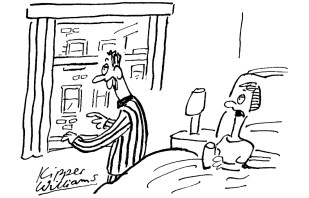
Mindich fled Ukraine just hours before his flat was raided, leaving packs of cash and a golden toilet
The gory details of Nabu’s investigation are less important than the potential political fallout. Ukraine’s traditionally turbulent domestic politics have been largely silenced by the war, with former enemies uniting behind Zelensky and forbearing from criticising him openly. But as Zelensky’s credibility dwindles and his political grip weakens, that truce is unravelling. The stage is being set for a tussle for power that could tip into political chaos.
Zelensky is six and a half years into a five-year term, but insists that Ukraine’s constitution bans national elections in wartime. Leading the polls to replace him is the former army chief Valeriy Zaluzhny, sacked by Zelensky last year and sent into political exile as ambassador to London. But so far, Zaluzhny has remained resolutely silent on his political future.
The same cannot be said for Zelensky’s most dangerous opponents, Ukraine’s ultranationalists. ‘Corrupt officials are enemies and traitors – if you steal from the nation during a war you deserve liquidation,’ stormed Dmytro Yarosh, the former leader of Right Sector and a nationalist firebrand who threatened to hang Zelensky in 2019 if he dared to make concessions to Moscow. As long as top officials are not jailed, ‘all statements about finding and punishing culprits look like ordinary populism’, tweeted Bohdan Krotevych, former chief of staff of the Azov battalion, once a volunteer nationalist unit that has grown into a major force inside the regular Ukrainian army. ‘The absence of real changes in the Office of the President and the General Staff directly threatens the state’s sovereignty. Either you save your pro-Russian corrupt friends, or you save the state – there’s no third option.’ According to Krotevych, if the President does not make hard decisions about punishing ‘traitors’ then the people must do so themselves. ‘If the question is about the state’s existence, and the [presidency] doesn’t work – then the people have every right to take responsibility upon themselves.’ That sounds scarily like the justification for a military coup. And as Ukraine’s most heavily armed, well-organised, politically vocal and most radically anti-Zelensky military formation, Azov is fully capable of seizing the role of kingmaker in the event of a political collapse.
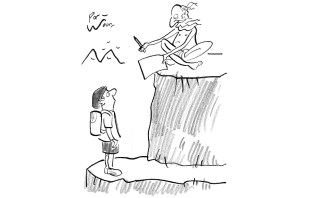
The most immediate danger for Ukraine, of course, still comes from Russia. There are disturbing signs that after three years of trying, Russian attacks are becoming dangerously effective at evading Ukraine’s air defences and destroying key electricity and gas infrastructure. Drone and missile swarms lasting for hours recently succeeded in blacking out half of Kyiv for a day, and region-wide power cuts are becoming longer. Most chillingly, many of Ukraine’s biggest 750kV electric interchanges which connect regional power grids have not yet been hit. It’s likely that the Kremlin is keeping a major attack in its back pocket for use in the depths of winter. If Ukraine’s citywide central heating systems – a Soviet legacy – are hit during hard frosts, the pipes will freeze and crack, rendering whole city blocks uninhabitable until spring. Having failed to break Ukrainians’ spirit with bombardments, Vladimir Putin’s plan seems to be to use cold and darkness to drive them from their homes.
In this winter of suffering, Ukraine’s people will need inspiring leadership more than ever before. But Zelensky’s tragedy is that the cynical thieving of his friends has robbed him of much of his once-colossal moral authority.
Event
The Spectator presents The Year in Review
Judges need fewer powers, not more
In my brief career as a parliamentarian I have developed a rule of thumb when it comes to evaluating legislation: if a bill has been brought forward in response to a national outcry about a terrible tragedy, whether the death of a child or dozens of adults, it will almost always be rotten. In particular, it will go far beyond what is required to prevent similar tragedies in future and create a swath of new laws that the already overburdened police will be expected to enforce. That I’m afraid is the default response of parliament when it’s trying to respond to an eruption of public anger: to stick more criminal offences on the statute books.
A case in point is the Public Office (Accountability) Bill, known colloquially as the Hillsborough Law. It’s named for the 97 people who died in the 1989 Hillsborough disaster and is supposed to make it easier for families and others affected by such events to find out what happened and to hold those responsible to account. Admittedly, in the case of Hillsborough, the reckoning was a long time coming, with the final government inquiry not publishing its findings until 2012 and the second coroners’ hearing not finishing until 2016. Subsequent trials ended with none of the police officers on trial being found guilty. It was those acquittals, in part, which led the government to introduce this bill.
The Hillsborough Law is supposed to help the victims of various other scandals too, such as the Grenfell Tower fire and the infected blood scandal. And to be fair, some of the bill’s clauses are unobjectionable. For instance, it creates a statutory ‘duty of candour’ requiring public authorities and public officials proactively to disclose relevant information to public inquiries, investigations or inquests. It will also make it easier for bereaved families to get legal aid.
But the purpose of the bill, as set out in clause one, is ‘to ensure that public authorities and officials perform their functions in the public interest…’. That goes far beyond what’s necessary to prevent another Hillsborough. As my colleague Lord Goodman has pointed out, it could lead to civil servants refusing to carry out the orders of a Reform government – or, indeed, any government – on the grounds that doing so wouldn’t be in the public interest. The ultimate arbiter of such a stand-off would be the courts, meaning the bill will transfer even more power from parliament to judges. The sclerosis of the British state, unable to tackle any of the country’s long-term problems because of the erosion of parliamentary sovereignty, is about to get worse.
Then there’s clause 11, which creates a new criminal offence of misleading the public: ‘A public authority or public official commits an offence if, in their capacity as such an authority or official, (a) they act with the intention of misleading the public or are reckless as to whether their act will do so, and (b) they know, or ought to know, that their act is seriously improper.’ If you’re wondering whether MPs and peers will be exempt, the answer is no. They’ll still have parliamentary privilege, but if they say anything ‘misleading’ on television or radio, even if they don’t intend it to be and don’t know that their behaviour is ‘seriously improper’, they could go to prison.
Could Ed Miliband be clapped in irons for saying household energy bills would fall by £300 a year?
Does this mean Rachel Reeves would be liable for prosecution if she raises taxes in the Budget, given that she promised not to? Could Ed Miliband be clapped in irons for saying average household energy bills would fall by £300 a year? Even if the police decided not to investigate these malefactors, there would be nothing to stop a political activist bringing a private prosecution. The thought of Jolyon Maugham being armed with this new weapon under a Reform government is terrifying. For a politician to be found guilty of this offence, even if they were spared a custodial sentence, would be career ending. The casting director of I’m a Celebrity… Get Me Out of Here! will be spoilt for choice.
Advocates of the bill claim it will help restore public trust in elected officials, but I’m not so sure. The main reason the public is disillusioned with politicians isn’t because they’re corrupt. Transparency International’s2024 Corruption Perceptions Index ranks the UK 20th out of 180 countries. No, it’s because they keep promising to fix problems like illegal immigration, only to do sod all about them. Why? Because when they move into their swanky ministerial offices they quickly discover they lack any real power. By further restricting their room for manoeuvre and placing them even more firmly under the thumb of judges, this bill will increase the public’s contempt for politicians.
Event
The Spectator presents The Year in Review
The Battle for Britain | 22 November 2025
Ben Stokes will go down as the greatest captain of modern times
And so it begins, as Donald Trump likes to say, though not usually about cricket. He was offering his thoughts on the New York mayoral elections, which is not as much fun as the Ashes. Pleasingly, the goading is reaching volcanic levels as the Perth Test gets ever closer. Who needs Trump?
The West Australian is not a paper many readers will be familiar with but its pages have been plastered with pictures of English players making their way through arrivals at Perth airport. A large photograph of Ben Stokes pushing his luggage trolley was headlined ‘BAZ BAWL’, with the subheading ‘England’s Cocky Captain Complainer, still smarting from “crease-gate”, lands in Perth early thinking dopey “Bazball” can take the Ashes’, referring to the controversial stumping of Jonny Bairstow by Australia’s Alex Carey at Lord’s in 2023.
Later the paper turned its attention to Joe Root, with the headline ‘Average Joe’ and sub-heading ‘Dud Root Down Under: Hero in the homeland, pretender in Australia. The stats that haunt England’s greatest batter ahead of Ashes showdown’. The stats in question are that England’s greatest batsman has never scored a Test century in Australia, despite scoring 39 elsewhere in the world. Dud Root is Australian slang for someone who is not very good when it comes to, er, the physical side of romance. It might be a whole load of laughs working at the West Australian, but slagging off a humble sporting titan known for his unshowy decency is a step too far, guys. Just sporting bantz, you say? Well, we’ll see.
Clearly and pleasingly, Bazball and England seem to have got under the Aussies’ skin to an even greater degree than usual. Stokes himself wittily recognised the West Australian’s pioneering approach to news: ‘It’s unbelievable journalism to get that much information out of a bloke pushing a suitcase through an airport, so fair play.’ Meanwhile, Zak Crawley’s claim that ‘Bazball winds the Aussies up’ provoked that finest of wicketkeeper-batsmen Adam Gilchrist to retaliate, making clear that Australia had been playing aggressive cricket long before England embraced it: ‘We were doing it 20 years before them. It’s just the way you play cricket. No it doesn’t wind me up. Bring it on.’
Good stuff, and all on the eve of what should be a thrilling series. Australia’s top order is vulnerable despite Marnus Labuschagne piling on some early-season runs with Queensland. The loss of two of their awesome fast bowling strike force in Pat Cummins and Josh Hazlewood isn’t going to be easy to cover, despite the efforts of replacement quick Scott Boland. But despite this being the best battalion of seamers England have fielded since 2010-11, the England batting line-up lacks experience Down Under. This is a first Ashes tour for Ben Duckett, Harry Brook, Jamie Smith and Jacob Bethell. Zak Crawley and Ollie Pope had a combined average of under 20 when they toured four years ago.
Clearly and pleasingly, England seem to have got under the Aussies’ skin to an even greater degree than usual
Always the key players in Ashes series Down Under are the fast bowlers. Australia invariably have good ones because they are used to the pacey pitches. England sometimes have them and when they do, they do well: Larwood, Tyson, Snow and, lest we forget, 6ft 7in Chris Tremlett, who in 2010-11 took 17 wickets in England’s 3-1 series win. So as England fans, we must hope that one out of Jofra Archer, Ben Stokes and Mark Wood has a good series.
Stokes will be the decisive player. He clearly believes the Ashes are part of his destiny, and who are we to stand in his way? This series comes at a critical moment in his career. He will go down as one of the best captains of the modern era anyway but bring back the urn, and he will be the very best of modern times, and possibly even the greatest of all time – the GOAT.