-
AAPL
213.43 (+0.29%)
-
BARC-LN
1205.7 (-1.46%)
-
NKE
94.05 (+0.39%)
-
CVX
152.67 (-1.00%)
-
CRM
230.27 (-2.34%)
-
INTC
30.5 (-0.87%)
-
DIS
100.16 (-0.67%)
-
DOW
55.79 (-0.82%)
Cambridge’s King’s College Chapel is no place for solar panels
If Cambridge colleges were entitled to register protected characteristics, there is no doubt what they would be in the case of King’s College. Announcing the election of Dr Gillian Tett (currently at the FT) as the next Provost, the current Provost of King’s, Mike Proctor, has described the college as ‘this vibrant and forward-looking institution’.
For at least a century its members have taken pride in its left-wing credentials. Whether Ho Chi Minh ever read the telegrams of support sent to him by the King’s College Students’ Union at the height of the Vietnam War is very doubtful, but at least they made the college’s Marxist student leaders feel important. And fifty years ago Edmund Leach, the atheist Provost of King’s, was muttering that King’s College Chapel should be hived off as a separate institution. It makes a dent in this rich college’s finances, but less so now that a gift shop full of gewgaws and a hefty admission fee of £11 (as much as £8.50 for a child) generate income.
So it comes as no great surprise that the lead roof of the Grade I listed chapel is to be graced with solar panels, as a gesture towards the climate crisis. This decision has been vigorously supported by the Diocese of Ely and Cambridge City Council. (The involvement of Ely is odd, since the college is a ‘peculiar’, or enclave, of the see of Lincoln, and as official Visitors of the college past bishops of Lincoln constantly had their patience tried by conflicts between the Provost and the Fellows). Nearly 500 solar panels are to be installed, and the existing lead roof will be melted down. The college, along with Cambridge City Council, sees this as an opportunity to ‘send a message’ about the climate emergency. Yet both Historic England and the city planning officers are opposed, arguing that the appearance of Cambridge’s most important building would be seriously affected, and that the real but small environmental advantages are outweighed by the harm caused to the building. Astonishingly, they were overruled by the city councillors, who seem not to have an interest in aesthetics.
A lead roof already existed by 1512. The present roof is only 150 years old, but it matches the shape of the previous one, to judge from surviving images. It is true that there has been extensive restoration work in the chapel during the last six decades. Visitors will not generally be aware that its pinnacles have been renewed and that many of the armorial sculptures have been re-carved. They are not necessarily looking at real fifteenth-century objects. Nonetheless, work was carried out as faithfully as possible and fulfils the exact meaning of the term ‘restoration’. Much more controversial was the lowering of the floor at the east end, unexpectedly and unpleasantly exposing the graves of ancient Fellows. The area was redesigned in the 1960’s to accommodate Rubens’ painting of the Adoration of the Magi, newly presented to the college and vaingloriously installed as the altar-piece, where it simply looks out of place. Still, there is plenty more to admire: the soaring late Gothic ceiling, the superb stained glass windows created by Flemish craftsmen, the extraordinary wooden choir screen bearing the initials of Henry VIII and Anne Boleyn, not to mention a world-famous chapel choir.
King’s Chapel is easily the most magnificent building in Cambridge or Oxford. Tampering with it is something that needs to be considered with enormous care. One of the characteristics of ecclesiastical buildings is that additions are made over time. These buildings are not museums; they develop organically. Tombs, furnishings, panes of glass are added over the centuries. Changes need to be in harmony with the rest of the building. The west end of Canterbury Cathedral is now decorated by two charming sculptures of the late Queen and Prince Philip. The point is that they are not out of place. They respect the overall character of the facade.
There are many ways to address fears about rising temperatures. One of Cambridge’s youngest colleges, Lucy Cavendish, has opened a splendid new Passivhaus building that has no need of internal heating. Transforming the chapel roof for small gains and the satisfaction of making a gesture ends up doing more harm than good. Solar panels may be forward-looking, in the spirit of King’s, and they may bring some small savings in carbon emissions; but they are out of place in the outer fabric of one of Britain’s most extraordinary buildings. They are, quite simply, another example of virtue-signalling.
Who cares about Syria’s earthquake victims?
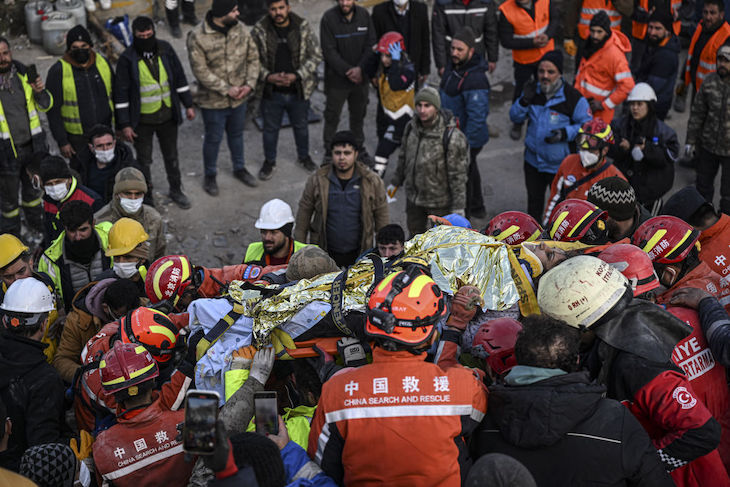
At 4 a.m. on Monday, when the earthquake hit, most of the 4.5 million people living in northwestern Syria were asleep. Thousands of buildings collapsed, burying their residents alive.
The majority of those living in this small corner of Syria had already been displaced from their homes in other parts of the country by the civil war. The northwest is the final stronghold of Syria’s opposition and is the main target of president Bashar al-Assad’s grim campaign to retake full control of the country. Before the earthquake, some two thirds of the area’s basic infrastructure – public housing, water and sanitation, hospitals and medical clinics, roadways and power generation – was already destroyed or damaged. The people living there could not have been more vulnerable. Nearly 2,000 bodies have been found in the five days after the earthquake, but tens of thousands are still missing.
You might have hoped that the international community’s response would be immediate; we have spent billions supporting Syria’s rebel groups, political opposition and civil society in this very area. It took four days, though, for any humanitarian aid to reach northwestern Syria, and what eventually came was six trucks of basic aid that had been loaded for delivery before the earthquake. It was enough for 4,000 people: 0.01 per cent of the population. There was nothing to help with disaster response. No fuel for heavy lifting equipment, and no shelter for those who had lost their homes. The arrival of 14 trucks of assistance today was an improvement, but far from enough.
While there has been a global response to help Turkey, there has been an almost complete abandonment of Syria. The White Helmets are the only rescue workers available, but they’re a volunteer force of 2,500 who are trained to respond to airstrikes (which have, thankfully, stopped in the last few days). In the first three days after the quake, White Helmets staff, many working with their bare hands, rescued a survivor every hour, but by the fourth day few were being found alive. The international community was too late.
Assad’s regime is to blame, too. The day after the earthquake, Syria’s envoy at the UN, Bassam Sabbagh, told reporters that disaster relief could only be delivered to regime-controlled areas. They would determine what was delivered and where. In 2022, 99.6 per cent of the aid that reached Syria’s northwest came through the single border crossing with Turkey, and just 0.4 per cent came through Damascus. Disaster aid does not need to go through the capital. The regime’s demand that it does is an extension of Assad’s decade-long strategy to starve and siege areas of opposition. Sadly, the UN has a track-record of kowtowing to the regime’s demands.
Assad’s government is using the disaster as an excuse to get sanctions relief. According to the regime and its supporters, western sanctions are impeding their efforts to deliver humanitarian aid. Like most claims made by Assad, this is farcical. All sanctions mechanisms have waivers to protect the provision of aid and, more importantly, 91 per cent of the aid that goes through Damascus is funded by the four sanctioning entities: the US, UK, EU and Canada. In the five days after the quake, Assad’s regime received humanitarian aid and disaster assistance – for the territory it controls – from 16 foreign governments, along with the UN and EU. There was no trouble receiving or distributing it. If there is a problem delivering aid to all those in need, it is being caused by Assad, not sanctions.
What’s happening in northwest Syria is a tragedy. Nobody expected the genocidal Assad regime to respond well, but the international community should have done better.
The terror of Turkey’s earthquake: a survivor’s account
Before Monday’s earthquake, the old town of Antakya, known historically as Antioch, had been a wonderfully preserved labyrinth of narrow cobbled streets on a gentle hill rising from the river. Beautiful houses with peaceful courtyards had been turned into restaurants and hotels, where people sipped tea and smoked under the shade of trees.
I had spent a couple of days in Idleb, northwest Syria, where I oversee operations as the country director for the HALO Trust, the landmine clearance organisation, and had decided to spend the weekend in Antakya before leaving for Gaziantep on the Turkish/Syrian border. That whimsical decision to stay in Antakya, and the choice to get up in the middle of the night for an early flight, were two of many factors that almost certainly saved my life.
I woke at 3.15am on Monday and made tea before my taxi arrived. It was raining torrentially, but the roads were empty. There was a lot of standing water and I felt the car aquaplaning now and then as we hit big puddles. The highway was very smooth, and the taxi was in good condition. So, it was peculiar when, for a few seconds, the car started wobbling.
Turks are chatty, sociable people. For hours, no-one said a word
Hatay is a small airport in open ground away from the town of Antakya. A single terminal building, modern with a high roof, and a small car park. I was one of the first to check in and go through to the departure lounge. From previous visits, I knew there were only a couple kiosks selling hot drinks but none was open, so I sat down in a seat next to the exit door. At that point, there were probably only half a dozen passengers in the departure lounge.
When the building started shaking, I looked at the woman opposite. Within a couple of seconds, the violence soared and her eyes filled with terror. In unison, we both got up. I grabbed my rucksack and we ran to the glass exit doors. They were two electric doors designed to open when a sensor is triggered. But the sensor was off and there were no staff there. We each grabbed one door and started pulling them apart. We managed to open them and I ran straight out to where the planes were parked. She must have run in another direction. Everyone else would have headed for the entrance on the other side of the building.
Two jets were parked with their noses pointing straight towards the terminal. I ran towards them, heading directly between them. By the time I was clear of the building, I was completely alone. It was pitch black, pouring with rain and completely silent. Then I stopped. The noses of the planes were rising up in unison, maybe twenty metres high.
In the darkness I could just about see that the wheels hadn’t left the ground. It was the ground that was moving and they looked like two boats riding a wave. It seemed that they had come alive and reared up like two enormous creatures. I thought that this utterly surreal vision was the last thing I would ever see; that the ripping ground would open up beneath me, and send me into the next world. After this crescendo of movement, they gracefully began to fall, and on reaching their original level they began toppling, dipping their wings before regaining balance.
I turned around and saw that the terminal was still standing. I don’t remember how I made it to the front of the building, but I found myself at the main entrance. The long, high, metal canopy that had covered the path from the drop-off parking to the entrance doors had completely collapsed. In the darkness, I could make out that a woman was trapped and screaming. I don’t know how many people were injured. Airport staff were trying to extract her and call for help. I tried to see if there was somewhere safe to take shelter from the pounding rain. I was in the car park and the ground was shifting. The streetlights had been knocked out and it was completely dark.
When the building started shaking, I looked at the woman opposite. Within a couple of seconds, her eyes filled with terror
All I could think of was to huddle beneath one of the small trees to get some shelter from the rain and away from any structure that might collapse. Ten years earlier, when I was in Somaliland, a colleague who had grown up during the civil war had told me about sheltering under a tree as government planes were dropping bombs on his village. At the time, I thought how utterly pathetic it sounded, the epitome of helplessness.
After a while, I made it to a small security hut where there were a few passengers and staff. I speak no Turkish, and no-one spoke English. We just stood there, in the rain and the dark.
I had managed to get a WhatsApp message to my colleagues in Amman, in Jordan, where I am based. I had seen a message from a Syrian colleague saying that a massive earthquake had hit Idleb, and the epicentre was in Gaziantep – nearly 120 miles east. I realised that the whole of southern Turkey must have been hit. If that was true, this was a total disaster.
Turks are chatty, sociable people. For hours, no-one said a word. They must have tried to contact relatives in Antakya, and either had no response, or heard initial reports of the nightmare that was unfolding there. The silence was awful. I was almost dreading daylight when we would see. Even though I was freezing cold, the darkness gave a sort of consolation.

Eventually, a single ambulance made it across the fractured car park to the collapsed terminal entrance. A JCB excavator turned up to start clearing the roads into the car park. A small bus arrived, big enough for the few dozen passengers to get on and keep warm. It was on the bus that I found someone who spoke enough English for me to ask about Antakya. ‘Very bad,’ she said.
I have spent years living and working in conflict zones and running large, complex mine clearance operations. Understanding risk and uncertainty, safety and security, is central to my job – trying to do dangerous things in lethal environments without my staff being killed or injured. Shortly after daybreak, I lost all communication with my teams in Syria and Jordan.
Everybody had just become a victim, effectively. The drivers of the bus, the ambulance and the JCB were all facing the appalling fact that their families may all be dead. Yet somehow they got on with their jobs. In doing so, they succeeded in getting us safely away from a location that might not be reached by anyone for days, because all resources would have been going to the town.
My taxi ride to the airport had taken less than half an hour. The return by bus took three times as long. The roads leading to the main highway were broken up. As it was open ground, the only things that could fall and block the route were streetlights, and the JCB managed to shove them out of the way. But fragments of the road surface, some several square metres in size were everywhere. It was one thing for the JCB to shift them; it was another to get the bus across each crack and crevice.
Back on the main highway into Antakya, the road was better, and some traffic was flowing. On the outskirts, most buildings were standing, though damaged. Some smaller, older structures had completely collapsed. As we approached the city centre, I noticed there was no power. No traffic signals, no lights in any apartments, no shop signs lit up. Traffic became heavier as we approached the river. Roads were blocked by the rubble from apartment buildings that had collapsed to the ground.
There were bodies under blankets. Children lying bleeding on the pavement
The bus could not take me back to the side of the river where the old town was, so I thanked them and got off. I stood in a street, trying to get my bearings. Nothing looked the same as before.
I went to a bridge I thought I recognised, and crossed over. I became aware of that mild but profound terror taking hold: not because of what I could see, but because of what I could not see. There were no ambulances, no police, no fire engines, no army trucks, no policemen, no soldiers, no medics. Almost six hours had passed and no relief had arrived. I knew this was because of the scale and complexity of the situation, so I am not being critical in saying that. Turkey is capable of responding to major emergencies, but the scale of this was completely overwhelming.
I tried many routes back to the hotel. I hoped that, being a low building higher up the hill, it might still be standing. It was a stupid thought, but there was nowhere else to go. What should have taken me fifteen minutes took about an hour and a half. Whole streets were annihilated. Clambering through collapsed buildings is a terrible idea, but there was no other way. Beds and carpets were sticking out from the rubble, all the mundane furniture of daily life were grotesque hints of what else lay underneath.
I finally found my hotel. The outer walls seemed intact, but the two entrances, one at the front, one at the side, were blocked with rubble almost to head height. The neighbouring buildings had all largely collapsed. The place was completely still and silent. I stood looking at the door for a moment. The property belonged to a nearby church, and had been rented by a young Turkish couple who ran it as a stylish guesthouse. She was a designer and had made the four or five bedrooms very beautiful. He was a logistics manager for an international NGO, which had operations in Syria.
I turned out of the cobbled street and back into the newer part of the neighbourhood. Since I had got off the bus, there hadn’t been any rain. Now, it started again. Heavily. I looked each way along the street. There were bodies under blankets. Children lying bleeding on the pavement. No water, and no medicines. People gathered around makeshift campfires. Not silence, but a lack of noise. It would take days for any machines to access this part of town to start moving rubble. It needed an army. It was clear to me that thousands of people had already been killed in the devastation that surrounded me.
As someone who works in the humanitarian sector, I have to deal as rationally as possible with the needs of people who find themselves in extreme situations. I realised I was about to become one of them. Then I met Augustin.
This young man pulling a suitcase was walking along the street. He clocked me and he said, ‘Are you a foreigner too?’
He seemed quite dazed, and said he was trying to remember the address of some distant relatives whose apartment blocks he thought might not have been badly hit. First, he wanted to go back to his guest house and collect some bags. I asked if I could go with him, as we might work better as a team.
As we walked, he told me he was a postgraduate student from Paris. He was French, with a rich heritage from this part of Asia, and he spoke good Turkish. He had been asleep when the quake hit, and must have been wandering around all morning. As I listened to him, I realised that, like a lot of people, his grasp of the situation was much poorer than mine. My journey back from the airport had allowed me to assess the state of the roads, the traffic, the impact of the damage all the way from the outskirts to the town centre. I was absolutely convinced that we had to do anything we could to get out as soon as possible. The prospect of staying was increasingly terrifying. Every minute closer to nightfall, the risks were increasing. I saw this as he led me back to his guest house. In a narrow alley, we ducked into a covered passageway and climbed over heaps of rubble, lumps of masonry dangling above our heads. Just doing this was ludicrously dangerous, and I doubted that the contents of his suitcase were worth the risk.
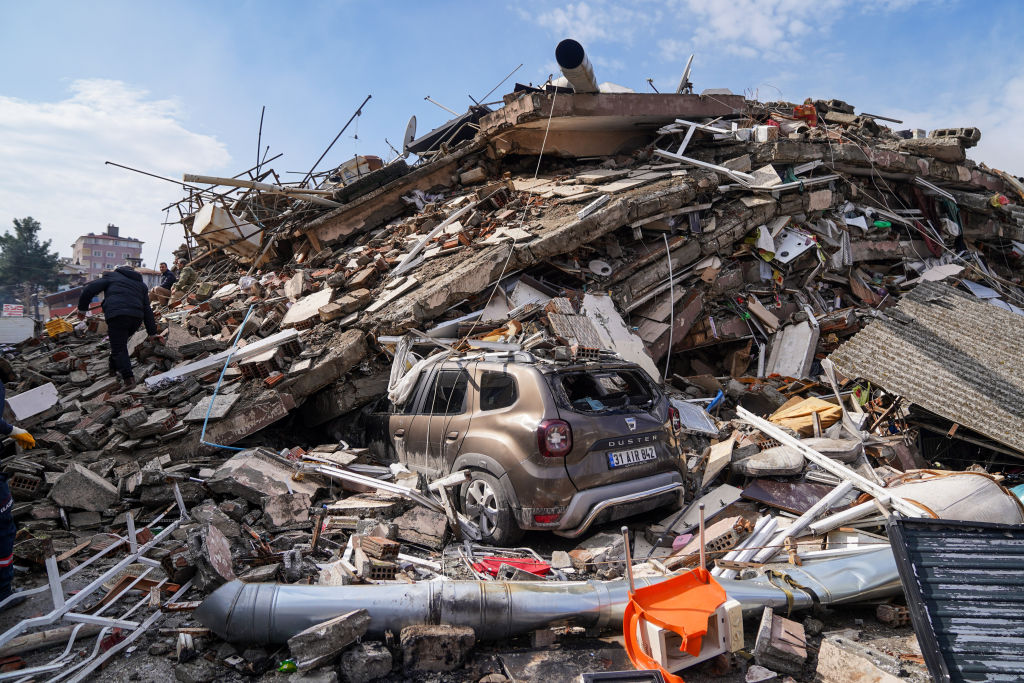
We made it to the courtyard and he gathered his belongings. It looked like it had been a two-storey building. He pointed to an upper room and said, ‘That was my bedroom.’ The roof had caved in but it was otherwise largely intact. It was unbelievable that he hadn’t been either trapped or unable to escape the courtyard.
We walked for about a half a mile, and found his relatives’ apartment block. Like every building that was standing, it was completely empty. Rubble in the stairways, cracks in the walls. Next door, there was a beauty salon with the front completely demolished. Two men were sitting inside. Augustin chatted to them for a while. I asked if there was a bathroom I could use. They gestured me to go further inside the building, I walked to the back of the shop and found a bathroom. The door was jammed. I carefully leaned on it and got it moving. I took the opportunity to use a toilet while there was still enough daylight to find one. With so many buildings destroyed or unsafe, the streets were likely to become open sewers within hours. Out of curiosity, I pressed the flush. As I did, my heart sank. If I had thought about it slightly more, I would have lifted the lid of the cistern to see if there was any water, and drunk it. I was almost relieved when it didn’t flush. Losing all that water because of a stupid mistake would have been demoralising. I checked the tap. Nothing. I was really starting to get worried about dehydration.
Whole streets were annihilated
I told Augustin that if we didn’t freeze to death overnight, we would be in such a state by the morning that we wouldn’t be able to do anything. There might be another quake. Whatever relief might come needed to go to the ones who really needed it. From bottles of water to tents to medical supplies and communications support. There were people here who couldn’t leave. Families trying to rescue trapped relatives. We couldn’t help them, but if we stayed, we might add to the burden.
We headed down towards the river towards a shopping centre where a major fire was taking hold. Thick smoke was filling the air, and similar blazes were visible in every direction across the city. Just then, a small bus drove past. The driver stopped and asked directions to a hotel. Augustin asked him if he could take us to Ankara. They talked, and then he drove off, stopping about fifty yards away. Augustin said that the bus was only for guests from a certain hotel. I told him firmly that if that bus was going to Ankara, we had to be on it. I had about $300 (£250) in various currencies and I wasn’t going to quibble about price. Augustin ran back to the bus. Yes, we could get on, if the hotel guests agreed and if there was enough space. We got a seat.
It was early afternoon and we were warm for the first time all day. I could barely believe our good fortune.
The broken roads on the way out were familiar to me. Stuck in traffic going into Antakya was a convoy of khaki-coloured civil defence ambulances, huge military-style off-roaders. This was the first sign I saw of concerted relief efforts, although it was a tiny fraction of what would be needed.
As we headed north, the damage generally lessened. More than an hour out of Antakya, still most buildings were damaged, some levelled. The coastal route hugged the hillsides around Iskenderun, where, as the sun was setting, we looked directly down at the container port which had a massive fire, like an oil refinery had been bombed.
By mid-afternoon, I had re-established communications with my office in Jordan. Incredibly, our Syrian colleagues were all unscathed, but I was deeply concerned about the coming days and nights. For years, millions of people in northwest Syria had effectively been supported by vast aid shipments from Gaziantep, in south east Turkey, which had just been destroyed. It would take weeks just to get basic supplies into the region in the massively increased volumes now needed. The elderly and vulnerable would be wiped out within hours, and there was nothing anyone could do about it.
North of Iskanderun, we were making good progress. Fortunately, we had a full tank of diesel, as there were typically queues of around 100 vehicles at the fuel stations that were open. We stopped a few times on the way for the driver to have a break. I went into the bathroom at one fuel station and there was blood everywhere, pools of it on the floor from casualties that people must have been evacuating in their own cars because there weren’t enough ambulances. The station shops were all nearly empty of drinks and food and they were running out of cigarettes.
As it became dark, the highway took us away from the towns into what seemed like wide open flatlands. I saw a layer of snow on the road and more was coming down. The blizzard became heavier. For a couple of hours, we didn’t get above 25mph.We passed an overturned bus covered with inches of snow, and surrounded by cars that had spun around it in a multi-vehicle crash.
The snow eventually eased and the roads improved. It was 3am when we got to Ankara. I was dropped off at a taxi stand. There was one taxi and a little hut. The lights were off. I knocked on the door. Through the window, I saw a man wake and get up from a sofa. He took me to a hotel near the airport. It was more than twenty-four hours since that first cup of tea.
I flew back to Jordan the next day. In the taxi on the way into Amman, the sensory overload from Monday was playing tricks on me. Because we had arrived in Ankara in the middle of the night, I could hardly see any buildings. The hotel I stayed in was a solitary high-rise block standing by itself on the road into the airport. Amman that day was the first time I’d seen a city since Antakya, and I couldn’t understand why the buildings were all intact. I found myself blinking over and over as if I hadn’t seen things properly. The image of wrecked buildings had registered so strongly that I was still imagining them.
Will Britain ever learn the lessons from the Prevent debacle?
The reaction in some quarters to William Shawcross’s review of Prevent, the UK’s counter-extremism programme, has been predictable. The Muslim Council of Britain, Amnesty International, the Guardian and Cage have all criticised the report and the author, with Amnesty launching a particularly unpleasant ad hominem attack on Shawcross, describing him as ‘bigoted’.
None of the above consider that Shawcross was the right man to lead the report because of a remark he made a decade ago stating that Europe’s relationship with Islam ‘is among the greatest, most terrifying problems of our time’.
Shawcross was speaking after the Madrid and London bombings of 2004 and 2005 that claimed 245 lives, and before the atrocities in Paris, Nice, Barcelona, Brussels, Manchester and London Bridge that resulted in hundreds more deaths. It is, therefore, difficult to understand what exactly it is about this honest and accurate statement that has caused so much anger. When one schoolteacher has his head cut off on a suburban French street and another in England is forced into hiding for the crime of blasphemy, then you have a terrifying problem on your hands.
For too long, Britain has tolerated the intolerant
In the last 48 hours, Cage has retweeted a claim that ‘Muslims working with Prevent are native informants’ and another from the Lewisham Mosque accusing the Prevent review of being ‘Islamophobic’, along with the hashtag ‘Whitewash’. It has also expressed its indignation at the Home Secretary. The distaste is mutual. In her statement to the House on Wednesday, Suella Braverman praised the Shawcross report. She took aim at its critics, including Cage, which she described as ‘an Islamist group’ that ‘has excused and legitimised violence by Islamist terrorists’.
Cage first came to public attention in 2015 when Asim Qureshi, its research director, described Mohammed Emwazi as a ‘beautiful young man’. Emwazi had recently been unmasked as ‘Jihadi John’, the Islamic State executioner who beheaded prisoners – including fellow Britons – on camera. Emwazi had had contact with Cage while a student in London between 2009 and 2012, and the organisation claimed he may have been radicalised after feeling harassed by British intelligence services.
The furore prompted the Charity Commission to declare that Cage should not, in future, be funded by charities, a position that Cage subsequently overturned in court. The commission’s chairman at the time was William Shawcross. In February 2015 he emailed fellow board members to inform them that he had just come from Washington where he met senior US government officials, one of whom expressed deep reservations about Cage.
In her Commons Statement this week, Braverman said that Cage and other groups have been fierce opponents of Prevent since its inception. ‘They have slandered those who work with Prevent to combat Islamist extremism as disloyal, sinful or “native” informants,’ the Home Secretary stated. ‘We must combat those pernicious fallacies and be courageous and muscular in combating that misinformation.’
As I wrote on Wednesday, the French are far ahead of Britain in this respect. The term ‘Islamophobia’ was discredited a decade ago, recognised by the government as an Islamist strategy to shut down any legitimate debate of Islam. France is also far less tolerant than Britain of Islamist ideology, regardless of whether it is promulgated by groups or by imams.
Last year, France expelled a Moroccan-born Imam, Hassan Iquioussen, who was active in mosques and on social media. In announcing the deportation order, the interior minister, Gérald Darmanin said the Imam had ‘been using hate speech against the values of France’.
Iquioussen is one of 734 foreign nationals expelled from France since Emmanuel Macron came to office in 2017, and there will be more. Darmanin confirmed this in a television interview last September, explaining that the Ministry of the Interior was compiling a list of ‘preachers’ and ‘presidents or agitators of associations’ that contained dozens of names.
The French government is also not shy in banning organisations that it regards as antithetical to the Republic. Not long after the brutal murder of the schoolteacher Samuel Paty, in October 2020, the Collective against Islamophobia in France (CCIF) and the humanitarian association BarakaCity were proscribed because of their ‘Islamist propaganda’. The decision was examined by France’s highest administrative court, who validated it on the grounds that it was within the government’s jurisdiction to dissolve organisations that ‘provoke discrimination, hatred or violence…propagate ideas or theories tending to justify or encourage such discrimination, hatred or violence’.
There was the inevitable backlash, both within and outside France. In March 2021, 25 organisations wrote to Ursula von der Leyen, President of the European Commission, demanding that action be taken against Emmanuel Macron and his government. They accused the French government of ‘exploiting the death of Samuel Paty’, who was killed because he showed a caricature of the prophet in a class discussion about the importance of freedom of speech, ‘for its own racist, discriminatory and Islamophobic agenda’.
The letter provoked comment in the French press, not just for its contents but also for some of its 25 signatories, among which were Cage and another British group, MEND (Muslim engagement and development). Were Cage a French organisation it would likely have been proscribed a long time ago. Considering that the Home Secretary described it on Wednesday as an organisation that ‘has excused and legitimised violence by Islamist terrorists’ one wonders why it is tolerated in Britain.
The same could be said of those British mosques which, as The Spectator revealed in 2021, are controlled by the Deobandi, who have long and strong links with the Taliban. Any government ban would be supported by the majority of British Muslims, 74 per cent of whom said in a 2016 poll that they approve of outlawing tutoring that ‘promotes extreme views or is deemed incompatible with fundamental British values’.
For too long, Britain has tolerated the intolerant. If the government is serious about acting on Shawcross’s courageous report, a good start would be to follow the French example and act against those individuals and organisations whose ideology is opposed to British values.
Labour triumph in West Lancashire by-election
Labour last night held the seat of West Lancashire on a ten-point swing from the Tories. The constituency has gone red since 1992 and was mostly recently represented by Rosie Cooper, who chose to resign to become chair of the Mersey Care NHS Foundation Trust. Turnout was just over 31 per cent, with Labour winning with 62 per cent of the vote and the Conservatives on 25 per cent.
It is a cliche, but perhaps the most surprising thing about this result is how unsurprising it is. The result was within less than half a per cent of national polling trends: currently Labour are on course to win a three figure majority that surpasses their 1997 result. The Reform party did better than expectations, taking 4.4 per cent and third place in the process, which perhaps indicates a hitherto unrealised threat to the Tories from the right. It’s the worst result for the Conservatives in West Lancashire’s history.
The new MP is Ashley Dalton, a lifelong Lancashire resident and part-time charity worker: the kind of by-election candidate who could have been dreamt up by Labour HQ. She played her part well on the night, calling her victory a ‘strong result’, arguing it sent ‘a clear message to Rishi Sunak’ and that the ‘people want a general election.’ Keir Starmer and the party frontbench have all tweeted a similar line: ‘After 13 years of Tory decline, it’s time for a Labour government.’
In short, the result of West Lancashire is a refrain we are likely to hear a lot of in the coming months: another bad night for Rishi Sunak and another good night for Keir Starmer.
The capital vs the Capitol
The capital vs the Capitol
When the House of Representatives voted to overturn a pair of laws recently passed by the Council of the District of Columbia this week, Eleanor Norton Holmes, the District’s non-voting delegate, delivered an uncompromising and partisan denunciation.
“I can only conclude that that the Republican leadership believes DC residents, the majority of whom are black and brown, are unworthy or incapable of governing themselves,” she said.
But Holmes’s black-and-white account of the House vote to block two controversial pieces of legislation — one a revamped (and relaxed) criminal code, the other allowing non-citizens to vote in local elections — omitted some inconvenient details.
One is that DC’s own mayor, Muriel Bowser, is opposed to the criminal law changes that soften penalties for violent crimes at a time when their rates are rising fast in Washington. She vetoed the measure last month but the Council exercised its right to press on anyway.
Another is just how many Democrats sided with Republican leadership on the votes. Forty-two Democrats voted to block the voting legislation. Thirty-one voted to overturn the revisions to the criminal code. Among those thirty-one was Minnesota lawmaker Angie Craig, who was, on the same day of the vote, assaulted in the elevator of her Washington apartment building by a homeless man.
Bowser, usually a staunch opponent of any congressional meddling in DC politics, has been notably quiet about the votes on the Hill. Axios reports that her office did not lobby lawmakers to vote against the blocking measure.
And so, with a vote on overturning the bill due in the Senate, the politics of DC’s latest standoff with Congress is a bit more complicated than it has been in the past — or than Holmes would have you believe. With the White House opposed to the blocking measures, which require the president’s signature, the DC council’s new laws are all but certain to remain in tact. But the showdown between DC and Congress could intensify further. Georgia Republican Andrew Clyde is drafting a bill that would repeal the Home Rule Act, the legislation which gives DC residents the ability to elect a mayor and council.
That, too, would be dead on arrival as long as there is a Democrat in the White House. But what Holmes this week called a “new level of hostility to the District of Columbia” is sure to remain for the foreseeable future. Not because of some fresh level of partisan hostility, but because DC’s powers that be seem so complacent about the safety of the city’s residents.
*** Sign up to receive the DC Diary in your inbox here ***
George Santos’s ‘simple-minded’ constitutents
New York congressman and serial fibber George Santos may not be in Washington for long. If he is to have any political future at all, he will have to win back the trust of his Long Island constituents. But his charm offensive evidently has a ways to go. As Cockburn reports, in a Newsmax appearance yesterday, Santos told host Greg Kelly that “Having somebody like me come and represent other people who are just like me — simple-minded folks who come from absolutely nothing and have a voice in Congress.”
Is I’m simple-minded, just like you a winning pitch? The more immediate question is whether Santos will get the opportunity to find out. The freshman congressman is now the subject of a House Ethics Committee probe that could end with his expulsion from Congress.
Fetterman’s long recovery
John Fetterman was hospitalized on Wednesday after feeling light-headed at a day-long Democratic retreat in Washington. Tests revealed that he had not suffered another stroke but stayed in hospital Thursday night. The Pennsylvania senator’s setback is only the latest reminder that the medical challenges he battled on the campaign trail persist now that he is in Washington. Another is Fetterman’s Senate desk, which has been fitted with a closed captioning monitor.
A New York Times story on Fetterman’s health makes clear that he is dealing with far more than just the auditory-processing issues that his campaign acknowledged last year. “He has to come to terms with the fact that he may have set himself back permanently by not taking the recommended amount of rest during the campaign. And he continues to push himself in ways that people close to him worry are detrimental,” reports Annie Karni. As was the case for much of 2022, when his health was among the biggest issues in one of the closest midterm Senate races, plenty of questions remain about Fetterman’s ability to discharge the duties of a US senator now he has made it to Washington.
What you should be reading today
Ben Domenech: How taxpayer money was used to silence speech
John Pietro: China is playing the US for fools over the spy balloon
Joel Kotkin: How America’s ‘big sort’ will upend politics
Dana Goldstein, New York Times: In post-Roe world, these conservatives embrace a new kind of welfare
Sean Durns, Washington Examiner: Manufacturing victory
George F. Will, Washington Post: Quadrillion-dollar national debt? Chew, don’t nibble, on this math
Poll watch
President Biden job approval
Approve: 44.3 percent
Disapprove: 51.5 percent
Net approval: -7.2 (RCP average)
Top issues in the Chicago mayoral race
Crime and public safety: 44 percent
Criminal justice reform: 13 percent
The economy and jobs: 12 percent
Education: 6 percent
Immigration: 6 percent (WBEZ/Chicago Sun-Times)
Sign up to receive the DC Diary here.
I’m pro-science. That’s why I’m anti-mask
“Are you anti-mask?” “Are you anti-vax?” “Are you anti-science?”
Employees of Levi Strauss & Co repeatedly pummeled me with these questions during 2020-2022, when I was the company’s brand president. Why? I advocated in defense of children: against the masking of toddlers, against closed playgrounds and youth sports, for open public schools.
I’m not exactly sure what an anti-science person is. But that’s not me. I’m pro-science. And that’s why I’m anti-mask.
Given the findings from the recent Cochrane study, a meta-analysis summarizing seventy-eight studies including a million people, the science is now clear: “Face coverings make little to no difference” in Covid infection and fatality rates. Even when the hallowed N95 is worn.
The analysis acknowledges that “adherence” to mask-wearing was low in many studies. Harms were poorly measured and reported, but discomfort wearing medical/surgical masks or N95 respirators was mentioned in several studies.
If an intervention does not work in the real world, it doesn’t work, even if models and lab tests on mannequins say it does. Think of it this way: if a cancer drug shrinks tumors, but the side effects are so grave that no one will take it, it doesn’t work. Likewise, whatever masks may or may not do to protect inanimate mannequins in a lab, if real people in the real world don’t wear them “correctly” because they interfere with everyday interactions, they don’t work. Period.
I believe in the scientific method: make an observation. Ask a question. Form a hypothesis. Test the hypothesis. Listen to the answer. Insisting on the answer before pursuing this methodological approach is not science, it is propaganda.
And “masks work” was never more than propaganda — rooted in mechanical plausibility, not actual science — furthered by public health officials, left-leaning government leaders, the press and the party faithful starting in 2020 and continuing to the present day.
The left is holding fast to the idea that masks do work, despite all the evidence to the contrary. In fact, as of February 6, mask mandates have been reinstated at four elementary schools in Marin County, California.
And, on February 8, CDC director Rochelle Walensky explained to Congress why no random controlled trials (RCTs — the gold standard of scientific inquiry and evidence) were conducted to determine if masks prevent Covid:
I’m not sure anybody would have proposed a clinical trial because, in fact, there wasn’t equipoise to the question anymore.
Walensky’s view: we didn’t conduct any scientific inquiries because it was obvious that masks work.
This is not only circular logic, it is the antithesis of the scientific method. Belief in the effectiveness of masks has never been scientific, it was always religious in nature. It is true because I believe it is so. This religious fanaticism can be seen by the response to the Cochrane study.
The best science we have says that masks and mask mandates do not work. Nevertheless, public health officials continue to push this unscientific requirement. Most disturbingly, these true believers continue to push these “interventions” on very young children, those most at risk of harm from this policy.
Will there be redemption for those who had the audacity to challenge authoritarian public health bureaucrats? No, it seems. Will there be a change in policy now that the science is clear? Again, no, it seems.
Will there be a doubling down, with the self-proclaimed pro-“science” crowd continuing to insist masking works despite the scientific evidence showing us that they don’t? Yes. It appears so.
At Levi’s, I was forced to answer the “anti-mask, anti-vax, anti-science” questions directly in a virtual town-hall-style “apology tour” in the spring of 2021. In preparation for the session, I was told by a colleague that I needed to demonstrate to employees that I was “one of us” rather than “one of them.” I was told my views (aka questions about mask effectiveness) were in conflict with “the good-bad world we are living in.”
The “bad” people in the “bad” world think that masks might not be effective and that public school students should get to go to in-person school just like their wealthy peers attending in-person private school.
As one of “them” I was smeared as a racist, fat-phobic, unemployable villain, and was ultimately ousted from my job. After being told that there was no longer a place for me at Levi’s in January 2022, I publicly resigned. Since then, the company has justified their action by claiming that I undermined the safety of employees because I dared to challenge public health officials by asking: “Does masking young children do more harm than good?”
Here is the company statement:
When Jen went beyond calling for schools reopenings and began using her platform to criticize public health guidelines… it undermined the company’s health and safety policies.
I was billed as a public health threat and Democratic Party (“us”) infidel because I had the audacity to ask about the efficacy and possible adverse impacts of a universal masking policy for toddlers in pre-school, many of whom are just learning to talk.
Can young children even mask correctly when they still wear diapers and can’t even put on their own shoes? It is, and always was, a fair question, one rooted in both common sense and science.
As far as undermining the company’s health and safety policies, as far as I know, there are no toddlers working at Levi’s. Whose safety was being undermined by asking this very reasonable question?
What seems clear is that the enthusiastic, religious devotion to the dogma — “masks work” — signified adherence to a set of beliefs: I mask therefore I am good. I mask my children therefore I am loyal to the Democratic Party and public health diktats. I mask therefore I care. I am a loyal follower of “the Science.” My faith is unwavering.
Those who claim to be on the side of “the Science” will continue to push unscientific policies in order to prove that they were right all along. This is the sunk cost fallacy writ large. Don’t admit mistakes. Ignore the actual science in favor of “the Science.” And continue to punish those who challenge. As well as those most vulnerable who simply aren’t in a position to challenge at all.
“Science” has apparently been rebranded by the left. It is now a slogan — a tagline — shouted at heretics to signify one’s moral superiority and loyalty to the party. What we have now is “science” that ignores the scientific method, which means “the science” is a cult. And a dangerous one at that.
Cyril Ramaphosa’s ‘state of disaster’ speech could not have gone worse
Joe Biden was heckled by Republicans during the US president’s State of the Union address this week. But that reception was warm compared with the one faced by his South African counterpart Cyril Ramaphosa during his State of the Nation speech last night.
Ramaphosa faced a record number of interjections from the floor, as he declared a state of disaster amid rolling power cuts and a looming recession. With an election due in May 2024, this speech was Ramaphosa’s chance to set out why his ruling African National Congress (ANC), in power since the late Nelson Mandela was elected in 1994, deserves another five-year term. Things did not go well.
Julius Malema of the radical Economic Freedom Fighters (EFF), which has called for Zimbabwe-style land seizures, raised endless points of order and caused the speaker to halt the president’s speech while decorum was restored. After being denied a constitutional right to interject by the speaker, Malema’s MPs sang, chanted and danced. The president sat down.
Cape Town is one of the murder capitals of the world
Not that it mattered. In the country’s biggest city, Johannesburg, a power cut left many viewers unable to watch. South Africans are used to the lights going off. Since August last year, the state power monopoly, Eskom, has implemented what’s known here as ‘load shedding’, turning off the grid four times a day for an average of two hours each, due to lack of capacity. Such measures are costing South Africa’s economy tens of millions of pounds a month in lost production.
South Africa’s troubles don’t stop there. In a country infamous for crime (Cape Town is one of the murder capitals of the world) and with endless reports of corruption, fake tenders, billions lost from the treasury and levels of black unemployment higher than under white rule during apartheid, it was never going to be easy for Ramaphosa to win the day.
He was at least honest as he went through a roll-call of problems. He conceded that, under his predecessor, Jacob Zuma – now on trial for corruption – billions were lost to the treasury. Ramaphosa also admitted that the lack of jobs, especially for the young, is at crisis level – with youth unemployment above 50 per cent.
Ramaphosa used these factors to justify his declaration of a state of disaster, a constitutional provision that allows the cabinet to rule by decree instead of going through parliament and the usual review of bills.
The opposition Democratic Alliance (DA) and some trade unions immediately announced a court challenge to the plan. The last time these emergency rules were used was for Covid-19 lockdowns in 2020, and inquiries continue over contracts for sprays, masks and protective gear that went to those connected with ministers or the ANC. Prices were overblown and goods went undelivered.
DA leader John Steenhuisen said his party would not ‘allow the ANC to abuse the electricity disaster it created to loot and further abuse the people of South Africa.’ This time, the president said, the Auditor General would monitor all spending. There would also be a new minister for electricity appointed to oversee the process.
On crime, Ramaphosa said that more police were being recruited but civic groups accuse the police of taking bribes and even working in tandem with criminals.
And on jobs, there were the same promises we’ve heard for years, of new programs to help millions who are out of work. Yet in spite of these, the unemployment rate has only got worse.
Climate change had to make an entry, of course; Ramaphosa pledged to reduce South Africa’s carbon output with a massive conversion to solar. Theft of panels, along with copper cables for regular transmission is already epidemic, with few arrests. Ramaphosa’s announcement is unlikely to help matters.
There is always a high level of foreign interest in the state of the nation address, and ambassadors are allowed in the visitors’ gallery. The British High Commissioner to Pretoria, Antony Phillipson, told The Spectator there was a ‘strength and depth’ in the bond with South Africa and that Ramaphosa had been a guest at Downing Street in November.
‘We have major trading links,’ he said, ‘and with our shared goals and challenges, South Africa and its plans for the future matter hugely to the UK.’
But for many South Africans, the focus right now is on issues much closer to home. Drop in to a soccer game – there are thousands every weekend in cities and villages – or visit a beer-hall in rambling townships where most of the urban black population live, and talk is about hunger, unemployment and a sense of hopelessness.
Polls show support for the ANC may be as low as 40 per cent. But there’s not been a corresponding rise for the opposition, suggesting voters might abstain or find other ways of being heard. This could include riots and violence in a country used to mayhem. Demonstrations are already a daily event in the cities.
This febrile atmosphere means there is a chance Ramaphosa could be ousted by factions within the ANC before next May’s poll. If he survives until then, he will have one final shot at a state of the nation speech that sets out a compelling reason to vote for him. But last night’s speech was missing that justification.
A cabinet reshuffle is imminent. But almost three decades after the advent of democracy – and with rising inflation and public anger over the stuff of daily life – it seems unlikely that new faces will be able mend the country before the public give their verdict at the ballot box.
Former Spectator deputy editor turns government censor
Biden’s pornbrained FCC nominee
One of President Joe Biden’s most embattled nominees for the powerful Federal Communications Commission was a staunch supporter of Ugly George, New York City’s “Cult Porno King,” and his right to showcase naked women on cable channels he leased, Cockburn has learned. Gigi Sohn is a lawyer by trade — and her past legal activism suggests that she’ll take a lax approach towards the never-ending influx of sexually explicit content on TV. Back in 1995, the Associated Press reported that Sohn “lamented” a court decision that upheld a law designed to limit people like Ugly George’s ability to air sexually explicit content during daytime hours.
“This is the farthest-reaching ban on indecency ever permitted by the courts,” Sohn said at the time. And Sohn’s ties with the porn community go beyond just advocating for the Cult Porno King, who is best known for “persuading women to go back to his studio and bare their breasts for his local cable show,” the AP reported. For years, she’s been on the board of the Electronic Frontier Foundation, which recently honored an OnlyFans dominatrix who brags about urinating on people. Beyond Sohn’s advocacy for explicit content, her nomination is up in the air due to conflicts of interest surrounding her membership of a think tank funded by companies she is poised to oversee if confirmed.
Sohn is a longtime member of the Benton Institute for Broadband & Society, which advocates for broadband access — and is also funded by many of the largest telecoms giants that she will be tasked with keeping an eye on at the FCC. Democrats recently scheduled a hearing for Sohn next week. It is unclear if the Cult Porno King or the OnlyFans dominatrix will be in attendance.
TikTok spies at State of the Union?
Were TikTokkers invited to cover the State of the Union? A spy says at least one was spotted in the press gallery, where photography is expressly prohibited, ahead of Biden’s speech. The TikTokker asked if it was OK to record some five-second reels for his account, to which a staffer replied, “Only if you do a BeReal first.” He did not realize the staffer was joking.
Looks like China isn’t sending their best — better stick to balloons…
Shock: Britney is not OK…
Earlier this week Page Six confirmed that Britney Spears’s family and friends were in talks to stage an intervention Tuesday out of fear for her well-being. TMZ further reported that Britney’s manager and husband Sam Asghari, an interventionist and doctors wanted to convince the singer to seek treatment and sequester her in a Los Angeles home for two months. Who could have seen this coming?
Well, er, The Spectator. In May we ran a story headlined, “Is Britney Spears OK?”
“Britney Spears suffered years of trauma that most of us couldn’t imagine (and yes, this is real trauma) but to say that her current behavior is normal seems wrong,” wrote Kara Kennedy. “Her outbursts aren’t quirky or sweet, they’re unsettling.”
Then in August, Kennedy wrote, “The treatment that Britney has endured over the last fourteen years surely has to have lasting mental effects on the star’s health. And her latest antics on social media imply that she is still dealing with the fallout of being controlled by her family members for the last decade.”
Santos’s ‘simple-minded’ constituents
Members of DC’s press pack have been feverishly attempting to interview the country’s most controversial congressman, George Santos. The Spectator, of course, managed the feat last week, well ahead of most. But a flub during a Newsmax appearance yesterday may offer some clues about why the embattled representative isn’t keen to face questions.
Santos told Greg Kelly, “Having somebody like me come and represent other people who are just like me — simple-minded folks who come from absolutely nothing and have a voice in Congress.”
The Santos Show has had Cockburn reaching for the popcorn more than most other happenings in DC of late. But calling your constituents “simple-minded” seems like a surefire way to ensure we don’t see a second season…
One bad Applebaum: former Spectator editor turns government censor
Speaking of Newsmax, they’ve found themselves on Anne Applebaum’s shit list. Applebaum, a former Spectator deputy editor, has turned tattletale as part of her role on the advisory board of the British-run Global Disinformation Index, which, my colleague Ben Domenech writes, “relies on taxpayer funds to blacklist American publications with advertisers.”
On the GDI’s most wanted list: the American Spectator (no relation), Newsmax, the Federalist, the American Conservative, One America News, the Blaze, the Daily Wire, RealClearPolitics, Reason and the New York Post. The same organization lists its most trusted sources as the New York Times, the Washington Post and NPR. In other words: accurately reporting on Hunter Biden’s laptop as the New York Post did = bad. Getting stories such as Russiagate wrong, as the Times did, and saying the laptop story isn’t worth investigating, as NPR did = good.
Staffers at the right-leaning titles are mad at the GDI. “It’s pathetic and unsurprising that the Global Disinformation Index is working to silence conservative news sources,” a friend at Newsmax told Cockburn. “Since its coinage ‘disinformation’ has been nothing but a buzzword liberals use to discredit dissent. The worst part is the blacklist is actually working: Newsmax is no longer on DIRECTV, despite viewership that dominated liberal outlets. Goddamn Brits.”
“When RealClearPolitics’s method — the pairing of partisan rivals — is seen as dangerous and in need of starving it of income, that’s the clearest of evidence that these self-appointed guardians of discourse are in fact enemies of an open society,” David DesRosiers, RCP’s publisher, told Cockburn. “They are not to the cure to what ails us but the disease.
“We are being censored through advertising starvation. These digital Mad Men Maoists are part of the thought-control network.”
Harry who?
King Charles is so sick of his loudmouth son that he’s resorted to pretending that he doesn’t know who he is.
While the monarch was greeting fans at the University of East London on Thursday, one attendee shouted, “Can you bring back Harry?” as King Charles shook hands. The King replied “Who?” before bursting into laughter and continuing his visit.
Cockburn isn’t surprised at the snub after the jaw-dropping revelations from the petulant prince in his memoir Spare.
Suella Braverman rows back on the ‘stop the Channel boats’ pledge
The whole point about making five key pledges, as Rishi Sunak did at the start of the year, is to give the average voter a consistent message. The idea is that such pledges, which should have been judiciously drawn-up based upon extensive opinion research, are hammered home again and again until the typical person far away from the Westminster Village has digested them.
What is Sunak’s administration for? Surely everyone knows that: to halve inflation this year, grow the economy, make sure our national debt is falling, cut NHS waiting and stop the boats.
Braverman declined to confirm that the PM’s pledge means the boats will be stopped in their entirety
The last of those pledges induced a particularly vigorous round of derision from erstwhile Tory voters who have been let down as regards illegal immigration too many times already. They simply did not believe Sunak to be serious.
So for Home Secretary Suella Braverman to start throwing in caveats just a month or so down the line will be a cause of great exasperation in Downing Street. Braverman has just declined to confirm that the PM’s pledge means the boats will be stopped in their entirety. Instead she told ITV News she is aiming for a ‘dramatic reduction in the numbers arriving’.
She has also refused to set any deadline for our arrival at this happy juncture. ‘I’m not going to put a timescale on it but what I am going to say is it is going to take as long as it will take,’ she said. That’s like asking a builder how long a kitchen extension is going to take and being told in response: ‘How long is a piece of string?’
‘What do we want? To stop the boats a bit. When do we want it? At some indefinable point in the future,’ simply isn’t going to cut the mustard as a political sales pitch.
It is perhaps understandable that Braverman should wish to create for herself some wriggle room in pursuit of an objective that completely eluded her tough-talking predecessor Priti Patel. But her coining of a new formulation is bad politics on an issue where public confidence in her party is already at rock bottom.
The right answer would have been something along the lines of:
‘The Prime Minister has been very clear. Our objective is to stop the boats. Period. People will have an opportunity at the next election to make a judgment on how vigorously and well we have pursued that goal.’
Because if Sunak and Braverman do manage to reduce the boats by, say, 90 per cent over the next two years, so that 2024 sees around 4,500 arrivals compared to the 45,000 of last year, then the chances are that they will have massively exceeded expectations and be given credit for that.
But that will only work if, in the meantime, they are seen to have strained every sinew to have brought the people smuggling racket to an end entirely, rather than indulged in a pre-emptive bout of backsliding away from their original promise.
Think of Boris Johnson imposing a deadline upon himself in autumn 2019 to get Britain out of the EU. When he failed to achieve it because of the deliberate obstructionism of Remainers in Parliament and across the establishment, did the electorate turn against him? It did not. Because it could see, via the prorogation row, the withdrawal of the Tory whip from foot-draggers and numerous other episodes, that he had fought gamely to thwart the Brexit-blockers and was worthy of a bigger mandate to help him get the job done.
Sunak and Braverman do not have the political space to gulp and retreat from the absolutist nature of the PM’s pledge. They must summon up their courage and charge straight at the guns of their opponents in the Commons, the Lords, the public sector left and the legal establishment.
He appears to know this, but maybe she didn’t get the memo. On the other hand, her very punchy performance in the Commons when giving a statement on the review of the Prevent anti-radicalisation programme may indicate she is more interested in fulfilling her own memos than his.
At a time when there is a veritable stampede of senior Tories towards showbiz and TV presenting as alternative careers, Braverman at least shows no sign of losing her appetite for the job she has right now. But her ultimate ambition is more likely to be achieved if she concentrates on stopping boats rather than rocking them.
Parliament blows £12k a week on traffic marshals
First there was talk of a medal; now MPs have had their pay bumped up to more than £86,000. And today Mr S can reveal the latest wheeze to bolster the image of parliament in the eyes of the public. For days now, Steerpike has heard complaint from Commons staff about the appearance of ‘useless’ traffic marshals on the estate in garish orange jackets ‘who stand around doing nothing all day’, according to one disgruntled researcher.
The staff have primarily been hired to station the road between Black Rod’s Gardens and New Palace Yard during the current building works, with a total of eleven dotted elsewhere across the estate –including a supervisor and two relief marshals. The total cost of this first XI of superintendents? A whopping £12,588 a week. That’s the annual equivalent of £654,576 – or £59,506 per person, more than the maximum amount permissible for hard-working Commons staff in the office of an MP.
It’s not just staff who are sounding off about the system: peers are noticing too. Lord Robathan sounds distinctly unimpressed in a question which he tabled last month, asking ‘what evidence there is for the need for those controllers.’ Parliamentary bosses responded by claiming that ‘the need for traffic marshals is not a consequence of vehicle or pedestrian causalities but is based on risk assessments, traffic modelling carried out prior to the operation of the one-way system, stakeholder requests, and construction industry best practice.’
Best practice in parliament? That makes a change…
Lee Anderson hits back at his critics
It’s the reshuffle move that everyone is talking about. The promotion of Lee Anderson to Tory deputy chairman has excited the Westminster press pack no end, with the Ashfield MP making headlines within his first 24 hours in the job. A run-in with a local radio station and his support for capital punishment have prompted much media interest into the 56-year-old. But some hacks, it seems, have now overstepped the mark.
Anderson took to Twitter this morning to complain that ‘some journalist is messaging ex miners who I worked with underground to ask about my life down the pits.’ To save the unknown journalist ‘time and effort’, Anderson helpfully listed his experience at four different collieries, including ‘coal face training at Creswell’ and working as a ‘rope fitter underground at Sutton.’ His riposte ended with the words ‘now go and check all my old social media posts to see what other stuff you can find or just get a proper job.’
Looks like the media won’t get Lee on miner offences just yet…
How taxpayer money was used to silence speech
Here’s a simple question: how much American taxpayer money is being spent to silence, censor, and blacklist opinions?
Legacy media reporting on the House Oversight Committee’s initial look into the actions of Twitter during the 2020 elections focused mostly on questions surrounding Hunter Biden’s laptop. The committee’s investigative reports, however, ought to hone in on the most disturbing aspect of this story: social media giants were routinely directed and coerced into censoring and silencing American citizens by entities funded by those same taxpayers.
A series of recent reports — the Twitter Files reporting of Michael Shellenberger and Matt Taibbi, and the work of Washington Examiner investigative journalist Gabe Kaminsky — provide a stunning picture of a three-pronged effort to censor American citizens and blacklist American publications. They used vague, unscientific methods, endorsed by former government officials and major media figures, all charging the taxpayers for the privilege of being silenced.
The first prong was via the intel community itself. FBI agents, as documented by Taibbi and Shellenberger, took an active role in pressuring Twitter to crack down on any accounts they found objectionable, often flagging as Russian-influenced accounts that turned out to have no such connection. This ramped up significantly as the election approached, and one can only imagine thepressure the FBI placed on Twitter. The intel community’s work both before and after the release of the New York Post’s Hunter Biden story, and the true depth of how much they were able to gaslight Twitter into doing, is still not fully known — it will be the committee’s job to find out.
The second prong focused on creating widespread panic about the malign influence of Russia-directed bots and foreign influence campaigns on these sites. This justification was laundered through an American think tank, the German Marshall Fund or GMF, and its attached Alliance for Securing Democracy. Advised by veteran swamp creatures like John Podesta and Bill Kristol, the GMF is funded by donors but also by American taxpayers, primarily via USAID. It was there that anti-free speech advocates stood up their greatest vaporware of the 2020 cycle, the Hamilton 68 project. The project had a vaunted dashboard that tracked foreign influence, the methods and process of which supposedly couldn’t be shared — as mysterious as the aurora borealis in Principal Skinner’s kitchen — yet was cited over and over again by dutiful media as examples of the breadth of Russian influence campaigns.
As Matt Taibbi writes:
If one goes by volume alone, this oft-cited neoliberal think-tank that spawned hundreds of fraudulent headlines and TV news segments may go down as the single greatest case of media fabulism in American history. Virtually every major news organization in America is implicated, including NBC, CBS, ABC, PBS, CNN, MSNBC, the New York Times and the Washington Post. Mother Jones alone did at least fourteen stories pegged to the group’s “research.” Even fact-checking sites like Politifact and Snopes cited Hamilton 68 as a source…
The two founders of Hamilton 68, the blue-and-red team of former counselor to Marco Rubio Jamie Fly and Hillary for America foreign policy advisor Laura Rosenberger, told Politico they couldn’t reveal the names of the accounts because “the Russians will simply shut them down.” Tchya, right. One look at the list reveals the real reason they couldn’t make it public.
This was not faulty science. It was a scam. Instead of tracking how “Russia” influenced American attitudes, Hamilton 68 simply collected a handful of mostly real, mostly American accounts, and described their organic conversations as Russian scheming. As [Twitter executive Yoel] Roth put it, “Virtually any conclusion drawn from [the dashboard] will take conversations in conservative circles on Twitter and accuse them of being Russian.”
SUPERCUT!
— Tom Elliott (@tomselliott) February 10, 2023
Observe disinformation in action #Hamilton68 pic.twitter.com/Qvq1zKcoed
Where the first two prongs of this silencing effort targeted the accounts of individual citizens for censorship or bans, the third prong targeted American publications in their entirety, seeking to blacklist them and tar them as compromised sources. Gabe Kaminsky’s reporting this week tells the story of the Global Disinformation Index, a British-based group headed by Clare Melford, a former senior vice president for MTV Networks. The GDI relies on taxpayer funds to blacklist American publications with advertisers.
As Kaminsky writes:
The Global Disinformation Index, a British organization with two affiliated US nonprofit groups, is feeding blacklists to ad companies with the intent of defunding and shutting down websites peddling alleged “disinformation,” the Washington Examiner reported. This same “disinformation” group has received $330,000 from two State Department-backed entities linked to the highest levels of government, raising concerns from First Amendment lawyers and members of Congress…
GDI compiles a “dynamic exclusion list” that it feeds to corporate entities, such as the Microsoft-owned advertising company Xandr, emails show. Xandr and other companies are, in turn, declining to place ads on websites that GDI flags as peddling disinformation.
The Washington Examiner revealed on Thursday that it is on this exclusion list. The list includes at least 2,000 websites and has “had a significant impact on the advertising revenue that has gone to those sites,” said GDI’s CEO Clare Melford on a March 2022 podcast.
GDI has identified that the ten “riskiest” news outlets for disinformation are the American Spectator, Newsmax, the Federalist, the American Conservative, One America News, the Blaze, the Daily Wire, RealClearPolitics, Reason and the New York Post.
A significant portion of GDI’s funding is routed through the State Department-backed group the National Endowment for Democracy (NED), which receives nearly all of its funding from taxpayers. (It’s worth noting that Atlantic columnist Anne Applebaum is a member of both GDI’s advisory panel and the advisory board of the NED.)
It’s clear GDI uses this funding not just to track “disinformation” but simply to flag things their staff disagree with. Kaminsky cites an October 2022 memo which flagged a Washington Examiner commentary article titled “The left’s gender-bending obsession is tiresome and absurd” as disinformation, and criticized Amazon for hosting ads on the Examiner.
Based on what we know so far, these campaigns to target Americans on social media involve the law enforcement and intelligence communities, foreign and domestic think tanks and nonprofits, and a complicit media. This is an incredibly disturbing example of the US government, whether through threat of consequence or force of funding, driving corporations to take steps they are barred from taking themselves.
Americans deserve to know the truth about this story, and the extent to which our government has exercised its power against the very people whose rights it promises to secure. It would be foolish to think the taxpayer-funded censors have stopped. Believe it when you see it.
Two tips at double figure prices for handicaps at the Cheltenham Festival
I make no apologies for the fact that over the next month I will spend a lot of time looking forward to what I regard as Britain’s finest annual sporting event: the Cheltenham Festival. Yes, there will be groans from racegoers that Guinness is a rip-off at £7.50 a pint; yes, it can get overcrowded even if you pay more than £100 for a club enclosure ticket; yes, the Willie Mullins and Gordon Elliott-trained horses will win more than their ‘fair share’ of the big races.
But the sheer quality of the racing, the exhilarating atmosphere and the beautiful setting of the course nestled beneath Cleeve Hill are all a joy to behold. Yet, as a punter, the enjoyment of the racing is always greatly enhanced by… a big-priced winner or two.
I have already put up a couple of horses for the first day of the Festival (14 March) and tipped a couple more outsiders for the Boodles Cheltenham Gold Cup. Today I am going to suggest bets on two more horses in Festival handicaps, even though the entries for these races have not yet been announced. Hence, both antepost bets must be placed on the Non Runner No Bet (NRNB) markets.
My first tip is a really strong fancy that I have for the so-called ‘boys’ race’, the Martin Pipe Conditional Jockeys’ Handicap Hurdle. The horse I like is MIGHT I, who has plenty of ability but who is not an easy ride as he is sometimes too keen in his races.
This race is for horses rated up to 145 and so provided Harry Fry’s seven-year-old gelding stays on that mark (and he is very unlikely to run again before the Festival), he will be top weight in the race. With the Martin Pipe in mind, his handler put conditional rider Lorcan Murtagh in the saddle for Might I’s last race and that worked well: the duo were a close second at Cheltenham to Hacker Des Places over just further than two miles, a trip short of the horse’s best.
The two and a half miles plus of the Martin Pipe on 17 March will suit Might I even better. He is best on very soft ground but his top run when second at Aintree in April last year to the ill-fated Three Stripe Life showed deep ground is not essential. That Grade 1 contest was run on ‘good to soft’ and in a respectable time too.
Back Might I each way at 10-1 NRNB five places with bet365, Sky Bet, William Hill or BetVictor. There will, of course, be lots of ‘plot horses’ for this race, notably from Ireland but, provided Might I settles well in the pack, I would be surprised to see the horse out of the first five home. With luck in running, I can see him coming with a late charge to land the race.
My other long-term Festival handicap fancy, although this comes with something of a ‘health warning’, is CAMPROND, who has been in woeful form to date this season. Initially, connections tried him novice chasing but his two runs over the larger obstacles left much to be desired: first an unseated rider and then a distant last of four after more jumping errors.
His jumping has been less than fluent in his three runs back over hurdles but as a result he is he is now down to a mark of just 138. That is very interesting if – a big if – he can return to his best.
Camprond was fourth in the Coral Cup Handicap Hurdle at last year’s Festival off a mark of 140. Although he was beaten more than ten lengths, he might well have won that day if the ground had been ‘good’, as it usually is for day two of the Festival. Instead, the heavens opened and the going was officially ‘soft’, while the race time was slower than standard by nearly 20 seconds.
The gelding then went to the Punchestown Festival, where the ground was riding faster, and won a quality 24-runner handicap over nearly two and a half miles by a comfortable three lengths off a mark of 137. That was no mean achievement.
Camprond is trained by Philip Hobbs and owned by J.P. McManus, and the latter always keeps his cards close to his chest. But if Camprond does tackle the Coral Cup over two miles five furlongs and if his handler can get him back to his best, then he has every chance of winning the race this year provided the rain stays away. Back him each way at a stand-out 20-1 NRNB five places with bet365.
This weekend’s Betfair Hurdle at Newbury is too hard for me and, unusually for a busy Saturday, I don’t have any other strong fancies for tomorrow. Having said that, I hope Mister Coffey runs a big race at Uttoxeter tomorrow (2.45 p.m.) and then goes on to do even better in the National Hunt Challenge Cup for amateur riders at the Festival (I have already tipped him for this race).
For my third and final bet of the week, I am going to look ahead eight days to the Betfred Grand National Trial Handicap Chase at Haydock. I am pretty sure that many of the horses at the top of the market will not run while others are soft-ground horses who will not get their favoured conditions if the weather forecast is right.
On balance, I much prefer an outsider in the field who, if he runs, will be at the bottom of the weights and is able to handle both the course and the faster ground.
Sue Smith’s SMALL PRESENT has won twice over hurdles at Haydock. He ran well on Boxing Day too, when third at Market Rasen. This is his only future entry so hopefully this race is his target. Take the 25-1 each way four places with either Sky Bet or Unibet in the hope that this he turns up at one of his trainer’s favourite tracks.
At the moment, Small Present is just out of the handicap proper but the topweight is very unlikely to run so he should compete off a mark of not much more than 10 stone on the day, provided he takes up the engagement. Here’s hoping he does just that because he ticks plenty of the right boxes for this contest.
Pending bets:
1 point each Small Present at 25-1 for the Grand National Trial, paying 1/4 odds, four places.
1 point each way Nassalam at 20-1 NRNB for the Ultima Handicap Chases, paying 1/5 odds, five places.
1 point each way Mister Coffey at 25-1 for the National Hunt Chase, paying 1/5 odds, three places.
1 point each way Camprond at 20-1 NRNB for the Coral Cup, paying 1/5 odds, five places.
1 point each way Hewick at 20-1 NRNB for the Cheltenham Gold Cup, paying 1/5 odds, three places.
1 point each way Royal Pagaille at 50-1 NRNB for the Cheltenham Gold Cup, paying 1/5 odds, three places.
1 point each way Might I at 10-1 for the Martin Pipe Hurdle, paying 1/5 odds, five places.
1 point each way Corach Rambler at 20-1 in the Aintree Grand National, paying 1/4 odds, four places.
1 point each way Lifetime Ambition at 33-1in the Aintree Grand National, paying 1/5 odds, five places.
1 point each way Any Second Now at 20-1in the Aintree Grand National, paying 1/5 odds, five places.
Settled:
1 point each way Hill Sixteen in the Becher Chase at 11-1, paying 1/5 odds, six places. Unplaced (7th). – 2 points.
2 points win Annsam at 8-1 for the Howden Silver Cup. Cancelled meeting. Stake returned.
1 point each way Eldorado Allen at 20-1 in the King George VI Chase, paying 1/5 odds, 3 places. Unplaced (4th). – 2 points.
1 point each way The Big Breakaway in 20-1 for the Welsh Grand National at 20-1, paying 1/5 odds, five places. 2nd. + 3 points.
1 point each way The Big Dog at 12-1 in the Welsh Grand National, paying 1/4 odds, four places. 3rd. + 2 points.
1 point each way Grumpy Charley at 12-1 in the Newbury 2.25 p.m. paying 1/5 odds, five places. 1st + 16.4 points.
2 points win Midnight River at 5-1 for the Cheltenham 1.55 p.m., with Skybet. 1st. + 10 points.
1 point each way Coconut Splash at 12-1 in the Cheltenham 1.55 p.m., with William Hill, paying 1/5 odds, six places. Unplaced (P). – 2 points.
1 point each way Sir Ivan at 20-1 in the Sandown 3 p.m., paying 1/5 odds, five places. Unplaced. – 2 points.
1 point each way Lord du Mesnil at 8-1 in the Warwick 3 p.m. race, paying 1/5 odds, five places. Unplaced. – 2 points.
1 point each way Dubrovnik Harry at 8-1 in the Kempton 2.40 p.m. race, paying 1/5 odds, seven places. Unplaced. – 2 points.
1 point each way Mister Coffey at 15/2 for the Doncaster 3.15 p.m., 1/5 odds, five places. Non Runner. Stake returned.
1 point each way Back On The Lash at 7/1 for the Cheltenham 12.40 p.m., 1/5 odds, five places. 1st. + 8.4 points
1 point each way Empire Steel at 12-1 in the Sandown 3.30 p.m., paying 1/5 odds, 5 places. Unplaced. – 2 points.
2022-3 jumps season, running total + 25.8 points.
My gambling record for the seven years: I have made a profit in 13 of the past 14 seasons to recommended bets. To a one-point level stake over this period, the profit of has been just over 469 points. All bets are either one-point each way or two-points win (a ‘point’ is your chosen regular stake).
Surgeries are no ‘quick fix’ for childhood obesity
The American Academy of Pediatrics has released new guidelines on childhood obesity, advocating that children receive medication and even surgery as early as twelve years old to avoid long-term health consequences.
The authors of the new guidelines argue against the historical belief that obesity can be overcome exclusively by lifestyle changes. They say that doesn’t adequately address “socioecological, environmental and genetic influences” that affect children.
Childhood obesity rates, however, are higher than they’ve been in fifty years — and genetics didn’t cause the concerning rise. The most obvious changes in the Western lifestyle since then have included a massive increase in processed foods and the integration of the internet into everyday life. Studies find that increased use of social media and online devices are correlated with childhood obesity.
Rather than attempting to “quick-fix” children, we should be providing more education for parents about the importance of physical activity, healthy eating and monitoring of screen time. As with most negative cultural trends affecting children, committed and involved parents are key.
But these guidelines are part of an attempt by power-thirsty health experts and money-hungry pharmaceutical companies to wrest control from parents and lead vulnerable children toward temporary, unnatural solutions that could damage their growing bodies.
To teach a child the importance of caring for their body through physical movement and healthy foods will benefit them for a lifetime. By telling them that costly, risky and unnatural solutions are required to “fix” them ignores the miraculous way our bodies were created to thrive in nature and nourishment.
Wayward health professionals already convince teens that their awkward body feelings mean they may be transgender and that wholeness is just a pill and a surgery away. They’re doing the same thing with obese children now.
It’s no surprise to find a social justice movement at the heart of these new guidelines. The AAP is known for their anti-science views on masking young children and supporting gender transition in teens. The organization names racism, poverty, immigrant status and adverse childhood experiences, or ACEs, as overlooked aspects of childhood obesity.
While it may be true that more children affected by these things are obese, it doesn’t mean the answer is more pharmaceuticals and body alteration via risky surgeries. The downsides of trusting Big Pharma are well known and creating more reliance on these companies is unwise. These methods will only prolong the deeper problems on which obesity is built.
We need only look at the adult population to understand. Since 2000, the adult obesity rate in the United States has increased from 30.5 percent to 41.9 percent. Severe obesity increased from 4.7 percent to 9.2 percent. Adults have access to pills and surgeries, but these resources aren’t creating healthier people. The least obese country in the world is Japan, where they have healthier diets and significantly more active lifestyles.
Some will argue that we’ve tried lifestyle changes. Former first lady Michelle Obama’s “Let’s Move” program was a valiant effort to motivate positive changes in kids across the country — but mandates and top-down government programming will never be the answer.
We know that poor children are more likely to be obese. This means a battle for their health starts not just in the home, but also in their larger environments.
Some advocate taxing unhealthy foods, but this is not the way. Empowering citizens in their local neighborhoods by providing plenty of outdoor activities for walking, biking and recreation is a good first step. Surrounding kids with loving, caring adults and mentors will also go a long way in influencing their choices on food and exercise.
There are also organizations like Jennifer Garner’s Once Upon a Farm, which partners with Save the Children, to provide nutritious meals to “food insecure” communities. There are also a ton of “urban gardening” organizations across the country that exist to help “build sustainable communities” that aren’t so reliant on grocery stores or quite as affected by shifting economies. Increasing funding and support for these kinds of organizations could be extremely fruitful.
As with so many other things, better homes and communities begin with stronger families. Incentivizing marriage before parenthood immediately reduces the chance of poverty and lowers the risk of adverse childhood experiences. It creates happier, healthier individuals, which, in turn helps communities and societies flourish in a multiplicity of ways. All this relates back to childhood obesity.
The only way to fix the childhood obesity issue is to get at the root of the problem. Otherwise, it will continue to multiply. Slow cultural change through parental education, family togetherness and empowered communities will ultimately be the answer.
Voters agree with Lee Anderson about cracking down on crime
Lee Anderson, the recently-appointed Tory party deputy chairman, has sparked a political row with his comments on capital punishment. ‘Nobody has ever committed a crime after being executed. 100 per cent success rate,’ he said in an interview with The Spectator. Rishi Sunak says he disagrees, and is not in favour of the death penalty. But what do most people think?
Voters’ views on some issues, like Brexit, range widely and change over time. But attitudes towards crime, and what to do with criminals, appear to be far deeper-rooted. You can never be too tough on crime, is the verdict of many voters.
Last week, J.L. Partners asked British adults which punishment – from a fine to a prison sentence of more than 15 years – would be most suitable for 24 different crimes. On the graph below every punishment that involves jail time is a shade of red. Amber is community service, while green is a fine. Dark green indicates no punishment at all.
The result, as you can see, is a sea of red.
For all but five crimes listed, more than half of the public want to see people do jail time. Just over half of us want to see people behind bars for bike theft. More than seven in ten of us want to see prison for those who possess a knife. And, for 56 per cent, racist or sexist abuse in person should result in a prison sentence.
We are most lenient on those not wearing a seatbelt in a moving car, with six in ten saying it should only warrant a fine. We can dismiss as statistical noise, the Prime Minister will be pleased to hear, the 1 per cent of Brits who say it should be met with life behind bars.
Just as alien to voters are politicians – Labour and Tory alike – who want to reduce jail sentences
It is not that people have not thought through the question. Significant proportions say many crimes – for example, upskirting or shoplifting – should only carry brief prison sentences. The message? That they feel prison works as a short sharp deterrent and that fines and community service do not.
Some crimes carry longer sentences. One out of five of every person you pass on the street wants arson to carry more than fifteen years’ jail time. Burglary of a home? 96 per cent say it should carry prison time. Domestic violence is the same. Murder and the rape of a child is where we are near-unanimous that the offender should serve no less than fifteen years.
It was reported this week that the Online Safety Bill may result in the criminalisation of online sexist abuse. The fact it may become an offence might be controversial to MPs, but will not be met by much criticism from the public. For nineteen of every twenty of us, it should warrant a form of punishment – and for more than half of us it should mean jail time.
What is behind all this is the strong sense of fair-mindedness that pervades the British psyche. When I have asked voters why they hold such strong views the answer is common-sensical. 'Don’t do wrong.' 'Play by the rules'. On issues like online abuse, the response is simply: 'Why would you do that?' Those firing opprobrium through their keyboards are a strange, delinquent minority amongst the public whose behaviour is alien to them and should not be tolerated.
Just as alien to them are politicians – Labour and Tory alike – who want to reduce jail sentences. During my time in government, politicians would ask me how they could sell the message of rehabilitative justice. Of course I would go away and try and find out, but the answer I often came back with to crestfallen faces was: there isn’t.
Surely these politicians can count on the younger generation. The under-45s who overwhelmingly now say they will opt for Labour, the Liberal Democrats, or the Greens – surely they hold the enlightened views they seek on crime and punishment?
Compare over- and under-45s and the results are practically identical. The same goes for Conservative and Labour voters.
I do not pretend to know what the right solution to crime rates is. One of my closest friends in politics is an ardent ‘prison works’ voice; another a great believer in reform. Both tell me their way is how to reduce crime.
But regardless of what works, we will not be seeing rehabilitative reform at the forefront of any election manifestos. The market is for longer sentences and for tough positions on crime, and politicians follow where the market goes.
Being tough on crime is no political opinion. For the British people, it is an instinct.
How to host an Eagles fan at your Super Bowl party
Hosting a Super Bowl party is always challenging, but every now and then — four times in history to be exact — the Philadelphia Eagles represent the NFC in the big game, introducing a next level complication: namely, Eagles fans.
As a lifelong Birds fan, this comes from a place of love — brotherly love even — but let’s face it: we are jerks. As such, if you have invited any Eagles fans over to watch their team play for a ring, there are some things you should know and be prepared for.
I know what you’re thinking: Debbie, and Joe, and Hakeem, they’re really nice people, how bad can it be? That isn’t how this works. Oh sure, at work or in the pick-up line at school they’re lovely, but put them in front of an Eagles game and that goes out the window. It’s not our fault; it just changes us. Think Lou Ferrigno. You’ll see their eyes tighten, their jaws clench, a coil spring just waiting to snap.
First some good news. You don’t have to worry about seating for the Eagles fans: they won’t sit much. Mostly they’ll frantically pace and occasionally drop suddenly to their knees, either in prayer or disappointment. This is normal and to be expected. There are documented cases of Eagles fans so out of their minds that they get close to one edge of the television and try to peer downfield, out of camera view, for flags.
Now for the bad news. It’s no accident that Philly fans are consistently, actually almost universally, rated the worst fans in sports. We cheer injuries to the other team, throw snowballs at Santa, there’s a jail in our stadium, you know the spiel. And as Han Solo said to Rey, “it’s true, all of it.”
First off, if you have protected your young children from effusive cursing, that’s over now. And I’m not talking about an “F”-bomb muttered under the breath, I mean long, almost poetic outbursts drawn from a thesaurus of vulgarity you cannot imagine. And that’s when we score.
When, although let’s be honest with this defense, if the Chiefs score, you’ll witness a frightening display as your friend’s face goes through all if stages of grief in about fifteen seconds. At this point the safety of your pets cannot be assured. Maybe best to leave them upstairs.
It’s very likely that your Eagles fan friends will have been pregaming with Yuengling and Irish Car Bombs, so be sure to offer them plenty of “wooder.” On a related note: try not to make a face when they pronounce KC QB Patrick Mahomes’s last name. There is no way to express it in written English, but you’ll know it when you hear it.
There’s going to be a lot of complaining about the anti-Philly bias from the announcers. Much of this will sound like Alex Jones-level conspiracy theories. But do keep in mind that half the time we watch our team play, there is some hated, former Dallas Cowboys quarterback like Troy Aikman or Tony Romo doing color. Not exactly fair and balanced!
Assuming you have no dog in the fight on the field you should probably root for the Chiefs to win. In this instance, your Eagles fans will put on a brave face, mutter something about being happy for former Eagles coach, and current Chiefs coach, Andy Reid, and sulk off into the late evening’s darkness. Your real problems start if the Eagles win.
Be warned. At this point anything could happen. They will quite possibly run through every room in the house singing “Fly Eagles Fly,” opening drawers, throwing clothes in the air to fall like Super Bowl confetti. By the end your place will look like Mar-a-Lago after the FBI tossed it.
These dear friends might inexplicably begin a friendly fist fight with each other: do not be alarmed. Obviously any flag poles or drain pipes should be greased beforehand — scientists still struggle to explain why an Eagles win leads to their fans developing a deep desire to start climbing things, but until they know, better safe than sorry.
Don’t worry: for all the danger of it, watching this Super Bowl with Eagles fans has much to recommend it. Short of actually playing nose tackle, there’s no more intense way to experience America’s biggest game. Marvel at the mental breakdowns, wade into the whirlwind of joy and despair. You will witness the most primal depths of humanity and be better for it.
So enjoy your party, and one more thing: go Birds!
Sandi Toksvig should stop picking on the Church of England
The breaking news is that Sandi Toksvig has demanded a meeting with God, over a friendly cup of tea. The BBC broadcaster has grown impatient with his vacillating human intermediaries and wants to explain to him what should happen in the religion that he allegedly launched. Love should come first, she plans to tell him. If he can’t reorganise his religion around this simple principle, he no longer deserves to be taken seriously as a modern deity.
The gay vicars that I know are sanguine
Toksvig is presumably unimpressed by the latest news from the Church of England’s Synod. As expected, bishops have got approval for their compromise: no to gay marriage, yes to church blessings for same-sex couples. It’s not enough, say progressives, including some MPs. But in reality it is enough: it allows most liberals to feel that the Church is moving on the issue. No surprise that it didn’t move all the way all at once. The gay vicars that I know are sanguine: slowly slowly catchey monkey. None is planning jumping ship to Methodism.
It looks like no further decision will be taken for another five years. Of course it might be that the Church decides to stay where it is in five years’ time. Or it might be that a conservative mood takes hold and we go to back to Biblical basics. But the bishops seem to expect otherwise. This is part of the joint statement made by the two archbishops following the vote:
‘It has been a long road to get us to this point. For the first time, the Church of England will publicly, unreservedly, and joyfully welcome same-sex couples in church. As Archbishops, we are committed to respecting the conscience of those for whom this goes too far and to ensure that they have all the reassurances they need in order to maintain the unity of the Church as this conversation continues.’
At the risk of over-analysing a metaphor, the implication is that they expect the Church to keep moving in this direction. For the current arrangement is clearly no final destination. And the pledge to welcome same-sex couples ‘unreservedly’ is a hint that the official line on gay sex, that it is sinful, will soon be dropped. (As I wrote recently, the Church’s conservatism on gay marriage is actually a useful cover for this crucial shift to be made).
The emphasis on respecting the consciences of the conservatives bears a subtle message: they are now the outsiders, the dissenters, the rump. They are the new version of the anti-women priests lot, who will be patiently tolerated but should understand that they are no longer central. So in fact it’s Evangelicals who should be considering jumping ship.
Can I briefly return to Toksvig? What irks me is that she picks on the CofE. If you’re going to berate religious traditions for homophobia, why pick on one that is earnestly on the fence, and moving in the direction you favour, when there are bigger beasts that have no interest in going anywhere near the fence?
Let the witty quiz-host have a go at the Muslims and the Catholics before she turns on the semi-liberal national Church. Ah, but as the established Church it ought to reflect the morality of the nation, you might say. Well, maybe, but it’s a complex matter, and I’m not sure that outsiders like Toksvig (she is an atheist) can really contribute to it with much authority. In their book, the Church ought not to exist at all. So it’s pretty meaningless for them to give it moral advice. Her position sounds obvious but is interestingly wrong. Like on QI when the obvious-but-wrong answer flashes up behind you, with a shaming siren noise. I want to make that noise at Sandi-monious.
Britain avoids recession – for now
Britain has avoided recession – for now. This morning’s update from the Office for National Statistics (ONS) reveals that there was no overall GDP growth between October and December last year. The UK has swerved the technical definition of recession – two consecutive quarters of negative growth – in the least glamorous way possible. It is not a story of growth, but a story of stagnation, that has kept the dreaded label of ‘recession’ at bay.
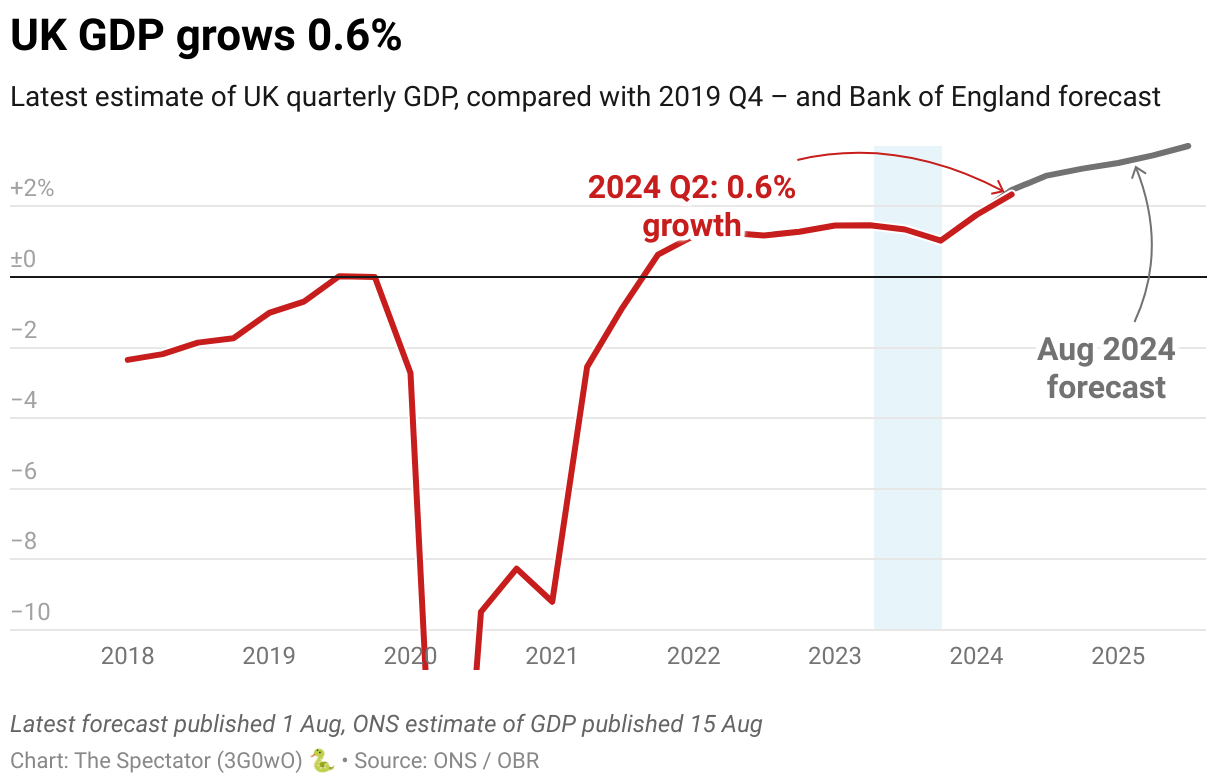
The government will be relieved by the figures this morning: the fiscal tightening that Rishi Sunak and Jeremy Hunt felt they had to do last year to calm market jitters and get the public finances back in order always risked taking steam out of the economy and stifling growth. That risk still exists. But this morning the Chancellor is already noting that the economy ‘is more resilient than many feared’. Instead of having to describe the economy as one in recession last year, he can instead note that it was ‘the fastest growing economy in the G7′.
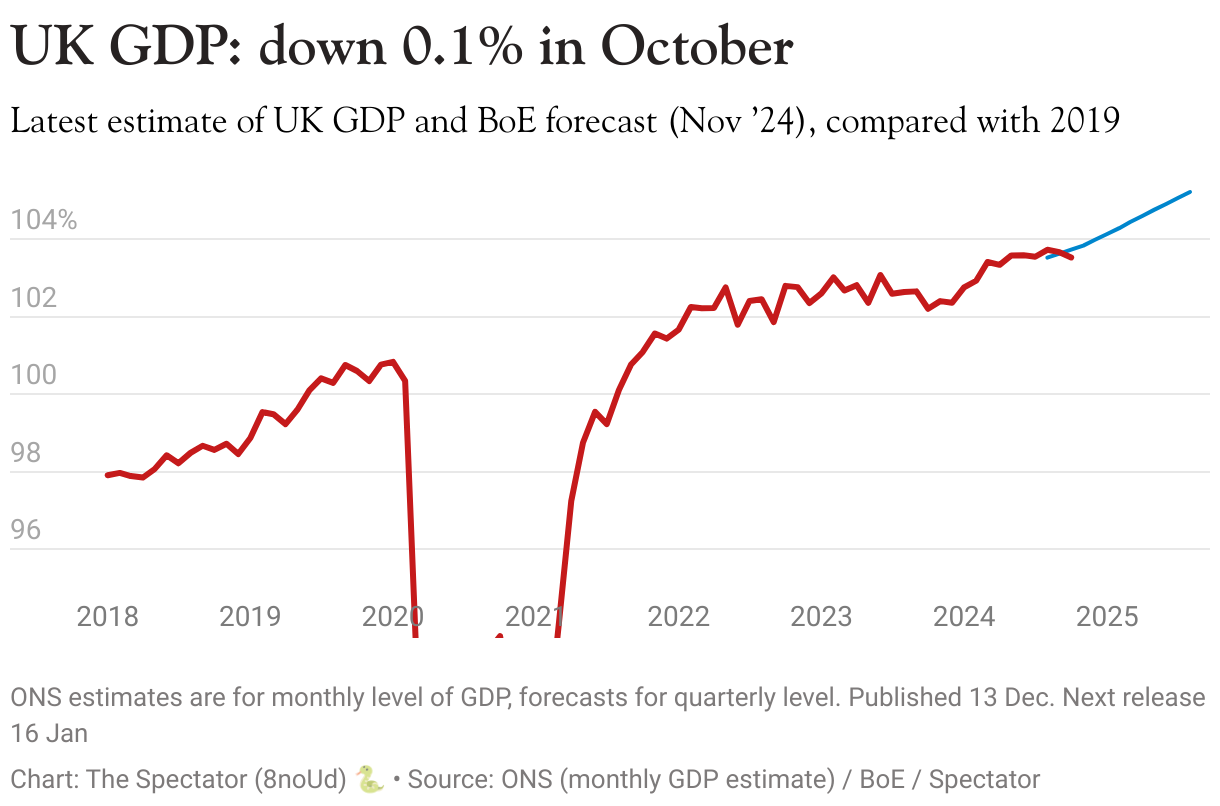
But no one should get too comfortable. The monthly figures for December last year, also released today, show that UK economic activity took a big hit, despite it being the first normal run-up to the holiday season in three years. The economy contracted by 0.5 per cent overall – 0.2 per cent worse than expected – with a 0.8 per cent dip in services (less health activity, in part due to strikes, is cited by the ONS as one of the leading causes for this fall).
Perhaps even more worryingly, December’s GDP fell by 0.1 per cent compared to the same month in 2021: a moment in time when the public was still isolating with Covid and voluntarily reducing activity as the Omicron wave hit the UK. For comparison, the ONS notes monthly GDP for November grew by 0.6 per cent between 2021 and 2022. So December’s GDP contraction is especially disappointing, when you consider the comparison between both the month and year before.
For now, the UK economy remains 0.5 per cent smaller than it was pre-Covid in February 2020. And these figures can still be revised. The ONS confirmed this morning that its monthly update for November remains ‘unrevised’ at 0.1 per cent growth. But the December figures won’t be confirmed until next month. If there is a downward revision, the UK still risks a formal recession.
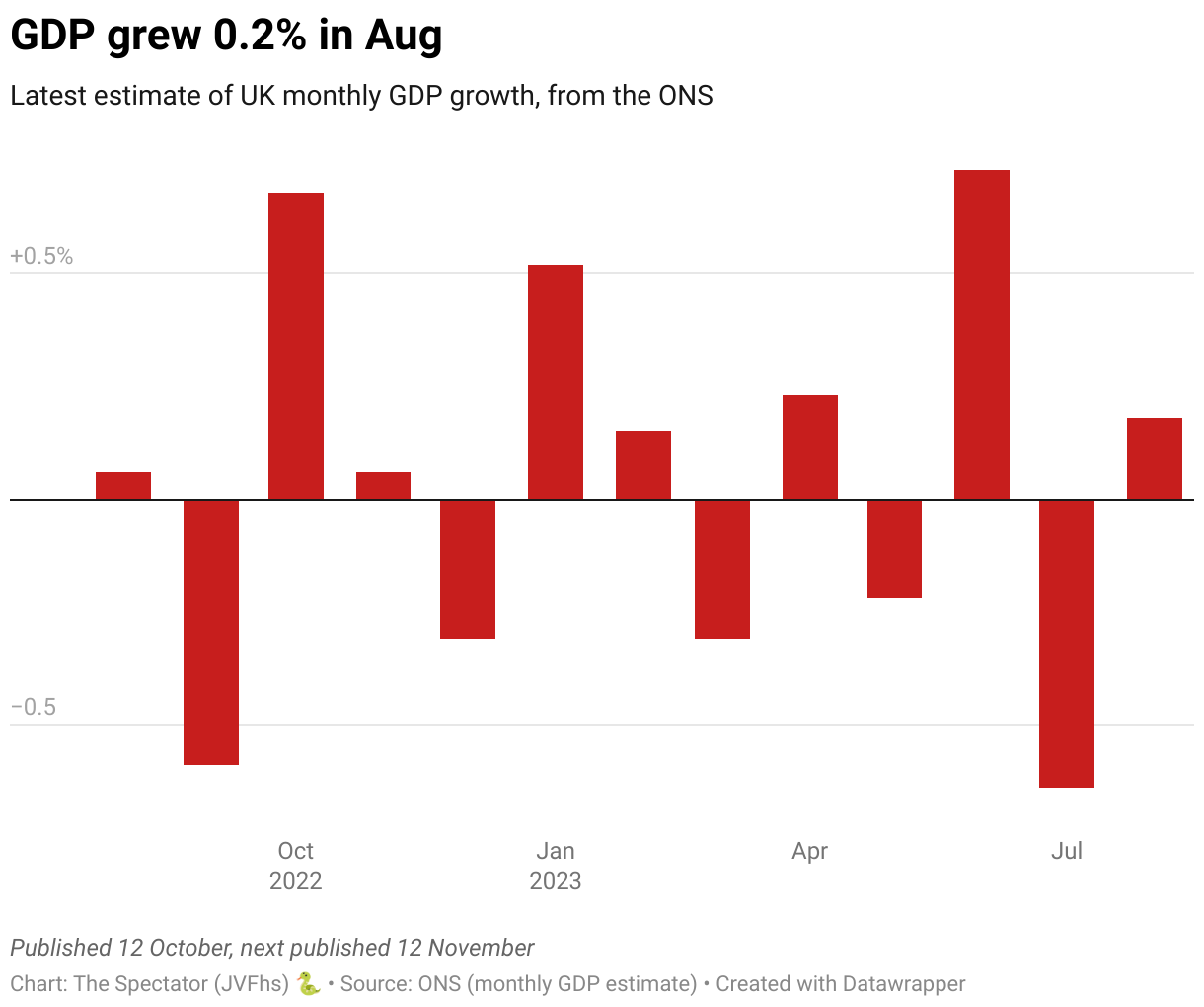
Thankfully it seems the worst predictions for last year have been avoided. But forecasters are keeping an arm’s length between themselves and any kind of optimistic analysis this morning, as the real test of recession is yet to come.
The big forecasters, including the Office for Budget Responsibility and the Bank of England, are still expecting a recession this year – although predictions are becoming shorter and shallower with each update. Capital Economics (CE) notes that ‘avoiding a recession in 2023 will prove harder’, largely due to ‘the drags from high inflation and high interest rates.’
CE also notes that households and businesses are holding up well, as ‘the combination of the government’s support and households/businesses using their cash reserves has so far cushioned the blow from the fall in real incomes’. But these reserves are bound to dwindle, especially as the Energy Price Guarantee changes in April to cover far fewer people. Meanwhile the impact of inflation on people’s pay packets continues to inflict the cost-of-living squeeze. The latest labour market update from the ONS shows both total and regular pay down 2.6 per cent on the year in real terms, ‘among the largest falls in growth since comparable records began in 2001′.
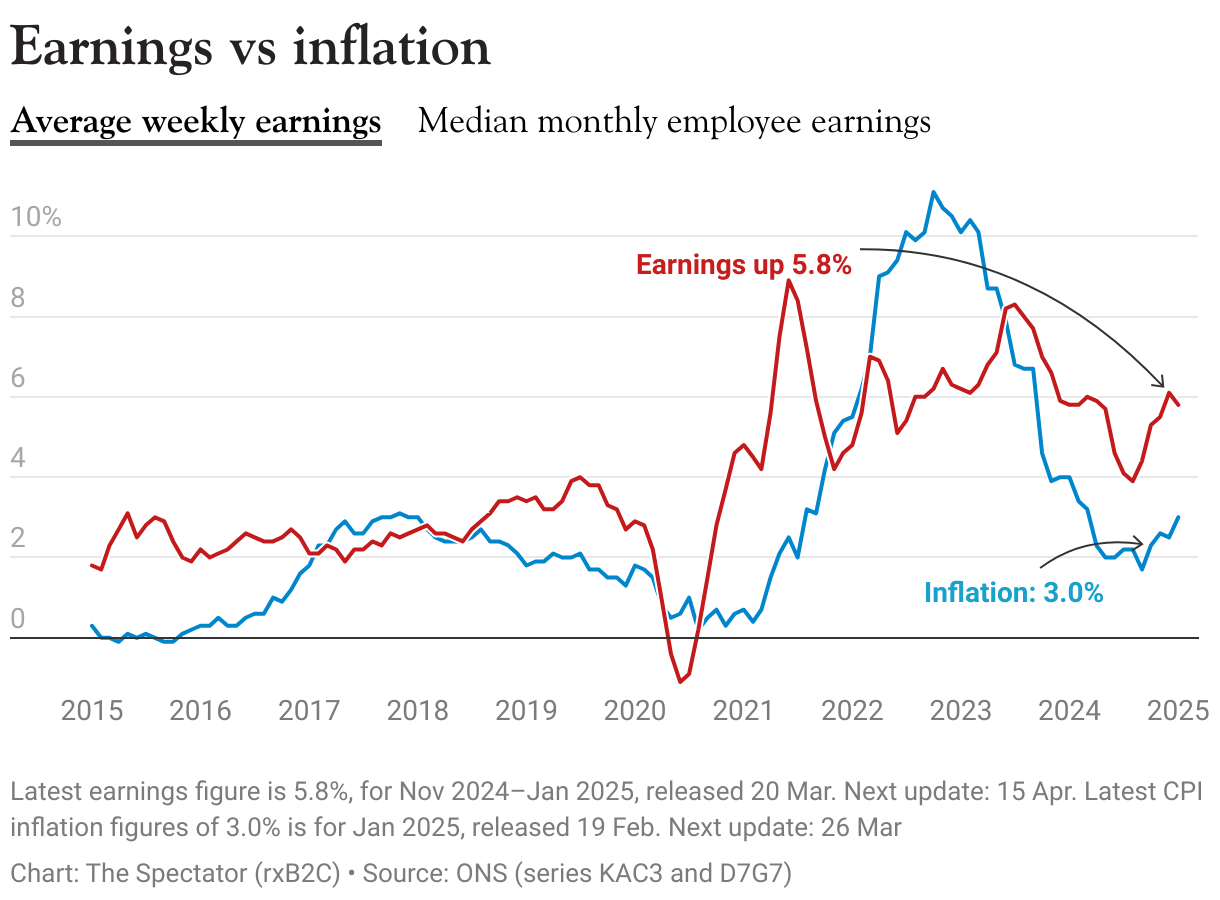
This remains one of the big problems with the technical definition of recession: it is, of course, much better for the UK to have dodged a formal recession last year than to find itself in one. But that is no guarantee that people feel better off. With real wages taking such a hit, many will feel as though we’re in recession anyway. No growth in Q4 last year translates to fewer opportunities and less prosperity, which makes everyone feel poorer. And that’s before we get to the economic trials and tribulations 2023 has in store.
Joe Biden takes a Florida vacay
Fresh — or not so fresh — from his awkward and stilted State of the Union address, President Biden took his show on the road to Florida to stump against what he claims are Republican plans to cut (“sunset” in Beltway-speak) Social Security and Medicare. Apparently unaware that Florida is now an irretrievably red state, on Thursday the president spoke at the University of Tampa in what was widely received as a kickstart to his expected 2024 reelection campaign.
Despite platitudes about bipartisanship, Biden targeted Florida Senator Rick Scott, a Republican who has floated a plan to review federal programs once every five years for reauthorization (though the plan does not specifically mention either Social Security or Medicare). Scott quickly replied on Twitter that Biden’s rhetoric is a “lie” and “a dishonest move… from a very confused president.” Scott will also soon air a television ad that refutes Biden, upbraids him for alleged tax evasion, and calls for his resignation.
The Republicans have no known plans to cut either Social Security or Medicare, but that is beside the point. Terrorizing an increasingly precarious middle class with tall tales of danger to grandma’s entitlement payments saved the Democrats from oblivion at the hands of mobilized Republican majorities in the 1990s, and it may be their only hope now. Biden himself gestured in his Florida speech at the unreality of such posturing, calling his depiction of Republican intentions “a dream” and promising to be that dream’s “nightmare.” Given a Democratic Senate and his own veto power, the straw man he is standing up to does not exactly boast the prowess of Corn Pop.
Despite his advantages over the slim Republican House majority and lackluster Republican performance in last November’s midterm elections, Biden’s numbers are terrible. On good days, his approval rating hovers just above 40 percent, a historic line of death for presidents seeking reelection. On economic issues, which are shaping up to be decisive in 2024, he is running significantly lower, at just 31 percent. Only 16 percent of Americans feel they are better off now than they were two years ago. With inflation reaching nearly 15 percent since Biden took office, along with high interest rates and fears of a deepening recession, the administration’s boasts about a booming economy sound fanciful to say the least.
A stark 7 percent of voters say they would be “enthusiastic” to see Biden win another term in 2024, while 62 percent would feel either “dissatisfied” or “angry.” Nearly 60 percent of Democrats would prefer another candidate for their party. Vice President Kamala Harris’s numbers are even worse. Biden’s longtime chief of staff Ron Klain, widely regarded as the real brains behind the administration, unexpectedly resigned in late January, leaving his post the day of the State of the Union. A bevy of recent polling shows Biden losing in a rematch against Trump, the only declared Republican candidate so far.
Even as his cognition continues to decline, Biden exists in a DC-centered echo chamber that tells him he is a great president and his opponents are fascist threats to Our Democracy™. By choosing Florida to castigate Republicans, he seems to be buying into his own 1990s-vintage propaganda, throwing in a few “tax the rich” digs for good measure. “Right now, there a thousand trillionaires in America,” he declaimed, before correcting to billionaires.
Nevertheless, hopeful Democrat strategists hailed the visit as a bold challenge to Florida Governor Ron DeSantis, the only serious Republican alternative to Trump in 2024. Just across Tampa Bay in Sarasota, DeSantis recently appointed a conservative majority to the board of trustees at the New College of Florida. DeSantis’s policies are popular, both statewide and nationally, and contributed to his 19-point reelection victory, while Republicans hold all state-level Florida offices, both of its Senate seats, 20 of its 28 congressional seats, and supermajorities in both houses of the state legislature.
The idea that Florida could be in play in 2024 is risible. And so did Biden fall into his own rhetorical trap yet again, praising DeSantis’s thoroughly trounced Democratic challenger Charlie Crist, saying to open laughter, “Charlie, I don’t think you’re finished.” But he is finished, and so, probably, is Joe Biden.
Paul du Quenoy is President of the Palm Beach Freedom Institute