-
AAPL
213.43 (+0.29%)
-
BARC-LN
1205.7 (-1.46%)
-
NKE
94.05 (+0.39%)
-
CVX
152.67 (-1.00%)
-
CRM
230.27 (-2.34%)
-
INTC
30.5 (-0.87%)
-
DIS
100.16 (-0.67%)
-
DOW
55.79 (-0.82%)
The BB wants to put my dream farm on a skip
‘Have you got your passport? Your phone? Your wallet?’ The builder boyfriend patted his pockets and told me not to worry as we drove through the Gatwick drop-off lane where they charge you £5 to open your car door for three seconds and push someone out.
When I arrived back home, he texted: ‘I left my euros in the pocket of my work jeans.’ No matter. He could draw out cash when he got there.
It had been a last minute rush to get him on a flight to Cork to view this dream farm I had found, in the sun-drenched valley.
It was really a modest white bungalow but it had 45 acres behind it, and post and rail fences. If I squinted, it looked a bit like Southfork. It was certainly the closest I was ever going to get to homesteading. And while it wasn’t quite on the scale of a ranch in Dallas it was 45 acres more than we could afford in Britain.
I got so nervous I went online and bought a giant paddling pool from Argos, click and collect
The builder boyfriend could do up the bungalow, and the rusted cattle barns. Of course he could. He could do anything. (Or, as my horse trainer said to me during my jumping lesson last week: ‘It’s taken you six years to not finish a three-bedroom cottage. Are you seriously considering doing up a farm?’)
The couple buying our house have hammered us down so much that it is uncertain what, if anything, we can afford.
I fretted while the BB checked in at his Airbnb that night, went for a drive, and started looking at another property he fancied more, a tired out Georgian mansion with not enough land.
I got so nervous the next morning while he was driving to Southfork that I went online and bought a giant paddling pool from Argos, click and collect. While I was trying to assemble it, spread-eagled on the patio, he texted. He liked the spot, but the bungalow needed putting in a skip. This is builder boyfriend-ese. When he really doesn’t like something, he declares his intention to put it in a skip. Interestingly, he also takes things out of skips. We have a very nice salvaged fireplace surround, a giant log burner, a statue of Mary – whoever skipped that really does need to take a good long look at themselves.
But in general, it is unclear to me whether he puts more into skips than he takes out. The net position, I fear, is hoarding, and I confirm this to myself every time I manage to sneak a look inside his builders’ yard, which is behind tightly locked gates.
‘Oo what’s that?’ I ask, if I pick him up there, and he bangs the gate shut and says: ‘Never you mind.’
He declared the house needed skipping while walking the land with the owner, but the owner was a builder too and I think this may be how these macho chaps talk to each other. In any case, discussing the necessity of putting a ball and chain through the bungalow cheered them both up immensely, apparently.
He rang me and declared the land mind-blowing. He went off to walk the nearby mountain trails where he bumped into a neighbouring racing yard owner’s wife who told him we would be able to hack our horses for miles.
By the time he was driving back to the airport, he declared it all a great find. He had hammered out a potential deal with the owner. So I crunched the numbers, wincing when I realised that I had been working on the premise of 1 per cent stamp duty in Ireland, but with land that rose to 7.5 per cent.
No matter which way I sliced and diced it, the figures just would not add up. The offer on our house was simply not enough to enable us to buy the dream farm in the sundrenched valley.
I suppose it was sun-drenched when I went to view it, and it was sun-drenched as the builder boyfriend walked the land while talking to his new mate, the owner, who lived on the land next door. In reality, it was probably going to rain eight months of the year, and the builder next door would soon fall out with us over our plans for his family’s old bungalow. But while it remained a theory, that valley certainly was drenched in sunshine.
The BB took the coast road to the airport via another farm I insisted I would not consider because it was totally derelict. He texted me the pictures. There was grass growing inside the house.
‘Absolutely no way,’ I said, thinking yes, but there’s 20 flat acres. When we called the agent the next day, he said they would take a low offer. And when I crunched those numbers, they did add up.
The death of fair play
New York
He’s oilier than Molière’s Tartuffe but gets away with more. His latest move involves the martial art of jiu-jitsu, where he managed to get a referee to reverse his decision. I’ve been competing in martial arts for close to 60 years now, and have rarely, in fact never, witnessed a ref reverse his or her decision. But I’m no bad loser like Zuckerberg.
Some of you old-timers may even remember something called fair play. Bad calls are inevitable in sport, and one is used to taking the bad ones with the good ones because in the end they all even out. Facebook’s honcho ended up a multibillionaire under a bit of a cloud, accused of having stolen the idea from twin brothers who could not have been overly smart to trust him in the first place.
Never mind. I find anyone who went to Harvard suspect – except for Michael Mailer, that is. But getting a referee to reverse his decision in jiu-jitsu takes the brazenness of Baron Munchausen combined with the false humility of Uriah Heep. If any of you missed it, the papers were full of pictures of the great martial artist wearing a yellow belt – the equivalent of second grade in school – competing against one wearing a white belt (kindergarten) and, after a brief conversation with the ref, getting him to alter his decision. This was followed by lots of pictures of the great warrior having won the gold medal.
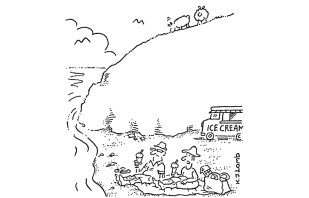
Well, I don’t criticise lower belts but I’ve yet to see, after close to 60 years of competing, anyone appealing or even conferring with a ref. It simply isn’t done in martial contests, not by martial artists anyway. All one does after a decision is bow, end of story. Trust someone like Zuckie baby to argue and convince the referee – obviously a total fool – to reverse his decision. Mind you, I should not be surprised. Even societies that were once in an enviable position have been dragged down by today’s culture, so why not the noble martial-arts tradition? But this is not the reason I’m writing about the multibillionaire ‘martial artist’. I am writing about him because of my friend Douglas Murray.
Facebook killed a Douglas Murray article, using the usual double talk these literary abortionists employ when they read something that doesn’t conform to their lefty standards: ‘It violated community standards on hate speech.’ As the sainted editor of this journal pointed out, it gave no details. Peachy, ain’t it? A malign ideology has taken hold both in the UK and in the US of A. Any criticism of the woke status quo is considered hate speech, and it has become the ultimate censor. As in Orwell’s Nineteen Eighty-Four, truth is now hate, and freedom of speech is prejudice.
What is to be done? What is to be undone would come closer to solving the problem. The war on intolerance has been manna from heaven for those who tolerate not an iota of dissent. Anti-West and anti-tradition rhetoric is the status quo, with punks like those Silicon Valley freaks leading the charge. That stunning good-looker Jeff Bezos, who owns the Washington Post, and the even better-looking Sulzberger chappy, proud owner of the Bagel Times, along with the Silicon lot, Hollywood and the TV networks, are sitting pretty and looking down on the rest of us peasants who still respect our past and what western culture has achieved.
Lest anyone doubt the ominous situation for anyone not woke, a new opera that celebrates the life and death of George Floyd will probably become a staple in American classical music. What I’m betting on is that Daniel Penny, an ex-Marine, who choked to death a criminal threatening people in a subway car, will not have an opera written about him. He will most likely go to jail.
Again, never mind. Everyone I know seems to be against something nowadays, but it’s not the first time this has been the case, as the book I was reading this week reminded me. Yet again I am reading about George Washington and the American Revolution and what a decent man and soldier General Howe was and how hard he tried to convince the rebels to put down their arms and become second-rate British citizens again. What reminded me of today’s split society was how divided Americans were – and remained so – even after the revolution.
Incidentally, did you know that the final attack by Washington on Redoubt No. 10 in Yorktown was led by the great Alexander Hamilton who was desperate for battlefield glory? Whose side would I have been on had I been a well-off Philadelphian once the revolt had begun? That’s an easy one. I would have remained a loyalist. I remember being insulted in school when I defended the great traitor in history class. Benedict Arnold won the Battle of Saratoga and while in hospital was cheated of his victory, which was claimed by Horatio Gates. He was refused funds he was owed by a do-nothing Congress, and was even court-martialled. And he was, after all, an Englishman.
The closest I ever got to any of those great types was the ball I went to given by Sheila Rochambeau in the Rochambeau château in 1963. It was the Frenchman with his fleet who spelled doom for the Brits and Cornwallis. Without him we’d all be speaking Brit over here today.
Terrifying: Reality reviewed
Reality is an edge-of-your-seat thriller that isn’t like any edge-of-your seat thriller you’ve encountered before. Trust me. It’s a docudrama that isn’t ‘based on a true story’ because it is a true story. It’s an enactment of the FBI’s interrogation of American whistleblower Reality Winner. Taken directly from the transcript of the audio recording, the word-for-word screenplay includes every cough, every ‘um’, every dog bark, every banality, no embellishments. Yet it’s more terrifying than any film that has set out to terrify (see: Sisu). You should trust me on this too.
The film is directed with clarity and precision by Tina Satter, a playwright who discovered the transcript online and first turned it into a theatre piece (Is This a Room). You may not have heard of Reality Winner. I hadn’t. Her name doesn’t seem to be up there with Chelsea Manning or Edward Snowden. I don’t know why. Sydney Sweeney is Winner and she is phenomenal, but we’ll get to that later.
The film opens, like the audio recording, with Winner returning to her home in Augusta, Georgia, on 3 June 2017. She is 25, and wearing cut-off jeans. It’s a Saturday, she’s just been grocery shopping, and here are two FBI agents waiting on her doorstep. The agents, Garrick (Josh Hamilton) and Taylor (Marchánt Davis), are friendly as hell. She’s a National Security Agency translator, fluent in Farsi, Pashto and Dari, and they’re awestruck. ‘Wow. That’s impressive. I am barely able to speak English,’ says Garrick. Winner laughs. ‘English is hard,’ she jokes. They talk about her passions (yoga, crossfit, animals) and show concern for her rescue dog and the rescue cat who is fat: ‘Girl likes to eat,’ says Winner. (This is sometimes funny.) We know, and she knows, that their amiability is in the service of something dark. But she doesn’t know what they know exactly. Yet. They know she knows that. What follows is a dance of entrapment.
The agents make out they are klutzes. They are, they tell her, investigating the mishandling of a classified document about Russian interference in the 2016 election that turned up on an American website. They discombobulate her by, initially, focusing on mundanities. Would she like to get her perishable groceries out of the boot of the car into her fridge? It’s often surreal, considering what’s at stake. They casually say that she can come to their office if she wants, but maybe they could just do it here? (This, I now know, would mean that they didn’t have to read out her Miranda rights or offer her a lawyer; you will go down a rabbit hole of your own afterwards.)
They end up in an unfurnished room in Winner’s house, just the three of them in conversation. She has to think on her feet, literally, offering alternative hypotheses as to how the document was released. Occasionally, there’s a crackle as the screen goes black, mirroring redacted passages in the transcript. Or there is a flashback to Winner sitting at her desk at the NSA, where Fox News was played constantly in the background. (‘And, um, I’ve filed formal complaints about them having Fox News on, you know? Uh, just at least, for God’s sake, put Al Jazeera on, or a slide show of people’s pets.’) But those are the only flourishes.
Sattar’s deliberate spareness gives this an unnerving, eerie quality while Sweeney’s performance is truly phenomenal. She plays Winner’s mounting dread and anxiety in a way that’s so authentic it will possess you. I think it’s clear whose side Satter is on, but I won’t say more in case you don’t know how it ends. Trust me, it’s good.
Much better than the film: Mrs Doubtfire, at Shaftesbury Theatre, reviewed
Mrs Doubtfire is a social comedy about divorce. We meet Miranda, a talentless, bitter mother, who tires of her caring but imperfect husband, Daniel, and kicks him out of the house on some footling pretext. When Miranda later discovers that Daniel’s loyalty to their children is an asset of inestimable value she invites him back. And he accepts her offer without a murmur of recrimination.
The story is based on the cruel imbalances in family law that entitle a vengeful, heartless woman like Miranda to destroy the emotional wellbeing of her children and her husband, and to call her vandalism justice. In this story Daniel is a voiceover artist who impersonates an eccentric Scottish nanny, Mrs Doubtfire, and persuades Miranda to hire him as their kids’ carer. A neat set-up. It works better as a play than a movie because the nanny’s disguise is more convincing on stage. And the audience is spared the relentless and distressing hyperactivity of Robin Williams, who starred in the 1993 film.
The audience is spared the relentless and distressing hyperactivity of Robin Williams, who starred in the film
The ingenious plot has some exquisite moments. Miranda shares the secrets of her troubled marriage with the wise, kindly Mrs Doubtfire, aka Daniel, who thus discovers where he erred in his marriage and how he might improve his conduct. The audience knows what’s going on. Daniel knows too. Miranda doesn’t. A wonderfully touching scene. The contrary device works just as well. Mrs Doubtfire befriends Miranda’s hunky new boyfriend who outclasses Daniel in every way. He’s younger, richer, better-looking, and he sounds more intelligent (to American ears, at least) because he’s English. Daniel uses Mrs Doubtfire’s persona to sour his wife’s budding relationship and to plant doubts in the boyfriend’s mind about Miranda’s true feelings.
The script is highly manipulative, in the best possible way, and it leads the audience like a flock of trusting lambs towards the sunny uplands of reconciliation and peace. Everyone learns, everyone grows, everyone hugs. This type of schmaltz is often unbearable to sit through but here it’s a joy. The tunes are decent enough although not well integrated with the storyline. The dancing is brilliant and the female performers have clearly been chosen by a red-blooded male with an eye for a fetching contour and a flexible physique. Tickets are costly but scarce. Great family fun.
Aspects of Love, by Andrew Lloyd Webber, is based on a novel by David Garnett. The storyline has become accidentally topical as it includes a pair of symmetrical romances between a middle-aged man and a younger female. It opens in the dressing room of a French theatre where Rose, a failing actress, is propositioned by an innocent but devilishly handsome teenager, Alex. (Great work from Laura Pitt-Pulford and Jamie Bogyo in these roles.) Alex embarks on a romance with Rose which is promptly wrecked by his rich, famous uncle, George, who shoves him aside and invites Rose to move into his swish Paris apartment.
The script is packed with enough surprises to fill ten hours of television but it never feels rushed or over-hasty. In one hectic scene, Alex barges into George’s home and begs Rose to take him back. She relents. They make love. Then they quarrel. Alex draws a pistol. Rose dares him to murder her. Bang! He misses. George walks in and correctly reads the situation but instead of getting angry he agrees to give Rose up. Alex makes an identical offer and suggests that Rose remain with George. But it’s George who quits, whereupon Rose becomes overwrought, rejects Alex and throws him out on to the street. Left alone, she confesses her undying love for him. This is an astonishing feat of compressed storytelling. Although it sounds absurdly melodramatic, the scene is handled with great tenderness and humour.
The sets keep pace with the fast-moving storyline. Director Jonathan Kent has chosen a shabby-chic style with mobile panels that indicate each change of location from Provence, to Venice, to Paris and so on. Some of the scene-painting is deliberately unfinished, which gives it a raffish, bohemian air. And the panels include quotations from the work of Cézanne, Degas and Van Gogh. It’s fun for art-lovers to play spot-the-masterpiece. Michael Ball dazzles as the opulent, dandyish George but the role is too slender for his talent. He has a huge aria in Act One that needs to be complemented by an even more impressive showstopper in Act Two. The influence of George fades unexpectedly towards the close, and the show ends on a minor key, in mournful anti-climax.
At press night, the curtain call was interrupted by the authors, Andrew Lloyd Webber, Don Black and Charles Hart, who tottered on to the stage, a little stooped and a little paunchy, like three ageing gunslingers in a wild west saloon. Perhaps they could spend an afternoon around the piano and create one last hit for this not-quite-perfect show.
Exceptional career woman, unexceptional painter: Lavinia Fontana, at the National Gallery of Ireland, reviewed
Reviewing the Prado’s joint exhibition of Sofonisba Anguissola and Lavinia Fontana in the Art Newspaper three years ago, Brian Allen pronounced it well worth seeing but predicted that each of these pioneering 16th-century women artists ‘would wither in the spotlight of her own retrospective’. Was he right? In its new monographic exhibition devoted to Fontana, the National Gallery of Ireland puts his waspish prediction to the test.
Her ‘Galatea and Cherubs’ and ‘Venus and Mars’ are believed to be the first nudes painted by a woman
Ireland’s National Gallery was an early investor in Fontana, acquiring her most ambitious work, ‘The Visit of the Queen of Sheba to King Solomon’ (1599), eight years after opening in 1864. During conservation for the exhibition, infrared reflectography revealed several pentimenti, one of which explains the rather strange resemblance of the Queen’s ladies-in-waiting to a flock of swans: at some point in the picture’s evolution Fontana shifted the whole retinue up a notch by lengthening their necks under their ruffs. Anatomy was never her strong point. As a woman artist she had no opportunities to draw from life, but – like other restrictions on her sex – that didn’t hold her back. Her ‘Galatea and Cherubs’ (c.1590), ‘Venus and Mars’ (c.1595) and ‘Minerva Dressing’ (1613) are believed to be the first nudes painted by a woman – among many firsts in the extraordinary career of this serial shatterer of glass ceilings.
Fontana came to painting relatively late; she was 23 in 1575 when she painted her earliest dated work. Her painter father Prospero Fontana had no sons and after becoming ill in the 1560s trained up his daughter to take over his studio. But as a woman in 16th-century Bologna, Lavinia couldn’t do business in her own name: she needed the studio version of a house husband. Step up Gian Paolo Zappi, a man of good social standing but little earning potential from nearby Imola. Their marriage contract was highly unorthodox: Gian Paolo would marry Lavinia without a dowry, move into the Fontana family home in Bologna and allow her to pursue her career as an artist. A marriage portrait she painted for him in 1577 shows her seated at a virginal with an easel in the background, a woman of diverse accomplishments but unremarkable looks – ‘neither beautiful nor ugly, but somewhere between the two’ in the opinion of her father-in-law.
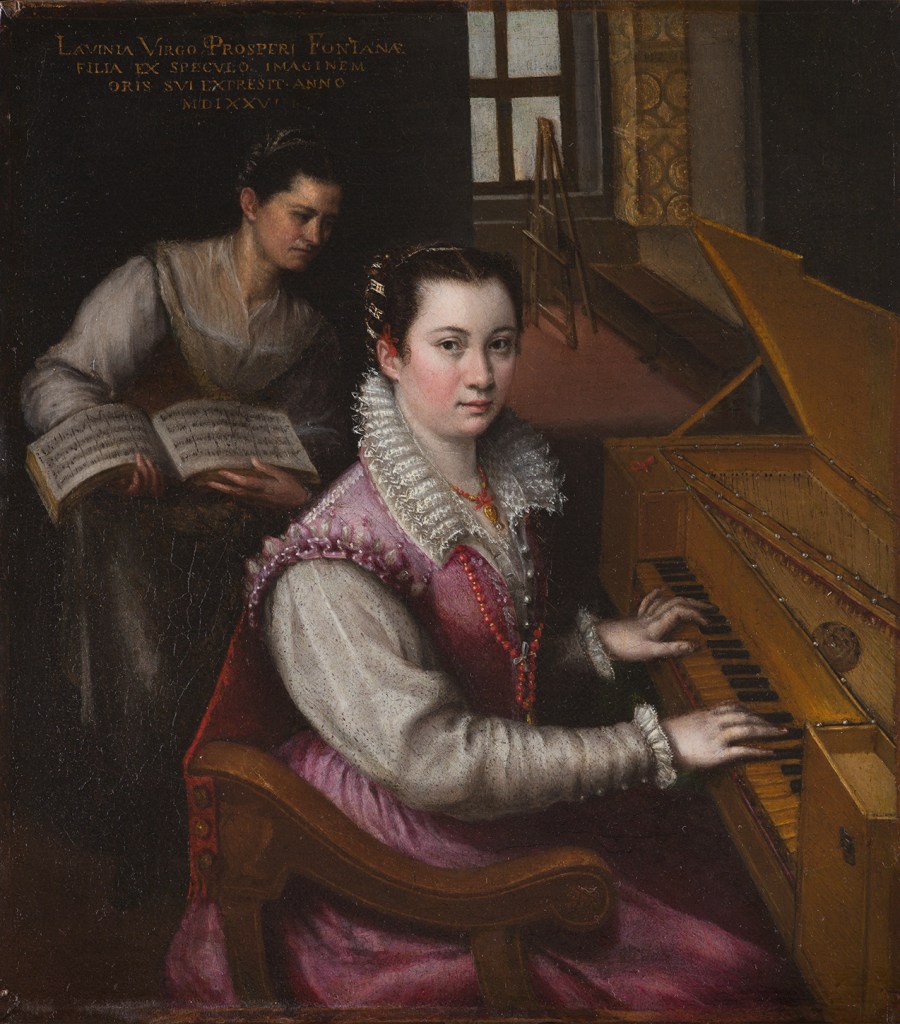
Having established herself as a portraitist with a clientele of male academics and prelates, Fontana moved in on the more profitable female market, relocating to the smart part of town where the Bolognese nobility had their palazzi. There she made herself popular with the ladies by painting portraits that doubled as inventories of her sitters’ jewels, every item of bling painstakingly rendered down to the jewelled collars and earrings worn by their lapdogs. ‘All the Ladies of the City flocked in want of her,’ her biographer Carlo Malvasia reported. ‘There was nothing greater that they desired than to be portrayed by her.’
As the mother of 11 children, she spent the best part of her professional life either pregnant or in mourning
It was laborious work. Zappi may have helped in the studio, though Malvasia disses his painting skills, joking that he was relegated to the role of ‘tailor’ assisting with drapery. But if Fontana’s output of some 130 works in 40 years was relatively small, it wasn’t because of the faff of adding drop shadows to the hundreds of pearls on the Queen of Sheba’s costume. As the mother of 11 children, this redoubtable woman spent the best part of her professional life either pregnant or in mourning. Only three of her children survived her. The most grievous blow was the loss of her 14-year-old daughter Laudomia, a talented painter she probably hoped would take over her studio. After her death in 1602 Fontana moved to Rome, where she became a portraitist to the Vatican Palace under Pope Paul V (a former papal legate to Bologna she had cannily made godfather to her youngest son) and portrayed the Roman goddess of wisdom as no one had ever seen her – in the nip – for his nephew Scipione Borghese. The fact it was painted by a woman will have added a frisson to this freak of naturism.
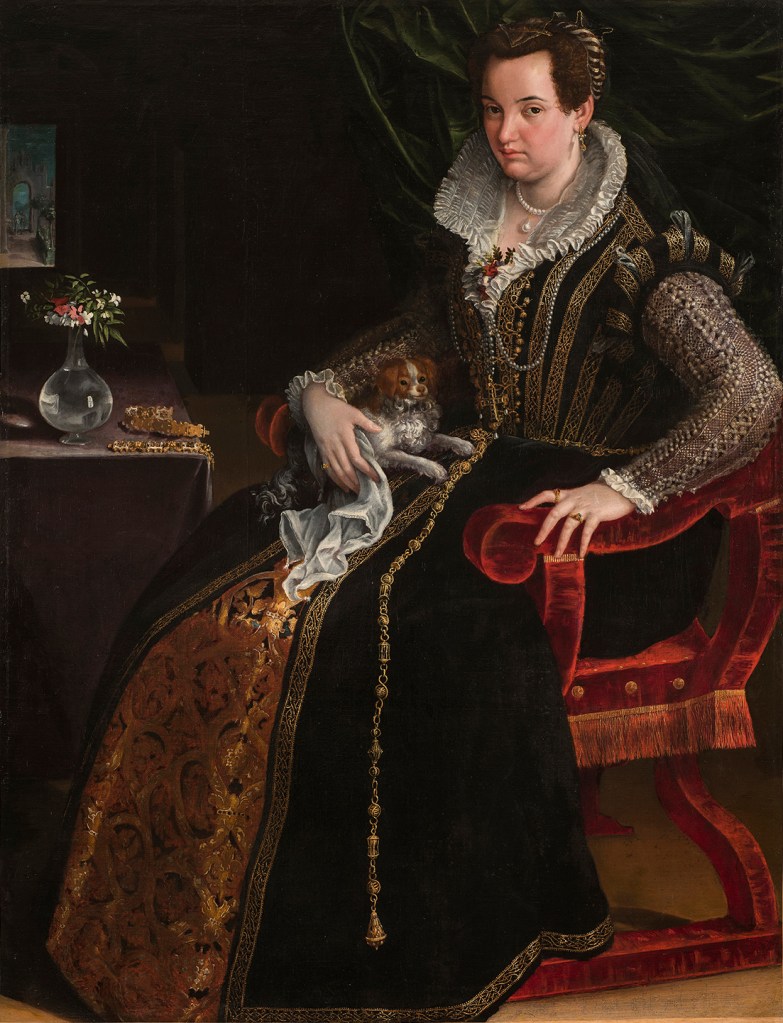
‘Minerva Dressing’ was Fontana’s last recorded painting; she died in Rome with ‘broken hands’ in 1614 aged 62. Does she wither in the spotlight of her own retrospective? Does she hell. True, her work is uneven. Her architectural perspectives are squiffy, her anatomy is shaky and her paint-handling finicky. She never acquired the fluidity born of early training and, although contemporary with Bologna’s baroque pioneers, the Carracci, she seems stylistically stuck in a mannerist past. The finest works in this show are not paintings but portrait drawings in a precious little album on loan from the Morgan Library & Museum New York; there’s no comparison between her stiff and stilted oil ‘Portrait of a Gentleman in Armour’ (late 1590s) and the living, breathing chalk drawing on which it is based. Yet she dared to charge as much as Van Dyck. As a painter she was unexceptional, but as a career woman she made history.
One of the most tuneless, vapid, dismaying things I’ve ever seen: Mötley Crüe, at Bramall Lane, reviewed
I’m not sure I’ve ever seen anything worse than Mötley Crüe in Sheffield. Nothing more tuneless, empty, vapid and dismaying. The Los Angeles glam-metal band became superstars in the 1980s, largely by wearing lots of make-up and doing terrible things, but I’ve never understood why. Even those who weren’t repulsed by the band members’ behaviour and personalities surely couldn’t have detected any actual tunes in there.
At Bramall Lane, with a viciously loud PA, the few melodies that were there were largely undetectable. And the band – now in their sixties – still gloried in their obnoxious infantilism. Late in the set, drummer Tommy Lee – the one who was in the sex tape with Pamela Anderson – came to the front of the stage and appealed for women to lift their tops up to be shown on the big screens. Several did, including one older woman, flatter of chest than the others. ‘We got us some man titties!’ yelled Lee. The face on the screen sank.
Mötley Crüe still gloried in their obnoxious infantilism
Def Leppard, by contrast, have aged remarkably gracefully. Their albums Pyromania (1983) and Hysteria (1987) are among hard rock’s biggest records, because – unlike Crüe – they really cared about songwriting and song construction, which they learned at the feet of their producer, Robert John ‘Mutt’ Lange, the great starmaker of 1980s and ’90s rock. Also, they remain delightful people (I have had several dealings with them in the past few years, and I have no hesitation in calling them the most helpful and reasonable major rock stars I have ever dealt with).
They were also too loud, but because the songs have proper melodies, it didn’t all descend into a swirl of noise. Leppard have always maintained that they had as much in common with pop as with metal, and so many of these songs could be reimagined – the none-more-1980s power ballad ‘Love Bites’, for example, could easily be rearranged into a Scandi-sad disco banger. Unlike Mötley Crüe, too, they keep on working and recording, and if ‘Take What You Want’ and ‘Kick’ don’t quite scale the heights of ‘Photograph’ or ‘Animal’, they’re still better than anything the Americans managed in their 90 minutes.
In Sheffield there was a lot of black clothing, a lot of make-up (both sexes) and a lot of cleavage (both sexes). In Brockwell Park, for the one-day indie festival Wide Awake, there were a lot of young men with terrible moustaches, which made them look like 1970s TV presenters with skeletons in their closet. It was a funny old event: the two big stages seemed to be filled with acts who weren’t quite big enough for the space (though the main headliner, Caroline Polachek, has become this year’s big hipster-pop crossover hope), while the tents seemed to be filled with acts too big for the space. I was desperate to see the excellent duo Jockstrap, but had to leave the tent after one song, because it was distressingly uncomfortable (people ended up being hoisted out of the crowd, passed out).
And in bright sunshine, even the thrillingly noxious Viagra Boys, from Sweden, with their songs about research chemicals, lost a lot of their grimy allure. There are certain kinds of music that simply demand roofs and darkness, and without the sense of enclosure a venue provides the songs simply swirl away into the ether.
The much-buzzed-about Bar Italia, for example, might well have bored me rigid had I watched them from a picnic blanket in the sunshine. But in the darkness of a gloomy ICA they were transfixing. The things that would have driven me mad at a festival – no talking to the audience, po-faced seriousness – worked completely. They are signed to the venerable indie label Matador, and they sounded exactly like a band on Matador from 25 years ago: all spindly, spidery guitar lines, quavery and questioning vocals, and plenty of quiet.
It’s a bit of a blank canvas but that blankness, I suspect, is part of their appeal – I saw a tweet from someone, praising them for not ‘having a story’ on which to sell themselves (regular readers of the music press will know that ‘having a story’ is considered essential; during the great public-mental-illness boom of seven or eight years ago, there were bands who were told to have some mental-illness stories to sell themselves to the media). They just make their beautiful, off-kilter music, and let you unfold your own stories on top. Their new album, Tracy Denim, is fantastic.
Wonderfully naturalistic and intriguingly odd: BBC2’s The Gallows Pole reviewed
In advance, The Gallows Pole: This Valley Will Rise was touted as a radical departure for director Shane Meadows. After all, he made his name with the film This Is England and its three rightly acclaimed TV sequels, about a group of working-class folks struggling to survive against the heartless backdrop of that reliable old enemy: Thatcher’s Britain. Now, he’s giving us a costume drama set in 18th-century Yorkshire.
In fact, though, it didn’t take long to realise that Meadows’s departure mightn’t be as radical as advertised – because the programme could easily have been entitled This Was England. Wednesday’s opening episode even began with a series of captions making it clear that, for the Calder Valley, the 1760s were a kind of proto-1980s, as traditional industries were wiped out and workers cast aside.
Meadows’s central point is that these people aren’t so different from us
Meanwhile, a man was dragging himself across a landscape of the purest grey – pausing only to examine the stab wound in his stomach, to collapse occasionally and to have visions of several cloaked figures with stags’ skulls for faces. As something more like social realism set in, he reached his home village where we learned that his name was David Hartley and that, rather impressively, he and his wound had walked from Birmingham where he’d spent the past seven years. Before long he’d been efficiently healed by the local herbalist and brought up to speed on the death of both his father and the village’s cottage weaving industry.
And that, as far as the first episode went, was pretty much that. Anybody who knows who the real-life David Hartley was, or has access to Google, will be aware that he’s about to lead one of Britain’s biggest ever criminal enterprises. But for now Meadows concentrated on setting the scene, building the atmosphere and making sure we knew where our sympathies lay.
Fortunately, he did a fine job of all three, since, along with his familiar themes, his familiar qualities were present in the new setting too. While his political concerns are never terribly mistakeable, they’re always firmly embodied in characters who, like actual human beings, have plenty of more personal things to worry about. There’s also the wonderfully naturalistic acting he gets from the whole cast.
Admittedly, one side effect here of his usual semi-improvised approach is that some of the dialogue is suspiciously modern – with David described as ‘not in a good place’ and people telling him: ‘I’m sorry for your loss.’ Yet, this verbal intertwining of past and present might well be part of Meadows’s central point: that these people aren’t so different from us – or, at any rate, from their descendants in his previous work. It also means that, as those stag-skulled dudes suggested, the social realism is accompanied by something more intriguingly odd, even dreamlike, that prevents the show from becoming straight (i.e. dull) agitprop.
Certainly, The Gallows Pole is a masterclass in subtlety compared with the other big new historical drama of the week. White House Plumbers (Tuesday) tells the story of the Watergate break-in from the perspective of two of the key perpetrators – and, so far at least, is keeping it very broad indeed.
Woody Harrelson plays E. Howard Hunt, whom we first saw in 1971 as a washed-up CIA operative still blaming Kennedy for the failure of the Bay of Pigs. But then came a call from the White House. The activist Daniel Ellsberg had just leaked the Pentagon Papers, about what the US was really up to in Vietnam, and President Nixon had decided that he needed a ‘real son of a bitch’ to discredit him (although Hunt himself would have preferred the more old-school methods of tarring, feathering and hanging). His chief colleague in the campaign would be G. Gordon Liddy (Justin Theroux) who struck even Hunt as a little right-wing – what with his habit of playing his dinner-party guests speeches by Adolf Hitler at full volume.
Nonetheless, the pair formed a dumb and dumber-style partnership, donning fright wigs and heading to California to steal Ellsberg’s file from his psychiatrist: a plan stymied only by the fact that their walkie-talkies were almost as useless as the comedy Cubans they’d engaged to carry out the theft. Strangely, the upshot was that the White House has now given them $1 million to do whatever it takes to get Nixon re-elected.
The trouble with all this is not only that there’s a constant sense of over-striving for effect, but also that it’s never quite clear precisely what effect the programme is over-striving for. Are we meant to be amused by the pair’s incompetence or horrified by their politics? In another show, of course, the answer could well be ‘both’. In this one, the two elements undermine each other so thoroughly that we end up feeling not enough of either.
The mystery of Boris Johnson’s missing WhatsApp messages
Where have Boris Johnson’s diaries and WhatsApp messages gone? The row over the demands of the Covid Inquiry for evidence from the former prime minister and his aide Henry Cook took another twist yesterday, with his team insisting that he has already handed over all the relevant material to the Cabinet Office and that it is in fact the government that’s holding the whole thing up.
The inquiry wants all messages from Johnson’s phone, and had demanded them by 12 May, then 4 p.m. yesterday, and now there’s another deadline extension of 1 June. The Cabinet Office had disagreed with the extent of these requests, saying not all of it was relevant and that revealing all the communications from the pandemic now, rather than under the 30-year rule would damage the decision-making process in government more widely. It is worth pointing out, though, that the inquiry doesn’t need to publish everything it is handed.
A lot of this fight is about the bad feeling between the Johnson camp and Rishi Sunak
Already the Johnson camp has been fighting with the Cabinet Office over the way it handled new information that was passed to the police about potential rule-breaking. Yesterday, the accusation was that the hold-up with the messages wasn’t Johnson being recalcitrant, but the government. The Cabinet Office then accepted, just before the deadline passed, that it didn’t have the material. So where is it?
Labour has got in on the act, with Angela Rayner saying ‘it now appears that vital evidence has gone missing’ and ‘must be found and handed over as requested if the whiff of a cover-up is to be avoided and bereaved families are to get the answers they deserve’.
A lot of this fight is about the bad feeling between the Johnson camp and Rishi Sunak, as well as bits of the wider government, about the way he left office last summer. But there is also a wider question about the inquiry and its efficacy and importance.
Publishing messages ahead of the 30-year rule might have an impact on decision-making, but will the inquiry have a real impact on decision-making more widely? The Chilcot Inquiry into the Iraq War took so long that successive governments had managed to repeat many of the mistakes it highlighted, while key figures had exited the political arena and didn’t have to account for their decision-making in the same way as those still in government.
It is far more likely that the messages disappear into a vortex for a long time than it is they have any real impact on how government works – though one might hope the government could work well enough to find out where they’ve gone.
The lives of even anti-Putin Russian artists are being made impossible
Swift and sure, the guillotine blade came down on Russians in the West on 24 February last year, the day Russia invaded Ukraine. The logic was clear as concerned Putin loyalists; cutting them off from western gravy trains in the face of their dear leader’s grotesque aggression made some sense. They could bed down with the devil, so to speak, but not on our buck. So one doesn’t weep much over the relegation to Europe’s fringes of the likes of openly pro-Putin musicians such as pianist Denis Matsuev or the former LSO and Munich Philharmonic chief conductor Valery Gergiev.
Then there’s the soprano Anna Netrebko, who, seen as being close to Putin, was sacked immediately by the Met when she didn’t condemn the Russian President fast enough. She later condemned the war in no uncertain terms, but she’s still untouchable in Britain, according to Antonio Pappano, the music director of Covent Garden. In April, Pappano criticised the epidemic of ‘inept cancelling’ of Russian musicians triggered by the invasion, and defended his collaboration with Netrebko in Salzburg next year. But ‘the conditions are not right for her to be performing [in London]’.
‘My next year is completely empty. I had a very full diary before and then a completely empty diary afterwards’
Netrebko, who is widely liked, is unlikely to be permanently exiled, even though the Met suggested she might be. But the near-deletion from the classical music and dance world of Russians who don’t share Gergiev’s or Matsuev’s allegiance – or their richly roubled pockets – has obliterated, for the time being, the prospects of many young Russians, and reconfigured the artistic landscape and atmosphere of the industry, making it more Manichaean, more politicised.
To be clear: my violins will stay safely stowed for apologists of Putin, or those who profit from his regime. But the idea that it is sacrilege to enquire into any Russian experience at all, even of artists who loathe Putin (as many do), is false, especially given how huge the Russian contribution to the arts in the West is. What has happened to them? What has the past year actually been like?
My curiosity was sparked in March, when I went to see The Dong With the Luminous Nose at the Royal Festival Hall, a new piece based on the Edward Lear poem composed by Muscovite Elena Langer. Langer has lived in Britain for more than 20 years, and is known for melodic, quirky and often comic compositions.
Surprisingly, the programme also included a new piece by the Ukrainian composer Victoria Vita Poleva who was allegedly furious at Langer’s presence alongside her. Poleva was sitting in the audience right behind me, and when I turned to congratulate her after the applause had died down, she nodded somewhat dourly before racing off in the interval before Langer’s Dong. It was a fairly benign hint of a much sharper trend that has come to define Russian musicians’ experience: Ukrainian artists demanding total excision from programmes not only of them, but of long-dead Russian composers too.
Still, clapping away with glee after a choir sang of ‘jumbly girls… going to sea in a sieve’ , the crowd didn’t seem bothered by Langer’s birthplace – if they knew it, that is (it probably helps that her surname is German).
The mass punishment of Russians is leading to ‘many Ukrainian artists who are mediocre being pushed up’
Afterwards, Langer told me that she loves Edward Lear because of her ‘love for Gogol’s style, and Bulgakov’ and the poetry of Daniil Kharms, ‘who in turn was very much influenced by the English absurdist poems, and he behaved like an Englishman eccentrically dressed in ridiculous clothes in 1930s Leningrad’. It’s hardly Putinist triumphalism.
Still, The Dong’s success aside, the last year has been tricky for Langer: a major commission from the Stanislavsky theatre in Moscow, for a version of Nikolai Erdman’s The Suicide, was informally dissolved after lines went dead. Excuses were made, fees went unpaid. In this case, Langer had become the western enemy.
‘It is a perfect subject for an opera because it contains so many ridiculous characters,’ she says in her melodic English. ‘It was mocking every character in society. And it was full of ridiculous, over-the-top operatic characters who somehow, like Gogol and Bulgakov, they represent life.’
But the theatre is ‘delaying, delaying or cancelling. They’re incredibly evasive about it. I only hear rumours and, like in my opera itself, I only hear lies. The situation is Kafkaesque. Because in Russia, it’s either cancelled, delayed, postponed, erased. And here in the West it’s presented as something in Russia, so they don’t want it.’
Langer asked an agent to represent The Suicide at the Opera Europa conference in Budapest. ‘She called me after the conference and said, “I’m so sorry, I cannot do your piece here because there are three representatives from Ukraine: from Kiev, Odessa and Lviv. And they will object to us even thinking about anything Russian which is new or newly commissioned.” And so I understood that it cannot be realised.’
I also spoke to Odessa-born, Munich-based Natalia Neumann, who until last year ran a successful boutique agency that worked with ‘great superstars’ of opera – mainly Russian singers but also Ukrainian. When the war started, 70 per cent of her contracts were cancelled, both in Russia and in Europe and America. By July last year, ‘I just couldn’t handle it anymore, I couldn’t do it any more, just couldn’t do it any more,’ she says. She is now an executive assistant at a medical technology firm and sees no future in music.
However rotten the war for Ukraine, the tales she tells of the treatment of her artists are shiver-inducing. One of her Ukrainian artists was meant to appear in Mussorgsky’s Boris Godunov at La Scala. But because it was a Russian opera he ‘had to withdraw because the Ukrainians were against it’. He was then taken on at the Bavarian Staatsoper to perform in another Russian work, Shostakovich’s The Nose, but a number of Ukrainians found out, having seen his name online, and sent a letter – in Neumann’s possession – that states if he went ahead ‘he will be stopped at the border if he tries to leave Ukraine [in future],’ she says.
I express surprise that people in Ukrainian opera have immediate control over borders. ‘They speak to the ministry,’ she explains. ‘Everything in Ukraine is combined. If you say something wrong, if you say that you like Russian books, Russian music, you are the enemy of the state.’
There’s a less PC consequence to the mass punishment of Russians: ‘Many Ukrainian artists who are mediocre are being pushed up,’ says Neumann.
But ‘the worst part was when my Russian artists had to explain 100 times that they are not Putin supporters and that they couldn’t say it out in the open. Most of my artists did declare that they are against the war. This led to some consequences that they did not like.’ Like what? Loss of the government-owned apartments Russia still gives to distinguished artists, loss of pensions, being blacklisted, she says. ‘It is easy to say [Russian artists should condemn Putin], but not easy to do,’ says Neumann.
I also spoke to Maria Ostroukhova, a UK-based mezzo-soprano from Moscow whose European schedule used to be jam-packed. Now, she tells me over Zoom from an apartment in Moscow, where she has returned for the first time since the war started to see her mother, it’s empty.
The last year has ‘felt like chaos. It just feels like you’re inside of a movie, like it’s not happening directly to you. So there is a bit of disassociation,’ she says. She echoes Neumann’s description of the sheer bureaucratic and administrative hell of being a Russian artist right now: every aspect of the job, from travelling (they can’t get visas) to payments (Russian banks have been cut off) to communication back home (WhatsApp and other social media has been suspended) is either impossible or a nightmare.
‘I love the UK, but that wasn’t the reason why I chose to stay in the UK for the past year,’ she says. ‘Legally, I couldn’t stay anywhere else; every opportunity to stay somewhere from a legal perspective for a Russian citizen just disappeared.’ She considered applying for political asylum in the UK, ‘but the problem is, as a political asylum seeker, you’re not allowed to leave the country where you claimed asylum. So basically, my work would have been on hold, possibly permanently. And my work is probably the most important thing in my life. Well, apart from my family, obviously. But my career is everything to me. I mean whatever is left of it.’
What now? ‘I’m trying a very difficult path of trying to sustain my legal residency in the UK. Looking for projects elsewhere. A lot of my contracts were cancelled when the war started. There were organisations that were honest and they just said, “We are under a lot of stress and we just can’t afford the scandal of having a Russian artist.” I appreciated that honesty.’
Ostroukhova has had a busy year despite the chilling of the atmosphere, ‘but all these contracts, they were pre-war. So right now my next year is completely empty. I had a very full diary before and then a completely empty diary afterwards, I am not insane. I understand the correlation between these two facts, between these two diaries, why one of those was completely full and the other is completely empty. So that is very devastating, I have to say. And I’m not blaming individuals. I understand that everyone is under a lot of duress.’
Oustroukhova says infighting among Russian artists adds to the unpleasantness. ‘Even between people who oppose Putin there is no solidarity with each other. There is no unity of any sort. We are at each other’s throats. And I think the reason is exactly this: we cannot reach [the real] bad guys. So we have a lot of this anger that cannot go towards the people who provoked us. So we are just being nasty with each other, which is unhealthy. It’s very toxic, for all of us.’
Could the nightmare for Russian artists who have never condoned Putin or the war – and in many cases risked personal security or safety to openly condemn both – be drawing to a close? ‘When it started on 24 February, I thought it was a joke, that it would be three days maximum,’ says Neumann with a bitter smile, though ‘some extremist Ukrainian patriots are throwing oil on the fire more and more… I hope and feel it’s getting better.’ For her, the improvement has come too late, but Langer’s prospects might be looking up – a recent meeting with the Israel Philharmonic sparked interest in The Suicide. They told her that they’re desperate for Russian-language material, since so many Russians, fleeing the motherland, have come to Israel. The same logic is unlikely to apply any time soon in Britain or Europe.
The SNP’s deranged stance on the deposit return scheme
When it comes to dealings with their political opponents, Scottish nationalists have only one setting: furious outrage. No matter the subject, Scotland’s ruling parties – the SNP and the Greens – may be depended upon to move swiftly to apoplexy. Everything the Conservatives and Labour say, no matter how benign, must be twisted and reshaped into an attack on Scotland. Good faith is an alien concept.
Nat attacks on evil Unionists and their dastardly plans and plots grow ever weaker because they’re so damned predictable.
But the problem with being permanently angry is that, well, it gets rather exhausting for everyone, doesn’t it? Nat attacks on evil Unionists and their dastardly plans and plots grow ever weaker because they’re so damned predictable. The latest affront fuelling the nationalist grievance machine is the UK government’s suggestion that ministers at Holyrood should work with their Westminster counterparts on the introduction of a deposit return scheme (DRS) for drinks containers.
Perhaps, because life’s too short, you may not have been following the ins and outs of this particular story so here’s how we got to where we are. Green minister Lorna Slater was put in charge of a scheme to encourage the recycling of drinks cans and bottles. She then proceeded to make a mess of things at every step.
She failed to bring manufacturers onboard. She delayed asking the UK government for an exemption from the Internal Market Act according to Westminster (necessary because a Scotland-only scheme would mean different responsibilities for producers, depending on which side of the border they sold their drinks), though she has labelled this ‘categorically not true’. And she has lost the faith of a number of senior government figures.
During the recent SNP leadership contest, won by Humza Yousaf, all candidates conceded the DRS was a mess. With Yousaf in office, Slater announced the government would postpone the launch of the scheme – which had been due to launch in August – until March 2024.
Then, on Friday night, the UK government wrote to Slater offering that exemption from the Internal Market Act. The proposal was that Scotland could run a pilot for a UK-wide scheme — but without the inclusion of glass bottles.
The reaction was tediously predictable. The ‘sabotage’ of the DRS was a ‘democratic outrage’, declared Yousaf. The UK government wasn’t just trying to scupper the scheme; it was trying to undermine devolution.
This was the laughable theme that Slater attempted to develop as she addressed MSPs on the matter yesterday afternoon. What we were seeing was yet more evidence that devolution is under ‘sustained attack’. Scottish Secretary Alister Jack seemed, Slater added, ‘more interested in torpedoing Scotland’s parliament than he is in protecting Scotland’s environment’. Instead of agreeing to the UK government’s proposal, Slater said this ‘deliberate sabotage’ left the Scottish government wondering whether this was something it could work with. She would update MSPs in due course.
It really was most exhausting stuff which, I think, will have limited appeal to voters. Those whom the DRS will affect – drinks producers, those in the hospitality industry – are already hugely unimpressed by it. Will Lorna Slater and Humza Yousaf really win new supporters to this independence cause with this latest piece of calculated outrage? Ah hae, as they say, ma doots. It’s hardly Braveheart stuff, after all, is it?
Even among the nationalists’ most excitable supporters, damned few would argue that a benefit of independence would be the ability to introduce a complicated scheme that’d let us get 20p back on an empty Irn Bru bottle. There is, I think, limited mileage in the slogan ‘rise now and put your empties in the appropriate container’.
The nationalists’ furious reaction to the UK government’s proposal doesn’t boost the independence argument. Instead, it simply makes Humza Yousaf and Lorna Slater sound deranged.
Russian children are being groomed for the war in Ukraine
As we pass the 15-month mark of Russia’s war against Ukraine, it’s clear the Putin government is in a fix. It cannot win this war nor afford to lose or stop it. But with another mobilisation politically risky and tens of thousands of Russian citizens now fallen on the battlefield, it’s evident they will need all the volunteers they can lay their hands on.
There is a problem facing the regime: the war itself is significantly less popular with the young in Russia than with the middle-aged and elderly. Over half the 55+ age-group in the country support the current war, while for 18- to 24-year-olds the figure falls to 26 per cent. This is why it’s crucial for the government to bring the young over to their side in ‘body and soul’ – indoctrinating them as well as providing military training. Indeed, an invisible front line now runs through the country’s schools and colleges, with millions of young Russians being prepared for the furnace of this abominable war.
Millions of young Russians are being prepared for the furnace of this abominable war
In some schools, where teachers are willing to push the military agenda, the memory of the ‘Great Patriotic War’ is used – and abused – to justify the current conflict. A member of the anti-war ‘Alliance of Teachers’, Daniil Ken, explains that in classes on world war two, students are required to give modern examples of ‘Nazism’ and ‘genocide’ (Russia cannot be found guilty of this, of course). This is followed by a leading question: whether the ‘special military operation’ in Ukraine was a mistake or justified to ‘save the civil population from genocide’. No prizes, naturally,for guessing the correct answer.
Another policy rolled out by the Ministry of Education is the militarisation of an old school subject: ‘The Fundamentals of Health and Safety’. This subject used to be about how to behave during emergencies, but will now also include marching drills, the basics of formal unit training, and the principles of taking cover. Students will be told how to dig trenches and fire-shelters, and master the use of basic weapons, like Kalashnikovs and hand-grenades. This subject will preferably be taught, the ministry makes clear, by veterans of military conflicts. Young Russians will thus presumably be instructed by ‘heroes’ who have fought in places like Bucha, Irpin and Kherson.
Even before this subject is rolled out, there are signs that education is already being militarised in Russia. Year ten schoolchildren from Saint Petersburg were recently sent for a five-day course in ‘emergency skills’ under the auspices of DOSAAF (an NGO which supports the Russian army, aviation and navy). This drew complaints from parents, who thought the measures would distract their children from the state exams. The Committee on Education retorted that, according to a 2010 directive (mostly ignored up till now), upper-form students are entitled to five days of basic military training a year. In Crimea this May, students accordingly took a course in tactical warfare, using Kalashnikovs and other weapons – and instructed by camouflaged men in masks.
Two youth groups have also sprung up, Yunarmia (the ‘Young Army’) for eight to 18 year-olds, established in 2015 by, the Minister of Defence and Dvizhenie Pervykh (Movement of the First) for ages six to 18, its civil counterpart. Yunarmia first came to prominence with a graffiti project portraying participants in the ‘Great Patriotic War’ alongside its members, all decorated with military symbols. Meanwhile, Movement of the First is the resuscitated corpse of the Soviet Pioneer movement, a communist version of the scouts. In April, Putin said the Movement of the First should be known once again as the Pioneers. In Soviet times, all children aged nine to 14 were required to join the Pioneers and observe their code of conduct. Its return to Russian schools is bound to make the process of indoctrination considerably smoother for the authorities.
Apart from state youth institutions pursuing a military agenda, there are also a plethora of youth clubs and veterans’ associations focused on military training and instilling the right patriotic attitudes. At the beginning of 2023, the government earmarked half a billion roubles for these societies in two annexed regions of the Donbass, Zaporizhzhia and Kherson.
On occasion these clubs have intervened in the schooling process, with mixed results. At a school in Perm, near Russia’s Ural mountains, teachers refused to take part in a patriotic programme. Because of this, they were denounced by a regional pro-war Telegram channel. Activists duly turned up at the school, claiming that an older teacher on the staff had said school management were blocking her patriotic initiatives. Later FSB officers turned up during the school’s German language exam, demanding the proceedings be translated into Russian for them.
When schoolchildren aren’t able to meet veterans personally, they are asked to write letters to the front, as part of the Russian ‘Letter to a Soldier’ campaign. Pupils are given clear instructions for their letters: the colours yellow, blue and brown are to be avoided, the first two colours for obvious reasons, the third because it’s the colour associated with the Nazis. As for the content, only gratitude must be expressed. Writing these letters is not mandatory but is heavily encouraged by teachers who often give out good marks as a reward, since schools have a quota of letters to meet.
Resisting this patriotism requires great courage, whether from teachers, parents or children themselves. As one brave headteacher, Sergey Chernyshov, put it, ‘In pre-war times at school I was taught that if something evil is happening, one must shout about it. I was taught the weak are to be protected. Children are to be taught kindness and love for their neighbours. That one should not grovel before an idiot-boss.’ Soon afterwards he was declared a ‘foreign agent’ by the Ministry of Justice.
Kathleen Stock and the rejection of reality
Last night, Professor Kathleen Stock told the Oxford Union that we need to talk about ‘reality’. She is absolutely right.
Make no mistake, Stock is a reasonable voice in a political debate where many appear to be living in some sort of fantasy world. Her views are what many would consider to be mainstream. For example, that human beings are sexually dimorphic, and it is sometimes appropriate to provide separate services for each sex.
But by voicing those ideas, Stock has been subjected to opprobrium. In 2021, she was hounded from her job at Sussex University. The scenes surrounding Stock’s talk last night were depressingly familiar. Young people – who seem to think that disagreement is hate – made lots of noise to disrupt the event. In an astonishing fit of petulance, student activist Riz Possnet (pronouns they/them) glued themselves to the floor directly in front of Stock and Union president Matthew Dick. Emblazoned across Possnet’s t-shirt was the slogan, ‘NO MORE DEAD TRANS KIDS’.
In a statement, Possnet added,
We will fight for trans rights and trans futures. We will not let the trans youth of the future suffer as we have. We will fight for justice for trans youth, healthcare for trans youth, dignity for trans youth, and joy for trans youth. No more dead trans kids.
Let’s be clear, Stock was addressing students at one of the most prestigious universities in the world. A place where ideas should be debated to deepen understanding and advance knowledge. In a remarkable intervention, Rishi Sunak asserted, ‘Agree or disagree with her, Professor Stock is an important figure in this argument. Students should be allowed to hear and debate her views.’ The Prime Minister added,
A tolerant society is one which allows us to understand those we disagree with, and nowhere is that more important than within our great universities.
Some debates can be contentious, and perhaps become heated, but children were not at risk from what Stock had to say last night. Amidst all the noise from the demonstrators, the focus on children is, in my view, the most worrying.
Words like justice, healthcare, dignity and joy might roll easily off the tongue, but what exactly is going on? Until very recently, the cohort of young people distressed with their sex was vanishingly small. In 2011-12 only 210 children were referred to the now-controversial Tavistock Clinic. Ten years later, that number had ballooned to 3,585.
But that is only part of the story. In 2022, the Pew Research Center found that around 5 per cent of young American adults identify as transgender or non-binary – whatever that means. To me, it sounds less like transsexualism and more like an attempt to escape from a mundane ‘heteronormative and cisnormative’ existence.
Words like justice, healthcare, dignity and joy might roll easily off the tongue, but what exactly is going on?
But fantasy is a poor foundation on which to build a life. The danger to young people comes not from Stock but influencers on social media and elsewhere who sell promises that can never be delivered.
Stock is right: sex matters and single-sex services and spaces are important. Hormones and surgery can perhaps give the impression of the other sex, but human beings can never change sex.
Despite that rather fundamental truth, the UK is an agreeable society in which to live as a transsexual. People are tolerant and accepting of me, and other transsexuals I know. They care rather less about our gender reassignment than our ongoing contribution to the communities in which we live and work. If, that is, they even notice.
However, that’s not the way some members of the Oxford University LGBTQ+ society see things. Zoë-Rose Guy (pronouns she/her), the society’s vice-president, told the BBC that it was ‘exhausting’ as a trans person to be ‘constantly expected to justify your existence’.
So it would be. I don’t suppose Guy will be keen to take advice from me, but nobody – trans or otherwise – needs to justify the fact they exist. It is self-evident. But I don’t think that’s what Guy means. Perhaps it is exhausting to require that everyone else believes that you are the other sex or thinks that your sex does not matter? Then, to make the fantasy work, you need to convince yourself that everyone else really does believe it and isn’t just paying lip service.
That futile endeavour is so much harder when an eminent professor of philosophy rocks up, armed with evidence, examples and reasons, which she can use them to adeptly argue her case. It might explain why Guy and Possnet were so worked up about Stock’s visit to Oxford.
They, and the rest of the rainbow brigade, need to get over themselves and find real meaning in life that extends beyond their transgender identities. Unless they go around imposing their implausible ideas on others, and influencing vulnerable children, nobody else really cares how they choose to identify.
Trump is the last of the Cuomosexuals
Last summer, it seemed clear to me, at least, that should Florida governor Ron DeSantis enter the 2024 primary, a major point of contention with former president Donald Trump would be the contrast in their responses to Covid.
Where Trump gave decision-making power over to the cabal of Anthony Fauci, Deborah Birx and the burgeoning public health bureaucracy, DeSantis defied their silly authoritarian approaches in his state to open beaches and businesses. The comparison is obvious and for DeSantis quite beneficial. The open question was how Trump would respond.
Well, a week into the DeSantis campaign, now we know: Trump thinks DeSantis sucked on Covid, and so did Florida! Instead of sounding a note of ownership of the state’s successes — that such freedom was only possible under a White House that respected gubernatorial power to make such decisions — Trump has decided DeSantis’s local control was very, very bad, despite all evidence to the contrary.
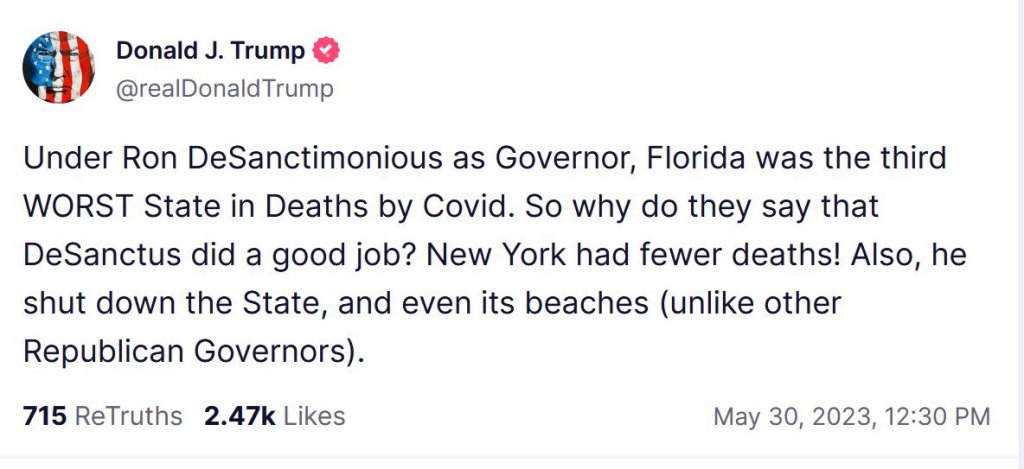
Has he hired whistleblower lunatic Rebekah Jones yet?
The best part of this approach is Trump’s decision to laud the disgraced Andrew Cuomo’s handling of Covid in New York, which led to immeasurable excess deaths. Ever the antithesis of hip, Trump has become the last of the Cuomosexuals, in thrall to the former governor’s every capable-sounding word and his hand sanitizer that was definitely not a convoluted grift.
The exiled Cuomo hailed the praise from the former president: “Donald Trump tells the truth, finally,” he tweeted. Trump’s campaign later sent out an email blast containing “evidence” of the Florida governor’s “Lying Record on Covid.” The mailer criticizes DeSantis for praising vaccines and, gasp, being pictured wearing a mask… both things for which President Trump’s administration advocated.
Maybe Trump just never got around to having his merch restitched. But the idea that he alone, Democrat or Republican, would be out there defending Andrew Cuomo’s record just goes to show: there is honor among skeeves.
In defence of the boozy office party
I’m not big on nostalgia – if the past was so great, how come it’s history? – but I allowed myself a smirk of reminiscence on reading recently that Ann Francke, chief executive of the Chartered Management Institute (‘a professional body focusing on management and leadership’) has put the damper on the age-old tradition of getting blotto at work parties.
Francke told the BBC that while hanging out after-hours with workmates is ‘a great team-building opportunity’, managers have a responsibility to keep inappropriate behaviour in check. ‘That might mean adding additional activities alongside alcohol, limiting the amount of drinks available per person or ensuring that people who are drinking too much are prevented from acting inappropriately towards others,’ she said.
In the light of recent reports of sexual harassment on the part of male management towards female subordinates at various organisations, this might well be a case of shutting the stable door after the predator has bolted. A CMI survey of more than 1,000 managers found that a third have witnessed ‘inappropriate behaviour’ at work parties; predictably, women were more likely (33 per cent) than men (26 per cent) to have witnessed sexual harassment, as they were far more likely to be the harassed. One has to wonder how many of the men who reported seeing slavering beasts making pests of themselves were unknowingly, in their sloshed state, looking into a mirror at the time.
I can’t help feeling that the defanging of the workplace party is yet another bid to make us all toil at home alone like good little bots, thus further wiping out worker solidarity and making us easier for the boss class to control
But it’s not parties that are the problem when it comes to sexual harassment in the workplace. It’s men. Not all men, of course – comparatively few, in fact – but I’d say a stone-cold sober man is more likely to assault a female colleague than a drunken woman is to bother a male colleague. Watching pornography at work probably doesn’t help matters: in one survey last year an extraordinary 60 per cent of respondents admitted to doing so, and I bet that the majority were men. It’s particularly distasteful when politicians and police are caught doing it; law-makers and law-enforcers, the vast majority of them highly undesirable, being encouraged to believe that women are panting for them at all hours of the day, including nine to five. So really, blaming the office party for bad behaviour is rather beside the point when it’s the white noise of misogyny which makes so many workplaces unpleasant for women.
Ms Francke says that alcohol ‘doesn’t need to be the main event’ at a work do, and on this I agree with her. Of course booze shouldn’t be the be-all and end-all of a bash – drugs also used to play a great part in office parties when I was a girl. How well I recall the thrilling build-up to the Yuletide work bashes of my teenage career at the New Musical Express, and how we little urchins would wait expectantly for the first white stuff of Christmas. More innocent times, when we didn’t need technology to enjoy ourselves. Kids today don’t know the meaning of fun; less drugs, less sex – no wonder they’re depressed as never before.
Writing in the Times last week, Hannah Evans reported that something called ‘sober dating’ is a trend among youngsters for the summer ahead: ‘For an emerging wave of single people, DUI (dating under the influence) is a turn-off,’ she said. ‘Some of them are even lumping it in the same category as smoking – a vice universally acknowledged as unhealthy and, quite frankly, a bit gross. On TikTok, searches for the term “alcohol is new cigarettes” has more than 13 million views and there are hundreds of videos on the app comparing the two. According to research by the dating app Tinder, almost three quarters of people who use the app have stated on their profile they either don’t drink or only have the occasional one.’
Good luck with that; we’re told that drinking causes anxiety, but I remember my robust cohort chucking it back from our earliest teens, and I’m certain we weren’t such poor sad creatures. People aged 16 to 34 are most likely to say that work parties should be organised around activities not involving alcohol, so I was pleased to see the 24-year-old Spectator World writer Kara Kennedy declare that ‘the office Christmas party is the opportunity for a night of true debauchery before you all head off for the festive break, leaving just enough time to live down anything embarrassing you might have done’. If people don’t want to get drunk or be offended, the solution is a simple one: just stay home.
It would be terribly short-sighted to phase out the office party, for the sake of team morale as much as anything else; surely very few things bond people faster than getting drunk together. Of course there’s always a risk of massive arguments, but that very risk is what makes a drunken office party worthwhile – you’re testing your team in the fire of booze, to see if they can still get on with each other once everyone’s said what they really think. I can’t help feeling that the defanging of the workplace party is yet another bid to make us all toil at home alone like good little bots, thus further wiping out worker solidarity and making us easier for the boss class to control.
Besides, the real danger to women in the workplace is now as much bile-fuelled gender-pests as booze-fuelled sex-pests, as everyone from Maya Forstater to Kathleen Stock has discovered. As Julie Bindel wrote for The Spectator this week: ‘Resistance to gender ideology and medical experiments… has come at a huge cost to those of us that have spoken out. Women have been hounded out of their jobs, become unemployable… when all we were doing was trying to expose the biggest medical scandal in the past century.’ So please, leave us our boozy office get-togethers – they’re the least of our workplace troubles now, compared with the witch-hunts of the New Puritans.
The joy of cheese rolling
It’s unnerving being surrounded by a crowd in the woods. You can hear people but only glimpse their limbs or faces through the leaves. It triggers something primordial, similar to the feeling of being watched. Ideally, someone with a big strimmer would have given Cooper’s Hill a good going over before the cheese rolling. But cheese rollers don’t concern themselves with ideals.
My friends were shocked by the brutal pitch of the hill. Could someone really hurl themselves down that?
On the last Monday of May, and for reasons lost to time, a wheel of Double Gloucester is thrown down the hill and a group of runners throw themselves after it. The first to reach the bottom gets the cheese.
All the roads around the hill had been shut by men from the Highways Agency so we strolled merrily down the middle of an A-road for the last few miles. The lanes narrowed and the crowds became tighter. There was a family selling cake and cans of Tango from a trestle table on their cottage driveway. As we reached the hill, we were met with a burst of ‘Johnny B. Goode’ over the tannoy and a good whiff of weed, joining a crowd in which we saw Kaleb from Clarkson’s Farm, a woman shouting into her phone in Mandarin, and a topless techno Viking.
Cooper’s Hill is a few miles outside Gloucester. It’s unnaturally steep, something the photos seem unable to capture. My friends were shocked by the brutal pitch of the hill. Could someone really hurl themselves down that? Yes, and gleefully too. The best technique seemed to be a mix of run and roll, sprinting until your legs can’t keep up and your body gives way to gravity. During the women’s race, a runner managed to knock herself unconscious as she flailed across the finish line. Onlookers gasped. A group of volunteers surrounded her for several minutes. Eventually, she came too, unsteadily raising the smartly ribboned cheese above her head. We all whooped with respect.
The whole event is a hopeless muddle. No one knows quite where to go, there’s a burger van but no portaloos, and the surrounding footpaths become clogged with huddles of people. Gardens are overrun by spectators hoping to find a good vantage point. Above us hovered at least three drones, while the best earthly spot was reserved for cameramen from international outfits like AFP, here to film the mad, peculiar English.
In the lower fields, you get to see most of the hill but not the finish line, which is obscured by cottages. That was good enough for us; less crowded and we had enough of a view to see most of the injuries. One friend wondered whether there’d have been the same jolly camaraderie at a public hanging.
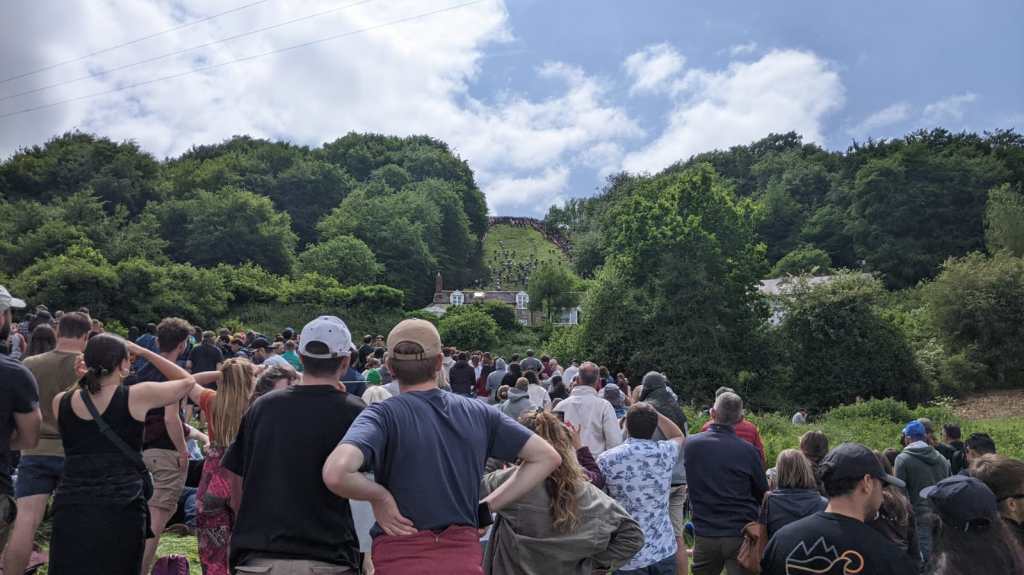
Every year the powers-that-be attempt to shut the cheese rolling down, once threatening the late Mrs Smart, who used to make the cheese, with criminal sanctions should someone end up injured (her son now runs the family dairy and still donates the cheese). This year, the traditional paramedics were absent, presumably justified by a stretched health service. Stay home, keep your cheese in the fridge, protect the NHS. Not that it mattered; the ambulance still had to come, accompanied by two wailing police cars.
The cheese rolling after-party is held around the back of a Toby Carvery in a glorious, happy field, complete with marquee and a yokel band. We were greeted by a dog sitting on top of a picnic table and one of the winners who kindly let us hold his prize cheese. My Irish companion bumped into a friend of a friend from the other side of the border. He’d thrown himself down the hill, smashing his phone in the process and losing his comrades. ‘Could you message my friend on Instagram,’ he asked, ‘his username is @suckingdiesel?’
We sat in that field chatting for hours. It felt like the whole world was with us; there was an elderly gent in nothing but faded black shorts and Crocs with a dog on a rope, a little girl bobbing along holding buttercups and a bottle of Lucozade Sport, a gang of pretty teenagers rolling joints, and a father with his eight daughters leaning against a transit van. The band played Springsteen and Kenny Rogers and we all sang along.
Do we still need Pride Month?
With Pride Month beginning tomorrow, how proud are you of your sexuality? As a white cis-gendered male, I am frankly a little embarrassed about mine. I mean, it’s not exactly cool to fancy the opposite sex these days, and many of us hetero-normies have become increasingly wary of appearing ‘inappropriate’ when making a move on someone we like the look of. So don’t expect me to be parading my vanilla-flavoured proclivities through central London any time soon. What would I even wear to signal hetero-pride – baggy cords and a neatly tucked-in shirt?
That said, you might well spot me at some of this year’s shenanigans; after all, the organisers certainly know how to put on a show. Back in my acting days, I even headed a Pride march through Soho with a bunch of other thesps dressed as (wait for it)… Judy Garland. We had been appearing in a play about the Stonewall riots and the Pride organisers thought it might be fun to get us to take part in the festivities dressed as the gay icon. The majority of our 12-strong cast were straight so we all felt a little uncomfortable – not just ethically but physically, what with our ill-fitting stilettos and itchy fishnets.
Look, I enjoy a good street parade as much as the next man/woman/trans/non-binary person, but I am beginning to wonder why Pride Month still exists. Obviously when homosexual acts were legalised in 1967 there was much cause for celebration within the gay community; when you’ve been hounded for your personal preferences, turning ignominy to pride makes sense. The closet can be a horribly lonely place in which to reside.
The real mark of success will come when setting aside a month to celebrate gayness becomes as absurd as setting aside a month to celebrate straightness
But here’s the thing: these equal rights for men and women of all persuasions have been in place now for well over six decades. So what are the Pride celebrations actually celebrating, other than reaffirming the old carrion cry that ‘We’re here and we’re queer’ – to which the natural response these days might be: ‘Yes, we know, so what?’ Who we choose to sleep with should be as irrelevant as who we choose to watch television with. Ironically, the more we focus on difference, the more we ‘other’ diverse lifestyles, and as we all know, ‘othering’ is just another form of bigotry… or is it?
Those who aspire to the politics of identity seem increasingly confused about what ‘diversity’ actually means. Is it the celebration or removal of difference? If a man can become a woman simply by saying ‘she’ is, then the latter would seem the most likely interpretation – but in the case of Pride, focusing on dissimilarity is crucial to the cause. Unless the new moral gatekeepers are able to define their orthodoxies, uncertainty and division will continue, but maybe confusion is all part of the progressive reordering of things.
When it comes to Pride Month, I certainly don’t mean to be a party-pooper, but I do feel it’s important to consider what ‘pride’ means in this particular context. Taking pride in one’s achievements, for example, is something we can all aspire to, but is sexuality really such an achievement? For most, sexual preference is simply a given; I have never tried to achieve straightness, I had straightness thrust upon me.
Conversely, if Proverbs is to be believed, ‘pride goeth before destruction, a haughty spirit before a fall’. For Christians, self-devotion, self-justification and self-glorification are an aversion of God and therefore sinful. For a lifestyle once unfairly mired in a perception of sinfulness, ‘pride’ may not be the best line of defence, if indeed defence is what the upcoming celebrations are really about.
I have always suspected that Pride is less a testament to the joys of being gay and more a repudiation of staid old societal norms. Again, this would be perfectly understandable if the society in question still regarded homosexuality as a crime. But this is 2023, where discriminating against someone on the grounds of their sexuality is a serious offence. That’s not to say there won’t be bigots who flout the law – but as a nation we have surely accepted that not everyone is straight. Equality under the law is indeed a vital achievement, but the real mark of success will come when setting aside a month to celebrate gayness becomes as absurd as setting aside a month to celebrate straightness. Now where did I leave those cords?
Oxford students disrupt Kathleen Stock’s talk
Oh dear. It seems the dreaming spires are having a nightmare. Professor Kathleen Stock is addressing the Oxford Union tonight, but not all students approve. One trans activist, Riz Possnett, glued themselves to the floor of the Union in protest before Stock even began speaking.
Wearing a t-shirt emblazoned with the words ‘No More Dead Trans Kids’, Possnett refused to move despite boos from members of the audience. One attendee called for ‘free speech’ and another urged attendees to ‘listen to Kathleen Stock’. Free speech at a university? It’s a novel thought…
Outside, hundreds of trans activists reportedly began a march on the, chanting ‘cut your system, fuck your hate, we are not open for debate.’ With logic like that, who is Mr S to disagree?
Below are some of the highlights from said protest…
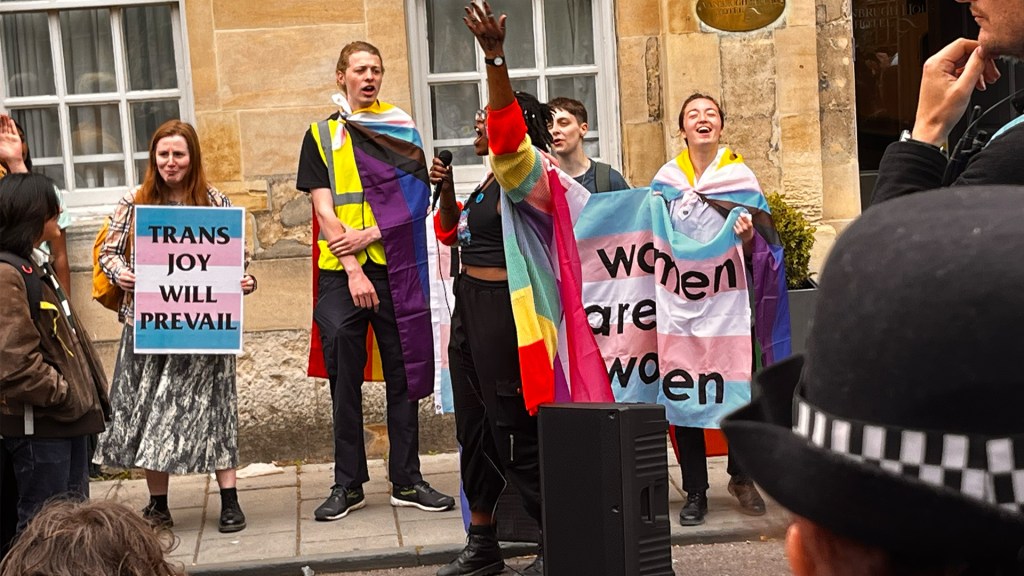
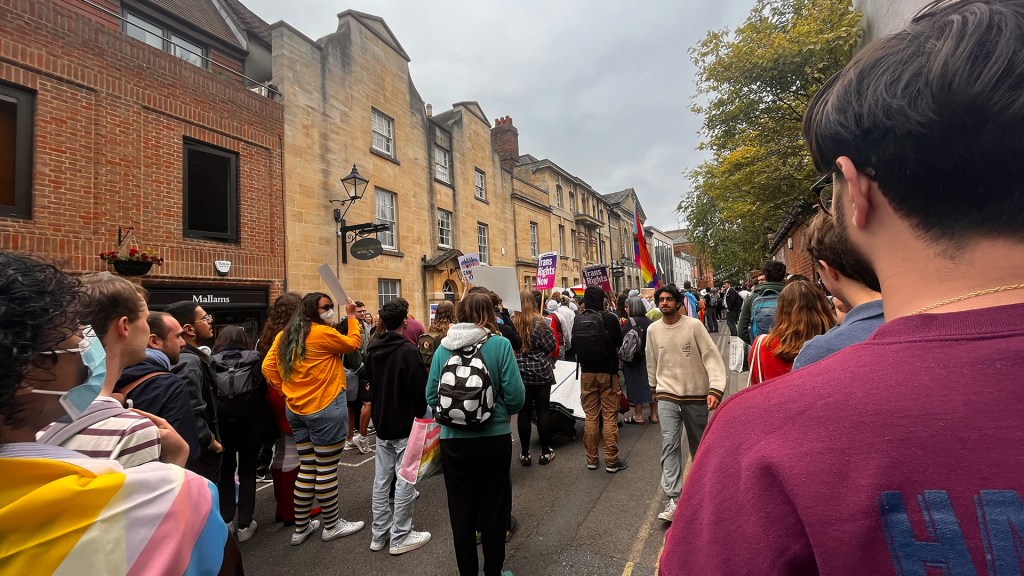
Millennials have no reason to vote Conservative
For some time now, critics of the Tories’ strategy of soaking millennials to buy votes from boomers have been pointing out its fatal flaw: a generation with nothing to conserve will have no reason to vote Conservative. This argument has typically been waved away with some bromide about how everyone becomes more conservative as they get older. And with that, the Tories returned to over-taxing young workers, preventing them from owning a home and taking away their freedom of movement.
How is this approach working out? A mega-poll of 8,000 voters aged 25 to 40 finds that 72 per cent believe the country is heading in the wrong direction. Six in ten say the Conservatives ‘deserve to lose the next election’, with 45 per cent already resolved to vote Labour. Just one in five plan to back the Tories and less than one in ten think that the party ‘stands up for people like me’.
That isn’t even the worst part for the Conservatives. The worst part is… well, take your pick. Millennials now make up one quarter of the adult population. They are the largest demographic in 51 per cent of constituencies. They outnumber boomers in 66 per cent of parliamentary seats. It’s almost as if impoverishing a large section of voters was a really bad electoral strategy.
The business of conservatism is not whining about wokeness and sneering at snowflakes, it’s fashioning a social order that encourages conservative ends
There are two silver linings: millennials like Rishi Sunak more than the party he leads and, despite their fondness for equity, they want to keep their taxes low. Conservatives should not feast on these crumbs. The electoral arithmetic that emerges from this poll hints at an existential crisis for the Tories.
The figures come in a new report by Onward, a centre-right think tank headed by Sebastian Payne, a millennial formerly of this parish and co-author of the analysis. As Payne points out, it’s not just that millennials are ‘the first demographic cohort not to become more right-wing as they age’, they are ‘the first generation to become more left-wing as they age’. An almighty brood of chickens, a-roosting they have come.
As a millennial myself, my innate instinct is to respond to this report with a meme, but I can’t decide which one. Maybe Principal Skinner: ‘Am I out of touch? No, it’s the looming electoral landslide that is wrong!’ Or perhaps ‘well, well, well, if it isn’t the consequences of my own short-termist policies’. The Tories sowing: haha, 2015; yes, 2019! The Tories reaping: well, 2024 sucks.
While I’m all for gloating, it’s worth interrogating these developments a little. How has one of the world’s oldest and most electorally successful political parties managed to alienate and antagonise so many voters? While social and cultural factors are part of it, such as millennials’ exposure to higher education and their cosmopolitan attitudes, this is primarily a story of economics. Millennials are the first generation to enjoy less prosperity than their parents. They start work lower down the career ladder and have fewer opportunities for advancement. They are less likely to own a home and therefore less likely to marry and have children. In the past five years, they have lost access to one of the world’s largest markets for jobs, goods and services, and are now stuck in a country that would rather settle into its twilight years than do the hard work to restore economic dynamism.
A generation lost to political and economic dysfunction is still only a symptom. The cause of the Conservative party’s troubles is the Conservative party and its separation from its own purpose and philosophy. The Conservative party is not merely failing to sell conservatism to the next generation. It has stopped buying into conservatism itself.
The business of conservatism is not whining about wokeness and sneering at snowflakes, it’s fashioning a social order that encourages conservative ends. Those ends, as I understand them, are the veneration of tradition, the exercise of caution, the defence of constancy, the kindling of humility and the pursuit of beauty. A conservative recognises marriage, child-rearing, strong communities, public integrity and cultural cohesion as goods in themselves but also as the base conditions for stable societies in which people live ordered, virtuous lives.
Not my idea of a good time but a philosophical tendency with a storied history in these islands. Yet you need not be a conservative to acknowledge that many forces and institutions of British public life have spent several generations either spurning the virtues of conservatism or working to undermine them. Chief among those institutions is the Conservative party, which has for four decades practised a hectic melange of market liberalism, statism, austerity and regressive redistribution. Britain in 2023 is a nation fractured by social atomisation, wracked by economic exclusion, and roiling in constant cultural upheaval. After 13 years of the Conservatives, the country is not only less conservative but less conducive to conservatism as a political platform.
Nowhere is this more apparent than in polling of British millennials. What do they want? A stable job, a mortgage, a family and access to a competitive market for goods and services. They may never vote Tory but their aspirations couldn’t be more conservative if they tried. Instead of courting them, the Tories have driven them away. The Conservative party can’t win over millennial voters in time for next year’s election but it will have to find ways to appeal to them thereafter. Without them, the Tories will struggle to win another election for a long time.
NHS Scotland waiting lists reach record levels
Scotland’s NHS has seen its waiting lists, once again, reach record levels. New figures from Public Health Scotland reveal that the equivalent of one in every seven Scots is on a waiting list. Care targets aren’t being met either, and the NHS is falling short on targets set for inpatient and day case waits.
A lot of the blame is being directed at Scotland’s new First Minister Humza Yousaf. From the time he took over as health secretary to the month he left the role, there was an increase of over 175,000 patients on NHS waiting lists, with 779,533 patients on lists at the end of March. Worse still, over 72,000 of the patients currently on waiting lists have been stuck on them for over a year.
The equivalent of one in every seven Scots is on a waiting list
In December, BMA chair Dr Iain Kennedy warned that the very survival of NHS Scotland was threatened, highlighting the service’s workforce crisis and saying that ‘Scotland’s overstretched NHS is on its knees’. In fact, Kennedy went so far as to call for the resignation of then-health secretary Yousaf. He wasn’t alone, his calls echoed by a number of others.
But Yousaf remained in post and continued to point to his work on the health brief as a strength during the SNP leadership race. Meanwhile, the pressure on the NHS continued to build. Over 2,500 patients joined outpatient waiting lists in the first three months of 2023, while just under 3,000 people were added to inpatient lists during the same period. The numbers of those waiting on diagnostic tests, like endoscopies and colonoscopies, increased by 4,300.
The latest planned care target aimed to stop patients waiting over a year for appointments in most specialities by the end of March. Yet the figures show there were still 31,498 patients waiting over 52 weeks for care at this time.
A new national standard aims to ensure that 95 per cent of new outpatients are left on waiting lists for no longer than 12 weeks. During the last three months, however, the number of waits ‘completed’ – with the patient being seen – in 12 weeks or less has decreased by 1,125 compared with the previous quarter. Worse still, a staggering 10,000 more patients have had to wait longer than 12 weeks to be seen during the first three months of the year compared to the quarter before that, from 107,925 to 118,402.
NHS Scotland’s ‘treatment time guarantee’ says that, following a clinical decision to embark on treatment, ‘all eligible patients should wait no longer than 12 weeks for treatment as an inpatient or day case’. The first three months of 2023 saw a small increase (of 266) in those patients who received treatment within 12 weeks compared with the previous quarter. But it also saw a larger increase in patients waiting longer than 12 weeks: with 762 more patients. This brings the total number of people waiting more than the target time to just under 25,000.
Scottish Labour’s health spokesperson, Jackie Baillie, labelled these new figures as Yousaf’s ‘catastrophic legacy as health secretary’, saying: ‘Michael Matheson must deliver a real plan to help our NHS recover from the damage inflicted first by the pandemic and then by his predecessor.’ The Scottish Conservatives health spokesperson, Dr Sandesh Gulhane, has pointed to the impact of waits on mortality rates: ‘In the worst-case scenarios, these delays lead to needless deaths.’
‘Challenges remain and there are still unacceptable waits in some specialities, but we remain committed to delivering sustained improvements,’ health secretary Michael Matheson has said in response to today’s data. ‘The Scottish government continues to work closely with NHS boards to maximise capacity and reduce the length of time people are waiting for appointments and treatment.’
Numbers aside, the pattern is clear: waiting lists are growing and patients continue to face daunting delays. When he became First Minister, Yousaf decided to rename the health brief, making Michael Matheson the cabinet secretary for ‘NHS recovery’, as well as health and social care. Scots will hope this wasn’t just a performative gesture. Pressures on other parts of the health service – like its staffing crisis – are only getting worse, and patient demand isn’t going to ease off anytime soon.
Does Biden actually care about gay rights?
Joseph Robinette Biden, a practising Catholic, has travelled a long way when it comes to gay rights. In 1996, as Senator for Delaware, he voted for the Defense of Marriage Act, which blocked the federal recognition of same-sex unions. Two years earlier he voted to cut funding to schools that taught the acceptance of homosexuality. In the 1970s, when asked about homosexuals in the US military, he replied: ‘My gut reaction is that they are a security risk but I must admit I have not given this much thought… I’ll be darned!’
Saudi Arabia is the world’s second-biggest oil producer and so it gets a pass. Uganda has little to offer the global markets in comparison
But it’s 2023 and, I’ll be darned, the now President Joe Biden’s moral outlook has changed dramatically. It just so happens that his values have moved with those of his ever-more progressive political party, the Democrats. The polite thing is to say he’s ‘evolved’.
Biden’s White House has been arguably the most pro-gay administration in American history. It’s increasingly assertive in telling other countries off for failing to live up to 21st-century progressive morality on matters sexual. Take Team Biden’s reaction to a new law in Uganda, which includes the death penalty for perpetrators ‘aggravated homosexuality’ – such as sex with a minor, or having sex while HIV positive, and incest.
The bill criminalises gay sex education and calls for ‘rehabilitation’ therapy for homosexuals. Joe Biden has called it ‘a tragic violation’ of human rights and suggested ‘all aspects of US engagement with Uganda’ could now be withdrawn. ‘We are considering additional steps, including the application of sanctions and restriction of entry into the United States against anyone involved in serious human rights abuses or corruption,’ he said.
Uganda’s president Yoweri Museveni has described the international outcry over his country’s new law as ‘imperialist.’ Most westerners, if they thought about him at all, would consider Museveni a nasty dictator. His views on homosexuality – ‘a deviation from normal’ – sound archaic to our hyper-tolerant minds. But it’s worth considering that the Ugandan government’s position today is merely a harsher version of Joe Biden’s not so long ago. Perhaps he isn’t best placed to lecture Africans about sexual equality from the Oval Office.
What we probably can all agree on is the hypocrisy of an American government in threatening Uganda with sanctions and more over gay rights – at the same time as the White House still treats Saudi Arabia as a vital strategic ally. Homosexuality is a criminal offence in Saudi, punishable by public lashings and the death penalty. But Saudi Arabia is the world’s second-biggest oil producer and so it gets a pass. Uganda has little to offer the global markets in comparison.
Biden likes to talk tough. He has spoken grandly about making the Islamic Kingdom of Saudi Arabia a ‘pariah’ on the world stage following its notorious execution of Jamal Khashoggi. But his administration has done no such thing. In July, last year he greeted the Crown Prince Mohammed Bin Salman with a fist bump. In October, after Saudi decided to cut oil production, a grumpy Biden changed his tune and announced his intention to re-evaluate the US-Saud relationship. But he hasn’t.
Biden likes to tell a story – some might call it a yarn – from his teenage years, when, standing with his father, he saw two men kiss. ‘Joey it’s simple,’ said Biden pere. ‘They love each other.’ The details of the anecdote tend to change with each telling. Biden’s recollections do vary.
But his sentimentality doesn’t go very far in international relations. In brutal soft-power terms, it’s self-defeating. American grandstanding on gay rights will only annoy a lot of conservative Africans across a continent where Christianity still thrives and many Islamists regard America as ‘the Great Satan’. Everyone can see that America’s moralism on such matters is not universal but selective and performative. And the message is clear: if you have enough oil, you get to persecute homosexuals. If you don’t, you don’t. Meanwhile, more powerful despotic regimes, such as China, Turkey and Russia continue to expand their influence from central Asia down to Sub-Saharan Africa. Xi, Erdogan and Putin deal in hard, often brutal realpolitik, not sanctimony, so we shouldn’t be too surprised.