-
AAPL
213.43 (+0.29%)
-
BARC-LN
1205.7 (-1.46%)
-
NKE
94.05 (+0.39%)
-
CVX
152.67 (-1.00%)
-
CRM
230.27 (-2.34%)
-
INTC
30.5 (-0.87%)
-
DIS
100.16 (-0.67%)
-
DOW
55.79 (-0.82%)
Helen Mirren is perfect to play Golda Meir
The word ‘actress’ used to be interchangeable with ‘prostitute’ and though it’s a good thing that this little misunderstanding was cleared up, it’s a pity that ‘living saint’ has been substituted for hooker. Modern actresses are variously ‘activists’ and ‘humanitarians’ – or whingeing nepo-babies mistaking themselves for the first two. But they are rarely ‘broads’ anymore, the way the great female stars (Taylor, Gardner, Mae West) used to be. Except, that is, for Helen Mirren.
The word, though originally meaning a woman of flexible sexual morality, has come to indicate an ultra-tough, good-humoured woman, the binary opposite of the non-binary cry-babies who now frequent the bazaars of Thespis. Mirren has gone from sultry Shakespearean starlet – of whom one wag said that she only kept her clothes on if the plot absolutely demanded it – to great character actress. Now she is playing the ultimate political broad, Golda Meir, in a new film.
David Ben-Gurion once gave Meir the backhanded compliment of being ‘the only man’ in his cabinet
When we consider female political leaders, they generally present themselves in one of three ways: Warrior Woman (Margaret Thatcher), Mother Of The Nation (Angela Merkel, often somewhat sickeningly called ‘Mutti’) and Irritating Older Sister (Theresa May.) Golda Meir, like Mrs Ghandi in India, pleasingly combined the first two. Male political leaders, on the other hand, aren’t so polarised in their presentation styles, and generally one size – vain and temperamental – fits all post-war party leaders from Heath to Davey.
Meir was both the fourth elected female head of government in the world and the fourth prime minister of Israel from 1969 to 1974 – a time when the re-created Jewish state was at its most imperilled but also its most impressive. She saw off the six-day war and the Yom Kippur war, teaching the shambolic Arab armies a lesson they’ve never truly forgotten, counterintuitively setting the scene for the rapprochement between the tiny democracy and its neighbours.
Only last year, Air Cairo made history by becoming the first Egyptian airline to operate a direct flight from Israel to Egypt, the first flight taking off to Sharm el-Sheikh one spring morning with 150 Israelis on board. Israelis are so good at fighting mostly because while Arab countries might lose a bit of territory if they don’t win a war, Israel would lose everything. After the Holocaust, and in recent years with the rise in anti-Semitic hate-crime throughout Europe, Israel is the safe-house of the diaspora, even for Jews who don’t approve of it.
Her premiership wasn’t the first time Meir had been involved in an existential battle; ‘When I was a child in Ukraine they would beat Jews to death in the street for fun,’ Mirren as Meir tells Liev Shreiber as Henry Kissinger. ‘I am not that little girl hiding in the cellar anymore.’
Meir’s family immigrated to that archetype blue-collar American city Milwaukee; by eight, she was minding the family store. She worked as a librarian and a shopgirl and was courted by a sign-painting socialist; her condition for marriage was that they settle in what was then known as British Palestine. The terror and excitement of fighting to establish a Jewish homeland while a third of the world’s Jewish population was being exterminated is unimaginable. When the state of Israel declared independence in 1948, Meir was one of the 25 signatories of the Israeli Declaration of Independence; she was still only 50.
Acting as envoy to the USSR that year Meir was mobbed by thousands of Muscovite Jews during Rosh Hashanah celebrations at the Choral Synagogue, as they chanted ‘Nasha Golda’ – Our Golda. But this notoriously blunt woman wasn’t suited to being a diplomat: when asked by a Russian ambassador how she traveled to Moscow, she told her interpreter ‘Tell His Excellency that we arrived riding on donkeys’.
Back in Israel, she became labour minister; she got a superhuman amount of work done between 1949 and 1956, especially in the arenas of construction and the absorption of immigrants. In 1951, Iraq expelled its large Jewish population, confiscating their assets in the hope that the new country would crumble under the weight of these penniless incomers.
While others in the Israeli government thought it wisest to ask other countries to accept them, Meir insisted that Israel welcome every last refugee. This was when modern Israel – and especially Tel Aviv, a city so electrifyingly full of life that it makes New York City look like York – began to look like itself. As Foreign Minister from 1956 to 1966 she convinced the USA to sell Israel missiles; the Soviet bloc had armed the infant Jewish state when Stalin allowed the Communist government in Czechoslovakia to sell weapons to it.
Her years as prime minister were interesting, to say the least. She was already 71, with arrhythmia and lymphoma, but she didn’t get much time to put her feet up. There were the wars and the Munich Olympic massacre. In 1973, Kissinger finally got her to accept his ‘security versus sovereignty’ peace proposal, in which Israel would accept Egyptian sovereignty over Sinai while Egypt would accept Israeli presence in some of Sinai’s strategic positions.
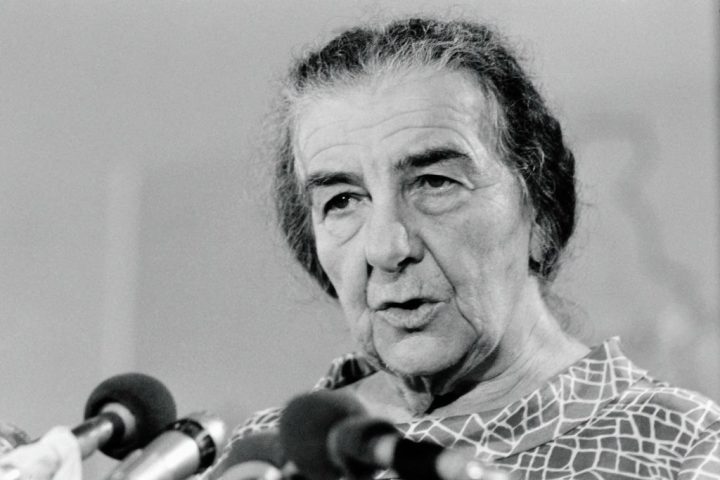
Meir still wasn’t a diplomat. In a Sunday Times interview in 1969, pushed on the ‘Palestine’ question, she said ‘when was there an independent Palestinian people with a Palestinian state? It was either southern Syria before the First World War and then it was a Palestine including Jordan. It was not as though there was a Palestinian people in Palestine and we came and threw them out and took their country from them. They did not exist.’
This sounds harsh by today’s #BeKind standards, but strictly speaking, she was right. The invention of Palestine was the first example of magical thinking posing as politics, which flourishes today in the ‘identity’ industry. There can be few funnier sights than those photos of QUEERS FOR PALESTINE, a cross between Turkeys For Christmas and Elves For Ogres. Unless you believe that women can have penises, it’s hard to believe that a nation which existed in 850 BC and a ‘nation’ which has only had its own flag since 1964 have the same level of claim to that territory.
David Ben-Gurion once gave her the backhanded compliment of being ‘the only man’ in his cabinet. Her reaction was amusement that this was ‘the greatest possible compliment that could be paid to a woman – I very much doubt that any man would have been flattered if I had said about him that he was the only woman in the government’.
As with Margaret Thatcher, the Left liked to mansplain that she was a Bad Feminist, but when there was a serial rapist at large and one of her cabinet suggested bringing in a curfew for women, she answered: ‘Men are committing the rapes – let them be put under curfew.’ If that’s not feminism, I don’t know what is, and I’m certainly not going to be told what it is by left-wing men who want to put rapists in female jails.
Now Golda Meir is controversial all over again, though this time the brouhaha – suitably, for an age obsessed with the idiocy of identity politics – centres around a false nose rather than matters of life and death. The fact that Helen Mirren is a Gentile playing a Jew has been questioned by some Jewish entertainers, such as David Baddiel, though I’m not personally inclined to take seriously the opinion of someone who has dressed up in blackface to get a cheap laugh when they talk about respect for racial integrity.
A lifelong supporter of Israel, Mirren worked on a kibbutz in the Golan Heights just after the six-day war (‘The extraordinary magical energy of a country just beginning to put its roots in the ground – it was an amazing time to be here’) and received the Jerusalem Medal earlier this year.
Speaking of Meir, Mirren said that she had the ‘deepest of admiration’ for the ‘extremely brave’ leader: ‘In a weird way, it was a bit like playing Elizabeth I in the sense of her utter commitment to her country and to her nation. The absolute total dedication of her life to that and what she achieved without being the sort of mad dictatory-type character at all.’
In a world where Israel is uniquely demonised, it doesn’t speak well of her critics to behave so churlishly towards a woman who has all her life defied the boycott, divestment and sanctions threats which so many in her profession have prostrated themselves before. That Mirren is a Gentile isn’t important; that she is a terrific broad playing a terrific broad is all that matters. And as Israel once more fights for its existence against the ignorant armies who wish to destroy it, Golda Meir will be missed.
Subsidies have defanged the French media
It’s not surprising that much mainstream French journalism is complacent, incurious and stenographic. The elite French media is lavishly subsidised and the torrent of handouts makes tenuous any claim that mainstream French journalism is independent.
The most compromised are the broadcasters. Indeed there’s little pretence that they offer more than token auditing of the government. Three billion euros annually goes to French state-owned radio and television stations (which are allowed to top this up selling advertising). The French TV license was abolished so the money is paid directly by the state.
The more the media feeds at the trough, the more it can ignore the interests of readers
There’s a gossamer-thin pretence, through various state consultative committees, that the state broadcasters are accountable to viewers and listeners – but they’re not really. The state broadcasters know who calls the tune. Hundreds of millions more go to the newspapers in direct subsidies and tax privileges, accounting for almost a quarter of the revenue of the press.
The French government claims its media subsidies are to guarantee pluralism but many recipients of state largesse are immensely rich plutocrats while pluralism in practice has mostly defaulted to a smug, narrow, Parisian, leftist groupthink. Real reporting is something the French media has largely abandoned and in the provinces, where local newspaper monopolies stand firm, it’s scandalous. I have been reading the Midi-Libre newspaper for more than 20 years and have yet to encounter the slightest interest in the conflicted conduct of certain local politicians.
Those unsubsidised journals and websites that dare to move the permissible limits of discussion ever so slightly to the right are immediately denounced as extremists and a danger to democracy. This is vividly demonstrated by the elite Parisian media attempt to demonise the unsubsidised right-of-centre CNEWS, currently the leading news station.
The recent feeble prime-time interview of President Emmanuel Macron in which he essentially ignored his interviewers sitting like numpties was a classic example of French television at its worst. Not one of the president’s assertions was challenged, even his claim that Operation Barkhane, the catastrophic French counter-terrorism operation in Mali, had been ‘a success’.
Not only are the broadcasters and publishers in France showered with other people’s money but individual, licensed journalists also nibble at the trough, enjoying a unique ‘niche fiscale’ in which a €7,650 (£6,600) slice of their income is entirely untaxed. This might be considered state aid to a failing profession but don’t worry because the nifty French have engineered a ‘cultural exception’ to normal EU rules.
The French Senate reports total public support for the press was €367 million (£319 million) in 2021. That’s essentially €1 million (£865,000) a day. Much of it ended up in the pockets of billionaires.
In addition to payments made to publishers for every paper sold – a charming conceit as the media digitises – the government hands out funds for modernisation and to subsidise physical distribution of newspapers and magazines. Even the New York Times, which prints a Paris edition, has had its hand in the cookie jar. It was a pitiful sum, but really. Have they no shame?
France does not boast one global digital media giant. The French excuse the failure as a question of language. But that’s nonsense. TikTok was created by the Chinese. Underwriting legacy players, backing losers, is how it done here and is simply a recipe for stagnation.
In addition to these diverse sums, millions more is paid to La Poste for its press distribution mission – in which taxpayers subsidise the physical distribution of newspapers. Millions more of taxpayer money goes into local newspapers that daily publish pages of public procurement announcements that could easily be made available free on the internet.
The government is also a heavy advertiser on TV and in the press. It’s hard to calculate how much is spent but very little of it goes to media that don’t toe the line. Dissident CNEWS gets nothing, as far as I can see.
Another indirect aid is tax expenditure, reports Acrimed, the Paris-based media observatory. This will have amounted to around €161 million (£138 million) in 2021. It includes the ‘super-reduced’ VAT rate on periodicals of 2.1 per cent and tax privileges for licensed journalists holding an official press card.
Excluding tax expenditure, aid to the press represented 21.4 per cent of the sector’s turnover, Acrimed estimates. How can any media be independent that is so dependent on the largesse of the state?
The Ministry of Culture says that in 2021, 431 titles received state aid. The newspaper that received the most was the tabloid called Le Parisen in Paris and Aujourd’hui en France in the provinces: €13,520,000 (£11,730,000). The paper is owned by Bernard Arnault, France’s richest man.
Next comes centrist Le Figaro owned by Groupe Dassault, the arms manufacturer, with €7.7 million (£6.7 million); Libération, the French analog of The Guardian with €6.7 million (£5.8 million), and Le Monde, the quintessential leftist establishment paper, €5.9 million (£5.1 million).
The communist party paper L’Humanité, which sells 30,000 copies daily, got €5.1 million (£4.4 million) – about €170 (£147) for every devoted reader.
Clientelist media is the inevitable consequence of these subsidies and sadly the phenomenon is not limited to France. Germany offered almost €200 million (£174 million) to its leading newspapers to assist with their digital transition, a project that was dropped before it could advance so far. The digital transition that British and American newspapers paid for themselves. The left-wing alternative Die Tageszeitung newspaper, which has spent most of its 42-year existence on the brink of financial ruin, calls this, properly, ‘dirty money from the state’.
The EU is piling in too with numerous funding streams to support ‘media freedom and pluralism’ including ‘collaboration and innovation’, and ‘citizen engagement’ although so far without direct handouts to the media. In Canada, the Trudeau government has poured $595 million (£355 million) into its media bail-out program, which funds media organisations using a cluster of tax credits and subsidies. That’s in addition to the billion-dollar subsidy for the CBC.
New Zealand has launched a $55 million (£27 million) fund of its own. Ireland is heading that way. ‘State support for journalism is in the public interest,’ says the Irish Times, its begging bowl outstretched.
It is surely not entirely coincidental that the more the media feeds at the trough, the more it can ignore the interests of readers, to focus on the wokish preoccupations of the affluent, urbane left. It could be argued that this is true, too, in Britain. The BBC, which takes £3.8 billion a year from its captive rent payers, is a perfect example. But at least in Britain the unruly press has to fend for itself.
French media companies claim that their independence isn’t threatened at all by their dependence on handouts. Canadian hacks say the same. The evidence is that awash in unearned income, none will bite the hand that feeds them. Which is why much of the French media is soft centered and the media in Germany, Canada, Ireland and New Zealand is heading the same way.
My faux pas with Orlando Bloom
The R word strikes terror into the hearts of ministers and their diary managers alike but spare a thought for the poor people organising events at this year’s Labour party conference after last month’s Shadow Cabinet reshuffle. I am in admiration of the creative energy of the fringe organisers who are desperately trying to hang on to their confirmed speakers. While it might be a bit of a stretch to refocus a debate on local government finance for the newly appointed lead for International Development, God love the lobbyist who tried.
Having been released from the task of levelling up the country, I am relishing the chance to level up the world. It doesn’t come without challenges. A long-planned trip to Yorkshire to discuss refuse collection had to be binned (sorry) in order to fly to New York for the UN General Assembly and the culture shock was immense. New York traffic and a last-minute flight meant I had a crazy dash across Manhattan to meet senior UN officials and the First Lady, Jill Biden, at a UNICEF event on children’s rights. A very nice, passionate man, who appeared to work for UNICEF, tried to interest me in a discussion about my development priorities but sadly he started talking just as the event began. I politely but somewhat firmly disentangled myself to listen to the young ambassadors. I only discovered when he went up on stage that the man who tried to talk to me was the Pirates of the Caribbean actor Orlando Bloom.
Celebrity faux pas aside, the incredible women I met at the event – from the young engineer from Ghana who has transformed girls’ education by sorting out access to water and hygiene in schools, to the Barbadian Prime Minister Mia Mottley, who is pioneering an emerging global agreement on climate change – have seriously fired me up for the challenge of the new job. Last time Labour was in government our economy was twice the size of China and much of the world’s debt was owed to countries like ours. Now, as democracy retreats and poverty advances, we are learning that the arc of history doesn’t always bend towards progress. If we are serious about shaping events beyond our shores, we will need an entirely different approach. The task for a new Labour government will be to bring the same energy and commitment as in 1997 but to an utterly transformed world. I’ll be laying out more detail at our party conference in Liverpool this week.
The Tory party conference was in my backyard this year, just down the road in Manchester, where we were treated to a feast of conspiracy theories and the setting up of straw men for various ministers to knock down: from the Chancellor’s decision to introduce benefit sanctions (already a thing) to the Home Secretary’s call to ban people from being granted asylum simply because they’re gay (not even a thing). It was the Transport Secretary’s condemnation of ‘sinister’ councils who control how often people can go to the shops that got a big laugh here in Wigan. After 13 years of Tory government and £15 billion of central government cuts, I’m fairly sure the local government official responsible for ‘monitoring shop use’ has long been made redundant. Maybe instead ministers could explain why our shops are closing and high streets are struggling in every part of the country.
My party conference diary is packed but a particular highlight is the chance to interview Nazanin Zaghari-Ratcliffe. I got to know her inspirational family when I was the shadow Foreign Secretary – a stint conducted entirely during a pandemic, which has given me the dubious distinction of being the first shadow Foreign Secretary in history never to leave Wigan. Nevertheless, it was a privilege to be able to lend my support publicly and behind the scenes to this incredible family who are still fighting for families forced to endure the same treatment they were. They know better than most that the world can be bleak and political systems can be brutal but after all they’ve been through, amazingly, they’re still smiling. Spending time with them is good for the soul.
There’s one other thing in my diary that cannot be moved and it’s my annual DJ set at Labour Students with my pal and National Executive Committee bigwig, Abdi Duale, as part of my one-woman mission to put the party back into party conference season. Last year I played 30 minutes of back-to-back Britney Spears and ejected anyone who complained. This year we’re still compiling our playlist (all suggestions welcome) but I’m thinking we should do a tribute to this Tory government – maybe Britney’s Toxic would fit the bill?
Has Soviet self-censorship come to Britain?
When the Soviet system fell in my native Estonia I was 17 years old. I’d spent the entirety of those years mastering the main rule for surviving the USSR: you needed two separate identities. One was for home and those you trusted, the other for public places: we knew that in front of outsiders or certain relatives, you simply didn’t speak about some topics. If you followed the rules and kept the two identities apart, you could survive and even prosper. But if you mixed the two worlds up, woe betide you.
My grandparents – who’d separated in the early 1950s – led lives that illustrated this. My grandfather had joined the party and never said a word against the regime. For this he was allowed to have a new flat, a summer house and a car – a Moskvitch! My grandmother, meanwhile, never hid what she thought of the Soviet occupation, and her life was correspondingly harder. She knitted at night to make ends meet and grew vegetables in her backyard.
Superficially the USSR was supposed to be Paradise on Earth. Free education, free healthcare, a guaranteed job and housing. But what could you do with that education? You couldn’t scheme under communism – it goes without saying – to become a world famous rockstar or a multimillionaire entrepreneur. You couldn’t even dream of going travelling or visiting the countries whose languages you learned. As for that guaranteed job, it was often nominal, to save you from state-prosecution as a ‘parasite’, and the same applied to accommodation. Everything needed to be checked and ‘permitted, and whoever you were, you were expected to show up to May Day parades, wave the red flag and speak never less than glowingly of the Party.
Britain has started to remind me of the system I thought I’d left behind forever
Of course we knew about the Free World – a colourful place full of hope, we believed, and we longed to join it. We watched overseas TV channels if we could tune into them and listened – if we could avoid the frequency-jamming – to channels like the BBC World Service: a message from that Free World we longed for. By the time the Soviet Union fell in 1991, we were ready for every kind of freedom: to think, speak, gather, travel, freedom to succeed and, sure, the freedom fail too. All the freedoms, here we come!
I came to UK in 2011 after a decade in Asia, fully confident I was entering another free society. I could, within reason, say whatever I wanted to whomever I wanted. Holding different opinions, post-Soviet, from someone else hadn’t been a problem: we’d argue and end with compromise or simply agree to disagree.
Yet increasingly, Britain has started to remind me of the system I thought I’d left behind forever. Of course, it isn’t called communism this time, but various names like ‘Diversity’, ‘Equality’, ‘Inclusion’, ‘Multiculturalism’. Just like communism, it takes the ideals of the brotherhood of man but then adds on others from western individualist tradition – LGBTQ rights, open borders, MeToo (a full pantheon is getting ever more complex, potentially wrong-footing you at every turn). Like communism, it presents many ideals which, on the face of it, are hard to disagree with: equality of the sexes and of different races, for example – and then constructs a kind of secular religion out of them.
It’s one of the central ideas of Christianity that humans are inherently flawed and sinful – and the new religion too seems to be drawing on this. Anyone failing to abide by this religion’s tenets must repent at once – or rather, in Newspeak, ‘Educate Yourself’ and ‘Do Better’. This doesn’t involve the physical re-education camps of the USSR (not yet), but compulsory (re)training sessions in anti-racism, anti-sexism and anti-ableism already abound.
If you’re ostracised, you have two choices, as you did under communism: either apologise profusely and publicly and grovel to the current orthodoxy, becoming, if not a good little member of Komsomol, then a vocal and obedient ally to BLM or LGBTQIA+ (or whatever the currently favoured minority is) – or never be seen or heard of again. As in both systems, the Evil needs to be rooted out and the witches burned. Just as saboteurs and dissenters had to be removed from Soviet society, the perceived racists, bigots, transphobes, misogynists, and toxic males etc. must vanish before the Western Paradise on Earth can be achieved. Of course, the categories are constantly ramifying as are the varieties of ideological crime. One of the main features of an institutionalised religion is that it has answers to all questions – and the ones it doesn’t have answers for, you’re not allowed to ask.
Just as in the USSR, there is the issue with language and the reality it hides. ‘Democracy’ in the USSR was often the obligation to vote for one single candidate chosen for you by the Party. ‘Rule of the Proletariat’ meant rule by a small group of high-ranking Party workers. Likewise, in the Newspeak of the West, ‘inclusivity’ means making sure anyone who disagrees is not included. ‘Diversity’ spells a deadening uniformity of thought. And ‘equality’ frequently means shamelessly privileging one group over another. As to that equality, while the old communists were obsessed with the economic kind, the new communists are fixated on culture and history. The current rewriting of Britain’s past, with many dubious claims, to give minority-cultures an equal historical standing here is merely the same old taking from the ‘rich’ and giving to the ‘poor’ – except in cultural form.
This doublespeak is developing at an alarming pace, and if you don’t self-censor, you risk punishment. In the Soviet Union this came from the Party and its adherents, but in modern Britain the sources of correction are more scattered and omnipresent – it’s a multi-headed dragon, seemingly everywhere and nowhere, making it even more scary. Your neighbour may be with you on some topics, but could have signed up to their own pet cause – Refugees Welcome, Climate Change, Trans-allies – you simply don’t know. So to avoid social cancellation it’s easier simply to avoid certain issues – especially the important ones – altogether. And, you can’t help wondering, is that neighbour a true believer, or someone simply as scared to express a wrong thought as you are? It’s all increasingly familiar.
The recent debanking of Nigel Farage was a prime example of a step into new territory. After long denials from the bank it soon became clear the reason was simply disagreement with his politics. All wrapped in the elaborate justifications of the Newspeak – ‘his views did not align with our values’ or were ‘at odds with our position as an inclusive organisation.’ It was the closest thing one had seen to the Soviet jailing of dissidents, and you couldn’t help wondering what new level of punishment, to keep the masses in line, was going to come next. ‘If this can happen to me it can happen to you,’ Farage said. And as someone brought up in the ex-Soviet system, I can tell you he’s right.
So I find myself facing a dilemma: whether to pack up all of our belongings and move, perhaps back to Eastern Europe – to the Free East, where I don’t have to sing to the red rainbow flags. Or correct my speech to avoid being detected by the KGB Trans Allies. Or get labelled a dissident Alt-Right.
Or perhaps I should simply stay in the UK after all and enjoy the feeling of being back home. Back home to keeping my mouth shut.
Hamas is targeting Saudi-Israeli peace talks
Why the attack? Why now? What pretext? For Muslims like me, who have been following the Israel-Arab peace talks with hope and expectation, the atrocity does have a monstrous logic: Hamas wants war. Hezbollah wants war. But in recent months and years we have seen peace talks between Israel and the Emirates, Bahrain and Saudi Arabia. Today’s attack, certain to solicit a furious response by Israel, will push Middle Eastern opinion back towards polarised extremes. This is an attack not just against Israel but on the whole process of Israeli-Arab rapprochement.
Sunni jihadis (Hamas) and Shi’ite jihadis (Hezbollah) joined forces for today’s attack and this alliance needs to be seen the context of recent events. Last month, Saudi Crown Prince Mohammed Bin Salman (MBS) gave an extraordinary interview to Fox News where he declared that ‘every day, we get closer’ to normalising relations with Israel. The Saudis would get US blessing to develop civil nuclear power. After the success of the Emirati-Israel detente following the Abraham Accords, a Saudi-Israel agreement almost looked like a done deal.
Iran was horrified: didn’t they know Jews are the enemy? Hasan Nasrullah, secretary-general of Hezbollah, castigated MBS. ‘The ummah [‘Islamic world’] needs to take responsibility for the Palestinian people. The Arab world must not abandon the Palestinians. The Zionists must hear the roars of the Muslim world,’ he ranted. ‘Any country that signs a normalisation agreement [with Israel] must be condemned and its actions denounced.’
The Saudi-Israeli rapprochement was threatening to dismantle Iran’s ‘Jews vs Muslims’ worldview, a narrative copied by no end of useful idiots in the West. The ayatollahs were in a panic with Iran’s supreme leader delivering a similar tirade on Twitter: ‘[Arab] governments that are gambling on normalising relations with the Zionist regime will lose… Imam Khomeini once described the usurper Zionist regime as a cancer. This cancer will definitely be eradicated at the hands of the Palestinian people.’
This is not a conflict of the Arab-Muslim nations with Israel: this is a new war involving Iranian and Arab forces against Israel.
But these words had no effect: MBS was determined to close the Israel deal. A new world was being created where new and lucrative trade links were formed between Israel and the Arab world. In March, Israel and the Emirates agreed a free trade deal. Only last month, Israel’s foreign minister was in Manama signing a free-trade deal with Bahrain. Photos (below) showed Arabs gathering beside their Jewish visitors and applauding as they opened a new Israeli embassy. Talk was of a shared Jewish/Muslim future. This was not in the script – for Hamas, or the ayatollahs.

Mohammed Bin Salman’s obsession is to create a post-oil economy in Saudi Arabia and he has been in a rush to move on from the old enmities. Israeli spending on Middle Eastern imports has doubled in the last two years alone and was set to double again: normalisation was moving with breakneck speed. So MBS, not one to be easily intimidated, carried on and didn’t care about the warnings from nutcases in Iran or old-school psychos like Hezbollah and Hamas.
But he did care about Palestine, as every Arab leader has to care about Palestine. ‘For us, the Palestinian issue is very important. We need to solve that part,” Bin Salman told Fox. So here was the vulnerability in the Saudi-Israel deal, and it has just been hit with 5,000 rockets fired at Israel. The inevitable Israeli retaliation was always going to make it politically difficult, if not impossible, for the Saudis or anyone else in the Arab world to continue to ‘get close’ to Israel. It pushes people back to the extremes where Hamas and others live.
This is about a ideological battle within the Muslim world: the moderates vs extremists. The latter have been losing hearts and minds recently, as a younger generation of Arabs started to see Israel more as a partner than a mortal enemy. Throughout the Arab world, Muslims will see in these attacks Hamas and Hezbollah, both fanatics, trying to seize war from the jaws of peace.
Together with Palestinian Islamic Jihad (PIJ), they are Islamist jihadis who see themselves in a war with global Jewry. They are motivated by a lethal, genocidal hatred for the Jewish people. Hamas is driven by a totalitarian ideology which has more in common with European fascism than anything from Islamic history.
Southern Israel is now embroiled in open conflict as Israel moves to expel the jihadists who have taken territory, kidnapped civilians and worse. Islamists will hold these hostages at ransom for hundreds if not thousands of incarcerated Islamists terrorists held in the Israel. While we are transfixed with scenes in southern Israel and Gaza, Iran may well prepare to order tens of thousands of Hezbollah troops into an assault on Israel from the northern border. This is why Israel has declared itself in a state of war: it expects more assaults to come.
Hezbollah has praised today’s attack. ‘We congratulate the Palestinian fighters for this operation,’ said Yahya Rahim Safavi, an adviser to Iran’s Ali Khamenei. Iran has timed its strikes effectively: EU ballistic missile sanctions expire on 18 October under a UN Security Council resolution endorsed by the Joint Comprehensive Plan of Action — after which Iran can import and export arms worldwide.
Five years ago, I was at the global summit at the International Institute for Counter-Terrorism at what is now Reichman University. Israeli leaders, including the IDF commander of Israel’s Northern Front, warned that the next conflict would be not only with Hamas but with Hezbollah. It would be bloody, extremely intense and door to door, he said — dwarfing the previous 2006 war of Hezbollah and Israel.
This new war threatens every Muslim nation in the region that had been hoping for peace, and threatens to destabilise the Muslim-majority world. The reverberations of this could be greater than the region can contain. It’s hard to imagine a conflict worse than the Russia-Ukraine war, but wemay be about to see just that.
The shameful gloating at Israel
Leftists love to fantasise about how heroic they’d have been when Jews were being rounded up in the 1930s. ‘I’d have said something’, they insist. Well, Jews are being rounded up again. They’re being kidnapped, humiliated, paraded through the streets, slaughtered. And leftists are definitely saying something. They’re saying: ‘Good’.
These are war crimes. They are acts of genocidal bigotry carried out by a movement whose founding charter committed it to an existential ‘struggle against the Jews’. If you ‘celebrate’ this, you are truly lost.
The radical gloating over Israel’s suffering today is beyond the pale. It’s a new low for a left that was already in the moral gutter. Across social media you will see radicals cheering Hamas’s invasion of Israel. That nasty Jewish State had it coming – that’s the implication of their rank apologism for this radical Islamist assault on a democratic nation.
Consider Rivkah Brown, who works for Novara Media. She is calling today a ‘day of celebration’. It’s wonderful to see ‘Hamas fighters cross into their colonisers’ territory’, she says. To us softies who think the massacre of Israeli-Jewish civilians is a bad thing, Ms Brown says: ‘The struggle for freedom is rarely bloodless.’
Struggle for freedom? Israeli women and children are being kidnapped. The elderly are being kidnapped. At least 150 Israelis have been killed. There are video clips seeming to show the ritual humiliation of dead Israeli soldiers. These are war crimes. They are acts of genocidal bigotry carried out by a movement whose founding charter committed it to an existential ‘struggle against the Jews’. If you ‘celebrate’ this, you are truly lost.
Ms Brown is not alone. Many others are chirping the praises of the ‘Palestinian resistance’. From the comfort of their Dalston flats and Home Counties houses, the middle-class left raises a collective fist as elderly Israeli women are taken hostage and a dead young woman, half naked, is paraded before a cheering mob in Gaza. It’s sickening.
Let’s remind ourselves what is being ‘celebrated’ here. Hamas is a virulently anti-Semitic movement. It started out, in the late 1980s with the express intention of killing Jews. As recently as 2021, one of its senior officials was telling Palestinians to ‘cut off the heads of Jews’. Is there anything more ridiculous than plummy, pink-haired, trans-friendly lefties in the West siding with the boorish, bigoted, Islamist patriarchs of Hamas? These people wouldn’t last five seconds in Gaza.
Alongside the shameful celebrations of the Israelophobic left, there has been a notably muted response to the Hamas invasion in the liberal media. ‘Israel launches airstrikes on Gaza Strip… after Palestinian gunmen infiltrate its territory’, said BBC Breaking News. What nice, neutral language to describe an extremist onslaught against a sovereign nation.
To get a real sense of what happened today – the kidnappings, the killings, the criminal humiliation of civilians – you need to look to the internet rather than the mainstream media. The opinion-forming set’s longstanding agitation with the uppity State of Israel has led to a situation where they can’t even bring themselves to give a full, clear account of the atrocities visited on it today by an army of hardcore religionists.
The Western world has been found seriously wanting today. Unforgiving extremists, as hostile to us as they are to Israel, attacked men, women and children for the ‘crime’ of being Jews in Israel, and too many over here either looked the other way or said: ‘Well, what did Israel expect…? Those women and kids being abducted in trucks? They were asking for it.’
Israel declares war on Hamas
Some 5,000 rockets have rained down on Israeli civilians in an attack co-ordinated from land, sea and air by Gaza-based Hamas and Palestinian Islamic Jihad. Gunmen have stormed the south of Israel, taking control of a number of towns. The attack seems to have taken Israeli intelligence completely by surprise: the death toll – 300 so far – is certain to rise with 900 injured and 100 kidnapped. ‘We are at war, not in an operation, not in rounds of fighting. At war,’ Benjamin Netanyahu has said. ‘I instructed a wide-scale call for reserves to respond militarily at an intensity and scale that the enemy has not known before. The enemy will pay a price they have never paid before.’ The Palestinian Health Ministry says 232 Palestinians have been killed so far, with more than 1,700 injured.
For now, Israel has to repulse the enemy, re-establish its security perimeter, bury its dead — then strike back.
No one predicted this. There were no simmering tensions, no exchanges of fire, none of the telltale signs of a coming salvo. Today’s events are being compared to the Yom Kippur War, which saw a coalition of Arab and Muslim nations launch a surprise assault on the holiest day in Judaism. Today is Simchat Torah, when Jews celebrate their ancestors receiving the laws from God. The yom tov will forever be associated with what may come to be known as the Simchat Torah War.
The political and public opprobrium heading the way of the Israel Defence Forces (IDF) and the Mossad will be coruscating but that is a matter for later. For now, Israel has to repulse the enemy, re-establish its security perimeter, bury its dead — then strike back. Netanyahu has called up reservists and promised to extract a heavy price for today’s attacks. For now, the international community is scolding Hamas but that will change when Israeli reprisals begin, at which point the US State Department, the EU, the UK Foreign Office and the rest will urge Israel to show ‘restraint’ and ‘proportionality’. A UN resolution mildly rebuking Hamas while furiously denouncing Israeli ‘aggression’ won’t be far behind.
Hamas has asked all Arabs and West Bank Palestinians to take up arms. ‘This is your day to make the enemy understand that his time has ended,’ said Mohammed Deif, who runs the military wing of Hamas. ‘Everyone who has a gun should take it out. The time has come.’
Delusions are dying in the desert today. There is the delusion that Hamas and Palestine Islamic Jihad (PIJ) can be ‘contained’ in Gaza in the long term. It’s a belief that runs the political spectrum in Israel, with the country’s governing elites having convinced themselves that the disengagement was painful but wise and necessary. In fact, Ariel Sharon’s withdrawal is in part to blame for what has happened. It gave the terrorists room to breathe and a platform from which to launch its offensives against Israelis.
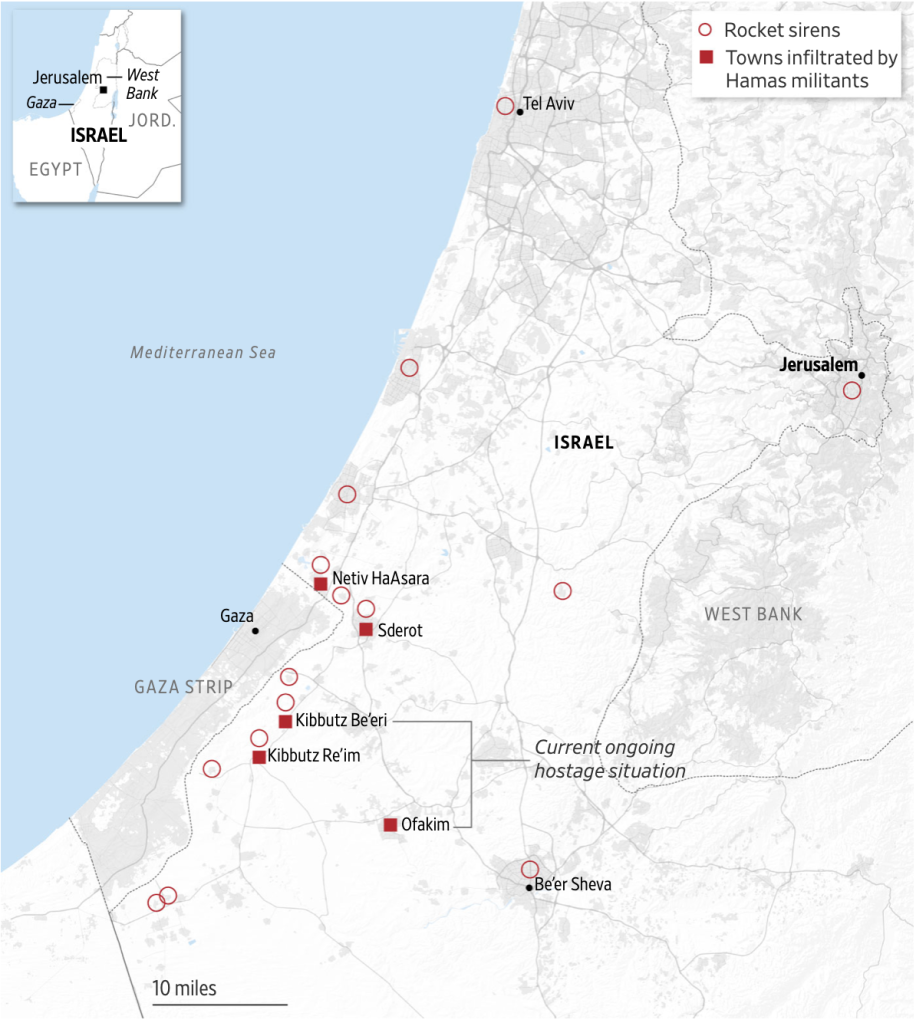
Hamas wants control not only of Gaza but of Areas A and B of Judea and Samaria, where the Palestinian Authority (PA) is nominally in charge. To take over, it must assert itself as a more reliable resistance to the Zionist entity than the tired old PA. That is what this raid is about. The Israeli response will be punishing militarily but Hamas will emerge stronger politically, having demonstrated in the most dramatic terms that it is the mightiest Palestinian faction.
As long as Hamas retains control of Gaza, Gaza will be a ticking time bomb, waiting to explode again in murderous fashion.
Israel’s political leadership and its citizenry have grown too complacent, bought too much into their own propaganda. Israel has the hardware to defend itself but conventional military power has no preventive value against operations like this. As long as Hamas retains control of Gaza, Gaza will be a ticking time bomb, waiting to explode again in murderous fashion. Hamas cannot be contained. It must either be tolerated, which will lead to the deaths of more Israelis, or be destroyed, which will lead to the deaths of many more Palestinians. What has happened today is not a terrorist attack but an invasion — an act of war. If Israel settles for a return to the status quo ante and yet another uneasy and temporary peace, it will invite more outrages on even grander scales. Weakness does not avoid conflict but invites it.
Another delusion rudely debunked is that of a practically achievable and sustainable two-state solution sometime in the near future. If Hamas can throw Israel into chaos from its isolated enclave in Gaza, it could inflict incalculable damage from the hills surrounding Jerusalem. Israel’s slight territory — the state is only nine miles wide at its narrowest point — would put the country at risk of being overwhelmed and bisected in an invasion from a future, Palestinian-run Samaria. The two-state solution has hardly been in rude health lately but the Simchat Torah War might withdraw life support altogether. Israel will now have to make more expansive territorial and security demands before allowing a Palestinian state west of the Jordan. Any other course of action would be national suicide.
One of the most durable delusions about this part of the world, common to academics, policy wonks and journalists, is the dogmatic insistence that Iran can be treated with. Tehran, which is the primary state backer of Hamas, wishes to dominate the region and uses its Gaza-based proxy to that effect. Despite this, the US and the UK are hellbent on reviving the ineffectual Iran deal which Donald Trump withdrew from in 2018. Until the international community is prepared to accept that Iran must be defeated, it will continue to pursue its nuclear weapons programme and to fund and arm not only Hamas but other terror groups such as Hezbollah. Israel will not be truly secure and the region truly stable until the Iranian regime is toppled or humbled.
The final delusion put to the sword today is the one that says Israel can be politically divided but militarily strong. The protests against Netanyahu’s judicial reforms and his far-right government are about fundamental matters: who governs the state and who is fit to. Protests have included refusal to attend reserves training and other duties. The right will try to blame the protesters for having undermined the IDF but while a causal link is difficult to establish — and deeply cynical — it is undeniable that question marks have been raised over military service. A civilian army in which some civilians will not serve for political reasons is a diminished and demoralised army. The protesters should never have embraced this tactic. The government should never have driven them to that point.
For now, though, Israel is at war. It must win – and smash Hamas.
Why hasn’t the UK outlawed the IRGC?
As the scale and barbarity of the Hamas terrorist assault on Israel begins to unfold, to no-one’s surprise Iran has leant its formal support to the insurgents. While thousands of rockets rain down on Israeli civilians and and Iran’s proxies pull men women and children out of their homes — murdering them in the streets — it’s worth remembering that the United Kingdom still has not proscribed that regime’s state terror exporters, the Islamic Revolutionary Guards Corps.
Whether it is terror funding and training to Hamas in Gaza, Hezbollah in Lebanon or Palestinian Islamic Jihad in the occupied territories, the IRGC is inextricably linked to today’s butchery. This is the same state organ that is responsible for the grotesque human rights violations of Iranian women who refuse to bow to its repressive medieval worldview. For over four decades the IRGC has been exporting violent extremism around the world and propagating the toxic ideology that animates its exponents. It is committed to the destruction of the state of Israel in its founding constitution and relentlessly involved in radicalisation.
It is hard to see why the UK still believes that not outlawing the IRGC preserves some sort of diplomatic leverage.
Perhaps the bloodied facts on the ground will move the United Kingdom to finally joining with the United States, Sweden and other countries in designating these murderous fanatics as a foreign terrorist organisation. Certainly the arguments against this look increasingly feeble in the light of today’s assault where the objective was to murder and terrorise as many Jews as possible.
In March this year, the leader of Hamas, Ismail Haniyeh, boasted of the $70 million sent by Iran to his insurgents to finance ‘missiles.’ An estimated 5,000 of those weapons were launched ahead of Hamas penetration of the Gaza border fence this morning. Those terrorists were later seen marauding through Israeli towns close to the frontier apparently murdering civilians with complete impunity. The video footage on display on social media includes the desecration of the dead by baying mobs of gunmen. It is hard therefore to see why the UK still believes that not outlawing the IRGC preserves some sort of diplomatic leverage. How can you negotiate with theocratic fascists so utterly devoid of humanity?
It’s becoming clearer that Biden’s capitulation in Afghanistan and the unfreezing of $6 billion of assets in the hopelessly one-sided prisoner swap deal just last month have emboldened the regime. Their primary military objective remains the development of nuclear weapons. Their primary diplomatic objective is to undermine the Abraham Accords. This is the historic agreement to normalise relations between Arab countries and Israel — and that threatens to make redundant the Iranian regime’s bleak ideology of a forever war with the ‘Zionist entity’.
We must now make it clear that the IRGC is a terrorist endeavour and there will be no further pretence that it is amenable to diplomatic persuasion. If there is hesitancy to do so because the IRGC is effectively the same as the Iranian regime, then we must make it plain that the Islamic Republic of Iran — who brutalise their own citizens and export that brutality worldwide — is in itself a terrorist entity. That export has reached the shores of the UK: the Islamic Students Association of Britain has reportedly hosted meetings with sanctioned apologists for the Khamenei regime steeped in antisemitic rhetoric that seeks to radicalise young people.
Israel is under attack now as it was exactly 50 years ago in an equally unforeseen and audacious assault on the feast of Yom Kippur. The dates are probably no coincidence. Today’s attack was underwritten by Iran’s Revolutionary Guards’ Corps. It now supports and coordinates all terrorist organisations surrounding this tiny country. It continues to operate in plain sight in this country with feeble and insufficient control over its mission to poison the minds of students.
Under the Terrorism Act 2000, the UK government may proscribe an organisation if it is concerned in terrorism and it is proportionate to do so. Both of those tests have been met and exceeded by the horrors unleashed on Israeli civilians. One way we could stand in solidarity with a traumatised ally under murderous assault is deny any legitimacy or hiding place to the international gangsters who are bankrolling it. It is time to act in the name of global and national security.
Will constitutional reform be on Starmer’s conference agenda?
As Labour travels to Liverpool this weekend, one issue which will attract attention is the extent to which Sir Keir Starmer spells out his vision on constitutional reform, if the party wins a majority at the next election.
The Blair administration introduced a variety of ambitious constitutional innovations in its first term, including devolution, Lords reform, the Human Rights Act and freedom of information. Gordon Brown also envisaged change, launching a significant (albeit unfinished) review into the governance of Britain when he took over as Prime Minister in 2007.
As we enter what might be the final Labour conference before the next general election, it is far from clear how radical Starmer wishes to be.
Initially, it appeared that Starmer might take a similar approach. In 2020, he established a Commission, overseen by Brown, to report on plans to settle the future of the Union and consider further reforms to the UK constitution. The Commission reported in December 2022 and set out 40 recommendations for change, principally focused on devolution, localism and reform of the House of Lords.
Yet Starmer has been fairly cautious in how he has approached these issues. His approach to Brexit is somewhat opaque and wider constitutional revolution may not be on the agenda. As we enter what might be the final Labour conference before the next general election, it is far from clear how radical he wishes to be: the only issues which appear to be on the table are the House of Lords and limited electoral reform.
The former issue will apparently be subject to a consultation, but with a clear preference for an elected second chamber which would be representative of the UK’s nations and regions. Starmer claims this would help to ‘restore the trust of the public’ in our system of Government.
In terms of electoral reform, recent headlines also suggest that Labour would introduce votes at 16, although a plan to grant the franchise to EU nationals resident in the UK does not appear to have been included in the final draft of the party’s national policy forum. It is suggested that Starmer is not a keen supporter of proportional representation.
The UK’s constitution is unusually flexible, as it provides no opportunity for a single government to entrench its constitutional values in law. Moreover, there are no specific legal requirements on a government which wishes to amend earlier constitutional legislation, provided that it does so clearly enough on the face of any new laws. As the Duchess of Omnium put it in Anthony Trollope’s novel, The Prime Minister: ‘Anything is constitutional or anything is unconstitutional, just as you chose to look at it.’ Or, as John Griffith put it so pithily, the constitution ‘is no more and no less than what happens’.
However, given the cost of living crisis and the implosion of the SNP, it would hardly be surprising if Starmer does not focus too much attention on the question of constitutional modernisation at conference. It is an issue that provokes great excitement amongst only a small number of voters. A recent report by the Institute for Government advocating constitutional renewal provoked only limited political interest. Despite renewed concerns about sleaze in parliament and Brexit, there is no obvious constitutional moment to justify substantial new reforms which do not have cross-party support in Parliament.
While caution may be wise, Starmer should also be careful that any reforms that he does propose do not look like partisan political fixes. The last constitutional innovations introduced in this fashion – the Fixed-term Parliaments Act and a weak version of English votes for English laws – were met with suspicion and did not have a happy fate.
While caution may be wise, Starmer should also be careful that any reforms that he does propose do not look like partisan political fixes.
It would be naïve to think that every constitutional innovation should be the result of public consultation, citizens assemblies and bipartisan co-operation; however, reform based mainly on self-interest is no way to tackle important issues. Unfortunately, votes at 16 has the appearance of political calculation, given the likely views of younger voters. Lords reform also gives the impression of a plan to try to fix the problems of the devolution settlement while achieving party political advantage. As such, it has the potential to be a double-edged sword.
Labour has a clear and legitimate worry that as the third largest group in the Lords (behind both the Conservatives and the Cross-benchers) it might struggle to get its legislative programme through unscathed. The creation of large numbers of new Peers is clearly problematic, given the fact that the Lords is already unwieldy and the risk that Starmer would face charges of hypocrisy if he simply ennobled a swathe of party supporters.
Yet radical reform of the House of Lords risks turning into a complex quagmire and it poses as many questions as it would answer. Notably, the Commons Speaker, Lindsay Hoyle, (a former Labour MP) has expressed reservations about the idea of an elected second chamber. His Lords counterpart, the Lord Speaker Lord McFall (another canny Labour operator) has noted that previous experience indicates small incremental changes have far been more successful than proposals for radical transformation, and has warned that any extensive reforms should enjoy ‘both consensus and legitimacy’. The current model may be unloved, but it does bring expertise to bear and has been useful in reviewing and revising some of the more egregious bills which emerge from the Commons.
At a time when there are so many other intense conflicts in our political system, sweeping reorganisation of the House of Lords also has the risk of being a needless distraction which could easily take up a disproportionate amount of parliamentary time. Wiser heads might counsel changes to remove the more indefensible aspects of the current system, including the hereditary peers and Lords Spiritual, while granting the House of Lords Appointments Commission more powers to ensure that clearly unsuitable candidates are not waived through by politicians.
We shall have to wait to see whether Starmer deigns to elucidate his plans in Liverpool. The recent Brown Commission review appeared to suggest that constitutional innovation could address profound problems and unleash growth and prosperity for the entire country. In truth, this seems highly unlikely. But it would be unfortunate if – having championed the idea of restoring trust in politics – Starmer’s proposals came to be seen as both polarizing and politically partisan.
Green co-leader denies party is ‘institutionally racist’
To Green conference, where the party is thrashing out its policy platform ahead of next year’s general election. All too often in British politics, the smaller parties are distracted and held back by internal rows and feuds. So Mr S was intrigued to hear how the Greens would walk the delicate line between broadening the party’s appeal and retaining their tradition of internal party democracy.
Upon entering the Brighton Centre, one of the first leaflets thrust in Steerpike’s direction expressed concern about the lack of ethnic minority representation within the party. Kefentse Dennis, one of the candidates for the party executive earlier this year, has previously accused the Greens of being ‘institutionally racist’. That came after the leadership of the party’s subgroup ‘Greens of Colour’ last year admitted it ‘was divided on whether’ the Green party is ‘institutionally racist. One side felt that this is obviously evident within the structure and process of the party, but others saw no evidence.’
Given all of this, Mr S felt duty bound to ask Green co-leader Adrian Ramsay in an interview what his response was to the allegations made by certain members in his party. Did he reject the idea that the Greens are ‘institutionally racist’? He replied thus:
Yes, er, I mean, like all organisations we strive to continually improve the work we do on equality and diversity. And that has to be an ongoing piece of work for any organisation, no one should be complacent about that. But, um, you know, we work with Greens of Colour, with Green party women, with Disability Greens, with all of the different groups we have that represent the different protected characteristics and different members’ groups in the party to promote policies that make sure we are accounting for the needs of different sectors of society and working to make the Green party as representative of society as it can be.
Will this afternoon’s ‘Greens of Colour’ speech see any further drama on this front? Steerpike looks forward to finding out…
Hamas’s unprecedented attack on Israel was meant to bring war
In the early hours of this morning, Israelis had a flashback to the surprise attack of the Yom Kippur War that started almost 50 years ago to the day, in October 1973. Hamas says it has launched 5,000 missiles deep into Israeli territory. The missiles were used to mask a much more elaborate attack that saw dozens of Hamas terrorists, dressed in uniform and — according to reports on Israeli media — heavily armed with machine guns and grenades, invade Israeli territory. The terrorists entered towns and villages by foot, paraglides and vehicles. Fighting between Israeli security services and the terrorists has gone on for hours, with reports of dead, injured and kidnapped soldiers and civilians.
The magnitude of this attack meant that the Israeli government quickly announced a state of preparation for war, and commenced calling in reservists.
The intensity and complexity of this attack is unusual for Hamas. Its success is largely due to the surprise by which it took Israel, indicating serious failures by Israel’s intelligence services and the Israel Defence Forces (IDF) that will have to be reviewed when the dust settles. In the past, Hamas has tried to walk the fine line between inflicting an attack on Israel in a way that will result in a limited Israeli response. Israel has usually opted for a policy of containment. Not this time. The magnitude of this attack meant that the Israeli government quickly announced a state of preparation for war, and started calling in reservists.
Hamas would require good reason for taking the enormous risk of starting a potentially prolonged, high intensity war with Israel. Such war will inflict considerable damage on Hamas and the Palestinian Islamic Jihad who declared they will join the fight — including casualties, destruction of infrastructure and diminished offensive capabilities.
One of the reasons behind this is Hamas’s plan to collapse the Palestinian Authority (PA) and as a result Hamas has been the main instigator of unrest in the West Bank. The last year saw a concerning rise in terror attacks committed within the West Bank. In the first six months of 2023, there were 148 ‘critical’ terror attacks and 28 Israelis have been killed. During this period, Israeli security serviced foiled 375 additional attacks. Tensions have been rising even more due to violence by Jewish settlers against Palestinian civilians. Many of the terrorists in the West Bank have been receiving support and guidance from Hamas in Gaza — and a successful attack on Israel will increase Hamas’s popularity across all Palestinian territories and aide its power grab.
Hamas has also been concerned by the negotiations between Israel, the United States and Saudi Arabia. A defence pact and diplomatic relations between the sides will be a significant boost for Israel’s position in the Middle East, which Hamas believes would compromise its relations with the Saudis. These relations have been strained for nearly two decades but have recently warmed up. Hamas’s leaders have visited Saudi Arabia — which has released Hamas operatives from its prisons.
A treaty between the three countries will also enhance their position against Iran, Hamas’s most important ally, who supplies the militant movement with arms, training and funds used to attack Israel. However, a war between Israel and Hamas — especially if it results in many Palestinian civilian casualties — may place pressure on the Saudis not to engage in talks with Israel.
The potential for escalation following this morning’s attack is considerable. It may even bring in Hezbollah, an Islamist political party and militant group which has been intensifying its threats against Israel in the past months. Both Hamas and Hezbollah have been encouraged by deep internal divisions in Israeli society that have seen hundreds of thousands march against the government on a weekly basis. The fierce criticism of the Israeli government’s judicial reform, which many believe undermines Israel’s democracy, has also affected the IDF. Officers and soldiers, including those serving as fighter pilots and in elite unites, have refused to attend training as reservists, which has reportedly had some effect on the army’s war preparedness.
If both these organisations join forces, along with smaller terror organisations in Gaza and the West Bank, Israel will face war on multiple fronts – south, west, north, and deep within Israeli territory – for the first time in many years.
Layla Moran embarrasses herself over Israel
Oh dear. It seems that Layla Moran has done it again. As Lib Dem foreign affairs spokesman, she has chiefly served to undermine her party’s carefully calibrated equivocations on tactical voting and rejoining the EU. But today the Oxford West MP has outdone herself with her response to the unfolding horrors in the Middle East, where dozens of gunmen from Hamas appear to have infiltrated southern Israel. Following a surprise Palestinian attack that saw hundreds of rockets hit Israel from Gaza, Moran decided to tweet the following:
Deeply concerned by reports from Gaza and Israel. Civilians must be protected, I am especially horrified to hear about hostage taking, and all violence condemned. This is a significant escalation. I can’t see how it ends well for anyone.
Talk about mealy-mouthed. No condemnation or identification of the perpetrators, only trite clichés about both sides. Both Labour and the Tories have already denounced Hamas, yet for the Lib Dems mere ‘concern’ is enough to describe the execution of civilians in their homes. Mr S looks forward to a further statement coming shortly. Diplomacy is one thing but appeasement is quite another…
Update: Looks like someone had a word
Union chief: use strikes to push green agenda
It’s day two of the Green party conference today in Brighton. There’s an air of expectation at this year’s jamboree as first-time attendees mingle with veteran eco-activists, clutching their pro-Palestine leaflets and tupperware lunchboxes. Mr S is a regular on the political conference circuit but even he didn’t expect the shindig to chime with his prejudices to this extent. From the all veggie menu to the copies of Jolyon Maugham’s book on sale, the homemade protest badges to the 20 minute check-in queues, at least the Greens are in keeping with traditional perceptions of the party.
But the Greens are now – they’d have you believe – a serious party of government, having quadrupled their number of councillors since 2019. They’re gunning for four seats at the next election and are willing to embrace a whole new swathe of tactics to keep the focus on green issues. So Mr S was intrigued to hear of one novel approach floated by John Moloney, Assistant General Secretary of the Public and Commercial Services Union, which boasts almost 200,000 members. He told delegates at a panel yesterday that Green members ought to support the repeal of anti-strike legislation to advance their agenda:
Certainly my union has discussed more than once going on strike over green issues. In this country legally you can’t just have a straightforward “We think we should move to renewable energy, we will go on strike”. You can in France, you can in Italy, you can in many parts of the world. So we actually have to smuggle in green issues. So for instance we are going to put in what we call “Green claims” in hopefully later this year which are equivalent to pay claims where we say to the employer – I don’t know – “We want you to change all the bulbs and LEDs within six months”… Making the right to strike much easier will actually be a very important component potentially of green politics and we can then take strike action over issues such as an unjust transition. We can take political strikes or so-called political strikes over how we think this country should go.
More strikes? Well it’s one way to try to win votes…
The trouble with Canterbury Cathedral’s rave
I will not be attending the silent disco that is soon to be held in Canterbury Cathedral. I will not witness ‘some of the UK’s best 90s DJs playing all your favourite tunes in the stunning, illuminated surroundings of Canterbury Cathedral’. I will not be among ‘100s of like-minded 90s fans singing their hearts out whilst wearing state-of-the-art LED headphones’.
Why not? Isn’t this the sort of trendy gimmick that a trendy liberal like me approves of? Don’t I often express the view that the Church should be open to the culture around it, and find ways to tempt arty agnostics into its orbit?
Well, I suppose it won’t do any harm, and maybe some of the ravers will look more positively on the cathedral as an impressive cultural space, and maybe one or two will wonder what worship is like there, and quietly give it a try. Maybe.
But my gut reaction is one of slight dismay. The event feels unimaginative. It simply imports a secular phenomenon into this religious space, rather than really thinking about the possibility of a dynamic cultural exchange.
What do I mean? I mean that the Church ought to be thinking about dance in a serious way, finding some real opportunities to introduce dance into its worship culture. Instead it vaguely gestures in this direction, but in an inauthentic, trivial, risk-free way.
The Church ought to be thinking about dance in a serious way, finding some real opportunities to introduce dance into its worship culture.
I have long been fascinated by the relationship of religion and dance. There are grounds for thinking that ancient Greek religion was rooted in communal dance, and of course this is backed up by the religious rites of every tribe known to anthropologists.
Did Christianity shun such pagan ways of worship? Alas yes, to a very large extent. Its founders seem to have been rather puritanical Jews, at least in this respect. It is hard to believe that Jesus did not dance, for example at the wedding he attended, but none of his biographers thought to mention it. Paul was probably more of a stand-at-the-back-of-the-disco-frowning sort of guy.
In the merry medieval era there was a bit of holy dancing, but no strong tradition took root. Of course any frail roots were stamped on by those nasty Protestants. And so modern Western dance has been deeply unchurched. It is hard to overstate how deep a problem this is for Christianity. It claims to be a religion of joy, but lacks the primary cultural language of spontaneous joy.
Admittedly there are some Christians, thank God, who do dance as they praise: Pentecostals and charismatic evangelicals. And maybe Mormons, if they’re Christian. But of course this sort of ‘enthusiasm’ is very un-British. We have been schooled to see religion as utterly distinct from the spirit of dance, which is associated with youth, coolness, drunken exuberance at parties. To my mind, this is a rather thin version of dance, too individualistic and too close to commercialised cultural fashion, which is why I tend to join Paul at the back of the disco, frowning — and quietly wishing there was a communal tribal dance, with real cultural meaning, that I could join instead.
My point is that serious Christian work must be done to restore the status of dance. The next religious genius won’t nail some theses to a church door; he or she will invent a dance that draws people to church on Sundays.
Could Nigel Farage unlock victory for Keir Starmer?
What is Labour’s offer for Nigel Farage? Yes, you read that right. Of course, Keir Starmer’s party detests almost everything the former Ukip leader stands for, including Brexit and immigration control. That almost goes without saying. But we are well into the phase of the political cycle when grubbing for votes is far more crucial than are purist ideals.
A generation ago, in advance of the 1997 election, Tony Blair and his gang were making regular overtures to Margaret Thatcher, who they knew to be deeply unimpressed by her successor John Major. Early in 1995, Blair caused consternation among many Labour left-wingers by praising aspects of Thatcher’s premiership, describing her as ‘a thoroughly determined person’ whose emphasis on enterprise had been proved right.
It did not take long for him to hit paydirt when she gave an interview to the Sunday Times in which she offered him guarded praise in return, describing him as Labour’s most formidable leader since Hugh Gaitskell and adding: ‘I see a lot of socialism in Labour’s front bench, but not in Blair. I think he genuinely has moved.’
Where is Starmer’s offer to Farage who is, after all, the closest thing we have to a modern-day Thatcher?
In effect, the Iron Lady had given her millions of admirers with right of centre views permission to view Blair as no worse – and possibly an improvement – on the despised Major. Even Gordon Brown, a far less imaginative politician than Blair, attempted to pull off the same trick in 2007 when he invited Thatcher to tea at Downing Street. She was delighted to attend and the event would have given him a perfect launchpad for a snap election had he not dithered and then lost his nerve.
So, where is Keir Starmer’s offer to Farage who is, after all, the closest thing we have to a modern-day Thatcher: highly influential in the eyes of millions of those with staunch Conservative opinions and yet no fan of the current Tory regime? It was indeed Farage who first tore away socially conservative voters in the Red Wall from Labour’s grip. He has joked that he was the ‘gateway drug’ to them going on to vote Tory in December 2019.
Imagine, then, what a similar soft endorsement of Starmer by Farage could do. Yes, many of those on the ideological hard left would emit squeals of anguish and cry betrayal. But that in itself would send a giant signal to those many Tory-leaners who nonetheless feel that the Tories merit a good spanking that it was safe to deliver one.
Let me tell you what Labour’s offer has been. It has been to publicly rejoice in Farage’s monstrous treatment at the hands of Coutts and NatWest banks and abuse parliamentary privilege to peddle false allegations about him being in receipt of substantial funds from Russia.
Shadow chancellor Rachel Reeves, who is supposed to be one of the more intelligent lieutenants in the Starmer operation, even publicly took the side of NatWest chief executive Alison Rose against Farage, claiming the discredited banker was a victim of ‘bullying’ behaviour.
‘If I was in the Treasury…I’d be spending my time trying to ensure that families are properly protected during the cost-of-living crisis rather than picking a fight with banks on behalf of Nigel Farage,’ she said.
Compare that to the way senior Tory figures, right up to Rishi Sunak himself, have been speaking warmly of their former tormentor in a bid to bind in him and his substantial public following.
In today’s Guardian newspaper, Blair’s old spin chief Alastair Campbell is quoted as follows on Starmer’s operation:
‘I don’t often get that sense of that sort of relentless, restless, obsessive attention to detail on everything that you need to focus on…we were not happy if we were not making the news and we weren’t making the weather.’
Campbell was one of those who took charge of Blair’s ‘operation big tent’ back in the day – the remorseless wooing of potential Tory defectors. No doubt he had a hand in the wooing of Lady Thatcher too.
It may be that wider political conditions are so favourable for them that Starmer’s team get over the line at the general election anyway. But the absence of any considered play for the Farage vote or for Farage himself is very telling.
Campbell is right. Starmer is not running a vote-winning machine anything like as formidable as that presided over by Blair. Nobody who has watched Starmer throw countless pledges overboard can think a lack of ruthlessness is the prime cause. A lack of flair and imagination is a far more likely culprit. And that could yet cost his party dear.
Stag don’t: Britain’s deer problem is out of control
Britain’s annual wildlife spectacular is just warming up. From the Highlands to the New Forest, the raucous bellowing of amorous stags fills the air. Stags trek up to 50 miles to find herds of hinds to mate with – fighting off other males before they can get down to business.
Granted, it’s hardly the migration of millions of wildebeest across the Serengeti, but deer rutting season is a feast for both eye and ears. Yet this annual event on any wildlife watcher’s calendar comes with a darker environmental cause for concern.
The truth is that we have too many deer in Britain. The current population of two million – the largest for a millennium – is causing millions of pounds of damage to our countryside, bird habitats, farmland and carefully cultivated flower beds of private gardens.
The truth is that we have too many deer in Britain
Our six resident species of deer – four of which have been introduced – are breeding at an alarming rate and there are no natural predators to keep the population down. Culling does take place and as many as 350,000 deer a year are killed, whether on private estates, parkland, nature reserves and other specialised areas. There is also a hunting season for deer stalkers. But the number of deer culled ought to rise considerably – perhaps even to more than double to as much as 750,000 – to keep wild deer under control.
In Scotland, the Forestry Commission estimate deer have caused around £4.5 million worth of damage to commercial woodland plantations. This isn’t only an issue north of the border: across the UK, but particularly in East Anglia and the South West, deer are responsible for millions of pounds a year worth of damage to crops.
As their population expands, deer are also increasingly a danger to motorists; around 74,000 accidents a year involve deer, at the cost of between 10-20 human lives, according to the British Deer Society.
Deer are wonderful creatures. The annual rut is a sight to behold, particularly involving the majestic red deer, immortalised as The Monarch of the Glen (Sir Edwin Landseer’s painting, not the TV series), and familiar to more urban residents as the Instagram-friendly herds of London’s Royal Parks Richmond and Bushy. Here in Suffolk you can hear them roar throughout the night. As Keats might have put it, this is a season of mists and bellow sleeplessness. But even those who, like me, love deers, should see that there are far too many.
The UK does not rival other countries for their ‘big beasts’. Red deer herds represent the nearest thing we have to such awesome wildlife spectacles. Therein lies a problem: without big cats, wolves or bears, there is no natural predator against ever expanding populations of deer in Britain. The numbers – and costs – will keep growing.
For now, Bambi is safe: many Brits see deer as cute woodland creatures, so it would take a brave politician to speak up for a wider cull. But it’s about time we cracked down on Britain’s deer problem before more damage is caused – and lives are lost.
How Brits turned soft on crime
It is almost exactly 30 years since a young Labour politician told his party’s annual conference in Brighton that as home secretary, he would be ‘tough on crime and tough on the causes of crime’.
That line helped make Tony Blair a star, since it allowed a left-wing party to grab an issue where its right-wing opponents traditionally held sway. That was the era of Michael Howard as home secretary, when the public and the people who helped set the political agenda were largely in favour of a tough, punitive approach to crime. Howard’s famously harsh Criminal Justice Act 1994 was a sign of those times.
Yet things change. The recent Conservative conference was heavy on speeches and events that allowed some commentators to allege a Tory slide towards the hard right. But the topics covered were notable for what was missing. Yes, the ECHR and migrant rights were a key focus, but where was the ‘lock-em-up-and-throw-away-the-key’ message on crime from would-be Tory leaders such as Suella Braverman, Kemi Badenoch and Miriam Cates?
(Yes, I include Cates as a leadership contender. If the Tories, as they expect, are out of office next year and she still has a seat, I think she’ll stand and do surprisingly well, because outflanking your opponents on the right is likely to be a profitable tactic in a post-Sunak party.)
Isn’t it odd that a Conservative party that’s taking solidly right-wing positions on lots of issues isn’t talking about law and order? It used to be that no Conservative conference was complete without a cry of ‘bring back hanging’ from the conference floor, generally followed by a round of applause.
Now, ‘hang-em-and-flog-em’ has largely vanished from politics.
Why? Largely because the electorate has moved on. That doesn’t mean, to be clear, that people aren’t worried about crime – they are, albeit at a lower level than in earlier decades: fewer than 10 per cent of the public name it as a top issue in the Ipsos Issues Index; in the early 2000s, readings of 30 per cent and 40 per cent were the norm.
The more subtle but significant shift is in what voters want the state to do about crime and criminals. Clear majorities of voters now want the criminal justice system to favour rehabilitation over punishment – because that’s what cuts reoffending.
Chalk doesn’t want to hang ‘em and flog ‘em; he wants to get ‘em a trade and a job
New polling from Novus, a prison education service linked to Manchester College, shows how public attitudes on law and order have moved. Some 55 per cent of the public want prisons to focus on rehabilitation instead of punishment – for Tory voters, the figure is 49 per cent.
Employment and education are where the public’s liberalism is most pronounced. Some 58 per cent of Tories think educating is a good use of public money, in line with the 62 per cent of Labour voters who say the same.
Employers are catching on to this agenda. More and more big companies are opening up recruitment to people with previous convictions and supporting prison education and enterprise. The state of prison education is still often shambolic, but it’s a start.
Even better, politicians aren’t fighting about this stuff. Conservative and Labour justice teams are both keen to support better prison education and training and employment. A decade ago a Conservative justice secretary, Chris Grayling, tried to ban sending books to prisoners. Today Alex Chalk, the current incumbent, boasts about increasing prisoners’ educational levels and employment rates.
Here’s an extract from Chalk’s speech to the Tory conference:
Our plan to break the cycle of reoffending is absolutely critical, because all but the most dangerous offenders will be released one day. Frankly, there are people wasting their lives going in and out of prison, at enormous cost to the taxpayer.
So, we are rolling out accommodation provision for prison leavers, to keep them off the streets and out of trouble in those critical early weeks. We have brought business expertise into over 90 prisons across the country to provide job opportunities and help prisoners gain the skills they need to hold down a job, pay taxes, and become a contributing member of society.
Yes, that’s a Tory justice secretary preaching to the Tory faithful about the help and support he’s offering criminals while they’re in prison. Chalk doesn’t want to hang ‘em and flog ‘em; he wants to get ‘em a trade and a job. Labour is likewise more interested in rehabilitation than punishment.
It can sometimes feel as if British politics is forever in the shadow of Blair and the 1990s, not least since we’re approaching the end of a long-serving Tory government. But some things do change, and Britain’s attitudes to crime, punishment and rehabilitation might just be among them.
In defence of Eton’s Provost
The world divides into two groups. Those who liked school and those who didn’t. Sir Nicholas Coleridge, the next Provost of Eton, is firmly in the first group. In an article in the Telegraph, he has frankly admitted that he prefers people who went to Eton, as he did. He said:
I am bound to say that if I meet somebody that I have never met before – for example, if I am travelling abroad, or through work or something – and it emerges that they were at Eton, I feel an interest in them that is multiplied by at least ten.
If we are being completely candid, I do accept that I prefer the company of Etonians to the company of people from any other school in the world.
This might sound shockingly snobbish to some. But in fact he’s just stating a truth most of us subscribe to. We are more interested in those who share something with us – particularly if it’s five years at a boarding school in your formative years. I went to Westminster School 35 years ago and I can still have endless conversations with my old friends there, about different teachers, pupils and incidents we think are outrageously funny – that others would find crushingly dull. That fellowship applies even to people who were there at different times.
I recently had dinner with someone who had been at Westminster ten years after me. We could still play the name game – of various teachers we’d loved and hated. These feelings of mutual solidarity, forged by closeness in your childhood, are intensified at Eton. It is the most famous school in the world – and the poshest. That produces buckets of the legendary Etonian confidence. It also means the richest and grandest parents send their children there.
A friend of mine, himself educated at Rugby, once said to me: ‘People only send their children to private school so they can have posh voices and be well-connected for life.’ He was joking. Even he acknowledged that some public schools, like Eton, are extremely good academically. But there is an element of truth in it, too.
These feelings of mutual solidarity, forged by closeness in your childhood, are intensified at Eton
If you go to Eton or some other big, famous public school, you will forever be bumping into people who also went there. And it’s undeniable that you feel a sort of connection with them – even if sometimes you can’t stand them. That public-school confidence is a sort of magic weapon, which can often conceal aching voids of talent beneath. Matthew Parris once wrote about an American friend of his, married to a public school boy 12 years after the marriage. She came to him and said: “Matthew, why didn’t you tell me he was so stupid? I thought he knew everything because he said he knew everything.’ Captain Grimes, the pederast master in Evelyn Waugh’s Decline and Fall, declares: ‘That’s the public school system all over. They may kick you out, but they never let you down.’
He is right – to a certain extent. As Coleridge said, schools produce a sort of club of old boys: ‘It is probably true to say that of the ten close male friends I have, certainly eight are Etonians, and I have not the slightest doubt that it will remain so until I die.’
Not every public schoolboy prospers, though. I could tell the story of dozens of tragic deaths, lives destroyed by drink and drugs, and people who never quite got a career off the ground, particularly if they’re weighed down with an onerous trust fund. Coleridge is certainly not in that bracket. I know him a little and, as well as being a very successful head of Condé Nast, he is one of life’s enthusiasts, lifting any conversation you have with friendliness and wit. He is also extremely honest and prepared to say things that are right but unpopular. We’ll be hearing lots more golden nuggets from him when he takes up his job as Provost next year. I can’t wait.
Could this former tantric sex coach become Argentina’s president?
One of Argentina’s presidential candidates is unlike the others. La Libertad Avanza’s Javier Milei whizzes past crowds shaking a chainsaw in the air and roaring his catchphrase ‘¡Viva la libertad, carajo!’, or ‘Long live freedom, goddamnit!’.
In the run-up to the general election, on 22 October, this anarcho-capitalist libertarian has flipped from being a joker wild card – and something of a meme – to the front-runner. Milei, a pro-life, climate change-sceptical libertarian, sends a message of his intentions to chainsaw through the red tape of what he considers the most prolific ‘organised crime group’, otherwise known as the state. His chainsaw has become such a signature accessory that figurines have gone on sale of Milei armed with one engraved with his slogan.
Milei wants to scrap sex education – despite being a former tantric sex coach
But Milei is no joke: this summer, he won thirty per cent of the vote in the primary election in a shock victory, beating the two main coalitions: the Peronists and the centre-right Juntos por el Cambio. So how did such an eccentric political figure, who is casting a long shadow over the other presidential candidates, rise to the top of Argentine politics?
This once-affluent nation is now grappling with the third-worst hyperinflation rate worldwide after a century of boom-bust cycles. Inflation soared past 124 per cent last quarter. Every month, shops are raising their pricing to keep up. Argentinians are desperately spending their cash, or else watch their savings turn to dust.
Milei claims to hold the answer to Argentina’s economic downfall and to balancing the budget ‘within months’. First on his to-do list is to swap the bloated peso for the US dollar, and ‘burn down’ the central bank, which has been printing streams of money to fund government deficits. He has also vowed to slash public spending by closing down or privatising state-run companies and bodies that he claims are ‘used as a haven for people collecting a paycheck without doing actual work’. This entails ending free higher education, replacing free universal healthcare with an insurance system, and selling the national oil and airline companies. Social media videos show him tearing cards with the names of ministries and tossing them into the air, cutting them down from eighteen ministries to eight.
Milei’s stances are full of surprising juxtapositions. On one hand, he is in favour of relaxing gun laws, cutting taxes, and scrapping sex education – despite being a former tantric sex coach. On the other, he takes a laissez-faire approach to drugs and gender identity, stating ‘As long as you don’t make me foot the bill, be whatever you want’. Even more bizarre is that, while Milei is anti-abortion, he has suggested people should be freer to do what they want with their bodies when it comes to organ trading.
But if Milei wins he might be in for a nasty shock. Argentinians are accustomed to stashing wads of USD under their beds, yet dollarisation, as adopted by Ecuador, El Salvador, and Zimbabwe, is a simplification of Argentina’s problems and no golden goose. The most obvious obstacle is the government’s lack of the necessary stock of liquid dollars, and having been cut off from international debt markets since its last default in 2020.
Yet Milei isn’t fazed by opponents who point out these things. His suspicion of the state is ideological and deep-rooted. His views echo the sentiment of libertarian thinker Murray Rothbard, who saw states as ‘organised banditry’ and taxation as nothing but ‘theft on a gigantic, and unchecked, scale’.
Milei admires Rothbard to such an extent that he named one of his five dogs after him; he also claims he can communicate with his deceased dog through a medium, and makes important decisions based on his conversations with it.
By background, Milei is not your typical politician. The 52-year-old bus driver’s son only entered the political arena four years ago, and has never held executive office. Beforehand, he worked as an economist in universities and think tanks, and even had a stint as a Rolling Stones-style amateur rocker in his youth. His history places him at odds with the political elite about whom he furiously rants on his 1.4 million follower-strong TikTok account.
The Argentinians from both working class and affluent neighbourhoods have demonstrated willingness to give Milei a whirl, in defiance of both the right and the left. In the next couple of weeks leading up to the general election, all eyes will be on Milei. His juxtapositions are leaving us wondering who is pulling his strings. After his primary election victory, the peso devalued by a staggering 22 per cent over the subsequent days. The world will be anticipating Argentina crumbling into deeper inflation on the 22 October if Milei triumphs.
Is the FBI targeting MAGA?
As the 2024 presidential election approaches, a Newsweek exclusive claims that the FBI is targeting presidential candidate Donald Trump’s followers. As the agency believes that the election may elevate domestic terrorism among MAGA sympathizers.
The report indicates that the Bureau has silently fixated on the former president’s followers by creating a new category of “anti-government” extremism. Although the institution was set to be non-partisan, classified data obtained by Newsweek indicates a majority of the ongoing “anti-government” investigations are of Trump supporters.
An FBI official who requested anonymity claims that the agency is “in an almost impossible position” as the agency is set to deter a second January 6 breach of the Capitol.
The informant adds that the targeting is counterintuitive, as its fixation on Trump’s base may only accelerate the extremism that it is supposedly countering. “Especially at a time when the White House is facing congressional Republican opposition claiming that the Biden administration has ‘weaponized’ the Bureau against the right wing, it has to tread very carefully,” says the official.
–Juan P. Villasmil
On our radar
ABOVE THE LAW The Bergen Record uncovered that Michael Mordaga, former director of Hackensack Police and an ex-chief of detectives in the Bergen County Prosecutor’s Office, helped Robert Menendez’s future wife flee the scene after a deadly car crash.
HILLARY CALLS FOR ‘DEPROGRAMMING’ MAGA Yesterday, former US secretary of state Hillary Clinton called for the “formal deprogramming” of “MAGA extremists” during an interview with CNN. “Something needs to happen,” Clinton said, suggesting that the government must intervene.
Fatal problems for the Problem Solvers?
The long-mocked Problem Solvers Caucus may be heading for a Matt Gaetz-induced break-up.
The evenly divided group of House Democrats and Republicans is at odds over every Democrat siding with Gaetz and just seven other Republicans to oust Speaker Kevin McCarthy in favor of… chaos.
For years, electorally vulnerable Republicans and Democrats have used their membership in the group as a shield to say that they’re not like the others in their party, but as everyone struggles to figure out what comes next.
Even normally moderate, by temperament and voting record, Republicans, are spoiling for a fight, and even Democrats such as Josh Gottheimer are being scorched by former House Republican Morning Joe Scarborough for siding with Gaetz.
To no one’s surprise, Leader Hakeem Jeffries is now urging a bipartisan coalition of Democrats and Republicans to come together to… grant the minority party more power. Many wonder where that energy was just a few days ago, when Democrats could have prevented a foe of theirs like Jim Jordan from taking over the chamber.
–Matthew Foldi
Trump plumps for Jordan
To the chagrin of the dozens of regular C-SPAN viewers, Donald Trump is taking himself out of contention to be the next House speaker, instead throwing his support behind Ohio’s Jim Jordan.
There are risks and rewards to Jordan’s Trump endorsement; in order to clinch the gavel, he’ll need to reassure moderate House Republicans that he can both raise oodles of money as Kevin McCarthy did, and that he won’t jeopardize their elections next fall. His main opponent, Steve Scalise, has been racking up support of his own — but Trump’s endorsement has moved a bunch of previous undecideds into Jordan’s column.
Perhaps disappointingly for Trump, the news of his endorsement was blasted to the world by Representative Troy Nehls, who posted on X that the former president is endorsing Jordan for the top House job. Nehls himself had previously nominated Trump for speaker, before switching his support to Trump’s guy.
An aide of a McCarthy ally told Cockburn that the idea of Trump “being speaker himself was a bigger joke than Nancy Mace, and we know he likes to be a kingmaker. There is a ton of early momentum for Jordan, even from moderates.” Going in Jordan’s favor is how Jordan “can keep a handle on the fringe members in a way Scalise can’t, which is why moderates are warming up to him. Not to mention, Scalise making calls before McCarthy was even finished left a bad taste with a lot of us. No one is at 218 yet, but Jordan has impressed.”
While Trump won’t run himself, the speaker’s race is still a spectacle — Fox News is trying to seize on it by hosting a candidate forum next week, which some are already predicting will be canceled. Representative Carlos Gimenez, for example, called it a “horrible idea.”
We’ll see if the cameras roll next week, and if Trump ends up making his much-anticipated return.
– Cockburn
Matthew Foldi: Nancy Mace using software in violation of House rules
Nick Russo : Mocking murdered leftists is not based
Sign up to get the DC Diary in your inbox on Mondays, Wednesdays and Fridays.