-
AAPL
213.43 (+0.29%)
-
BARC-LN
1205.7 (-1.46%)
-
NKE
94.05 (+0.39%)
-
CVX
152.67 (-1.00%)
-
CRM
230.27 (-2.34%)
-
INTC
30.5 (-0.87%)
-
DIS
100.16 (-0.67%)
-
DOW
55.79 (-0.82%)
Why Met firearms officers want to hand in their guns
The decision by up to 300 Metropolitan police firearms officers to withdraw from armed duties is a serious and worrying development – the gravest that Sir Mark Rowley has had to face since he took over as Commissioner 12 months ago.
It follows last week’s announcement by the Crown Prosecution Service (CPS) to charge a Met firearms officer with murder over the fatal shooting of Chris Kaba in south London in September 2022. The 24-year-old, who was black, was shot through the windscreen of a car which police had followed and tried to box in. Police had believed the car was linked to a firearms incident the previous day. No gun was subsequently found.
The Independent Office for Police Conduct (IOPC) launched a ‘homicide’ investigation, which took six months to complete. The CPS then took six months to make a charging decision. The officer, who has been suspended from duty for more than a year, is due to face trial next autumn. Whatever the outcome, there will be an inquest afterwards and possibly further proceedings, too. It could well be 2026 before all legal matters are dealt with.
No one would relish the prospect of living for so long under a cloud of uncertainty and anxiety – and it’s one of the key reasons why armed officers are pulling out. They accept their actions will be scrutinised, every shot they fire must be justified and they may have to account for what they did in court but, they ask themselves, is it worth it? It took ten years for Anthony Long, the last firearms officer to be prosecuted for murder in the line of duty, to face trial (and clear his name) after he shot a suspected armed robber, Azelle Rodney, in 2005. Almost eight years on, a Met firearms officer known as W80, who fatally shot Jermaine Baker during an operation to thwart a prison break, is still waiting to find out if he’ll face a misconduct hearing after a succession of legal wrangles.
To ‘reduce the punitive impact’ of such delays and ensure the public see ‘rapid resolutions’ where there’s been wrongdoing Rowley has now called for time limits for the IOPC and CPS. This idea was in a hastily-written letter sent to the Home Secretary, Suella Braverman, on Sunday afternoon. She had tweeted her backing for ‘brave firearms officers’ and announced a review of the accountability process, as the scale of the armed officers’ protest became apparent.
The Commissioner also asked Braverman to consider changing the threshold at which the IOPC can launch criminal or misconduct inquiries and strengthening legal protection for police who use force. But the letter was more of a wish list than a well-evidenced package of proposals: many of the issues Rowley cited have been examined in detail before, including by the UK Supreme Court. In 2015, David Cameron established a review which covered similar ground – it took four years to report back and did not lead to any substantive changes.
It’ll take more than warm words to encourage firearms officers back to a role which they volunteer for
The real purpose of Braverman’s review and Rowley’s letter is to send a message to firearms officers: ‘We’ve got your back, we understand your concerns, we’ll try to improve things – but please return to work.’ The absence of 300 armed officers can be covered temporarily by police from other constabularies but it will cause significant problems in the long term. The number of firearm officers was on the decline well before this latest controversy – there are just over 6,000 across England and Wales, down by almost 600 in four years, representing just 4 per cent of the total officer workforce.
But it’ll take more than warm words to encourage firearms officers back to a role which they volunteer for. What they want is for their managers and leaders to back them through good times and bad. Mark Williams, Chief Executive of the Police Firearms Officers Association, told the BBC’s World at One programme that Rowley had met Kaba’s family – but not the officer who’d shot him. ‘They all back off straight away… they don’t want to talk to the officers, they don’t want to be seen with them – unless of course we shoot a terrorist then of course everyone’s happy to have a photograph taken,’ he said.
The challenge for Rowley in shoring up support among armed officers is made more complex because of his pledge to overhaul standards of behaviour in the specialist firearms command, MO19. Baroness Louise Casey’s eye-opening review into the Met identified ‘elitist attitudes and toxic cultures of bullying, racism, sexism and ableism’ in the unit. Casey’s report said junior-ranking firearms officers hold ‘disproportionate power’ in their relationships with senior personnel because of the importance of the ‘blue card’ status – the permit which gives them authorisation to carry guns.
It helps explain why Rowley is taking the concerns of those officers so seriously – but also how he must not lose sight of the bigger picture. Solving the immediate crisis of a collapse in confidence among armed police cannot be achieved by neglecting the fundamental cultural changes that are needed in MO19.
Sex Education: it’s time class was dismissed
Since Netflix’s Sex Education began in 2019, it has won plaudits for being one of the most reliably entertaining shows on the platform, combining refreshing frankness about sex in all its forms with a finely judged balance between gross-out humor and genuine wit, while also being unafraid to delve into deeper emotional territory. Showrunner and creator Laurie Nunn — daughter of British theatrical royalty Sir Trevor — has proved a remarkable talent, not least for assembling a truly excellent cast of lesser-known actors who have all transformed into stars over the past four years.
There is, inevitably, a problem with popular shows continuing beyond their natural ending, and that is a feeling of staleness. In the case of the fourth series of Sex Education, the major innovation is that the setting for most of the action of the previous instalments, Moordale Secondary School, has been changed. The characters now attend Cavendish Sixth Form College, which is even more outrageously “woke” and sex-positive than the previous institution.
Asa Butterfield’s Otis, Ncuti Gatwa’s Eric and Mimi Keene’s Ruby all attempt to settle in this new environment as best they can. Emma Mackey’s Maeve, meanwhile, has accepted the inevitable and gone to college, where she finds herself involved in some Chair-lite shenanigans with Dan Levy’s creative writing tutor. And Gillian Anderson’s sex therapist Jean has had a baby and finds herself beleaguered and stressed as she tries to juggle late-period motherhood with the demands of a new job presenting a radio series. Anderson, a fine actress, looks tired and bored here; it is hard to tell whether this is a realistic portrayal of the exhaustion of new parenthood, or simply the demands of a role that has ceased to offer her any interesting challenges.
The major problem with Sex Education now is that the actors are all far too old to be remotely convincing as school-age adolescents. Connor Swindells, who plays bully-turned-Eric’s-love-interest Adam, recently played an SAS lieutenant colonel in the BBC show SAS: Rogue Heroes. He was convincing and charismatic; unfortunately, the now-twenty-seven-year-old Swindells is about as likely a teenaged school drop-out as I am. And this woefully unconvincing casting — a necessity of not casting young teenagers in sexually explicit roles in the first series — means that suspension of disbelief is now more or less impossible. Butterfield has aged from being a convincing-looking teenager into a kind of Woody Allen-lite. And the excellent Mackey — by far the show’s most exciting discovery — has the poise and confidence of someone who should be teaching at a university, not being taught. Only Gatwa convincingly conveys an ageless enthusiasm, perhaps because he knows that he will be going straight into the next series of Doctor Who and superstardom.
Casting the oldest teenagers in town in shows or films like this is an occupational hazard; Henry Winkler’s Fonz in Happy Days or Stockard Channing’s Rizzo in Grease come to mind. And Sex Education, with its British-accented cast in a high school that seems like a time-warp version of an idealized American institution, has never made any attempt to be a realistic depiction of the teenage experience. Which is why its continuing saga of Alistair Petrie’s sad-sack former headmaster Michael Groff, played for poignancy rather than laughs, sticks out so incongruously.
Yet the laughs have dried up. The would-be comic situations now seem forced rather than amusingly surreal, and the suspicion remains that the wokery at the show’s heart is being celebrated rather than satirized. It has certainly made a significant impact on pop culture: Barbie featured Mackey, Swindells and Gatwa, and everyone here is bound for lengthy and successful careers. It’s just a pity that this final series is by far the least successful and enjoyable outing, meaning that Sex Education is — if you’ll excuse the imagery — suffering from a severe case of limply creative dysfunction rather than arriving at a judderingly triumphant climax.
What happened when the Bully XL protesters met the ‘Rejoiners’?
London was swamped with protesters this weekend but not all of them saw eye to eye. Bully XL dog owners and ‘Rejoiners’ who want Brexit to be reversed stomped down Whitehall. Anti-monarchists Republic were also in town. Things ended predictably badly: one angry dog owner heckled the ‘Rejoiners’, screaming ‘Traitors’ at them as they waved EU flags; another video showed a poor anti-Brexit protester end up swept up in the wrong mob, surrounded by dog owners.
What is most striking about all three of these insurgencies is that the participants in all the groups looked exactly like you would expect them to look. The ‘Rejoiners’ were very Marks & Spencer, healthy-looking late middle aged or pensioners. A youthquake this is not: they wore blue berets and looked jolly-angry rather than actually-angry, prone to the occasional interpretive dance outside Parliament. The majority have melted away, leaving only an indissoluble rump of true believers. But this hardcore resembled something straight out of central casting.
The Bully XL crowd, on the other hand, were frankly terrifying
The Bully XL crowd, on the other hand, were frankly terrifying, and exactly the type you’d expect would enjoy the cultivation and company of super aggressive hell hounds. They were overwhelmingly male and, let’s try not be rude, somewhat unrefined. (The day before, in Wolverhampton, one of these canine fans was savaged when asking of a fellow walking weapon enthusiast ‘shouldn’t you put that on a lead?’)
The anti-monarchists were scruffy and somewhat pathetic, ‘sneaking’ into Buckingham Palace at £35 a head to spell out NOT MY KING! on their T-shirts. The selfie they took is notable for its obvious lack of rehearsal – see the big gap between the O and the T – and for the pleased look on the faces of the perpetrators. This is the same look an infant has when it proudly displays to a parent the results of its first solo trip to the potty. Thank goodness they at least lined up in the right order, or they could’ve been mistaken for Frenchmen angry about rules for exercise wear: GYM KIT NON!
Three protests, and three sets of easily categorisable stereotypes then. In Viz terms, this is the Modern Parents, Biffa Bacon et famille, and a little lineup of Student Grants. Stereotypes like this are useful. They can be handy in speeding up communication all round. We are all busy, so we prefer people who don’t surprise us very often and who do the same kind of thing again and again. Unpredictable people are confusing and they waste our attention and energy. It’s easier all round if we do the the kind of things a person like us would do, and assume everyone else is the same.
People are unnerved when you don’t fit in to a type. I know this all too well: ‘I thought you were one of those blokes who shouts ‘Are you looking at my bird?’, and then you opened your mouth,’ someone once told me.
Boris Johnson, too, must know what this feels like. Boris looks like something he isn’t. He has a funny name, funny hair and a funny voice. He has all of those in common with Donald Trump, yes, so it feels like he ought to be similarly outré.
But Brexit aside, Johnson in office was largely indistinguishable from Tony Blair. Like many parliamentary Tories, he seemed embarrassed by the new supporters of 2019. I think this stereotype syndrome is why Boris was and is so hard to understand for many of us. We thought he was different, many still do – but he only looked different. His ‘crime’, above all the others he was accused of, was being gauche. He looked wrong. Perhaps then there’s a lesson for Boris in the Whitehall protest: you can take a pop at the Bully owners and the Brussels’ enthusiasts, but, unlike our errant former PM, at least they don’t confound your expectations.
Where ‘Rejoiners’ are going wrong
‘Rejoiners’ – who want Britain to once again be a part of the EU – took to the streets of London this weekend. It was a sorry sight. ‘We want our star back,’ the protesters yelled, as they waved EU flags and donned Brussels-branded berets. But who do they think they are actually persuading to change their mind?
I think Brexit was a grave mistake and I hope to one day see the United Kingdom enter back into the fold. But the plain truth is that continuity Remain – those campaigners who want the democratic result reversed – are doing the hard work for Brexiteers. It sometimes feels like the best case for staying out of the EU is made by the ‘Rejoiner’ campaign groups themselves.
Too many of those in the pro-EU campaigning bubble appear to have a deep inability to learn from any of the mistakes they’ve made – which are many and counting – or to even try and think clearly and rationally about achieving their goals. They seem to design things like this past weekend’s protest march in London around strengthening the cosy little world they have ensconced themselves in since they lost the referendum.
Looking at the footage of the protest, even I suddenly felt a twinge of Euroscepticism
The way the Leave and Remain campaigns were run in 2016 and the result of the referendum should have been more than enough to burst this bubble. The Leave campaign was one of the most impressive political campaigns ever run, anywhere in the world; the Remain campaign was a shambles, a rolling mess headed by New Labour nepo babies. Leave winning the referendum should have been all the wake-up call that was required; instead, we’ve had to watch the same group of people make the same mistakes, over and over and over again.
Take the speaker line up at this weekend’s Rejoiner march: Guy Verhofstadt, Gina Miller and Femi. Did I just dream the last five years happened and I’ve woken up and it’s still 2017? Verhofstadt is a Eurofederalist; he wants to create a United States of Europe. Given this is the main thing any ‘Re-join’ campaign would wish to heavily play down, why have the EU parliament’s main Eurofederalist speak at your UK re-join campaign rally? It’s like there was no thought given whatsoever to the audience they wanted to reach or the people they need to convince.
Could they not have asked Ken Clarke to speak? Or Michael Heseltine? Or David Gauke? No. The ‘Rejoin’ campaigning groups seem allergic to Tories, even though they desperately need Conservatives to embrace their cause if it is to have any chance of succeeding. Some demonstrators have been complaining on social media about the mainstream media mostly not covering the march, but what did they expect? How interesting did they think Gina Miller giving the same speech she’s given a hundred times since 2017 was going to be for an audience that mostly doesn’t care about Brexit either way any longer?
If the ‘Rejoiners’ want media attention, here’s a suggestion: they should work harder to secure a noted Brexiter and use the march as the moment for them to announce their conversion. Imagine that the march organisers told the press beforehand that they had a big name speaker who had worked on the Leave campaign, and that said prominent Brexiteer was going to be announcing that they were now anti-Brexit, live on stage. Then, on the day of the march, a prominent Brexiteer would have come out and said they were wrong about Brexit and we should now all get together to try and re-join the EU.
That would have got picked up by the national press for certain.
Instead, this past weekend’s march will mostly be remembered for one thing only: a group of people dressed in EU flag berets and blue and yellow costumes doing interpretive dance to John Lennon’s ‘Power to the People’. If I was trying to concoct a more negative image for ‘Rejoin’ to have attached to it, I would struggle to think of anything worse. It’s like the march was there to try and really drive home the idea that re-joining the EU is only of concern to a small group of mostly older liberals in the Home Counties, well-off enough to spend time sewing together EU-themed superhero costumes. Looking at the footage, even I suddenly felt a twinge of Euroscepticism.
Despite these scenes, I remain a ‘Rejoiner’. I feel like Brexit was a mistake, one that I would like to see reversed in my lifetime. But the pro-EU groups don’t make it half hard to continue saying that out loud. The thing that might keep us out of the European Union for a long time, more than anything else, is the continued ineptitude of pro-European campaigners. Brexiteers should thank their lucky stars.
As Lego has found out, the world isn’t ready to give up plastic
Predictions of the demise of the fossil fuel industry are based almost wholly on energy. In future, goes the argument, we are going to use clean energy and so we will be able to leave fossil fuels in the ground as ‘stranded assets’, as Mark Carney would call them.
It is proving hard enough to decarbonise the energy sector, but it tends to be forgotten that at present we rely on coal, gas and oil for many other things, too, such as fertilisers, a reducing agent in the steelmaking process and the manufacture of plastics. While there may be substitutes in theory for some of these uses, the experience of Lego demonstrates how difficult it is to replace oil.
We soon saw during the pandemic how difficult it would be to run the modern world without plastics
Two years ago, as part of its programme to become entirely fossil fuel-free by 2030, Lego proudly announced that it had found a substitute for acrylonitrile butadiene styrene (ABS), the material from which is currently makes its bricks. Instead, it would use recycled polythylene terephthalate (rPET), made from recycled plastic bottles.
However, it has just announced that it has given up. Not only did the material turn out to be unsatisfactory – like ‘trying to make a bike out of wood rather than steel’ according to the company’s head of sustainability – but using it would have led to twice the carbon emissions as compared with the current material, thanks to the large quantities of energy required to process and dry it. Nor is there much hope of an alternative material emerging: the company says it has tested hundreds of materials, all to no avail. Instead, Lego will continue to make its bricks from ABS, although it will use paper packaging rather than plastics in future.
It is yet another demonstration of the myriad of technological issues which will have to be solved if we are to get anywhere near net zero by 2050. These issues have not even occurred to the Panglossian tendency as they fool themselves into thinking achieving net zero is a little more than a formality, and something which is magically going to make us all richer in the process.
Children can always play with wooden bricks, I suppose, as I did as a child. As has been demonstrated with the compulsory levy on single-use shopping bags, we can do without some plastics. But we soon saw during the pandemic how difficult it would be to run the modern world without plastics, when personal protective equipment (PPE) – another form of single-use plastic – became one of the most sought-after commodities in the world.
From hospital equipment to electronics goods, the modern world runs on plastics extracted from oil wells. How to do without them is just one more issue which has hardly been addressed.
The West and Russia are at war, says Sergei Lavrov
The United States and Britain are at war with Russia. So said the Russian Foreign Minister Sergei Lavrov at a UN press conference on Saturday. ‘You can call this whatever you want,’ said Lavrov. ‘But they are directly at war with us. We call this a hybrid war but that doesn’t change the reality.’
Lavrov was answering the question: ‘At what point does this actually become a direct conflict with the United States, not simply a proxy conflict via Ukraine?’ Earlier that day it had been announced that President Biden had agreed to supply Ukraine with long-range army tactical missile systems (ATACMS), capable of hitting targets 190 miles away. Ukraine had been asking for ATACMS for months, with the US reluctant to supply them partially out of concerns over whether Russia would accuse Washington of escalating the conflict. Ukraine has reportedly pledged not to aim ATACMS at Russian territory.
Although the question to Lavrov only referred to the US, the Foreign Minister did not shy away from accusing other countries, and Britain in particular, of culpability. Stating that the West was ‘actively engaged in hostilities [with Russia] using the Ukrainians as fodder’, Lavrov singled out the US and Britain for ‘waging war’ through increasingly frequent deliveries of weapons to Ukraine, training soldiers in the UK and Europe and sending reconnaissance planes to help identify targets in Crimea. Asked by another journalist whether a new arms race and cold war was on the horizon, Lavrov refused to give a straight answer.
Tanks, jets, bombs: the question of supplying weapons to Ukraine has been one the US, Britain and Europe have been wrangling over from the very beginning of the war. The main concern throughout from Ukraine’s supporters has been to avoid triggering a Russian escalation in the war that would pull their own territories and populations into the conflict.
For some time, Putin and the Kremlin have sounded off about American influence and involvement and threatened further escalation in response to what they see as ‘provocations’, referencing a ‘hybrid war’ with the West for at least a year. Nevertheless, the UN is among the most public platforms where the Foreign Minister has made such remarks.
The first instinct of western leaders and commentators will be to refute Lavrov’s comments, dismiss them and profusely deny excessive western involvement in the conflict. Indeed, thus far, aside from periodically intensifying attacks on Ukraine, the Kremlin’s threats of retaliation have, on the whole, amounted to little that might be termed direct escalation. However, such comments from Lavrov and the rest of the Putin regime provide valuable insight into the Kremlin’s way of thinking, reliable or not. Britain and the US would be foolish to dismiss Lavrov’s comments completely out of hand.
Macron’s political relaunch was a masterclass in self-belief
After months of inbound slings and arrows, Emmanuel Macron, powdered by the star dust of the royal visit, relaunched himself on Sunday night. His presidential address from the Elysée Palace was officially described as an interview but the French journalists who were on set posing the questions were purely props. The star of the show was Macron.
Macron ignored and patronised Anne-Claire Coudray, a Grande Dame of French television. ‘Attendez, attendez,’ he ordered her at one point, when she dared to ask him a question. Not that he paid much more attention to the handsomely coiffed Laurent Delahousse, another establishment French TV journalist.
The president talked incessantly. He has mastered the actor’s art of never pausing for breath. His message, entirely undisputed by his interlocutors, was a very lightly modified ‘tout est parfait’. And where, due to events beyond the president’s control, things might not be precisely so great, it wasn’t his fault.
Perhaps a better comparison to Macron is AA Milne’s irrepressible Tigger from The House at Pooh Corner
Macron launched his show by recalling his recent moment of glory, the royal state visit. ‘Which one is the King?’ was the joke as the two heads of state surfed the carefully vetted crowds.
He revelled how in a single week he had welcomed the King to Paris, Pope Francis I to Marseilles, and hosted the Rugby World Cup. (France beat Namibia on Thursday, 96-0). With the Paris 2024 Olympic Games to come, Macron the statesman defined himself as France’s host to the world.
Macron has been compared by some to Louis XIV, the Sun King. He has compared himself to Jupiter. On the evidence of Sunday night, perhaps a better comparison is AA Milne’s irrepressible Tigger from The House at Pooh Corner.
The period since Macron’s re-election as president in 2022 (as the lesser of two evils, seeing as his opponent was Marine Le Pen) has been punishing. In the spring he fought angry unions opposing his pension reform. The reform didn’t amount to much but there were plenty of demonstrations, some of them violent.
A weak prime minister and the loss of Macron’s presidential majority in the National Assembly continue to handicap him. The war in Ukraine; the collapse of Françafrique to gangsters, Islamists and Russians; the migration crisis; political unrest over energy prices; doubts over the national climate change strategy; drug wars and mass killings in places like Marseilles; riots in Paris, and Macron’s beloved European union in economic and political crisis – this is not even a comprehensive list of what is besieging him.
If the president had seemed a little gloomy of late, the message on Sunday night was that he has confidently bounced back, reanimated by the royal touch. It was a confident, bravura TV performance from the former drama student, perhaps episodically a little hypomanic, broadcast from a progressive, dramatic, monochrome, ultra-modern set.
It’s impossible to imagine Macron faced with questioning by a competent British political journalist. A serious journalist might have confronted the president with the many contradictions and questionable assertions that he delivered so confidently. But there’s no pretence of forensic challenge.
Macron’s claim that Operation Barkhane, the French effort to pacify the Sahel, had been a success, when it was abject, ending in the withdrawal of French forces with anarchy in their wake, was allowed to pass without even a raised eyebrow from the timorous interrogators.
On Friday, Francis I demanded in Marseilles that more immigrants be welcomed. Macron batted this aside. The pope was right when he called for compassion for migrants, said Macron. But France had made its contribution and could not receive the miserable of the entire world, he said.
The other bubbling crisis is the economy – inflation in France is approaching 5 per cent, driven by high fuel prices – and here too Macron was untroubled by interrogation. The cost of living crisis was not his fault, he declared. Diesel and petrol price were not his fault. Property tax increases – up 63 per cent in Paris – were not his fault but the responsibility of local authorities.
It is embarrassing that star French journalists allow themselves to be humiliated and exploited like this. But they know their place. The Elysée was never going to invite the smart, street-wise Christine Kelly or the insolent, relentlessly informed Pascal Praud to talk to Macron. This was a display of French political journalism at its incurious worst and a masterclass in political monologue and untrammelled self-belief from an unbowed president.
Johnsons deny sacking their nanny for having a drink with Boris
Childcare can be a contentious issue at the best of times. So Mr S was intrigued to read of reports that Boris and Carrie Johnson have fallen out with their ex-nanny, Theresa Dawes. She claims that she was unfairly dismissed three days into the job after having a drink with the former PM while his wife was still in hospital with their third child.
In allegations described as ‘untrue’ by Johnson’s spokesman, Dawes, 59, said that she was given 15 minutes to pack her bags by Carrie Johnson the day after she returned to the couple’s Oxfordshire home this summer. When she went to speak to the former Tory leader about her treatment, he allegedly told her that his wife was ‘hormonal’, adding: ‘It’s out of my control.’
Dawes made the claims in an interview with the Sunday Mirror. Dawes said that she had been hired on a three-month contract to work for the couple before the birth of their third child, Frank Alfred Odysseus, who was born on July 5. When she arrived for work, Carrie Johnson was still in hospital and her husband, asked her to join him to ‘toast’ the baby:
It was a lovely, hot day and when Boris got home, he went out on to the terrace and opened a bottle of wine. He asked me to join him, to toast baby Frank and to give me a report on Carrie and the baby, how they were doing, when they were coming home, that sort of thing.
Dawes said that the drink had been witnessed by Carrie Johnson’s mother, and the following day when she returned from hospital with the baby she was ‘extremely rude’ to her:
I was waiting to welcome her and she just walked past saying, ‘Where’s my mum?’ Then she went upstairs with all the children. I went to make a cup of tea and Boris came in like a whirlwind, flustered… Carrie swanned down holding the baby. She didn’t ask me to sit down but Boris did. I think he could sense something was up. I think he knew she was going to dismiss me and he didn’t know what to do. The other nanny was there with the other children. He asked me to wet the baby’s head, but I said, ‘No thank you.’
Dawes said that she later received a message from Carrie Johnson asking to meet her at 11am the next day, at which she raised comments that Dawes had made when they met previously about a former employer who had celebrated when her husband resigned as prime minister. ‘She said she didn’t like the comments I’d made about her husband, when I’d told her about the other family that didn’t like him… I think that was an excuse. If she didn’t like it, why didn’t she do something two weeks earlier?’
She subsequently sought out Boris Johnson to apologise if she had offended him. According to Dawes ‘He didn’t know what to do. He said, “I don’t know what to say, she’s hormonal, she’s just had a baby, it’s out of my control”. I think it’s all because I had a glass of wine with him and she didn’t like that.’ Dawes said that she received six days’ pay but her contract states she is entitled to be paid for the entire booking. A spokesman for the Johnson family categorically denied the claims, saying: ‘This account is totally untrue. It is disappointing to see someone who sought a position of trust abuse it to create a completely false story for financial gain.’
Still, at least they’ve got that ‘other nanny’ to help with childcare, until a replacement can be hired…
Sunakism meets the Tory party
As the Liberal Democrats attempt to seize the political agenda at their annual conference in Bournemouth, Rishi Sunak is facing a series of decisions on how far to go with his policy shake-up. Last week, he diluted a number of the UK’s net zero commitments – including delaying the ban on petrol cars by five years. Now, other policy changes are planned as the Prime Minister attempts to pitch himself as the minister for hard truths, a politician who will do things differently by being up front about trade-offs.
The snag is that such changes have the potential to be divisive with Sunak’s own side. First up, the HS2 Birmingham-Manchester line. Ministers are considering scrapping the HS2 rail link to Manchester as a result of the soaring costs. The last official estimate on HS2 costs added up to about £71 billion but just last week Jeremy Hunt suggested the costs were getting ‘totally out of control’. The Sunday Telegraph reports that the cost of the rail scheme has increased by another £8 billion.
It means that this is a decision that could fit with Sunak’s theme of hard truths. However, he is facing a pre-emptive backlash as Tory MPs worry a decision could be made as soon as this week. George Osborne has said cancelling the extension would be an ‘act of huge economic self-harm’ while the Greater Manchester mayor Andy Burnham has said it risks creating a ‘north-south chasm’. Making a decision to scrap it days before the Tories head to Manchester for their annual party conference would be an interesting move.
There are also some tricky decisions that remain a bridge too far for the Prime Minister. While ministers consider changes to savings schemes and inheritance tax reform, the pensions triple lock is likely to be in the next Tory manifesto – as I first reported in this week’s magazine. The Conservative party response to the decisions Sunak is mulling next point to how hard his new strategy will be to execute – even if voters take to it.
It is time to rethink the age of consent
In 1983 Samantha Fox was sixteen years old when she first appeared topless on Page Three of the Sun. That paper and its kind used to delight in doing birthday countdowns: in just three days, they’d promise, alongside a picture of a provocatively pouting fifteen-year-old, it’ll be legal for us to show you her breasts. Wahey!
In more recent memory (a 2003 change in the law having outlawed topless shots of under-18s) Emma Watson was ‘upskirted’ by photographers on her 18th birthday: they were handsomely compensated for images that, a few hours previously, would have landed them in jail. The Daily Mail’s so-called sidebar of shame likes to use the phrase ‘all grown up’ to signpost sexualised paparazzi images of young women.
The concepts of ‘grooming’ and ‘coercive control’ indicate how slippery the concept of informed consent is
All this seems to point to two things. One is that there is a very strong appetite in the culture for sexualising images of girls in their early and mid teens, the borderline between what’s legal and what’s illegal being a particular locus of titillation. The other is that, one way and another, the law is a pretty blunt instrument for policing it: in this case, it even seems to add spice to that appetite.
There’s something dismaying, isn’t there, in the way that rather than have morality dictate the law, we seem to outsource the former to the latter? The age of consent is a necessarily arbitrary best-guess line, drawn across a whole population. Rather than recognise the unsatisfactory, morally complex issues that implies, the tabloid take is that one side of the line is fine, while the other is inhumanly deplorable. 24 hours makes the difference between a ‘vile paedophile’ and a healthy red-blooded fella.
And, of course, the law contains all sorts of strange wrinkles and contradictions. We’re collectively confused about where childhood ends. You can fight and die for your country before you’re old enough to vote for the people who will send you to do so. Hell, you can fight and die for your country before you’re allowed to watch the same thing happening, in pretend form, in a movie. You can give your physical body to a grown man as a sixteen-year-old girl, but you can’t send him a photograph of it. Russell Brand, one of his sexual assault accusers anonymised as ‘Alice’ reports, was very careful when they were ‘dating’ while she was sixteen to make sure she didn’t send him naked pictures.
So here’s one of those grey areas. It’s telling that amid the coverage of Russell Brand’s alleged misdeeds (among them rape and sexual assault, and all of which he denies), the very fact of his having a sexual relationship with a sixteen-year-old while he was in his thirties was given so much prominence. It was incontestably 100 per cent legal, but it still gave most of us the ick. Rightly so, I think.
‘Alice’ argued in an article for yesterday’s Sunday Times that the law as it stands doesn’t protect teenage girls from predatory older men. She suggests a graded age of consent – so that though sixteen-year-olds would be allowed to experiment sexually (as if we could stop them), it would be illegal for over-21s to sleep with under-18s.
I’d be cautiously in favour, personally, of what she suggests. Does this infantilise young women (or young men), treating them as delicate flowers in need of patriarchal protection? Well, maybe. And so what? Sixteen is very, very young. A man in his thirties or older will, you can be pretty sure, be getting one thing and one thing only out of a relationship with a sixteen-year-old. There’s a grave power imbalance there. The age of consent is already 18 for relationships where there’s a formal power imbalance (teacher and student, for instance). Why, she asks, should informal power imbalances be any different.
What if you consent as a more-or-less child, because you are overawed by a much older suitor’s power and apparent sophistication, but you repent of it ten or twenty years later and conclude you were groomed? You may be absolutely right, but it’s very tricky to imagine a legal recourse for that situation that would be plausible and fair and consistent.
Keeping it to under-21s, or outlawing an age gap of more than three years, doesn’t land you automatically in a paradise of equality and mutual respect. Eighteen-year-olds are very capable of exercising power over each other, and doing so with a cruelty and selfishness in proportion to their youth. Sex and love are always going to be messy and dangerous.
But, as I say, the law is about drawing a crude line. Can a one-size-fits-all law prevent power imbalances, bad decisions, exploitation, heartbreak and bitter regret? Of course it can’t. The very concepts of ‘grooming’ and ‘coercive control’ indicate how slippery, how hard to legislate for, the concept of informed consent is. How impossible it is, except in statistical generalisations, to use physical age as a proxy for emotional resilience, self-knowledge, and the confidence to know and say what you want and do not want. The law, as Queen Bess had it, doesn’t make windows into souls.
But let’s not make the perfect the enemy of the good. I think we can say with a reasonable degree of confidence that if you were to look at 100 relationships between thirtysomethings and teenagers, on the whole you would find overwhelmingly more of them were in the zone we’d call not-exactly-healthy than in the zone we’d call touchingly-romantic-and-mutually-fulfilling.
The law can’t do everything, but it can do something. And meanwhile, quite apart from the statute books, we could get out of the habit of, even in leering jest, treating a 16th birthday as a chequered flag.
The Pope is wrong to criticise Europe over the migrant crisis
Pope Francis spent the weekend in Marseille where he admonished Europe for their attitude towards migrants. Specifically, the Pontiff took to task those who used words such as ‘invasion’ and ‘emergency’ when discussing the millions of migrants who have arrived in Europe in the last decade. ‘Those who risk their lives at sea do not invade, they look for welcome,’ he pronounced. Those who said otherwise were ‘fuelling alarmist propaganda’ and acting contrary to the teaching of the Catholic church.
The Pope reiterated the Vatican’s four-stage approach to migrants: welcome, protection, promotion and integration, the overriding aim of which is ‘the safeguarding of human dignity’. He continued: ‘Those who take refuge in our midst should not be viewed as a heavy burden to be borne. If we consider them instead as brothers and sisters, they will appear to us above all as gifts.’
The real propaganda comes from those like the Pope, who would have us believe that there is no migrant crisis
Close to where the Pope gave his address in the southern French city is Marseille’s main train station. It is almost six years to the day since two young French women, cousins aged 20 and 21, both studying medicine, were stabbed to death outside the station. The perpetrator was a Tunisian, in France illegally, who took the women’s lives in the name of the Islamic State.
As I wrote in June, not long after a Syrian had stabbed several babies in an Annecy playground, such incidents are no longer ‘isolated cases’, whatever Europe’s leaders may tell their people. They are increasingly common.
Take Nice, 100-odd miles up the Cote d’Azur from Marseille. In October 2020 a Tunisian migrant stabbed to death three worshippers in a church, having made the journey across the Mediterranean specifically for the purpose. A fortnight ago in the same city a 53-year-old woman was beaten half to death by a man the authorities described as ‘Swedish’. That was a half-truth; he had Swedish citizenship, but he was an Angolan who had already committed acts of ‘ultra violence’ in his new country before fleeing to France.
This month, the Ministry of Interior in France released figures that revealed the disturbing rise in crimes committed on the country’s public transport network in 2022. In particular, sexual assaults are up by 13 per cent; such crimes have soared 68 per cent in the last six years. According to the ministry, 55 per cent of the crimes on the network are committed by ‘foreigners’, of whom 29 per cent are classified as minors.
This is no great surprise; as Emmanuel Macron conceded last year, half of crime in Paris is the work of foreigners.
In charge of the Interior Ministry is Gerald Darmanin, who greeted the pope on his arrival in Marseille on Friday. One suspects he didn’t tell His Holiness what he had told reporters earlier in the week: that France will not welcome any of the 11,000 migrants from Africa who have recently come ashore on the Mediterranean island of Lampedusa.
Nor, perhaps, did he repeat the warning that he issued during a radio interview on Thursday. Citing a credible threat against France from Al-Qaeda, Darmanin said there was always the possibility that Islamic terrorists could exploit the migrant route to gain entry into Europe, as they did in the summer of 2015 prior to the coordinated assault on Paris in November that left 130 people dead.
A handful of political figures in France have challenged the Pope’s attitude towards mass migration. Eric Zemmour, leader of the right-wing Reconquest party, and his deputy, Marion Marechal, have both used the airwaves to criticise what they regard as his naivety. ‘What does the Pope want?’ wondered Zemmour. ‘That Christian Europe, the cradle of Christianity, should become an Islamic land?’
Marechal, a practising Catholic, expressed her view that ‘the Pope should not get involved in politics’. It particularly riled her that the Argentine Francis is not European and therefore ‘does not know the type of immigration we are experiencing’. Zemmour made a similar point in 2020, when he was still a journalist, accusing Pope Francis of being ‘an enemy of Europe’ who ‘despises Europe’.
Marechal is nearer to the truth than Zemmour. The Pope doesn’t despise his adopted home, but like the Archbishop of Canterbury, who shares his unsophisticated idealism on the subject of mass migration, he is sheltered in his palace from its worst effects, and of course its cost.
As figures from Britain’s Home Office detailed last month, the migrant crisis ‘is costing the taxpayer around £8 million a day’. In France, the bill for the taxpayer is €54 billion (£47 billion) each year. The 1,000 inhabitants of the Vatican are exempt from paying income tax.
There are, of course, migrants who arrive in Europe and become valuable hard-working members of society. But there are also many who arrive with no such intentions.
This is the towering challenge confronting the continent. How to distinguish between those fleeing war and persecution, and those who simply see Europe as a way of making money, legally or illegally. Or worse, those who see it as a target, as the Islamic State did in 2015 when its members attacked Paris, a city of ‘abominations and perversion’.
This article is not ‘alarmist propaganda’, it contains cold hard official facts. The real propaganda comes from people like the Pope, who would have us believe that there is no migrant crisis. There is, and its scale endangers Europe.
I’ve abandoned my useless British passport
‘Vous êtes anglais, je suppose?’ A question frequently posed to me in France. To which I reply: ‘C’est compliqué.’ To be honest, I’m not sure. If one passport is good, two are better. I have three. Crise d’identité.
In France, I am Irish, thanks to my grandmother, born in County Antrim. In Canada, I am Canadian, having been born there. Albeit I left aged ten months. In Britain, where I spent much of my childhood, I am British, as my parents were.
My British passport is essentially useless. It’s in a drawer somewhere. I don’t need it to fly to Britain
It’s the nationality equivalent of a multi-phasic personality disorder. I suppose I could now even get a French passport, but this seems greedy. It would theoretically permit me to be elected president, which would be to the great benefit of the Republic, but I’m not sure my neighbours would endorse my project of restoring the monarchy and driving on the left. I’ll stick to three for the moment.
My Irish passport, which I got after Brexit, is the most useful of my laissez passers, giving me unlimited access to the European Union and also to the United Kingdom. My Canadian passport is essential for getting into Canada and also allows me into the United States without a visa.
My British passport is essentially useless. It’s in a drawer somewhere. I don’t need it to fly to Britain. The Irish passport is just as good. The Canadians won’t let me into Canada with it, since I was born in Canada. And to go to America I must pay for an Electronic Travel Authorisation.
Some might accuse me of being opportunistic, even cosmopolitan. That’s probably true though I prefer to think of myself as practical. And also a trend setter. Almost everyone I know has at least two passports, or is desperate to have them. Slebs, too. Elon Musk is South African, Canadian and American. Nicole Kidman, Australian and American. Mo Farah, Somalian and British. Arnold Schwarzenegger, Austrian and American. David Byrne of Talking Heads (British, American) put his finger on the confusion this can generate in his song Life During Wartime: ‘I got three passports, a couple of visas. You don’t even know my real name.’
I travelled for years on my British passport in the halcyon days before Brexit. But then I had to go to Canada and apply for a $7 Canadian visa waiver online, a new requirement. The web form demanded: ‘Where were you born?’ Saskatchewan, was my honest reply. ‘You’re not eligible for a visa waiver,’ was the curt response. It informed me that I could only fly into Canada with a Canadian passport. The cost of this was $260.
I presented myself at the Canadian High Commission in Trafalgar Square where the passport office was full of accidental Canadians bitterly complaining at the cost of obtaining a Canadian passport after years of travelling to Canada using a British passport. The clerk was unyielding.
I subsequently flew into Montreal from Paris where I presented my new Canadian passport to the immigration officer. ‘Welcome home,’ he said. ‘This is not my home,’ I snarled.
Then, Brexit. Idiotically I voted for it, imagining that it could precipitate the welcome collapse of the absurd EU. It turns out that the EU is doing a remarkably good job of disintegrating without help from me. But my life was suddenly very complicated. I live in France and was faced with being limited to being here no more than 90 days every six months.
Grandma Edith to the rescue. Born in Belfast. Before the partition. The Irish government doesn’t care where you’re born on the island of Ireland. Only one Irish-born grandparent is required. But there are procedures. I needed her birth certificate, her marriage license, my mother’s birth certificate, her marriage license and my own birth certificate. Plus photos, proof of identity, proof of residence and more, all of it notarised by a solicitor.
It took me a year to assemble the dossier, which I submitted to the Irish Department of Foreign Affairs in Dublin. I was not the only Brit to have had this idea. All over the EU British expats with tenuous claims to Irish nationality were engaged in the same wheeze. Eventually, 80,000 of us applied. It took almost two years to get my Irish passport. It arrived on Saint Patrick’s Day, just before the deadline for me to be kicked out of France. Erin go Bragh.
An Irish neighbour in France asked me: so will you learn Irish? My grandmother’s mother tongue was in fact Yiddish, so no. (I did briefly have a look at Duolingo’s Irish course and concluded I’d never master it, even if I lived to be a million.)
The Irish manoeuvre has not been the only route to remaining in the EU sans souci. I’ve a friend whose family was forced out of Prague when the Germans invaded. He’s never been there but is now the proud possessor of a Czech passport. I have two Jewish friends whose families were forced out of Hitler’s Germany before the war. Both are newly minted citizens of the Bundesrepublik. (They tell me the German embassy in London was exceptionally helpful and efficient at processing their claims.) Another pal here has a Swedish wife and has copped a Swedish passport.
My Detroit-born wife (American, British) with family origins in Poland, investigated the Polish route but the Poles are impossible, demanding unobtainable documents – stupid because, as the Irish have discovered, it doesn’t hurt to have a substantial diaspora. She eventually obtained a renewable Titre de Séjour allowing her to stay in France for ten years. But she still has to queue in the non-EU lane at passport control.
For those without traceable roots to claim a second passport, there are a variety of options on offer, but they’re expensive and complicated and it often takes years to qualify. Spain, Portugal, Malta, Greece and Ireland all offer residency in return for substantial investments, leading in time to the possibility of citizenship. Vanuatu offers a passport for a mere $130,000 but it won’t let you live in the EU and most of us can’t even find it on a map.
Do I feel British? Canadian? Irish? Possibly none of the above. I’m the human equivalent of one of those Panamian ships owned by a Swiss stiftung and operated by a holding company in the British Virgin Islands. But I confess I’m definitely enjoying my Irish inner child.
We’ve taken to escaping France in the heat of the summer and renting a house in County Galway, exploring the magical coast of Connemara. The people are lovely, the food fabulous. That it’s constantly raining isn’t a problem. When God created Ireland, he forgot the roof. Tant pis.
Often my new Irish compatriots, confused by my accent, ask me: ‘Are you British?’
‘It’s complicated,’ I reply.
Why do cyclists insist on making drivers angry?
Picture the scene. I’m in the New Forest, riding in a bicycle race. It looks like I’m on course for a personal best, perhaps even first place. I’m well-fuelled and feeling strong. Then I hit traffic.
The road is too narrow to slip alongside the line of five or six cars in front of me. I stand on the pedals and crane my neck for a view of the holdup. There it is: a bunch of my fellow competitors, riding quite slowly, two abreast.
Nobody honked, revved or attempted a dangerous overtake. But a fair few of them must have cursed into their windscreens
Now this wasn’t exactly a race. It was a sportive, which is timed, but supposed to be non-competitive. You couldn’t get any more amateur than that. But to a middle-aged man like me, with a boy’s imagination, it was a race. No longer was I a journalist who struggles to fit in three training sessions a week and derives most of his exercise from his Brompton. I was Tom bloody Pidcock.
After a few minutes of frustration, I spotted a gap and sprinted past the line of cars on the opposite side of the road. Then I overtook the bunch of plodders and was released onto the open tarmac beyond. I gripped the drop handlebars and pumped the pedals as the wheels thrummed on. This was yellow jersey stuff, I thought, my belly wobbling slightly as I bumped over a pothole.
In the end, I came first. OK, second. I thought I had won for a couple of days until the official times were published when I discovered that some bloke called Mike had completed the course 50 seconds ahead of me. But still, in spite of the traffic delays – which in my mind cost me my victory – I’d averaged 19.6mph over the 45 miles, which was a personal best. Go me.
But it was the behaviour of the bunch of plodders that rankled. They had been having a whale of a time, showing zero awareness of the inconvenience they were causing to the other road users. To be fair to the motorists, they were all extremely patient. Nobody honked, revved or attempted a dangerous overtake. But a fair few of them must have cursed into their windscreens. And why shouldn’t they? Would it have been so bad for the racers to have dropped into single file to let them pass?
Most cyclists are wonderful people, but some of them can be deeply inconsiderate. I fear the latest revamp of the Highway Code may have encouraged this by allowing riders to occupy the middle of the road, permitting them to position themselves two abreast, and giving them licence to ignore cycle lanes if they so wish.
It’s obviously a good idea to keep cyclists safe. But when they abuse those rules to hog the road and treat motorists with disdain, the result is a pressure cooker on four wheels. There’s no more dangerous driver than a furious driver. That’s what worries me.
The bit I can’t understand is that plenty of cyclists are also motorists. Most must have cars in their driveways. The ones who gratuitously hold up traffic, therefore, must exist in some state of double consciousness, suspending their values as they move from one mode of transport to another.
When they’re behind the wheel, they must be as eager to get to their destination as the next driver. When they’re in the saddle, they’re happy to contribute towards a delay for everybody else. The contradiction doesn’t seem to occur to them. Their attitude moves seamlessly into a stance of two wheels good, four wheels bad.
Jumping the lights is similar. Personally, I can’t get too worked up about cyclists ignoring the finer details of the rules of the road when there’s nothing at stake. Expecting them to wait at a red light when there’s no traffic in either direction feels a bit much. But I appreciate that it winds up motorists, and for that reason alone it is probably unwise.
Either way, one conclusion is indisputable. Cyclists rightly demand that motorists drive with care and consideration. But if the favour isn’t returned, the enmity only grows. If we want to reach a state of harmony between two wheels and four, this must be a two-way street.
Welcome to the pub of 2030
In 2030 I will turn 30. I hope to be in the pub, but maybe a little less often than I am now. Judging by the way things are going, that might be easier than we’d like to admit. And not just because we lost 383 pubs between the start of the year and the end of June.
I’ll set the scene: it’s seven years from now. Off I go, to one of the last four pubs in London, and park my e-bike next to three thousand others. I walk through the entrance, the etched Victorian glass door replaced by government-mandated energy-efficient double glazing, and there they are: eight 0 per cent beers on draught.
Human beings like pork scratchings and a fag and a pint, and will do forever
‘Do you have anything alcoholic?’
‘What?’
‘Sorry, I feel a bit ashamed. But do you have a lager with some alcohol in it? A crisp Corona? I’ll take a Carling? Please?’
‘Sorry mate, you’ll have to go to a specialist bar for that. Sure I can’t interest you in a ginger shot?’
OK, that might be too pessimistic. But us young’uns really are shunning the fun stuff: more than one in four Gen Zers are teetotal. Even without the changes in preferences, the country is going through a puritanical phase.
Let’s head back to 2030, where we have calorie counts on the beer pumps. They’ve been introduced because Labour says they’re a good idea. I look down the bar for the least worst option, growing conscious of my waistline. BrewDog Punk IPA sounds nice, I’ll just have a check and… 292kcal. Argh!
Oh, Guinness isn’t that bad: it’s just 210 calories. That’ll be the one pint please, mine for just £14.50. The bar only accepts govcoin, which was introduced by Jeremy Hunt in his twilight as chancellor. I step outside for a cigarette.
‘You can’t smoke out here! We’ll call the police!’
Silly me. It’s been so long since I went to the pub that I forgot that, almost a decade ago, Rishi Sunak banned cigarettes outside pubs because he hates them, so no one else should be allowed them.
I stub my fag out frantically.
‘Sorry, gov. Haven’t been to the pub for so long. Cost of living and all that.’
‘Well you should know the rules. You can only smoke weed out here.’
In I skulk, hungry after all the stress. I ask for a menu. I want a steak and ale pie but can’t focus on the description of the food when next to each item is a massive label that reads: ‘UPF! Ultra-processed food score! There’s ascorbic acid in the pastry and the sauce has a hint of soybean oil along with other binding agents! Death! Death! Death!’ I order some kefir.
It’s not exactly cosy in here. Buildings aren’t allowed boilers anymore and open fires were banned thanks to the risks from ‘ultra-fine particulate matter’. That’s OK, I can wrap up, but the more existential problem is the local residents’ association. Central London noise complaints mean that we have to keep the chatter below 70 decibels. Any louder and the pub loses its licence. Anyway, people don’t really like music anymore – just podcasts. The Rest is Responsible Drinking plays tinnily around the room.
I go to the gender-neutral loo and on entry am chastised by posters that assume I’m a budding wifebeater. Another poster tells me to consider logging my units for the week so as not to exceed the government-recommended limit of zero. ‘When the fun stops, stop.’ So I stop, and I leave the pub of 2030.
I might be verging on hysterical, but things are already bad. The price of a pint keeps rising and rising. The pub at the end of the road already charges £7.25 for a pint. Why should we expect it to stop? More grating is the obsession of politicians who wish to police what they see as our bad choices. Choosing fun over health is treated like a societal bug that can be eradicated, instead of an aspect of our nature. Human beings like pork scratchings and a fag and a pint, and will do forever.
In any case, the well-meaning forget what a pub is. Perhaps if we tell them that pubs are a ‘vital hub for the community’ they might lay off a bit. But actually, the pub is a place to celebrate human imperfection. It’s the place to be a little less healthy, a little less sensible, and a little less boring.
Lib Dems pay Truss tribute in Glee Club anthem
What is Liz Truss’s legacy? It’s a question that will no doubt entertain future historians. But one thing they will never be able to take away from her is a place in the annals of Lib Dem history. As a former card-carrying member, Truss earned an entry in the party’s infamous ‘Glee Club’ songbook – a collection of tunes sung on the last night of the Lib Dem annual conference. Her 1994 call to abolish the monarchy was subsequently immortalised in a song called ‘The week we went to Brighton’. Sung to the tune of ‘Day Trip to Bangor’ by Fiddler’s Dream it concludes:
Didn’t we have a lovely time, Upsetting Paddy Ashdown, Making him hot at the thought of pot, Available at sweetie counters, ‘No, not at all’ he was able to call, ‘We’ll have a Royal Commission’, So wasn’t he lucky, We didn’t go on, To abolish the Queen!’
And now Mr S can reveal that in 2023, the Lib Dems have again paid tribute to Truss. According to this year’s songbook, a new entry has been penned to mark her 49-day premiership. Sung to the tune of ‘Let it Be’ by the Beatles, it reads as follows:
When I find myself in times of trouble, Graham Brady comes to me, passing me the dressing, lettuce be. And in my hour of darkness, He is standing right in front of me, passing me the dressing, lettuce be. Lettuce Liz, Lettuce Liz, Lettuce Liz, Lettuce Liz, Outlasted by a Lettuce, Lettuce Liz.
Steerpike looks forward to that one being belted out tomorrow night…
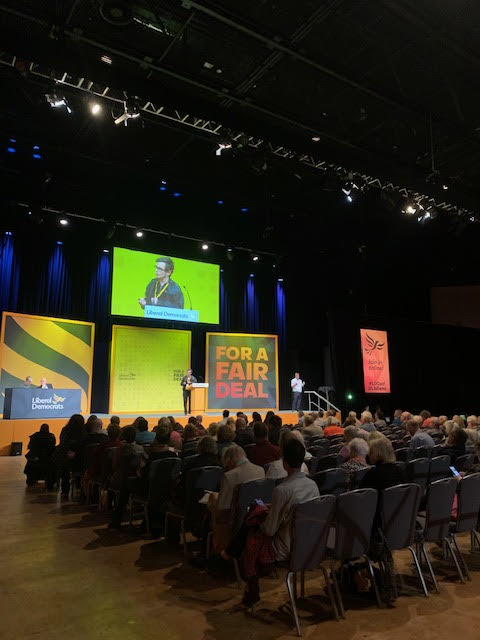
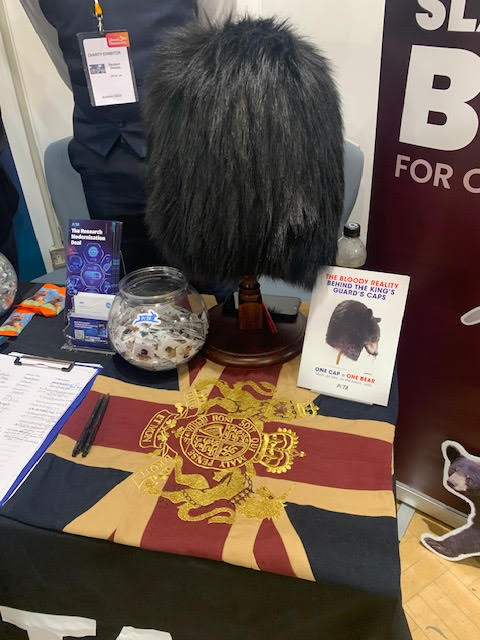
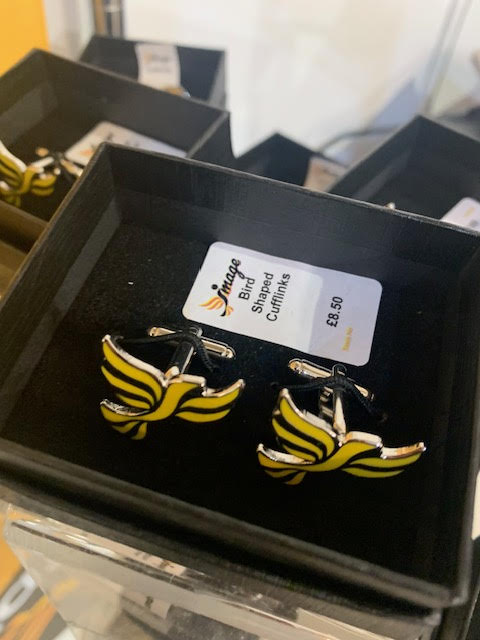
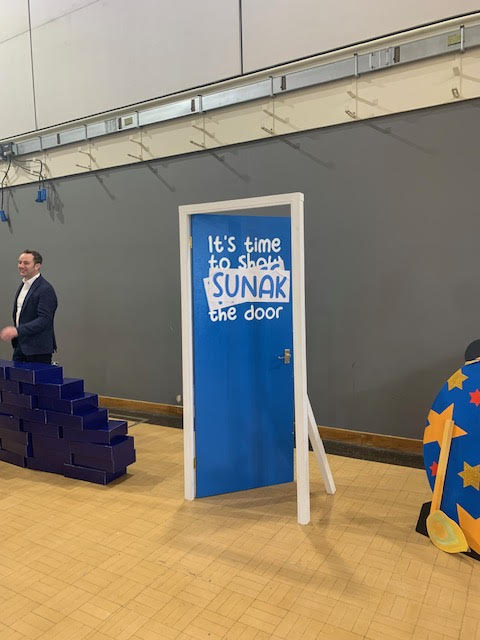
Lib Dem conference 2023: in pictures
Is there any greater anthropological experiment than the Lib Dems’ annual conference? Britain’s third party has not had such a jamboree since 2019 and the delegates are determined to make the most of it. Mr S certainly saw some sights at last night’s disco, where Munira Wilson and Wendy Chamberlain were among the MPs to man the decks.
‘You say Brexit, I say bollocks’ was one of the chants of the night, as young hopefuls mingled with old veterans. Never has the Cha Cha Slide been conducted in quite the same way before, with many of the same party animals looking forward to tomorrow night’s Glee Club. As one attendee put it to Mr S: ‘It’s much like the Truman Show – there are so few characters, you keep bumping into the same faces at these things.’
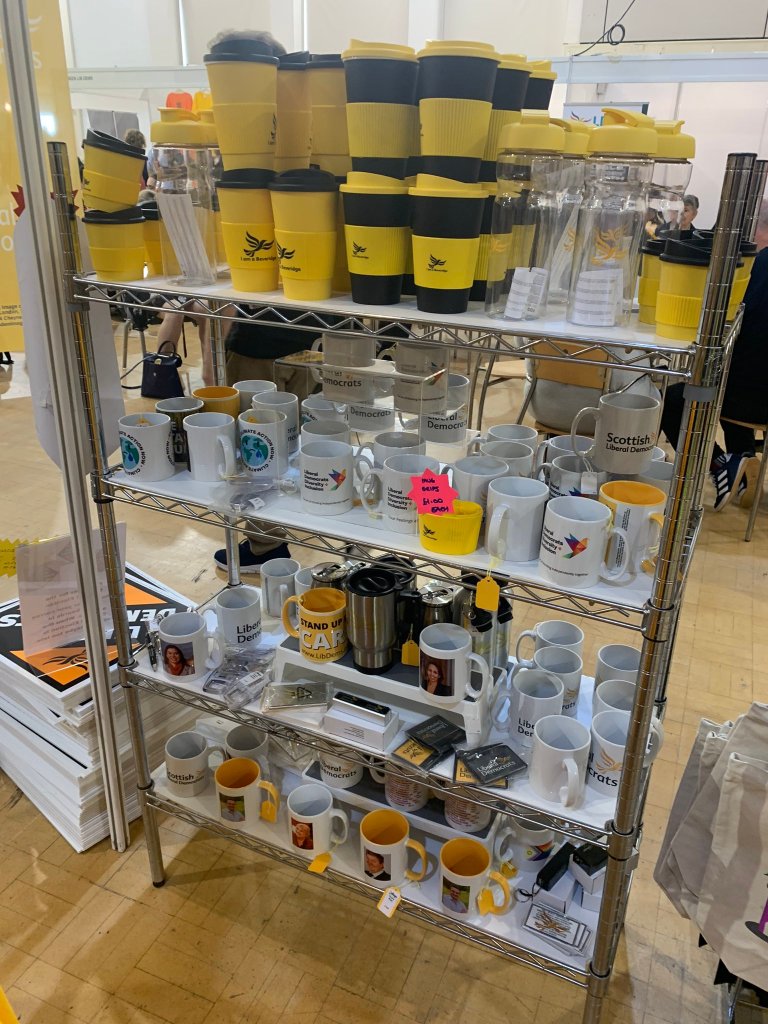
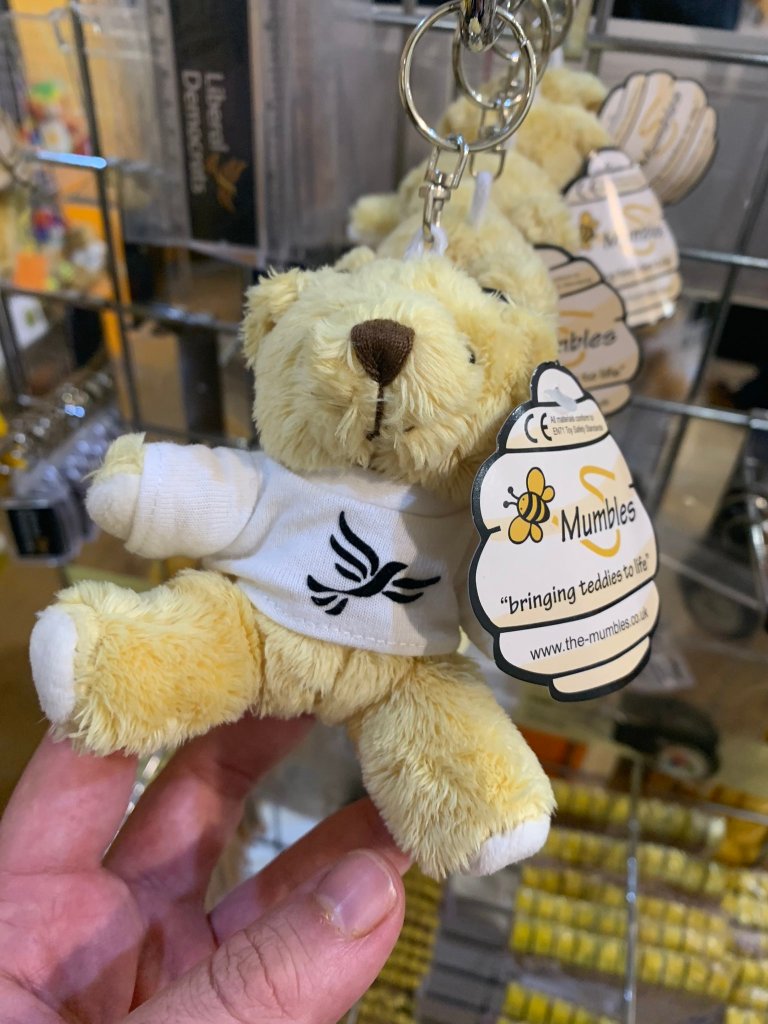
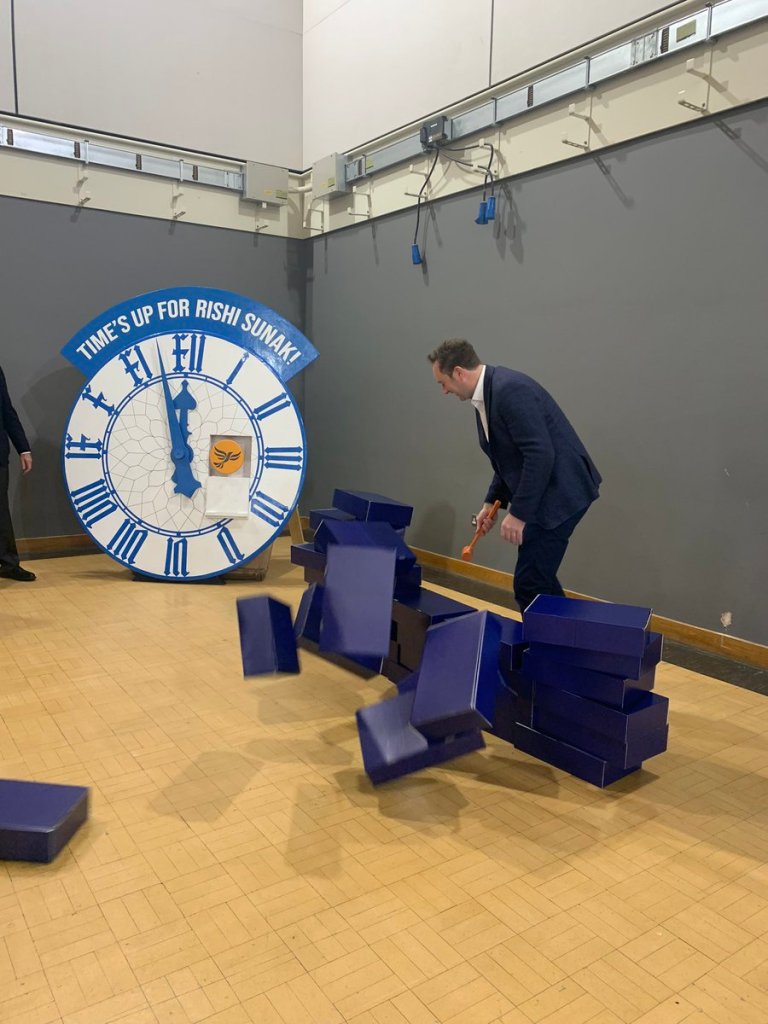
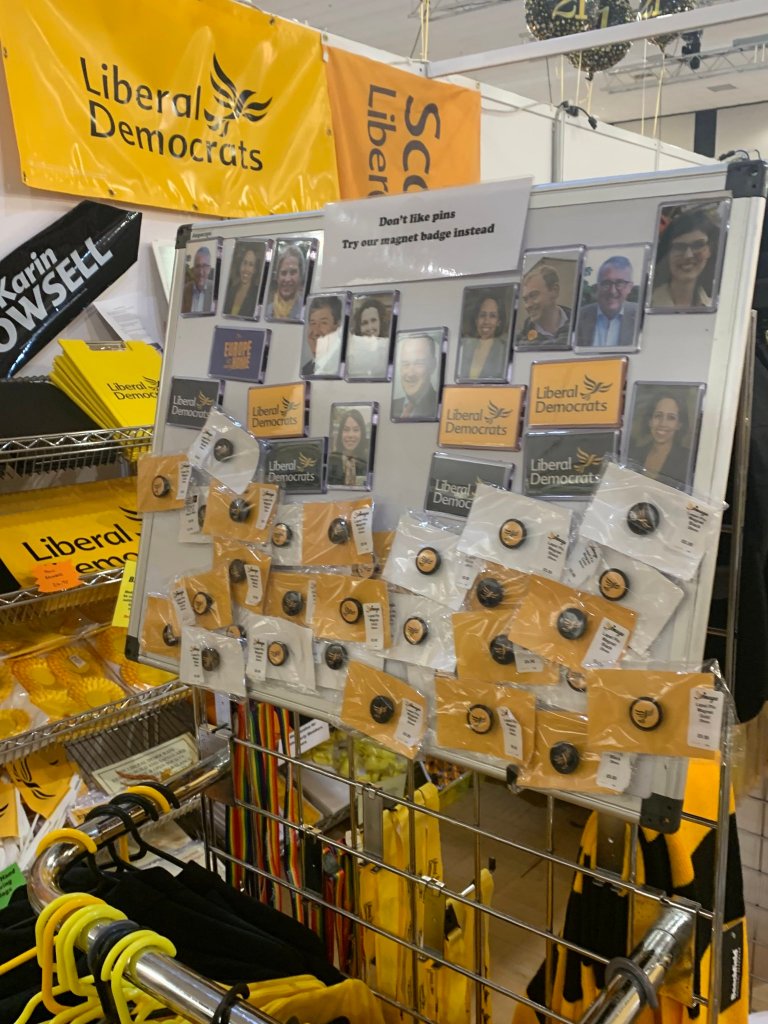
Today the focus has been on deputy leader Daisy Cooper’s address to the party faithful. But away from the main hall, Steerpike has been checking out the fringe events and seeing the merchandise on sale to the hardcore orange activist. Below is a selection of images from an event that is truly Beyond the Fringe...
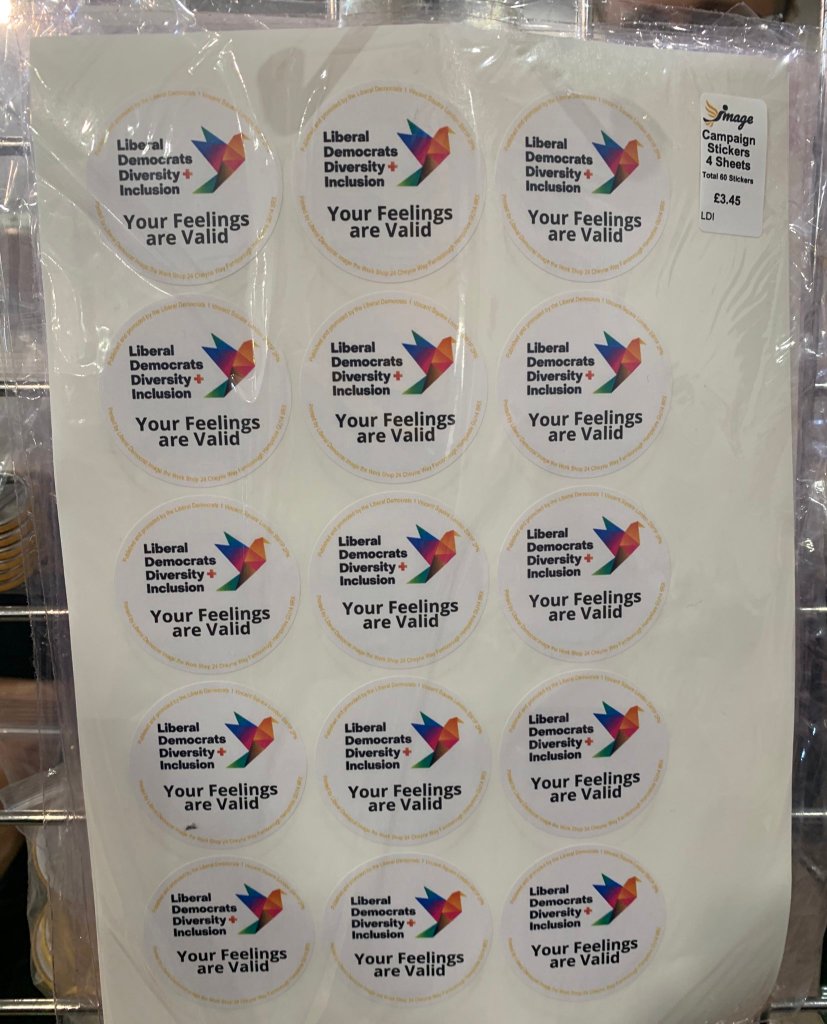
Watch: Ed Davey confronted by word cloud
The Lib Dem conference is well underway and the party has a spring in its step. After four by-election gains in this parliament, there’s much excited talk in the conference bars about the party doubling their MPs next year. So what’s behind the orange surge? Clearly, er, not their less-than-charismatic leader.
Sir Ed Davey was wheeled out on the BBC this morning for his annual hit interview. And Victoria Derbyshire opted to use the occasion to show the Kingston MP just what voters think of him. Davey was confronted by a striking ‘word cloud’ of the words most associated with him. They are, in descending order, ‘Don’t know’, ‘no idea’ and ‘not sure’.
Easy to be popular when no one knows what you stand for…
Canada’s parents are taking to the streets
In the biggest demonstration since the Freedom Convoy, large numbers of Canadian families and supporters took to the streets across the country on 20 September to assert the rights of parents as primary educators and protectors of their children with the slogan, ‘Leave our kids alone!’
The ‘1 Million March 4 Children’ was spearheaded by Muslim Canadians in response to increasingly aggressive policy and curriculum changes in publicly funded schools, pushing radical gender ideology and putting content before children that protesting parents say is indecent or age-inappropriate. Turnout was impressive, with many thousands of participants in over 100 cities and up to 10,000 marchers reported at the largest gathering in Ottawa.
Yes, it was the biggest Canadian demonstration since the freedom truckers – and yet there was barely a ripple in mainstream reporting. Left-wing gatekeepers – the Trudeau government, the unions, and radical progressive activists – declined to engage with the rallies in good faith. (In fairness, it must be hard to keep up an unsullied image as the white knights of democracy if the peasants get to keep rising up against you on live TV.)
The state-subsidised Canadian media, knowing which side its bread is buttered, got to work downplaying the event, focusing on the relatively small counter-protests. These counter protests were partly organised by senior union leadership in Ontario and radical activists, as a secret Zoom meeting leaked ahead of the event showed.
At the meeting, protesting parents were described as right-wing extremists, hate-filled, and racist. (Is it right-wing extremism to want a say in what your child learns in school?) Yet the March’s organisers had been clear that the protest was specifically focused on a single issue, that of parental rights in education, not on other aspects of radical social change, or, on anything remotely connected with race.
Nonetheless, Prime Minister Justin Trudeau felt the need to ‘strongly condemn this hate and its manifestations.’ Why should he mischaracterise the perfectly ordinary issue of parental rights as hateful? Canadian academic Jordan Peterson later rebuked Trudeau directly on Twitter, telling him, ‘Once again, you are on the wrong side of history…’
Along the same lines, the mayor of Ottawa declared that he supported the right to protest, but not the targeting of children ‘for being who they are’ – implying that this was the goal of the March 4 Children. He did not explain why he thinks parents wanting to care for their own offspring is equivalent to ‘targeting’ children.
Jagmeet Singh, leader of the NDP, joined a counter-protest in Ottawa and made cryptic remarks to reporters about ‘a lot of folks that don’t feel safe because of the rise in hate and division that’s targeting vulnerable people.’
As for Pierre Poilievre’s Conservatives, the party originally instructed MPs not to make any public comment about the mass protest, though in an internal memo the party allegedly admitted that protestors had ‘legitimate points’ to make about parental rights. On Thursday afternoon, Poilievre criticised Trudeau for demonising concerned parents and expressed support for parental authority over what is taught to children.
The Conservatives’ original reticence to support the protests is probably because they fear that if they are perceived to be supporting a grassroots protest criticising gender ideology in schools, they will be smeared as extremist, divisive, racist and hateful. But who are they trying to please? The state-subsidised media? That’s a lost cause, particularly after Poilievre’s promise to defund the CBC.
Much more courageous was Premier Blaine Higgs of New Brunswick, who came out to welcome pro-family protestors in front of the provincial legislature. Premier Higgs recently took a great deal of heat from all sides for obliging schools to obtain parental consent to use new names or pronouns for children under 16 – hardly an extreme policy from any perspective. His own – conservative! –party attempted to pressure him out of it, but he stayed firm, expressing his willingness to trigger an election over the motion, and ultimately carried the day.
But traditional families are also good, full stop
The federal Conservatives could learn from Roger Scruton’s commentary on UK conservatives over ten years ago: ‘For the ordinary voter the family is a place in which children are produced, socialised and protected. That is what the party should be saying, but does not say, since it is prepared to sacrifice the loyalty of its core constituents to the demands of a lobby that is unlikely to vote for it.’
There is only one way that progressive activists will endorse the Conservatives, and that’s if they believe Conservatives will serve to further the progressive agenda better than other parties. They’ll be willing to compromise on some issues to get what they want on others – and right now, that’s unfettered access to children’s minds through public education.
Will the 1 Million March 4 Children protestors vote Conservative? Probably, if they have any reason to believe that Conservatives will protect what they cherish most – their children. If not, maybe not.
And aside from pleasing the voters, Conservatives might like to consider another Scrutonism: The traditional family has not just an instrumental value, but an intrinsic value. Sure, traditional families are good for the economy, good for the wellbeing of children, good for the stability of society, good for getting leaders with conservative values into power.
But traditional families are also good, full stop. So is standing up for them – whatever the cost.
Zelensky is in a serious bind
The recent spat between Kyiv and Warsaw over grain – with Ukraine suing Poland at the WTO – has come at bad time. In normal times, a trade dispute (however meaningful for those directly affected) would barely register. At a time of mortal danger, however, rifts between allies are grounds for profound concern.
For Poland’s right-leaning Law and Justice Party (PiS), banning the sale of Ukrainian grain is an electoral matter. With a mid-October parliamentary election it may well lose, the populist PiS wants to appease Poland’s rural constituencies (the party’s base) by being seen to be protecting farmers from a deluge of foreign grain. Responding to Ukrainian criticism in his speech to the United Nations General Assembly, Polish President Andrzej Duda likened Ukraine to a drowning man: he had to be helped but not at the cost of taking the helper down with him.
Poland has stood by Ukraine steadfastly since the Russian invasion, providing weapons and ammunition. It has signaled its continued commitment, but keen observers can certainly sense of whiff of irritation in Warsaw bordering on despondency. We have done so much for these people, and this is how they repay our kindness – by suing us in the WTO? Polish Prime Minister Mateusz Morawiecki has indicated that Warsaw may stop supplying Ukraine with weapons and instead focus on building up its own defence capabilities. As Kyiv faces the prospect of a drawn-out war of attrition, these signals from a key ally are deeply disturbing.
President Volodymyr Zelensky has found himself in a serious bind. On the one hand, Ukraine’s narrative of victimhood has helped him win hearts and minds in the West. Our perception of Ukraine as a victim of unprovoked Russian aggression has helped Zelensky drum up political, economic and, most importantly, military support for his struggling country. The horror of death and destruction, the suffering of the innocent, the plight of refugees have all aroused our moral indignation and left us inclined towards charity. But as is often the case with charity, there is an unspoken assumption that the other side must show gratitude in response. Suing one of your allies in the WTO is not consistent with this image.
On the other hand, Zelensky has tried to sell the West a different narrative. In this competing narrative, Ukraine is not so much a struggling supplicant as a stout saviour – of Europe, of the West, of the entire world – from the Russian evil. Ukraine has been paying with blood for our freedom. It is therefore the West that must be grateful to Ukraine, not the other way around. In this reading, helping Ukraine is not an act of charity but an obligation. The West must not just pay up but do so promptly, and with appropriate humility and gratitude for Ukraine’s bravery and sacrifice.
This narrative helps Zelensky at home. It is better for Ukrainian morale if the country feels it can stand tall and proud than if it is seen as a poor relative, barely scraping by on foreign donations. But there is an inherent danger in standing too tall and too proud. This becomes a source of annoyance for allies who may well be genuinely committed to Ukraine’s cause but resent being lectured by Kyiv.
In the meantime, the Russians will no doubt take note of such quarrelling. Vladimir Putin’s long-term game in Ukraine is to outlast the West. He will take signs of momentary tensions between Ukraine and its western backers as clear-cut evidence that he has been right all along; that the West is wavering, and that it does not have enough resilience and patience to carry on with the fight. Putin will be overjoyed at the sight of disagreements between Brussels (which had lifted the ban on Ukrainian grain) and Warsaw (which blatantly ignored the EU). The longer the war continues, he thinks, the greater the frictions, the more obvious the fatigue.
The challenge for Ukraine and western policymakers is to prove that Putin is mistaken in his calculations. This will require infinite tact, lots of patience, and an understanding that the question is not who owes more to whom, but what we can do together to push back against Russia’s aggression. And that in turn means reducing unnecessary posturing and toning down harmful rhetoric.
President Duda spoke of a drowning man in need of help. A better metaphor for Ukraine and Poland is that they find themselves in the same boat. It is about time they learn how to row in unison.
The Caribbean island that wants to claim a Russian super yacht
Earlier this year I asked Gretta Fenner, head of a Swiss Foundation that investigates oligarchs and financial crime, about confiscating the assets of wealthy sanctioned Russians and using the proceeds to support the Ukrainian military and rebuild the country. I was surprised by her response. ‘Confiscating assets without proof they are the proceeds of crime is akin to expropriation,’ she told me. ‘This is done by dictators not by democracies that adhere to the rule of law and international human rights. Financial support for Ukraine is vital and urgent. But if western governments undermine their own commitment to the rule of law to obtain that money, then they are violating the very principles that Ukraine is fighting to preserve.’
For sanctioned Russians – supporters and enemies of Putin – the threat of their assets being confiscated and sold off without being able to challenge the case in a court is akin to the Stalin show trials of the 1930s. ‘It is theft. Plain and simple’, the international lawyer, Bob Amsterdam, told me.
The first battles over Russian assets being sold off arbitrarily is being played out on the sun-drenched Caribbean Island of Antigua. The asset in question is a 259-foot-long luxury super yacht called Alfa Nero, valued at $120 million.
In March of last year, the Alfa Nero arrived and moored at Falmouth harbour in Antigua. Legally it is owned by Flying Dutchman Overseas Ltd, a BVI company owned by the Tyne Trust whose beneficiary is Yulia Guryeva-Motlokhov, the daughter of the Russian oligarch Andrey Guryev. Guryev is best known for once owning Witanhurst Estate, the second biggest house in London. And he is being sanctioned by the US for being ‘a known close associate of Putin’ and part of a ‘Kremlin-connected elite’ who ‘generate substantial revenue for the Russian regime.’
Five months after Guryev was sanctioned the US Treasury imposed restrictions on the Alfa Nero after classifying it as his ‘blocked property’. This banned the owner from selling or leasing out the vessel. The problem is that Guryev does not own the yacht. He is not a beneficiary of the Tyne Trust. And the US was unable to provide any evidence the Oligarch owned the yacht or even controlled the Trust.
Legally there was no case to seize the yacht. But then the fate of the Alfa Nero took a remarkable twist. On 15 March 2023, the Antiguan Prime Minister suddenly proposed a special amendment to a law which enabled the ‘government to sell by auction a vessel that appears sanctioned or falls under the Proceeds of Crime Act’. The text of the law was written to suit the yacht’s sale. Two days later the bill was passed in a single day with no notice. The opposition was furious and walked out of the parliament in protest.
Within a week the port manager in Antigua announced the Alfa Nero was ‘an abandoned vessel’ and posed ‘an imminent threat to the safety and security of the harbour’. He added that unless an individual came forward to prove he or she was the beneficial owner, then the yacht would be regarded as abandoned, seized by the government, and sold at auction.
The Antiguan government ignored the fact the yacht was not owned by a sanctioned individual and on 11 April 2023, the port manager took possession of the Alfa Nero. The Antiguan flag was raised, and maintenance costs were covered by the government.
Their justification was that the owner had not contacted the authorities. This was not true. On 4 April, Shane Giles, CEO of the company that managed Flying Dutchman Overseas Ltd emailed Darwin Telemaque, the port manager, and explained the owner was seeking a licence from the US Treasury to remove the vessel. He asked for a postponement of the sale. The port manager did not respond directly. Officials and lawyers for the owner contacted the authorities on multiple occasions, according to court documents. They were ignored.
The condition of the yacht was central to the argument for the Antiguan government seizing the yacht. In one interview the port manager said the vessel ‘was in pristine condition’ but four days later stated it was in poor condition, unattended and fees were not paid. In fact, fees were reportedly paid up until December 2022. But reportedly the banks were unwilling to make payments to the crew on a vessel sanctioned by the US for fear of being sanctioned themselves. This was later resolved.
The Antiguan government was keen to sell the yacht as quickly as possible and on 18 May 2023, the US Treasury issued a special licence to authorise the auction. The impatience to receive the cash was revealed by the asking price – a mere $60 million for a vessel worth $120 million. Unsurprisingly, it was snapped up quickly. Eric Schmidt, former CEO of Google, successfully bid $67 million, but then changed his mind and withdrew because of the legal challenges.
Today the yacht remains unsold and its status unresolved. This month, a part of Guryeva-Motlokhov’s claim that the yacht should be returned to ‘the rightful owner’ was heard in the East Caribbean Court of Appeal. The next hearing will be in December.
This unique case raises serious issues about the rule of law. The Ukrainian government is open about confiscation. ‘We’ve been quite intensively confiscating assets belonging to Russian individuals’, said Vlad Vlasiuk, a sanctions advisor to the Ukraine President. For many UK lawyers, the move from freezing Russian assets to seizing them and transferring the proceeds to Ukraine without due process is a step too far.
Ukraine argues the war is a special case. Their very existence is under threat. Horrific war crimes are committed daily. The country is being destroyed. The western rule of law should be set aside. The Ukrainian people desperately need the cash from the sale of Russian Oligarch assets.
But in Antigua this argument for confiscation collapses spectacularly. In fact, the $60 million-plus proceeds from the sale of this super yacht will not be used to help the Ukrainian people or pay for weapons or post war reconstruction. The money will instead be transferred to the bank account of the Antiguan government. Piracy has returned to the Caribbean.