-
AAPL
213.43 (+0.29%)
-
BARC-LN
1205.7 (-1.46%)
-
NKE
94.05 (+0.39%)
-
CVX
152.67 (-1.00%)
-
CRM
230.27 (-2.34%)
-
INTC
30.5 (-0.87%)
-
DIS
100.16 (-0.67%)
-
DOW
55.79 (-0.82%)
Rishi the revolutionary? Come off it
It was preposterous. A prime minister at the head of a party that’s been running the country for 13 years posed as a revolutionary today. Rishi Sunak presented himself to the Tory conference as a dashing anarchist, an upstart rebel, a fearless saviour who wants to wrest power from an authoritarian clique and hand it back to the people.
‘Our mission is to fundamentally change our country’, he cried. Evidently he’d forgotten that the Tories have been in office for the last decade-and-a-bit.
To the surprise of no one, he announced that HS2 will be scrapped. The Birmingham-to-Manchester leg is no more, he declared.
‘The right thing to do when the facts change is to have the courage to change direction.’
He pledged to spend ‘every penny’ of the leftover £36 billion on ‘hundreds and hundreds’ of new transport schemes. Mostly in the North. Roads, trams, by-passes and railways will all be built, he chirruped excitedly. The new golden era of infrastructure will include a link from Manchester to Hull, ‘fully electrified,’ he added, as if this were a recently patented innovation.
Those who mourn the loss of HS2 will be thrilled to learn that the Euston terminus will go ahead as planned. But Rishi has decided to appoint a superefficient new management team to oversee its construction. ‘For the first time in the life-cycle of this project,’ he said, ‘we will have cut costs.’ A bit more forgetfulness there. Did he not spend years as chancellor while the HS2 budget was spiralling out of control?
The chief innovation of his speech was to curtail the freedoms of teenagers. He revived the failed ‘war on drugs’ and widened its scope to include tobacco.
‘I propose that in future, we raise the smoking age by one year, every year.’
The chief innovation of his speech was to curtail the freedoms of teenagers
Rishi seems unaware that prohibition adds lustre to any human activity and makes it more attractive and glamorous. It’s possible that repeat offenders will end up in jail for puffing on a Silk Cut. He might be better advised to back off and let kids make their own mistakes.
He also wants to keep sixth formers in class for longer by forcing them to spend ‘at least 195 hours more with a teacher.’ What exquisitely painful news for school-leavers: more time wasted in school. Reluctant students are disruptive and hard to discipline, of course, and Rishi plans to boost the salaries of their hapless teachers as compensation. He announced tax-free bonuses of ‘£30,000 during the first five years of their careers’. If learning is so beneficial, why are bribes and laws needed to impose it?
And though he praised education as ‘a silver bullet’ he also attacked a significant part of the university system. He promised to scrap ‘rip-off degrees’, which he didn’t define. No degree can be considered a ‘rip-off’ if the customer is correctly informed about its content and the costs involved. The Prime Minister probably meant diplomas that feature very little academic content but such courses attract vast numbers of foreign students who want a qualification from the UK and don’t care what subject is being offered. He failed to explain how ‘a rip-off degree’ could be expressed in law.
There was more forgetfulness when it came to channel crossings.
‘Know this’, he said sternly: ‘I will do whatever is necessary to stop the boats.’
That pledge had a rather elderly ring to it. He went on to boast that the number of crossings has dropped ‘by 20 per cent.’ Fair enough. Then came another bout of amnesia. He said that the business model of the people-smugglers would be smashed ‘once flights start going regularly to Rwanda.’
‘Regularly?’ He sounded as if the removals were already taking place – but not frequently enough.
If his aim was to deliver a speech that will soon be forgotten, this was a triumph.
Rishi Sunak’s exam shake-up doesn’t add up
After 13 years in power, the Conservatives have decided to rebrand themselves as the ‘party of change’. Today, Rishi Sunak announced that the Tories will ban smoking for the next generation, scrap a significant portion of HS2, and abolish A-levels and T-levels in favour of new ‘Advanced British Standards’. Rishi Sunak is no longer ‘Inaction Man’, but ‘Over-reaction Man’
While it is encouraging to see the government finally being proactive rather than reactive on education policy, the government will have to put its money where its mouth is if it wants to prove that this is more than a headline-grabbing pre-election gimmick. A British Baccalaureate is not a new idea; dozens of education committees and thinktanks have recommended a broader post-16 curriculum since David Miliband first co-authored a paper on the subject in 1990. What is new is the current teacher recruitment and retention crisis, which means that the government wants to introduce radical systemic changes when this year it only recruited half the number of needed secondary school teachers.
Perhaps the Tories know they could be walking away from the game soon
There are four key factors supposedly driving this reform. The first is to ensure students study a wider range of subjects. It is true that the narrowness of A-levels make us international outliers: most A-level students currently only study three subjects, whereas across the OECD, students typically study around seven. There is an argument that this early specialisation closes off students’ options, and that the changing world of work – where young people are far more likely to change careers – requires more flexibility and creativity. Yet our university system depends on this in-depth preparation at sixth form: most undergraduate courses in England are three years, whereas bachelor degrees in the US, Canada, Spain and South Korea (where sixth formers take at least five to seven subjects) are all four years long. Universities will also have to adapt their courses if schools prioritise breadth over depth.
The second reason is to increase quality teaching time. Currently, the government funds 16-19 providers for about 640 hours of structured time per year, or 17 hours per week, which is less than Denmark, the Netherlands, Norway, Finland, Sweden, Italy and Canada. In France, students get over 1,700 hours over two years. This is particularly problematic for disadvantaged students, who may have fewer resources for independent study, and so need the structure and stability of more contact time. Yet the only way the government is going to be able to deliver on its promise of an extra 195 hours for students (equivalent to two and a half hours per week) is by recruiting more teachers: something which it has repeatedly failed to do. As Sam Freedman, former senior policy advisor to Michael Gove, wrote: ‘There’s no point designing new qualifications – however good they are – if there’s no one there to teach them, and no resources to teach them with.’
The third reason is to embed a core of essential knowledge, by ensuring all students take some form of Maths and English until they are 18. A noble pursuit in theory, but if we want a more literate and numerate society then we have to ensure that pupils can pass the basics first. Last year 167,000 students failed GCSE Maths and 172,000 failed GCSE English Language: the highest number in a decade. Only around 16 per cent of pupils who resit GCSE Maths and a quarter who resit GCSE English Language will go on to pass. Given that only six in ten pupils will achieve a ‘Good Pass’ (level 5) in English and Maths, surely we should be focusing on plugging the attainment gaps between Key Stages 1-4 first?
Finally, the government says that it wants to deliver genuine parity of esteem between technical and academic routes. More vocational options are too-often looked at as lower-class: anyone who works in a school will tell you that ‘BTEC’ has become slang for ‘inferior’ (I once heard a student say that ‘Kingston Carnival is just a BTEC Notting Hill’, for example). By merging A-levels and T-levels, and therefore removing the artificial divide between academic and technical routes, pupils can take a more creative and dynamic combination of subjects, and hopefully ensure quality: the current system is hopelessly messy, with around 7,000 different qualifications at level 3 or below. This is a welcome change, but a rather frustrating one, given that the government just spent £1 billion on creating and implementing T-levels to replace BTECs, and schools are still getting to grips with what could be a short-term system.
The government has admitted that these changes will take up to a decade to come into effect, and given that we are, at most, a year or so away from an election, then it feels like this could be the right idea at the wrong time. Perhaps the Tories know they could be walking away from the game soon, and so have laid their cards on the table with no intention of actually playing their hand; perhaps therefore the more pertinent question is, what will Labour do with this information? They have generically promised a full ‘review of curriculum and assessment’, but Starmer will have to do more to prove he is ‘Actionable Man’ first.
Is now really the time to scrap A-levels?
The history of education reform is a graveyard of acronyms: TVEIs, GNVQs and so on. There have been many well-meaning initiatives that made sense at the time but struggled to gain acceptance. Rishi Sunak needs to proceed with caution before he launches into yet another reform of school qualifications, especially if it means the end of the only one that has stood the test of time: the A-level.
The Prime Minister’s concern – shared by many educationalists – is that A-levels are too narrow and specialised and lead to too many people entering adult life lacking adequate literacy and numeracy skills. In the Survey of Adult Skills conducted by the OECD, England not only scored poorly in literacy and numeracy; it was also the only country where 16- to 24-year-olds performed less well than 55- to 64-year-olds in both. It is a rather damning indictment of the past 40 years of school exam reforms.
This isn’t really about pupils. It’s about political posturing
In fact, A-levels were introduced in 1951 with the aim of avoiding premature specialisation in the sixth form. Yet Britain is now nearly alone in the developed world in not making literacy and numeracy compulsory subjects up to the end of the school years. There have been various attempts to broaden education, such as the introduction of AS-levels, which it was hoped would lead to more students studying four or five subjects in the lower sixth.
But not only have AS-levels fallen into obscurity; the average number of A–level subjects taken is now decreasing. Seven years ago, 7.6 per cent of A-level pupils studied four subjects. By 2020 that had fallen to 4.4 per cent. Pupils are told by universities they are judged only on the top three.
As a result of the recent grade inflation (whereby A*s and As were given to the top 44 per cent of entries, later lowered to 27 per cent), the system looks a mess. But this is precisely why governments should act with caution when intervening in education. The best-laid plans too often go awry – and when they do, schoolchildren are the victims. Pupils should not be used as lab rats in a political experiment.
Education reform has inflicted huge damage in Scotland, where the SNP imposed the much-mocked ‘curriculum for excellence’. It has become a case study in how a reputation for excellence in schooling, built up over generations, can be quickly destroyed. Keir Starmer is itching to get his hands on the school curriculum with his idea of ‘oracy’. This for him is an election narrative: that the Sunaks of this world are taught how to debate in their fancy schools, while a Labour government would teach this to every child.
Oracy is a pet subject of Tony Blair’s former adviser, the headteacher Peter Hyman. It was deployed in Hyman’s School 21 and the results were less than inspiring. School 21 suffered a double-downgrade in its Ofsted report from ‘outstanding’ in 2014 to ‘requires improvement’ in 2023. If oracy didn’t work in a pilot scheme, why roll it out nationally? But this isn’t really about pupils. It’s about political posturing.
Sunak is quite right to say that English sixth-formers receive too little tuition and that it’s a shame they have to narrow their options at the age of 16 by choosing just three A-levels. But this is something that should be put out to consultation, so that the pros and cons can be carefully considered.
What Sunak seems to be proposing with the ‘advanced British standard’ qualification is another attempt at a British baccalaureate, aping the International Baccalaureate (IB). This consists of a core of compulsory subjects together with a choice of courses from six subject groups as well as an extended essay on a subject of the pupil’s choosing. But if the IB is such a good thing, why not simply allow schools to choose whether they want to offer it? More than a hundred schools already do so, after all. The IB has the advantage of international recognition – an important factor in a world where the workforce is increasingly mobile. It is also based in Switzerland and therefore immune to political interference.
To create an English version of the IB (the existing ‘English baccalaureate’ is a misleading name given to a collection of GCSEs), and to expect all schools to transfer to it in one go, would cause huge practical problems. Given that there is already a shortage of maths teachers, how would schools find the extra staff? The Tomlinson report, commissioned by the Blair government to look into exam reform, proposed replacing A-levels, GCSEs and vocational qualifications with a single diploma. The reforms were to be phased in over a decade, but in the end the whole idea was dropped.
How to deal with vocational education is especially difficult when you consider how many attempts to rationalise the system have come and gone. The government’s latest idea – T-levels – have not really bedded in yet. The encouragement of apprenticeships has stalled, too, with few small firms able to offer the kind of placements that would meet the requirements.
All told, this is an unusual mission to choose in a pre-election year: it is the kind of long-term project that might be undertaken by a new prime minister soon after a landslide majority. Sunak is, to state it mildly, not in that position. So his A-level reform should be seen as the beginning of a conversation. For the sake of pupils who have suffered too much disruption in recent years, exam reform should be conducted with the greatest care.
The many flaws in Sunak’s smoking wheeze
In the run-up to the Conservative party conference, Rishi Sunak was promoting himself as a serious politician who wanted workable policies that respect consumer choice. No more war on motorists! No more pie-in-the-sky net zero promises! Here was a practical man in tune with the concerns of ordinary people.
Having teed himself up as a pragmatic, back-to-basics Conservative, it was all the more puzzling when, in his keynote speech, he announced a preposterous anti-smoking gimmick borrowed from Jacinda Ardern that no one was asking for. New Zealand is the only country to have taken seriously the idea of increasing the age at which people can buy cigarettes by one year every year. Last December, the Kiwis banned anyone born after 2010 from ever buying a pack of fags. It will be five years before this starts to bite, although it may be academic by then because the government is also removing nearly all the nicotine from cigarettes, so it is doubtful whether many smokers will be buying tobacco legally anyway.
Sunak announced a preposterous anti-smoking gimmick borrowed from Jacinda Ardern that no one was asking for
One way or the other, New Zealand is opening up a new front in the war on drugs. Given the dismal record of prohibition, the best approach for British politicians would be to watch from afar and see how it goes. Instead, under no pressure whatsoever, Sunak suddenly decided to wade in with the same policy. In his conference speech, he claimed that the policy was necessary because smokers put an excessive burden on the public purse, but he has spent enough time at the Treasury to know that this is nonsense.
There is no point outlining the libertarian case against prohibition. Either you think adults should have the right to smoke tobacco or you do not. Personally, I think they should, but you have to give the devil his due. The incremental approach outlined today is politically clever because few people are prepared to defend the rights of adults who smoke as it is, let alone people who might want to smoke in the future. Eventually, in about 100 years’ time, no one will be able to smoke at all. When Sunak said that this year’s conference was going to be about ‘long-term decisions’, he wasn’t kidding.
Rather than focus on the rights of the unborn smoker, let us focus on the practical reasons why this is an absurd policy. At some point in the future, a 33-year-old will be able to buy cigarettes while a 32-year-old will not. Unless my finger is even further from the pulse of public opinion than I thought, this must strike most people as absurd, and it will be scarcely less ridiculous in a few short years when some first year university students will be able to buy cigarettes while others cannot.
It takes little imagination to see that there is going to be a large informal market of cigarette sales between adults of very similar ages. Most people would agree that it is unethical to buy cigarettes for a 12-year-old, but it is hard to imagine a 26-year-old feeling guilty about buying cigarettes for a 25-year-old. The law will be seen as an ass, and rightly so. And if you can’t find a friend to buy you cigarettes on the grey market, there is already a multi-billion pound black market to serve your needs.
Now consider the retailers. They are already expected to challenge anyone seeking to buy tobacco if they look under the age of 25. In ten years’ time, they will have to challenge anyone who looks under 35. In twenty years’ time, it will be anyone who looks under 45. This is not only silly, it is also time-consuming and inconvenient. Customers will be infuriated. Tourists will be baffled. A few will become aggressive. It may ultimately require a system of national ID cards for the system to work properly.
There is a distinct possibility that Sunak’s prohibitionist wheeze will breach equalities legislation. It is essentially ageism. It is certainly discriminatory. The government cannot redefine what an adult is with an amendment tacked onto to an existing piece of legislation. Legally, this is a big deal. There will have to be consultations and a free vote. It is almost certain to be challenged in the courts.
Assuming the Conservatives lose the next election, Sunak will simply not have time to introduce this policy. He is doing exactly what he has implicitly criticised Boris Johnson and Theresa May for. He has come up with an eye-catching but fundamentally unworkable policy and is going to leave it to his successors to sort out the mess.
GB News sack Laurence Fox and Calvin Robinson
It’s been a mixed fortnight of fortunes for GB News. Their party at Tory conference attracted a galaxy of right-wing stars, with Liz Truss and Priti Patel among those toasting the self-proclaimed ‘People’s Channel.’ But as the Manchester meet-up draws to a close, the thorny question of the Ava Evans scandal has reared its head once again.
Two of the three not-so-wise men at the heart of it have today been sacked: presenters Laurence Fox and Calvin Robinson were unceremoniously axed, while Dan Wootton remains suspended. In a statement the upstart channel said blandly that:
Laurence Fox and Calvin Robinson were both suspended last week pending internal investigations that have now concluded. As of today, GB News has ended its employment relationship with Laurence Fox and Calvin Robinson. The internal investigation into Dan Wootton continues.
In the battle between the station’s mavericks and the moderates, it looks like there’s only going to be one winner. Fox’s sacking comes on the same day he was arrested by the Metropolitan Police on suspicion of conspiring to commit criminal damage. Not really his year is it?
Is Mitt Romney behind Akshata Murthy’s appearance?
Is Akshata Murthy using the Ann Romney playbook? Rishi Sunak’s wife made an unexpected appearance on the main stage at Conservative party conference, delivering a speech that she insisted was even a surprise for the Prime Minister. This wasn’t just an introduction to her husband’s speech. It was ten minutes of glowing remarks about Sunak, dating back to when they met as students in California, noting the ‘aspiration’ he had ‘to build for a better country’ at the age of 24.
Murthy’s remarks were the kind that are usually given by a presidential candidate’s partner at the Republican or Democratic Convention, where it is the job of the spouse to highlight the personal, more relatable side of the candidate. It’s a staple in US politics, but almost non-existent in the UK. Murthy’s comments this morning – about her husband’s love of rom coms (‘the cheesier the better’) and about ‘his strength of character, his honesty, his integrity with a firm understanding of right from wrong’ – are nothing short of an American import.
So who might have influenced this speech? Perhaps a politician who Sunak wanted to bring to Manchester.
As my colleague Katy Balls revealed last month, Republican senator and former presidential candidate Mitt Romney was ‘top of No. 10’s wish list for speakers’ at party conference. When Sunak travelled to Washington D.C. over the summer, the two politicians met and became fast friends. Romney didn’t make an appearance this week, but Murthy’s speech reflected the kinds of speeches his wife Ann used to make, especially in the run-up to the 2012 election.
Back then, Romney was facing the same kinds of accusations that Sunak is facing now: that he is too rich and out of touch with the public to be able to understand their concerns. Working at the bottom of the rung in the scheduling team at Romney’s campaign headquarters in late summer 2012, I felt there was deep frustration that the man we were campaigning for was being painted in such an ugly, and inaccurate, light. It was decided by the senior advisors that more needed to be done to combat those accusations.
Romney struggled to sing his own praises, especially around charity work, which he didn’t want to use for political gain. But Ann didn’t. She proved to be her husband’s best advocate. The stump speeches Ann was doing on the campaign trail were ramped up to bigger, national appearances. The strategy was thought to be working – but implemented too late.
It’s not hard to imagine Sunak and Murthy might be learning lessons from their new friends across the pond
It’s interesting then, somewhere between six months and a year to the next UK election, that Murthy is inserting herself into the political arena, specifically to emphasise the character of her husband. Her choice of language reflects those similar challenges, trying to correct the record about what is true and ‘not so true’ about her husband.
It does not seem coincidental that Murthy’s speech was added to the conference agenda just days after Sunak’s Sunday interview with Laura Kuenssberg, where he was asked to respond to the ‘word cloud’ of people’s perceptions of him, including the words ‘himself’, ‘money’ and ‘greed.’ The lesson from Romney’s campaign was that such perceptions need to be tackled well before the last leg of the race. It’s not hard to imagine Sunak and Murthy might be learning lessons from their new friends across the pond.
Battle begins: inside Rishi Sunak’s plan to take on Labour
When David Laws moved in as chief secretary to the Treasury in 2010, he found a note from his predecessor Liam Byrne saying: ‘I’m afraid there is no money.’ It was the most famous parting gift in British political history. What was meant as a joke (Byrne had thought his friend Philip Hammond would get the job) quickly became the coalition government’s most effective weapon against the opposition: proof that Labour could not be trusted with the public finances. Today, Labour wants to level the same accusation against the Conservatives.
‘On the first day [in power], we need to land the message very quickly that the finances are in a very bad state and it is all because of the Tories,’ says one Keir Starmer aide. ‘We would need to make them wear it. Then show it’s even worse than they let on.’ That should not be hard to do. Welfare costs are surging, with 5,000 new sickness benefit claims a day, the NHS is in a state of near-collapse and the tax burden has already been pushed to a post-war high.
Team Sunak want to try to pitch him as the change candidate – ‘the only way we will win’, says a strategist
As a result, Starmer plans to lower expectations and establish from day one who is to blame for the lack of room for manoeuvre when it comes to public spending. Yet the fact that Labour’s strategists are worrying about the public’s expectations for a Starmer government is proof in itself of how much their confidence has grown in the past year. Rishi Sunak’s failure to significantly move the polls means that Labour aides now often talk about ‘when’ they are in government rather than ‘if’. In the world of commerce, a Labour victory is viewed as inevitable. Labour’s business forum at the party conference in Liverpool at the weekend will have more exhibitors than the Tories had in Manchester this week. The event will be closer to Davos than to a socialist rally.
Sunak has concluded that, with the Tories behind in the polls and so little time left until the next election, he may as well take some chances. ‘He’s just decided – fuck it,’ says a senior aide. His party conference strategy was to do the things he had always wanted to do and announce them all at once to make a big bang. ‘He’s contrasting his action against Starmer’s inaction,’ says one senior minister. ‘Starmer says we’ll get the same: more spending, more tax. He’s the one offering more of the same, Rishi is offering change. This is the paradox. Voters do want change, and the Tories will more plausibly offer it.’
This rather optimistic Tory strategy is based on a belief that if Starmer is wedded to a caution-first strategy, Sunak can spring to life as an energetic reformer, causing a stir, and choosing subjects that will be big talking points. He spent the first year of his premiership promoting his ‘five pledges’, which were devised with heavy influence from focus groups. His new priorities are more personal. ‘What they have in common is they are all things he fundamentally believes in,’ says a senior government figure. They are intended to go back to his main point: that politicians in the past have shied away from making tricky decisions and talking about trade-offs.
The Prime Minister has succeeded in grabbing attention with his first two policy changes. He has taken a carving knife to two Tory sacred cows: HS2 and the net zero agenda. He has always resented both projects as being hugely expensive and lacking an honest analysis of the trade-offs. In his conference speech, he made two more big announcements: the abolition of A-levels, and a New Zealand-style lifetime smoking ban for those born after a certain year (in this case, 2009).
Sunak is teetotal and doesn’t smoke. He believes cigarettes inflict a massive cost on human life, as well as the NHS. So Britain will copy Jacinda Ardern’s radical policy of a ban that would, in time, see shopkeepers legally selling cigarettes to 26-year-olds but not 25-year-olds. Someone buying cigarettes 50 years from now would need to prove they were at least 64. Britain would become one of the three most anti-smoking countries in the world – the most hardline being the Himalayan kingdom of Bhutan, which banned cigarette sales outright in 2010.
It’s a talking point, certainly, but the announcement doesn’t exactly scream faith in people’s personal autonomy. Wes Streeting, Labour’s shadow health secretary, was already saying he was considering a smoking ban. Like financing childcare for the under-fives, Sunak is implementing an idea that Labour was considering in the hope that doing so will deny Starmer the chance to set an agenda. The arguments against a ban – that corner shops may close, that gang members may have a new product to sell – will probably be made by Tories in what is expected to be a free vote, on the grounds that it is a conscience issue.
Sunak’s second new policy announcement is bigger still. Scrapping A-levels in favour of a UK version of an international baccalaureate – titled the ‘advanced British standard’ – would upend 70 years of English education on the premise that choosing three subjects forces children to specialise too early. England will become more like Scotland, where students typically choose five Highers. Crucially, teaching time would be increased and there would need to be fewer free periods. Since exam boards and universities would have to fine-tune an entirely new system, the change would take years to implement.
Given that Sunak is not, to put it politely, the odds-on favourite to win, what’s the point of all this? Why is he making long-term plans when he has most probably just months left in office? The reason is Team Sunak want to try to pitch him as the change candidate – ‘the only way we will win,’ according to a strategist. The message they hope to push is that Starmer is prone to change his stance on issues and appears opportunistic.
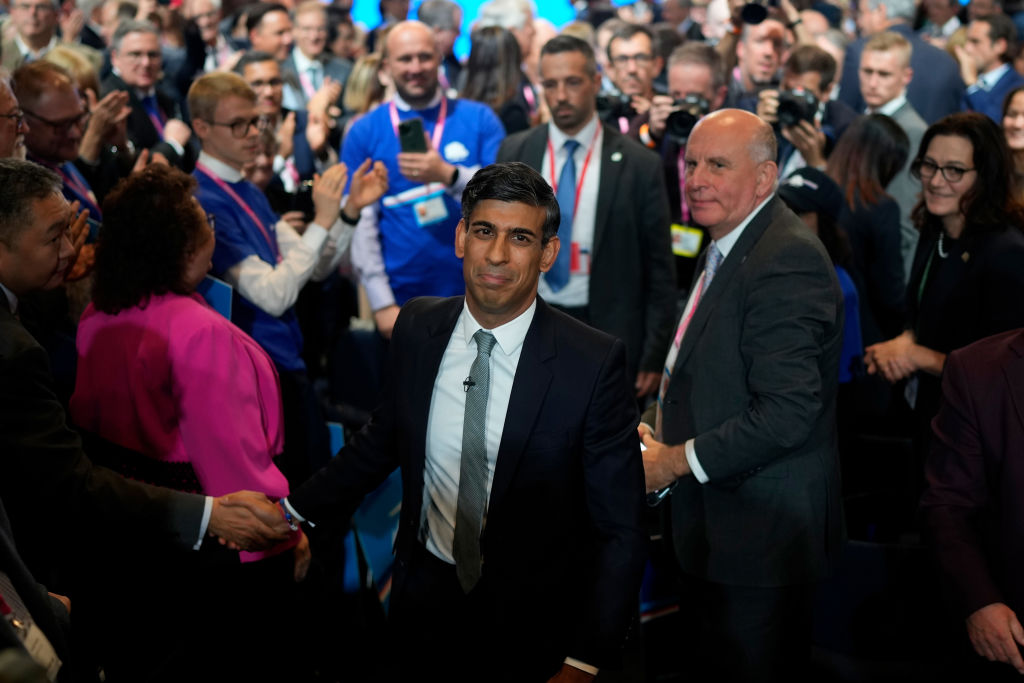
Starmer’s first test will be how much of Sunak’s agenda he rejects. Would he really bring back a 2030 ban on petrol-car sales, given that the necessary infrastructure and charging apparatus shows no sign of being built? Would he deny that A-levels need reform? (Tony Blair considered an overhaul, only to get cold feet.) Would he risk being seen as pro-tobacco? Or claim that the original HS2 plan really is better than the infrastructure upgrades promised by Sunak?
There are still members of the shadow cabinet who worry about the polls and just how reliable Labour’s 20-point lead is. ‘It’s not real,’ says one put-out Labour MP. ‘It doesn’t feel like a 20-point lead when you knock on doors. I’m betting on a small majority or a hung parliament with the Liberal Democrats.’
To avoid such a fate, the question Starmer needs to answer in Liverpool is: ‘If not them, why us?’ So far, he has had little luck doing so. Earlier this year he laid out five ‘national missions’, but they have had little public cut through and are disliked by many aides and shadow ministers. ‘They are a load of gibberish,’ says one Labour aide. ‘No one is sure what they mean, including the politicians who are meant to action them.’ Others in the shadow cabinet complain that there are too many policy advisers and no clear overall strategy.
Like Sunak, Starmer wants to show that he represents change. After 13 years of Tory government, his argument is easier to make. Labour left-wingers, already upset at the party’s move to the right, could be disappointed further. Starmer’s goal at party conference is to reach out to voters who have not previously voted Labour. ‘One of the things we need to do is speak to Spectator readers and those in the centre-right who have voted Tory for a long time,’ says a figure close to Starmer. ‘If you are for sound money, patriotism, an improved country and politics out of your life, we are here.’
Starmer worries that voters still see his party as anti-aspiration, which is why he’s scrapping plans to end the charitable status of private schools while still charging VAT. Some 17 per cent of English sixth-formers are educated privately, which means there would be quite a lot of parents bracing for 20 per cent VAT on school fees. The day after Labour’s defeat in the Uxbridge by-election, he told his party that they are doing something wrong if their policies ‘end up on each and every Tory leaflet’. There are those in the shadow cabinet, however, who complain that he lacks boldness. ‘What are we if the Tories agree with all our policies?’ asks one shadow cabinet member.
Starmer’s aides want to compete on personality more than policy. Liz Truss’s appearance at Tory party conference dismayed 10 Downing Street but delighted Starmer. ‘There were more people queuing to see Liz Truss than in the hall to see Jeremy Hunt,’ says a Labour figure. Truss has a book due out in April and her prominence is useful to Labour, who are stoking fears of a Truss revival.
In past elections, the Tories have talked up the threat of a hung parliament and a Labour-run ‘coalition of chaos’. In next year’s election, Labour will argue that a slender majority for Sunak, which is perhaps the best result he can hope for, would mean hellraising MPs on the Tory right would hold the balance of power. Rachel Reeves, the shadow chancellor, will use her speech in Liverpool to argue that the electorate’s choice is between stability with a changed Labour party or five more years of Tory chaos.
The next election will be fought like a presidential campaign, each party targeting the other’s leader. Labour believes Sunak is a too-slick-by-half banker unable to win enough votes in his own party, let alone the country, and liable to become tetchy under pressure. The Tories see Starmer as a slow-moving legal bureaucrat, laughably miscast as party leader: a moaner, not a reformer.
Of the two, opinion polls seem to back Starmer as the reassuringly dull face of change, while Sunak has just a few months for his gamble to pay off. Both sides know that the party conferences were their last chance for a makeover. As they go into an election year, the battle lines have now been drawn.
The National Theatre underestimates its patrons
It was a story that Rishi Sunak was not saying what he would decide about the future of HS2. But was it the story? The BBC thought so. On Tuesday, Today’s reporting of the Conservative party conference consisted chiefly of Nick Robinson and Chris Mason gleefully commenting on how the Prime Minister was avoiding their HS2 questions. The explanation, which they chose not to recognise, was that he would have been idiotic to pre-empt his own conference speech on Wednesday. There he did announce his big HS2 change. The only other thing that interested Today, especially Robinson, who specialises in this theme, was that ‘the Tory right’ were being supported at the conference by GB News, partly in the form of its presenter Nigel Farage. Both these points are matters of legitimate interest, but where they sit in the BBC’s public service remit of neutrally conveying what was said at the conference is less clear. In the case of the GB News angle, the BBC ought to declare its own potential interest here, which is to destroy a rival. If GB News is what Robinson calls ‘a Tory-backing news outlet’, then it would be equally fair to call the BBC an ‘anti-Tory news outlet’. As so often, the BBC was asserting its media dominance more than reporting news.
Sitting in the National Theatre foyer this week, I studied an enormous notice staring at me, entitled ‘Everyone is welcome’. I reproduce it in full, because its length (more than half that of the Ten Commandments) is part of its oddity:
We are all part of making the National Theatre a welcome, inspiring place where everyone can feel they belong, whatever the purpose of their visit. Discriminatory and intimidating behaviours have no place here. If you experience any, we’ll take action. Speak to any member of staff who can refer you to a manager. We’re here to be proactive and to help. We take pride in acting with care and compassion, and everyone who visits and works here is entitled to be treated with dignity and respect. This place exists to spark creativity, conversation and thought, although please don’t assume that other visitors and staff will necessarily agree with your point of view.
Finally, in red letters, ‘Please be open, patient and kind.’
What is the purpose of this notice? If it wishes simply to say that everyone is welcome and should behave politely, a subeditor’s traditional blue pencil could cut the verbiage by 95 per cent. Other factors must be at work. What are they? One, I guess, is pressure – perhaps from unions and other workplace groups – to tell visitors to be nice to staff, particularly ethnic minority or LGBT staff; hence the warning against ‘discriminatory and intimidating behaviours’. Possibly management is worried that if it did not display concern by erecting such notices, disgruntled staff might sue it.
But there lurks a weird tension here. The National Theatre wants to say it loves everyone, while at the same time seeming to believe significant numbers of its visitors to be unpleasant. It might, while ‘acting with care and compassion’, have to frogmarch such ‘discriminatory and intimidating’ persons off the premises. Staff will be ‘proactive’ about this. They won’t necessarily wait for a complaint but might just go in hard. As it proceeds, the notice gets in a terrible tangle. The National Theatre ‘exists to spark creativity, conversation and thought’, it says, but then comes the anxious ‘although’: when we visitors have our sparky conversations, we must not ‘assume that other visitors and staff will necessarily agree with your point of view’. Speak your mind, but watch your lip. This is strange. Why would any visitor to the theatre assume that other visitors or staff would necessarily agree with him/her? Why would it matter if they didn’t? By telling us that we need to be ‘open, patient and kind’, the National Theatre is suggesting that we aren’t. So this notice about welcome and respect is actually rather rude to theatre-goers.
Of course, it could be that theatre behaviour is deteriorating. There are growing reports of unruly audiences, especially in musicals. Such a trend is likely if, as now happens, you can turn up wearing anything you like and bring food and drink into the auditorium. This invitation to put your own convenience first provokes discourtesy to others. I have just read Lance Morrow’s eloquent account, in the New York City Journal, of his time as a teenage pageboy in the US Senate in the early 1950s: ‘Massachusetts’s Leverett Saltonstall, of Mayflower stock, stood ramrod straight, with neat, steel-gray hair and a pronounced Plantagenet jaw: he looked like an aristocratic lobsterman. Not far away sat Clyde Roark Hoey (pronounced HOO-ee) of North Carolina, an upcountry Confederate antique who wore a wing collar and a black string tie.’ Then there was LBJ: ‘The Senate minority leader, Lyndon Johnson, was radiant with the vulgar opulence of Texas – expensively tailored in dark silk suits and wine-colored Countess Mara ties and shined cowboy boots. His shirts were monogrammed with his initials on each French cuff.’ And today? The current majority leader, Chuck Schumer, has ruled that senators may now wear pretty much anything in the chamber. This gesture, says Morrow, is ‘intended to appease one highly peculiar man: John Fetterman, the 6ft 8in freshman senator from Pennsylvania, who goes about his daily business wearing gym shorts and a hoodie. Pennsylvania’s electoral votes may be crucial in 2024. I know how Lyndon Johnson would have responded to the sight of 54-year-old John Fetterman skulking into the chamber dressed like a disturbed adolescent.’ Morrow records: ‘The Senate of those days had its flawed characters but despite all, a formality – an archaic dignity. Senators Schumer and Fetterman have invited their colleagues to turn the place into a smelly gym or a psychiatrist’s waiting room.’ Such trends, thespian or political, inevitably reduce the dignity and respect which the National Theatre says it wishes to defend.
Full text: Rishi Sunak’s Tory conference speech
Thank you, Akshata, for that introduction, and thank you for always being there for me. My wife: truly the best long-term decision for a brighter future, I ever made. I have been blessed in my life. I have a wonderful wife and two daughters who make me proud every single day. And I was also lucky enough to grow up in the most loving of homes.
My Dad was a GP and my Mum a pharmacist… you did need a smaller mention than last summer I know. In so many ways, I wouldn’t be standing here before you today without them. They were – and are – my inspiration. Thank you, Mum, thank you Dad.
Like so many of us in this hall, they understood the importance of community… and made sure that I did too. They didn’t believe community was some extension of government. Rather, they understood community is sustained by individuals… by those who look out for their neighbour, treat others as they would like to be treated. They understood the fundamental importance of service.
It was seeing the difference they made to people’s lives that made me want to go into politics. My mother set up her own pharmacy. It was a proper family business. We all chipped in; as a teenager, I helped deliver prescriptions and do the books. I learned there the importance of being able to meet your commitments and make good on your promises.
My parents are long retired now. But the Sunak pharmacy left me with a lasting respect for every small, family business. This Conservative party, the party of the grocer’s daughter and the pharmacist’s son, will always be the party of enterprise, the party of small business.
I have been Prime Minister for almost a year now. We have done good things in that time. We have made progress on our five priorities… to halve inflation, grow the economy, reduce debt, cut waiting lists, and stop the boats. But today I want to share with you my reflections on what I have seen and what I have learnt doing this job.
I have seen up close the quality of our armed forces and intelligence services. Truly, the finest in the world. The debt of gratitude we owe them is why we are making this the best place to be a veteran. I know we will deliver because we have a Minister for Veterans Affairs sitting in Cabinet. Johnny served in Afghanistan; this is personal for him. He stood with his fellow soldiers in battle, and now he is ensuring that it is this Conservative government making our country fit for our heroes.
If we give President Zelensky the tools, the Ukrainians will finish the job. Slava Ukraini
We have backed our military with record investment. Working with Ben – a great defence secretary – we put the defence budget on a sustainable footing. Now, Grant will ensure that our advanced Aukus submarine alliance, with Australia and the United States, keeps the world safe for decades to come and create jobs here at home. And, through our leading role in Nato, we remain the bulwark of European security. All testament to this country’s global reach and influence, and our determination to take long-term decisions in the national interest.
By contrast, just remember that not once, but twice, Labour tried to make a man Prime Minister who didn’t believe in Nato, who would have surrendered our nuclear deterrent and who blames Britain for every problem. Sir Keir Starmer might want us to forget about his repeated support for Jeremy Corbyn, but we never will. You can never trust Labour with our country’s security.
I am proud to say we have led the world in providing support to Ukraine. We were the first country to send western battle tanks to Kyiv, now more than ten others have followed. We were the first country to send long-range weapons to Kyiv, now France and the United States have followed. We were the first country to agree to train Ukrainian pilots, now more than a dozen others have followed. I say this to our allies, if we give President Zelensky the tools, the Ukrainians will finish the job. Slava Ukraini.
Doing this job, I meet and talk to inspirational men and women across our country. You see that our most potent strength, our most powerful resource, our greatest hope is our people. But what I have learned is that there is an undeniable sense that politics just doesn’t work the way it should.
The feeling that Westminster is a broken system – and the same goes for Holyrood, Cardiff Bay, and Stormont. It isn’t anger, it is an exhaustion with politics. In particular, politicians saying things, and then nothing ever changing.
And you know what: people are right. Politics doesn’t work the way it should. We’ve had thirty years of a political system that incentivises the easy decision, not the right one. Thirty years of vested interests standing in the way of change. Thirty years of rhetorical ambition which achieves little more than a short-term headline. And why? Because our political system is too focused on short-term advantage, not long-term success. Politicians spent more time campaigning for change than actually delivering it. It doesn’t have to be this way. I won’t be this way.
Conference, our mission is to fundamentally change our country. The Labour party has set out their stall: to do and say as little as possible and hope no one notices. They want to take people’s votes for granted and keep doing politics the same old way. It is a bet on people’s apathy. It does not speak to any higher purpose or brighter future. It is about power for the sake of power. It is, in short, everything that is wrong with our politics.
So, if this country is to change, then it can only be us who will deliver it. Because if we do not, our growth will be stunted. More places will be left behind. And ever more of our time will be spent debating the side issues and symptoms… rather than the deeper, more structural challenges we face. We won’t allow this to happen.
So, where a consensus is false, we will challenge it. Where a vested interest is placing itself above the needs of the people, we will stop it. And where common sense is under attack from an organized assault, we will defend it. Today, I will set out how we will achieve this. Beginning with a set of long-term decisions, to build a brighter future for our children, and fundamentally change our country.
If this country is to change, then it can only be us who will deliver it.
And conference, you can already see my approach in the course I charted on net zero. We Conservatives love our natural world. We are determined to be good stewards of it. In my own constituency, it is the beauty of the North York Moors… and Swaledale and Wensleydale that makes the place home. We Conservatives also value frankness and consent. We believe that politicians have a duty to treat household budgets with respect… and that change only endures if we bring people with us.
As you could tell by the reaction to my decision to chart a new course to net zero… it was not the easiest argument to have. But when I looked at the reality of what people were being asked to do, the thousands of pounds people would need to pay, all of that disproportionately falling on the poorest in society, by the way, and all of it not actually necessary in those time frames to meet our net zero targets, and in spite of us doing more than any other country – I concluded it simply was not right.
So, I decided to take a pragmatic, proportionate, and realistic approach to reaching net zero. And I won’t take any lectures from other countries that have done far less than us… or from those for whom spending thousands of pounds means nothing. Change is difficult, particularly for those who disagree. But remember this: we will still meet our international obligations… we will still meet our domestic targets, and we will still get to net zero by 2050. We have solved a problem and offered an unapologetic defense of good Conservative common sense.
So, as much to the country, I make this promise to all of you in this hall. As I did last summer: I will tell it as it is. I will lead in a different way. Because that is the only way to create the sort of change in our politics and in our country that we all desperately want to see.
Now I came into office in difficult circumstances… and I don’t want to waste time debating the past because what matters is the future. The facts are the facts. You can’t borrow your way out of inflation. And if we want fundamental change in our country, we need a strong economy as a foundation. That is why halving inflation was the first and most important of the five priorities I set out at the start of the year.
Everything that we want to achieve requires getting inflation under control. ‘Inflation is the biggest destroyer of all – of industry, of jobs, of savings, and of society.’ ‘No policy which puts at risk the defeat of inflation – no matter its short-term attraction – can be right.’ Not my words, but those of Margaret Thatcher: as true now as they were then.
I know you want tax cuts, I want them too, and we will deliver them. But the best tax cut we can give people right now is to halve inflation and ease the cost of living. And with inflation under control, our debt reduction will become easier, and as debt falls, confidence grows, and as confidence grows, so too will our economy.
We need our economy to grow faster, and for people across the country to feel the benefits of that. Like other western economies, we haven’t grown quickly enough in recent years. But don’t let Labour and the others talk down our country. We now know that we have had one of the fastest recoveries from the pandemic of any major economy in Europe.
Since leaving the single market, we’ve grown faster than France and Germany. Not despite Brexit, because of Brexit. We have the largest life sciences, financial services, creative and tech sectors in all of Europe. And we have near-record numbers of people with the security that a job provides.
And if we want to keep growing, we have to create the conditions in which businesses can drive growth, and that’s exactly what we’re doing. We still have the lowest corporation tax rate in the G7. And thanks to the Chancellor’s business tax cuts, we are the best place to invest in the machinery and equipment that your business needs to grow.
Innovation drives growth in a modern economy, so, we also have the most generous tax regime for research and development in the G7. And our Brexit freedoms make us ever more competitive. From financial services to clinical trials to agriculture, we are creating a more agile regulatory system, freeing up businesses to drive the growth our country needs.
The fact we control our own trade policy now is why we can be the first European country to join the £11 trillion Pacific trade pact, linking us to the fastest-growing region in the world and opening up new markets for our farmers and great British products. We have new free ports from the Firth of Forth to the Solent, ensuring the benefits of trade and investment are spread across our country. And thank you, Kemi, for cutting away Brussels red tape and saving small businesses a billion pounds a year.
Brexit was more than a vote to leave the EU: it was a vote to change, to become something more. It was a statement of our belief that Britain could begin a new story… one that reached all parts of our country and everyone in it. We must keep making the case for taking back control because if we don’t, our opponents will try and neuter this change. To align us with the European Union so that we never seize the full opportunities of Brexit.
We know where Keir Starmer’s heart lies on this issue – and we know he can’t be trusted on it either. First, he said he’d respect the referendum result. Then he wanted a second referendum. Then he wanted free movement. Then he didn’t. He said he wouldn’t try and renegotiate our deal. Then he said he would. And then just two weeks ago, he was caught on camera telling a meeting of international politicians… that he now just wants to follow all the EU rules.
While we’re busy thinking about the future of the United Kingdom, Keir Starmer’s just banging on about Europe
The irony isn’t lost on me. While we’re busy thinking about the future of the United Kingdom, Keir Starmer’s just banging on about Europe. You just cannot know what you are going to get with him. The only thing that is certain is that it won’t be what he is promising you. But the worst thing about Sir Keir is that he just says whatever he thinks will benefit him the most. It doesn’t matter whether he can deliver it, doesn’t matter if it’s true, it doesn’t matter if he said the opposite just a few weeks or months ago.
He is the walking definition of the 30-year political status quo I am here to end. That is why we have to beat him – and conference: that is why we will!
If we are to create change and drive growth across our country, then we must get our infrastructure right. A false consensus has taken root that all that matters are links between our big conurbations. This consensus said that our national economic regeneration should be driven by cities, at the exclusion of everywhere else. It said that the most important connection those cities could have was to London, and not anywhere else. And it said that the only links that mattered were north to south: not east to west.
What we really need, though, is better transport connections in the North. A new Network North that will join up our great towns and cities in the North and the Midlands. I wanted to come here to Manchester today, to say that this will be our priority, our focus, our project.
HS2 is the ultimate example of the old consensus. The result is a project whose costs have more than doubled, which has been repeatedly delayed and it is not scheduled to reach here in Manchester for almost two decades, and for which the economic case has massively weakened with the changes to business travel post-Covid.
I say, to those who backed the project in the first place, the facts have changed. And the right thing to do when the facts change is to have the courage to change direction. And so, I am ending this long-running saga. I am canceling the rest of the HS2 project. And in its place, we will reinvest every single penny – £36 billion – in hundreds of new transport projects in the North and the Midlands, and across the country.
This means £36 billion of investment in the projects that will make a real difference across our nation. As a result of the decision we are taking today, every region outside of London will receive the same or more government investment than they would have done under HS2, with quicker results. No government has ever developed a more ambitious scheme for Northern transport than our new Network North.
This is the right way to drive growth and spread opportunity across our country. To level up. With our new Network North, you will be able to get from Manchester to the new station in Bradford in 30 minutes, Sheffield in 42 minutes, and to Hull in 84 minutes on a fully electrified line.
Don’t worry, there’s more. We’ll protect the £12 billion to link up Manchester and Liverpool as planned, and we will engage with local leaders on how best to deliver that scheme. We’ll build the Midlands Rail Hub, connecting 50 stations. We’ll help Andy Street extend the West Midlands Metro. We’ll build the Leeds tram, electrify the North Wales mainline. Upgrade the A1, the A2, the A5, the M6. There is more. There’s lots more… and we’ll connect our Union with the A75, boosting links between Scotland and Northern Ireland. We’ll fund the Shipley bypass, the Blyth relief road, and deliver 70 other road schemes. We’ll resurface roads across the country. We’ll bring back the Don Valley line. We’ll upgrade the energy coast line between Carlisle, Workington, and Barrow. Build hundreds of other schemes. And keep the £2 bus fare across the whole country.
I challenge anyone to tell me with a straight face that all of that isn’t what the North really needs. Our plan will drive far more growth and opportunity here in the North than a faster train to London ever would. As John Stevenson and Ben Houchen have long argued, east-west links are more important than north-south ones. Given how far along construction is, we will complete the line from Birmingham to Euston. And yes, HS2 trains will still run here to Manchester. And journey times will be cut between Manchester, Birmingham, and London by 30 minutes. And I say this to Andy Street, a man I have huge admiration and respect for, I know we have different views on HS2. But I also know we can work together to ensure a faster, stronger spine: quicker trains and more capacity between Birmingham and Manchester.
The management of HS2 will no longer be responsible for the Euston site. There must be some accountability for the mistakes made, for the mismanagement of this project. We will instead create a new Euston development zone, building thousands of new homes for the next generation of homeowners, new business opportunities, and a station that delivers the capacity we need. And in doing so, for the first time in the life cycle of this project – we will have cut costs. The £6.5 billion of savings that Mark and I are making will be taken from the Euston site, and given to the rest of the country.
The decision I have made and the stance I am taking will be attacked. They will say that halting it signals a lack of ambition. There will be people I respect, people in our own party, who will oppose it. But there is nothing ambitious about simply pouring more and more money into the wrong project. There is nothing long-term about ignoring your real infrastructure needs – so you can spend an ever-larger amount on one grand project.
They will say that we have already spent so much on it that it would be embarrassing to stop. That, though, would be an absurd reason to continue: an abdication of leadership. They will say that there is somehow a cross-party consensus on the project. As I have already said, that consensus is wrong. For too long, people in Westminster have invested in the transport they want, not the transport the rest of the country, particularly the North and Midlands, wants and needs. And to those who disagree, who will focus on what I have stopped, I ask you to consider what we have just created with Network North.
An alternative, which in place of one delayed and overrunning project will now begin hundreds upon hundreds of new projects, large and small, road and rail, bus and train, covering the whole country. That will be delivered faster. That will see every region receiving more investment than they would have done. You can’t have both. So those who wish to disagree with me, I respect that. But they should have the honesty to admit that they would now be canceling the hundreds of alternative projects, right across the country, that people will benefit from instead.
I think our new plan is simply a better long-term investment of £36 billion of taxpayers’ money
Conference, I think our new plan is simply a better long-term investment of £36 billion of taxpayers’ money. We need to bring this willingness to make the right decision, not the easy one, to every aspect of our national life. The NHS is important to us all. It is the birthright of every person in this country. It was the NHS and social care staff who worked night and day to get us through the pandemic.
Our commitment to the principle of an NHS free at the point of use is immovable. And this Conservative government is putting record resources into our NHS, and social care too. But we Conservatives know that you don’t measure your affection for the NHS, just by how much money you put in, but by how you reform it for the challenges ahead.
I know that right now waiting lists are patients’ most pressing concern. Just as in Scotland and Wales, they have risen because of the pandemic. And now strikes have led to more than a million canceled appointments. Now, this is a reasonable government. We have negotiated and reached pay deals with over a million NHS workers, including nurses and hospital porters. We have met the recommendations of the independent pay review bodies for junior doctors and consultants in full. We have cut their taxes on their pensions as they requested. But they continue to demand massive unaffordable pay rises. And that they have chosen to walk out this week says it all.
This strike is all about politics, not patients. These strikes are not in the spirit of the NHS. This year we celebrate its 75 years of service, and one of my abiding aims as your Prime Minister is to set the NHS up for the next 75. True believers in the promise of the NHS want it to reflect the world we live in today. That means a higher quality service that offers you – the patient – more choice, allowing you to use any provider, independent or NHS, free of charge, if that will get you treated quicker. A common-sense reform that this Conservative government has made.
Next, Steve and I want to give the NHS the staff it needs. For decades, we have not trained enough doctors and nurses. The result: the NHS either hiring staff from abroad or paying temporary agency workers huge fees. And we are ending that with the first-ever long-term workforce plan for our health service. Let me repeat that, the first-ever long-term workforce plan. It says everything about the short-termism of our politics that for the last 75 years… not a single government has planned for how many doctors and nurses the NHS will need in the decades ahead.
Our plan doubles the number of students training to be doctors and nurses. But it is also a reform plan for the NHS with new ways of training, new roles and new ways of working, all driving up productivity. I know vested interests will oppose some of these measures. But we Conservatives must do the right thing and make the changes that will enable the NHS to work as productively as the best healthcare systems anywhere in the world. And this is what a long-term decision really is.
And this is what a long-term decision really is. Given it takes up to 15 years to train a consultant, there’s no politics in this investment, it’s not about credit. It’s about our kids and their kids; they’ll get a much better and stronger NHS. And that’s why we’re here. That’s why we Conservatives do what we do, up and down the country from Whitehall to Town Hall. We’re building a better future for the next generation.
But to ease the more fundamental burden of demand on the NHS, we need more preventative care to stop people having to go to the hospital in the first place. We must tackle the single biggest entirely preventable cause of ill-health, disability, and death, and that is smoking. In our country, smoking causes one in four cancer deaths. It kills 64,000 people a year and leads to almost one hospital admission every minute. It significantly increases the risk of strokes, heart disease, dementia, and stillbirth.
Now we’ve made great progress in tackling smoking. The number of people smoking is down by two-thirds since the 1970s. But if we are to do the right thing for our kids, we must try and stop teenagers taking up cigarettes in the first place. Because without a significant change, thousands of children will start smoking in the coming years and have their lives cut short as a result.
People take up cigarettes when they are young. Four in five smokers have started by the time they are 20. Later, the vast majority try to quit. But many fail because they are addicted and they wish had never taken up the habit in the first place. If we could break that cycle, if we could stop the start, then we would be on our way to ending the biggest cause of preventable death and disease in our country.
A 14-year-old today will never legally be sold a cigarette, and that they – and their generation – can grow up smoke-free
So, I propose that in the future we raise the smoking age by one year, every year. That means a 14-year-old today will never legally be sold a cigarette, and that they – and their generation – can grow up smoke-free. We know this works. When we raised the smoking age to 18, smoking prevalence dropped by 30 per cent in that age group. When the US raised the age to 21, the smoking rate dropped by 39 per cent in that age group.
Smoking places huge pressures on the NHS and costs our country £17 billion a year. We have a chance to cut cancer deaths by a quarter, significantly ease those pressures and protect our children, and we should take it. This is not a values judgment on people who smoke. I don’t believe it would be fair to take away the rights of anyone to smoke who currently does so, and the vote on this in parliament will be a free vote, as the bar on smoking in public places was and raising the smoking age to 18 was. There will be no government whip; it is a matter of conscience, and I want you all, and the country, to know where mine is.
For a Conservative, measures that restrict choice are never easy. I know not everyone in this hall will agree with me on this. But I have spent a long time weighing up this decision. Simply put: unlike all other legal products, there is no safe level of smoking. And what has ultimately swayed me is that none of us, not even those who smoke, want our children to grow up to be smokers. This change can make that a reality. It will save more lives than any other decision we could take.
And as any parent or teacher knows, one of the most worrying trends at the moment is the rise in vaping among children: one in five children have used vapes. We must act before it becomes endemic. So, we will also bring forward measures to restrict the availability of vapes to our children. Looking at flavors, packaging, displays, and disposable vapes.
As Prime Minister, I have an obligation to do what I think is the right thing for our country in the long term. And as Conservatives, we have never shirked that responsibility. We have always been at the front of society, leading it. And when we have the tools at our disposal, to deal with the biggest cause of preventable illness and death in our country, to cut cancer deaths by a quarter, to significantly reduce long-term pressure on our NHS, and to do for our children what we all, in our heart of hearts, know is right, we must act, we must lead. Conference, we must put the next generation first. And that is what I will do.
But all the boldness in the world will only mean so much if we can’t similarly deal with matters of fundamental sovereignty, safety, and control. I’m talking, of course, about illegal immigration. It is non-negotiable that you, the British people decide who comes here, and not criminal gangs. Those gangs ply a trade that leads to innocent people dying, we have a moral duty to defeat this evil – and we will.
I never pretended that stopping the boats will be easy. At the time I committed the government to delivering that goal the consensus was simple… there was nothing we could do about it. They pointed to four years of growing crossings and said ‘impossible.’ Well conference: they were wrong. It is not impossible and we are proving it. Small boat crossings are, for the first time since the phenomenon began, down 20 per cent this year. All while entry into Europe is up. We are by no means where we want to be. But don’t let anyone tell you we aren’t making progress. We are. And we will get there.
Our new law will ensure that if you come here illegally, you will be detained and swiftly removed. I am confident that once flights start going regularly to Rwanda, the boats will stop coming. Just look at how our returns agreement with Albania has seen the numbers coming from there fall by ninety per cent. I am confident that our approach complies with our international obligations. But know this, I will do whatever is necessary to stop the boats.
By contrast, Labour’s plan is to cook up some deal with the EU, which could see us accepting around 100,000 of Europe’s asylum seekers. If your answer to illegal migration is to increase it, you clearly just don’t get it. And that’s why we have got to stop them.
And that’s because on this and so many other issues Labour simply don’t share our and the country’s values. My values are simple: service, family, work. I was brought up to understand the value of work. Work gives you security, work gives you purpose.
My values are simple: service, family, work
When the pandemic hit, we were faced with the prospect of 12 million people losing that security, that purpose overnight. And once you’re out of work, it can be hard to get back in. I wasn’t prepared to cast 12 million people into that darkness. I am proud that furlough not only prevented this, but helped ensure our economy recovered more strongly from the pandemic than France, Germany, and Japan. Never forget the scale of what we did for so many. In six weeks, we did something that had never been done before: from scratch. I was told it wasn’t possible, that it wouldn’t work, but I got it done. Furlough was compassionate Conservatism in action.
If furlough was one thing that helped us get through Covid, then Iain Duncan Smith’s welfare reforms were another. The old system could not have coped with the pressure in the way that universal credit did. But we have more to do. We must end the national scandal where our benefits system declares that more than two million people of working age are incapable of actually doing any. That’s not Conservative, that’s not compassionate – that must change.
In 2011, one in five of those doing a work capability assessment were deemed unfit to work. But the latest figure now stands at 65 per cent. Are people three times sicker today than they were a decade ago? No, of course not. It’s not good for our economy, it is not fair on taxpayers who have to pick up the bill, and it’s a tragedy for those two million people being written off. I refuse to accept this and that is why we are going to change the rules so that those who can work, do work.
Your values and your priorities should be expressed in everything the public sector does. Too often it is not. In too many parts of our permanent state, virtue-signalling has replaced common sense. As Suella has said, there is no such thing as a minor crime. If the police tolerate crime and anti-social behaviour in any form, we will have more crime of all sorts. So, that’s why we now have record numbers of police officers and every crime should be investigated. Our streets will be safer, our communities more secure, no one should be afraid to walk home alone at night.
Our London mayoral candidate Susan Hall is doing a great job of holding Sadiq Khan to account for his failings on policing. Londoners, you will be safer with Susan. And I am clear: there are some crimes so heinous that those who perpetrate them should spend the rest of their lives behind bars. So, I can confirm that we will legislate for sexual and sadistic murders to carry a full life term, with no prospect of release. We are going to change this country and that means life means life.
Now that shouldn’t be a controversial position. The vast majority of hardworking people agree with it. And it also shouldn’t be controversial for parents to know what their children are being taught in school about relationships. Patients should know when hospitals are talking about men or women. And we shouldn’t get bullied into believing that people can be any sex they want to be. They can’t; a man is a man and a woman is a woman. That’s just common sense.
Whenever you want to talk about family, someone whispers ‘is that wise, Prime Minister?’
We also should never be afraid to talk about the thing that matters most to most of us, family. Whenever you want to talk about family, someone whispers ‘is that wise, Prime Minister?’ You’ll be accused of promoting a one size fits all view. But in this Conservative party, the party that legislated for same-sex marriage and is investing record amounts in childcare, we know that what matters is that love cascades down the generations. It is family that cares for us at the beginning of our life, it is family that helps us learn, it is family that sustains us, and in old age, it is family that lightens the autumn of our days. Family matters, and as proud Conservatives, we should never be afraid to say that.
And there’s another family that matters to us all, our family of nations: England, Scotland, Wales, and Northern Ireland. Today, our Union is the strongest it has been in a quarter of a century. The forces of separatism are in retreat across our country. Nicola Sturgeon wanted to go down in the history books as the woman who broke up our country, but now it looks like she may go down for very different reasons. We are a remarkable combination of four nations with a proud history, and that history should give us enormous confidence in our future.
My grandparents did not emigrate to just Leicester or Southampton, but to the United Kingdom. They came here because our country stands for a set of values. We are the home of fair play, the best of British. We are the place for those who want to add to our national story. The United Kingdom has done a huge amount for my family. I often think about how different our lives would be if my grandparents had not left India and East Africa all those years ago. I owe our country everything. And it is my duty to do what I can to help this country take the right long-term decisions for the years ahead.
This United Kingdom is also the most successful multi-ethnic democracy on earth. And our party has led the way on that. We had the first ethnic minority Prime Minister when Queen Victoria was still on the throne, we have had three female Prime Ministers, and I stand before you today as the first non-white leader in our country’s history. Meanwhile, Labour’s last three leaders all live within the same square mile of North London. When the Richmond Conservative Association selected me in North Yorkshire, people in other countries couldn’t understand it. One American magazine even sent a reporter to Yorkshire to write about how ‘a candidate of the wrong race [could] cost the Tories one of the safest seats in England?’ But they should not have projected their own prejudices onto our country. The people of North Yorkshire were not interested in my colour, but my character. Never let anyone tell you that this is a racist country. It is not. My story is a British story. A story about how a family can go from arriving here with little to Downing Street in three generations.
What does the Conservative Party offer a family of immigrants? The chance to become Energy Secretary, Business Secretary, Home Secretary, Foreign Secretary, even the chance to become Prime Minister. When I first became an MP, my grandfather came to parliament to see me. As we stood in Westminster Hall, on that floor which Disraeli and Churchill had walked across so many times, my grandfather got out his mobile phone and made a quick phone call. I was a new MP and I wasn’t quite sure whether phones were allowed there or not. I was like, Nanaji, can this not wait a moment. He replied that he was calling the landlady he had when he had first arrived in this country: He said to me, ‘I just wanted to tell her where I was standing.’ I am proud to be the first British Asian Prime Minister, but you know what… I’m even prouder that it’s just not a big deal. And just remember: it was the Conservative party who made that happen, not the Labour party.
If we want to change the direction of our country and build a better future, nothing is more important than making our education system the best it can be. When our party came to power in 2010, our schools were slipping down international league tables. Now, they are rapidly rising. Of what we have done in government since 2010, what I am proudest of is our record on education. With Michael and Nick Gibb, we took on a failed ideology. We brought back proper knowledge. We empowered reformers. We gave parents more choice and helped them to hold schools to account.
But, perhaps, the most profound thing we have done is to disprove the idea there is something pre-destined about who will succeed and who won’t. We have state schools in some of the most deprived parts of the country, producing some of the best results. These state schools, empowered by reform, don’t think there are limits to these children because of the postcode they were born in. Rather, they demand, inspire, and deliver excellence. A Labour government would never have done this. Rather, Labour pursued the false dream of 50 per cent of children going to university and abandoned apprenticeships. This assumption that the only route to success was the university route was one of the great mistakes of the last 30 years. It led to thousands of young people being ripped off by degrees that did nothing to increase their employability or earnings potential. So, we are stopping universities from enrolling students on courses that do nothing for their life chances. Under us, no more rip-off degrees. And if you want to know how much I value apprenticeships, look at the fact that in Gillian we have our first-ever apprentice to be Education Secretary.
Labour pursued the false dream of 50 per cent of children going to university and abandoned apprenticeships
Today, I want to build on these Conservative achievements and take a long-term decision to address the problems with our 16 to 19 education system. Technical education is not given the respect it deserves. Students don’t spend enough time in the classroom. A quarter of our children leave education without the basic literacy and numeracy they need to fulfill their potential. And our students study too narrow a range of subjects.
Today, I am changing all of that, pulling one of the biggest levers we have to change the direction of our country. We will introduce the new rigorous, knowledge-rich Advanced British Standard, which will bring together A-Levels and T-Levels into a new, single qualification for our school leavers. First, this will finally deliver on the promise of parity of esteem between academic and technical education because all students will sit the Advanced British Standard. Second, we will raise the floor, ensuring that our children leave school literate and numerate because with the Advanced British Standard, all students will study some form of English and maths to 18, with extra help for those who struggle most. In our country, no child should be left behind.
Third, our 16- to 19-year-olds spend around a third less time in the classroom than some of our competitors. We must change this. So, with our Advanced British Standard, students will spend at least 195 hours more with a teacher. And fourth, A-Level students, generally, only do three subjects compared to the seven studied by our economic competitors. The Advanced British Standard will change that too, with students now, typically, studying five subjects. And thanks to the extra teaching time that we are introducing, this greater breadth won’t come at the expense of depth which is such a strength of our system.
Our new plan will require more teachers in the coming years. So, I can announce today that in order to attract and retain more teachers, those who teach key subjects in schools and, for the first time, in our further education colleges too, will receive special bonuses of up to £30,000 tax-free over the first five years of their career. Our teachers do one of the most valuable jobs in our society, and we should reward them for that.
And conference, I can tell you: my main funding priority in every spending review from now on will be education. Why? Because it is the closest thing we have to a silver bullet. It is the best economic policy, the best social policy, the best moral policy. It the best way to spread opportunity and to create a more prosperous society. It is not just my way. Conference, it is the Conservative way.
I know times have been tough. We have all had to deal with unprecedented challenges. And I will be straight with you: we have mountains to overcome still. But today we have made three huge decisions to change the direction of our country. We will give Britain the infrastructure it needs, protect the long-term future of our NHS and cut cancer deaths by a quarter, and create the best education system in the western world, to set our children up for the opportunities of the future.
If we commit, if we come together, then we can achieve truly great things. We can build a country where work is truly valued, where welfare is a safety net and not a way of life, where small businesses drive our economy, where innovation makes life better, where our NHS is properly funded and properly reformed, where our children are the best educated in the western world, whether that’s at university or yes: through an apprenticeship.
Where the scourge of anti-social behaviour is treated as the crime it is and not some social condition, where for the most violent offenders life means life, where the people and their government decide who can come here and who can’t, where the next generation can achieve the dream of owning their own home, where the elderly grow old with dignity and where the young grow up with opportunity, where decency and mutual respect bind communities together. Where the very idea of Britain is a symbol of hope and stability across the world, and where our United Kingdom remains united.
All this and more is ours if we want it, but we have to fight for it. At the next election, the choice the people face is bigger than party politics: Do we want a government committed to making long-term decisions, prepared to be radical in the face of challenges, and to take on vested interests… or do we want to stand still – and quietly accept more of the same? You either think this country needs to change or you don’t. And if you do, then you should stand with me – and every person in this hall. You should stand with the Conservatives. Today this party put the needs of the British people first. We’ve taken the decision many should have done: but didn’t. We’ve ended the HS2 drama, and in its place will embark upon a full-scale national reinvestment, in the infrastructure people actually use and want, and the skilled workforce who’ll build it.
Today this party put the needs of the British people first
And no more hiding: no more pretending in the face of overwhelming evidence. Too many sons and daughters, fathers and mothers are lost to lung cancer, heart disease, dementia, stillbirth and we can change that. Today we went beyond ideology and put the people first again, and committed ourselves to ensure our children and grandchildren, can be the first generation that doesn’t have to suffer the false choice to quit smoking or not, because they will have never started. Today we set a course for our education system that will set our children up for the opportunities of the future. No more rip-off degrees; no more low aspiration; no more denigration of technical education. Just the best education system in the western world.
We will be bold. We will be radical. We will face resistance and we will meet it. We will give the country what it so sorely needs, and yet too often has been denied: A government prepared to make long-term decisions so that we can build a brighter future – for everyone. Be in no doubt: it is time for a change. And we are it. Thank you.
Portrait of the week: HS2 cancellations, (another) doctors’ strike and US Congress meltdown
Home
The Conservatives argued about tax and HS2 at their conference in the former Manchester Central railway station. At the end, Rishi Sunak, the Prime Minister, announced cancellation of the Birmingham to Manchester leg of HS2. He promised £36 billion for a ‘Network North’ and for transport outside London (where there would be a ‘Euston development zone’). He proposed raising the legal age for smoking by one year every year. He declared his values as ‘service, family, work’ and said: ‘A man is a man and a woman is a woman.’ He wore a bracelet saying ‘Dada’. In her own speech, Akshata Murty, his wife, said ‘aspiration’ summed him up. Lightning struck a food waste recycling tank at Cassington, Oxfordshire, causing a huge explosion.
Junior doctors and consultants belonging to the BMA union went on strike for three days at the same time. Steve Barclay, the Health Secretary, announced a ban on trans women on women’s wards. Gillian Keegan, the Education Secretary, said mobile phones should be banned from classrooms. Sir Nicholas Coleridge will become Provost of Eton in 2024. Dame Sharon White announced her resignation, from February 2025, as chair of John Lewis. From January, a typical household is expected to pay £1,996 annually for energy – less than the annual rate of £2,074 in the third quarter of 2023, but up from the £1,923 in the fourth; the forecast was by the usually reliable Cornwall Insight. A standard ticket for Glastonbury next year will cost £360.
The RMT union called off a Tube strike, but Aslef brought out train drivers nationally. A new system for moving goods from Great Britain to Northern Ireland came into operation; ‘Not for EU’ labelling appeared on some food. Supplying plastic cutlery became illegal in England. A cheap malaria vaccine developed at the University of Oxford was recommended for use by the World Health Organisation. Sir Michael Gambon, the actor, died aged 82. Someone planted a sapling near the felled sycamore by Hadrian’s Wall, but the National Trust dug it up again.
Abroad
More than 100,000 people had fled the Nagorno-Karabakh enclave, almost all the Armenians living there, since Azerbaijan attacked it on 19 September. Allies of Ukraine were running out of ammunition to give it, Britain and Nato warned. The pro-Moscow Smer party led by Robert Fico, a former prime minister, won Slovakia’s parliamentary elections; it had promised an end to military support for Ukraine. The British company BAE Systems won a £3.95 billion contract to build a new generation of Australian submarines under the Aukus security pact. Demand for oil would continue to grow this year, according to the cartel of 23 oil-exporting countries called Opec+. Turkey carried out air strikes on Kurdish targets in northern Iraq, after a bomb was set off in Ankara by allies of the banned PKK Kurdish rebel group. The main opposition leader in the Seychelles, Patrick Herminie, was charged with witchcraft but released on bail.
The United States government avoided a federal shutdown after Congress passed a short-term funding bill; but it excluded provision for $6 billion in aid for Ukraine. Kevin McCarthy was voted out as the House Speaker, 216-210. Senator Dianne Feinstein died aged 90; the Governor of California said he would appoint a black woman as interim replacement until an election could be held for the remainder of the senator’s term. Donald Trump, the former American president, appeared in the Supreme Court of New York for a civil trial, accused of inflating prices of his properties to secure better loans and insurance deals. A former gang member Duane ‘Keffe D’ Davis, 60, was indicted with the murder in 1996 of the rapper Tupac Shakur, then aged 25. All models of Onewheel electric skateboards were recalled after America’s Consumer Product Safety Commission highlighted four reported deaths involving the machines between 2019 and 2021.
The UN sent a police mission led by Kenya to Haiti to counter gangs. The Pope said it might be all right for a priest to bless a same-sex couple, as long as this did ‘not convey a mistaken concept of marriage’. His reply, in a series of answers to dubia by a group of old-fashioned cardinals, came on the eve of a synod in Rome examining how the Catholic Church could become more ‘synodal’. At least 13 people died in a fire at the Fonda Milagros nightclub in the Spanish city of Murcia. Some people complained that the new iPhone 15 became too hot to touch, especially when playing the video game Asphalt 9. CSH
Can Sunak really cast himself as the enemy of the status quo?
Rishi Sunak today revealed a new enemy that he’s defining himself against: ‘the 30-year status quo’. Why this period? Because it includes Blair, Brown, Cameron, May and Boris. Sunak wants to lump them together as a melange that includes Starmer. This was the crux of his speech today: to cast himself as the candidate of change and Keir Starmer as the custodian of the ‘old consensus’. This is plausible and has lots more potential: after his net zero and HS2 announcements, today was the chance to follow-up.
All told, it was a decent speech but one in which the ghost of Jacinda Ardern loomed larger than that of Thatcher
In his speech, Sunak fleshed out his original thesis: that it’s time to think about trade-offs. Instead of banking the £36 billion of savings from HS2, it would be spent on a plethora of far more needed projects: a Shipley bypass, 70 road schemes, bringing back the Don Valley line, doing up the A2, A5, and M6. This is what David Cameron should have done in 2012 when it became clear that the HS2 business case had collapsed. Simple embarrassment about admitting to this disaster meant it staggered on, undead, for a decade. It’s the same with net zero pledges like the 2030 petrol car-sale ban that was never plausible, but also undead. Sunak has finally taken some dragonglass to these White Walkers.
So what would be next? Welfare reform? Announcing a commission to review the future of the NHS, as suggested by Sajid Javid? Not really. Instead, Britain will become the only country in the world to follow Jacinda Ardern’s radical ‘lifetime ban’ on cigarettes to those born after 2009, and the government will consider scrapping A Levels. Both radical talking points but not, I don’t think, tackling the ‘old consensus’. Both would also need him to be re-elected and bookmakers say the chance of this happening next year is 20 per cent.
The cigarette plan means Alex, my 15-year-old, will be able to buy cigarettes all his life. Dominic, his 13-year-old brother, will not. When they are pensioners, and if Dom smokes, he’ll be getting ID’d and asking Alex, 66, to buy fags for him when he’s 64.
Of course, neither of them are likely to smoke. The young are giving up on cigarettes already – a government ban was not necessary. If it’s not necessary to ban then it’s necessary not to ban: that would be the Burkean, conservative way. So this sits ill with the rest of the Sunak agenda and ‘good conservative common sense’ he was defending earlier on in his speech. I suspect it was inspired more by Wes Streeting saying that a Labour government might do this. Is this shooting your opponent’s fox, or adopting their agenda? Before this speech, I’d have said that Sunak is a liberal. I’m not quite so sure that I’d say that now.
I can see the case for A-Level reform and share concerns about it being too narrow. But the Tomlinson report under Blair showed this is a ten-year project and one that’s so big, with such long-term consequences, that it would need to be done either with cross-party consensus or by a government with a big majority. As we say in the leading article for the new magazine (out tomorrow) Sunak’s plan for an Advanced British Standard would best be seen as a conversation starter.
I loved his line about being ‘proud to be the first Asian PM and even prouder that it’s just not a big deal’. In general, he succeeded in positioning himself as a man of energy – even though, now, some of his new targets are a bit perplexing. To me, welfare was – and remains – the obvious segue. I’m writing this in Manchester, a booming city desperate for workers, where some 18 per cent are on out-of-work benefits. Yet this is the scandal that, still, no one wants to talk about.
All told, it was a decent speech but one in which the ghost of Jacinda Ardern loomed larger than that of Thatcher. Welfare reform is the natural segue to HS2 and net-zero reform. With that, he really would have momentum. That might be picked up in the coming weeks. Here’s hoping.
Train wreck: HS2 destroyed the countryside I love

Melissa Kite has narrated this article for you to listen to.
When I drive to see my parents in the once-peaceful farming country where I grew up, it is a strange, bittersweet experience. The car journey takes me through places I ought to recognise but I don’t any more, because the green fields of Warwickshire, the villages and the farms, are scarred by the tortuous works of HS2.
The distinctive red earth is laid bare for mile upon mile as the bulldozers do their worst. Rows of cottages and entire villages lie deserted, testimony to the billions already spent. As I drive along the main Banbury to Coventry road, I see mountains of earth piled high as flyovers take shape. I stare at this curiously outdated project – old hat both in terms of the controversy and the purpose it was meant to have. It seems to me that the works advance only about a few inches every time I drive up there.
Crackley Crescent became Area 18 in the HS2 plans
A high-speed line has, for many years, been yesterday’s answer to yesterday’s problem. It was outmoded when the Tories backed the idea at their 2008 conference: the speedy trains to Manchester and Leeds would cost just £16 billion, it was said, and be ready by 2027. That money has been spent, but not an inch of track has been laid. The budget is closer to £100 billion and the deadline is some time in the 2040s.
But it’s not just that. Lockdown accelerated home-working, so commuter trains from Manchester and Leeds are already arriving in London full of empty seats. It is so old-fashioned and pointless – the idea of paying billions so businessmen can get to a meeting a few minutes quicker – that the main puzzle is why Rishi Sunak has not just cut his losses and called the whole thing off, rather than half of it, from Birmingham northwards. His alternative to that – a massive list of road and rail upgrades – was a trade-off that should have been made years ago.
London to Birmingham is fast enough already – under 80 minutes every time I have done it – and it has always seemed folly to argue that £50 billion or indeed £100 billion would be well spent making that journey shorter by less than half an hour.
A Japanese-style bullet train might have been a good idea 20 years ago when travel time was dead time. But now that you can easily work on a train, who is going to pay £200 or more for a high-speed train ticket just so that you can get from London to Birmingham ten minutes quicker?
My parents were not close enough to the line to be automatically bought out. Only those within 60 metres of the proposed 225mph trains were compensated without a fight. The three-bedroom semi I grew up in, one of a dozen in a row surrounded by fields, rather sweetly called Crackley Crescent, was 200 metres from the line, and because it was flood plain, a massive feat of engineering was planned to get the railway across their road. The farm opposite was carved in two and Crackley Crescent became Area 18 in the HS2 plans.
A leading law firm took on my parents’ case, and I found myself sitting in front of a House of Commons select committee giving evidence about their plight as we fought to persuade HS2 Ltd that they needed to be compensated, that they could not be expected to live the latter part of their lives cut off from the nearby towns and services by endless roadworks, watching the surroundings they love being bulldozed around them.
My parents were treated abominably. At one point the union leader Bob Crow suggested people like them should stop worrying about their ‘lawns’, as though anyone whose home was lost was just a rich Nimby. I’d like to see George Osborne (or Lord Adonis, who championed HS2 for Labour) wake up to find his home was next to a high-speed rail overpass and be happy about it.
The HS2 lawyers tied us up in mind-bending bureaucracy and waited until the very last moment, when my parents were packed up and ready to move to a new home further away from the line, to suddenly drop their offer. They had the cheek to tell me that this was in order to get the best deal for the British taxpayer. I sent an email back pointing out that my parents are the British taxpayer.
The wooded landscape at the back of the house where I grew up was once teeming with wildlife. Trees were cut down during breeding season. Ancient woodland was desecrated. There is hardly anything recognisable left of that natural landscape. Hundreds of acres of beauty are gone, and for what? If a vital new economic artery had been created – say, a power line that would halve energy bills – then fair enough. But this is all about shaving ten or 20 minutes off a train journey for a fantasy group of business people who, it is imagined, are suddenly going to come off Zoom and go to meet each other in an office.
As they began the felling, some idiots from the local council erected a modern sculpture of a tree, made of wood, complete with a plaque about biodiversity. You could not make this stuff up. Joni Mitchell sang many years ago about a time when they would cut down all the trees and put them in a tree museum. Now, courtesy of HS2, that really is happening.
What a terrible waste of years of struggle: not just for my family, but for all the people whose lives have been blighted. What an almighty con against the taxpayers whose money could and should have been spent on repairing roads, school buildings or building an east-west railway that the people in the north of England might actually use. And what a waste of all that beautiful countryside that is gone for ever; what a kick in the teeth for those communities where life will never be the same again.
‘Cancelled’ seems to be the word that best sums up Britain
Much fuss was made recently over the discovery of a painting by Artemisia Gentileschi, a near contemporary of Caravaggio’s, and the first woman to bring a successful rape charge in a Roman court. The painting of ‘Susanna and the Elders’ was found gathering dust in a storeroom at Hampton Court. Cleaned up and now glowing with colour, it is Artemisia’s take on an ancient Bible story. Two lecherous men catch Susanna naked while bathing. They blackmail her to have sex with them and, when she resists, falsely accuse her of adultery. The charge is thrown out by a judge. Susanna is vindicated and the men revealed as liars. Because a boldly depicted naked woman takes up so much of the canvas, many have assumed that it must have been painted by a man. But Artemisia was a very skilful operator. A woman in a very macho world, she used her great skill in portraying the unclothed female body to make money from leery male collectors. But she had the last laugh as her subject matter is always the power of strong women over weak men. Her depiction of Judith cutting off the head of Holofernes is feminism at its most brutal and most jubilant.
Do motorcyclists think the speed limit doesn’t apply to them? Motorists in our neighbourhood are now required to potter along at 20mph. This is fine, but it lulls pedestrians into a false sense of security as they step off the curb only to find a bike carrying two coffees and a prawn curry racing round the corner at 50 miles an hour. Some of them at least announce their approach with an ear-splitting roar, giving you time, unless you’re old or disabled, to jump back on to the pavement to let them pass. I’ve never seen a bike stopped for speeding. Probably because they’re going too fast.
I’m not surprised the police are not stopping motorbikes these days because they have so much else to do. Like walk properly. They’re weighed down by so much office equipment that many of them waddle towards an incident, which seems to reduce their authority and make them touchy. Mind you, if I was encumbered with all that stuff I’d be far more inclined to be stroppy than reasonable.
‘Cancelled’ is the word that best sums up our troubled times. On destination boards at stations and airports it appears frequently, flagrantly and unapologetically. What was once the exception is now the norm. I recently encountered this when I was planning a book tour around the country. Railway travel is by far the best way to go, but to someone like me who finds it sensible, safe and often wonderfully restful, the railway is no longer an option. Our leaders have for some reason never been proud of the railway system, and seem to have little in common with those who run it. The open warfare between the rail unions and the government is getting us nowhere, except into that five-mile tailback.
I was 80 in May and am still getting used to it. I like to think nothing much has changed. It’s just another number. But on my way to buy some bananas the other day I bumped into Sylvester McCoy, the ex-Doctor from Doctor Who. He’s just become an octogenarian and said very wisely that being 80 means that at last you are old. He’s right of course. You can be a fit 70, or even a skittish 70, but no one speaks of a ‘young 80’.
Reports of an unclothed man popping out of the bushes on Hampstead Heath reminded me of a time in India when a naked man came down the street towards me surrounded by a cavalcade of ecstatic followers. It turned out he was a Jainist holy man whose beliefs forbade the taking of any other life. The mere act of slipping on a pair of underpants might have squashed a microscopic insect, and his followers were there to prevent him squashing anything. As a lover of all God’s creatures, apart from poodles, I admired his strictness. But back home, difficult choices had to be made. Flowers or slugs, wasps or sandwiches, cats or birds. And to be honest, showing an ant the door takes a big chunk out of the working day. There’s never just one of them.
Recently I came upon a phrase book called Hindustani Simplified, which my father had been given when he was in India in the 1920s. The choice of popular phrases was frankly bizarre. One exercise called ‘Useful Sentences’ reads like a surrealist Manifesto: ‘Burn this.’ ‘Bring three cups of tea.’ ‘Put the gun there.’ ‘Read good books.’ ‘Wash your face.’ ‘Don’t laugh.’ No wonder we lost the Empire.
What ‘populist’ really means
Two months ago, in these pages, I predicted that Robert Fico’s Smer-SD party would win the Slovakian elections and everybody would start worrying about what this meant for Ukraine. Why do I mention this now? Because what I predicted happened – and while you may think it rather bad form of me to remind you of my extraordinary insight, the thing is I feel a little embittered that I am not given the respect I am due as an oracle. Perhaps only an oracle on Slovakian politics, but still. It is only a week since the Financial Times predicted, with great confidence, that Michal Simecka’s ‘Progressive Slovakia’ would win the poll. Whoever wrote that piece clearly hadn’t read my analysis, or perhaps had and didn’t take it seriously. This is what annoys me. I would like to be known as the foremost journalistic expert on Slovakian affairs in the UK and perhaps offered a chair at a university. But when I go to universities I am not offered a chair, I am more frequently offered the door.
The liberals will argue that populist parties play to the ‘baser instincts’ of the electorate, tapping into their fears
Anyway, the worries have begun that Putin has a foothold in the West, a suspicion not helped by Fico’s assertion that the war in Ukraine was begun by ‘Ukrainian Nazis and fascists’. His party’s lack of sympathy for Ukraine comes partly from a pan-Slavism which has always placed the Russkis at the pinnacle, plus the vestigial tail of Bolshevism wagging inside their minds (Fico is a former member of the Communist party of Czechoslovakia) as well as a healthy distrust of the USA and the European Union.
The only upshot, so far as Ukraine is concerned, is that Slovakia might get its MIGs back but otherwise Kyiv will not be hugely discommoded. More interesting for me is the rest of the stuff in Smer-SD’s political programme and the confusion it occasions in observers from west of the Elbe. None seemed more confused than the BBC Radio 4’s Nick Robinson on the Today programme on Tuesday when he was interviewing Katarina Roth Nevedalova, an MEP who represents Smer and who was treated by Nick as if she represented Smersh. ‘You’re a left-wing party – so how come your victory has been welcomed by Viktor Orban?’ was the gist of Robinson’s bewilderment. He then started bandying around the word ‘populist’, which is the go-to insult for all broadcasters when faced with a politician who doesn’t fit neatly into the archaic left-right divide which still, to a degree, governs our politics.
What does ‘populist’ actually mean? Smer-SD (the title means Direction – Social Democrats) is redistributive and well to the left of centre economically. However, it is also very conservative on social issues – you will not see the rainbow flag flying in Bratislava for a while – and anti-immigration. Its opposition to incomers is not couched in the genteel terms usually used by those politicians who say it is just a matter of controlling numbers. Indeed, Fico has been called an ‘extreme Islamophobe’ by Arab websites and, in fairness to them, he has said that Islam has no place in Slovakia. He fears that Islam will ‘change the face’ of the country. Nor is he hugely enamoured of Slovakia’s large Roma minority. So much, so Orban, then.
But I am not sure why any of this should see the party classed as ‘populist’. As I say, the SD in their name means ‘Social Democrats’ and that is exactly what they are: traditionalist, patriotic, pro-family, pro-Christian but also economically radical. His party’s stance on LGBTQI issues and immigration would more normally be characterised, totally wrongly, as ‘far-right’ by people such as Nick Robinson when they are looking to denigrate people with whom they disagree. Shove Smer-SD in the box with Orban and Germany’s AfD, the Brothers of Italy in Italy, Vlaams Belang in Belgium and the Front National in France. But this doesn’t quite work with Smer-SD, because of its radical economic policies – and so the term ‘populist’ is wheeled out.
Semantically, ‘populist’ simply means a party which adopts policies which are popular with many voters. At a deeper level, it is a party which, the liberals will quietly argue, plays to the ‘baser instincts’ of the electorate, tapping into their fears about social change occasioned by an influx of people from a different culture and their profound misgivings about the clear and obvious insanity of the current gender debate.
There is no reason, however, why a pride in your nation’s history and tradition allied to a legitimate objection to the la-la-land fantasies of gender politics should be classed as a ‘baser instinct’. It is a disaffection with a liberal programme which has been foisted on populations who did not consciously vote for it and who, having gradually awakened, will not vote for it any longer. In truth, the term populist seems to mean only this: ‘People whom Today programme presenters would not invite over for a kitchen supper.’ It has no greater purchase than that. Any political description which can encompass, within its folds, Donald Trump, Jeremy Corbyn, Robert Fico, Viktor Orban and Greece’s radical left Syriza party, Nigel Farage… well, it is so broad as to be meaningless. It is an insult to any politician, from left or right, who does not accord with the conventional agenda. Anyone who believes the EU may be undermining national sovereignty or who has a faith in the traditional family: all populist. It has become a nonsense term which conceals far more than it reveals.
But what, then, of the term ‘liberal’? I know some readers object when I use the word as a kind of ad-hominem insult directed at people whom I wouldn’t invite to a tea of fish and chips. I do not mean Gladstone or J.S. Mill, obviously. But it is probably a little lazy of me to have adopted this Americanism – for when I use it, I mean it in its modern, American, sense. I shall try to come up with a new term for these people who have predated upon us all for too long.
Rishi Sunak’s conference speech gamble
After spending most of his conference refusing to say much at all, Rishi Sunak used his speech to make three big policy announcements as he seeks to pitch himself as the change candidate. The first was HS2, with Sunak confirming that the government will axe the planned Manchester leg. Sunak said he would spend the £36 billion saved to fund other rail, road and bus projects across the country – so all areas either receive as much in funding as they would have done or more.
When announcing this, the Prime Minister mentioned the West Midlands mayor Andy Street several times, saying that he looked forward to working with Street on other infrastructure projects. Given Street has made his displeasure well known on the issue and even suggested he could quit, this seemed as much a plea to Street not to resign in protest.
The phased ban on smoking is the most divisive policy within the Tory party
The next announcement was on smoking – with Sunak confirming that he plans to bring in a phased ban on smoking, in the style of the New Zealand ban. It would come in as a policy in which 14-year-olds would be prevented from ever buying cigarettes (legally). It means a teen who is 15 years old at the time of the policy being enacted would be allowed to buy cigarettes for the rest of their life but their younger 14-year-old classmate would never be. There will be a free vote on the legislation in parliament. There will also be a consultation on vaping and, in Sunak’s words, how to stop it becoming an ‘endemic’ problem for youngsters.
This is the most divisive policy within the Tory party. It has already been criticised by the Institute for Economic Affairs as ‘hideously illiberal’. Polling suggests it is popular with the general public. It means Sunak’s policy pivot is more complicated than a rightward pivot – some of this will be the hardest to swallow for his own party. Meanwhile, Labour MPs are likely to support it, meaning Sunak should have the votes regardless.
The final big shift is on education. Sunak plans to scrap A-levels in favour of a UK version of an international baccalaureate – titled the ‘advanced British standard’. This would mean that students don’t have to specialise so early. However, this policy will take time to implement and require consultation with the sector so it will really only come into effect should Sunak win the next election.
So, on that point, have the chances of Sunak turning around his party’s fortunes risen on the back of that speech? Sunak chose to announce all three together – despite it meaning HS2 speculation dominated the entire conference – in a bid to make a bang that means voters notice and look at him differently.
In the coming hours, he’ll discover whether he has struck a balance that means he will keep his West Midlands mayor and whether the Libertarian wing of the party will go along with the smoking ban. As for voters, the risk is that on HS2 it looks like more Tory U-turns as opposed to his new pitch. No. 10 hope that Starmer will look cautious by comparison when he stands up to speak next Tuesday at Labour’s conference in Liverpool.
Rishi Sunak vows to end the ‘30-year status quo’ in Tory conference speech
Rishi Sunak pitched himself as the change candidate at the next election in his speech to Conservative party conference this afternoon. It was a bold move after 13 years, to argue that ‘if this country is to change, it can only be us who do it’, and to complain that ‘politics doesn’t work the way it should’. He didn’t go so far as to repudiate his predecessors: in fact, he said he didn’t want to ‘waste time’ going over the past and the ‘difficult circumstances’ in which he came into office. But he did refer to a ‘30-year status quo I am here to end’ – at that point in the speech it was in connection to Keir Starmer as the ‘walking definition’ of that status quo, but the past 13 years of status quo have been Tory, not Labour.
Either way, Sunak repeatedly pitched himself as the man who is dismantling the consensus, whether it be on transport policy, health or immigration.
So what is he actually going to change? HS2 was the first policy the Prime Minister went to, saying it was the ‘ultimate example of the old consensus’, and that ‘the facts have changed and the right thing to do when the facts have changed is to have the courage to change direction’. He confirmed – as reported on Coffee House last night – that he was cancelling the rest of the HS2 project, and reinvesting the money in transport projects across the North and the Midlands. After a fortnight of headlines about letting down the North, Sunak tried to reframe the announcement as a ‘new Network North’ and that ‘no government has ever developed a more ambitious scheme for northern transport’. He tried to turn the arguments from his critics back on them, saying that while he respected those who disagree with him, ‘they should have the honesty to admit that they would now be cancelling the hundreds of alternative projects right across the conference that people will benefit from’.
As all eyes were on Andy Street and whether he will resign in protest from the West Midlands mayoralty, Sunak said he had ‘huge admiration and respect for’ him, insisted ‘I know we can work together’, and promised to ‘work with Andy Street to extend a West Midlands Metro’. It sounded as though he wasn’t fully confident that Street would agree.
His second area for change was the NHS. Much of this section was a re-announcement of previous policies on workforce, patient choice and productivity. He attacked the British Medical Association, which the Tory party has clearly decided can reasonably be characterised as being a militant trade union. But he then moved onto preventive care, and the pre-trailed smoking ban, with the smoking age rising by one year every year. ‘This means a 14-year-old today will never legally be sold a cigarette’, he said. There were still some gasps in the hall as he announced it, and Sunak swiftly moved to explaining why, as a Conservative, he thought this change was acceptable: ‘Unlike all other legal products, there is no safe level of smoking.’ That may go some way to answering questions about a slippery slope to other products that are associated with ill health, including alcohol and ultra-processed food.
The third major change was in education. It is now his ‘main funding priority in every spending review’, which will provoke an interesting response from the more demanding spending areas like health. Once again, his education announcement had been pre-trailed: abolishing A-levels and bringing them together with technical qualifications in a ‘new single qualification for our school leavers’ called the Advanced British Standard. His case for change was that students weren’t spending enough time in the classroom and that technical education had not received the respect it deserves. That final point is one politicians of all parties have been making for decades, but it’s not clear who since Ken Baker has done much about it.
Sunak used immigration as another example of the way he had gone against the consensus, which he claimed said ‘there was nothing we could do about it’. He said he was ‘confident that once flights start going regularly to Rwanda, the boats will stop coming’. It may actually turn out to be more convenient for the government if the flights don’t start going regularly: then the Prime Minister won’t have to answer questions about why some boats are in fact still coming.
Sunak’s speech was well-argued and structured, but it wasn’t revolutionary
We were promised a ‘personal speech’. He opened with his own family section, joking once again about his father being a GP and his mother a pharmacist, and thanking them for the start in life that they gave him. Later, he told the hall ‘my values are simple: service. family. work’. He spoke about his grandparents and how much the UK had done for his family, adding: ‘The United Kingdom is also the most successful multi-ethnic democracy on earth.’
The attacks on Labour came at the start and end of the address. Like Penny Mordaunt who spoke shortly before the Prime Minister, he described Keir Starmer as being a flip-flopper who ‘just says whatever he thinks will benefit him the most’, and that Labour’s stall was ‘to do and say as little as possible and hope no-one notices’. And there was the Corbyn attack: ‘Keir Starmer might want us to forget about his repeated support for Jeremy Corbyn, but we never will.’ He did deal with his own internal opposition, though didn’t name Liz Truss or the other disruptive figures. But he did take care to say early on that ‘I know you want tax cuts. I want them too, and we will deliver them. But the best tax cut we can give people right now is to halve inflation and the cost of living.’
Did this speech really amount to an end to a 30-year consensus and the start of politics changing? It was well-argued and structured, but it wasn’t revolutionary. Sunak described what he announced as ‘three huge decisions to change the direction of our country’. His peroration offered a vision of his ‘brighter future’, none of which was really particularly controversial. What Conservative MPs wanted from this speech was a sense that Sunak will be able to give voters the reason they are looking for to stick with the Tories rather than have to move to Labour at the next election. The rail reforms are probably the most tangible – but they are of course also the most controversial.
Will Ian McEwan ever get over Brexit?
‘Screw the lot of them.’ Ian McEwan’s blunt advice to young authors having to deal with ‘sensitivity readers’ had me punching the air. At last, a bona fide national treasure prepared to take on the performative offence-taking that has Britain’s publishing industry in its censorious grip. Speaking in Paris ahead of the publication of the French edition of his latest novel, Lessons, McEwan urged authors to ‘be brave’.
Sensitivity readers, unheard of a decade ago, are now all the rage. Individuals with a superior capacity to detect offence comb through an author’s manuscript highlighting anything they consider dodgy. Whether their attention is caught by a two-word description of a character or an entire subplot, authors are expected to humbly acquiesce and remove offending material.
Ultimately, McEwan’s confusion leads him to blame the rise of woke publishing on Brexit
The process hit the headlines back in 2021 when author Kate Clanchy objected to her award-winning memoir Some Kids I Taught and What They Taught Me being subjected to post-publication sensitivity-reading. But not even death offers authors protection from the perma-offended word-butchers: Roald Dahl, Ian Fleming, Enid Blyton and Agatha Christie have all been posthumously sensitised.
McEwan suggests that the demand for sensitivity readers comes largely from ‘very young people who are living in societies that are relatively free’ although, he notes, not all young people think alike. He criticises young authors for subjecting themselves to this editing process, accusing them of wanting ‘to bind their arms and legs in ways that are just trivial’. ‘You’ve got to write what you feel. You must tell the truth,’ he advises.
Anyone familiar with McEwan’s writing – most famously, Atonement and On Chesil Beach – knows that he writes what he feels. And whether he’s writing from the perspective of a fetus (Nutshell), a cat (Daydreamer) or a middle-aged childless woman (The Children Act) the emotions McEwan conveys are authentic. And yet, despite my every urge to cheer on his tirade against sensitivity readers, there are problems with McEwan’s latest comments that suggest he has not truly walked in the shoes of a young author.
McEwan describes hyper-sensitivity to offence as ‘a weird thing that happens in some universities, which we got from the United States’. He’s right, but only in part. But the danger with this argument is that us Brits are absolved of responsibility. It’s the mad Yanks who are to blame for the ‘mass hysterias’ that ‘sweep through populations every now and then’. This might be a comforting thought – after all, what blows in from abroad can soon blow back out again – but it denies reality. The truth is that overly-sensitive, censorious publishers, literary agents and book sellers are endemic right here in the UK.
It seems that in the book industry, the bar for triggering offence is now set so low that any author wanting to write outside of their own lived experience or argue a point that veers even slightly from that of a Guardian editorial is likely to be rejected. Highly regarded scholars struggle to get their work accepted for publication or find themselves dropped after final manuscripts have been submitted. In this context, if I was a young author who had been repeatedly knocked back by literary agents for not meeting a diversity quota, I might think the fault lay less with me being over-sensitive and more with the industry. McEwan’s rush to blame young authors for the rise of sensitivity readers suggests the 75-year old Booker Prize winner’s own prejudices might just be shaping his views.
McEwan’s failure to grasp the scale and the extent of the problems in publishing means he inadvertently lends weight to some of the key arguments used in support of sensitivity readers. He suggests, for example, that it is possible to draw a line between demands for ‘safe spaces’ on the one hand and calls for ‘a racial reckoning’ on the other. More plainly: he thinks trigger warnings are bad but he backs the removal of statues. Yet the same assumptions about trauma, mental vulnerability, the need for emotional safety and the power of words and images to inflict psychic harm drive both demands.
Ultimately, McEwan’s confusion leads him to blame the rise of woke publishing on Brexit. Brexit, he maintains, represented the end of an old order where power lay with teachers, librarians – and, presumably publishers. Now, in contrast, it lies with rich people who are blithely unconcerned with the social good. But surely he doesn’t think it is hedge fund managers who are hiring sensitivity readers? It is precisely because publishers and book sellers have such power that young authors need to be told to be brave simply to write fiction – and this has nothing whatsoever to do with Brexit.
The suspicion is that when McEwan bemoans the end of an old order, what he really means is he is unhappy that a majority of the great British public ignored people like him and voted to leave the EU. But then, that’s the thing about both free speech and bravery. There’s no knowing where they might lead.
Sunak’s smoking ban is a terrible policy
What, you might ask, has Rishi Sunak been smoking? There is no way to spin as conservative the idea of working towards a complete ban on cigarettes by legislating a progressive age-related bar on buying tobacco. This is not conservatism as libertarianism or as the Scrutonian practice of not taking the axe to existing social institutions. The only serious precedent is not happy: think supremely bossy Jacinda Ardern, the New Zealand premier who brought in a similar draconian ban last December before abruptly leaving politics.
Rather like Prohibition, this will open the door to bootlegging and racketeering
Admittedly, there is on one level a kind of abstract logic here. A lacklustre Keir Starmer, seeking a shiny new health policy. would probably have hit on this wheeze himself in the next few months. This pre-emptive raid on Labour’s wardrobe neatly blocks it. Young voters who would be affected by the policy overwhelmingly don’t smoke anyway, and the older Tory supporters who like a couple of Marlboros after dinner wouldn’t be deprived of them. And since Rishi has an interest in reassuring wavering electors that he is a pragmatist rather than an ideologue, what better than a combination of cracking down on vapes with completing some unfinished business on public health?
Unfortunately this is one area where the Tories should be very careful with hedge fund manager logic, however impeccable it might sound in a meeting room. A number of points should ring alarm bells.
One is that it will, rather like Prohibition a century or so ago, open the door wide to bootlegging and racketeering. This racketeering, moreover, may well attract a good deal more sympathy once it becomes not simply a matter of lorry-drivers making a few Euros on the side by bilking the Revenue of some tax, but a matter of supplying a genuine want which an authoritarian government is trying to stifle.
Secondly, the Tories are risking much of the progress made so far in clawing back some of Labour’s lead. This progress is largely due to Rishi’s reputation for getting on with the job in hand and opposing unnecessary government grandstanding on issues few care about. By contrast, the smoking policy, an intrusive piece of interference demanded by nobody apart from a few grim zealots in the BMA who would not be seen dead voting Tory anyway, is exactly what the government should be running a mile from.
Thirdly, the policy is open to ridicule, which is always a big risk. ‘You are charged that on the first of April last you attempted to buy a packet of Silk Cut, being at the time aged less than 27’ isn’t a phrase any prime minister should want to be associated with. Whatever the logic of the matter, British workers in Romford and Rochdale still have a keen eye for the state poking its nose in matters that they see as none of its business.
The Conservatives need eye-catching policies, it is true, if only to differentiate them from the unutterably grey Keir Starmer. ‘Steady as she goes’ is a non-starter: if Rishi wants confirmation of this, he need only look back roughly a century, to what happened to ‘safety first’ Stanley Baldwin in 1929 (hint: he lost). To be fair, Sunak has begun to see this: he is already making the right noises about dealing with the anti-car fanatics, for example, and has been fairly skilfully laying the groundwork for a sudden satori-like discovery that net zero 2050 is ruinous, electorally impossible and not going to happen.
But he needs more. And the irony is that he has plenty to choose from that will go down well among the just about managing outside the south-east. Outlawing zero-hour contracts will please not only academic leftists but ambitious parents in Doncaster and Darlington (not to mention Dover) worried about their children’s employment prospects. A promise of legislation making it illegal, barring tightly-controlled exceptions, for any employer to dictate what its employees can say off the job would also appeal to the feeling of many workers that there should be a part of their life they can call their own. The list is endless.
Measures like the smoking ban are a mere distraction. Even if they don’t make potential Tory voters go for Labour or the Lib Dems they will leave large numbers wondering whether there is any point in bothering to turn out. Rishi needs to realise this and concentrate on what people want, not what his logic tells him they ought to support.
The joy of ‘ugly’ Birkenstocks
Fifteen years ago, when I was a teenager, wearing Birkenstocks meant you were flatfooted or you had no interest in attention from men. While the rest of us clip-clopped around in heels, it was only a brave few who would choose the flat sandal. Your geography teacher might wear them, or your mum when she took out the bins, but no one fashionable would be caught dead in a pair. Television and films encouraged the prejudice. Carrie Bradshaw taught us that you should never stoop so low as flats as she spent every dollar on Manolo Blahniks. And it’s not a coincidence that in Clueless, Travis, whom Cher describes as being from a group ‘no respectable girl actually dates’, has the surname Birkenstock.
I remember watching a game show in the 2000s, one of those American pyramid ones, and a contestant had five seconds left to describe his final word to his partner and win the jackpot. The word was Birkenstocks. His clue? ‘The ugly sandals that lesbians wear.’ He won the money.
When I was a teenager, I swore I’d never wear those frumpy, orthopaedic shoes. I promised myself that my first real paycheck would go on a pair of red-bottomed heels. But my teenage ideals disintegrated as I reached my twenties and thirties. I never bought those Louboutins and I regularly strut the streets in my favourite pair of Birkenstocks.
I’m not the only convert. This week it was announced that Birkenstock is valued at more than $9 billion, which would have made a teenage me assume the world had become overrun with frumpy geography students. And while millennial teenagers used to avoid Birkenstocks at all costs, now Gen Z teens on TikTok are sharing the best places to get cheap knockoff versions.
Birkenstocks, like Crocs, are part of the ‘ugly shoe’ grouping, but it’s a term they themselves reclaimed, often using the slogan ‘ugly for a reason’ when describing why they’re so comfortable. And while they might be ‘ugly shoes’, they’re certainly the chicest kind. A pair of black Birkenstock Arizonas with a dark suit, some nude Birkenstock clogs with baggy jeans, even with shorts and some thick socks – these shoes have suddenly become cool. Every celebrity from Gigi Hadid to Gwyneth Paltrow and Tracee Ellis Ross to Julianne Moore have been spotted in a pair. Another indicator of the brand’s fashion ascension is the list of designers they’ve collaborated with, including Jil Sander, Proenza Schouler, Rick Owens and Valentino Garavani. Last year they even created a line with Manolo Blahnik.
Birkenstock saw a bump in sales this summer after the Barbie movie came out. There’s a scene in the film where ‘weird Barbie’ offers ‘stereotypical Barbie’ the choice of the high-heeled shoe, symbolising the pretty faux world, or the Birkenstock, representing the real, messy one. Initially, Barbie tries to pick the heels, but by the end of the film she’s seen wearing a pair of pink Birkenstocks.
Like so many others with blisterless cradled feet, I get it. I’ve gone from not wanting to be caught dead in Birkenstocks to hoping I’m buried in them; I plan for both style and comfort in the afterlife.
Live: Rishi Sunak scraps HS2 extension in Tory conference speech
Rishi Sunak has confirmed that the HS2 line between Birmingham and Manchester will be scrapped. The Prime Minister said he was ending the ‘long-running saga’ and vowed to invest the money saved – £36 billion – ‘in hundreds of new transport and infrastructure’ projects. The PM also used his Tory conference speech to unveil a crackdown on smoking. He also announced a new qualification to replace A levels.
- Rishi Sunak describes HS2 as ‘the ultimate example of the old consensus’. The PM says its costs have ‘more than doubled’. ‘The economic case (for building HS2 between Birmingham and Manchester) has massively weakened,’ he adds.
- The PM pledges, as expected, to raise the smoking age by one year, every single year, to create a smoking free UK over the next 70 years. It means a 14-year-old today will never be able to buy cigarettes legally. The availability of flavoured vapes for youngsters will also be restricted. On Coffee House, Andrew Tettenborn says the plan is full of holes.
- Sunak says HS2 will travel all the way to Euston station in London. The PM also announces a flurry of transport announcements, including a Midlands Rail Hub, connecting 50 stations, extending the West Midlands Metro, building the Leeds tram and upgrading the A1, the A2, the A5, the M6.
- The PM announces a new qualification called the ‘Advanced British Standard’, which, he says, will ‘bring together A-levels and T-levels into a new, single qualification for our school leavers’.
- Sunak proposes full-life terms for ‘sexual and sadistic murders’. ‘We are going to change this country and that means ‘life means life’. That shouldn’t be a controversial position,’ he tells Tory conference.
- The Tory leader opens his speech by attacking Labour. Sunak says: ‘You can never trust Labour with our country’s security’, as he criticises Keir Starmer for sitting in Jeremy Corbyn’s shadow cabinet. Sunak says Starmer is making a ‘bet on people’s apathy’ in its bid to win power.
- The Prime Minister’s warm-up act was his wife, Akshata Murty. Murty tells the conference in Manchester that ‘Rishi cares deeply about this party, and the values that underpin it’.