-
AAPL
213.43 (+0.29%)
-
BARC-LN
1205.7 (-1.46%)
-
NKE
94.05 (+0.39%)
-
CVX
152.67 (-1.00%)
-
CRM
230.27 (-2.34%)
-
INTC
30.5 (-0.87%)
-
DIS
100.16 (-0.67%)
-
DOW
55.79 (-0.82%)
Labour is in a weirdly disciplined state
The phrase you overhear the most at Labour conference is: ‘this is a good one to come to’. Most delegates assume this is the last conference before a general election, and both Keir Starmer and Rachel Reeves have made comments to that effect in their speeches. The latter said she hoped to be standing before the next conference as the first ever female Chancellor of the Exchequer.
When Labour MPs want to be loyal, they really, really go for it
It has been a very long time since the party has realistically had these expectations: the pre-election conference in 2014, for instance, was so markedly muted and depressed that it became very clear to those attending that Labour’s frontbenchers did not think they were on the brink of an election win. In the intervening years, each conference has become progressively less attractive to attend, unless you enjoy watching human misery. Last year there was still a sense of a battle within the party over its structures. This year, the mood has changed, and Labour is now in an election winning frame of mind.
The party has snapped into a weird disciplined state: fringes have largely been unremarkable because almost everyone is anxious not to distract from the leadership’s mission. Even culture war flashpoints have been carefully managed: at a fringe hosted by LGBT Labour and Stonewall, there was a very careful emphasis on polite disagreement, rather than shouting at people with different views on gender identity. Angela Eagle insisted to the meeting that this was how to win the argument, rather than shouting at those who had doubts (she did also say that the Equalities and Human Rights Commission was being used to ‘gaslight’ the people it was supposed to be protecting, so the disagreements are still running very deep). Even the fringes hosted by the various groups concerned with the Israel-Hamas conflict have been largely disciplined and restrained.
I say ‘weird disciplined state’ because it has been so long since Labour looked like it was pulling in the same direction that many of us have forgotten what its MPs and activists look and sound like when they are in loyalty mode. The Tories have splits and factions almost as hobbies, and never fully fall into line even in election campaigns. But when Labour MPs want to be loyal, they really, really go for it. One explained this to me a few years ago as being born from the solidarity of the picket lines, except of course Labour frontbenchers don’t stand on picket lines these days.
But underneath all of that loyalty is still an anxiety about whether the party really will win the election, or whether it might scrape through into a minority government or one with a wafer-thin majority. ‘There are still too many unknowns across the country,’ one aide explained to me. ‘We don’t know if the red wall voters are actually going to come back to us en masse, and Scotland looks promising but isn’t a done deal.’ When Starmer spoke yesterday of a ‘decade of renewal’, he meant that the changes he wanted to make were going to take time.
But some in his party also wonder if Labour might need more than one election to get the numbers it needs to make those changes at all.
As gripping as an Agatha Christie thriller: Shooting Hedda Gabler, at the Rose Theatre, reviewed
The unlovely Rose Theatre in Kingston is a modest three-storey eyesore. The concrete foyer looks like an exercise area on a North Sea oil platform, and the auditorium itself is a whitewashed rotunda that resembles the chapel in a newly built prison. Yet this cheerless, functional space is perfect for a mischievous new satire, Shooting Hedda Gabler, about recent developments in the acting trade.
The central character, Hedda (Antonia Thomas), is a washed-up American starlet who wants to gain artistic credibility by taking the lead in a pretentious film version of Hedda directed by Henrik, a tyrannical Norwegian auteur. ‘There is no script,’ he announces on the opening day. But he’s lying. The script exists in his head and he barks out lines and stage directions which his cast must enact as he commands. And he films every moment of rehearsals so the actors get no chance to relax or to improvise on their own terms. Henrik sounds like an irritating swine but Christian Rubeck plays him as an interesting but unpredictable nutcase who might be fun to work with.
The closing scenes are as gripping as an Agatha Christie thriller
Thanks to the #MeToo movement, the set features an ‘intimacy co-ordinator’ who oversees all physical contact between cast members and makes certain that no inappropriate touching takes place. But Henrik constantly gropes and assaults Hedda with complete impunity because his intimacy co-ordinator is on the pay roll, and she feels obliged to do his bidding. The same applies to the on-set therapist (amusingly played by the same actress) who uses her scientific authority to give Henrik a free hand and to let him do whatever he likes. The safety inspector, who happens to be Henrik’s assistant director, also rubber stamps his decisions and fills in the paperwork to suit his wishes. This illustrates a truth that many of us had half-suspected: the type of person who works as an ‘intimacy co-ordinator’ is a spineless busybody whose loyalties can easily be coerced. On Henrik’s film set, the new roles are seamlessly incorporated into the time-honoured hierarchies of power. It’s as if the #MeToo movement had never happened. The gropers grope, the victims endure, and the witnesses say nothing because they don’t feel entitled to speak out. It’s no coincidence that Henrik is a handsome alpha male and the minions he mistreats are all fey, soft-hearted women. That’s part of the gruesome joke.
The second half turns into a different creature as the film becomes a parody of the original story. Ibsen’s play culminates in a fatal shooting and a destructive fire, and the same elements occur here but with new results. Hedda’s loaded gun is on stage throughout Act Two and this creates a delicious atmosphere of tension and uncertainty. Someone is bound to die. But who? And when? Will Henrik get a bullet in the skull? Might the useless ‘intimacy co-ordinator’ be gunned down? Or will the much-abused Hedda turn the weapon on herself? The closing scenes are as gripping as an Agatha Christie thriller. This ingenious and amusing skit is a must for anyone who works in the theatre.
Richard Jones has created a low-budget version of Pygmalion at the Old Vic. The play opens in Covent Garden beneath the famous pillars of St Paul’s church which look like rolls of fibreglass painted beige. Some scenes are set in a vintage recording studio, for obscure reasons, and the constant use of harsh spotlights makes the show difficult to watch. Too often, the actors’ faces are in shadow. Racy music and bustling passages between the scenes feel like an attempt to transform Shaw’s comedy into an animated crime cartoon, like an episode of Tintin. But what for? The costumes and the hairstyles are a mishmash of influences that date, rather vaguely, from around 1925 until about 1960. The men’s suits belong to the 1950s. The women’s head-dresses owe much to the 1920s but their frocks seem to have been designed in the post-war era. As is often the case, no clear advantage is won by updating the script. But the result is to soften the impact of phrases like ‘what the devil’ and ‘not bloody likely’ which sound harmless now but were scandalously obscene before the first world war.
Patsy Ferran screeches her head off as Eliza in the early scenes. It’s grating to sit through but these eruptions of howling are what the script demands. Her transformation into a sophisticated Mayfair beauty is magnificently done. Bertie Carvel’s Higgins emphasises all his least likeable qualities. He’s vain, aggressive and pitilessly inhumane. And he’s so fixated with the minutiae of phonetics that he can’t form proper relationships with women, although he gets on fine with his boorish, hectoring mother. This is a highly successful portrait of a geek who suffers from ‘high-functioning autism’, as we call it now. The Higgins that Shaw wrote was a loveable English eccentric. Something’s gone missing here. The warmth.
What happened to the supermodels of the 1990s?
‘What advice would you give to your younger self?’ has become a popular question in interviews in recent years. It’s meant to generate something profound but, musing privately, I always find it a puzzler. Sometimes I think that maybe I shouldn’t have wasted so much of my twenties talking nonsense in pubs, but on the other hand I really enjoyed it. So I usually settle on: ‘Don’t buy a sofa bed, especially not the kind with a concealed metal frame that you pull out.’ Unbelievably, I’ve done this twice. These vast, unwieldy contraptions cost a bomb, weigh a ton, make a terrible sofa and an uncomfortable bed. If you’re 16 and reading this, be warned.
Evangelista’s brag that ‘I don’t get out of bed for less than $10,000 a day’ sounds like a triumphal war cry
It’s just as well, perhaps, that I’m not on Kirsty Young’s new podcast Young Again which asks her interviewees to revisit their earlier years with the benefit of accrued wisdom. Her first guest was Linda Evangelista, the supermodel who prowled the catwalks of the 1990s and Noughties while looking like a lither, fiercer Sophia Loren. Evangelista, now 58, had a precocious notion of glamour as a human right: in seventh grade, she tearfully convinced her working-class Italian-Canadian mother that she ‘needed more outfits’.
Aged 12, and already a statuesque 5ft 8in, she enrolled in a local modelling school, and by 16 found herself alone on a job in Tokyo. The Japanese agency requested nude shots, which rang alarm bells even with a rookie. Although Evangelista’s surprisingly girlish voice, seasoned with vocal fry, still suggests an innocent abroad, she had enough nous even then to get herself on a plane back to Canada sharpish. Next stop was the Miss Teen Niagara pageant, where she was spotted by a scout from Elite model agency: the rest is fashion history.
Behind the glossy magazine covers, there are glimpses here of a deceptive, predatory world rife with bullying and sexual exploitation. At 22, Evangelista married Elite’s European boss, Gérald Marie, whom she says was charming at first, then abusive (her parents never approved of the union. Life lesson? ‘Listen to your parents!’). Marie has since been accused of rape by a number of former models, something he denies. But Evangelista says she believes them – although she didn’t know about it during their six-year marriage – and grows audibly distressed: she wishes she had done more to warn other women about him.
Against this backdrop, what a thrill it must have been to be crowned a ‘super’ – that shifting band of first-name-famous models, which began with Linda, Cindy, Christy, Naomi and Tatjana together on the January 1990 cover of Vogue. Evangelista’s famous brag that ‘I don’t get out of bed for less than $10,000 a day’ sounds less like arrogance and more like the triumphal war cry of a woman finally wielding some industry clout.
The past few years have been difficult for her, coming through breast cancer and a rare, disastrous reaction to a non-surgical procedure called ‘coolsculpting’, which was meant to dispel fat but instead left larger, hard lumps. She talks a lot with her son about what beauty really means, she said – an interesting philosophical question – but Young was keen to hark back to the glory days, when Karl Lagerfeld dubbed Linda ‘the Stradivarius of models’. In photographs, the presenter told her guest: ‘You look otherly, like the most beautiful alien from the planet beauty that’s landed among us.’ Quentin Crisp once remarked of his exhibitionism: ‘I was now taking doses so massive that they would have killed a novice.’ Towards the end of this generally compelling interview, I began to feel a bit the same way about Young’s compliments.
Still, I can see how one might slip into hyperbole. The 1990s supers have been everywhere again lately, even the cover of September Vogue (minus the late Tatjana Patitz), wearing their conquest of that more carefree decade like a trophy pelt. And Evangelista, bruised but with cat eyes undimmed, clearly retains her charisma: somewhere in its ruthless, fickle heart, fashion keeps a soft spot for its poster girl.
After decades of hearing other people analyse the lyrics to his Beatles songs, Paul McCartney is finally providing some answers of his own. In the podcast A Life in Lyrics, McCartney talks to the Irish poet Paul Muldoon about the ideas behind the words, sprinkling in autobiography along the way. Each episode will examine a different song, starting with ‘Eleanor Rigby’, a character McCartney says was based on the elderly ladies he knew in Liverpool as a boy. The music, meanwhile, took inspiration from sources as varied as Bach and the jagged violins on the Psycho soundtrack.
Muldoon’s a warmly mellifluous host, and McCartney’s a genial guest, rolling with his companion’s livelier subtextual interpretations without fully committing to them. It was rewarding just to pause and consider the lyrics to ‘Eleanor Rigby’, a compressed short story with the emotional force of poetry. As a portrait of a woman fated to be an overlooked supporting character in other people’s dramas – ‘Picks up the rice in a church where a wedding has been/ Lives in a dream’ – it is still gently heartbreaking.
The Goldberg crown has settled on a new head: Vikingur Olafsson’s Golberg Variations reviewed
Grade: A+
In 2018, the Icelandic pianist Vikingur Olafsson released a solo Bach album. It bounced along unforgettably. Olafsson’s subsequent albums for Deutsche Grammophon were all lovely, but like many ‘intellectual’ pianists blessed with a pearly touch he could sound a bit precious. I missed the playfulness of his Bach, and so when he announced he was recording the Goldberg Variations I was excited. Could he sprinkle the magic of his original album over this famous Aria and its 30 tightly argued variations, at a time when there are more than 200 rival recordings on piano floating around – and roughly the same number on harpsichord? (When Glenn Gould cut his sensational Goldberg Variations in 1956, the only competition was a forgotten disc from Claudio Arrau.)
The answer is: yes, he’s pulled it off. Olafsson’s Goldbergs begin by passing a big test: he doesn’t moon over the Aria, but just plays it. And then he piles one triumph on top of another. He can bring out the structural logic of the most virtuosic variations by throwing tiny spotlights over shifts in harmony at gravity-defying speed. Admittedly, the best of the modern competition – my favourites are Ji, Kolesnikov and Perahia – can match him for dexterity. But, as Olafsson’s fingers fly ever faster towards the Quodlibet, there’s a flavour of Schumannesque fantasy that I can’t find anywhere else.
So I’ll go out on a limb and say that the Goldberg crown has settled on a new head after an interregnum of 41 years. I remember Gould so fondly. It’s startling to realise that Olafsson wasn’t even born when he died.
Biden must rethink US policy in the Middle East
Responsibility for the catastrophe now unfolding in the Middle East belongs to Hamas and its sponsor, Iran. The atrocities we are now discovering — the deliberate killing of innocents, the capture of hostages — were an integral part of Hamas’s military strategy and grew directly out of its vicious hatred of all Jews — and of Western civilization. These are acts of true evil and, in committing them, Hamas has the full backing of Iran. President Biden spoke for America when he said, bluntly, “The brutality of Hamas’s blood thirstiness brings to mind the worst rampages of ISIS. This is terrorism.”
It is important to begin with these basic points before discussing mistakes made by Israeli and American leaders. Theirs were policy mistakes, nothing like the barbarism of Hamas and its sponsor, Iran, or the moral wretchedness of those who support them in Europe and the United States.
What mistakes should Israeli and American leaders be held responsible for?
Israeli leaders are responsible for two major failures:
- The surprise surrounding the Hamas attack, which underscores the failure of Israel’s spies and signals-intelligence to discover this massive, long-planned operation before it was launched; and
- The inability to deter or defeat the assault as it unfolded
The United States also bears responsibilities for two failures, one is similar to Israel’s, one different. The similar one is an intelligence failure. The CIA and NSA have spent considerable time, money and effort focused on Iran — and for good reason. Yet they completely missed this huge initiative. America’s failure complemented Israel’s, which did not detect what was happening in the Gaza Strip. Taken together, those intelligence failures meant the invasion came as a complete surprise.
America’s other failure concerns its basic policy in the Middle East. That failure lies at the feet of Barack Obama and Joe Biden, who has continued Obama’s policy in the region. To understand that failure, we need to recognize the basic policy choice confronting three successive administrations, those of Presidents Obama, Trump and Biden.
Their most fundamental strategic decision was how to deal with Iran, governed by a fierce Islamist regime, hellbent on developing nuclear capability and an effective delivery system, determined to assert regional dominance and often working with terrorist proxies to achieve that goal (in Yemen, Lebanon and Gaza, among others).
In dealing with Iran, the basic choice facing each US administrations was whether to a) oppose and contain the regime in Tehran, primarily through sanctions or b) provide inducements to them in hopes of facilitating their integration into a broader, more cooperative and peaceful Middle East.
Whether they chose option A or B, all three US administrations agreed that US troops should not become involved in local fighting and should seek a lower-profile, less costly role in the area. That makes sense. After all, Washington’s larger strategic problems lay in the Pacific, where China threatened the entire American-led order. Russia was not deemed an immediate problem until February 2022, when the Kremlin launched an unprovoked war of aggression in Ukraine, threatening the US-led order in Europe. As Washington policymakers saw it, the problems posed by China and Russia were far larger and more pressing than any in the Middle East.
Still, Iran did pose problems, which American administrations dealt with differently. Trump chose sanctions and unambiguous opposition to the mullahs in Tehran, a policy that managed to push Iran to the brink of bankruptcy and limited their ability to fund terror proxies. Trump had no intention of committing US troops to any regional conflicts, a policy that became clear after Iran bombed a major Saudi oil facility. President Trump condemned it, naturally, but he did little more.
That reticence pushed the Saudis and their regional allies to bolster their security by turning to the strongest local power, Israel. The Trump administration fostered that emerging partnership, which culminated in the Abraham Accords, brokered by Trump’s son-in-law, Jared Kushner. Although the Saudis did not participate directly in those accords, they quietly approved the participation of their partners. The Saudis themselves were gradually moving toward more open cooperation with Israel before the Hamas invasion. (Indeed, one of Iran’s goals in sponsoring the invasion was to prevent that Saudi-Israeli rapprochement.)
The Obama and Biden administration choose a completely different strategy — the one that now lies in ruins. They chose to accommodate Iran and appease its demands. The idea was that loosening the sanctions on Iran, returning blocked assets, allowing them to sell oil to enrich themselves and replenish their foreign reserves, would encourage the regime in Tehran to see the benefits of cooperation within the region and with the United States. The Biden administration called it “an integrated Middle East,” which meant an Iran that cooperated with the Saudis and avoided direct confrontation with Israel.
That’s not how it turned out, to put it mildly. Tehran used its newfound wealth to expand its regional dominance and fund terrorist proxies. What the US saw as accommodation, the Iranian regime saw as American weakness, easy to exploit. That policy was already failing before Hamas launched its invasion, but the full effects had not yet been felt.
As late as last week, the Biden administration believed its “accommodation policy” was working exactly as they expected. Biden’s national security advisor, Jake Sullivan, said so publicly, noting that the peaceful region allowed him to spend his time on other problems.
What he didn’t know, was that the elephant had already plunged off the cliff. We just hadn’t heard the gigantic splat yet.
Well, we’ve heard it now. Iran backed, funded and helped plan Hamas’s invasion of Israel, launching the largest war in decades.
That invasion means the Biden-Obama approach to Iran has failed catastrophically. America’s entire regional policy will have to be rethought and reconstructed. That must begin by returning to the basic goals of containing Iran and punishing them, not rewarding them, for their malign role across the region.
It’s too much to expect the Biden administration to publicly acknowledge its abject failure. They haven’t acknowledged their disastrous failure on the southern border — and they won’t acknowledge it in the Middle East, either. But if they won’t publicly acknowledge this disastrous miscalculation, they need to acknowledge it privately. That should be the premise of high-level meetings at the White House, Pentagon, State Department and CIA. Officials there need to admit that the Obama-Biden strategy toward Iran did not work, contributed to the unfolding horror in Israel and must be revamped in fundamental ways.
The goals of any new policy are simple to state but hard to achieve. America needs to contain, punish and deter the malign, expansive, revolutionary regime in Tehran, prevent it from achieving nuclear weapons and do it without provoking a wider war or direct involvement by American troops. The immediate goal must be to prevent the Hamas-Israeli war from expanding — and that will take American threats, directed at Iran. Those are hard tasks, to be sure, but that’s the job they asked voters to entrust them with.
New Order’s oldies still sound like the future
The intimate acoustic show can denote many things for an established artist. One is that, in the infamous euphemism coined by Spinal Tap, their audience has become more ‘selective’. Attempting to make the best of a bad job, the artist shifts down a gear while aiming upmarket, much in the manner of a balding man cultivating a fancy moustache.
The cosy concert is also favoured by pop stars craving some old fashioned string-and-wire authenticity. Occasionally, the urge is a creative one, propelled by the sense that the material being promoted lends itself to a less triumphalist approach.
‘My Love Mine All Mine’ is, thanks to the ludic powers of TikTok, one of the most played songs on Spotify
The impulse for Mitski’s coolly choreographed hour in Edinburgh seemed to lean towards the latter. The US singer-songwriter is one of those contemporary artists whose success is hard to measure by conventional readings. There have been no hits to speak of, but her knotty, apparently very personal songs are a magnet for cultish fervour online – and, it transpires, in the flesh. The Queen’s Hall bar was serving tumbleweed; although few people in attendance were old enough to buy alcohol, most were drunk on devotion. Mitski’s songs channel all the angst, dread, intimate detail and flashes of dark humour that encourage young people to overidentify. One new song is called ‘I Don’t Like My Mind’. During a pause, a girl called out: ‘You seem a bit sad, Mitski, are you okay?’
I think she’s fine. Wisely, she refused to light the fuse of an audience primed for detonation. Singing in character, she kept us at a studied distance throughout, deliberately breaking focus only towards the end, when we were urged to adopt a cat. The show was no less theatrical for being minimalist. Dressed sombrely in a black dress, ankle socks and sensible shoes, she sang with a slightly severe poise which was quietly mesmeric.
Backed by acoustic guitar and stand-up bass, Mitski performed her new album in sequence, all half-an-hour of it, followed by a handful of older songs. Her seventh album, The Land is Inhospitable and So Are We, is her first top five record in the UK. One track, the soft, breathy, jazz-tinged ‘My Love Mine All Mine’ is, thanks to the ludic powers of TikTok, one of the most played songs on Spotify right now. This commercial cut-through is impressive, because her music doesn’t necessarily seem designed for mass access. The melodies take unexpected turns, suggesting a kinship with everyone from Jimmy Webb to Weyes Blood and Big Thief.
On a bare stage, the emphasis was loaded on to her songs and voice. Both stood up admirably. She sang softly while wielding a big stick. ‘Heaven’ had a Lynchian feel, that sickly sense of a 1950s ballad gone awry. ‘Bug Like an Angel’ and ‘I Love Me After You’ evoked the gloriously narcoticised country-rock of Mazzy Star. ‘The Frost’ was twee and ‘Love Me More’ almost comically bleak, but ‘Star’ was more representative, a beautiful chamber piece that felt like eavesdropping on a muttered conversation. This was a strange, dreamlike and magical show.
You won’t find New Order playing their new album at an intimate venue any time soon. Indeed, at their concert at the cavernous Hydro, it was notable the extent to which they are embracing the entire sweep of their historic legacy. For at least two younger generations, the band are increasingly venerated as a living link with the more mythical Joy Division, the group in which New Order singer Bernard Sumner and drummer Stephen Morris – as well as long-departed bassist Peter Hook – were members up until Ian Curtis took his own life in 1980.
In late middle-age, they are leaning into their distant past. It means Unknown Pleasures T-shirts at the merch stand and a mini Joy Division set as an encore, the highlight of which was a sombre ‘Decades’.
With their guitar riffs and crunchy dynamics, the newer New Order material – ‘Academic’; ‘Be a Rebel’ – shifted them closer to the terrain of a straightforward rock band, which was to nobody’s benefit. Thankfully, the set was dominated by a parade of glistening, future-perfect numbers from the 1980s. A pulsing ‘Vanishing Point’; an exquisitely beautiful ‘Your Silent Face’, as timeless and unimprovable as a classical column; the shuddering ‘Ultraviolence’. ‘Age of Consent’ and ‘Temptation’ were raggedly anthemic yet somehow still pale and vulnerable. These songs and several others begged the question: is playing the oldies an act of nostalgia when the oldies still sound like the future?
The miracle of The Miracle Club is that it does, I promise, end
The Miracle Club, which is about a group of Irish women who travel to Lourdes, has a magnificent cast – Maggie Smith, Kathy Bates, Laura Linney – and it inspired me to pray. ‘Dear God,’ I found myself praying mid-way through, ‘let this be over soon.’ The film’s stars make it just about watchable but it’s still a disappointingly trite and shopworn affair. It’s as if three thoroughbreds have been entered in the local donkey derby.
It inspired me to pray. ‘Dear God,’ I found myself praying, ‘let this be over soon.’
It is written by Jimmy Smallhorne, Timothy Prager and Joshua D. Maurer, and directed by Thaddeus O’Sullivan. I’ve just looked him up and can see he directed some episodes of Call the Midwife, which makes sense, as the film has a Sunday-evening TV vibe. It’s set in Ireland in the sixties where Lily (Smith) and Eileen (Bates, whose accent is fine, if spotty) live in a religious, working-class area of Dublin. They have known each other forever and, along with their young neighbour, Dolly (Agnes O’Casey), sign up for the local parish talent contest to win tickets for a pilgrimage to Lourdes. (I was more enticed by the second prize: a joint of bacon.)
They’re a singing act, The Miracles, and on the night of the contest perform ‘He’s So Fine’ by The Chiffons, and it is fun watching Maggie Smith do the ‘doo-lang, doo-lang, doo-lang’ part, even if Lady Grantham would be horrified. The evening is then disturbed by the appearance of Chrissie (Linney), who has returned after an absence of 40 years. She is greeted frostily. I intuited the following: secrets will out.
All four are after a Lourdes miracle, for reasons that are laid out heavy-handedly. Eileen has discovered a lump on her breast. Dolly’s young son can’t (or won’t) talk. Lily has a bad leg and a backstory with Chrissie that will inevitably require untangling (sigh). They all get a ticket in the end through convoluted means that are also confusing – according to my calculations, they are a ticket short – and all leave behind husbands of the most condescendingly stereotyped kind. They can’t cook a meal or change a baby’s nappy, while Eileen’s husband, played by Stephen Rea, can’t even shop for groceries without spilling them all over the street. I felt sorriest for Stephen Rea – because he’s Stephen Rea.
The film wants, I think, to be a comedy drama like Calendar Girls or something with proper oomph, like Philomena, but the jokes aren’t sharp enough, the characters aren’t explored deeply enough and neither are the themes of grief and forgiveness. There’s a trauma at the heart of it that, because the tone is off, doesn’t properly land emotionally.
All manner of odd decisions are made. The trip to Lourdes by coach must have taken an age but they arrive in two minutes flat without appearing to have had one conversation on the way. Bates’s character and Linney’s are meant to be the same age despite a near 20-year gap between the actresses. And if Dolly’s son is electively mute, why? It’s as shallow as the holy water baths they take in Lourdes which are, they are told, ‘purified’ by God. No miracles are produced – but several verrucas might have been.
The three stars elevate the material, and it’s always a pleasure to watch Smith, who can convey contempt with the slightest twitch. While Bates doesn’t turn in the most subtle of performances she is, it turns out, a terrific singer. Linney is mostly required to emote from afar. As for the ending, it’s so insistently ‘heart-warming’ I found it had the opposite effect and was thus left stone cold. The bacon might have been the better bet.
I watched it so that you didn’t have to: ITV2’s Big Brother reviewed
Big Brother is Nineteen Eighty-Four rewritten by Aldous Huxley. The detail that George Orwell got wrong is that far from being terrified and brainwashed into submission by Big Brother, the populace would embrace the all-seeing eye as their route to fame, prosperity and freedom.
Some of the populace, at any rate. We met 16 of them – there were 30,000 applicants, allegedly – on ITV on Sunday night, mugging and pratting around and enjoying their newfound semi-celebrity en route to entering the new-look Big Brother house, vying to win a £100,000 prize and, presumably, a career in minor-league showbiz by abasing and humiliating themselves in public.
Into monopede DJs with disco lights on their false leg? That’ll be Dylan from Coventry
I watched so that you didn’t have to and you should be grateful that I did because I suspect I may have saved one or two of you from a new and terrible addiction. This is not, let me stress, because Big Brother has got any better. On the contrary, this new series – the first since 2018 when even Channel 5 decided it was too awful – is more cringeworthy than ever. As well as being the most diverse, sustainable and inclusive yet, it has an eco-garden, a hidden smokers’ room, no Geordie voiceover and no Davina McCall. But it’s amazing and a bit scary how, despite all that, the formula still manages to draw you in.
It’s a formula probably unchanged since the Romans hit on the genius idea of pitching a man from Nubia with a trident and net against a man from Gaul with a fish on his helmet. Despise yourself though you might, you cannot help rooting for one or the other, often for the silliest of reasons: you’ve always been a Neptune fan; a man with a Gaulish accent once stole your bird and so on. It’s just the same with the Big Brother hopefuls, a freakshow of weird attributes to cater to every imaginable taste.
Strict Muslim? Then Farida, 50, from Wolverhampton is your woman, promising from the beginning that she’ll be praying five times a day and will always keep her hair covered. Fan of that ‘Only Gay in the Village’ sketch on Little Britain? Step forward Jenkin from Wales. Into monopede DJs with disco lights on their false leg? That’ll be Dylan from Coventry. ‘Ah,’ you’ll say, ‘but what if the only bag I’m into is hirsute, medically qualified New Age weirdos, who like old people, literally bark at the moon, live on the Isle of Man and dress like a Duran Duran groupie at the Rum Runner club circa 1980?’ Sorry. They’ve got that one covered too. His name’s Matty.
The one category you won’t find, of course, is anyone remotely resembling a real person. Probably the closest are my two current favourites, Tom, who works in a butcher in a part of Somerset where it seems – joyously – that time has stood still for 50 years. And Jordan, a ‘lawyer’ from Scunthorpe who is totally fake – he learned his posh accent from watching Downton Abbey and dresses like a Jarvis Cocker manqué – but feels oddly authentic because he’s so openly weary with the artifice, stupidity and dishonesty of the Big Brother concept and clearly wants to be evicted as soon as possible.
Continuing this week’s theme of grotesque cultural phenomena you’d happily never hear of again, the BBC has finally brought out The Reckoning, its four-part dramatised version of the life of Jimmy Savile, starring Steve Coogan. As you might expect, Coogan’s impersonation of Savile’s vocal mannerisms is note-perfect; so, too, is that aura of but-barely-concealed thuggishness that once led Savile to quip that if St Peter didn’t let him in through the Pearly Gates, he’d break his fingers. But the physical appearance is slightly off, especially those black, soulless eyes, which I’m sure Savile used to mesmerise his victims like Kaa the snake in The Jungle Book.
Why, though, are we going here at all? As I get older and more squeamish, I find myself thinking this way about a lot of true-crime docudramas, especially ones involving serial killers or sordid sex crimes. All they do, it seems to me, is titillate the prurient, pick at old scabs and needlessly ramp up the general climate of paranoia and fear. Why spend licence payers’ money – this is a BBC production, after all – disinterring this monster yet again?
Writer Neil McKay’s script rings true. I particularly like the lines voiced by Savile’s mother, ‘The Duchess’, with whom he had a relationship not dissimilar to the one Norman Bates had with his mum in Psycho. ‘All you do is prance around and speak in a silly voice,’ she tells him. And to someone who speaks complimentarily of her son: ‘I’d divide everything he says by two, if I were you.’
But despite the period authenticity and grisly detail – it even dares broach the issue of Savile interfering with corpses in the morgue – it’s hard not to indulge the suspicion that this, ultimately, is part of the BBC’s whitewashing exercise. The Savile depicted here is a vile piece of work. But the one who walked among us – and who the BBC and the Establishment indulged for so many years – was in all likelihood a lot worse.
Proof that Rubens really was a champion of the female sex: Rubens & Women, at the Dulwich Picture Gallery reviewed
‘She is a princess endowed with all the virtues of sex; long experience has taught her how to govern these people… I think that if Her Highness could govern in her own way, everything would turn out very happily.’
The ‘princess’ in question was Isabel Clara Eugenia, Infanta of Spain and regent of the Spanish Netherlands; ‘these people’ were the pesky, ungovernable Flemings and the author of the glowing testimonial was Peter Paul Rubens who, since the death of Isabel’s husband the Archduke Albert in 1621, had become her trusted diplomatic adviser. It was quite a step up for a mere court painter, especially one with a skeleton in the family closet. Before Peter Paul’s birth his lawyer father Jan had been adviser to another princess, Anna of Saxony, with whom he had had an affair that produced a son. In 1571 he had been arrested and thrown into prison, from which he was released only through the generosity and persistence of his ever-loving wife. Maria Rubens stood by her man.
Rubens rarely painted companies of men; he does seem to have preferred the company of women
Rubens’s mother was the formative influence who turned him into a champion of the female sex. That’s the idea, anyway, behind Rubens & Women, Dulwich Picture Gallery’s new exhibition – and for those who think ‘Rubens & Embonpoint’ might be a better title, the show amasses some convincing evidence.
Unlike Rembrandt and Hals, Rubens rarely painted companies of men; he does seem to have preferred the company of women. And the women he painted, real and mythological, were forces to be reckoned with: they wielded power on Olympus and on Earth. His Maria de’ Medici cycle for the Luxembourg Palace was the first such series to celebrate the achievements of a woman, and in his portraits of the French queen mother and the Archduchess Isabel – two of the 17th century’s most powerful women – he made no attempt to flatter their female vanity. He painted Isabel as a plain Jane in the habit of a Poor Clare and drew the dowager Maria de’ Medici from below looking as jowly as Margaret Rutherford, and more severe. Yet the expression in the eyes of both women hints at an empathy between artist and sitter.
Rubens wasn’t one of those neurotic portraitists who demand total silence from their subjects. One sitter described how the artist would be listening to a reading of Tacitus, dictating a letter and carrying on a conversation while busy at the easel. It was obviously not boring, and by all accounts, he was absolutely charming. And although he was said to dislike portraiture, he did the business: in her full-length portrait of 1606, the Genoese banker’s wife Marchesa Maria Serra Pallavicino looks a million denari. But in his family portraits, he took things to another level: the faces of his first wife Isabella Brant and their 12-year-old daughter Clara Serena sparkle with life. Poignantly, these paintings would become memorials after Clara died in 1623 and Isabella followed three years later.
Isabella may have modelled with her younger son Nicolaas for the intimate ‘Virgin in Adoration before the Christ Child’ (c.1616-19); Rubens’s second wife, Helena Fourment – 37 years his junior and reportedly ‘the loveliest woman in all of Flanders’ – was better suited to playing goddesses. Rumour had it that she posed for Venus in Rubens’s ‘Judgment of Paris’ in the Prado, a picture the Cardinal-Infante Ferdinand deemed to have ‘only one fault, the goddesses are too naked’. This the artist could not be persuaded to correct, ‘as he maintained that it was essential for the appreciation of the painting’. Quite.
There’s endless debate among art historians about whether 17th-century Netherlandish artists drew women from life. Though they wouldn’t have advertised the fact, it must have gone on: the evidence is there in drawings in this show. Rubens could riff on antique statuary with the best of them while insisting that paintings shouldn’t ‘smell of stone’. True, his ‘Psyche’ (c.1609-12) is quite obviously a bloke with toned abs and added mammaries à la Michelangelo, but the models for other drawings are plainly women. Matisse could have painted ‘La Danse’ from imagination, but the modelling of the flesh in Rubens’s dancing ‘Three Graces (1636)’– all, incidentally, with Helena’s face – demands study from life.
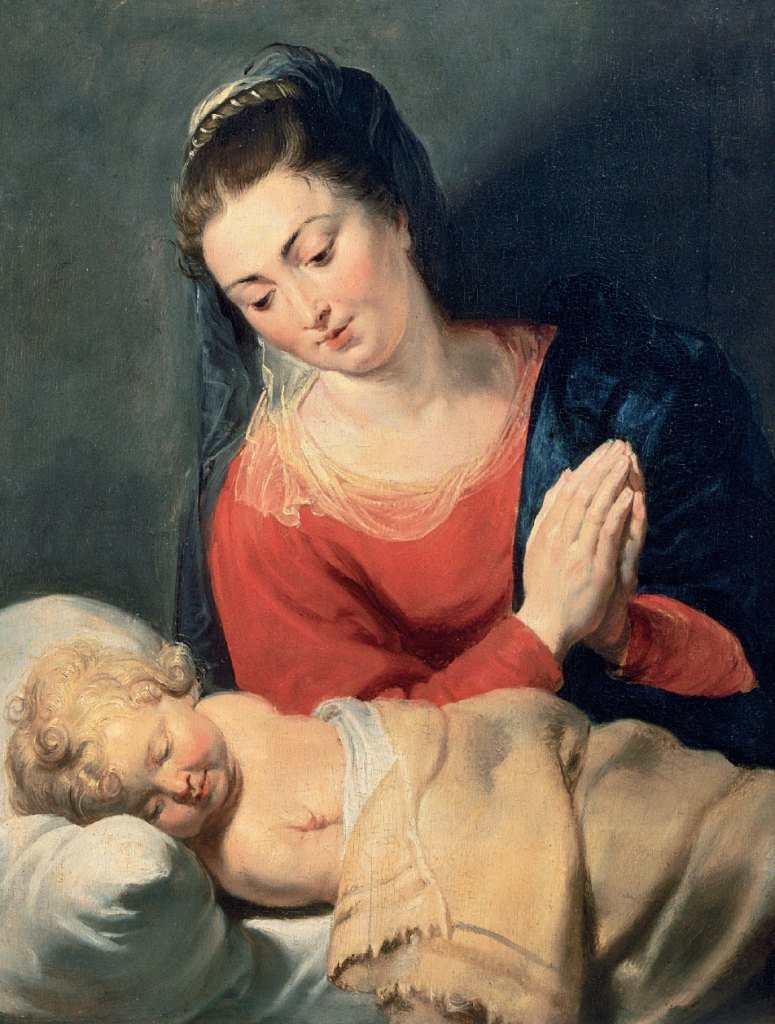
He drew the dowager Maria de’ Medici from below looking as jowly as Margaret Rutherford, and more severe
Male or female, Rubens is the great painter of tactile flesh: the pudgy shoulder of his sleeping Christ Child (see above) cries out for a squeeze. In the mythological romps in the final room, he delights in contrasting roseate nymphs with sunburned satyrs. The riot of colour in these paintings would have horrified Blake, who thought Rubens’s pictures ‘the most wretched Bungles… His shadows are of a Filthy Brown somewhat the Colour of Excrement,’ he scribbled in the margin of his copy of Reynolds’s Discourses; ‘His lights are all the Colours of the Rainbow.’ In the battle between Rubenists and Poussinists Blake sided with Poussin, but in a battle between nymphs and satyrs I’d back Rubens’s nymphs. Under that Rubenesque exterior, they’re solid muscle.
Has VR finally come of age?
A heavily made-up Iranian woman in bra and knickers is dancing seductively before me. We’re in some vast warehouse, and she’s swaying barefoot. But then I look around. All the other men here are in military uniforms and leaning against walls or sitting at desks, smoking and looking at her impassively. I slowly realise we are in a torture chamber and this lithe, writhing woman is dancing, quite possibly, for her life. Me? I have become one of her tormentors.
You can immerse yourself in war-ruined Ukraine, go on the run from the Holocaust, become a mushroom
Welcome to The Fury, a bravura attempt by Iranian artist Shirin Neshat to use virtual technology in her art.
‘Have you ever experienced VR before?’ asks the assistant as she adjusts my goggles, while I sit myself on a stool that rotates through 360º. Only once: I was across town at the Saatchi Gallery, masked up and sitting on a chair that came to life, hurling me forward to explore a simulation of Tutankhamen’s tomb. It gave me, perhaps, an experience akin to what Howard Carter felt in 1923, entering chambers that had lain in darkness for millennia.
Neshat’s film similarly puts me in someone else’s shoes. First of all I seem to be viewing the dance through the eyes of a military thug. Neshat tells me she modelled the men in her film on Iran’s Revolutionary Guard and indeed the actors she’s employed superbly incarnate the kind of moral void that might allow them to commit unspeakable atrocities.
But then the point of view shifts and I become the nameless dancer, sidling up to a particularly hard-faced brute leaning against the wall. As I approach, he blows smoke into my face.
Then the point of view shifts once more. I’m no longer a patriarchal goon or vulnerable dancer, but a voyeur watching the woman reel backwards from the smoke. Her body, I notice, is now covered in bruises and scratch marks. Perhaps those cigarettes have been stubbed out on her body. Clearly wounded, she stumbles, falls, gets up, tries to dance.
I swivel on my stool as the guards form a circle and walk towards me. I am, most likely, next to become a human ashtray. I’m not sure if, as the bumf suggests, this gives me, a pampered Englishman, a sense of what ‘it’s like to be an objectified woman in Iran’, but it certainly made me panic.
In a month in which we saw footage of Iran’s morality police beating a teenage girl into a coma on a metro platform for not wearing a headscarf, and in which the imprisoned human rights activist Narges Mohammadi won the Nobel Peace Prize for campaigning against repression in Iran, The Fury might seem only topical within the homeland from which the artist is exiled. Neshat, who lives and works in Brooklyn, argues The Fury may primarily confront women’s repression in her homeland, but hardly stops there. ‘All she has is her sexualised body, all she has is to make herself into a thing for her oppressors.’ says Neshat. ‘That is not just something that happens in Iran.’
The Fury is just one of a curated spate of VR artworks screening as part of the London Film Festival’s Expanded strand in the Bargehouse at Oxo Tower Wharf. You can immerse yourself in the experience of being in war-ruined Ukraine, go on the run from the Holocaust, or even become a mushroom.
Can VR escape its tragic-comic aura of being the means by which Zuckerberg tanked his company?
Is it appropriate to exploit real life horror for sensory titillation? And can VR really escape its tragic-comic aura of being the means by which Mark Zuckerberg tanked his noxious social-media company? Certainly Meta’s current TV ads insist that VR technology is a boon: it will help medical students learn how to do eye operations in cyberspace before performing them in reality. But sometimes VR looks like the dead end on the way to transhumanism at worst, and at best just another piece of kit destined for technology’s discard pile along with Wii wobble boards, vintage Game Boys, Atari Pong consoles and eight-track tape players.
Ulrich Schrauth, who is in charge of the Expanded programme, insists there is more to VR than that. That it take us where other technologies fear to tread.
VR ‘immersion’ is everywhere in London this autumn. Across the river, the 400th anniversary of the publication of Shakespeare’s First Folio will next month be the pretext for what’s being called an ‘immerzeo’, a means of immersing pilgrims as they wander through the City of London in the time and place of Shakespeare. As you stroll down, say, Cheapside, you will be able to hold up your phone or tablet and see projected images of what the city would have been like in the early 17th century.
Meanwhile, in Mayfair, Manolo Blahnik will soon open his multi-sensory VR experience at xydrobe, a new ‘luxury virtual reality destination’. Here, you will be able to sit at a virtual replica of the designer’s desk and be whisked via visuals, smells, wind and surround sound into the world of the shoemaker’s art. It could be more blah than Blahnik, but let’s see.
The most powerful of the VR experiences I see as part of the London Film Festival is Darren Emerson’s film Letters from Drancy. It documents Holocaust survivor Marion Deichmann’s time on the run from the Nazis when she was a child. With headset on, I am transported to the back of a truck in which little Marion and her mum flee occupied Luxembourg for Paris.
Letters from Drancy is by no means the most sophisticated VR film Emerson has made. In Pursuit of Repetitive Beats required visitors to wear not just VR headsets but backpacks pumping out thumping bass sounds the better to recreate Coventry’s acid house rave scene.
That said, one of the things that makes Letters from Drancy so potent is its combination of VR and other media. Once installed in a Parisian apartment, Marion and her mum get a fateful knock at the door. It’s the French militia who have orders to arrest mother but not daughter. This scene is reconstructed as a black and white 3D stop-motion animation, with Emerson’s nine-year-old daughter serving as the model for the little Marion.
‘I remember the last thing she said to me was, “Be good, I’ll be back”,’ Marion Deichmann, now aged 91, tells me. But she never saw her mother again.
After Alice Deichmann was transported to the holding camp at Drancy, little Marion and her grandmother fled Paris. Thanks to the Resistance, she was able to live for the rest of the war in a safe house with a sympathetic French family in Normandy. During her time there, Marion received postcards from her mother telling her not to worry and that she was going to join an aunt. Both were murdered as soon as they arrived at Auschwitz-Birkenau on 27 July 1942.
At one point in the film, we see Marion Deichmann on a recent visit to Drancy, now a Parisian suburb. In the middle of a square is a Holocaust memorial, including a cattle truck of the kind that transported her mother to her death. ‘I had never been to Drancy before we made this film. It was then that I broke down.’
I watch several visitors in tears after watching the film. The radical empathy that Schrauth thinks VR storytelling offers seems at its most valuable here. Deichmann quotes to me from Primo Levi’s poem from the start of his Auschwitz memoir If This is A Man imposing on us the duty to remember. Perhaps VR might help with that obligation.
It might help to do other things too. Not least demonstrate to us that we risk falling into a future worse than Orwell imagined. I stumble into another room where Karen Palmer has created a VR experience called Consensus Gentium about facial recognition software and all the other paraphernalia of the surveillance industry that gives me the willies. There are no goggles but you stare gormlessly into a smartphone and become immersed in a scintillating VR experience that unfolds like an episode of Charlie Brooker’s Black Mirror. The phone uses artificial intelligence and facial recognition technologies to analyse my gaze and emotions in real-time, and thereby to shape narrative. The data culled from my eyes also decides whether I am entitled to download an app that accords me credits and decides on my social status, my employment chances and whether I should be treated as a law-abiding drone or enemy of the state.
Consensus Gentium isn’t just an immersive satire on AI and social media but also a morality tale about how facial recognition is often racist: studies have suggested that the darker your skin tone, the more likely you are to be misidentified by facial recognition software.
At the end of the experience, I am pleased to learn that I have been deemed an enemy of the state and locked out of all its apps. True, I am now functionally unemployable and social kryptonite but I wouldn’t have it any other way.
What happened to ‘Never Again’?
For Jews everywhere, there was an eery familiarity about the terrible violence unleashed on Israel during Saturday’s attack by Hamas. This was no simple act of terrorism. It was a pogrom.
Pogroms were violent attacks against Jews living in the Russian empire in the 19th and early 20th century. They, much like the atrocity this weekend, included homes being torched, the abuse and execution of civilians and the rape of women. In the kibbutz of Kfar Aza, close to the Gaza border and scene of the most depraved Hamas violence, no-one was spared, whether they were female, young or old. All suffered the same fate. All were targeted for being Jewish.
Hamas’s pogroms included bodies being set alight and the casual, sadistic murder of children. This is reminiscent of Isis, or the Nazis. Decades of dehumanising not only Israelis, but Jews in general, opened the door for Hamas’s savage indiscriminate violence. Similar to the Nazis, Hamas has been comparing Jews to animals and vermin, something to be exterminated. This attitude explains the bloodthirsty disregard for Jewish lives we saw when Hamas fighters crossed the border into Israel.
The casual, sadistic murder of children is reminiscent of Isis
Terrorism has political aims. However, Hamas – as is made clear in its founding principles – has never advocated for a political, peaceful solution with Israel. Their ideology is deeply rooted in antisemitism. They have, for years, been using age old antisemitic tropes, including claims that Jews control and manipulate the West, the media and international financial institutions. Most crucially, they believe that Jews have waged a war on Islam. They do not distinguish between Israelis and Jews living outside of Israel, nor between Zionism and Judaism. To them, ‘the Jew’ is an enemy that must be extinguished.
Article 15 of the organisation’s charter declares a Jihad, or a war against the enemies of Islam, against Jews. The charter argues that ‘the Palestinian cause is a religious cause.’
Article 4 of the chapter reads:
‘[Hamas] looks forward to fulfill the promise of Allah […] because the Prophet of Allah (saas) says: The Last Hour would not come until the Muslims fight against the Jews and the Muslims would kill them, and until the Jews would hide themselves behind a stone or a tree and a stone or a tree would say. Muslim or Servant of Allah there is a Jew behind me; come and kill him; but the tree of Gharqad would not say it, for it is the tree of the Jew.’
Hamas has been waging a war of religion against Jews, and it is time we recognise it as such.
Iran, Hamas’s closest ally, is believed to be the mastermind behind the recent attack. For years, they have provided training, funding and other forms of support to Hamas.
Iran’s belligerent policy towards Israel goes far beyond politics. Its leadership holds deeply antisemitic views. These come across in speeches, textbooks in schools, and in planning or supporting terror attacks against Jewish targets globally. The Iranian Islamic Revolutionary Guard Corps (IRGC; Iran’s international arm that reports directly to the supreme leader) has targeted Jews everywhere.
Both Iran and Hamas have never hidden the fact that their ultimate goal is the eradication of Israel because of their hatred of Jews. Finding a peaceful solution for Palestinians has never been their desired outcome.
The terrible tragedy unleashed on Israel must serve as a wake-up call. The world, and indeed Israel too, need to change how they view this conflict. It is, of course, legitimate of the Palestinians to seek independence and establish a nation. Yet it is unfortunate that the organisations fighting on their behalf are waging a religious war rather than working towards a realistic and peaceful political cause.
After the Holocaust, the civilised world made a vow to Jews. ‘Never Again.’ But, 80 years on, it has happened again – this time in the Jewish state itself.
Israel must recognise that the conflict it is fighting is greater than a regional conflict. A war of religion, as history shows, can last centuries. A Treaty of Westphalia-type solution will only be possible when Palestinian leaders forgo the goal of annihilating Judaism and adopt a pragmatic approach of co-existence with Jews and a Jewish State. Hamas will never adopt this position. For Israel, this means that Hamas should exist no more. The problem is that, currently, no such viable Palestinian leadership exists that can take over and hold a more moderate approach.
Former Israeli PM Golda Meir famously said that ‘if the Palestinians lay down their weapons, there will be peace. If the Israelis lay down their weapons, there will be a massacre.’ How right she was.
Football’s shameful silence on Israel’s tragedy
Few top-flight football matches these days kick off without an expression of solidarity with a cause or condolence. Along with the customary tributes to footballing legends or club stalwarts, just last week Premier League players took the knee, yet again, to show their opposition to racism.
In recent weeks, we have had silences for the victims of the Moroccan earthquake and the Libyan floods. Support has been shown for Ukraine, and for the victims of terror attacks in Paris in recent years. And yet, strangely, no decision has apparently been made about honouring the now more than 1,000 victims of Hamas terrorism in Israel.
Sunday’s Premier League games – including the high-profile clash between Arsenal and Man City – unfolded without a tribute. A few days on, there still appears to be no mention of the appalling events on the Football Association’s website, even in the ‘Equality and Inclusion’ section.The Premier League’s ‘No Room for Racism’ page also appears to be silent on the atrocities.
Talks over whether to illuminate the Wembley arch in the colours of the Israeli flag when England play Australia on Friday are underway, but the FA Chief Executive Mark Bullingham appears to have been concentrating instead on the UK and Ireland’s successful bid for Euro 2028.
This is a problem entirely of the football authorities’ own making
You might say that focusing on the day job is the right thing for the likes of Bullingham to do. And yet, the way in which football has gone out of its way in recent years to mark tragedies and honour causes, such as Black Lives Matter, makes this silence on Israel troubling. If football is going to involve itself in international tragedies then surely there should be no equivocation over formally registering solidarity with the victims of the worst single loss of Jewish life since the Holocaust. Events have moved quickly but the Wembley arch was lit up in Ukraine colours within 24 hours of Russia’s invasion and Downing Street managed to stage a projection of the Israeli flag this week. David Bernstein, who led the FA between 2011 until 2013, has strongly criticised the governing body’s inaction.
The FA are clearly fearful of appearing to take sides in one of the world’s most protracted disputes. Taking a stand over the atrocities in Israel would lead to immediate claims from some that a similar position should be adopted over the loss of life in Gaza as a result of the Israeli retaliation. Once you start, where will it end? Who will adjudicate which horrors are worthy and which are not? The prospect of crowd disturbances in and possibly outside the ground in the wake of the pro-Palestine demonstrations in London must be unnerving the football officials too.
But this is a problem entirely of the football authorities’ own making and one that can be traced back precisely three years. After the death of George Floyd, the rush to signal unqualified support for Black Lives Matter led to all Premier League clubs having the group’s name emblazoned on their shirts for 12 weeks. Players were also allowed, some would say expected, others might suggest mandated, to take the knee to show their support. Nearly all did. The FA and the England team, with the enthusiastic cooperation of manager Gareth Southgate, who sees it as part of his job to ‘educate people around the world’, followed suit.
This appeared, to some at least, though few were brave enough to say so – and if they did they risked losing their jobs – over the top and setting a dangerous precedent. There was a suggestion of panic about the BLM response, of a multibillion-pound industry with a not quite forgotten unsavoury reputation from a minority of supporters, desperate to avoid accusations of not doing enough in the global war on racism that Floyd’s death seemed to have triggered. So, the Premier League and the FA without much analysis of what exactly it was they were pledging allegiance to, threw their considerable weight behind BLM, as visibly as possible, as a means of establishing their ‘anti-racist’ credentials and thus protecting their assets.
But having assumed the mantle of moral arbiter on a range of global issues the football authorities have now left themselves open to accusations of cowardice, or partiality when it comes to Israel. For the Premier League in particular, this is a an especially thorny issue. Shameful antisemitic abuse has been a problem at Tottenham Hotspur matches. To do nothing when the state of Israel has been defiled in the most appalling manner is hard to square with the exhaustingly reiterated ‘No Room for Racism’ message. It begs the question of whether this anti-discrimination agenda is as inclusive as it claims to be.
The moral of the story seems to be that you can either show your support in every case of global tragedy or none. There is a good argument for the latter. A dignified position for clubs would have been to honour football heroes, and show sympathy to victims of domestic tragedies, and leave it at that, acknowledging that it is crass and presumptuous to assume to have a role in the grief of those in the wider world. Leave the national response to governments, and let the individual players and fans pay their respects in the manner they see fit as individuals.
But it’s too late for that. BLM saw the British football authorities summon up the sorcerer’s apprentice, invoking powerful spirits that it is now struggling to control. British football has chosen to be an actor in social issues and global politics. As a result, it has some awkward decisions to make in the next few days, and there will doubtless be many more in the weeks, months and years to come.
America’s support for Israel must not come at the price of backing Ukraine
Hamas’s heinous attack and the robust Israeli response serve as a useful reminder of well-known double standards on the activist left. In an echo of those US Republicans who are unable to see Ukraine’s defence against Russian aggression with any moral clarity – framing it instead as a ‘territorial dispute’ – some commentators have been reluctant to condemn Hamas’s terrorism, at least not without first appropriately ‘contextualising’ it.
The attack, however, also uncovered a more recent and worrying trope taking root on both sides of the political spectrum: the idea, implicit or explicit, that the United States can only focus on just one issue at a time. The Biden administration, keen to turn the page after the quagmires of Iraq and Afghanistan, has treated the Middle East as an afterthought. Hence the rushed withdrawal from Kabul and the reflexive effort to revive Obama-era Iran deal – even at the price of rattling traditional US allies in the region, or empowering Tehran to double down on its backing of Hamas and Hezbollah.
There are those on the right, like former Pentagon staffer Elbridge Colby, who argue that backing Israel and/or confronting China is non-negotiable – and that doing so must come at the cost of US Ukraine policy. Senator Josh Hawley has said that ‘Israel [was] facing an existential threat. Any funding for Ukraine should be redirected to Israel immediately.’
For a tiny fraction of the Pentagon’s budget, Ukrainians are degrading Russia’s military so that it cannot threaten Nato for a generation
While some trade-offs undoubtedly exist, the United States cannot just focus on a narrow subset of critical issues facing the world – particularly not if those are connected. If recent events demonstrate anything, it is that there is an international coalition of revisionists – an axis of evil, if you will – eager to replace what remains of the ‘rules-based international order’ with barbarism and the principle of ‘might makes right’. Those forces are on the march in Ukraine, the Middle East, and can soon set fire to the Indo-Pacific.
For America and its allies, the only effective strategy is not to pick our battles carefully or exercise restraint. It consists of nipping our adversaries’ efforts in the bud wherever they stick out their heads – in Eastern Europe, in the Middle East, and in the Indo-Pacific. Being selective in responding is not a display of prudence nor of a nuanced understanding of the relative urgency. Instead, it signals weakness, thereby encouraging more bad behaviour from our enemies.
Being the world’s policeman is expensive, of course. However, if there is a one thing worse than taking that role, it is for Americans, or the British, to wake into a world that has no policemen – or into one that is policed by Iran’s mullahs, Vladimir Putin, and Xi Jinping.
By default, that is the world that the United States is bound to get if they retreat from this conflict. Ignore the isolationists’ fairy tales: it is US leadership, not its absence, which encourages our allies to step up and do more. Nobody was in a position to fill US shoes in Afghanistan when Biden headed for the exits in the summer of 2021. But Ukraine has demonstrated what happens when the US steps up. The magnitude of US (and British) assistance to Ukraine – which, in many ways, still fails to rise to the occasion – has changed the calculations of Europeans. Already, EU institutions alone provide more than three times as much humanitarian and financial aid to Ukraine than the United States does. Jointly, European governments and Brussels give almost twice as much military and non-military aid to Ukraine than Washington. Countries such as Poland, meanwhile, are far exceeding their defence spending commitments. Even in Germany, the Zeitenwende might be arriving slowly, but it is no less real.
For Ukraine, the talk of choices and trade-offs is misleading. For a tiny fraction of the Pentagon’s budget, Ukrainians are degrading Russia’s military so that it cannot threaten Nato for a generation. None of the major weapon systems transferred to Ukraine are needed either by Taiwan or by Israel and, in fact, their replacement in US stocks by more advanced alternatives has been long overdue.
Again, none of this suggests that a US leadership is a free lunch. Washington’s defence budget is inadequate for the task. There are a host of domestic policy challenges – from the Southern border and the Fentanyl crisis to rising costs of living – that need addressing. Yet the United State’s dysfunctional politics aside, the turmoil in Israel is a timely reminder that the US ought to be able to deal with more than just one issue at a time. Whether we are, however, is a different question.
Dalibor Rohac is a senior fellow at the American Enterprise Institute in Washington DC
Labour is already tearing itself apart. How would it cope in government?
Keir Starmer’s chances of becoming the UK’s next prime minister seem to be improving by the day. From a huge win in the Rutherglen by-election to a ‘buoyant’ atmosphere at Labour’s party conference in Liverpool, the party of the opposition is on the up.
The Tories and the SNP, meanwhile, continue to be distracted by chaotic messaging and party infighting. But could a Labour government pull together the fractured state that is Great Britain in a way the Tories haven’t been able to? Possibly – but it would mean repairing relationships within their own party first.
In the politics of the Union, Welsh and Scottish Labour have been at loggerheads for quite a while – and reports suggest this has Starmer’s office pretty worried. Welsh First Minister Mark Drakeford regularly talks of a ‘union of four territories’, the importance of sovereignty and Scotland having the right to decide its own future.
Drakeford is speaking for a wide constituency in Welsh Labour when he speaks in such tones, but it is one which irritates large elements in the Scottish party. One Scottish Labour party insider said:
When Drakeford goes down this line, the Scottish party gets on the phone and complains to Starmer’s office… The Scottish party have much more clout with the British party than Welsh Labour. This is about the electoral importance of Scotland.
It does nothing for the Welsh group’s relations with Scottish Labour (one source said they ‘despair’ at their Scottish counterparts) or Starmer. ‘We are fed up being told off, and being told to cling onto what is in effect a Tory interpretation of the constitution,’ said a Welsh Labour figure, ‘which does not help Labour in Wales, or elsewhere.’
Wales is a sovereign nation. The UK has to be a union of consent, not a union of being told you have to belong to it… Our tanks are firmly parked on the lawn of national identity, culture and autonomy. It is part of who we are, not about who we are against.
Scottish Labour doesn’t see it this way. One senior figure in Scottish Labour says that many in the party believe it has to stop ‘appeasing the SNP’, to avoid the ‘slippery slope’ of giving greater powers to Scottish parliament – which never appears to quite satisfy the nationalists anyway. Scottish Labour has to stop operating ‘on the same ground as the separatists and instead emphasise what unites us in Scotland and the UK’.
Parts of Scottish Labour believe that it simply ‘embraces a hugely unimaginative, conservative take on the UK. The party has to stop looking like it is standing up for Britain in Scotland – and instead stand up for Scotland in Britain.’
Given the deep divisions that conversations about the splitting up of the UK create, the constitution is understandably a sensitive topic for Labour – and the bickering between the Welsh and Scottish parties isn’t making things easier for Starmer. A source close to the UK leader’s office reflected that ‘maybe Scottish and Welsh Labour could stick to what they are meant to do: the politics of devolution’.
An opportunity has opened up for Labour after years of inadequate governing by both the Conservatives in Westminster and the SNP in Holyrood. But seizing that opportunity – holding together that diverse Labour coalition across the different nations of England, Scotland and Wales – is never going to be easy. If Labour wins the 2024 general election, these problems won’t go away. Instead, they will only grow more acute as the party’s warring factions continue to squabble over where their party stands on the constitution.
Why can’t I simply book a swim?
It shames me to admit this, but I haven’t been near a public swimming pool for many a year. Hotel pools, yes; the sea – occasionally, in parts of the world with predictable warmth. But I have resisted the new wave of ‘wild’ swimming and was never a regular – to be honest even an irregular – at the Hampstead Ladies’ Pond. Nor have I frequented health clubs or spas, though I did go to enquire about one that had opened nearby; then came the pandemic.
As a one-time regular pool user, I am taking another look. This is because I have just completed my four-session NHS allocation of hydrotherapy (for a broken ankle). And they bade me farewell with a wodge of papers, which include a long list of public pools all over London where I might possibly continue my hydro-regime.
Public pools and leisure centres have adopted the practices of private gyms and spas, designed primarily for urban professionals
This manner of farewell, incidentally, has a name: it is something the NHS, local authorities and charities call ‘sign-posting’, and it’s an ingenious way of passing the buck. What it actually does is allow paid staff or well-intentioned volunteers to tick a box that says ‘job done’, when all they have actually done is pass on a load of information to the patient or petitioner, often couched in baffling officialese, which is then left to us to decipher and, maybe, act on.
But that’s by the by. My information sheets contained one surprise. You would have thought that, after all the complaints about how every pool in the land was at risk as a result of austerity or the pandemic, they would all have run dry. Well, London may be unusually fortunate, but my leaflet lists more than a dozen pools, where – to quote – ‘you can continue your hydrotherapy’.
The availability of pools, however, turns out to conceal a more complicated reality, whether you want to improve your ankle mobility or just have a swim. In those long-ago days when I would frequent local pools, all you had to do was turn up with your towel and your ‘bathers’ (now, regrettably, I learn, termed a ‘cozzie’), paid your 50p or whatever, found a cubicle, took a shower and plunged, or shivered, your way in.
How things have changed. Pools are now ‘leisure facilities’, some are run for councils by private companies, others by the council directly. But all the ones that I looked at have nigh-impenetrable websites, advertising the multiplicity of what is on offer – without much of the practical information you might need: like when can I swim, and what does it cost. Hunting down anything akin to hydrotherapy requires a facility for gymnastics, at least of the mind.
To ‘access’ any of this information, you must ‘register’, divulge volumes of personal data, and take out a ‘membership’, for which there is invariably a dizzying array of ‘special offers’. Just turning up and paying a flat fee for a ticket, it seems, is no longer what you do. Some pools publish their timetables, and all have a myriad of special sessions – for women, seniors, mothers and babies and the like, with ‘fitness’ sessions, which turn out to be nothing more interesting than lap swimming.
Something called ‘aqua-aerobics’ looked as though it might approximate ‘hydrotherapy’, or as much as I needed it to, but I spent hours trying to figure out which pools actually offered this (not many, or not many that say so), what it cost, when it happened and how to book it. On the rare occasion I chanced upon a timetable that included such a session at a pool less than an hour away by public transport (I’m still hobbling, by the way), it was not happening, full, or bookable only nearer the date.
Exhausted by the effort – even before getting to a pool – I resorted to emailing the basic questions that the websites did not answer. So here is a special thank you to Adam from an organisation called Better – which calls itself a ‘charitable social enterprise’ and seems to run quite a few leisure centres – who replied with a location and times, but when I asked how to book, sent me back into the infernal loop where the only ‘fitness activity’ on offer is lap swimming.
The internet and the proliferation of apps have ensured that there is a blizzard of information and promotions out there, but rather less information that is either useful or usable. In fact, you are probably better doing what I will do one day, which is actually to go to the pool and find out from there.
What I was hoping to find, and was assured exists, was a group workout in warm-ish water in a public pool. But if it does exist, whoever provides it is doing a pretty good job of hiding it. And what seems to have happened over the years is that public pools and leisure centres have adopted the practices of private gyms and spas, designed primarily for urban professionals. This means complex membership schemes, incentives for this and that, and ‘tailored’ packages that might suit those who have regular schedules and a good income, but effectively exclude those who don’t.
The consequence is that fitness, like so much else, is fast on the way to becoming a preserve of the better off, in terms not just of money (those who can afford to join a private club), but also of time (those who can fit their schedule around what the public provider chooses to offer).
Which may help to explain two mysteries. One is why National Fitness Day, which fell last month – sorry, I didn’t notice it, either – has increasingly become a pretext for lamenting what the government has described as the country’s ‘stubbornly high levels of inactivity’. The UK now ranks 12th out of 15 comparable European countries for levels of physical activity.
The other mystery might be why so many Britons have been rushing to have themselves jabbed with Wegovy and other substances promising weight loss. Anyone who has engaged in a fruitless search for public exercise provision – not necessarily because it does not exist, but because it is so hard to find – might well conclude that injections offer a quicker, easier route to a slimmer and fitter life than, say, navigating the complexities of swimming at your local pool.
Social media is worse than smoking for teenagers
Would you knowingly give your daughter a birthday present that was going to increase her chances of self-harming, developing anxiety and even depression? I assume the answer would be no, yet this is what so many parents do to their children when they give them a smartphone with access to social media.
You could not design anything more pernicious for socially insecure teenagers
As a mother of two daughters who are now teenagers, I know the pressure to do so feels enormous. Children see us adults glued to our phones, their peers have them, and their friends socialise on them. The temptation to give in can be, like the temptation to check WhatsApp, overwhelming.
Helpfully, some new research has come out which should help parents make the right decision. A report by Sapien Labs, which analysed global data from nearly 30,000 18 to 24-year-olds is unequivocal; the younger the child is when they receive their first smartphone, the worse their mental health as they grow older.
The percentage of females with mental health problems is 74 per cent for those who received their first smartphone at age six. It’s 46 per cent for those who received a phone at age 18. For males, it’s 42 per cent at age six and 36 per cent at age 18. Problems with suicidal thoughts, feelings of aggression towards others, a sense of being detached from reality and hallucinations declined the older the child was when they got a phone.
And for those who think your happy home is a good enough buffer, the same study found the correlation between mental well-being and age of smartphone acquisition was just as strong for those with no traumatic or adverse childhood experience.
Having recently spent time with my goddaughter, who is 15, this correlation comes as no surprise. She was suffering significant feelings of anxiety and depression. The main culprits? Tik Tok and Instagram. A quick look over her shoulder at the two-minute videos she was watching showed me the problem in no time.
She was absorbed by videos showing freakishly skinny girls – long hair, bangs, heavily made-up eyes – all looking like they were having an enviable blast. Often, they were dancing provocatively, putting on make-up, dressing up in new clothes, discussing their most recent diet tips, and having fun on holiday or at a party.
So here in lies the problem with TikTok, Instagram and teenage girls. At a time where self-confidence is painfully low, their point of reference is not a natural one – your class, perhaps the girls from a nearby school or your town. Instead, teenage girls are comparing themselves to something that doesn’t exist. The women in these videos are not actually having fun – they are too busy taking videos of themselves to enjoy the moment and their looks are distorted with corrective filters. The whole thing is a lie. To a young teenager, however, the comparison to your own less-than-superhuman self is stark and painful. The more they scroll, the further their confidence falls.
The videos were vacuous, narcissistic and nihilistic. There were no recordings about what books the girls enjoyed, what they were interested in and what issues they cared about – nothing aspirational in a deeper sense, just pure objectification.
Another app my goddaughter pointed me to is Snapchat (which is what teenagers mainly use to communicate, WhatsApp is for oldies). The photo-sharing app enables you to track the live location of those you have connected with (each person is depicted by a fun avatar), so you can watch from your sofa at home as your friends all head off to parties and holidays that you have not been invited to. You could not design anything more pernicious for socially insecure teenagers.
Then there are the filters which you can use on all these apps, which ‘correct’ your face to look more ‘attractive’. The nightmare ingredient here is that they are encouraged to take an analytical approach to their face. They can see how the filter slims down their noses, makes their mouths wider and their lips fuller. It’s the perfect advertisement for plastic surgery.
It’s notable the degree to which social media negatively impacts girls far more than boys. We also know that young girls are more likely to receive sexual messages than boys. Surely this should be the issue for the latest wave of feminists?
Deep down, if we are honest with ourselves, we parents know all this. We wrestle with the risk of fallout and social isolation for our children if we don’t give them a smartphone before the age of 16. We also wrestle with the risk of significant mental health problems brought on by having one.
These apps have been designed by the brightest and best minds from across the world, with vast quantities of funding behind them, to make them as addictive as possible. Up against this, our children don’t stand a chance, which is why we must protect them.
This issue of teenage smoking, which a Tory-led Britain is now slow banning, is dwarfed by the wreckage social media is doing to our young. A truly brave government should, in the words of Rishi Sunak ‘make tough choices and big decisions that will deliver long-term success’ and ban social media for under 16s.
But we can’t rely on government bans alone to protect our children. We parents must do more. We need to create a cultural shift where it is socially unacceptable to see a young teenager – let alone a child – with a smartphone. To make it as shocking as seeing a ten-year-old lighting up a rollie. We did this with drink driving and racism. Now it is time to do it with smartphones. The health and happiness of our children depends on it.
Crocs vs Birkenstocks: the great clog divide
What we put on our feet says a lot about a person. Shoes define our character. There are shoes that breathe, shoes for diving, shoes for driving, shoes that light up, shoes with wheels in them, shoes that look more like gloves than shoes, shoes by Kanye West, shoes for old people, shoes for the indoors, shoes for hunting, shoes for dancing. You get the point.
Neither of them is aesthetically pleasing – at least not for the sane amongst us
Then there are Birkenstocks and Crocs: two heinous additions to fashion and yet two very successful brands, albeit for different markets. They are at war. Battling it out for the nation’s feet on metropolitan high streets and in the gardens of our countryside dwellers; a great clog divide of injection-moulded polymer versus leather and cork.
Neither of them is aesthetically pleasing – at least not for the sane amongst us. But it seems these shoes refuse to die. Like tiny beanie hats, Peaky Blinders haircuts, and choker necklaces, these shoes have clung on for dear life. But what’s all the fuss about? And, more importantly, which shoe is the lesser of two evils?
I’ll start with Birkenstocks, which last week was valued at a phenomenal $9 billion. Now, I’ve never actually owned a pair of Birkenstocks, and I don’t intend to. If you ever catch me wearing them, please call the number on the bracelet around my wrist and inform the authorities I’ve escaped.
Birkenstocks don’t just make sandals for the exceedingly rich, they make clogs too. And boots. And whatever else the designers can get their evil hands on. I don’t really get Birkenstocks. I don’t think Birkenstocks get Birkenstocks. I doubt that Johann Adam Birkenstock sat in 18th century Hessen envisioning his name as being synonymous with Hollywood Boulevard and psilocybin-dusted beach parties. But here we are.
Birkenstocks still market themselves as a ‘comfortable’ shoe. A review online said they were like walking on clouds. I decided it was only appropriate I try these cloud shoes for myself. I went to a Jones Bootmaker in Canary Wharf’s labyrinthian shopping centre this weekend. The shop assistant told me that Birkenstocks were out of season. But before I could say, ‘That’s OK. I suppose a pair of Havaianas and an all-inclusive trip to Majorca will do,’ she said, ‘Actually, I think I have one pair in the back.’
She brought me the Arizona: Birkenstocks’s most popular sandal. ‘Thank you,’ I said. Slipping them on, I half expected to fall to my knees in tears, screaming, ‘Where have you been all my life?’ But that didn’t happen. The shoes felt like how they looked: misshapen. I know that Birkenstocks require ‘breaking in’, but how long are you meant to walk around with golf balls of cork sticking into the soles of your feet?
I took a look in the mirror. Ah, yes, I thought. There he is. I could almost sense the life I was missing. One of shouting at live-in staff, of cheating on my dissatisfied wife, of hiring a personal trainer to whip me into shape every Wednesday evening. But that’s not me. My name isn’t Bob Vicious and I don’t own a new build on the waters of Saint-Tropez. I handed the sandals back and lost myself in the endless corridors of Jubilee Place once more.
Crocs are a different beast. I have a soft spot for Crocs. I’ve owned them and admired their stubborn place on the world’s shoe rack for years. Crocs are a polymer dichotomy. They’ve been owned by glamour models and hungover aunties alike. They’re a statement – though not always a good one. Crocs – founded some two hundred and something years after Birkenstocks – have a timeless evil to them. There’s something anciently disturbing about these floating clogs. You can almost imagine some nefarious mage producing them from his sheepskin sack before the egregious king of a long-forgotten empire.
‘Pray, tell me, little cretin, what are those feet-boats made of?’
‘Why, my Lord, they are made of Croslite.’
‘Croslite?’
‘A material known only to the Gods.’
‘And what do you call them?’
‘Crocs, my Lord.’
‘Excellent. Guards, behead the little sorcerer and bring me his “Crocs”. My feet are sore and I’m in need of something to shuffle around in when I feel frumpy.’
Although I respect Crocs, I still think they’re awful. But for me, it boils down to one thing. Toes. I hate my own toes, but not as much as I hate seeing other people’s. And at least with Crocs, they’re semi-obscured. But with Birkenstocks, people flaunt their little nubbins for the world to see as they enter and exit vehicles, walk down the road, stop for a spot of lunch.
I’ll have to give this round to Crocs, as much as I hate to admit it. I just can’t stand the sight of a stranger’s gammy toe as I’m trying to enjoy my coffee. It’s not fair.
Crocs: 1.
Birkenstocks: 0.
Were we all wrong about Frasier?
It is fair to say that, of this fall’s new and revived television shows, the reboot of Frasier was seen as at best a difficult proposition and at worst a cynical exercise in artistic necrophilia. There was no doubt that the original show was one of the finest American situational comedies of the twentieth and twenty-first centuries; a pitch-perfect farce, acted and written with enormous sophistication by a peerless cast, even if Jane Leeves’s “Mancunian” accent as Daphne is still one of the most peculiar things to have been heard on television. Even a lessening of impact after Daphne and Niles finally became a couple did not stop Frasier being regarded with enormous fondness after the show came to an end in 2004.
It’s also a given that, over the past two decades, Kelsey Grammer’s career has never again hit the same heights, partly because of his unashamedly right-wing politics — including praising Trump for “disrupting the fabric” of conventional government — and partly because his performance as Dr. Frasier Crane has been his defining role throughout his life, ever since he first played the character in Cheers. Therefore, it was unsurprising that he was the driving force behind the series’ reboot. His erstwhile co-stars David Hyde Pierce and Leeves showed no interest in reprising their roles, and the late, great John Mahoney, who played Frasier and Niles’s loving but bewildered father Martin, died in 2018.
Little about the revived series offered much in the way of optimism, and my judgment from earlier this year that “it is hard to be particularly excited by its reprisal” seemed vindicated by a dismally unfunny first trailer for the show that appeared in August, and suggested that Frasier had very much left the building. So it was with a mixture of surprise and relief that we can see that the early reactions to the show have been generally positive. Granted, there have been some duff notices: Rolling Stone lambasted it for being “an unfunny, uninspired dud” and TIME, in a review that read as if it had been written before the series had been aired, sighed “the project starts to sound especially dire. And it is.” But many other publications have praised the show, not least for Grammer’s assured reprise of his signature role. As Consequence wrote, “Grammer is as cool and confident as ever, while still fearless about taking on even the most absurd comedic challenge. When he talks, we still listen.”
It sounds as if many of the jokes and situations owe a significant debt to the past, and Frasier’s quip in the first episode that “I am no stranger to an underperforming dinner party” immediately brings to mind any number of classic and farcical incidents from the first time around. Yet there has been some adroit casting, not least the appearance of Nicholas Lyndhurst — a superstar in Britain, thanks to Only Fools and Horses, but little known outside it — as Frasier’s cynical and booze-driven academic colleague Alan. By all accounts the absence of Hyde Pierce is made up for by the casting of Anders Keith as Niles and Daphne’s son David (another nice nod to the original actor), who comes complete with a laminated card with his allergies listed on it; “the ones in red are fatal,” he solemnly informs those around him.
The father-son dynamic between Frasier and his Harvard dropout-turned firefighter boy Frederick could yet descend into schmaltz, and many will still question whether this was really a necessary revival so much as a retirement plan for Grammer. But, in the words of Variety, “there is something so charming about dusting off and polishing up a past relic that makes it as refreshing as you remembered it.” In a world where we are mired in uncertainty and misery at every turn, sometimes returning to a more uncomplicated, sunny past is exactly the tonic that we all need. Frasier is back in the building, and it seems to have transpired that he was much missed, after all.
Dreary Keir Starmer makes Iain Duncan Smith sound exciting
It might have been an inside job. The saboteur who threw a handful of glitter over Sir Keir Starmer at the start of his speech turned the Labour leader into a hero for a few seconds. The assailant was frogmarched away while protesting in a very expensive accent. ‘True democracy is citizen-led’ he brayed, using the cultivated tones of a duke giving orders to his grouse-beaters. On the podium Sir Keir shrugged his jacket to the floor and revealed a manly torso. His white shirt was bulging in all the right places (and a few of the wrong ones). He stood before the conference like a veteran wrestler, an undefeated champion, a sturdy prize-fighter who throws upstart challengers out of the ring. They loved him for it. They stood and cheered so wildly that he had to raise his hands, as if signalling a six, and beg them to resume their seats.
Then his speech began and he reverted to his usual droning delivery. Sir Keir sounds like IDS with a flat battery. He could be an old chainsaw grinding away in a condemned orchard.
The speech had been leaked in advance and it contained three important promises. To heal. To modernise. And to build. Sir Keir included a strange new mantra. ‘Mission government.’ He kept repeating this phrase and letting it hang in the air, as if its significance were understood by everyone. But its syntactical function was very hard to pin down. Sometimes it worked as a chapter heading. Sometimes it sounded like the decisive point in an argument. ‘Mission government.’ So there. But what is ‘mission government’? Is it a government with a mission? Perhaps it’s a mission that operates through government. Or it could refer to Labour’s mission, namely, to form a government. Very puzzling. You’re unlikely to hear yourself saying ‘mission government’ unless you’re a fully programmed young thruster in Sir Keir’s inner circle.
He loves the idea that his incoming government will pick up where the last Labour administration left off. He recited Tony Blair’s greatest achievements (apart from Iraq and the private finance initiatives). ‘Crime cut by a third’, he said, ‘the minimum wage. Peace in Northern Ireland.’ He added a favourable statistic about waiting-lists and then he gave up. ‘I’m not going to do the whole list. I haven’t got time,’ he said. That’s how widely admired and loved Blair is. Even his fans run out of steam when singing his praises.
Sir Keir vowed that 1.5 million new homes will rise like spring daisies under his administration.
‘We’ll have shovels in the ground and cranes in the sky and we’ll build the next generation of Labour new towns.’
To do this, he won’t have to sacrifice the green belt, of course, as that was created by Labour ‘in the first place.’ Instead he’ll build new towns on the ‘grey belt’ as he called it. ‘Car parks and dreary wastelands.’ He may have to rephrase that pledge for the manifesto. ‘Vote Labour and live in a new house on a car park.’
Sir Keir’s childhood is like Jimmy Savile’s career. The more you hear about it, the more depressing it gets
Sir Keir was worried that he hadn’t lowered the crowd’s spirits enough so he began to reminisce about the brutality and deprivation of his early years. ‘I grew up working-class and I’ve been fighting all my life,’ he said. The family home was a ‘pebble-dash semi’ where he endured the ‘cost-of-living crisis of the 1970s.’ His father made tools for a living. (Did you know that?) His mother had trouble moving her legs and she struggled to walk for a few paces, even while enjoying a holiday in her beloved Lake District.
Sir Keir’s childhood is like Jimmy Savile’s career. The more you hear about it, the more depressing it gets. Even now, his loved-ones are beset by penury and toil. During the pandemic his sister, a care-worker, faced ‘unimaginable pressure’ as she completed 14-hour shifts. And things haven’t improved for her in the slightest. ‘It’s a struggle every week,’ he revealed, ‘just to make ends meet.’
The poor woman. Why doesn’t he give her a job in his office? Her first task could be to translate ‘mission government’ into English.
Seamus Heaney’s letters confirm that he really was as nice as he seemed
Seamus Heaney wrote letters everywhere – waiting for his car to be repaired at a country garage, sitting over a glass or more of Paddy late at night, and above all in aeroplanes, ‘pacing the pages against the pilot as he takes us in to Heathrow or Shannon’, as he wrote to a friend in 1995. So many eloquent missives were dashed off at high altitude that his editor suggests he might have had notepaper printed with the heading ‘EI 117’, the Aer Lingus flight between Dublin and Washington DC. This airborne activity is significant because it indicates two characteristics illuminated by Christopher Reid’s riveting collection: the pressures of life lived at an exceptional pitch of fame, and Heaney’s powerful need to keep faith with friends and fellow poets.
His old friend Karl Miller once asked him, with characteristic suspiciousness: ‘Seamus, are you really as nice as you seem?’ Heaney answered: ‘I have been cursed by a fairly decent set of impulses.’ The niceness and the decency are amply demonstrated over 800-plus pages, but also the extent to which they could turn into a kind of tyranny. ‘In the last two days I have written 32 letters,’ he tells his friend the artist Barrie Cooke in 1985, ‘all of them a weight that was lying on my mind even as the accursed envelopes lay week by week on my desk. The trouble is I have 32 more to write…’
Faced with this amplitude, the principles of selection behind this collection prioritise the professional side of the poet’s life. By agreement, there are no letters to his wife Marie, subject of his magical love poems, or to his three adored children. This inevitably sets aside the vital and central rock on which his private life was built. And there is no juvenilia. The letters begin in 1964, with the 25-year-old poet just about to inaugurate his relationship with Faber, which would publish his first book, Death of a Naturalist, two years later.
A number of agonised testaments add to the constant conundrum of the poet’s role in dark political times
Reid tells us that his touchstone was ‘the pleasure principle, conveying the sheer inimitable ebullience of Heaney’s personality. In this he has decisively succeeded, and his editorial approach is hard to fault. Footnotes are economical but crisply authoritative, with occasional ironic shafts. The rich mix of literary references, reflecting Heaney’s boundless reading and capacious memory, is impressively tagged. Reid includes many long letters in rollicking verse to favoured friends. In more serious mode, seven pages are devoted to the celebrated poem ‘Open Letter’ addressed to Andrew Motion and Blake Morrison, where Heaney gently but firmly declares that he should not be included as a ‘British’ poet in their anthology.
The predominant choice of correspondents tells us much – notably his oldest friends, the critic Seamus Deane and the poet Michael Longley; fellow teachers from sojourns at Berkeley and Harvard, Thomas Flanagan and Helen Vendler; and writers with whom he felt an almost freemasonic bond, such as Tom Paulin, Brian Friel, Paul Muldoon, Czeslaw Milosz, Ted Hughes, Bernard O’Donoghue and the Irish poet Dennis O’Driscoll, who persuaded him to collaborate on the extraordinary collection of in-depth interviews about his creative life, published as Stepping Stones.
Heaney himself said that book was ‘meant to keep biographers at bay’, and it certainly represented his determination to assert a firm grasp of the narrative of his life. This collection shows a similar canniness and sensitivity about commentary that approaches too near his private existence. There are, for instance, sharply minatory instructions to Michael Parker, the author of a perceptive 1993 book on Heaney’s early life and work, ticking him off for invading the family turf in Derry. Nonetheless, much here adds significantly to the picture given in Stepping Stones. The letters from his spells at Berkeley illustrate vividly the freedoms conferred by American academe and Heaney’s ability to wring the most out of new experiences, while a number of agonised and passionate testaments add materially to the constant conundrum of the poet’s role in dark political times.
A fascinating 1975 letter to the novelist John McGahern lays out more frankly than elsewhere Heaney’s reasons for moving south to County Wicklow:
Partly I wanted to be rid of the enervating social footwork entailed in the role of papist-writer-makes-good-and-in-danger-of-co-option-by-Unionist-establishment; partly I felt I was never going to encounter my shallownesses and small possibilities if I stayed swathed in Queens and the swaddling bands of the ‘Belfast literary scene’; partly I enjoyed the grandeur of walking out.
Episodes of depression and writer’s block are indicated in 1997, and again after his stroke in 2006; and amid the high spirits, boundless energy and joie de vivre a darker note sometimes persists – particularly when he feels his muse being elbowed aside by the smiling public man. ‘“Pretending to be myself”, as Larkin puts it, becomes more and more of a test,’ he tells Longley in 2007.
For one of the dominant themes in this book is the overwhelming pressure of literary celebrity, especially after his 1995 Nobel Prize. Not only does Heaney reply, energetically and eloquently, to anyone who sends him a book or poem; he writes at courteous length to an unknown and self-important correspondent who has nagged him about not signing one of his books for her daughter at a reception launching the work of another poet. Sometimes he allows himself a certain testiness, as when he suggests to a clearly histrionic prentice poet that he would do well to calm down and read some Elizabeth Bishop. His own image on an Irish postage stamp in 2004, he remarks elsewhere, ‘will act like one of those old white bread poultices used to work – it’ll draw out all the venom in the literary system of the island’.
But generally he lavishly hands out hosannas and laurel wreaths, based on close reading and suiting the mode to the writer. Such letters must have made a correspondent’s day – unless they were as cantankerous as Derek Mahon, stellar poet and congenitally dyspeptic personality. At the bottom of a 1997 letter where Heaney raves about Mahon’s The Yellow Book (‘note perfect all the way, the opulence of means and melodies, the pleure dans le coeur’), the ungracious recipient scrawled: ‘Pompous ass.’
This says far more about Mahon than Heaney, who was nonetheless more than capable of a wicked stab too (as about McGahern: ‘He’s got too good at what he does’). Frivolous readers like myself will rather regret the instances where the editor has eliminated a frank report of ‘a noisy and boring dinner party’ or ‘an international gathering of poets in Dublin’ – or where a tactful ellipsis smooths over a clearly less-than-charitable opinion of another poet. But as with the omission of family letters, this is the inevitable approach for this moment in time, ten years after Heaney’s sudden death at 74.
Reid was himself the recipient of admiring letters from Heaney, notably for his consummate editing of Ted Hughes’s correspondence: ‘The intensity and abundance,’ Heaney told him in 2007, ‘have tilted scales and changed perspectives.’ This is no less true of his own letters. The one inevitable exception to Reid’s exclusion of family correspondence is the last item – Heaney’s text message to his wife just before his death on a Dublin operating table in August 2013: ‘Noli timere’, ‘Do not be afraid.’ Encountered here, as the envoi to a volume and a life of such riches, it breaks the heart.