-
AAPL
213.43 (+0.29%)
-
BARC-LN
1205.7 (-1.46%)
-
NKE
94.05 (+0.39%)
-
CVX
152.67 (-1.00%)
-
CRM
230.27 (-2.34%)
-
INTC
30.5 (-0.87%)
-
DIS
100.16 (-0.67%)
-
DOW
55.79 (-0.82%)
Why Brigitte Bardot terrified men
My teenage self was right. Brigitte Bardot, who died this weekend, symbolised sex and freedom. It’s why I had a poster of her on my study wall at school in which she was topless in a white cowboy hat and faded blue denims with the zip undone to reveal that she had no knickers. Needless to say it was not long before someone burnt a hole in her crotch with an aerosol can and lighter. But I still kept the poster up.
Such was the impact of Bardot on teenage boys like me that at a certain point I hitch-hiked off to Saint-Tropez where she lived. Once there, I moved about barefoot in faded denims and Breton fisherman’s shirt, just like she used to do. Dreaming.
Bardot personified the sexual revolution of the 1960s which above all meant the unleashing of female sexual desire and all its potentially terrifying consequences
It was in Saint-Tropez in the summer of 1968 – the year that Soviet tanks rolled into Prague and France toyed with revolution – that Bardot had a fling with a famous Italian playboy Gigi Rizzi. ‘While French students burned flags and occupied universities in ’68,’ he would recall, ‘we engaged in our own battle against conformity.’
So huge was the reaction in the Italian press to Rizzi’s ‘capture’ of Bardot – then married to her third husband, Gunter Sachs, an Opel heir – that it was as if Italy had defeated France and Germany combined in a World Cup final. As one Italian journalist wrote: Rizzi had ‘planted the Italian flag on the most delicate and sensitive part of French pride… It was something so stupefying as to obscure for a moment [the revolutionary unrest of] Sixty-Eight.’
But of course it was Bardot who was calling the shots, not Rizzi. For Bardot symbolised not just sex, or freedom in general, but the sexual freedom of women.

Naturally, no one in their right mind would want such a woman as their girlfriend, let alone wife (she was married four times). For a start, the obsessive attention paid to her by other men would have been hard enough to cope with. But worse, she was incapable of fidelity as she herself confessed in her memoir Larmes de Combat (Tears of Battle): ‘I’ve always looked for passion. That’s why I’ve frequently been unfaithful.’
Andy Warhol famously called Bardot the first modern woman. She personified the sexual revolution of the 1960s which above all meant the unleashing of female sexual desire and all its potentially terrifying consequences.
In essence, this meant that men had to accept what they had until then regarded as unacceptable: female promiscuity. They did not, and do not, find it easy.
In the film that launched her career, And God Created Woman, set in Saint-Tropez before it became a tourist resort, she plays a young women who flits thoughtlessly from one man to another. ‘That girl was made to destroy man,’ says one of her victims,
In a 1959 essay ‘Brigitte Bardot and the Lolita Syndrome’ the French feminist and existentialist, Simone de Beauvoir, called her the ‘locomotive of female history’. ‘In the hunting game, she is both hunter and prey,’ De Beauvoir writes. ‘Males are an object for her, as much as she is an object for them. This is precisely what hurts males’ pride.’
She adds: ‘With BB they get nowhere. She corners them and forces them to be honest with themselves. They are obliged to recognise the crudity of their desire, the object of which is very precise – that body, those thighs, that bottom, those breasts. Most people are not bold enough to limit sexuality to itself and to recognise its power. Anyone who challenges their hypocrisy is accused of being cynical.’
Bardot’s sexuality threatened women as well as men. Mothers, especially. Scared that their daughters would grow up to become like her, they bombarded ‘newspaper editors and religious and civil authorities to protest against her existence.’
Nor would you want Bardot as your mother. In a 1996 memoir Initiales B.B., she wrote that when pregnant in 1959 with Nicolas-Jacques, her only child, he felt like a ‘cancerous tumour’ and she would have ‘preferred to give birth to a little dog’. After his birth, she made one of several suicide attempts in her life and soon afterwards divorced the boy’s father, Jacques Charrier, the actor and painter who brought him up. She rarely saw him.
Such a visceral hostility to having children might appeal to a certain type of feminist but Bardot went out of her way to oppose feminism.
‘Feminism isn’t my thing… I like men,’ she told BFM TV in her final TV interview this year. When the interviewer suggested it was possible both to be a feminist and like men, Bardot shouted: ‘No!’
As for MeToo, asked by Paris Match in 2018, what she thought of actresses denouncing men for harassment in the film industry, she replied: ‘In the vast majority of cases they are being hypocritical, ridiculous, uninteresting… There are many actresses who flirt with producers in order to get a role.’
Her decision in 1973 to quit the cinema for good aged 39 probably saved her sanity if not her life, even if she did become batty. Feeling increasingly bored with making films and imprisoned by the media obsession with her as a global sex symbol her last film was The Edifying and Joyous Story of Colinot.
All her life she had suffered from depression and her fame made it worse. At one point, nearly half (47 per cent) of all conversation in France was about Bardot, according to one survey, and only 41 per cent about politics.
But what finally convinced Bardot to take a leap in the dark and quit films to dedicate her life to looking after animals and defending their rights was a goat which was an extra on the film set. Between takes, she told the old woman who owned it: ‘What a lovely goat.’ To which the woman replied: ‘You’d better hurry up and finish your film because it’s going on the spit on Sunday for my grandson’s first communion.’ So Bardot bought the goat and took it back to her hotel where it slept in her bed. ‘I realised the life of an animal was more important than all these singeries,’ she said. ‘And I decided not to do them anymore. I know how animals feel. I was hunted, hunted, hunted.’ Her well-endowed Brigitte Bardot Foundation these days employs 110 staff looking after animals in France and abroad. As she confided to Le Monde in 2018: ‘Without animals, I would have committed suicide.’
Many on social media were quick to brand Bardot a fascist when she died because she had supported Jean-Marie Le Pen’s Front National, and its successor, Rassemblement National, led by his daughter. Bardot’s fourth husband was businessman Bernard d’Ormale, a former adviser to Jean-Marie whom she married in 1992 and remained with until her death. She once called Marine Le Pen, whose party has the most seats in parliament and is well ahead of the others in the polls, the Joan of Arc of our day.
In later years, Bardot was convicted several times of incitement to racial hatred. Many would feel her remarks were certainly not deserving of a criminal prosecution. In December 2006, for instance, Bardot wrote to then Interior Minister Nicolas Sarkozy to object to the Muslim practice of slitting the throats of sheep without first anaesthetising them. France was ‘tired of being led by the nose by this population that is destroying us, destroying our country, by imposing its acts,’ she added. A French court found her guilty of incitement to race hate and fined her €15,000. Elsewhere, in 1999, she wrote that France was ‘invaded by an over-population of foreigners, especially Muslims’ for which a court fined her €30,000.
But such was her allure that few people cared all that much about her strident views on Muslims, especially as many agreed with her more or less anyway.
In 1969, President General Charles de Gaulle, who said she was as important an export as Renault, decided that she should be the model for the first ever real-life model of Marianne, the personification of France. Copies of a sculpture of her head adorned every town hall in France and postage stamps. Bardot, for better or worse, had become the face of France.
The bitter truth about New Year’s Eve
New Year’s Eve is the party we don’t need but can’t get rid of. The location varies according to geography. City-dwellers gather in public squares and cheer at midnight as the skyrockets explode overhead and add more fumes to the blanket of urban smog. In the countryside, revellers meet in freezing farmhouse kitchens and drink bathtub gin while grumbling mutinously about soaring taxes and declining freedoms.
Compared with Christmas Day, the procedure is maddeningly vague. There are no special dishes or designated drinks
In Britain, the festivities have a distinctly Caledonian flavour. Hogmanay is a Scots word of uncertain origin. The theme tune, ‘Auld Lang Syne’, means something like ‘past time’ or ‘time long since.’ Robbie Burns wrote the lyrics and everyone promptly forgot them – apart from the opening line. For obscure reasons, the anthem is sung by revellers holding their arms across their chests and grasping the hands of both their neighbours to create a circle of unbroken contact. This eccentric rite is never taught, discussed or explained to anyone. And yet everyone knows how to do it.
We have nothing specific to celebrate on 31 December. It’s a funeral that becomes a birthday at the stroke of midnight. One year ends and another begins. And everyone is 12 months closer to being dead – which is hardly good news. The inventive Chinese name each year after a cuddly creature or a mythological beast but we westerners use four digits, 2026, like a PIN number. Why are we getting excited about a pass code?
Compared with Christmas Day, the procedure is maddeningly vague. There are no special dishes or designated drinks. Gifts may or may not be exchanged. Party games are optional. Buffet nibbles are good enough and a sit-down meal looks a bit needy. Timing is important. If you write ’10 pm till late’ on your invitation you may have an empty house until 11.30pm when a gang of thirsty drunks will arrive on your doorstep. An earlier starting point, ‘7.30pm for 8pm’ creates a four-hour void with nothing for the guests to do but get smashed and talk rot. Large quantities of booze are essential, the cheaper the better. And that means punch. The basic ingredients are sugar, rum, ginger and a lot more sugar. The recipe for napalm is not dissimilar. Some hosts treat the punchbowl as a recycling basin for the disposal of leftover beverages like ruby port, crème de Menthe, cooking sherry, home-made pear wine and even cough mixture. If the punch is pre-heated it’s less likely to poison you than the chilled variety. As your host ladles the concoction into your goblet, prepare for the experience in a spirit of adventurous forgiveness. If it tastes like tractor fuel and causes hallucinations, you’ve got off lightly.
Your challenge at the party is to converse politely with your host’s misshapen neighbours and inbred relatives. There’s nothing to say, of course, apart from the seasonal inanities like ‘did you eat turkey or goose?’ and ‘what are your new year resolutions?’ Be imaginative here. Don’t bore people by explaining your new seaweed diet or your ambition to take up gymnastics and do the splits by Easter. The Dry January pledge is so out of date that it’s almost due for a revival – but not quite yet. Declaring that you plan to cancel your TV licence is as normal as changing your energy supplier. Not worth mentioning. Resist the temptation to use your resolutions as a chance to boast. ‘I’m making do with a smaller yacht this year,’ or ‘I’m giving all our gardeners a six per cent pay rise.’ Everyone will see through these self-aggrandising ploys. If you want to create a real stir, you could announce a new habit that will improve your character and add to the sum of human happiness. As follows.
‘Tomorrow morning, I’m throwing away my phone to encourage my children to do the same.’
‘I’m taking a litter-picker with me each time I walk the dog.’
‘I’m volunteering to teach literacy at a young offenders’ institute.’
‘I vow to stop typing “Keir Starmer affair with” into Google.’
‘When a vagrant starts begging on a train, I’m going to leap up and organise a whip-round.’
These are fantasies of course. No one wants to start 2026 by helping anyone else. Let’s continue as we were.
Attending a New Year’s Eve party is optional but even the hermits and the refuseniks like to mark the stroke of midnight in some way. You’ll understand this urge if you’ve ever arrived at a failing New Year’s Eve party and tried to escape but found your exit route blocked by your smiling host. He doesn’t want you to leave. And he has a trump card to flourish. ‘Stay for the bongs,’ he says. And that’s it. The bongs are your inescapable duty. You have to stick around and join in the countdown and shout ‘hurray’ when the first chime rings out.
The same rite is being observed all around the world. A simultaneous display of reverence for a ticking clock. That’s the essence of New Year’s Eve. Time itself becomes our idol. This brings us satisfaction because the stroke of midnight may not be delayed or cancelled by any earthly power. No president or oligarch can prevent the universal stopwatch from grinding onwards, adding years to our age and wrinkles to our skin, and driving us towards the grave. And the process offers us a kind of comfort. Good timekeeping binds us together. Punctuality creates order and certainty. We arrive at work at 9am and we feel that our job is secure, our income is guaranteed and our home is safe. And on New Year’s Eve, we come together to celebrate our willing enslavement to this implacable deity. Every single member of the human race genuflects in honour of the same benign despot. And we recite the numbers in reverse, from ten to one, as a kind of plainchant. For a tiny moment, we turn into monks in an abbey that spans the globe.
AI is killing the art of speechwriting
‘Where are the snows of yesteryear?’ lamented the French poet François Villon. Professional writers around the world are devising their own variation on this refrain: ‘Where has the money I used to make from speechwriting gone?’ Is it the economy? Yes. Is it because our business leaders have all the charisma and moral courage of East German politicians circa 1987? Yes. Is it because of AI? Well, that isn’t helping at all, either.
Speechwriters like me are having to face three harsh possibilities: the craft we have practised over decades will cease to be a marketable skill; that AI will eliminate the need for the last creative and sensitive person left at the top of corporate and political ladder; and that all of us will be replaced, as one mild-mannered speechwriter put it, with a ‘sociopathic plagiarism machine that’s prone to flattery, racism, and delusions, weakens critical thinking, and is an environmental disaster’.
The leaders of the top organisations don’t care about how good the writing is
But the root of the problem actually long pre-dates AI. The graduate class has massively expanded. The system trains them to write in an abstract and colourless style. They don’t understand the concept of persuasive speech.
They emerge into the outside world and see themselves as leaders by election, not grace. They want the top jobs, but the long and painful task of learning to stand up in front of an audience, talk with the groundlings and motivate a team is one most of them are keen to avoid.
The crisis came in 2015. Jeremy Corbyn was the joke candidate in the Labour leadership election which pitted him against three Oxbridge graduates. Of course, it was supposed to be a fast-stream stitch-up. The problem was that the Oxbridge graduates couldn’t make a decent speech.
Corbyn had patiently learnt his trade espousing unpopular causes in town halls over many years, while Yvette Cooper, Andy Burnham and Liz Kendall were over-promoted graduates who never considered that rousing an audience to action was part of the job description.
The pattern has continued. Modern leaders are far more comfortable with data and digital intermediation. They go to great lengths to avoid direct confrontation with voters, customers or employees. They’ve taken ‘performance’ out of the role because it’s too difficult.
Demosthenes, when asked what was the most important factor in speechmaking, replied, ‘Delivery, delivery, delivery.’ Millions of people hate the Orange Man, but Donald Trump is brilliant at delivery. Are business leaders and politicians actually going to spend hours memorising and rehearsing their AI scripts? Of course not.
In recent years it has been common for high-status people to ask speechwriters to find some words to go with their slide deck. They have a baffling faith in the ability of slides to convey ideas. The miracle of AI is that it can really do this – in seconds. It’s not surprising that big companies love it.
They imagine AI will increase productivity, but as Rory Sutherland will tell you, the potency and meaningfulness of any communication depends on the ‘costliness of its creation’. AI, like PowerPoint before it, will solve the problem of the speaker who needs to find ‘content’, but the tool does nothing for audiences who crave leadership and something worth listening to.
For the past fifteen years, we have been trying to enliven the meaningless platitudes spouted by CEOs about growth, technology, globalisation, health, net zero and DEI. These topics appeal because they allow top people to align themselves with ideal images of society. Ideal images of society that have little relevance to the real political problems that bedevil us.
The Canadian-British commentator Cory Doctorow has got some fascinating things to say about ‘enshittification’, a process we’re seeing on our apps, on our supermarket shelves and in our public life. We all know that month by month we’re getting products and services that are of a lower quality and a higher price, but where are the business leaders pointing this out for competitive advantage?
It’s hard to find a business leader who talks about customer service any more, because that’s not a feature of authoritarian capitalism. They’re all trying to run restaurants, supermarkets and helpdesks as automated systems. They want to dispense with tiresome and expensive human beings altogether.
This is why, let’s be honest, AI talk fills us with dread. We know that the leaders of the top organisations don’t care about how good the writing is. I once wrote for a chief executive who had grown up in Albania during its most repressive times. What good preparation for a modern corporate executive, I remember thinking. Nobody expects CEOs to challenge the status quo, entertain or provoke controversy.
Back in 2010, the UK Speechwriters’ Guild gave the then British Airways chairman Sir Martin Broughton a communication award for the quality of his jokes. Today, I would struggle to name a British business leader under 65 who has made a joke. Where are the Anita Roddicks, the Jimmy Goldsmiths and Freddie Lakers of yesteryear?
Shoot an elephant to save Africa
Africa’s elephants are out of control, and the continent’s people, and plants, are paying the price. Far too many elephants, with far too little territory – surrounded by ever more people and with culling hampered by Western animal rights groups and green activists – risk contributing to a wildlife-induced forest ecocide. Millions of mopane, baobab and other trees, are being pushed over, devoured or shredded into bushes. Great national parks are in danger of being transformed into desert-like scrubland.
Elephant numbers have exploded in Kruger over the past century
During a week hiking in what should be forest but now is a degraded bushland near the Olifants River on the edge of South Africa’s Kruger National Park, I saw elephants everywhere. On the first day, we ran into a herd of six elephants in less than an hour. Circling around them we encountered another larger herd tearing the tops off the already denuded trees. Trying to avoid this group, we blundered into three, young elephant bulls.
The largest of the trio caught wind of us and angrily flapped his ears forward. Trumpeting as he advanced in our direction, it was some comfort to be accompanied by two professional hunters armed with rifles. At about 70 meters, the bull broke off his shuffling canter in our direction and headed back to his pals. Wian Espach, one of the guides, laughed: ‘That was typical. It’s always the young bulls who cause the most trouble. A bit like with us people.’
Elephant numbers have exploded in Kruger over the past century. They now number over 31,000 up from ‘just a handful’ in the early 1900s, according to South Africa National Parks website. Kruger Park did not respond to three emails asking if there are plans to reduce elephant numbers.
‘We cannot cull elephants anymore because ‘the public wouldn’t like it’,’ says Ron Thomson, a retired game warden and field ecologist, and a founder of the NGO True Green Alliance. But something needs to be done – and urgently – to address the number of elephants in order to save Kruger’s biological diversity.
How many of the giant pachyderms are too many for the park’s almost five million acres? According to Thomson, the ‘carrying capacity’ for the park – the maximum number of an animal species a habitat can have without causing irreparable damage to the vegetation and eco-system – is just 3,500 (give or take 500) elephants. Some might dispute these exact numbers. But any visitors to Kruger will see for themselves the devastation elephants are causing.
‘Over 95 per cent of the trees here have been torn up and browsed by elephants and some parts of the park are even worse,’ Esbach said. ‘What do you notice? There are no birds or small animals. They need the big trees.’
Big trees are crucial nesting sites for countless African birds, including eagles, vultures and owls. No big trees; no big birds of prey. Giving limitless protection to elephants destroys the habitat for other wildlife.
There’s another ecological problem caused by elephants destroying the tree canopy: less trees mean less leaves and less leaf mass to rot and improve the soil. The whole nutrient cycle is ruined.
Centuries ago, elephants roamed across huge areas and were often kept moving by their only real enemies: human hunters who pursued the animals for meat, hides, ivory or in self-defense. Today, Africa’s human population is over 1.5 billion – up from an estimated 140 million in 1900 – and expected to rise to over three billion by 2070. This means even less space for mega-fauna and far more chance that human-elephant conflicts turn deadly.
Decades of global campaigns have simplistically claimed elephants are threatened across Africa. Not true. Elephants may be struggling in Kenya, which banned hunting in 1977, but their population is stabilising or rising across southern Africa, which tries to use hunting as a management tool.
Emotional campaigns by well-funded animal rights groups make all elephant culling – either by state game wardens or controlled trophy hunting – a political minefield. This has contributed to the current problems: Germany’s Greens have played a big role in European efforts to ban elephant and other trophy hunting. Unable to force African leaders to do their bidding, the Greens instead sought to destroy the economic basis of African big game hunting by Diktat from Berlin.
‘The import of hunting trophies must be completely banned,’ said the German Greens in a 2021 election manifesto. This is what Germans call ‘Wasser predigen und Wein trinken’ (preaching water but drinking wine). Back at home, the Greens are shrill in their demand for massive shooting of Germany’s roe and red deer to reduce populations to protect trees from browsing. The magnitude of woodland damage in Southern Africa would trigger an instant and deadly response if it happened in German forests.
‘No more than ten per cent tree damage is acceptable,’ said Harald Malek, a certified and state-appointed wildlife damage assessor in Saxony-Anhalt state’s Altmark. ‘But 95 per cent damage? That would lead to drastic orders to massively reduce deer numbers by hunting. And there would be huge compensation claims.’
Botswana, which has 130,000 elephants, was so angered over the German Greens’ attempted trophy ban that it suggested sending 20,000 elephants to Germany as a gift. Germans should try living with elephants that trample people to death and destroy crops and damage villages, Botswana’s then president, Mokgweetsi Masisi, told Bild newspaper. ‘This is no joke,’ he said. Botswana has since resumed elephant hunting which it had temporarily banned.
Left on their own, an elephant population can double every ten years
Kruger’s problem is similar to that of Yellowstone National Park in the United States, where wapiti (which the Americans also call elk) were devastating the vegetation. The release of wolves into the park in the 1990s led to a reduction in the elk population from about 20,000 to 8,000. Trees and woody vegetation have since recovered. But elephants are the apex animal in Southern Africa, and their only real historical enemy has been people. Left on their own, an elephant population can double every ten years.
On my last night at the Olifants River lodge, there was a tremendous racket outside at 3 a.m. Half asleep, I thought it was a helicopter. At breakfast, Wian showed a me a film on his mobile phone of an elephant herd rampaging through the grounds. They knocked down one of the last big trees still standing, just 50 meters from where I had been sleeping. ‘Some bull showing who’s the boss here,’ said Wian.
The metropolitan-green brigade and animal rights NGOs will hate it, but if you want to help save Southern Africa’s forests: book a safari and shoot an elephant.
Janus and the back and forth of the new year
The Roman god Janus is about to play his annual trick on us. 31 December, the last day of the year, will be followed by 1 January, the first day of the year. We’ve ended up right back where we started. Frustrating, but at the same time reassuring.
Janus, after whom the new month is named, was always pictured with two faces, one looking forward, the other back. He is the god of both beginnings and endings. The notion of returning to 1 January has always bothered me slightly, as though all that effort last year was for naught. Indeed the fact that each day of the year is a ‘copy’ of all the equivalent days in previous years seems troublesome too. It’s the only reason we can have birthdays, of course, and wedding anniversaries and Halloween and all the rest – but still, a little groundhoggy.
I like the idea of numbering the days that pass, with the number always going up. Start it whenever you like, maybe backdating it to year zero in the calendar we use now, although that risks igniting the old debate about why there wasn’t a year zero, why it went straight from 1 BC to 1 AD. But wherever we start, each day would have a different number. Say you’d been born on day 685,374, and it was now 703,281, you would have a sense of how much life you’d lived. A lifetime of 80 years is just under 30,000 days.
Of course I’m not being serious. Not only would the maths get tricky, but each year being the same as the last is a symbol of the seasons, of the eternal truths of life, of the cyclical nature of our existence. As T.S. Eliot said in the Four Quartets: ‘In my beginning is my end … We shall not cease from exploration / And the end of all our exploring / Will be to arrive where we started / And know the place for the first time.’ Many of the men who walked on the Moon said that, as great as the experience was, the most mind-blowing moment was looking back at Earth. It made them appreciate their home.
Life keeps throwing you back towards the start. Shakespeare knew, with his seven ages of man, the ‘big manly voice turning again toward childish treble’. Older people might not remember what they had for breakfast, but they can remember the noise the hinge on the back door made when they were five.
Janus is there when we become a parent – you’re looking forward to beginning the new adventure, but also remembering your own childhood. Reliving it, in fact – that child is physically part of you, half of its genes being yours. Chances are that some of your child’s traits will remind you of your own, possibly making you re-evaluate them. Sometimes the process can be profound, sometimes it just makes you laugh. As Karl Marx pointed out: ‘History repeats itself, the first time as tragedy, the second time as farce.’ That’s one of the things I love most about getting older – you just don’t take life as seriously.
Life keeps throwing you back towards the start. Older people might not remember what they had for breakfast, but they can remember the noise the hinge on the back door made when they were five
The messiness of parenthood was highlighted by Philip Larkin, with his poem ‘This Be The Verse’ and its famous first line about what your mum and dad do to you. But less well-known is the poem’s ending: ‘Man hands on misery to man. / It deepens like a coastal shelf. / Get out as early as you can, / And don’t have any kids yourself.’ A typically cheery contribution from Larkin. But even though Old Grumpy Chops obeyed the last instruction (never becoming a father), he couldn’t bring himself to obey the one before that: he didn’t take his own life. Very few people do, compared with the number who think about it. The same genes that kept themselves alive by giving us the urge to have a child also keep themselves alive by making it so hard to end it all.
Janus should also be the god of the Bering Strait, that little stretch of water separating Russia from America. On the map the two countries seem as far apart as it’s possible to be, the very definition of east and west. But of course in reality they meet ‘round the back’, another case of getting to the end only to find yourself at the beginning. The strait is home to two islands, Big Diomede (owned by Russia) and Little Diomede (owned by America). They’re only two miles apart, but the international date line runs between them, meaning that Big is 21 hours ahead of Little. Because of this they’re nicknamed ‘Tomorrow Island’ and ‘Yesterday Island’. Just like the first day of the year being next to the last.
I’d always assumed that Janus was female, partly because the only other one I’d heard of was the actress Samantha Janus, but also because, by looking forwards and backwards, the god is doing two things at once, something we men find tricky. (These days I struggle to do one thing at once.) But no, Janus is masculine, his name literally meaning ‘door’, as in the thing that helps us pass from the old to the new. That’s also where we get the word ‘janitor’.
So this New Year’s Eve, raise a glass to the god who takes you right back to the beginning. In the coming year you’re going to visit new places, have new experiences, meet new people. And then when it’s all over, you’re going to meet Janus, yet again.
Tags for asylum seekers are a huge distraction
There’s a strange pattern in how the UK discusses policy, and once you notice it you realise it’s everywhere. What happens is that there’s a problem, often something which makes us less safe. The problem will be fundamentally a result of policy, and often something we’re ‘forced’ to endure because of laws we have created. No one feels able to step outside our existing legal or conceptual framework, and often they don’t even really feel able to name the problem. So they propose a weird solution which just creates more costs and burdens, often falling on law-abiding Brits. Then the entire debate will take place within this limited space, ignoring the real problem and real solutions.
This pattern was apparent in the weird campaign to make it harder for us to buy knives, in the wake of Axel Rudakubana’s trial. We saw it again in the summer when the government spent a huge amount of time and energy negotiating a so-called ‘one-in, one-out’ scheme with France in an effort to reduce the numbers of illegal migrants crossing the Channel.
Today’s example is the suggestion by Katy Bourne, the Conservative police and crime commissioner for Sussex. She’s concerned about the 540 asylum seekers due to arrive at Crowborough barracks in Sussex next year, and has asked the Home Secretary to ‘be bold and pilot tagging of the men due to arrive soon at Crowborough’. Bourne apparently believes that tagging asylum seekers would deter them from committing crime and give them ‘greater freedom’ to travel further afield and even get temporary jobs.
The problem Bourne is trying to address is that none of us want hundreds of foreign men overrepresented in crime statistics imported into our towns and villages. The actual problem is that they’re here at all. But Bourne isn’t willing, or able to grapple with that, so instead she’s pushing a confused idea which would cost a great deal and do no good.
The Home Office have responded to this idea, saying that it would breach asylum seekers human rights to tag them all, and in any event such an undertaking would be impractical. Then a charity, ‘Refugee and Migrant Justice’, which received £1 million in government grants last year, joined the debate, saying it would be ‘cruel’ and ‘punitive’ to tag asylum seekers, before going on to argue that we should just let these new arrivals join the labour market instead.
It’s tempting to be drawn in to this debate, to argue with this nonsense on its own terms. I could tell you that no one involved seems to really understand how tags work, because even the GPS ones are not monitored live, so this will just mean that when an asylum seeker commits a sexual assault, rape or murder it will be slightly easier to prove they did it. I could tell you that it would be cripplingly expensive, with a year’s worth of asylum seekers costing over £2 billion a year to tag, and that money would just flow to one of the big outsourcing companies and their shareholders.
But the reality is that all of this is a distraction. The problem is that over 100,000 people a year, mostly men, are claiming asylum here. They commit a great deal of crime, as a result we see absolutely justified protests and unrest. The asylum system itself costs billions, and we now know that the fiscal impact of these arrivals is ‘unambiguously negative’, with each successful asylum seeker devouring the median British taxpayer’s lifetime contributions.
There’s a simple switch which would fix everything, and so much of the media and policy debate seems to exist to prevent us from noticing, or pressing that switch. All we have to do is change the law, stop accepting asylum seekers and all of this goes away. The hotels full of strange men. The vast costs we’re loading on the country. The petty crime. The sexual assaults. The rapes. The murders.
The Refugee Convention and human rights laws are not geographical features which we must live with forever. They, and indeed all laws, are tools. We made them, and if we decide they no longer serve us then we can simply replace them with laws which do. So instead of inventing weird, expensive and ineffective solutions to these problems of our own making, let’s make 2026 the year we press the fix everything easily switch.
I have a ‘zero bill’ home – and you’re paying for it
Ed Miliband has given up trying to promise £300 a year off our energy bills. He is now dangling the prospect of something even better: ‘zero bill’ homes. He is expected to announce a new £13 billion ‘Warm Homes Fund’ to subsidise solar panels and heat pumps which could mean some householders paying nothing for their energy whatsoever.
That £13 billion Miliband is going to be shelling out to homeowners has to be paid for somehow. It will either come out of our bills or our taxes
Is that possible? Yes it is – if you get someone else to pay your energy bills for you. As it happens I already live in a zero bill home, in that the money that I earn from the solar panels on my roof exceeds the sums I pay for electricity and heating oil. In fact, my net energy bills are less than zero – I end up with an annual profit of several hundred pounds.
Unfortunately, however, this is not because my solar panels are super-efficient – rather it is because I was able to take advantage of the Feed-in Tariff scheme as it existed in 2011. Under the deal, I am currently selling electricity from my solar panels to the grid for over 70 pence per kilowatt-hour, rising with the Retail Prices Index. I am paid this even when I don’t feed the electricity into the grid – the payment is simply for generating electricity, so I get paid over 70 pence per unit even if I use it myself. When I buy electricity from the grid, by contrast, I pay around 30 pence per kilowatt-hour. This rather pleasing arrangement will continue for another 11 years.
It is a great deal for me, but not so much for energy consumers who don’t have solar panels on their roof, and who consequently are forced to subsidise my tumble drier through hidden levies on the bills. This burden will shortly be transferred onto general taxation, although that doesn’t make it a whole lot better – it is just that taxpayers will be coughing up instead. I could, I suppose, have refused on principle to take advantage of the scheme, but that would have left me paying for other people’s solar panels.
Miliband’s latest wheeze will be much the same. That £13 billion he is going to be shelling out to homeowners – and to judge by previous schemes the chief beneficiaries will be relatively well-off – has to be paid for somehow. It will either come out of our bills or our taxes. The creation of a subsidy scheme will do nothing to change the underlying economics of solar power, except in one sense: the more solar capacity that is installed, the more expensive it will become. Sunshine may be free, and the capital cost of solar panels may have fallen sharply compared to 14 years ago, when I paid £12,000 for my solar system (an outlay which was recouped in six years). But if you are going to build an electricity grid which makes use of significant quantities of intermittent renewable energy you can’t just look at the marginal cost of generating energy – you also have to take into account the cost of coping with the variation in output. You need, in other words, to pay for some form of energy storage or back-up. Both are extremely expensive: to store electrical energy in lithium ion batteries costs around three times as much as it does to generate the electricity in the first place. If you are going to use gas power stations to step in when there is little wind or sun – as we do at present – that costs a lot, too, because you have to pay for a plant which will spend much of its time idle. The more solar energy in the system, the bigger the cost.
When it comes to intermittency, solar is far worse than wind. Solar produces a lot of energy on summer afternoons when demand is low; and it produces zero energy on cold winter evenings when demand peaks. True, Miliband seems to be suggesting that his Warm Homes Fund will pay for batteries – which should smooth out the daily variation in solar output, but not seasonal changes. This is certainly not going to be cheap energy. It will only seem so to the beneficiaries because other people who are going to have to pay for it.
Saudi Arabia and the UAE’s proxy war in Yemen
The escalation that emerged overnight in southern Yemen did not originate on the battlefield but in a relatively quiet logistical operation. It began with the arrival of two ships carrying weapons and military vehicles from the United Arab Emirates, docking at the port of Mukalla in Hadramawt. The cargo was unloaded without coordination with the Saudi-led coalition or with Yemen’s internationally recognised authorities. Early this morning, Saudi aircraft struck it at or near the port.
Mukalla marks a shift from managed rivalry to overt confrontation between Saudi Arabia and the UAE inside Yemen
Saudi Arabia described the strikes as action against unauthorised external military support entering Yemen. It stated that the operation had been conducted at the request of the chairman of Yemen’s Presidential Leadership Council, Rashad al-Alimi. No casualties were officially reported.
While many beyond the region have become familiar with the Houthis through their attacks on international shipping in the Red Sea, the developments in southern Yemen belong to a different arena of the war. The movement that controls Sana’a and much of the north was not reported to be involved in the events around Mukalla. The arrival of arms shipments, the subsequent Saudi airstrikes, and the diplomatic fallout that followed have unfolded entirely within the anti-Houthi camp. What is taking shape in Hadramawt is an internal struggle over authority, alignment, and control in territory formally claimed by the internationally recognised government, rather than a confrontation with Yemen’s northern insurgency. It is part of a struggle between allies over who shapes Yemen’s future political and security order.
Saudi Arabia continues to anchor its Yemen policy in the internationally recognised government, now embodied in the Presidential Leadership Council. That body enjoys United Nations recognition and formal sovereignty over the Yemeni state, even as its practical control remains limited to parts of the south and east. For Riyadh, this formal architecture matters. Saudi strategy has consistently aimed at preserving Yemen as a single state, albeit decentralised and weak, maintaining Saudi primacy over its security arrangements, and preventing the emergence of armed entities beyond its influence along its southern border.
The arrival of uncoordinated arms shipments into Mukalla struck at each of these priorities simultaneously. From the Saudi vantage point, the episode represented a breach of Yemeni sovereignty, a direct undermining of the recognised government, and the reinforcement of an armed actor aligned with a foreign power. The subsequent airstrikes were therefore framed as enforcement, a reminder that control over who arms whom inside Yemen remains a Saudi red line.
That armed actor is the Southern Transitional Council, a southern movement that seeks autonomy or independence for the former South Yemen. Over several years, the STC has built its own forces and administrative structures, largely through the political, financial, and military backing of the United Arab Emirates. The weapons unloaded in Mukalla were intended for forces aligned with the STC, at a moment when those forces had been expanding their reach in Hadramawt and neighbouring areas, including moves against military sites and economically significant territory.
Abu Dhabi’s involvement reflects a strategic logic that has long diverged from Riyadh’s. The UAE has shown deep scepticism toward centralised Yemeni authority, viewing it as ineffective and unreliable. Its preference has been to cultivate local partners that are directly dependent on Emirati support, capable of securing territory, ports, and infrastructure critical to maritime trade. Southern Yemen, with its coastline, ports, and proximity to vital shipping routes, fits neatly within that framework. Influence over places such as Mukalla carries weight far beyond local politics.
The Saudi response extended beyond airstrikes. Yemen’s Presidential Leadership Council chairman Rashad al-Alimi announced the cancellation of the joint defence agreement with the United Arab Emirates, and demanded the withdrawal of Emirati forces from Yemeni territory within 24 hours. It declared a temporary closure of airspace, ports, and border crossings in government-held areas. Saudi officials issued warnings that any threat to Saudi national security would be met with force. The language was measured but firm, signalling boundaries rather than escalation for its own sake. For its part, the STC moved quickly to reaffirm its relationship with Abu Dhabi, stating that it continued to regard the UAE as a central partner.
Though not directly involved in this most recent clash, the Houthis nonetheless stand to gain. Divisions among their adversaries dilute attention, strain coordination, and complicate any effort to present a unified negotiating position. Each episode of intra-coalition confrontation reinforces the Houthis’ hold over the north and strengthens their leverage in future talks.
What has taken shape in Mukalla marks a shift from managed rivalry to overt confrontation between Saudi Arabia and the UAE inside Yemen. It does not amount to a collapse of relations between the two Gulf states. It does, however, expose competing visions that have coexisted uneasily for years. Yemen has become a stage not only for regional proxy conflict but also for intra-Gulf competition over sovereignty, security architecture, and maritime influence.
This underlying tension remains unresolved, rooted in incompatible approaches to Yemen’s future. One vision seeks unity under a recognised state framework managed through Riyadh. The other invests in a southern configuration shaped through Abu Dhabi and its local partners. The encounter at Mukalla has brought that divergence further into the open, with consequences that may yet reverberate well beyond the port’s quayside.
Why did so many luvvies fall for el-Fattah?
It is not only our hapless Prime Minister who supported the release of Alaa Abd el-Fattah from an Egyptian prison, with the PM on Friday saying he was ‘delighted’ to be able to welcome him to Britain. Our luvvie community have also long campaigned for el-Fattah’s freedom.
A lengthy list of actors – including Stephen Fry, Olivia Colman, Dame Judi Dench, Carey Mulligan, Bill Nighy, Neil Gaiman and Brian Cox – praised el-Fattah and called for his release from the Egyptian jail where he languished for more than ten years for criticising the authoritarian regime of President Sisi.
Luvvies can almost always be relied upon to make public pronouncements of quite staggeringly naive foolishness when it comes to judging a nasty piece of work like el-Fattah
Admittedly, their protests against el-Fattah’s imprisonment were made before his many vile historic social media posts emerged, which revealed him to have been not just a ‘pro democracy activist’ as they trustingly described him, but what shadow home secretary Chris Philp yesterday called ‘a scumbag’. A man who wrote in social media posts ten years ago that he hated white people, who called British people ‘dogs and monkeys’, wanted the British police and ‘Zionists’ to die violently and wished to burn down Downing Street (he has since apologised for his ‘hurtful’ tweets, some of which he says have been ‘completely twisted out of their meaning’). Yet so far his thespian supporters do not appear to have publicly recanted their backing for him, or even criticised his indefensible violent posts.
This raises all sorts of questions, but for me the most puzzling is why our showbusiness stars so often become left-wing ‘useful idiots’ who take the wrong side in politics. They can almost always be relied upon to make public pronouncements of quite staggeringly naive foolishness when it comes to judging a nasty piece of work like el-Fattah.
It is only in Britain that actors and their ilk are so solidly politically stupid. Even in notoriously liberal Hollywood there are a large number of conservatives and Republicans who proudly call themselves right wingers. This includes a handful of British stars, but it should be noted that generally they ‘came out’ as conservatives once they crossed the pond and established their careers in California: had they stayed on this side of the Atlantic they would never have dared to do so.
Often our famous actors aren’t just vaguely left of centre Labour supporters either. In the 1970s it became fashionable for luvvies to become fun revolutionaries, and several of them signed up to the extremist Trotskyist Workers Revolutionary party, including Corin and Vanessa Redgrave and Frances de la Tour (who played the beloved Miss Jones character in the TV sitcom Rising Damp).
There is of course something rather ridiculous about well-paid middle class actors like Emma Thompson, Brian Cox, Patrick Stewart, and the Redgraves identifying with such progressive causes as oppressed Palestinians or the toiling workers, and perhaps we shouldn’t take their loudly proclaimed politics too seriously. But there is also something slightly sinister in them taking the side of a figure like el-Fattah.
Spotify wouldn’t exist without the musicians it exploits
It used to be said that you could walk from the west of Ireland to Nantucket on the backs of the cod, so thick was the Atlantic with the fish. But as readers of a certain age will remember, by the last decade of the last century, it was looking doubtful that the cod population would see this century out to the end. By 1992, the cod population was one 100th of its historic level.
We knew that the way we were fishing was, in that unappealing but apt vogue-word, unsustainable. The fishermen themselves knew that it was unsustainable – that they were destroying the very resource on which their livelihoods and futures depended; that they were, in effect, sawing off the branch they were sitting on. And yet, for years, the overfishing… just sort of happened. The logic of competition, and individual short-termism, added to the difficulty of regulating the open ocean, drove this weird industrial suicide-loop and the attendant environmental catastrophe. It’s a pretty good instance of that quirk of economics sometimes called the tragedy of the commons.
It was the fate of the Atlantic cod that came to mind as I read a report yesterday about how shockingly little musicians and songwriters are getting paid for their work on streaming services. This is not, it should be said, a bolt from the blue. Fully 15 years ago, I remember writing in response to the story that Lady Gaga (remember her) had earned just $167 from Spotify after one of her songs was streamed a million times.
Spotify are in a position to squeeze both their suppliers and their customers with impunity
And here we are again. A Welsh indie band called Los Campesinos! decided to figure out how much money they were making from each music streaming service each time someone listened to their album All Hell. The most they were making was £0.75 (about $1) – from a service called Tidal – and the least was, ta-dah!, Spotify, which at £0.29 per stream was paying a bit less than two-thirds per listen of what most of its competitors paid. And yet, be it noted, at nearly 7 million listens, Spotify represents the lion’s share of the band’s distribution and income. There’s a direct proportionality between the market dominance of the company and its exploitative relationships with the people who make its business possible in the first place.
With Spotify, incidentally, there are some extra miserly twists in the business model. One is the traditional big-tech arm-twist. Like Amazon and Google and Meta, they are so dominant in their markets – so locked in with incumbency and network effects and barriers to exit – that they’re in a position to squeeze both their suppliers and their customers with impunity. Further, they don’t actually allocate royalties per stream, as would seem intuitive: rather, they dollop the portion of their income from subscribing customers into a big pot (diluted, of course, by the free-with-ads customers), and divvy it up according to how big a share of the total streams for that territory the artist represents; which is in turn distorted by major labels paying to promote their artists through playlists. Goodish news for the likes of Taylor Swift. Not so much for Los Campesinos!
Further still, the deals are made with the rights-holders – usually record companies – and Spotify long ago signed sweetheart equity deals with the “big three” record companies (Sony, Warner and Universal own more than 70 percent of all music recordings and 60 percent of compositions rights) meaning that those companies get paid megabucks whether or not their artists do; indeed, the less Spotify pays artists the better the bottom line for its co-owners. So, as Cory Doctorow and Rebecca Giblin have pointed out in their book Chokepoint Capitalism, the record companies have no incentive whatsoever to go into bat for their artists’ rights.
Why did I think of the cod? Because Spotify would not, could not, exist were it not for the musicians and songwriters who produce the material it’s selling to the public. And because, even if Spotify is the worst offender, it’s dizzying to consider that the fact that paying a musician a royalty of less than a penny on an album is taken for granted as normal. These services depend on musicians for their very existence, and they are sawing away at that branch like fury. No music, no Spotify or any other streaming service worth talking about (or, rather, a nightmare future represented by Joe Rogan stamping on a human face forever).
The same, I would say, goes for the AI companies whose slop-generation models wouldn’t exist at all were it not for the copyright material – millions of books by millions of authors; millions of paintings and drawings by millions of artists – they have infringed without permission or compensation. The business model is parasitic – and it’s that particularly stupid species of parasite that, in the long run, kills its host. This is not, as its tech-bro CEOs with their gruesomely sticky copies of Atlas Shrugged would have it, good old capitalism working as it should. The so-called free market is not free, and it is not working. It’s just making a handful of rent-seekers with their thumbs on the scales very rich in the short-to-medium term and wrecking the fisheries in the long term.
I remember a few years ago interviewing the economist Joseph Stiglitz about his book People, Power and Profits: Progressive Capitalism for an Age of Discontent on The Spectator’s Book Club podcast. When I said that some of his more red-blooded compatriots seemed to see him, Nobel Prize or no, as some sort of commie, he shot back very determinedly that he was a devout believer in capitalism. His objection to big tech was a capitalist’s objection – which is that monopolies are impediments to capitalism working as it should. The absence of regulation does not a free market make.
Those cod, incidentally: they recovered. But they did so not because the Invisible Hand swept in to save them. What saved them was governments and international bodies belatedly pulling their thumbs from their rear ends and applying some regulatory tough love.
France is becoming used to gratuitous violence
France seems to be witnessing more gratuitous attacks and stabbings. On the day after Christmas, in the middle of central Paris, a man went on a knife rampage through the metro. He struck out at random, stabbing women on station platforms at République, Arts et Métiers and Opéra. There was screaming. There was blood. One of the victims was pregnant. There was no argument, no robbery, and no apparent motive. The attacks were entirely indiscriminate.
Random violence has become part of the background noise of public life
After each assault, the attacker didn’t run, he boarded the next train. Passengers recoiled. Doors closed. The train moved on. Station by station, through some of the busiest metro stations in the city, he continued.
This unfolded between four and five in the afternoon, when the underground was full of shoppers, commuters and tourists moving through Paris over the Christmas period. Yet no one stopped him. No one appears to have chased him. Police got to each scene too late.
When the rampage was over, the attacker left the network and traveled home, seemingly undisturbed. Hours later, police arrested him outside his house in Sarcelles, a densely populated northern suburb of Paris. Fortunately, no one died, although three women were injured.
The suspect is a Malian man, already known to police. He had been imprisoned in January 2024 for aggravated theft and sexual assault, before being released in July this year. Five months later, he was free to roam central Paris with a knife.
His release followed a period in administrative detention. He was held for the maximum 90-days designed to organize deportation. But Mali refused to provide the necessary consular documents to confirm his identity. He was under a form of house arrest, but otherwise left free, despite his criminal record. This deadlock is far from unique. Governments in countries such as Mali and Algeria frequently obstruct the return of their nationals, even those convicted of serious crimes, by delaying or withholding approvals. Relations with Mali have been particularly strained. Algeria, too, has repeatedly clashed with France over returns. Successive French governments have argued for tougher leverage, including restricting visas for officials, cutting development aid, or imposing EU-wide sanctions in order to force greater cooperation. Ministers have repeatedly insisted that countries which refuse to take back their own citizens must face real consequences. Yet the tools remain blunt, the diplomacy hesitant, and the outcome unchanged. Dangerous convicted foreign offenders who should have been removed are instead released back onto French streets.
The Interior Ministry has since revealed that the attacker, born in Mali, was naturalized French in 2018. This was only discovered after a passport was found at his home following the attacks. He never declared his French citizenship in any prior proceedings. This raises serious questions about administrative oversight and file interconnection, allowing a serious offender to be mistakenly treated as deportable while remaining at large.
After the attack the authorities moved almost immediately to frame the incident. Terrorism was ruled out within hours. The Paris prosecutor opened an investigation for attempted murder and made clear the attacks were not being treated as terrorist in nature. The suspect has since been moved to a psychiatric hospital.
We’ve heard this all before, and not only in France. Random attacks in public places are explained as tragic eruptions of mental illness. The attacker’s background is minimized. Immigration status is treated as incidental. Prior convictions are mentioned late, if at all. The violence is presented as inexplicable, and therefore unavoidable.
Attacks like this now follow a familiar script. They dominate the news cycle briefly, sometimes for a day, and then fade. Often, they barely register as major headlines at all. Random violence has become part of the background noise of public life.
The fact that this attacker had already committed serious crimes, had been in custody and released, barely featured in much of the mainstream coverage. It was acknowledged by only a handful of the press.
This pattern certainly isn’t new. It recurs with grim regularity. Convicted illegal migrants are released, removal orders go unenforced, and serious further crime follows. In September 2024, 19-year-old student Philippine Le Noir de Carlan was raped and murdered in the Bois de Boulogne. The prime suspect, a Moroccan national in France illegally, had previously been convicted of rape in 2021 and was under an order to leave France that was never enforced. The case triggered political outrage. Ministers at the time spoke of systemic failure and promised that such a crime would never be allowed to happen again. Procedures would change. Expulsions would be enforced, or those concerned would be held for longer. And yet, more than a year later, an illegal migrant previously convicted of serious crimes was once again free to roam central Paris, this time with a knife.
In Britain the narrative around violent attacks often follows the same pattern of focus on individual pathology rather than background. In Britain, knife crime is frequently explained in terms of social or mental-health causes, while questions about immigration status rarely dominate mainstream coverage.
The right will denounce the latest metro attack, as it has denounced so many before. It will point out that a country which cannot enforce its own expulsion decisions, cannot remove convicted offenders with no right to remain, and then expresses surprise when violence follows, is failing at its most basic task. It will no doubt be accused of exaggeration and stoking fear as a result. And yet the pattern remains. The same profiles recur. The same explanations are offered. The same decisions are defended. The same outcomes are absorbed.
Knife attacks that once would have shocked now flicker briefly before being forgotten. Sexual crimes are rising. Random violence is increasingly treated as normal. We cannot continue to ignore the fact that a growing number of these crimes are being committed by migrants who have already passed through the criminal justice system and been released back onto the streets. This is not a comment on immigration in the abstract – it is a statement about enforcement, about expulsion orders not carried out, about custody without consequence.
What’s tragic is no longer that these attacks happen, but how quickly they’re treated as ordinary and how quickly the profiles of the attackers are brushed aside.
The uncozy chaos of Harry and Meghan
Lucky subscribers to “As Ever,” Meghan Markle’s Pravda-esque newsletter, were given an exclusive insight this festive season into how the Duchess of Sussex would be spending the Christmas period. She wrote that “Last night, I was nibbling the remnants of our Christmas Eve feast (dim sum this year), wrapping a few last-minute gifts, and tiptoeing down the stairs with my husband to make sure ‘Santa’ had enjoyed his cookies and ‘the reindeer’ had eaten their carrots. Anything to maintain the morning magic of Christmas through our children’s eyes.” She went on to offer further heartwarming domestic details, saying “I plan to spend today cuddled up with my family – maybe pajamas all day, some Scrabble or Sequence (or Candyland for the kids), music playing, candles flickering, dogs snoring, endless grazing; the laughter, the sidebars, the deep breaths (you know the ones), the fun, and the memories.”
Perhaps in the future we could mark time not by months or weeks, but in periods of employment for the Duchess of Sussex – ‘that was three Meghan publicists ago’
All wholly commendable, if rather bland, stuff: the preserve of any well-to-do Montecito family. Yet curiously absent from this litany of heartwarming activities was any mention of the structural chaos that appears to have engulfed Brand Sussex over recent weeks. It has been revealed that not only has the 11th – 11th! – publicist who works for Megs ’n’ Hal departed, but James Holt, executive director of the Archewell Foundation that the couple established, has decided that a better future awaits him outside the auspices of California after five years working for the newly renamed Archewell Philanthropies.
Publicly, at least, Holt is leaving on good terms with the Sussexes. A statement suggested that he was returning to London to spend time with his family, and giving up a well-remunerated post in order to do so. He called Meghan “a kindred spirit — someone who finds joy even in difficult moments and connects authentically with people regardless of circumstance” and said, “When I pass the baton to the team leading Archewell Philanthropies in the coming months, I’ll do so with immense pride and optimism for what lies ahead.”
High-powered chief executives often leave jobs, especially if they require them to work on another continent, and no doubt Holt will find another well-paid role in Britain without any difficulty. Yet the curious case of the departing publicist Meredith Maines is more interesting. It has been suggested that the reason she quit the role – which she took up at the beginning of 2025 – was that she was embarrassed by Harry and Meghan being photographed at a party for Kardashian matriarch Kris Jenner’s 70th birthday. As one insider told Page Six at the time, “It truly shows that Harry is so far removed from the rest of the family. These people may be stars in America, but the pure ostentatiousness is at odds with what Prince William is trying to do with his life and the monarchy.”
It was suggested that there was pressure put on the Kardashians to delete pictures taken of the Sussexes at the party from their social media, but to little avail: the embarrassing and incriminating evidence of their presence is still freely available online. The suspicion lingers, not for the first time, that acting as a publicist for the Sussexes in general and Meghan in particular is a near-impossible job. She might present herself as a warm and cozy California earth mother type, forever thinking of new and innovative ways to make her family (and her dwindling array of As Ever subscribers and Netflix viewers) happy, but it may be that working for her is deeply at odds with this carefully constructed fantasy.
Perhaps in the future we could mark time not by months or weeks, but in periods of employment for the Duchess of Sussex – “that was three Meghan publicists ago” or “can we meet for dinner in two Meghan publicists’ time?” As 2026 approaches, with the promise of future legal shenanigans and no doubt some commercial innovation for As Ever, public relations professionals will be scanning their LinkedIn inboxes with unusual trepidation. Should an elegantly written invitation from “Meghan, Duchess of Sussex” appear in their mail, the best advice I can give them would be to delete it, unread, and move swiftly on with their lives. Everyone else has, after all.
The uncozy chaos of Harry and Meghan
Lucky subscribers to “As Ever,” Meghan Markle’s Pravda-esque newsletter, were given an exclusive insight this festive season into how the Duchess of Sussex would be spending the Christmas period. She wrote that “Last night, I was nibbling the remnants of our Christmas Eve feast (dim sum this year), wrapping a few last-minute gifts, and tiptoeing down the stairs with my husband to make sure ‘Santa’ had enjoyed his cookies and ‘the reindeer’ had eaten their carrots. Anything to maintain the morning magic of Christmas through our children’s eyes.” She went on to offer further heartwarming domestic details, saying “I plan to spend today cuddled up with my family – maybe pajamas all day, some Scrabble or Sequence (or Candyland for the kids), music playing, candles flickering, dogs snoring, endless grazing; the laughter, the sidebars, the deep breaths (you know the ones), the fun, and the memories.”
Perhaps in the future we could mark time not by months or weeks, but in periods of employment for the Duchess of Sussex – ‘that was three Meghan publicists ago’
All wholly commendable, if rather bland, stuff: the preserve of any well-to-do Montecito family. Yet curiously absent from this litany of heartwarming activities was any mention of the structural chaos that appears to have engulfed Brand Sussex over recent weeks. It has been revealed that not only has the 11th – 11th! – publicist who works for Megs ’n’ Hal departed, but James Holt, executive director of the Archewell Foundation that the couple established, has decided that a better future awaits him outside the auspices of California after five years working for the newly renamed Archewell Philanthropies.
Publicly, at least, Holt is leaving on good terms with the Sussexes. A statement suggested that he was returning to London to spend time with his family, and giving up a well-remunerated post in order to do so. He called Meghan “a kindred spirit — someone who finds joy even in difficult moments and connects authentically with people regardless of circumstance” and said, “When I pass the baton to the team leading Archewell Philanthropies in the coming months, I’ll do so with immense pride and optimism for what lies ahead.”
High-powered chief executives often leave jobs, especially if they require them to work on another continent, and no doubt Holt will find another well-paid role in Britain without any difficulty. Yet the curious case of the departing publicist Meredith Maines is more interesting. It has been suggested that the reason she quit the role – which she took up at the beginning of 2025 – was that she was embarrassed by Harry and Meghan being photographed at a party for Kardashian matriarch Kris Jenner’s 70th birthday. As one insider told Page Six at the time, “It truly shows that Harry is so far removed from the rest of the family. These people may be stars in America, but the pure ostentatiousness is at odds with what Prince William is trying to do with his life and the monarchy.”
It was suggested that there was pressure put on the Kardashians to delete pictures taken of the Sussexes at the party from their social media, but to little avail: the embarrassing and incriminating evidence of their presence is still freely available online. The suspicion lingers, not for the first time, that acting as a publicist for the Sussexes in general and Meghan in particular is a near-impossible job. She might present herself as a warm and cozy California earth mother type, forever thinking of new and innovative ways to make her family (and her dwindling array of As Ever subscribers and Netflix viewers) happy, but it may be that working for her is deeply at odds with this carefully constructed fantasy.
Perhaps in the future we could mark time not by months or weeks, but in periods of employment for the Duchess of Sussex – “that was three Meghan publicists ago” or “can we meet for dinner in two Meghan publicists’ time?” As 2026 approaches, with the promise of future legal shenanigans and no doubt some commercial innovation for As Ever, public relations professionals will be scanning their LinkedIn inboxes with unusual trepidation. Should an elegantly written invitation from “Meghan, Duchess of Sussex” appear in their mail, the best advice I can give them would be to delete it, unread, and move swiftly on with their lives. Everyone else has, after all.
France is becoming used to gratuitous violence
France seems to be witnessing more gratuitous attacks and stabbings. On the day after Christmas, in the middle of central Paris, a man went on a knife rampage through the metro. He struck out at random, stabbing women on station platforms at République, Arts et Métiers and Opéra. There was screaming. There was blood. One of the victims was pregnant. There was no argument, no robbery, and no apparent motive. The attacks were entirely indiscriminate.
Random violence has become part of the background noise of public life
After each assault, the attacker didn’t run, he boarded the next train. Passengers recoiled. Doors closed. The train moved on. Station by station, through some of the busiest metro stations in the city, he continued.
This unfolded between four and five in the afternoon, when the underground was full of shoppers, commuters and tourists moving through Paris over the Christmas period. Yet no one stopped him. No one appears to have chased him. Police got to each scene too late.
When the rampage was over, the attacker left the network and traveled home, seemingly undisturbed. Hours later, police arrested him outside his house in Sarcelles, a densely populated northern suburb of Paris. Fortunately, no one died, although three women were injured.
The suspect is a Malian man, already known to police. He had been imprisoned in January 2024 for aggravated theft and sexual assault, before being released in July this year. Five months later, he was free to roam central Paris with a knife.
His release followed a period in administrative detention. He was held for the maximum 90-days designed to organize deportation. But Mali refused to provide the necessary consular documents to confirm his identity. He was under a form of house arrest, but otherwise left free, despite his criminal record. This deadlock is far from unique. Governments in countries such as Mali and Algeria frequently obstruct the return of their nationals, even those convicted of serious crimes, by delaying or withholding approvals. Relations with Mali have been particularly strained. Algeria, too, has repeatedly clashed with France over returns. Successive French governments have argued for tougher leverage, including restricting visas for officials, cutting development aid, or imposing EU-wide sanctions in order to force greater cooperation. Ministers have repeatedly insisted that countries which refuse to take back their own citizens must face real consequences. Yet the tools remain blunt, the diplomacy hesitant, and the outcome unchanged. Dangerous convicted foreign offenders who should have been removed are instead released back onto French streets.
The Interior Ministry has since revealed that the attacker, born in Mali, was naturalized French in 2018. This was only discovered after a passport was found at his home following the attacks. He never declared his French citizenship in any prior proceedings. This raises serious questions about administrative oversight and file interconnection, allowing a serious offender to be mistakenly treated as deportable while remaining at large.
After the attack the authorities moved almost immediately to frame the incident. Terrorism was ruled out within hours. The Paris prosecutor opened an investigation for attempted murder and made clear the attacks were not being treated as terrorist in nature. The suspect has since been moved to a psychiatric hospital.
We’ve heard this all before, and not only in France. Random attacks in public places are explained as tragic eruptions of mental illness. The attacker’s background is minimized. Immigration status is treated as incidental. Prior convictions are mentioned late, if at all. The violence is presented as inexplicable, and therefore unavoidable.
Attacks like this now follow a familiar script. They dominate the news cycle briefly, sometimes for a day, and then fade. Often, they barely register as major headlines at all. Random violence has become part of the background noise of public life.
The fact that this attacker had already committed serious crimes, had been in custody and released, barely featured in much of the mainstream coverage. It was acknowledged by only a handful of the press.
This pattern certainly isn’t new. It recurs with grim regularity. Convicted illegal migrants are released, removal orders go unenforced, and serious further crime follows. In September 2024, 19-year-old student Philippine Le Noir de Carlan was raped and murdered in the Bois de Boulogne. The prime suspect, a Moroccan national in France illegally, had previously been convicted of rape in 2021 and was under an order to leave France that was never enforced. The case triggered political outrage. Ministers at the time spoke of systemic failure and promised that such a crime would never be allowed to happen again. Procedures would change. Expulsions would be enforced, or those concerned would be held for longer. And yet, more than a year later, an illegal migrant previously convicted of serious crimes was once again free to roam central Paris, this time with a knife.
In Britain the narrative around violent attacks often follows the same pattern of focus on individual pathology rather than background. In Britain, knife crime is frequently explained in terms of social or mental-health causes, while questions about immigration status rarely dominate mainstream coverage.
The right will denounce the latest metro attack, as it has denounced so many before. It will point out that a country which cannot enforce its own expulsion decisions, cannot remove convicted offenders with no right to remain, and then expresses surprise when violence follows, is failing at its most basic task. It will no doubt be accused of exaggeration and stoking fear as a result. And yet the pattern remains. The same profiles recur. The same explanations are offered. The same decisions are defended. The same outcomes are absorbed.
Knife attacks that once would have shocked now flicker briefly before being forgotten. Sexual crimes are rising. Random violence is increasingly treated as normal. We cannot continue to ignore the fact that a growing number of these crimes are being committed by migrants who have already passed through the criminal justice system and been released back onto the streets. This is not a comment on immigration in the abstract – it is a statement about enforcement, about expulsion orders not carried out, about custody without consequence.
What’s tragic is no longer that these attacks happen, but how quickly they’re treated as ordinary and how quickly the profiles of the attackers are brushed aside.
Don’t assume Donald Trump wants nuclear Armageddon
Donald Trump is plotting to turn Britain into a ‘nuclear launchpad’, according to a startling report in the Daily Mail. Leaked Pentagon documents suggest a $264 million upgrade of RAF Lakenheath in Suffolk will end with US nuclear weapons on British soil for the first time since they were removed under Barack Obama in 2008.
The bombs would be aimed at ‘facing down Putin’, the paper claims. The revelation comes just weeks after Trump ordered the US military to resume nuclear testing for the first time in more than 30 years, fuelling fears of a dangerous new global arms race.
From the moment he first rolled into the White House in 2017, the discourse surrounding Trump and the nuclear arsenal has oscillated between dark comedy and barely suppressed dread. People assume that he is either too dim to grasp the apocalypse that nuclear weapons promise or, having grasped it, too erratic to resist the seductive glow of the launch codes.
But Trump and the nuclear threat have history. He was born within months of the bombings of Hiroshima and Nagasaki. During his school days, ‘duck and cover’ civil defence drills were commonplace in US classrooms. As the world held its breath during the 13 days of the Cuban missile crisis, Trump was in his easily-influenced teenage years.
He tells us often that his understanding of nuclear matters was shaped through long conversations with his uncle, Dr John G. Trump. ‘I used to discuss nuclear with him all the time’, said Trump. He describes his late uncle as ‘a brilliant man’ who gave him ‘very good genetics’. The New Yorker has identified five times where Trump praised his uncle’s genes, which he is thought to believe bequeathed him a unique insight into nuclear weapons.
In the 1980s, after a jaunt to the Soviet Union, the future president convinced himself he had the singular genius to negotiate global nuclear disarmament. ‘It would take an hour-and-a-half to learn everything there is to know about missiles,’ he told the Washington Post. ‘I think I know most of it anyway.’
In the 1990s, he told Playboy magazine that he’s ‘always thought about the issue of nuclear war’, describing it as ‘a very important element in my thought process’. He also compared the nuclear threat to an illness no one wants to talk about it.
But he continues to talk about it. Theresa May was one of his first visitors in the White House. She tried to talk to him about climate change but he said ‘the greatest risk to climate is nuclear winter’, telling her about images he’d seen of nuclear explosions melting granite. It seems likely that Trump is haunted by the bomb. The question is whether this haunting restrains him or merely feeds the drama he so cherishes.
We should recall that in 2016 he reportedly startled a foreign policy expert by repeatedly asking, ‘If we have nuclear weapons, why can’t we use them?’ His campaign team denied the exchange, but when asked later whether he could imagine circumstances under which he might resort to nuclear arms, he replied: ‘Possibly. Possibly.’
During his first term he rattled his nuclear sabres, warning North Korea that it could face ‘fire and fury the likes of which the world has never seen’. He followed up with a boast that America’s nuclear weapons are ‘far stronger and more powerful than ever before’.
But every president has the capacity for transformation. Ronald Reagan, after viewing the 1983 television film The Day After, admitted in his diary that it left him ‘greatly depressed.’ More importantly, it shepherded him toward the ‘Reagan reversal’: the landmark Intermediate-Range Nuclear Forces Treaty, which was the first pact to abolish an entire class of nuclear weapons.
Trump, characteristically, withdrew from that very treaty during his first term. But he is said to have recently read Annie Jacobsen’s book Nuclear War: A Scenario, a meticulous reconstruction of how a nuclear exchange might consume the world within an hour. The fictional president of this account does not fare well – and one wonders whether this detail, more than the billions incinerated, might give Trump pause.
Could the book spark a ‘Trump reversal’? Does the man who fancies himself as history’s greatest deal-maker still imagine negotiating the ultimate deal: the end of the nuclear age? I won’t hold my breath, but stranger things have happened – and with Trump, they usually do.
We’ll never escape Britain’s stupid class system
Britain’s class system has always been a load of self-defeating, nonsensical garbage with no obvious purpose. But, remarkably enough, it has just become even more ludicrous. This month, we learned not only that Civil Service internships will be restricted to those from ‘working class’ backgrounds, but that the children of train drivers earning £80,000 a year will qualify, whereas the children of police and prison officers, who earn far less but are apparently ‘middle class’, will not.
We seem to have voted in the most class-obsessed yet confused government in history
Where that leaves someone whose father is a train driver, but whose mother is a police officer, I have no idea. And I reckon the government doesn’t either. Because the class system is a mass of silly contradictions that make it utterly useless. After all, those supposedly working-class young men and women who gain an internship next year will presumably become middle class as soon as they become established in their careers, which means their own children will automatically be privileged and therefore disqualified from following in their footsteps. No wonder more than half of the British public, including a GP I know, say they are working class.
Well, perhaps it makes sense to the Prime Minister, who confusingly says that he was working class as a child (Dad was a toolmaker, blah blah) but became middle class as an adult. Yet he also describes his former deputy, Angela Rayner, as working class (unlike him, she never graduated to middle class, it seems) despite her previously living in a grace-and-favour apartment in Admiralty Arch and earning well into six figures. If you can make sense of it all, you’re way ahead of me.
We seem to have voted in the most class-obsessed yet confused government in history. Yet, it’s not just that the class system makes no sense, it’s also positively damaging. It’s one more way in our already fractured, siloed society of dividing us still further, and inevitably means that people of different classes feel they don’t belong or wouldn’t be welcome in certain social or work situations. Worse, we still hear of families that reckon their son or daughter has ‘married beneath them’ (i.e. to someone of a supposedly lower class).
Unlike sex and skin colour, class is a purely human construct. It exists only in our minds, and is based not only on such silliness as what your father (rarely your mother, it seems) does or did for a living, but on ludicrous notions such as how you hold your knife and fork and how you say the word bath. It is these bizarre criteria, not money, that we use to classify someone as working, middle or, occasionally, upper class. Some obsessives then divide each of these three basic categories into lower, upper and middle, and will learnedly lecture you on who fits where, like it’s all some sort of scientifically provable fact. You know the sort of thing – he’s lower middle, whereas she’s middle middle, and that guy going to the dole office covered in tattoos is lower working. No, wait, I got that wrong, his father’s a Lord so he’s actually upper.
So, why don’t we just get rid of this damaging and farcical system, which we could easily achieve by just collectively agreeing to stop thinking and talking about it? That question has always obsessed me, ever since someone at university in the late 80s asked me out of nowhere, ‘What class are you?’ as though it might be stamped on my passport. In fact, when I argue the toss about this with intelligent, politically engaged people, they accuse me of refusing to accept the ‘advantages of being middle class’. In other words, my attempt to eradicate class advantage founders on my class advantage.
Well, after debating with a friend recently, I now know the answer. The very fact that the class system is so damaging means we must keep talking about it, she told me. And try as I might to mansplain to her that this surely meant we’d therefore keep the damage in perpetuity, she wouldn’t budge. Perhaps Keir Starmer would understand.
It’s now three decades since John Major said we must become a classless society. I wholeheartedly agreed with him then and still do. Yet I’m clearly in a minority. Most people wouldn’t be able to name a single benefit of the class system. Most people agree that it’s profoundly harmful. Yet they remain utterly wedded to it. It’s therefore hopeless and we must give up.
The worst thing about being an Iranian in Britain
What’s the most annoying thing about being an Iranian in Britain? Since coming to the UK a year ago, I’ve lost count of the number of times I’ve heard one particularly irritating comment. I’ve been told it by Oxford students and professors, Uber drivers and friends. It has felt like a shadow following me. No, it’s not a racist remark; I’ve never encountered this in Britain. It’s being told: ‘I support what your government is doing.’
The greatest challenge has been not losing my temper when someone says it
People say it because they oppose Israel, back Palestine or enjoy resisting US imperialism. Of course, they know little of life under the mullahs.
The greatest challenge has been not losing my temper when someone says it. Believe me, it’s not easy. It’s like having a heated argument with someone, saying nothing, and then, in the hot shower at night, thinking of everything you could have said.
Where do I even start when someone tells me they support the Islamic Republic? ‘I don’t,’ seems too short. I love Iran, but its government is repressive and brutal. It finances terrorist groups in the Middle East. It buys guns for militias. Its morality police roam the streets. Its leaders are also wildly incompetent: double-digit inflation has been the norm for half-a-century.
Yet some Brits – blinded by the things they dislike, such as Israel – seem to give Iran a free pass. They are gripped by a kind of western derangement syndrome that means anything opposed to the West automatically gains the moral high ground. It’s as if it’s unimaginable that there could be moral and legal systems far worse than the ones here – because the West is always assumed to be the oppressor. But believe me, as someone who lived his whole life in Iran, there are worse legal systems.
What exactly is admirable about a country that lets a 50-year-old man marry a ten-year-old girl but bans a ten-year-old bottle of wine? (Between 2017 and 2022, roughly 184,000 marriages involving girls under 15 were registered in Iran.) Walking with your girlfriend while constantly fearing the morality police? Drinking alcohol with the risk of going blind because, since it’s illegal, many brew it themselves and methanol poisoning is common? Not going blind from alcohol and not allowing a 50-year-old to marry a ten-year-old is not a matter of cultural preference. One way of life is objectively better; one has nothing to be admired.
Growing up in Iran, one slogan was everywhere — in school textbooks, on walls in the street, on state TV: ‘The West, the Great Evil.’ Strangely, in my experience here, I’ve heard a softer continuation of that same idea coming from Westerners themselves. The reason, in my view, is privileged thinking: privilege is invisible to those who have it. The moment you are born British, you are free to criticise your government, to walk with your girlfriend without fear of morality police, and, when you hit legal age, to go to the pub without risking blindness. Things that seem normal to you are not normal where I was born. What is everyday life for you is a dream for many like me. That is the unique achievement of the Western value system — what philosopher Charles Taylor calls ‘the sanctification of ordinary life.’
That is not my experience, nor the experience of millions.
How many times I’ve wanted to say to British people who tell me ‘I support what your government is doing’: do you know why we’re having this chat here and not in Iran? Because alcohol is banned. Going out without a hijab is risky. Speaking your mind is outlawed.
The differences between life in Britain and Iran are not simply cultural ones, but about basic principles: one culture cherishes life; the other crushes it.
Is there anything I admire about my country? Yes: the men and women who simply want a ‘normal’ life. When Iranian women rose against the hijab, Ayaan Hirsi Ali wrote: ‘Nowhere else in the Muslim world — and I mean literally nowhere else — would we see what we are seeing right now in Iran.’ What are we seeing? ‘The men of Iran are standing alongside women as they burn their hijabs.’
That’s the Iran I’m proud of – not the country’s brutal and useless leadership who are leading my homeland into despair. The truth is that western derangement syndrome has blinded many Brits to the reactionary nature of the Iranian regime. Yes, I know you want to ‘free Palestine’. But perhaps you should start by wanting to free Iran from the regime financing so much of the tragedy you claim to oppose.
‘Doomer jazz’ and the strange afterlife of Taxi Driver
Bernard Herrmann died 50 years ago this month. He only just lived long enough to complete the suite of instrumental jazz that’s now regarded as not only his finest work across many decades as a movie composer, but one of the greatest celluloid soundtracks of all time.
There are very few movies which you can honestly state simply wouldn’t have got out of the traps were it not for the soundtrack. Taxi Driver is one of them. There’s more than enough available film critic geekery about Martin Scorsese and Robert De Niro’s finest hour to plough through already. But the curious afterlife of the Taxi Driver soundtrack was something I had no idea about until a recent Spotify sleuthing session.
You’ve heard the main siren call theme of the movie. It’s an unforgettably sonorous and hypnotic lament to a dying city – as the Big Apple most certainly was in 1975. Manhattan, as any recent visitor will know, has long since been thoroughly sanitised and cleaned up for our pleasure. So what astonishes me about Herrmann’s 50-year-old masterpiece today is that it’s not just beloved by old-timers like me who still cherish memories of cigarette smoke, dive bars and diesel exhaust fumes.
Look online and you’ll find dozens of playlists loosely gathered together under the sub-sub-genre of ‘doomer jazz’. These are collections of tunes which, taking Herrmann’s soundtrack as their root, feature an array of downbeat jazz curated around the atmospherics of blurred neon, wet windscreens, dank truck stops and quiet torpor.
Of course, hacks like me who wish they could take a deep bath in pure essence of Bukowski and Hopper (Edward, not Dennis) are bound to enjoy this kind of music – mainly due to the painfully immature but still extant pretence that a full ashtray, a drifting saxophone and an Anglepoise lamp illuminating a book shelf of musty orange Penguin paperbacks makes us more interesting people. This is highly erroneous, as my friends and fiancée never fail to remind me.
But the fact that doomer jazz has become an attractive genre for twentysomethings should comfort anyone around my age who despairs at the fragile egos and endless neediness of the generations below us. Doomer jazz, belying its title, actually acts as a repository for feelings. It’s the antithesis of the kind of music that takes a listeners’ vulnerability and accentuates it ruthlessly into a paroxysm of self-pity. Yes, I’m talking to you, Morrissey and Thom Yorke.
Doomer jazz is the Gary Cooper of late-night music: stoic, silent and taking care of business regardless. Pain, these chords and solos tell us, is to be endured rather than disseminated over all and sundry at every opportunity. The mood is sad of course, but not in a way that would inspire anyone to post missives of hate on social media or to take a razor blade to their wrists. Rather this is music that (in the best lesson imaginable for anyone under the age of 30) shows us how a little bit of emotional repression can go a long way.
This is music that (in the best lesson imaginable for anyone under the age of 30) shows us how a little bit of emotional repression can go a long way
Yes, you may say, but look what Travis did at the end of Taxi Driver. However, his eruptions of deadly violence were always conducted outside his yellow cab. Inside it, while Herrmann’s music purrs, we see De Niro’s character in states of calm and repose. With Herrmann to accompany him, Travis still has a chance. Outside his vehicle, with the sleaze, grime and crime of New York within touching distance and with the noir-ish somnambulance of the soundtrack’s main theme absent, decline and fall are rapid. Doomer jazz kept the demons from enveloping Travis, and apparently it’s working for young people today too.
The listener comments that pile up underneath the myriad YouTube doomer jazz playlists generally attest to how healing this music is for its adherents. The selections, always including Chet Baker, John Coltrane, Bill Evans and, of course, Herrmann himself, are soothing a new generation, long after the deaths of the creators of this music.
Interestingly, this is an entirely listener-led underground phenomenon. There are no musicians toadying up to the ‘doomer jazz’ label with their own creations. This is a new generation dredging up the past that they weren’t around to experience the first time, rather like the Northern Soul pioneers did in the 1970s.
The much-touted sequel to Taxi Driver was, thankfully, never made. As with all great pieces of art, the feelings it induces wriggle and twirl into new forms that are much more interesting than any Travis comeback amid the pilates studios and juice bars of present day New York.
Yet somehow, the musical accompaniment to this bleakest of films is comforting people whose parents might not even have been born in 1975. The ethos of doomer jazz is long overdue. It’s OK to feel sadness, loneliness and ennui – but it’s also imperative to survive, to keep going into the rain-sodden, bleary night.
Reform offer removal van to Tory HQ
It is the season of goodwill to all men. So, in the spirit of brotherly love, Reform staff have today made a kindly Christmas gesture to their Tory rivals. Two removal vans rocked up at Conservative Campaign Headquarters (CCHQ) with an offer to help Kemi Badenoch’s staff move out ahead of their expected departure from Matthew Parker Street in 2026. Unsurprisingly, the Tories are yet to take up Nigel Farage’s team on such a generous offer…
The ‘Reform Removals’ vans are billed as offering a ‘premium removals service’ for struggling political forces. ‘Major movers for minor parties’ is the slogan emblazoned on both sides of each van. A senior Reform source told Mr S that the offer to the Tories was made in a spirit of altruism: ‘Their staff have had one of the busiest years in politics cancelling memberships, losing councillors and dropping in the polls. The least we could do was turn up with a van and help them finish the job.’
Ouch. It comes a year after Reform’s last Christmas stunt, when Farage aides cheekily projected their growing membership numbers onto CCHQ’s building. Since then, the party has overtaken the Tories on the metrics of council seats, by-election wins and opinion polls too. In May, they could add seats in the Welsh and Scottish parliaments to that list as well.
Happy Christmas Kemi eh?
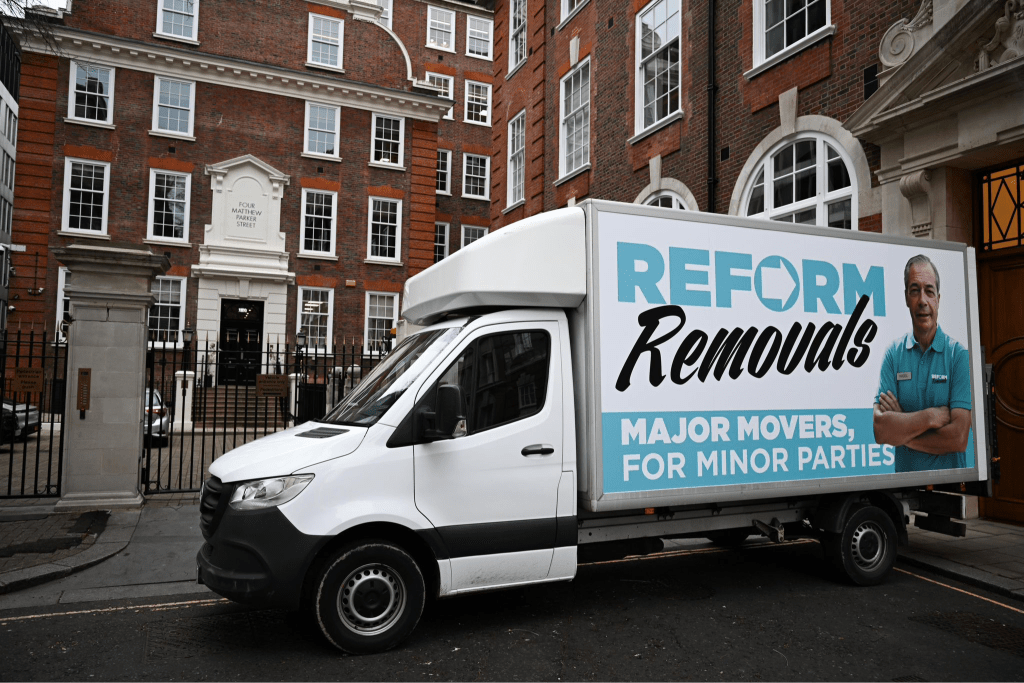
Could Alaa Abd el-Fattah have his British citizenship revoked?
It’s a difficult Monday for the Prime Minister. Shortly after Keir Starmer expressed his ‘delight’ that Egyptian dissident Alaa Abd el-Fattah had arrived in the UK, it emerged that the PM’s ‘top priority’ apparently hates Jews, white people and the English most of all, if his past tweet are anything to go by. As a result, the government is now facing demands from Nigel Farage, Kemi Badenoch, and even senior Labour MPs to strip el-Fattah of the citizenship he was granted in 2022 while a prisoner in Egypt.
How plausible is this? In fact, although such demands are very unusual in British politics, the deprivation of citizenship is a long-established ministerial power. Under the 1981 British Nationality Act, the Home Secretary has the right to deprive ‘any British citizen, British Overseas citizen, British National (Overseas), British Protected Person or British Subject’ of their citizenship if they are ‘satisfied that such an action is conducive to the public good’.
British citizenship is more than a piece of paper
This is specifically defined. ‘It is in the public interest to deprive an individual of British citizenship because of their conduct and/or the threat they pose to the UK’. Examples include ‘the interests of national security’, ‘where the person has been involved in serious organised crime’ and ‘where the person has been involved in…unacceptable behaviour’. It is left to the Home Secretary to ‘determine personally whether a person’s actions are such that it is in the public interest that they are no longer a British citizen’. One key limit on this power is that the Home Secretary can’t make such an order if it would make the person ‘stateless’.
Such powers have been tested very recently, in the case of Shamima Begum. Unlike el-Fattah she had lived in Britain from birth until she was 15, at which point she left the country to join Islamic State.
In 2019, the then Home Secretary, Sajid Javid, deprived her of her British citizenship on the basis that she posed a ‘risk to national security’. At that point, Begum was still a citizen of Bangladesh. She, supported by people within this country, mounted an appeal on numerous grounds, including the ‘public sector equality duty’ and that deprivation of British citizenship would make her ‘de facto’ stateless, because there was no realistic prospect of Bangladesh allowing her to enter the country.
In February 2024, the Supreme Court unanimously dismissed Begum’s appeal, rejecting all of her arguments. The matter was settled in British law, and the Home Secretary can deprive someone of their British citizenship, even if they are only theoretically entitled to citizenship in another country. This legal reality is accepted on the left, with organisations like the Runnymede Trust publishing research showing that ‘up to nine million people’ could have their citizenship removed by the Home Secretary under existing powers.
Given all of this, it would not be difficult or unreasonable at all for Shabana Mahmood to conclude that the presence in this country of a man who has described white people as ‘a blight on the earth’ and England as ‘the nation responsible for the greatest number of massacres in human history’ is not conducive to the public good. It seems he has never resided in the UK, his citizenship was issued just a few years ago and he still holds Egyptian citizenship. The Home Secretary could lawfully and swiftly remove el-Fattah’s British citizenship and order his deportation.
What is particularly interesting about this case is that it has changed the conversation about who is British. For the longest time we’ve been asked to accept that the mere grant of a British passport makes someone as British as people who have lived here their whole lives and whose ancestors have lived and died in these lands for centuries. That claim is obvious nonsense, and at last it is crumbling.
We all know that people like el-Fattah are not British in anything but an administrative sense. Of course he should be stripped of British citizenship and deported. And perhaps this will begin a wider, more pragmatic conversation about who we wish to share our country with. The UK issued nearly 270,000 British citizenships in 2024 alone. In fact, we’ve granted more citizenships since 2022 than Japan has since 1967. If British citizenship is to mean anything, then we must recognise that it is more than a piece of paper, and we should ask how many other new British citizens hold views as dangerous, and unconducive to the public good, as el-Fattah’s.