-
AAPL
213.43 (+0.29%)
-
BARC-LN
1205.7 (-1.46%)
-
NKE
94.05 (+0.39%)
-
CVX
152.67 (-1.00%)
-
CRM
230.27 (-2.34%)
-
INTC
30.5 (-0.87%)
-
DIS
100.16 (-0.67%)
-
DOW
55.79 (-0.82%)
Why bullies win
Remember when Friends Reunited was a thing? Twenty-something years ago, before Facebook even existed, this primaeval social networking site connecting people with their old schoolmates was the most searched thing on the UK internet. It is, now, at one with Nineveh and Tyre. In fact, the only truly memorable thing it achieved was to inspire a black-hearted spin-off site called ‘Bullies Reunited’.
That site purported to help reconnect the pre-teen thugs of yesteryear with their sniggering accomplices, or the boys and girls whose knees they’d skinned, pigtails twisted or Y-fronts wedgied to shreds. It was a joke, but a good one.
The nastiest, most aggressive, most tantrum-prone ten-year-olds grew up to be the most successful 46-year-olds
Because you do remember the bullies, don’t you? For all that Thomas Hughes loved pious Doctor Arnold, the standout character in Tom Brown’s School Days, as George Macdonald Fraser recognised, was Flashman. Most of those of us who grew up with Grange Hill in the 1980s will, I dare say, remember only two characters clearly. One was Zammo, obviously – the lad who was in all the papers because he couldn’t handle his drugs. The other was ‘Gripper’ Stebson, the school bully. Dennis the Menace, at least until he was emasculated by the Woke Stasi, was a straight-down-the-line bully, and readers of the Beano were expected to cheer for him. The poet Thom Gunn, a nice man who liked a bit of rough, was candid: ‘I praise the overdogs from Alexander/ To those who would not play with Stephen Spender.’ Nietzsche was on to something with that ‘will-to-power’ thing.
Unfortunately, the two cliches with which we victims seek to comfort ourselves about bullies are right up there with ‘size doesn’t matter’ and ‘your call is important to us’ among the great fibs. The first is that bullies are always cowards. The second is that, in the long run, they don’t prosper. Many of us discovered that the first one was a lie through bitter experiment. Empirical evidence for the second, though, has been patchier and longer coming. Yet yesterday it arrived in the form of the findings of the British Cohort Study’s multi-decade longitudinal survey of the lives of 7,000 children born in 1970.
They took data gathered from the primary school teachers of 1980 and matched them up with how their subjects were faring in 2016, at the age of 46. I don’t know whether it was personal mortification or fear or reprisals that caused the knock-kneed social scientists concerned to spend fully seven years before publishing their results, but there it is: the nastiest, most aggressive, most tantrum-prone ten-year-olds grew up to be the most successful 46-year-olds. On average, said one of the study’s authors, they found ‘a strong link between aggressive behaviour at school and higher earnings later in life’. Bullying other kids at ten was associated with a four per cent lift in earnings in middle age.
A surprise? Perhaps not. Many of us, I think, will see these results as reflecting a world we recognise. We had a sense of what bears do in the woods, even if we hadn’t before been given a detailed and scientifically verified account of the distribution of their leavings. Bullies occupy positions of power in all sorts of walks of life. They like power, after all; it’s their thing. You can be sure the ‘Alexander’ of Thom Gunn’s poem wasn’t Alexander Graham Bell or Alexander Beetle. The pop-psychologist Oliver James wrote a book a few years back called Office Politics in which he argued that those who thrive in white-collar environments often exhibit the so-called ‘dark triad’ of qualities: psychopathy, Machiavellianism, and malignant narcissism.
The very metaphors with which we talk about the business world – of ‘cut-throat competition’, of fighting for market share, of driving out competitors, of hostile takeovers, ‘killer instinct’, even of bulls and bears – are metaphors of violence. They imply an arena in which aggression is rewarded and ‘ruthlessness’, which is literally a synonym for lacking pity, is a quality to be admired.
And as for politics, hooboy. Vladimir Putin’s career and his baleful effect on international politics aren’t to be accounted for by his silky diplomacy. It’s looking very likely that the next president of the United States will again be a man whose chief appeal to his fans is his jeering aggression against anyone and everyone he perceives as weak, vulnerable or a ‘loser’. Even among those whom decent people might admire, the most successful often show a bullying streak. Whatever her many virtues, Mrs Thatcher never really acquired a reputation as a patient consensus-builder.
That’s not to say the consensus-builders never prosper – none of Mikhail Gorbachev, Tony Blair or David Cameron seemed to have much of the bully about them in office – but even the consensus-builders tend to keep a tame bully or two on the staff. And the last few cabinets have contained enough triadic individuals that the phrase ‘bullying inquiry’ has seldom been out of the headlines. (Rishi Sunak’s difficulty seems to be that he’s a decent man but isn’t enough of a bully himself to keep the real bullies in his entourage under control.)
It looks bleak for the meek
One of the authors of the British Cohort Study was quick to deny that their findings mean we should all encourage our kids to channel their inner Gripper Stebson. ‘I suppose [it means] encouraging your child to stand their ground, rather than being aggressive,’ said Prof. Emilia Del Bono. I can’t help thinking that sounds a little like an attempt to spin the result in a way palatable to our moral sensibilities. Standing up for yourself is a slightly different form of assertiveness to pushing the other fellow over.
Hopeful noises were made, too, in the report I read of these findings, that perhaps things will be different for later generations than the one surveyed; that the post-#metoo era has shaped a cohort in which the kinder, gentler, more feely-touchy and consensual virtues are valued and aggression gets you nowhere. But looking at the state of our public discourse – where the ‘pile-on’ (whose very name is drawn from playground violence) is the quintessential form of engagement and even supposed victims are now (in Julie Burchill’s phrase) cry-bullies – I kinda doubt it.
Few people see themselves as bullies, mind you. As a conjugation, it goes: I don’t suffer fools gladly; you are pushy and aggressive; he’s a bully. But whichever way you parse it, it looks bleak for the meek.
Keir Starmer should think twice before shunning Marine Le Pen
Riding high in the polls with a 20-point lead, the Labour party is preparing for government. Across the Channel with a 10-15 point poll lead in the June European elections and predicted victory in the 2027 presidentials, the Rassemblement National is making tentative preparations for government too. Two years after forming his cabinet, Sir Keir Starmer’s cross-Channel interlocutor will be either Marine Le Pen or – should her ineligibility be declared in the forthcoming October trial for alleged misuse of European parliamentary assistants – the RN’s star president Jordan Bardella.
David Lammy, who is given to intemperate language, should avoid insulting the future French government
Labour’s election manifesto is yet to be revealed, although something of its international positioning is gradually emerging from Starmer on Brexit and shadow foreign secretary David Lammy on foreign and defence matters. The RN’s programme for the European elections is only just being revealed in drip form. But there is much that France and Britain will wish to negotiate bilaterally, even if ideologically Starmer and Le Pen are unlikely bed-fellows.
Defence looms large. The relationship has at its core the Franco-British bilateral Lancaster House agreements signed in 2010 by then prime minister David Cameron and French president Nicolas Sarkozy. Subsequent British and French defence reviews and programmes reference them. The joint commitment is to close cooperation on a wide range of defence partnerships from weapons production, nuclear collaboration to joint combined military task forces. Piqued as he was by Brexit, then Aukus, Macron has paid scant attention to relations with London, other than souring them.
The RN wishes to recalibrate French foreign and defence policy away from its focus on the EU towards greater national sovereignty, independence and world reach – a sort of Global France. The RN’s website on defence has many policies that chime with neither Labour or Conservative governments: withdrawal from Nato’s integrated command (again), ‘dialogue with Russia on major shared issues’. It also plans to cease structural cooperation with Germany on large joint projects, such as the next generation tank and fighter jet. But on Britain specifically, the RN calls for a ‘new phase of dialogue on the entente cordiale with the British’ in areas such as nuclear and defence operations.
It should not be forgotten that the RN, or Front National as it was, supported Brexit. At his first campaign rally on 3 March, Jordan Bardella returned to this issue in setting out his party’s line on reforming the EU. While the party has moved from its desire for Frexit, Le Monde labels it as wanting ‘a hidden Frexit’, via an à la carte Europe based on ‘a European alliance of free and sovereign nations’ to be achieved if necessary by a re-working of EU treaties. Moreover, the RN’s EU would be a de-fanged one, in which the Commission’s prerogative for initiating laws would be removed, reducing it to a mere secretariat. For the RN’s president, who praised Brexit, the new model for the EU would be so un-constraining that even the British could reintegrate it. On defence and diplomacy specifically, Bardella stated that no further cooperation with the EU will be countenanced.
So how should Labour approach relations with a Le Pen/Bardella regime? There are clearly things they should avoid. First David Lammy, who is given to intemperate language, should avoid insulting the future French government as he did on Twitter with Donald Trump. Second, Starmer and Lammy should avoid jumping at the opportunity of signing a mooted foreign and security agreement with the EU. While professing not to reverse Brexit, one can easily imagine a naïve Labour foreign affairs team hastily succumbing to the siren sounds of eased trade relations with the EU on phytosanitary inspections or musicians touring to the continent in exchange for a major defence and security pact with the EU.
This would be foolish on several grounds. After June, the new EU parliament and new commission will be very different to now. A more national sovereignty focus could see radical EU reforms undertaken that would need to settle before Britain could even contemplate signing any security pact, especially if it involved engaging in an EU common weapons procurement scheme. Serious thought should be given to how an EU deal would impact recently sealed agreements with major allies like the USA and Australia (Aukus), or construction of the next generation fighter aircraft with Japan and Italy (Tempus), or indeed Britain’s tilt to the Indo-Pacific. This would leave time for Labour’s team to consider whether, post-Macron, Global Britain might not be better suited to working with a new Global France that shared some of its international values rather than hitching itself anew to a tired EU.
The real problem with Jonathan Glazer
Every year the Oscars unleashes some kind of political controversy, and this year’s revolves around Jonathan Glazer’s speech denouncing Israel. Glazer, the director of the acclaimed Holocaust film The Zone of Interest, used his moment in the spotlight to rail against ‘the Holocaust being hijacked by an occupation which has led to conflict for so many innocent people’. An open letter has sprung up to rebuke him, and even the film’s executive producer has distanced himself from Glazer’s remarks. Some argued that Glazer unwittingly betrayed his own film’s core message. In fact, Glazer’s comments flow naturally from the film itself, and from the very problem of focusing a Holocaust film on the ‘banality of evil’.
The protagonist of The Zone of Interest, Auschwitz Commandant Rudolf Höß, is presented as the epitome of the ‘banality of evil’. He is a twitchy, conscientious civil servant. He commits his crimes at a distance, filling in forms and phoning suppliers. He concludes his conversations with a lacklustre ‘Heil Hitler, et cetera’. All he seems to want is a conventional family life with his wife Hedwig. He frolics in the water with his children, he weeps while saying goodbye to his horse: and all the while, the din of Auschwitz can be heard in the background, behind the garden wall (the film undoubtedly deserved its Best Sound win at the Oscars). Glazer’s Höß, in short, is the consummate competent bureaucrat, his mind fixed on the job.
But what’s the historical reality? On 31 May 1923, in a forest in Mecklenburg, a 63-year-old schoolteacher named Walther Kadow was beaten to death by a band of thugs. One of Kadow’s former pupils, Martin Bormann, suspected him of having betrayed an ally to the French, and thus encouraged his underlings, including Rudolf Höß, to kill him. For this crime, Bormann was sentenced to one year in prison: he joined the Nazi Party a few years later, and was to serve as Hitler’s private secretary. Höß, already a card-carrying Nazi, was sentenced to ten, but then released after only five as part of a general amnesty. Perhaps this convicted murderer wasn’t quite the dull bureaucrat that The Zone of Interest would have us believe. One could watch Glazer’s film a thousand times and remain none the wiser that its protagonist once killed a man with his bare hands.
At its essence, the problem with The Zone of Interest is the problem with the ‘banality of evil’. Hannah Arendt dreamt up that snappy phrase while viewing the trial of Adolf Eichmann in Jerusalem in 1961, and it has retained a hold over the popular imagination of the Holocaust ever since.
The Zone of Interest exaggerates what is universal about the evils of Nazism at the cost of what was particular
Arendt has been criticised by generations of historians for, in effect, taking Eichmann at his word: for believing that he was merely a weak-willed middle-manager who only did what he was told. Her analysis of Eichmann may well apply to ordinary Germans who lived under the Third Reich; it may even be appropriate for the lower rungs of the Nazi civil service. But it is wholly inadequate as an explanation for the behaviour of the Nazi top brass, which The Zone of Interest tries to represent. The architects of the Holocaust, men like Eichmann and Höß, were not banal mandarins living banal lives: they were zealots, radicals, brutes, and gangsters, committed to an ideology that would strike most of us today as profoundly weird. They gloried in violence and were often prepared, as Höß was, to kill, even when that came at a substantial personal cost.
The point of the film, according to Glazer, is to bring forth the unsettling fact that the Nazis were human beings. It serves nobody, least of all their victims, to present the Nazis simply as ‘monsters’. But Glazer runs the risk of overcorrection. The Nazis were people, but, as the French historian Johann Chapoutot has masterfully demonstrated, they were not people like us. They possessed an idiosyncratic, historically-contingent worldview: they had their own cosmology, their own anthropology, and, crucially, their own moral law.
Höß did not do what he did as a cog in the machine, but because he was motivated by a specific set of beliefs. In his post-war memoir, Meine Psyche, he explained that, since the Jews had declared war on Germany, exterminating them at Auschwitz was as justifiable as bombing Allied cities. There is no ‘banality of evil’ here to be found: beneath his evasions and excuses, Höß revealed himself as a fervent ideologue. ‘I remain a National Socialist’, he wrote before he was hanged in 1947, ‘in the sense that I still believe in this idea of life. It isn’t easy to give up an idea, a worldview you believed in for twenty-five years’.
Although it is vastly better, by any measure, as a work of art, the message of The Zone of Interest reminds me of The Boy in the Striped Pyjamas, a novel (and film) which ranks among the least proficient portrayals of the Holocaust. The book ends with the sardonic and nauseating line: ‘Of course, all this happened a long time ago, and nothing like that could ever happen again. Not in this day and age.’ Glazer wants his film to fulfil a similar didactic purpose. ‘This is not about the past’, he said back in December; ‘it’s about now’. We shouldn’t say ‘look what they did then’, he more recently declared in his infamous Oscars speech, but ‘look what we do now’. The point of The Zone of Interest is that the Holocaust could happen again – or, more disquietingly, that it could be happening right now. The omission of Höß’s personal capacity for physical violence is part of this refashioning of the Holocaust into an urgent modern warning: if such a thing could have been perpetrated by ‘ordinary’ bureaucrats, then we really ought to be on our guard.
Where does all this lead? Unsurprisingly, post-7 October, to Israel. The highest-rated review of The Zone of Interest on the website Letterboxd reads: ‘Truly horrifying how many people are going to watch this movie, rate it highly and bestow it awards and whatever, and then still be pro-Israel. This is literally about you.’ Glazer would seem to be open to this line of interpretation. Like so many artistic engagements with the Holocaust, The Zone of Interest exaggerates what is universal about the evils of Nazism at the cost of what was particular. This allows it to make a comment, perhaps even a ‘warning’, about contemporary politics – while sacrificing vital historical truth in the process. If Glazer’s Oscars speech is anything to go by, that might have been the point all along.
Carrie Johnson and the tragedy of pond life
As so often, Hello! magazine had the scoop. Carrie and Boris Johnson are expecting again. This time it is ducks. For her 36th birthday Mrs Johnson was presented with an incubator and some duck eggs. Any day now there will be a splintering of shell and a chorus of incipient, high-pitched quacks as another waddling brood fights its way into the world. Yet more young beaks for Boris to feed, and all the little darlings topped by fluffy, yellow fur. Those Johnson genes!
There is another sense in which baby ducks resemble MPs: they do not always last terribly long
Duck incubators are fashionable in Chelsea-tractor circles. You need enough room near the Aga to accommodate a cage where the new arrivals can be kept warm and safe from clumsy-oaf feet. Space is not a problem for the Johnsons now that they own a ‘sprawling’ (Hello! speak) country house. ‘Impressive, lovely, £3.8 million, 400-year-old Brightwell Manor,’ in Brightwell-cum-Sotwell, Oxon, has its own duck pond, soon to be a splashing kindergarten, more precisely Entegarten, as the Johnson ducklings take to water.
Friends of ours in Herefordshire have ducks. Every evening they file back into the duck house like US marines returning from field manoeuvres. Young children love ducklings. They are more fun than the plastic, bath-time variety. Live ducklings have a busy, slightly drunken gait and occasionally tumble on to their backs. When this happens they flap their feet in the air and have difficulty righting themselves. A prod from a human finger will help them roll back on to their fronts and continue cheerfully on their way. Ducklings are careless, comical, eat a lot and make a frightful mess. Just like certain politicians. Is it this, or a fertility obsession, or a Tony Soprano-esque hankering for innocence that attracted Boris and Carrie to ducks?

There is another sense in which baby ducks resemble MPs: they do not always last terribly long. My wife and I live in an old mill. A brook flows past – sometimes through – our house and every spring we are visited by ducks. Normally it is a couple but this year it is a ménage à trois, two drakes and one female. The chaps have handsome green heads. Their girlfriend is outwardly a more drab prospect, though no doubt she has what Hello! magazine would call a bubbly personality.
Every year, as happens, they produce little ones. The mother-duck puffs out her chest and proudly paddles along the brook, followed by some ten ducklings who swim in a neat line. It is the quaintest thing. Naming the little dears is probably, mind you, a mistake, for heartache will always follow. Next time you look at the brook the ten ducklings have become nine, then eight, soon four, eventually fewer. As the limerick goes:
A foul-smelling vulture said ‘cluck!’
Translation: ‘I’m down on me luck.
Can you show me a bird bath?
I’m now on my third path
And my talons still stink of dead duck.’
It is a lesson we must all learn, though three-year-old Wilfred Johnson, his sister Romy, two, and baby brother Frank may have hoped to postpone it for perhaps a few years yet: this world is ruthless. Your average duckling is, to a Brightwell-cum-Sotwell owl, an amuse bouche, an hors d’oeuvre, the owl equivalent, give or take hoisin sauce, of first-class rillette. Even before you consider the local shoot, magpies are not averse to duckling. Mink, squirrels, foxes and domestic moggies have also been known to indulge. Duckling can be jolly moreish. As someone once said, them’s the breaks.
Unhappy? What a luxury
Rob Stephenson is trying to produce a sonic representation of joy. He’s DJing on stage at the World Happiness Summit in London, pumping out a kick drum at 124bpm. The sound represents the subliminal satisfaction you get from a walk round the park, Rob says. He adds bongos and the dinging noise of a triangle to the track – acoustic equivalents of proper sleep and good nutrition. ‘Can you feel it?’ Rob asks. ‘Can you feel it?’ More inexplicable sound is layered – the melody from ‘Clocks’ by Coldplay, the riff from ‘Seven Nation Army’ by the White Stripes – and Rob starts gyrating at his decks in aural ecstasy. The crowd dance and raise their hands to the roof. They close their eyes and smile.
Today, we enjoy life more as we get closer to death
The summit is an annual get-together for joy junkies – people obsessed with trying to make the world a cheerier place. Last year they met in Lake Como, the year before in Miami, and now they’re in a conference hall on the South Bank of the River Thames. For a couple days they dance and chant and meditate and listen to lectures on wellbeing and mindfulness, as they try to learn the newest ways to become happy. ‘It’s insightful, inspirational,’ says Miguel, who works in hospitality. (‘I lead a team – I serve a team – of six,’ he says.) ‘I’m here to find my purpose. Just to find my groove. Find my flow. That’s why I’m here.’
The happiness business is just the newest incarnation of a decades-old western addiction to self-care. Dr John Travis opened America’s first ‘wellness centre’ in the 1970s. ‘It’s recognising that there’s more to life than the absence of sickness’, he told 60 Minutes. Jon Kabat-Zinn made a career in the 1990s spreading mindfulness techniques he learnt from Buddhists. He wrote bestselling books like Full Catastrophe Living and Wherever You Go, There You Are. The writer Tom Wolfe said the luxury of ‘dwelling on the self’ was a side effect of America’s mid-century economic success: people became rich enough to worry about the meaning of their life.
Outside the South Bank conference hall, Karen Guggenheim, who runs the happiness summit, says self-care today isn’t an indulgence like it used to be – it’s essential to coping in our insane world. Think about the pressures we put on our kids, she says:
Be yourself, be happy, but then again, get good grades, do this, do that. Make sure you shine in sports so you can get into the best universities and you can get the best job, and then you can get… and then you can… and then you can. The kids are like: ‘No.’ It’s too much. Too much pressure.
Western societies are now so sad that they’re reversing one of the foundations of behavioural economics. This year’s ‘World Happiness Report’, which ranks countries by measuring the satisfaction of their populations, came out a couple days ago. Britain’s under-30s are the 32nd happiest in the world, and our over-60s are 20th. In America, their under-30s rank 62nd, and their over-60s, 10th. Today, we enjoy life more as we get closer to death. ‘Youth, especially in North America, are experiencing a mid-life crisis,’ said Dr Jan-Emmanuel De Neve, who helped put the report together.
Faced with that terror, Karen is ‘awestricken’ by the success of her summit. ‘If you look at the standings from the World Happiness Report today, they’re quite bleak,’ she says. ‘So I’m excited, actually.’ You couldn’t deny it: the summit had hosted excellent sessions like ‘The Impact of Sense of Smell on Wellbeing’ and ‘Thriving in Today’s High-Speed Life’. But they were treating a crisis with a shtick. Earlier this year, a University of Oxford study said relaxation routines, lifestyle coaching and wellbeing apps make ‘no difference’ to happiness. A study on school children from 2022 found mindfulness techniques do not improve wellbeing.
Never mind. ‘Business executives have only just got their heads around diversity’, says Paul, who helped arrange press coverage for the summit. A new workplace revolution is coming; on LinkedIn, two-thousand people already have the job title ‘Chief Happiness Officer’. Paul picked up a free flat white outside the conference hall, and raised it to the barista: ‘To good health.’ We’re created sick, commanded to be sound.
The snobbery of lemon supremacists
I love certain sour flavours, such as the sprinkle of lemon on a piece of oily fish, or fatty meat. It is perfect with food that is naturally sweet, such as brown shrimp, scallops, or young, fresh peas. But spare me the heavy hand with the acid, which seems to be getting more and more frequent when it comes to pre-seasoned food in restaurants. Lemon juice should be a background note, helping the main flavours to stand out. It should not make you wince as though you are chewing a live wasp.
We should resist drowning our food in lemon juice in the way that we would ketchup or salt
I am just back from lunch at a lovely little Cypriot joint where every single thing is made from scratch. I had bulgur kofte – a crunchy shell filled with lamb, ground pistachios, walnuts, and pine nuts, and flavoured with oregano, fresh parsley mint, cinnamon, and a tiny hint of allspice. This dish is meant to be served with wedges of lemon on the side, but the chef had been unable to resist squeezing a load of the stuff over the kofte. I couldn’t taste any of the subtle flavours at all. Not only that, but the crispy shell was soggy where it met the puddle of acid on the plate. On my way home from the restaurant I stopped at the pharmacy to buy a large bottle of Gaviscon.
Excess lemon use is not only a problem in restaurants. At a friend’s cocktail party recently our host served the most exquisite seafoods blinis, onto which she squirted what looked like a litre of citrus as she brought them from the kitchen. The blinis were drenched, I could hardly taste the main ingredients, and the abundance of acid curdled the cream cheese.
And it’s not just food that too much lemon can ruin. The acid in the fruit is bad for your teeth. It can literally strip the enamel off it, and too much on a regular basis dries out your skin. Think about why you are squeezing that juice on your food before you do it, particularly if you have already added sumac or something else quite citrusy. If lemon will enhance something, think about it as the way you might sprinkle a little salt on a dish, don’t drown it in the stuff.
Apple cider or sherry vinegar are a much better option with delicate dishes, or use the juice from a roasted lemon mixed with a little brown sugar or honey. It is delicious on a roast chicken or vegetables such as courgettes and spinach, and allows the flavour of the main ingredient to sing. I’ve been making celery juice recently, which adds a delicious overtone, but without excess acid.
We should resist drowning our food in lemon juice in the way that we would ketchup or salt. It is an enhancer and should lift the flavours, not dominate. Those guilty of committing this particular culinary crime do it, in my experience, for one of two reasons: the food has little flavour, and lemon is a disguise, or, because lemon is a fruit and therefore healthy, it is assumed that it can do no wrong. Basically, it’s a type of snobbery.
What would we do without the lemon? Its juice works wonders for tenderising meat prior to cooking, and to stop avocado going brown once it’s been removed from its shell. The zest is delicious in lentil soup, and I can think of 100 other ways to use a lemon in cooking. But like adding too much cumin, or chilli, that little bit too much ruins everything.
Next time you are sprucing up a kofte, seafood, or salad, try using drops of a decent red wine vinegar, such as the rather special Pommery, or the less pricy Kolossos for a gentler contrast. Or, if you are hell-bent on lemons, be a bit more sparing when you sprinkle?
Why did the SNP make allowances for Spain during Covid?
The Covid Inquiry’s recent Scottish sojourn brought several weeks of bad headlines for the SNP. One revelation got less attention than others but struck me as more significant than most, so I wrote about it for Coffee House.
That revelation was an email chain dug up by the inquiry dating from the first summer of the pandemic. It contained a discussion about which countries should be added to the list of ‘travel corridor’ nations. In one email, a senior civil servant argued for Spain to be added to the list because ‘there is a real possibility they will never approve EU membership for an independent Scotland’ otherwise.
If that seems like quite the leap, know that the possibility of Spain vetoing an independent Scotland’s accession to the European Union has long been a source of anxiety for Scottish nationalists. The email, addressed to then top civil servant Ken Thomson (but cc-ed to the offices of Nicola Sturgeon, Humza Yousaf and others), was sent on 19 July 2020. On 23 July 2020, Spain was added to the list. (It was removed again three days later because of its high Covid prevalence rates.)
Yousaf told the Scottish parliament in February: ‘To suggest that the decision on Spain was made for any other reason than epidemiology is, I am afraid, a fantasy.’ However, a report in today’s Scottish Mail on Sunday casts doubt on that. (Full disclosure: I write a weekly column for its sister paper, the Scottish Daily Mail.)
The newspaper says officials were sent a note on 20 July 2020, the day after the email in question, outlining plans to open a travel corridor with Spain. According to the newspaper, the memo ‘explicitly stated that public health data was not the only consideration in reopening travel’, and the story quotes a reference in the missive to ‘the impact on Scotland’s external relationships, including with Spain’. For its part, the Scottish government says its decisions were ‘based on the UK government’s data’.
Rather a lot has come out during the Covid Inquiry that is at odds with the image projected by Sturgeon and lapped up by the London media: that of the smart, sensible government that, unlike the hated Tories, listened to the experts.
There was the confirmation that Sturgeon deleted her WhatsApp messages from the pandemic, despite having promised to retain them, and that her second-in-command, John Swinney, had manually erased all of his messages with Sturgeon from that time period.
There were communications from Thomson in which he encouraged officials to ‘clear’ their messages because they were ‘discoverable under FOI’. ‘Plausible deniability are my middle names,’ he told them.
We learned that Scotland’s response to Covid-19 was led by a shadowy group called the ‘Gold Command’, headed by Sturgeon and comprising her loyal lieutenants. Meetings took place without any minutes recorded. The Scottish cabinet wasn’t entirely sidelined: three months into the pandemic, it was discussing a fresh campaign for independence that would use the pandemic to its advantage.
But the Spanish travel story, to my mind, is particularly damning. A senior Scottish government official advised a change in the rules for one country based, in part, on that country’s ability to hinder a major policy goal for an independent Scotland. Worse, the Scottish Mail on Sunday story would appear to suggest that this constitutional dimension played some part in the decision to open a travel corridor with Spain.
Wherever the truth lies, this episode is another example of the utter folly of devolution. Far from lancing the boil of nationalism, all this Blair-era blunder did was build up the apparatus of incipient statehood, apparatus which it arrogantly believed would always be controlled by Labour, but which was quickly taken over by the SNP. Predictably, the Nationalists have used that apparatus as a battering ram, directing part of the British state to undermine it overall.
If Labour deserves contempt for its dangerous idealism in setting up a Scottish parliament, the Tories warrant white-hot hatred for entrenching and expanding devolution long after its constitutional perils had become apparent. But both parties would rather listen to ultra-devolutionists in their ranks and to on-message thinktankers and commentators than confront the truth: that every advance for devolution in Scotland has been an advance for the cause of independence for Scotland. The SNP may be a formidable opponent, but Westminster is its own worst enemy.
Will Sunak renege on ‘foreign powers’ owning newspapers?
Last week, a rebellion in the Lords drew a government pledge to ban foreign governments and their proxies from owning British newspapers and magazines. It was a historic moment for the defence of press freedom in the era of acquisitive, well-connected autocracies. It will have global significance. But the devil was always going to lie in the detail, and that will come in the third reading of the Digital Markets Bill due Tuesday.
The risk is that ministers may row back and allow the Emiratis to become part-owners of this magazine and the Telegraph by keeping a low stake of 5 per cent or even 1 per cent. This would still grant them the ownership status that they seek, albeit on a far-diminished basis. If so, would it matter? I think so, for the following reasons.
The is about principles, not percentages. The published text of the amendment says the government must act to prevent ‘foreign powers from gaining control or influence over newspaper enterprises’. Allowing the Emirati government the status of part-ownership – whether 1 per cent or 25 per cent – is allowing them to gain influence. This is not explicitly ruled out in the wording and the fuzziness may be deliberate.
There are good reasons for the government to fudge it: to keep the Emiratis sweet in hope of the £10 billion of investment Abu Dhabi promised, to invest in projects such as Sizewell C etc. You can see the temptation for ministers to say ‘let’s let them keep a small stake in the Daily Telegraph. It’s negligible. They would have no real power and it saves face, and keeps our chance of that cash. My concern is that the principle of autocratic part-ownership of UK media – which should not be entertained by any self-respecting democracy – may still be allowed, just to keep the Emiratis on board. Control? No, not at 2 per cent. But influence? Yes, even at such low levels.
A small stake could still put the Emiratis in the list of top five, even top three, shareholders of a newspaper. It could transform their status from ‘undemocratic regime allied with Vladimir Putin, to be scrutinised like any other autocracy’ to joint owners who may well have the editor on speed dial. It risks sending a chill down the spine of any publication: a young journalist who may (for example) be considering digging in to the deepening Emirati relationship with Putin could think twice. What if this upsets a senior manager? What if this marks you out as a troublemaker?
Readers, too, would have good reason to be suspicious if foreign governments start part-owning publications. As I recently wrote in my Telegraph column:
My fear about RedBird IMI buying The Spectator was not that we’d turn into an Arab Pravda, but that the magazine would be seen as part of this influence-laundering apparatus. For example, I happen to think Islam is often unfairly maligned in this country and that recent reforms in Saudi Arabia are more impressive than are generally credited. But if I said so, and you know that Emiratis owned my magazine, would you take me seriously? Your suspicions would remain, quite rightly, if the Emirati government owned even 5 per cent. That’s why it’s important that Rishi Sunak’s new law does rule out minority shareholdings.
The Emirati game is not about control but ‘influence laundering’. This is a post-2008 crash trend whereby cash-rich autocracies seek to build a portfolio of influence by part-ownership, or funnelling cash into front organisations. Sheikh Mansour’s IMI was providing 75 per cent of the funding for the joint venture with RedBird. Jeff Zucker, former president of CNN and current head of RedBird IMI, would be the face of it. That ended up being a bit too obvious. Zucker claimed that IMI was not at all an Emirati government project but a private one that just happened to be run by the deputy prime minister of the UAE. This proved unconvincing.
Tina Stowell’s amendment – and Robert Jenrick’s proposed rebellion in parliament – stopped outright RedBird IMI ownership but that was on principle. Thangam Debbonaire, the shadow culture secretary, was speaking on principle when she said that foreign government ownership of newspapers was incompatible with press freedom. Quite evidently, this goes for part-ownership, too. It would give the Emiratis a favour to trade in, or the ability to enter a newspaper’s office with the status of a part-owner.
As Baroness Stowell said in the Lords, it’s important that any new law does not bar the $1.6 trillion(!) government pension fund of Norway, for example, from investing in UK media. Same for pension funds of Japan, Netherlands etc. Such funds (list here) are not used as tools for their government’s foreign policy. Baroness Stowell calls ‘indirect foreign-state passive investment’ and, in my view don’t pose a risk. Limiting their stake in media firms to 5 per cent would be fairly harmless as none of these government pension funds want to go above this in a media investment.
Baroness Stowell is optimistic that the door won’t be left open for minority stakes by foreign powers:-
I’ve been assured – and will ask the minister to repeat it from the despatch box this week – that anyone blocked by the definition of foreign power in the government’s amendments on the face of the Bill will not qualify for the exempt category to be set out in secondary legislation. In my view, the threshold for indirect foreign-state passive investment by the likes of sovereign wealth or state pension funds in the UK news industry – which is important economically to the news industry – should be set at 5 per cent, and that’s what I’ve made clear to the government.
My ideal figure for the maximum ‘foreign power’ stake is zero. But I can see why all this is sensitive for the Tories. The Emiratis have turned out to have strong Tory contacts: Sheikh Mansour had not one but two former Tory chancellors acting for RedBird IMI in this deal (Nadhim Zahawi and George Osborne). David Cameron, now Foreign Secretary, was actually living in Abu Dhabi last year. In my view, this is bit much and ministers should be banned from ever working for any foreign power. This would allay concerns about ministers making decisions now with a view to their post-politics career. It’s a clear source of potential conflict .
Parliament has acted to defend press freedom – and so far, it has worked. So well that you almost expect there to some last-minute backsliding. Baroness Stowell, who has led this campaign with flair and precision, has said she will make sure this week and ask questions. We’ll bring you more on Tuesday as the debate unfolds.
UPDATE
Tina Stowell has posted the below. If she is right, it’s very good news – and Sunak will have been every bit as good as his word. Here’s hoping.
My understanding is that any foreign power as defined by Govt’s new amendment will be 100% blocked from owning, controlling or influencing a UK newspaper or magazine. They can’t have even 0.01%. No exemption category will be allowed unless it is passed by Parliament in a piece of secondary legislation still to be presented. That won’t come forward until after the primary law is passed (in a few weeks).
So, once the new primary law is passed, there will be no exemption for anyone until Parliament approves such an exemption. The devil will be in the detail.
My expectation – which I’ll seek confirmation of during Tuesday’s Third Reading – is that the exemption in secondary legislation will not be for those entities or individuals disqualified by the foreign power definition in primary legislation; and such entities won’t be allowed to re-emerge or restructure to qualify. The exemption is only for the kind of well-established indirect foreign-state investors that already make passive investments in our news industry (eg, the Norwegian Sovereign Investment Fund).
Also, for the news industry only, those kind of passive investors (ie, the sovereign wealth funds that are not state-controlled) will be capped – and I’ve proposed that cap is not higher than 5%. All of this is what I’ll be seeking Ministerial confirmation of from the despatch on Tuesday, and assuming that confirmation is given, will make sure is delivered in the secondary legislation to follow.
The West must wake up to the threat of Islamic State-Khorasan
It is time to wake up to the growing international threat posed by Islamic State-Khorasan (IS-K), the group believed to be behind Friday’s terror attack on a Moscow concert hall that left more than 130 people dead. For far too long this Afghanistan-based offshoot of Islamic State, formed in 2015, has been underestimated. Ignoring it is no longer a safe or wise policy option.
Alarm bells have been sounding for some time now about the growing threat posed by IS-K
IS-K has been growing in strength in Taliban-led Afghanistan ever since the Americans pulled out of the country in 2021. It has been successful in attracting a growing number of jihadis to its cause through a series of deadly attacks. Some reports suggest its fighters now number more than 2,500 – a considerable increase for a group that started off with no more than a few hundred recruits. What are its aims? It wants to establish an Islamic caliphate in central and south Asia. It hopes to achieve this through the tried and tested method of Islamists everywhere: sowing instability and chaos through murder and violence.
The terror attacks increasingly attributed to the group provide ample evidence of its growing capacity to conduct cross-border operations in a number of countries. IS-K was behind the twin bombings in Kerman in Iran in January, which killed an estimated 90 people and injured hundreds more. The group has also claimed responsibility for several attacks in neighbouring Pakistan. This includes a suicide bombing at a Shi’ite mosque in Peshawar in 2022 and another attack in Bajaur district in Pakistan last year, which killed 60 and wounded more than 100 others. It was also behind the attack on Kabul airport, which killed 13 American soldiers and 170 Afghans during the US withdrawal from the country in 2021. It has claimed to have orchestrated more than 200 attacks in Afghanistan. What is without doubt is that in eight short years, it has managed to establish itself as one of the most brutal terror groups in a region that is already teeming with militants and extremists: quite some feat. Running parallel to its terror ambitions is a clever propaganda operation, trumpeting its violent successes with the aim of attracting even more recruits to its cause.
Alarm bells have been sounding for some time now about the growing threat posed by IS-K, but few in power seem to have been listening. In March last year, General Michael Kurilla, head of US Central Command, told the Senate armed services committee that IS-K could be capable of conducting external operations ‘with little or no warning’ in less than six months. Kurilla was speaking primarily about the group’s ability to carry out attacks in Asia and Europe, but US officials have long pointed out that IS-K propaganda frequently trumpets its intentions for a 9/11 style attack on the United States.
The uncomfortable truth is that the Biden administration’s decision to withdraw from Afghanistan – which paved the way for the Taliban to return – has inadvertently helped to strengthen IS-K. The ability to monitor terrorist threats emanating from Afghanistan has been seriously downgraded since America pulled out. Thousands of fighters and potential recruits escaped from prison in the power vacuum and chaos that ensued as the Taliban prepared to seize power in the weeks and months after America’s departure. The humanitarian crisis and the wider social breakdown once again leaves the country as an ideal base for Islamists to congregate, plot and operate with impunity. It is all eerily reminiscent of al-Qaeda in the years before the 9/11 attacks.
So, what next? IS-K is still in its infancy when it comes to conducting an international campaign of sustained violence and terror. It doesn’t have the money, logistics and numbers required to do much beyond its Afghan base. Not yet, anyway. But – and this is the critical point – it can no longer be dismissed. It is growing more ambitious and aggressive in its attempts to sow terror in as wide a geographical area as possible. The growing number of successful attacks it has carried out highlight the glaring holes in intelligence-gathering and security when it comes to monitoring the movements of militants in a part of the world plagued by political violence and terrorism. No one in power can say they weren’t warned. Combating IS-K must be made a priority.
Hunt: Tories will keep the triple lock on pensions
Jeremy Hunt: Russian government creating a ‘smokescreen of propaganda’
On Friday night, a terrorist attack at a large concert in Moscow led to at least 133 deaths. Russian officials vowed revenge and suggested Ukrainian involvement, despite Islamic State claiming responsibility. On Sky News this morning, Trevor Phillips asked Jeremy Hunt how much Russia’s version of events could be believed. The Chancellor said it was always a tragedy when innocent people lost their lives, but that the UK had ‘very little confidence in anything the Russian government says’. He suggested they were creating a ‘smokescreen of propaganda’ to justify their invasion of Ukraine.
Hunt guarantees Tories will keep triple lock on pensions
Speaking to Laura Kuenssberg, Hunt was unequivocal in stating that the ‘triple lock’, which guarantees that rises in the state pension keep pace with inflation, would remain in place for the whole duration of the next parliament if the Tories were to be re-elected. Hunt said that in 2010, pensioners were more likely to be in poverty than other income groups – whereas the opposite is now true. He admitted that keeping the triple lock is an ‘expensive commitment’, but claimed that the Tories’ plan for economic growth would allow them to fund it.
Anneliese Dodds: ‘Labour is going to ban zero-hours contracts’
Phillips questioned Labour party chair Anneliese Dodds over her party’s approach to zero-hours contracts. He suggested that shadow chancellor Rachel Reeves had not been explicit in her speech that Labour was going to stick with its policy of banning them. Dodds disagreed, saying Labour had always been clear that there needed to be flexibility in some kinds of work. When pressed by Phillips to clarify Labour’s position, Dodds said the party was indeed banning zero-hours contracts, and that Reeves had been very clear in stating how important such a measure was to improve productivity in the country.
Hunt: ‘With the Waspi women, it is genuinely more complicated’
This week a report by the Parliamentary and Health Service Ombudsman found that Waspi pension campaigners were entitled to compensation for the poor governmental communication, which led to many women being tens of thousands of pounds worse off than they expected to be at retirement. Kuenssberg asked Hunt if he would commit to compensating those affected. Hunt claimed that the situation was complex, as a 2020 High Court ruling said the Department for Work and Pensions had not discriminated against the Waspi women. He said they needed to get to the bottom of the ‘apparent difference’ between the two findings, and said there was no ‘secret vault of money’ for compensation.
Paddy Harverson: Princess of Wales ‘always had this great strength’
Finally, a social media storm speculating about the welfare of the Princess of Wales ended on Friday when she announced that she has been diagnosed with cancer. Paddy Harverson, Prince William’s former communications secretary, told Kuenssberg that this instance of media intrusion was the worst he’d ever seen, but said that the Prince and Princess were a strong couple and would be coping ‘better than people realise’. Harverson pointed out that families need time when confronted with cancer, and said he was convinced they would have announced the news in the same way even if the ‘madness’ on social media hadn’t happened.
Should Biden change his Venezuela approach?
Venezuela has been leading the United States on, maintaining the pretense that they will ensure that the upcoming presidential elections are free and fair. That’s despite the US relieving sanctions, releasing prisoners and months of “diplomacy.” The Nicolás Maduro regime has also gone on offense, threatening to take back the Esequibo, an area now under Guyana’s jurisdiction, where American oil companies have invested billions. This Wednesday, Maduro mocked the Biden administration once again, arresting two high-level officials from opposition candidate María Corina Machado’s team and issuing arrest warrants against several others.
Henry Alviarez, Machado’s campaign’s national organization coordinator, and Dignora Hernández, her political coordinator, were the subjects of Wednesday’s arrests. The warrants, issued by attorney general Tarek Saab, also target many others, including Machado’s campaign chief Magalli Meda, who has been discussed as an alternative candidate considering the continued barring of the opposition leader from running for office.
In a statement, assistant secretary for western hemisphere affairs Brian Nichols said, “We condemn the arbitrary arrests and warrants issued… for members of the democratic opposition in Venezuela. We call for the immediate release of these individuals and all those unjustly detained.”
The arrests are set to further complicate the prospects of an already-dubious democratic election in July. This is bad for Venezuela, of course, but it is also a slap in the face for the US, which developed an entire rapprochement strategy that has evidently backfired.
Maduro’s steadfastness in keeping Machado out of the election may surprise some White House policy experts. Not Florida senator Rick Scott. “It was obvious that the dictatorship was going to respond in this way to President Biden’s weak appeasement and reduction of sanctions,” he told The Spectator. “This is what happens when you give a genocidal dictator what he wants.”
When asked about what the White House could be doing better, Scott said, “President Biden must re-impose severe sanctions on the illegitimate Maduro regime now. Now.”
“No more excuses, second chances for Maduro or ‘revisions’ that only fuel the regime and undermine our fight for freedom and democracy in Venezuela,” Scott said. “America should never trust a genocidal tyrant and a liar like Nicolás Maduro — that should hold true regardless of which party is in power.”
Accompanied by Senators Marco Rubio and Bill Cassidy, Scott sent a letter back in January demanding that the White House abandon their appeasement attempts. The latest developments appear to vindicate their stance. Scott suggests that US policy must be consistent in refusing “concessions with the Maduro regime and any appeasement policies, like lifting sanctions, that benefit the regime while doing nothing to advance the cause of freedom and democracy.” He suggests that the US should do more to back Machado, arguing that an election without her cannot, by definition, be democratic.
“Let me be clear: Nicolás Maduro’s regime is a narco-dictatorship that commits genocide against its own people and works with all the evil regimes that hate America,” the senator said. “Iran and its Islamic Jihad proxies, Russia, communist China and Cuba” are some of the countries he says are working with Maduro to “destabilize the Western Hemisphere.”
“From the release of Maduro’s nephews, lifting sanctions and granting clemency to Maduro’s crony, Alex Saab,” Scott says, the Biden administration has “turned its back on freedom and democracy, putting the stability of the region and America’s national security at risk.”
Will the Biden administration change track? His foreign policy record in his first term has proven mixed at best — and he can ill afford another blunder abroad in an election year.
Jon Sopel joins the Garrick Club
Tough times for the Garrick Club, after the embarrassing leak of its membership list to the Guardian. Following the newspaper’s front-page splash on Tuesday, multiple senior Establishment figures quit the all-male club. They included MI6 boss Sir Richard Moore, Simon Case, the cabinet secretary, and Sir Robert Chote, the former head of the Office for Budget Responsibility. Other resignations at the £1,000-a-year West End haunt are expected to be in the offing too.
But never fear: one’s man loss is another man’s gain. And the man filling the space occupied by recent departees is none other than former BBC newsman Jon Sopel. He has just joined the 193-year-old club after ‘a lengthy wait’, according to today’s Mail on Sunday. The paper suggests that Sopel’s election might explain why his News Agent podcast – usually so keen to cover anything obsessing right-on opinion – is yet to discuss the Garrick Club fall-out. One can only hazard a guess as to what Sopel’s co-presenters Emily Maitlis and Lewis Goodall make of it all…
Regardless, it’s good to see the Guardian under editor Katharine Viner giving proper coverage to such an important story. They splashed the Garrick list in Tuesday’s edition, put it on the front on Wednesday and dedicated thousands of words in-between. But the paper didn’t find space to mention its own historic links with the club, with members past and present including Graun hacks Michael White, Ian Aitken and Viner’s predecessor Alan Rusbridger. Shame!
How Brigitte Macron captured the Elysée
As Emmanuel Macron approaches the end of the second year since his re-election, his presidency seems to have become a cosplay. Out is Macron the policy wonk, mansplaining interminably. In is Macron the action man.
What might be behind this remarkable transformation? Brigitte, say the Elysée-ologists. President Macron’s wife, his high school drama teacher, 24 years his senior, appears to be the winner in a palace power struggle and Macron 2.0 is the result.
It’s been rough for Macron since he lost his majority in the National Assembly in 2022. His relationship with the German chancellor has descended into mutual loathing. He’s tottering on the edge of humiliation to the Rassemblement National (National Rally) in June’s European elections. In the polls he’s even less popular than Rishi Sunak and only marginally more liked than Olaf Scholz.
Macron’s response, influenced by Brigitte, wife turned Elysée power player, has been metamorphosis. The irritating know it all, the uber-technocrat, unable to stop talking, is suddenly channelling Sylvester Stallone’s Rocky Balboa.
In recent days the new Macron has been omnipresent. He showed up in Marseille last week to personally launch a massive police operation against drug gangs. Never mind if the gangsters are not ultimately defeated, it was the politics of spectacle, the image of the president on the front line, almost American in its naked mediatisation, akin to the President of the United States visiting the Mexican border.
This was then followed by the release of extraordinary photographs of Macron in a black t-shirt and bulging biceps attacking a punch bag in a gym, posted to Instagram by his official photographer, Soazig de la Moissonnière. The semiologists are having a field day. Boxing enthusiasts noted that he didn’t have much of a jab, but this technical detail was irrelevant to the message that Macron is a hard man.
Then of course there is the president’s tough talk about French and European intervention in Ukraine – a Damascene conversion for the politician who has previously humiliated himself trying to appease Putin. True, French troops are probably unlikely to be deployed in Ukraine. But never mind the credibility of the threat, feel the symbolism.
Even the president’s many foes have to admit that he’s fit. Macron, still only 46, looks like he could deliver a formidable upper cut to Vladimir, if they were to take it outside. (Vladimir was of course the pioneer in macho imagery, having himself pictured shirtless on a horse, and tossing opponents on the judo mat. Although he has recently been pasty-faced and trembling.)
Are we now to see Macron without a shirt? His latest boast is that he would swim in the Seine himself to prove that the water is clean enough to be used by athletes in the forthcoming Olympics. A Macron version of Mao swimming the Yangtze.
And there are all the other symbols of the new Macron, including the introduction of school uniforms – a big win for Brigitte – and obligatory national service for teenagers, to inculcate republican values.
Macron’s presidency is not just more macho but is verging away from the centre and towards the right, which is both politically astute and also not coincidentally the position of Mme Macron.
A delicious gossipy story in Le Monde last week reveals from the Elysée that the ‘Madame Wing’ of Brigitte Macron and her entourage are increasingly influencing the president. They have overcome centrist advisors to push the presidency to undercut the appeal to France’s increasingly conservative voters of the Rassemblement National of Marine Le Pen and her attractive protégé Jordan Bardella.
If Brigitte is Lady Macbeth, then her own Svengali (to mix literary allusions) is Bruno Roger-Petit, a former television anchorman and columnist for the business magazine Challenges. He has set up his office in the East Wing of the Elysée in the former sacristy, adjacent to the chapel built under Napoleon III, which Charles de Gaulle’s wife Yvonne used to frequent assiduously, Le Monde reveals.
The other great influence on Brigitte is the new prime minister, Gabriel Attal, who phones her often, and embraces her ideas ‘without taking much convincing.’ Attal, a strikingly handsome, gay 35-year-old whose suits and hair are both beautifully cut, is Macron’s Mini-Me and a former socialist who harbours ambitions to succeed Macron in 2027. ‘Former’ is the operative word since Attal has realised that sticking in the left lane won’t get him the top job as voters lean ever more strongly to the right.
Can the influence of Brigitte rescue a presidency that’s been looking bogged down? She seems like a positive influence. Parisian friends of mine say she’s underestimated, very nice and unlike her husband, doesn’t talk all the time.
She’s affected by the nasty stories that circulate about the origins of this marriage and because she is obviously more shopworn than her younger husband, is particularly sensitive about cruel jests and the bizarre rumours that circulate about her, most recently the absurd claim by Candace Owens that Brigitte is actually a man. The First Lady of France has become a bit like the Princess of Wales, attracting vile and ridiculous gossip.
In Le Monde, historian Camille Pascal, a former adviser to Sarkozy, said that under the Fifth Republic, ‘the Madame Wing is always more powerful when presidential power weakens,’ becoming a sort of ‘last trench, a recourse.’
So who’s in charge? It’s an odd couple in the Elysée and the Elysée is a curious institution, a macedoine of power struggles and plotting. For the moment at least, it seems that Brigitte has the upper hand.
Could corruption bring down Spain’s government again?
Just four months into its second term, Spain’s Socialist-led government is already mired in corruption allegations. The latest scandal emerged this week and focuses on the wife of prime minister Pedro Sanchez, Begoña Gómez.
Gomez is alleged to have had secret meetings with the management of Air Europa, Spain’s third largest airline, in late 2020, just before it was bailed out with a €475 million aid package by her husband’s leftist government.
The Conservative Popular party (PP) has wasted no time in capitalising on this. Eloy Suarez Lamata, a PP representative in Spain’s upper house, claimed that the allegations against Gomez ‘would have brought down’ any other president in Europe ‘because Caesar’s wife cannot have commercial relations with the companies that Caesar rescues. That is called state corruption’.
PP leader Alberto Feijoo has already announced his intention to launch a judicial investigation into corruption allegations affecting Sanchez’s government. During Wednesday’s tense parliamentary session, Feijoo reminded Sanchez that t Socialist leader that he himself came to power in 2018 after winning a no-confidence vote against a Conservative government that was, at the time, the focal point of a massive fraud investigation (the so-called Gurtel case). The PP has so far stopped short of taking the same action against Sanchez, who scraped back into power last November on the back of a wildly unpopular amnesty deal with Catalan separatists. Yet it can’t – and shouldn’t – be long before Feijoo tables a no-confidence vote against Sanchez’s floundering coalition.
Sanchez responded to Feijoo’s challenge with a strategy that has become standard in the polarised, insult-driven world of Spanish politics: he simply hurled accusations of corruption back at the PP leader. These allegations, though, don’t concern Feijoo himself. Instead, they centre on the husband of the Conservative president of Madrid, Isabel Ayuso, who has emerged as Sanchez’s most strident critic over the last few years.
Healthcare executive Alberto Gonzalez Amador, Ayuso’s partner since 2021, is said to be under investigation by Spanish tax authorities for illicit enrichment during the pandemic. Amador is alleged to have defrauded the Spanish Treasury of €350,000 between 2020 and 2021. Sanchez has called for Ayuso’s resignation over the Amador affair, although no evidence of wrongdoing has yet been uncovered against him. Ayuso claims her partner is being ‘besieged’ by ‘all the powers of the state’.
Mutual antagonism is well-established between Sanchez and Ayuso. Ayuso was the only politician in Spain to blast the government’s authoritarian, economically-ruinous response to Covid. Last November, the Madrid president was seen on camera calling Sanchez hijo de puta (‘son of a b****’), when the PSOE leader referred to suspicions of impropriety centred on her brother, Tomas Diaz Ayuso, that emerged in early 2022. Like Amador, Diaz Ayuso was also suspected of benefiting during the pandemic, in his case off the back of a contract to supply face masks to the regional government run by his sister.
Yet it was not Sanchez nor any other member of the leftist government who hit the Madrid premier with the allegations against Amador’s brother – it was Pablo Casado, at that time the PP’s leader. Casado underestimated Ayuso’s popularity and ended up having to resign himself. It has yet to be proved that there was anything illegal about the face mask contract given to Ayuso’s brother.
Sanchez is calling for Ayuso’s resignation for the same reason that Casado wanted her gone two years ago: she is a threat. Charismatic, outspoken and hugely popular in Madrid, she is tipped as a future PP leader (and would be much more effective in the role than either Casado or Feijoo have been).
Sanchez’s hypocrisy in demanding her departure is remarkable, even by the lowly standards of Spanish politics – because his own party is also entangled in a Covid-related scandal. The so-called Koldo case centres on Koldo Garcia, formerly an advisor to the Socialists’ ex-transport minister Jose Luis Abalos. Koldo was arrested by the Guardia Civil last month, suspected of brokering fraudulent face mask contracts while working for Abalos.
As damaging as the accusations against Sanchez’s wife and the Koldo case are for Spain’s leftist government, they are not the only reasons why the Conservatives should table a no-confidence vote. The amnesty deal by which Sanchez returned to power is loathed by the majority of Spaniards and has caused protests all over the country. The PP, the Spanish judiciary, the EU and even elements of Sanchez’s own party have expressed concerns about its potential erosion of the rule of law. Yet despite being reinstalled at such a heavy cost, the Socialist-led coalition is effectively impotent, unable even to pass a budget for this year. The recent corruption allegations merely deal a fatal blow to a government that shouldn’t be here in the first place.
Don’t blame health and safety for killing the Harry Potter steam train
When the operators of the most popular steam train service in Britain decided to challenge the safety authorities, they were confident that sentiment and nostalgia would win out. They’ve been proved wrong. The health and safety brigade has triumphed and consequently the Jacobite train, popularised in a Harry Potter film and running along one of the nation’s most attractive rail lines between Fort William and Mallaig on the West Coast, will no longer operate.
It’s the culmination of a lengthy battle between the train-spotters and the grey men of the Office of Road and Rail (ORR), who are insistent that a temporary concession to allow the trains to operate without key safety equipment cannot be extended. That key safety issue is that these carriages, which date from the early days of British Railways, do not have a central door-locking device that is now mandatory on all trains operating on main lines but are still allowed on heritage routes on which services are limited to 25 mph.
The operator, West Coast Railways (not to be confused with Avanti West Coast), was given a temporary dispensation to operate these old carriages more than a decade ago but its failure to introduce the central-locking device now means a permanent ban.
Is this ’elf and safety gone mad? After all, trains traditionally ran without any such safety device and slam-door trains operated until the middle of the first decade of this century. West Coast Railways argues that fitting the device would make its operation uneconomic. Indeed, one could ask how likely it is that people will risk their lives by opening doors while a train trundles along in the spectacular scenery of the west Highlands? This is not India, where passengers regularly sit in open doorways watching the world go by (I have done so myself, without coming to any harm). Train fans do not generally allow their enthusiasm to get the better of them by jumping on the tracks in front of trains to take pictures or lean their head out of windows with fatal results.
But while West Coast Railways is presenting this as a freedom issue, with it standing up for the rights of train enthusiasts against faceless bureaucrats obsessed with the tiniest risk, even a shallow dig into the background of this story suggests there is an understandable caution. In the 1980s, there was a spate of deaths on High Speed 125 trains as doors mysteriously flew open mid-journey, and it was only after a lengthy newspaper campaign that central locking, which prevented such mishaps, was mandated.
Last year, West Coast Railways sought a judicial review into the ORR’s decision not to continue to allow the derogation from the rules. The reasons set out in the court’s unequivocal decision against the company are revealing. For a start, there has been plenty of time to sort this out and the judge pointed out that other heritage railway companies had fitted the equipment without a problem. The key issue, though, is money. West Coast Railways claims it would cost £7 million to fit its two trains with the equipment and that would make the service unviable. ORR, however, presented detailed evidence, accepted by the judge, which argued the bill would be far smaller, possibly as little as £700,000 for the two trains. Moreover, she argued, a £10 rise in the Jacobite fare would raise £1 million, easily covering the extra. And that does not sound too outlandish given that the return (West Coast Railways does not do singles) first class fare is already £98, with £65 for steerage, compared with an advance single on a conventional service costing as little as £8.20.
Should we be tempted to regard the safety risks on a few puffa trains as being nothing much to worry about, it should be noted that West Coast Railways has form on potential dangers of this sort. The company was involved in what, in my 30 years of writing about the railways, came close to becoming one of the worst disasters in British railway history. In March 2015, a steam tour, headed by a locomotive called Tangmere, passed a signal at danger after the driver had disconnected a safety device. Belatedly realising his error, he brought the train to a halt across a mainline junction at Wootton Bassett, where a high-speed train with 240 passengers aboard had passed just 45 seconds previously. Had it hit the steam locomotive, there is no doubt there would have been a very high death toll.
West Coast Railways was temporarily banned and fined £200,000, and the driver given a suspended jail sentence. West Coast has had numerous subsequent run-ins with the safety authorities which resulted in further temporary bans.
The company has requested a temporary derogation in the hope that this will be allowed while its longer-term application for a further ten years is considered. However, according to one senior industry source, this is not likely to succeed: ‘In the early days of privatisation, there was a bit of a Wild West feel to the railways, with people being very gung-ho in terms of the precautions they were taking. Now that has changed and that seems to have resulted in the hardening of ORR’s attitude towards such cases.’
With no mood for compromise from the safety regulator, West Coast Railways will have to comply or there will be no steam trains on the West Highland Railway this year. Not all hope is lost, though. Other operators may well come forward to provide what is clearly a popular and potentially lucrative service. For this year, though, Harry Potter fans will have to seek their pleasure elsewhere.
Can Macron halt the ‘Mexicanisation’ of France?
Emmanuel Macron showed off his virility this week with the release of two photos in which he is seen giving a punchbag his best shots. Is Vladimir Putin scared? More to the point, will the drug cartels of Marseille be frightened into submission by the Elysee Palace’s very own Rocky?
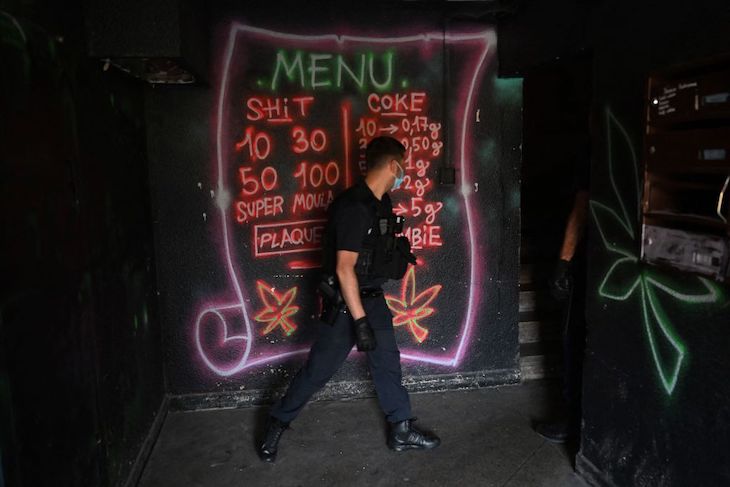
The day before the publication of the photos, Macron visited Marseille, his thirteenth visit to the Mediterranean city in seven years. As usual, the president swung by to talk tough about the deadly violence that has gripped the city for years. Last year, 49 people were shot dead in tit-for-tat killings among rival drug gangs, and 123 were wounded. ‘In Marseille and other cities in France, we have launched an unprecedented operation to put a stop to drug trafficking and ensure republican order,’ declared Macron on Twitter.
What if the drug lords take control of Marseille and other towns and cities across France?
At the start of the week nearly 100 people were detained in a series of raids. The government has also promised that 4,000 police officers will be deployed in the coming weeks as Macron looks to restore order to Marseille before the summer Olympics. The city will be the base for the sailing events when the Games start in late July.
For the people of Marseille, particularly those who live on the northern housing estates where the cartels are based, there is little hope that anything will change. This is not the first government to declare war on the drug gangs. In September 2012, the newly-appointed prime minister, Jean-Marc Ayrault, and 15 of his ministers visited the city and proclaimed that the ‘inertia’ that had characterised previous governments was over. More police would be deployed, declared Ayrault, because it was in the ‘national interest’ to eradicate the scourge of the gangs.
Twelve years later, what was a Marseille problem has now become a national problem. The cartels have expanded into other cities: from Nimes, just along the coast, to Dijon and as far north as Rennes, where earlier this month terrified residents cowered in their apartments as rival drug dealers fought an hour long battle with AK47 assault rifles.
In Paris, the cartels made their presence felt last May when a man was executed in the affluent 8th Arrondissement. But the contract killer made a mistake, shooting dead an estate agent who, unlike the intended victim, was not linked to the Marseille drug scene.
In total five people lost their lives last year to cartel killers because they had the misfortune to be in the wrong place at the wrong time. In the southern city of Nimes a ten-year-old boy was shot dead, and in Marseille a student revising for her exams was struck by a stray bullet in her bedroom.
If Macron’s latest crackdown fails, what then for Marseille? Earlier this month, one of the city’s top magistrates warned the Senate that the Republic was losing control of Marseille, what he referred to as ‘Narcoville’.
The critics of Macron’s plan, called ‘Operation Clear Space XXL’, say it is superficial and short-term; what is needed, certainly according to the public, is far tougher prison sentences. That was the most popular answer to a recent poll asking what the most effective strategy against the gangs would be. Second was more police on the streets and third was to send in the army.
Prison was the topic of conversation on a popular TV discussion programme the day after Macron’s visit to Marseille. The host pointed to the success of El Salvador’s president, Nayib Bukele, in ridding the streets of the vicious gangs which once ruled the country through fear.
When Bukele came to power in 2019 it was with a promise to eradicate the gangs. He’s been true to his word. Murder rates have fallen from 38 per 100,000 to 7.8, which is under half the Latin American average. Gangsters now languish in prison, an estimated 75,000, which works out at one in 45 adults. Many have not been charged with a crime – they have simply been removed from the streets.
Bukele’s methods have proved a hit with the Salvadorian public, 87 per cent of whom re-elected him in February. He is less popular with the western liberal media. The New York Times, Guardian and Le Monde have all run critical articles of his crime fighting strategy. One of the panellists on the French TV programme reacted in horror to the suggestion that France could learn something from El Salvador. ‘I don’t want inhumane prisons in my country,’ declared George Fenech, a former magistrate and MP in the centre-right Republicans.
But what if the killings – and the corruption, which is reportedly spreading in scale across France and taking in police officers and civil servants – continue? What if the drug lords take control of Marseille and other towns and cities across France? This isn’t a flight of fancy. The ‘Mexicanisation’ of France has been worrying commentators for a while. On Sunday night, a mob of fifty hoodlums in northern Paris attacked a police station with Molotov cocktails and improvised mortars.
The day after Macron’s visit, life returned to normal in Marseille and the drug dealers were back on the streets. One woman told the local paper of her despair, and her disgust at Macron’s ‘masquerade’. ‘The president came to show off before the European elections, not to change the lives of the residents,’ she said. The editor of La Provence has since been suspended by its Macron-supporting owner, prompting a walkout from staff at the newspaper.
Marseille is a city in tumult and while Macron might be able to influence what the newspaper writes, he’s less successful at bringing the drug cartels to heel.
Is London the ‘most anti-Semitic city in the West’?
The last time I saw Amichai Chikli, he was struggling to put on a suit jacket at the Israeli embassy in London. ‘Do I really have to wear one of these things just to make a speech?’ he muttered. He got it on by hoiking it over his shoulders like a rucksack.
That was last September, when the Israeli diaspora affairs minister visited London to mark Rosh Hashanah. Chikli had sparked controversy with comments about Tel Aviv’s gay pride parade (‘vulgar’), the Palestinian Authority (‘neo-Nazis’) and George Soros (‘his actions and investments are feeding the flames of anti-Semitism’). But the hotheaded minister finds it as easy to restrain his rhetoric as he does to put on a jacket.
We have to stop the blot of bigotry from creeping across our country under the guise of opposition to Israel
This week he waded once again into a highly-charged debate, branding London the most anti-Semitic city in the West during an interview with European journalists in Jerusalem. ‘Today in the UK, Jews are hiding their Jewishness, the mezuzah, the kippah,’ he said. ‘They know that if they speak Hebrew on the subway, they might get hit. And this is the reality for Jews in Europe… It seems what is happening now in Britain is that freedom of speech no longer exists.’
Although Chikli speaks in primary colours, he was right to draw attention to a growing problem. Many Jews, particularly observant ones, are frightened and are taking humiliating precautions as a result. On the Friday after 7 October, I gave a talk at a synagogue. The rabbi turned up without his kippah on. After the service we were released out of the rear entrance in groups of ten, under the watchful eyes of security guards.
Children have been covering up their uniforms on the way to Jewish schools. People have asked me whether I think they should remove their mezuzot from their doors. This is not the spirit amongst all Jews, of course. When I was recently interviewed by the Evening Standard, the subs gave it the headline ‘Jews are terrified’, something which I emphatically did not say and did not mean. But while it is not true of the whole community, it is certainly true of many.
Keeping things in perspective can be difficult when the heat is high. Overall, Britain is among the most tolerant environments that Jews have experienced in 2,000 years. As I tell my kids, if you are born a Jew, you need to develop a certain resilience to cope with inevitable anti-Semitism; but it has never been much better than this. Most Britons don’t harbour any animus towards Jews, and most Jews go about their daily business generally free from harassment.
On the other hand, there have been physical assaults, such as the poor woman who was kicked unconscious in Stamford Hill in December, and acts of vandalism, like the paint attack on a north London school. There have been regular acts of intimidation across the country, from examples on a personal scale to the projection of genocidal slogans onto Big Ben last month.

Universities are deeply hostile, as are many schools. Social media is a sewer. The most recent figures from the Community Security Trust, a charity responsible for keeping Jews safe in the UK, showed a fourfold increase in anti-Semitic incidents last year, with some of the biggest spikes on 7 and 8 October, before Israel had even fired a shot on Gaza. There have been no murders or terror attacks, thank God. But the rise in everyday hatred is disturbing.
For ordinary Jews, the challenge is to maintain a balance. It is important not to underestimate the seriousness of the threat, but it is equally vital not to panic. A spiritual degradation takes place when you hide your identity out of fear. Nobody else in Britain feels the need to disguise their religion or their race. Why should Jews be forced to do so?
Since 7 October, I have often thought of how in 2016 the Chief Rabbi Ephraim Mirvis gave evidence to a select committee on anti-Semitism. When asked to assess the level of Jew-hate in Britain, he drew a large dot in the centre of a piece of paper and displayed it to the panel.
‘I shall… ask what you see,’ he said. ‘You will be thinking that that is a crazy question and that there is obviously a large dot on the paper. There is actually a much better answer, which is that it is a white sheet of paper, and on the white background there is a large dot.
‘The white area represents the situation of Jews in the UK today. It is great to be Jewish in Britain and we are proud to be British. This is a truly wonderful country. But, in that context, we’ve got a problem. It used to be smaller, but it has now got bigger, and it could get bigger and bigger unless we deal with it effectively.’
The Chief Rabbi’s metaphor has only become more relevant since. The march against anti-Semitism that took place in London in November, attracting 100,000 people, was remarkable for the number of non-Jews who attended. The British Friends of Israel campaign, started by the inspirational Laura Dodson, together with Allison Pearson, Toby Young, Jan MacVarish, Ian Rons and Francis Hoar, is a demonstration of middle Britain’s determination to show Jews that they are not alone.
Britain is a good place and Jews are proud to call it our home. My Jewish grandfather fought for the RAF at D-Day and this is typical of our community. If we are to continue to hold our heads high – if London is to shake off the unwelcome label of the most anti-Semitic city in the West – we need support from the decent majority that has no truck with antisemitism.
We have to stop the blot of bigotry from creeping across our country under the guise of opposition to Israel. That means both standing up against the rising threat and keeping in mind the tolerance of Britain. We must be unafraid but sensible, robust yet confident. It’s a very difficult balance, particularly when you’re under pressure. But the future of our society depends on it.
A ride-along with the King County Sheriff’s Office
There are probably better ways to start your fifteen-hour work shift than to hear the words: “Fire at the Renton Avenue gas station. Pump still leaking fuel. Possible injuries. Attend scene immediately.”
That was the stark dispatch that came over the radio of the King County Sheriff’s car driven by thirty-two-year-old Deputy Cy Brame, one of 720 law enforcement officers who serve the needs of half a million people living in the sprawling unincorporated areas around Seattle. I recently joined him on a characteristically drizzly early March afternoon on his beat behind the wheel of a black Ford Interceptor SUV. “You’re lucky,” said Deputy Brame, with a thin smile. “The last ride-along I had was here all day without an emergency.” At that the whooping siren suddenly came on above my head, and we were off speeding past blurred red lights and careening through rapidly emptying intersections on our way to the scene of the incident about two miles away.
When we arrived there ninety seconds later, the raging inferno was revealed as something rather more mundane: two young men in a rented U-Haul truck had managed to clip the edge of a gas pump on their way out of the station forecourt. Now they were standing, full of remorse, by the side of their vehicle parked just a few feet away. Deputy Brame got out in his all-black uniform and baseball cap, a formidable array of weaponry hanging on his belt (and wearing the standard-issue bulletproof vest) to speak to them, making voluminous notes about their registration and insurance before amicably waving them on their way. “A lot of the job’s like that,” he said, watching his colleagues from the fire department mark off the area with red tape. “I’d say it’s at least 80 percent sorting things out and calming people down, not high-speed pursuits and blazing guns.” The deputy drew my attention to a sticker on the glove-box just in front of me: “No Duty is So Important and No Call So Urgent that We Cannot Proceed with Caution and Arrive Safely,” it read.
Despite the paperwork, Brame expressed his love for the job. “Most people are friendly”, he assured me. “Probably nine out of ten folks smile and wave as you go by, while the tenth gives you the finger.” There were exceptions to this rule, he admitted, naming a locally notorious apartment complex with an impressive number of broken-down vehicles and young women dressed in flimsy shorts and T-shirts standing at its front entrance. Not for the last time that day, I could feel my eyeballs protrude slowly from their sockets, and then slowly retreat again, as we drove by. “We won’t even go in there without back-up,” Brame told me, before drawing my attention to a small orange button on the car’s center console. “If you ever see I’m in trouble, push that and every law-enforcement officer within ten miles will come to our assistance,” he said mildly.
The shift turned eventful again a few minutes later, when a call about a “possible trespass” at the local 7-Eleven revealed a powerfully intoxicated man of about forty who was accosting customers on their way in or out of the store’s front door. Sighing, Deputy Brame got out to speak to him, displaying more patience in the ensuing exchange than many of us might have managed. In time, the man wandered off into the middle of the road and flagged down a passing city bus which obligingly stopped to pick him up. “We can’t ever lock up a trespass, unless it’s a case of DUI or domestic abuse,” Brame said. “Most of the time I’ll just speak to them, and try to defuse the situation that way.”
Following that came two welfare checks. A woman had been seen sitting at a bus shelter, a plastic bag of debris clutched to her chest and a blanket draped over her shoulders, apparently in some distress. Deputy Brame parked the car and walked over, all the hardware (weighing some twenty to thirty pounds, he told me) again conspicuous on his hips. “She’s OK,” he announced on his return, without elaborating. In short order, we were off to a narrow, tree-lined road where an elderly man had assembled a tent for himself perilously close to the line of passing traffic. The man told us that a friend of his had been struck and killed in the same location, and that he had elected to bivouac there as a form of tribute. Not commenting on the internal paradox of the man’s choice of residence, Brame contented himself with helping him move his belongings to the comparative safety of the leafy verge a few feet away from the busy roadside. Both these incidents later obliged the deputy to complete lengthy reports.
“At least 80 percent of the crimes I see are by repeat offenders, and maybe 15-20 percent are ones where someone gets in a bad situation, usually involving drugs,” Brame told me. “But a lot of the day-to-day stuff isn’t criminal at all. You’re always treading a line between being the local authority figure and a sort of therapist.” He spoke of a new policing environment of heightened scrutiny and occasional resentment. Within moments of an incident, onlookers can gather and start recording on smartphones. “Boom, they’re out there, they’re on it. Some of them will be baiting you. Maybe they think they’ll get to be famous.” He shrugged. “It’s part of the job.”
As the day continued I found it hard not to warm to Deputy Brame, and indeed his colleagues on the King County force as they navigate the wasteland of gangs, prostitution and drugs that make up their immediate environment, with the legions of the merely confused or dispossessed as their other primary points of contact with the community. The deputy cheerfully told me that he was working a double shift that day, and had been for several days in the past, in order to save up for his imminent wedding and Greek honeymoon. I found I had to ask him whether he thought attitudes to the police as a whole had changed since the events of 2020. “Most ordinary folks are still friendly,” he assured me. “The real issue is that about 100 officers left in 2021-22 for failing to comply with the state’s mandatory-vaccination policy. We still haven’t made the numbers up.”
Before we parted, Brame set off on another of those unglamorous but necessary calls that constitute the basic fabric of the beat officer’s routine. A concerned citizen had called in about a loose power line that was dangling from a utility pole dangerously close to a line of cars snaking down the hill towards a busy intersection by the Renton airport and adjacent Boeing assembly plant. All the lights had been knocked out in the area, including those in the normally neon-lit branch of McDonald’s just across the street. On our way to the scene I brazenly asked my host if he had ever been shot at, and he told me that no, luckily he hadn’t, but that, as per department policy, he routinely drew his own weapon in certain situations.
“It’s not like we’re immune to fear,” said Brame, a man who looked to me as if he could probably take care of himself if the need arose. “We’re still human and have emotions. Our lives aren’t perfect. But we just have a job to do.”
By the time we arrived on the scene, a whole convoy of utility trucks and men and women in bright-orange reflective vests were already working to secure the stray power line and restore service to the nearby homes and businesses. “That’s the first time City Light’s ever beaten me to a call,” Brame said, surveying the scene with a smile and a brief affirmative stroke on his computer keyboard. “But I look at it this way: no one’s hurt, the problem’s fixed, and people can get back to living their normal lives again. At the end of the day, that’s really what the job’s all about.”
Putin is as deluded about the Islamist threat as the West
From the outset it was obvious to seasoned observers who massacred more than 130 Russians at a concert hall Moscow on Friday evening. It wasn’t, as some in the Kremlin claimed, Ukraine. What would they stand to gain from such indiscriminate slaughter?
The people who opened fire in the Crocus City Hall cleaved to the same ideology as those who have this century murdered thousands of innocent men, women and children in New York, Bali, Madrid, London, Brussels, Paris, Manchester and Nice. According to reports, the group that carried out the Moscow attack is known as Islamic State Khorasan (Isis-K) and it has a reputation for ‘extreme brutality’.
Despite the fact that Islamic State has claimed responsibility for Friday’s attack, Putin is still trying to implicate Ukraine
What Islamist group doesn’t have such a reputation? Al-Qaeda, Islamic State, Boko Haram, Hamas, Palestinian Islamic Jihad and the Congo’s Allied Democratic Forces all get a kick out of killing without mercy. Those who suffer most are Muslims, murdered in towns and villages across Africa and the Middle East.
Friday’s atrocity in Moscow was as indiscriminate as Hamas’s attack on Israel on 7 October, and just as savage as the series of co-ordinated strikes against Paris in November 2015 that left 130 dead. The men who carried out these massacres had no political aims and no wish to sit round a negotiating table. They had only one ambition: a global caliphate, as outlined by the Islamic State a decade ago. Actually, they had two ambitions: the second was to die for their belief. As one Islamic State fighter told John Simpson of the BBC in 2015: ‘We are men who love death as much as you love life’
One man who dreamed of such a caliphate was a Briton called Khalid Masood. On 22 March 2017 he killed five people in Westminster before he was shot dead by a policeman, an attack that was celebrated by the Islamic State.
London’s Mayor, Sadiq Khan, marked the seventh anniversary of the Westminster atrocity on Friday with a tweet: ‘Today we remember the victims who were killed seven years ago in the Westminster terrorist attack,’ he said. ‘London will never forget the innocent people who lost their lives on this day in March 2017.’
For what cause did these six innocent people lose their lives? Was it English nationalism? Zionism? Hindu extremism? Khan didn’t have the honesty to mention Islamism. In that he’s not alone. Prime ministers Theresa May and Boris Johnson have also in recent years lacked the courage to name the West’s most implacable foe.
Rishi Sunak did namecheck Islamism in a speech outside 10 Downing Street at the start of this month. But in the same breath he bracketed the ideology with far-right extremism. Evidently, he believes both pose a clear and present danger to Great Britain.
France and Germany have also been talking up the danger in recent months from the far-right. Why? The resurgence in anti-Semitism that has swept through London, Paris and Berlin in recent years is not being driven by men named John, Jean and Franz. The men and women marching through the British capital each week chanting hate are not skinheads with Union Flags tattooed into their arms.
Despite the fact that Islamic State has claimed responsibility for Friday’s attack, Putin is still trying to implicate Ukraine, claiming that the terrorists ‘tried to hide and moved towards Ukraine, where, previously, a window had been prepared for them to cross the border’.
Mock the president but he’s just as delusional as a generation of Western leaders who are too weak to confront the truth: it is not Russia or China or North Korea that poses the greatest danger to our way of life. It is the ideology of Islamism, for it has crossed our borders and is now moving freely among us, spreading through schools, universities and households.
The hounding of Kate was a new low for Britain
Shame on the ghouls who spread lies and rumours about the Princess of Wales. And the idiot conspiracy theorists who wondered if she might be dead or getting divorced. And the tragic social media sleuths who squealed ‘That isn’t her!’ when a video showed her shopping at a farmers’ market. And all the rest of you who knew Catherine was ill, and knew she’d had serious surgery, and knew she was craving privacy, and yet who wailed ‘WHERE’S KATE?’ on a loop, like lunatics, for weeks.
For now we know the truth. She’s not in hiding. She’s not in a coma. She’s not fleeing ‘the Firm’ in a huff over something William did. No, she has cancer. Cancerous cells were found following her abdominal surgery in January and she’s now undergoing preventative chemotherapy.
In her darkest moment, the mob hounded her. Truly it was a sick spectacle
A wave of shame should be washing over Britain this morning. For the woman that some people feverishly defamed as a sinister faker who was putting out doctored photos to throw people off the scent of her whereabouts is in truth just a young mum facing what will likely be one of the toughest battles of her life. In her darkest moment, the mob hounded her. Truly it was a sick spectacle.
There is something profoundly sad about the video statement in which Catherine reveals her cancer diagnosis. It isn’t only the fact she has cancer, which is always rough, especially in someone who is only 42. It’s also the feeling that this is an involuntary statement. At least in part. It feels like a forced confession, a public declaration of intimate pain made at the behest of a scandal-hungry mob.
There’s a medieval feel to it: a woman jostled into the public square by baying halfwits and pressured to confess to her sickness. Catherine didn’t want to do this, did she? She wanted seclusion. She wanted to recuperate quietly, away from the unforgiving glare of the media eye. But the mob wouldn’t allow it. Something’s up, she’s lying, it’s weird, they cried. And in the end Catherine clearly felt she had no choice but to reveal all in the hope that it might scotch their lies and blunt their pitchforks. Extracting a confession from a young mum who’s suffering – even by the standards of the digital mob it’s a whole new low.
We can now see the authoritarian streak to therapy culture. These days everyone is expected to make a public spectacle of their lives. To get emotional on social media, to ‘open up’ about their mental troubles and moral foibles.
And if you don’t? If you prefer, as Catherine initially did, and as many of us do, to maintain a firm line between your private life and your public life? You’ll be hounded. You’ll be branded ‘secretive’ and possibly ‘in denial’. You might find yourself broken on the rumour mill, made into an object of unhinged speculation by people who can’t believe you are refusing to furnish their sad little lives with information about yours.
This is what the medieval dragging of Catherine into the public eye really represents: the humiliation of a woman for daring to desire a private life. Yes, she is class personified in the video statement. Clear, resolute, generous. But her composure in the face of frenzied demands for revelation should not distract our attention from how strange it is, how sick it is, that our society refuses to let people be.
A dark irony of this wild prying into the life of a princess is that much of it is coming from the self-styled ‘Sussex Squad’. Not from Harry and Meghan themselves, who have sent warm wishes to Catherine. No, from their obsessed fans online. From the kind of people who think Meghan is the most oppressed woman on Earth, and that wicked William and Kate enable this oppression by forever briefing (allegedly) against the persecuted duchess and her poor hubby.
These are the kind of people who think that Meghan getting papped in California is an outrage against morality and yet they have happily spent the past few weeks defaming and shaming a princess who only wanted to convalesce at home following serious surgery. What epic levels of hypocrisy. What rotten double standards.
The harrying of Kate represents one of the worst invasions of private life of modern times. It should worry all of us, republican and royalist alike. For if even the future Queen can be coerced into the cult of confession, what hope is there for us mere citizens who also prefer the free and peaceful life to the dystopian hell of ceaseless revelation?