Latest from Coffee House

Latest from Coffee House

All the latest analysis of the day's news and stories

Shots fired at the White House Correspondents’ Dinner

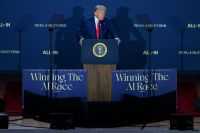
Donald and Melania Trump entered the hall at 8:16 to cheers and applause. “Hail to the Chief” was followed by presentation of the colors and the National Anthem.  We had a brief introduction from Weijia Jiang, this year’s president of the White House Correspondents Association, followed by dinner. Two questions hovered in the background. One, how would President Trump treat the press? And two, would he, as had many presidents in the past at this event, treat the audience to a little self-deprecating humor? “Donald Trump” and  “self-deprecation” are not words you often hear together, but who knows?  The President is also a master communicator who reads his audience well.   We never found out.

Trump believes Britain has betrayed the SAS

The Special Air Service, Special Boat Service and other elements of UK Special Forces are held in the highest regard by the Pentagon and by US special operators. British and American special forces have forged a bond of trust over decades with joint high-risk operations and combined training. A recent visit to Washington made clear that the American leadership on both sides of the political divide, and within the military and intelligence services, believe the current British government has broken that alliance. America views the SAS and SBS as equal to its own tier one special forces operators in Delta Force and SEAL Team Six. The eight saber squadrons of the SAS and SBS contribute a significant amount of the special forces’ manpower relied upon by both countries.

SAS

Ukraine won’t give up at the behest of Donald Trump

Four years after President Putin bragged that he would "demilitarize and denazify" Ukraine, it still stands free. Talking to locals, expats, journalists and diplomats recently in Kyiv, I found a profound sense of realism and a confidence. Ukraine’s military strength is burgeoning. Its people are determined to see things through. They are cautiously optimistic. Although life is looking up after an exceptionally difficult winter, one astute insider noted that the country faces the same strategic challenges: a larger, implacable, and cunning enemy; economic fragility; $500 billion damage to infrastructure; US hostility; and steady civilian and military deaths. The faces of the fallen were everywhere.

The Palantir manifesto doesn’t go far enough

Tech companies like Palantir now find themselves in a bind. Wanting government contracts, they have a reason to stay politically neutral. At the same time, they rightly suspect that the greater part of the left has already marked them for destruction. The hostility has little to do with Silicon Valley’s enthusiasm for Austrian economics, or its occasional calls for a property-based franchise – an old National Liberal demand rather than a fascist one. Rather, the left is hostile to technology because it is America’s conservative party, suspicious of anything that threatens to undermine old solidarities.

alex karp palantir

The contempt Trump feels for his NATO allies is mutual

The war in Iran has revealed plenty about America’s ability to inflict damage on its enemies, Tehran’s capacity to resist pressure and Washington’s broader tendency to get itself stuck in the Middle East – a region several US presidents planned to extricate from. The conflict has been paused since April 7 due to a ceasefire that Trump extended earlier in the week. But it is nonetheless revealing a gradual systemic shift in the so-called international order that has been bubbling beneath the surface for years. The movable object is none other than the transatlantic alliance which, through NATO, has bound the United States and most of Europe into a single security construct.

NATO

Why Trump is threatening the Falklands

There are still those who argue that President Trump’s aggressive, impulsive and inconsistent foreign policy is radical and disruptive, and because of this delivers results. The jury remains out on that. But there is one aspect of international affairs in which Trump is at a marked disadvantage. This is an expression of anger, not a policy The President is often governed by impulse, satisfying his instinct of the moment. That has been underlined by a leaked email from the Department of Defense, setting out a list of potential punishments for countries which so far have failed to support Trump’s military action against Iran, Operation Epic Fury. The lack of cooperation has enraged the President, who bears grudges and is sensitive to perceived slights.

Don’t whitewash Michael Jackson

We’re not used to famous pedophiles having a great talent; perhaps because all of their drive goes into their secret obsession, they’re generally just operators with a lot of front. It’s been easy to slice the cultural contributions of, say, Jerry Sandusky from one’s life and not feel the least absence. If the chattering classes are allowed to keep their Eric Gill, why can’t the dancing classes keep Michael Jackson? On the other hand, we’re inclined to give Caravaggio a pass, as he was such a great painter as well as a boy-abusing murderer – and it was such a long time ago, that the victims can't speak out. The same goes for the pedophile Paul Gauguin, who spent many years spreading syphilis among a proportion of the girl children of Tahiti.

Russell Brand is everything that is wrong with the world

There are few stranger public careers than that of Russell Brand, the former "comedian" turned MAGA cheerleader-in-chief. He has given an interview to Tucker Carlson, another figure who has been on his own peculiar journey, and has announced his intention of running for Mayor of London in 2028, on a vaguely defined but somehow sinister platform that includes "pragmatic" democracy for "people who live in London, who love London." He is the strutting, peacocking representation of all that is wrong in contemporary society Brand has railed against most of Sadiq Khan’s innovations, asking: "Do you want ULEZ cameras? Do you want congestion charges? Do you want this type of policing where people are arrested for Facebook posts? Do you want us to focus on contemporary rape gangs?

russell brand

How real is the ‘Trumplash?’

Freddy is in DC and is joined by Daniel McCarthy from the Heritage Foundation to discuss why the Iran war is unpopular in America; the significance of China ahead of Trump's visit; plus NATO, Europe and "Trumplash.

trumplash

The tawdry shenanigans of the Southern Poverty Law Center

In the financial world, most frauds are short-lived. Ponzi schemes such as Bernie Madoff’s eventually run out of new suckers to provide enough funds to pay the phony “returns” promised to earlier investors. When the cash flow dries up, the scam collapses. The con artists at the non-profit Southern Poverty Law Center have a different racket, and a different problem. Instead of swindling the public with promises of unrealistic, too-good-to-be-true investment returns, the fear-mongering SPLC sold “paranoia porn” to credulous donors, convincing them – falsely – that the country is full of dangerous right-wing extremists who need to be identified and brought to heel.

southern poverty law center

France isn’t ready for its first openly gay president

France is ready to elect its first openly gay president. That is the belief of Gabriel Attal, who discusses his homosexuality in the memoir that was published yesterday. Attal became the first gay prime minister of the Republic when he was nominated by Emmanuel Macron in January 2024. At 34, he was also the youngest, a man described as a "mini Macron." Attal is busily promoting his oeuvre – En Homme Libre (As a Free Man) – with media interviews and book-signing appearances. He told one radio station yesterday that being gay was "not at all" a barrier to becoming president. "Our country is more open and tolerant than it realizes," declared Attal.

Who is really leading Iran?

In declaring an extension to the ceasefire in the Iran war, President Trump signaled clearly enough that he would prefer to strike a peace deal with Tehran. J.D. Vance, the Vice President, has been kicking his heels, waiting to return to the Pakistani capital Islamabad for another go at achieving a breakthrough. The Iranians keep blowing hot and cold on whether they are ready to play their part. Trump suggested in a social media post earlier this week that he believes this is because Iran’s government is "seriously fractured." His ceasefire extension is aimed at allowing the regime time to deliver a new proposal. Trump may want to hammer everything out in Islamabad, but he is not dealing with an ordinary government operating under a straightforward power structure.

iran

It’s little surprise that an Israeli soldier was caught desecrating a crucifix

There’s something apposite, I suppose, about the desecration of a crucifix. In this case, it was an Israeli soldier in southern Lebanon who took a sledgehammer to one on private property and smashed the Jesus figure on the cross. The original crucifixion, as anyone who heard the gospels over Easter will recall, was marked by the humiliation of Jesus; this attack on the figure of one who took on suffering willingly was another humiliation, through the image. Mind you, if the charmer with the sledgehammer had reflected that the Christ-figure is, in Christian belief, not just God-made-man but God-made-Jew, he might have eased off a bit.

Is Russia’s economy really on its last legs?

The head of Swedish military intelligence has dropped what he clearly regards as a bombshell. Thomas Nilsson told the Financial Times this week that Russia's economy is far weaker than it appears, that the Kremlin systematically manipulates its statistics to fool Ukraine's Western allies, and that the central bank is understating inflation, which he believes is closer to 15 percent than the official 5.86 percent. For good measure, he endorsed the German intelligence service BND's earlier estimate that Russia's budget deficit is understated by $30 billion. One need not be a Kremlin agent to find this less than convincing. That Russia's economy is struggling is not in dispute.

Virginia referendum loss adds to Trump’s woes

In 2020 Donald Trump became the first Republican presidential candidate to lose Virginia twice since William Howard Taft. Then in 2024 Trump lost once more, this time to Kamala Harris. Now he has in effect lost it a fourth time as Virginia voters approved on Tuesday a fiercely contested referendum redrawing congressional districts to favor Democratic congressional candidates in the 2026 midterm elections. "This is really a country election. The whole country is watching," Trump said. If so, it watched Trump suffer a major blow – one that will prompt renewed questions about his political acuity and judgment.

Virginia

Why Iran doesn’t want peace

Perhaps we should be used to be this by now. Yet again, there have been a flurry of promises to rapidly achieve peace in Iran. Yet again, the American administration has threatened to destroy the nation’s infrastructure. J.D. Vance is again flying to Pakistan for more talks. And yet the conflict shows no sign of ending. We don’t know whether the Iranians will actually turn up. A foreign ministry spokesman said yesterday that Iran will not be joining the talks. The speaker of the parliament Mohammad Bagher Ghalibaf has also made clear that the regime won’t negotiate under threat of civilizational destruction. Why would they resist peace talks? There is both a diplomatic and domestic answer.

iran peace
china

The Iran war is giving Xi the upper hand with Trump

China’s largest trade show is now under way in the southern city of Guangzhou. The Canton Fair is a colossal month-long affair with around 32,000 exhibitors and is often described as a shop window for Chinese manufacturers – a barometer of the China trade – where just about anything and everything can be bought. This year the mood is subdued. "The specter of the Iran war hung heavy like the banners inside the gigantic exhibition halls," as Bloomberg described it. Exhibitors reportedly complained of soaring costs and falling orders, most notably from the Middle East.

starmer

Why Trump hasn’t stuck the knife into Starmer

As public messages of support go, it scored pretty low on the conviction-o-meter. “Prime Minister Keir Starmer of the United Kingdom acknowledged that he ‘exercised wrong judgment’ when he chose his Ambassador to Washington,” said President Donald Trump on Truth Social last night. “I agree, he was a really bad pick. Plenty of time to recover, however! President DJT.” Uh oh. None of the trademark capitalization, which suggests Donald’s heart isn’t really in it. Some aide must have just spoken to him about Keir Starmer’s Peter Mandelson crisis, or perhaps a news story came to his attention.

Iran is winning the meme war

The opening strikes on Iran forced the country’s military to operate without a centralized command structure. Despite this enormous setback, something like a unified approach has emerged, and nowhere is that more evident than on social media.  Iran’s embassies have become meme factories, centers of information warfare churning out images and videos designed to do just one thing: mock the US and Israel and, in particular, Donald Trump. Courtesy of Iran’s overseas missions, we’ve now seen Donald Trump as a minion from Despicable Me; a Lego man fleeing a Lego Jeffrey Epstein; and a Pirate of the Caribbean trying, and failing, to hijack the Strait of Hormuz.

Why politicians make us wince

Mind your language! There has recently been another smattering of incidents featuring accusations of inappropriate choice of words, or even just the wrong tone. I think it’s worth taking a closer look at some of these for what they reveal about our hang-ups, the tender areas of our discourse. What makes us wince? What is considered appropriate, and what isn’t? On last week’s Edition podcast, former Archbishop of Canterbury Rowan Williams spoke of there being something "demonic" about the current political culture of the US. Secretary of War Pete Hegseth’s "rhetoric about the violent obliteration of enemies" strikes him as "diabolical" – and of course Trump’s recent threat that "an entire civilization will end" (it didn’t).

Tariff refunds are a nightmare for Trump’s economy

Donald Trump's second presidency began with a blaze of executive orders which horrified and impressed in equal measure. It also begged the question: if it really were so easy for a president to circumvent the legal obstacles and assert his will, how come none had behaved in this way before? A year on, we are learning the truth: no, a president can't just do what he likes, and there is a horrible price to pay if he tries. In the case of Trump's "Liberation Day" tariffs the notional bill is $166 billion. That is the sum that US Customs believes it will have to refund to importers who paid tariffs which were ruled unlawful by the Supreme Court in February. A computer portal to handle the refunds was set up this week, the administration of which adds more cost.

trump tariffs

Trump’s costly armchair geography

In the 19th century, the geographer and explorer David Livingstone was scathing of what he described as "easy-chair geographers" – authors and mapmakers who produced maps and treatises about the non-European world without ever leaving their learned society or personal office. Donald Trump is a latter-day armchair geographer. Or judging by photographs repeatedly released by the White House, a president comfortable convening meetings in the Oval Office with large maps displayed by his desk. But whether it is a case of acquiring Greenland or blockading the Strait of Hormuz, maps can be poor substitutes for in-field knowledge and understanding.

armchair geographer

Starmer squirms on Mandelson debacle

Keir Starmer is enduring perhaps his most uncomfortable afternoon in the House Commons since being elected Britain's Prime Minister. He promised in his opening remarks that he would set out the full timeline of Peter Mandelson’s appointment as US ambassador, which ended in Olly Robbins’s dismissal last Thursday. Carefully worded and legally precise, his statement contained another revelation: Chris Wormald, the ex-cabinet secretary, was not told Mandelson had failed the UK Security Vetting interview (UKSV), despite leading an official review. Starmer’s tone was one of scorned hurt and anger. He remarked repeatedly how various facts of the case were "staggering.

keir starmer

What happened to Provence?

The best time to visit Provence, I always advise when asked, is in the spring before the scorching heat and summer crowds. I have been spending time in the south of France since the early 1990s. Provence was fashionable in those days. Peter Mayle’s massively successful book, A Year in Provence, inspired thousands to pull up stakes and move to southern France to emulate his idyllic life in the Luberon hills. Some settled farther west in the Dordogne, famously called "Dordogneshire" for its concentration of British expats. Mayle became a one-man publishing industry, following up with sequels including Toujours Provence and Encore Provence. Thirty years ago, I stayed with friends who owned a renovated farmhouse with a spectacular view of the Dentelles de Montmirail.

How Peter Mandelson became Britain’s ambassador to the US – despite failing vetting

I have just been contacted by a source who knows much more about what happened with Peter Mandelson’s vetting. It supports the case that I made in my summary of the case last night and Sam Coates made in his thread yesterday that the crucial decision was Keir Starmer’s political decision to appoint him. In essence, Oliver Robbins – the top civil servant who overruled Mandelson’s failed security vetting – was rubber-stamping a decision which had already been made. Things are much less clear cut than Downing Street has been claiming for the last three days I have heard too from an ally of Mandelson who believes Robbins’s dismissal was "egregious" for exactly the reasons which follow.

peter mandelson

Russia’s nationalists are falling out of love with Putin

Moscow's Manezh exhibition hall is playing host to a celebration of the life and politics of Vladimir Zhirinovsky, the outspoken, unfiltered and unrepentantly toxic founder of the nationalist Liberal Democratic Party of Russia (LDPR), who died in 2022. What is meant to memorialize Zhirinovsky's career, though, also highlights the degree to which the Kremlin is losing control of the nationalist right. The neatly-choreographed simulation of party politics that has worked for so long is getting harder to sustain The LDPR – which was neither liberal nor democratic – was established in 1992 and from the first was a populist force that was more a vehicle for the bombastic Zhirinovsky than the expression of a coherent ideology.

Britain’s ‘drone gap’ makes it vulnerable

When John Healey was asked, onstage at the London Defence Conference, whether the armed forces were “ready” for war, the Defence Secretary replied: “Yes.” One of those present says: “That was greeted with near incredulity in the room.” Another attendee compared Healey’s plight to someone “playing French cricket,” with critics from all sides hurling balls at his ankles while he tried to bat them away. “You can’t score any runs in French cricket.” George Robertson, Healey’s most respected Labour predecessor and a former secretary general of NATO, was not present; he was in Scotland celebrating his 80th birthday. But he returned to give a withering interview to the FT and a speech.

britain drone

How France is bending the knee to Iran

What is Emmanuel Macron playing at? In the space of just a few days, three apparently unconnected incidents have the French president’s fingerprints all over them. They indicate that, while Macron is a spent force at home, he is willing to deploy his powers to help France navigate the Iran war crisis and try to salvage his reputation – even if it means making his allies, including the United States, look utterly foolish. While Macron is a spent force at home, he is willing to deploy his powers to help France navigate the Iran war crisis On April 2, a French container ship, the Kribi, became the first western vessel to cross the Strait of Hormuz and exit into the Gulf of Oman since the war against Iran began.

Trump badly needs a victory

Has the dustup between Washington and Tehran come to an end? "They’ve agreed to give us back the nuclear dust that’s way underground because of the attack we made with the B-2 bombers," Donald Trump proclaimed on Thursday evening. "So we have a lot of agreement with Iran, and I think something’s going to happen, very positive, very important." Trump indicated that he himself might fly to Pakistan this weekend to participate in negotiations with Iran. Trump’s response to the spate of bad news he’s encountered has consisted of a mixture of bravado and defiance If Iran were to hand over its enriched uranium stockpile, it would represent a startling development indeed. No previous American president, whether George W. Bush or Barack Obama, came close to accomplishing that goal.

Former British archbishop: ‘There’s something demonic in US political culture’

Rowan Williams, the former Archbishop of Canterbury, has said "there is something demonic" in the "political culture" of the United States.  He made the remark on The Spectator’s Edition podcast when discussing Donald Trump’s row with the Pope over the President's decision to go to war in Iran. Following J.D. Vance’s comments earlier this week that the Pope should "stick to morality," Williams said that he feels "slightly sorry" for the recent Catholic convert – "with just a hint of schadenfreude." The former archbishop observed that Vance appears to be "floundering" in his arguments. "People who look to the Catholic church for a strong lead on issues of morality tend to mean one kind of morality only," Williams said.

Who’s actually winning the wars in the Middle East?

If you read the New York Times or watch the foreign policy establishment’s “best and brightest,” you will be told, with imperious certainty, that America is losing the war in Iran and was stupid to begin it. The conspiratorial wing on both the right and left add that it is all the Jews’ fault, although they usually remember to mutter they mean “Israel” instead of all Jews, a gossamer cloak over what they really mean. If, on the other hand, you watch Fox News or read blogs by conservatives or military analysts, you will be told with equal certainty that America and its ally, Israel, are actually winning – and winning decisively.  So, who is right? The answer, of course, is Carl von Clausewitz. What that old Prussian says goes to the heart of the issue.

middle east
allies

Trump is making life increasingly hard for his allies

Here is a fun one: what do Giorgia Meloni, Pope Leo XIV, Ed Miliband and the Cato Institute all have in common? The answer is that they have each been attacked in the past 24 hours on Donald Trump’s overactive Truth Social feed. The President’s erratic actions both online and off now seem to be exhausting the patience of even erstwhile allies. In the aftermath of the Iran crisis, Keir Starmer and his ministers appear to have had enough of pussyfooting and pandering to the whims of the Commander-In-Chief. Downing Street sees little benefit in indulging what one Labour MP calls ‘Trump’s imperial overreach’ This afternoon, Rachel Reeves publicly called the war a "mistake.