Politics

Read about the latest political news, views and analysis

Ukraine’s allies are falling away

As Ukraine emerges battered but unbowed from the third and most terrible winter of the war against Russia, its people have proved that they can survive and fight on even as Vladimir Putin's troops destroy swaths of their country’s heating, transport and electricity infrastructure. But one thing that Ukraine cannot survive without is money – and that, the European Union seems critically unable to provide.  On Thursday, a Council of Europe summit once again failed to remove a veto by Hungary’s prime minister, Viktor Orbán, on a €90 billion ($104 billion) tranche of funding for Ukraine.

ukraine

Israel can’t assassinate its way to victory over Iran

The killing of the Iranian senior security official Ali Larijani this week is the most significant "targeted assassination" undertaken since Israel’s killing (in cooperation with the US) of supreme leader Ali Khamenei on the opening day of the war. These two very high-level hits have been accompanied by a long list of killings of less well-known senior Iranian officials. These have included Islamic Revolutionary Guards (IRGC) commander Mohammad Pakpour, intelligence minister Esmail Khatib, armed forces chief of staff Abdolrahim Mousavi, defense minister Aziz Nasirzadeh, military intelligence chief Saleh Asadi and many others. Around 30 officials in all have met their deaths at the hands of this campaign.

Why America and France are always arguing

“Not perfect,” was Donald Trump’s reply when asked about Emmanuel Macron’s support for the Iran operation. “But it’s France, we don’t expect perfect.” The French President had initially distanced his country from the bombing campaign for, in his view, noncompliance with international law. Then Iran struck allied Gulf states and Cyprus. Macron immediately dispatched France’s Charles de Gaulle aircraft carrier to the eastern Mediterranean (while Britain was, humiliatingly, unable even to scramble a frigate). “We are not taking part in the conflict that is under way,” Macron declared with characteristic grandiloquence from the deck of the carrier. “France is a balancing and peaceful power.

france

The outrageous cynicism of the Democrats on Iran

Given my longstanding disgust with America’s lawlessly interventionist and self-destructive foreign policy, I should be outraged by Donald Trump’s cavalier remarks justifying – and weirdly minimizing – his surprise attack against Iran in collaboration with Israel. After all, a president stupid enough to mock the new Supreme Leader as “damaged” and only “alive in some form” – while simultaneously urging sitting-duck oil tanker captains to “show some guts” by running the Iranian blockade of the Strait of Hormuz – is someone who logically should be rebuked in the firmest possible terms. But this wildly unstable solipsist is very different from other politicians.

war powers

Why Israel is pushing further into Lebanon

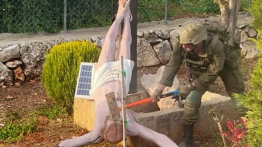
Israel launched a limited ground operation in southern Lebanon this week, intended to expand the de facto buffer zone which it has maintained along the border since the ceasefire of November 2024. At that time, Israel held control of five positions on the Lebanese side of the border. In response to Hezbollah’s decision to re-engage with Israel in the context of the current conflict between Jerusalem and Tehran, the IDF is pushing further into Lebanon.   Israel is now bombing Hezbollah targets throughout the country. Ground forces, meanwhile, are cautiously pushing forward. According to Israeli media reports, the IDF’s goal is to establish 13 additional positions north of the border.

Lebanon
Joe Kent

Joe Kent’s resignation was an act of political positioning

Reflecting on the resignation of Cyrus Vance, James Thomson, the American historian and journalist, wrote in the Washington Post that the former secretary of state “has done us all a great public service.” In doing so, Thomson argued, Vance gave “new life and spine to a somewhat rare and weak convention in our nation: resignation in protest of an issue of principle.” The year was 1980. Vance had resigned in protest over the Carter administration’s decision to authorize Operation Eagle Claw, the ill-fated mission to rescue American hostages held in Iran after the Islamic revolution. The mission ended ignominiously. President Carter pulled the plug after equipment failures and a deadly helicopter collision killed eight service members. Vance was vindicated.

Why King Charles should still visit Trump

22 min listen

King Charles is due to travel to the US on a state visit to see President Trump. Given the turbulence between Keir Starmer and Trump over the war in Iran, some politicians such as Ed Davey have suggested the King should not go. Freddy speaks to royal author and Daily Mail journalist Robert Hardman about the history of controversial state visits, why Donald Trump loves the British royal family and how King Charles navigates his royal duties and subtle influence over leaders. https://www.youtube.com/watch?

eu

Revealed: Keir Starmer’s new plan to get closer to the EU

A Labour MP, reflecting on the problems UK Prime Minister faces over the war in Iran, observed: “Keir got it right, but things keep going wrong.” His point was that Starmer kept Britain out of the Israeli-American air strikes, a position popular both with the parliamentary Labour party and the electorate, yet the impact of that conflict has laid bare three serious problems at the heart of the British state. First, there has been a fracturing of relations between Starmer and Britain’s defense chief, Air Chief Marshal Sir Richard Knighton. Second is the vulnerability of the economy to energy price shocks. Third is Ed Miliband’s net-zero crusade, which has put further pressure on the cost of living, Starmer’s biggest domestic problem.

The Iran war won’t help Russia defeat Ukraine

For Vladimir Putin, Donald Trump is the gift that keeps on giving. Just as Moscow was tiring of the American president’s assurances that he could strong-arm Volodymyr Zelensky into accepting Russia’s terms for peace in Ukraine, the US-Israeli intervention in Iran caused a spike in the oil price. This has given Russia the chance to supply more oil to the global market and boost its flagging budget revenues. On balance, the war in the Middle East is set to bring significant benefits for Russia, but they will not be enough to bring about Putin’s most urgent desire: the defeat of Ukraine. Of course, the Russian president can bask in the glory of Russia being recognized by the United States as an indispensable energy superpower.

russia

Why Iran will hasten MAGA’s demise

Readers may disagree with the cover line of this issue. Pronouncing “the end of Trumpism” feels somewhat similar to declaring “the end of history” – a provocative, albeit less grandiose, statement that risks being mocked in the near future. We should start by saying we hope that we are wrong. Trumpism, as this magazine understands it, has been a boon to America. As Christopher Caldwell argues, the rise of Donald Trump was a healthy democratic response to a fetid political system. On many fronts, the Trump administration, now in its second and more dynamic term, has made great progress. It has fought illegal immigration with vigor.

The end of Trumpism

Having Donald Trump as President probably resembles being a heroin addict: you undergo regular episodes of sweating terror and mortal danger, the end result of which is to get you – at best – back to normal. A year ago, the Liberation Day tariffs nearly caused the American economy to seize up, before China mercifully let the matter drop. Then came the even more reckless decision to join Israel in bombing Iran’s Fordow nuclear installation; Iran agreed to halt hostilities just as it was figuring out how to penetrate Israeli airspace with its missiles. But now the President has pressed his luck. He has joined Israel in a campaign of aerial assassination and bombardment against Iran – this time of an almost incredible violence – and has wound up trapped.

The chaotic truth about Russia’s internet blackouts

From the modern metropolises of Moscow and St. Petersburg to Arkhangelsk on the permafrosted northern coast and Khabarovsk on the Chinese border, for over a week now, Russian cities have been experiencing unprecedented interruptions to mobile internet coverage. Ostensibly for security reasons, the rumor mill has inevitably cranked out all kinds of alternative explanations, from fear of a coup to preparations for a comprehensive imposition of state control on the "runet," Russia's online world. Notions that Vladimir Putin fears some imminent coup can most quickly be laid to rest. There is dissatisfaction with the continuing war and its economic consequences, but nothing to suggest anything more serious.

russian

Decapitating Iran’s leadership might not topple the mullahs

Iran’s most powerful leaders are being picked off one by one by Israeli and American military strikes. The latest scalp claimed by Israel is Ali Larjani, Iran’s security chief, and widely believed to be the most powerful figure in the present Iranian leadership. The reported killing comes just days after Larjani went on a public walkabout in Tehran, all defiance and bombast as he greeted members of the public during the Quds Day rally last Friday in the capital. Larjani also spoke to state media during the march, claiming that the Americans and Israelis were “running out of steam”. Well, not quite in his case, it turns out. Few will mourn the demise of Larjani.

larjani

Iran and the crisis in the European mind

The politics of the Iranian war feature an observable gap between interest and action for nearly all parties. The Americans possessed overwhelming casus belli versus Iran for nearly half a century, and did not act upon it until three weeks past. The Iranians possessed none against America for just as long, but exerted themselves with religious fanaticism to bring this war upon themselves. The Arab autocracies of the Persian-Gulf region find themselves under direct attack from the Iranians, but do not respond in kind. The Chinese observe a core strategic proxy and key commodities supplier taken off the chessboard – for the second time in under 90 days – and refrain from direct engagement.

Europe

Why is America always at war?

Sizable minorities on both the left and the right want America to intervene in fewer foreign conflicts and to exercise more restraint in foreign policy. In the 2006 midterm elections, antiwar voters contributed to the Republicans’ loss of both houses of Congress. They also helped defeat Hillary Clinton in the 2008 Democratic presidential primary contest and the Republican nominee, John McCain, at that year’s general election. While McCain styled himself a “maverick,” the label could be more accurately bestowed upon the anti-interventionist Republican Ron Paul, who shocked the GOP establishment by showing that an unstinting critic of the Iraq War could mount an insurgency within the party of George W. Bush.

Paul Ehrlich’s bad ideas won’t go away

I am sorry to hear of the death of Stanford University Professor of Biology Paul R. Ehrlich at the age of 93, but to read his writings you wonder whether it is an event he might actually want us to celebrate. It does, after all, mean one less mouth to feed. Just another 6.5 billion people to go and we will be down to what in 2018 he stated was the world’s optimum population of between 1.5 to 2 billion. Ehrlich’s 1968 book, The Population Bomb – written with his wife Anne whose name his publisher famously kept off the front cover – established Ehrlich as the world’s latter-day Malthusian-in-chief.

paul ehrlich
NATO STRAIT

Should NATO help America defend the Strait of Hormuz?

As soon as Operation Epic Fury, America’s latest campaign against the Islamic Republic of Iran, got underway on the last day of February, political, military and economic minds around the world should have turned their attention to the Strait of Hormuz. The waterway provided the only shipping route from the Persian Gulf to the Gulf of Oman and the open seas beyond. That has long made the strait the dagger Iran holds at the throat of the world. At its narrowest, it is less than 25 miles across, and Iran controls the northern shore; to the south is the Musandam Peninsula, shared by the United Arab Emirates and an exclave of Oman.

Oscars night was one yawn after another

The results of this year’s Oscars were so predictable as to be entirely unexciting. Months ago, the pundits had called the major results: Paul Thomas Anderson’s Pynchon adaptation One Battle After Another to win Best Film and Best Director, Jessie Buckley to win Best Actress for Hamnet, Sinners to win Best Original Screenplay. It wasn't hard to predict because they had won these prizes in ceremony after ceremony. And so, last night in Los Angeles, events unfolded with the grim pre-ordination of awards voters who had seen what they liked and liked what they saw. The results of this year’s Oscars were so predictable as to be entirely unexciting There were, admittedly, a couple of interesting stories, but they took place long before the ceremony.

How the Nazis used vanity to lure pilots to their deaths

"Vanity of vanities... all is vanity." Ecclesiastes had a point, but he never met a Luftwaffe fighter pilot. For the young Germans who hurled their Messerschmitts at enemy planes over the Channel, the Reich, and the Eastern Front, there was one object that could make them forget their odds of survival: a small iron cross, worn at the throat, called the Ritterkreuz – the Knight's Cross. To many, it was worth more than money, more than leave, more than the quiet relief of making it home in one piece. It meant you were the best. And everyone could see it.