World

The catastrophic dumbing down of German education

German teachers are a privileged species. Most of us enjoy the status of a Beamter, a tenured civil servant. We can be dismissed only after a serious criminal conviction, we are exempt from social insurance contributions, and even our mortgage rates are lower. Such comfort discourages dissent. Yet, after more than 25 years as a pampered Beamter, I find myself overwhelmed, not by the teaching load or the students, but by the accelerating erosion of academic standards. Having taught English, history and Latin at four different Gymnasien, the equivalent of a grammar school, I have learned that challenging students is frowned upon by both bureaucrats and politicians. Nearly all my

Britain’s national security must not be sacrificed to net zero

Those who, like myself, experienced life behind the Iron Curtain understand instinctively that centrally planned economies beholden to an ideology do not bring benefit to the majority of the population on whom they are imposed. A few top-level individuals prosper, but the citizen finds himself and his aspirations crushed by the diktats of central government. The state itself is similarly confined by a set of ideas which are presented as self-evident truths which constrain its policy–making and exclude challenge. That Iron Curtain model describes pretty accurately the UK’s energy policy, driven as it is by the ideological pursuit of net zero and the diktats required to implement it. Thus: I

Portrait of the week: an immigration overhaul, Budget chaos and doctors’ strikes

Home Shabana Mahmood, the Home Secretary, proposed that refugees would only be granted a temporary right to stay and would be sent home if officials deemed their country safe to return to. They would not qualify for British citizenship for 20 years. To avoid drawn-out appeals, a new appeals body would be created. Article 8 of the European Convention on Human Rights, which protects migrants’ ‘right to family life’, would somehow be weakened. Digital ID was invoked for the enforcement of checks on status. Opponents seized upon the possibility that, to pay for accommodation, migrants’ jewellery would be confiscated. Kemi Badenoch, the Conservative leader, offered her party’s support if the

Ukraine is on the verge of political collapse

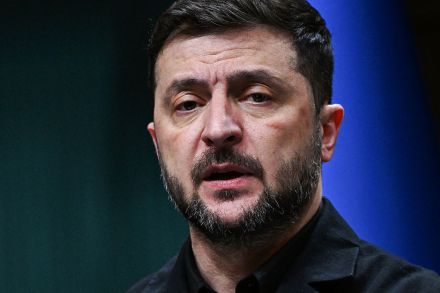
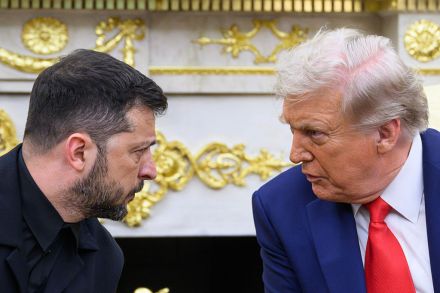
Defeat, political implosion and civil war – those are the jeopardies that Volodymyr Zelensky faces as Ukraine heads into the most difficult and probably the last winter of the war. Evermore effective Russian strikes against Ukraine’s energy and transport infrastructure are likely to plunge swaths of the country into cold and darkness. Russian troops continue to push forwards slowly and bloodily in Donbas and, more dangerously, on the southern flank in Zaporizhzhia. Desertions from the Ukrainian army are up four times since last year and the number of deserters now matches the number of active fighters. The US has turned off the money taps and Europe struggles to produce the

Zelensky must get a grip of his government

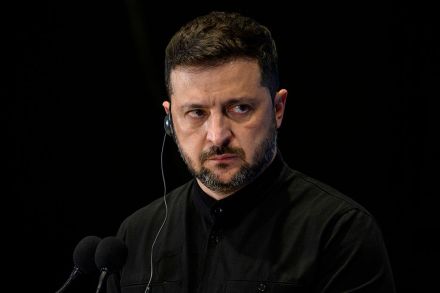
Vladimir Putin’s hopes of wearing Ukraine down in a war of attrition are no longer far-fetched. The country feels fragile, like it did in February 2022. Back then, Ukrainians rallied behind a president who stayed and shared a conviction that victory was possible. Today many are wondering whether defeat and the end of Ukraine’s statehood are drawing nearer than anyone would like to admit. A corruption scandal is engulfing Volodymyr Zelensky’s government. Russia is making gains on the battlefield. Ukraine’s tragedy is not only that Zelensky’s close associates were leeching off 15 per cent from contracts meant to fortify critical energy infrastructure, stealing from the country £76 million at the

Is Trump trying to strike a fresh deal on Ukraine?

With fresh wind in his sails after his success brokering a somewhat fragile peace in Gaza, Donald Trump has once again turned his attention back to Ukraine. According to reports, the US President’s team has secretly been working on drafting a new plan to end the war. Concerningly, though, once again that confidential plan is being hashed out with Russia – without any input from Ukraine or its European allies. Details of the plan are, as yet, scant – although a report by Axios suggests that it will be made up of 28 points falling under four rough headings: peace in Ukraine, security guarantees for the country, security in Europe

Europe can’t fix Ukraine’s cash crisis

Who will pay for Ukraine’s war effort now the Trump administration has turned off the financial taps? European leaders have expressed themselves ready and willing to take up the burden, with European Commission President Ursula von der Leyen affirming that ‘if we continue to believe that Ukraine is our first line of defence, we need to step up our assistance.’ Individual countries have come up with generous funding packages – most open-handed of all being Germany, which has recently pledged more than €3 billion in direct funding. But that’s just a drop in the ocean compared to what Ukraine says it needs. With more than 40 per cent of its

Donald Trump doesn’t want to talk about Epstein

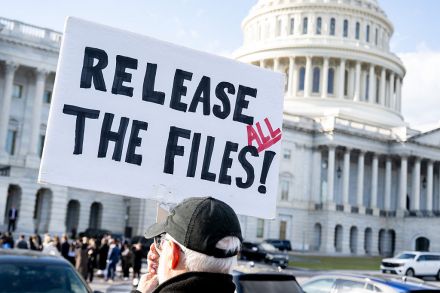
The contrast could hardly have been starker. As Donald Trump palled around with Mohammed bin Salman in the newly gilded Oval Office, Congress was voting on a transparency act that would further expose Jeffrey Epstein’s grave misdeeds. Trump, who had worked overtime to try and quash the vote, was in his element with the Saudi crown prince. Transparency? Not a bit of it. Trump proclaimed that the crown prince ‘knew nothing’ about the death of Jamal Khashoggi who was, after all, ‘extremely controversial,’ the term that he often deploys to describe anyone he dislikes or finds nettlesome. The hero, or, to put it more precisely, heroine, of the day was Marjorie Taylor Greene. Greene is a profile in courage. She stood up for Epstein’s victims

Europe's leaders are finally waking up on immigration – but is it too late?

The impressive shift in the terms of trade of the immigration debate in the last 24 hours proves one unlikely proposition: that the British political marketplace actually works. Giorgia Meloni is the only leader of a major European country in these times who seems successfully to have united the grievances of losers and winners in a viable political coalition Nigel Farage was correct this morning to assert that the Home Secretary Shabana Mahmood would not have spoken as she did but for Reform successfully conditioning the terms of trade in this Parliament. However, he in turn was forced to concede that her rhetoric, at least, deserved serious consideration – even as

What Trump's Gaza peace plan means for Israel

This may not be the conclusion Israel imagined when it launched its campaign in Gaza. Not all the hostage bodies are home. Hamas is bruised, but not broken. The region remains volatile. Yet even as combat continues, the United Nations Security Council, backed by an American administration long assumed to be ‘pro-Israel’, yesterday endorsed a resolution that places an armed international force in Gaza, sketches a vague pathway to Palestinian statehood, and outlines a governing arrangement in which neither Israel nor the Palestinian Authority is central. For Israel this is a moment of profound uncertainty – a reminder that military operations, however successful, do not automatically dictate the shape of

How Trump could attack Venezuela

President Trump has assembled the largest naval force in the Caribbean since the Cold War. How will it be used? Is he considering an attack on Venezuela to overthrow the Maduro regime? Will he pursue the drug cartels by attacking them in Venezuela? Or will the President simply continue America’s counterdrug operations at sea? With all of these possibilities there is the hope that the Maduro regime will collapse under the pressure of America’s military might. The arrival of the Gerald R Ford seems to signal some sort of direct action against Venezuela At present, the United States is countering the flow of illegal drugs by sinking suspected drug-carrying boats off the

Did the Louvre robbers want to get caught?

It is more than a month since thieves stole the crown jewels from the Louvre and the chances of recovering the loot, worth an estimated €88 million, diminish with every passing day. The robbery was initially dubbed the ‘heist of the century’, a brazen theft in broad daylight as visitors strolled through the world’s most famous museum. They were up and down the ladder and in out of the museum in seven minutes, giving the impression that this was the work of villains well-versed in daring robberies. Are the alleged perpetrators of the Louvre heist happy to go to prison for a few years knowing that when they get out

Chile flirts with a rightward turn

A border ‘ditch’ may prove to be the thing that brings the right back to power in Chile. Although the communist-affiliated candidate Jeannette Jara leads the polls going into this weekend’s election, a second-round run-off seems almost certain, with a consolidated right-wing alliance – running on a platform to cut illegal immigration – likely to win the final showdown. Jose Antonio Kast, the leading right-wing candidate, is a hardliner who admires both Donald Trump and El Salvador’s President Nayib Bukele. He has promised to rule with ‘mano dura’ (an iron fist). He says drug dealers will be held in in solitary confinement and has pledged to construct a series of

Are we in an age of necromancy?

19 min listen

Katherine Dee is the new technology correspondent for The Spectator World. She joins Freddy to discuss the phenomenon of necromancy, the practice of communicating with the dead, and how AI is fuelling it. How is technology blurring the lines between the living and the dead?

Why Israel fears Turkey's involvement in Gaza

As the Gaza ceasefire struggles into its second month, a significant difference between the position of Israel and that of its chief ally, the United States, on the way forward is emerging. This difference reflects broader gaps in perception in Jerusalem and Washington regarding the nature and motivations of the current forces engaged in the Middle East. The subject of that difference is Turkey.   The Turks have expressed a desire to play a role in the ‘international stabilisation force’ (ISF), which, according to President Donald Trump’s 20-point plan, is supposed to take over ground security control of Gaza from the IDF (and Hamas) in the framework of the plan’s implementation.

Why did the Danish PM call for a 'spiritual rearmament'?

22 min listen

Earlier this year, Denmark’s Prime Minister, Mette Frederiksen, stood before a group of university students and made a striking statement: ‘We will need a form of rearmament that is just as important [as the military one]. That is the spiritual one.’ This was all the more remarkable from the leader of the Social Democrats, and in a country which is amongst the most secular in the world. Danish journalist Iben Thranholm – who joins Damian Thompson for this episode of Holy Smoke – says that in some ways the welfare state had replaced the belief in god in Denmark. So to what extent is Frederiksen’s call to action a political

The Jewish blood libel is back. Its return should trouble us all

It’s back. The lie that led to the slaughter of so many Jews has returned to public life. The calumny that caused so much anti-Jewish persecution, expulsion and bloodshed has stirred, zombie-like, from its historic slumber. Jews drain the blood of Christians and use it to make bread – incredibly, unconscionably, this most appalling falsehood has returned. It is obscene that such words are being uttered on a university campus in 2025 At University College London (UCL) this week, a lecture was given in which it was allegedly suggested that Jews murder Gentiles and use their blood in perverse rituals. The comments were made by Samar Maqusi, a US academic.

Why German conscription should worry Britain

For years, Germany, like Britain, has drifted through history as though nothing could ever again disturb its peace. The world outside was assumed to be orderly, rational, restrained. Conflict was something that happened elsewhere. The Bundeswehr, neglected to the point of embarrassment, became a case study in strategic complacency. Germany’s political class preferred moral posturing to the dull, necessary business of national defence. Some fear that conscription is merely a prelude to sending Germany’s youth into war And as long as Russia was merely grumbling at its neighbours rather than invading them, Berlin convinced itself it could go on like this forever. Those days are over. And Germany, finally –