World

Philip Patrick

Japan's prime minister is on borrowed time

‘It is a difficult situation and we have to take it very humbly and seriously’. This was the typically understated and solemnly delivered verdict of Japanese Prime Minister Shigeru Ishiba after his party and their coalition partners lost their majority in the Upper House elections on Sunday. It is the kind of wording used by Japanese doctors to inform patients that their illness is terminal (they never tell you directly). Ishiba insists he will stay on as PM, but long-term, he is probably doomed. Ishiba’s party, the Liberal Democrats (LDP), and their partners Komeito, needed fifty seats in yesterday’s election to hang on to a majority, but managed only 47.

The painful truth about Christian anti-Semitism

When I walked past a group of shouting protestors holding placards announcing, ‘Christians for Palestine,’ I couldn’t resist: ‘If Christians hadn’t treated Jews so appallingly for so many centuries there wouldn’t have been a need for Israel,’ I said politely. ‘Do you genuinely think that one-sided polemics are appropriate,’ I asked. There was a pause for self-righteous reflection, before one of the group responded: ‘Typical! A Zionist playing the antisemitic card.’ Early in its history, the church removed the Jewish Jesus from the Christian narrative The truth is that this Anglican priest with three Jewish grandparents wasn’t playing any card at all. I was trying to point out some of

Why Putin thinks Trump's Russia tariffs are a bluff

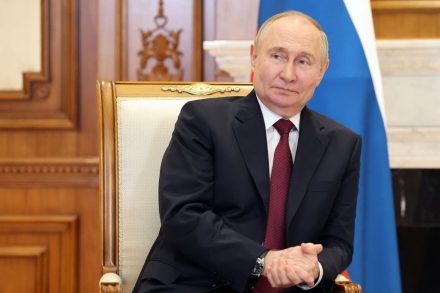
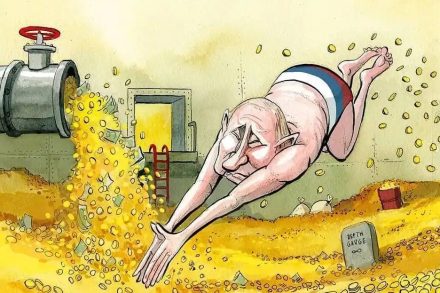
Moscow’s response to the latest ultimatum issued by Donald Trump last week has been to deploy that most Russian of diplomatic weapons: contemptuous laughter. The US president’s threat to impose draconian sanctions unless Putin ends his invasion of Ukraine within fifty days has been met with the kind of theatrical disdain that would make Chekhov proud. Foreign Minister Sergey Lavrov, never one to miss an opportunity for diplomatic sarcasm, openly sneered at Trump’s intervention on Tuesday. ‘We want to understand what exactly is behind this statement. Fifty days. It used to be 24 hours, and then it became 100 days. Russia has gone through all this and now wants to understand what the

Is Taiwan ready for an attack by China?

It’s still lunchtime in Taipei but the streets are strangely quiet. A few people are running with their bags, despite the sweltering summer heat, desperate to get somewhere before 1.30 p.m. I’m enjoying the air-conditioning in a local supermarket when an announcement politely informs me and the only other customer still in the shop that we need to hurry if we want to buy something. The checkout assistant rushes to hand me my change, and I head back out into the heat. The Taiwanese government is certainly taking the risk of an attack by China seriously At precisely 1.30 p.m., my phone buzzes with a yellow alert in Chinese and

Gavin Mortimer

The slow death of Welsh rugby

Heard the joke about the Englishmen, Irishmen and Scotsmen? They have all been selected for the British and Irish Lions squad to face Australia in Brisbane today. At the expense of the Welshman. The fact that no Welshman has been included among the 23 players chosen for the first of three Test matches is further confirmation of the diminishing stock of Welsh rugby. The last time a Lions matchday squad had no Welsh representation was in 1896. Welsh rugby players once blamed the English for the ills of their country, but the damage done to their sport this century is home-grown When in May, Lions’ coach Andy Farrell named his

Ian Williams

Is China cooking the books on its economy?

A Western financial analyst based in Shanghai once described China’s economic statistics to me as ‘one of greatest works of contemporary Chinese fiction’. Not even the Communist party’s (CCP) own officials believed them. A cottage industry of esoteric techniques developed to try and measure what was really going on, ranging from diesel and electricity demand to the fluctuating levels of the country’s chronic air pollution, car sales, traffic congestion, job postings and construction – even the sale of underwear or pickled vegetables. One enterprising analyst regularly sent spies to Shanghai port to count the ships and throughput of trucks. Questioning the official figures has become increasingly dangerous in the China

Germany has become a useful ally for Britain

Yesterday the German Chancellor Friedrich Merz visited London for the first time since he took office in May. He and the prime minister have met on a number of occasions, and although the two lawyers are different characters – Sir Keir Starmer, the stiff, soi disant progressive human rights barrister; Merz, the abrasive, hard-nosed corporate counsel – they have forged a functional relationship. But this was Merz on Starmer’s home ground. The government has put a great deal of effort into bespoke bilateral relationships. Defence secretary John Healey and the German defence minister Boris Pistorius signed the Trinity House Agreement last October, and there have also been various kinds of

Freddy Gray

Is Epstein the new Russiagate?

28 min listen

Freddy Gray is joined by Spectator writer Roger Kimball. They delve into the Epstein claims, the media’s handling of the story, Trump’s economic agenda, and whether the MAGA movement is holding strong or starting to splinter.

The plight of the Druze

Over 500 people are estimated to have been killed in the ongoing sectarian clashes between the Druze and Bedouin populations in Syria’s southern Suweida province this week. Vowing to protect the local Druze, and backing the community’s militia, Israel has bombed Syrian government forces around Suweida and launched missiles on Damascus. While Syria’s interim president Ahmed al-Sharaa has promised to safeguard the minority community, and has announced the withdrawal of troops from the area, his government forces have been directly involved in attacks against the Druze. Druze civilians have been indiscriminately killed in ‘field executions’ by Syrian government forces and their allies. A militia affiliated with the government have also

Where are the resettled Afghans living in Britain?

This week, we learned that three years ago a Ministry of Defence official accidentally released details of 18,714 Afghans who had applied for relocation to the UK. The Afghans, who had worked with British armed forces, feared retribution from the Taliban, so the Conservative government introduced a new scheme, alongside existing programmes, to resettle some of these people. The Spectator’s leading article this week argues that Britain had a moral responsibility to help them. But how many have arrived so far? And where are they living in Britain? As of May, 35,245 people had been relocated to the UK through the Afghan resettlement programme made up of several schemes such as the Afghan Relocations and

Freddy Gray

Will AI have rights?

17 min listen

Freddy Gray speaks to Spectator writer Paul Wood about his piece this the latest edition of Spectator World on AI and whether it will soon have rights. This first came about when Paul went to live in Rome and discovered some of the work the Vatican has been doing in AI.

Philip Patrick

Could Japan soon be governed by chatbots?

Tokyo Could Japan be the world’s first -algocracy – government by algorithm? The concept has been flirted with elsewhere: in 2017 a chatbot called Alisa challenged Vladimir Putin for the Russian presidency. But there is reason to believe that if any major country is going to replace its politicians with AI, it will be Japan.  The citizens of Yokosuka in Kanagawa have had a remarkably lifelike AI avatar of their mayor, Katsuaki Uechi, at their service for over a year now. It (he?) speaks perfect English with a slight Japanese accent, with Uechi’s facial features manipulated to make it look as if he is pronouncing the words correctly. The avatar

Ukrainians have lost faith in Zelensky

Donald Trump this week boosted Ukraine’s air defences with new Patriot batteries, threatened Vladimir Putin with sanctions if he does not agree to a ceasefire, and even reportedly gave tacit approval to more Ukrainian strikes on Moscow. Trump’s newfound support for Ukraine is a welcome lifeline. The question is whether his help will be enough to stop Russia’s relentless attacks before Ukraine is engulfed in a critical military, political and social crisis that threatens to destroy it from within. Putin chose war over peace this spring because his spies and generals told him that Ukraine is on the brink of collapse. Alarmingly, they may be right. Ukraine is running out

Portrait of the week: Inflation up, hosepipes off and grants for electric cars

Home Sir Keir Starmer, the Prime Minister, agreed with President Emmanuel Macron of France that Britain could return perhaps 50 asylum seekers a week to France and accept in their place the same number of applicants through a regulated system. To celebrate, 573 people arrived that day in England in small boats, bringing the total for the week ending 14 July to 1,387. Moygashel Bonfire Committee in Co. Tyrone defended the placing of an effigy of a small boat with 12 migrants on a bonfire to usher in 12 July. Britain had, it was revealed, offered asylum to thousands of Afghan soldiers and their families caught by the accidental publication

Gavin Mortimer

Bayrou will regret his plan to scrap French bank holidays

The Prime Minister of France announced his plan on Tuesday to balance the country’s books: his most eye-catching intention is to scrap two public holidays. In addressing the nation, Francois Bayrou warned that France’s out-of-control public spending has left the country in ‘mortal danger’. It was imperative to reduce the public deficit by 43.8 billion euros by 2026, explained Bayrou. ‘It’s the last stop before the cliff, before we are crushed by the debt. It’s late, but there is still time.’ The holidays Bayrou wants to jettison are Easter Monday and 8 May (VE Day), two of the eleven annual public holidays in France. Britain has eight. Bayrou has taken

Are we sure the Afghan data debacle won't happen again?

‘Afghanistan’ was the heading of Defence Secretary John Healey’s statement to the House of Commons on Tuesday – a word that hardly does justice to a three-year saga involving a catastrophic security breach and loss of data by the Ministry of Defence, a superinjunction and billions of pounds of taxpayers’ money. Ministers and civil servants cannot be allowed to make policy and spend taxpayers’ money without any kind of oversight. That is not how a democracy works The bare bones of the story are these. In February 2022, the details of nearly 20,000 Afghans who had applied to come to the UK after the Taliban had seized power, as well

Cutting bank holidays for French workers is a bad idea

Banning the baguette, perhaps? Or making it compulsory to eat a sandwich at your desk at lunchtime? If you think hard enough, it is possible to imagine reform that would create more anger in France. Even so, prime minister Francois Bayrou’s plan to scrap two public holidays is right up there. Bayrou wants to reduce France’s 11 public holidays in a bid to kick-start France’s economy. Bayrou said Easter Monday had ‘no religious significance’, and the whole nation had to work and produce more. He said that bank holidays had turned the month of May into a gruyère – a Swiss cheese full of holes. He said that bank holidays had turned

Freddy Gray

Trump – the conventional foreign policy President?

28 min listen

Trump has said he’s “very, very unhappy” with Russia, and threatened severe tariffs against them if there’s no deal on Ukraine within 50 days. He’s also sending more weapons to Ukraine in coordination with NATO. What’s behind his change of heart on foreign policy, and how’s his MAGA base responding? Freddy Gray is joined by deputy US editor Kate Andrews, and Sergey Radchenko, professor at the Johns Hopkins School of Advanced International Studies. You can watch this episode here.

Freddy Gray

Is Texas eating Hollywood?

20 min listen

Freddy Gray is joined by editor-at-large of The Spectator World, Ben Domenech. They discuss why Hollywood productions are being drawn away from California to states like Texas, and what this could mean for the future of filmmaking in America. Ben writes about this in the new edition of Spectator World, and you can subscribe to the print magazine here: https://thespectator.com/subscribe